







Abstract
The article theorizes how neutrality, hedging, and sheltering benefit small states and help them to navigate great power rivalries within buffer complexes. We analyze Georgia’s foreign policy, showing how it evolved from balancing against Russia through Euro–Atlantic alignment to adopting a more flexible combination of the three non-alignment strategies. Contrary to realist expectations and recent small state theorization, Georgia’s case reveals that small states do not always follow fixed grand strategies or simply bandwagon or balance. Driven by a combination of domestic and external factors, they can adopt adaptive, overlapping approaches to remain unaligned amid intensifying geopolitical competition. Utilizing a game theoretical approach the study contributes both theoretically and empirically to the understanding of small state agency in buffer zones and challenges assumptions in International Relations about their limited strategic options in great power rivalries.
Introduction 1
In a world increasingly marked by great power rivalry, sphere of influence has gained significant prominence to understand how great powers attempt to organize international politics. The general International Relations (IR) debates have mainly addressed the rivalry between traditional Western and upcoming non-Western great powers (Allison, 2017) or regional powers (Duggan et al., 2022; Wastnidge and Mabon, 2022). In turn, the question of how small states caught in between great powers’ spheres of influence navigate these buffer zone complexes have so far received limited theoretical attention. This neglect is largely caused by a great power bias as mainstream IR often makes a capability-based distinction between state types (Long, 2022), where the smaller state is assumed to side with one of the great powers through bandwagoning or balancing (Korolev, 2019; Waltz, 1979). In opposition to this, the small state and Foreign Policy Analysis (FPA) literature have demonstrated that small states have a wide range of diplomatic options (e.g. Bjøl, 1968, 1971) that allow them to avoid the entrapment costs associated with balancing or bandwagoning by pursuing various non-alignment strategies; for example, hedging, sheltering, and neutrality (Kirmanj and Tofik, 2023; Kuik, 2008; Worrall, 2021).
Recently, the small state literature has even suggested that small states like great powers can pursue multiple “coherent” grand strategies, where especially neutrality and sheltering are considered as key non-alignment strategies for small states to preserve autonomy (Silove, 2019; Wivel, 2021). So far, this literature has made great progress in describing the diplomacy of the small states, but has made less theoretical progress in improving our understanding of (1) what the different non-alignment strategies offer small states, (2) when and why they are chosen by decision-makers, and (3) how small states are able to change strategies in order to navigate power rivalries in the buffer complexes. This article addresses these gaps.
Analyzing the diplomatic strategies through the lens of buffer zone logics and utilizing a game theoretically inspired approach, the article develops the theoretical mechanisms of three predominant non-alignment strategies – that is, neutrality, hedging, and sheltering – and illustrate how the non-alignment strategies help smaller states to formulate responses that aim to contain great power influence.
While the buffer states’ diplomatic strategies are mainly a result of the functionalist demands of the rivaling powers (Efremova, 2019), the specific choice of non-alignment strategy is best explained through a combination of domestic and external factors. Our theoretical argument is that the different non-alignment strategies produce both external distributional effects that increase the rivaling powers’ valuation of the buffer zone, as well as domestic distributional effects that filter the political elites’ relative valuation of non-alignment strategies.
Empirically we demonstrate how these theoretical mechanisms play out and how small states change strategies through a case study of Georgian foreign policy from 2008 to 2025. Geographically located in between Russia and Turkey – and with significant presence from Russia, China, North Atlantic Treaty Organization (NATO), European Union (EU), and the United States – Georgia is a suitable case to illustrate if, how, and why the theorized non-alignment strategies unfold empirically and how external and internal distributional effects shape foreign policy.
The analysis shows that despite increased great power rivalry, small states can navigate and impact upon the incitement structure of rivaling great powers through their choice of non-alignment strategies. This is the case, because their strategies have distributional consequences for the larger power economically, diplomatically, and in terms of security. So far, this dynamic has not been theorized systematically empirically. Our analysis also shows that not only the external distributional effects, but also the domestic effects of alignment or non-alignment, determine small buffer states’ choice of foreign policy strategies. In the case of Georgia, domestic factors play a central role in the sense that the Georgian Dream (GD)-government also utilizes non-alignment strategies as tools to consolidate its political dominance in Georgian politics.
Theorizing small state strategies in buffer complexes
We argue that it makes the most sense to understand small states’ non-alignment strategies through the lenses of buffer zone theory (Efremova, 2019; Partem, 1983). A buffer complex is a power constellation, where a small state is exposed to the pressure of two (or more) greater powers and are caught between the great powers’ spheres of influence.
From a great power perspective, the creation and the continued existence of a neutralized buffer zone helps to provide the assurance that the buffer state’s territory will not be used to launch an aggression against any of them, which helps to regulate the negative dynamics that have led to the creation of the buffer zone (Efremova, 2019). However, due to the existence of mistrust and lack of information about the credibility of the deterrence potential of its advisory, rivaling great powers may expand their sphere of influence over the buffer zone. One great power’s efforts to extend its influence over the buffer state usually evokes an immediate response from the rivaling great power, who considers such actions a direct threat. Such actions may result in a military conflict, which would dissolve the buffer zone state.
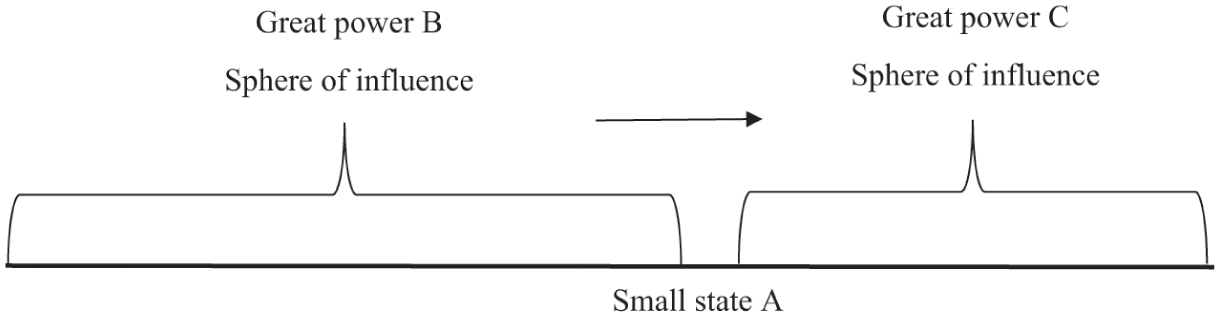
Buffer complexes are defined by the power parity and the power asymmetry between the states. According to Partem (1983), within the buffer complex the “rival powers” take on the roles of larger states, while the buffer behaves as a small state in absolute terms. In short, in a bilateral conflict any of the large states may conquer the small state, while the latter has no chances to win unless supported by an outside power. A simple buffer complex is illustrated in Figure 1, where a small state (A) is positioned in a power constellation between two rivaling greater powers (B and C) and their spheres of influence.

A buffer complex with two rivaling great powers and a small buffer zone state.
Given the level of geopolitical competition in the South Caucasus, we acknowledge, this is a simplified presentation of a complex strategic environment. Nonetheless, by using an understanding of buffer zone theory as an ideal typical dyadic representation of a regional power constellation we argue that the parsimonious model is able to shed light on both the case-specific factors shaping Georgia’s strategic outlook but also enhance our general knowledge about the strategic choices facing small buffer states.
In our case study of Georgia, we treat the United States, NATO, and European Union as the “collective West” 2 who in tandem with Russia make up the constitutive powers shaping Georgia’s position as a buffer state. While China has begun to play a more active role in Georgia, we do not analytically consider it a part of the constitutive powers of the buffer complex, primarily because of the temporal criteria and the geographic distance, but treat its role in the complex as a result of a Georgian diversification strategy.
The greater powers can limit the political independence of weaker states within their sphere of influence and prevent other external powers from exercising similar influence. In order to reduce tensions and minimize the risk of direct conflict, great powers often construct buffer zones to regulate and control the negative dynamics in the power balance (Allison, 2017). By default, great powers prefer maintaining the status quo and upholding the relative equidistance between the great powers and the small state(s) in the buffer zone even though great powers might put different values on the functional value of the zone.
Therefore, great powers are anxious about whether the buffer states take actions that align with the rivaling great power. They might also fear that the rival great power will be tempted to absorb the state(s) in the buffer zone if the opportunity arises, as adding the small state(s) would expand its sphere of influence and bolster its ranks. This situation is illustrated in Figure 2.
A buffer complex where an aggressive great power transgresses the zone.
Traditionally, small buffer states’ foreign policy agency is assumed to be limited as they have to balance their policies between the superior rivaling great powers inducing them to either balance against or bandwagon with the aggressive great power (Korolev, 2019).
However, the small state literature has demonstrated that smaller (buffer) states possess a degree of agency (Panke and Thorhallsson, 2024). Moreover, they are capable of making corrections to great power politics within the buffer complex by navigating in a manner that helps in alleviating the temptation of great powers to alter the status quo (Efremova, 2019).
In the following, we assume that it is in the interest of both rival great powers to expand their spheres of influence up to the point where they establish full control over the buffer zone. For Russia, the expansion into Georgia might be territorial, while the collective West would want to enlarge its alliances, for example, through normative, value-based integration. In such a situation, it is obvious that their spheres of influence will overlap and collide. Suppose next that each great power must choose between two foreign policy strategies: cooperation (readiness to compromise, giving up one’s claims on the buffer zone) and confrontation (readiness for conflict, claiming the buffer zone).
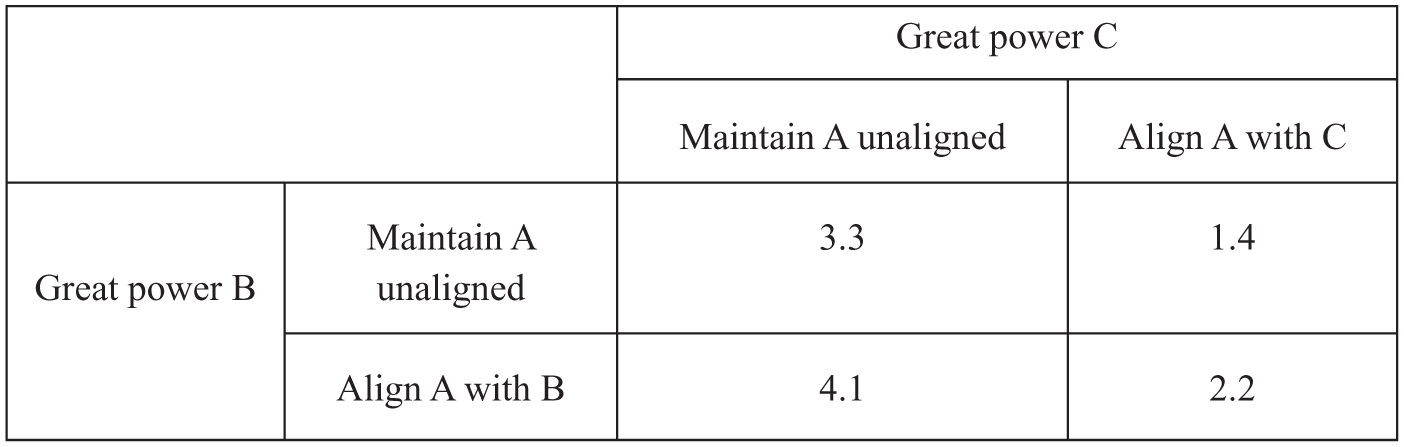
Both great powers try to predict the rival’s reaction while planning their policies toward the buffer state. Depending on concrete circumstances, each great power faces one of four alternatives: (1) extend one’s control over the whole buffer zone (4); (2) prevent establishing the rival great power’s control over any part of the buffer zone by giving up one’s own claims (3); (3) guarantee one’s control over a part of the buffer zone, allowing the rival great power’s control over the other part (2); (4) lose the opportunity for controlling the buffer zone, renouncing it to the rival power (1). Obviously, in a zero-sum game, every great power tries to maximize its own gains by minimizing the gains of its rival, yet it must consider similar aspirations of the other part. The strategic environment of the small state caught in a buffer zone can be illustrated in Figure 3.
The alignment game for the constituent powers of the buffer zone.
The model assumes that the great powers attribute symmetrical value and strategic significance to the buffer zone. In practice, however, this is not always the case. There are instances in which a buffer zone is far more important for one of the great powers, or where one great power views it primarily in security terms, while another attaches only limited security significance to it but values it higher economically. In the Georgian case, geographic proximity to Russia and greater distance to the European Union and NATO is a particularly important factor in shaping potential differences. That is, Russia might have stronger incentives to take risks while NATO or the European Union are less willing to confront Russia over Georgia, which in turn might induce Russia to a more aggressive line. 3
The table illustrates an alignment dilemma, where both great powers are most interested in maintaining the status quo and keeping the small state non-aligned, but always have an incitement to attempt to subdue the small state and absorb it into their respective spheres of influence if the rival great power’s deterrence potential is fading or perceived as uncredible.
Conceptualizing small state non-alignment strategies
The literature has pointed to several strategies that the small states can utilize to maintain their non-aligned position in the buffer complex: neutrality, hedging, or sheltering (see Panke and Thorhallsson, 2024 for an overview). Building on Pedersen (2025), we will go beyond descriptions of the strategies and advance our understanding of how the different non-alignment strategies can be theorized to influence the great powers’ incitement structure and help small states navigate the buffer zone. A central aim for these different strategies is that A can ensure that great power B and C continue to perceive the status quo as an “asset” relative to the potential costs of tying the small state closer to their sphere of influence in the power rivalry. Despite power disparities, A can therefore be assumed to exert agency and exercise influence onto the stronger sides who have a desire to win the strategic competition over the buffer or fear losing it. This fear may push the rival powers toward cooperation with the small state who designs strategies aimed at increasing the value of A’s unalignment by for example, guaranteeing that neither its territory nor its decision-making process will ever be heavily influenced by the rivaling great power.
Neutrality
In its simplest form, neutrality refers to a strategy of not siding with either rivaling great power thereby disrupting the status quo of the buffer zone. Upholding the status quo and the equidistance in its relations with rivaling great powers is traditionally how a small buffer state is expected to survive. But, if this systemic mechanism of deterrence fails, the buffer state may lose its sovereignty to a stronger nation (Karsh, 1988: 82). Neutrality therefore entails a particularly unique theoretical feature compared to hedging and sheltering. That is, the neutral state aims to influence great powers’ incitement structure by increasing their dependence on the small state non-aligned position and hence the valuation of its non-aligned position by distributing symmetric benefits to the rivaling great powers without relative gain split.
How a buffer state creates symmetric benefits to remain non-aligned can be illustrated with a historical case from Denmark during World War I. Here, Denmark followed a policy of strict neutrality aimed at maintaining the status quo in its buffer complex between the United Kingdom and Germany. A central element in the Danish neutrality strategy was to adopt a “balanced trade policy,” where Denmark was committed to export agreed quotas of commodities to both sides. Denmark depended on these exports, but both sides also depended on the Danish imports. This meant that they both saw Danish neutrality as an asset upon which they were partly dependent.
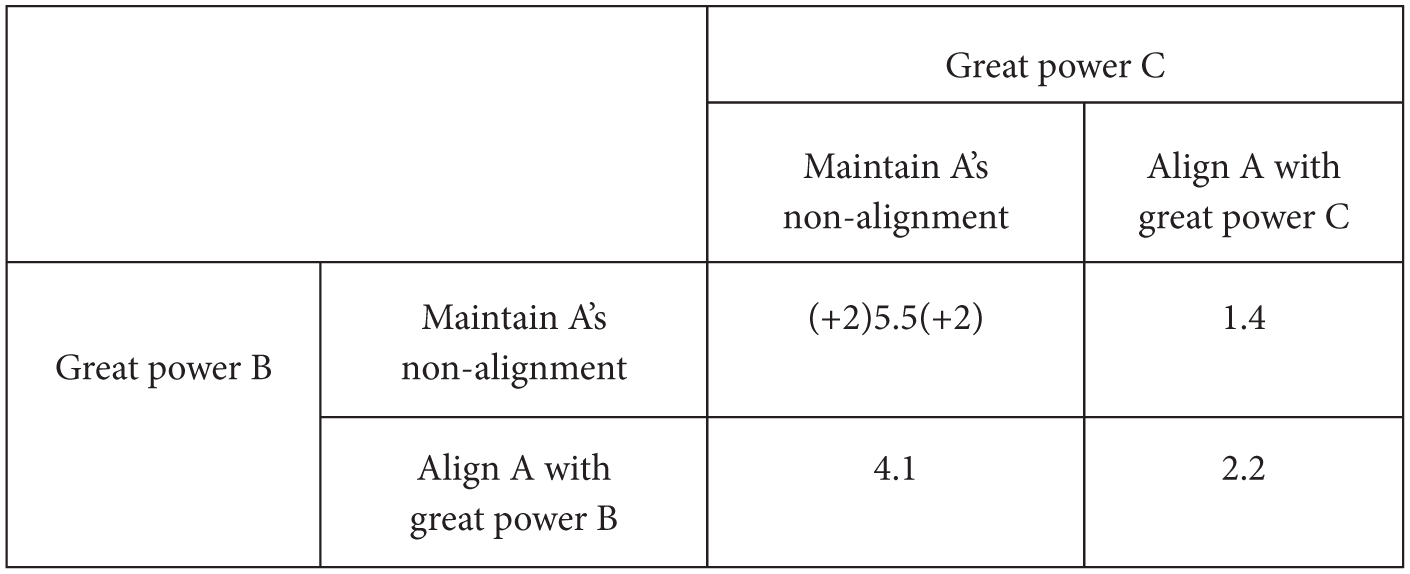
In theoretical terms this increased the United Kingdom’s and Germany’s evaluation of Danish non-alignment with a cooperation reward on +2 and helped Denmark to maintain the equidistance in its relation to the United Kingdom and Germany. Failure to comply would be considered as “taking sides” in the conflict, as it would alter the distance, which could trigger alignment attempts from one of the great powers thereby drawing Denmark into the war (Karsh, 1988).
We illustrate the logic of balancing demands from great powers to consolidate the status quo in Figure 4, where the symmetric cooperation rewards take the form of +2, which means that there are no relative gains left for the great powers. In the hypothetical game, the rewards for cooperating alter the incitements of the great powers, implying that they now receive 5 for cooperation instead of 3, which makes maintaining non-alignment the dominant strategy of the great powers.
Effects of cooperation rewards under neutrality in the alignment game.
Hedging
Hedging is understood as a non-alignment strategy that emphasizes the need to maintain relative equidistance in the relationship between the smaller state and greater powers in order to preserve the buffer zone. Getting too close to one great power may entail the risk of losing independence by inviting uncalled-for interference in domestic politics (Kuik, 2008, 2021, 2022) and thereby inflict entrapment costs. On the other hand, keeping too distanced may lead to distrust or even hostility from a great power (abandonment costs).
The problem for a small buffer state is that while they know that the power structure will fluctuate at some point, and that the great powers’ valuation of their non-aligned position might change, it is almost impossible for them to ascertain how and when this will occur. This means that they must find ways to balance between abandonment and entrapment costs to maximize the benefits from interacting with the greater powers bilaterally.
In opposition to neutrality, hedging is a non-alignment strategy in which buffer states try to offset the different cost types by pursuing multiple and often counteracting policy options. 4 According to Kuik (2021), hedging consists of three crucial attributes: (1) an insistence on not taking sides among competing powers and ensure that they do not fully align ones’ own interest and support with another power; (2) pursuing opposite, mutually counteracting measures to offset multiple risks; and (3) pursue the goals of preserving gains while cultivating a “fallback” position through a diversification strategy. Hedging is therefore a strategy that simultaneously pursues two sets of mutually counteracting policies: return maximizing and risk contingency.
An example of a buffer state pursuing a hedging strategy is Malaysia who has positioned itself as being “equidistant” between the United States and China. But being equidistant does not mean being equally distant or equally close. Instead, it means maintaining a “balanced position” while seeking inclusive but selective multilayered partnerships with all competing powers across different domains. The Malaysia–US defense partnership is for instance much closer than that between Malaysia and China. The Malaysia–China diplomatic ties are, however, much closer and more multifaceted than those between Malaysia and the United States (Kuik, 2024). In this situation Malaysia is trying to reap the economic and political benefits from its relations to China (return maximizing), while fencing off unwanted interference (entrapment costs) by engaging with the United States on defense and security questions (risk contingency).
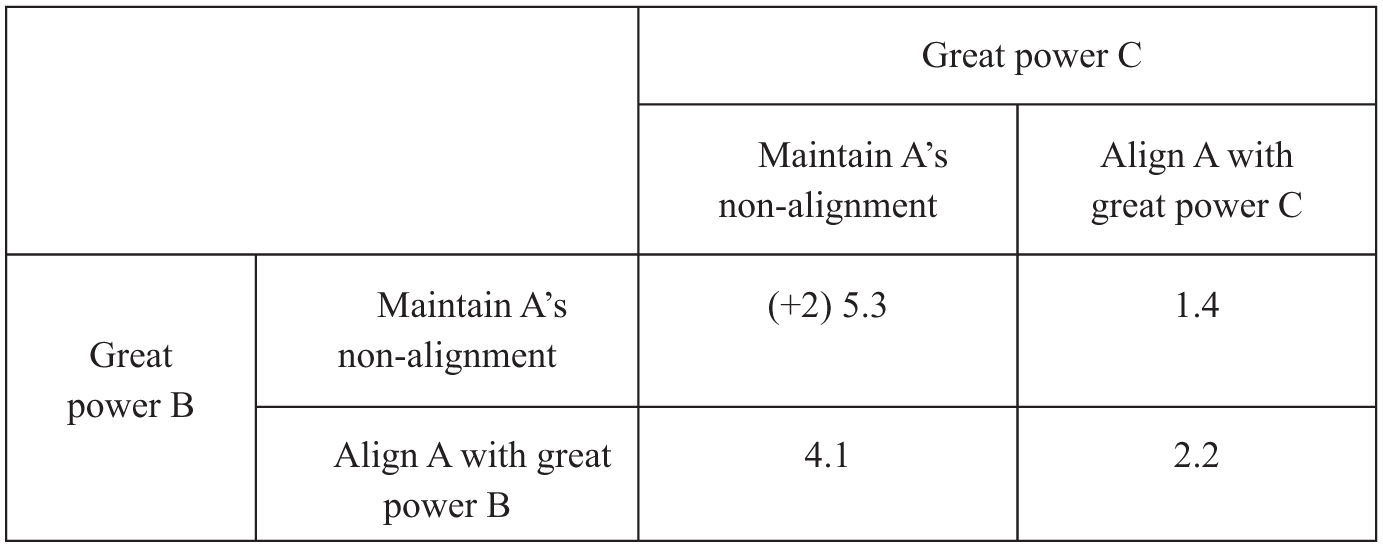
In game theoretical terms, we have illustrated the effects of return maximizing and risk contingency behavior in Figure 5. The effect of return maximizing, where the buffer zone state has increased the economic cooperation with one of the rivaling great powers (B), can be seen in the increase in B’s valuation of A’s non-aligned position as B is awarded the cooperation reward of +2. This illustrates that B now stands to obtain a cooperation payoff of 5. From the perspective of the buffer state, the increased economic cooperation with B entails benefits, but the change of B’s valuation might also entail that entrapment costs become too high. That is, B might become more tempted to interfere in the domestic politics of the buffer state to consolidate the cooperation reward or to permanently obtain them by absorbing A into B’s sphere of influence (e.g. interference in elections, bribes, support for elites supporting cooperation, etc.). Such interference can risk undermining the regime of the buffer zone state, which means that B needs to be deterred in order for A to avoid paying the entrapment costs of alignment. As will be elaborated on below, this can be mitigated through risk contingency behavior, aimed at reducing the hedger’s loss if things go awry, and the entrapment costs get too high (Kuik, 2021). Such behavior can often be observed through strategies of “dominance denial” or “indirect balancing” that are aimed at minimizing political and security risks through increased security cooperation with the opposite rivaling great power.
Effects of return maximizing hedging in the alignment game.
The risk of the return maximizing behavior of the buffer zone state is the difference in the cooperation payoff (5.3) with great power C, as illustrated in Figure 6. That is, the negative cooperation loss on -2 seen from the perspective of C might change C’s evaluation of the buffer zone states non-aligned position making C more tempted to take the whole zone (4) or some part of it (2). Despite being an inferior outcome compared to 3, it can be attractive as it does entail relative gains (2.2) compared to the negative cooperation payoff -2 if they maintain A’s non-aligned position. To counter the potential damaging effects, the buffer zone state A can engage in risk contingency strategies of dominance denial or indirect balancing with C in order to counter B’s potential influence on A by tying its security to the structural power of C. In theoretical terms this relates to the possibility of increasing the cooperation rewards for C (+2), which can be used to balance B’s interest in absorbing or dominating the buffer state. The cooperation rewards for C are not necessarily awarded in economic terms but can be given in areas of security or defense, as the goal for the small state is to protect it from the interference of B, where closer defense cooperation might deter B and thereby increase C’s evaluation of the small state.
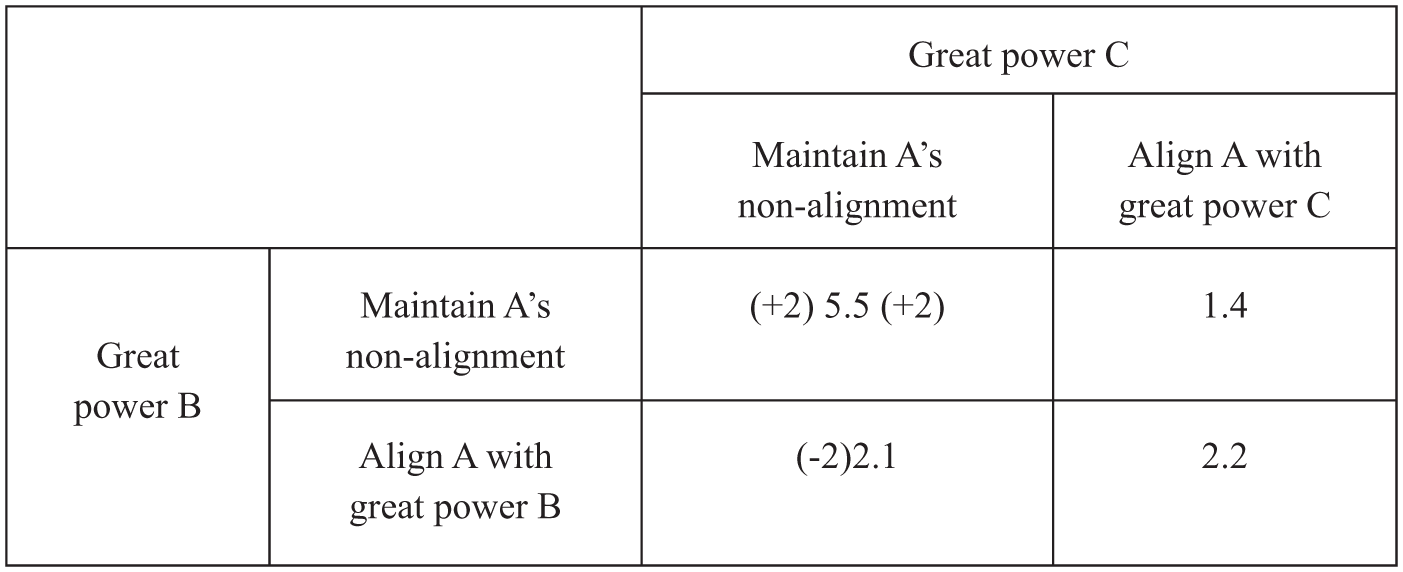
Effects of risk contingency hedging in the alignment game.
Compared to neutrality, where small states try to distribute symmetric rewards to the great powers, a hedging strategy implies a riskier give and take relation in that cooperation with one great power on one area (economic) can be balanced with cooperation with the rivaling great power on another area (defense). Small states will try to balance the potential influence of one great power (B) by increasing the deterrence potential through security cooperation with the other great power (C). While cooperation with great power B on one area and with C on another might create concerns of relative gains within the specific area, the goal is that the distribution of relative gains across policy areas balance each other out.
Sheltering
Bailes et al. (2016) had originally suggested that shelters are created in asymmetric relations where shelter is provided to a smaller state by a stronger state (or international organization). Small states are assumed to seek shelter to increase their political, economic, and societal resilience (Bailes et al., 2016; Pedersen, 2023; Thorhallsson, 2018; Thorhallsson and Wivel, 2006). Sheltering has not been applied in relation to buffer zone complexes, but we propose that the application of the theory holds great potential for enhancing our understanding of how small buffer states can navigate the buffer complex. Sheltering therefore refers to a series of small state strategies aimed at alleviating the inherent vulnerabilities of being small in the buffer complex by forming relations with great powers outside the buffer zone to regulate the negative incitement in the alignment game. The goal is to exploit the structural power of the outsider by increasing the outsider’s interest in the small buffer states non-aligned position, typically in economic terms, while maintaining autonomy over the national decision-making, as the investments of the outsider might help to deter the great buffer powers by increasing the alignment costs. Within shelter theory, we see attempts of theorizing domestic political considerations in small states’ choice of non-alignment strategy. For example, Panke and Thorhallsson (2024: 504) noted that “small states seek shelter as much for domestic reasons as for external ones.” In this view, the cultivation of shelters from great powers are considered as a precondition for the success of domestic goals and policy agendas.
The hypothesized effects of the strategy are illustrated in Figure 7, where the small state’s engagement with an outsider (D), for example, economically or militarily, increases the outsider’s valuation of the small buffer state’s non-aligned position, as the outsider wants to secure future gains from its engagement. Knowing this, the rivaling great powers’ (B and C) incitement to align the small buffer state decreases, as they might face higher alignment costs (-2), since a conflict with the small buffer state might draw the outsider great power (D) into the buffer zone and potentially side with the small buffer state (A) or the other rivaling great power in order to deter alignment behavior from the buffer states. This would, in any case, force the outside great power to increase its presence in the buffer complex, thereby potentially turning it into a multipolar regional system. An example of the application of this strategy can be found in the strategies of Qatar, who in relation to their independence insisted on continued presence of US military bases to deter future Iranian or Saudi Arabian alignment attempts in the Gulf Region.
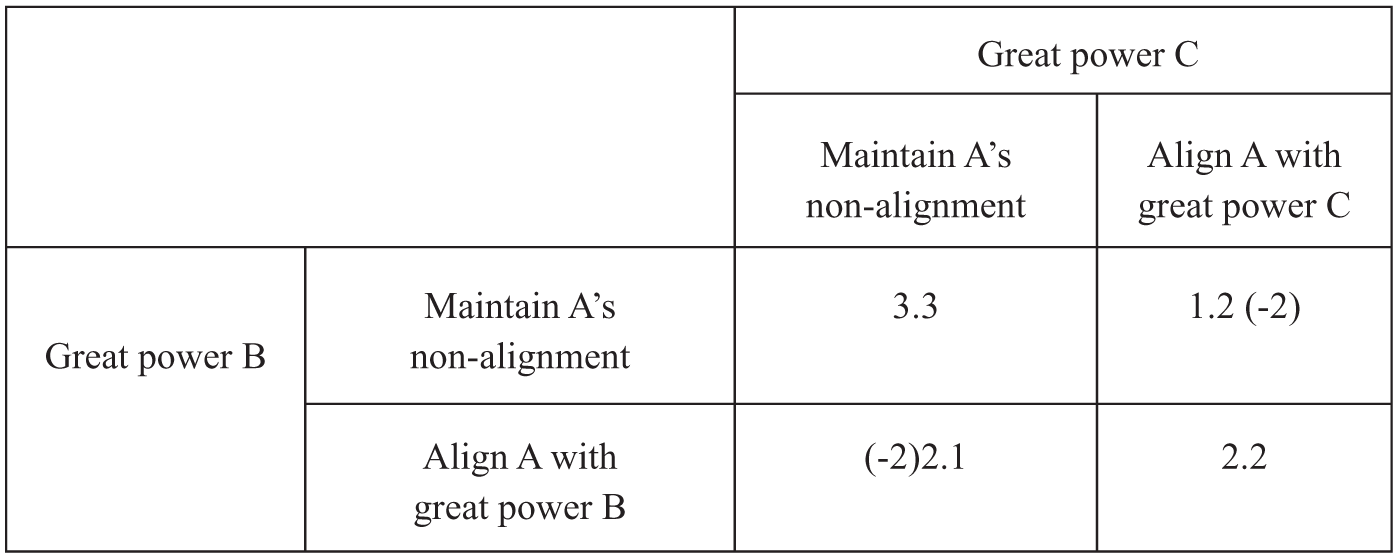
Effects of sheltering in the alignment game.
How domestic filters shape small states’ choice of non-alignment strategies
As Efremova (2019: 109) noted, buffer zone complexes are shaped by the functional needs of great powers. Due to power asymmetry, the primary drivers of non-aligned small buffer states’ strategies are often theorized to be determined by the preferences of great powers toward the zone (Korolev, 2019). The choice of non-alignment strategy is therefore a functional response to which strategy that is most suited to stabilize the status quo. Consequentially, small buffer states are often more constrained in their maneuvering space due to the spatial limitations they operate under, compared to non-buffer states. These constraints stem from the fact that their foreign policy choices must always interpret the demands of great powers and assess the risk that these powers may be tempted to dissolve the buffer zone. Gvalia et al. (2013, 2019) therefore emphasized the importance of including the domestic filters through which decision-makers evaluate the buffer state’s threat position, risk tolerance, and the domestic effects of foreign policy strategy when designing diplomatic responses.
Elites’ external threat perception
Kakachia et al. (2018: 824) showed how competing threat perceptions in recent years have shaped Georgia’s foreign policy. Within the “internationalist” interpretation Georgia’s geostrategic position is considered as a strategic asset bridging Western and Eastern partners due to their dependence on Georgia’s geographical position. Accordingly, Georgia’s reliance on Western support against Russia is seen as a means to maintain sovereignty within a liberal international order (Nodia, 2022). Accordingly, this privileged position provides the foundation for a bolder and more engaged posture aimed at internationalizing Georgia’s diplomatic relations; for example, seeking membership in international organizations, committing to strategic partnerships, and aspiring to join NATO and the European Union to balance regional threats and strenghten the countrys European identity (German, 2015; German et al., 2022; Kakachia and Minesashvili, 2015; Sanikidze, 2022). In contrast Kakachia et al. (2018: 824–825) also pointed to a competing “realpolitikal” interpretation where perceptions about Georgia’s strategic options are based on the view of the South Caucasus as a volatile region. That is, a region dominated by Russia’s ambition to aggressively expand its sphere of influence and the Western actors (United States, European Union, NATO) and China are perceived as expansive normative and economic powers that seek to influence domestic politics in the region which holds the potential to deteriorate the desired status quo in the buffer zone complex (Kakachia et al., 2024: 596). This intrepration aligns with a call for a cautious, accommodating policy, as proximity to Russia constitutes an unchangeable threat that cannot be credibly balanced through either internal or external means (see also Lebanidze and Kakachia, 2023; Oskanian, 2016).
Elites’ perception of the internal distribution of economic and political power
In addition to elites’ external threat perceptions, the distribution of economic and political gains domestically also explain the buffer states’ foreign poicy choices. Trade and investment flows from the interaction with the great powers generate domestic benefits that can significantly influence future foreign policy choices, as these flows provide domestic elites with economic resources that can be used to generate and consolidate political support domestically. Such distributional effects might help to explain why small buffer states seek closer economic cooperation and alignment with one of the major powers in the buffer zone. Kakachia et al. (2024) therefore argued that the GD’s efforts to diversify its political and economic partnerships can be viewed through the lens of regime legitimation toward the Georgian population. These efforts to ensure non-alignment represent attempts by the ruling regime to shield itself from democratic conditionality and mounting criticism from the West – particularly the European Union. Non-alignment thereby becomes a strategy for the regime to enhance its chance of survival by diminishing the entrapment costs associated with deeper EU integration. GD’s decision to implement the Foreign Agent Law in 2024, which has since been amended to further tighten state control over foreign funding (bne Intellinews, 2026), has raised the question whether regime security now takes primacy over external drivers of foreign policy.
In the following we focus on the explanations of the variation of the Georgian foreign policy strategies as a result of the interplay between the two types of drivers. The main purpose is to understand and explain the variation over time, but not to test the relative importance of each driver in the different time periods.
Operationalizing small state non-alignment strategies
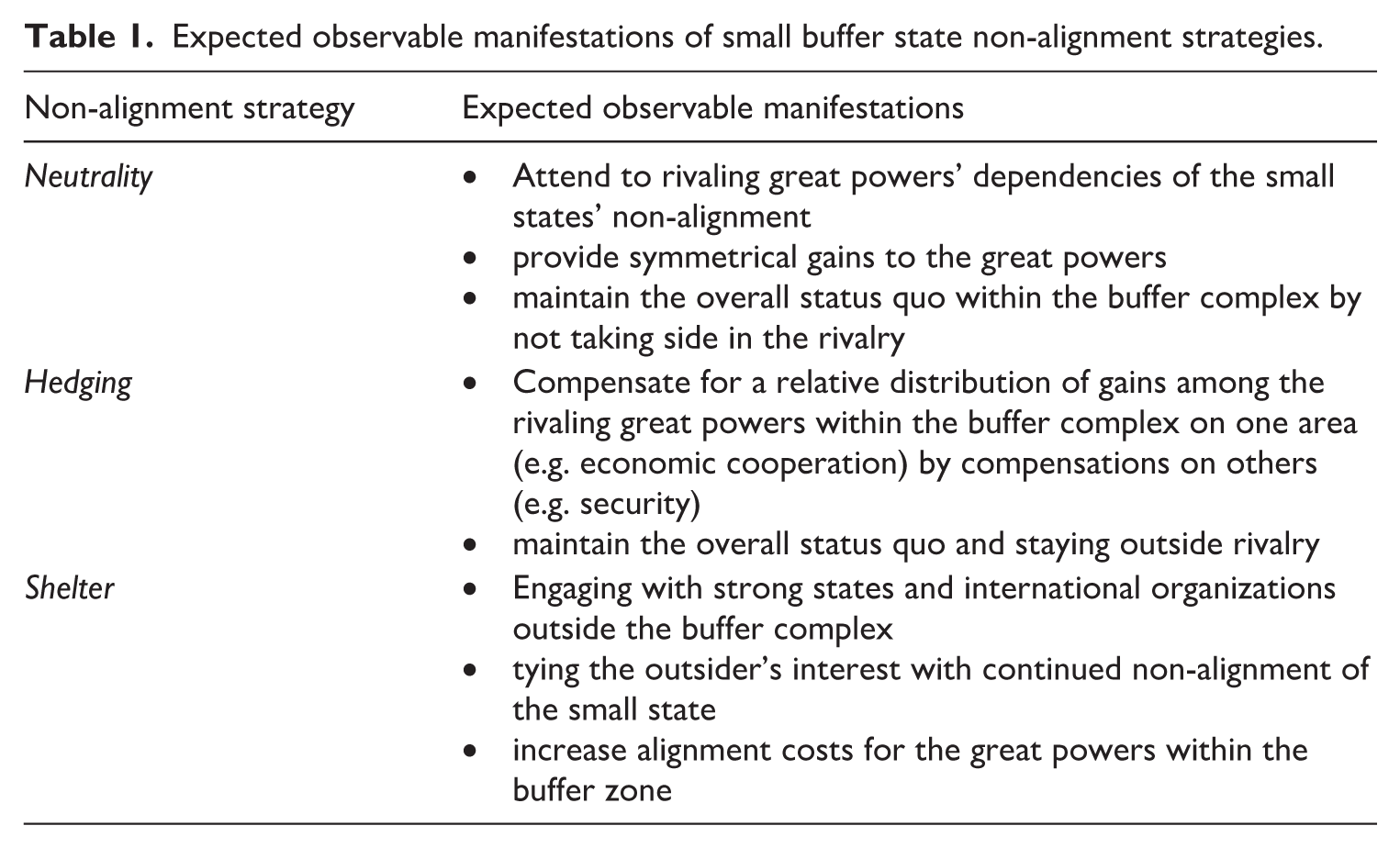
Our analysis of Georgian foreign policy is temporally structured around three phases (2008–2012, 2012–2019, and 2019–2025), where we examine whether the abovementioned strategies either dominated or co-existed with each other. The temporal structure of the analysis allows us to connect developments in the power balance among the great powers in the buffer complex and the influence of domestic developments to understand the formulation, variation, and function of the different forms of non-alignment Georgia pursued after the Russo–Georgian War. To identify traces of a neutrality strategy (see Table 1), we look for fingerprints of Georgia’s attempts to produce “symmetric benefits for the rivaling great powers” (e.g. equal trade agreements) with the aim of incentivizing them to maintain the non-alignment of the buffer state. When we look for the presence of a hedging strategy in Georgia’s foreign policy, we look for fingerprints of combining risk contingency and reward maximizing strategies. In practice this means that Georgia tries to maximize its gains – for example, economic – with one of the greater buffer states, while at the same time, it tries to deter its influence by engaging with the other rival great power on another policy area. For sheltering to be the dominant strategy, we expect it to manifest itself through attempts of the small state to utilize the structural power of greater powers outside the buffer zone to deter or increase the potential alignment costs.
Expected observable manifestations of small buffer state non-alignment strategies.
Analyzing the variation in Georgian foreign policy
2008 to 2012: United National Movement’s continued alignment with the Euro–Atlantic bloc
Since gaining independence in 1991, Georgia’s foreign policy has primarily been shaped by the challenge of positioning itself between Russia and the West. Central to understanding Georgia’s strategic orientation is its complex relationship with Russia (Jones, 2012; Nodia, 2013). Russia has consistently represented the most salient external pole in Georgia’s foreign policy prioritization. This has been coined a “cyclical regularity in Georgia’s Russia policies” where any new government always aims to restart relations with Russia while accusing the preceding government of implementing irrational policies (Nodia, 2022: 207).
This also characterized Mikhail Saakashvili’s and the United National Movement’s (UNM) Russia policy when he first took office in the wake of the Rose Revolution in 2004 but was also a point on the agenda after his reelection in 2008 where the priority was to (re)-establish friendly, neighborly relations with Russia (Tsygankov, 2012: 237; Voice of America, 2004). Despite the initial inclination toward rapprochement, Georgia’s relationship with Russia became increasingly hostile during UNM’s two terms in office. This can be ascribed to the dynamics of the buffer zone where Georgia under UNM voiced a strong desire to pursue Euro–Atlantic integration leading to several punishments by Russia filtered by domestic elites’ threat perceptions (Tsygankov, 2012).
In line with the logics of buffer zone theory, Russia’s policy toward Georgia during the UNM government was a consequence of the fear that Georgia would no longer remain unaligned but rather pursued alignment with the West. As a response to Georgia’s balancing strategy, focusing on a strong partnership with the United States and its wish to join NATO, Russia decided to stop the issuance of visas, ban the import of Georgian wine, and ultimately went from passive to active containment of Georgia (Tsygankov, 2012).
As regards the influence of domestic filters, Mikhail Saakashvili and other political elites shared the perception of belonging to a common European identity where they shared the values with the Western powers (Gvalia et al., 2013; Kakachia and Minesashvili, 2015). The institutionalization of the UNM elite’s pro-Western orientation meant that Georgia not only constituted a threat to regime stability in Russia, but also Russia’s level of influence in the post-Soviet space (Delcour and Wolczuk, 2015). In other words, the UNM’s elite threat perception provided an intrinsic reason for Georgia to pursue membership in NATO and the European Union, disregarding how this would shake the status quo in the buffer zone.
Undoubtedly, the main event defining Russo–Georgian relations during the UNM government was the five-day war in August 2008, as it underscored the perception that Russia constituted Georgia’s main security threat. Following the defeat in the Russo–Georgian War, the logical expectation – based on the experiences of other small state – would be that a defeated Georgia would decouple itself from power politics by adopting a form of neutrality. Contrary to such expectations, the general tendency in the foreign policy strategy of the UNM government was to continue its ambition to balance against Russian influence through Western alignment. Shortly after the war, Tbilisi made several attempts to cultivate relations with the United States. In 2009, Georgia committed a substantial number of troops to the International Security Assistance Force in Afghanistan (Nilsson, 2019: 456). Georgia’s goals were “to show everyone that we are back on track, on the European and Western track” (Nilsson, 2019: 457). The continued movement toward the West was also present in Saakashvili’s address at the United Nations General Assembly, in September 2008, where he indicated that Russia’s attack on Georgia constituted an “assault on the shared values” of the United Nations. Saakashvili consequently announced that Georgia would fight Russian aggression by deepening democracy (United Nations, 2008; Maher, 2008). The signing of the US–Georgia Strategic Partnership, in January 2009, institutionalized the relationship with the United States, despite its lack of security guarantees (Nilsson, 2019: 457). Overall, the UNM continued balancing Russian influence in the buffer complex.
A central explanation for the continuity in the Georgian balancing line relates to the view of Saakashvili’s governments. The UNM government considered its clearly defined pro-Western foreign policy as a way to resist Russian hegemony but also utilized the discourse of Georgia’s European identity to enhance popular legitimacy at home and secure Western patronage and investments (Ó Beacháin and Coene, 2014). A central tendency in this period was also that the question of normalizing relations with Russia began to emerge as a political cleavage up till the election in 2012, where the GD began to integrate rapprochement with Russia as a central element in their foreign policy platform based on a more realpolitikal assessment.
2012 to 2019: Georgian dream’s hedging equilibrium
The relatively one-sided balancing strategy promoted by the UNM changed after the Georgian election in 2012, where the formulation and implementation of a new foreign policy aimed at diversifying Georgia’s relations to the Euro–Atlantic alliances and Russia gained traction. The GD vehemently supported Georgia’s bid to join the European Union and NATO, but also claimed that the UNM had provoked the 2008 Russo–Georgian War by antagonizing Russia. The GD began marketing itself as the party that could secure Euro–Atlantic integration, while simultaneously curating better relations with Russia thereby continuing the aforementioned “cyclical regularity” in formulating policies vis-à-vis Russia (Nodia, 2022). Following the 2012 parliamentary election, the party’s founder, Bidzina Ivanishvili, envisioned the GD as an acceptable interlocutor for Russia. Acknowledging Georgia’s strategic location as a hub between East and West, Ivanishvili (2012) underlined that Georgia was forced to be “realistic” about the foreign policy cards it had been dealt – especially, being “a small regional power in a very dangerous neighborhood.” Ivanishvili described his preferred policy toward Russia as “firm and principled” with a need for reconciliation, pragmatism, and an ending of Russo–Georgian saber-rattling. Being one of the most important political elites, Ivanishvili’s line of thinking aligns with realpolitikal interpretation of Georgia’s strategic options. In the period, this led to the formulation of a hedging strategy within its buffer complex aimed at compensating Russia for Georgia’s continued Euro–Atlantic integration through the establishment of political, economic, and societal partnership exemplified by the establishment of avenues for political dialogue, short of reestablishing formal diplomatic relations, and enhanced economic cooperation. Within this period, the GD maintained that a stable Russo–Euro Atlantic–Georgian nexus constituted the primary consideration for its foreign policy strategy (Kakachia et al., 2018).
As the logics of hedging posit, the GD – in its first tenures – upholds an asymmetric reward system favoring its Euro–Atlantic partners politically, militarily, and to some extent economically, whereas Russia is rewarded in the societal/cultural domain and also increasingly economically. A defining element in hedging is that the small state tries to offset risks by pursuing multiple policy options at the same time where the intention is to produce mutually counteracting effects in situations under high uncertainties. The purpose of this is to stabilize the balance in the buffer complex by providing selective incitements for the great powers and thereby increase their evaluation of Georgia’s non-aligned position through return maximizing and risk contingency (Kuik, 2021).
Return maximizing strategies
While pursuing Euro–Atlantic integration, the GD actively worked on normalizing relations with Russia by building a pragmatic and “realistic” approach which was designed to improve economic trade agreements. In theoretical terms, this corresponds with what Kuik (2021) has labeled “economic pragmatism” and “binding engagements,” which sometimes can resemble limited bandwagon. The GD’s “realistic” approach vis-à-vis Russia, we argue, is symptomatic for such ambitions where Georgia through asymmetrical rewards, and namely its economic engagement with Russia tries to offset the risks of its engagement with the Western alliances by securing status quo in the buffer zone. Then Georgian Defense Minister, Irakli Alasania, drew the contours of the so-called “realistic” approach when in 2013 remarking that, [. . .] a nuclear-armed country of 140 million people on our northern border [Russia] will not disappear [. . .]. We don’t have any illusion that Russia will change its policy toward Georgia [. . .]. We want to tone down the rhetoric so we can have a workable relationship (Irakli Alasania in Whitmore, 2013).
Moreover, the appointment of the Special Representative to Russia under the Prime Minister, Zurab Abashidze, in 2012 was also a clear signal of a change in the bilateral relations between Georgia and Russia, where the GD actively strived to “decouple economic and social issues from security” (Kakhishvili, 2021: 189). Russia acknowledged Georgia’s attempt of normalizing relations by lifting its ban on the import of Georgian wine and mineral water thereby reigniting trade relations between the two countries (see Figure 8). After a comprehensible drop following the Russo–Georgian War, the GD quickly reestablished trade to former levels and continued to expand in this regard. Remarkably, within the first year of the GD’s rule, Georgia’s export to Russia was higher than it had ever been since the collapse of the Soviet Union. Ties were also reestablished within the cultural and social domains seeing that Russia decided to ease visa restrictions for Georgians in 2015 (Civil.ge, 2015).
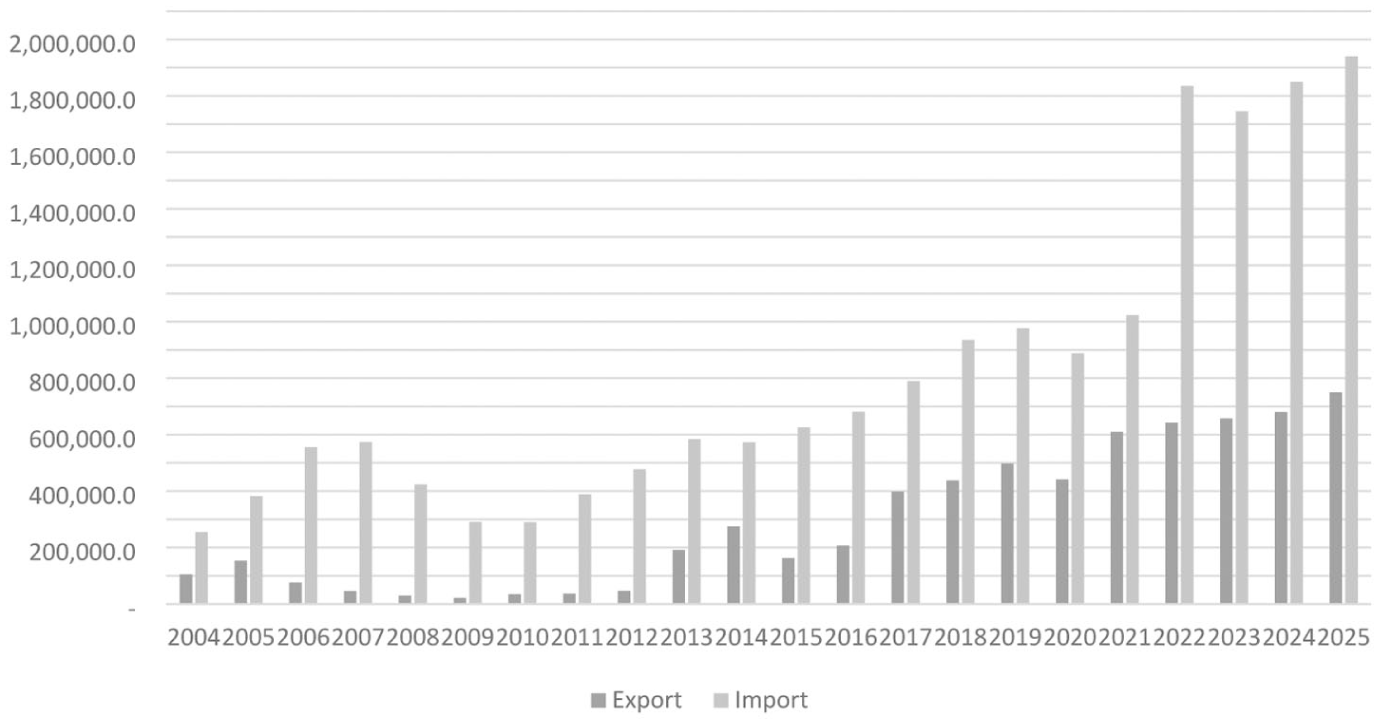
Russo–Georgian import/export (thousand USD).
The GD’s policy toward Russia was not only based on the idea of rapprochement, but the overall priority vis-à-vis Russia seemed to be based on the core principles of not antagonizing the Kremlin in order to strengthen sovereignty and regain territorial integrity.
The GD’s ambitions to pursue pragmatic relations with Russia were also highlighted in relation to the 2018 presidential election, where the party backed the independent candidate Salome Zourabichvili who subscribed to a pragmatic policy toward Russia (DW, 2018). Opposed to some views in the Georgian opposition, the GD did not consider rapprochement with Russia in conflict with the country’s Euro–Atlantic ambitions (Kakachia et al., 2018). To the GD, foreign policy was not a zero-sum game where closer relations with one great power necessarily prompted a need to distance oneself from that great power’s adversary (Kakhishvili, 2021: 189–190). Rather, the GD viewed it as possible and indeed beneficial to explore deeper relations with Russia within cultural and economic domains, cutting short of any political or military partnerships that would have constituted red lines for Euro–Atlantic partners and the Georgian public.
Risk contingency tendencies
The GD’s rapprochement with Russia, logically, meant that Georgia risked paying the entrapment costs of unwanted Russian interference in domestic politics. The engagement therefore had to be balanced with further policies and actions of dominance denial or indirect balancing aimed at minimizing potential political and security risks. One overall example of risk contingency can be found in the foreign policy resolution that the GD passed after taking office in 2012. On one side, the resolution declares that Euro–Atlantic integration “represents the main priority of the country’s foreign policy course” and lists the European Union and United States as Georgia’s main strategic partners (Civil.ge, 2013). Moreover, the resolution insists that Georgia would not seek any kind of diplomatic, political, military, or customs alliance with states that recognize the independence of or occupies the two breakaway regions Abkhazia and South Ossetia – that is, Russia. One the other side, the resolution also defines a path forward for developing “good neighborly relations” with Russia and acknowledges that the disagreement over the breakaway regions should be dealt with through dialogue based on both the Geneva-format and bilateral avenues (Civil.ge, 2013). The resolution was followed up by the negotiations of a number of vital partnerships with both the European Union, NATO, and the United States that deepened Georgia’s Euro–Atlantic integration. First, the GD managed to conclude both an Association Agreement and a Deep and Comprehensive Free Trade Agreement (DCFTA) with the European Union thereby cementing its role as a frontrunner within the Eastern Partnership (Kakhishvili, 2021). In regard to NATO, a significant event was the establishment of the Substantial NATO–Georgia Package at the 2014 Wales Summit, which aimed at increasing the capability of the Georgian security and defense sector with the view to achieve NATO-interoperability. Moreover, the GD solidified Georgia’s bilateral relationship with the United States by signing a joint memorandum on Deepening the Defense and Security Partnership (US Department of State, 2016).
Sheltering tendencies
Although neither the GD’s foreign policy resolution, nor any pre-election programs, highlighted a partnership with China as a strategic interest for Georgia, the bilateral relationship deepened substantially from 2012 to 2016. In 2016, a year after the announcement of negotiations, a free trade agreement with China was finalized (Civil.ge, 2017). In 2016, the GD also established the Georgian–China Friendship Association embedded in the Georgian Chamber of Commerce and Industry aimed at strengthening bilateral ties and securing Chinese investments. As Figure 9 shows, while the UNM had managed to increase the level of imports from China, exports from Georgia rose markedly after the GD took office as tariffs were eliminated due to the Sino–Georgian free trade agreement. Since the GD had already allowed Chinese imports at near-zero tariffs, the agreement disproportionately favored Georgian exports to China (Larsen, 2017). Likewise, infrastructure investments continued – often within the framework of the Chinese-led Asian Infrastructure Investment Bank.
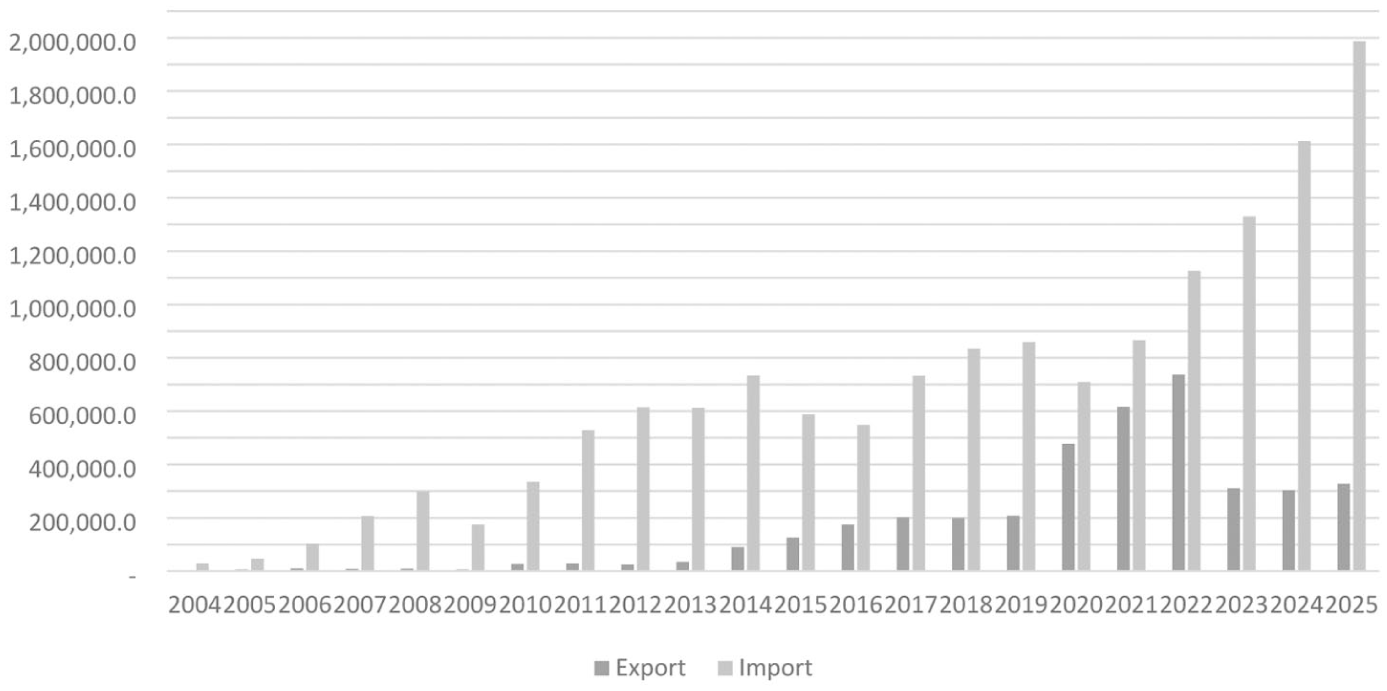
Sino–Georgian import/export (thousand USD).
Since Georgia already had completed the DCFTA with the European Union, the GD put the country in a strategically important position in relation to China’s Belt and Road Initiative (BRI) (Larsen, 2017). To achieve intercontinental logistical alignment within the Middle Corridor of the BRI, China began to invest heavily in infrastructure projects in Georgia.
From a shelter perspective, the engagement with China can be interpreted as an attempt for Georgia to bring in actors from outside the buffer complex, with the aim of increasing the Chinese interests in Georgia’s non-aligned position. This, in turn, might affect the risk assessment of Euro–Atlantic partners and Russia. However, there is also merit in the interpretation that the GD sought closer ties with China not to increase its security, by making it more difficult for the West and Russia to exert excessive influence, but rather to reap the economic gains of trading with another great power; that is, the GD’s foreign policy decision was filtered by perceived benefits for the distribution of economic power at home. There is no clear evidence that the GD in this period interlinked Georgia’s ties to China with the regulation of the dynamics within the country’s buffer zone. One example of the missing linkage is related to the construction of the strategically important Anaklia Deep Sea port. Despite the strong Chinese commitment to the project, the tender was not awarded to the Chinese companies involved but given to a joint Georgian–American consortium (Menabde, 2016). This is important, as the harbor in Anaklia has substantial and real geostrategic relevance – also from Euro–Atlantic perspective. So, despite improved Chinese Georgian relations, the GD initially decided to use Euro–Atlantic partners as the primus motor on the project, which correlates more with a hedging than a sheltering logic.
2019 to 2025: Georgian dream’s hedging conundrum and increasing sheltering
Internal and external events after 2019 put pressure on the hedging mechanisms that the GD relied on to regulate the power dynamics in the buffer complex. To mitigate the risks from growing antagonistic Russo–Western relations, we argue, that the GD in this period began to instrumentalize its engagement with great powers outside its buffer complex – primarily China – to discourage Russia and the Euro–Atlantic bloc from unwanted interference, but also to increase their valuation of Georgia’s non-alignment.
We argue that four catapulting events changed the foreign policy calculus of the GD, as they increased the potential entrapment costs of Euro–Atlantic integration and the rapprochement with Russia. First, the June crisis in 2019, sparked by Russian MP Gavrilov’s speech in Georgia’s parliament, prompted massive protests demanding a change from a mixed to a fully proportional electoral system for the coming 2020 parliamentary election. After initially courting the protesters, agreeing to transition the electoral system, the GD ended up backtracking on their promise only partially giving in to the protesters’ demands. The June crisis strained the pragmatic relation that the GD had built with Russia, leading Moscow to punish the GD and suspend direct flights to Tbilisi (RFE/RL, 2019).
Second, the domestic crisis, and the GD’s refusal to fully change the electoral system, affected the 2020 parliamentary election which was marked by accusations of election rigging. This prompted the European Union, led by then EU Council president Charles Michel, to intervene and mediate between the GD and the opposition, resulting in an agreement that the GD found unjust. The then chair of the GD, Irakli Kobakhidze, vehemently criticized the European Union for not demanding the same of the opposition as it did of the government (Civil.ge, 2021). The failed mediation efforts lowered the trust that the GD had in Georgia’s EU-accession process, thereby accentuating the entrapment costs of becoming too integrated in the Euro–Atlantic bloc that might undermine the GD’s opportunities to maintain power. This is illustrated by the GD’s subsequent decision to break several conditions of the mediated agreement.
Third, the COVID-19 pandemic heavily affected the Georgian economy resulting in a negative GDP growth rate of -6.3% (year-on-year) in 2020. Nominally, in terms of trade, the GD pursued an asymmetrical reward system at least until 2020 mostly favoring the West while equally awarding Russia and China. However, after 2020, the distribution became gradually more symmetrical, likely to mitigate the severe economic and societal costs of the COVID-19 pandemic.
Finally, and most importantly, Russia’s 2022 invasion of Ukraine, and the European Union’s decision to decouple Georgia from Moldova and Ukraine in its EU-accession process, completely upended any remaining image of balance in the buffer complex. The invasion sparked an increased European and Georgian interest in advancing EU membership negotiations. Georgia, hoping for a more lenient process due to the geopolitical necessity of expanding the European Union (European Commission, 2023), became disappointed after the European Union insisted on full compliance with the accession criteria. Likewise, NATO membership was still out of the question.
In addition, the GD was placed in a dilemma with regards to joining the international sanctions against Russia. Seeing that Russia constituted one of Georgia’s main trading partners, joining the sanctions would potentially severely affect Georgia’s economy, and hamper the possibilities of trading with regional neighbors, due to the risk of transporting sanctioned goods. In short, subscribing to unconditional Euro–Atlantic integration after 2022 increased the economic entrapments costs of becoming an EU member. Conversely, offering itself as a hub for (re)exporting goods to and from Russia constituted a significant economic opportunity for Georgia. 7 Recent developments have supported this view that Georgia’s hedging strategy following Russia’s full-scale invasion was pursued for economic reasons. In October 2025, the World Bank improved Georgia’s GDP growth forecast from 5.5% to 7% in 2025 (Interfax, 2025). This decision can also be ascribed to concerns related to internal economic distribution, as it provided the GD with economic resources to satisfy political support domestically.
Increasing sheltering with China
To mitigate the risks of hedging, Georgia has instrumentalized its economic relations with China. The signing of the strategic partnership between Beijing and Tbilisi in 2023 benefited China’s ambition to reduce its dependency on the Northern BRI corridor through Russia, while simultaneously consolidating its strategic position in the South Caucasus. The South Caucasus did not even feature among the original corridors covered by the BRI but has since proved vital geopolitically as the competition between Russia and the West creates fertile ground for China to increase its regional presence. This is clearly visible in China’s second attempt to enlarge its maritime presence through the construction of the Anaklia Deep Sea Port. After a long process, the GD canceled the tender that was otherwise given to a European consortium and in May 2024 instead awarded it to a consortium led by a majority state-owned China Communications Construction Company (Ports Europe, 2025a). This indicates that the GD, after February 2022, began to take Russia’s and China’s preferences more into account when designing their domestic and foreign policy. Thus, awarding the tender of Anaklia Deep Sea Port to European partners would heighten Georgia’s entrapment costs associated with Euro–Atlantic integration, while China, also from the perspective of Russia, constituted a more acceptable interlocutor. Moreover, the growing partnership with China initially opened new opportunities for Georgia to navigate in the buffer zone (Avdaliani, 2023).
Importantly, the GD’s increased use of sheltering to mitigate the growing risks of hedging must not be confused for parting with the Euro–Atlantic bloc nor Russia. Hedging is still, we argue, the dominating non-alignment strategy. This is clear when observing the nature of Georgia’s military relations where NATO, and particularly Turkey, remains Georgia’s primary military partner. The GD has not shown intent of completely severing ties with its NATO and US partners in the Euro–Atlantic bloc by crossing any red lines that would incline them to fully abandon Georgia. For example, the GD decided to still hold the annual NATO–Georgia exercise “Agile Spirit” in July 2025 without in any way attacking the NATO-alliance rhetorically as it has done with the European Union (Imedi News, 2025). Again, it seems that the GD carefully attempts to maintain an increasingly unstable status quo within its buffer complex with the partners it believes are the most important to the territorial integrity of Georgia but also fit with the elites’ perceptions of consequences for the internal distribution of economic and political power. The recent Georgian gamble on drawing China closer to Georgia has however backfired somewhat, as the United States has become more critical toward the attempted shelter strategy putting pressure on the GD through the Mobilizing and Enhancing Georgia’s Options for Building Accountability, Resilience, and Independence Act ( MEGOBARI Act), passed by the House of Representatives on 5 May 2025, which requires the US President to sanction members and senior representatives of the GD related to blocking Euro–Atlantic integration by awarding the Anaklia Port tender to aforementioned Chinese consortium (US Library of Congress, 2025). The MEGOBARI ACT has forced the GD to reopen the tender (Ports Europe, 2025a). The pressure from the United States is also underlined by the introduction of the Strategic Ports Reporting Act, where control over strategic ports is deemed a central element of US National Security Strategy (Popkhadze, 2025). Consequently, as of November 2025, considerable time after the tender process, no investment agreement has been finalized with the Chinese consortium meaning the construction of the port still has not begun (Ports Europe, 2025b). Likewise, the GD recently decided to cut down on funding to the Anaklia project in the 2026 state budget from 56 million USD to 18 million USD, which reflects an adjustment in the expectation of the project’s feasibility (DF Watch, 2025). Still, Tamar Ioseliani, Deputy Minister of Economy and Sustainable Development, claimed at the 2025 Tbilisi Silk Road Forum that the first vessels were expected to be able to utilize the port by 2029 (Alimova, 2025). This highlights the potential fragility of relying on shelter providers as a strategic asset, as they are inherently less invested in the dynamics of the buffer zone complex and therefore may have fewer second thoughts in defaulting.
Nonetheless, some nuances in terms of the GD’s policy toward the United States have emerged under Donald Trump. Officially, the GD’s policy toward the United States following their disputed reelection has been based on the objective of resetting US–Georgian relations (Menabde, 2025). In this regard, the GD has utilized the same narratives as the Trump administration by underlining that the future of US–Georgia relations depends on Trump’s ability to defeat the so-called “deep state” (Menabde, 2025). According to the GD, this so-called “deep state” is the perpetrator behind the efforts to overthrow the government and drag Georgia into war. However, it seems that the GD went too far in their courting attempt when they sent a private letter to the Trump administration which former US Ambassador to Georgia, Robin Dunnigan, said was “threatening, insulting, unserious, and was received extremely poorly in Washington” (Gelashvili, 2025). Likewise, a few months before, at the end of May 2025, party founder Bidzina Ivanishvili – for unknown reasons – refused to meet Ambassador Dunnigan to hear a message from the Trump administration (US Embassy in Georgia, 2025).
The GD’s relation to the European Union has deteriorated rapidly during 2024 and 2025. A key reason for this is the party’s escalating rhetoric against the European Union who they – among other things – claim seek to destabilize Georgia, drag the country into the war against Russia and destroy Georgian cultural and religious identity (EEAS, 2025; Shamanauri, 2025). Following the GD’s reelection in the 2024 parliament election, it seemed that the party had achieved a point of equilibrium maintaining some level of status quo in its relationship with the European Union. Despite the European Union’s limited efforts to discipline the GD, the latter continued to act in a way that increased the risk of full abandonment by the European Union. While the GD has acted against the expectations of buffer zone theory by breaking the status quo and potentially upending the balance in the buffer zone, the domestical distributional effects might help explain why this is the case. Continued cooperation with the European Union would entail considerable political concessions aimed at democratizing which would make it more difficult for the GD to ensure reelection through legal means – that is, from the GD’s perspective entail adverse effects to the current distribution of political power in Georgia. Relatedly, by continuing to alienate the European Union and create a negative sentiment in the Georgian electorate toward the union, the GD can more easily blame the European Union for not being able to achieve membership by 2029, which is still the party’s official policy objective. The 2024 parliamentary election in Georgia, which was marred by allegations of electoral fraud (Gavin and Parulava, 2024), and the subsequent decision to de-facto halt the EU-accession process (Parulava, 2024) can be viewed as a testament to the GD’s definitive move away from any elements of a balancing strategy, including value-based alignment with the Euro–Atlantic bloc. Rather, it reflects the increased importance ascribed to regime security concerns by the GD-elites.
This also might help explain why GD supporters, opposing membership of the European Union and NATO, in 2024 begun to promote neutrality as a viable foreign policy strategy for Georgia under the banner of the United Neutral Georgia Movement (UNGM) (Kincha, 2024). The UNGM seems to be driven by domestic and regime concerns rather than genuine foreign policy reorientation. This can be interpreted as a result of the stalled accession negotiations with the European Union, and recent US statement showing understanding of Russia’s concerns for future NATO eastward expansions. The GD might therefore be more tempted to pursue a variant of neutrality to consolidate their non-aligned position in the buffer zone (Politico, 2025), avoid unwanted political interference, and to balance the alleged contradictory demands put on Georgia from abroad.
Perspectives and conclusions
To improve our understanding of what different non-alignment strategies offer small buffer states caught in between rivaling great powers, we adopted a game theoretical approach to theorize the use of neutrality, hedging, and sheltering. To examine their analytical usefulness, we operationalized the non-alignment strategies by outlining their observable implications. Afterwards, we put them to work in an illustrative case study of Georgian foreign policy from 2008 to 2025.
Our analysis shows that in the period leading up to the GD’s siege of power in 2012, Georgia’s foreign policy strategy was largely characterized by alignment with the European Union, NATO, and the United States to balance Russian influence and bolster Georgia’s economic development. The GD continued – if not further enhanced – the Euro–Atlantic course set out by the former UNM government.
The GD’s initial introduction of a more pragmatic and balanced foreign policy, we interpret as a reaction to the slow Euro–Atlantic integration process, where the lesson from the 2008 war was that Georgia would not receive any firm security guarantees. Therefore, a non-alignment strategy of hedging largely steered the country’s foreign policy until 2019, when the strategy became more difficult to sustain due to domestic and international developments.
While already engaging with China, the relation changed after 2019, and markedly after the full-scale invasion of Ukraine in 2022, in that Georgia’s geographical position and relevance became a strategic asset in the attempt to balance Euro–Atlantic and Russian influence. In wake of the 2019 June crisis, failed EU mediation following the 2020 parliamentary election, and Russia’s 2022 invasion of Ukraine, the GD changed its foreign policy strategy to also include sheltering. As of 2025, the GD still follows a double-pronged non-alignment strategy where the growing risks of hedging in between the Euro–Atlantic partners and Russia is mitigated by bringing in other states from outside its buffer zone – primarily China – as prescribed by shelter theory.
Our analysis of Georgian foreign policy begs three general questions for future research about small state non-alignment. First, our analysis shows that Georgian foreign policy in practice was increasingly marked by not one but two non-alignment strategies. This raises a question about how we should theorize and analyze the interrelationship between small state strategies and whether the adaptation of different strategies reflect an overarching grand strategy, as it is proposed in recent small state literature (Wivel, 2021), or whether the variation in Georgian foreign policy represents an ability of the political elites to be flexible and expand their state’s room for maneuvering (Mouritzen, 2022). Thus, future research should focus on the interaction and compatibility between non-alignment strategies rather than compartmentalizing them.
Second, the period from 2008 to 2025 featured few empirical manifestations of neutrality. We expect that elements of neutrality will take up a more prominent place in the future. In a world marked by intensifying great power rivalry, we caution against writing off neutrality as an analytical lens to understand small state behavior (see also, Agius, 2024; Agius and Devine, 2011; Binter, 1992 Lottaz et al., 2022). For some small states, neutrality is preferable for domestic reasons (e.g. Turkmenistan, which had its neutrality recognized by the United Nations in 1995), as neutrality can become a tool for the buffer state’s government to shield it from external pressure or expectations, while for others it is imperative to maintain autonomy and influence in buffer complexes where hedging or sheltering are not realistic or desirable.
Third, the analysis showed that the GD’s foreign policy decisions were not solely determined by an aspiration of keeping the status quo between rivaling great powers in the buffer complex. The GD’s decision-making was also shaped by domestic filters in the form of elite perceptions about threat as well as the perceived consequences of foreign policy choices for the distribution of political and economic power in Georgia. Notably, the GD was willing to go as far as to potentially destabilize the status quo between rivaling great powers to implement authoritarian legislation that was on collision course with EU and NATO membership. By mimicking the Russian way of governance – for example, the GD’s implementation of the Foreign Agent Law in 2024 – the GD has reassured Russia of Georgia’s continued commitment to pragmatism in the form of hedging (Light, 2024) and enhanced its regime security. We acknowledge that externally induced geopolitical concerns may establish the framework within which decisions on foreign policy strategy are made in small states, but – building on Gvalia et al. (2013, 2019) – we also find that domestic filters play a critical role in shaping the timing, design, and orientation of choice of non-alignment strategy. Essentially, our article highlights the dialectic, multicausal relationship between domestic filters and external buffer zone logics in driving the foreign policy strategies of small states. Using this study as a stepping-stone, we urge future studies to ask when and how domestic elites’ external threat perceptions and perceptions of the internal distributional effects of political and economic power influence foreign policy decision-making in small states caught between a rock and a hard place.
Footnotes

Funding
The authors received no financial support for the research, authorship, and/or publication of this article.
Declaration of conflicting interests
The authors declared no potential conflicts of interest with respect to the research, authorship, and/or publication of this article.
1.
The authors wish to express their gratitude for the constructive comments provided by Peter Viggo Jakobsen, the International Relations Section of the 2024 Annual Meeting of the Danish Political Science Association, and colleagues from the Institute for Strategy and War Studies at the Royal Danish Defence College. The authors further extend their appreciation to the three anonymous reviewers and the journal’s editorial team for their insightful suggestions on how to improve the article.
2.
However, following Donald Trump’s second term in office and the recent development in Georgia’s relation to the European Union, it could be argued that it is more accurate to differentiate between Georgia’s approach to the Western actors, especially between their relations to European Union and NATO. We elaborate on this in the analysis.
3.
For heuristic reasons, we have chosen not to include a differentiated pay off structure in our model. The aim is to capture that the great powers have an initial preference for the status quo, but that the temptation to exercise control or influence over the zone might help to destabilize it. If one side has a stronger interest in aligning the buffer state, then the success of the diplomatic non-alignment strategies of the small state presupposes greater cooperation gains for this actor compared to the actor with less interests in aligning. Despite the differences in the cooperation pay off, the scorned power is expected to accept this to a certain point, as it prefers to uphold the buffer zone compared to any confrontation scenario.
4.
Our understanding of hedging shares similarities with Kakachia et.al.’s (2024) concept of transactional hedging where Georgia’s balancing is seen as a way to keep an equal distance to both Russia and the European Union and eschewing the value-based approximation of the latter which GD considers a threat.
5.
Please note that the data from 2025 is preliminary.
6.
Please note that the data from 2025 is preliminary
7.
One indication of this is the marked increase of trade with Central Asia after 2022. For example, Georgia’s exports to Kyrgyzstan from 2021 to 2025 increased by approximately 4.779% according to the National Statistics Office of Georgia. After the 2022 Russo–Ukrainian War, Georgia’s increasing trade with CIS-countries accelerated markedly.