






Abstract
This article investigates how the Trump administration discursively reframed the European Union (EU) as a strategic rival in US foreign policy. Drawing on a corpus of 65 primary texts, including presidential speeches, policy documents, press releases, and tweets, the analysis employs critical discourse analysis (CDA) within a constructivist framework to trace how the EU was repositioned in US strategic identity between 2017 and 2020. The article identifies three recurring frames: reciprocity and exploitation, which cast trade relations as systematically unfair; burden-sharing and NATO delinquency, which portrayed European allies as debtors compelled into compliance; and sovereignty versus supranational control, which depicted the EU as the embodiment of illegitimate bureaucratic authority. Together, these frames unsettled the symbolic foundations of transatlantic partnership by normalizing a rival identity for Europe within US presidential discourse. The findings demonstrate how discursive practices can reconfigure allied relations by linking economic, security, and institutional grievances into a coherent narrative of imbalance and illegitimacy. The article contributes to scholarship on transatlantic relations by situating Trump’s discourse within broader debates on the erosion of Atlanticism, the politicization of alliance politics, and the constitutive role of language in shaping strategic identities and rivalries.
Introduction
Since 1945, the transatlantic relationship has rested on dense institutional commitments, collective security guarantees, and a shared belief in the benefits of integration. The North Atlantic Treaty Organization (NATO), in particular, not only bound the United States to Europe but also helped consolidate a transatlantic “security community” underpinned by common norms and practices (Ackermann, 2003; Yost, 2002). Although tensions over trade, burden-sharing, and strategic priorities periodically surfaced, these disputes were traditionally framed as manageable disagreements within a broadly cooperative Atlantic order.
The election of Donald J. Trump in 2016 unsettled this discursive equilibrium. Trump repeatedly questioned NATO’s value, challenged multilateral institutions, and portrayed the European Union (EU) less as a partner than as a competitor or burden (Riddervold and Newsome, 2018). Scholars have interpreted this shift in different ways: as a collapse of trust within the transatlantic security community (Böller, 2020), a traumatic shock to alliance relations (Cox, 2021), or a symptom of the broader unraveling of the liberal international order (Ikenberry, 2018). Yet despite extensive analysis of Trump’s rhetoric, an important question remains insufficiently explored.
The discursive shift was evident from the start of Trump’s presidency. His inaugural address in January 2017 gestured toward a worldview in which the United States had been exploited by allies and adversaries alike: “We’ve made other countries rich while the wealth, strength, and confidence of our country has dissipated” (Trump, 2017a). While the EU was not named, the logic of exploitation was clear. Over the following years, the EU and NATO allies became explicit targets. At the 2018 NATO summit in Brussels, Trump accused NATO allies of being “delinquent” in their defense spending obligations, claiming that the United States was “paying for them” while Europe “treated us very unfairly on trade” (Trump, 2018e). This rhetorical fusion of economic grievance with security obligations recast alliance solidarity in transactional terms.
This development raises the central puzzle of the article: how did a long-standing ally come to be discursively reimagined as a rival in US presidential discourse? Existing scholarship has documented Trump’s rejection of multilateralism and his confrontational style (Olsen, 2022; Peterson, 2018b), shown how his rhetoric reframed freedom and sovereignty in civilizational terms (Sinkkonen and Vogt, 2019), mobilized populist–nationalist coalitions (Boucher and Thies, 2019; Hall, 2021; Lacatus, 2021; Wojczewski, 2019), and reshaped transatlantic relations through dynamics of misrecognition and identity contestation (Blanc, 2024; Restad, 2020). However, this literature largely treats Trump’s discourse either as rhetorical excess detached from material consequences or examines policy domains in isolation. It pays less attention to the discursive mechanisms through which allied relations themselves are reconstituted as rivalries.
A necessary clarification concerns what this article means by “Europe.” In Trump-era US foreign policy discourse, references to Europe frequently collapsed multiple institutional and symbolic referents into a single discursive category. Analytically, this article distinguishes between the EU as the primary object of analysis, NATO as a distinct but discursively entangled referent, and “Europe” as a broader symbolic category through which economic, security, and institutional grievances were fused in presidential rhetoric. The article argues that this discursive fusion did not merely express dissatisfaction within a cooperative framework but progressively normalized a rival identity for Europe within US strategic discourse. In doing so, it highlights an underexamined dimension of alliance politics: how sustained rhetorical practices can unsettle the symbolic foundations of partnership and make rivalry with a long-standing ally more intelligible and politically legitimate, even in the absence of formal institutional rupture.
Empirically, the article analyzes a corpus of 65 primary texts—presidential speeches, policy documents, press releases, and tweets—produced between 2017 and 2020. Methodologically, it employs critical discourse analysis (CDA) within a constructivist framework to trace how meanings, identities, and power relations were articulated and stabilized over time. The analysis proceeds through three thematic sections: the framing of the EU through reciprocity and exploitation; the construction of NATO burden-sharing as delinquency and debt; and the opposition between sovereignty and supranational authority, in which the EU emerged as the archetype of illegitimate bureaucratic power.
Theoretically, the article contributes to constructivist accounts of foreign policy by demonstrating that rivalry can be discursively constituted not only with adversaries but also within alliances. While constructivist scholarship has emphasized how shared identities and norms sustain alliance cohesion (Rafferty, 2003; Riim, 2006), this article highlights the reverse dynamic: how sustained rhetorical practices can erode symbolic foundations of solidarity and recode allies as rivals. In doing so, it reinforces discourse-analytic approaches that treat identity and rivalry as produced through language rather than predetermined by material structures (Hansen, 2006; Milliken, 1999)
In sum, the Trump presidency represented a moment of discursive rupture in US–European relations. By fusing economic, security, and institutional grievances into a coherent narrative of imbalance and illegitimacy, presidential discourse normalized a rival identity for Europe within US foreign policy. The implications extend beyond the Trump era, raising broader questions about the fragility of Atlanticism and the role of discourse in shaping the boundaries between alliance, competition, and rivalry in international politics.
Clarifying “Europe”: Analytical scope and discursive referents
A necessary preliminary clarification concerns what—and whom—the article refers to as “Europe.” In Trump-era US foreign policy discourse, references to Europe frequently collapsed multiple institutional, strategic, and symbolic objects into a single discursive category. This article therefore treats “Europe” not as a unitary empirical actor, but as a discursive shorthand through which different institutional and normative targets were fused within presidential rhetoric. This approach aligns with constructivist and discourse-analytic scholarship emphasizing that foreign policy discourse often operates through symbolic condensation, producing relational identities by blurring institutional distinctions between self and other (Milliken, 1999; Restad, 2020; Rumelili, 2004).
Analytically, the article distinguishes between three related but conceptually distinct referents.
First, the EU constitutes the primary object of analysis. In Trump’s discourse, the EU was consistently portrayed as a supranational regulatory authority—an actor associated with unfair trade practices, illegitimate bureaucratic power, and constraints on US sovereignty. It is in this sense that the article examines the discursive construction of the EU as a rival: not merely as a competitor in discrete policy areas, but as an institution whose integration model was framed as structurally incompatible with US economic and political autonomy. This focus is consistent with existing scholarship that conceptualizes the EU as a contested political and normative actor, whose international role and legitimacy are continuously negotiated through discourse rather than given as neutral institutional facts (Aggestam and Hyde-Price, 2019; Carta and Morin, 2014; Rumelili, 2004).
Second, NATO appears in the analysis as a distinct but discursively entangled referent. While NATO is formally a security alliance rather than a supranational political authority, Trump’s rhetoric repeatedly fused NATO burden-sharing disputes with broader grievances against Europe. Claims about defense “delinquency” were routinely articulated alongside accusations of trade exploitation and regulatory overreach, producing a composite narrative in which European allies were simultaneously economic exploiters and security free-riders. NATO is therefore examined here not as an independent analytical focus, but insofar as it was mobilized to reinforce a rival framing of Europe as a whole. This discursive fusion has been documented in analyses of Trump-era transatlantic relations that highlight the rhetorical intertwining of alliance politics, economic disputes, and identity contestation (Restad, 2020; Riddervold and Newsome, 2018).
Third, the term “Europe” itself is treated as a symbolic and civilizational category within Trump’s discourse. Presidential speeches and tweets frequently invoked “Europe” as a generalized Other—standing in for a liberal, technocratic, and supranational order contrasted with an authentic, sovereign United States. In this sense, “Europe” functioned as a discursive condensation that blurred institutional distinctions and enabled the moralization of rivalry across economic, security, and governance domains. Such constructions are consistent with relational accounts of identity formation in international politics, which emphasize how political communities are constituted through processes of differentiation rather than fixed institutional boundaries (Restad, 2020; Rumelili, 2004).
This clarification establishes the article’s analytical scope. The aim is not to treat NATO, the EU, and “Europe” as institutionally interchangeable, but to show how Trump’s discourse rendered them discursively entangled within a broader narrative of exploitation and illegitimacy. This distinction provides the basis for tracing how allied institutions were rhetorically repositioned without overstating claims about material rupture or institutional collapse.
Literature review: Trump, alliances, and the discourse-policy gap
Scholarship on the Trump presidency has generated three relevant strands of analysis. A first strand examines Trump’s foreign policy through discourse-analytic and constructivist lenses, emphasizing identity, populism, and narrative. A second strand focuses on alliances and transatlantic relations, highlighting trust erosion, strategic strain, and identity contestation between the United States and Europe. A third, more policy-oriented strand emphasizes continuity and institutional constraint, showing that radical rhetoric often coexisted with limited material change. Taken together, this literature illuminates important aspects of the Trump era, but they leave insufficiently explored how sustained presidential discourse can discursively normalize rivalry within an alliance even in the absence of formal rupture.
A significant body of discourse-analytic and constructivist scholarship examines Trump’s foreign policy through the lenses of identity, populism, and narrative. These studies show how “America First” operated as a discursive project that challenged liberal internationalism, rearticulated US national identity, and reframed international politics as a zero-sum arena structured by exploitation and competition. Much of this work emphasizes how Trump’s rhetoric mobilized antagonistic friend–enemy distinctions, rejected cosmopolitan norms, and recast US leadership in nationalist and civilizational terms (Boucher and Thies, 2019; Hall, 2021; Lacatus, 2021; Wojczewski, 2019). Within this literature, Trump’s foreign policy discourse is often analyzed as an extension of domestic populist politics, with rhetorical attacks on multilateral institutions and international agreements understood as strategies for delegitimizing elite authority and consolidating a populist–nationalist coalition at home.
Several influential contributions situate Trump’s discourse within broader debates on grand strategy and political order. Peterson (2018b) highlights how narratives of decline, exploitation, and sovereignty underpinned Trump’s rejection of postwar liberal norms. Löfflmann (2019) conceptualizes “America First” as a populist mode of foreign policy that fused anti-globalism, transactionalism, and nationalist resentment, while explicitly noting the gap between radical rhetoric and constrained policy outcomes. Extending this analysis, Löfflmann (2022) develops the notion of a populist security imaginary, showing how Trump’s discourse collapsed internal and external enemies into a single antagonistic field, linking foreign policy positions on trade, migration, and alliances to affective appeals rooted in fear, resentment, and ontological insecurity. Related work on presidential rhetoric similarly emphasizes how Trump’s language redefined the US role in the world symbolically, even as institutional arrangements remained largely intact (Edwards, 2018).
This body of work has been essential in establishing discourse analysis as a central lens for understanding the Trump presidency. At the same time, it is now a saturated field. Much of the existing discourse-analytic literature treats rhetoric primarily as an object of interpretation—examining how Trump spoke about identity, sovereignty, and threat—rather than as a mechanism through which specific international relationships were systematically reconstituted. Allies and adversaries often appear as illustrative referents within broader identity narratives or security imaginaries, rather than as actors whose status within US strategic discourse is actively transformed. As a result, discourse-focused studies rarely examine how sustained presidential rhetoric might reconfigure alliance relationships themselves.
A second strand of scholarship addresses the impact of the Trump presidency on transatlantic relations more directly. This literature documents heightened conflict, declining trust, and growing uncertainty in US–European relations, frequently characterizing the period as one of crisis, rupture, or shock. Riddervold and Newsome (2018) argue that Trump’s rhetoric and policy positions undermined established patterns of cooperation across security and trade, while Böller (2020) identifies a breakdown of trust within the transatlantic security community. Other studies frame the Trump era as a traumatic disruption of informal norms governing US–European cooperation (Cox, 2021) or situate transatlantic strain within broader debates about European strategic autonomy (Aggestam and Hyde-Price, 2019). A related set of contributions foregrounds identity contestation and misrecognition, showing how Trump’s discourse positioned Europe as a foil against which US sovereignty and authenticity were defined (Blanc, 2024; Restad, 2020).
Related scholarship approaches the Trump presidency from the perspective of European strategic adaptation, treating US presidential rhetoric not merely as noise or signaling, but as a variable that reshaped the conditions of alliance engagement. Fjærtoft (2019), for example, argues that Trump’s confrontational and identity-driven discourse fundamentally altered how European actors could meaningfully engage the United States, even as the institutional foundations of the transatlantic relationship remained intact. Rather than emphasizing alliance breakdown, this work highlights how changes in strategic language disrupted shared expectations, narrowed the grammar of cooperation, and compelled European policymakers to rethink how the United States could be addressed and persuaded. Recent work similarly conceptualizes the Trump presidency as a moment of narrative disruption in US foreign policy rather than a wholesale strategic reorientation. Löfflmann et al. (2023) characterize the “Trump shock” as an ideational and discursive intervention that unsettled established narratives of US leadership, legitimacy, and alliance politics, even as institutional structures and many policy practices remained largely intact.
While this alliance-focused literature convincingly demonstrates that transatlantic relations deteriorated in symbolic and political terms during the Trump presidency, its analytical focus tends to remain on alliance strain as a condition rather than on the redefinition of alliance identity itself. Europe is typically portrayed as a destabilized partner or a disappointed ally reacting to US unpredictability, not as an actor discursively repositioned as a rival. Even where ideational coherence is identified—such as interpretations of Trump’s worldview as a revival of the Jacksonian tradition (Clarke and Ricketts, 2017) or as an expression of populist sovereignty rather than principled realism (Ettinger, 2020)—these accounts do not examine how such ideas were operationalized discursively to reclassify allies within US strategic narratives.
A third, more policy-oriented strand of scholarship stresses continuity and constraint in US foreign policy under Trump. From this perspective, radical rhetoric did not translate into fundamental changes in alliance commitments or institutional structures. Ikenberry (2018) argues that the liberal international order proved resilient due to institutional density and shared interests, limiting the administration’s capacity for disruptive change. Similarly, Olsen (2022) shows that core patterns of US–EU and NATO cooperation persisted despite rhetorical confrontation, while Meunier and Nicolaïdis (2019) demonstrate that transatlantic trade conflicts remained bounded rather than systemic. Empirical evaluations further reinforce this conclusion: Steff and Tidwell’s (2020) three-frame analysis of NATO funding, trade, and migration shows that presidential rhetoric often encountered significant institutional, bureaucratic, and systemic constraints, limiting its practical impact. Recent work has further reinforced this continuity-oriented perspective by situating the Trump presidency within longer-term patterns of US disengagement from the liberal international order. Heinkelmann-Wild and Schütte (2025), for example, argue that skepticism toward multilateral institutions and alliance commitments reflects structural and domestic forces that predate and outlast the Trump presidency, challenging interpretations that treat Trump as a singular rupture in US foreign policy.
This literature persuasively documents that, notwithstanding confrontational discourse, the material foundations of transatlantic relations exhibited significant continuity. Importantly, this article accepts these findings. It does not argue that Trump’s rhetoric dismantled alliances, overturned institutional commitments, or produced immediate policy rupture. At the same time, the emphasis on material continuity leaves the symbolic and interpretive dimensions of alliance politics underexamined. By privileging policy outcomes, continuity-focused accounts tend to treat discourse as either political theater or an unreliable indicator of strategic intent. This obscures how sustained rhetorical practices can reshape the meaning of cooperation even when institutional arrangements remain intact. Alliances depend not only on material commitments but also on shared understandings of legitimacy, reciprocity, and collective purpose. Discourses that frame allies as exploiters, delinquents, or illegitimate actors can erode these symbolic foundations without producing immediate institutional breakdown.
Taken together, the existing literature reveals a persistent analytical gap. Discourse-analytic studies illuminate how Trump rearticulated “American identity” and challenged liberal internationalism, while nondiscursive scholarship demonstrates the resilience of alliances and institutions. What remains insufficiently explored is the space between these findings: how discourse can matter without producing immediate policy change. This article addresses that gap by conceptualizing Trump’s rhetoric as a process of discursive normalization, through which allies were rendered intelligible as rivals across economic, security, and institutional domains. By focusing on this discourse-policy gap, the article contributes to debates on US foreign policy and alliance politics without contradicting established findings on continuity and constraint. It shows how symbolic erosion can coexist with material resilience, and how rivalry can be discursively constituted within alliances even in the absence of formal rupture. This perspective also provides analytical leverage for understanding developments beyond Trump’s first term, including the rhetorical interregnum of the Biden presidency and the subsequent reactivation—and intensification—of rival narratives in the early stages of a second Trump administration.
From alliance to rivalry: Constructivism, discourse, and identity reversal
This article draws on constructivist international relations (IR) theory and CDA to explain how US foreign policy under the Trump administration discursively reconstituted the EU as a strategic rival. The framework combines a constructivist account of identity and rivalry with a discourse-analytic approach to foreign policy language, allowing the analysis to examine not only what policies were pursued, but how allies and adversaries were rhetorically redefined in US strategic discourse.
In this article, “rivalry” is understood not simply as competition or episodic antagonism, but as the systematic discursive reconstitution of another actor as an illegitimate counterpart across multiple domains of interaction. Following Colaresi and Thompson (2002), rivalry entails the sustained perception that another actor poses a threat to one’s interests or identity. Recent scholarship has further emphasized the discursive dimension of rivalry: rather than being reducible to material antagonism, rival identities can be constituted and reproduced through language (Dadabaev, 2020). From this perspective, “discursive rivalries” emerge when interactions are framed as inherently zero-sum and incompatible, transforming a partner with manageable disagreements into a persistent source of exploitation, delinquency, or domination. This distinction is central to understanding Trump’s discourse: rather than voicing dissatisfaction within a cooperative framework, his rhetoric repeatedly casts the EU as an illegitimate beneficiary of US openness, thereby repositioning Europe from ally to rival within “American” strategic identity.
Constructivist theory in IR posits that state behavior is shaped not only by material capabilities but also by intersubjective meanings, identities, and norms (Checkel, 1998; Wendt, 1992). This is particularly relevant to alliance politics, where the meaning of partnership, threat, and responsibility is continuously negotiated through discourse. From this perspective, rivalry can be understood as emerging through identity-based oppositions that differentiate self from other and structure perceptions of legitimacy and incompatibility (Rumelili, 2004). The redefinition of the EU from a partner to a rival in US discourse reflects a broader transformation in how the United States, under Trump, constructed its strategic identity vis-a-vis the liberal international order and multilateralism more broadly.
Trump’s emphasis on “America First” entailed not only a policy shift but a rearticulation of US identity. Constructivist approaches enable the unpacking of this identity transformation by examining how foreign policy discourse defines “the Self” (the United States) in opposition to “the Other” (in this case, the EU), often through the mobilization of narratives such as sovereignty, burden-sharing, and bureaucratic overreach (Aggestam and Hyde-Price, 2019; Peterson, 2018a). This constructivist emphasis on identity formation provides a bridge to discourse analysis. CDA enables the systematic examination of how discursive practices produce and contest meanings, identities, and boundaries of legitimacy in international politics (Löfflmann, 2019; Löfflmann, 2022; Milliken, 1999; Wehner, 2023).
This article adopts Hansen’s (2006) approach to discourse analysis, which foregrounds the role of identity in foreign policy and conceptualizes meaning as constituted through the drawing of difference. Foreign policy discourse, in this view, involves the continual reproduction of distinctions—between friends and foes, order and disorder, legitimacy and illegitimacy—through which political action becomes intelligible. Applied to the Trump administration, discourse on the EU repeatedly constructed boundaries between an authentic, sovereign United States and a constraining, technocratic Europe. These distinctions were not merely rhetorical; they functioned to legitimize the downgrading of multilateral commitments and the pursuit of more unilateral or transactional approaches to diplomacy.
Following this logic, discourse is a performative act that enacts policy even before material action is taken. When Trump framed the EU as a “foe” on trade or portrayed NATO allies as delinquent actors exploiting “American” generosity, these statements did more than express opinion. They reshaped the interpretive context in which subsequent policies—tariffs, diplomatic snubs, or NATO budget threats—were understood and legitimated. CDA allows us to systematically map these shifts in meaning and identify how certain framings became dominant while others were marginalized.
Operationalizing constructivist and discursive concepts
To empirically investigate the discursive construction of the EU as a rival, this article conceptualizes foreign policy discourse along three analytical axes: (1) thematic framing, (2) intertextuality, and (3) identity positioning.
Thematic framing refers to the dominant semantic fields through which actors are represented. In the Trump administration’s discourse, the EU was increasingly framed through themes of economic competition, regulatory constraint, and security freeloading. These themes not only contrasted with earlier narratives of partnership and shared values but also recontextualized EU institutions as impediments to US prosperity and sovereignty.
Intertextuality involves the linking of different discourses across policy arenas, speeches, and institutional settings. Trump’s discourse did not emerge in isolation but drew on long-standing narratives of US exceptionalism, anti-globalism, and conservative critiques of international institutions. At the same time, these statements were amplified, contested, or legitimized through congressional hearings, media outlets, and think tanks, creating a wider discursive field in which rival framings of Europe could circulate and gain resonance (Hansen, 2006; Löfflmann, 2019; Milliken, 1999; Wehner, 2023).
Identity positioning analyzes how the United States and the EU were positioned in relation to one another through discursive practices that ascribed legitimacy, agency, and moral standing. In this discourse, the EU was defined not merely as a competitor but as lacking in strategic and normative legitimacy. Phrases such as “bureaucratic Europe,” “NATO delinquency,” and “unfair trade partner” positioned the EU as a passive or parasitic actor vis-a-vis an active, sovereign, and wronged United States, thereby reinforcing an identity-based distinction between legitimate self and illegitimate other.
Through these axes, the theoretical framework enables a systematic analysis of how discourse functions to construct identities, authorize foreign policy choices, and reconfigure alliances. The decision to combine constructivist theory with CDA rests on the need to move beyond policy description toward an explanation of the ideational mechanisms through which strategic meaning is constructed. Constructivism provides the ontological foundation: that ideas matter, that identities are socially constituted, and that foreign policy is an arena of performative practice. CDA offers the methodological tools to trace these processes in concrete textual and rhetorical artifacts.
This combination is particularly suited to the study of the Trump presidency, where radical departures in foreign policy were often justified not through formal doctrine or institutional consensus, but through rhetorical improvisation and discursive contestation. As Peterson (2018b) notes, the Trump administration’s “America First” discourse simultaneously challenged multilateral norms and constructed new domestic and international audiences for its policies. Importantly, this theoretical framework also addresses critiques of discourse analysis as insufficiently embedded in IR theory (Milliken, 1999). By rooting CDA in a constructivist account of identity and rivalry, this article ensures conceptual coherence and analytical depth. At the same time, it offers an empirical contribution to the underdeveloped discourse-analytic literature on US–EU relations (Aggestam and Hyde-Price, 2019; Riddervold and Newsome, 2018).
To clarify the analytical baseline, the analysis is informed by reference to pre-Trump US presidential rhetoric on Europe, particularly during the Obama administration. This pre-2017 discourse is not treated as a separate empirical case, nor subjected to systematic coding, but serves as a contextual anchor. Earlier presidential rhetoric consistently framed the EU and NATO allies as legitimate partners within a shared liberal order, even when disagreements over trade, regulation, or burden-sharing were acknowledged. The focus of this article is therefore not longitudinal comparison per se, but the extent to which Trump’s rhetoric departed from these established patterns by normalizing adversarial interpretations of alliance relations. The framework thus enables the article to examine how rivalry can be discursively constituted within alliances and how presidential rhetoric can reshape the symbolic foundations of partnership even without immediate institutional rupture.
Tracing discursive rivalry: Corpus, coding, and interpretive strategy
This article employs a qualitative, interpretive research design rooted in CDA, with a constructivist epistemological orientation. Rather than focusing on policy outcomes alone, this approach examines how foreign policy discourse shapes the interpretive context within which material constraints are understood (Hansen, 2006; Milliken, 1999). Accordingly, US discourse under the Trump administration is analyzed as a constitutive practice that reconfigures transatlantic relations by reimagining the EU not as an ally but as a strategic rival.
The article investigates how the Trump administration discursively constructed the EU as a problematic and threatening actor across regulatory, economic, and normative domains, through language emphasizing unfairness, burden-sharing asymmetries, and erosion of sovereignty. The aim is not to assess the empirical accuracy of such claims, but to uncover the discursive logics, narrative structures, and identity practices through which these constructions gained political traction.
The analysis is confined to presidential discourse. While narrower in scope than studies that include congressional debates, bureaucratic statements, or media representations, this choice is deliberate. The US presidency functions as a primary agenda-setting institution in foreign policy, shaping the symbolic boundaries within which subsequent debates unfold (Peake, 2001). Trump’s speeches, policy documents, and social media interventions thus offer a vantage point for tracing how allied relations were discursively reframed at the highest level of political authority. The aim is not to provide an exhaustive mapping of all discursive sites, but rather to show how the presidential level normalized a rival identity for the EU that could then reverberate across other arenas of US foreign policy. This delimitation should be seen as an analytical focus rather than a weakness, since it highlights the centrality of presidential language in constituting US foreign policy narratives.
Constructivist approaches to IR emphasize that rivalry is not merely a function of material incompatibilities or power asymmetries, but is constituted through identity-based oppositions that redefine legitimacy, partnership, and responsibility (Checkel, 1998; Wendt, 1992). From this perspective, foreign policy discourse plays a central role in delineating who qualifies as a legitimate partner and under what conditions cooperation is possible. In this article, “transactional” is not treated as a coherent grand strategy, but as a discursive surface logic through which adversarial and delegitimizing claims were articulated. This clarification is important, as it avoids reifying transactionalism as an explanatory framework and instead situates it within broader processes of discursive rivalization.
Rather than focusing on policy outcomes alone, this approach examines how foreign policy discourse reshapes the symbolic and interpretive context within which material constraints, institutional commitments, and strategic interests are understood, justified, and contested. A substantial body of scholarship in US foreign policy analysis demonstrates that institutional density, alliance commitments, and bureaucratic politics often limit the policy consequences of radical presidential rhetoric (Ikenberry, 2018; Olsen, 2022; Steff and Tidwell, 2020). This article accepts these findings and does not claim that discourse directly determines policy outcomes. Instead, it analyzes how sustained presidential rhetoric can normalize rival interpretations of alliance relations, even when patterns of cooperation remain formally intact.
Instead, the analytical focus lies elsewhere: on how discourse reshapes the symbolic and interpretive context within which foreign policy choices are understood, justified, and contested. Recent discourse-analytic and interpretive scholarship has emphasized that rhetorical practices can produce durable effects on identity, legitimacy, and role expectations even when material behavior remains constrained (Löfflmann, 2019; Löfflmann et al., 2023; Wehner, 2023). From this perspective, discourse matters not because it overrides material conditions, but because it structures how those conditions are narrated and politically mobilized.
The corpus was assembled to capture a representative and intertextually rich sample of Trump-era foreign policy discourse concerning the EU, NATO, and the transatlantic order. The following categories of primary sources were included:
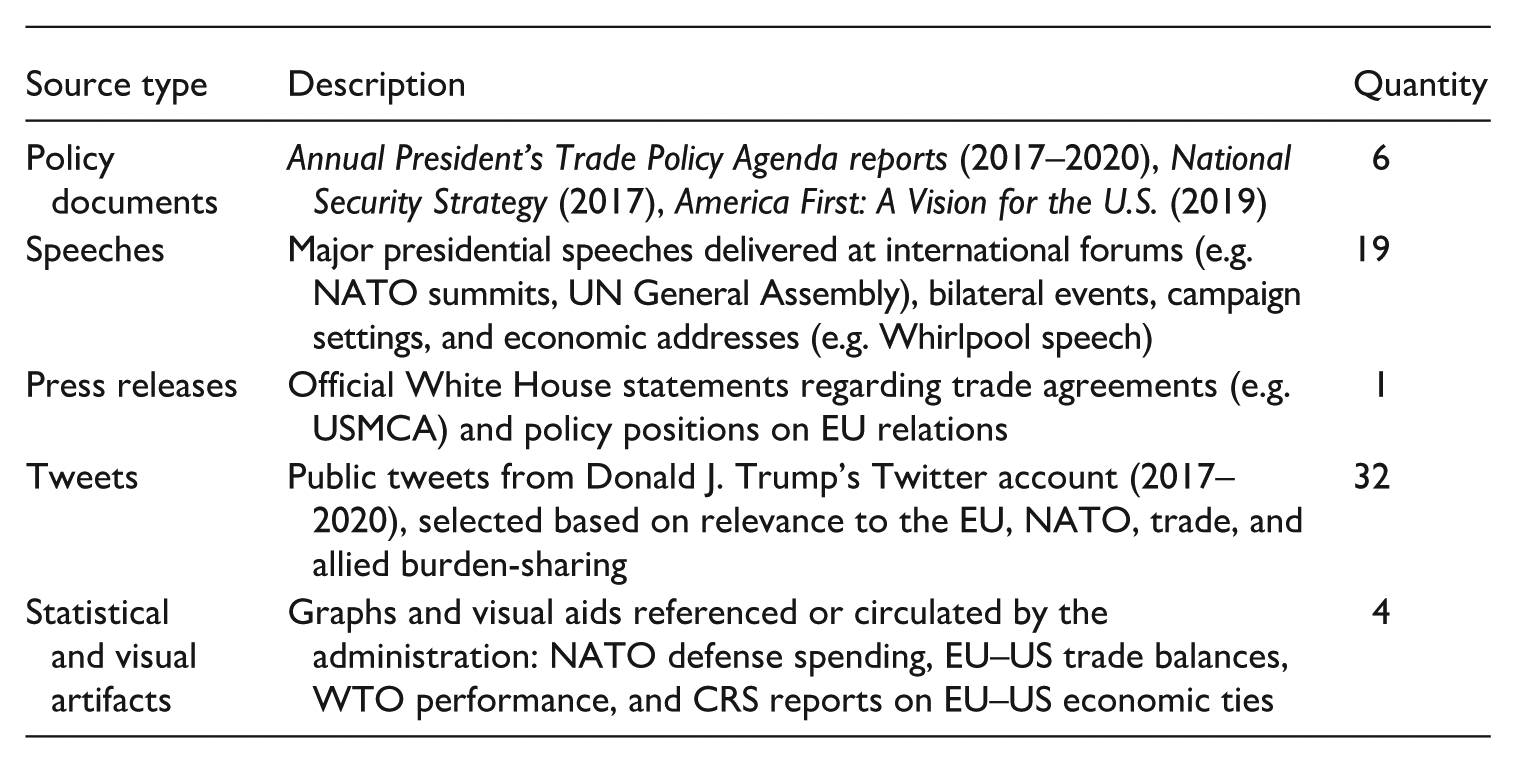
Total corpus: 65 primary texts, from official sources (White House Archives, USTR, @realDonaldTrump, Congressional Research Service).
The analysis followed a manual coding process informed by CDA principles (Fairclough, 1992; Hansen, 2006; Fairclough and Wodak, 1997). No automated software was used. Instead, texts were printed or converted to PDF, annotated, and examined in three iterative stages:
Thematic coding and categorization
Each text was read in full and manually coded for recurrent semantic and rhetorical patterns. Coding was both deductive, guided by the theoretical framework, and inductive, allowing subthemes to emerge from the data. Through iterative comparison, the analysis identified three overarching frames that structured Trump’s discourse on the EU:
Reciprocity and exploitation—grievances centered on trade imbalances, tariffs, market barriers, regulatory fines, and later currency manipulation, all framed as evidence that the EU prospered unfairly at the expense of the United States.
Burden-sharing and NATO delinquency—narratives portraying European allies as defense free-riders or “delinquents,” discursively indebted to the United States and later compelled into compliance under US pressure.
Sovereignty versus supranational control—discourse opposing US independence to the authority of international institutions and “unelected bureaucrats,” with the EU positioned as the archetype of technocratic overreach and supranational governance.
Subthemes were coded inductively within these frames, including distinctions between Germany and the EU as antagonists, the rhetorical fusion of economic and security grievances, and the shift from implicit accusations to explicit enforcement claims over time. This coding process enabled the reconstruction of the discursive trajectory by which the EU was transformed from a background beneficiary of US openness into an explicit and structural rival across the four years of Trump’s presidency.
Self/other positioning
Following Lene Hansen’s (2006) model, the analysis identified the discursive mechanisms through which the United States was positioned as an aggrieved and sovereign “Self” and the EU as an overreaching, parasitic “Other.” This involved tracing
Subject–predicate constructions (e.g. “the EU has taken advantage of us for years”)
Adjectival and metaphorical language (e.g. “delinquent,” “obsolete,” “unfair”)
Narrative structures, including contrasts with “better allies” (e.g. the United Kingdom or Japan)
This enabled a mapping of identity discourses across modalities—especially how economic grievances were fused with strategic alienation.
Intertextual and diachronic analysis
The final stage examined how discursive patterns traveled across textual types (e.g. from speeches to tweets), and evolved over time. Special attention was given to the recurrence of particular tropes (e.g. “freeloading allies”) and the strategic use of data (e.g. NATO graphs) to reinforce claims. This allowed for the reconstruction of broader narrative trajectories and the tracing of shifting rivalry framings (from regulatory disputes to civilizational contrasts).
This article adopts textual plausibility and interpretive coherence as its primary criteria for validity, consistent with post-positivist research in IR. The strength of its claims lies in the systematic patterning of discourse, the transparency of its coding categories, and the intertextual and diachronic mapping of identity construction.
Limitations include the following:
The article does not analyze the reception or contestation of Trump’s discourse (e.g. by EU officials or Congress), which could be addressed in future work.
While the corpus is extensive, it remains bounded to presidential-level discourse. Broader institutional narratives (e.g. from the State Department or Pentagon) were outside the scope.
As with all discourse-analytic research, findings are interpretive rather than replicable—but are grounded in a transparent, evidence-led methodology.
Pre-Trump discursive framing of Europe
This section establishes the discursive baseline against which the Trump-era shift analyzed in the article can be interpreted. Its purpose is not to introduce a second empirical case or a systematic Obama–Trump comparison, but to clarify what changed at the level of meaning, legitimacy, and rhetorical framing. Pre-Trump US rhetoric toward Europe was marked by persistent policy disagreements, yet those disagreements were articulated within a discursive framework that reaffirmed the legitimacy of the EU, NATO, and the transatlantic partnership as such. As several studies emphasize, the Obama administration inherited a transatlantic relationship strained by earlier unilateralism and military interventionism, yet it sought to restore cooperation through rhetorical recalibration rather than institutional redesign (Anderson, 2018; Nielsen, 2013). This recalibration did not eliminate conflict, but it reshaped how that conflict was narrated.
A defining feature of Obama-era discourse was the framing of Europe as a legitimate but occasionally frustrating partner, rather than as a source of exploitation or systemic unfairness. Trade disputes, regulatory differences, and burden-sharing concerns were acknowledged openly, but they were consistently embedded within narratives of shared responsibility and mutual dependence. As Nielsen (2013) notes, the Obama presidency did little to reverse long-term policy drift between the United States and Europe, yet it significantly altered the tone of relations, reducing acrimony and emphasizing diplomatic restraint. Crucially, this change in tone did not imply the absence of disagreement; it reflected a discursive commitment to managing divergence within an accepted partnership framework.
This pattern is also evident in how Obama articulated US leadership and exceptionalism. Rather than invoking a crusading or unilateralist vision, Obama’s rhetoric emphasized what Gorski and McMillan describe as a “prophetic” form of US exceptionalism—one that defined US leadership in terms of example, restraint, and responsibility, rather than domination or exemption from rules (Gorski and McMillan, 2012).
Relatedly, Obama-era discourse consistently upheld the normative legitimacy of multilateral institutions, even when their performance was questioned. Anderson (2018) characterizes the Obama years as marked by “rancor and resilience,” highlighting that disputes with European partners were real and sometimes intense, yet rarely escalated into challenges to the foundations of the Atlantic political order. Importantly, the language of resentment, exploitation, or moral delinquency—later central to Trump’s rhetoric—was largely absent. Criticism was framed as frustration with outcomes or capacities, not as indictments of intent or legitimacy.
This discursive posture was reinforced by Obama’s broader approach to US global leadership. As Hallams (2011) argues, Obama sought to reposition the United States as an “exemplar” rather than a crusader, foregrounding soft power, diplomatic engagement, and multilateral cooperation as sources of influence. In this context, Europe functioned discursively as a key partner in demonstrating the viability of cooperative leadership, even amid economic crisis and geopolitical uncertainty. The EU’s regulatory model, political institutions, and normative commitments were treated as different, and sometimes cumbersome, but fundamentally legitimate.
At the same time, this baseline should not be idealized. Pre-Trump rhetoric did not erase long-standing tensions over burden-sharing, trade, or strategic priorities. Nor did it prevent a gradual divergence in policy preferences, particularly as US attention increasingly shifted toward Asia and the Middle East. What distinguishes the pre-Trump discourse is not harmony, but the grammar of disagreement through which tension was articulated. Conflict was narrated as manageable, correctable, and embedded within an ongoing partnership rather than as evidence of structural exploitation or civilizational incompatibility.
This distinction is analytically significant. As Bonikowski (2016) shows in his analysis of populism as a discursive strategy, populist rhetoric is characterized not simply by criticism of elites or institutions, but by the moralization of conflict and the delegitimation of established actors. In the pre-Trump period, such moralized delegitimation of Europe was largely absent from presidential discourse. Europe could be disappointing, slow, or internally divided, but it was not portrayed as an adversarial force benefiting from US weakness.
Establishing this baseline clarifies what is at stake in the Trump-era shift analyzed in the subsequent sections. The argument is not that Trump introduced conflict into an otherwise harmonious relationship, nor that he overturned entrenched institutional arrangements. Rather, the shift lies in the discursive withdrawal of partnership as a default interpretive frame. By contrast with pre-2017 rhetoric, Trump’s discourse increasingly framed economic exchange, security cooperation, and institutional engagement with Europe as zero-sum, morally asymmetrical, and structurally illegitimate. It is this reconfiguration of meaning—rather than policy divergence per se—that constitutes the core empirical focus of the article.
The discursive construction of the EU as a rival
Reciprocity and exploitation
From the start, Trump positioned “America” as the morally wronged victim of unfair trade relations, with reciprocity as the moral benchmark of justice. In 2017, the emphasis was broad and implicit: the Inaugural Address spoke of wealth “redistributed across the entire world” (Trump, 2017a), while the first address to Congress lamented jobs “exported . . . to foreign countries” (Trump, 2017c). The Trade Policy Agenda 2017 pledged to dismantle “unfair trade barriers” and resist the World Trade Organization (WTO) rulings that weakened US rights (United States Trade Representative, 2017), and the National Security Strategy (NSS) warned that unfair practices had “weakened our economy and exported our jobs overseas” (Trump, 2017b: 1). The EU was not named, but as a central trading partner it was clearly implicated in this reciprocity logic. Finally, Trump’s Twitter interventions in 2017 echoed these themes in a simplified, populist register, branding previous agreements as “the worst deals ever made” (Trump, 2017e). Here, tweets functioned as amplifiers, stripping complex policy arguments down to moral binaries of victim versus exploiter.
By 2018, the EU was explicitly targeted. Trump accused Brussels of “really shut[ting] out our country. . . very high tariffs. . . it’s just not fair” (Trump, 2018f). At the NATO summit, he fused economic and security registers: “our farmers have been shut out of the European Union” even as the United States “pay[s] for the defense of Europe” (Trump, 2018e). The Trade Policy Agenda 2018 listed EU market-access disputes and pledged unilateral action where necessary (United States Trade Representative, 2018). Tweets threatened tariffs on European cars, condemned the EU’s US$5 billion fine against Google, and repeatedly highlighted the EU’s trade surplus with the United States (Trump, 2018a, 2018c, 2018h). The EU was no longer a background actor but was narrated as the prime exemplar of systematic cheating.
In 2019, unfairness claims were scaled up into a systemic indictment. The Trade Policy Agenda declared that the United States had “inherited a deeply flawed global trading system” disadvantaging US firms and highlighted EU negotiations as part of the rebalancing effort (United States Trade Representative, 2019: 2). Tweets extended the unfairness charge beyond tariffs to currency manipulation through euro–dollar policy (Trump, 2019a). In this shift, the EU was not simply a tough negotiator but a manipulator of both markets and money, cast as an actor that distorted the rules themselves.
In 2020, the reciprocity frame matured into enforcement and correction. The Trade Policy Agenda 2020 celebrated “historic” victories against Europe: the WTO’s US$7.5 billion award over Airbus subsidies and US action against France’s Digital Services Tax, denounced as “unfair and discriminatory” (United States Trade Representative, 2020: 1). These cases were framed as proof of the US restoring fairness through strength. Negotiations with the EU remained a listed priority, reinforcing the adversarial cast. Across four years, the EU was repositioned from an unnamed beneficiary of US openness (2017) to an explicit exploiter (2018), then a systemic manipulator (2019), and finally a target of successful enforcement (2020). The moral economy of victimhood was transformed into a narrative of redemption: “American First” validated itself through coercive correction of Europe’s unfair practices.
Across these 4 years, the discourse of reciprocity performed more than a critique of tariffs or regulatory disputes. It articulated a broader identity narrative in which Europe’s prosperity was made intelligible as parasitic upon “American” openness. Earlier scholarship suggests that pre-2016 US–EU trade relations were often cast as manageable irritants to a broadly cooperative relationship (Meunier and Nicolaidis, 2019). Trump’s discourse, however, redefined such irritants as structural wrongs, producing a zero-sum logic in which Europe’s gain was “America’s” loss. This frame also resonated domestically by aligning with populist rhetoric that depicted US workers as victims of globalization (Hall, 2021; Lacatus, 2021). Thus, reciprocity was not just a benchmark but a narrative tool that normalized Europe’s discursive shift from background partner to visible rival.
Burden-sharing and NATO delinquency
A parallel discourse portrayed Europe as failing to meet its defense obligations, casting alliance solidarity as conditional on financial reciprocity. In 2017, this critique was present but muted. The NSS condemned “unfair burden-sharing with our allies” (Trump, 2017b), and the Warsaw speech reminded partners to “shoulder a fair share of the burden” (Trump, 2017d). Tweets about Germany’s low NATO contributions foreshadowed the coming escalation (Trump, 2017f). At this early stage, burden-sharing was presented as an issue of fairness, but the vocabulary remained within the expected parameters of alliance management.
By 2018, the language hardened. At the NATO breakfast with Secretary General Stoltenberg, Trump declared that many allies were “delinquent” because the United States was “paying for them” (Trump, 2018d). The term “delinquent” is a moralized metaphor borrowed from the legal and financial sphere, casting allies not as partners but as offenders and debtors. At the NATO press conference, he fused defense and trade imbalances, arguing the United States was “paying for the defense of Europe” while being treated “very unfairly on trade” (Trump, 2018e). This collapse of domains turned NATO contributions and trade disputes into two sides of the same pattern of exploitation. Tweets quantified delinquency with figures: the United States paying “90% of NATO” and the EU running a US$151 billion surplus (Trump, 2018a). Germany was cast as emblematic of European free-riding, spending only 1% of GDP compared to “America’s” 4% (Trump, 2018b). Here, tweets functioned as simplified audit tools, presenting complex alliance commitments as a ledger of debts and surpluses that morally justified US assertiveness. The narrative shifted from vague unfairness to explicit moral condemnation.
In 2019, the focus was on coercive correction. The “America First” Vision 2019 credited Trump with forcing allies to increase defense spending by more than US$100 billion (Trump, 2019b). On Twitter, Trump portrayed NATO as “very unfair to the United States” and circulated a chart comparing allied defense expenditures, reinforcing the claim that European allies were failing to contribute their fair share (Trump, 2019d). The circuation of visual evidence reinforced the debtor-creditor binary, by portraying NATO burden-sharing as an unequal arrangement in which European allies failed to meet their obligations. NATO delinquency was thus recast as a problem of persistent underpayment requiring U.S. pressure and enforcement.
By 2020, burden-sharing was discursively reframed as a promise kept. The UN General Assembly (UNGA) speech praised NATO as “revitalized,” with others now contributing “a much more fair share” (Trump, 2020d). The delinquency vocabulary of 2018 gave way to a narrative of Trump’s success in compelling Europe to pay. Burden-sharing thus transitioned from critique to evidence that “America First” had delivered tangible results. The NATO frame moved from generalized complaint (2017) to explicit delinquency and exploitation (2018), then to conditional compliance achieved under US coercion (2019), and finally to a narrative of successful correction (2020). Europe was consistently positioned as a dependent debtor forced into alignment by US pressure.
What is significant here is not whether NATO spending actually shifted in the ways Trump claimed, but how his discourse redefined the meaning of alliance solidarity. Whereas earlier US officials and NATO documents emphasized shared values, indivisible security, and collective responsibility (Kaufman, 2017), Trump recast NATO solidarity through the metaphor of a ledger, portraying Europe as a debtor compelled into compliance by US enforcement. In this way, the burden-sharing frame stripped NATO of its normative foundations and reframed it as a transactional arrangement, showing how language alone can destabilize the symbolic basis of alliance politics even without immediate material rupture.
Sovereignty versus supranational control
The third frame revolved around sovereignty and the rejection of supranational authority, with the EU discursively positioned as the archetype of technocratic overreach.
In 2017, the Trade Policy Agenda committed to defending US sovereignty against international organizations (United States Trade Representative, 2017), and the NSS emphasized defending US sovereignty “without apology” (Trump, 2017b: 1). The EU was not named but implicated as a leading actor in the WTO and NATO. In 2018, sovereignty critiques sharpened into direct attacks on technocracy. The Trade Policy Agenda denounced the “activist approach of the Appellate Body” (United States Trade Representative, 2018: 28) and warned that “international bureaucracies to undermine US interests” (United States Trade Representative, 2018: 1). At the UNGA, Trump declared that the United States would always choose “independence . . . over global governance, control, and domination” (Trump, 2018g). On Twitter, the EU’s Google fine was framed as illegitimate bureaucratic punishment of a US firm (Trump, 2018c). The EU was discursively redefined as the exemplar of supranational regulation.
In 2019, sovereignty discourse became an institutional confrontation. The Trade Policy Agenda denounced the WTO’s Appellate Body for “judicial activism” and “seizing more power for itself” (United States Trade Representative, 2019: 6). Trump’s tweet that the “WTO is broken” (Trump, 2019c) encapsulated his delegitimation strategy, with the EU implicitly cast as the leading defender and beneficiary of supranational rule-making.
In 2020, the discourse shifted from critique to rollback. The Trade Policy Agenda pledged to “limit the WTO to its original purpose” (United States Trade Representative, 2020: 3). Enforcement against Airbus and France’s Digital Services Tax (DST) was framed not only as reciprocity but as sovereignty restored—proof that US power could push back against EU overreach. At the UNGA, Trump again rejected “global governance,” while praising NATO allies now paying more (Trump, 2020a). Speeches such as the Made in “America” proclamation and Whirlpool remarks tied economic independence to national sovereignty, reinforcing the opposition between US self-reliance and EU-style integration (Trump, 2020b, 2020c). Sovereignty discourse moved from generalized defense (2017) to explicit attacks on bureaucratic overreach (2018), to institutional showdown with the WTO (2019), and finally to rollback and redesign (2020). Across all stages, the EU functioned as the exemplar of supranational authority, portrayed as illegitimate and corrected through US assertiveness
Across these 4 years, the sovereignty frame repositioned the EU as the embodiment of illegitimate authority. While previous administrations had largely accepted the EU’s regulatory role as part of a cooperative liberal order, Trump’s discourse inverted this logic: Europe’s supranationalism became the foil against which US sovereignty could be affirmed. In discursive terms, the EU served as a proxy for “global governance,” functioning as the symbolic “Other” to “America’s” “independence.” This inversion also illustrates how regulatory power—what scholars describe as the “Brussels effect” (Bradford, 2020)—was recoded from complementary to coercive. Analytically, the sovereignty frame shows how presidential rhetoric can normalize rivalry by casting allied institutions as threats to autonomy, even in the absence of material rupture.
Taken together, the three frames—reciprocity, delinquency, and sovereignty—did not causally transform transatlantic relations but cumulatively legitimized a rival identity for the EU within US presidential discourse. The EU was successively cast as an unnamed beneficiary of US openness (2017), a named exploiter and delinquent (2018), a systemic competitor embedded in unfair and illegitimate structures (2019), and ultimately a foil for “America First” achievements (2020). The analytical significance of this trajectory lies in showing how allied relations can be discursively recoded as rivalries through sustained rhetorical practices. Rather than describing shifts in material policy, these frames demonstrate how discourse can make estrangement plausible and rivalry intelligible in the symbolic domain of foreign policy.
These discursive mechanisms show that the EU’s rival identity was not constructed merely through the accumulation of policy disagreements, but through the rhetorical strategies that redefined those disagreements as systemic, moral, and illegitimate. Metaphors of delinquency and theft produced a moralized language of exploitation; binaries of sovereignty versus supranationalism rendered cooperation as capitulation; and the fusion of economic and security registers expanded the scope of rivalry across domains. Tweets amplified these frames by distilling complex arguments into simplified moral binaries, ensuring their circulation in a register accessible to both domestic and international audiences. Together, these mechanisms illustrate how Trump’s discourse shifted the EU’s position in US strategic identity from flawed partner to enduring rival.
When allies become illegitimate: Discursive erosion of Atlanticism
This article has shown how US presidential rhetoric under the Trump administration discursively reconstituted the EU as a rival, even as the institutional foundations of transatlantic cooperation largely endured. The central implication is that alliance cohesion depends not only on material interests, institutional commitments, and strategic necessity, but also on shared understandings of legitimacy, reciprocity, and collective purpose (Ikenberry, 2018; Olsen, 2022). Presidential rhetoric that repeatedly frames allies as exploiters, delinquents, or illegitimate actors can erode these symbolic foundations without producing immediate institutional rupture. In this sense, the absence of formal breakdown should not be conflated with discursive stability (Blanc, 2024; Riddervold and Newsome, 2018).
The analysis also clarifies that discursive rivalization and material continuity are not contradictory outcomes. Consistent with policy-oriented scholarship, the argument is not that Trump’s rhetoric dismantled alliances or fundamentally altered US–European cooperation during his first term (Ikenberry, 2018; Olsen, 2022; Steff and Tidwell, 2020). Rather, it shows how adversarial discourse can reshape the meaning of cooperation even when institutional arrangements remain formally intact. This is precisely what makes the Trump case analytically significant: it demonstrates how alliance relations can remain institutionally resilient while becoming symbolically more brittle (Fjærtoft, 2019).
From discursive rupture to strategic meaning
This finding carries three implications. First, it underscores the symbolic fragility of alliance legitimacy. Alliances are commonly understood as durable arrangements grounded in shared interests, institutional commitments, and strategic necessity, yet this article shows that they also depend on shared discursive understandings of legitimacy, reciprocity, and partnership (Ikenberry, 2018; Olsen, 2022). When these symbolic foundations are repeatedly undermined, alliances may persist institutionally while becoming politically brittle (Blanc, 2024; Riddervold and Newsome, 2018). Second, the article contributes to research on rivalry by showing that rival identities can be discursively constituted within alliances, not only between established adversaries. Rivalry in this case did not arise from overt material conflict alone, but from identity-based oppositions that rendered cooperation increasingly zero-sum and morally asymmetrical (Colaresi and Thompson, 2002; Dadabaev, 2020; Rumelili, 2004). Third, the article advances debates on populist foreign policy by suggesting that the most durable effects of populist rhetoric may lie less in immediate policy redesign than in the redefinition of who counts as a legitimate partner and on what terms cooperation becomes intelligible (Boucher and Thies, 2019; Hall, 2021; Löfflmann, 2019; Löfflmann et al., 2023; Wehner, 2023; Wojczewski, 2019).
At the same time, the analysis complements scholarship that emphasizes continuity and constraint in US foreign policy. The persistence of NATO commitments, trade interdependence, and institutional cooperation during the Trump presidency underscores the resilience of the transatlantic relationship at the material level (Ikenberry, 2018; Olsen, 2022; Steff and Tidwell, 2020). The contribution here is to show how discursive rivalization can coexist with institutional resilience, helping explain why perceptions of crisis and uncertainty emerged despite limited formal change. Continuity in practice, in other words, does not preclude rupture in meaning. To the extent that similar rhetorical patterns reemerge in later US political discourse, the Trump case should be understood not simply as an episode of stylistic disruption, but as a demonstration of how alliance politics can be recoded in adversarial terms through sustained discursive practices (Löfflmann et al., 2023).
Footnotes
Acknowledgements
An earlier version of this article was presented at the Norwegian Institute of International Affairs (NUPI) conference “Constructivism in an Era of Geopolitics: Social Construction in Turbulent Times.” The author would like to thank Patrick Thaddeus Jackson for comments on earlier versions of the article, as well as the anonymous reviewers for their constructive feedback. The author also thanks research assistant Ioannis Agis Tsimplakis for assistance in collecting the empirical material used in this article.

Funding
The author received no financial support for the research, authorship, and/or publication of this article.
Declaration of conflicting interests
The authors declared no potential conflicts of interest with respect to the research, authorship, and/or publication of this article.