







Abstract
The total is based on combined estimates from the American Society for Training and Development and the International Association of Conference Centers.
Increased competition and more-demanding customers that careful consideration must be given to the facilities and services provided during meetings, conferences, and training programs. The purpose of the study we discuss in this article is to identify the physical and service-related characteristics of properties that may have an important impact on program and meeting effectiveness. The results should enhance our understanding of the factors customers use to evaluate the quality of the products and services that are offered by hotels and conference centers, and provide guidance for redesigning facilities and revamping services.
Services, Products, or Both?
As is the with many hospital industry transactions, the meeting business combines intangible service with tangible products and facilities. A substantial amount of research conducted in re-cent years has attempted to assess the differences between service and nonservice organizations. Two findings are particularly germane to the current study. First, from a customer's perspective, all purchases comprise varying degrees of product and service components, whether it is the purchase of an automobile or consuming a take-out dinner. 2 Customers differentiate two major components of a transaction—the commodity portion and the activity portion—and those are each evaluated differently. The activity portion of the transaction seems to be critical to customer satisfaction. Research in the banking industry, for example, has found that many otherwise satisfied customers are unhappy with some nonhuman aspects of their banks. This finding suggests that human contact is a critical determinant of customer satisfaction in some service firms and that satisfaction with human interaction may overcome other technical problems.
This discussion is an assimilation based on research by H. Shams and C. Hales, “Once More on ‘Goods’ and ‘Services’: A Way Out of the Conceptual Jungle,” Quarterly Review of Marketing, Vol. 14, No. 3 (Spring 1989), pp. 1-5; J. Cronin and S. Taylor, “SERVPERF versus SERVQUAL: Reconciling Performance Based and Perceptions Minus Expectations Measurement of Service Quality,” Journal of Marketing, Vol. 58 (1994), pp. 125-131; J. Barsky and R. Labagh, “A Strategy for Customer Satisfaction,” Cornell Hotel and Restaurant Administration Quarterly, Vol. 33, No. 5 (October 1992), pp. 32-40; C. Reeves, D. Bednar, and R Lawrence, “Back to the Beginning: What Do Customers Care about in Service Firms?,” Quality Management Journal, Vol. 3, No. 1 (1995), pp. 56-72.
The second important research finding is that customers distinguish the concept of “service quality,” a global evaluation of an entire service encounter, from “customer satisfaction,” which is related to specific, discrete transactions. These individual transactions then have a cumulative effect on the overall evaluation of service quality. Some aspects of the service encounter are going to be more salient and important to each individual customer, and must be satisfied if the over-all impression is to be positive. In addition, first and last transactions will have a disproportionately strong impact on overall perceptions of service quality due to attribution errors caused by first impressions and recall of most recent events. 3 Exhibit 1 illustrates these concepts.
Service-quality priority continuum
Attribution errors are discussed in detail in: Attribution: Perceiving the Causes of Behavior, ed. E. Jones, D. Kanouse, H. Kelley, R. Nisbet, S. Valins, and B. Weiner (Morristown, NJ: General Learning Press, 1979).
All purchases lie on a continuum with service at one extreme and product at the other. The customer determines the location on this continuum of a given purchase based on perceptions of the relative importance of the service and non-service aspects of that purchase. The purchase includes a number of individual transactions of varying importance that in aggregate constitute the entirety of that purchase. The extent to which these transactions prove satisfactory affects the customer's perceptions of overall service quality. For example, the purchase of an automobile might lie toward the product-oriented end of the continuum due to the importance of tangible features, but buying a car still includes many service attributes that can be relevant to the purchase decision. Thus, the customer could love the car but dislike the dealer (or the other way around). In contrast, the customer's view of an automobile rental would primarily be based on the service aspects of the transaction, even though the customers final verdict on this transaction would still take into account the physical attributes of the car being rented. In a hotel setting, the activity transactions that constitute an individual's perceptions of service quality might be arrival, check-in, courtesy of wait-staff, and check-out, while the commodity aspects might be the room itself, the view, hotel policies, room cleanliness, and food quality. The selection and weighting of each of these transactions varies from customer to customer and expectations will differ at various types of properties and price points. In this study we will examine both the activity and commodity aspects of service quality for meeting facilities.
Lewis Phillips, Making Meetings Work: An Analysis of Corporate Meetings (Dallas: MPI Foundation, 1998).
Human contact is a critical determinant of customer satisfaction, and when customers are satisfied with the human interaction, they may be forgiving of other problems.
Previous Hospitality Research
In one of the few prior attempts to understand the factors that are important to meeting effectiveness, Renaghan and Kay conducted a study to assess the characteristics meeting planners use to select a meeting facility. 5 Based on a qualitative, deductive process, the authors identified a list of five general, facility-related characteristics that deemed to be critical for an effective meeting. These five factors included the size of the meeting room, the location of breakout rooms, the complexity of the audio-visual equipment, the control of lighting and climate, and price. Then, the authors developed 16 distinctive combinations of these five characteristics and asked a sample of meeting planners to indicate on a scale of 0 to 100 how likely they would be to book a meeting in a conference center that offered these characteristics. The higher the rating, the more likely the meeting planner would be to book the meeting. Using conjoint analysis, Renaghan and Kay found that meeting-room size and location of breakout rooms were the most important characteristics for booking meetings, followed by price, AV, and climate and lighting. They further determined that with respect to controlling AV, climate, and lighting the meeting planners expressed concerns about the competence of the staff.
L.M. Renaghan and M.Z. Kay, “What Meeting Planners Want: The Conjoint-Analysis Approach,” Cornell Hotel and Restaurant Administration Quarterly, Vol. 28, No. 1 (May 1987), pp. 67-76.
Other studies’ results suggest that there are distinct, identifiable categories of attributes that have a potential effect on customers’ overall perceptions of service quality.
Several related studies have attempted to define the possible criteria by which facilities and services may be evaluated. For example, the widely used SERVQUAL instrument was developed to measure service quality and has been used in several hospitality settings. 6 SERVQUAL assesses five dimensions of service quality: tangibility, or the physical appearance of facilities, personnel, and equipment; reliability in performing the service dependably and accurately; responsiveness in providing prompt service; assurance, or the ability to convey trust and confidence; and empathy, the individualized attention provided to customers. Studies using the SERVQUAL instrument have repeatedly shown that the two most important dimensions in a transaction from a customer perspective are reliability and responsiveness. This finding suggests that these service attributes are important in shaping perceptions of overall service quality and helps provide a general framework for the current study.
A. Parasuraman, L. Berry, and V. Zeithaml, “Refinement and Reassessment of the SERVQUAL Scale,” Journal of Retailing, Vol. 67, No. 4 (1991), pp. 420-450.
In a similar stream of research, Oberoi and Hales attempted to identify factors that influenced customer satisfaction with conference hotels in England. 7 Based on interviews with 30 conference organizers, the researchers identified 54 attributes that might affect customer satisfaction. The attributes included items such natural daylight in meeting rooms, competitive rates, food quality, clear signs and property information, swimming pool, and immediate response to requests. They then determined that these 54 attributes could be categorized into four primary components describing the service encounter: facilities (16 items), catering (6 items), pricing (7 items), and activities (25 items). A group of meeting and conference organizers was then asked to rate the importance of the 54 attributes of conference hotels. Six of the ten highest-rated attributes were related to the competence and responsiveness of staff, while two of the other four top-ten responses, food quality and cleanliness of facilities, were also greatly affected by staff members’ activities. (The remaining two top-ten responses were comfortable seating and comfort of accommodations.) Further analysis revealed that attributes tended to cluster into two general dimensions reminiscent of the continuum we introduced in Exhibit 1: service (functional) and physical (technical) attributes. Oberoi and Hales then administered the same questionnaire to conference participants to assess their satisfaction with a meeting experience. They found that the evaluation of the functional attributes was strongly related to perceptions of overall service quality, while the technical attributes were unrelated to service-quality perceptions.
U. Oberoi and C. Hales, “Assessing the Quality of the Conference Hotel Service Product: Towards an Empirically Based Model,” Service Industries Journal, October 1990, pp. 700-721.
The results from these and other studies discussed earlier suggest that there are distinct, identifiable categories of attributes that have a potential effect on overall perceptions of service quality. Further, this research has found that the functional, or service, component of the transaction is more strongly related to overall perceptions of service quality than is the technical, or tangible, component.
The Current Study
The current study may be viewed as an extension of the work by Oberoi and Hales in that it adopts a similar methodological approach. However, our focus is not on overall customer satisfaction but on identifying a comprehensive set of service and nonservice factors viewed to be the most important attributes provided by meeting facilities in the United States. In addition, our study extends and complements that conducted by Renaghan and Kay by considering a much broader set of factors, including those associated with service elements, and uses data from multiple customer groups, including meeting planners, training professionals, and meeting participants (i.e., trainees).
We conducted the study in three phases. The first phase involved two separate focus groups—one with meeting planners and one with trainers—to identify the factors that might be important to meeting and program effectiveness. For the second phase, we administered a survey to executives and managers who regularly schedule meetings and programs at various facilities to examine the importance of the characteristics identified in Phase 1. The third phase was a replication of Phase 2, this time, however, using data collected from participants in a training program.
Phase 1: Two focus groups
We conducted one focus group at a conference center in Atlanta and another in Houston. The Atlanta group comprised six participants, while the Houston group had seven individuals. Participants’ titles included meeting planner, training director, and trainer. The focus groups’ purpose was to identify those factors that the participants felt had potential bearing on the effectiveness of meeting and program activities. The open-ended discussions lasted approximately six hours each, and at the conclusion we administered a short questionnaire to obtain summary data. The two groups identified over 200 salient factors that influence meeting effectiveness, but by independently sorting the factors we reduced that list to 50 items. Our sorting, which eliminated redundancy yet retained items that were similar in nature, resulted in nine inductively derived categories. Those are: guest rooms, public area, security, food and beverage, staff, meeting rooms, convenience, recreational amenities, and price and billing. The 50 items in nine categories became the basis for the questionnaire we used in the second and third phases of the study.
It is clear that these respondents felt that safety and security were of utmost importance, a finding that is consistent with surveys of business and leisure travelers.
Phase 2: 50 items
Training magazine provided the authors a mailing list of meeting planners and human-resources professionals. A random sample of 76 respondents completed the survey with the 50 items identified in Phase 1. The survey was accompanied by a cover letter describing the purpose of the study. We collected demographic information about the respondents and assured them of their anonymity. Exhibit 2 (on the next page) presents the 50 items and the mean rating for each divided into critical, moderate, and low importance. (This was done subjectively, using discontinuity and a distribution of the means for each item. The means for each category differed at p < .05.)
Critical aspects of a meeting, as judged by meeting planners

From this analysis it is clear that these respondents felt that safety and security were of utmost importance, a finding that is consistent with surveys of business and leisure travelers. 8 The other factors of critical importance fall into four major categories: cleanliness of facilities, competence of staff, sensory attributes of meeting space (e.g., temperature), and accuracy and efficiency of billing procedures. Of moderate importance are food and beverage, convenience, and physical attributes of the meeting space. Those attributes judged to be of lowest importance include complete meeting packages, décor, and amenities.
For example, a 1998 study by the Travel Group/Total Research Corporation of 216 women business travelers found that the main concern was a need for personal safety. See: Glenn Withiam, “Studying Women Business Travelers,” Cornell Hotel and Restaurant Administration Quarterly, Vol. 39, No. 4 (August 1998), p. 8.
Phase 3: 80 employees.
The third phase of the study involved 80 employees of a large transportation firm who were participating in a management-development program at a southeastern-U.S. conference center. About three weeks before the program began, we gave trainees a questionnaire asking them to rate the importance of the items described in Phase 1. Dropping price and billing items, we retained for analysis 43 items that related specifically to meeting facilities and services. Those results are presented in Exhibit 3. These items were assessed using a seven-point scale because these data developed as part of another research project.
Critical aspects of a meeting, as judged by participants
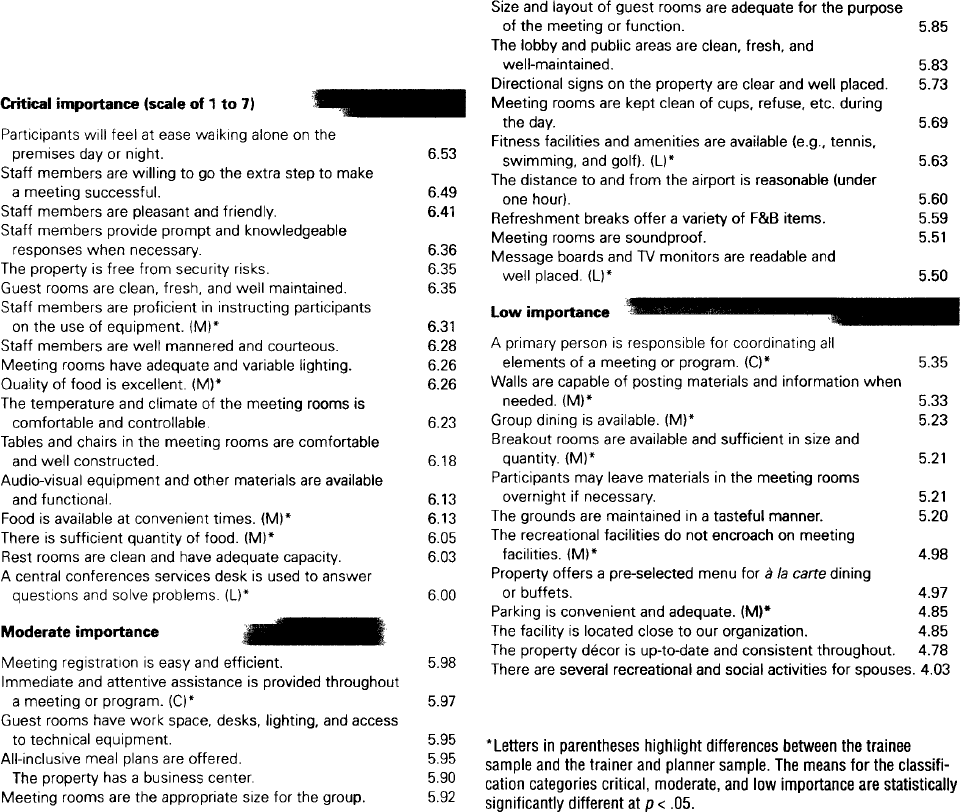
Letters in parentheses highlight differences between the trainee sample and the trainer and planner sample. The means for the classification categories critical, moderate, and low importance are statistically significantly different at p < .05.
Many of the items rated important by the meeting participants were also rated high by the meeting planners (Exhibit 2). Like the planners, the trainees viewed safety and security as critical, as well as cleanliness, competent staff, and sensory attributes of the meeting space. Unlike the meeting planners, however, the people who attended the meeting considered food and beverage to be a critical factor. Those attributes judged by the trainees to be of moderate importance virtually mirrored the planners’ results from sample one, with only three exceptions. On the other hand, the trainees gave low ratings to several points that the planners considered highly important. The most notable difference was the trainees’ lack of concern about having one primary person responsible for coordinating the meeting, which was judged to be critical by the meeting planners.
For the final analysis, we combined each of the items associated with the nine original categories and computed overall mean scores to compare the category ratings across the two groups. Remember that items relating to pricing and billing were included only in the questionnaire sent to meeting planners. The results from the two samples are strikingly similar, with security, staff, sensory attributes of meeting rooms, and guest rooms rated in the top four; food and beverage and physical attributes of meeting rooms rated in the middle; and convenience, public and amenities rated the lowest. Pricing and billing was rated in the middle by meeting planners. Applying these results to the model presented in Exhibit 1, one could conclude that the meeting purchase lies slightly to the right of center, or toward service, on the product-service continuum. Security, staff, sensory attributes of meeting rooms, and quality of guest rooms are rated as the most important aspects of overall service quality, and should receive the most attention from management. Décor of the public areas and recreational amenities were rated as least important by both groups of respondents. Exhibit 4 presents a list of all items’ ratings by category, while Exhibit 5 presents a summary of the ratings, ranked by category.
Comparison of results between meeting planners and participants
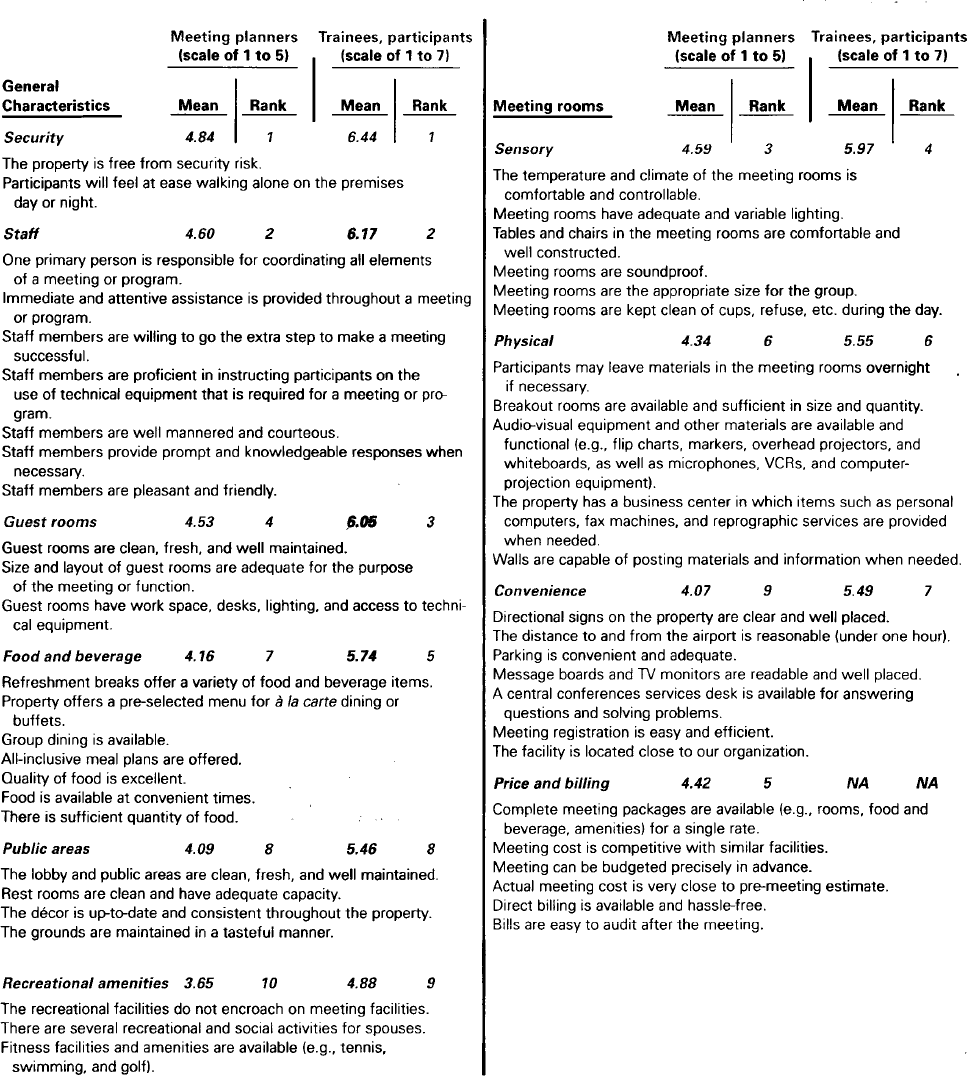
Comparison of importance rankings for meeting planners and participants

Service Is the Controlling Factor
The purpose of this study was to identify a comprehensive set of physical and service-related characteristics of properties that may strongly influence program and meeting effectiveness. Several of our findings should assist managers of convention properties in better allocating their resources to meet the expectations of their customers. First, safety and security were judged to be of critical importance by both meeting planners and trainees. Security should be a given, so that guests do not have to be concerned about their personal safety. While many meeting facilities are in reasonably safe locations, those facilities located in vicinities where crime might be an issue must make their property secure and ensure that their marketing message reinforces that safety message. Indeed, all properties need to pay attention to their guests’ personal safety.
Second, the service provided to two different customer groups may have a stronger influence on overall perceptions of service quality than do the facilities. As Renaghan and Kay demonstrated, physical characteristics have a large influence on site decisions for meeting planners. They also found, however, that the most frequent problem faced by meeting planners had nothing to do with the facility itself but rather with a lack of staff competence. The findings of prior research and of our study likewise provide strong evidence that appropriate staffing is critical to meeting success. Sales people who possess an understanding of meeting logistics and the training function provide great benefits to the customer and, for meeting planners, having one primary contact person is perceived as having high importance. A responsive and knowledgeable staff, especially in the area of technology, is also viewed as beneficial. Initial contact and final interaction are going to play a major role in shaping a customer's overall perceptions of service quality. This information has major implications for accounting and sales and marketing, as well as for front-office operations.
Finally, the responses on individual items from the two different samples varied somewhat. It is crucial to understand that the attributes of greatest importance to the meeting planner (during the sales transaction) are somewhat different from the most important factors for those participating in the meetings.
Our findings amend and validate previous research in both conference hotels and other service industries. Our results add strength to the argument that human elements may be of greater importance than are physical attributes for meeting facilities, and the way the property functions may be more important than the way it looks. Perceived service quality is the inextricable combination of a number of discrete human and nonhuman transactions, which vary in importance to the customer. As such, it is imperative to understand which attributes of the overall service encounter the customer deems to be critical and ensure that expectations for those attributes are met. This is a necessary precondition to successful programs.
Every resource-allocation decision regarding meeting facilities is important. We hope that this study will help managers make decisions that meet and exceed the expectations of their customers and provide an overall positive meeting experience from beginning to end. ■