







Abstract
After they learned exploration skills, 103 undergraduate helping skills students were taught to use challenges. Prior to training, students’ self-efficacy for using challenges did not change, although the quality of written challenges and reflections of feelings did. After training, students rated themselves as having more self-efficacy for using challenges and were judged as providing better written challenges, although there were no further changes in quality of written reflections of feelings. Students maintained self-efficacy for using challenges at a 5-week follow-up. Self-efficacy for using challenges increased after lecture, modeling, written practice, and lab group practice, but students indicated that practice was the most helpful training component. Natural helping ability predicted higher final levels of self-efficacy for using challenges. Qualitative results indicated that cultural background played a role in learning and using challenges.
To raise client awareness of unresolved conflicts, ambivalence, suppressed feelings, or defenses, therapists may use challenges, such as pointing out maladaptive beliefs, discrepancies, or contradictions (Hill, 2009). The rationale for challenging is to make clients aware of unrecognized feelings or behaviors that cause disruptions in their lives (e.g., anger leaking out as sarcasm and negatively affecting relationships). Awareness is thought to be preliminary to insight and change, such that clients need to become aware of their actions and feelings before they can gain insights into the origins of such behaviors and feelings, and then make changes in these behaviors and feelings.
Challenges are typically taught in the Hill (2009) three-stage (exploration, insight, action) helping skills model as part of the insight stage; hence, students are first taught the exploration stage, whereby they listen empathically and encourage clients to delve into their thoughts and feelings. They use this time to build rapport and help clients feel comfortable exploring.
After spending several weeks learning exploration skills, it can be quite daunting for students to shift focus and learn to challenge clients at the beginning of the insight stage. For example, Hill et al. (2008) found a drop in self-efficacy when students began learning insight skills. Students may worry about disrupting the therapeutic alliance or causing harm to clients due to the perceived confrontational nature of challenges. Trainees seem to have difficulty thinking about how to challenge clients in a manner that is gentle, supportive, and direct. Thus, training is crucial to help beginning trainees learn to use this complicated skill therapeutically.
Outcomes of Training Students to Use Challenges
In addition to changes in self-efficacy for using challenges, as was discussed in the overview paper (Hill, Spangler, Chui, & Jackson, 2014), we speculated that training would also have effects in other domains. Specifically, in this study, we hoped to assess the trainee’s ability to produce a challenge. Accordingly, as has been done in previous studies (see review in Hill & Lent, 2006), we asked students before and after training on challenges to write a challenge and a reflection of feelings in response to a written client vignette. These written statements were then evaluated for quality by trained judges who were unaware whether responses were written pre- or post-training. Although not indicative of whether students could implement challenges in sessions with actual clients, we thought this exercise would allow us to determine whether students had learned how to formulate a challenge and whether they changed more in their ability to use challenges than they did in ability to use reflection of feelings (an exploration skill that was taught in the first half of the semester) during training in challenges.
Purposes of the Present Study
Our first purpose in the present study was to evaluate whether students changed in self-efficacy for using challenges, quality of written challenges, and quality of written reflections of feelings following training in exploration skills (including reflections of feelings). Our second purpose was to examine whether students changed in self-efficacy for using challenges, quality of written challenges, and quality of written reflections of feelings following training in challenges. Our third purpose was to assess whether students would change in self-efficacy for using challenges during the remainder of the semester (during which they received training in other insight skills and in action skills). Our fourth purpose was to test the effectiveness of components of training (instruction, modeling, practice). We included three types of practice: writing challenges in response to video stimuli during the lecture class, group practice during the lab class (where the group leader played a client and trainees responded as helpers), and dyad practice (where a helper worked with a classmate who was playing a role designed to elicit a challenge). Another method we used for assessing the effects of the various components of training involved asking trainees to rate the various components after all the training for challenges was completed. We based this quantitative assessment on the qualitative results from Spangler et al. (2014) about what trainees found to be the most and least helpful components of training. We also asked the students to write a narrative account so that we could gain a richer understanding of their experiences learning the components. Our final purpose was to assess whether we could predict who might respond positively to training; hence, we investigated initial self-efficacy for challenge, prior helping experiences, attitudes toward learning helping skills, and natural helping ability in relation to final level of self-efficacy for using challenges and changes in self-efficacy for using challenges.
Method
Participants
Instructors
There were four (three advanced doctoral students, one PhD with 35 years of teaching and research experience) European American female instructors, all in counseling psychology. Doctoral student instructors had been teaching assistants for the course between 1 and 6 times, and one had instructed the course 3 times. Using a 9-point scale from 1 (not at all) to 9 (completely), instructors reported that they believed in the Hill model of helping skills an average of 8.50 (SD = 0.58). They also reported, using a 5-point scale from 1 (low) to 5 (high), the degree to which they believed in and adhered to the techniques of a psychoanalytic/psychodynamic orientation (M = 4.50, SD = 0.58), to a feminist/multicultural orientation (M = 3.75, SD = 0.96), to a humanistic orientation (M = 3.50, SD = 0.58), and to a cognitive–behavioral orientation (M = 2.00, SD = 1.41).
In addition, 11 individuals (8 females, 3 males; 8 European American, 2 Latino/a, 1 of Asian origin; 6 doctoral students, 5 undergraduate seniors), all of whom had taken at least one helping skills course previously, served as lab leaders or graduate teaching assistants. Using the same scales reported in the previous paragraph, they reported the degree to which they believed in the Hill model of helping skills (M = 7.45, SD = 0.52), a humanistic orientation (M = 4.09, SD = 0.70), a feminist/multicultural orientation (M = 3.91, SD = 0.94), a psychoanalytic/psychodynamic orientation (M = 3.55, SD = 0.69), and a cognitive–behavioral orientation (M = 3.09, SD = 1.14).
Students
Of the 129 students enrolled in four course sections of helping skills, 2 dropped the class, 2 did not provide consent for using the data, 9 did not attend the full lecture on challenge, 5 did not attend the lab on challenges, 7 had a non-standard lab experience due to lab leader lateness and non-compliance with research procedures, and 1 did not complete the reflection paper (i.e., did not provide qualitative results). Thus, data from 103 students were included in the present analysis. Of the students who provided consent, included and excluded participants did not differ in age, natural helping ability, prior helping experiences, or attitudes towards learning helping skills.
The 103 participants (83 females, 20 males; 73 European American, 8 African American, 8 of Asian origin, 6 Latino/a, 1 Native American, 7 “other” or not reported; 88 seniors, 15 juniors) were all upper-level undergraduate psychology majors. Their average age was 21.61 (SD = 2.74 years). All students had taken several prerequisite courses (e.g., introductory psychology, statistics). In addition, 74 (71.8%) were currently taking or had taken either or both Introduction to Counseling Psychology and Introduction to Clinical Psychology. Participation was voluntary and anonymous (i.e., although tasks were all requirements of the course, students gave informed consent to have their data used for the research study). Students were informed that participation in the study, including their ratings of skills use and self-efficacy, would have no bearing on their grades in the course.
Judges
Five of the authors of the present study served as judges for the qualitative data. One was a professor and four were advanced doctoral students. Two other advanced doctoral students and co-authors served as raters for students’ quality of responses to written vignettes.
Measures
We used the demographic form, the Prior Helping Experiences (PHE), Attitudes Toward Learning Helping Skills (ALHS), Natural Helping Measure (NHM), and the Self-Efficacy for Challenges (SEC) measures as described in the overview paper (Hill, Spangler, Chui, & Jackson, 2014). As described next, we also used some new measures for the present study.
Challenge reading quiz
A quiz was created for this study to assess the extent to which trainees read and understood the assigned reading for the study. The multiple-choice quiz included eight items, with one correct answer for each item (score could range from 0 to 8). An example item is as follows: “Which of the following statements is true of challenges? (a) they are all related to pointing out negative aspects a client is not ready to face, (b) they can help a client gain insight, (c) they are appropriate for all clients, and (d) they are mostly appropriate in the exploration stage” (correct answer: B).
Quality of intervention
The quality of interventions was assessed by students’ written responses to written clinical vignettes. Three client vignettes (vignettes A, B, and C), of approximately equal length and difficulty, were created for this study. An example is:
I recently broke up with my partner of 2 years . . . I thought everything was going so well and then right after Thanksgiving he broke up with me. I was so completely shocked. I had built my life around him, moving down here and all. I just don’t know what to do with myself. My grades have been falling because I just can’t seem to concentrate, and I have been staying away from friends who I used to enjoy hanging out with. I’m not sure why this bothers me so much given that I told him that I didn’t want a permanent relationship, and I was kind of planning on breaking up with him sometime soon.
Students wrote a reflection of feelings and a challenge, after being provided with definitions of these skills:
A reflection of feelings is defined as repeating or rephrasing of the client’s statements, including an explicit identification of feelings. A challenge is defined as pointing out maladaptive thoughts, discrepancies, or contradictions of which the client is unaware, unwilling, or unable to change.
Each reflection and challenge was scored by two judges on a 3-point scale, where 2 = responses that met the definition of the intervention and were considered therapeutic (e.g., reflection of feeling: “So it seems like you are surprised and almost devastated that he broke up with you;” challenge: “Your actions seem to be contradicting your thoughts.”), 1 = responses that did not meet the definition of the intervention fully or were not quite as therapeutic (e.g., reflection of feeling: “Okay, so it sounds like this guy broke up with you and you are upset even though you were going to break up with him soon anyway. Is that correct?;” challenge: “It sounds like you were surprised that your boyfriend broke up with you. However, you said that you were planning on breaking up with him soon. Do you think you would have felt the same way had you broken up with him?”), and 0 = responses that did not meet the definition or were not considered therapeutic (e.g., reflection of feeling: “I recently broke up with my partner of 2 years. . . I’m feeling depressed. It does bother me, but I don’t want to show it so I’m telling people I was planning on breaking up.”; challenge: “You were planning to break up with him; you should have been prepared for life without him. Are you sure your break up is the real reason for your anxiety?”). Intraclass correlation coefficients between the ratings given by the two raters for reflection of feelings and challenges were .77 and .70, respectively, evidencing adequate inter-rater reliability. The average score between the two raters was calculated for subsequent analyses.
Ratings of components of training
Trainees used a 5-point scale from 1 (strongly disagree) to 5 (strongly agree) to indicate the helpfulness of each of the following components of training: reading, lecture/discussion, videos, written practice to vignettes, practice in the lab group, and participation in the dyad exercise in lab. Trainees also wrote narratives about how each component was helpful or unhelpful.
Procedures
During the lecture class in the third week of the semester, in addition to the common core of measures completed in all three studies (see overview paper), students completed the initial SEC-1. They were also given definitions of reflections of feelings and challenges and asked to write a reflection of feelings and a challenge to a vignette (one third of the students in each class were assigned to Vignette A, one third to Vignette B, and one third to Vignette C).
At the end of the lecture on exploration skills during Week 7, students completed the SEC-2 and wrote a reflection of feelings and a challenge to a different vignette than they had at the beginning of the semester. Students were then assigned to read the chapter on challenges (Hill, 2009) and informed about the quiz.
At the beginning of the next lecture class (Week 8), students took the quiz and completed SEC-3. They then participated in a lecture/discussion about challenges, after which they completed the SEC-4. Next, after watching and discussing reactions to three taped vignettes (Hill & O’Brien, 1999) of expert therapists using challenges, students completed the SEC-5. Students then listened to four client vignettes read by a narrator on a video and wrote a challenge. Several students shared their challenges in class and then completed the SEC-6.
At the beginning of the lab class two to five days later, students completed the SEC-7. They then had a 45-min group exercise in which the lab leader role-played the client in a standard scenario so that trainees could take turns practicing exploration and challenge skills; trainees then completed the SEC-8. Finally, trainees were paired with a classmate for a dyad exercise. In the first 20 min, one student played the role of a client based on a case scenario, and the other student played the helper and tried to use exploration skills and at least one challenge. They switched roles, using a different scenario. Case scenarios were used to increase the likelihood that the client would present discrepancies that could be challenged. After the dyad exercise, trainees completed the SEC-9 and wrote a reflection of feelings and challenge to a different vignette than they had earlier in the semester.
After the lab on challenges, students rated the helpfulness of the components of training. They also wrote a narrative about what they liked and disliked about each of the components, wrote suggestions for how training for challenges could be improved for future courses, and wrote about how their personal background (e.g., family, gender, culture, social class, religion) influenced, either positively or negatively, their ability to use challenges in a helping situation. Students submitted this ungraded, required paper to their instructor via e-mail prior to the start of the next lecture. In the final week of the class (Week 14), trainees completed SEC-10.
Quality of interventions ratings
Two judges read 30 of the students’ written reflections of feelings and challenges to establish criteria for rating quality. Once they had adequate inter-rater reliability (α > .70), they independently rated all the responses, with no awareness of which were written at the three different time points.
Results
Quantitative Results
Table 1 shows the inter-correlations, means, and standard deviations for variables used in the study. The correlation between SEC-1 and initial quality of the written challenges was not significant, nor were changes in SEC significantly related to changes in quality of written challenges; hence, it appears that the two outcome measures (self-efficacy and quality of written responses) were not related and, thus, will be treated as separate outcomes.
Inter-Correlations, Means, Standard Deviations, and Sample Size for Variables in the Study.

Note. SEC = Self-Efficacy for Challenge; QC = quality of challenge; PHE = Prior Helping Experiences; ALHS = Attitudes Toward Learning Helping Skills; NHM = Natural Helping Measure; S9 − S2 = change in self-efficacy for using challenge after training; QC3 − QC2 = change in quality of challenge after training.
p < .01. **p < .001.
Effectiveness of Training
Changes in self-efficacy
Figure 1 shows the ratings of self-efficacy for using challenges across time. Hierarchical linear modeling (HLM) analyses were conducted to test the effects of changes in self-efficacy for using challenges across the different time points to determine the effects of the different training components (see overview paper for details of the analyses). The results showed a significant overall linear growth of self-efficacy for challenge over time, t(102) = 15.13, p < .001; linear slope, β = .42, whereas the quadratic and cubic growth curves were not statistically significant. Thus, there was evidence for the overall effectiveness of training. Testing of instructor effects on the intercept and linear growth of self-efficacy for challenges by entering instructor as a Level 2 predictor variable showed non-significant results, χ2(2) = 4.26, p = .12, suggesting that differences in instructors did not contribute significantly to student change in self-efficacy for using challenges in this sample.
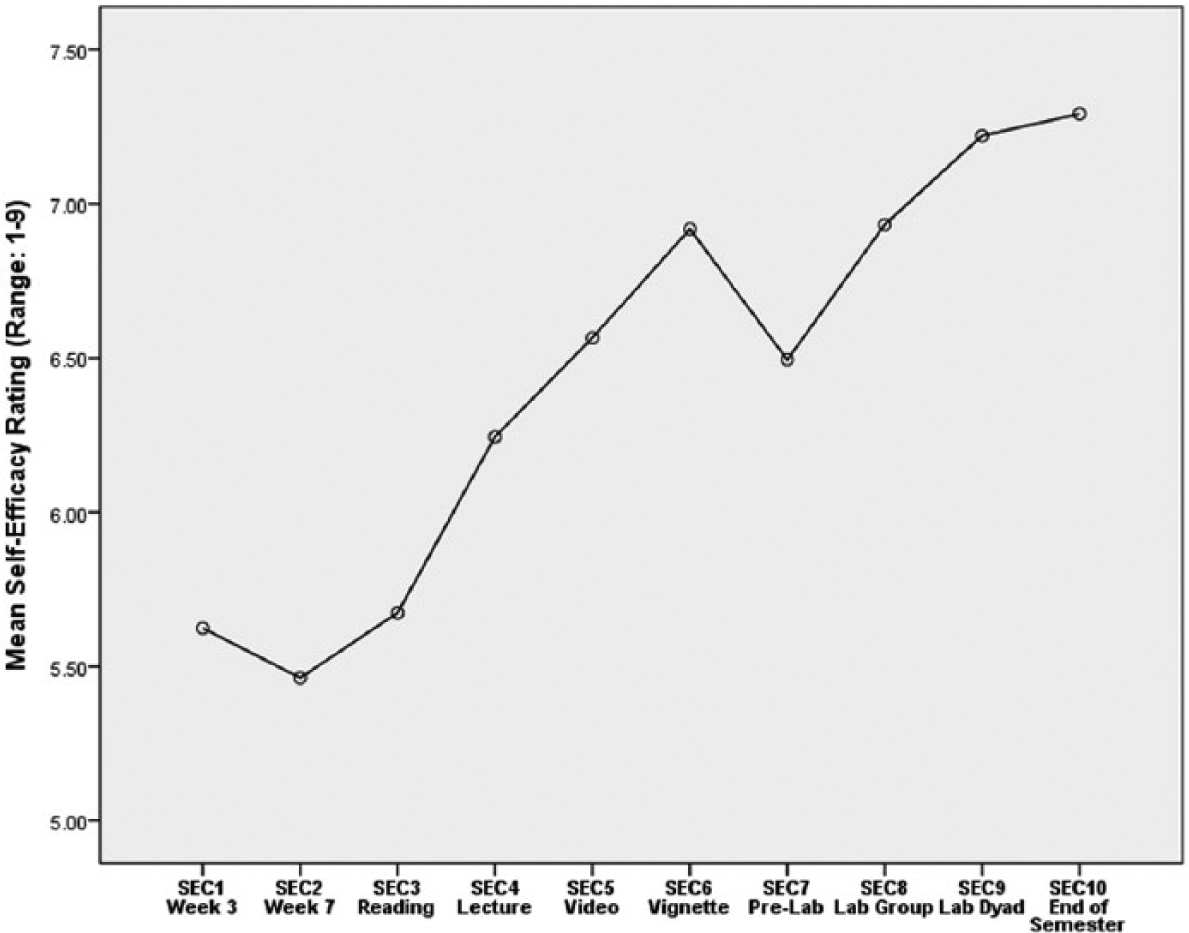
Changes in self-efficacy for using challenges across time.
Changes in quality of challenges and reflections
Figure 2 shows the changes in quality ratings of participants’ written challenges in comparison with their written reflections of feelings to written client vignettes at three time points over the course of training. Repeated measures ANOVA showed a significant overall change in the quality of written challenges, F(1.91, 187.54) = 61.30, p < .001, after applying a Huynh–Feldt correction for the violation of sphericity assumption. Pairwise comparisons with a Bonferroni-adjusted alpha of p < .001 indicated that quality of challenge increased significantly from the start of the semester to post-exploration training, and also from post-exploration training to post-challenge training. The quality of reflection of feelings also changed significantly overall, F(1.24, 121.18) = 25.87, p < .001, after applying a Greenhouse–Geisser correction for the violation of sphericity assumption. However, pairwise comparisons with a Bonferroni-adjusted alpha of p < .001 showed that the quality of reflection of feelings increased significantly from the start of the semester to post-exploration training, but not from post-exploration to post-challenge training. Thus, students improved in both reflections and challenges during exploration skills training, but only improved in challenges after training on challenges.
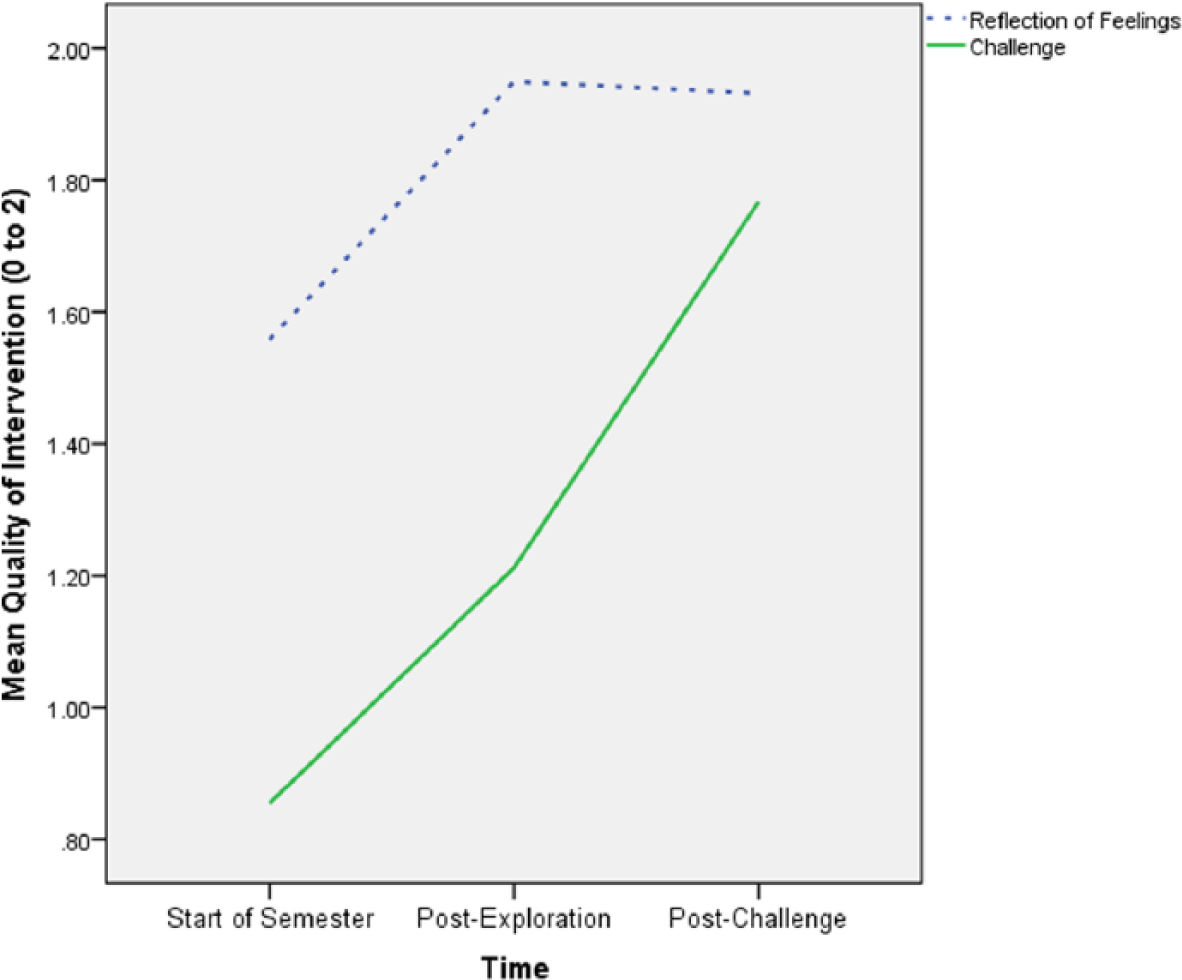
Changes in the observer-rated quality of reflection of feelings (dotted line) and challenge (solid line) at the start of the semester, after training on exploration skills, and after training on challenge skills.
Effectiveness of Components of Training
A repeated measures ANOVA revealed a significant overall change in self-efficacy for using challenges, F(5.54, 520.82) = 54.44, p < .001, after applying a Greenhouse–Geisser correction for a violation of the sphericity assumption. Pairwise comparisons of adjacent changes using a Bonferroni-adjusted alpha of p < .001 revealed an increase in self-efficacy from Time 3 to 4 (following lecture), an increase from Time 4 to 5 (following video modeling), an increase from Time 5 to 6 (following lecture class written practice), and an increase from Time 7 to 8 (following lab group practice). Thus, there was evidence for the effects of lecture, video modeling, in-class written practice, and lab group practice in terms of increases in self-efficacy for using challenges.
Effectiveness of reading intervention
Although self-efficacy did not change as a result of reading in the above analysis, we worried that such a result may have been confounded by the possibility that not all students did the assigned reading. As such, we examined the reading quiz score and its relation to students’ self-efficacy. Reading quiz scores were not associated with self-efficacy immediately after reading (SEC-3), r(101) = .18, p = .07, nor with the change in self-efficacy from before to after reading (SEC-3 to SEC-2), r(97) = .13, p = .20. These results confirm the finding that reading was not associated with self-efficacy for challenge.
Post-Training Ratings of the Effectiveness of the Components
Ratings of helpfulness
Figure 3 shows the relative effectiveness of the various components, as rated by trainees at the end of the training. A repeated measure ANOVA among the components was significant, F(4.53, 452.62) = 12.98, p < .001, after applying a Huynh–Feldt correction for the violation of sphericity assumption. Post hoc tests, using the Bonferroni-adjusted alpha of .001, indicated that the practice in the lab group was rated as the most helpful of all the components.
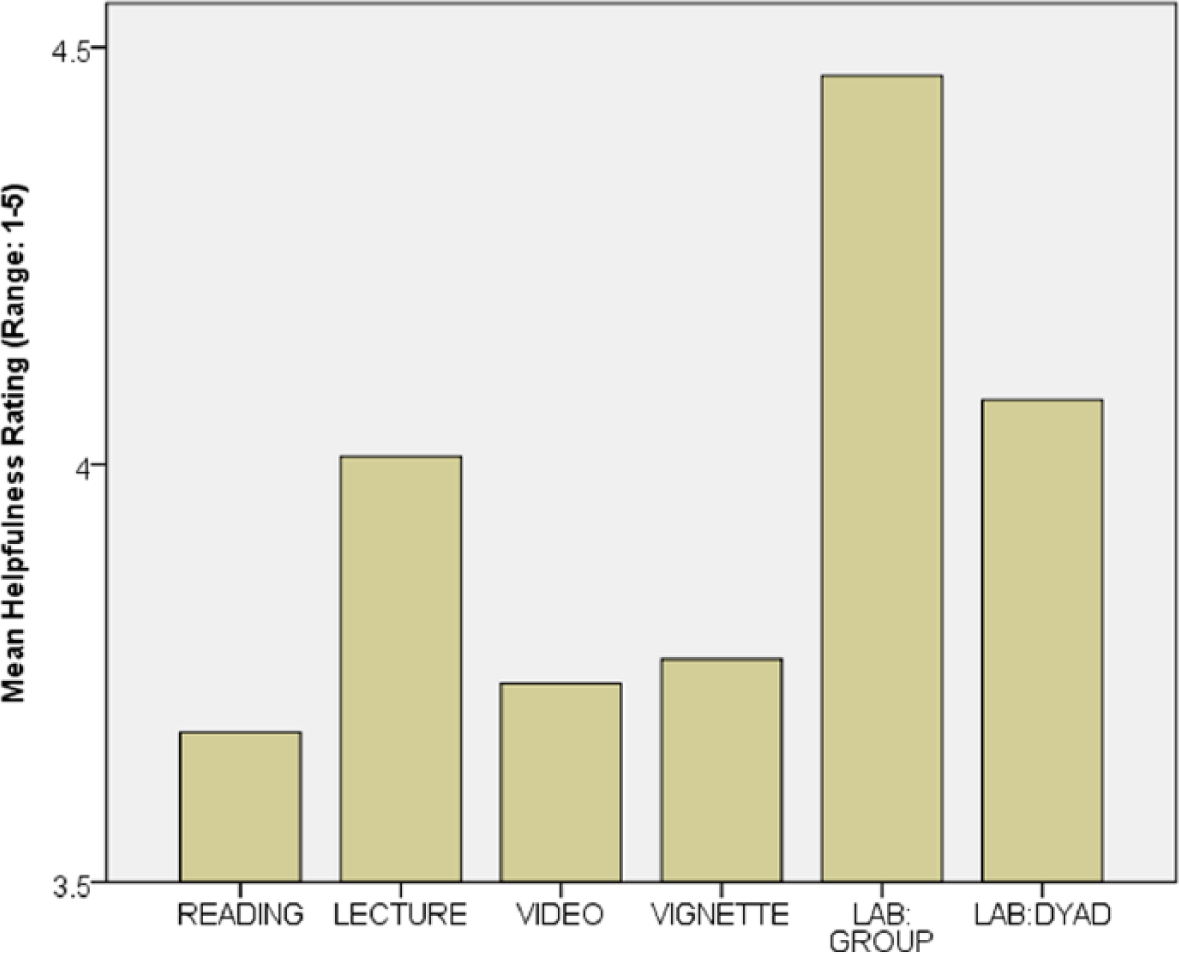
Helpfulness of the various components of training for challenges as rated by trainees after training.
Qualitative analyses of narratives
We report data here from the narrative accounts for which at least 15% of the students endorsed. A majority of students (93%) reported that reading provided an overview and explanation for the use of challenges, highlighting relevant theoretical constructs and situations when challenges are appropriate to use. One student noted that the reading “gave pretty good advice of how to perform a challenge and many difficulties that may arise, which gave me confidence.” In addition, 41% of the students indicated that they found the examples of challenges provided in the reading particularly helpful (e.g., “By reading the text, especially the example portions, I was able to get an understanding of the rationale for using challenges and a few bits of insight as to its frequency of use and reactions.”). We would note, however, that 50% of the students reported that reading alone was not adequate for learning how to do challenges (e.g., “Without the videos and class participation that followed I would have had a very weak understanding of how challenges are carried out in the real world.”).
Most students (69%) also reported liking the lecture because of the discussion and the student–teacher interaction (e.g., “Having a chance to ask questions and discuss what was in the book helped put it all together and clarify everything.”). In addition, 64% of students noted that the lecture provided them with an overview of when and how to use challenges (e.g., “The information we got in lecture was the next building block in learning how to use challenges. . . .The appropriate use of challenges was further explained and we learned more about how and when to use them.”). In contrast, some students (29%) expressed that the lecture repeated what was in the book, and some students (16%) commented that the lecture by itself was not adequate for learning how to do challenges (e.g., “I felt like I understood challenges better after lecture, but I realized soon after. . . that although I understood the purpose of them, I was still struggling to form them.”). In addition, 54% of the students wanted more practice. One student wrote,
I would focus less on the time spent in class explaining specifics and more on lab times spent practicing. I felt more confident after the lab than I did from just hearing the professor speak about how they may be used.
Most students (67%) found videos to be helpful because they demonstrated the use of challenges (e.g., “I believe that it is important for us as helpers to hear real therapists and real clients interact as a model for what a real-life therapy session is like, outside of our classroom settings.”). In addition, 56% thought that the examples of challenge presented in the videos were good (e.g., memorable, realistic, interesting), although 46% complained that the examples were poor (e.g., dated, lacked context, unnatural). In addition, 20% of the students recommended having more videos (e.g., “Any time you can put videos into the class it really helps. If you had more video instances of helpers using challenges instead of talking about it, students might enjoy and learn it more.”).
Close to half of the students (48%) indicated that they found lab group practice helpful because their peers provided a model. For example, one student wrote,
I found it helpful to hear other lab group members’ questions and challenges because they framed things in ways I hadn’t thought about, asked what I wanted to know but in a way that was clearer and more precise than I had formulated.
Many students (45%) liked the opportunity to practice in the group in the lab. According to one student, “I was able to use the tools and skills I learned in the text in a real world scenario and practice with others to see how they used the challenges and how others responded to those challenges.” A number of students (22%), however, disliked taking turns when practicing in a group setting because it interrupted their train of thought (e.g., “I disliked it because sometimes I forgot what I was going to say or the topic passed as I was waiting for my turn to speak.”).
About half of the students (48%) reported that writing down challenges to vignettes in the lecture class was good because it provided them an opportunity to practice. In addition, 42% of the students noted that they liked hearing the challenges from their peers. In contrast, 22% thought the written vignettes seemed artificial and did not like that the instructor read the scenario.
Nearly half of the students (49%) liked that the dyad exercise felt natural or engaging (e.g., “I really liked this exercise because it modeled an actual therapy session and using the techniques seemed natural.”). In addition, 36% of the students said that dyad exercise provided them with the opportunity to practice (e.g., “The dyad exercise was very useful as well because I had another opportunity to practice using challenges with different scenarios.”). However, 44% of the students disliked the dyad exercise because the scripted scenarios were unrealistic or unclear, and 27% of the students noted that it was hard to play the client role.
Ideas for improving training
In terms of improving training, 27% of the students requested more specific individual feedback from the instructor (e.g., “I think that the level or [sic] practice is great, but I think that a greater amount of helpful criticism is needed so that we can make sure that we are not reinforcing incorrect usage of the challenges [sic] technique.”). Students also wanted better quality in all components: video (25%), dyad exercise (21%), writing practice (18%), and lecture/discussion (16%).
Predictors of Outcome of Training
In bivariate correlations between participant predictor variables (PHE, ALHS, NHM, and SEC-1) and the final self-efficacy (SEC-9), the only significant correlate was NHM (see Table 1). Thus, students who initially had greater natural helping ability had the highest self-ratings of self-efficacy challenge in the end. Furthermore, none of the predictor variables were correlated with the change in self-efficacy for challenge over the course of training (SEC-9 to SEC-2). Thus, we could not predict which participants experienced the greatest gains in self-efficacy for challenge as a result of training. Furthermore, none of the correlations between the predictor variables and final levels or change in rated quality of written challenges over the semester (QC3 − QC2) were significant; hence, we could not predict end level or changes in written challenges from the predictor variables included.
Influence of personal background on the ability to learn and use challenges
The most noted personal background factor in the narrative reports was family, with 49% of the students endorsing its positive influence on learning to use challenges (e.g., “My family has probably provided a very positive influence in that none of us are afraid of calling each other out on most anything we say or do.”). In contrast, 21% of the students indicated that family was a negative influence on their ability to use challenge. One student reported:
Sometimes my family can be very blunt and abrasive toward each other when one of us does something that is contradictory or if our actions don’t match what we said. In that regard, I may come off a little judgmental when I make a challenges [sic] during a helping situation.
Among female students, 36% reported a negative influence of gender on their ability to use challenge (e.g., “My gender negatively influences my ability because I feel as if it is less expected for a female to challenge others.”). However, 18% of the female students indicated that their gender conferred an advantage (e.g., “I also think that being a female who is in touch with emotions and feelings helps because I am able to present a challenge and then empathize with the feelings that they might be having toward that challenge.”).
For male students, 25% indicated that their gender had a negative influence on their use of challenge. One student reported:
As a male, I realize that I am probably not as sensitive to people’s feelings as women generally are. Because of this, I could see myself being too forward in my challenges and actually hurting a client’s progress. This would be very detrimental to the helping situation.
In contrast, 20% of the male students reported a positive influence of gender (e.g., “My gender probably had an influence on my ability to perform this ‘pushy’ helping skill. I am male, and our culture is characterized by male hegemony; I have been socialized to take the dominant role.”).
Discussion
Undergraduate students were able to begin to use the skill of challenge after two 2-hr sessions of intensive training following half of a semester of training in exploration skills. In this section, we discuss the evidence for the effectiveness of training, the effectiveness of the components of training, and the predictors of the outcomes of training.
Effectiveness of Training
Prior to training, students did not change in terms of their self-efficacy for using challenges. But they did change in self-efficacy over the course of training, and they maintained these gains for 5 weeks after training. Furthermore, although students increased in the quality of written challenges both during exploration training and training in challenges, they only increased in quality of written reflections of feelings during exploration training. These findings provide evidence that students changed not only in terms of self-efficacy but also that students learned how to formulate challenges.
It was noted that scores for self-efficacy and for quality of written challenges were not significantly correlated, suggesting that self-efficacy and quality are distinct outcomes of training. Although one may argue that the goal of helping skills training is to improve the quality of interventions, self-efficacy may sustain the beginning helper’s interest and motivation to persist in training (Bandura, 1986) and therefore is an important outcome. Thus, we argue that both self-efficacy and performance are important to assess as outcomes of training. The next step would be to gather evidence of the extent to which trainees use challenges appropriately and empathically in sessions with actual clients.
Components of Training
Some evidence was found for the effectiveness of all the components used in training, although most evidence was found for the effectiveness of lecture, video modeling, practice on written vignettes in the lecture class, and practice in the lab group. Less consistent evidence was found for reading and dyad practice.
Specifically, in terms of instruction, reading did not appear to be as effective as lecture/discussion in terms of learning skills. We speculate that reading was not as effective as lecture/discussion because it did not require students to be as actively involved in generating the skills. We still believe, however, that reading creates a foundation, but the way in which reading helps still needs to be examined. Based on student comments, it appears that lectures need to present different material than the reading, and that students prefer to interact with the instructor.
In terms of modeling, it appears that it was helpful to watch experts deliver the skills because students could see how challenges could be delivered. But in their written comments, the students cautioned that modeling still did not enable them to produce the skill themselves.
Of all the training components studied, practice “won” the race and was viewed as most effective in terms of helping students feel more self-confident about using challenges. Interestingly, however, practice writing a response to a written vignette and lab group practice seemed to be more effective than dyad practice in the current study. This result was surprising because students in the Spangler et al. study had asked for dyad practice. We speculate that working in a dyad was difficult with challenges because of the artificiality of the structured practice. To have the “client” present material that could elicit a challenge, we asked the “clients” to role-play from a scripted scenario. Clients varied in their ability to present a convincing role, which made it difficult for some of the helpers to challenge them. In addition, challenges could be hard to deliver, so there may have been more comfort in working in the larger lab groups where the lab leader could monitor the process to make sure that challenges were used appropriately.
Interestingly, qualitative analyses showed that each component was liked by some students and not liked by others. Also, different students liked different components, suggesting a benefit of using a variety of components to appeal to different students.
Predictors of Training Effects
In terms of predicting who would benefit from training, none of our predictor variables (initial levels of self-efficacy for using challenges, prior helping experiences, attitudes toward seeking help, or natural helping ability) were significantly associated with changes in self-efficacy for challenges over the course of training or with changes in quality of written challenges. Natural helping ability, however, was associated with higher final levels of self-efficacy for challenges. Thus, those students who believed they had more natural helping ability had more self-efficacy for using challenges at the end of training, which supports Stahl and Hill’s (2008) claims about the importance of natural helping ability. Given that it could be very difficult to challenge appropriately and empathically, it may be that having more natural helping ability allows students to believe that they can use this skill without damaging clients.
In the qualitative analyses, family background and gender were the most mentioned cultural factors related to the learning of challenges. Interestingly, being in a family where members communicated directly, being female, or being male led some to believe that they were better at challenges and others to believe that they were worse at challenges. This observation, along with the quantitative findings, indicates the overall difficulty in predicting who will benefit the most from training to use challenges. Students may have considered different aspects of challenges (e.g., empathy, objectivity) when they thought about influences on their ability to learn and use challenges.
Limitations and Implications
One limitation is that written responses to written client stimuli may not generalize to behavior in a clinical situation. Another limitation is that although we included assessments of baseline change with no training and maintenance, we did not include a delayed training condition or alternate treatment comparison. Other limitations are described in the final paper (Hill, Spangler, Jackson, & Chui, 2014).
In terms of implications, it would be helpful to explore whether there are other methods of teaching that would be particularly suited to teaching students to use challenges. Some students in this study expressed a desire for more feedback given that challenges are perceived to be a skill that when done incorrectly can hurt the client. Coaching might also be an effective method for teaching this particular skill, given that it is hard to learn how to apply it in a therapeutic setting. Other implications are in the final paper (Hill, Spangler, Jackson, & Chui, 2014).
Footnotes
Acknowledgements
We thank Michael Amrhein and Amber Farn for assisting in data collection.
Authors’ Note
Harold Chui is now at The Derner Institute of Advanced Psychological Studies, Adelphi University, Garden City, NY. Stacie Ain is now at the University Counseling Center, George Washington University, Washington, DC. Heather V. Ganginis Del Pino is now at Montgomery College, Rockville, MD. Ann Hummel is now at the Naval Medical Center San Diego. Erica S. Merson is now at the University Counseling Center, University of Maryland. Patricia T. Spangler is now at the Center for the Study of Traumatic Stress, Uniformed Services University of the Health Sciences, Bethesda, MD.
Declaration of Conflicting Interests
The author(s) declared no potential conflicts of interest with respect to the research, authorship, and/or publication of this article.
Funding
The author(s) received no financial support for the research, authorship, and/or publication of this article.