







Abstract
The study examined links from acculturation experience (i.e., acculturation and enculturation) through coping strategies (i.e., social connectedness [SC]) to short-term outcomes (i.e., future subjective well-being [SWB]). Using a longitudinal design, 213 Chinese international students completed an online survey. Results partially supported two mediation hypotheses: Mainstream SC at Time 2 partially mediated the association between acculturation at Time 1 and life satisfaction and positive affect (but not negative affect) at Time 2; Ethnic SC at Time 2 partially mediated the association between enculturation at Time 1 and negative affect (but not life satisfaction and positive affect) at Time 2. Furthermore, unexpectedly, Mainstream SC at Time 2 partially mediated the association between enculturation at Time 1 and life satisfaction and positive affect (but not negative affect) at Time 2. Therefore, Mainstream SC and Ethic SC are both important coping resources for Chinese international students.
Keywords
According to the Open Doors annual report (Institute of International Education, 2013), Chinese international student enrollment in U.S. colleges and universities has been steadily increasing by 20% to 30% every year since 2008. To be precise, the number of Chinese international students has increased by 248% from 2007 (67,723 students) to 2013 (235,597 students), making China the top country of origin for international students in the United States. In the 2012-2013 academic year, students from China made up 29% of the total international student population (Institute of International Education, 2013). One challenge facing almost all students is adapting to a new culture while living in the United States. However, little research has specifically focused on the adjustment of Chinese international students in the United States. For example, of the 64 studies on international students’ psychosocial adjustment in the United States published in peer-reviewed journals between January 1990 and January 2009, very few studies focused specifically on students from mainland China (J. Zhang & Goodson, 2011). Among these studies, researchers examined various factors (e.g., family contact frequency, length of time in the United States, English proficiency, and American cultural knowledge) as predictors of students’ psychological distress and/or sociocultural adjustment difficulties (e.g., Kline & Liu, 2005; Wang & Mallinckrodt, 2006; Wei et al., 2007; Ye, 2006a; N. Zhang & Rentz, 1996).
Although scholars have conducted studies contributing to the literature on international students’ adjustment, several issues still need to be addressed. First, almost all previous studies used cross-sectional designs, which fail to reveal the adjustment process (J. Zhang & Goodson, 2011). Second, most studies focused on negative psychological outcomes (e.g., acculturative stress, psychological distress), which assume that the acculturation process is a stressful event rather than a new and inspiring learning experience (Yoon, Lee, & Goh, 2008).
Using a longitudinal design, the present study aimed to contribute to the literature by exploring how Chinese international students’ acculturation orientation (i.e., acculturating to U.S. culture or maintaining ethnic culture) would influence their subjective well-being (SWB, including life satisfaction, positive affect, and negative affect) through their social connectedness (SC) in mainstream society (i.e., Mainstream SC) and SC in the ethnic community (i.e., Ethnic SC).
In the last four decades, SWB, “a broad category of phenomena that includes people’s emotional responses, domain satisfactions, and global judgments of life satisfaction” (Diener, Suh, Lucas, & Smith, 1999, p. 277), has received increasing attention. Operationally, Diener et al.’s (1999) measure of SWB consists of two components. One is a cognitive component, which is associated with an individual’s satisfactory perception of life. The other is an affective component, which refers to both the presence of positive affect and the absence of negative affect. Individuals with higher SWB experience more positive emotions and feelings, and appraise their lives as ideal and meeting their expectations (Diener et al., 1999). For many Chinese international students, studying abroad is a learning experience that can promote one’s independence and the ability to adapt to new environments, which may then contribute to SWB (e.g., Yoon et al., 2008). Therefore, the present study was designed to examine Chinese international students’ SWB in the process of acculturation/enculturation based on these three aspects: life satisfaction, positive affect, and negative affect.
Acculturation and Enculturation
In the cultural adjustment process, international students face many challenges compared with their U.S.-born peers, including language barriers, sense of loss when adjusting to a new culture, cultural shock, adjusting to a new educational system, lack of social support, and alienation from domestic students (Tas, 2013). For the present study, we adopted the bilinear approach to examine the acculturation adjustment process for Chinese international students. The bilinear model of acculturation conceptualizes the process as having two dimensions: acculturation and enculturation. Acculturation is broadly defined as cultural socialization to the mainstream society, and enculturation is broadly defined as cultural socialization or retention of the ethnic culture (Berry, 1997; Kim, 2006). Acculturation and enculturation are two independent processes that may happen simultaneously within a person (Kang, 2006). To assess the concepts of acculturation and enculturation, researchers generally focus on several dimensions. These dimensions include (a) values (e.g., “I believe in the values of my heritage culture”), (b) adherence to cultural traditions (e.g., “I often participate in my heritage cultural traditions”), and (c) social relationships (e.g., “I would be willing to marry a North American person”; see Vancouver Index of Acculturation [VIA], Ryder, Alden, & Paulhus, 2000).
Moreover, we adopted Berry’s (1997) acculturation framework as a conceptual model, which depicts the process of acculturation and adaptation. After entering a different culture, international students are first exposed to new acculturation experiences, and they subsequently appraise these experiences (stressors). To deal with these new life experiences, they use coping strategies (e.g., social interactions with either host people or co-nationals) that either effectively reduce stress to a tolerable level or, in some cases, increase the level of stress. In the long term, adaptation may be achieved and international students can either become better adjusted to the environment or become more resistant to the environment (Berry, 1997).
Berry’s (1997) acculturation framework also highlights the potential mediation effects of various factors in the acculturation process. As the model shows (i.e., acculturation experiences → appraisal of experiences → coping strategies/resources → immediate effects or outcomes → long-term outcomes), coping strategies as well as coping resources have mediation effects in the process of acculturation; the coping strategies and resources that individuals adopt in the process can lead to various immediate and long-term outcomes (Berry, 1997). In addition, Berry’s model also suggests that length of time in the United States may potentially affect acculturation and outcomes. Empirically, Wang and Mallinckrodt (2006) found that length of time in the United States was negatively and significantly associated with sociocultural adjustment difficulty and with psychological distress in a sample of Chinese and Taiwanese international students. Therefore, it is important to take length of time in the United States into consideration in examining the associations between acculturation and enculturation, and mental health outcomes.
Acculturation, Enculturation, and SC
General SC represents a global and subjective sense of connection with others and with the world (Lee & Robbins, 1995, 1998). The concepts of SC in mainstream society and in the ethnic community (i.e., Mainstream SC and Ethnic SC) developed from this general concept. Yoon et al. (2008) defined Mainstream SC as the sense of closeness within mainstream society and Ethnic SC as the sense of closeness in the ethnic community. Unlike general SC, Mainstream SC and Ethnic SC are recognized as context-specific, thus having more potential to change based on environmental influences (Yoon, Jung, Lee, & Felix-Mora, 2012).
Yoon and Lee (2010) argued that Mainstream SC and Ethnic SC are related to, but distinct from, acculturation and enculturation, respectively. Conceptually, they argued that acculturation and enculturation contain multiple components, including behavioral, affective, and cognitive components. Mainstream SC and Ethnic SC focus only on the affective aspect of acculturation and enculturation (Yoon & Lee, 2010). These two types of coping resources have only recently been examined in the research literature among other populations (e.g., Yoon, Hacker, Hewitt, Abrams, & Cleary, 2012; Yoon et al., 2008). Some early studies found that having links to members in the host culture is helpful in psychologically adapting to a new culture, especially when relationships meet one’s expectations (e.g., Berry, 1997; Berry & Kostovcik, 1990), and others found that maintaining links to one’s heritage culture is associated with less stress (e.g., Vega, Kolody, Valle, & Weir, 1991). Yoon et al. (2008) examined the mediating effects of Mainstream SC and Ethnic SC among Korean immigrant community adults in the United States and reported that Mainstream SC “tended to partially mediate the relationship between acculturation and SWB,” even though the effect “did not reach statistical significance” (p. 252). They also found that Ethnic SC was a significant mediator for the association between enculturation and SWB. In another more recent cross-sectional study on Asian American college students, Yoon, Hacker, et al. (2012) found that Mainstream SC and Ethnic SC were both significant mediators in the association between acculturation and SWB, and Ethnic SC was also a significant mediator in the association between enculturation and SWB.
SC and SWB Among Chinese International Students
When Chinese international students enter a different culture, many often lose their previous social connections. As a result, it can be challenging for them to establish a sense of social connection in a completely new environment (Sandhu, 1994). Some Chinese international students may intend to get involved in mainstream culture and society in the United States. When they acculturate into the new culture, their involvement may facilitate their sense of belonging to U.S. society (i.e., more Mainstream SC). In this case, an increase in the sense of close contacts with individuals in the mainstream United States may predict better psychosocial adjustment, which might be associated with better SWB (e.g., Li & Gasser, 2005; Wang & Mallinckrodt, 2006).
While they acculturate into American culture and society, many Chinese international students may still wish to maintain a strong connection with their home culture through long-distance social networks (i.e., family and friends from China) and through making social connections with other co-national friends in the United States (e.g., Ye, 2006b). The desire to maintain ethnic connections may be especially strong for Chinese international students, as their cultures tend to strongly value collectivism (Triandis, 1989). Therefore, when they enculturate, they may gain a sense of connectedness in the ethnic community (i.e., more Ethnic SC). Chinese international students may then feel more connected with other co-nationals and perceive high levels of social support by sharing their frustrations of living in a completely new world, thus resulting in better SWB (e.g., Ye, 2006b).
As we know, Chinese student enrollment has significantly increased in U.S. universities, and becoming involved in Chinese ethnic communities has become an alternative to participating in mainstream U.S. society. Especially in larger universities, students are free to choose the social circles in which they would like to socialize. Depending on their needs, building social connections in either the mainstream society or the ethnic community may be beneficial for Chinese international students’ adjustment in the United States. In other words, those with strong acculturation may be more likely to report SWB through a sense of connectedness in the mainstream society, and those with strong enculturation may be more likely to report SWB through a sense of connectedness in the ethnic community.
The Present Study
Based on the rationale just presented and Berry’s (1997) theoretical framework of acculturation, it appears that Mainstream SC and Ethnic SC may mediate the association between acculturation/enculturation and SWB among Chinese international students (e.g., Yoon et al., 2008). Despite the rapid increase of Chinese international students, no studies have examined the proposed mediation effect of this population living in the United States. Furthermore, J. Zhang and Goodson (2011) concluded that future studies need to examine the mediation process and positive outcomes, conduct more studies with a longitudinal design, and focus on a specific international student group. Therefore, under Berry’s acculturation framework and using a longitudinal design with two time points, this study aims to advance the literature by evaluating the potential role of Mainstream SC and Ethnic SC as mediators between acculturation and enculturation and future SWB among Chinese international students living in the United States. Because general SC may be confounded with Mainstream SC, Ethnic SC, and SWB (Yoon et al., 2012), we control for general SC in the study. In addition, we control for length of time in the United States, as previous studies suggest that this may be related to international students’ adjustment (Wang & Mallinckrodt, 2006).
Two sets of hypotheses follow. First, Mainstream SC at Time 2 would mediate the association between acculturation (but not enculturation) at Time 1 and SWB (i.e., life satisfaction, positive affect, and negative affect) at Time 2, after controlling for general SC at Time 1, SWB at Time 1, and length of time in the United States at Time 1. Second, Ethnic SC at Time 2 would mediate the association between enculturation (but not acculturation) at Time 1 and SWB at Time 2, after controlling for the same set of variables (see Figure 1). Under this set of hypotheses, better future SWB is achieved through high Mainstream SC while Chinese international students acculturate to the host culture, and through high Ethnic SC while individuals enculturate to the heritage culture.
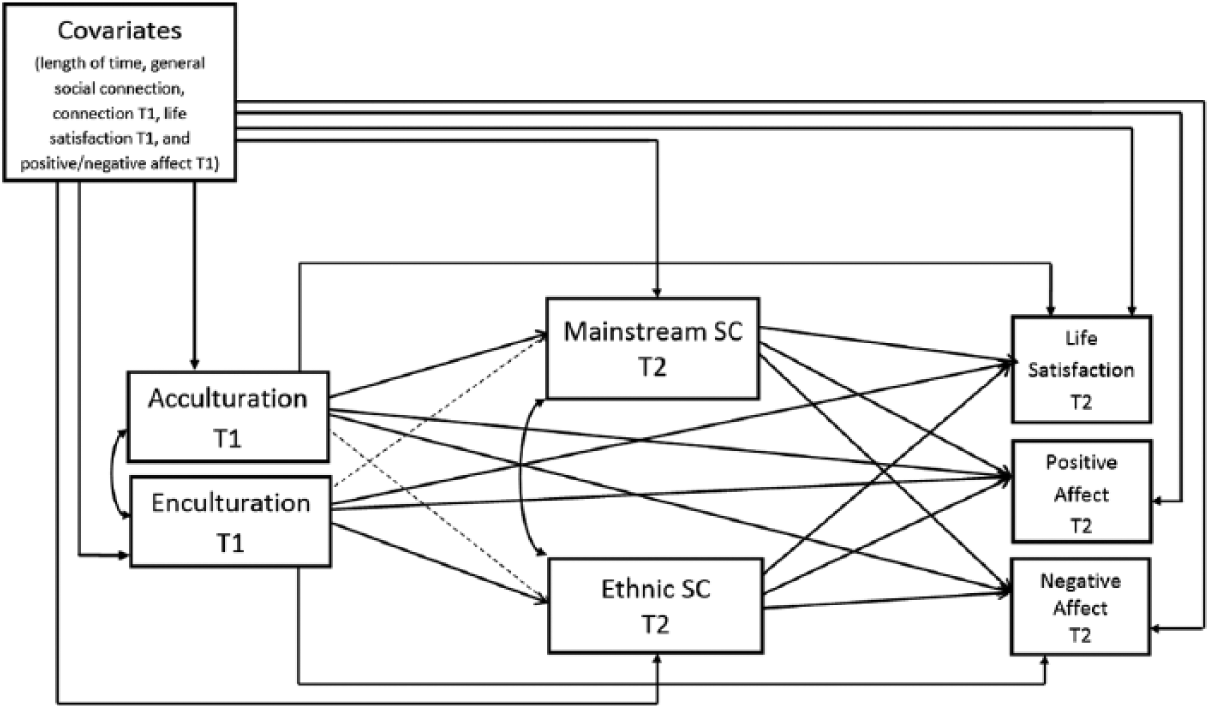
The hypothetical partially mediated model.
Method
Participants and Procedure
A list of all Chinese international students’ contact information (N = 1,828) was obtained from the registrar’s office at a large Midwestern state university in the beginning of the fall semester. At Time 1 (September 15-October 31), half of the Chinese international students (N = 914) were randomly selected from the list and contacted by research assistants via phone calls (N = 611) or emails (N = 303), if no phone number was listed. Both phone and email conversations were conducted in Chinese. In the invitation email or phone call, Chinese international students were informed that the study was about Chinese international students’ experiences in the United States and that they would complete an online survey at two different time points, either in Chinese or in English. In all, 115 students who received the email invitation provided responses to the survey (11 in English, 104 in Chinese). A total of 361 students who received phone calls agreed to participate, and 302 provided responses to the survey (32 in English, 270 in Chinese). Among all the Time 1 participants (N = 417), 389 completed the survey and answered the checking items correctly (e.g., “Please select ‘Did not apply at all’ for this question”). The response rate at Time 1 was 43% (389 of 914). At Time 2 (February 4-March 1), these 389 participants were contacted again and reminded to take the Time 2 survey via email reminders sent by the principal investigator. A total of 246 participants responded to the survey, and 213 provided complete data and answered the checking items correctly (26 in English, 187 in Chinese). Therefore, Time 2 had a response rate of 55% (213 of 389) and 23% (213 of 914).
The final sample (N = 213) consisted of 122 males (57%) and 90 (43%) females (there was missing data for one participant). In all, 107 participants were undergraduate students (50%) and 106 were graduate students. One hundred sixty-five participants (77%) were originally recruited by phone, and 48 were recruited through email. One hundred eighty-seven participants (88%) chose the Chinese version of the survey, and 26 chose the English version. Participants’ ages ranged from 18 to 34 years old (M = 23.09, SD = 3.08). At Time 1, participants reported their length of time in the United States ranging from less than 1 year to 8 years (M = 24.79 months, SD = 18.14 months). More than half of the participants were single, and close to half of the participants were married or in a dating/committed relationship.
Instruments
All scales used in the study were given in random order. Surveys were provided in Chinese or English, depending on the participant’s preference. All Chinese versions were reported in other studies to have been translated following the established three steps in the translation and back-translation process (Brislin, 1980).
Acculturation and Enculturation (Time 1)
The VIA (Ryder et al., 2000) is a 10-parallel-item scale measuring the extent to which people adhere to the cultural values and behaviors of the mainstream culture (i.e., North American) and the heritage culture. There are two subscales, Mainstream and Heritage, which are used to measure acculturation and enculturation, respectively. Sample items are as follows: “I enjoy North American entertainment (e.g., movies, music)” (for Mainstream) and “I often participate in my heritage cultural traditions” (for Heritage). Participants respond to each item using a Likert-type scale that ranges from 1 (strongly disagree) to 9 (strongly agree). A higher score suggests a higher level of identification with the corresponding culture. We selected this scale, in part, because Ryder et al. (2000) recruited three ethnic Chinese samples in their development and validation of the scale. They reported Cronbach’s alpha coefficients of .91 for Mainstream and .89 for Heritage among Chinese. For the present study, the coefficient alphas were .81 for Mainstream (.82 Chinese, .54 English) and .80 (.80 Chinese, .83 English) for Heritage. Significant correlations between scores on the Suinn-Lew Asian Self-Identity Acculturation Scale and scores on the two VIA subscales (r = −.30, p < .001 for the Heritage subscale, and r = .54, p < .001 for the Mainstream subscale) provide evidence of validity among Chinese individuals (Ryder et al., 2000).
SC (Time 1)
The Social Connectedness Scale (SCS; Lee & Robbins, 1995) is an eight-item scale measuring a general emotional sense of lacking connectedness, affiliation, and companionship. Participants respond to eight statements using a Likert-type scale that ranges from 1 (strongly disagree) to 6 (strongly agree). A sample item is, “I feel distant from people.” A higher score suggests a lack of SC. Cronbach’s alpha for the Chinese version was .91 among Taiwanese college students (Chen & Chung, 2007) and .90 (.91 Chinese, .89 English) in the present study. Validity was supported by significant associations with global loneliness, intimate loneliness, and social loneliness among Taiwanese (Chen & Chung, 2007).
SC in Mainstream Society and SC in the Ethnic Community (Time 2)
The measure of Social Connectedness in Mainstream Society and Social Connectedness in the Ethnic Community (SCMN and SCETH; Yoon, 2006) consists of two sets of five parallel items measuring Mainstream SC and Ethnic SC, respectively. Participants rate their degree of agreement with each item on a scale ranging from 1 (strongly disagree) to 7 (strongly agree). A higher score represents a greater sense of connectedness to the corresponding community. Sample items are as follows: “I feel a sense of closeness with U.S. Americans” (SCMN) and “I feel accepted by Chinese” (SCETH). In a sample of Korean immigrants in the United States, Yoon and Lee (2010) reported coefficient alphas for the SCMN and the SCETH at .92 and .93, respectively. In the present study, the coefficient alphas were .88 for SCMN (.88 Chinese, .89 English) and .94 for SCETH (.94 Chinese, .90 English). Yoon and Lee (2010) reported positive correlations between Mainstream SC (i.e., SCMN) and acculturation, and between Ethnic SC (i.e., SCETH) and enculturation, suggesting good convergent validity. In addition, a negative correlation between Mainstream SC (i.e., SCMN) and enculturation, and the lack of correlation between Ethnic SC (i.e., SCETH) and acculturation, suggested good divergent validity (Yoon & Lee, 2010).
Satisfaction With Life (Time 1 and Time 2)
The Satisfaction With Life Scale (SWLS; Diener, Emmons, Larsen, & Griffin, 1985) is a five-item scale measuring global life satisfaction based on participants’ cognitive self-evaluation. Participants are asked to rate their responses on a scale ranging from 1 (strongly disagree) to 7 (strongly agree), with higher scores indicating greater life satisfaction. A sample item is, “In most ways my life is close to my ideal.” In a sample of Chinese international students, the coefficient alpha for this scale was .93 (J. Zhang, Mandl, & Wang, 2010). In the present study, the coefficient alphas were .85 (.86 Chinese, .85 English) at Time 1 and .87 (.87 Chinese, .84 English) at Time 2. Also, in J. Zhang et al.’s (2010) study, life satisfaction had negative correlations with general and academic sociocultural adjustment among Chinese international students, which provided evidence for construct validity.
Positive Affect and Negative Affect (Time 1 and Time 2)
The Positive Affect and Negative Affect Scales (PANAS; Watson, Clark, & Tellegen, 1988) consist of two 10-item scales measuring the aroused states of both positive affect and negative affect. Participants rated their degree of various emotions over a limited period of time on a Likert-type scale from 1 (very slightly or not at all) to 5 (extremely), with a higher score indicating a stronger emotion (e.g., interested, ashamed). In a previous study with Korean immigrants, the coefficient alphas were .89 for positive affect and .88 for negative affect, respectively (Yoon et al., 2008). In the present study, the coefficient alphas for positive affect were .86 (.86 Chinese, .78 English) at Time 1 and .87 (.88 Chinese, .83 English) at Time 2. The coefficient alphas for negative affect were .88 (.89 Chinese, .87 English) at Time 1 and .92 (.92 Chinese, .87 English) at Time 2. Validity for positive affect was supported by its positive correlation with life satisfaction; conversely, validity for negative affect was supported by its negative correlation with life satisfaction among Korean immigrants (Yoon & Lee, 2010).
Results
Preliminary Statistics
First, seven t tests were conducted to detect possible differences in the seven measured variables between those who completed Time 1 only and those who completed both Time 1 and Time 2 surveys. These seven Time 1 variables were length of time in the United States, general SC, acculturation, enculturation, life satisfaction, positive affect, and negative affect. After applying a Bonferroni correction, a p value of .05/7 = .007 was used. No significant differences were found, with t values ranging from t(409) = −0.43, p = .67, to t(408) = 1.89, p = .06.
Second, a Bonferroni adjustment was used for a series of independent t tests to examine possible differences in all 12 measured variables due to gender (i.e., male, female) and academic status (i.e., undergraduate, graduate). The 12 measured variables were the 7 variables previously mentioned and another 5 Time 2 variables: Mainstream SC, Ethnic SC, life satisfaction, positive affect, and negative affect. For gender, only positive affect at Time 1 showed a significant difference, t(208) = 3.25, p = .001, with male participants reporting higher positive affect at Time 1 (M = 2.84, SD = 0.58) than female participants (M = 2.57, SD = 0.63). A Cohen’s d of 0.45 indicated a small effect size (Cohen, 1988). In addition, for academic status, two variables showed significant differences. Undergraduate students reported a significantly higher negative affect at Time 1 (M = 2.11, SD = 0.71) than graduate students (M = 1.78, SD = 0.57), t(209) = 3.73, p < .001. A Cohen’s d of 0.51 indicated a moderate effect size. Moreover, undergraduate students reported a significantly higher negative affect at Time 2 (M = 2.14, SD = 0.76) than graduate students (M = 1.81, SD = 0.68), t(210) = 3.33, p = .001. A Cohen’s d of 0.46 indicated a small effect size.
Third, a chi-square test was used to examine whether the sample (N = 213) was representative of the population of Chinese international students at the large Midwestern university (N = 1,815 at Time 2) with respect to sex and academic status. A non-significant chi-square result, χ2(1, N = 213) = .03, p = .86, indicated that the proportion of male and female students in the sample did not differ significantly from the expected proportion of students. A significant chi-square analysis result, χ2(1, N = 213) = 23.43, p < .001, indicated that the proportion of graduate students (50%) in the sample was significantly greater than the proportion of graduate students in the original population (34%).
Fourth, we examined the missing data. Missing data ranged from a low of 0.00% for the measure of SC to 1.4% for the measure of length of time in the United States. The result from Little’s Missing Completely at Random (MCAR) test was found to be not significant, χ2(61, N = 213) = 38.11, p = .99. This result implies that the missing cases were not significantly different from the non-missing cases. Based on Schlomer, Bauman, and Card’s (2010) suggestion, the full information maximum-likelihood (FIML) estimation method was used in the analyses.
Means, standard deviations, and zero-order correlations among the 12 measured variables are shown in Table 1. As the table shows, the sample is more enculturated (M = 6.38, SD = 0.96) than acculturated (M = 5.31, SD = 1.01). With respect to correlations, first, acculturation was weakly correlated with enculturation (r = .14, p = .04). Whereas acculturation was significantly and positively correlated with Mainstream SC (r = .35, p < .001), acculturation was not significantly correlated with Ethnic SC (r = .06, p = .37). Similarly, although enculturation was positively and moderately related to Ethnic SC (r = .45, p < .001), enculturation was not significantly correlated with Mainstream SC (r = −.05. p = .50). Finally, Mainstream SC was moderately associated with life satisfaction (r = .30, p < .001) and positive affect (r = .32, p < .001) at Time 2, but was not significantly associated with negative affect (r = .00, p = .995). Ethnic SC had weak correlations with life satisfaction (r = .20, p = .01), positive affect (r = .15, p = .03), and negative affect (r = −.24, p = .001) at Time 2. Conceptually, as described previously, general SC at Time 1 should be controlled for because it would associate with Mainstream and Ethnic SC at Time 2 as well as three indices of SWB at Time 2. Statistically, the significant correlations seem to support this conceptual argument. Specifically, general SC at Time 1 was significantly related to Mainstream SC (r = −.21, p < .01), Ethnic SC (r = −.23, p < .01), life satisfaction (r = −.20, p < .01), and negative affect (r = .25, p < .001) at Time 2. Finally, length of time in the United States was not significantly correlated with any variable.
Intercorrelations and Descriptive Statistics for Measured Variables (N = 213).
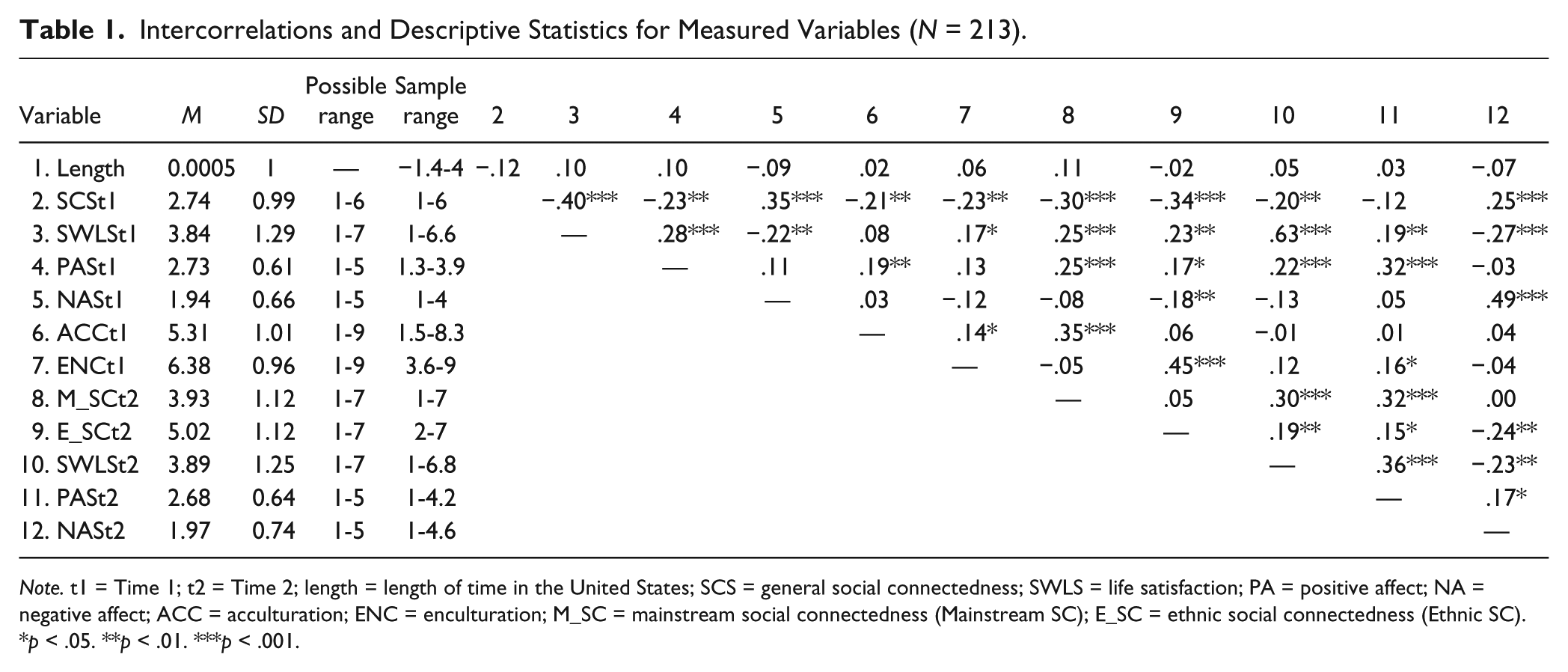
Note. t1 = Time 1; t2 = Time 2; length = length of time in the United States; SCS = general social connectedness; SWLS = life satisfaction; PA = positive affect; NA = negative affect; ACC = acculturation; ENC = enculturation; M_SC = mainstream social connectedness (Mainstream SC); E_SC = ethnic social connectedness (Ethnic SC).
p < .05. **p < .01. ***p < .001.
Path Analysis
The statistical package of the Mplus Version 6.1 program (Muthén & Muthén, 2010) was used to test the path model. A test of multivariate normality suggested that the data set significantly departed from normality, χ2(2, N = 213) = 94.81, p < .001. To adjust for the impact of non-normality on the data, the corrected/scaled chi-square statistic was reported (Satorra & Bentler, 1988). Furthermore, we used three fit indices to evaluate the goodness of fit of the models (Hu & Bentler, 1999). The first one was the comparative fit index (CFI), with a value of 0.95 or higher, indicating that the model is a good fit to the data. The second one was the root mean square error of approximation (RMSEA), with a value of 0.06 or less indicating an adequate fit. The third one was the standardized root mean square residual (SRMR), with a value of 0.08 or less, suggesting that the model is a proper fit to the data.
In addition, based on Holmbeck’s (1997) recommendation, the fully and partially mediated models were compared to determine the best model. The hypothesized model was a partially mediated model, in which six direct paths from acculturation/enculturation to life satisfaction, positive affect, and negative affect at Time 2 were not constrained to 0. The alternative model was a fully mediated model with six paths constrained to 0. When the fully mediated model was compared with the partially mediated model, there was a significant chi-square difference, Δχ2(6, N = 213) = 13.46, p = .036. This result indicates that the six direct paths contribute significantly to the model and need to be kept. Thus, the proposed hypothesized model (i.e., partially mediated model, see Figure 2) was determined to be a model of better fit, χ2(6, N = 213) = 10.03, scaled χ2(6, N = 213) = 9.50, CFI = 0.99, RMSEA = 0.06, and SRMR = 0.02. Therefore, we selected the partially mediated model as the final best model and used it to test the significance of the indirect or mediation effects.
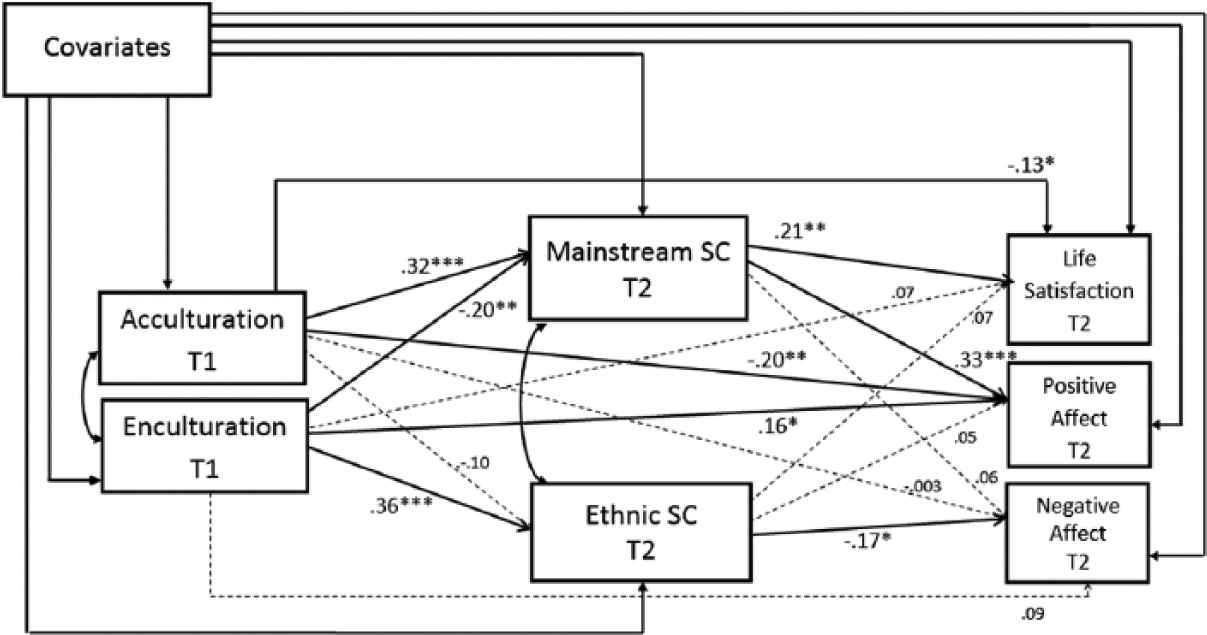
The Final Mediated Model.
Testing the Significance of the Indirect Effects
The bootstrap procedure was used to test the significance of indirect effects (MacKinnon, Lockwood, Hoffman, West, & Sheets, 2002; Mallinckrodt, Abraham, Wei, & Russell, 2006; Shrout & Bolger, 2002) for the final mediated path model. We requested 1,000 bootstrap samples in the Mplus program to estimate 12 mean indirect effects (e.g., acculturation Time 1 → Mainstream SC at Time 2 → life satisfaction at Time 2; see Table 2 for all 12 indirect effects). MacKinnon, Lockwood, and Williams (2004) reported that the bootstrap confidence interval (CI) adjusted for bias correction showed the highest levels of statistical power. Therefore, a 95% bias-corrected bootstrap CI for the indirect effects was reported in this study. If the 95% CI does not include 0, the indirect effect is considered significant at the .05 level.
Bootstrap Analysis of Magnitude and Statistical Significance of Indirect Effects (N = 213).
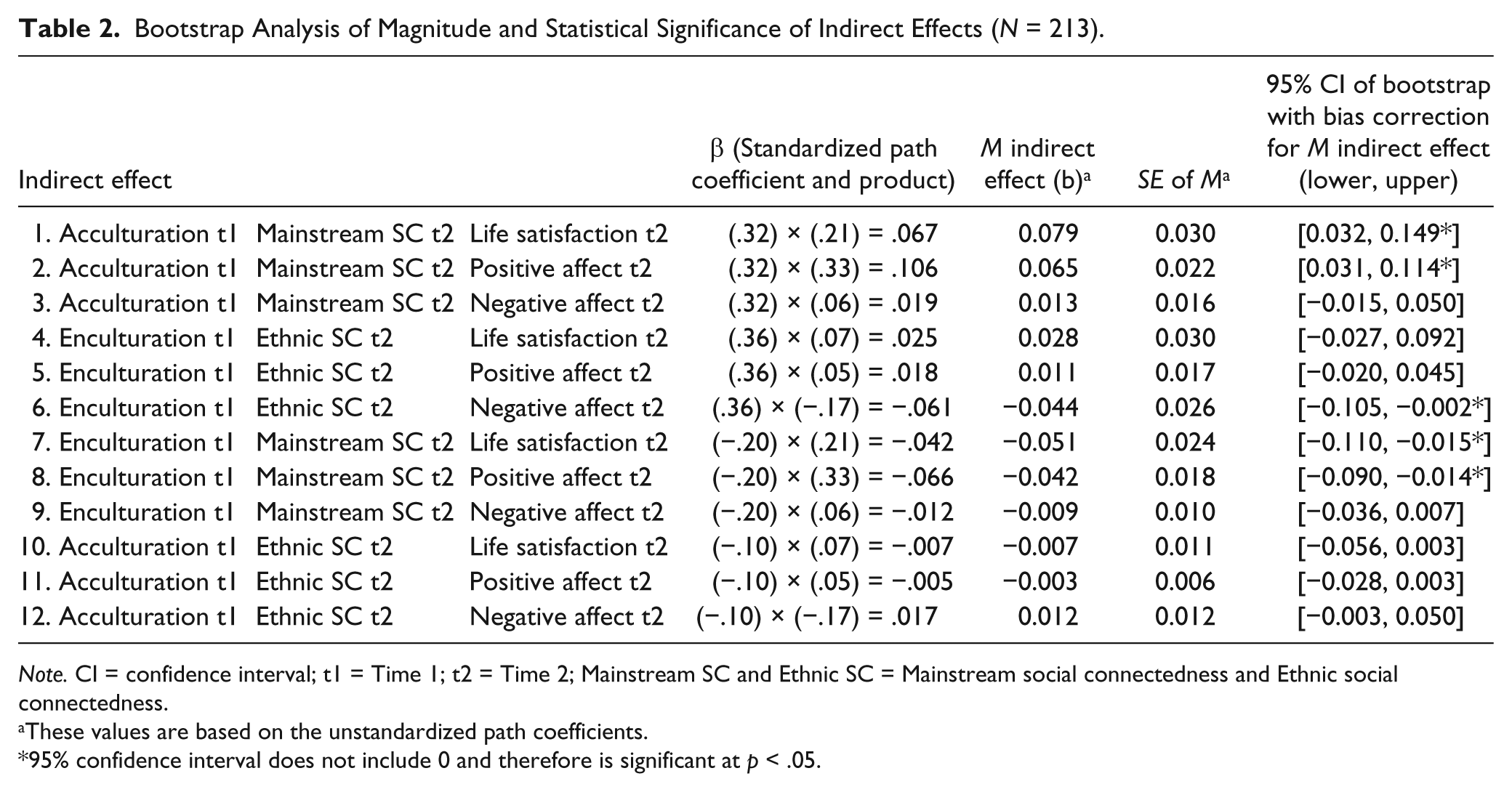
Note. CI = confidence interval; t1 = Time 1; t2 = Time 2; Mainstream SC and Ethnic SC = Mainstream social connectedness and Ethnic social connectedness.
These values are based on the unstandardized path coefficients.
95% confidence interval does not include 0 and therefore is significant at p < .05.
Results in Table 2 show that 95% CI for 5 of 12 indirect effects did not include 0. The Indirect Effect 1 (acculturation Time 1 → Mainstream SC Time 2 → life satisfaction Time 2) and Indirect Effect 2 (acculturation Time 1 → Mainstream SC Time 2 → positive affect Time 2) were statistically significant, providing partial support for the first set of hypotheses that Mainstream SC at Time 2 would mediate between acculturation at Time 1 and SWB at Time 2 (only for life satisfaction and positive affect, but not for negative affect). Furthermore, the Indirect Effect 6 (enculturation Time 1 → Ethnic SC Time 2 → negative affect Time 2) was statistically significant in assessing the mediation effect of Ethnic SC at Time 2. This result partially supported the second set of hypotheses. That is, Ethnic SC at Time 2 only mediated the associations between enculturation at Time 1 and negative affect at Time 2 (but not life satisfaction and positive affect at Time 2). However, the Indirect Effect 7 (enculturation Time 1 → Mainstream SC Time 2 → life satisfaction Time 2) and Indirect Effect 8 (enculturation Time 1 → Mainstream SC Time 2 → positive affect Time 2) were also statistically significant, which was a surprising result. It was not hypothesized that Mainstream SC at Time 2 would mediate the relation between enculturation at Time 1 and any components of SWB at Time 2. However, in this case, Mainstream SC at Time 2 did mediate the associations between enculturation at Time 1 and life satisfaction and positive affect at Time 2.
Finally, no significant indirect effects of Ethnic SC were found for the associations between acculturation at Time 1 and all components of SWB at Time 2, indicating support for the hypothesis that Ethnic SC at Time 2 would not mediate the association between acculturation at Time 1 and SWB at Time 2.
Post Hoc Analyses
To examine whether the mediation (indirect) effects remained the same or showed differences between the two gender groups (i.e., males and females) and between the two academic levels (i.e., undergraduate and graduate), additional bootstrap analyses were conducted. Results indicated that the Indirect Effect 2 (acculturation Time 1→ Mainstream SC Time 2 → positive affect Time 2) remained significant for both males and females as well as for undergraduate and graduate students. Moreover, the Indirect Effect 1 (acculturation Time 1 → Mainstream SC Time 2 → life satisfaction Time 2) remained significant for both females and graduate students; the Indirect Effect 6 (enculturation Time 1 → Ethnic SC Time 2 → negative affect Time 2) remained significant for males and graduate students; and the Indirect Effect 8 (enculturation Time 1 → Mainstream SC Time 2 → positive affect Time 2) remained significant for males and undergraduate students. However, the Indirect Effect 7 (enculturation Time 1 → Mainstream SC Time 2 → life satisfaction Time 2) was non-significant for all groups. The remaining indirect effects were not significant, which is consistent with previous results using the whole sample.
Discussion
The purpose of the present study was to examine Chinese international students’ Mainstream SC and Ethnic SC as mediators in the association between acculturation/enculturation and SWB. The first set of hypotheses was partially supported. Mainstream SC at Time 2 did partially mediate the association between acculturation at Time 1 and life satisfaction and positive affect at Time 2, but did not mediate the association with negative affect at Time 2 after controlling for general SC at Time 1 and SWB at Time 1 (i.e., life satisfaction, positive affect, and negative affect). Moreover, results from our post hoc analyses indicated that the indirect effect from acculturation (Time 1) through Mainstream SC (Time 2) to life satisfaction (Time 2) could apply to females and graduate students. The indirect effect from acculturation (Time 1) through Mainstream SC (Time 2) to positive affect (Time 2) could apply to either males or females and either undergraduate or graduate students. These findings are similar to those of Yoon et al. (2008) for Korean immigrant community adults and Yoon, Hacker, et al. (2012) for Asian American college students. In other words, all three studies including the present study with independent Asian samples demonstrate that Mainstream SC mediates the association between acculturation and SWB (in particular for life satisfaction and positive affect), thus increasing generalizability of this mediation effect in different Asian populations.
Furthermore, it is important to highlight that the current results advance this line of research by controlling for general SC and SWB (i.e., life satisfaction, positive affect, and negative affect) at Time 1. The current study also extends previous studies with Korean immigrant community adults (Yoon et al., 2008) and Asian American college students (Yoon, Hacker, et al., 2012) to include Chinese international students. In addition, the short-term longitudinal design of this study demonstrates that acculturation contributes to future Mainstream SC (i.e., in the following academic semester), which, in turn, increases two positive aspects of future SWB (i.e., life satisfaction and positive affect at Time 2) but does not decrease negative affect at Time 2.
The second set of hypotheses was also partially supported. Ethnic SC at Time 2 partially mediated the association between enculturation (but not acculturation) at Time 1 and negative affect at Time 2 (but not life satisfaction and positive affect at Time 2) after controlling for general SC and SWB (i.e., life satisfaction, positive affect, and negative affect) at Time 1. This finding was inconsistent with that of Yoon et al.’s (2008) study. They found that Ethnic SC fully mediated the association between enculturation and SWB for life satisfaction and positive affect among Korean immigrant community adults. In the present study, this mediation result was only found for negative affect (but not life satisfaction and positive affect) among Chinese international students, particularly for males and graduate students. Conversely, our findings were partially consistent with those of Yoon, Hacker, et al.’s (2012) cross-sectional study, which found that Ethnic SC significantly mediated the association between enculturation and SWB (including life satisfaction, positive affect, and negative affect) among Asian American college students. In our longitudinal study, the results suggested that international students who were enculturated were more likely to build future Ethnic SC, and that this helped them regulate future negative affect, but did not promote their future life satisfaction and positive affect.
Unexpectedly, we also found that Mainstream SC at Time 2 partially mediated the association between enculturation at Time 1 and SWB (only for life satisfaction and positive affect) at Time 2. This path was not found in Yoon et al.’s (2008) study with Korean immigrant community adults. However, in Yoon, Hacker, et al.’s (2012) study, acculturation was associated with SWB via connections to both mainstream and ethnic communities for Asian American college students. Our study provided a different pattern and specified that Chinese international students who have an enculturation orientation may feel less connected to U.S. mainstream society, thus experiencing less life satisfaction and positive affect. It is possible that, compared with Asian American college students, Chinese international students in our sample who displayed an enculturation orientation, especially those who were males and undergraduates, may have found it difficult to build close social connections with people from the mainstream society. This difficulty in connecting may contribute to a sense of less SWB.
Altogether, these results inform readers that (a) international students with higher levels of acculturation were likely to have more future life satisfaction and positive affect through feeling close to individuals in U.S. mainstream society, (b) students with higher levels of enculturation were likely to report less future negative affect through feeling close to other Chinese, and (c) students with higher levels of enculturation were likely to report less future life satisfaction and positive affect through feeling less close to individuals in U.S. mainstream society.
The present study contributed to the line of research on acculturation and enculturation in several important ways. First, all previous studies on acculturation and SWB have only used cross-sectional designs, which limited any conclusions that could be made about causality among variables. As stated by Smith and Khawaja (2011), there is a dearth of longitudinal studies that examine the effect of variables on international students’ adaptation over time. J. Zhang and Goodson (2011) also called for more longitudinal studies to examine the potential mediators in the cultural adaptation process of one specific international student group. The present study was able to fill these gaps in the literature and provided a closer and more accurate observation of mediation effects in the acculturation process: Students who were acculturated or enculturated at Time 1 revealed differences in SWB at Time 2 through Mainstream SC and Ethnic SC at Time 2. Thus, the longitudinal design of the study contributed to the literature by predicting future SWB.
Second, this study builds on Yoon et al.’s (2008, 2012) findings by extending this line of research to Chinese international students. Previous research on acculturation/enculturation and SWB has focused on SWB as a global construct rather than on its three individual components (i.e., life satisfaction, positive affect, and negative affect; for example, Yoon, Hacker, et al., 2012). Even though SWB as a latent variable can be predicted using the three variables, it is still necessary to examine if all three are affected equally and consistently by the two mediators (i.e., Mainstream SC and Ethnic SC). The present study revealed how acculturation/enculturation affects different components of SWB through the two mediators. Mainstream SC mostly contributed to greater life satisfaction and greater positive affect, whereas Ethnic SC mainly contributed to less negative affect. As mainstream society is the environment that Chinese international students are immersed in every day, their identification with the host country may become stronger over time, and feeling close to the mainstream society may promote their sense of life satisfaction and positive affect (Cemalcilar & Falbo, 2008). However, most Chinese international students come into another country highly enculturated and have stable sources of social support from their ethnic community (either in the host country or in their country of origin). Having such stable sources of support helps reduce negative feelings in their daily lives. Thus, the present study seems to differentiate the various mechanisms for the effect of acculturation/enculturation on SWB.
This finding could possibly help us comprehend the various contradictory results in previous studies. For example, Jung, Hecht, and Wadsworth (2007) reported that level of identification with host culture did not significantly predict depressive mood. In another study, Ward and Rana-Deuba (2000) found that only strong identification with the home culture, but not strong identification with the host culture, was negatively related to negative mood states. Zheng, Sang, and Wang (2004) found that strong identification with both host and home cultures was positively related to one’s SWB. The seemingly inconsistent findings can be reconciled by applying our model. Individuals who identified highly with the host culture can achieve more satisfaction with life and positive affect if they have strong Mainstream SC. Conversely, individuals who identify strongly with their home culture may have lower levels of negative affect if they have strong Ethnic SC. Because none of the aforementioned studies examined the mediation effects of Mainstream SC and Ethnic SC, and all used different types of psychological outcome measures, their inconsistent results may be explained by methodological choices.
Another interpretation of the different effects of acculturation/enculturation on the three components of SWB is that SC with individuals in the U.S. mainstream and with other Chinese can improve one’s SWB in two different ways. Mainstream SC may mostly contribute to SWB by promoting one’s life satisfaction and positive affect, whereas Ethnic SC may affect SWB by regulating one’s negative affect in daily activities. This is similar to the findings in the discrimination literature. For example, Wei, Wang, Heppner, and Du (2012) found a moderation effect of Ethnic SC, but not Mainstream SC, on racial discrimination (i.e., a negative-affect-inducing experience) and post-traumatic stress disorder (PTSD) symptoms experienced by a group of Chinese international students. Given these findings, it is possible that support from the ethnic community may be more helpful in regulating negative mental health outcomes, but support from the mainstream society may be more helpful in promoting positive mental health outcomes. However, future studies are needed to confirm or disconfirm these hypotheses.
A third contribution of our study is that our results provided empirical evidence for Berry’s (1997) theoretical framework of acculturation. As Berry proposed, when individuals first experience cultural differences in the acculturation process, they may use various coping strategies (e.g., Mainstream SC and/or Ethnic SC) to overcome changes in their daily lives. When these coping strategies are effective, individuals may feel more satisfied with life, have more positive affect, and have less negative affect while adjusting. When coping strategies are not sufficient in meeting individuals’ needs (e.g., an enculturated individual only establishing social connections in the mainstream society), individuals may experience less of these positive outcomes manifested as SWB. Therefore, our study partially supported Berry’s (1997) framework.
Furthermore, J. Zhang and Goodson (2011) encouraged researchers to examine the mediation effects in the area of international students’ adjustment and adaptation. Our study not only answered this call but also depicted how Mainstream SC and Ethnic SC function as mediators in Chinese international students’ adaptation process.
Limitations and Suggestions for Future Research
Several limitations and suggestions for future research need to be addressed when interpreting the results. First, participants of this study were recruited from the Chinese international student population in a Midwestern, predominantly White university. Before our findings can be replicated with Chinese international students in other U.S. regions, caution needs to be exercised in the generalization of these results. Furthermore, these results only apply to Chinese international students from mainland China. Future research needs to examine whether the findings generalize to other populations (e.g., international students from other countries or ethnic minorities in the United States).
Second, self-report measures for the three components of SWB were used. Therefore, it is unclear whether the measures accurately reflect participants’ actual SWB level. For example, individuals could report high satisfaction with life because of their unhealthy lifestyle (e.g., substance abuse). Even though this type of lifestyle could be perceived by participants as contributing to their SWB, it is contradictory to the construct of life satisfaction that we intended to measure (Yoon & Lee, 2010). Future researchers can think of other objective ways to validate participants’ self-report of their SWB, develop new measures that can avoid participants’ inaccurate interpretation of their well-being, or examine other positive outcomes (e.g., psychological well-being, self-acceptance, resilience, positive relations with others, purpose in life; Keyes, Shmotkin, & Ryff, 2002). Moreover, we should note that the internal consistency of Mainstream SC in the English version (α = .54) was quite low, even though it was adequate in the Chinese version (α = .82). This is possibly due to the fact that only 26 participants chose to use the English version of the survey. Future studies are needed to ensure the adequacy of the English version for Mainstream SC.
Third, we attempted to conduct post hoc analyses to examine whether the mediation effects were the same or different between males and females as well as between undergraduate and graduate students. The number of participants within each group can be increased to confirm or disconfirm our results from the post hoc analyses. Therefore, further studies may recruit a larger number of participants from each group and examine these or other demographic variables more closely to advance this line of research.
Implications for Clinicians, Educators, and Institutions
Despite the limitations, the present study provides several clinical implications for counselors who work closely with this population. First, having an understanding of international students’ acculturation and enculturation levels might allow counselors to conceptualize students’ presenting concerns from a more appropriate perspective and develop relevant treatment plans. Specifically, for acculturated Chinese international students who express a lack of life satisfaction and positive affect, it may be beneficial for counselors to first assess whether their need to connect with individuals in the U.S. mainstream is being met. If students express the need to seek out or enhance that connection, counselors can attempt to discuss possible strategies, such as participating in campus organization activities and making friends with individuals from the U.S. mainstream in class. Similarly, for those who show negative affect and identify themselves as enculturated, counselors can help evaluate if they have received enough support and connection via relationships with other Chinese international students in the community or friends and families in their home country. If not, counselors can encourage clients to discuss ways to seek support from their ethnic communities, such as making international phone calls home, participating in international student events, and celebrating ethnic holidays.
Second, counselors can take into consideration the fact that Mainstream SC and Ethnic SC mediate the association between their clients’ acculturation orientations and their SWB in different ways. Counselors might want to identify which element of SWB is not satisfied and what might be closely related to that outcome. For example, when students report lower SWB, counselors can assess whether they are reporting a lack of satisfaction with life and positive affect, or if they are experiencing more negative affect. After identifying the source of the presenting concerns, counselors can consider which mediation path could potentially take effect for these clients. Eventually, counselors could try to promote these students’ SWB by encouraging them to build connections with people from the culture (e.g., mainstream or ethnic) with whom they desire a connection.
In addition to counselors, faculty and staff at higher educational institutions can also benefit from our findings in their work with this population. As Chinese international students’ enrollment has been increasing, faculty and staff in U.S. universities need to become more aware of these students’ needs for connection with people from both U.S. society and their ethnic communities. For example, college professors can “break the ice” for these students in their interactions with other U.S. students by initiating group activities in class, introducing U.S. cultural background knowledge while teaching, and showing interest in learning about Chinese culture. Furthermore, staff from offices on campus (e.g., international student offices) can create more campus opportunities for Chinese international students to learn about U.S. culture as well as enhance their ties with ethnic community members. Faculty and staff members could work directly or indirectly with these students to help them learn about and use the various resources available to them, thus promoting a closer connection among these students.
At an institutional level, our findings on how Chinese international students benefit from connecting with people in both U.S. society and their ethnic communities also suggest that more preventive services are needed in working with this population. Administrators at university counseling centers may (a) consider building support groups consisting only of Chinese international students who are more enculturated and want to establish connections with other Chinese, and (b) encourage more acculturated Chinese international students to join support groups with other domestic students. In addition, university administrators should consider providing orientations and trainings to university faculty and staff with respect to the importance of maintaining ethnic SC for Chinese international students. They should be informed of the harm in shaming enculturated students who hesitate to contact domestic students and prefer to maintain contact with mostly ethnic Chinese. To facilitate the psychosocial adjustment of Chinese international students and improve their well-being, various departments and services on campus, such as offices involving international student and multicultural services, student housing and residential life, and student affairs, are encouraged to collaborate and initiate social events and mentoring programs that promote Chinese international students’ social connections with both domestic and ethnic groups.
Footnotes
Declaration of Conflicting Interests
The author(s) declared no potential conflicts of interest with respect to the research, authorship, and/or publication of this article.
Funding
The author(s) received no financial support for the research, authorship, and/or publication of this article.