







Abstract
A distinctive feature and unifying theme of the work of counseling psychologists is a focus on client strengths, assets, and potentialities regardless of the degree of psychopathology. As such, positive psychology appears to have a natural home within counseling psychology. Evidence from content analyses of flagship journals of the field as well as from surveys of Members and Student Affiliates from the Society of Counseling Psychology (Division 17) of the American Psychological Association suggests, however, that a distinctive disconnect exists between the philosophical stance taken by many counseling psychologists toward strength-based approaches and knowledge and use of specific positive psychology theories and practices. The goals for the creation of this special issue are reported, and the articles that comprise the special issue are introduced.
A hallmark of the counseling psychology profession is focusing on the positive in psychology (Magyar-Moe & Lopez, 2008). Indeed, a distinctive feature and unifying theme of the work of counseling psychologists is a focus on client strengths, assets, and potentialities regardless of the degree of psychopathology (American Psychological Association [APA], 1999; Gelso, Nutt Williams, & Fretz, 2014; Savickas, 2003). A review of the development of the counseling psychology specialty confirms this enduring philosophy and commitment to helping individuals to discover, develop, and utilize personal and social resources on a regular basis (see Lopez et al., 2006).
As part of a Major Contribution in The Counseling Psychologist (TCP) in 2006, Lopez et al. conducted a content analysis of four major outlets of counseling psychology scholarship aimed at identifying the amount of research devoted to the study of human strengths, positive processes, and positive outcomes over the past 50 years. Results revealed that 29% of the research in counseling psychology guild and theme journals was positive focused. When broken down by decade, the percentage of positive-focused scholarship was 23% or greater for the past 40 years, “indicating that counseling psychology’s philosophical commitment to studying the best in people has resulted in a large scholarly base fairly consistent throughout the decades” (Lopez et al., 2006, p. 218).
A follow-up content analysis was conducted for this special issue, following the methodology of Lopez et al. (2006), to determine the presence of positive psychological constructs and processes from mid-2004 through mid-2014 in the same journals (1,468 articles in total; Journal of Counseling Psychology [JCP] = 500, TCP = 456, Journal of Career Assessment [JCA] = 324, and Journal of Multicultural Counseling and Development [JMCD] = 188). A random sample of 20% of the articles from each journal was analyzed for any of the positive psychological constructs from the list generated by Lopez et al. One construct, meaning, was added to the list following feedback from the Rejoinder (Lopez & Magyar-Moe, 2006) of the 2006 Major Contribution.
The methodology for the content analysis required several steps (see Lopez et al., 2006, for details on the methodology utilized). Step 1 involved distinguishing articles with a positive focus from those without. After completing Step 1 of the analysis, a total of 186 articles (JCP = 52, TCP = 67, JCA = 40, and JMCD = 27) were included in Step 2, which involved identification of each article’s positive constructs/processes. Consensus among 10 advanced undergraduate psychology student research assistants, trained and overseen by the first two authors, was achieved during Step 2 regarding ratings of the degree to which the constructs/processes were present according to the following categorical system: (a) “Category 1” if the article had “one of the positive psychological constructs/processes as its main focus,” (b) “Category 2” if the article had “some other topic as the main focus but examines positive psychological constructs/processes as a part of the article and/or in the statistical analysis. Or the article addressed the general topic of positive psychological constructs/processes,” or (c) “Category 3” if the article “mentions positive psychological constructs/processes but does not discuss them substantively or does not use them as part of any analysis” (Lopez et al., 2006, p. 215).
Kappa interrater reliability coefficients for Steps 1 and 2 were identical (κ = .68; described as “substantial agreement” by Viera & Garrett, 2005) and suggested adequate agreement was achieved. The team originally rated 96% and 95% of the articles identically for Steps 1 and 2, respectively. Following discussion between coders, the team achieved 100% agreement on all articles for both steps.
Including both “Category 1” and “Category 2,” self-efficacy was the construct discussed most frequently (in 42 articles), followed by well-being (in 16 articles) and values/ethics (in 15 articles). Values/ethics and self-efficacy were the top two constructs identified in the 2006 content analysis. Table 1 summarizes the results of the current content analysis, identifying the frequency of constructs present and to what degree in each journal.
Frequency of Articles that Focus on Positive Constructs/Processes in JCP, TCP, JCA, and JMCD.
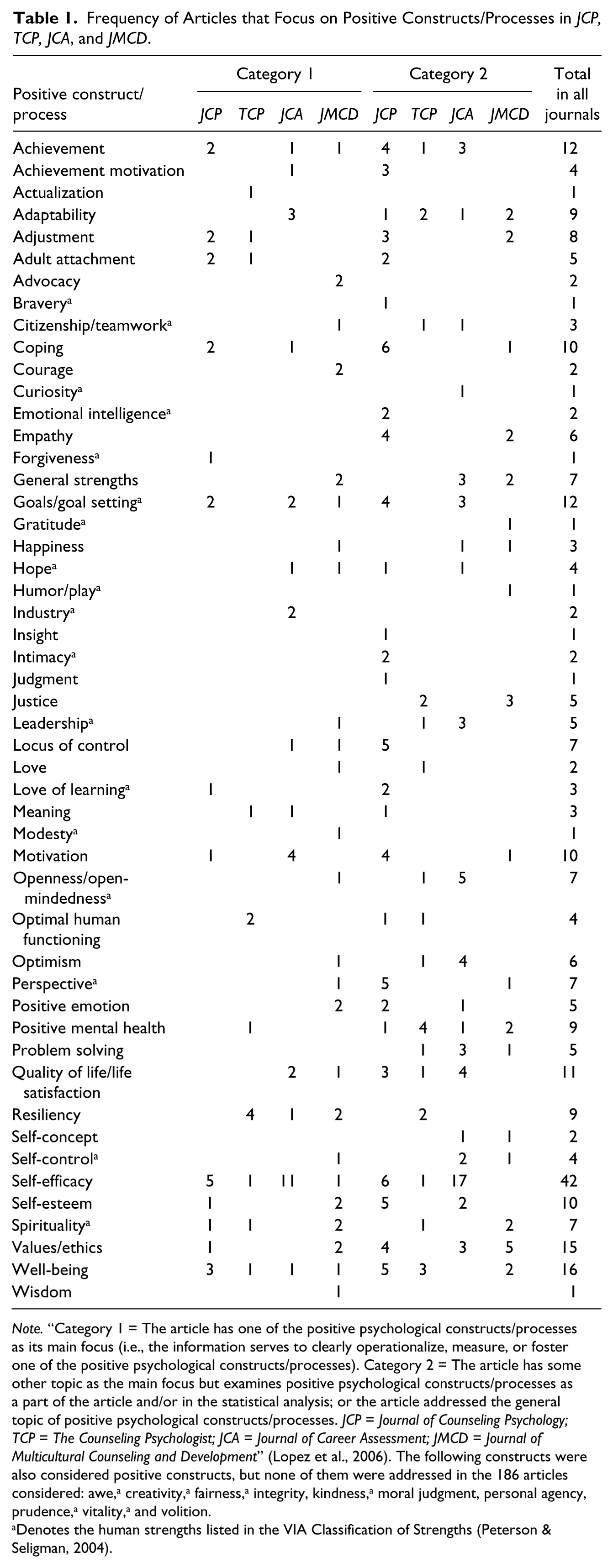
Note. “Category 1 = The article has one of the positive psychological constructs/processes as its main focus (i.e., the information serves to clearly operationalize, measure, or foster one of the positive psychological constructs/processes). Category 2 = The article has some other topic as the main focus but examines positive psychological constructs/processes as a part of the article and/or in the statistical analysis; or the article addressed the general topic of positive psychological constructs/processes. JCP = Journal of Counseling Psychology; TCP = The Counseling Psychologist; JCA = Journal of Career Assessment; JMCD = Journal of Multicultural Counseling and Development” (Lopez et al., 2006). The following constructs were also considered positive constructs, but none of them were addressed in the 186 articles considered: awe,a creativity,a fairness,a integrity, kindness,a moral judgment, personal agency, prudence,a vitality,a and volition.
Denotes the human strengths listed in the VIA Classification of Strengths (Peterson & Seligman, 2004).
Overall, results demonstrate that 13% (186 of 1,468 articles) of the random sample of counseling psychology scholarship in guild and theme journals had a positive focus. This is less than half of the 29% of articles found to have a positive focus in the 2006 Major Contribution, suggesting that despite the creation of the APA Section on Positive Psychology (established in 2004) and the International Positive Psychology Association (established in 2007), as well as positive psychology’s growing body of literature demonstrated in other journals (e.g., The Journal of Positive Psychology and the Journal of Happiness Studies, established in 2006 and 2000, respectively), book series (e.g., Lopez, 2008), textbooks (e.g., Lopez, Teramoto Pedrotti, & Snyder, 2015; Peterson, 2006), and large compilations (e.g., Lopez, 2009; Lopez & Snyder, 2011; Parks & Schueller, 2014), positive psychology has lost representation in major counseling psychology journals.
In 2011, Magyar-Moe et al. conducted a survey to identify positive psychology’s role in the work of counseling psychologists. Four hundred eighty members of Division 17 completed a survey that assessed their perceptions of positive psychology and the ways in which they apply (or fail to apply) positive psychology in their work as scholars, teachers, and clinicians. Results indicated that 47% to 77% of the counseling psychologists who completed the survey were using positive psychology in their various work roles about half of the time or more. More specifically, research in positive psychology was endorsed at the lowest rate (47%), and positive psychology applied to vocational assessment was endorsed at the highest rate (77%). Positive psychology as applied to mental health counseling (72%), infused into teaching content (67%), and applied to social justice advocacy (65%) was endorsed at very high levels as well.
A follow-up survey was developed and disseminated (Magyar-Moe et al., 2012) to capture more detailed information. The second survey included multiple questions and checklists regarding which specific constructs, theories, and forms of therapy from the literature in positive psychology were being utilized most in the workplace by Division 17 members. Although data were collected on the use of positive psychology across work settings, the results presented in this article pertain only to the findings from those who endorsed engaging in clinical practice.
Eighty-three percent of participants in clinical practice (N = 227) indicated that positive psychology informs their client assessment and client conceptualization. Seventy-five percent endorsed that positive psychology informs their treatment planning, and 92% reported utilizing positive psychology in the process of providing counseling. However, when asked which major theories and constructs from positive psychology scholarship inform their clinical work, 46% indicated that they do not utilize any specific positive psychology theories or constructs (see Figure 1), and 60% indicated that they do not utilize any positive psychological models of therapy (see Figure 2). Eighty-seven percent rated being unfamiliar with “at least some” of the 44 positive psychology constructs and theories noted throughout the survey (see Table 2), and 30% indicated being unfamiliar with “all” or “almost all” of the constructs and theories. Overall, the majority of the participants indicated that positive psychology informs their practice in a general, philosophical sense (e.g., “I use the general concepts rather than any specific constructs or model; While I use few of the theories explicitly, my general approach respects the capacities of humans to create solutions to their problems”), and many noted the belief that positive psychology and counseling psychology are one and the same, such that delving into the literature in positive psychology is not necessary (e.g., “Having a strong Counseling Psychology identity to me means I am doing strength-based work all the time, in all areas. I don’t see a need to specifically hop on board the Positive Psychology bandwagon in order to do this”; “I do not see any differences between positive psychology and traditional counseling psychology. I believe that many of the strategies listed as positive psychology are up-named versions of counseling psychology.”).
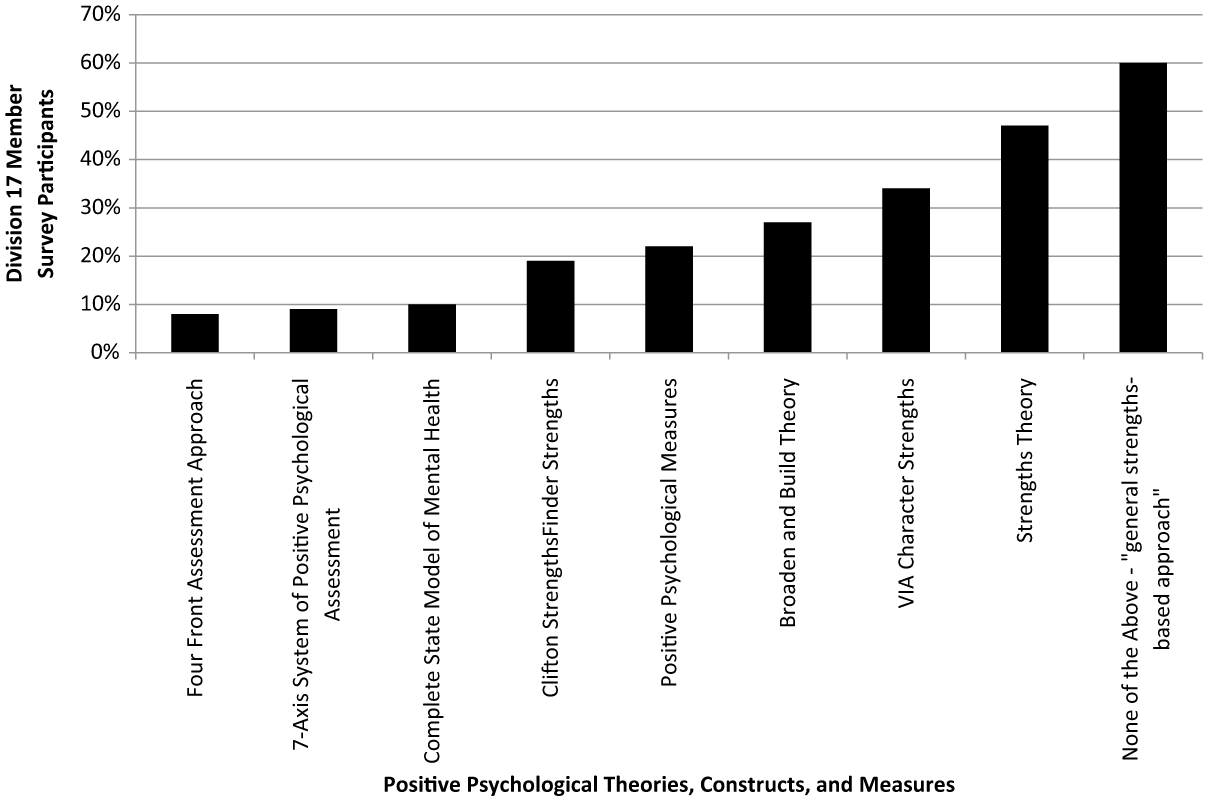
Use of positive psychological theories, constructs, and measures in client assessment and conceptualization.
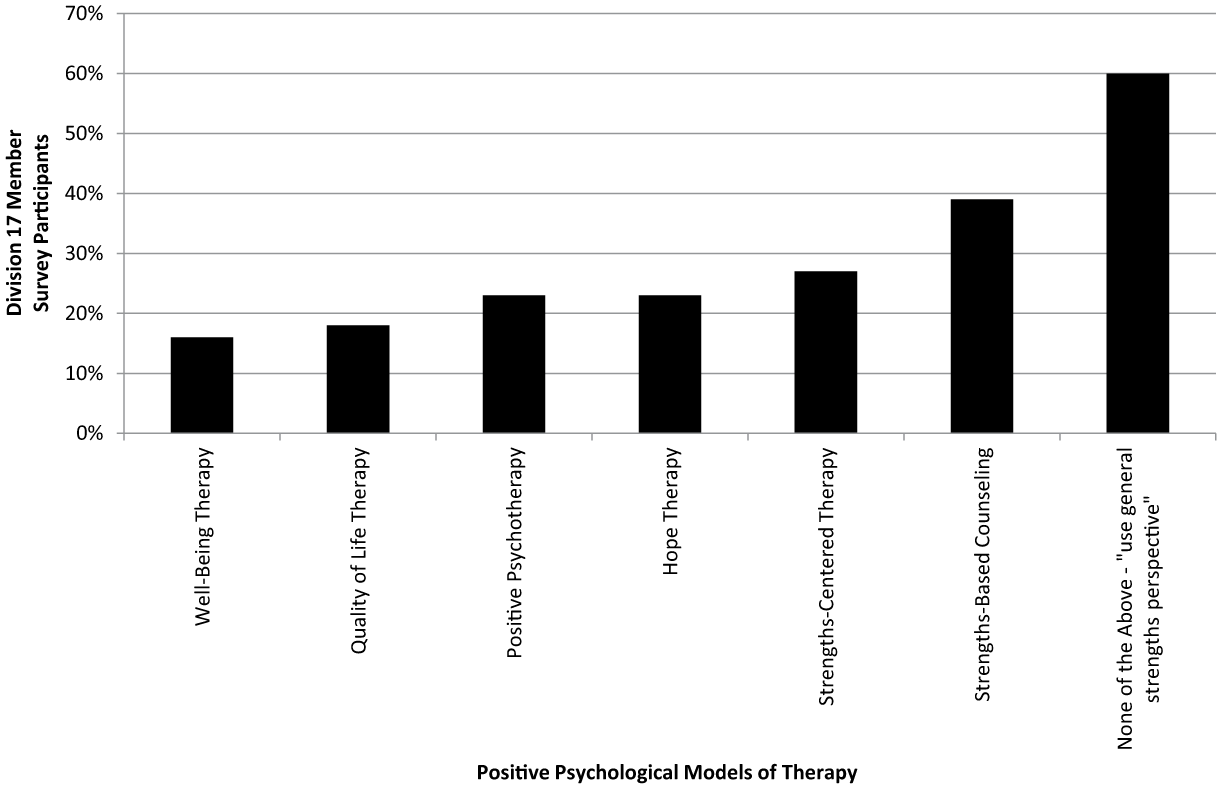
Use of positive psychological models of therapy by APA Division 17 members.
Positive Psychological Constructs and Theories Assessed in Surveys Administered to APA Division 17 Members and Student Affiliates.
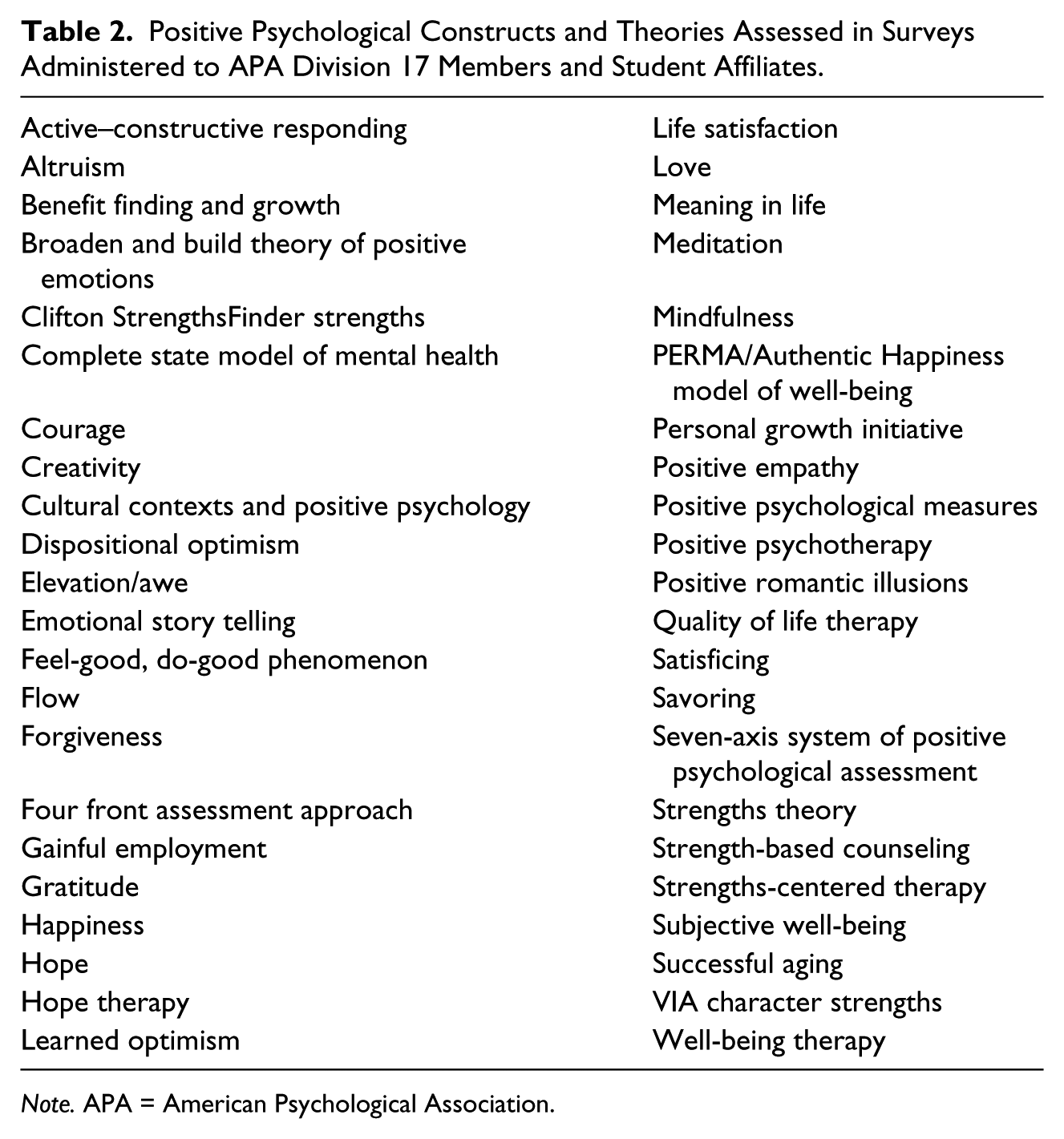
Note. APA = American Psychological Association.
The perspectives that engaging in positive psychology simply requires a philosophical commitment to a strengths-based approach and that positive psychology and counseling psychology are one and the same may be detrimental to counseling psychologists and those with whom they work. Counseling psychologists may be missing opportunities to contribute in meaningful ways to the growing field of positive psychology, especially in relation to one of its major criticisms, namely, the lack of multicultural perspectives on positive psychological processes. Furthermore, counseling psychologists are missing the opportunity to apply the existing literature in positive psychology to benefit their clientele in ways that go beyond just a philosophical stance. Indeed, participants who reported using the scholarship from positive psychology to inform their work noted that this information has been invaluable (e.g., “I cannot imagine doing any of this counseling work without the incorporation of Positive Psychology!”; “Positive psychology is of immense value to me and my staff in working with first-generation-eligible-for-college-graduation, low-income, underrepresented, and/or disabled high school and college students.”).
Student Affiliates of APA Division 17 were also surveyed to determine their exposure to, and use of, positive psychology in their roles as graduate students. The foci of the results presented in this article are upon classroom exposure to positive psychology and applications of positive psychology to their counseling work (Magyar-Moe, Parks, Pzybilski, Van Gompel, & Weirzba, 2015). Only 7% of the 216 participants reported having had an opportunity to take an undergraduate course devoted to positive psychology, despite 93% indicating that they would have liked the opportunity. Twenty percent reported having an opportunity to take a graduate course devoted to positive psychology, and 94% indicated that they would have liked the opportunity to take such a course. Eighty-seven percent indicated taking graduate courses that incorporated some aspects of positive psychology into other content areas, and 100% indicated that they would like positive psychology to be infused in other courses. Thirty-three percent reported having completed training in positive psychology through programming external to their formal graduate coursework (i.e., conference workshops or sessions). Fifty-two percent reported that positive psychology informs their client assessment and conceptualization, 42% endorsed utilization of positive psychology in their treatment planning, and 53% noted that they apply positive psychology through the process of providing counseling. However, when asked which major theories and constructs from the scholarship in positive psychology inform their clinical work, 32% of the participants indicated that they do not utilize any specific positive psychology theories or constructs, and 40% indicated that they do not utilize any positive psychological models of therapy. Seventy-eight percent indicated being unfamiliar with “about half” of the 44 positive psychology constructs and theories mentioned in the survey, and 30% indicated being unfamiliar with “all” or “almost all” of the constructs and theories. Forty-nine percent reported planning to consult the literature to learn about the positive psychology constructs and theories they did not recognize. Constructs endorsed at the highest rate of familiarity were mindfulness (78%), flow (44%), and learned optimism (44%).
The data from the student affiliate survey are somewhat promising, based on high levels of reported interest in opportunities to take courses devoted to positive psychology and that infuse positive psychology into other content areas. Student survey responses did not indicate a specific mind-set of positive psychology and counseling psychology as one and the same or as “old wine in new bottles” as was observed in the Division 17 member sample. It remains troublesome, however, that the majority of the student sample reported lack of familiarity with most or all of the 44 positive psychology constructs presented and endorsed utilizing positive psychology in their counseling work but could not specify which models or theories they applied.
The findings from the member and student surveys and content analysis are disconcerting given positive psychology’s natural home in counseling psychology. We had hoped that with positive psychology’s growth following Seligman’s 1998 APA presidency, there would have been a greater representation among counseling psychologists in recent years. Counseling psychologists have much to contribute to positive psychology, and positive psychology can enhance the work that counseling psychologists have been doing for decades. However, to achieve the best possible outcomes for our clients and ourselves, counseling psychologists must acknowledge the inaccurate nature of the perception that a strengths-based philosophical approach is equivalent to empirically based positive psychological treatment approaches. Indeed, the current state of positive psychology in the work of counseling psychologists seems to be an inclination toward promotion of strengths without specific grounding in the growing science and practice of positive psychology.
To address this disconnect, a call for manuscripts for this special issue on Applications of Positive Psychology was disseminated. The stated purpose in the call was “to cultivate a broader understanding of mental health that includes consideration of positive characteristics, adaptive functioning, and positive experiences. This is in sharp contrast with a sole focus placed upon remediation of problems.” We further stated that the “dissemination of scholarly work [in positive psychology] is needed to link theoretical and empirical work and provide direction for applications across contexts, such as clinical and educational settings.” We solicited manuscripts of positive psychology applications across four broad areas of counseling psychology: (a) counseling; (b) vocational psychology; (c) teaching, training, and supervision; and (d) social justice, prevention, outreach, and consultation. Thus, our hope through the call was to elucidate the current work of counseling psychologists in developing specific positive psychology theory and applications fitting to counseling psychology.
The response to the call was substantial with 24 submitted manuscripts, 8 of which were accepted for publication and will appear in two issues. The selected articles address positive psychology applications in vocational psychology, prevention, assessment, instrument development, family therapy, counseling processes, and counseling psychology doctoral training. In the first article appearing in this issue, Magyar-Moe, Owens, and Conoley provide an extensive review of foundational positive psychology theories and constructs and related counseling processes and models of therapy. This article was designed as a primer in positive psychology for those who may be unfamiliar with positive psychology scholarship and is inclusive of many of the major theories and constructs that were assessed in the member and student surveys and referenced in the articles that follow. Completing the first issue are two application papers within the contexts of career and mental health counseling. More specifically, Dik and colleagues provide an excellent model consisting of innovative positive psychology interventions that promote the examination of purpose and meaning in career development, and Howell, Jacobson, and Larson anchor a group counseling intervention for individuals with chronic pain through a focus on hope.
In the next TCP issue, Owens, Magyar-Moe, and Lopez provide a comprehensive model of positive psychological assessment that can be used to guide assessment, conceptualization, and treatment planning for clients across a variety of counseling contexts. Their balanced assessment approach considers both strengths and deficits of clients, and is inclusive of client cultural identities and environmental contexts. Next, Bartholomew, Scheel, and Cole present a new assessment instrument based on the positive psychology construct of hope (Snyder, 2002) for use in therapeutic contexts. The third and fourth articles presented by Conoley and colleagues address therapy processes anchored in positive psychology. More specifically, an integrated model of positive psychology methods within systemic family therapy is presented followed by a detailed review of the implementation and advantages of capitalization, a positive therapy process used to emphasize strengths and frame positive perceptions. The last article in the series is concerned with doctoral training. Georges and Tomlinson-Clarke offer a framework and strategies for the integration of positive psychology into the existing Model Training Program in counseling psychology as a means to further integrate the strengths-based philosophical stance of counseling psychology with the empirical foundations and processes of positive psychology.
Through the years, many leading counseling psychologists have commented on the importance and need for counseling psychology to take the next step beyond our strength-oriented identity to develop tangible tools that actually promote healthy human functioning and foster client strengths (Gelso & Fassinger, 1992; Gelso & Woodhouse, 2003; Lopez et al., 2006; Super, 1955). With the nine articles comprising this special issue, we enthusiastically celebrate the work of counseling psychologists bringing strength-oriented practice alive through the integration of positive psychology theories and practices. Our intention is to bring forth awareness of the need to continue building positive psychology scholarship and providing training in applications of positive psychology in relation to the work of all counseling psychologists. We hope this special issue serves to revitalize counseling psychologists’ mission to recognize and bring out the best in people, and that the articles included provide inspiration for future scholarship and applications that merge positive psychology with counseling psychology.
Footnotes
Acknowledgements
We would like to thank the University of Wisconsin–Stevens Point psychology student research assistants who volunteered their time to assist with the content analysis: Heather Crawford, Andrea Horn, Brooke Johnson, Steven Kreul, Laci McCann, Kelsey McNamee, Lhea Owens, Elizabeth Parks, Jena VanderLogt, and Jemimah Vettrus. We would also like to thank Lydia Buki and Kennon Sheldon for their assistance with editing the special issue and Meifen Wei for assisting with several manuscript revisions.
Declaration of Conflicting Interests
The author(s) declared no potential conflicts of interest with respect to the research, authorship, and/or publication of this article.
Funding
The author(s) received no financial support for the research, authorship, and/or publication of this article.