







Abstract
As a field, counseling psychology distinguishes itself through its values of building on client strengths, developmentally-informed and preventative approaches to treatment, social justice efforts to confront individual and systemic oppression, and treatment of individuals across the lifespan. Community-based youth programs offer a culturally-responsive way to advocate for and challenge the systemic inequities faced by youth today. Despite the connections between counseling psychology values and community-based programs, it is unclear how, and to what extent, the field has contributed to this literature. To address this issue, we conducted a content analysis of the three major counseling psychology journals to determine how community-based youth programs have been represented in the field. From January 1990 to March 2019 only 10 articles were published about community-based youth programming, representing only .17% of the articles published during that time period. Implications and future direction for researchers, journals, and the field as a whole are addressed.
Keywords
Youth programming promotes social, emotional, and academic development for children and adolescents ages 3–21 years old, referred to in this paper as “youth.” Youth programming exists in a range of settings, from churches to museums to art institutions (Roth & Brooks-Gunn, 2003a); however, the majority of youth programming takes place in schools, which are more accessible to White, English-speaking, middle class youth (Fredricks & Eccles, 2010; Gast et al., 2017). Community-based youth programs (CBYP), in contrast, offer programming that is often responsive to community needs and is culturally relevant, resulting in services that are more affirming to historically marginalized youth. In this paper, we examine the importance of youth programs in the United States, how those programs have been represented in the research literature, and how counseling psychology has contributed to literature on CBYP. Community-based youth programs are well-aligned with the values and aims of counseling psychology. They promote healthy development and create opportunities for economically, racially, gender, and sexually diverse youth who may not have access to other extracurricular spaces. Despite this, only 10 articles have been published about community-based youth programming in the three counseling psychology flagship journals since 1990, suggesting the field has failed to acknowledge or contribute to these programs. Based on these results, we reiterate past calls for counseling psychology to broaden its scope of research and intervention beyond traditional clinical and school settings to promote accessible and culturally-responsive development opportunities for youth.
Significance of the Scholarship to the Public
Context: Youth Programming
Youth programming refers broadly to activities that promote skill development and/or reduce risky behavior in youth (Anderson-Butcher, 2005; Roth & Brooks-Gunn, 2016). Current conceptualizations of this programming, which “replaced the deficit view of youth as ‘problems to be managed’ with a more positive image of youth as ‘resources to be developed’” (Roth & Brooks-Gunn, 2016, p. 189) became popular in the 1980s with the advent of positive youth development frameworks (J. V. Lerner et al., 2013). Growing out of these frameworks, youth programming is typically guided by three core principles, including an emphasis on positive development, the creation and maintenance of a caring and hopeful climate, and opportunities for skill building or interest expansion (Roth & Brooks-Gunn, 2003a).
Youth programs take place in one of two broad contexts: school or nonschool settings (Edginton & Randall, 2005; Jarrett et al., 2005). As the name implies, school-based youth programs are those that are affiliated with schools, occurring either during or after the school day (Harris & Kiyama, 2015). Because school-based youth programming is diverse in quality and topic (e.g., ranging from sexual health education to conflict resolution to substance use; Greenberg et al., 2003), the benefits of school-based youth programming cannot be stated conclusively. However, researchers have noted the strengths of school-based programming to include that it is easily accessed by youth, is often overseen by professionally trained individuals, and can target certain youth through referrals from school personnel (Randolph & Johnson, 2008). At the same time, other researchers have identified substantial drawbacks to school-based youth programming, most notably that schools are often unwelcoming and discriminatory to racially, economically, and sexually diverse youth (e.g., Hope et al., 2015; McCarty-Caplan, 2013; Ullucci & Howard, 2015).
In contrast to school-based programming, CBYP are unaffiliated with a particular school, although they may be physically housed in a school building. As with school-based programs, considerable range exists in the location and purpose of CBYP. Programs take place everywhere from museums to churches to sports facilities and focus on everything from educational access to socioemotional development to problem remediation (Roth & Brooks-Gunn, 2003a). Because many CBYP are offered at little to no cost, starting as far back as the 1960s, U.S. policy has supported CBYP as a way to remedy the social inequities faced by economically marginalized, and racially diverse youth in the United States (National Research Council and Institute of Medicine, 2002; Roth & Brooks-Gunn, 2016).
Current estimates suggest more than 60% of U.S. youth participate in some form of extracurricular programming (Feldman & Matjasko, 2005; United States Census Bureau, 2014). However, rates of participation vary widely across economic groups, with participation rates of economically marginalized youth lagging their more affluent peers by nearly 30% (Moore et al., 2014). As a result, the majority of economically privileged students participate in high quality, adult-supervised out-of-school-time activities intended to promote prosocial skills and educational preparation, a significant portion of youth from economically marginalized households—a disproportionate majority of whom are Students of Color—are forced to spend discretionary time unsupervised, watching TV or “hanging out” with friends (Snellman et al., 2014).
The reasons for economic and racial disparities in youth programming are multiple. However, finances and safety often play a role, causing economically marginalized parents to have difficulties finding and accessing suitable afterschool activities for their children (Sommerfeld, 2011). Because of this, gaps in CBYP participation and the resulting gaps in opportunities for prosocial and educational development, have widened across economic groups over time (Snellman et al., 2014).
Research on Youth Programming
Since 1990 more than 50,000 articles were published about some aspect of CBYP in English-language, peer-reviewed journals. These articles were diverse in their focus, methods, and publication venues. The largest proportion of published CBYP articles (approximately 15,000) reviewed or evaluated community-based health interventions for children or adolescents on a broad range of topics such as sexual health, obesity, and smoking cessation. Accordingly, many of these articles were published in medically-oriented journals such as the American Journal of Public Health or Journal of Adolescent Health.
A relatively smaller, but still notable, number of published articles highlighted the work of one or more CBYP that target well-being beyond physical health. In keeping with the design of CBYP overall, many programs were preventive in nature (e.g., preventing violent behavior, developing prosocial skills, etc.) whereas others focused on remediation (e.g., CBYP for youth with depression or eating disorders, diversion programs, etc.). Although some of these articles were published in topic-specific journals (e.g., Journal of Suicide and Life Threatening Behaviors, Journal of Family Violence), most appeared either in journals focused particularly on youth (e.g., Journal of Child & Family Studies, Journal of Adolescence, Youth & Society), or in journals specific to the topic of youth development (e.g., New Directions in Youth Development, Journal of Youth Development, Afterschool Matters). This suggests the age of participants, and the particular focus of these articles, may restrict the venues in which they are published. The primary exception to this trend are journals in the field of community psychology, which broadly study the reciprocal effects of individuals and communities. The top two journals in this field (Journal of Community Psychology, American Journal of Community Psychology) published 69 articles on CBPY from 1990 to 2019, representing more than 2% of their total published articles during this time period.
Published research in journals, books, and research reports generally agree that when youth programs follow the core principles mentioned above, they are effective at increasing positive competencies and decreasing problem behaviors (Durlak et al., 2007; Roth & Brooks-Gunn, 2003a, 2003b, 2016). For example, a series of meta-analyses found youth programs reduce problem behaviors such as drug and alcohol use, school misbehavior, aggressive behavior, violence, truancy, high-risk sexual behavior, and smoking, and increase prosocial competencies such as mental health coping skills, self-efficacy, academic achievement, interpersonal skills, assertiveness, and self-confidence (Catalano et al., 2004; Durlak & Wells, 1997, 1998; Greenberg et al., 1999; J. V. Lerner et al., 2013; Mahoney et al., 2009; Roth & Brooks-Gunn, 2003b; Vandell et al., 2015). What is more, the long-term implications of these gains are sweeping, leading to life-long benefits such as higher pay and better career prospects (e.g., A. Wong, 2015).
For economically marginalized youth, the positive implications of participating in effective youth programming may be especially profound. When economically marginalized youth participate in effective programming, they make larger gains than their more affluent peers in areas such as academics, socioemotional development, and school engagement (e.g., Lauer et al., 2006; Vandell et al., 2007). This is true of youth with intersecting underrepresented identities as well. Fish et al. (2019) found that economically marginalized Youth of Color who identified as transgender were more likely to participate in LGBTQ specific CBYP, with the focus on mental health and well-being.
One way researchers conceptualize the benefits of CBYP for youth with underrepresented identities is through the lens of social and cultural capital (Gast et al., 2017). As Harris and Kiyama (2015) noted, educational systems in the United States adhere to cultural values typically associated with cis-gender, heterosexual, White, middle-class norms, making them feel unsafe for LGBTQ youth, economically marginalized youth, and Youth of Color (Toomey & Russell, 2016). However, CBYP regularly reflect the cultural values and norms of the communities in which they are situated (Fish et al., 2019; Noam et al., 2002), thereby creating culturally-affirming spaces that value the identities of economically marginalized youth, Youth of Color, and gender and sexually diverse youth.
The Role of Counseling Psychology
Attending to context and culture appears central to CBYP effectiveness, especially for economically marginalized youth, Youth of Color, and LGBTQ youth (Fish et al., 2019; Noam et al., 2002; N. W. A. Wong, 2008). As a psychological specialty, counseling psychology similarly attends to systems and cultural awareness and identity. However, it is unclear how counseling psychology has historically acknowledged or contributed to literature on CBYP.
In the 3rd edition of Counseling Psychology, Gelso et al. (2014) named five core counseling psychology values that have a long history in the specialty, including a focus on (a) human strengths and optimal functioning; (b) brief, educational, and preventive interventions; (c) life-span development and vocational growth; (d) advocacy, social justice, and person-environment interactions; and (e) the scientist–practitioner model. These values continue to be prioritized in the work and training of counseling psychologists, as evidenced by the newest edition of the model training program, which reiterates the four core values of counseling psychology (i.e., growth toward full potential, holistic and contextual, diversity and social justice, and a communitarian perspective; Scheel et al., 2018). Taken together, these values ground the field in a commitment to understanding how contextual factors impact individual development across the lifespan, how practitioners can foster growth, remove barriers, and use interventions tailored to the needs of diverse populations, and how to challenge systems that marginalize people (Lichtenberg et al., 2018; Packard, 2009). It would seem, based on these values and stated commitments, that counseling psychologists would be especially interested in CBYP, which not only support optimal functioning in youth through educational and preventative interventions, but which also highlights the contextual embeddedness of individuals and seeks to address systemic inequities.
Despite counseling psychology’s stated interest in development across the lifespan, little research in counseling psychology’s flagship journals are devoted to the needs of youth (Buboltz et al., 2010). What is more, the majority of youth research published in counseling psychology journals has focused on school settings (Vera et al., 2007). As a result, the field seems to have overlooked community-based programming that could promote optimal functioning amongst historically underserved youth (Romano & Hage, 2000; Smith, 2006). This historical oversight led Kaczmarek and Riva (1996) to suggest, over 20 years ago, that students within counseling psychology programs should develop competency and knowledge related to community-based interventions that promote the healthy development of diverse youth. To date, however, it is not clear if or how this suggestion has been taken up. Therefore, the current study seeks to identify the extent to which, and in what ways, CBYP is represented in counseling psychology literature. Based on those results, the current study seeks to outline possible ways counseling psychology can contribute to CBYP in the future.
Method
The current study seeks to explore how counseling psychology has contributed to literature on CBYP. To do so, we conducted a summative content analysis of the three flagship counseling psychology journals (i.e., The Counseling Psychologist [TCP], Journal of Counseling Psychology [JCP], Counseling Psychology Quarterly [CPQ]), to explore how CBYP are represented in the field. Summative content analysis is a qualitative content analysis approach that combines manifest and latent content analysis methods. Manifest content analysis quantifies the representation of certain words in a given collection of texts (Potter & Levine-Donnerstein, 1999) whereas latent content analysis explores the usage of those words (Holsti, 1969). Summative content analysis does both of these things, identifying the frequency of word usage and interpreting the context of that word usage (Hsieh & Shannon, 2005).
Judges
The judges included one faculty member and one doctoral student in an American Psychological Association accredited counseling psychology program. Amanda S. Case selected 22 keywords related to CBYP based on her familiarity with the literature; Laura Jensen and A. S. Case together determined the inclusion criteria, which were that (a) the article was published between January 1990 and March 2019; (b) the article was about youth programming (with youth defined as any individuals between the ages of 3 and 21 years old); and (c) the programming occurred outside of a school setting. Citations from the initial search were all uploaded to EndNote. L. Jensen and A. S. Case then screened those articles for adherence to the inclusion criteria. To preserve the integrity of the initial screening process, any articles that raised questions about adherence to inclusion criteria were read in their entirety and discussed by the authors before being eliminated or retained. After the final articles were selected, the authors collaboratively created a coding scheme to identify the program type, program objective, and method. L. Jensen and A. S. Case individually coded each article based on the coding scheme and then met to review results, discussing discrepancies until consensus was reached. Interrater reliability estimates indicated a near perfect level of agreement (κ = .87, p < .001; Viera & Garrett, 2005) in the coding.
Procedure
Using their respective databases, we searched TCP, JCP, and CPQ from January 1990 to March 2019. Given the variability within CBYP, the initial search terms were broad, including: youth development programs, community programs, community-based organizations, positive youth development programs, positive youth development, community youth programs, afterschool programs, out-of-school time, extracurricular activities, sports-based youth development programs, youth clubs, youth programs, youth activities, youth development, YMCA, YWCA, 4-H, Boys & Girls Club, Girl Scouts, Boy Scouts, Campfire U.S.A., Girls, Inc. This initial search resulted in a total of 5,537 hits: 3,455 from TCP, 129 from JCP, and 1,953 from CPQ. L. Jensen did an initial review of the title and abstracts of those hits and eliminated duplicate articles and those that were obviously unrelated to youth CBYP, retaining 623 articles. L. Jensen then did a second review of abstracts and eliminated articles unrelated to programming for youth, resulting in a sample of 41 articles. The authors consulted about any questions that came up during the second review step, including articles that were unclear regarding for example setting or age of participants. The remaining 41 articles were downloaded in their entirety and reviewed by both authors to ensure they met inclusion criteria. Articles that were not relevant to CBYP (e.g., adult/parent interventions, school-based or school-focused programs) were eliminated, resulting in a final sample of 10 articles. These articles were then coded by L. Jensen and A. S. Case.
Results
Article Characteristics
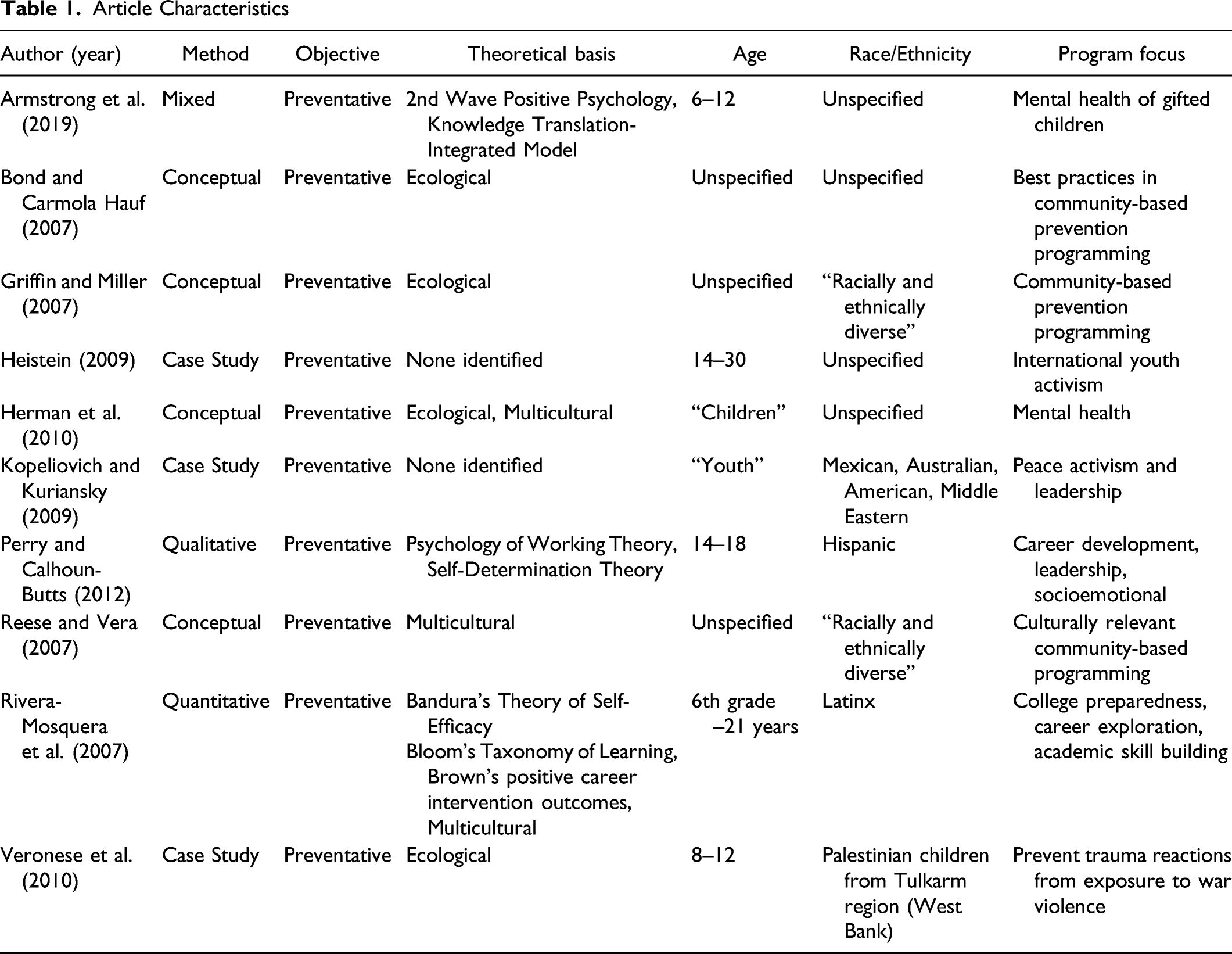
Four articles were conceptual, relying on theoretical frameworks common to counseling psychology to describe issues relevant to CBYP. Of note, the authors of only one of these articles (Herman et al., 2010) stated at the outset that they were exclusively describing programming for youth; the remaining three articles used youth programming as examples to describe best practices and issues facing the implementation and evaluation of community-based programs. The conceptual article by Bond and Carmola Hauf (2007) used ecological theory to explore how community-based collaborations promote prevention and to describe six common themes of effective, preventative community-based collaborations. The three remaining conceptual articles (Griffin & Miller, 2007; Herman et al., 2010; Reese & Vera, 2007) drew from a combination of ecological and multicultural theory to advocate for the creation of more culturally relevant, community-based prevention programs for youth. Griffin and Miller (2007) advocated for rigorous program evaluation designs to assess the cultural relevance of community-based programs and argued that culturally relevant programming can interrupt the deleterious effects of systemic and systematic racism and classism on youth. Herman et al. (2010) and Reese and Vera (2007) provided examples of culturally-relevant community-based programs to illustrate their arguments for preventive community-based programming and the role of counseling psychologists in that work. In each of these articles, the authors used their theoretical lenses to consider how systems-level prevention efforts can respond to community-specific needs.
Three additional articles were empirical in nature, each evaluating a single program using quantitative (n = 1), qualitative (n = 1), or mixed (n = 1) methods. Perry and Calhoun-Butts (2012) conducted a two-year PAR and consensual qualitative research study to explore the career, educational, and cultural development of Hispanic youth enrolled in an after-school, community-based program. Youth reactions to the program were diverse, ranging from perceptions that the program was generally helpful to “not that important” (Perry & Calhoun-Butts, 2012, p. 505). Although the authors describe the program as targeting the career development, leadership, and socioemotional development of youth, they provided no details about the program’s structure or activities.
In contrast, the articles by Armstrong et al. (2019) and Rivera-Mosquera et al. (2007) provided considerable detail about the programs they evaluated. Armstrong et al. (2019) used mixed methodology to describe the DREAM Program, which employed principles of Rational Emotive Attachment Logotherapy to foster resilience and promote mental health in gifted youth. The authors used a type of PAR called the knowledge translation-integrated approach (Wathen & MacMillan, 2018) to create the DREAM program curriculum and assess its effectiveness. Results showed the children enjoyed the program, parents found it helpful, and teachers found it feasible to implement. Authors also found that children’s mental health and meaning (e.g., hope, openness, agency) improved from pre- to posttest.
Rivera-Mosquera et al. (2007) evaluated a grassroots college preparation program for Latino youth called Latinos en Camino al Exito Universitario. In addition to reviewing the theoretical bases for the program (see Table 1) the authors also described the aim of the program, which was to foster college preparedness, career exploration, and academic skills in a culturally and linguistically sensitive manner. The authors used a pre–post quantitative approach to assess program outcomes. However, due to limited posttest data, the authors only calculated descriptive statistics, which showed average posttest scores were higher than pretest scores. The authors noted the limitations of these evaluative methods but also argued those limitations are common in CBYP research due to issues such as attendance and attrition.
The final three articles that met inclusion criteria were case studies about single CBYP published in CPQ. In keeping with the international focus of CPQ, all three articles described programs that took place outside of the United States. Two of the case studies (Heistein, 2009; Kopeliovich & Kuriansky, 2009) described CBYP with social justice agendas that targeted leadership development in youth. Heistein (2009) described the aims and key components of the Global Youth Connect program, which helps youth and emerging adults 14 to 30 years old develop activism skills with other youth leaders around the world as a way to promote human rights. Kopeliovich and Kuriansky (2009) similarly described the key components of Journeys for Peace, a program based in Mexico that prepares youth to become leaders for peace and change in the world. Included in their description were specific examples of social service projects youth complete as part of the program and statements from youth involved. In contrast to the other two case studies that promoted prosocial development, the case study by Veronese et al. (2010) described an unnamed CBYP designed to prevent trauma reactions in Palestinian children exposed to violence in the Tulkarm region (West Bank). After describing the ways they involved community leaders in the program, the authors described the two stages of program implementation, including volunteer training and child programming.
Discussion
This study examined the extent to which, and in what ways, CBYP research is represented in the field of counseling psychology by conducting a summative content analysis of three flagship counseling psychology journals in the past 30 years. Since 1990, these journals published only 10 articles focused on CBYP, representing .17% of the journals’ total published articles. For comparison, the two flagship journals of counseling psychology’s sister field of community psychology have published more than 11 times the proportion of articles about CBYP in the same time frame. These results lay bare the underrepresentation of CBYP in counseling psychology journals.
Despite the diminutive number, those articles that were published on CBYP demonstrate several core counseling psychology values. In keeping with the field’s emphasis on person–environment interactions, all of the conceptual articles relied on multicultural and/or ecological theories to argue for involving community stakeholders in CBYP development, implementation, and evaluation. The case study by Veronese et al. (2010) demonstrated these principles, describing how a program can be created out of, and in collaboration with, local authorities and community members. These participatory approaches to program design and implementation align well with Fouad’s (2013) call for counseling psychology research to embrace diversity through research methodology, and to make research a collaborative process that benefits the community.
Several of the conceptual articles and case studies also reflected the field’s foundation in, and call for more, social justice work. By describing CBYP that promote social justice and activism among youth, the articles by Heistein (2009) and Kopeliovich and Kuriansky (2009) provided examples for how such attitudes can be developed in youth. Both of these articles focused on enhancing social justice work among youth internationally, proceeding recent calls for counseling psychology to expand social justice efforts internationally (Wang & Ciftci, 2019). By describing the need for culturally relevant CBYP, the conceptual articles by Herman et al. (2010) and Reese and Vera (2007) also reflected the field’s social justice mission by advocating for the development of community-based programs that can interrupt the systemic racism and classism that threaten economically marginalized youth and Youth of Color.
Finally, in line with counseling psychology’s prioritization of development and prevention, all of the articles that met inclusion criteria described existing CBYP, or the need for CBYP, that are preventive rather than reactive in orientation. Thus, although research about CBYP is underrepresented in counseling psychology journals, those articles that are published are firmly rooted within counseling psychology values, mission, and history.
Limitations
The results should be considered in light of several study limitations. We examined articles that were published in only three journals. Expanding the search to other journals related to counseling psychology could allow for more insight about representation of CBYP research in the field. As mentioned earlier in the manuscript, CBYP research exists in journals outside of counseling psychology that focus on community intervention (e.g., Journal of Community Psychology) and youth (e.g., Journal of Adolescence, Youth & Society). A thorough analysis of CBYP research outside of counseling psychology, although beyond the scope of this article, could allow for greater insight into CBYP research more broadly.
This is also the first article of its kind, and additional content analyses are needed to assess result replicability. Search criteria and coding used to identify the final relevant articles were based on the authors’ knowledge and experience. Due to the variability in CBYP, different researchers may use different keywords or find relevant articles that the current authors did not. In addition, the current study only coded articles based on type, and did not examine the appropriateness of empirical methodology. Additional content analyses are needed to look closer at the existing empirical articles to examine the quality and fit of methodology. Further research on appropriate methodology can be a helpful next step to understand and highlight specific ways counseling psychologists can contribute to literature on CBYP.
Implications for Practice, Advocacy, Education/Training, and Research
High quality CBYP grown out of community needs are happening across the country and serving as a key source of support and enrichment for youth, especially economically marginalized youth, Youth of Color, and LGBTQ youth. However, counseling psychology journals are not publishing research or theory about such programs. Although this analysis does not allow for the discernment of why research on CBYP is not being published in counseling psychology flagship journals, the results nonetheless hold implications for how counseling psychology could better recognize, contribute to conversations about, and work to improve CBYP through practice, advocacy, training, and research efforts.
Practice
Counseling psychologists have considerable expertise to offer CBYP personnel due to training in human and vocational development, prevention, cultural competency, systems, and research methods. Because of this, Herman et al. (2010) called for counseling psychologists to contribute to youth development in the communities in which they live and work by partnering with local community-based programs. However, if CBYP are not being written about in counseling psychology journals, counseling psychologists may not be well-informed about the work of CBYP or the ways they can contribute to that work.
One way counseling psychologists can contribute to CBYP is by assisting with program development. As several of the conceptual articles mentioned, community stakeholders must be involved in CBYP development for programs to be culturally relevant for the youth they serve. In fact, Reese and Vera (2007) defined cultural relevance as: “the extent to which interventions are consistent with the values, beliefs, and desired outcomes of a particular community” (p. 766). But not all CBYP have personnel with the expertise or resources to effectively engage stakeholders in preliminary and ongoing discussions about needs. Therefore, counseling psychologists should partner with local CBYP, so they can use their training and skills in group facilitation and needs assessment to support CBYP in the development of culturally relevant programming (Vera & Speight, 2003).
Advocacy
CBYP are typically funded through private donations, public donations, or grants. Over the years, competition for such funds has increased, forcing CBYP to present more compelling rationales and data to secure funding (Griffin & Miller, 2007). However, CBYP rarely have the resources to employ personnel with training in program evaluations or to publish research that shows the importance of CBYP. Therefore, a simple way counseling psychology as a field can advocate for CBYP is by conducting research in partnership with CBYP and publishing that research in journals.
By publishing research on CBYP, counseling psychologists will be advocating for those programs in multiple ways. Research on individual CBYP can supply programs with data they can use to apply for grant funding and bring national attention that can facilitate fundraising efforts. Research on CBYP in aggregate can also advance policy that diverts funds away from classist and racist systems that disproportionately target economically marginalized youth and Youth of Color (e.g., juvenile justice) and towards preventive, culturally relevant CBYP (McCarthy et al., 2016). In doing so, the field will be living out its social justice values of combating systemic disparities that threaten marginalized youth (Griffin & Miller, 2007).
Education/Training
The call for counseling psychologists to expand beyond traditional, individual modes of intervention is not a new one. For decades now, counseling psychologists have been encouraged to move into system-level and community-based interventions (Herman et al., 2010; Kaczmarek & Riva, 1996; Reese & Vera, 2007) that “promote community empowerment” (Vera & Speight, 2003, p. 265). Doing so is especially important to support the developmental and mental health needs of Black, Latinx, Indigenous, economically constrained youth, for whom individual therapy is often inaccessible and educational systems are toxic (Albee, 1999; Hope et al., 2015; Shim et al., 2018). Supportive community-based programs also offer key services for youth with intersecting sexual and gender diverse identities, who report feeling invisible in school and healthcare settings, and experience elevated levels of mental health concerns (Logie & Lys, 2015; Newcomb et al., 2020). However, most counseling psychology training programs continue prioritizing individual interventions conducted in traditional settings.
Training programs may have failed to answer calls to expand into nontraditional community-based interventions because much of counseling psychology’s published research centers on individual treatment (Albee, 1999). As a result, counseling psychologists in training, as well as counseling psychologists providing training, are not being introduced to alternative modes of intervention. In addition, counseling psychologists and counseling psychologists in training may be receiving the implicit message that they cannot or should not conduct research on alternative interventions such as CBYP because counseling psychology flagship journals do not publish such research.
Counseling psychologists must move beyond inaccessible and oppressive modes and contexts of intervention and start learning from CBYP that provide effective, accessible, culturally relevant programming. In addition, if the field aims to prepare psychologists who can serve as partners with, and advocates for, organizations that support historically underserved youth, counseling psychologists need to train students to conduct truly collaborative research with such organizations. Developing partnerships with CBYP, like those described by Reese and Vera (2007), could enable counseling psychology training programs to reach both of these aims while also serving as a resource to local organizations.
Research
As Fouad (2013) points out, important research is missed when journals strictly abide by methodology that is valued and deemed acceptable by larger U.S. policy and practice. For example, CBYP are typically developed out of community need, sometimes making it difficult for research on CBYP to adhere to historical conceptualizations of “good science” that prioritize a priori theoretical groundings and strict controls (Corvellec, 2013; Griffin & Miller, 2007; Reese & Vera, 2007). However, as Griffin & Miller (2007) pointed out, programs need to start somewhere and “all evidence-based strategies begin as non-evidence-based programs” (p. 853). That is not to say that no CBYP begin from a theory, or that programs should not be evaluated using rigorous empirical methods that enable program refinement and the establishment of generalizable lessons (Duerden & Gillard, 2011). But if counseling psychology aims to publish research about CBYP, the field may need to reexamine how research assumptions and expectations are shaping what types of programming is recognized in journals. Requiring CBYP to have specific theoretical groundings and utilize strict empirical propositions can restrict the creativity of programs, practitioners, and the youth involved. This is especially the case given the additional ethical hurdles of conducting research on youth. Therefore, it may be worthwhile for counseling psychology to publish research rooted in a variety of theoretical and empirical methods, thereby bringing attention to the beneficial heterogeneity of CBYP.
Relatedly, because of the importance of involving community stakeholders in CBYP development and implementation (Reese & Vera, 2007), for research on CBYP to be published in journals, counseling psychology will have to continue embracing methodologies that explicitly and intentionally prioritize participant voices. For example, community based participatory research methodologies, including PAR, collaborative inquiry, and feminist participatory research (Israel et al., 1998; Minkler & Wallerstein, 2003) allow researchers to hear from youth who are impacted by inequities and involved in community programs. R. M. Lerner et al. (2016) described several potential evaluative and methodological tools for assessing program efficacy, based in the relational development systems metatheory, which emphasizes the connection between person and environment. Methods such as those listed above can help researchers share power, uplift the voices of marginalized youth, and collaborate to promote programming that empowers youth to meet their own goals (Perry & Calhoun-Butts, 2012).
Finally, some CBYP focus on problem remediation and reducing risky behavior, in addition to optimizing strengths and promoting optimal functioning (e.g., J. V. Lerner et al., 2013), which may run contrary to the field’s focus on preventative, strength-based approaches. However, as Roth and Brooks-Gunn (2016) asserted, promoting optimal behavior and reducing risky behaviors are both critical to youth development. Therefore, to publish research on CBYP, counseling psychology journals may need to make space for publications about programs that focus on problem remediation, especially since such programs are often developed out of a community need (e.g., Royce et al., 2006). If they do so, counseling psychology journals should also be cognizant of the historical overemphasis on deficit-focused programming for Youth of Color (Griffin & Miller, 2007).
Expanding publication criteria would enable the field to better respond to as-of-yet unanswered calls for greater attention to community-based interventions and expand professional work beyond traditional counseling activities (Kaczmarek & Riva, 1996; Vera & Speight, 2003). In doing so, counseling psychology could become a leader in the development of culturally relevant and community situated youth programming.
Conclusion
Counseling psychology, as a field, values treatment that builds upon client strengths, social justice efforts to confront individual and systemic oppression, developmentally informed and contextually-situated conceptualizations of clients, and treatment of individuals across the lifespan. Despite these values, the leading journals in the field are not publishing articles about programming that supports youth outside of school in their own communities. CBYP offers unique preventative, culturally relevant, and prosocial developmental opportunities for youth. Therefore, research within counseling psychology journals must expand to contribute to the improvement of CBYP and promote them as legitimate and essential mechanisms for building on youth strengths, reducing risky behavior, and combating systemic and systematic inequities.
Footnotes
Declaration of Conflicting Interests
The author(s) declared no potential conflicts of interest with respect to the research, authorship, and/or publication of this article.
Funding
The author(s) received no financial support for the research, authorship, and/or publication of this article.