






Abstract
We invite readers into an open dialogue about the foundations of the integrative neuroaffirming framework (INAF). We begin by reflecting on our own responses to critique as an example of how meaning-making unfolds within INAF, highlighting the value of remaining grounded and approaching relationships with curiosity and openness. INAF encourages psychologists to move beyond critical analysis toward a more integrative practice that includes embodied awareness and self-reflection. Drawing on epistemic humility, epistemic plurality, and decolonial scholarship, we examine how dominant top-down approaches to knowledge production can constrain emerging perspectives, whereas bottom-up approaches grounded in lived experience may generate novel and clinically meaningful insights. We argue that scholarly dialogue can unintentionally reproduce systems of power when a select few determine what counts as legitimate knowledge. Meaningful progress requires shifting from gatekeeping toward greater openness to diverse ways of knowing. Doing so can strengthen psychology’s capacity for attunement and responsive practice.
Action Editor: Alex L. Pieterse
Significance of the Scholarship to the Public
Many people spend years trying to fit into systems that were not designed with their experiences in mind. This is especially true for people whose ways of thinking and being differ from what society considers “normal.” Too often, these differences are misunderstood or dismissed. The impact can be significant, leading to stress, burnout, shame, difficulty finding the right support, and a growing disconnect from who they truly are. When approaches to healing overlook people's own experiences and inner wisdom, they can unintentionally create barriers rather than pathways to growth. We further argue that academic and scientific conversations can unintentionally reproduce systems of power when a select few determine what counts as legitimate knowledge. Progress is strengthened when we remain open to learning from a wider range of experiences and perspectives. By listening to more voices, we can develop a richer and more complete understanding of what it means to be human. Using the integrative neuroaffirming framework (INAF) as a starting point, this work invites readers to reflect on how they understand themselves and others. It encourages people to trust their lived experiences, stay curious, and reclaim ownership of their own stories rather than relying solely on labels or explanations imposed by others. Ultimately, this article advocates for a more inclusive approach to knowledge that makes room for diverse perspectives in shaping how we understand ourselves and the world around us.
We would like to begin by expressing gratitude for the opportunity to be in community with those reflecting on this work. In that spirit, we also want to clarify that the purpose of the integrative neuroaffirming framework (INAF) was not to present a final truth, but to invite reflection and to support readers in engaging with their own understanding. We are encouraged to see that this dialogue reflects that process.
Within academic and research contexts, engagement with new ideas often emphasizes critical analysis and intellectual evaluation. Although these processes are essential, they represent only one way of engaging with knowledge. The INAF invites a more balanced approach that also includes embodied awareness and reflection. As readers engage with this work, we encourage not only analysis, but also awareness of what arises internally. This may involve softening the impulse to immediately evaluate or categorize and instead allowing space to notice how the ideas are experienced. What assumptions feel challenged? What evokes resonance, discomfort, curiosity, or resistance? What prior frameworks are shaping interpretation? These reflections are integral to meaning-making and are part of how understanding develops in real time.
This process reflects what we refer to as heart wisdom, a construct introduced in our original work (Porras Pyland & Rodriguez Tackett, 2026) to describe a person’s capacity for emotional awareness, expression, regulation, and integration. We see heart wisdom as a complementary process to intellectual reasoning, which allows for more nuanced and contextually grounded understanding. Attending to both cognitive and embodied responses may support deeper engagement with complex ideas and more flexible application in practice (Barsalou, 2016). In this context, we define embodiment as a person’s ability to experience life in and through the body—how they feel, sense, and respond to the world, not just think about it.
We also hold the perspective that truth is constructed through lived experience, shaped by our relationships—with ourselves, with others, and with the broader world—and integrated through our capacity for reflection and awareness (Jordan, 2010; Jordan & Stiver, 2017; van Manen, 2023). From this perspective, multiple truths can coexist. We honor each person’s way of knowing and understanding, and we welcome it alongside our own. When individuals are supported in connecting with their own internal sense of meaning, there is potential not only for personal insight, but for collective expansion in how they understand and engage with one another (Jordan, 2010; Siegel, 2020).
Consistent with this approach, we don’t intend the INAF to function as a prescriptive model. Given the complexity and variability of human experience, it would not be possible—or aligned with our values—to outline every potential application of the framework. Rather, we trust in psychologists’ clinical judgment and their capacity to attune to the unique needs and contexts of the individuals they serve. Even as readers engage with the INAF, we encourage them to remain connected to their own internal sense of what feels meaningful and applicable, and to adapt these ideas in ways that are responsive to each person and context. In this way, engagement with the INAF becomes both an intellectual and relational process. Through this framework, we offer a space for continued exploration, integration, and growth.
Returning to Ourselves
As we began our work in developing the INAF, we recognized that the process would entail a critical examination and intentional unlearning of our professional enculturation into dominant norms (Freire, 2021). We recognized how these norms have shaped adaptive patterns that supported our functioning within institutional contexts. However, this adaptation also distanced us from our core selves and inner coherence. As academics, practitioners, and researchers, we became increasingly aware of how deeply we had assimilated to colonized norms embedded within professional culture, and how misaligned this felt with who we are at our core. We made an intentional choice to move away from this conformity, recognizing the extent to which it constrained our capacity to fully explore and make sense of our existing knowledge.
This shift involved a return to ourselves: an acknowledgment that there is not a single truth and a commitment to honoring our own. Through this process, we came to recognize the value of epistemic plurality (the recognition that there are multiple valid ways of knowing) as legitimate and necessary. Different epistemic stances may illuminate different aspects of a complex world (Ganeri, 2019). The absence of epistemic plurality limits true understanding, constrains the potential for genuinely affirming work, and diminishes our ability to truly walk alongside our clients. A pluralistic stance invites humility by recognizing that no single framework can fully capture the totality of the human experience.
Importantly, to our knowledge, the concept of epistemic plurality does not belong to any single discipline. It has been developed across philosophy, feminist theory, decolonial scholarship, sociology, and political epistemology, among other traditions. In a similar way, many of the terms and concepts within the INAF do not derive from one theory alone. Rather, they reflect an intentional integration of ideas drawn from multiple bodies of knowledge in service of a more expansive and contextual understanding of psychology.
Decolonial scholars have similarly used the notion of pluriversality to challenge the assumption that there is a single universal way of knowing, being, or organizing reality (Mignolo & Walsh, 2018). Rather than a singular worldview to which all must conform, pluriversality recognizes the coexistence of multiple valid ways of knowing shaped by culture, history, embodiment, relationship, and place. Many Indigenous knowledge traditions similarly emphasize relationality, reciprocity, contextual wisdom, and the inseparability of person, community, and environment. This relational coherence contrasts with the fragmentation characteristic of Western reductionism. The INAF invites psychologists to move from imposing meaning toward co-creating understanding, with particular attention to challenging embedded systems of power and normativity. Rather than asking whether clients fit preexisting categories, it asks how clinicians might better understand the realities clients are already living. Notably, in validating their own ways of knowing, they strengthen trust in their insights and their potential to benefit others. This process opens space for a more authentic relational connection with clients grounded in shared humanity, mutual recognition, and respect.
In today’s sociopolitical climate, many individuals and communities are engaging in similar efforts to challenge entrenched systems of power, advocate for the rights of diverse individuals, and reclaim more authentic ways of being (Pastor et al., 2020). Therefore, the process is not unique to us, but reflects a broader human experience, particularly among those whose identities and ways of knowing have been marginalized or invalidated. We chose to focus on neurodivergent individuals as a clear example of the systemic impacts of forced conformity. That said, we view this as a starting point, and our future work aims to explore the broader applicability of the INAF across diverse populations navigating similar processes of adaptation, misalignment, and return to self.
Relational Processes of Understanding and Meaning-Making
At a broader level, this exchange reflects a deeply human experience, the experience of being misunderstood. For many individuals, and particularly for those whose perspectives have historically been systemically silenced, misunderstanding can carry a cumulative weight (Stone et al., 2024). It can evoke discomfort and deeper response patterns shaped by past experiences of not being fully seen or heard. We also note with humility that, despite receiving largely supportive responses to the INAF, our attention was initially drawn most strongly to the commentary that evoked feelings of misunderstanding. This awareness highlights how, when work carries personal and professional meaning, moments of perceived misattunement can become especially salient and can evoke an immediate sense of vulnerability (Brown, 2015). For us, this moment brought an awareness of the tension between two possible responses. One path was shaped by fear: a pull toward defensiveness to protect our credibility, the integrity of our work, and the value we believe it holds. Although understandable, this response reflects a broader pattern in academic and professional spaces, where critique can be experienced as a threat rather than an invitation.
Concurrently, we recognized the possibility of another response—one grounded in connection and intentionality. Rather than interpreting misunderstanding as rejection, we chose to approach it as a necessary part of engaging across different perspectives. From this perspective, misunderstanding signals the presence of differing epistemologies and lived experiences. What may initially feel like misalignment can be understood as a reflection of the complexity inherent in translating ideas across contexts. This shift required intentional reflection, noticing and honoring our initial somatic responses of tension while also creating space to engage with them rather than react from them. In doing so, we were better able to respond in a way that aligned with the core values of our framework. Choosing this stance was not about dismissing critique or minimizing its impact, but about engaging it with curiosity. It allowed us to remain grounded in the intention of contributing to dialogue, rather than protecting against perceived threat.
Our response to misunderstanding became an extension of the framework itself. By approaching critique with openness, we sought to model the very process we are advocating: one that prioritizes relational understanding, honors multiple ways of knowing, and creates space for continued dialogue. The goal, then, is not to eliminate misunderstanding, but to engage it in ways that expand the possibility for connection, insight, and mutual growth.
Bridging Ways of Knowing Through Epistemic Humility
The experience of feeling misunderstood initially created a sense of disconnection, both internally and in relation to those with whom we were engaged in dialogue. Yet, as we anchored in our knowing, we were able to reflect on the importance of epistemic humility, which we define as the ability to hold existing frameworks with openness rather than certainty (Medina, 2013). By doing so, we recognize that all frameworks are partial, context-bound, and shaped by the perspectives, histories, and power dynamics from which they emerge. When knowledge is held too rigidly, it can begin to function less as a tool for understanding and more as a filter that determines what is allowed to be seen. In contrast, epistemic humility invites curiosity, where individuals remain receptive to the emergence of new meaning through lived and relational experience.
This stance becomes particularly important in how we train and practice within psychology. Much of our education emphasizes linearity and categorization. These approaches offer valuable organization and shared language; but can inadvertently constrain our capacity to engage with the complexity of human experience. When clinicians are primarily trained to recognize patterns that fit within predefined categories, they may feel disoriented when encountering individuals whose experiences do not align with those structures. The challenge, then, is not a lack of knowledge, but a limitation in how knowledge has been engaged—one that prioritizes classification over integration, and certainty over exploration. Our existing frameworks can then be understood as conceptual tools, not comprehensive representations of reality. They allow us to navigate aspects of human experience, but they do not encompass its full depth or variability. To engage this complexity, we must be willing to move beyond purely reductionistic approaches and cultivate ways of thinking that are more fluid, integrative, and responsive to context. This requires not only expanding what we know, but also how we come to know (Mignolo & Walsh, 2018).
It is within this context that we begin to consider how people make sense of the world. When individuals engage with openness to lived and emergent experience, new patterns of meaning can arise that are not predetermined by existing models. Different ways of knowing reflect broader processes in how knowledge is constructed. It is this distinction that we later describe using the language of top-down and bottom-up epistemologies.
Incorporating Embodiment as a Way of Knowing
We are often taught to engage with new ideas by analyzing them, comparing them to what we already know, and making sense of them primarily through cognition. The INAF invites an additional way of engaging with new knowledge: embodiment. This way of engaging encourages the reader to feel into the work—to temporarily set aside the impulse to immediately categorize and allow the experience to unfold through sensation (van Manen, 2023). This is the difference between understanding a favorite dish by studying its ingredients and understanding it by tasting it. From a decolonial perspective, this distinction reflects broader historical patterns in how knowledge has been constructed and legitimized (Mignolo & Walsh, 2018; Quijano, 2000; Smith, 2021), often marginalizing integrative, experiential, and relational forms of understanding (Smith, 2021). As a result, work that draws from lived experience, embodiment, and interdisciplinary integration may be experienced as disruptive, particularly when it challenges or exceeds existing analytic frameworks (Botha et al., 2021). The sense of being an “outsider” in these spaces is not incidental—it reflects deeper questions about who is authorized to produce knowledge and what forms of knowing are permitted to count (Freire, 2021).
Top-Down and Bottom-Up Epistemologies
With this in mind, we appreciate Sivathasan et al.’s (2026) emphasis on grounding emerging frameworks within existing scholarship. We share the value of humility in this work and do not position our framework as a definitive truth, but as one perspective shaped by our lived experience as AuDHD (autistic and ADHD [Attention-Deficit/Hyperactivity Disorder]) practitioners and researchers and our extensive work alongside MINDS individuals. Consistent with the perspective described above, we view knowledge as inherently contextual and evolving. The recognition that no single perspective can fully capture the complexity of human experience is a foundational principle of our framework.
That said, some of the differences highlighted in this exchange may reflect distinct epistemological approaches—specifically, differences in how knowledge is generated, organized, and validated. Sivathasan et al. (2026) emphasize a top-down integration of established scholarship, whereas the INAF reflects a bottom-up process grounded in embodied, perceptual, and relational ways of knowing. We illustrate these two approaches in Figure 1 as the pyramid (top-down) and the tree (bottom-up). Top-Down & Bottom-Up Epistemologies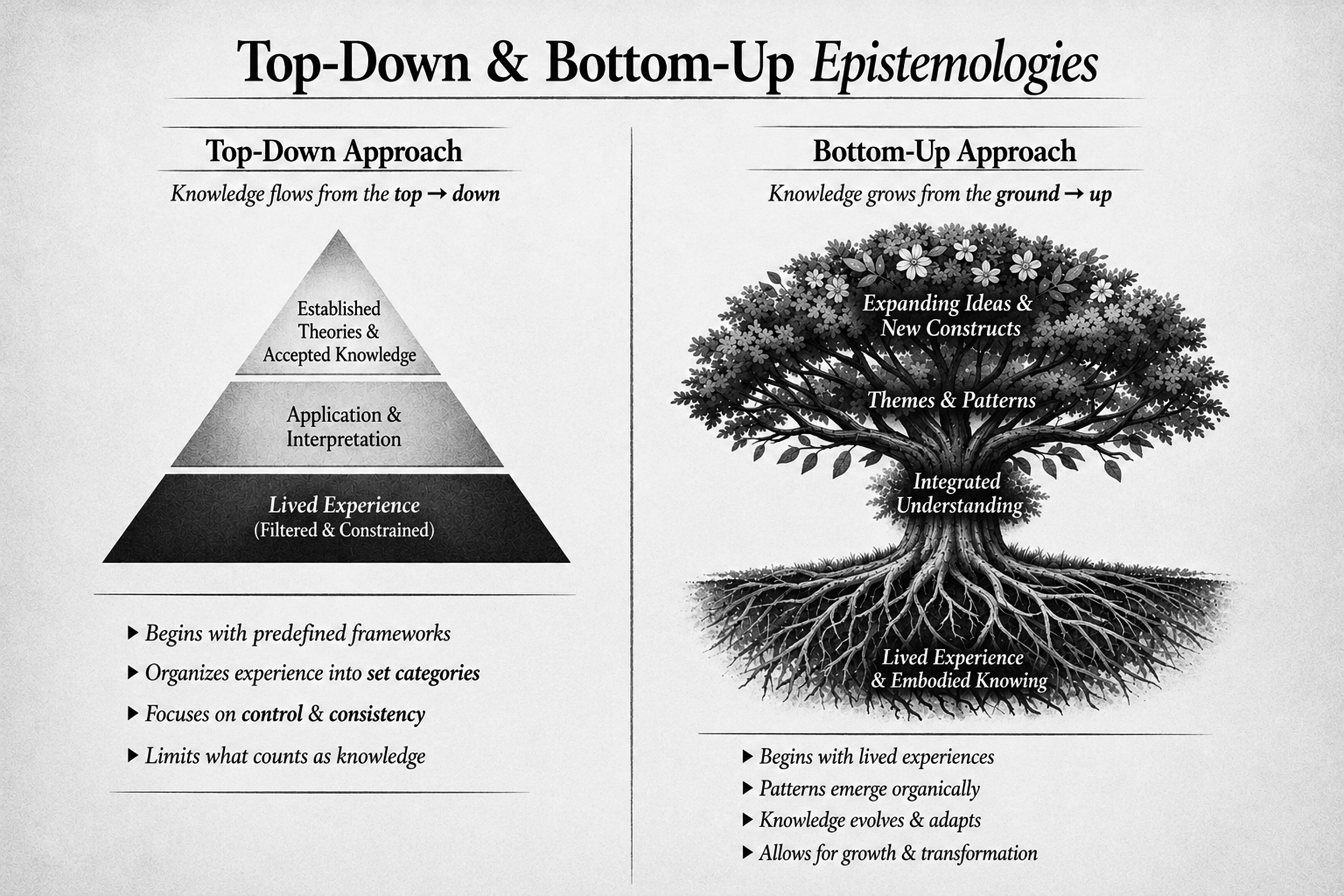
Although the terms top-down and bottom-up are traditionally used within perception research (Clark, 2015; Friston, 2009), we draw on them here as a conceptual analogy to describe integrative and reciprocal processes in knowledge development. Specifically, we use these terms to distinguish between approaches that prioritize preexisting frameworks (top-down) and those that emerge from lived, contextualized experience (bottom-up).
A top-down approach in academia prioritizes alignment with prior research and accepted scientific standards. It has been essential to the development of psychology as a discipline and it was integral to our work, as it provided a foundation for the development of the INAF. Top-down approaches are often valued for providing a shared language that can streamline communication and reduce the need to continually define constructs. The approach is designed to minimize uncertainty within complex systems (Clark, 2013; Friston, 2009), but this assumes that shared language leads to shared understanding. In practice, individuals bring different experiences and internal frameworks to these terms, meaning that even commonly accepted constructs may be interpreted in divergent ways. The way knowledge is consumed further shapes these dynamics. Academic training often privileges dominant epistemological frameworks, which can inadvertently reinforce the authority of established sources, particularly when information is assumed to be valid because it originates from a credible platform (Bhatia et al., 2024; Clark, 2015).
In contrast, bottom-up approaches begin with lived experience and moment-to-moment perceptual and relational data (Clark, 2015). In practice, bottom-up processes attend to patterns that emerge directly from engagement with individuals and contexts rather than fitting experience into preexisting categories. These approaches draw on embodied awareness and personal meaning-making. Although bottom-up approaches are often devalued in dominant methodological frameworks (Grzanka & Moradi, 2021), we challenge this assumption by suggesting it reflects a different form of rigor. This approach prioritizes depth, context, and the ability to recognize patterns as they emerge from lived experience, all of which are essential for meaningful understanding (Freire, 2021; Haverkamp et al., 2005). Just like bottom-up approaches are helpful in research (e.g., qualitative and mixed model research), they offer a valid and useful way of generating and organizing knowledge that remains closely connected to lived experience. This kind of bottom-up depth also supports a model of knowledge that is inherently organic and evolving.
Whereas traditional notions of rigor emphasize consistency and control, bottom-up approaches introduce continuous integration and responsiveness to nuanced and diverse information. A primarily top-down approach to knowledge development, such as the pyramid depicted in Figure 1, implicitly posits that knowledge produced at the “top” is comprehensive and universally applicable. Yet, those granted platforms to produce and disseminate knowledge are often not fully representative of the broader population, resulting in inevitable gaps in perspective and understanding (Pastor et al., 2020). Integrating bottom-up approaches into knowledge development situates established knowledge within a more inclusive and responsive epistemological landscape that remains open to revision and offers a necessary counterbalance to these limitations. In this way, rigor becomes a dynamic process shaped by established theory and ongoing engagement with diverse lived realities.
Cultivating Knowledge: From Experience to Theory
In developing the INAF, we intentionally engaged these two epistemologies but oriented our process primarily from the ground up (see Figure 1). Beginning with embodied and relational experience (roots), we engaged deeply with clinical and coaching practices, community knowledge, and interdisciplinary research to identify emergent patterns and themes (trunk). From this integration, new constructs were allowed to develop and expand organically (branches), with the recognition that knowledge is continually evolving over time (leaves and flowers).
We are deeply appreciative of the many voices whose work forms part of this broader root system. Although we drew extensively from this collective body of knowledge, not all contributions were explicitly cited. Commentators’ identification of additional psychological research not explicitly cited further illustrates that the INAF is well-aligned with a broad, established, and emerging body of existing work (Sivathasan et al., 2026; Williams, 2026; Zamarripa, 2026). It also reflects a deliberate emphasis on synthesis and generativity rather than reiteration. Citation choices were necessarily selective rather than exhaustive. When knowledge is approached primarily through a top-down lens, there is a risk that existing frameworks shape what is seen and constrain what is allowed to emerge (as illustrated in the pyramid). This limitation tends to disproportionately impact those whose perspectives have been historically underrepresented (e.g., Bhatia et al., 2024; Smith, 2021; Wilson, 2008).
In some ways, this structural constraint (where existing frameworks shape interpretation) shows up in Sivathasan et al.’s (2026) reaction to our use of the term “intersectionally” in the MINDS acronym. To us, this feels less like a disagreement about the word itself and more like an example of how new language grounded in lived experience can be interpreted differently in relation to what is already known. In contrast, a bottom-up approach creates space for new patterns, meanings, and possibilities to unfold.
Importantly, the INAF does not position these epistemologies as opposing or mutually exclusive. We view them as complementary and interdependent. Many top-down paradigms originate through exploratory, and, at times, disruptive bottom-up processes grounded in observation, interpretation, and pattern recognition within specific cultural and historical contexts (Anand et al., 2020). Over time, these emergent insights were codified into dominant frameworks and treated as fixed standards rather than evolving understandings. As they became institutionalized, often by those in positions of power, they began to constrain inquiry, limiting the integration of new and marginalized ways of knowing (Freire, 2021). Such dynamics can contribute to forms of epistemic marginalization and silencing, wherein individuals whose experiences fall outside dominant explanatory models are more likely to be misunderstood, dismissed, or excluded from knowledge production (Bhatia et al., 2024; Pastor et al., 2020).
When integrated, these approaches have the potential to evolve the field, allowing us to build on what is known while remaining open and responsive to what is not yet fully understood (Anand et al., 2020; Bhatia et al., 2024; Clark, 2015). Although historically marginalized knowledge rooted in non-Western epistemologies and Black, Indigenous, and people of color contexts have at times been incorporated into psychological frameworks, it is often only after being translated into forms that align with dominant scientific conventions, rather than being acknowledged in their original context (Bhatia et al., 2024). Epistemological integration allows for paradigm-level innovation and structural change by expanding what is considered valid knowledge production and facilitating responsive, context-attuned action. This integration advances individual and clinical understandings. It can also lead to social transformation by advancing existing frameworks that may no longer adequately account for contemporary complexity (Pastor et al., 2020).
Integrating the INAF Into Practice
We recognize that there is no blueprint for how people experience the world. Our goal was not to situate the INAF within a fixed conceptual structure, but to invite an expansive way of understanding. We believe this allows readers to engage with the ideas more openly and make connections that extend beyond any one perspective or context. For instance, we appreciate Sivathasan et al.’s (2026) attention to our use of polyvagal theory. However, our intention was not to offer a comprehensive application of polyvagal theory but to use it as a conceptual bridge to provide language for the potential physiological components of mental health that are not sufficiently accounted for in current psychological frameworks. By not fully prescribing meaning, we left space for interpretation and personal sense-making. In many ways, this is reflected in the responses themselves, as each contributor drew from their own expertise and prior knowledge when engaging with the framework. This reflects the point we hoped to convey—that there is an abundance of evidence across specializations (Sivathasan et al., 2026; Williams, 2026; Zamarripa, 2026), as well as vast diversity in lived experiences, and our contribution lies in bringing these patterns together in a way that allows new insights to emerge.
We also want to clarify that the INAF is not intended to be a discrete intervention or technique to be applied. Instead, it reflects a shift in how practitioners orient to understanding and meaning-making. As practitioners, our role is to adapt to the client’s needs rather than forcing the client to fit our frameworks. For example, Zamarripa (2026) emphasizes acompañamiento, an embodied and relational practice that moves beyond the more static and separate Western notion of holding space. In this way the INAF is intended to expand, not constrain, the ways we work with individuals. That is, we “walk-with” our clients in their experiences and emergent meaning-making in order to understand how to best support their needs.
Our hope is that practitioners integrate this framework and its insights into their existing therapeutic skills and modalities. For example, within cognitive-behavior therapy models, a practitioner might begin by intentionally attending to factors that shape a client’s sense of safety, such as power dynamics or prior experiences of marginalization, while also reflecting on their own assumptions to support greater relational attunement. Exploration of thoughts, feelings, and behaviors can then be expanded to include curiosity about nervous system awareness, embodied processing, and the adaptive functions underlying behavior.
Rationale for Introducing New Language
We also want to address the introduction of new language, including the term MINDS. As Williams (2026) noted, language plays a central role in shaping how we understand and engage with human experience. Our intention in introducing this term is to offer an alternative that more closely aligns with the values of agency and self-determination. We fully respect individuals and communities who choose to continue using the term neurodivergent. At the same time, we recognize that language evolves alongside shifts in understanding, and that existing terminology may not always fully capture the complexity and diversity of lived experience (American Psychological Association, 2020).
In many ways, the limitations of current language reflect broader gaps in our frameworks. Psychological constructs are often developed within specific disciplinary and cultural contexts, which can shape not only what is named, but what is left unnamed. Our aim was to begin bridging these gaps by integrating insights across disciplines and lived experience. In doing so, we also recognize that language itself is not fixed but continually shaped through collective use and meaning-making. Expanding how language is used is one way of supporting the field’s ongoing evolution.
The term MINDS reflects an attempt to explicitly capture the lived realities of individuals who have often been misunderstood, intersectionally marginalized, and silenced within dominant systems of knowledge. New terminology is not meant to create division, but to expand the range of perspectives available to psychologists and those they serve. It offers an additional lens that may support a transition toward more affirming ways of understanding diverse experiences, while preserving individual choice in how people name and define themselves. Whereas the term neurodivergent primarily centers neurological functioning, MINDS seeks to broaden this understanding by also acknowledging relational experience (misunderstanding), diverse and intersecting identities, and sociopolitical contexts (silenced).
We appreciate Sivathasan et al.’s (2026) observation regarding the potential tension between experience and identity within the term MINDS. This distinction is important, and we do not intend for the term to collapse either construct. MINDS is meant to describe patterns of lived experience that exist across relational, identity-based, and sociopolitical contexts, without prescribing how individuals define themselves. MINDS is offered as a flexible and descriptive framework rather than a categorical label. Some individuals may resonate with it as part of their identity, whereas others may relate to it as a way of naming certain experiences without adopting it as an identity. Consistent with the values of the INAF, we view this choice as inherently personal and grounded in self-determination. A similar distinction can be seen in the Nahuatl Indigenous conceptualization of autism as Nepantla (the in-between space; as discussed in Zamarripa, 2026). Here, the language highlights the lived experience rather than reducing the person to a fixed identity label. This framing preserves nuance and resists flattening diversity across individuals who may otherwise be grouped together based on external observation. We view the term MINDS as centering the practice of acompañamiento, by walking-with both identity and lived experience without requiring alignment between them. This orientation helps people express diverse experiences that may not fit within existing language or conceptual frameworks.
Embodied Engagement Across Clinical Practice and Scholarly Dialogue
When thinking about next steps, we encourage readers to not only engage with our work intellectually, but to embody it. At its heart, the INAF is a practice of intentionality and inner reflection that invites personal meaning-making and growth. In practice, this involves an ongoing and integrated self-awareness, as psychologists remain attuned to their internal responses while engaging with the experiences of those with whom they work. For example, Williams’ (2026) emphasis on therapist self-reflection and awareness of one’s own nervous system responses highlights how understanding is shaped by external knowledge, internal experience, and attunement. Our responses to new ideas are not purely intellectual but influenced by how we experience and make sense of those ideas in the moment. In this way, scholarly exchange becomes not only a space for evaluating ideas, but also for noticing how those ideas are felt and integrated across different ways of knowing. Williams (2026) offers a comprehensive starting point for self-reflection and examination, outlined in Table 1 of that paper.
The internal conflicts we carry influence how we interpret the world and can become reflected in our relationships and, more broadly, in the systems in which we participate (Jordan, 2010). In states of protection or defense, it can be difficult to access the deeper forms of understanding available to us. We may find ourselves relying on familiar interpretations, reacting rather than attuning. The INAF invites a different approach. By developing inner awareness, we create space to move from reactivity toward reflection. In working with internal patterns, we may find ourselves less easily activated, more present, and more open to understanding perspectives that differ from our own. This shift allows for greater attunement, collaboration, and shared meaning-making—both in clinical relationships and in scholarly dialogue. In this process, we are reminded that there is space for all of us in the conversation. We bring unique perspectives that are not obstacles to understanding, but essential contributions to it.
A driving tenet of our work is to hold our expertise with humility. Although we draw on research and professional experience, we remain open to the possibility that meaning may be organized differently than we expect. Ultimately, we see this dialogue as aligned with the very principles we are advocating: humility, curiosity, and openness to multiple ways of knowing. Rather than viewing difference as error, we are invited to pause and consider that meaning may be valid within a different organizational structure. This stance supports deeper attunement and reciprocal communication. By reinforcing a presumption of competence and commitment to autonomy and self-determination for those with whom we work, we honor individuals as active agents in defining and making sense of their own experiences. It is through this kind of engagement that the field can continue to grow. We therefore wholeheartedly appreciate the voices of those who have engaged with our work and welcome continued dialogue.
Footnotes
Acknowledgements
The authors acknowledge the use of ChatGPT, a language model developed by OpenAI, to assist in editing and refinement of the final manuscript. All content, interpretations, and conclusions are the sole responsibility of the authors.

Funding
The author(s) received no financial support for the research, authorship, and/or publication of this article.
Declaration of Conflicting Interests
The author(s) declared no potential conflicts of interest with respect to the research, authorship, and/or publication of this article.
Ethical Considerations
Ethical approval was not required for this paper.
Author Contributions
Claudia Porras Pyland played a lead role in conceptualization, visualization, and writing. Amy Rodriguez Tackett played a supporting role in conceptualization, visualization, and writing.