







Abstract
Problem-oriented policing (POP) has generated substantial attention from practitioners, scholars, and policy makers. A growing body of research is beginning to cast doubt on the extent to which this reform has been implemented in police agencies as prescribed by reformers. This study presents findings from an analysis of POP in the Colorado Springs Police Department, one of the national leaders of POP in the United States. The principal form of evidence is a systematic content analysis of case summaries and reports completed by police officers in 753 POP cases in Colorado Springs. The results point to a set of common roadblocks in the implementation of POP, as well as more general patterns that seem to influence the implementation of police reform.
Introduction
Understanding reform movements within any industry means looking carefully at how reform is implemented in organizations. The way reforms are implemented often bears little resemblance to the way they were envisioned by those who originally designed them. Two prominent dimensions on which implementation varies are dosage and fidelity. Dosage is the depth of the reform, or the intensity with which it is implemented; fidelity is the extent to which a reform, as implemented, matches the way it was originally conceived or envisioned (Bauman, Stein, & Ireys, 1991; Boruch & Gomez, 1977; Dusenbury, Brannigan, Falco, & Hansen, 2003). People in organizations find many ways to reject, resist, alter, or dilute organizational reforms. This may involve simply acting passively or apathetically about implementation, doing things wrong or doing the wrong things, or mobilizing active resistance. The result is often shallow or incomplete implementation (low dosage) or inaccurate or unfocused implementation (low fidelity). 1
This article examines the implementation of one type of reform—problem-oriented policing (POP)—in the Colorado Spring Police Department (CSPD). Our analysis of POP’s implementation in the CSPD, especially when considered in light of similar research in other police organizations, reveals a set of common implementation patterns. Thinking carefully about these patterns helps illuminate the realistic limitations of POP, as well as the capacity for reform in police organizations more generally. The primary source of evidence used in this article is a systematic content analysis of case summaries and reports completed by police officers in 753 POP cases in all three of the department’s geographic divisions 2 from 1995 to 1999. The content analysis findings are augmented with evidence derived from other sources, including interviews, observations, and historical documents.
Problem-Oriented Policing
Although the roots of the POP movement can be traced to early events in the history of policing and other public service industries (Scott, 2000), the concept began to take shape in the late 1970s and early 1980s with the publication of highly influential articles by Goldstein (1979) and Wilson and Kelling (1982). Both articles emerged at an important juncture in police history. Recent evaluations of team policing had been fairly pessimistic, and these articles began to outline a new vision that came to be known as community policing (Sherman, Milton, & Kelly, 1973; Walker, 1993). Throughout the 1980s, police agencies began to experiment with a wide variety of community-oriented policing strategies, including POP. In 1990, Goldstein’s book, Problem-Oriented Policing, was published, and it quickly became a classic treatise in the police reform literature.
Although the community policing movement was well underway prior to the appearance of his 1990 book, Goldstein’s prescriptions for police reform shook the foundation of policing throughout the United States and many other nations. Goldstein rapidly became the father of the POP movement in policing, but even he could probably not have imagined how quickly his ideas would begin to take hold. The literature on POP has grown markedly, including research evidence on its effectiveness (e.g., Braga, Kennedy, Waring, & Piehl, 2001; Braga et al., 1999; Chermak & McGarrell, 2004; Weisburd, Telep, Hinkle, & Eck, 2010; White, Fyfe, Campbell, & Goldkamp, 2003), normative prescriptions about how to implement it (e.g., Plant & Scott, 2009), and case studies of problem-solving efforts (e.g., Brito & Allan, 1999; Brito & Gratto, 2000; Shelley & Grant, 1998). There are now annual POP conferences; police officers can now compete for national POP awards in the United States (the Goldstein award) and Great Britain (the Tilley award); police officers can subscribe to an electronic network (known as POPNet) to share information and experiences about POP strategies; and the Center for Problem-Oriented Policing has emerged as a hub for information and resources on POP. POP is now a well-known alternative or supplement to traditional styles of policing.
Central to the notion of POP is the idea that police agencies need to become proactive rather than reactive, moving away from simply reacting to citizen calls-for-service and moving toward identifying and solving the problems that generate excessive calls (Goldstein, 1990). For example, research in Minneapolis showed that only 3.3% of addresses and intersections were responsible for 50.4% of all calls for which a police car was dispatched (Sherman, Gartin, & Buerger, 1989). Solving the chronic, recurring problems underlying these “hot spots” might reduce crime, fear of crime, and calls-for-service and improve police–community relations. Although spatial proximity is one of the ways that individual incidents or calls to the police can be grouped into larger problem types, there are many others. For instance, police might group individual incidents together into larger problem types based on similarities in victim characteristics, offender characteristics, modus operandi, or temporal patterns. Moreover, police agencies can look beyond police data to discover chronic problems that may reveal themselves in other ways. Many police agencies have learned that third parties often have a unique vantage point through which to view community problems (Mazerolle & Ransley, 2005).
Because communities face a diverse array of problems, POP takes many forms (Scott, 2000). In some agencies, police officers work with citizens to identify and respond to a variety of local problems. Some agencies form partnerships with other governmental agencies to develop coordinated responses to specific types of problems such as gangs, drugs, child abuse, or domestic violence. Consequently, there are substantial variations in the ways in which police agencies implement POP (Scott, 2000). When police executives in Colorado Springs first began formulating their ideas about implementing POP, they sought to design a strategy that would not follow a cookie-cutter model: They wanted to create a strategy that would fit the unique needs of the department and the community (Sheingold, 2000, chap. 2).
A Brief History of Problem-Oriented Policing in Colorado Springs
According to one observer, CSPD was a traditional police department in the 1970s and 1980s: “Patrol officers primarily responded to 911 calls for service and strategic and tactical decisions were made at the top of the organization’s hierarchy” (Sheingold, 2000, chap. 2). Although there were isolated instances of problem solving and community partnerships, these principles did not form the guiding philosophy of the agency. In 1991, CSPD officers learned that in the 3 months prior to a fatal shooting incident at a bar, they had responded to the bar about 90 times for various disturbances. In the aftermath of the shooting, the department worked with the state liquor board and the bar’s owner to minimize the potential for further violence there. This incident, and the effective response implemented in its aftermath, planted a seed in the department about the potential effectiveness of POP principles (Sheingold, 2000, chap. 2).
The department began a pilot test of POP in the Sand Creek Division in June 1992. By December 31, 1992, an internal audit by a police commander showed that the department had initiated 34 separate POP cases. With this pilot as a foundation, the department initiated POP department-wide (Sheingold, 2000, chap. 2). Chief Kramer argued that POP would be “the agency’s comprehensive approach to service delivery” (Kramer & McElderry, 1994). By his account, POP was not treated as a separate function; rather, it was imbued in all facets of the Department’s operations. In 1994, Chief Kramer and Deputy Chief McElderry authored a short book titled Total Problem-Oriented Policing, describing the department’s efforts to implement POP. In the second edition of the book released in 2001 (Kramer, McElderry, & Spivey, 2001), the authors stated, We have completed the major transition from traditional reactive policing to community-based Problem-Oriented Policing. After making that transition, we have continued to develop our programs, operations, and philosophy for an additional half-dozen years, so that for us it has gradually become the ‘normal’ way of policing. This has been a good and profitable experience for us, and we are confident that our agency and our community are the better for the transformation we have chosen. (p. 125)
This statement represents a bold claim by the agency’s leaders about the depth of implementation of POP in the CSPD.
In October 1997, the Colorado Springs Police Department was one of 21 departments nationwide that was awarded a grant from the COPS (Community-Oriented Policing Services) Office to establish a Community Policing Demonstration Center. The grant award of $998,643 was provided to support the development of community policing. As one part of the grant, CSPD decided to expand its internal use of POP by providing officers with a higher level of training and improving systematic record keeping on POP projects. The authors of this article served as external evaluators for the Demonstration Center grant. There is ample evidence to suggest that Colorado Springs is considered a national—and perhaps even an international—model for POP. It was one of 10 agencies profiled in a compendium of detailed case studies prepared by the Urban Institute in its National Evaluation of the COPS Office (Sheingold, 2000, chap. 2). A case study of CSPD’s “Mazatlan Circle” POP case was featured in a book chapter on POP published by the National Police of Spain (Maguire, 2000). The department was also one of 62 American, British, and Canadian police agencies mentioned in a review of prominent leaders in the POP movement (Scott, 2000).
CSPD’s reputation as a leader in the POP movement makes it an ideal candidate for improving our understanding of the content of POP as actually implemented in a police agency. What kinds of problems does the agency focus on? Who nominates cases for attention? What is the scope of these cases? How are they resolved? What agencies are involved in processing these cases? How long does it take to close these cases? The literature on POP is dominated by normative theorizing, reform prescriptions, and impact assessments. Research on the dosage and fidelity of its actual implementation is rare. This study augments findings from research by Cordner and Biebel (2005) on the implementation of POP in San Diego. Both studies examine implementation issues in agencies regarded as leaders in the POP movement.
Data and Method
As part of the larger Demonstration Center evaluation, we visited the Colorado Springs Police Department 22 times from 1999 to 2001. During those visits, we spent time interviewing employees at all levels of the organization, touring the sites of various POP cases, and observing officers on patrol in all three geographic divisions. Thus, the article is informed by these general sources of knowledge about the department. However, the primary methodology we rely on is a systematic content analysis of 753 POP case files obtained from the Department. CSPD officers routinely keep records of every POP project they initiate or to which they are assigned. An enterprising young officer, assigned by the department to handle the implementation of the Demonstration Center grant, compiled an electronic document summarizing the details of all 694 POP cases handled by the department from 1995 to 1999 for which records could be located. These case summaries served as the primary unit of analysis in this study. In an additional 59 cases, summaries were not available, but we were able to access and code the original case files directly. Taken together, these 753 POP cases form the universe of cases made available by the department and later coded for inclusion in this study. 3
After studying the POP case summaries and the original case files, we developed a coding sheet that enabled trained coders to read each case summary and enter information about it directly into a database. We began the coding process by training two coders (one criminal justice graduate student from the University of Nebraska at Omaha and one law student from the University of Nebraska at Lincoln) on the types of information we hoped to extract from each POP report. The coding sheet was divided into six sections examining the scope and type of the problem, how it was nominated, how it was resolved, what agencies were involved, and how closely the officers followed the SARA (scanning, analysis, response, and assessment) process.
Once the coding sheet was developed and the coders trained, each coder began the coding process by entering information on the same 10 cases and reviewing instances of disagreement or dissimilarity in coding decisions. This process was then repeated until there were no discrepancies between coders. This training and debriefing process was implemented to ensure strong interrater reliability between the coders. By the end of the coding process, one assistant had coded about 25% of the cases, and the other about 75%. After coding about 40% of the reports, we edited the coding sheet, adding categories where necessary. The coding sheet contains several questions with an “other” category, which allowed the coders to enter alternative responses for which we did not provide a check-box. For instance, if a particular problem type was not listed on the coding sheet, but was entered manually by a coder two or more times into the “other” category, we added a check-box to the coding sheet to represent that problem type. The same coding process described above was repeated until all cases were coded and entered into a central database containing 188 pieces of information about each case. Overall, we coded and analyzed 753 POP cases: 349 cases from the Gold Hill division, 192 cases from the Sand Creek division, and 212 cases from the Falcon division.
Although this general approach has been used in prior research on POP, the current study represents the most ambitious effort by far, both in terms of the number of cases analyzed and the number of characteristics coded about each case. This is the second time that we have used this approach to analyze POP cases for a police department. In an earlier study, we used a similar methodology to review 63 POP cases processed by the Lincoln (Nebraska) Police Department’s Problem-Resolution Team (Maguire and Schechinger, 1998). Others have used similar approaches as well. For instance, Leigh, Read, and Tilley (1998), in one of the most ambitious studies to date, analyzed approximately 340 POP cases drawn from police agencies in Cambridge and Leicestershire, England. Clarke (1998) used this general approach to examine 88 POP cases submitted to the Police Executive Research Forum to be considered for the “Herman Goldstein Award for Excellence in Problem-Oriented Policing.” Scott (2000) used a similar approach to examine 100 applicants for the same Goldstein Award. It is worth noting that the former two studies drew their samples of POP cases from police agencies, whereas the latter two drew their samples from cases submitted to an award program. In each instance, the nature of the coding sheet differed, but the general approach was roughly similar.
The Nature and Scope of Problem-Oriented Policing Cases
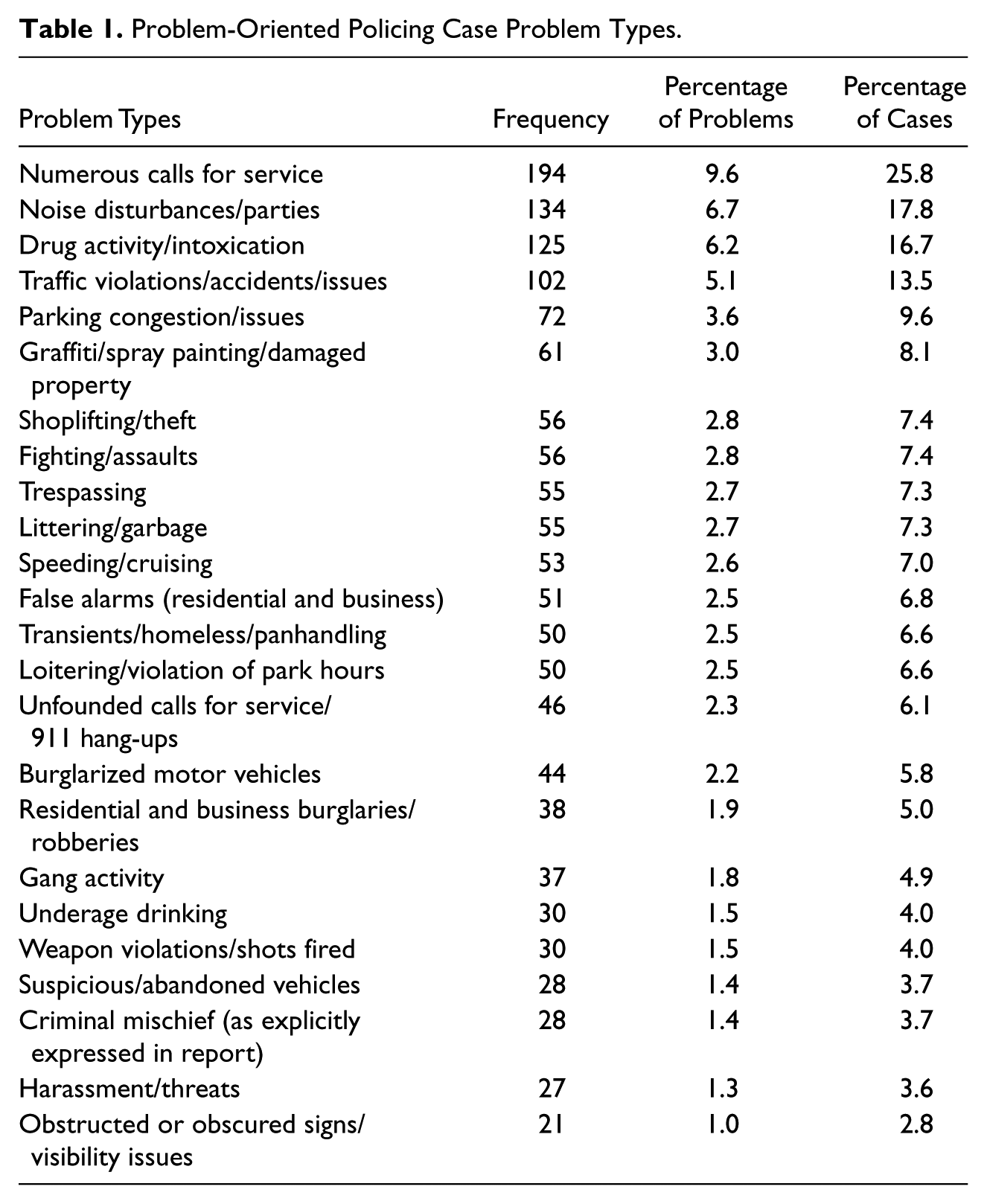
Goldstein (1990) viewed POP as sufficiently flexible to apply toward a wide range of problem types, from minor forms of disorder to serious, violent offending. In this section, we examine the nature and scope of the problems in 753 POP cases handled by CSPD officers from 1995 to 1999. The POP case files demonstrate that CSPD officers handle dozens of different types of problems in POP cases. Because a single POP case can address more than one problem type simultaneously, the 753 cases included 2,012 total problems. The number of problem types per POP case ranged from 0 to 17 with a mean of about 2.7 and a median of 4. The largest number of cases (343 out of 753 cases, or about 45% of the total) involved just one problem type.
The problems were originally coded as listed by the officers in their case reports. For purposes of this article, we then attempted to group like problems together. For instance, traffic violations, traffic accidents, and other traffic issues were all placed into a single problem category. Although each problem type has its own unique nuances, categorizing similar problems reduces fragmentation and makes the analysis more parsimonious. Table 1 lists the 24 most common problem types (each constituting at least 1% of total problems) in descending order of frequency. Note that in Table 1, there are two ways of looking at the problem types: as a proportion of the 2,012 total problems and as a proportion of the 753 total cases. The most common problem type is numerous calls for service. According to the POP case files, this means that officers opened a POP case because call logs or other data sources showed that a particular address, location, individual, or group was generating a disproportionate number of calls-for-service. These calls may have been the result of different problems; however, the concentrated and excessive demand for police services is what brought these cases to the attention of police. Observe that although the most common problem types are likely to be of major concern to citizens and residents, serious violent crime does not occupy center stage in this list.
Problem-Oriented Policing Case Problem Types.
Goldstein’s (1979) initial conception of POP focused on citywide problems, but by the time his 1990 book on the topic was published, he had begun urging police to focus on smaller, more disaggregated problems. When police officers first start thinking about applying POP in their communities, they tend to think of broad classes of problems that match definitions found in the penal code, such as underage drinking of alcoholic beverages, loitering, burglary, and sexual assault (Goldstein, 1990). This is easy to understand, since much of what the police do involves matching unsavory behaviors to definitions found in the criminal law. Yet Goldstein argues that for POP to be implemented successfully, the police need to disaggregate problems into smaller, more homogeneous categories, developing new labels that are not necessarily bound to the penal code. For instance, many police agencies in the United States focus their POP efforts on individual problem properties. This unit of analysis may appear much too small for police to focus their energies on, but it can be surprisingly difficult to solve the persistent problems associated with a single place such as a residence, park, business, or street corner (Weisburd, Bushway, Lum, & Yang, 2004). Once police begin to focus on the problem, rather than on the formal label assigned in the penal code, it also becomes easier to think about alternative means for solving the problem that do not rely solely on the police.
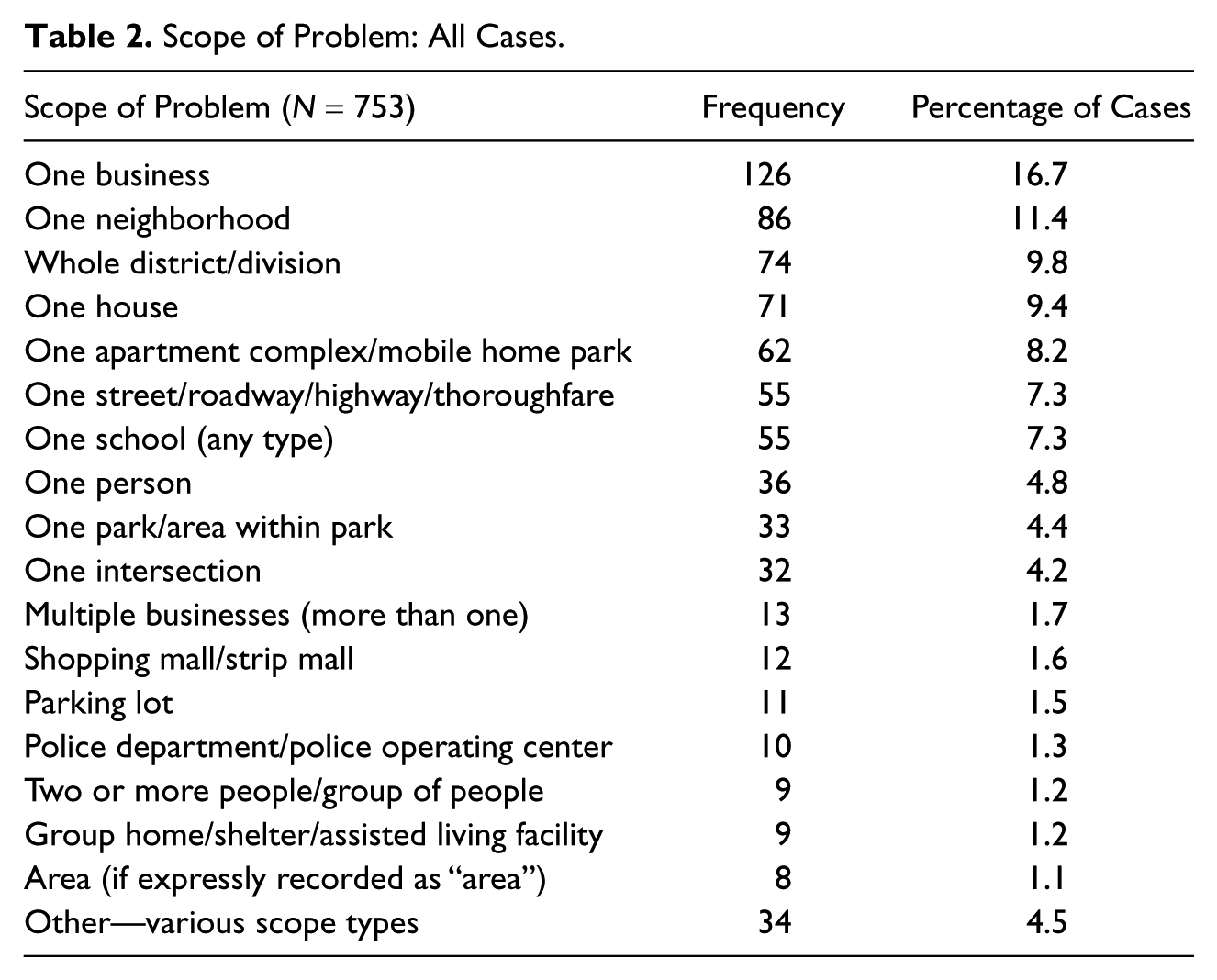
Table 2 lists the 18 most common categories for the scope of the problem in POP cases (each one constituting at least 1% of cases). Only 9.8% of cases represent district-wide problems. Nine of the top 10 problem-scope categories focus on one person, area, or building. This level of focus represents the kind of targeted attention that Goldstein and other POP reformers have envisioned.
Scope of Problem: All Cases.
Processing of Problem-Oriented Policing Cases
According to reformers, POP is a philosophy that must be tailored to the special needs and unique circumstances of the agency and the community (Goldstein, 1990). It is not a canned program that can be easily implemented within the agency in a “loosely coupled” way without influencing the technical core of the agency (Maguire & Katz, 2002). Because the focus of POP is on designing customized solutions to unique local problems, there is some reluctance among reformers to endorse a “cookbook” approach to solving problems. On the other hand, for inexperienced agencies struggling to understand and implement POP, the availability of a concrete strategy can sometimes be useful for getting started. According to Goldstein (1990), The principal danger in providing a detailed procedure is that it will be used to oversimplify the concept: that more effort will be invested in moving mechanically through the recommended steps than in the explorations and thinking that the steps are encouraged to stimulate. (p. 66)
This section focuses on the processing of POP cases in the CSPD.
One of the methods (though certainly not the only method) used by police agencies to process POP cases is the SARA model, which was first developed in the mid-1980s in Newport News, Virginia (Eck & Spelman, 1987). A decade later, when the U.S. Department of Justice developed a new grant program intended to diffuse POP throughout the nation, all applicants were required to use the SARA model. Police officers throughout the United States and many other nations can now be heard discussing the SARA approach to problem solving. The four elements of the SARA process include the following: scanning the environment to identify the problems that need to be solved; analyzing data about these problems in an effort to discover patterns or trends useful for developing creative response strategies; responding to the problem in an attempt to solve or mitigate the problem; 4 and assessing the efficacy of its response strategy. 5 The SARA model emphasizes the notion that POP is intended to be a dynamic process involving a series of stages. Many of these stages fall outside the routine processes of a typical patrol encounter or criminal investigation. They involve data collection, systematic analysis, the design of creative solutions that may not rely on a formal criminal justice response (such as an arrest, citation, or summons), and may involve other agencies and organizations.
How Are Problems Nominated for Attention?
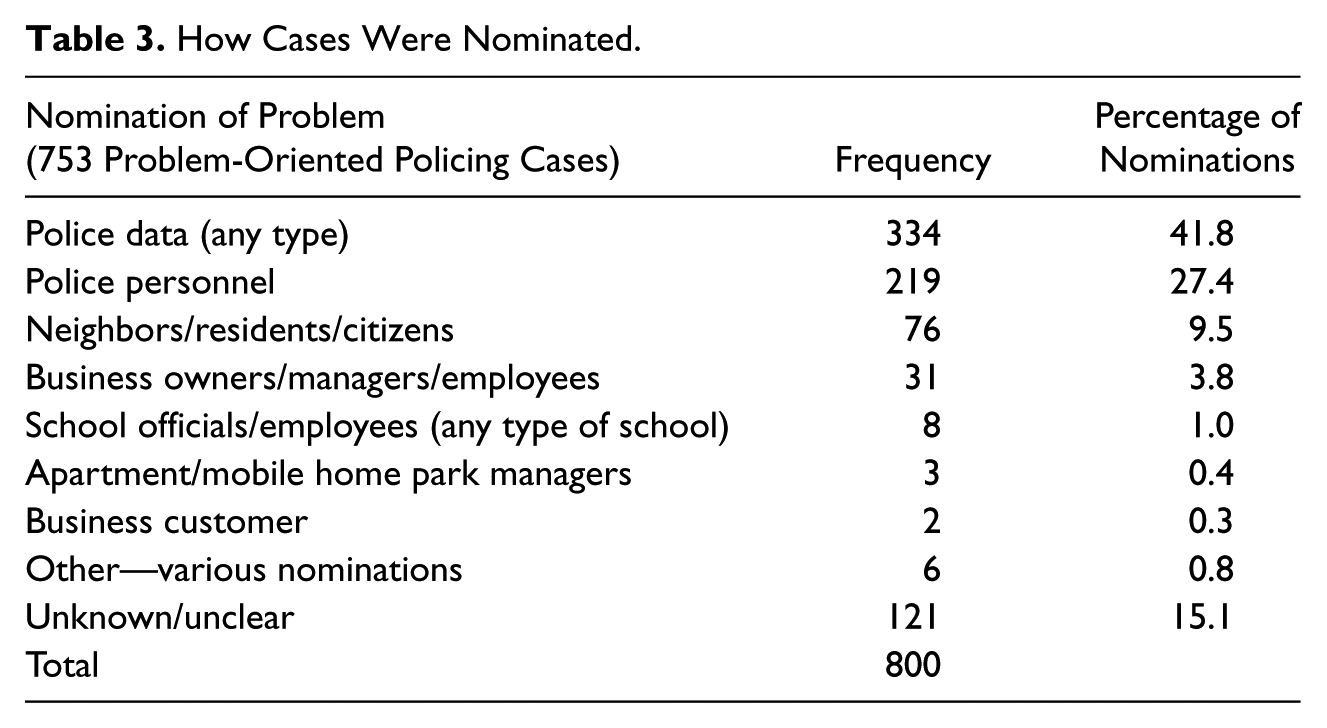
Scanning and analysis are the first stages of the SARA process. These are the steps through which an agency identifies a pool of potential problems, selects one or more for attention, and analyzes them to provide evidence about designing an effective response. One source of data useful for understanding these processes in the CSPD is a list of the ways that problems were nominated for attention. Table 3 shows the various methods by which POP cases have been nominated for attention by the CSPD. 6 This table provides several noteworthy pieces of information. First, the primary method through which cases are nominated for attention is analysis of police data. As we demonstrated earlier, the most prevalent problem type is “numerous calls-for-service.” Therefore, it is not surprising that police data serve as a primary source of information for nominating problems. Altogether, almost 70% of cases are nominated for attention through police personnel or police data. Only about 16% of cases are nominated for attention from outside the agency, from sources such as citizens, businesses, or school authorities. Although one could make the argument that calls-for-service data reflect the concerns of the community, the large difference between police-nominated and community-nominated problems is still striking. In about 15% of cases, the records we examined contained inadequate documentation about how the problem came to the attention of the CSPD. In some cities, POP cases are nominated for attention from other community agencies such as zoning and code enforcement, the fire department, and other entities. Police agencies are encouraged by POP reformers to explore alternative methods for seeking community input on the problems nominated for attention.
How Cases Were Nominated.
Responding to Problems
Earlier, we established that many POP cases feature more than one problem. Therefore, it makes sense that some cases might involve more than one response strategy. Of the 648 POP cases containing sufficient documentation to identify the response, 34% used only one, 27.6% used two, and 18.8% used three response strategies. However, the number of response strategies ranged from 1 to 18, with a mean of about 2.5 and a median of 2. This range in the number of responses is consistent with the wide variation in the nature and scope of POP problems.
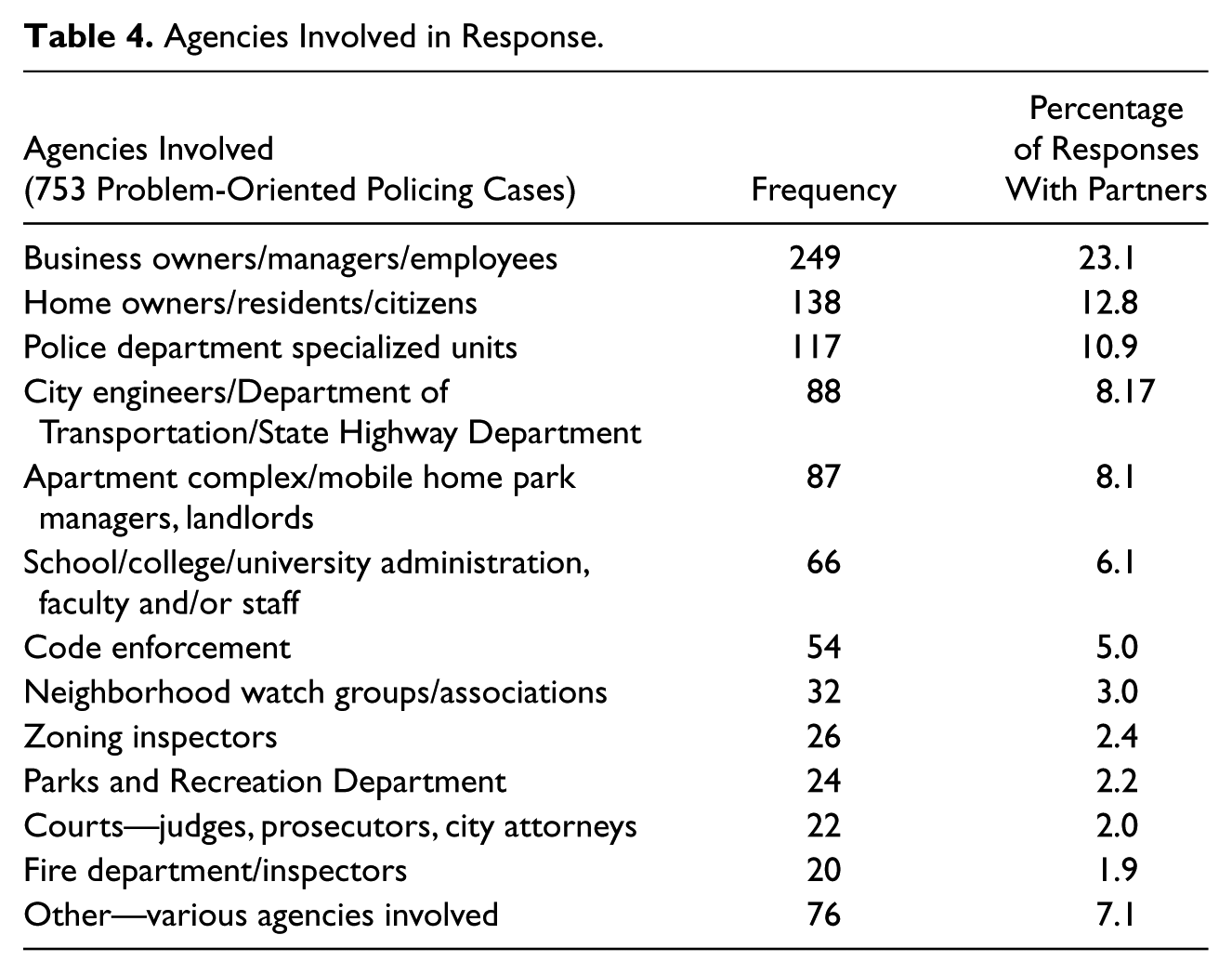
POP reformers encourage police agencies to partner with other agencies and organizations to develop effective responses to community problems. Table 4 lists some of the entities involved in the responses to POP problems processed by CSPD. We identified 1,077 instances of partners being used in POP cases, including 27 separate categories of partners ranging from individual home and business owners to various community and government organizations. Table 4 includes only those categories of partners appearing in at least 1% of the responses involving partners. The information in Table 4 provides strong evidence that CSPD is engaging a broad range of partners in responding to community problems. Our analysis is not able to provide evidence about the substance of these partnerships. Gauging the quality and duration of these partnerships would require a very different research design. Nonetheless, the involvement of these partners is a sign that the department is embracing the idea of working in tandem with other coproducers of public safety.
Agencies Involved in Response.
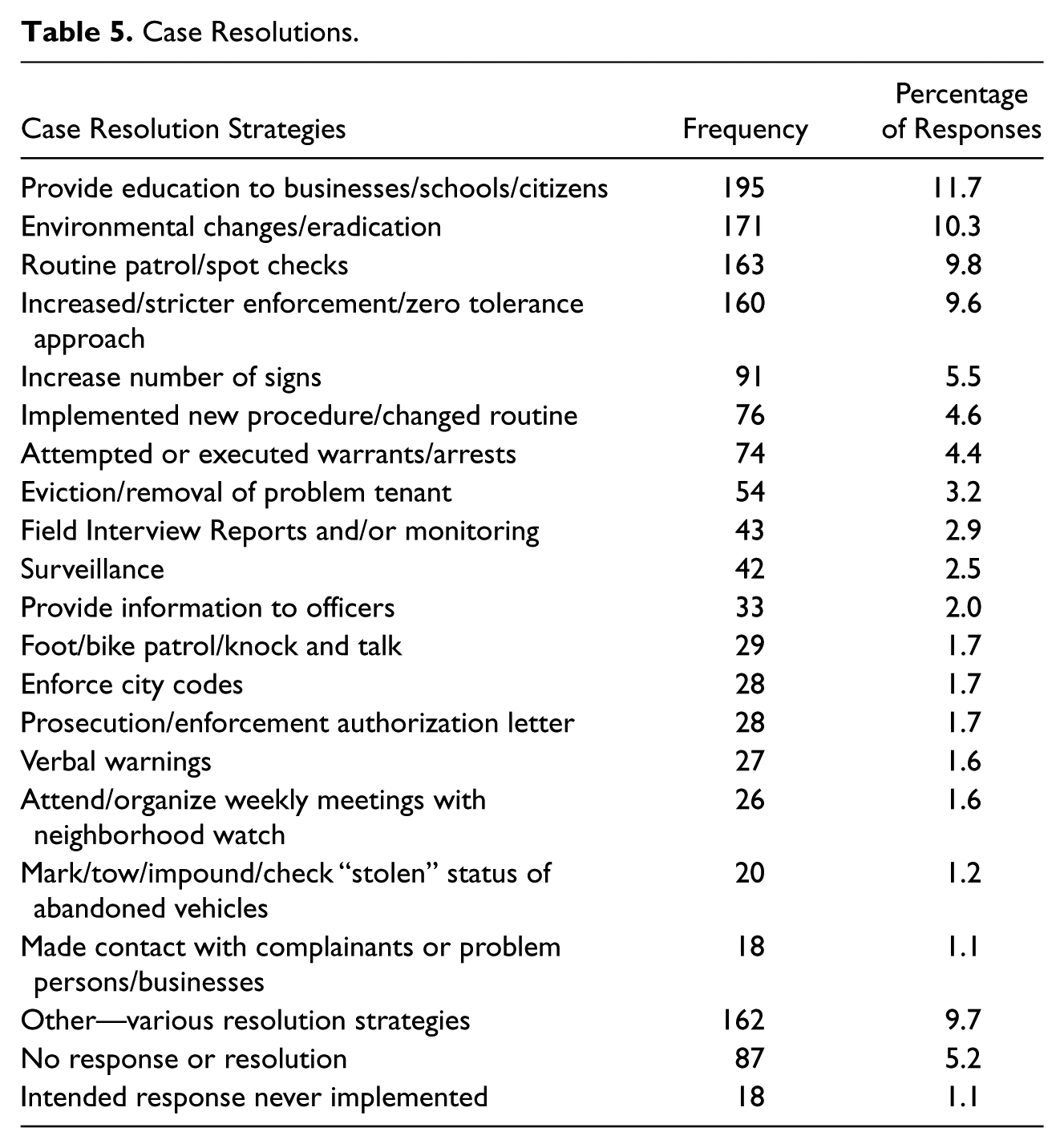
We have already established that CSPD officers employ a range of responses involving a number of different partners. But what is the nature of these responses? We identified 1,665 separate responses. Table 5 lists the 37 response types used in at least 1% of the cases containing sufficient information to identify a response. Clearly, many of the responses fall outside the scope of traditional police response options such as arrests, warnings, and citations. Police are solving problems by educating people, altering the environment, evicting problem tenants, and a variety of other methods.
Case Resolutions.
How Long Does It Take to Process a POP Case?
There is no standard benchmark for how long it should take to process a POP case. The nature and scope of POP problems varies widely, as does the complexity of the responses. Therefore, it should not be surprising that the time it takes to process a POP case also varies widely. Unfortunately, in 49% of the case files, either the beginning or end date of the case is missing. Among the 385 case files containing dates, the time it takes to close a POP case ranges from 1 day to just over 3 years, with a mean of 130 days.
Two additional observations are noteworthy about case processing in the CSPD. First, case records sometimes do not clearly identify the response. In 105 cases (about 14%), we were unable to identify the response strategy that was implemented. This is consistent with our observations and interviews in the field, during which officers told us that they enjoyed doing POP but not the paperwork associated with it. Perhaps, there is a technological solution to this problem that would reduce the paperwork burden on officers while still enabling them to record important information about their work. This catalog of effective and ineffective responses could potentially be used to help the organization learn about “what works, what doesn’t, and what’s promising” (Sherman et al., 1998). Second, there appears to be an imbalance in the role of outside agencies, organizations, and groups. The previous section demonstrated that they often have little to do with nominating cases for attention, yet they appear to play an important role in processing and resolving cases. At the same time, much of the evidence presented in this section suggests that CSPD is adhering to the reform literature on effective responses in POP. The agency relies on a wide range of partners and response strategies; it relies on multiple partners for implementing responses; and many of the responses are implemented by third parties, including landlords, home and business owners, community groups, and other government agencies (Mazerolle & Ransley, 2005).
Assessment of Case Processing
The coding sheet we developed for this project contained 16 questions in which coders trained on POP were asked to provide an assessment of how the department processed each case. Because of the inherent subjectivity in these questions, we developed a set of guidelines to assist coders in selecting the most accurate response. The questions and responses are provided in Table 6. Our discussion collapses the “strongly agree” and “agree” categories (and the “strongly disagree” and “disagree” categories). Fidelity of implementation varies across items in some interesting ways. For instance, in about 73% of cases, the agency used data to analyze the problem. Moreover, in approximately 64% of cases, the police agency worked together with external entities to resolve the problem, and 60.6% of cases were judged to have involved a “creative and well thought-out” response. Reformers would likely be encouraged by these findings. On the other hand, in approximately 63% of cases, the officer(s) did not contact the appropriate agencies to resolve the problem. In only about 32% of cases did the police officer view the problem as solved. Finally, only about 5% of agencies reported conducting a formal assessment of the response; another 36% conducted an informal assessment.
Additional Information About Problem-Oriented Policing Case Processing.
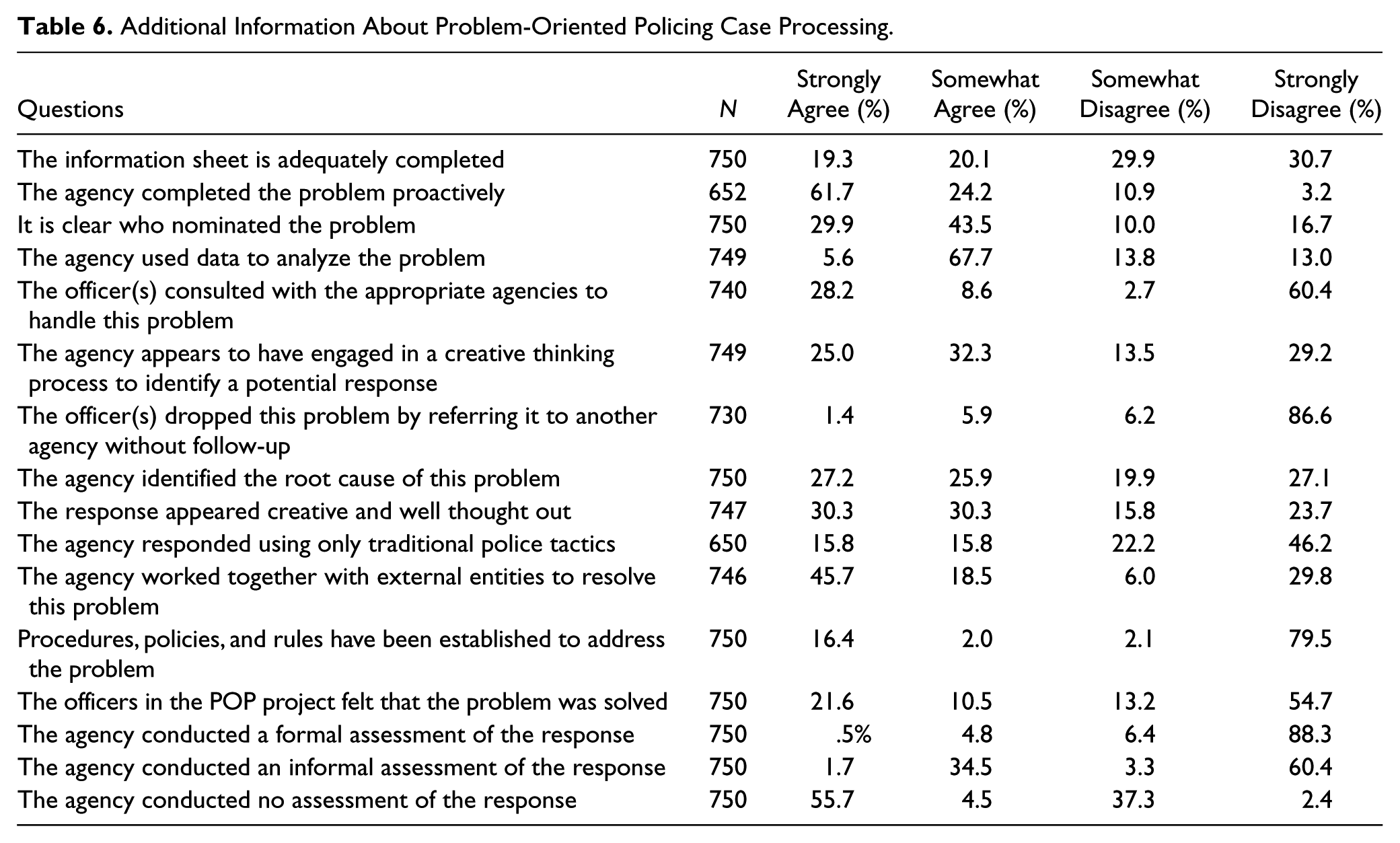
Overall, these ratings paint a picture of problem solving in CSPD that reformers would very likely view as mixed. CSPD officers appear to seek out POP cases proactively. They routinely use one or more data sources to analyze the problem, though in many instances, they do not clearly identify in case records how the problem was nominated. They reach out to outside agencies, though the role of these agencies appears to be limited. Many of the cases demonstrate evidence of Goldstein’s (1990) vision of a creative thinking process to identify the best solution, though some cases appear to generate a traditional police response. The one major pattern noted throughout the case reports is the absence of assessments to determine the efficacy of the response. Formal assessments are rare, informal assessments are used in some cases, and no assessment at all is the norm. The “SARA” model in Colorado Springs during the time of our study might better be described as a “SAR” model.
Discussion and Conclusion
Fans of the POP movement would likely be discouraged by some of our findings and elated by others. Overall, much of CSPD’s work on POP is concordant with Herman Goldstein’s vision as first expressed in an influential journal article (Goldstein, 1979) and later in his classic book Problem-Oriented Policing (Goldstein, 1990). The department attempts to solve a variety of problem types using a diverse array of responses. In most cases, the scope of the problems is specific and focused, just as Goldstein (1990) has counseled. The department engages the assistance of various partners in formulating responses. Furthermore, there is evidence that the department is now viewed as a national leader in POP.
At the same time, the realities of how POP is practiced in CSPD deviate from the reform ideal in several ways. First, though the department relies frequently on external partners, these partners tend not to play much of a role in nominating cases for attention. Furthermore, our subjective assessment shows that in many cases, other partners probably should have been selected but were not. Since partnership is essential in the community-oriented and problem-oriented policing reform movements, taking these reforms seriously means creating new opportunities for collaboration. Second, inconsistent record keeping makes it difficult to develop a catalog of effective and ineffective responses. Some agencies are using software (either off-the-shelf or customized) to track their POP cases. These software packages serve multiple purposes: to communicate the status of each case effectively across shifts and geographic divisions, to maintain an archive of case-related activity, and to serve as a resource for officers shopping for new ideas about how to respond to a case. In about 15% of cases, we couldn’t tell how the case was nominated for attention or what response was implemented. Furthermore, we (and influential people within the department) were unable to locate all POP case files. Improving record-keeping practices about POP cases will enable the organization to establish a source of institutional memory and organizational learning. Third, it is clear that officers either do not routinely assess the efficacy of their responses or do not record these assessments. We suspect that in most cases, officers either do no assessment or do a very informal one.
These findings should be considered in light of the study’s limitations. First, 2 years of data for one division were lost before we arrived, and therefore, we were unable to analyze the complete universe of POP cases. Second, several police officers voiced their discontent about the amount of paperwork that POP required. These concerns appear to have contributed to a problem of incomplete records in the POP database. Thus, our analyses are limited to some extent by missing data. Third, the majority of our work focused on the police and not on other agencies and organizations; thus, we were unable to gauge in a systematic way the extent of cooperation and communication between the police and these external entities. Finally, previous research has emphasized the limitations of case study approaches for understanding implementation (Goggin, 1986; Montjoy & O’Toole, 1979; O’Toole, 2000). The scientific knowledge base on the implementation of POP and other strategic reforms in policing would benefit from multisite studies.
Thinking About Implementation
We began this article by discussing the notion of implementation in organizations. Implementation is the translation of ideas into action. POP is an influential idea that has gained a substantial following in the policing industry. Although many reformers and practitioners are busy extolling POP’s virtues, some researchers and scholars have adopted a much more critical perspective. Central to their critiques is that POP has not yet effectively transformed the “activity systems” or the technical cores of police organizations (Maguire & King, 2004). In the language of implementation theorists, POP in practice appears to suffer from both low dosage (because its implementation is shallow) and low fidelity (because it deviates from the reform prescriptions in important ways).
Cordner and Biebel (2005) examined the implementation of POP in the San Diego Police Department, an agency well known as a worldwide leader in the implementation of POP. 7 Consistent with our findings from the CSPD, they found that nonspecialist officers “tended to engage in small-scale problem-solving with little formal analysis or assessment. Responses generally included enforcement plus one or two more collaborative or nontraditional initiatives” (Cordner & Biebel, 2005, p. 155). Cordner and Biebel emphasized the need to draw a distinction between everyday “problem-solving” carried out by officers, and the more intensive forms of “problem-oriented policing” envisioned by reformers. A study of POP in Reno found that “scanning is mostly based on personal observations, analysis in support of problem solving is typically unsystematic, and assessment is often lacking due to the unavailability of data” (Dunworth et al., 2000, p. 111). We concluded that in spite of these difficulties, some innovative problem solving still occurred.
Both of these studies illustrate a natural tension in the POP movement between the experiential, on-the-job knowledge that is valued so heavily in police culture, and the analytical, empirical approach to solving problems that is valued by reformers (Goldstein, 1990, 2003; Scott, 2003). Because problem identification is so vital to POP, Bichler and Gaines (2005) examined the extent to which officers are effective in identifying the problems in their assigned geographic areas. Their study of officers in a medium-sized southern police department found “little consistency between focus groups of officers working in the same district” (Bichler & Gaines 2005, p. 68). As a result, they recommended that agencies rely on data from multiple sources to identify problems. Another recent appraisal of POP concluded that shallow problem-solving efforts with “weak analyses, mostly traditional responses, and limited assessments” are the norm (Braga & Weisburd, 2006, p. 149). However, evaluation research suggests that even shallow implementation of POP still produces crime prevention benefits. Based on this evidence, Braga and Weisburd (2006, p. 149) urge reformers to abandon their quest for the ideal and “embrace the reality of . . . ad hoc shallow problem-solving efforts.”
Taken together, recent research paints a pessimistic picture of a reform movement in which the reality of POP on the streets looks very different from what its original architects envisioned. Although POP is practiced with fidelity on a case-by-case basis and by specialist units, to our knowledge, it is not practiced routinely by generalist police officers in any agency. A fruitful line of research for criminologists and policing scholars is to begin articulating and testing hypotheses about why this influential reform movement appears to have reached an invisible boundary in its implementation. The results of that research are likely to contribute to a more general understanding about the policing industry, including its cultures, its structures, and its receptivity or resistance to strategic reform.
Implementation science teaches us that some reforms are easier to implement than others (Montjoy & O’Toole, 1979; O’Toole, 2000). Some are more difficult, especially in human service bureaucracies, “because the task is complex, hard to define and measure, variable from client to client, and requires a good deal of expertise and judgment and much contact with clients” (Chase, 1979, p. 395; also see Hasenfeld, 1992). Several observers have suggested that police may simply lack the analytical skills necessary to implement effective analyses and assessments as part of their problem-solving efforts (Goldstein, 2003; Knutsson, 2003; Scott, 2003). These observations are consistent with findings identified in this study from the CSPD. More generally, these observations are also consistent with recent theorizing on the capacities of street-level bureaucrats and the public agencies in which they work to implement reform. What often looks like resistance to reform among individuals may instead simply be a lack of access to the resources that teach street-level bureaucrats the true essence of a particular reform, as well as the skills necessary to implement the reform (Hill, 2003, p. 278). Moreover, POP represents a serious challenge to existing agency routines in which it is likely that “the new patterns of individual activity required may compete with the old ones” (Montjoy & O’Toole, 1979, p. 466; O’Toole, 2000). Police agencies may simply not have the capacity to implement the analytical elements of POP. If reformers are serious about police agencies conducting formal assessments of POP responses, serious attention needs to be paid to developing these skills among police officers.
The findings in this study add to a growing body of research on the implementation of police reform. Police agencies appear much more adept at managing the signs and symbols of reform than in altering their core ways of doing business (Manning, 2003). Even in CSPD, where, at the time of our study, POP seemed to be taken more seriously than in most agencies, policing still followed (at least) two tracks. Patrol officers continued to view their primary role as answering calls and engaging in proactive enforcement. They referred POP cases to special units in most cases. These special units appeared to have embraced many of POP’s ideas, though certainly not all. The result was a loosely coupled system in which POP did not exert a strong influence on the “technical core” of the organization (Goldstein, 2003; Maguire, 2003; Manning, 2003; Thompson, 1967). Even in an agency with a reputation as a leader in the POP movement, POP appears to have influenced the edges of the organization although not successfully reaching the middle.
The central issue is implementation—how the idea or the ideal translates into action. All organizations grapple with implementation issues. For police reformers, the enduring challenge is getting police agencies to allow reforms to reach the center when so much of the attention of police executives is focused on symbolic reform at the edges. For police scholars, the continuing challenge remains disentangling the implementation puzzle—why some reforms make it closer to the center than others.
Footnotes
Acknowledgements
This study would not have been possible without the cooperation of the Colorado Springs Police Department. In particular, we would like to thank the following former members of the Department: Chief Lorne Kramer, Deputy Chief Dave Felice, Commanders Dave Glenn and Bob Ownbey, and Grants Administrator Mora Fiedler. We would also like to thank Commander Rick Millwright, Lieutenant Maggie Santos, and the Neighborhood Policing Unit at Sand Creek.
Declaration of Conflicting Interests
The author(s) declared no potential conflicts of interest with respect to the authorship and/or publication of this article.
Funding
The author(s) disclosed receipt of the following financial support for the research and/or authorship of this article: This study was funded under a contract from the Colorado Springs Police Department to 21st Century Solutions (now Justice and Security Strategies, Inc.).