







Abstract
A gender gap in alcohol and drug use exists but is somewhat smaller than the gender gap in other forms of delinquency. This article extends studies that examine the gender–delinquency relationship to substance use in particular and estimate the extent to which major risk and protective factors mediate the association between gender and alcohol and marijuana use. The authors simultaneously draw on two traditional delinquency theories, social learning and social control, and the feminist pathways perspective regarding victimizations. This gendered pathways approach highlights the extent to which gender influences life experiences and thus the trajectories of girls and boys. In a large sample of 8th to 12th graders, school bonds and victimizations accounted for much of the gender–substance use relationship, especially in the case of casual and binge drinking.
Long treated as a form of delinquency or as a predictor of delinquent offending, alcohol and illicit drug use was the focus of the current study (e.g., Elliott, Huizinga, & Ageton, 1985; Johansson & Kempf-Leonard, 2009). The pattern of gender differences in substance use is complex but generally described in terms of boys’ greater use of alcohol and other drugs. 1 Having said that, the gender gap in substance use is smaller than the gender gap in delinquency, especially violent delinquency (Moffitt, Caspi, Rutter, & Silva, 2001). National data from the Monitoring the Future Study revealed that boys are more likely to drink than girls and are more likely to drink often and in larger quantities (Johnston, O’Malley, Bachman, & Schulenberg, 2008). Furthermore, the gender gap in various forms of alcohol use appears to increase between 8th and 12th grade. Johnston and colleagues (2008) reported that the gap in binge drinking though still balanced toward boys has been declining over the last few decades such that girls are starting to approach male use patterns. In addition, among 8th graders, girls are more likely to have drank at least once, a gap reversal in effect since 2002. Since 2005, 10th-grade girls and boys have been equally likely to have drank at least once in the past month. Perhaps the simpler case, a gender gap in marijuana use appears robust. Boys report a greater likelihood to have tried marijuana, to have used it recently, and to have used it often. This pattern holds across 8th, 10th, and 12th graders (Johnston et al., 2008).
Our interest centers on this gender gap. What explains why boys are more likely to use alcohol and marijuana and why do they use them more frequently and in larger amounts? Admittedly, this question is not new; more than 20 years ago, Daly and Chesney-Lind (1988) urged researchers to conduct analyses with a feminist lens that could explain the gender gap. The primary response to this call was research that generalized the dominant, seemingly gender neutral, theories of boys’ delinquency to girls’ behavior. The expectation was that boys were exposed more often to risk factors and less often to protective factors than girls, thus their higher level of delinquent involvement. Importantly, some feminist scholars realized that the gender gap itself implied “that a gender-neutral etiological process is not occurring” (Miller & Mullins, 2009, p. 35), though others suggested a more balanced approach that expects “both gendered and generic processes” occur (Giordano, 2009, p. 144). Furthermore, Daly and Chesney-Lind suggested researchers might be better guided to rethink concepts rather than test the generalizability of traditional gender-neutral theories. The alternative to generalization studies was research on the unique pathways to offending experienced by girls and women because of the gendered organization of society, gender inequality, and gender socialization. In so doing, the original feminist pathways perspective stressed the importance of victimization in girls’ and women’s crime and delinquency.
We bring these two approaches together in the current study and ask whether girls and boys are differentially exposed to certain experiences that can explain variation in substance use and the gender gap. The task was to determine the extent to which key explanatory constructs mediate the relationship between gender and substance use. Of particular interest were three forms of substance use including casual drinking, a less serious problem behavior, and binge drinking and marijuana use, two more serious behaviors. We drew on insights from two mainstream criminological theories, the theories of social learning and social control, and the pathways focus on violent victimization experiences. As such, we contend that mediation analyses that examine whether gender affects the trajectories that girls and boys encounter are in fact analyses of gendered pathways as defined by Miller and Mullins (2009). 2 Multivariate regression analyses of data for a large contemporary sample of middle and high school students in Michigan enabled us to estimate the extent to which the potential mediators account for the gender–substance use relationship.
Research Context
Various scholars have suggested that gender socialization, gendered parenting practices, and gendered treatment of girls and boys in schools and elsewhere predict that gender will affect the likelihood that girls and boys are exposed to criminogenic factors (e.g., Heimer, De Coster, & Unal, 2006). These ideas led to hypotheses about an indirect effect of gender. That is, gender is expected to affect drug use because it affects, for example, the strength of social bonds and exposure to delinquent peers.
We utilized the extant strategy in criminology in which researchers integrate insights from multiple theories to explain the target of interest (e.g., Liu & Kaplan, 1999; Simons, Miller, & Aigner, 1980). We drew on social learning theory, social control theory, and the feminist pathways hypothesis about the relationship between violent victimizations and delinquency and drug use. In the remainder of this section, we briefly summarize the theoretical ideas we drew on in our analyses and report relevant findings, including the relatively few studies of mediation in substance use research.
Social Control
Although social control theory purports to be a gender neutral theory, the first test of it only examined male delinquency (Hirschi, 1969). The assumption is that youth with a strong bond to society are less likely to commit crime and engage in delinquency. The social bond consists of attachment to significant others, commitment to conventional goals and institutions, involvement in conventional activities, and belief in the values and norms of society (Hirschi, 1969). Parenting practices are often studied in concert with the elements of the social bond because they play a major role in the development of the bond. Some researchers have explored the extent to which the social bond may explain the gender gap.
Gender socialization in all its complex forms, including parenting practices, teaching, peer interactions, and religious socialization, is often cited as the reason why the dimensions of the social bond may mediate the gender–delinquency relationship. In addition to teaching their children how to be boys and girls, parents (and others) may differentially control them. One argument is that girls are more likely to experience informal social control (e.g., parents restricting curfew) whereas boys are subjected to formal social control (e.g., police picking them up for breaking curfew; Hagan, Simpson, & Gillis, 1979). Past research has found that girls are subjected to stronger informal parental control, including parental monitoring, than boys, which then decreases the likelihood of delinquency and substance use (Cernkovich & Giordano, 1987; Svensson, 2003). Parental monitoring, but not parental attachment, appeared to mediate the relationship between gender and physical aggression in a small sample of middle and high school students (Carlo, Raffaelli, Laible, & Meyer, 1999). Girls reported higher levels of school attachment than boys, supporting the treatment of some school bonds as mediators of the gender–delinquency relationship (Payne & Gottfredson, 2005, as cited in Payne, Gottfredson, & Kruttschnitt, 2009).
Social Learning
Where social control theory states that attachment to others should lessen involvement in delinquent behavior (Hirschi, 1969), social learning theory proposes that a differential association with delinquent peers is a strong predictor of delinquent behavior (Akers, 1998). More generally, the social learning perspective argues that deviant and criminal behavior is learned through a complex interaction between peers and family members (Akers, 1998). The social learning process involves the following: differential reinforcement, differential association, definitions favorable or unfavorable to law breaking, and imitation. Definitions can be favorable or unfavorable to law violating behavior, some peers may be deviant and others conventional; it is the balance of the whole process that helps explain learned behaviors. As with social control theory, a gender neutral social learning theory proposes that girls and boys respond to the learning process similarly.
Akers’ (1998) social structure and social learning theory (SSSL) extended social learning theory to integrate macro- and micro-level variables to more fully explain delinquency. In terms of gender, Akers argued for gender to be conceptualized as an indicator of social location in the social structure. He proposed that gender primarily affects behavior indirectly through its influence on the learning process. In other words, with the SSSL approach, Akers offered a hypothesis about mediation. Gender is expected to affect exposure to the differential learning process, which then explains behavior. Importantly, Akers (1999) admitted that while the effects of other indicators of social location (i.e., race and class) might be fully accounted for by the social learning process, the gender effect may only be partially mediated. 3
Few studies have explored the possibility that elements of the learning process mediate the gender–delinquency and drug use relationships. Using a sample of Swedish youth, Svensson (2003) found that the effect of gender on drug use disappeared when peer delinquency was included in the model. Peer delinquency mediated the effect of gender on delinquency as well (e.g., Morash, 1986; Simons et al., 1980). Lanza-Kaduce, Capece, and Alden (2006) reported that the effect of gender was partially mediated by social learning variables in predicting alcohol usage prior to sexual activity.
Feminist Pathways
The feminist or gendered pathways perspective takes the position that there are identifiable pathways or trajectories of life experiences that lead some girls to delinquency, drug use, and eventually adult crime. The pathways are gendered because of the gendered organization of society, gender inequality, and gender definitions and beliefs (Daly & Chesney-Lind, 1988). An assumption is that girls’ pathways into delinquency differ from those of boys (e.g., Chesney-Lind & Pasko, 2004). The most researched pathway is that of victimization to offending. In particular, researchers have identified a scenario where young girls leave abusive homes, find themselves homeless, and then turn to various delinquent and criminal activities to survive (Chesney-Lind & Pasko, 2004).
Several studies identify victimization as an important antecedent to girls’ and women’s offending. Miller’s (1986) book, Street Woman, provided an in-depth context to the life situations that led a group of women into criminal behavior. While prior victimization was not the only predictor, it was an important factor. Daly’s (1994) qualitative analysis examined the pathways that led women into the criminal justice system; half of her sample of women came from abusive homes and another quarter of her sample had been in a violent relationship.
This particular pathway, sometimes referred to as the blurred boundary between being a victim and an offender, appears to be prevalent among incarcerated adult females (e.g., Harlow, 1999; Moe, 2006). However, victimization is also a risk factor for boys. Evidence from a prospective study of abused and neglected children matched with nonabused children pointed to abuse and neglect as predictors of adult criminal offending for both boys and girls (Widom, 1989). Belknap and Holsinger (2006) also found that self-reported childhood abuse was a risk factor for both girls and boys (in an incarcerated sample). Another study, however, of youth referred to juvenile court found that self and official reports of sexual, physical, and emotional abuse and Child Protective Services involvement were more common in girls’ histories than boys’ (Johansson & Kempf-Leonard, 2009).
To our knowledge, there are no deductive quantitative studies that examine victimizations as a possible mediator of the relationship between gender and delinquency, drug use, or criminal involvement. The adaption of the victimization pathways hypothesis to a study of mediation is complex. For mediation to occur, gender must be significantly associated with the experience of abuse or other victimizations and then the effect of victimizations on the target outcome would reduce or wipe out the effect of gender. A review of research on gender differences in childhood abuse, dating and partner violence, sexual assault, bullying, and physical assaults (fights, muggings, etc.) exceeds the scope of the current study. The challenge of articulating a meditational hypothesis is further hindered by the huge range of victimizations that people experience, the gendered meanings associated with them, and the wide (probably gendered) range of reactions possible after the different incidents. Nonetheless, we explore the possibility that a certain form of victimization (recent threats, injuries, and attacks) may mediate the gender–drug use relationship. It is critical to explore gender neutral and gender specific factors simultaneously.
Summary
Analyses of potential mediators of the gender–alcohol and drug relationship are in effect studies of gendered pathways. If school bonds, differential association, and victimizations mediate the effect of gender, results would suggest that gender shapes the life experiences of girls and boys in ways that impact their alcohol- and drug-related behaviors. Miller and Mullins’s (2009) review of feminist scholarship pointed out that the victimization pathway is not the only pathway to offending, even for girls and women. For example, the intersection of race, class, and gender likely produces different pathways for boys and girls in different structural planes. A gendered pathways approach can be more generally described as one that explores the potential for gender to shape the life trajectories of girls and boys, their treatment by others, and the meanings of these experiences (Miller & Mullins, 2009). A gendered pathways approach explores the potential for differential exposure to risk and protective factors.
Method
Sample and Data
More than 104,000 students in 200 school districts completed the Michigan Alcohol and Other Drugs (MAOD) school-based survey. District participation was voluntary and occurred between 2001 and 2004; all students presented were invited to participate. After accounting for missing data and unreliable responses, 78,103 middle and high school students comprised the sample. 4 About 36% of the respondents were in the 8th grade, 37% in the 10th grade, and 27% in the 12th grade. Just under half of the students were male (48%). The majority were White (n = 67,489) but 6.2% were African American (n = 4,855), 3.5% were Latino/a (with majority being Mexican American or Chicano), 2.4% were Asian American (n = 1,875), and 1.5% were Native American or American Indian (n = 1,161).
Dependent Variables
Our measures of casual alcohol use, binge drinking, and marijuana use were based on anonymous self-report questionnaire items. 5 The question for casual alcohol use was, “On how many occasions (if any) have you drank alcohol during the past 30 days?” Answer categories ranged from 0 to 6 (0 = 0 occasions, 1 = 1-2 times, 2 = 3-5, 3 = 6-9, 4 = 10-19, 5 = 20-39, and 6 = 40 or more times). The question about marijuana use was identical. To assess excessive alcohol use, binge drinking was indicated by the question, “Think back over the last 2 weeks, how many times have you had 5 or more drinks in a row?” (0 = none to 5 = 10 or more times). Compared to questions about the exact number of substance using incidents, questions with frequency intervals are more reliable. However, the use of ordinary least squares regression is inappropriate for ordinal dependent variables. A review of the literature revealed extant strategies ranging from using ordinary least squares regression with the ordinal scales, using logistic regression with dichotomized substance use variables, to using a regression procedure for count data (see, for example, Booth, Farrell, & Varano, 2008; Daigle, Cullen, & Wright, 2007; Svensson, 2003). To enable the latter, we created count variables by utilizing the midpoints of the intervals such that alcohol and marijuana responses were recoded to 0, 1, 4, 7, 14, 29, and 40 and the binge drinking responses to 0, 1, 2, 4, 7, and 12.
Mediating Variables
Differential association
An important element of social learning theory is the notion that peer definitions matter. Students were asked how they thought their close friends feel or would feel about the respondent (a) drinking 1 to 2 drinks daily, (b) binge drinking, (c) using marijuana occasionally, and (d) using marijuana regularly. Responses ranged from 1 (strongly disapprove) to 3 (would not disapprove); high score indicated more peer approval for light daily drinking, heavy drinking, and occasional and regular marijuana use. We averaged approval for 1 to 2 drinks daily and approval of binge drinking into peer approval for alcohol use and used this variable in the alcohol use and binge drinking analyses. We also averaged approval of occasional and regular marijuana use into approval for marijuana use and used this variable in the marijuana analyses. To measure peer pressure to consume illegal substances, students were asked “how much pressure do you feel from schoolmates to drink alcoholic beverages” and “ . . . to use marijuana?” Answer options ranged from 1 (none) to 4 (a lot). Peer pressure regarding alcohol was included in the alcohol and binge drinking analyses and pressure regarding marijuana was included in the marijuana analyses.
Social control
Two measures of the commitment dimension of the social bond were utilized. College graduation expectation was measured by the question, “How likely is it that you will graduate from a 4-year college after high school (1 = definitely won’t to 4 = definitely will)?” Grade point average (GPA) was measured originally with letter grades that we then translated into numeric values and a scale of 1 (D or below) to 8 (A).
Victimizations
Students were asked to look back over the past year and report how many times they experienced each of the following: someone threatened you with a weapon, someone threatened you without a weapon, someone injured you with a weapon, and someone injured you without a weapon. The response options include 0 = none, 1 = one time, 2 = two times, 3 = 3 or 4 times, and 4 = 5 or more times. We then summed responses to the four questions to yield an index of victimizations that ranged from 0 to 16.
Independent and Control Variables
We have students’ gender, race and ethnicity, and grade level, and as a crude measure of parents’ social class, we include parents’ highest level of education. Gender was coded 1 for male and 0 for female. Race and ethnicity was measured by dummy-coded variables for African American, Latino, Asian American, American Indian or Native American, and White (the reference group). To estimate parents’ social class, we calculated the average educational attainment of the parental unit from the average of mother’s and father’s highest educational attainment (1 = completed grade school to 6 = graduate or professional school). If data were available for only one parent, that parent’s education was used.
O’Malley, Johnston, Bachman, Schulenberg, and Kumar (2006) reported that though there is more variation in substance use within schools than between schools, variation across schools is not unimportant. Thus, we included a measure of district-level substance use to control for shared experiences of living within a particular district. In the alcohol and binge drinking analyses, we included a measure of the district average frequency of alcohol use calculated by aggregating students’ responses within a district and dividing by the number of students surveyed in the district (the mean number of students per district was 465 students [SD = 635]). In the marijuana analyses, we controlled for average district use of marijuana.
Analytic Strategy
Preliminary analyses revealed sufficient overdispersion in the count dependent variables, requiring the use of negative binomial regression (versus Poisson). Robust standard errors were used as a more conservative test of significance to deal with any error resulting from the nesting of students in school districts and model misspecification (Long & Freese, 2005). Finally, because large samples can identify significant but unimportant relationships, we used a conservative critical alpha (.01, two-tailed) and emphasized magnitude of effects over significance tests.
Several steps were taken to answer the research question concerning mediation. First, to test the hypothesis concerning mediation, we determined the bivariate relationship between gender and substance use. The second criterion for mediation is that gender is significantly associated with each potential mediator. We conducted t tests for significant group mean differences. Finally, we entered each mediator into a baseline control variable model to examine whether the inclusion of the mediator actually reduced the effect of gender on substance use, net control variables. Each mediator was entered separately to determine its unique impact on the gender coefficient and all together in a final model. The latter step also confirmed the final criterion that mediators be significantly associated with the dependent variables of interest.
Results
As seen in Table 1, the mean for casual drinking was 2.36 (SD = 6.5), 0.81 (SD = 1.0) for binge drinking, and 2.59 (SD = 8.3) for marijuana use. Gender was, in fact, strongly associated with the number of times students used alcohol and marijuana (see column 4 in Table 1); the average number of times that males casually drank, binge drank, and used marijuana was significantly higher than the average for females.
Sample Description.
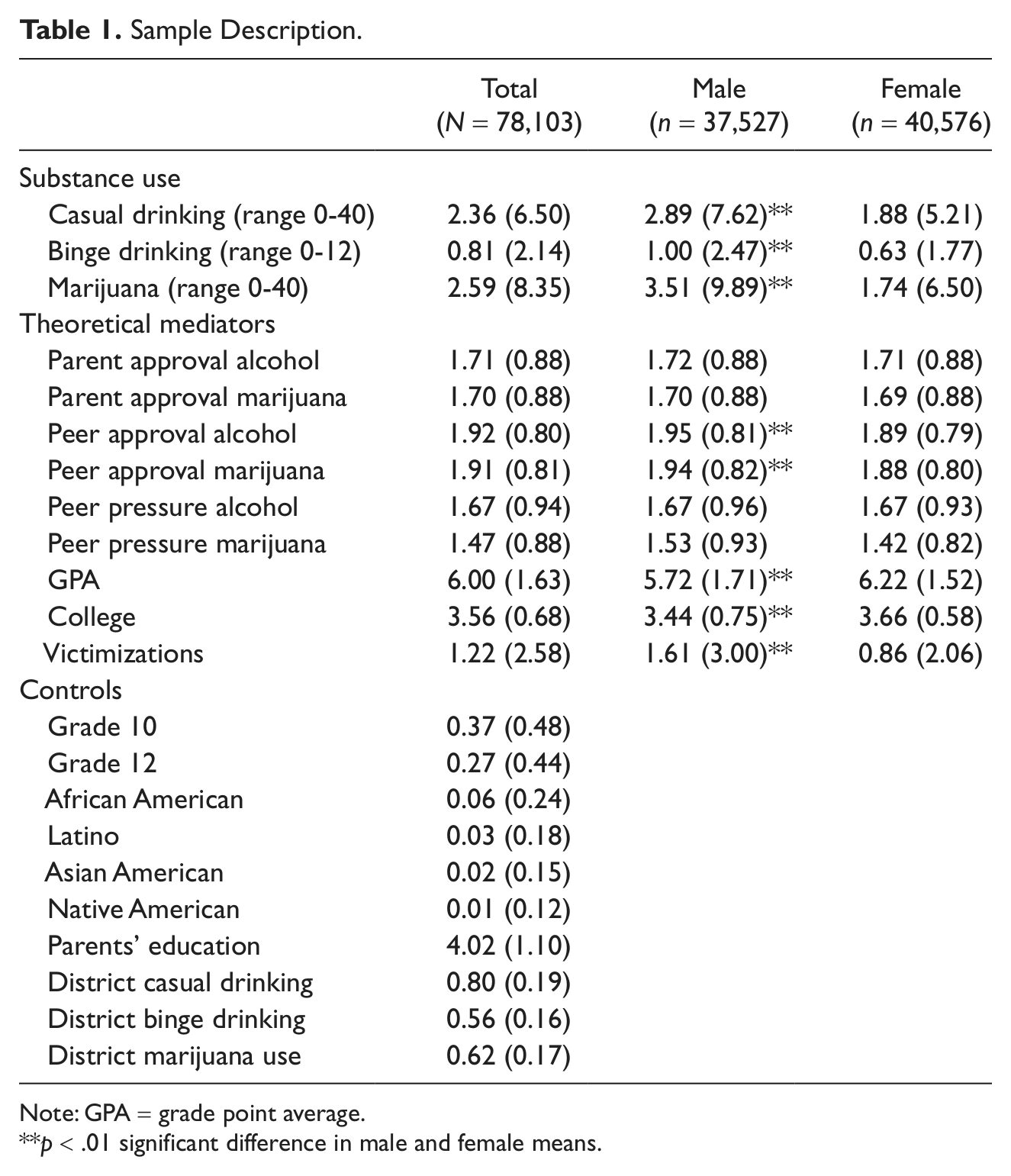
Note: GPA = grade point average.
p < .01 significant difference in male and female means.
For a particular theoretical variable to mediate the relationship between gender and the three dependent variables, gender had to be significantly associated with it. While on average students reported peer disapproval for both alcohol (M = 1.92, SD = .80) and marijuana use (M = 1.91, SD = .81), boys reported a higher degree of peer approval for both substances. On average, students experienced between none and a little peer pressure to drink and smoke marijuana, and 1.2 (SD = 2.58) victimizations in the last year. Boys reported more pressure to use marijuana and more victimizations. The average GPA in the sample was a B and on average students expect to probably or definitely graduate from college. Nonetheless, girls reported higher GPAs and a stronger expectation for college graduation. Girls and boys reported similar levels of peer pressure to drink and parental approval for both alcohol and marijuana. Thus, the second criterion for mediation was met for six of the nine explanatory variables.
Bivariate regressions revealed strong associations between gender and each dependent variable (table available from author on request). The expected frequency of casual alcohol use and binge drinking was 54% and 57% higher for boys compared to girls, respectively. The expected frequency of marijuana use was 102% higher for boys than girls. The odds ratios (ORs = exp[b]) for gender in the casual drinking, binge drinking, and marijuana models were 1.54, 1.57, and 2.02, respectively.
As seen in Model 1 of Tables 2 and 3, when grade in school, race and ethnicity, parents’ education, and school district substance use are controlled for, the gender gap remains strong. The ORs for gender in the casual drinking, binge drinking, and marijuana models were 1.48, 1.52, and 2.16, respectively (the results for casual drinking mirror those for binge drinking so only the latter are presented in table form; contact the authors for the casual drinking table). In other words, controlling for these other demographic characteristics did not substantially reduce the effects of gender.
Negative Binomial Regression of Binge Drinking on Predictors (n = 77,959).
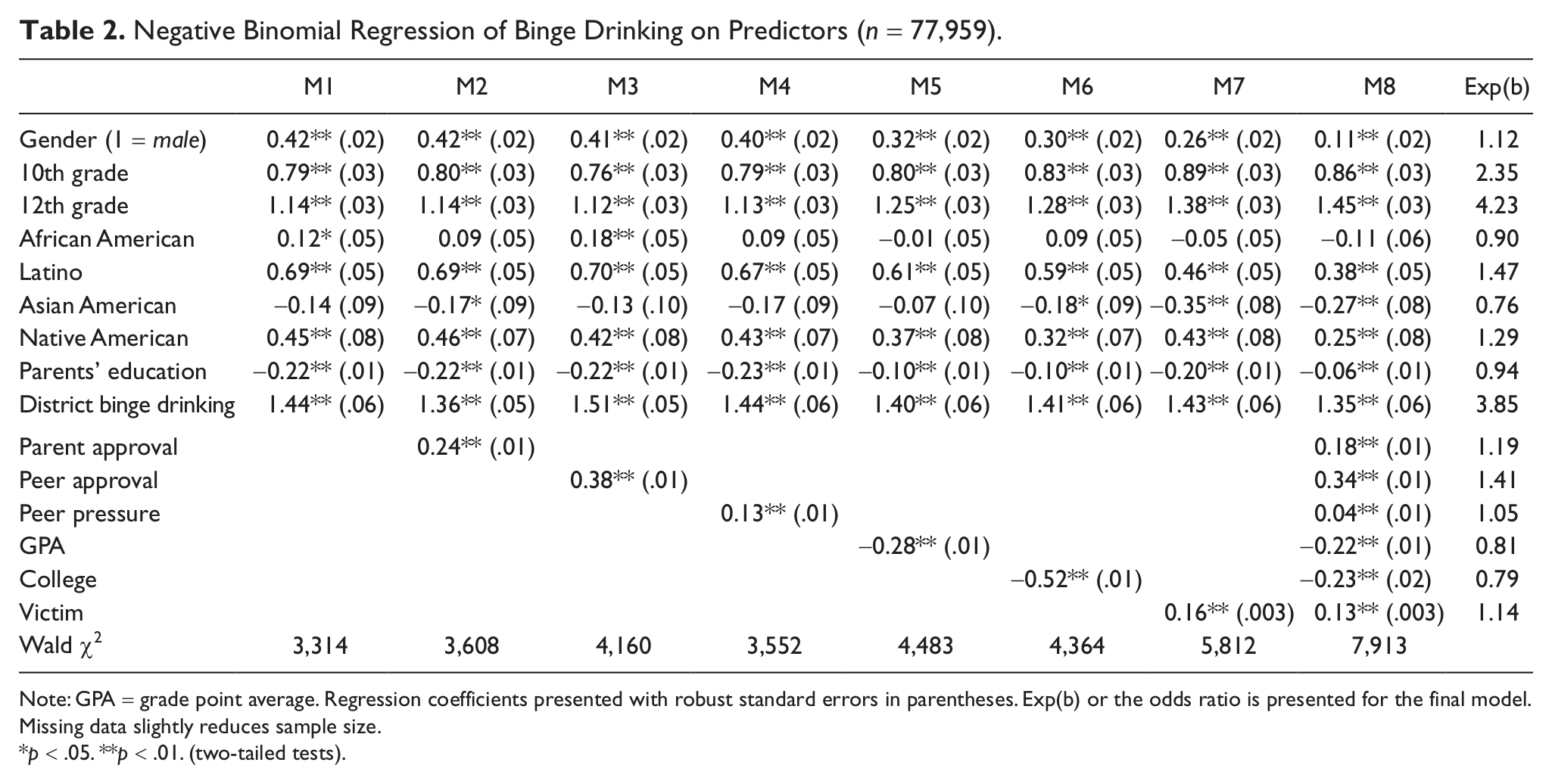
Note: GPA = grade point average. Regression coefficients presented with robust standard errors in parentheses. Exp(b) or the odds ratio is presented for the final model. Missing data slightly reduces sample size.
p < .05. **p < .01. (two-tailed tests).
Negative Binomial Regression of Marijuana Use on Predictors (n = 77,974).
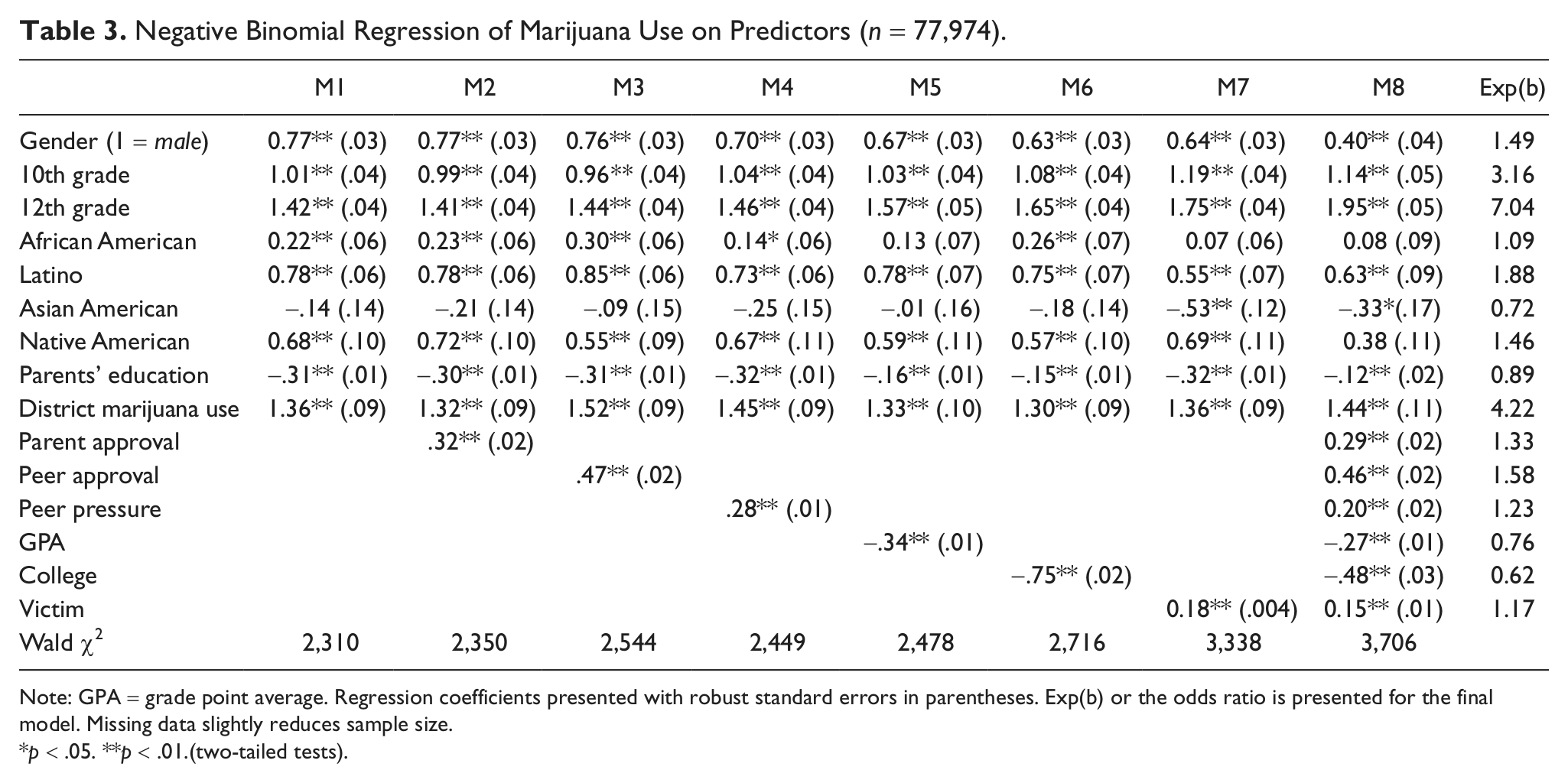
Note: GPA = grade point average. Regression coefficients presented with robust standard errors in parentheses. Exp(b) or the odds ratio is presented for the final model. Missing data slightly reduces sample size.
p < .05. **p < .01.(two-tailed tests).
To determine if the theoretical variables mediated the relationship between gender and substance use, we compared the coefficients in Model 1 to the subsequent models. Across all three substances, it was the school commitment variables and victimizations, rather than the differential association variables, that most substantially lowered the gender coefficients. Marginal declines occurred in Model 4 when peer pressure was introduced to the two alcohol equations; however, recall that there were no gender differences in peer pressure to drink, thus this is not a significant mediation finding. Model 7 in all three tables revealed that the variable that produced the largest decline in the gender coefficient was victimizations.
The simultaneous inclusion of parental approval, peer approval, peer pressure, GPA, expectation for college graduation, and personal victimization experiences further reduced the coefficient for gender. All of the theoretical variables significantly affected substance use in expected directions, and more importantly, all six variables significantly associated with gender (i.e., the mediators) affected all three dependent variables.
In case of casual alcohol use, the OR for gender dropped to 1.10, which means that the expected frequency of use was only 10% higher among boys than girls net all the other correlates. In the binge drinking model, the OR dropped to 1.12; the rate of use was 12% higher among boys. In other words, the explanatory variables substantially mediated the effect of gender on casual drinking and binge drinking. Substantively, this means that these theoretical variables accounted for some of the gender gap. Males’ rate of casual alcohol use was 48% higher than females in the baseline model; in the final model, their use was only 10% higher. Some of the effect of gender on casual drinking was due to the gendered differential exposure to parental approval, peer approval, GPA, graduation expectation, and personal victimization experiences. The situation was more extreme in the case of marijuana use. Males’ rate of marijuana use was 102% higher than females’ in the bivariate model and 116% higher in the demographic control model but was only 49% higher in the final model.
Discussion and Conclusion
A gendered pathways approach is increasingly observed in research on substance use and other forms of delinquency. Generally, researchers are asking how gender matters for the gender gap in delinquency and for within-gender variations. Our particular interest was whether girls and boys are differentially exposed to risk and protective factors for various forms of drug use and delinquency. If girls and boys are differentially exposed to life experiences that put youth at risk of substance use and that protect them, then this differential exposure may explain the gender gap. Accordingly, the theoretical and empirical task would turn then to explaining why girls and boys are differentially exposed to these predictors.
The major substantive question in the current article was whether girls are less likely than boys to use alcohol or marijuana simply because they are differentially exposed to factors that explain substance use. Not unexpectedly, we found that gender was strongly associated with casual drinking, binge drinking, and marijuana use. Our bivariate analyses found that girls were less likely than boys to associate with substance approving peers, encountered less peer pressure (for marijuana use but not alcohol use), had higher GPAs, had higher expectations to graduate college, and experienced less victimization.
The multivariate analyses revealed evidence for substantial mediation. Of these factors, it was school commitment (GPA and college graduation expectation) and victimizations that significantly mediated the effect of gender on alcohol and marijuana use. Payne & Gottfredson (2005, as cited in Payne, Gottfredson, & Kruttschnitt, 2009) also reported an effect of gender on school attachment and then a negative effect of school attachment on delinquency. Individually, the social learning variables in our analyses barely reduced the effect of gender; a finding contrary to a few studies of peer delinquency as a mediator (Morash, 1986; Simons et al., 1980; Svensson, 2003). In the case of marijuana, peer pressure slightly mediated the effect of gender but the inclusion of the other differential association variables did not. Victimizations reduced the effect of gender on casual and heavy drinking quite substantially (of all the variables it produced the largest drop in the gender coefficient). In terms of marijuana, college graduation expectation and victimizations were tied for reducing the gender effect the most. When all mediators were included in one model, the reduction in the effect of gender was quite large, especially in the alcohol equations. In total, these findings confirmed the expectation that life experiences as measured in this study (differential association, school bonds, and victimizations) are shaped by gender.
A strength of the study was that we were able to compare traditional delinquency theories with the feminist pathways hypotheses; however, we were limited in our ability to fully test any one theory. For example, while the social learning variables did not individually mediate the gender effect, we hesitate to discount social learning theory as relevant in mediation analyses because all the mediators combined further reduced the gender effect and a more complete operationalization of the theory’s multiple dimensions may reveal mediation. Our analyses also lacked any measures of family attachment prohibiting a full test of social control theory. Although the gender gap in casual and binge drinking was largely reduced by the mediators, a gender effect remained in the marijuana model. This suggests that the inclusion of additional mediators is needed and that some of the gender effect is also about differential reactions and moderated effects. Boys and girls may exhibit significantly different reactions to victimizations, interactions with delinquent peers, and school bonds, and these potential differential reactions should be further examined.
In the remainder of this section, we suggest additional areas for future research. First, further theoretical and empirical investigation into why girls and boys are differentially exposed to major risk factors is needed. That is, we should conduct more research on the most distal part of the causal picture. How does gender shape the kinds of peers that girls and boys are exposed to? How do girls and boys come to have different academic expectations? The field needs comprehensive studies that incorporate indicators of gender socialization, other gendered experiences, standard criminological risk factors, and delinquency measures (see also Miller & Mullins, 2009).
A second direction for research is to explore more fully the relationship between gender, victimizations, and substance use. Forms of victimization are quite diverse, varying in type (physical, sexual, verbal, and emotional), in perpetrator (family members, intimate partners, school mates, acquaintances, and strangers), in severity, and in location (home, school, and community; see for example, Cullen, Unnever, Hartman, Turner, & Agnew, 2008). The feminist pathways perspective has emphasized child abuse and relationship violence in girls’ pathways to offending (Belknap & Holsinger, 2006). We need to better understand the ways that gender, race, and class influence risk for child abuse, relationship violence, street violence, school violence, and bullying (as well as the social control and social learning mediators). Qualitative research that can tap into the meaning of these forms of victimization for girls and boys would help us develop testable theoretical ideas as to how the different forms of victimization might mediate the relationship between gender and substance use.
Overall, the present research finds support for a gendered pathways approach to understanding substance use. We see that boys use substances more than girls in part because of their greater exposure to theoretical risk factors and lesser exposure to protective factors. The continued use of both mainstream and feminist theoretical perspectives was supported here as was the importance of examining mediation instead of simply controlling for gender. Our results support the continued exploration of this line of research and reiterate Miller and Mullins’s (2009) call for “systematic attention to gender well beyond the analysis of crime” to fully understand both gendered pathways and gendered lives as they pattern youths’ delinquent and criminal behaviors (p. 45).
Footnotes
Acknowledgements
The authors thank Thomas Van Valey and the Department of Sociology at Western Michigan University for use of the MAOD data set.
Declaration of Conflicting Interests
The author(s) declared no potential conflicts of interests with respect to the authorship and/or publication of this article.
Funding
The author(s) received no financial support for the research and/or authorship of this article.