







Abstract
Labeling theory suggests that contact with the criminal justice system leads to feelings of stigmatization, which will consequently have the counterproductive effect of increasing offending. The current study investigated this phenomenon by (a) interviewing 394 young people sentenced in the New South Wales Children’s Court about their emotional reactions to the experience and (b) testing whether differences in these emotional reactions were related to increases or decreases in reoffending. It was found that feeling stigmatized after the hearing was a significant predictor of reoffending for the young women, but not the young men, in the sample. In addition, young men with previous convictions who reported feeling stigmatized were less likely to reoffend. The implications of these findings for the way in which young offenders are treated are discussed.
Introduction
Stigmatization occurs when a publicly acknowledged attribute disqualifies an individual from full social acceptance (Goffman, 1980). Obesity and eating disorders (Bannon, Hunter-Reel, Wilson, & Karlin, 2009; Crisp, 2005; Myers & Rosen, 1999), sexually transmitted diseases (Kelly, St. Lawrence, Smith, Hood, & Cook, 1987), psychological disorders (Hinshaw, 2005; Pescosolido, Martin, Lang, & Olafsdottir, 2008), and homosexuality (Martin & Hetrick, 1988) have all been suggested to be sources of stigma. In addition, an important theoretical tradition in criminology argues that being publicly identified as an offender is an important cause of stigmatization. Proponents of labeling theory, and, more recently, Braithwaite’s theory of reintegrative shaming, explain the positive correlation commonly observed between past and future offending as a result of the stigmatizing properties of being dealt with by the traditional legal system (Becker, 1966; Braithwaite, 1989; Garfinkel, 1956; Lemert, 1972; Schur, 1969). Although there have been vicissitudes in acceptance of labeling theory since it was first proposed, recent evidence has accumulated supporting the contention that contact with the criminal justice system can have detrimental effects (Bernburg & Krohn, 2003; Bernburg, Krohn, & Rivera, 2006; Huizinga & Henry, 2008). However, much still remains to be learnt about how the labeling process operates, and in particularly, whether contact with the criminal justice system affects uniformly on different subgroups.
The purpose of the current study is to contribute to knowledge about the impact of formal labeling by investigating the emotional reactions of a group of young people to being sentenced in the New South Wales Children’s Court, Australia. An earlier study comprising approximately half of the current data set (n = 206) found that young people reporting increased feelings of stigmatization after their sentencing hearing were more likely to reoffend, while controlling for a number of other factors, including prior offending history (McGrath, 2009). The current study will utilize an expanded data set of 394 young people dealt with by the children’s court, which will allow, in particular, an examination of the effects to which gender affects the relationship between subjective experiences of labeling and reoffending.
Labeling Theory: Background and Research
Classic labeling theory originates in the work of Tannenbaum (1938), who argued that the process of dealing with delinquents was misguided in so far as it identified the individual, both to themselves and others, as a delinquent person. Becker similarly saw deviancy as a social creation; in what has been described as the classic formulation of the labeling conception of deviance, he wrote, “The deviant is one to whom that label has successfully been applied: deviant behavior is behavior that people so label” (Becker, 1966, p. 9; Liska & Messner, 1999). The concept of deviancy as a social label was also crucial to Lemert’s (1972) distinction between “primary” and “secondary” deviance. Primary deviance is norm-violating behavior, which occurs without changing a person’s psychological structure; whereas, secondary deviance, by contrast, is a reaction to any social disapproval that might be experienced in relation to the act of primary deviance. Central to all these accounts is the view that disapproving social reactions to deviancy serve to entrench, rather than discourage, the deviant behavior. This leads to what is perhaps the central prediction of labeling theory: that contact with the criminal justice system will increase subsequent offending in the sanctioned offender.
This prediction has received mixed empirical support. Methodological shortcomings of previous research on the deleterious effect of contact with the criminal justice system provide one explanation for this ambiguity. Previous studies have, in many cases, been marred by small samples, indirect measurement of the labeling properties of contact with the criminal justice system, and insufficient control for exogenous variance. Researchers typically compared a sample dealt with by the traditional court system with a sample diverted from this system, first, assuming that a dichotomous variable indicating formal (or informal) court adjudication was an adequate operationalization of labeling and, second, ignoring the possibility that the groups were unequal on important determinants of future offending. The fact that most of these studies found that being sentenced in a formal court setting led to higher recidivism therefore provides little evidence for labeling theory (Smith & Paternoster, 1990).
It is true that a number of experimental studies have been conducted to address the problem of selection bias; however, these too provide no clear evidence for the detrimental effect of processing by the formal justice system. Some of these studies found evidence that diversion from court could reduce subsequent offending (Davidson, Redner, Blakely, Mitchell, & Emshoff, 1987; Klein, 1986; Schneider, 1986), whereas others observed no difference (Patrick & Marsh, 2005; Severy & Whitaker, 1982). The Minneapolis domestic violence experiments in fact found arrest to be superior to mediation and forced separation in reducing subsequent offending (Sherman & Berk, 1984). Some recent initiatives emerging from the restorative justice movement (e.g., youth justice conferences 1 ) have been found to be effective in reducing recidivism (McGarrell & Hipple, 2007), whereas other studies have observed mixed or no effects (McCold & Wachtel, 1998; Sherman, Strang, & Woods, 2000; Tyler, Sherman, Strang, Barnes, & Woods, 2007).
Moreover, these randomized experiments, although methodologically preferable to much of the labeling literature, fail to provide substantive information regarding the nature of the labeling process. The reason for this is that they suggest no mechanism linking contact with the criminal justice system to subsequent “deviance amplification” (Smith & Paternoster, 1990, p. 1110). In most cases, it is assumed that such contact has damaging labeling properties, without any effort being made to quantify this beyond allocation to the experimental or control condition. Much remains to be learnt, therefore, about the mechanisms that causally link labeling with increased recidivism.
It has been suggested that public identification as an offender can have two possible effects (Paternoster & Iovanni, 1989). The first consequence is impaired conventional opportunities. An individual labeled as an offender will face restricted academic and employment choices, marginalization into deviant peer groups, poverty, and reliance on welfare. Sampson and Laub (1997), for instance, found length of incarceration while a juvenile to be a powerful predictor of later employment instability. In a more recent study, Bernburg and Krohn (2003) found evidence that the relationship between early contact with the criminal justice system and adult criminality was partly mediated by exclusion from school and conventional employment opportunities. Another study using the same data from the Rochester Youth Development Study found formal labeling diverted youths into deviant peer groups, which increased the likelihood of subsequent offending (Bernburg et al., 2006).
There is therefore a growing body of evidence indicating that early public identification as an offender can have a detrimental impact (see Huizinga & Henry, 2008, for a review of this evidence). However, less evidence is available to support the hypothesis that the psychological impact of labeling can have criminogenic properties. According to this view, “escalation to secondary deviance rests heavily on the subjective effects of being labeled; that is, the labeling experience serves to recast individuals in their own eyes as well as in the eyes of others” (Paternoster & Iovanni, 1989, p. 378, italics added). An influential version of this theory has been provided by Braithwaite (1989), who argues that public shaming can take two different forms: stigmatic, where both the act and the actor are condemned, and reintegrative, where only the act is condemned. Stigmatization leads to “outcasting, to confirmation of a deviant master status” (Braithwaite, 1989, p. 12) as well as accelerated subsequent offending.
Efforts to test this hypothesis have been deficient because they have failed to recognize that, in this case at least, labeling theory is a psychological account of crime. Stigmatization is an emotional reaction that will presumably be experienced by all offenders who come before the court to a greater or lesser degree. Testing whether stigmatization has criminogenic properties requires that these emotional reactions be measured to determine whether (a) they are in fact experienced by offenders coming into contact with the legal system and (b) variations in these reactions are related to subsequent offending patterns.
In the Canberra Reintegrative Shaming Experiment (RISE), people charged with drink driving, assault, and property offenses were randomly allocated to either a court hearing or youth justice conference. Their reactions to these differing treatments were subsequently measured in a structured interview. Similar levels of stigmatization were observed in both conditions, although the conference groups felt more reintegrated by the experience (Sherman et al., 1997). Unfortunately, as the aim of this study was to determine whether conferencing reduced recidivism, the question of the extent to which variations in stigmatization and reintegration affected subsequent offending was untested. Another, more recent Australian study found that feelings of stigmatization following a court hearing led to increased subsequent offending (McGrath, 2009). In this study, 206 young people were interviewed immediately after being sentenced in the NSW Children’s Court. Among other things, they were questioned about the extent to which they felt stigmatized by the hearing. It was found that those young people who reported higher feelings of stigmatization were more likely to reoffend in the follow-up period. This is one of the few pieces of extant evidence supporting the prediction that negative reactions to contact with the legal system can be criminogenic. The current study represents an advance on this earlier study for two reasons: first, the data set is twice as large as the earlier study, which will, in particular, allow an examination of gender differences in relation to formal court processing, and second, the data set is more diverse and includes a substantial group of young offenders sentenced to custody. This study will therefore seek to replicate this earlier finding using this larger sample, while also investigating the extent to which gender differences are of relevance to the labeling process.
Gender and Labeling
Although official female delinquency has been steadily increasing in a number of jurisdictions since the 1960s (Carrington, 2006), one of the most enduring findings in criminology remains the fact that males account for a greater percentage of criminal acts than females and in particular are more likely to commit violent offenses (e.g., Blumstein, Cohen, Roth, & Visher, 1986; Cernkovich & Giordano, 1979; Elliott, Huizinga, & Menard, 1989; Steffensmeier, Schwartz, Zhong, & Ackerman, 2005). Criminological research has historically failed to investigate gender differences in criminal behavior because of sample limitations or, alternatively, used gender as a control variable (Cernkovich, Lanctot, & Giordano, 2008). Until recently, this has been particularly true for labeling theory. As the authors of one recent attempt to rectify this gap in the literature put it, “The relevance of sex for labeling outcomes has been substantially overlooked in criminological discourse” (Chiricos, Barrick, Bales, & Bontrager, 2007, p. 550).
This is not to say there has been no recognition that labeling effects could vary across subgroups: As Paternoster and Iovanni (1989) commented, “There is no uniform effect of public labeling” (p. 386). Braithwaite (1989) suggested that gender difference in offending could be explained by the fact that although males were more likely to be the object of public and stigmatic shaming, female transgressions would more likely be dealt with privately and reintegratively. Others have argued that given the relative rarity of female offending, transgressive behavior by females is the object of more severe stigma (Giordano, Cernkovich, & Lowery, 2004).
The research that has been conducted does little to clarify this. Wilson, Gottfredson, and Stickle (2009), in their evaluation of teen courts in the United States, predicted that females who were dealt with by these peer courts would have more positive self-evaluations as a result and thus be less likely to reoffend. However, no differences in reoffending were observed between girls in the experimental and control conditions.
Chiricos and his colleagues (2007) compared recidivism among adults adjudicated with or without a finding of guilt, reasoning that being found guilty and receiving a criminal record would have more potent labeling properties than release without a finding of guilt. After reviewing the somewhat sparse evidence regarding the differential effects of labeling for men and women, they tentatively predicted that attracting a public label would have more adverse consequences for women. The theoretical grounds for this prediction were derived from earlier arguments that suggested that because women were more attentive to social relationships, labeling would have a more detrimental influence on their behavior (Ray & Downs, 1986). Furthermore, Giordano et al. (2004) argued that the social stigma attached to public identification as an offender would impair the conventional opportunities of women more than men. Chiricos et al. found that the men in their sample (n = 71,548) were more likely to reoffend than the women (n = 24,371), regardless of the sentence they received. However, there was an additional and negative interactive effect between type of adjudication and gender. In other words, women who were adjudicated with a finding of guilt (or who were publicly labeled as offenders) were more likely to reoffend. Although this study has a number of important methodological strengths, such as a large sample and sophisticated statistical techniques that adjust for the possibility of selection bias, the nature of the administrative data set utilized means that labeling is only indirectly measured. The current study aims to determine whether these findings can be replicated when the emotional impact of labeling is taken into account.
Earlier studies investigated gender differences in parental responses to delinquency. Two studies using the National Youth Study data set (Elliott et al., 1989) found that delinquency in girls was more likely to attract a negative label from parents but that parental labels were more likely to increase delinquency in boys. In other words, “The deviance amplification process involving informal labels operates for males but not for females” (Bartusch & Matsueda, 1996, p. 160; Zhang, 1997). A further study using the same data set investigated gender differences in self-perceptions, reasoning that girls who had a more feminine self-identity would be more likely to view delinquency as transgressive and thus be less likely to become involved in delinquent behavior. Evidence was found to support this prediction, with acceptance of gender definitions leading to less offending for girls but not boys (Heimer, 1996). A question that remained unanswered was whether contact with the criminal justice system would lead to more profound violations of this self-identity for girls. Finally, an important earlier study by Hagan, Simpson, and Gillis (1979) provided some support for Braithwaite’s (1989) view that girls’ transgressions would be dealt with in the family, with females more likely to be the object of informal social control than males. However, the extent to which this would translate into more negative behavior outside the family is unclear, especially in the light of the findings discussed earlier that indicate informal social control affects males but not females (Bartusch & Matsueda, 1996; Zhang, 1997).
Conclusion and Hypotheses
Although it could be argued, following Chiricos et al. (2007), that some weak theoretical grounds exist to indicate females will be more vulnerable to labeling effects than males, the empirical evidence to support this prediction is somewhat mixed. The current study aims to contribute to the literature on labeling theory by investigating the interaction between stigmatization and gender, in a sample of young people dealt with in the Children’s Court of NSW. Consistent with earlier findings, and the predictions of labeling theory, it is anticipated that feeling stigmatized by the sentencing hearing will be associated with greater subsequent offending. A tentative prediction is also made to the effect that girls will be more vulnerable to the effects of self-perceived stigma than boys—specifically, given equal levels of self-reported stigmatization, the young women in the sample will be more likely to reoffend than the young men.
Data and Method
Data
Data were gathered by structured interviews conducted between December 2004 and June 2007 in two settings in NSW, Australia: Children’s Courts 2 and juvenile detention centers. 3 Participants interviewed at court were introduced to the researcher by their defense lawyer, who explained the purpose of the study to them and asked them to participate. Interviews were conducted immediately after the completion of the sentencing hearing, in a private interview room. All of the young people in this part of the sample had been convicted of, or had pleaded guilty to, the offense or offenses that were the subject of this court hearing. They had been sentenced to community-based sanctions ranging from cautions to suspended control orders. 4 In most cases, interviews were of between 15- and 20-min duration. The participants were given two movie tickets after they were interviewed. Response rate was approximately 70%. Most young people approached initially agreed to take part, but sometimes their matters were not held until late in the day, in which case they were more likely to decline to be interviewed. The remainder of the sample had been sentenced to custodial orders. The mean sentence was 12 months detention (SD = 6.78). Sentences ranged from 1 to 36 months. Court procedures meant that these young people were unable to be interviewed on the day of their sentencing hearing. They were therefore interviewed in custody at a later date. Response rate for participants interviewed in custody was 93%. Young people interviewed in custody had AUD$20 put in their custody account in return for their participation. The final sample comprised 394 young people, with mean age at interview being 16.8 years (SD = 1.21, range = 13 to 20).
It should be noted that the questionnaire was designed to test the impact of a greater range of factors on reoffending, such as the extent to which the hearing was perceived to be a deterrent. Only variables included in the final model are described here. McGrath (2009) and Weatherburn, Vignaendra, and McGrath (2009) have further details in regard to the full data set.
Variables
Dependent Variable
The dependent variable of this study is recidivism. Recidivism has been defined in a number of ways in past studies, most commonly as a binary arrest/no rearrest (or conviction/no reconviction) variable over a set follow-up period (Farrington, 1983; Farrington & Welsh, 2005). In the current study, recidivism was defined as free time to the next reoffense resulting in a conviction. “Free” is used in this context because time spend in detention was subtracted from the total time to reoffend. The final follow-up date was January 1, 2008, 6 months after the completion of the final interview. Recidivism data were obtained from the reoffending database (ROD), maintained by the NSW Bureau of Crime Statistics and Research. This database contains all finalized criminal appearances in NSW higher courts (District and Supreme), NSW local courts, and the NSW Children’s Court since 1994. Further information regarding the matching procedures used and their accuracy can be found in Hua and Fitzgerald (2006) and Weatherburn, Lind, and Hua (2003).
Independent Variables
The two independent variables of this study were self-reported levels of stigmatization and gender. Control variables were whether the young people had previous convictions, whether they were in custody at the time of interview, time in days between court hearing and interview, whether they were from an Indigenous background, whether they had been convicted of a serious or violent offense, self-reported illicit drug use, and age at first offense. These variables are described in the following section.
Stigmatization
Stigmatization was measured using six questions from the RISE questionnaire (Sherman et al., 2000). The questions were as follows: “Even though the court case is over, do you still feel that others will not let you forget what you have done?”; “During the court case, did any of the people who are important to you reject you because of the offense?”; “Were you treated in the court case as though you were likely to commit another offense?”; “Did people during the court case make negative judgments about what kind of person you are?”; “During the court case, were you treated as though you were a criminal?”; and “During the court case were you treated as though you were a bad person?” Answers to these questions were measured on a 4-point scale ranging from “not at all” to “a lot.” One measure of stigmatization was obtained by calculating the mean of these scores. 5 A mean score of 1.85 (SD = 0.70) was observed for this variable, with a range from 1 to 4. No differences between males and females were observed for this variable (t = −0.68, p = .499).
Gender
This variable was coded 0 = female and 1 = male. The final sample comprised 69 females (17.5%) and 325 males (82.5%).
Prior convictions
This variable was somewhat skewed in its raw form. Number of prior court appearance resulting in a conviction ranged from 0 to 21. For over half the sample, this was either their first or second court appearance. As a result, a new variable was constructed so that 0 = no previous appearances resulting in a conviction (n = 126, 31.9%), 1 = one previous appearance (n = 80, 20.5%), 2 = two or three previous appearances (n = 88, 22.3%), and 3 = more than three previous appearances (n = 100, 25.3%).
Custodial interview
This variable was coded 0 = noncustodial interview, and 1 = custodial interview. In the final sample, 151 young people (38.3%) were interviewed in custody and 243 (61.7%) were interviewed at court. This means that the 151 young people interviewed in custody were imprisoned as a result of the hearing that was the subject of the interview.
Time to interview
Given that the primary rationale for this study was to investigate the relationship between emotional reactions to the sentencing hearing and subsequent offending, a potential confound related to the delay between sentencing and interview for the custodial sample. To adjust for this in the analyses, an additional control variable was constructed measuring time from sentencing to interview in days. Mean days to interview (including the court sample) was 32 days (SD = 71.5), with a range from 0 to 564 days. As this variable was considerably skewed in its raw form, a new variable was constructed so that 0 = 0 days to interview (n = 244, 61.9%), 1 = 1 to 35 days (n = 49, 12.4%), 2 = 36 to 77 days (n = 53, 13.5%), and 3 = more than 77 days (n = 48, 12.2%). This new variable was highly correlated with the dichotomous custody variable (r = .89), thus this latter variable was dropped from subsequent analyses.
Indigenous status
This variable was coded so that 0 = non-Indigenous, and 1 = Indigenous. The final sample comprised 95 young people (24.1%) identifying themselves as Indigenous and 299 (75.9%) identifying themselves as non-Indigenous. 6
Serious and violent offense
A binary variable was created to control for the type of offense the young person had been convicted of prior to being interviewed. A serious and violent offense was defined as an aggravated robbery, aggravated assault, or aggravated sexual assault. In the final sample, 82 individuals (20.8%) were identified as having been convicted of a serious and violent offense.
Drug use
A scale measuring drug use was constructed from self-reported accounts of cannabis, cocaine, amphetamine, and heroin use, where a score of 1 = no drug use, 2 = mild drug use, 3 = moderate drug use, and 4 = heavy drug use. A mean score of 2.27 (SD = 1.25) was observed for this variable.
Age at first offense
Age at first offense was obtained from court records and used as a continuous variable. The mean age at first offense for the young people in this study was 15.25 (SD = 1.74).
Analyses
A series of hierarchical Cox’s regression models were developed to test the hypotheses of the current study. The reported statistic is the hazard ratio, which provides an estimate of the likelihood of an individual reoffending, while holding other variables in the model constant. A score of 1 indicates that the predictor variable has no relationship to recidivism, a score less than 1 indicates the existence of a negative relationship, and a score greater than 1, a positive relationship.
Cox’s regression is a widely used technique in studies of recidivism (see, for example, Dietrich, Smiley, & Frederick, 2007; Huebner, Varano, & Bynum, 2007; McGarrell & Hipple, 2007; Rasmussen, 2004; Theriot, 2006) that models the data in terms of time to reoffend. It is useful when follow-up periods differ, as in the current study, where free time to reoffend ranged from a minimum of 146 days to a maximum 1,181 days. Time to reoffend can also be thought of as a proxy for offending frequency, which is an inherently more informative measure than a binary reoffense/no reoffense variable. The only assumption made about the underlying structure of the data is the proportional hazards assumption—that is, the model assumes that the hazard rate for two individuals is parallel over time.
Analyses proceeded in three steps. The initial model comprised the control variables: whether the young person had prior convictions, time to interview in days, whether they were from an Indigenous background, whether they had been convicted of a serious or violent offense, their self-reported drug use, and their age at first offense. Significant predictors from this model (where p < .05) were included in a subsequent model, together with the main independent variables of the study, gender and stigmatization. The third and final model included these main effects, together with one interactive term: stigmatization by gender.
Results
Table 1 reports bivariate intercorrelations between the variables in the models. The highest correlation observed was between prior convictions and whether the interview was conducted in custody, with people with prior convictions more likely to have been interviewed in custody. 7 The correlation coefficient is not sufficiently large to raise concerns about multicollinearity. Stigmatization was positively related to a number of variables: receiving a custodial sentence, time to interview, having prior offenses, and drug use, and it was negatively related to age at first offense. Young people who were interviewed in custody and who had a longer delay between sentencing and interview, had prior convictions, had higher levels of self-reported drug use, and had an earlier age of first offense were more likely to report feeling stigmatized. In most cases, the observed correlations were consistent with what might be expected, although the negative correlation between violent offending and past convictions was somewhat surprising. It might be that repeat offenders are more likely to be involved in nonviolent property offenses and that violent offenses, in particular assaults, are more likely to be involved in isolated (and possibly alcohol-fuelled) incidents.
Bivariate Intercorrelations Between Predictor Variables.
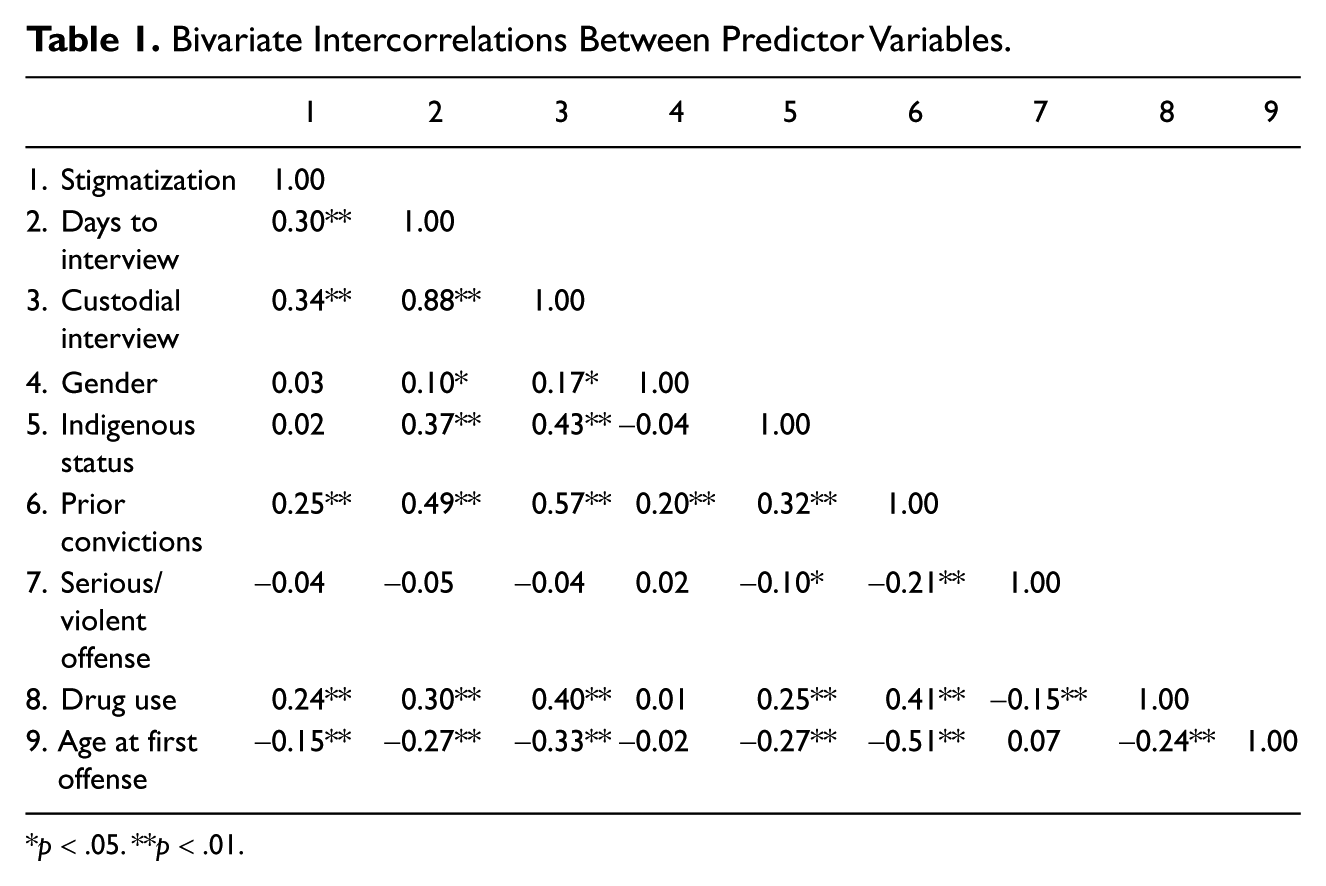
p < .05. **p < .01.
Table 2 reports the results of the hierarchical Cox’s regression models. Model 1 shows the hazard ratios and associated p values for the control variables. Number of prior convictions was the only significant predictor of time to reoffend out of this group of variables, with young people with prior convictions more likely to reoffend. This variable on its own accounted for an equivalent amount of variance as the full six predictor model (χ2 = 5.68, p = .338), and, as a result, the other five nonsignificant control variables were dropped from subsequent analyses. 8
Hierarchical Cox’s Regression Model of Recidivism.
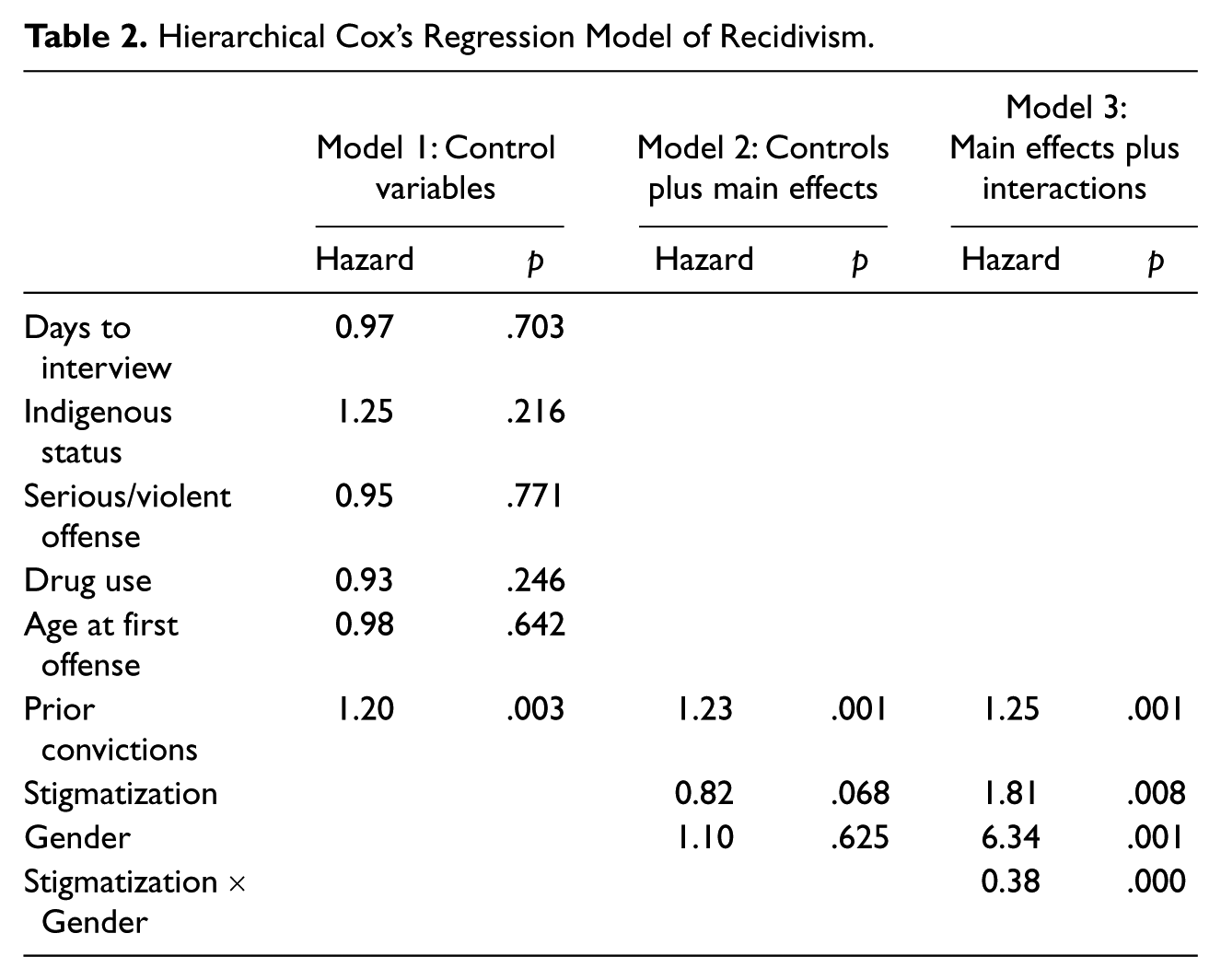
Model 2 therefore comprised prior convictions, stigmatization, and gender. In this model, only prior convictions were significantly related to subsequent reoffending. Model 3 therefore comprised prior convictions, the two independent variables (stigmatization and gender), together with one interaction terms: stigmatization by gender. All terms were significant in this model. Risk of reoffending increased for each extra level scored on both the stigmatization and prior offending variables. In addition, the interactive term had a negative relationship with subsequent convictions. To investigate the nature of this interaction, a series of Cox’s regression models testing the effects of stigmatization on subsequent offending was run with the sample divided in two by gender. These are reported in Tables 3 and 4.
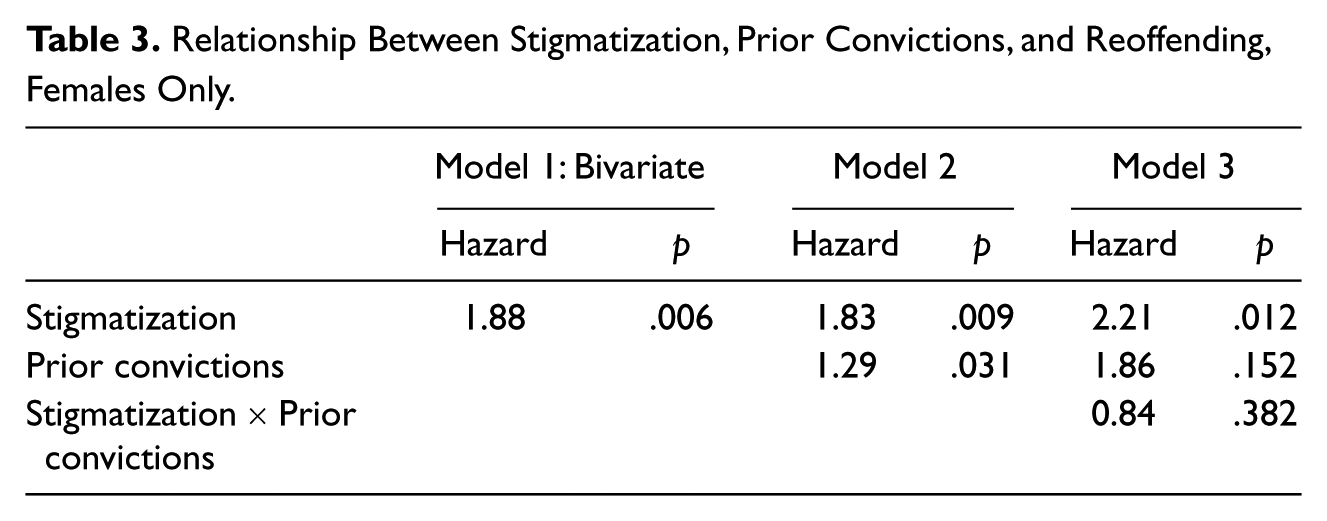
Relationship Between Stigmatization, Prior Convictions, and Reoffending, Females Only.
Relationship Between Stigmatization, Prior Convictions, and Reoffending, Males Only.
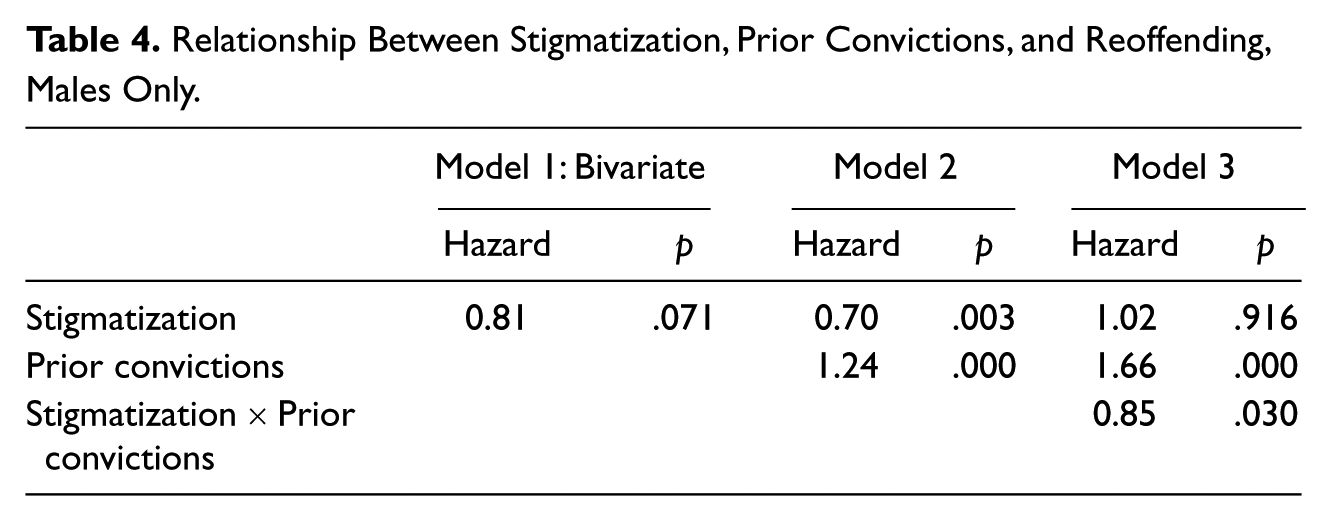
It is clear from these analyses that the deleterious effects of feeling stigmatized are present for the young women, but not the young men, in the sample. On a bivariate basis, the young women who reported feeling stigmatized after their court hearing were considerably more likely to be reconvicted in the follow-up period, with risk of reoffending increasing by approximately 90% for each level scored on this variable (H = 1.88, p = .006). For the young men in the sample, this variable was not a significant predictor of recidivism (H = 0.81, p = .071).
This picture becomes considerably more interesting when prior convictions are introduced as a control. For both the males and females in the sample, prior convictions were a significant predictor of reoffending. Given that the positive relationship between past and future offending has been referred to as the most robust finding in criminology (Nagin & Paternoster, 2000), this is not surprising. 9 However, what is interesting is that while the relationship between stigmatization and reoffending remains essentially unchanged for the young women, for the young men it becomes negative. That is, the young men in the study who reported feeling stigmatized after their court hearing were less likely to reoffend when prior convictions were controlled for. To explore this relationship in more detail, a further model was run for both genders with these two variables as well as their interaction term. In this model, stigmatization was again a significant predictor of reoffending for the young women in the sample but not the young men. Instead, the interaction between stigmatization and prior convictions was a negative predictor of reoffending for the young men. In other words, the males who felt stigmatized and had prior convictions were less likely to reoffend. This interaction as well as prior convictions were not significantly related to reoffending for the girls in the sample, although given the disparity in numbers and the fact the hazards were approximately equal, this may well be due to a lack of power. What is clear, however, is that the positive relationship between stigmatization and reoffending is robust for the young women in this sample across all the iterations described here.
Discussion and Conclusion
The current study aimed to investigate the relationship between gender and the labeling properties of the criminal justice system, by examining the emotional reactions of a group of young people to being sentenced in the NSW Children’s Court. The most notable finding was that feeling stigmatized after the hearing was a significant predictor of reoffending for the young women in the study but not the young men. In this regard, the present findings build on the work of Chiricos and his colleagues (2007), who observed a more potent labeling effect for women than men sentenced in an adult court in the United States. The current study differs in that it measured the emotional responses of the young people interviewed to the experience of being sentenced in a Children’s Court in NSW. In this sense, it is a finding consistent with what has been referred to as the symbolic interactionist tradition in labeling theory (Paternoster & Iovanni, 1989). As the authors of this article point out, it is likely that the labeling process operates differently for different subgroups. The current study offers evidence supporting this proposition, at least in regard to the effects of gender.
The relatively clear gender difference in the relationship between stigmatization and reoffending was complicated somewhat by the introduction of prior offenses into the analyses. Although stigmatization was a clear predictor of reoffending for females through all iterations, in the ultimate model, the interaction between stigmatization and prior convictions was a significant and negative predictor of reoffending for the males. Young men who felt stigmatized and had prior convictions were less likely to reoffend. This finding suggests that harsher judicial treatment of young men with previous criminal convictions could reduce subsequent offending. This appears to be a unique finding and, at the very least, requires replication before it becomes the basis of any policy change.
Why young women should be more vulnerable to the effects of labeling is not entirely clear. It is possible that public identification as an offender is a more profound violation of self-perceived gender roles. Some have argued that the psychological impact of drug and alcohol use, for instance, is more severe for women because it violates popular views of the nurturing and sexually modest female (Robbins, 1989). Others have noted the pressure to conform to social norms falls more heavily on young women than men (Schur, 1984). It has also been suggested that delinquent young women are more likely to have traditional views of gender identity (Campbell, 1981). If these arguments are correct, the detrimental effects of self-perceived criminality should be greater for women than men. The findings of the current study are consistent with this view.
An alternate explanation is that the young women who find their way to the more extreme end of the criminal justice system differ from their male counterparts in several important respects. Some evidence for this view can be found in a study conducted by Dixon and her colleagues of young women in detention in NSW (Dixon, Howie, & Starling, 2005). This study found high rates of posttraumatic stress and associated psychopathologies among these young women, the etiology of which in most cases was previous experience of sexual abuse. It is clear from these findings that these young women comprise a particularly vulnerable and damaged population, something that is reflected in research from other jurisdictions (Carlen & Worrall, 2004). In particular, there is a growing body of literature indicating that women have criminological needs quite different to men, most notably a history of abuse and victimization as well as experience of mental illness (Salisbury, Van Voorhis, & Spiropoulos, 2009). Given this, it is perhaps not surprising that self-perceived criminality should play such an important role in subsequent offending.
A final explanation is suggested by psychological research showing that women, in general, possess more highly attuned emotional capabilities than men. It has even been suggested that there are “male” and “female” brains types, with male brains characterized by greater systemizing ability and female brains characterized by greater empathizing (Baron-Cohen, 2002). Evidence for the greater empathizing ability of females comes from a number of sources. Girls, even when young babies, are better able to identify and respond to distress in other people (Hoffman, 1977). Women are better able to detect social faux pas than men (Baron-Cohen, O’Riordan, Stone, Jones, & Plaisted, 1999). Women also tend to be better emotional communicators than men (Tannen, 1990). In short, a considerable body of evidence exists to indicate that females are, in general, more emotionally acute than males. This emotional acuity might well have made the young women in this sample more vulnerable to the effects of stigmatization than the young men.
In 2006, Carrington reviewed official crime data in NSW from 1960 to 2004 and concluded that there had been a significant increase in the number of young women coming before the courts in that time. In particular, violent crimes as a proportion of criminal matters for young women rose from 13.8% in 1989 to 30.5% in 2003. These trends are reflected in other jurisdictions, notably the United States, Canada, and the United Kingdom (Carrington, 2006). A number of reasons were considered to account for these uniform increases, including the “sisters in crime” thesis, which holds that increased female delinquency is a product of increased gender equality (Smart, 1976). Carrington however concluded that this explanation had been largely discredited, and the most compelling reason to explain increased female representation before the courts, in Australia at least, were policy changes that have resulted in girls being processed through the criminal justice system rather than the welfare system. In addition, changes in young women’s public visibility have also made them more likely to attract the attention of law enforcement agencies. In effect, recent years have seen a reversal of the different methods used to deal with male and female delinquency suggested by Braithwaite in 1989. If this is the case, the results reported in the current article can only serve to accentuate this trend. Young women are now more likely to be dealt with by the formal justice system, and, as shown in the current article, those who are dealt with by the formal justice system are more at danger from any ensuing stigmatization, with the result being accelerated subsequent offending. This nexus should be a matter of considerable concern for policy makers who aim to reverse the trend of increased female criminalization.
Whatever the reasons for the findings observed here might be, the policy implications are clear: First, serious consideration should be given to the development of more extensive diversionary and therapeutic options for young women coming into contact with the criminal justice system, and second, judicial officers dealing with young women should be aware of the dangers of stigmatization for these individuals. There has been long-standing debate regarding whether males and females coming before the criminal justice system are, or indeed, should be, treated differently (Carlen, 2002; Daly, 1994; Daly & Tonry, 1997). The current findings suggest that such a policy, if it exists, might not be so misguided.
Some caveats should be acknowledged. It might be argued that the measures of stigmatization used in this study were somewhat crude, especially in light of the relatively low internal reliability observed. Stigmatization is obviously a complex phenomenon and in most likelihood one not experienced uniformly. Further exploration of this construct would be welcome and could well result in the development of superior measures to those used in this study. However, the fact that the gender differences reported in the current article emerged using these crude measures only emphasizes the importance of self-perceived stigma.
Although the rationale for the current study was to determine whether emotional reactions to being sentenced in the NSW Children’s Court had any impact on subsequent offending, some caution needs to be exercised in this regard. While these findings are consistent with the existence of a causal relationship between the reactions described here and subsequent criminality, they cannot establish it conclusively. It may be that there is a factor or combination of facts that predict stigmatization and recidivism independently. Young people with a more resentful demeanor in court might be subject to more stigmatic treatment; however, their offending patterns could be driven more by factors that cause this resentful attitude than anything that happens in court. In addition, it should be noted that although the community interviews took place immediately after the sentencing hearing, the custody interviews took place sometime later. Because of this, it is likely that the initial emotional reactions experienced by the young people in custody had become less intense by the time they were interviewed. Alternatively, it could be that the experience of incarceration might have intensified any feelings of stigmatization reported. For these young people, it is difficult to determine whether the degree of stigmatization they reported in custody would have been same had they been interviewed immediately after their hearing, as the others in the sample were. Nevertheless, the results of this study show that young women are at far higher danger from stigmatic treatment by our legal system. It does not seem unreasonable to suggest that these vulnerable young people should be treated with special care.
Footnotes
Acknowledgements
I would like to acknowledge the assistance of my colleagues Michael Kiernan, James Schuurmans-Stekhoven, and Graham Tyson in the preparation of this article. I would also like to extend my thanks to an anonymous reviewer for his or her comments on an earlier version of this article.
Declaration of Conflicting Interests
The author(s) declared no potential conflicts of interests with respect to the authorship and/or publication of this article.
Funding
The author(s) disclosed that they received the following support for their research and/or authorship of this article: This work was supported in part by the Criminology Research Council (Grant No. 02/04-05) and the New South Wales Bureau of Crime Statistics and Research.