







Abstract
It has been proposed that hiring more Black police officers is an effective way to alleviate long-standing tensions between police and African Americans because Black officers will connect with Black citizens and treat them well. This hypothesis, however, fails to account for the macro-level context of the troubled locations in which African Americans disproportionately reside and wherein police–minority citizen problems are deep seated. The present study examines two competing hypotheses concerning the influence ofofficer race relative to that of ecological context in shaping African Americans’ experiences with and perceptions of local police. These hypotheses are testedusing in-depth interview data with Black residents of a majority-Black, high-crime, economically troubled city. Implications for policy and future research are discussed.
Police–minority relationships in the United States have historically been characterized by animosity and distrust. The social distance and precariousness of the balance between these groups run so deep as to be part of the ethnic identity development of many youths of color (Lee, Steinberg, & Piquero, 2010; Lee, Steinberg, Piquero, & Knight, 2010). Given that police forces nationwide have traditionally limited employment to Whites (Jacobs & Cohen, 1978), some commentators have blamed the racial mismatch between White officers and Black citizens for the latter’s high rates of negative feelings about the police. The “community accountability theory” (e.g., Reiss, 1971) predicts that one way to reduce acrimony between the police and Black citizens is to hire more African American officers (Smith & Holmes, 2003). The assumption is that Black police officers will instinctively “get” Black citizens and that their superior communication will enhance dialogue, reduce the frequency of clashes and abuse allegations, and ultimately result in improved police–community relationships (e.g., Decker & Smith, 1980). Although this strategy has intuitive appeal and has proven attractive to many police administrators and city leaders, little empirical research has been conducted to confirm the validity of its core assumptions (e.g., Weitzer, 2000). Simply put, whether Black citizens are satisfied with local police when African Americans comprise a substantial portion of the agency remains unclear.
There are reasons to doubt that achieving high proportions of Black officers within a department will improve Black citizens’ perceptions of and attitudes toward the police. The most glaring cause for skepticism is that policing is a heavily contextualized phenomenon rooted in historical racial tensions and contemporary settings of geographically concentrated, nonrandomly distributed pockets of poverty and crime. In the United States, these areas are characterized by clusters of public housing, joblessness, general disorder, and decay (e.g., Schill & Wachter, 1995). Racial minorities—especially African Americans—disproportionately reside in these hotbeds of social disorganization (Massey & Denton, 1993; Wilson, 1987). These are, likewise, the places where police misconduct is most likely to occur (Fagan & Davies, 2000). Police–citizen relationships in these contexts are laden with mutual animosity, distrust, and fear (Mast, 1970). These are the primary locales where policy makers tout the strategy of hiring additional Black officers as a step toward improving citizen satisfaction, yet the dire social and economic distress these beleaguered areas face seems to militate against the notion that success can be achieved merely by altering the demographic composition of the police.
The community accountability theory’s officer race hypothesis, predicting that Black officers will relate to and treat Black citizens well, conflicts with the theory that policing is ecology based in many key respects and that context helps shape police–citizen interactions. These competing theories suggest two alternative hypotheses about the effect of high African American representation in police agencies:
Hypothesis 1: Black citizens living in an area where the local police force contains a high proportion of African Americans will report positive perceptions of and experiences with Black officers and will hold supportive views about the police in general.
Hypothesis 2: African American citizens will not necessarily hold Black officers in high esteem because it is not the race of individual officers but the ecological dynamics of policing in distressed, high-crime areas that gives rise to relational problems between police and disadvantaged Black citizens.
The present study employs comparative hypothesis testing using in-depth interview data with a sample of Black residents of East St. Louis, Illinois. This city is populated almost entirely by African Americans (approximately 98%) and typifies the social, political, and economic distress of many modern, low-income Black communities. Furthermore, an overwhelming majority of East St. Louis police officers are also Black (nearly 94%). These characteristics make East St. Louis an ideal setting in which to conduct the current research. The goal of this study is to examine whether African American citizens report favorable perceptions of and experiences with officers from a majority-Black police department (i.e., support for Hypothesis 1) or whether the geography of extreme poverty and crime collectively shape study participants’ perceptions of and experiences with police officers irrespective of the fact that citizens and police share racial backgrounds (i.e., support for Hypothesis 2). Important research and policy implications flow from the results regardless of the particular outcome and will be discussed.
The Community Accountability’s OfficerRace Hypothesis: Black Officers as a Solution to Strained Police–Minority Citizen Relationships
The 1960s and 1970s marked a fundamental and permanent change in U.S. policing. Civil rights demonstrations and riots brought highly visible clashes between police and Black protestors. Graphic images of officers turning fire hoses and dogs on African Americans charged the nation emotionally and sparked widespread criticism of the police. In the aftermath, police agencies were forced to acknowledge that they faced a crisis of legitimacy in the Black community and particularly among those African Americans residing in low-income, urban areas. Something had to be done.
An idea put forth by academics and commentators was “community accountability,” which, as the name implies, involves making municipal police more responsive to the communities they serve (Reiss, 1971). One of the most popular proposals offered under the auspices of community accountability was hiring more Black officers and deploying them in Black communities (Decker & Smith, 1980; Greene, 2004; Kelly & West, 1973; Mast, 1970; Smith & Holmes, 2003). The presumption was that Black officers would quell Black citizens’ ire toward the police through shared racial understanding and that this greater rapport would translate into more civil, respectful behavior (see Decker & Smith, 1980). Urban police departments nationwide began attempting to recruit African Americans, though some agencies’ efforts were court ordered rather than voluntary (Weitzer, 2000).
The tacit assumption implicit in the accountability-based proposal is that the problem in police–minority citizen relationships is the result of individual officer characteristics and behavior. It is presumed under this hypothesis that improvement moves in a “bottom-up” fashion in that it starts at the encounter level and ascends, eventually altering the behavior of the police organization at large and improving Black citizens’ opinions about all officers. Some indirect support for this argument can be taken from the related topic of procedural justice and police legitimacy, wherein it has been consistently demonstrated that citizens’ personal encounters with officers can affect their general beliefs and attitudes about police (Tyler, 2006; Tyler & Huo, 2002). The research on the officer race hypothesis, however, is sparse and inconsistent.
The existing research can be categorized into three main topics: aggregate statistical studies, studies of Black police officers, and studies of Black citizens’ evaluations of Black officers. All signs derived from aggregate statistical studies point to the conclusion that enhancing the proportion of a police agency that is Black does not produce the predicted positive outcomes. The percentage of a department that is Black appears to be either unrelated to Black citizens’ complaints about police abuse of authority (Cao & Huang, 2000; Hickman & Piquero, 2009) or possibly even associated with an increase in such complaints (Cao, Deng, & Barton, 2000). At the encounter level, officer race has in some studies born no relationship with the use of force (Friedrich, 1980), whereas other research indicates that because of deployment patterns, Black officers shoot Black citizens at rates far exceeding those of White officers (Fyfe, 1981).
Some researchers have concentrated their efforts on police-related racial issues from the perspective of Black officers. One of the earliest and most comprehensive studies of Black police officers was that by Alex (1969), who interviewed 41 Black, male police officers in New York City and constructed a detailed composite of their experiences and challenges. Officers’ narratives revealed a reality far more complex than the community accountability theory’s officer race hypothesis allows for. For instance, in middle-class Black neighborhoods, officers felt they enjoyed a mutually respectful relationship with residents. In lower-class Black areas, however, they described feeling that Black citizens thought of them as traitors and were resentful. In these areas, they said, Black citizens often showed disrespect and refused to acknowledge their legal authority, which prompted officers to sometimes treat residents rudely or even heavy-handedly as a means of instilling respect or, at least, submission. This destructive dynamic, Alex concluded, probably reinforced rather than alleviated African Americans’ beliefs that police are rough and brutal.
Other research has uncovered even further complexity in Black officers’ views about their roles as police and their relationships with Black citizens. Black and Reiss (1967) reported that a substantial portion of Black officers who worked majority-Black beats displayed prejudice toward African Americans and used many of the same epithets and stereotypes as White officers. Bannon and Wilt (1973) discovered that Black, male officers in Detroit generally believed that they had developed good rapport with Black citizens in their patrol areas and they also reported that Black citizens generally liked them. One notable finding was that Black officers asserted that Black citizens’ views were shaped more by the institution of policing than by individual officers themselves—African Americans who did not like police at all also disliked Black police; likewise, those more favorably disposed toward police liked the Black officers too (see also Alex, 1969).
In a survey of male and female Black officers in Washington, D.C., Beard (1977) concluded that respondents believed that Black officers treat Black and White citizens differently. Younger officers also tended to endorse the view that police have the right to enforce the law using any means necessary, whereas older officers overwhelmingly reported that politeness and decency were useless on the job. Kelly and West (1973) compared Black and White officers in Washington, D.C., 1 and one of their findings was that although White officers tended to read only “White media” (i.e., mainstream newspapers and magazines), many Black officers read both “White media” and “Black media.” This reflects the dual role that Black officers occupy as members of a historically White group (the police) and of their own racial group (Alex, 1969; Mast, 1970). Kelly and Farber (1974) compared White and Black officers on attitudinal dimensions and found that (a) Blacks were overrepresented in the group researchers labeled “responsive” to community needs and (b) the group labeled “unresponsive” was comprised entirely of Whites. This and other evidence summarized above indicates that Black officers may be more in tune with human-relationships issues; however, as also reported, there is evidence suggesting the opposite. Whether and to what extent improved understanding translates into better behavior also remains unknown.
Studies pertaining to Black citizens’ perceptions of Black police are the most relevant to the present study. Insufficient research exists on this topic, though what has been conducted implies that Black citizens have mixed feelings about Black officers. Wallach and Jackson (1973) studied Black citizens in the Western Precinct of Baltimore. Of the 50 respondents, 36 said they were concerned only with officer effectiveness and professionalism and that officer race was immaterial, whereas 14 of those interviewed reported preferring Black officers. Twenty-eight study participants believed that there is no difference in the way Black and White officers treat African Americans. Importantly, 8 of the 22 respondents who did feel there was a difference professed the belief that Black officers are more brutal than White officers, yet none of the study participants said that White officers are more brutal than Black officers (see also Mast, 1970).
In a study of Black and White citizens’ attitudes, Skogan (1979) discovered a positive association between Black representation on the local police force and African Americans’ ratings of police services. Decker and Smith (1980) divided the issue of officer race into two subcomponents, one that can be conceptualized as cognitive and the other behavioral: (a) whether Black police would understand Black citizens better and (b) whether that enhanced understanding would translate into more respectful treatment. Using city-level police demographic data and survey-based measures of Blacks’ satisfaction with police, Decker and Smith uncovered minute support for the notion that Black citizens would be more satisfied with police in areas where minorities were actively recruited into policing.
In the most recent study that has concentrated on African Americans’ perceptions of Black officers, Weitzer (2000) studied Black residents in both a middle- and lower-class neighborhood and compared the findings. He observed that Blacks residing in lower-class areas were more likely to believe that Black and White officers act differently toward neighborhood residents. In the lower-class area, though, specific attitudes were far from uniform and many respondents described White officers as more courteous and Black officers as more harsh. Other respondents believed that officers of both races were equally biased and abusive toward people in their neighborhood. Finally, very few of Weitzer’s study participants evinced a staunch preference for Black officers and most liked the idea of racially integrated patrol teams.
Macro-Level Theories: SociostructuralImpacts on Police Behavior
Relative to the “bottom-up” orientation of community accountability theory and the officer race hypothesis, the theory that police–community relationships are entwined with macro-level context can be viewed as a “top-down” notion wherein it is the characteristics of a police department and its surrounding community that primarily affects relationships between police and citizens of color. This approach would reject the notion that these relationships can be bettered simply by hiring more Black officers; such a strategy would be considered far too simplistic. Understanding officer–citizen encounters requires looking beyond the individual characteristics of suspects and officers. Contacts between the police and the public are embedded within a complex network of factors, one of which is ecological context (see Skolnick, 1966).
Race is tied intricately to multiple aspects of U.S. society. African Americans suffer disproportionately high rates of poverty and are particularly susceptible to living in the most severe forms of deprivation (Calmore, 1995; Massey, 1995; Massey & Denton, 1993; McNulty & Holloway, 2000; Parker, MacDonald, Alpert, Smith, & Piquero, 2004; Schill & Wachter, 1995). Violent crime thrives in these areas of social, political, and economic isolation (Massey, 1995; Wilson, 1987; see also Hawkins, 1983), and it is within these urban enclaves that police–minority relationships are at their worst. The intensity of poverty, crime, and general disorder in the locale affects the amount, type, and quality of policing that citizens receive (Brunson, 2007; Gau & Brunson, 2010; Klinger, 1997; Parker et al., 2004; Skolnick, 1966; Smith, 1986; Sobol, 2010). Area levels of structural disadvantage also may mediate the effect of race on people’s attitudes toward police (Dowler & Sparks, 2008; Sampson & Bartusch, 1998).
Although middle-class African Americans tend to think the police provide better services to them based on their socioeconomic profile (Weitzer & Tuch, 1999), those of low income often see themselves as frequent targets of police prejudice, surveillance, and abuse (Brunson, 2007; Hahn, 1971; Jacob, 1971; Weitzer, 1999; Weitzer & Tuch, 1999). Police misconduct, moreover, is most likely to occur in these areas (Fagan & Davies, 2000; Gau & Brunson, 2010; Kane, 2002; Weitzer, 2000; Weitzer, Tuch, & Skogan, 2008; see also Terrill & Reisig, 2003). One reason for this is that police may fear for their own safety when entering “dangerous” neighborhoods and may thus resort to force faster and with less provocation than they would in more tranquil areas (Smith, 1986). People in disadvantaged neighborhoods also lack the social and political clout to launch effective complaints against misbehaving officers (e.g., Kane, 2002). Officers may be uninhibited by the promise of impunity.
The geographic concentration of poverty and crime and the effect of concentrated disadvantage on police officer actions suggest that altering the racial composition of police agencies falls short of being an adequate solution to the problem of strained police–minority citizen tensions. Evidence that officer race is not related to Black citizens’ evaluations of police responsiveness and effectiveness has been uncovered by prior researchers (Decker & Smith, 1980), and there is indication that some African Americans may distrust Black officers even more than they do White officers (Wallach & Jackson, 1973; Weitzer, 2000). None of these past studies, however, analyzed Black citizens’ experiences with and perceptions of Black officers within the framework of macro-level concentrated disadvantage, so whether and how sociostructural conditions factor into the Black citizen–Black officer dyad remains unexamined.
Current Focus
Despite the informative and useful investigations that have been conducted on Black citizens’ evaluations of and experiences with Black police officers, the research remains riddled with gaps. First, studies are too few in number for any dependable conclusion to be drawn; more research is needed. Second, the studies that have been conducted are dated and much has changed socially and politically in the United States. There is a need for contemporary research on this topic. Nearly all existing studies, moreover, are descriptive or exploratory in nature and seek only to gather information; they do not test theories or pit theories against one another for comparative analyses. Another issue concerns research settings. Some of the research has been single site (Wallach & Jackson, 1973) and other studies have combined multiple cities (Decker & Smith, 1980; Skogan, 1979). The mixed results produced by these examinations indicate that Black citizens’ views about the treatment received at the hands of both White and Black officers varies by municipality (see also Skogan, 1979; Weitzer, 2010). Additional jurisdictions need to be studied so that a more comprehensive picture can be rendered. The city-by-city variation may mean that this will have to be done one locale at a time.
Finally, most existing studies of Black citizens’ perceptions of police have been done in cities that were majority-White in citizenry and/or police composition (see Decker & Smith, 1980; Wallach & Jackson, 1973). The exceptions are Weitzer et al.’s (2008) and Weitzer’s (2000) research in Washington, D.C., where both the public and the police are majority-Black. Neither study, however, tapped the specific question being examined in the present research. In addition, the aforementioned fact that Black citizens’ perceptions and Black officers’ behavior appear to vary substantially between jurisdictions means that research conducted in different kinds of settings is needed.
The present study contributes to the literature by helping to address the problems identified above. First, it is current and thus contributes a more modern perspective to the body of research on the topic. Second, the current research is theory driven and compares two hypotheses to determine which one appears to have greater validity. Third, it focuses on a jurisdiction that has never been the subject of this sort of inquiry. And fourth, the study site is majority-Black in both citizenry and police.
Study Site and Method
Data for this article are drawn from a larger study of East St. Louis, Illinois (hereinafter “ESL”). This city sits directly across the state border from St. Louis, Missouri. The ESL Police Department employs 62 full-time officers. Four (6.5%) are White and the rest (93.5%) are Black. Eleven (17.7%) are women (personal communication with ESL Police Department staff, October 8, 2009). The city is midsized, urban, and primarily Black (see Table 1).
Census-Based Socioeconomic Characteristics of East St. Louis, Illinois State, and the United States.
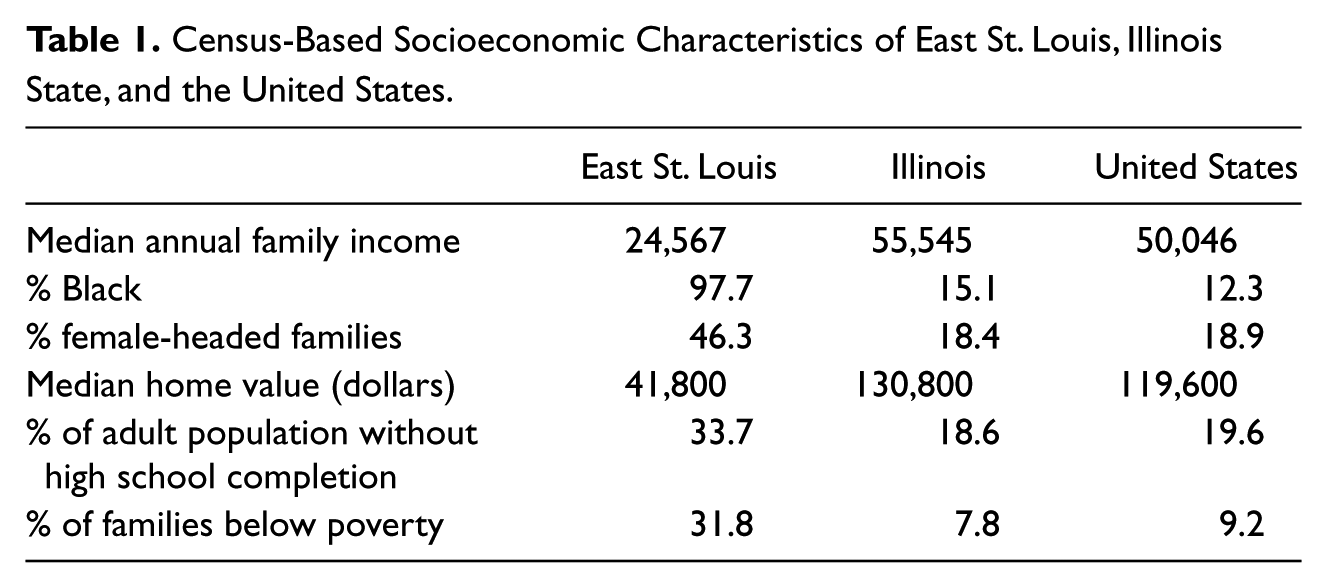
There are competing ideas about what it means for African Americans when they become the majority in a jurisdiction. On one hand, the group position thesis (see Weitzer et al., 2008, for a review) holds that becoming the majority unleashes political power. Where Black citizens are the predominant group, they control the vote and are thereby possibly less vulnerable to exploitation and abuse. On the other hand, there are two specific reasons to believe that a majority-Black city faces as many and perhaps even more police-related problems than its majority-White counterparts. First, citizen complaints about police appear to increase as the proportion of the local population that is Black rises (Holmes, 2000; Smith & Holmes, 2003).
Second, the strong link between race, poverty, and crime in the United States suggests that an equally plausible alternative to the group-position thesis is that higher Black populations might mean greater concentrations of poverty, unemployment, and crime. The geographic concentration of socioeconomic malaise (discussed above) implies that a density of African Americans in a city could be a sign not of power but of intense racial and economic segregation. The history of ESL and current conditions lend support to this interpretation. The city has experienced rapid population decline in the past decades, most of which resulted from Whites moving away and Blacks staying. The poverty rate in 1995 was 44.3%, which, in conjunction with the fizzling of the population during the 1900s, placed ESL high on the list of the most distressed small cities in the nation (Department of Housing and Urban Development, 1999). The city’s average annual homicide rate from 1985 to 1994 was 116 per 100,000 (Watkins & Decker, 2007); by contrast, the annual homicide rate for Washington, D.C., was 60 per 100,000 (Lattimore, Trudeau, Riley, Leiter, & Edwards, 1997; Watkins & Decker, 2007) and other large cities similarly infamous for violence also paled in comparison (Lattimore et al., 1997). Since the 1990s, the homicide rate has remained consistently high relative to the rest of the country (Watkins & Decker, 2007).
ESL is a prime forum for a study contrasting the officer race hypothesis to the ecology hypothesis because it contains both a rare racial composition (majority-Black in police and general public) and an abysmal socioeconomic environment. If the officer race hypothesis is correct, then the respondents’ detailed accounts analyzed here should indicate positive perceptions about the local police. If, conversely, the ecological hypothesis is correct, then study participants will be more concerned with the way in which macro-level conditions of disadvantage affect the functioning of the department and its officers.
The current study is based on in-depth interviews with 44 African American adults (25 women and 19 men) living in ESL. 2 All of the personal experiences respondents reported having with police involved Black officers. The data are limited to study participants’ versions of events, but we do not take for granted that their interpretations are objectively “true” or that they have provided full disclosure in all instances. We also recognize that police officers’ views are not represented in this analysis and that their accounts of incidents described by study participants may have differed substantially. We approach the qualitative data analysis here with less concern for objectivity than for the psychological dynamics of respondents’ experiences with and attitudes toward police (Brunson, 2010). That said, however, interviewers did take several steps to strengthen the reliability and validity of the data by repeatedly asking respondents about their experiences at multiple points during the interviews and by probing for detailed narratives of events. Furthermore, we try in the present study to corroborate respondents’ descriptions of well-publicized events by examining the archives of local newspapers and national newswire services. During the analysis of the interview transcripts, considerable care was taken to ensure that the concepts developed and illustrations provided typified the most common themes and subthemes in respondents’ accounts. This was achieved using grounded theory methods, including the search for and explication of deviant cases (Strauss, 1987). The end result of the analysis was an in-depth understanding of these respondents’ personal and vicarious experiences with, attitudes toward, and beliefs about the local police force. As is customary with qualitative research designs, our sampling frame requires that we forgo generalizability in pursuit of rich, detailed, highly descriptive information. The results, though themselves of possibly limited generalizability, lend themselves to future testing with quantitative data to determine the extent of their applicability to other persons in other locales.
Results
Study participants consistently reported being dissatisfied with and having little confidence in the ESL Police Department. No race effect emerged in the analysis—of all the problems and issues respondents described, neither their own race nor that of ESL officers was mentioned. Furthermore, although residents offered few positive statements about the ESL Police Department, they frequently expressed being satisfied with the performance of other police organizations with whom they were familiar (see below).
Many interviewees’ negative impressions of the police stemmed from a combination of the deleterious impact of resource scarcity on the department and perceptions of the officers’ poor performance in law enforcement and crime-solving capabilities. These consistent reports coalesced into the first theme of the results. A majority of respondents also expressed concerns about what they considered widespread corruption, which became the second major theme. We investigate each of these topics and conclude with a discussion of the types of factors (i.e., officer level or macro level) that most strongly influenced respondents’ opinions about the local police.
Ineffective Law Enforcement: 911 is a Joke 3
In an economically disadvantaged, African American city with a majority-Black police department, residents’ primary concerns about crime control efforts may center on the harmful effects of underpolicing rather than overpolicing (see Kennedy, 1997; Smith, 1986). This prediction came to fruition in much of the study participants’ accounts. The vast majority of respondents acknowledged that ESL’s dismal economic conditions adversely impacted the quality of many city services. Regarding the police in particular, residents were especially frustrated by lengthy response times. For example, John 4 reported, “A lot of people [say], ‘Man, call the police? [There’s] no need to call the police, it[‘s] gonna take ‘em 2 hr to get here.’” Similarly, Alexis noted, “[The police], they full of crap [laughs]. They full of crap. Because when you need them, they’re never there and if you really need them it takes forever!” In agreement, Jeremiah commented, “East St. Louis could use about 15 or 20 more officers on the street. I feel that the police department is understaffed . . . I saw a shooting once and called the police but by the time they got there the other boys was gone.”
Respondents were asked what would make them feel safer in their neighborhoods. A number of residents tied their perceptions of victimization risk directly to manpower shortages and poor police response times. For example, Michelle remarked, “[I would feel safer] if we could get some more police to patrol the streets . . . I had an incident where I needed the police and it took maybe an hour and a half for [them] to get there.” Likewise, Dottie replied, “We can’t really feel safe in our neighborhood because we don’t have a lot of police officers patrolling the area.” Like many respondents, Michelle and Dottie explained that in addition to being frustrated by lackluster response times, they had wearied of officers’ customary explanation for lengthy delays. Michelle stated, “[When I’ve questioned them about] what took so long they’ve said, ‘well ma’am, we were on another call.’” And Dottie noted,
[The police typically respond to citizen complaints about poor response times by saying], “well, we was at a car accident” or “we was at a shooting.” Everybody knows that when there’s a shooting, they ain’t gonna come. They’re gonna wait till the shooting over with before they come. We need for East St. Louis police to respond immediately when we call and say, “Somebody out here just got shot. I think they’re dead. [And the suspects] are running down the alley.” I know that they can’t be there in 2 and 3 min, but they need to come at a decent time. If we call you at 10, we don’t want you to come at 11 . . . people [are] getting tired of hearing, “we’re shorthanded and well, see, we was on another call.”
Respondents struggled to understand the extent to which they should hold officers accountable for their poor performance given that the department’s resource deficits were widely known; nonetheless, the vast majority of study participants reported low levels of satisfaction.
Not only did statements about poor performance highlight respondents’ lack of faith in the ESL police, they also appeared to contribute to some residents’ apathy and reluctance to call them for assistance. For instance, Annie said, “When we call the police they don’t come. So what can we do? . . . We feel so neglected.” Furthermore, study participants’ dissatisfaction with the police appeared to result in their withdrawal from active participation in neighborhood life. Gail observed,
I feel like [the police are] doing the best that they can with the resources they have, but in other ways I feel like there’s always more that could be done. The attitude or perception [of most residents] is that the police are not coming anyway [laughs]. And if they come it’s not gonna be real soon, so you just as soon to handle [matters] yourself, mind your own business, and keep on going, which is an unfortunate situation.
Several respondents commented on staffing levels. For instance, Harold observed,
From my viewpoint [the police] aren’t really dealing with [crime in East St. Louis]. [Specifically], East St. Louis is so small and we have this high crime [and] murder rate, it’s like [the police] really not [actively investigating] who’s really [committing crime].
Alton remarked, “I feel that on the weekend you might have only four policemen patrolling the whole [city of] East St. Louis—and that’s just ridiculous!”
Alton’s comments were confirmed by several study participants who referred to recent newspaper articles highlighting officers’ safety concerns as a result of what they considered inadequate staffing levels (see Leventis, 2008; Smith, 2008). Ongoing labor disputes (including officers’ participation in a “sickout” and/or the “blue flu”) between the police union and city leaders over back pay, working conditions, and manpower shortages have been well documented by area newspaper reporters (Hollinshed, 2005; Leventis, 2008; Smith, 2006a, 2006b). Bettie explained, “Unfortunately just recently, we had a [newspaper] report that said we are limited to two policemen per shift . . . that’s frightening, very scary.” Dorothy exclaimed, “[The media] tell you [that] you got five police that’s taking care of the whole city.” And Bernard noted, “I’m not sure how many police officers they really have, as far as they say in the paper, if it’s a [shortage], they need more police.” Residents were especially concerned with staffing levels at night. Cliff noted,
It’s times when you think you should see [the police] a little bit more. I see them about three times during the day . . . but the freaks come out at night [laughs], we don’t hardly see [the police] that much at night.
Similarly, Vernon reported,
I can’t say for certain [what kind of coverage] we have in the city at night because nobody will tell you this information but the city needs to be protected when it’s most vulnerable and nighttime is certainly a time when most crimes are committed.
In addition to respondents’ harsh criticisms over poor response times and manpower shortages, several held the view that local law enforcement was inept at effectively preventing and solving crime; that is, a number of residents expressed dissatisfaction concerning how calls were handled, even when officers arrived in what study participants considered a timely manner. They questioned the officers’ fitness as law enforcement personnel. For instance, Vernon called the police to report a burglary and challenged the veracity of the responding officer’s statement that no one (i.e., an evidence technician) was available to process the crime scene. He quipped,
[You mean to tell me that] we don’t have anyone on the police department of this size who can lift fingerprints? Most of the time when you have crimes, whether it be break-ins or criminal acts, you need to have someone there who can process the crime scene.
Thomas noted,
I was carjacked and I [reported it to the police]. I walked for like 2 days until I found my own car, and it was torched. And I made a report of it and called the police out to make another report that I’d found the car. I asked for some pictures to be taken and the officer didn’t even have a camera! We [had a heated exchange] for that reason.
Gail aptly summarized the view that most study participants held regarding ESL police officers. She explained, “Unfortunately, as a whole, the community either views the police as useless or views them as only helping out those they know.”
Respondents’ negative perceptions did not appear to be manifestations of uniform hostility toward all police; to the contrary, participants consistently expressed high levels of confidence in other local, state, and federal law enforcement agencies that were often called in to assist the ESL department with homicide investigations and routine crime control efforts (Hollinshed, 2005, 2006). Respondents welcomed the presence of external law enforcement agencies. On reading about police personnel shortages in the paper, Bettie wondered why the city had not “requested assistance from the Illinois State Police or some other form of protection.” Some residents directly compared the ESL Police Department to other law enforcement agencies. This finding is consistent with recent scholarship highlighting that citizens’ evaluations of local police are often independent of their views of state law enforcement agencies and vice versa (see Warren, 2010). For example, Kurtis explained why he held the state police agency in higher regard than the ESL Department. He said, “I know that the [state police] can come to a regular city police [department] and get things taken care of.” Likewise, Calvin commented, “The city police are very slow, but when the state men and different other organizations come in, they get the job done.” It appears that questions about the effectiveness of the municipal police were not limited to citizens’ perceptions. For example, Mary noted, “When I had a problem with [a drug house in my neighborhood], I talked to a police officer and he told me to go and report it to the [St. Clair County] sheriff’s department and that’s what I did.” Finally, Vernon remarked,
Most people [in East St. Louis] feel like I do. They don’t have a great deal of confidence in the police—especially [when] it comes to crime solving. [The East St. Louis police] will come out and take your report, but they don’t have the mechanism[s] to follow up on it. If the state police or the Major Case Squad [doesn’t] get involved, most of these crimes never would be solved.
The themes and comments discussed thus far have revolved primarily around resource scarcity and the ways that officers and citizens both adapt to the challenge and to one another within the context of that challenge. No race effect emerged in the analysis—of all the problems and issues respondents described, neither their own race nor that of ESL officers was mentioned. This omission was significant, as it indicated that neither being the majority race in the city population nor having a police department that was majority-Black enhanced Black citizens’ satisfaction with police services. Respondents’ contact with officers left them feeling neglected and disillusioned despite the fact that all reported contacts were with Black officers. This finding comports with prior literature showing that Black citizens’ views about police do not suddenly switch from negative to positive as Black representation on the local force rises (Decker & Smith, 1980), and sometimes African Americans are even more unhappy with Black officers than they are with White officers (Wallach & Jackson, 1973; Weitzer, 2000).
We next examine in detail the respondents’ direct and vicarious experiences with police malfeasance and how these contacts appeared to affect these citizens’ perceptions of the integrity and quality of the ESL Police Department. Many of the study participants’ comments factored into a general theme of on- and off-duty misbehavior, but two subthemes also emerged: sexual misbehavior and corruption. Each is detailed in turn. Once again, the absence of any mention of race (citizens’ or officers’) is noteworthy.
Police Misconduct On- and Off Duty
Study participants described a wide range of both personal and indirect experiences with police wrongdoing. ESL has a long history of public corruption scandals, many involving police figures (“A city,” 2003; Moore, 2005; Shaw, 2005, 2006). All of the misconduct described by respondents was unethical and much of it—such as drug use—was also criminal. Gail explained,
[Allegations of wrongdoing have] done a lot to erode citizen trust. There have been multiple problems with liquor licenses and underage drinking. Some taverns get shut down and others don’t. Unfortunately we’ve made national news too many times from the police force and the city hall, everything from a prostitution ring being ran out of the police department and city hall to federal bribes . . . [East St. Louis Police Officers] have been [involved in] every kind of scam known to man. [And] those things do not help the [public’s] perception.
A majority of residents expressed the view that during their tenure in ESL, they had come to expect and accept a certain amount of corruption. Thomas explained, “Depending on the person, it’s a give and take situation. You have some people that [are not that concerned about police corruption] because they’ve been [in ESL] for years and [have ties to police officers suspected of wrongdoing].” Before the interviewer could finish asking Quintin whether he thought ESL officers sometimes engaged in misconduct, he interrupted by exclaiming, “You ain’t even got to finish your question . . . Yes they do! Yes they do! Drugs, money, cars, women . . . Whatever they can get their hands on and don’t get caught, that’s what they do.” Although residents attempted to avoid maligning the entire department because of the actions of some officers, this was often not an easy task. For instance, Dorothy remarked,
Most of [the people in my neighborhood] have some real negative attitudes about [ESL police officers] because they know a lot of them and know what kind of people they are. [They believe that] some of them are and some of them aren’t worthy of the job. And I don’t know if I should [have a negative outlook] on the whole department or just some of the [officers].
The influence and volatility of local politics has resulted in recurring instability among key leadership positions in the police department (Fitzgerald, 2005a, 2005b), and frequent changes to the department’s command staff appears to have further diminished citizen trust. For instance, Gail remarked,
Well, once again we’ve changed police chiefs [laughs] . . . and of course he’s sworn an oath to make a difference and [root out corruption]. He’s been on the job all of 2 or 3 months and [he’s already] in the newspaper over something [he supposedly did].
Sexual impropriety and abuse
Several respondents reported that it was common knowledge among city residents that particular officers frequently attempted to use their positions to solicit or coerce women into engaging in sexual activities. For example, Geraldine described how a male police officer might proposition a female motorist during a traffic stop. She noted that he might say, “Give me your [phone] number and you won’t get this ticket, or go out with me and this [traffic violation] could be forgotten.” In agreement, Warren observed, “[Growing up] I done heard about police pulling women over and letting them slide [in exchange for] getting they phone numbers.”
Although Geraldine’s and Warren’s somewhat general descriptions of officers’ verbal sexual harassment represented the majority of study participants’ accounts, a handful of respondents offered more explicit, specific examples. For instance, Willis noted,
An officer stopped my daughter. She didn’t have her license with her but she did have a license and insurance. He could have looked [up her information] in his computer, but he choose not to. He just took her downtown [when she did not respond favorably to his request for a date].
Similarly, Dottie said,
My cousin got pulled over by an East St. Louis police officer and he told her that she can get outta her ticket if she let him see her breasts. She told him, “No! [and] well, you just gotta give me a ticket then.”
Lorraine emphasized that some women, particularly sex workers, were especially vulnerable to officers’ demands for inappropriate sexual contact. She explained,
In my line of work [as a social services provider], I’ve talked to several females who have accused police officers of having sex with them. These are ladies of the night. In exchange for not taking them to jail, [the officers] just took them somewhere and had sex with them.
General corruption
A number of citizens stated that officers were much more likely to engage in corrupt practices when dealing with those they believed to be criminals. For example, several study participants referred to a highly publicized event where an officer pled guilty to two counts of felony wire fraud in connection with his participation in a plot with a prostitute to shake down male customers (Smith, 2005). Thomas noted, “[A story] was published in the paper about the police officer who had hookers on the street, he was [pulling over customers’] cars, ripping them off and letting them go.” John explained, “You got some cops that will take the drugs from the dealer and [let him go] and sell or use it themselves.” Likewise, Warren explained,
The East St. Louis police is stealing. Some of them out here stealing and selling drugs. They’re pulling over some of the drug people, taking they money, and keeping it. They might turn in some of the [evidence], but they’re keeping some of that money.
Although like Thomas, a number of study participants shared vicarious information regarding corrupt officers, others offered direct experiences. For instance, Lydia reported,
I used to sell weed. If I was driving and [the police] pulled me over, they knew what I was doing, they knew I had weed or they knew I had money . . . So whenever I would get caught, I would always have to give [the police officers] money in order for them not to take me to jail. They would always throw me a [Black work] glove and I knew what to do . . . I’d put some money in it and give it back to them.
In agreement, Javone said, “Police take money under the table from people that they pull over. I witnessed it myself.” Kurtis noted, “I done seen [the police] take stuff from a person that was selling drugs and they go take it to another person. I’ve seen that with my own eyes [laughs].” And Dottie was emphatic in her claim about police misconduct. She advised,
I’ve seen a police officer, I ain’t gonna say no names, but I know for a fact, nobody told me this, I know this for a fact, that I’ve seen police go up and buy drugs theyself. Not to bust nobody, for theyself.
Eddie explained how observing officers engaged in illegal activities damaged his opinion of them. He noted,
A female friend of mine was [addicted to drugs]. About three policemen [frequently came] over to her house getting her [high] . . . I walked in [on them once] and seen [the officers] getting high [alongside her] and it just hurt my [feelings] . . . and when I saw [those officers] again, there just was no respect for them.
Despite the legacy of public corruption in ESL, citizens were particularly outraged and demoralized by two recent, highly publicized events. Concerning the first event, a number of study participants mentioned that an off-duty ESL detective was discovered asleep behind the wheel of a department vehicle in nearby Belleville, Illinois. The officer was suspected of drunk driving, but the Belleville sergeant reportedly did not conduct an investigation, choosing instead to release him to ESL police administrators who allegedly said “the matter would be handled internally” (Girresch, 2007; Hollinshed, 2007; Smith, 2007). Bettie commented on the incident. She noted, “We just recently had a policeman thats on leave now for driving drunk in Belleville [in a department issued vehicle].” Similarly, Quintin reported, “[We have police] that drink on the job and get caught while [they] sleep.” Lorraine noted,
A [certain detective] got caught sleeping in a car and the policeman in Belleville didn’t report it because he was a fellow officer, but some kind of way, the officer in Belleville who didn’t report it ended up getting in a world of trouble and I think [the East St. Louis] detective also got in a world of trouble. Because he was parked, I believe in the police car, drunk, asleep.
The second ire-provoking event was a former police chief’s arrest and conviction on federal charges of conspiracy to obstruct justice, attempted obstruction of justice, and perjury before a grand jury (see Shaw 2005, 2006). Jeremiah observed, “[I remember the case involving] that chief of police that [tampered with evidence]. The chief of police they had about two chiefs ago, the one that got sent away to federal prison.” Whitney noted, “Before [the current] mayor came in, there was corruption down there at City Hall and at the police station. Even the chief of police down there was taking bribes.” Finally, Eddie commented,
I’ve been here all my life, and I’ve seen the change. Citizens in East St. Louis don’t trust the policemen. Really to hit the nail on the head, whenever your police chief, hallelujah, gets arrested, what does that tell you?
Respondents’ accounts highlight how several factors converge to adversely impact their confidence in the police. A majority-Black police department is clearly not a panacea to police–minority public relationships.
Discussion
The officer race hypothesis derived from the community accountability perspective (e.g., Reiss, 1971; Smith & Holmes, 2003) is at odds with the nexus between race and socioeconomic disadvantage (Massey & Denton, 1993; Wilson, 1987) and the tendency for problems between police and some minority citizens to surface most poignantly in areas characterized by poverty and disorganization (Fagan & Davies, 2000; Mast, 1970). These two theoretical perspectives were framed as competing hypotheses in the present study. Hypothesis 1 predicted that Black citizens would express high opinions of their local majority-Black police force, and Hypothesis 2 predicted that the macro-level socioeconomic disadvantage of ESL would be the deciding factor in respondents’ attitudes about police.
Analysis of the in-depth interview data indicated support for Hypothesis 2 and no sign that Hypothesis 1 accurately depicted the state of affairs in this city. The most prominent theme that emerged from the data concerned the deleterious impact of the sluggish local economy and high crime rates on the department in terms of staffing and response times. Although it could be argued that all officers, regardless of race, are affected equally by department-level resource deficits, respondents were also vocal about their disapproval of ESL officers’ behavior. In an agency where more than 90% of the force is African American, corruption, illegality, and generally unprofessional behavior are perceived by the majority-Black public as a staple of the department. 5 The findings lend themselves to four conclusions.
The first conclusion is that a shared racial background fails to guarantee positive interactions between police and citizens and that Black citizens can in fact be very dissatisfied with Black officers. Prior researchers have attributed African Americans’ relatively low support for police to, in part, the racial disparities between White officers and Black citizens. The present research, however, refutes the assumption that homogenizing the racial dyad will in and of itself produce positive outcomes (see also Wallach & Jackson, 1973; Weitzer, 2000). This is not to say that race is entirely absent from consideration, however, and in this sense, more work should be done to fully address the officer race thesis embedded in Hypothesis 1. The difference between citizens’ perceptions of malfeasance by White officers and by Black officers may be that Black citizens mistreated by White officers tend to conceptualize that interaction in racial terms, whereas Black citizens mistreated by Black officers may—like the vast majority of our respondents—make the racially neutral but just as damaging inference that the department is rife with corruption and mismanagement. By substituting Black officers for White ones, policy makers may be able to reduce African Americans’ perceptions of race-based discrimination but still fail to alter these citizens’ overarching beliefs that they are the recipients of substandard policing (see also Weitzer & Tuch, 1999).
The second main conclusion pertains to the contextualized nature of policing and the profound influence of local ecology on officer behavior. There is no way to divorce policing from its macro-level context (Weitzer, 2010), and bottom-up strategies like manipulating the racial composition of a municipal police force are not sufficiently systemic to effect real change. Many African Americans living in economically depressed parts of the country have problems with the police that far transcend the race of the officers they encounter. In particular, police in disordered, high-crime areas may suffer inadequate fiscal resources and a bombardment of calls for service (e.g., Smith, 1986) that prevent them from rendering high-quality assistance to the public. Furthermore, police in these areas may experience greater levels of burnout and frustration (Klinger, 1997). Because Black officers are disproportionately called on to work beats in poor, high-crime, majority-Black neighborhoods (Fyfe, 1981), the ecology of their day-to-day work routines puts them at risk for becoming resentful or even hostile toward the residents of these troubled areas (Black & Reiss, 1967). African American officers are not immune to occupational stress. Police administrators who use race as a factor in constructing deployment patterns should be cognizant of the damage that prolonged stress can inflict on officers’ psychological health, particularly given the fact that Black officers are already at risk for stress-related problems because of their token status in most law enforcement agencies (Dowler, 2005; Gustafson, 2008). Whether occupational stress was a factor in the present study and contributed to some officers’ seemingly negative attitudes toward citizens cannot be ascertained with the available data, but prior research suggests that it is a potential influence.
The third major conclusion arises from the theme concerning officer misconduct and corruption. This finding highlights the fact that Black officers sometimes mistreat Black citizens—shared race is not enough to prevent some African American officers from handling African American citizens dismissively or with derision. The officer race hypothesis rests on the untenable assumption of homogeneity among African Americans and fails to acknowledge intraracial variability. Policing is a self-selective occupation and will by definition attract a nonrandom segment of any racial group. African Americans who become police may differ qualitatively from those who do not on a number of dimensions, and these discrepancies could create substantial barriers to positive Black officer–Black citizen relationships. The findings from the present study underscore the danger in presuming that shared race is a proxy for mutual respect and understanding. Police administrators should be careful to recognize that officer race is not a substitute for recruit training or for better community outreach. Hiring Black officers is vital for equal opportunity in employment, but applicants’ abilities—not their race—should be the determining factor.
The final conclusion pertains to the importance of including sociostructural context in any study of citizen perceptions of police or of police–citizen interactions. Respondents in the present study expressed many opinions and concerns about both officer behavior and the fiscal status of the department itself. Prior studies have also found that sociostructural context and perceived quality of life can mediate the impact of race on people’s attitudes about the police (Dowler & Sparks, 2008; Sampson & Bartusch, 1998; Weitzer, 1999). Omitting questions (in qualitative research) or variables (in quantitative studies) capturing macro-level, ecological features can lead to missed themes, misspecified models, and erroneous conclusions. Future researchers should be careful to control for this important factor.
Policy Implications andDirections for Future Research
Although more theoretical and empirical research should be done before translating the present findings into implications for police policy, the results of this study suggest potential courses of action for police practitioners and other policy makers, particularly those at the local level, to take. First and foremost is the vital impact of department resources. Failing to properly fund and equip local police agencies does more than jeopardize public safety—it can lead to the development of a chasm between citizens and the police when citizens reach the conclusion that the police are simply unable to attend to the community’s needs. Second is the importance of selection of police recruits during the hiring process and ongoing training throughout all officers’ careers. There is no doubt that agencies need to diversify their personnel in terms of race and gender, but police leaders should be cognizant of the absence of an empirical connection between an officer’s race or gender and his/her ability to deliver effective services to citizens (Jordan, 2002; Weitzer, 2000). The goal of equal employment must work in tandem with the objective of hiring qualified, dedicated individuals. The third primary policy implication revolves around police departments’ need to maintain strict internal discipline. Respondents in the present study perceived local police officers as being immune to punishment both on- and off duty, and this perception seemed to diminish citizen trust in the ESL Police Department. To prevent such erosions of trust, substantiated officer misconduct must be met with swift and proportionate discipline to correct officers’ behavior and reassure citizens that appropriate oversight is being exercised.
The current study has limitations. The findings and conclusions are based on the lived experiences, observations, and beliefs of 44 longtime residents. No claim is made that these individuals are representative of ESL residents; likewise, no claim is made that ESL is representative of cities nationwide or that the present findings would emerge in a similar study of a different locale. Qualitative analyses require the goal of generalizability to be relinquished in favor of greater analytical depth; however, the findings from the present study offer a testable theoretical framework essential for deductive, quantitative analyses. Future research should focus on (a) using quantitative survey methods to tap the personal opinions of a large sample of citizens of multiple races, (b) quantitatively comparing the relative predictive strength of citizen race versus ecological context to further tease out the relationship between these factors and citizens’ satisfaction with police, (c) gathering both qualitative and quantitative data from police officers so that their views about race and policing can be explored, (d) employing multisite analyses for purposes of comparison, (e) studying the impact of media accounts of police misconduct on citizens’ views to determine the strength of vicarious (e.g., Weitzer, 2002) relative to direct experiences, and (f) attempting experimental studies in laboratory and/or field settings with officer race manipulated to better discern this variable’s impact on citizen attitudes. The pursuit of improved police–minority citizen relationships depends on a solid knowledge base.
Footnotes
Acknowledgements
The authors would like to thank Eric A Stewart and Ron Weitzer for helpful comments and advice on earlier drafts of this manuscript.
Declaration of Conflicting Interests
The author(s) declared no potential conflicts of interests with respect to the authorship and/or publication of this article.
Funding
The author(s) received no financial support for the research and/or authorship of this article.