







Abstract
This study examines whether deterrence and morality interact in the explanation of adolescent offending. On the basis of the Situational Action Theory, the author hypothesizes that deterrence is more effective in preventing offending among individuals with low levels of morality than among individuals with high levels of morality. To test this hypothesis, self-report data are used from a sample of young adolescents in Halmstad, Sweden (N = 891). The findings provide strong support for the hypothesis that the effect of deterrence (measured as the perceived risk of getting caught, that is, “certainty”) on offending is dependent on the individual’s level of morality, indicating that deterrence has a significantly stronger effect on offending for individuals with low levels of morality than for individuals with higher levels of morality.
Introduction
Deterrence theory stipulates that people refrain from committing crimes because of the perceived risk of getting caught (certainty) and the perceived consequences of getting caught (severity; Andenaes, 1974; Gibbs, 1975; Wikström, 2007). While a large body of studies have examined whether perceived certainty and perceived severity deter people from committing crime, the empirical evidence for the relationship has not been unequivocal and the strength of the correlations ranges from negligible to modest, although the relationship is stronger for certainty than for severity (e.g., Nagin, 1998; Paternoster, 1987, 2010; Pratt, Cullen, Blevins, Daigle, & Madensen, 2006).
As the relationship is rather weak, the question has recently been raised of whether it might be reasonable to assume that perceived certainty deters offending among some kinds of individuals but not among others (Gallupe & Baron, 2010; Pogarsky, 2007; Pratt et al., 2006; Wikström, 2007). In a review of the research, Piquero, Paternoster, Pogarsky, and Loughran (2011) discuss the importance of examining in what way deterrence may have a different effect on offending for different types of individuals. They argue that improving our understanding of this hypothetical interaction is important not only from a theoretical perspective but also for the purpose of developing prevention strategies.
Most of the research in the field of deterrence either ignores or attaches little importance to individual differences in offending. However, some studies proceeding from a rational choice perspective have examined whether deterrence (certainty) has a different effect on offending for different individuals (e.g., Nagin & Paternoster, 1993; Piquero et al., 2011). The majority of these studies have examined whether the effect of deterrence (certainty) on offending is moderated by the effect of self-control (e.g., Gallupe & Baron, 2010; Wright, Caspi, Moffitt, & Paternoster, 2004). 1 Whether deterrence (certainty) might interact with other individual characteristics, such as morality, is something that we know relatively little about. One criminological theory that explicitly discusses an interaction with morality is the Situational Action Theory (SAT; for example, Wikström, 2006, 2010).
In brief, SAT states that human action and offending are the outcome of how individuals perceive their alternatives for action and make their choices when confronted with different types of settings. This perception–choice process is seen as the situational mechanism that links individuals and environments to offending. The theory regards perceptions as being more important than choices: If an individual does not see crime as an alternative for action, the individual does not need to take a decision about it, and, hence controls such as deterrence are irrelevant (Wikström, 2006).
Whether an individual will see an act of crime as an action alternative depends ultimately on the individual’s morality. Morality has been conceptualized as the main factor in offending and is defined as the “rules of conduct which guide people’s action by specifying what it is right or wrong to do or not to do in particular circumstances” (Wikström, 2010, p. 218). Individuals vary in whether they have high or low levels of moral values. It is also stated that the feelings of moral emotions such as shame and guilt provide an indication of whether the individual has high or low moral values when committing a crime. Because individuals vary in their moral values and in how much they care about following moral rules, individuals have different “moral thresholds.” This indicates that “the higher the moral threshold an individual has, the stronger the environmental inducement needed to move him to break a moral rule” (Wikström, 2006, p. 96). In addition to an individual’s moral influences and an individual’s capacity to see crime as an action alternative, an individual’s ability to exercise self-control also influences an individual’s process of choice.
Deterrence, however, is defined in SAT as constituting part of the setting. If the monitoring and the sanctioning of committing crimes is effective, then the setting has well-developed deterrent qualities (Wikström, 2006). Wikström (2006) has argued that deterrence is what leads to the avoidance of committing crimes in specific settings as a result of the fear of the consequences (certainty and severity). More importantly, it has been stated that if an individual does not see crime as an action alternative . . . , or he commits an act of crime out of habit . . . , deterrence does not enter as a factor influencing his choice of actions . . . It is only when he sees crime as an action alternative and he deliberates over whether to commit the crime or not . . . that the fear of consequences may affect his choice. (Wikström, 2006, p. 102)
As this is a statement of the theory, SAT stipulates that morality and deterrence interact with each other. If an individual sees crime as an action alternative (has a low level of morality) and deliberates over whether to commit a crime, effective deterrence would have a significant impact on the individual’s chosen cause of action. However, deterrence is not a relevant factor in offending when an individual does not see a crime as an action alternative (thus having a high level of morality). Against this background, we hypothesize that there is an interaction effect between deterrence and morality in the explanation of offending. More precisely, deterrence would be expected to have a greater effect on offending for individuals with low levels of morality than for individuals with high levels of morality.
As far as we know, seven previous studies have explored whether the effect of perceived deterrence on offending might be conditioned by the level of morality. Only two of these studies have exclusively tested for this interaction using SAT as a theoretical framework. The results from these seven studies are mixed. First, Jensen, Erickson, and Gibbs (1978) found no evidence of any interaction effect in relation to the prediction of self-reported offending in a sample of Arizona high school students. Similarly, Grasmick and Green (1981) found no evidence of any interaction effect between morality and deterrence on past or future offending in a sample of 400 adults.
However, in a sample of males with a mean age of 19, Bachman, Paternoster, and Ward (1992) found that deterrence has a greater effect on intentions to commit sexual assault among those with low morality than among those with high morality. In a sample of business graduate students with a mean age of 29, Paternoster and Simpson (1996) also found that deterrence appears to have a larger effect on intentions to commit corporate crime among students with lower levels of morality than among those with higher levels of morality. Similarly, in a British sample of 703 adolescents, Wikström, Tseloni, and Karlis (2011) found in a SAT perspective that the effect of deterrence (certainty) on offending is stronger for individuals with a higher offending propensity (temptation).
Finally, Gallupe and Baron (2010) tested a number of hypotheses from SAT using a Canadian street youth sample of 300 with a mean age of 19.9 years (65% males). They found no evidence of any interaction effect between morality and deterrence (certainty, measured as a single item) in the explanation of hard and soft drug use (measured as a single item) using a multiplicative term combining morality and deterrence. To explore the hypothesized interaction, they also split the sample into three groups on the basis of the level of morality. Surprisingly, they found evidence that deterrence was significantly correlated with soft drug use among individuals with high morality but not among individuals with low morality. In a Dutch sample of 843 adolescents, Pauwels, Weerman, Bruinsma, and Bernasco (2011) found no empirical evidence of any interaction between low morality and the perceived sanction risk (combination of certainty and severity) in relation to total offending. Using offense-specific analyses, they found a positive interaction effect between low morality and perceived sanctions for vandalism and assault. The positive effect implies that the less tolerant a person is of vandalism and assault, the more strongly he or she is affected by perceived sanctions.
To summarize, some empirical studies were not able to find any evidence that deterrence is conditioned by morality in offending, whereas other studies have found evidence of such an interaction. The studies have reported finding positive and negative interaction effects. This indicates that no clear patterns have yet emerged. It is difficult to explain the differences found between these studies. One reason may be the different samples used (street youth samples, business graduate students, samples with a majority of males, and school samples). Another reason may be the different measures of deterrence, morality, and offending used. Deterrence is for the most part measured as certainty, while a combination of certainty and severity has also been used. In most of the studies, morality is measured as moral values (moral beliefs). Finally, offending is measured as self-reported actual behavior and as intentions to offend.
In this study, we will test one of the key assumptions of the SAT and examine whether morality and deterrence measured in terms of perceived certainty interact in the explanation of offending. More specifically, perceived certainty is assumed to have a greater deterrent effect on offending for individuals with low levels of morality than for individuals with high levels of morality. Because the existing research presents no clear picture with regard to this interaction, it is obvious that more research is needed. In line with this, the current study will build on the previous research that has produced rather mixed results in relation to this interaction and will use a general sample of respondents and well-developed measures of deterrence and morality, and will focus on actual behavior. In the next section we outline our methodology, the participants, the measures, and the analytical strategy used. The findings are then presented together with a number of concluding remarks.
Method
Participants
The data used in the study are drawn from the Halmstad School Survey (e.g., Pauwels & Svensson, 2008; Svensson & Oberwittler, 2010; Svensson & Pauwels, 2010; Svensson, Pauwels, & Weerman, 2010). Halmstad is a medium-sized city on the southwest coast of Sweden with approximately 90,000 inhabitants. With regard to levels of income, unemployment, and educational achievement, the sample is comparable with the Swedish average. The Halmstad school survey included all students in their final year of compulsory education (on average 15 years of age). The study constitutes a census of 1,003 adolescents in 47 classes at 13 schools. The study was conducted between February and March of 2005. The headmaster of each school distributed the questionnaires along with information about the study to teachers, and students completed the questionnaires during lesson time in the presence of the teacher. The nonresponse rate for the population was 15.2%. Following listwise deletion of missing values, the analyses below are based on 891 respondents. The survey consisted of 47.4% boys and 52.6% girls; 75.4% of the respondents had a fully native background (both parents from Sweden), and for 24.6% of the respondents, at least one of the parents was born abroad; 82.7% of the respondents lived with both parents, and 17.3% lived in a single-parent family.
Measures
Self-Reported Offending
This is measured by an overall offending measure reflecting the number of times in the past year that the respondents have committed any of 14 different behaviors. The offending scale is based on an additive index with an alpha value of .837. To complement the frequency-based scale, we also constructed a variety scale. Supplemental analyses using this variety scale of offending produced similar results to those reported in this article. 2 Detailed information on wording of the items and descriptive statistics of the scales is provided in Appendix A.
Morality
This is measured by six statements regarding how wrong the respondents think it is for someone of their age to engage in different forms of potential wrongdoing. The morality scale is an additive index with an alpha value of .826. In the analysis, a high value on this measure indicates a high level of morality.
Deterrence (Perceived Certainty)
This is an additive index based on four items measuring the perceived risk of getting caught. This scale is an additive index with an alpha value of .719. A high value on this index indicates a perception that there is a very high risk of getting caught when committing different kinds of crime, that is, higher levels of deterrence.
Social Control Variables
These were included in the analysis as control variables. The variables include parental monitoring, family bonds, school bonds, and school achievement. Parental monitoring is an additive index based on three items with an alpha of .823. Family bonds is an additive index measured by five items with an alpha value of .863. School bonds is an additive index measured by six items with an alpha of .707. Finally, school achievement is also an additive index comprising four items with an alpha of .855. We argue that it is important to include controls for these theoretically relevant variables to reduce the risk of identifying spurious relationships, that is, where the association between deterrence and morality may in part reflect low bonds to parents or to school. A high value on these indexes indicates strong bonds to parents and to school.
Self-Control
This was included in the analysis as a control variable. The scale is an additive index primarily based on the items used and developed by Grasmick, Tittle, Bursik, and Arneklev (1993). The construct taps into whether an individual has the ability to resist temptations and provocations. The scale is based on five items in the study with an alpha of .715. We argue that it is important to include controls for self-control, because self-control has a dominant role in SAT. High values on the measure indicate a low level of self-control.
Demographic Variables
These include gender, immigrant background, and family structure. Gender is coded as zero for girls and one for boys. Immigrant background is coded zero when both parents are native and one if at least one of the parents was born abroad. Family structure is coded as zero if the respondent is living with both parents and one if the respondent is living in a single-parent family. These background variables are assumed to have at most a weak direct effect on offending when the variables from SAT are controlled for.
Analytical Strategy
To examine whether perceived deterrence has a different effect on offending for different individuals depending on their level of morality, three ordinary least squares (OLS) regression models were estimated. In the first model, deterrence and morality were included as independent variables. In the second model, the interaction term of deterrence and morality was added. The problem of multicollinearity was dealt with by mean-centering the variables prior to their inclusion in the interaction term (Jaccard, Turrisi, & Wan, 1990). In the third and final model, the four social control variables, self-control, and the demographic variables were included as controls.
To test the robustness of the findings, we replicated all OLS analyses using Tobit regression analysis. We conducted these additional analyses because a number of scholars have argued that inclusion of interaction terms in OLS regression models may reveal interaction effects that are not substantively meaningful as a result of the skewness of the crime variable (Osgood, Finken, & McMorris, 2002). In addition, as the data are based on respondents in a number of school classes, clustered robust standard errors will be presented for the OLS analyses. The use of clustered robust standard errors takes account of the fact that the observations are clustered into school classes and that the observations may be correlated within school classes.
Findings
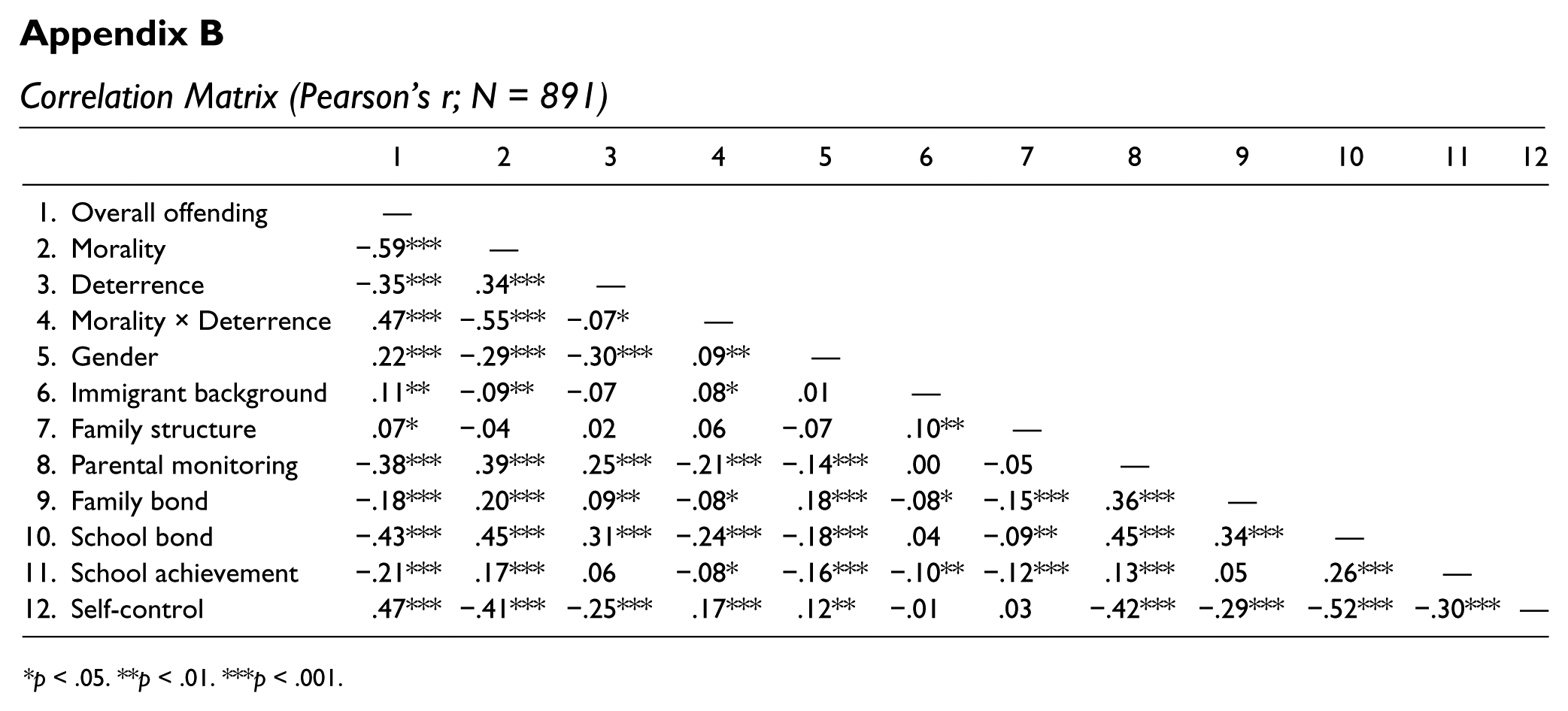
A correlation matrix for the variables included in the analysis is presented in Appendix B. The results show that deterrence is significantly related to morality (r = −.34, p < .001). Morality and deterrence are significantly correlated to offending (r = −.59, p < .001 for morality and r = −.35, p < .001 for deterrence). The social control variables, self-control, and the demographic variables are significantly correlated with offending in the expected direction. Multicollinearity was not a problem in our analysis, where the highest variance inflation factor score was 2.04, well below critical levels.
Table 1 presents the findings from the three OLS regression models. In the first model, low morality and low levels of deterrence are significantly correlated with higher levels of offending. This indicates that individuals with low levels of morality are at higher risk of offending. It further indicates that individuals who do not perceive any risk of getting caught when committing various crimes are also at higher risk of offending. The variables in the first model explain 37.4% of the variance in offending. In the second model, the interaction term of morality and deterrence is significantly correlated with offending (b = .202, p < .001). This indicates that the effect of deterrence on offending is dependent on the value of morality. The inclusion of the interaction term in Model 2 increased the amount of variance explained by the model by 4.3%. The interaction between deterrence and morality is still significant (b = .208, p < .001) when self-control and the social control and the demographic variables are included in the third model. The results from the model that includes these control variables indicate that the findings are robust. Of the control variables included in the third model, it is only self-control that produces a significant effect on offending. The third and final model explains 49% of the variance in offending. The results produced using Tobit regression lead to the same conclusion as those from the OLS regression analysis. Here too, the results showed that morality and deterrence interact in the explanation of offending (coefficient = .112, p < .01) when controls are included for self-control, social control, and the demographic variables. This interaction indicates that the effect of deterrence on offending is dependent on the level of morality.
OLS Regression Analysis Predicting Overall Offending (N = 891).
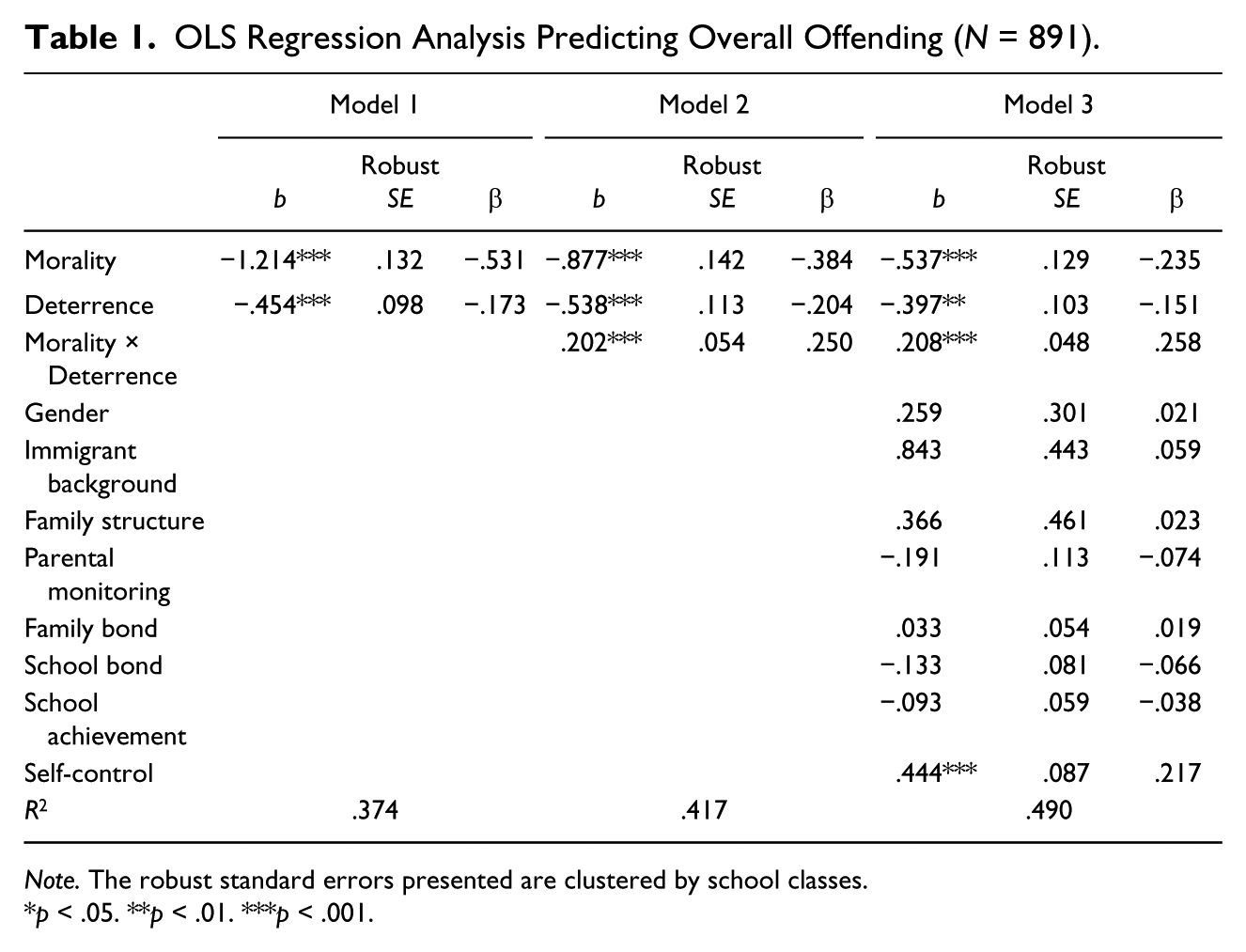
Note. The robust standard errors presented are clustered by school classes.
p < .05. **p < .01. ***p < .001.
To examine the nature of the interaction between deterrence and morality on offending, the distribution of the moderator variable morality was split at its median. Two OLS regression models were then estimated predicting the relationship between deterrence and offending for individuals with high versus low morality (see Table 2). The results show that the effect of deterrence on offending is significant and negative for individuals with low (b = −.839, p < .001) and high (b = −.137, p < .01) morality, respectively. The effect of deterrence on offending is, however, significantly greater for individuals with lower levels of morality (z = −3.815, p < .001). 3 These results support the hypothesis that the relationship between deterrence and offending is dependent on the level of an individual’s morality and that deterrence has a greater effect on offending when morality is low.
OLS Regression Analysis Estimating the Effects of Deterrence on Overall Offending at Different Levels of Morality (Unstandardized Regression Coefficients Presented).
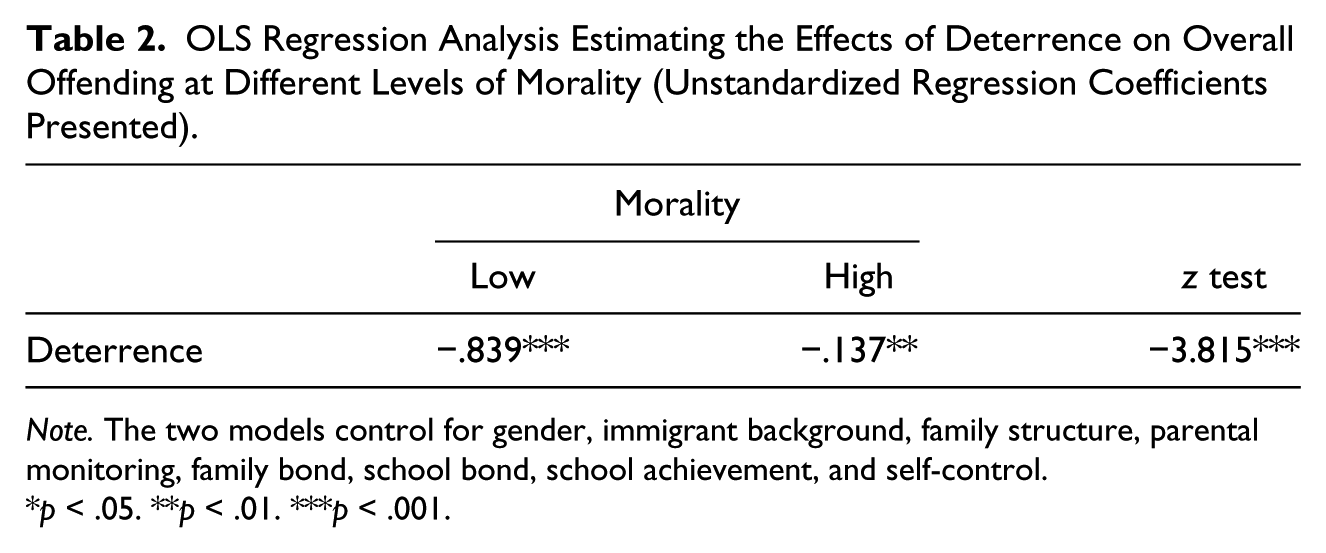
Note. The two models control for gender, immigrant background, family structure, parental monitoring, family bond, school bond, school achievement, and self-control.
p < .05. **p < .01. ***p < .001.
Concluding Remarks
This study examines whether deterrence and morality interact in the explanation of adolescent offending. This is a question that has to date only rarely been explored in the research. On the basis of the SAT, we hypothesized that deterrence has a more important effect on offending for individuals with low levels of morality than for individuals with high levels of morality. To test this hypothesis, self-report data have been used from a sample of 891 young adolescents in Halmstad, Sweden.
In line with our hypothesis, we found a strong interaction effect between deterrence (measured as perceived certainty) and morality in the explanation of offending. This indicates that deterrence has a larger deterrent effect on offending for individuals with low morality and a weaker deterrent effect for individuals with high morality.
While the results presented in this study are in line with some previous research (Paternoster & Simpson, 1996; Wikström et al., 2011), they also contradict the findings from some other studies (Gallupe & Baron, 2010; Pauwels et al., 2011). In these two studies, it was found that the effect of deterrence was more important among individuals with high levels of morality. Both of these studies differ in some important respects from the present study. Gallupe and Baron (2010) used rather poor measures of deterrence and soft drug use, and they also used a rather small sample of street youth. Pauwels et al. (2011) used a combination of certainty and severity as a measure of deterrence, which may have had some impact on their findings. The use of this combined measure may “blur” the results as research has found that certainty is the measure of deterrence that has the greatest effect on offending. It is also worth noting that Pauwels et al. (2011) did not find any evidence of an interaction using nonoffense-specific measures. Their evidence of an interaction was only found using offense-specific measures of morality, deterrence, and offending.
The interaction found in this study provides support for the theoretical assumptions of SAT, which argues that deterrence would be more likely to deter crime among those with low levels of morality (Wikström, 2006). The theory states more precisely that deterrence is a relevant factor in offending only when an individual sees crime as an action alternative (has a low level of morality) and deliberates over whether or not to commit a crime. However, deterrence is not a relevant factor in offending when an individual does not see a crime as an action alternative (thus having a high level of morality) or commits a crime out of habit. Although findings from this study provide support for SAT, it is worth mentioning that the effect of deterrence on offending is significant for individuals with high and low levels of morality. The effect is significantly greater among those with low levels of morality. Furthermore, because only a few studies have tested for this interaction between morality and deterrence, and because the findings reported to date are somewhat contradictory, it is clear that more research is needed on this topic.
This study has one limitation that needs to be addressed. The study is based on cross-sectional data. This is a limitation of the study with regard to the possibilities of determining causal order. Accordingly, we argue that it would be useful in the future to test the interaction between deterrence and morality using longitudinal data. Furthermore, results from this study show the importance of examining whether deterrence has different effects on offending for different types of individuals. That deterrence has a different effect on offending for individuals with different levels of morality may also explain why deterrence has a rather weak effect on offending.
These findings may also have important implications for deterrence theory because they suggest that deterrence theory needs to give more consideration to how the potential for achieving deterrent effects may be dependent on individual-level characteristics such as levels of morality. Finally, these findings may also have important implications for the development of prevention strategies, and the question that policy makers should look at is not whether deterrence has an effect on offending, but for whom deterrence has an effect (Piquero et al., 2011). And because morality seems to be a more fundamental factor than deterrence and seems to determine whether deterrence will have an effect on offending, the development of individual morality becomes a very important goal for crime prevention. This can be achieved through different forms of socialization practices.
Footnotes
Appendix
Correlation Matrix (Pearson’s r; N = 891)
| 1 | 2 | 3 | 4 | 5 | 6 | 7 | 8 | 9 | 10 | 11 | 12 | |
|---|---|---|---|---|---|---|---|---|---|---|---|---|
| 1. Overall offending | — | |||||||||||
| 2. Morality | −.59*** | — | ||||||||||
| 3. Deterrence | −.35*** | .34*** | — | |||||||||
| 4. Morality × Deterrence | .47*** | −.55*** | −.07* | — | ||||||||
| 5. Gender | .22*** | −.29*** | −.30*** | .09** | — | |||||||
| 6. Immigrant background | .11** | −.09** | −.07 | .08* | .01 | — | ||||||
| 7. Family structure | .07* | −.04 | .02 | .06 | −.07 | .10** | — | |||||
| 8. Parental monitoring | −.38*** | .39*** | .25*** | −.21*** | −.14*** | .00 | −.05 | — | ||||
| 9. Family bond | −.18*** | .20*** | .09** | −.08* | .18*** | −.08* | −.15*** | .36*** | — | |||
| 10. School bond | −.43*** | .45*** | .31*** | −.24*** | −.18*** | .04 | −.09** | .45*** | .34*** | — | ||
| 11. School achievement | −.21*** | .17*** | .06 | −.08* | −.16*** | −.10** | −.12*** | .13*** | .05 | .26*** | — | |
| 12. Self-control | .47*** | −.41*** | −.25*** | .17*** | .12** | −.01 | .03 | −.42*** | −.29*** | −.52*** | −.30*** | — |
p < .05. **p < .01. ***p < .001.
Acknowledgements
The author would like to thank David Shannon, the anonymous reviewers, and the editor of Crime & Delinquency for their helpful comments.
Declaration of Conflicting Interests
The author(s) declared no potential conflicts of interest with respect to the research, authorship, and/or publication of this article.
Funding
The author(s) received no financial support for the research, authorship, and/or publication of this article.