







Abstract
Social bonds theory is one of the most influential and tested perspectives for explaining juvenile delinquency, yet tests have often been methodologically limited. Prior research has failed to examine how intra- and interindividual variation in social bonding influences delinquency. In addition, there are few applications of this theory to non-Western contexts. Thus, the current study attempts to test the cross-cultural generalizability of social bonds theory and overcome weaknesses of prior research. We use longitudinal panel analyses and five waves of data from the Korean Youth Panel Survey to examine the influence of nine measures of social bonding on delinquent behavior. By estimating different panel models, we find some support for social bonds as indicators of within- and between-individual variation in delinquency. Specifically, the emphasis on education in Korea and the role of parents in supervising their children play an integral role in reducing the delinquency of Korean youth.
Introduction
Hirschi’s conception of social bonds theory has become one of the most influential and widely tested perspectives on juvenile delinquency in the field of criminology (Cullen & Agnew, 2010; Ellis & Walsh, 1999; Gibbons, 1979). Despite a recent call for more cross-cultural research and empirical tests of general theories of crime and deviance (Akers, 2010), most studies of social bonds have been conducted in the United States and other western contexts (e.g., Hartjen & Priyadarsini, 2003; Junger-Tas, Terlouw, & Klein, 1994; LeBlanc, Vallieres, & McDuff, 1993; Li, 1999; Mak, 1990). Recently, researchers have begun testing social bonds theory in Asian countries and have reported findings generally supportive of the theory (e.g., Chui & Chan, 2012; Kobayashi & Fukushima, 2012; Wang, Qiao, Hong, & Zhang, 2002; Zhang & Messner, 1996). Specifically, delinquent behaviors among youth in Hong Kong (Chui & Chan, 2012) and Japan (Kobayashi & Fukushima, 2012) are strongly constrained by beliefs in their respective normative systems. However, there is evidence that other social bonds, such as attachment to parents and commitment to school, also reduce delinquency (Chui & Chan, 2012; Wang et al., 2002). Still, these studies are limited by methodological and substantive weaknesses, including nongeneralizable and cross-sectional data, and limited measures of social bonds. Furthermore, prior research has not examined the effect of social bonding in South Korea (for an exception, see Hwang & Akers, 2003).
South Korean culture provides an opportunity for assessing the global applicability of a prominent American criminological theory in a unique cultural context. The governance and moral system of South Korean society is heavily influenced by Confucianism, which promotes collectivist values (Seo, Leather, & Coyne, 2012). Confucian values, such as education and academic achievement, are stressed in South Korean society and viewed as necessary for obtaining a rewarding job, marriage, and social status (Cho, 1995; M. Lee & Larson, 2000). In fact, individual worth in South Korea can be determined by the rank of the university one attends (Cho, 1995; S. Lee & Shouse, 2011). Discipline also differs between American and South Korean adolescents. In South Korea, “parents put relatively greater efforts than Western parents in monitoring children’s behavior and disciplining their misbehavior” (Yun & Walsh, 2011, p. 446). Teachers are permitted to use both corporal and emotional punishment (e.g., humiliation in front of peers, name calling, and shouting) as a means of motivating students to work harder.
Based on these cultural differences, one might expect to find that delinquent behavior among South Korean adolescents is more constrained by particular social bonds, such as commitment to school and parental attachment/supervision, than other bonds. Furthermore, South Korea and other collectivist societies encourage group values leading to group members that are often loyal and protective of each other (Hofstede, 1993). South Koreans are expected to conform to the group and respect the social hierarchy within their group, which often results in strong social bonding among South Korean adolescents (Seo et al., 2012). Consequently, there may be less variation in social bonding between adolescents in South Korea than adolescents in individualistic societies like the United States. It is important, then, to look at social bonding as a longitudinal process, examining the between- and within-variation of social bonds and how this variation influences delinquent behavior in a non-Western context.
Hirschi’s Social Bonds Theory
According to Hirschi’s (1969) classic Causes of Delinquency, people are hedonistic and innately motivated to engage in delinquent behavior. Delinquent motivation is usually not addressed, as it is assumed to be evenly distributed across the population. Under this theoretical framework, the dominant factor that constrains the intrinsic criminality of individuals is how “bonded” one feels to conventional society. Weak social bonds caused by inadequate socialization increase the propensity to offend, whereas the presence of strong and high quality social bonds inhibits this propensity.
While “social bonding” can be seen as a unitary construct in the sense that all social bonding is hypothesized to constrain delinquent behavior, Hirschi (1969) further specified that social bonding is comprised of four interrelated, yet independently measured, elements: attachment to significant others and institutions, commitment to conventional goals, involvement in conventional activities, and belief in conventional norms. These elements are found in three major domains of the social institution: the family, peers, and school. Strong attachment to parents, for example, can constrain individual behavior to social norms. Likewise, commitment to school might keep individuals away from delinquent behavior because they may not want to jeopardize their educational goals. Involvement in school might also keep individuals occupied with prosocial behavior, limiting the time that could be spent engaging in delinquency. Finally, individuals who internalize the conventional norms of their society will be less likely to deviate from “acceptable” behavior (Hirschi, 1969). Thus, central to the theory is the belief that delinquent behavior is simply a result of not being adequately socialized and conformed to conventional values and norms in the early stages of childhood.
Empirical Tests of Social Bonds Theory
With minimum theoretical assumptions and a parsimonious operating mechanism of how one enters into delinquent behaviors, social bonds theory is replete with empirical studies. Synthesis of the impressive body of national and international tests indicates that attachment, particularly to parents, is the element with the most consistent and strong empirical support in regard to its influence on delinquent and criminal behavior (Agnew, 1985, 1991; Fagan, Van Horn, Hawkins, & Jaki, 2013; Hoeve et al., 2012; Massey & Krohn, 1986; Wright & Cullen, 2001). Conversely, prior research, especially that conducted in the United States, tends to find less support for measures of involvement and belief (e.g., Booth, Farrell, & Varano, 2008; Cernkovich & Giordano, 1987; Hindelang, 1973; Junger & Marshall, 1997; Krohn & Massey, 1980; Payne, 2008; Rankin & Kern, 1994; Wiatrowski, Griswold, & Roberts, 1981). This seems to contradict some of the cross-national studies of social bonding in Asia, which indicate that belief in societal rules and legal systems is the strongest social bond for constraining delinquency (Chui & Chan, 2012; Kobayashi & Fukushima, 2012). Both national and cross-national research, however, has been subject to important methodological limitations.
First, although Hirschi (1969) clearly introduced four elements of social bonds in three key social institutions, the majority of subsequent studies have used limited social bond measures. Kempf’s (1993) meta-analysis on empirical studies of social bonds theory found that only 17 out of 71 studies included the four elements of social bond in their assessment. Furthermore, past tests relied on relatively weak or incomplete proxy measures to capture each of the social bonds. For example, parental supervision was a widely used proxy measure for parental attachment (e.g., Cernkovich & Giordano, 1987; Junger & Marshall, 1997; Loeber & Stouthamer-Loeber, 1986; Rankin & Wells, 1990; Unnever, Cullen, & Agnew, 2006). Likewise, grade point average (GPA) has been used to represent commitment to school (Hirschi, 1969; Hoffmann, Erickson, & Spence, 2013; Krohn & Massey, 1980). More recent studies, especially those with an international focus, are also limited to one or only a few social bond elements (Chui & Chan, 2012).
Second, divergent findings have formed around different methodological approaches used to test the theory. Studies using longitudinal data have concluded that social bonds are more weakly associated with offending than studies using cross-sectional data (Krohn, Massey, Skinner, & Lauer, 1983; Longshore, Chang, Hsieh, & Messina, 2004). Still, these conclusions are based on outdated research with limited longitudinal designs. For instance, the longitudinal approach used by Agnew (1985) involved regressing Wave 2 delinquency on Wave 1 indicators of social bonds, controlling for Wave 1 delinquency (see also Agnew, 1991, Elliott, Huizinga, & Ageton, 1985; Liska & Reed, 1985; Paternoster & Triplett, 1988). Essentially, this approach uses social bonds to predict changes in delinquency within individuals, while research using cross-sectional data has examined differences between individuals.
Modern methods of analyzing panel data allow researchers to better estimate differences both between and within individuals across different time periods. This is particularly important as Hirschi (1969) was not clear about the stability of social bonds across time, or about which bonds predict differences in offending across individuals. This has resulted in theoretical discussions of social bonds which assume they are static and ignore their potential dynamic nature. Unlike the stability hypothesis of self-control theory that has received a great deal of theoretical and empirical attention from criminologists, to our knowledge, no studies to date have directly addressed the stability of social bonds over time and the impact this may have on delinquency. However, a 2012 meta-analysis of the link between parental attachment and delinquency by Hoeve et al. provides useful insight. They found that age moderated the relationship between attachment and delinquency, with studies of younger participants having larger effect sizes for this relationship. The authors suggest that as individuals age, the link between parental attachment and delinquency is weaker, perhaps because parental attachment is stronger at younger ages (Hoeve et al., 2012). Findings on intraindividual variability of social bonds have the potential to provide important insights for future social bonds research.
The third limitation of prior studies relates to the omission of potential confounders, such as peer delinquency. This is especially true in studies analyzing non-Western contexts (e.g., Chui & Chan, 2012; Kobayashi & Fukushima, 2012). Peer delinquency has been shown to mediate at least some of the effects of social bond variables on delinquency (Agnew, 1993; Alarid, Burton, & Cullen, 2000; Elliott et al., 1985; Matsueda, 1982). This finding can be understood theoretically in terms of the intervening role peer delinquency plays between social bonds and delinquency. Inadequate social bonding may free individuals to associate with delinquent peers (Agnew, 1993), resulting in increased peer association (Jang, 2002). Thus, studies that have failed to account for peer delinquency may be biased in their interpretations.
Fourth, despite the general nature of Hirschi’s (1969) social bonds theory (i.e., it is expected to explain all types of misbehavior), research in the United States has shown that social bonds are better at explaining less serious delinquency than more serious delinquency (Agnew, 1985, 1991; Kempf, 1993; Krohn & Massey, 1980; Krohn et al., 1983). Thus, social bonds might explain status deviance (e.g., drinking, smoking, and truancy) better than criminal behavior (e.g., robbery, assault, and theft). Much of the international research is limited to either serious delinquency (e.g., Chui & Chan, 2012) or minor delinquency (e.g., Kobayashi & Fukushima, 2012). Analyzing a single type of delinquency limits the understanding of how social bonds affect various delinquent outcomes.
Present Study
The present study seeks to both overcome some of the methodological and theoretical weakness of other social bonds research, and provide an empirical investigation into the cross-cultural generalizability of social bonding to a non-Western context. It extends previous research in three important ways: (a) by using nine measures of social bonding that encompass all four elements and span all three domains; (b) by using a current, nationally representative sample of South Korean adolescents; and (c) by using advanced longitudinal analyses to understand individual variation across time. We address the following research questions and hypotheses:
Data
Data for this study come from the Korean Youth Panel Survey (KYPS). The KYPS is a nationally representative sample of South Korean adolescents, collected by the National Youth Policy Institute (NYPI) using a stratified multistage cluster sampling design. The KYPS was collected in six annual waves between 2003 (Wave 1) and 2008 (Wave 6). Data were collected using face-to-face interviews with students and phone interviews with students’ parents or guardians. The sample consisted of 3,697 students, of whom approximately half were male and almost all were 13 or 14 years old during the first wave of data collection. The response rate of students in the first wave was 93.3% (n = 3,449), and 86% of those students participated in all five waves of the interviews (n = 2,967).
Measures
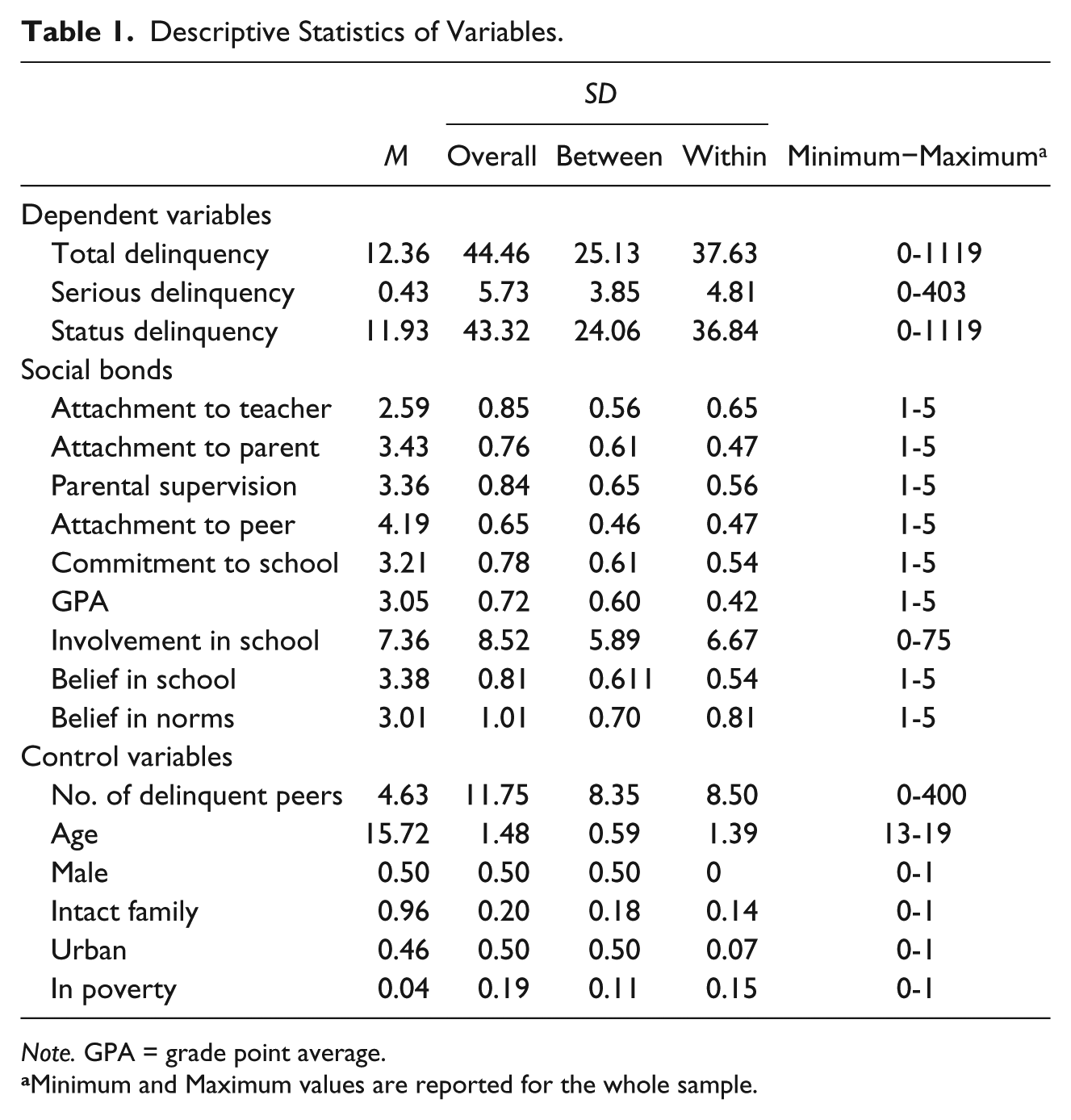
Table 1 presents descriptive information on the variables used in the current study. We used three dependent variables to measure delinquency: (a) serious delinquency, (b) status delinquency, and (c) total delinquency. These variables are additive scales that ask students how many times in the past year they have committed a particular delinquent act. “Serious delinquency” is the sum of the amount of times the following acts were committed: severely beating others, gang fighting, threatening others, collective bullying, sexual assault/harassment, robbing, and stealing. Similarly, the “status delinquency” scale is the sum of the amount of times the following acts were committed: smoking, drinking, running away, having an unexcused absence from school, and teasing others. “Total delinquency” is the sum of all 12 of these delinquency measures. 1
Descriptive Statistics of Variables.
Note. GPA = grade point average.
Minimum and Maximum values are reported for the whole sample.
The independent variables in this study consisted of several different measures of the four types of social bonds (i.e., attachment, commitment, involvement, and belief), measured across all three of the hypothesized domains (i.e., parents, school, and peers). Each measure of social bond is a scale comprised of two to six items in which relevant items were summed and then divided by the number of items. The following measures of social bonds were included in the analysis: attachment to teachers (α = .702), attachment to parents (α = .859), parental supervision (α = .850), attachment to peers (α = .759), commitment to education (α = .778), GPA (α = .790), involvement in school (α = .875), belief in education (α = .784), and belief in norms (α = .838). 2 Items used to construct these measures are similar to the items used in prior social bonds research (see Appendix A for a description of the items used in each scale).
Control variables in this study included age, gender, poverty, 3 urbanity (living in one of South Korea’s seven largest urban cities), family intactness (living with both parents in the household), and peer delinquency. We measured peer delinquency by summing the total reported number of each student’s friends who were disciplined in school, were arrested by the police, have an unexcused absence from school, severely beat others, drank, smoked, robbed, or stole (α = .855). These control variables are typically included in previous social bonds research (e.g., Agnew, 1993; Chui & Chan, 2012; Gardner & Shoemaker, 1989; Jang, 2002; Kobayashi & Fukushima, 2012; Longshore et al., 2004; Özbay & Özcan, 2006; Rankin & Kern, 1994; Rebellon, 2002). By including them in the current study, we are better able to assess the direct impact of social bonds on delinquency.
The questions pertaining to the outcome variables were asked retrospectively (e.g., “In the past one year how many times have you . . . ”), while the independent variables were measured contemporaneously. To correct this temporal issue between predictors and outcomes, the outcome variables from each wave were merged with the previous wave before any analyses were conducted (i.e., Wave 2 delinquency was merged with Wave 1, Wave 3 delinquency was merged with Wave 2, etc.). Essentially, this process created a lagged effect, allowing the independent variables to predict future delinquency. Consequently, only five waves were included in the current study, with the measures of social bonding and the control variables being measured in Waves 1 through 5, and the measures of delinquency being measured in Waves 2 through 6. 4
Analytic Technique
As the dependent variable in the present study is the reported number of delinquent acts committed by each student over a period of 5 years, we use a panel model with a count distribution. Panel models need to account for the structure of panel data, which include a group of individuals (n), who are observed over a period of time (t), for a total of observations. Thus, panel models allow researchers to estimate more complicated models than models designed for cross-sectional data or a single time series. They make it possible to examine differences between and within individuals across different time periods by allowing explanatory variables to vary for individuals and time so that:

Panel models, then, have more accurate and efficient estimates than those from other types of data, especially with regard to changes between time periods (for an overview of panel models, see Verbeek, 2008).
Model Specification
Panel models for count data can be specified using a Poisson or a negative binomial distribution, and can be estimated with fixed effects or random effects.5,6 We used the statistical program Stata (version 11) in this study because it is capable of estimating both Poisson and negative binomial panel models with either random effects or fixed effects. Poisson regression is only appropriate if the assumption that the conditional means equal the conditional variances is met (the assumption of equidispersion). Alternatively, negative binomial models are less restricted than Poisson models and are appropriate when data are overdispersed (Cameron & Trivedi, 1998, 2003). After specifying Poisson models with random effects for each measure of delinquency, we used the likelihood ratio test of the overdispersion parameter to determine that our data were overdispersed and that a negative binomial model was more appropriate.
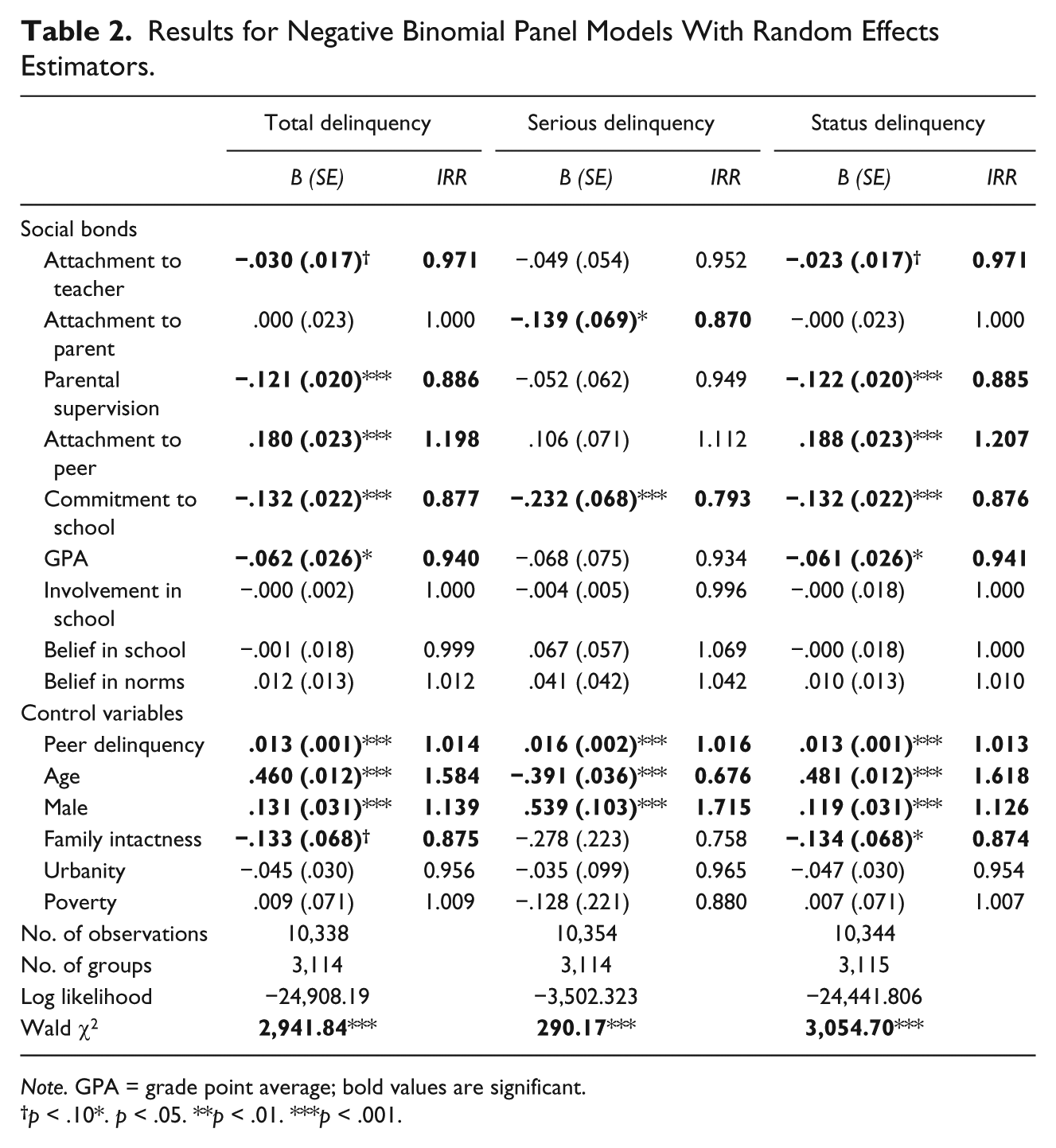
Next, we determined whether our models should be specified with random or fixed effects. Count models estimated with random effects are based on the assumption that cases in a particular data set are randomly and independently drawn from a larger population. They are used to explain the variation between individuals. Conversely, fixed-effects models do not assume that the cases are randomly drawn from a larger population and are better for analyzing the changes within an individual. Consequently, any variable in the model that is constant over time (e.g., race or gender) will be excluded from the analysis 7 (see Green, 2008). We estimated negative binomial models with both random effects (Table 2) and fixed effects (Table 3) and used the Hausman (1978) test 8 to determine that the models estimated with fixed effects are the best fit for our data. We thus focus the discussion of our results on these analyses.
Results for Negative Binomial Panel Models With Random Effects Estimators.
Note. GPA = grade point average; bold values are significant.
p < .10*. p < .05. **p < .01. ***p < .001.
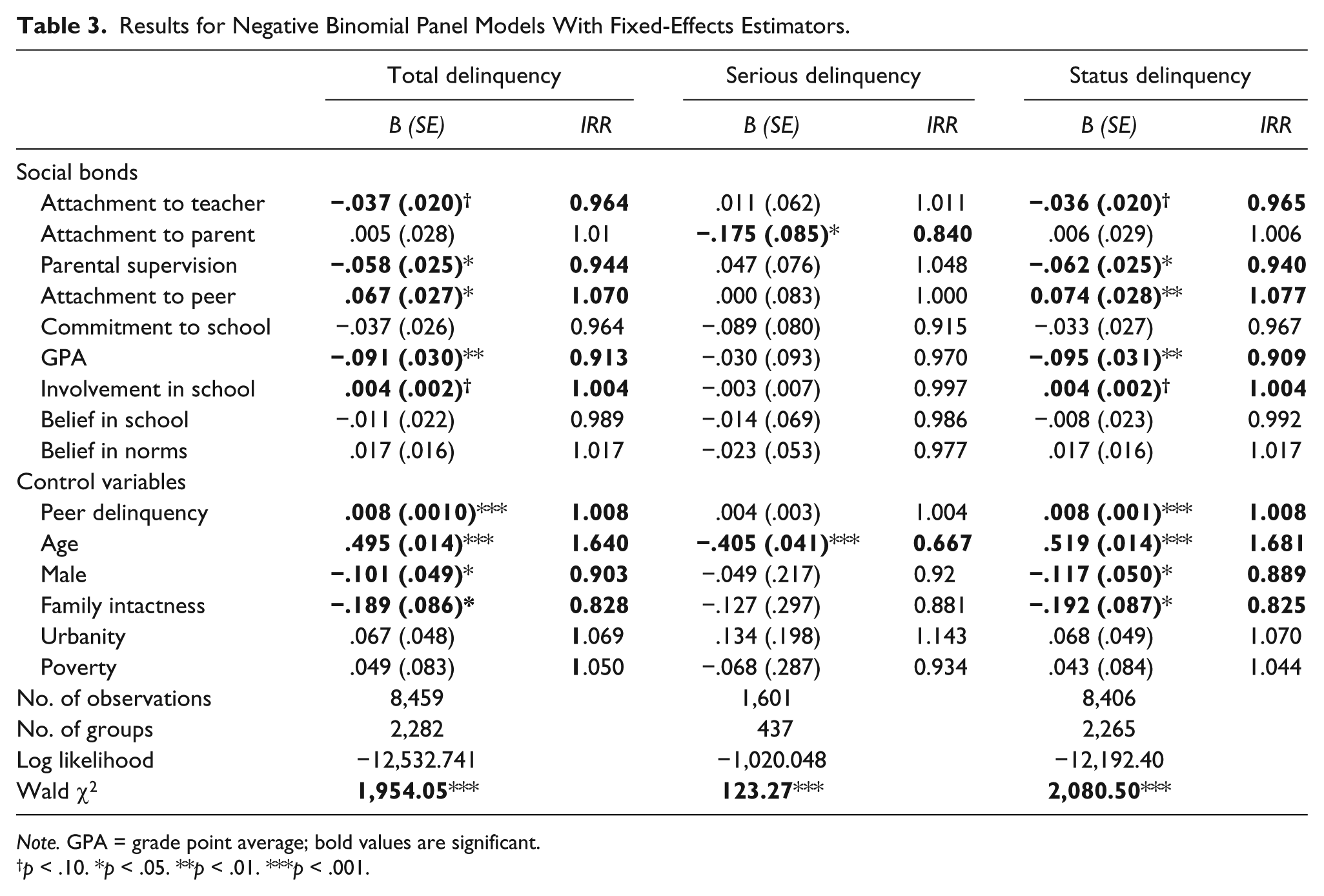
Results for Negative Binomial Panel Models With Fixed-Effects Estimators.
Note. GPA = grade point average; bold values are significant.
p < .10. *p < .05. **p < .01. ***p < .001.
Results
Table 1 presents the summary statistics of variables in the model. These numbers are the aggregated values for all waves. In other words, the mean represents the mean across all five waves of data (for means and standard deviations of each wave, see Appendix B). The sample is approximately half male and half female. Almost one half of the students lived in one of the seven largest cities in South Korea. The means for each of the indicators of social bond suggest that most Korean students are highly “bonded” to conventional society. The mean of each measure of social bond is closer to the maximum than the minimum observation. We also see that 96% of the students in this sample live with both of their parents, and only 4% live in poverty. Since these data are nationally representative, we do not expect this distribution to be a consequence of sampling bias. Finally, Table 1 indicates that the ranges of some of our variables, such as the number of reported delinquent friends and the measures of delinquency, are quite large. We provide a more detailed discussion of these ranges in the following section.
Unlike cross-sectional data, panel data can also vary between and within individuals. The overall standard deviation in Table 1 represents the variation from the overall mean for each observation, while the between-standard deviation is the average standard deviation for each individual, and the within standard deviation is variation of each individual’s observation from his or her own mean. This table indicates that delinquency varies more within individuals than between, and that the indicators of social bonding vary similarly between and within individuals. In fact, except for gender which has no within variation, every variable included in our models varies both between and within individuals. These findings support our decision to examine the dynamic nature of social bonding.
Table 3 presents the results for the negative binomial models with fixed-effects estimators. Overall, the results of our analyses provide some support for social bonds theory. Specifically, most of the measures of social bonding are found to be in the hypothesized direction, and many of these are statistically significant in both the total and status delinquency analyses. These results for the analysis of serious delinquency, however, are questionable as it is based on fewer observations (n = 1,601) than the status (n = 8,406) or total (n = 8,459) delinquency analyses. This disparity is a result of the fixed-effects estimates, which excluded the individuals from the analysis that reported committing zero acts of serious delinquency every year. Fixed-effects models are used to explain within-individual variation and thus exclude groups whose outcomes do not vary across time. This also resulted in fewer observations for all of the analyses estimated with fixed effects than those estimated with random effects.
The fact that so few cases were retained in the analysis of serious delinquency, as well as the similarities between the predictors in the status and total delinquency analyses, indicates that interpretation of the total delinquency analysis is also suspect. The explanatory ability of any of the variables in this analysis seems to stem almost exclusively from these variables’ ability to explain status delinquency. Parental supervision and GPA significantly decreased the frequency of status delinquency. The incidence rate ratios (IRR) suggest that GPA is the strongest of the social bond indicators. For every one-unit increase in our measure of GPA, the number of status delinquent events is expected to decrease by a factor of .913, holding all other variables constant.
Most of the other indicators of social bonding were not significant, but were in the hypothesized direction. Two important exceptions to this finding are the measures of peer attachment and involvement in school. Both of the variables significantly increased the number of status delinquent acts. The positive association between peer attachment, while inconsistent with Hirschi’s original conception of social bond theory, is not surprising in consideration of others’ findings (e.g., Conger, 1976; Elliott et al., 1985; Hindelang, 1973). However, the direction and significance of school involvement is surprising and contrary to expectations. Some potential explanations for this finding are discussed in the next section.
Findings indicate that peer delinquency, which was added to the model as a control variable, significantly increases delinquent behavior, such that with each additional delinquent friend, the number of status delinquent events is expected to increase by a factor of 1.008. This seemingly weak relationship must be interpreted with consideration of the range in the reported number of delinquent peers (0-400) and reported number of delinquent acts (0-1119). In addition, as youths aged in this sample, they committed a greater number of delinquent acts, which is not surprising given the fact that the first wave of this sample was collected when most of the youths were 13 years old and the last wave when most were 18. The measure of family intactness is also negative, which suggests that students from two-parent homes are less delinquent than students from one-parent homes.
Surprisingly, the results in Table 3 demonstrate that males are expected to commit fewer delinquent acts than females. This is contrary to crime research in general, which consistently shows that males are more delinquent than females. However, any interpretation of these findings is questionable. Models estimated with fixed effects are supposed to drop predictors that do not vary over time, such as gender. However, Stata and most other statistical packages estimate conditional fixed effects for negative binomial models based on the work of Hausman, Hall, and Griliches (1984). The problem with this method is that this is not a true fixed-effects estimator and does not fully condition out the fixed effects. This allows for the erroneous estimation of time-invariant predictors (Allison & Waterman, 2002; see also Greene, 2005; Guimarães, 2008). Therefore, the influence of gender is better interpreted in the random effects models (Tables 2). In these models, the impact of gender is consistent with expectations: Males committed a significantly higher number of total, serious, and status delinquent acts than females.
Aside from the influence of gender, model specification does not seem to change many of the overall interpretations of our results. Across all models, social bonds, except for peer attachment, seem to constrain delinquency. One difference between the negative binomial analyses estimated with random effects (Table 2) and the analyses estimated with fixed effects (Table 3) is the measure of commitment to school. Contrary to our expectations, this measure is not robust across all models and is only significant in the models estimated with random effects. This suggests that South Korean students who study harder for school are less likely to engage in delinquent behavior than students who do not study as hard, but students who study harder for school over time are just as likely to engage in delinquent behavior as they were in previous years. In addition, involvement in school is only significant in the models estimated with fixed effects. Thus, as students become more involved in school from 1 year to the next, they tend to commit more acts of delinquency, but this is not true for students who are more involved in school than other students in a particular wave.
Implications for Criminological Theory
Ronald Akers (2010) recently said that the goal of cross-national theory testing should be “to test current theory, to modify it appropriately for better application in different societies, and to develop new or integrated theories that come closer to being truly universally applicable to explaining criminal and deviant behavior” (p. 3). To that end, the current study found general support for the application of social bonds theory to South Korea: Many social bond measures were significantly associated with a decrease in the frequency of delinquent acts. However, some of our findings were inconsistent with our hypotheses. For example, peer attachment was significantly positively associated with status and total delinquency, even when controlling for peer delinquency, and involvement in school approached statistical significance in the same direction.
In addition, we also found that model specification influenced our findings, which allowed us to determine which predictors are better indicators of within-individual variation (fixed effects), or between-individual variation (random effects). In both models, GPA and parental supervision significantly decreased the frequency of status and total delinquency. These two indicators of social bonds, then, appear to have the most robust effect on constraining delinquent behavior. These findings differ from prior research which has generally shown parental attachment to be one of the most significant and robust predictors of criminal and delinquent behavior (Agnew, 1985, 1991; Chui & Chan, 2012; Fagan et al., 2013; Hoeve et al., 2012; Massey & Krohn, 1986; Wright & Cullen, 2001). These findings suggest that the cultural context of South Korea plays a large part in the influence of school commitment and parental supervision on delinquency. South Korean standards of education, academic achievement, and increased parental supervision and discipline create essential bonds found to decrease delinquency among South Korean youth.
Importantly, the current study’s two social bond measures related to belief (belief in school and belief in norms) were not significant in any of the models. Other studies of social bonds theory conducted in Asian contexts (e.g., Hong Kong—Chui & Chan, 2012; and Japan—Kobayashi & Fukushima, 2012) have found belief in societal rules to be an important element in reducing delinquency. However, because the current study does not include a similar measure of belief, it is not clear whether or to what degree the influence of belief on deviant behavior differs among these diverse cultures.
Following Aker’s (2010) suggestion to integrate theory, we believe that some of our findings support other criminological theories. Furthermore, interpreting our results in the context of these other theories improves our understanding of the study’s interesting findings. The measure of parental supervision, for example, was a better predictor of delinquency than parental attachment. This finding is consistent with prior social control research in the United States and other Western countries (Cernkovich & Giordano, 1987; Junger & Marshall, 1997; Rankin & Wells, 1990), and is especially consistent within the cultural context of South Korea. South Korean parents place a greater emphasis on direct controls of misbehavior, such as monitoring and disciplining, than their Western counterparts (Yun & Walsh, 2011). The significance of parental supervision is also consistent with self-control theory. A major tenet of self-control theory is that low self-control, the cause of crime, can be reduced by parents’ ability to monitor and react to misbehavior at a young age (Gottfredson & Hirschi, 1990). Thus, parental supervision in our study may be a measure of parents’ ability to monitor their children’s behavior, and not necessarily an indicator of social bonding. It is important to note, however, that students are spending up to 14 hr a day in school. As a result, teachers are providing much of the supervision and discipline (Morash & Moon, 2007).
Students’ GPA also exerted a greater influence on delinquency than the measure of commitment to school. While this coincides with other social bonds research (Krohn & Massey, 1980), it also provides some support for strain theory. Merton (1938) posited that criminal behavior occurs when individuals are not provided with legitimate means to reach their goals. In South Korea, education is an important component of social status (M. Lee & Larson, 2000). This could explain why students’ actual educational achievement (GPA) was a better predictor of reduced delinquency than their commitment to education. 9
Strain theory could also explain the inconsistent finding that involvement in school leads to an increased frequency of delinquent acts (although this relationship only approached statistical significance). According to general strain theory, individuals misbehave as a way to cope with the negative emotions that stem from experiencing strain (Agnew, 2006). Youth in our sample spent between 0 and 75 hours per week studying for their classes (see Table 1). There are two possible explanations for the observed relationship between scholastic involvement and delinquency. First, youths may be spending a substantial amount of time studying for their classes. The pressure to excel in school may be too overwhelming for some students, especially those that are expected to pass their university entrance examinations with a high enough score to attend a “good” university. Second, it is also possible that adolescents are experiencing corporal and emotional punishment from their teachers (Moon, Blurton, & McCluskey, 2008). As a result, South Korean adolescents may experience negative emotions (such as frustration) and engage in delinquency as a coping mechanism. 10 However, the true reason for this finding remains unclear.
This study found a positive relationship between peer attachment and status delinquency. While Hirschi (1969) hypothesized that social bonds in general would constrain youth from committing crime, our findings are not so unexpected in light of more recent research (e.g., Conger, 1976; Elliott et al., 1985; Hindelang, 1973), which has similarly demonstrated a positive relationship between peer attachment and delinquency. In the current study, the number of delinquent peers also increased the frequency of status delinquency. These results provide some support for differential association theory and social learning theories, which generally propose that criminal behavior is learned by interacting with intimate others, such as peers 11 (Akers, 1985; Sutherland & Cressey, 1955).
In previous research, longitudinal methods have produced smaller effect sizes than cross-sectional analyses (Agnew, 1991; Kempf, 1993). The effect sizes in the current study similarly suggest that social bonds are relatively weakly associated with delinquency. However, incident rate ratios (IRR) are more difficult to interpret than other measures of effect sizes, such as odds ratios, and the strength of the relationship for an IRR cannot be compared with an odds ratio. For example, while a value of .913 would generally indicate a weak relationship for an odds ratio, this may not indicate the same for a .913 IRR, as the IRR is based on a count outcome variable. Still, our study reveals that social bonds do not explain all of the variation in delinquent behaviors among Korean adolescents. Future research should continue to test criminological theories as they apply to this population.
Methodological Limitations
There were important limitations to the current study that should not be overlooked. First, descriptive statistics of the variables used in the present study (Table 1) suggest that our models may have been influenced by the wide ranges of some of the variables. For instance, though the average student reported having almost 5 delinquent friends, 5% of the students in this sample reported more than 20 delinquent friends, and 1% reported more than 50. Under further examination, though, these seemingly extreme values did not appear to influence our interpretation of the analyses. 12
Likewise, the ranges of our measures of delinquency were also wide. Although the range for the reported number of total delinquent acts was more than 1,000, fewer than half of the students reported committing zero total delinquent acts in a given year, while 5% reported committing at least 60 and 1% reported committing 150 or more. This distribution is consistent with uncensored count data (see Cameron & Trivedi, 1998). Moreover, many of the methods commonly used to detect outliers in linear regression models are inappropriate and underdeveloped for count models, especially in panel count models. 13 Thus, we found no reason to treat extreme values as outliers and, instead, believe that a few of the individuals in our data set simply engaged in more delinquency than others. These findings suggest that future studies should use methods such as group-based trajectory analysis (Nagin, 2005) to identify the social bond factors that influence membership in different groups with distinct delinquent trajectories.
Another limitation to our models was the use of negative binomial analyses estimated with conditional fixed effects. These produced estimates for time-invariant covariates, which should normally be excluded in fixed-effects models. Allison and Waterman (2002) suggest two possible solutions to this problem, “unconditional estimation” and the “approximate conditional score method,” both of which are computationally demanding and impractical with available statistical software (see also Allison, 2005).
A final limitation was our distinction between the two measures of delinquency. There was very little within-individual variation in serious delinquency, which, as we have explained, resulted in the majority of observations being excluded from the analyses estimated with fixed effects. As a result, interpreting those analyses is problematic. This issue was further compounded by the exploratory factor analysis we originally conducted to determine how to group the various measures of delinquency. Contrary to our expectations, the items did not appear to load in any theoretically discernible manner. Thus, our distinction between status and serious delinquency was not statistically supported. Nevertheless, because previous research has consistently found a difference in the ability of social bonds to constrain minor versus serious misbehavior, we thought it was theoretically justified to include these separate measures of delinquency in addition to the measure of total delinquency.
Conclusion
Consistent with previous research, this study found general support for social bonds theory. GPA and parental supervision are the most important social bond elements for South Korean adolescents. These findings indicate that the Korean emphasis on education and the role of parents in supervising their children play an integral role in reducing the delinquency of Korean youth.
The results of the current work also indicate that longitudinal analysis is a useful method for testing Hirschi’s social bonds theory because it allows for better understanding of the between- and within-individual influence of social bonding on delinquency without exaggerating the strength of this relationship. Future research should continue to use longitudinal data and examine other non-U.S. samples to determine whether these findings are generalizable across nations. Extending theory beyond specific national contexts leads to a deeper understanding of the underlying mechanisms of social bonding and delinquency on a global level. Furthermore, this type of research can help to develop policies and interventions that target individual cultures.
Footnotes
Appendix A
Appendix B
Declaration of Conflicting Interests
The author(s) declared no potential conflicts of interest with respect to the research, authorship, and/or publication of this article.
Funding
The author(s) received no financial support for the research, authorship, and/or publication of this article.