







Abstract
This study tested a general strain theory (GST) model across two times with an ethnically diverse sample of 184 female adolescent offenders. We tested whether exposure to violence was associated with girls’ emotions and substance use. We found that (a) hostility mediated the relationship between experiencing violence and alcohol use at Time 1; (b) hostility mediated the relationship between witnessing violence and alcohol use at Time 1; and (c) depressive symptoms mediated the relationship between experiencing violence and marijuana use at Time 2. These mediated effects were minimal in magnitude given that that the bivariate relationships between violence exposure and substance use were small or nonsignificant. Exposure to violence was associated with negative emotions across both models.
Keywords
Stressful and traumatic events in childhood, collectively known as adverse child experiences (ACEs), have been linked to future substance abuse problems (Dube et al., 2006; Felitti et al., 1998; Rothman, Edwards, Heeren, & Hingson, 2008; Sharp, Peck, & Hartsfield, 2012). In a landmark study on the effects of adverse child experiences on later health and well-being, researchers surveyed 9,508 adults about seven different types of childhood trauma and household dysfunction exposures: physical abuse, sexual abuse, emotional abuse, mother treated violently, substance misuse within the household, household mental illness, and having an incarcerated household member. They found that ACEs were strongly related to adverse health problems in adulthood, including those associated with substance abuse (Felitti et al., 1998). Certain adverse child experiences, most notably childhood victimization and witnessing violence, appear to be even stronger predictors of later substance use and abuse than other ACEs (Dube et al., 2006; Rothman et al., 2008; Sharp et al., 2012).
Understanding how childhood victimization and witnessing violence, known collectively as exposure to violence, is linked to substance use problems among high risk individuals such as juvenile offenders is critical given that rates of victimization and witnessing violence are higher among juvenile offenders relative to members of the general population (Baglivio & Epps, 2016; Baglivio et al., 2014). In a population of 64,329 juvenile offenders, 29.5% reported physical abuse, 11.9% reported sexual abuse, and 81.9% reported family violence (Baglivio & Epps, 2016). Among this same population, female adolescent offenders reported higher prevalence rates than males of physical abuse (males: 26%, females: 41%), sexual abuse (males: 7%, females: 31%), and family violence (males: 81%, females: 84%; Baglivio et al., 2014).
Despite the high rates of exposure to violence (Abram et al., 2004; Baglivio et al., 2014; Foy, Ritchie, & Conway, 2012) and substance use (Gehring, 2018; McClelland, Teplin, & Abram, 2004) among female adolescent offenders, scant attention has focused on how experiencing direct and indirect forms of victimization can lead to substance use among this high-risk population. This study seeks to address this void by testing a model based on general strain theory (GST) to determine whether experiencing and witnessing violence are associated with an increased risk of alcohol and marijuana use among female adolescent offenders; and second, to test whether these relationships are mediated by negative emotions (i.e., depressive symptoms, hostility).
Conceptual Framework
GST provides the framework for the current study (Agnew, 1992, 2006; Broidy & Agnew, 1997). This social psychological theory posits that strains or stressors such as ACEs result in negative emotions such as anger, hostility, sadness, and anxiety. To cope with these negative emotions, individuals engage in illicit behaviors if other coping strategies have either not been successful or are unavailable. GST also predicts that girls and women (compared with boys and men) experience different types of, generate different responses to, and develop different coping mechanisms to deal with strain (Broidy & Agnew, 1997). Indeed, several studies have examined these propositions on gender, strain, and crime (Jang, 2007; Piquero & Sealock, 2004). Jang (2007), for example, found empirical support that males and females experience strain differently, with women in the study more likely to generate self-directed (depression, anxiety) rather than other-directed (anger) emotions. Although GST suggests that girls and women may be less likely than their male counterparts to respond to strain with violence, delinquency, and crime and more likely to respond to strain with either legitimate (i.e., exercise) or self-directed coping mechanisms (i.e., substance use; Broidy & Agnew, 1997), research supporting this proposition remains mixed (see Piquero & Sealock, 2004, for review).
According to feminist pathways perspectives, personal victimization is a major strain in the lives of young women who engage in crime (to name a few, Belknap, 2014; Brennan, Breitenbach, Dieterich, Salisbury, & Van Voorhis, 2012; Chesney-Lind & Shelden, 2013; Harlow, 1999). Indeed, research indicates that females are more likely than males to experience certain types of victimization such as sexual abuse, sexual assaults, and rape (sexual abuse: Putnam, 2003; rape and sexual assaults: Tjaden & Thoennes, 2006). Because girls are frequently socialized and expected to be relationship-oriented and put others’ needs before their own (Miller, Winn, Taylor, & Wiki, 2012), they are also more likely than boys to demonstrate significantly higher rates of internalizing symptoms (i.e., depression, anxiety; Hanson et al., 2008; Merikangas et al., 2010).
In particular, sexual abuse is a gendered strain that affects girls’ ability to form attachment bonds needed to deter delinquency and anti-social behavior; it increases the likelihood of depression, suicide attempts, self-injury, aggression/violence, eating disorders, association with delinquent peer groups, and risky lifestyles (Bailey & McCloskey, 2005; Grant et al., 2004; McKnight & Loper, 2002; Riehman, Blutenthal, Juvonen, & Morral, 2003; Simkins & Katz, 2002; Ullman, 2004). Sexually abused girls are 2 to 3 times more likely to develop drug problems than their nonabused counterparts (Bergen, Martin, Richardson, Allison, & Roeger, 2004). While girls also experience anger in response to strains such as sexual victimization, their anger is “more likely than that of boys to be accompanied by depression as well as guilt and anxiety, largely because of how girls are socialized to internalize rather than externalize blame” (Goodkind, Ruffolo, Bybee, & Sarri, 2009, p. 102).
Witnessing violence also represents a salient strain for adolescents, but most of these studies have examined the relationship between strain and delinquency (Agnew, 2002, 2006; Craig, Cardwell, & Piquero, 2017; Lin, Cochran, & Mieczkowski, 2011; Pasko & Chesney-Lind, 2012). Few studies have examined how witnessing violence is related to emotional coping responses and substance use, particularly among girls. The current study adds to this limited research by examining this relationship among girls involved in the juvenile justice system. Understanding the impact of witnessing violence on system-involved girls is critical given these girls not only experience high rates of personal victimization, but often witness violence in their homes, schools, and communities (Abram et al., 2004; Baglivio et al., 2014; Berenson, Wiemann, & McCombs, 2001; Foy et al., 2012).
Exposure to Violence and Substance Use
Studies have generally found a significant association between experiencing violence and substance use, and this is true whether the violence is experienced in the home (child abuse, sexual abuse: Simpson & Miller, 2002), within intimate partner relationships (Carbone-López, Kruttschnitt, & Macmillan, 2006), or at school and in the community (bullying: Radliff, Wheaton, Robinson, & Morris, 2012; school and community violence: Wright, Fagan, & Pinchevsky, 2013). Dube et al. (2006) found that adults who reported physical abuse were 2.2 times more likely to have initiated alcohol use before age 14; those who reported sexual abuse were 2.8 times more likely to initiate alcohol use before age 18; and those who had a battered mother were 2 times more likely to initiate alcohol use before the age of 18. Based on a national probability sample of current and former drinkers, Rothman et al. (2008) found that five ACEs—including sexual and physical abuse—were associated with early initiation of alcohol use before the age of 14 even after controlling for confounds. In another study comparing the cumulative effects of ACEs with the effects of individual ACEs, Sharp et al. (2012) found that certain ACEs, including physical abuse and having a battered mother, were both directly and indirectly associated with increased substance use among a sample of incarcerated women. The relationship between experiencing violence and substance use appears to be especially pronounced for girls as indicated by a meta-analysis, which found that victimization (physical and sexual abuse) was associated with increased substance use among girls, but not boys (Simpson & Miller, 2002). In another study of high-risk youth, adolescent girls who experienced violence were 2 to 3 times as likely as those who had neither witnessed nor experienced violence to report alcohol and substance use (Berenson et al., 2001).
Witnessing violence also appears to be associated with increased substance use among adolescents (Berenson et al., 2001; Lin et al., 2011; Pinchevsky, Fagan, & Wright, 2014; Vermeiren, Schwab-Stone, Deboutte, Leckman, & Ruchkin, 2003; Wright et al., 2013; Zinzow et al., 2009). Although we were only able to identify one study specific to high-risk girls, this study found that girls who witnessed but did not experience violence reported marijuana use in the past 12 months more often than girls who had neither witnessed nor experienced violence (Berenson et al., 2001). Clearly, more research is needed to further investigate the relationship between witnessing violence and substance use among girls.
Exposure to Violence, Negative Emotions, and Substance Use
Only a handful of studies have examined the relationships among exposure to violence, negative emotions, and substance use. In their study of 139 women who had been exposed to multiple forms of gender-based violence, Rees et al. (2011) found that nine out of 10 had mental health disorders, with nearly half reporting substance abuse. In addition, Francis (2014) found that depression/anxiety influenced substance use among youth, but the type of effect varied by gender. For girls, depression/anxiety was directly associated with increased substance use, but only acted as a moderator of the exposure to violence–substance use relationship for boys. Kaufman (2009), using the Add Health dataset, found that depressive symptoms mediated the relationship between violent victimization and weekly drinking for girls, but not boys. Only one study to our knowledge has examined the relationship between witnessing violence, depressive symptoms, and substance use among adolescents. This study, which was based on a national probability sample of adolescents, found that “vicarious victimization” was directly related to drug use, and this relationship was mediated by depression (Lin et al., 2011).
Moreover, very few studies have examined the relationship between anger and substance use, especially among female adolescent offenders. One study with incarcerated youth found a positive association between anger expression and marijuana and alcohol use, but this study was specific to boys (Eftekhari, Turner, & Larimer, 2004). In a study of multiethnic youth, Nichols, Mahadeo, Bryant, and Botvin (2008) found that anger was associated with drinking alcohol, smoking cigarettes, and using marijuana, with affective factors playing a greater role in girls’ drug use. Espelage, Low, Rao, Hong, and Little (2014) examined the relationships among family violence, bullying, fighting, and substance use among 1,232 middle school students from the Midwest. For boys, fighting and bullying perpetration mediated the relationship between family violence and substance use. For girls, there was a direct relationship between exposure to family violence and substance use over time, but fighting and bullying did not mediate this relationship. Comparing incarcerated women who were addicted to drugs prior to incarceration to those who were not, Sharp et al. (2012) found that strain was indirectly related to substance abuse through anger expression. Physical abuse and having lived with someone who used alcohol or drugs were specific strains most likely predicting daily substance abuse. In addition, sexual abuse was directly related to daily drug use but not alcohol use.
Study Purpose
The current study expands upon the extant research in several ways. First, this study examined the direct relationships between two different types of exposure to violence (personally experienced and witnessing violence) and substance use among a sample of serious female adolescent offenders (see Figure 1). To date, most GST studies have not distinguished between different types of violence exposure nor have they considered substance use as an outcome. Second, this study examined both depressive symptoms and hostility as possible mediators of the exposure to violence—substance use relationship. We hypothesized that these negative emotions (depressive symptoms and hostility) would mediate the relationships between exposure to violence (witnessing violence and experiencing violence) and alcohol and marijuana use. We focused on alcohol and marijuana use outcomes because both result in decreased anxiety and increased feelings of euphoria, which can ameliorate negative feelings such as anger and sadness that are often associated with exposure to violence and both marijuana and alcohol are more socially accepted than other drugs, and therefore, more readily available to adolescents. Finally, most studies testing GST among adolescents have focused on school or community samples and have been cross-sectional. This study is longitudinal in nature and tested major tenets of GST among a sample of serious female offenders.
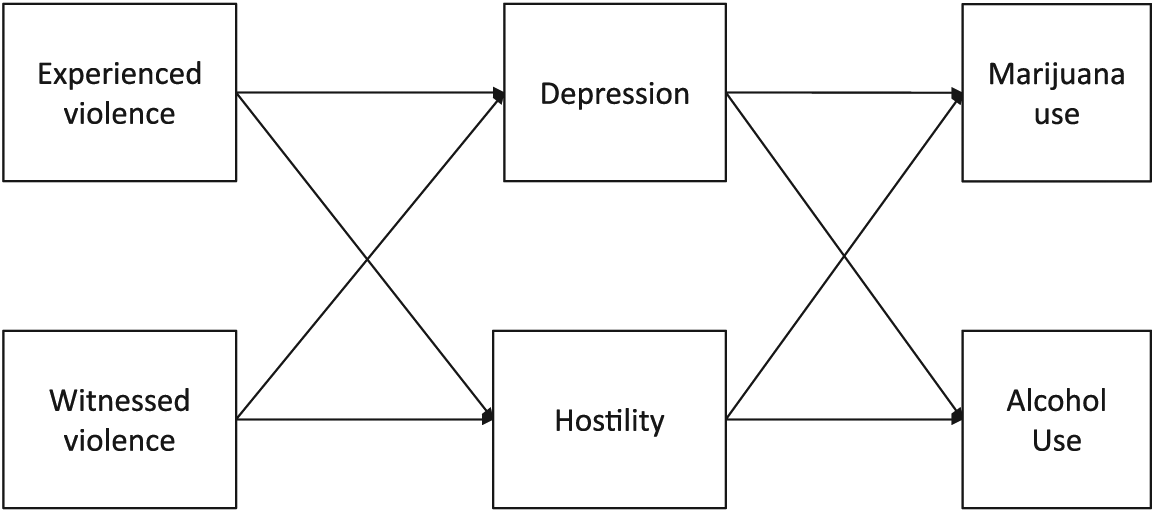
Conceptual model predicting substance use (control variables not pictured).
Method
Data
Data for the current study were drawn from the Pathways to Desistance (PTD) project, a multisite effort to examine changes in criminal activity among serious adolescent offenders (Mulvey, 2013). This study followed over 1,000 adolescent offenders in Maricopa County, Arizona, and Philadelphia County, Pennsylvania, from 2000 to 2010. The PTD project was created to examine the relative impact of juvenile justice practices and life changes among serious adolescent offenders. The project recruited 1,345 adjudicated adolescents between the ages of 14 and 17 at the time of committing their offense. Youth were deemed eligible through a process involving review of court files, which determine they had been found guilty of a serious criminal offense. Adolescents who committed any felony offense were eligible, but those who were adjudicated for less serious property crimes, misdemeanor weapons offenses, and misdemeanor sexual assault were excluded. In addition, male offenders adjudicated for drug offenses were limited to 15% of the sample to maintain heterogeneity, while all female offenders meeting the age and offense requirements remained eligible, even if they were charged with a drug offense. See Mulvey (2004) and Schubert et al. (2004) for detailed information about the methodology and data collection procedures used by the researchers who supervised the data collection process. The data were deposited for public access as part of the National Addiction & HIV Data Archive Program (NAHDAP), a collaborative project sponsored by the University of Michigan’s Inter-University Consortium for Police and Social Science Research (ICPSR), the National Institute on Drug Abuse (NIDA), and the National Institutes of Health Office of Behavioral and Social Sciences Research.
The longitudinal research design included a series of interviews. The baseline interview covered six domains, including (a) demographic background characteristics; (b) individual factors such as substance use, mental health, and school performance; (c) psychosocial development and attitudes; (d) family context; (e) personal relationships; and (f) community context. Interviews were separated into multiple 2-hr sessions based on the extensive nature of the information collected. Follow-up interviews were conducted in 6-month intervals from baseline through 18 months. This interval was stretched to 12 months beginning at the 24-month follow-up and concluded with a 7-year follow-up interview.
The sample for the current analyses included all female adolescent offenders who participated in the baseline (T1) and 6-month (T2) follow-up interviews. The 184 female participants ranged in age from 14 to 18 years, with a mean of 15.99 (SD = 1.03). The largest (37%) racial group was comprised of Black participants, followed in sequence by Latina (30%) participants, White (27%) participants, and participants (6%) who identified as a different race or ethnicity. Participants came from a wide variety of family structures, with the largest proportion reportedly having a single biological mother who had never been married (22%). The group with a single biological mother who had divorced or was separated included the same number of female participants (n = 34, 19%) as the group with a biological mother and stepfather. The group with two biological parents was comprised of 13% of the sample while the group with another adult relative included 12% of the sample. The remaining 15% of the sample included those who reported another type of family structure.
Measures
Exogenous Variables
Exposure to violence
A modified version of the Exposure to Violence Inventory (Selner-O’Hagan, Kindlon, Buka, Raudenbush, & Earls, 1998) was utilized to assess participants’ experience with violent situations. The overall scale consisted of two subscales. The violence victimization scale, which was comprised of seven items, asked youth whether they have ever been the victims of various forms of violence (e.g., Have you ever been raped or the victim of attempted rape or other sexual attack? Have you ever been chased where you thought you might be seriously hurt?). Responses to these seven items were summed to create an index, with higher numbers indicative of exposure to a wider array of forms of violence.
The observed violence scale was also comprised of seven items designed to assess the different types of violence witnessed by participants (e.g., Have you ever seen someone else being raped, an attempt made to rape someone, or any other type of sexual attack? Have you ever witnessed someone else being chased and thought they might be seriously hurt?). Responses to these items were summed to create an index representing the number of forms of violence witnessed by youth. Higher counts on this scale indicated observations of a greater variety of violence.
Endogenous Variables 1
Depressive symptoms
The Brief Symptom Inventory was used to assess participants’ recent experiences with an array of symptoms (Derogatis & Melisaratos, 1983). The Inventory has nine subscales, and the depression subscale was utilized for the current study. This subscale was comprised of six items (e.g., recent feelings of loneliness, feeling blue, lacking interest in things, and feeling hopeless about the future), which were measured with items ranging from (0) not at all, if participants had not experienced the symptom, to (4) extremely, if the participant was severely bothered. These six items were used to compute a mean depressive symptom score, which ranged from zero to four with higher values indicative of more recent experiences of a variety of symptoms.
Hostility
This measure was also collected as part of the Brief Symptom Inventory. Assessed in a similar fashion, this scale assessed the extent to which participants recently experienced several indicators of hostility (e.g., feeling easily annoyed or irritated, having urges to break or smash things, and getting into frequent arguments). Responses ranged from (0) not at all,” if participants had not experienced the symptom, to (4) extremely, if the participant was severely bothered. These five items were used to compute a mean score, which ranged from zero to four, with higher values associated with heightened recent hostile experiences.
Control Variables
Race and ethnicity
Research has documented the disproportionality of criminal justice system contact and detention of racial and ethnic minority youth (Rodriguez, 2013). In addition, youth of color have been found to experience violence at greater rates relative to their White counterparts (López et al., 2017). Furthermore, previous research indicates that the effect of experiencing violence on substance use varies by race/ethnicity with the effect being stronger for White adolescents than Black and Latino adolescents (Schilling, Aseltine, & Gore, 2007). Considering the racial and ethnic diversity of the sample, and the primary issue under investigation, a control variable was created with White non-Hispanic female offenders coded “0” and racial or ethnic minority youth coded “1.” 2
Age of first prior offense
One of the most influential factors related to offending among youth is the age at which the first offense or the first incarceration occurred (Myner, Santman, Cappelletty, & Perlmutter, 1998). A continuous measure of age of first prior offense was collected from official records to control for this potentially confounding relationship. This measure ranged from 12 to 18 years, with female offenders in the sample being slightly older than 15 years (M = 15.37, SD = 1.39) at the time of their first recorded offense.
Adults in the household
Research has also shown the composition of adults in the household can include the likelihood children are exposed to violence (Waldfogel, Craigie, & Brooks-Gunn, 2010). A measure of the number of adults in the home was included to control this influence. This item ranged from 0 to 4, with zero representative of no adults in the home and four representative of four or more adults in the home. Most (45%) female offenders in the sample reported having two adults in the home, followed by those who reported having one adult (42%) in the home.
Substance Use
Marijuana use
Participants’ marijuana use was measured with a modified version of the Substance Use Inventory (Chassin, Rogosch, & Barrera, 1991). The substance use subscale asked adolescents to report how frequently they had used marijuana in the past 6 months. Responses ranged from (1) not at all to (9) every day. Higher values were indicative of more frequent marijuana use. The current study included a baseline (T1) measure of marijuana use and the identical measure collected during the 6-month (T2) follow-up interview.
Alcohol use
Participants’ alcohol use was also measured with a subscale of the same inventory. Adolescents were asked to report how often they had used alcohol in the past 6-month period. Responses ranged from (1) not at all to (9) every day with higher values representative of more frequent alcohol use. The current study included a baseline (T1) measure of alcohol use and the identical measure collected during the 6-month (T2) follow-up interview.
Data Analyses
Analyses for the current study were conducted in several stages. Data management, descriptive, and bivariate statistics were conducted with Stata 15 (StataCorp, 2017). Based on the hypothesized relationships between variables, it was determined path analysis would provide the optimal approach. Path analysis is ideally suited as a formal method to assess the direct and indirect effects among multiple exogenous and endogenous variables. In addition to testing hypothesized relationships between multiple variables, this method also offers the ability to neatly summarize results in a compact and straightforward diagram (Klem, 1995). All path analyses for the current study were conducted with MPlus 8.1 (Muthén & Muthén, 1998-2017). This software performs analyses using a Full-Information Maximum Likelihood estimator with standard errors and a chi-square test statistic that are robust to nonnormality (MLR). This statistical estimator has been found to be an efficient estimation method, which effectively addresses missing data (Enders & Bandalos, 2001).
The proportion of missing data in the study sample was minimal. Information was missing from baseline (T1) interviews from nine participants, which amounted to a missing data rate of 4%. These missing data were also limited to two T1 measures: depressive symptoms and hostility. All other T1 measures had complete data. A slightly higher (7%) missing data rate was observed among the T2 substance use measures.
Results
Descriptive Statistics
The female adolescent offenders in the sample observed a fair amount of violence. Descriptive information for the aggregate sample as well as female offenders who experienced violence is provided in Table 1. On average, female offenders reported witnessing approximately three (M = 3.26, SD = 2.02) different types of violence. Slightly more than half (55%) of female offenders in the sample reported being victimized and on average, those who were victims experienced one type of violence (M = 1.14, SD = 1.31). In terms of negative emotions, female offenders in the sample reported few (M = 0.72, SD = 0.80) depressive symptoms and slightly higher indications of hostility (M = 1.03, SD = 0.90).
Descriptive Statistics According to Exposure to Violence.
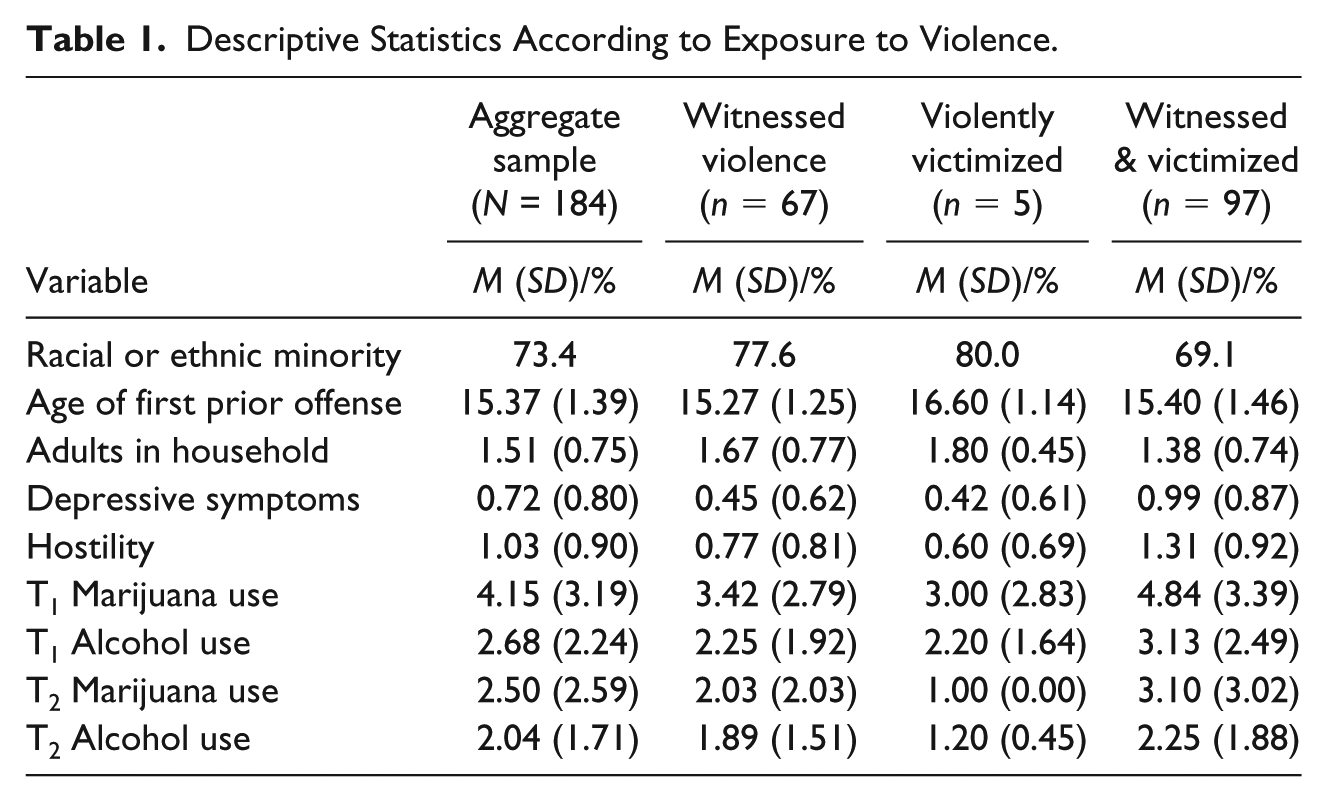
In terms of substance use, a larger proportion of participants reported marijuana use (61%) at T1 relative to the proportion that reported alcohol use (54%) during the same time period. Specifically, female offenders reported frequency of marijuana use to be around once per month (M = 4.15, SD = 3.19), on average. Alcohol use was less frequent, with average reports of use falling between 1 and 2 times in the past 6 months (M = 2.68, SD = 2.24). Frequency of substance use was lower during the T2 interview, with alcohol (M = 2.04, SD = 1.71) and marijuana (M = 2.50, SD = 2.59) reportedly used between one and two times per month, on average.
Bivariate Analyses
Control variables
Initial examination of the control variables demonstrated several significant bivariate relationships. Racial and ethnic minority female offenders (M = 1.47, SD = 1.49) reported higher levels of violence victimization relative to their White (M = 1.02, SD = 1.22) counterparts, t(184) = 2.06, p =.04. In addition, depressive symptom scores varied according to female offenders’ age at first prior offense, F(6, 168) = 2.61, p = .02. Specifically, girls whose first offense occurred at 18 years of age reported the greatest (M = 1.71, SD = 0.35) mean depressive symptom scores, followed by girls whose first offense occurred at 13 years of age (M = 1.21, SD = 0.83). The lowest (M = 0.52, SD = 0.64) depressive symptom scores were reported by female offenders whose first prior offense occurred at 14 years of age. Finally, there was an association between the number of adults in the household and the different types of violence witnessed by female offenders, F(4, 179) = 2.54, p =.04. Female offenders with four or more adults in the home reported witnessing the widest variety of violence (M = 4.50, SD = 3.54) and those with two adults in the home reported witnessing the fewest (M = 2.88, SD = 1.98) types of violence.
Associations with exposure to violence
When comparing female offenders who witnessed violence to offenders who witnessed and experienced violence, some interesting patterns emerged. Table 1 contains descriptive information according to female offenders’ experiences with violence. There were several significant differences with a clear pattern demonstrating greater mental health risk and substance use among female offenders who witnessed violence and also experienced violent victimization. One-way analysis of variance (ANOVA) results indicated female offenders who witnessed violence and also experienced violent victimization had greater depressive symptoms, F(3, 171) = 8.48, p < .001, and greater hostility, F(3, 171) = 7.84, p < .001. Female offenders who witnessed violence and also experienced violent victimization also reported more frequent marijuana, F(3, 180) = 3.27, p = .023, and alcohol, F(3, 180) = 2.96, p = .034, use at baseline. Finally, girls who witnessed violence and also experienced violent victimization reported more frequent marijuana, F(3, 180) = 3.85, p = .011, use at the 6-month follow-up interview.
Correlations
A correlation matrix was analyzed to examine the bivariate relationships among the key study variables (Table 2). There were a number of significant associations between measures of exposure to violence, negative emotions, and substance use. Beginning with the correlations between different exposures to violence, as female offenders observed more forms of violence, reports of violent victimization also increased (r = .45, p < .001). Although there was a significant amount of overlap between these two measures with only five girls reporting experiencing violence only, they were only moderately correlated suggesting distinct constructs were observed. This evidence supports the use of a more precise approach accounting for these two forms of violence exposure can yield important observations with regard to the ways in which witnessing violence and direct victimization influence negative emotions and substance use. In addition, this multidimensional approach is supported with initial analyses conducted by the scale creators and other PTD researchers (Center for Research on Health Care (CRHC), 2018; Selner-O’Hagan et al., 1998).
Matrix of Correlations Among Measures of Exposure to Violence and Substance Use.
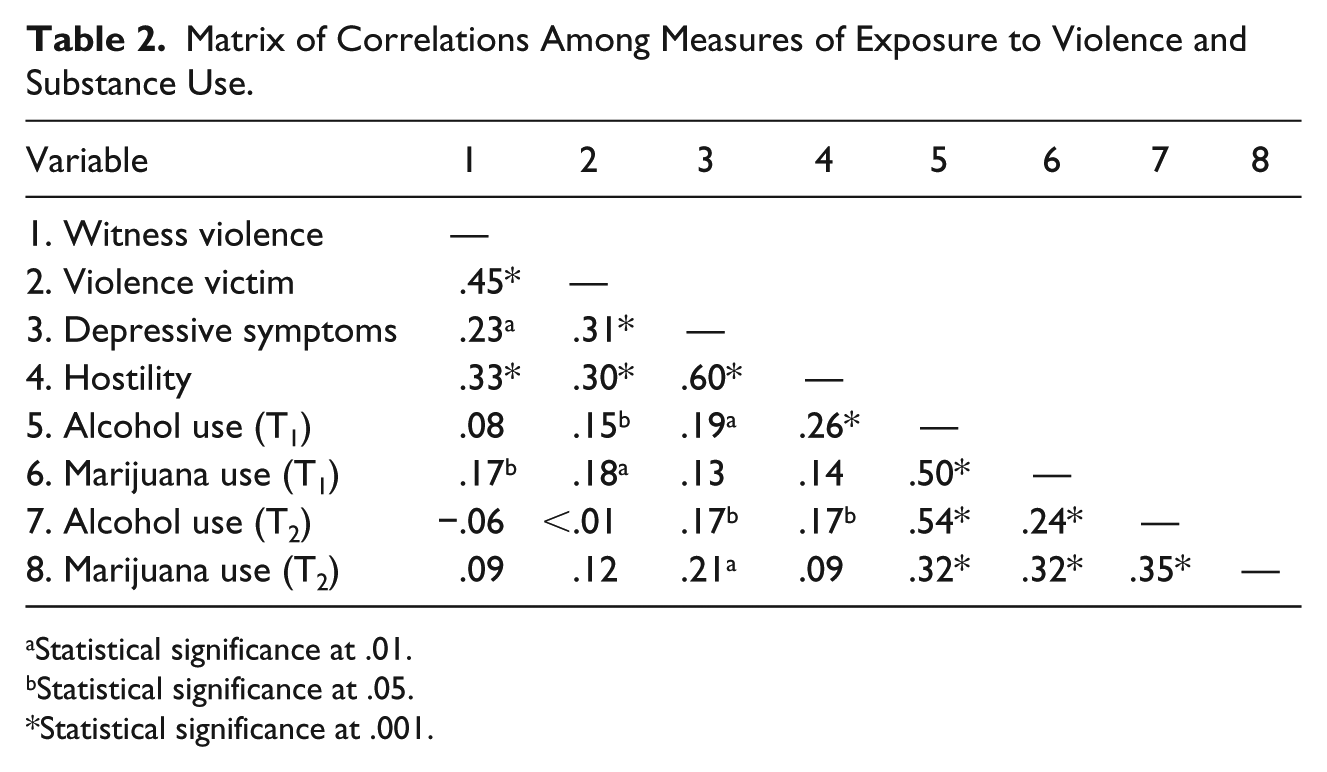
Statistical significance at .01.
Statistical significance at .05.
Statistical significance at .001.
Observed violence was also significantly associated with both mental health measures. As the types of violence observed by female offenders increased, depressive symptoms and hostility also increased. Witnessing violence was also positively associated with T1 marijuana use, although this relationship was weak.
Similar relationships were observed between violent victimization, depressive symptoms, hostility, and substance use. Violent victimization was significantly associated with a rise in depressive symptoms, as well as a rise in hostility. A moderate positive correlation was also observed between depressive symptoms and hostility, which indicated greater depressive symptoms in the presence of higher levels of hostility. Violent victimization was positively associated with both T1 substance use measures, but these relationships were also fairly weak. The strongest association was observed between hostility and T1 alcohol use.
With regard to violence exposure and T2 substance use, the associations did not meet the generally accepted level of significance. However, the relationship observed between violent victimization and T2 marijuana use approached significance (r = 0.12, p = .113) and the associations between depressive symptoms, hostility, and T2 substance use measures remained significant. Thus, the mediated effects of depressive symptoms and hostility were explored with the understanding that observed effects would be minimal in their magnitude.
Path analyses
The conceptual model that tested the pathways between exposure to violence, mental health measures, and substance use is presented in Figure 1.
The first iteration of the model was tested to examine the associations between exposure to violence, negative emotions, and T1 substance use measures. Fit indices demonstrated a significant improvement over an unconstrained model and suggested an adequate fit to the data, baseline χ2 = 226.718, df = 25, p < .001; constrained χ2 = 15.653, df = 13, p = .268; comparative fit index (CFI) = 0.987; root mean square error of approximation (RMSEA) = 0.033; 90% confidence interval (CI) = [0.000, 0.084]. Results from the model test are presented in Figure 2, with significant associations represented by solid arrows.
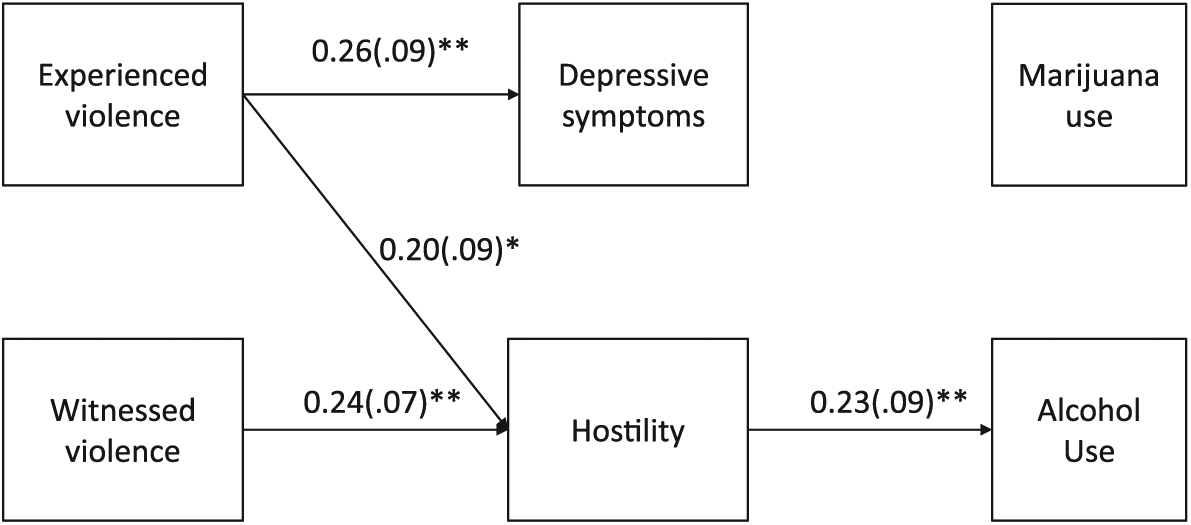
Significant pathways predicting T1 substance use, β (SE).
As female offenders reported more instances of experiencing firsthand violence, the number of depressive symptoms and levels of hostility significantly increased. Hostility also rose in tandem with the amount of violence female offenders witnessed, but this form of exposure to violence was not associated with depressive symptoms. In addition, hostility was the sole negative emotion associated with substance use, and it was related to alcohol use, not marijuana use.
The second iteration of the model was tested to examine the same associations but utilized the T2 substance use measures to assess the lagged associations between violence, negative emotions, and subsequent alcohol and marijuana use. Fit indices for this model also demonstrated a significant improvement over an unconstrained model and suggested an adequate fit to the data (baseline χ2 = 197.995, df = 25, p = .000; constrained χ2 = 17.002, df = 13, p = .199; CFI = 0.977; RMSEA = 0.041, 90% CI = [0.000, 0.089]). Significant associations are represented with solid arrows in Figure 3.
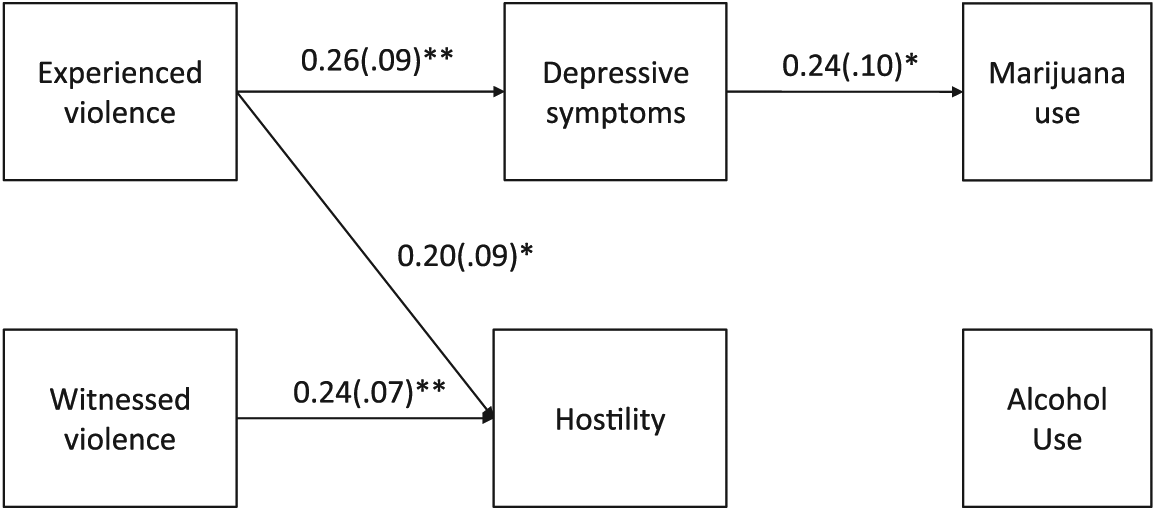
Significant pathways predicting T2 substance use, β (SE).
The associations between exposure to violence, depressive symptoms, and hostility remained the same as the first model. The notable difference, utilizing the T2 substance use measures, was observed between the negative emotions measures, alcohol, and marijuana use. The association between hostility and alcohol use was no longer significant, but the association between depressive symptoms and subsequent marijuana use achieved significance in this model.
To summarize, four important results emerged from this series of model tests. The first was related to the significant positive associations between firsthand experiences of violence, depressive symptoms, and hostility. The second was related to the significant positive association between observed violence and elevated hostility. The third indicated greater hostility was associated with more frequent and recent alcohol use, but only at Time 1. The fourth highlighted the association between elevated depressive symptoms and more frequent but later marijuana use at Time 2. Together, these results indicate that alcohol and marijuana use have different precursors among young female offenders, and the determinants of these behaviors appear to change over time.
Discussion
The intent of this study was to empirically test a GST model with an ethnically diverse sample of serious female adolescent offenders. We focused on witnessing and experiencing violence as the types of strains or adverse child experiences that girls endured and examined the emotional responses to such strains as well as substance use as the coping mechanism to such negative emotions. In particular, we hypothesized that the relationships between exposure to violence and substance use would be mediated by depressive symptoms and hostility. Unlike prior GST studies, we examined how two different types of exposure to violence—personal victimization and witnessing violence—impacted girls’ emotional coping responses and substance use. Our study also has implications for Pathways Theory, which posits that personal victimization—usually in the form of childhood abuse—leads to mental health issues such as depression and anxiety, which, if left untreated, may result in self-medicating substance use behaviors (Belknap, 2014; Chesney-Lind & Pasko, 2013; Gehring, 2018; Vaske & Gehring, 2010).
Consistent with other research on female adolescent offenders (Abram et al., 2004; Baglivio et al., 2014; Foy et al., 2012), exposure to violence was very high among the study participants: Approximately 92% of the sample had been exposed to violence. Furthermore, there was a large overlap between witnessing violence and being violently victimized. Despite this overlap, experiencing violence and witnessing violence independently contributed to negative emotions despite the fact that they tend to happen simultaneously. More specifically, we found that personally experiencing violence was associated with increased depressive symptoms and hostility and these relationships held steady across both the cross-sectional and longitudinal models. These findings add to our limited understanding of how female adolescent offenders respond to being personally victimized and underscores the importance of further studying anger as a possible coping response among members of this population.
Witnessing violence was associated with increased hostility, a relationship that was maintained at 6-month follow-up. No other research to date has examined this relationship among serious female adolescent offenders. Future research is needed to further understand why witnessing violence is related to hostility among female adolescent offenders. One possibility is that witnessing violence may result in normative beliefs about the acceptability of aggression (Boxer et al., 2008). Context may also play a role with regard to how adolescents emotionally respond to witnessing violence (Mrug, Loosier, & Windle, 2008; Wright et al., 2013). For example, girls growing up in neighborhoods characterized by high rates of violence may be more prone to react with hostility in response to witnessing violence (Ness, 2004).
Contrary to our hypothesis, depressive symptoms did not mediate the relationship between experiencing violence and marijuana use at Time 1; however, support for mediation was found at Time 2. One possibility for these contradictory findings is that female adolescent offenders were introduced to more marijuana-using peers via their involvement in the juvenile justice system, as previous research indicates that peer substance use is associated with more frequent drug use among female adolescent offenders (Neff & Waite, 2007). Of course, this remains conjecture at this point given that we did not include a measure of peer substance use in our model.
Hostility mediated the relationship between experiencing violence and alcohol use, but only in our cross-sectional model. This finding was consistent with Sharp et al. (2012) who also found in their cross-sectional analysis that anger expression mediated the relationships between physical abuse and alcohol use among women prisoners. Unlike Sharp et al. (2012), we did not find support for hostility mediating the relationship between experiencing violence and marijuana use.
Hostility also mediated the relationship between witnessing violence and alcohol use, but again evidence for mediation was only found in our cross-sectional model. This finding is inconsistent with Sharp et al. (2012) who failed to find a mediation effect for anger expression on the relationship between witnessing violence and daily alcohol use among a sample of women prisoners. While Sharp and colleagues (2012) included a one-item measure of witnessing violence specific to the family domain (i.e., having a battered mother), we included a comprehensive measure of witnessing violence across various domains.
Contrary to our expectations, hostility did not mediate the relationship between either exposure to violence measure and either of the substance use measures at Time 2. One possible explanation for the lack of mediation effects at Time 2 is that the participants in our sample were exposed to anger management programming, which is quite common in juvenile detention and correctional facilities (Young, Dembo, & Henderson, 2007). Again, this remains conjecture at this point and additional research, preferably with a longer follow-up, is needed to test this premise.
Finally, it is worth noting that girls in our sample reported higher rates of marijuana use than alcohol use. This finding is consistent with previous research on female adolescent offenders. In a study of 1,829 randomly selected detained youth in Cook County, Teplin, Abram, McClelland, Dulcan, and Mericle (2002) found that approximately 41% of girls met the diagnostic criteria for marijuana use disorder compared with approximately 27% who met the criteria for alcohol use disorder. Although beyond the scope of the current study, understanding why female adolescent offenders use marijuana at higher rates than alcohol is worthy of additional research with a focus on drug and alcohol use motives.
The current study has several strengths, including an ethnically diverse sample of serious female adolescent offenders and data collected over two waves. Most studies testing GST among youth focus on adolescents from the general population (e.g., Francis, 2014; Kaufman, 2009; Lin et al., 2011) as opposed to system-involved youth who are most at risk for future substance use. Another unique contribution of our study is that we tested whether hostility mediated the relationship between exposure to violence and substance use. Such an emphasis is important given that much of the literature on adolescent girls’ coping focuses exclusively on internalizing symptoms as a response to violence exposure. Finally, we were able to test for both direct and indirect effects of experiencing violence and witnessing violence on substance use, which has implications for both GST and Pathways Theory as well as studies related to the relationship between adverse child experiences and substance use among adolescents.
Despite our study’s strengths, several caveats and limitations should be noted. First, we did not distinguish between personally experiencing and witnessing violence across a number of different contexts (Mrug et al., 2008; Wright et al., 2013). Second, we examined the effects of depression and hostility separately despite research indicating that system-involved girls’ anger often coincides with depression and anxiety (Cauffman, Lexcen, Goldweber, Shulman, & Grisso, 2007). Indeed, our analyses revealed that depressive symptoms and hostility were positively correlated for the young women in our sample. Finally, it should be emphasized that while our results provide partial support for GST and Pathways Theory, not all hypothesized relationships were significant, and significant relationships varied depending on whether the model was cross-sectional or longitudinal. Moreover, the expected relationships between exposure to violence and substance use were not as strong as we had anticipated, which resulted in either nonsignificant or small mediation effects. Additional research is needed to replicate our findings, as well as research that expands upon our findings by examining outcomes other than substance use.
This research should include a more specific measure of alcohol and marijuana use that taps into whether adolescents are drinking and using marijuana as a coping strategy or for other reasons as suggested by Catanzaro and Laurent (2004). More information on adolescent girls’ perceptions, particularly those who are most at risk, such as the young women in the current study, could inform cognitive-behavioral interventions aimed at increasing positive coping skills and decreasing marijuana and alcohol use among serious female offenders. Further research on girls’ legitimate coping mechanisms to strain can enhance GST’s ability to test alternate models explaining desistance from delinquency as well (Jang, 2007). For instance, additional models, which may help elucidate the relationships between coping and substance use, can include more detailed tests examining the timing between negative emotions and substance use.
Finally, policy recommendations from this study point toward the importance of early identification and treatment of female adolescent offenders’ emotional and physical needs in a significant, timely manner. Previous research has also found that when providers are asked what services female offenders need, they assert, “real drug treatment” (Davidson, Pasko, & Chesney-Lind, 2011). The focus on state-sponsored drug services for youth is often on education and prevention for this at-risk population, with any direct services for adjudicated drug-using youth housed in Juvenile Drug Court or a school-based program. Intervention services and sentencing alternatives for those adolescents who are “in risk” of addiction are limited. Currently, there is a dearth of intensive residential drug treatment options for adolescents, with gender-aware programming becoming even more limited for system-involved girls (Wasserman et al., 2003). As this research—as well as other examinations of female offenders (e.g., Chesney-Lind & Pasko, 2013)—has shown, more community-based substance abuse treatment programs that move beyond the prevention and school-based models and address the severity of drug use for girls who are already “in risk” of lifetime trajectories of addiction are needed.
Footnotes
Declaration of Conflicting Interests
The author(s) declared no potential conflicts of interest with respect to the research, authorship, and/or publication of this article.
Funding
The author(s) received no financial support for the research, authorship, and/or publication of this article.