







Abstract
The extent to which environmental context has been considered when developing crime scripts has been limited to descriptions of the locations offenders visit during the crime. This research contributes a description of the environmental characteristics of an open-air drug market and identifies environmental facilitators and inhibitors toward offender actions during a drug-selling crime script. Closed-circuit television (CCTV) camera footage is combined with Google Street View images to determine whether physical disorder, decay, and “crime generators” characterize the drug market under study. There is little evidence to suggest that the former two dimensions influence the crime sequence; however, crime generators such as retail facilities and bars and liquor stores are environmental facilitators toward a drug-selling crime script; and transit locations, corner stores, and public parks are environmental inhibitors toward the script.
Keywords
Introduction
Recent advancements in environmental criminology demonstrate that crime unfolds across several disparate steps that cumulatively enable offenders to take advantage of a criminal opportunity. The identification of the disparate steps that comprise crime events is widely known as script analysis (Cornish, 1994). Identifying the discrete actions engaged in by offenders before, during, and after a crime may help to uncover the discrete actions that offenders engage in at various points throughout the criminal event. Such an analysis can support situational crime prevention by identifying a number of unique intervention points that likely go uncovered when crime is treated as a single event in time and space (Leclerc, 2017).
Despite the benefits script analysis has provided the field, prior studies have almost exclusively focused on the action sequences of individual offenders in identifying crime scripts. Although this is a valid and powerful approach given that offender decision making is at the core of the rational choice perspective (Cornish & Clarke, 1986), recent research has demonstrated that offender actions can be influenced by the encompassing environment. To our knowledge, environmental context has played little to no role in prior research on crime scripts. This is curious, considering the emphasis that the crime-and-place literature places on the influence of the physical environment on criminal behavior. In short, crime-and-place research has paid a great deal of attention to the effect of environmental characteristics on crime incidents while largely overlooking how the environment may influence the action sequences of offenders during crime events. We seek to fill this gap in the literature through an analysis of an open-air drug-selling script for Newark, New Jersey.
The current study builds upon the findings of a systematic social observation (SSO) of narcotics transactions recorded on closed-circuit television (CCTV) cameras. This prior SSO identified various defensive actions of drug sellers (Piza & Sytsma, 2016) and analyzed how decisions to deploy the disparate defensive actions combine to form a drug-selling script (Sytsma & Piza, 2018). The unique contribution of the current study is the direct measurement of the environmental context of the surrounding environment, and a test of whether environmental features affect drug-seller actions at each of the disparate steps of the event script. Through an SSO of Google Street View (GSV) imagery, we measure physical disorder, decay, and crime generators in the immediate surrounding area for each drug transaction included in the study. Logistic regression is used to measure how each variable affects drug seller actions throughout the crime script.
Review of Relevant Literature
Crime Scripts
Crime scripts map a series of incidents, which, taken together, form a larger crime event (Leclerc & Wortley, 2014). Such incidents have been referred to by Cornish (1994) as acts—for instance, the preparation period, the crime itself, and the getaway period may all be separate acts. Crime scripts are developed to “identify the necessary and sufficient requirements for such criminal events to take place” (Cornish, 1994, p. 39), thereby providing information that can inform crime control strategies. Cognitive science has employed script analysis since at least the 1970s (see Abelson, 1976; Schank & Abelson, 1977), and crime scripts have since emerged as a key analytical tool in the field of criminal justice. A recent systematic review by Dehghanniri and Borrion (2019) has shown that crime scripting has been especially popular over the past 5 years, with 52% of the 416 identified articles published since 1994 being published between 2014 and 2018. Dehghanniri and Borrion identified 105 original scripts within the 416 articles. Relevant to the current study, 14 of the 105 original scripts were drug-offending scripts (see, for example, Chiu et al., 2011; Jacques & Bernasco, 2015; Sytsma & Piza, 2018).
In their work on street-level drug selling, Jacques and Bernasco (2015) add to Cornish’s “necessary requirements” the concept of facilitating steps (p. 124). These are steps in the crime commission process that are not necessary for the crime to take place but are common and serve a function in the process. Jacques and Bernasco also contribute the concept of the “best fit script,” which is the typical sequence of events that makes up the crime event (p. 124). In Sytsma and Piza’s (2018) work on open-air drug markets, they identify necessary steps, typical conditions, and facilitating factors. Typical conditions are those conditions that are the most common manifestations of necessary steps. Facilitating factors are those factors that make typical conditions more likely to be present. These concepts are discussed in more detail below.
Cornish (1994) points out that crime scripts that are constructed using self-report and secondary sources bring with them inferential steps not found in those scripts developed through direct observation. Crime script analysis that relies on “free elicitation” from the offender, coupled with active probing by the researcher, can provide sufficiently rich information with a high level of specificity, therefore lessening reliance on inference (Cornish, 1994, p. 39). Crime scripts that rely on direct observation such as those developed by Jacques and Bernasco (2015) and Sytsma and Piza (2018)—the latter of which relied on video footage to observe offender behavior—provide a comparatively high level of validity and specificity as these scripts were “elicited” during observations of the crime commission sequence, rather than constructed post hoc through self-report. Using video footage to construct crime scripts follows in the tradition of research demonstrating that recordings amenable to later coding and reinterpretation can generate important insights on issues of crime and justice (Sampson & Raudenbush, 1999).
Environmental Characteristics and Crime
Environmentally based disorder variables have been widely studied regarding their relationship to crime. Prior examinations of disorder have included the operationalization of environmental disorder variables in the form of physical disorder and decay. Physical disorder variables commonly include the environmental consequences of human behavior, such as the damaged appearance of buildings, the presence of graffiti, and other related incivilities (Swatt et al., 2013). Decay variables generally refer to more long-term environmental ills, such as deterioration, dilapidation, and prolonged vacancy (Wheeler, 2018). Physical disorder and decay have become especially pertinent in informing our understanding of the interactions between the physical environment and a variety of social concepts, including social cohesion (Steenbeek & Hipp, 2011), collective efficacy (Stein et al., 2016), quality of life (Chappell et al., 2011), and crime (Skogan & Steiner, 2004).
Research on physical disorder has commonly relied on surveys and other citizen-generated records (such as 311 data). However, such data may not be best suited to accurately assess the relationship between environmental disorder and crime. Research indicates that citizens often lack the understanding and ability to parse out the differences between environmental disorder and crime (Gau & Pratt, 2008). This finding may greatly affect the application of 311 and survey results based on the potentially questionable reliability of citizen-derived environmental perceptions.
Tangential to the study of disorder and decay, ecological theories of crime have focused on the impact of land use features on crime. Crime pattern theory (P. L. Brantingham & Brantingham, 1993; P. J. Brantingham & Brantingham, 2008) suggests that crime occurs when the activity spaces (e.g., home, work, shopping, entertainment, and the paths that join such “nodes”) of offenders and the activity spaces of targets intersect. Activity spaces include what P. J. Brantingham and Brantingham (2008) refer to as crime generators: locations where large numbers of people tend to congregate, such as shopping and entertainment districts. In contrast, repeat offenders may frequent spaces where there are known opportunities for specific crime types, such as drug markets or large parking garages. These types of locations are known as crime attractors (P. J. Brantingham & Brantingham, 2008). Furthermore, crime will cluster at the intersection of multiple activity spaces, such as in places where shopping and entertainment districts overlap (P. J. Brantingham & Brantingham, 2008).
There is a great deal of literature exploring the impact of various general land use types on crime, such as commercial, industrial, and residential land use features (see, for example, Boessen & Hipp, 2015; Stucky & Ottensmann, 2009). For instance, Twinam (2017) found that in pedestrian-friendly neighborhoods in Chicago, commercial land use predicts street crime in the area, with the criminogenic effect primarily driven by liquor stores and “after hours” bars. Similarly, liquor stores and other alcohol outlets have been found to predict various crime types (Hipp, 2007; Nielsen & Martinez, 2003; Peterson et al., 2000; Smith et al., 2000), as have retail outlets (Hipp, 2007; Sherman et al., 1989).
Recent methodological developments may assist researchers in measuring the effect of disorder and land use features on crime. SSO provides an objective way of measuring pertinent characteristics of target environments and is particularly useful in evaluating microlevel contexts and place-specific indicators of crime. First advanced by Reiss (1968, 1971), SSO involves observing the phenomena of interest in a formalized, replicable manner that is independent of the outcome being observed. Modern data providers offer web-based platforms, such as GSV, that facilitate SSOs of public places. GSV has been found to be a reliable method of evaluating neighborhood-level structural and environmental conditions (Ben-Joseph et al., 2013; Griew et al., 2013; Kelly et al., 2013; Rundle et al., 2011), and it has been used to validate previously utilized scales that score conditions of the environment (Marco et al., 2017). SSOs using GSV have been gaining popularity in criminal justice research (He et al., 2017; Hsu & Miller, 2017; Langton & Steenbeek, 2017; Odgers et al., 2012; Vandeviver, 2014).
Platforms such as GSV can help advance crime-and-place research by expanding upon readily available data sources. Land use features have typically been measured from official data sources, such as tax filings (Slocum et al., 2013; Smith et al., 2000), city planning departments (Boessen & Hipp, 2015; Slocum et al., 2013), and liquor licensing bureaus (Nielsen & Martinez, 2003; Peterson et al., 2000). Although official data sources provide a high degree of reliability, data of this nature are restricted to licensed or registered establishments. Land use features that are unlikely to be recorded in official filings, such as parking lots, public parks, and vacant spaces, are less easily captured. Furthermore, indicators of disorder and decay, which may characterize such land use features, cannot be observed via official data sources. Pairing SSO with alternative data sources such as GSV imagery provides a strategic advantage over relying on official records.
Environmental Characteristics and Scripts
The existing crime script literature has included indicators of physical dimensions only insofar as they directly contribute to the script. Such descriptions of the environment primarily take the form of a list of various locations an offender visits during the crime commission sequence, or an indication of the mobility required to move from one location to the next during the crime commission sequence. For instance, Beauregard et al. (2007) developed a crime script of the sex offender hunting process, which includes geographic information, such as the encounter, attack, and victim-release sites. Leclerc et al. (2011) similarly identified victim–offender meeting and attack sites for sex offending against children, and Morselli and Roy’s (2008) script identifies theft, storage, and disposal sites of stolen vehicles. Chiu et al.’s (2011) drug manufacturing script includes laboratory location and storage type (e.g., house, shed, storage facility), as well as setting (e.g., rural, suburban). Brayley et al. (2011), Jacques and Bernasco (2015), and Sytsma and Piza (2018) each include actor mobility within their respective crime scripts, and Petrossian and Pezzella’s (2018) script of illegal fishing includes a description of offenders traveling to a harvest destination and returning to port.
In the context of drug offending, a large body of research has found that illicit drug markets tend to exist in areas where environmental crime generators or crime attractors (P. J. Brantingham & Brantingham, 1995) highly concentrate (see, for example, Barnum et al., 2017; Rengert et al., 2005). Ethnographies on drug offenders provide more direct support for this phenomenon. For example, St. Jean (2007) found that drug sellers in Chicago explicitly selected locations that offered “ecological advantages” for quick and discreet transactions. Drug sellers reported that ecological advantages were offered by specific factors of the immediate environment, including high levels of foot traffic, concentrations of cash-and-carry businesses, and the presence of public transport stops. Piza and Sytsma (2016) have documented a number of ecological advantages of crime generators and crime attractors within the open-air drug market, such as taking advantage of the features of the environment to appear as though there is “legitimate context” for a drug seller and buyer to be interacting, or using the environment to create a semiprivate area within a public setting—what they refer to as public cuts (p. 49).
Similarly, disorder and decay also may influence the crime script in several ways. Because the perception of a location is largely the result of a visual assessment of the immediate surroundings, theoretical perspectives such as broken windows theory (Wilson & Kelling, 1982) are predicated on the nexus that seeing disorder is what influences the likelihood of crime occurrence and associated script decision making. On the front end of the crime script, the decision to enact the crime script at a given location could be the result of the level of disorder and decay in the present environment and the visual cues they prompt. Therefore, decay indicators such as building dilapidation and infrastructure deterioration may have an exacerbated impact on the perception of the environment due to their often persistent and prolonged existence (Wheeler, 2018). In addition to influencing the initial perception of the area, physical disorder indicators have been observed to directly influence activities associated with the crime commission sequence. Piza and Sytsma (2016) observed the use of props, such as old cigarette packages to hide drugs or money, as well as off-person stash spots, which could include the use of debris in the area as a hiding place for drug market–related materials. Abandoned buildings and vacant spaces have also been observed to facilitate drug transactions, as they provide rent-free, nonregulated locations for a buyer and seller to conduct an exchange (Frazier et al., 2013).
Although Dehghanniri and Borrion’s (2019) systematic review found the pool of existing crime scripts to cover a broad range of crime types, they also conclude that existing literature lacks depth. These authors predict “a change of direction might be observed, with the generation and quantitative analysis of multiple and more detailed scripts (that is, tracks) for each crime type” (p. 15). The present study is consistent with such a change of direction by contributing depth to the open-air drug market crime script through an exploration of how the environment can influence an offender’s action sequence as it relates to the established crime script, rather than only identifying locations an offender visits during the crime commission sequence.
Scope of the Current Study
The present study builds upon prior SSOs of drug market activity recorded on CCTV (Piza & Sytsma, 2016; Sytsma & Piza, 2018) to better understand (a) the environmental structure of open-air drug markets and (b) whether the observed dimensions (physical disorder, decay, and crime generators) predict drug seller actions throughout the different acts of the crime script. We build upon this prior literature by conducting an SSO of drug markets though GSV. We draw upon an existing database of open-air drug transactions coded through SSO of CCTV footage (Piza & Sytsma, 2016), rather than through self-report and secondary sources, thereby improving validity and specificity of the constructed crime script. Relying on GSV also increases measurement validity as observations of potentially crime-generating land use features are not restricted to licensed or registered establishments, and observations of physical disorder and decay in microlevel contexts are not restricted to citizen reporting and/or official data sources. Finally, the present study contributes to the script literature a description of the physical environment within which open-air drug-selling sequences occur, and is the first to move beyond identifying locations an offender visits during the crime commission sequence to explore how the environment can influence offenders’ action sequences within open-air drug markets.
The Open-Air Drug-Selling Script in Newark
To analyze the defensive actions employed by drug sellers, Piza and Sytsma (2016) accessed the CCTV footage of all drug distribution arrest incidents recorded on Newark’s (New Jersey) CCTV cameras in 2011. Using SSO, the authors created detailed transcriptions of each individual narcotics transaction observed in the footage. Piza and Sytsma found that the use of various defensive actions employed by the drug sellers largely depended on the setting (mixed-commercial or residential) and time of day (daytime or evening). More directly related to the current study, Sytsma and Piza (2018) followed-up on their 2016 work by developing a crime script of open-air drug selling in Newark. The authors identified three central acts of the open-air drug transaction: the pretransaction act, transaction act, and the posttransaction act, as well as identifying buyer and seller activities, and demographic and setting variables within these acts. Within each act, Sytsma and Piza identified the necessary steps for the drug sale event to occur. They identified typical conditions, and the facilitating factors that make each typical condition more likely to present.
According to Sytsma and Piza’s findings, it is first necessary for one party to approach another to initiate the transaction, and it is typical for the buyer to initiate the transaction. Sytsma and Piza (2018) describe transaction initiation as “the buyer and seller establish contact for the first time in preparation for the transaction” (p. 86). Given that the data source is CCTV without audio, “contact” refers to one party physically approaching the other in the space. This typical condition is facilitated during daytime hours and with sellers being aged late teens to early 20s. During the pretransaction act, buyers do not generally take the time to inspect drug packages before engaging in the transaction. During the transaction act, it is necessary for there to be an exchange of product for money, and this exchange usually occurs in one simultaneous and immediate transfer. Such a typical condition is facilitated when buyers initiate the transaction and when no drug inspection occurs on the part of the buyer. It is also necessary for the transaction to occur in a particular location. Generally, the greeting from the pretransaction act, the exchange of money, and the exchange of drugs all occur at the same location. This typical condition is facilitated when no drug inspection occurs. Finally, there must be some form of posttransaction mobility (or lack thereof), with sellers most often electing to maintain their anchor point within the drug territory. This typical condition is facilitated by buyer initiation. The crime script developed by Sytsma and Piza is summarized in Figure 1. Although Sytsma and Piza identify five typical conditions, it should be noted that all five typical conditions are rarely met in the same transaction (this is the case for approximately 10% of transactions), but at least one condition is present in approximately 98% of cases. See the “Results” section below.
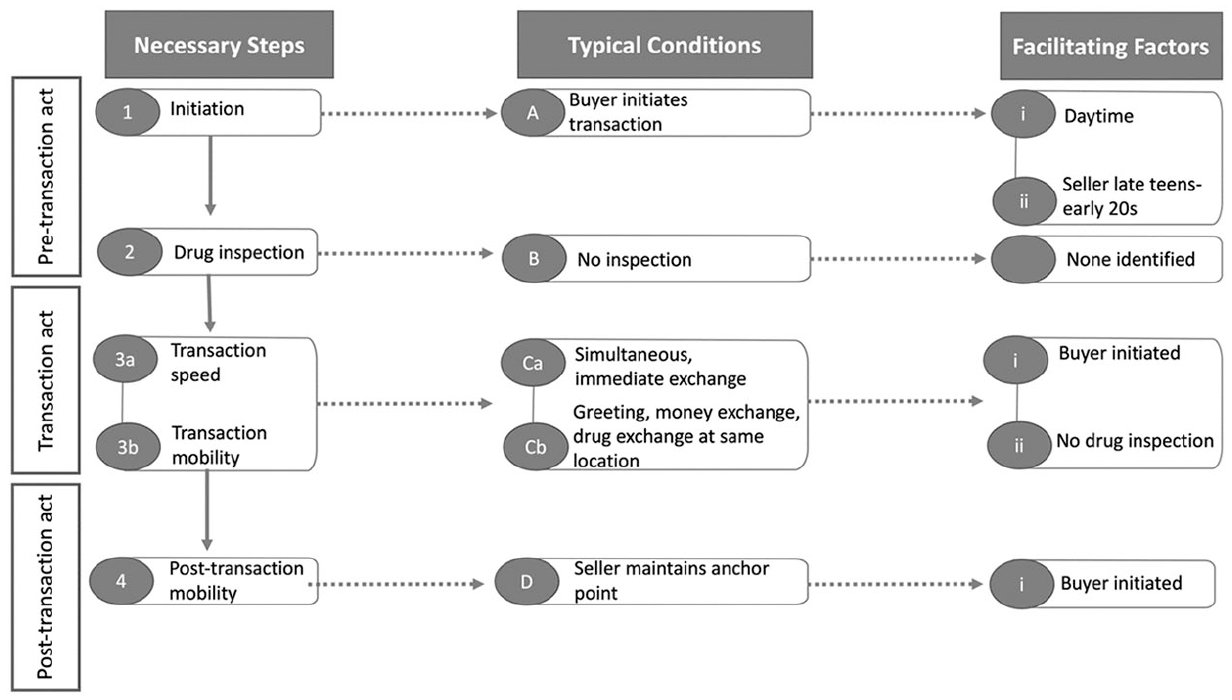
Necessary steps, typical conditions, and facilitating factors of open-air drug selling as identified by Sytsma and Piza (2018).
By relying on video footage to explore the use of defensive actions by drug sellers, Piza and Sytsma (2016) were limited to those which could be captured within the viewshed of the camera. Similarly, the crime scripts developed in their 2018 piece were constructed out of “participant behaviors occurring within the geography of the drug market” (Sytsma & Piza, 2018, p. 84). By supplementing Piza and Sytsma’s existing database with observations collected through GSV, we are able to gain further insight into the environmental conditions of the open-air drug markets contained in the CCTV footage. Environmental data collected through the SSO of GSV allow us to measure how physical disorder, decay, and crime generators influence drug seller actions within each act of the crime script. This provides further insight into the role of the physical environment as a potential crime script facilitator.
Method
Data Coding Using GSV
SSO was utilized to measure the environmental characteristics associated with Newark’s drug markets under study. The SSO was completed using GSV, which allows users to search for address-specific microlocations and provides 360-degree horizontal imagery of the specified location. The user is then able to scan and move the static, panoramic image as if on the street, and tools such as “zoom” increase the clarity and ability to identify features of interest. In the present context SSO, using GSV provides an interface to record environmental characteristics that may influence the activities within drug markets.
A review of the literature was first completed to identify empirically derived disorder measures that may be related to drug market activity in Newark. Although the review was thorough and applicable to the city of Newark, it is not meant to be a representation of the drug market literature more generally. The literature suggests that there are three distinct dimensions of the environment that pertain to drug markets, with several indicators for each dimension. These dimensions include physical disorder, which can be conceptualized as human-caused aspects of disorder in the environment such as graffiti and littering; decay, which refers to deterioration of structures and surfaces as a result of neglect over time; and crime generators, which include the places designed to facilitate interactions between large groups of people, which may obscure or otherwise facilitate drug market activities. Physical disorder and decay are thought to contribute to activities associated with the crime–commission sequence through the ways in which the seller can use litter or debris to facilitate the drug transaction (e.g., an empty cigarette package can be used as a prop and other debris can be used as off-person stash spots). Furthermore, some forms of physical disorder and various crime generators may provide ecological advantages, such as the use of a transit location to create “legitimate context” (see Piza & Sytsma, 2016, p. 49). Observable crime generators have previously been studied in Newark’s drug markets through GSV observations to determine which generators inform drug-selling hot spots (Hsu & Miller, 2017). Results of the review of drug market disorder measures are summarized in Table 1, including dimensions, indicators, and sources.
Descriptive Statistics: Dimensions and Indicators by Source; and Length of Street Segment.
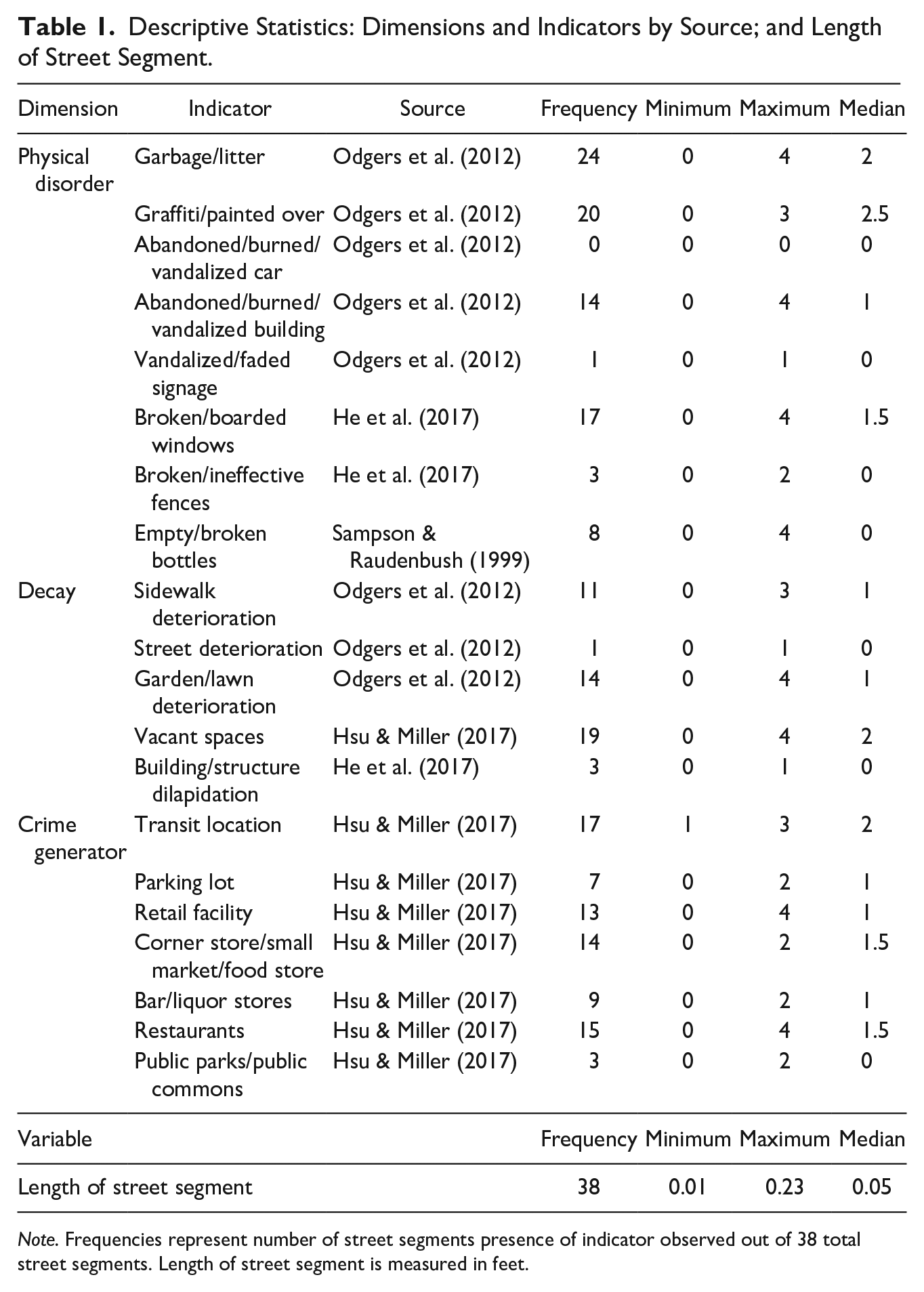
Note. Frequencies represent number of street segments presence of indicator observed out of 38 total street segments. Length of street segment is measured in feet.
These dimensions and their associated indictors were then used to produce a coding manual. The coding manual informed the SSO, with the second author identifying the presence or absence of various indicators at all street segments (i.e., both sides of a block face between two street corners) intersecting a CCTV camera used to capture the video footage coded by Piza and Sytsma (2016). Street segments are an appropriate unit of analysis for the GSV SSO due to the theoretical and methodological benefits they offer. Street segments are both small enough to avoid aggregation issues, such as the ecological fallacy, and large enough to avoid coding errors associated with smaller units such as addresses (Weisburd et al., 2004). Furthermore, street segments are useful microlevel units of analysis, in that, they capture “regularly recurring rhythms of social activity” within their concise boundaries (Braga et al., 2010, p. 39).
Beginning at the intersection, both block faces of the connected segment were observed by scrolling along the street until the next intersection was arrived at. The coding process involved working through the segment in one direction, and then reversing back down the segment in the opposite direction to ensure every feature was observed. The individual segments associated with each intersection were identified according to their cardinal direction and were coded and scored separately.
As a cross-sectional methodology, GSV captures a single moment in time for a year, and archives multiple years of images. GSV allows the user to select the year the imagery was recorded when multiple years are available, but the years available vary across places and may introduce some temporal instability (Curtis et al., 2013). 1 In each instance, we selected the available year closest to the year the transaction events were recorded (2011), with priority given to years that were recorded prior to the transaction event—following the approach of previous studies that have operationalized GSV for SSO (Langton & Steenbeek, 2017).
In total, 38 street segments were coded through the aforementioned process. For each of the 10 CCTV cameras that recorded footage coded by Piza and Sytsma (2016), the dichotomous environmental measures were aggregated upward to reflect the number of times an indicator was present across the cumulative street segments that intersect a given CCTV camera. Each of the 98 drug transactions (the unit of analysis for the current study) were assigned the indicator measure of its associated CCTV camera.
Measurement and Analytical Framework
The environmental measures included in the study were captured as dichotomous, presence or absence variables, with measures scored as “present” if the feature of interest was observed at any point on the segment connected to the intersection. 2 The coding was entirely completed by the second author to maintain consistency of coding for each of the disorder measures operationalized. According to Potter and Levine-Donnerstein (1999), an individual coder can be considered fairly reliable when the content requires little subjective interpretation. When content is more complex and manifest in nature, multiple coders may be recommended to avoid inserting the biases of an individual coder. Given the lack of interpretation required to make a coding decision in this case (attributes were binary in nature, with the indicator either being present or absent), one coder is acceptable.
To ensure the intrarater reliability of our SSO measures, we incorporated the test–retest method with results being measured through percent agreement. Given its ease of interpretation and lack of reliance on expected agreement, percent agreement is preferable to the kappa coefficient for assessing degree of agreement when there are two (or fewer) raters, and outcomes are binary in nature (McHugh, 2012). Of the 38 street segments observed, 10 (26%) were randomly selected and coded a second time. The original coding was completed in September 2018 and the retest took place in November 2019. This time lapse of more than 1 year substantially minimizes any possible memory effects and is consistent with time lapses seen in other environmental audits (see Porter et al., 2018). Results of the test–retest indicate an average agreement of 94% across the 20 separate indicators, indicating a high level of intrarater reliability. Similarly, Piza and Sytsma (2016) calculated percent agreement in their interrater reliability assessment of the drug transaction cases and found substantial agreement, with coders in agreement an average of 97.6% of the time and an observed mean k coefficient of .85.
The environmental characteristics of the drug markets are presented using descriptive statistics. To explore which environmental characteristics influence drug seller actions at each act of the script, a number of regression models were employed. Five sets of logistic regression models were first run with each of the five typical conditions of the crime script acting as dependent variables. These typical conditions are all binary in nature, with “1” representing the presence of the typical condition and “0” representing absence. Dependent variables include buyer-initiated transactions, no product inspection (1 = no inspection, 0 = inspection), simultaneous and immediate exchange of product and money, no mobility during the transaction (greeting, money exchange, and product exchange all occur at the same location—1 = no mobility, 0 = mobility), and seller maintains anchor point following the transaction. The independent variables for all five of these models include composite measures of each of the three environmental dimensions: physical disorder, decay, and crime generators. Because indicators for each dimension were coded in a binary fashion for each intersection within a single camera viewshed, composite measures were created using the following formula:
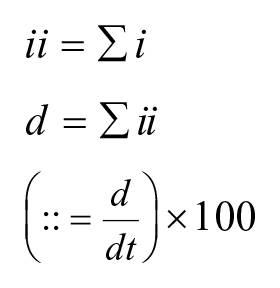
Binary scores (i) were summed for an indicator. For example, if an intersection has four intersecting streets and an indicator is present at three of four streets, the total indicator score (ii) is 3. All total indicator scores (ii) that make up a dimension were then summed to create a dimension total (d), which was then divided by the total possible dimension score (dt) to create a proportion (::). The total possible dimension score (dt) is the dimension total (d) observed if all dimension indicators were present on all intersecting streets. For instance, the total possible physical disorder score, a dimension with eight indicators, for a camera site with four intersecting streets is 32. Finally, proportions (::) were converted to percentages (i.e., multiplied by 100) for ease of interpretation.
Each of the five models also included crime script “facilitating factors” not already accounted for within the typical conditions as control variables. These are variables within each scene of the crime script that Sytsma and Piza (2018) identified as being significantly associated with typical conditions observed in the subsequent scene and include seller age range (1 = late teens/early 20s, 0 = greater than late teens/early 20s), and time of day (1 = daytime, 0 = not daytime). These models also controlled for setting (1 = commercial area, 0 = mixed/residential area), and length of the street segment as measured in the Newark street centerline geographic information system (GIS) file maintained by the City of Newark. Finally, to determine whether typical conditions are conditional on the outcomes of previous actions in the crime script sequence, each typical condition was used as a predictor of the following condition in the sequence. All predictors were added to the model in a step-wise fashion. Regarding the full model containing all predictors, although there is empirical support for relaxing the sample size assumption of logistic regression (see Vittinghoff & McCulloch, 2006), these models should be interpreted with caution given the large number of predictors employed. Standard errors were clustered by CCTV camera identification number to account for differing characteristics of the camera locations. Robust standard errors were used to account for heteroskedasticity of sample variance.
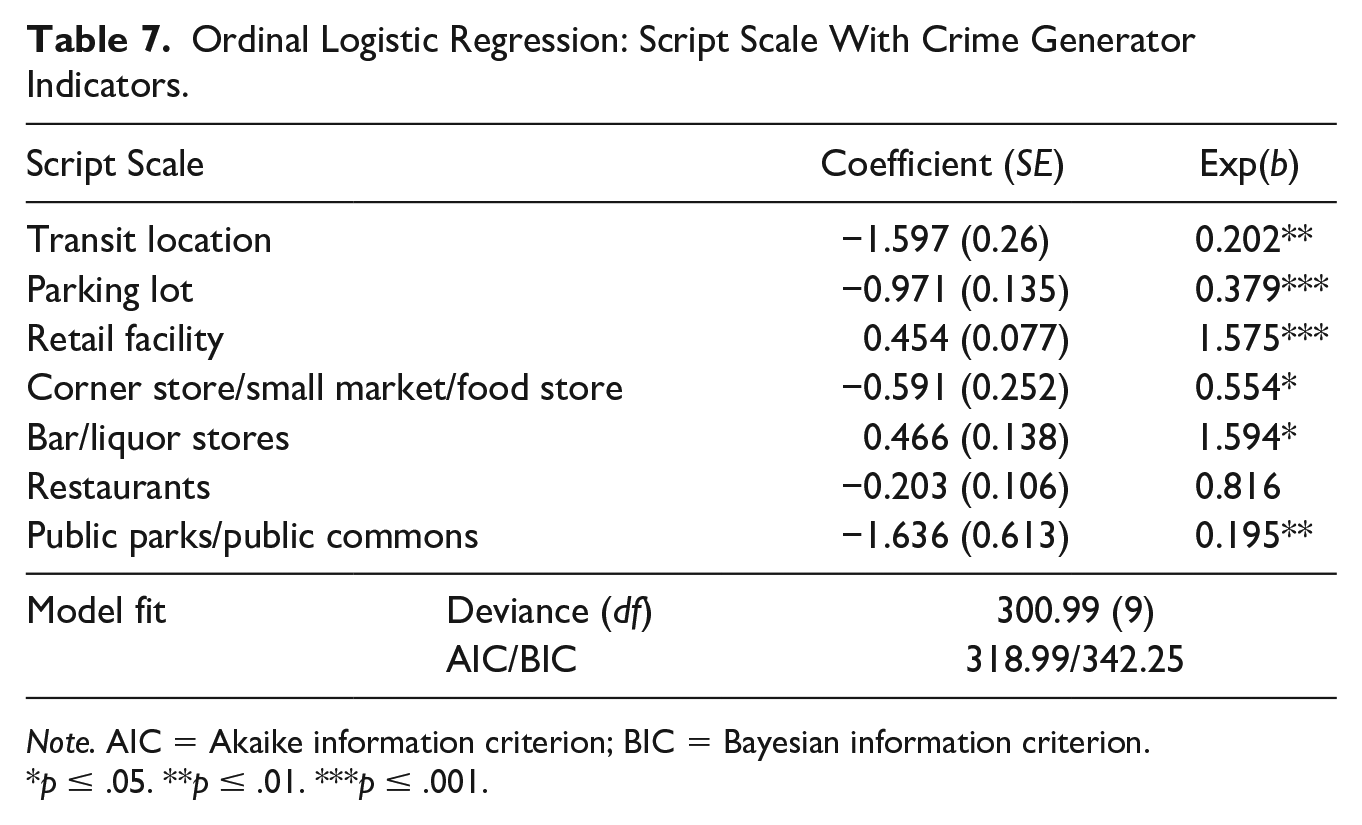
Following the models using individual typical conditions as dependent variables, an ordinal regression model was run to explore how environmental characteristics predict the script as a whole. For this model, a 6-point ordinal scale ranging from 0 to 5 was created that combines each typical condition. Independent variables remained the same for this crime script scale model. Results from this model (discussed below) indicated further exploration of the crime generator dimension was warranted. A final ordinal regression model was run with the 6-point script scale as the dependent variable, and each of the seven crime generator indictors as predictors.
Results
Descriptive statistics for typical conditions, the script scale, facilitating factors, and setting can be found in Table 2. Of the 98 drug transactions under study, 10 are completely on script, but approximately 61% of transactions include three or more typical conditions and almost 86% include two or more of five typical conditions. Only two transactions do not follow the established script at all.
Descriptive Statistics: Typical Conditions, Facilitating Factors, Setting, and Script Scale.
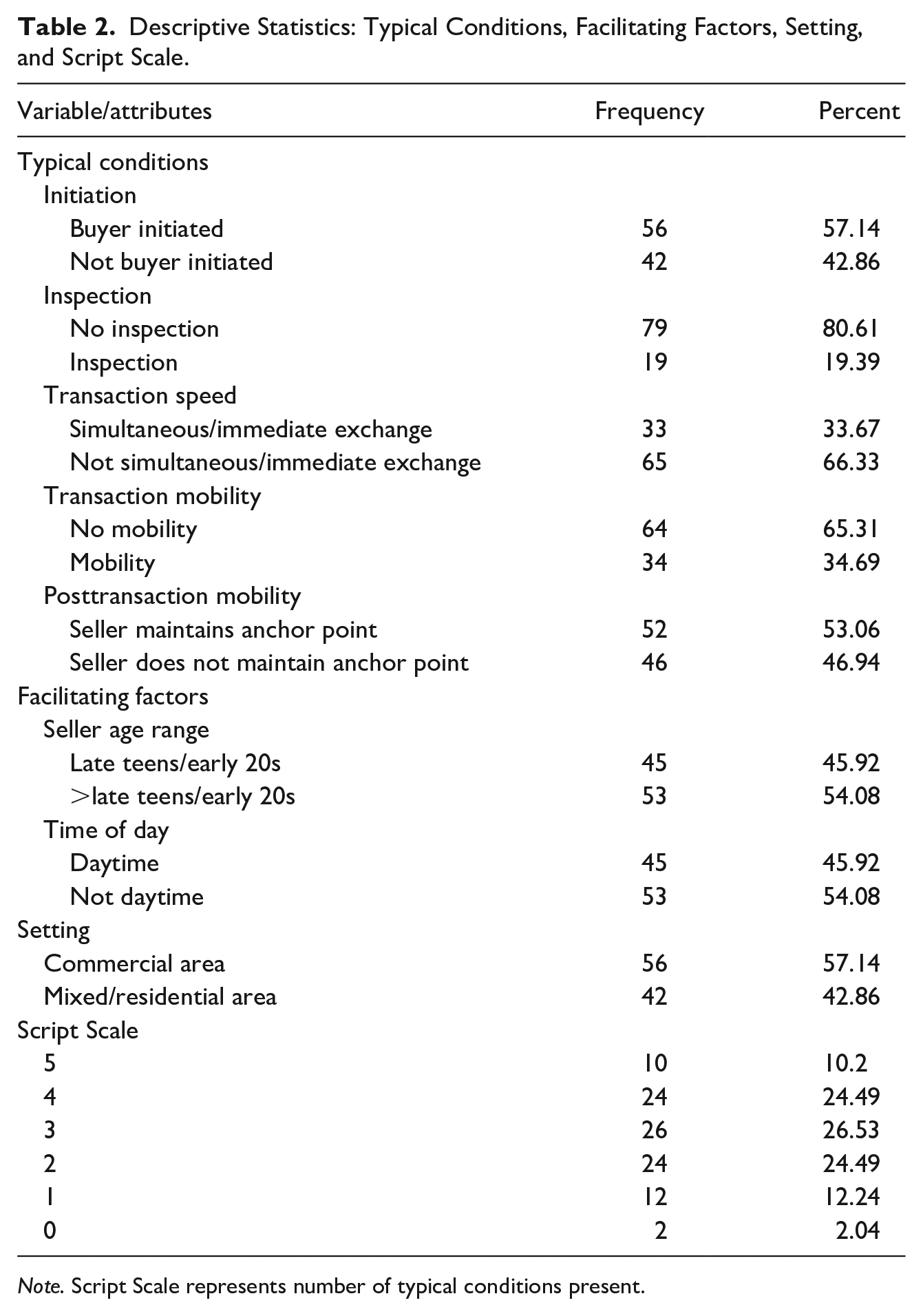
Note. Script Scale represents number of typical conditions present.
Determining the Environmental Characteristics of the Drug Market
Of all of the physical disorder indicators under study, garbage/litter is the indicator found on the most street segments (n = 24) within Newark’s open-air drug markets, followed by graffiti (n = 20) and broken/boarded up windows (n = 17). Abandoned, burned, or vandalized buildings (n = 14), and empty or broken bottles (n = 8) present moderately. Of the 38 street segments under study, there are no instances of abandoned, burned, or vandalized cars, and vandalized/faded signage presents on one street segment. Broken/ineffective fences are also fairly rare (n = 3).
Of the 38 street segments coded, 19 include vacant spaces (the most frequently present indicator of decay), and street deterioration is present on one street segment. Sidewalk deterioration (n = 11), and garden or lawn deterioration (n = 14) each present moderately. Transit locations are the most frequently present crime generator within Newark’s open-air drug markets (n = 17), followed by restaurants (n = 15). Parking lots (n = 7), retail facilities (n = 13), corner stores, small markets or food stores (n = 14), and bars and liquor stores (n = 9) each present moderately. Public parks/common areas are the least frequently present crime generators, with these spaces presenting on three street segments. See Table 1 for descriptive statistics of the environmental indicators.
Predicting Drug Seller Action Sequences
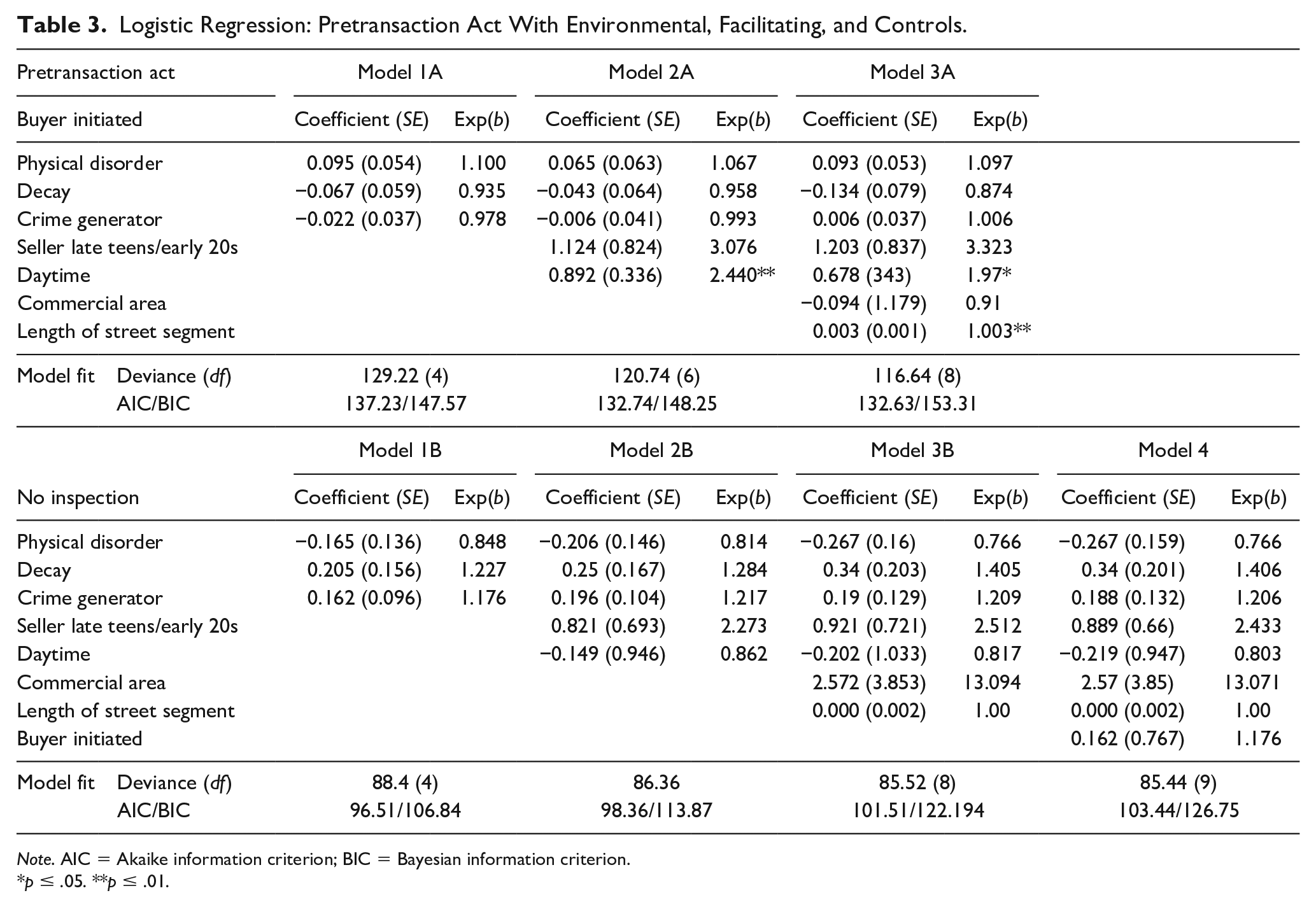
Table 3 presents the findings of models containing the two typical conditions found in the pretransaction act: initiation and inspection. When the models contain only the environmental dimensions (Models 1A and 1B), none are significant predictors of the odds of a transaction being buyer initiated, nor are any dimensions significant predictors of the odds of a transaction having no product inspection. Adding facilitating factors to the models (Models 2A and 2B) does not change the results for the environmental dimensions, but the strongest predictor of a transaction being buyer initiated is the transaction taking place during the daytime, as opposed to evening or night. When the other control variables are included (Models 3A and 3B), length of street segment is significant, but with a small effect size. Controlling for the model, the buyer-initiated typical condition is not a significant predictor of the subsequent condition, buyer inspection (Model 4).
Logistic Regression: Pretransaction Act With Environmental, Facilitating, and Controls.
Note. AIC = Akaike information criterion; BIC = Bayesian information criterion.
p ≤ .05. **p ≤ .01.
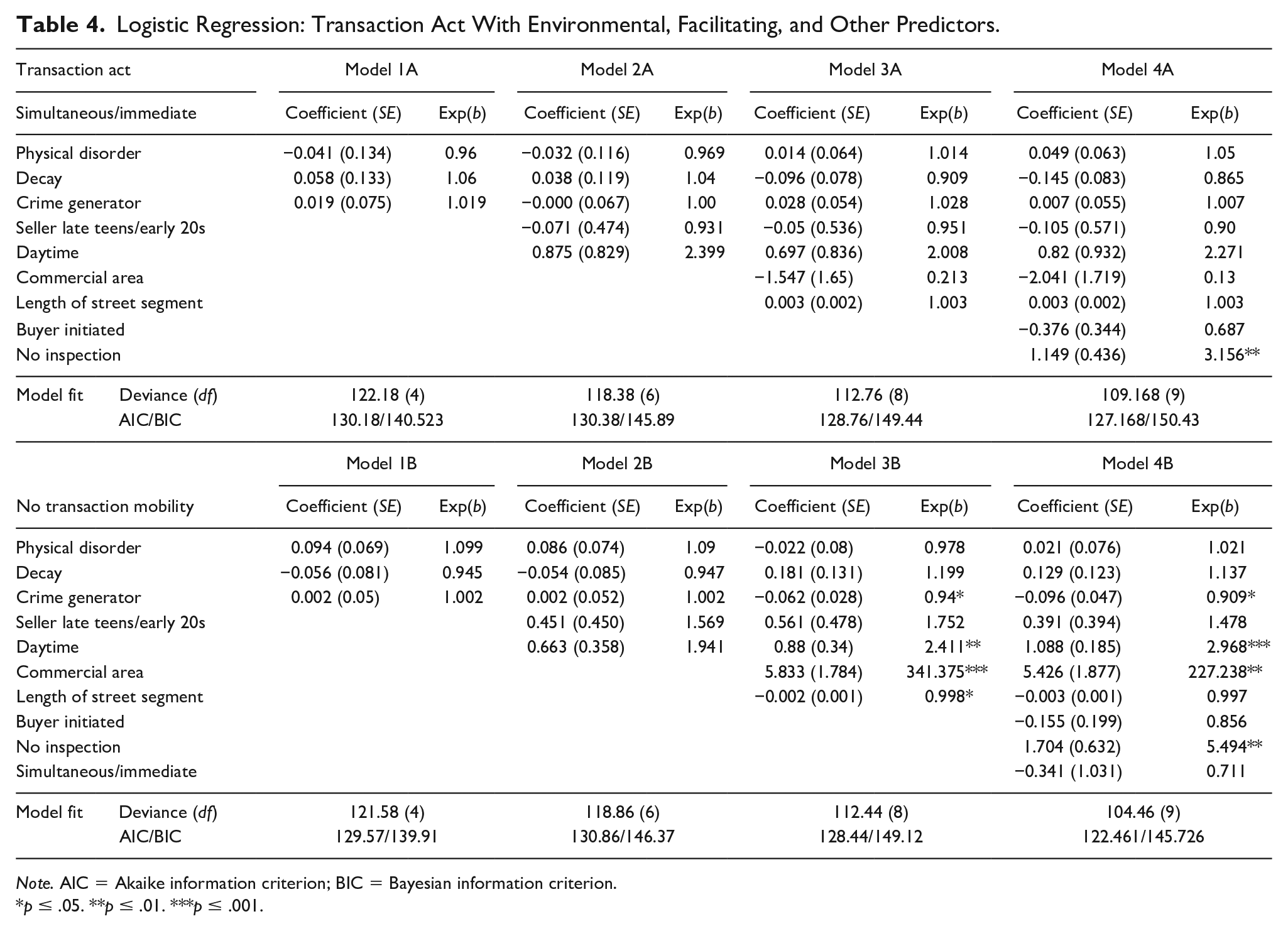
Table 4 presents the findings of the models containing the two typical conditions found in the transaction act: transaction speed and transaction mobility. When the environmental dimensions are included in the models (Models 1A and 1B), none of the dimensions are significant predictors of either the transaction exchange being simultaneous and immediate in nature, or the lack of transaction mobility. When the facilitating factors are added (Models 2A and 2B), the results do not change, nor are either of the facilitating factors significant in both cases. That said, when the other control variables are included (Models 3A and 3B), the crime generator dimension becomes significant in Model 3B. For each percent increase in the proportion of the crime generator composite, the odds of there being no mobility during the transaction (the second typical condition of the transaction act) decreases by 6%, controlling for the model. In other words, as the proportion of crime generators increases, the odds of going off-script during the transaction act increases. Setting is by far the strongest predictor of transaction mobility not occurring (Model 3B), with commercial areas increasing the odds of immobility (staying on script) by 341.4 times, controlling for the model. Although buyer initiated is not a significant predictor of simultaneous and immediate exchanges, there being no product inspection is significant (Model 4). Buyers not inspecting product increases the odds of the transaction being simultaneous and immediate by 1.15 times. No inspection is also a significant predictor of there being no transaction mobility.
Logistic Regression: Transaction Act With Environmental, Facilitating, and Other Predictors.
Note. AIC = Akaike information criterion; BIC = Bayesian information criterion.
p ≤ .05. **p ≤ .01. ***p ≤ .001.
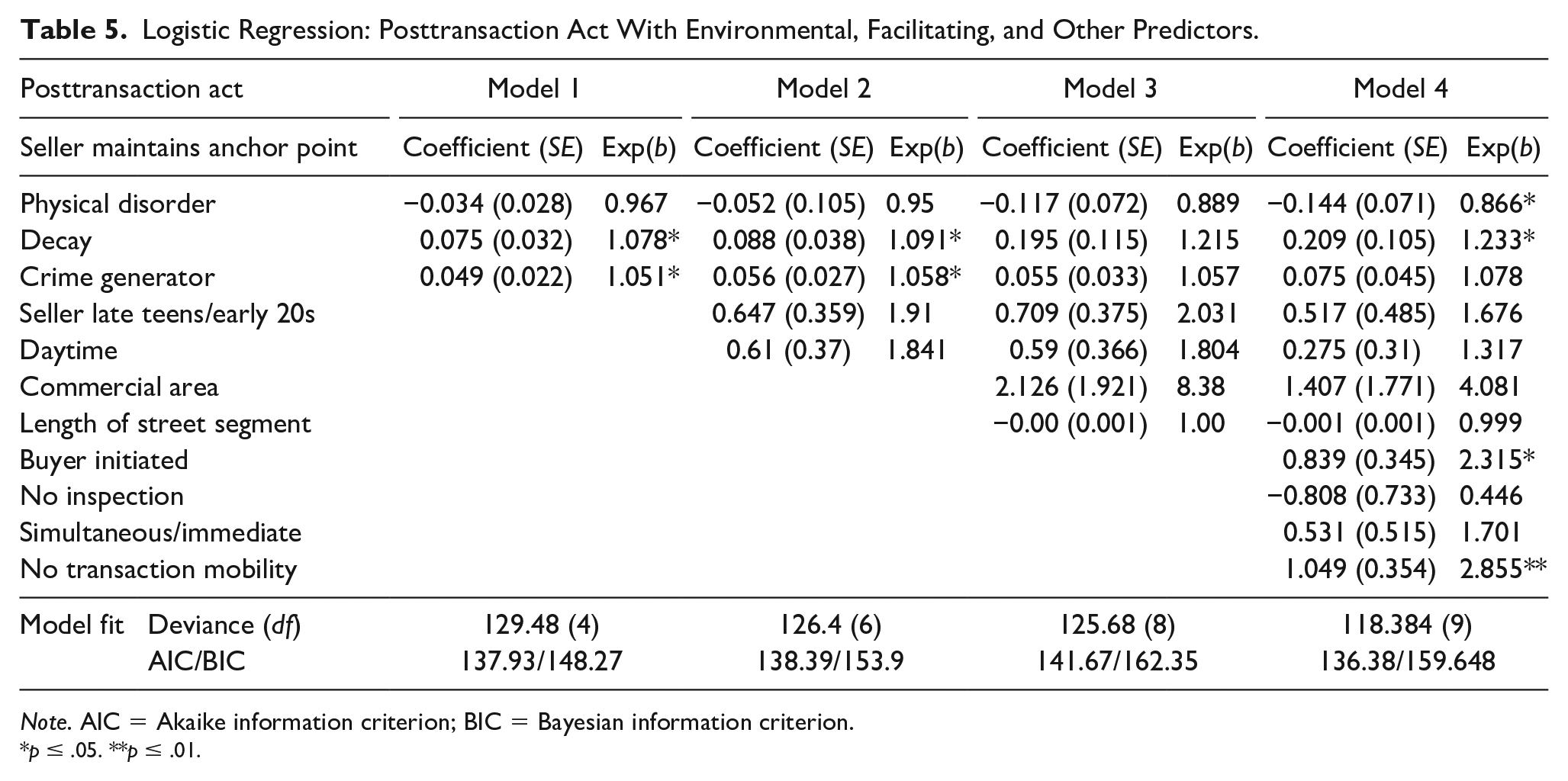
Table 5 presents the findings of the posttransaction act model, which only includes the typical condition around posttransaction mobility. During the posttransaction act, both the physical decay and crime generator dimensions are significant predictors of the seller maintaining anchor point (staying “on-script”; Model 1). These findings remain when facilitating factors are added to the model (Model 2), but when setting and street segment length are added to the model (Model 3), the physical decay and crime generator dimensions are no longer significant. Both buyer initiation and lack of transaction mobility are significant predictors of seller maintaining anchor point during the posttransaction act (Model 4).
Logistic Regression: Posttransaction Act With Environmental, Facilitating, and Other Predictors.
Note. AIC = Akaike information criterion; BIC = Bayesian information criterion.
p ≤ .05. **p ≤ .01.
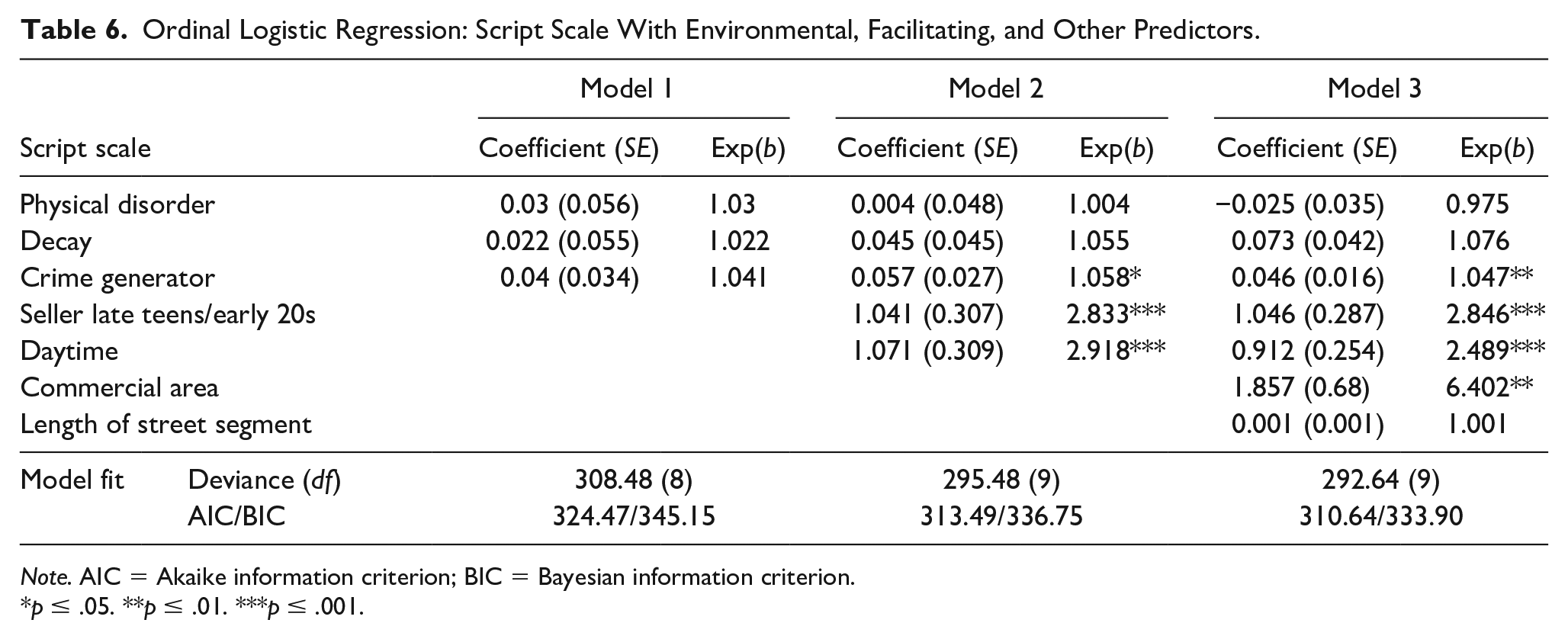
When the dependent variables are combined into a 6-point Crime Script Scale, which is a combination of each of the typical conditions previously assessed individually (ranging from 0–5), the crime generator dimension is the only environmental characteristic dimension that is a significant predictor of staying on script (see Table 6), but not when the environmental dimensions are included without other controls (Model 1). It is not until facilitating factors are added to the model (Model 2) that the crime generator dimension becomes significant and the effect size actually increases from Model 1 to Model 2 and Model 3. Each percent increase in the proportion of crime generator indicators increases the odds of all five typical conditions of the crime script being present compared with the lower four script categories by 1.05 times or about 5%, controlling for the model (Model 3). The facilitating factors (seller age range and time of day) are both significant in Model 2 and remain as such when additional controls are added to the model (Model 3). Setting (commercial area) is the strongest predictor of staying on script.
Ordinal Logistic Regression: Script Scale With Environmental, Facilitating, and Other Predictors.
Note. AIC = Akaike information criterion; BIC = Bayesian information criterion.
p ≤ .05. **p ≤ .01. ***p ≤ .001.
When the crime generator dimension is broken down into individual indicators (see Table 7), all indicators except the presence of restaurants are significant predictors of staying on the predominate drug transaction crime script. With that said, many indicators decrease the odds of all five typical conditions of the crime script being present. This is the opposite direction observed when indicators are combined into one composite measure. The exceptions to this are retail facilities, and bars and liquor stores. These indicators both increase the odds of all five typical conditions of the crime script being present by 58% and 59%, respectively. The largest significant predictors are the presence of transit locations, and the presence of public parks or public commons. The presence of a transit location decreases the odds of all five typical conditions of the crime script being present by 0.2 times or 80%, controlling for the model. The presence of public parks or public commons also decreases the odds by approximately 0.2 times or 80%.
Ordinal Logistic Regression: Script Scale With Crime Generator Indicators.
Note. AIC = Akaike information criterion; BIC = Bayesian information criterion.
p ≤ .05. **p ≤ .01. ***p ≤ .001.
Discussion and Conclusion
Although the majority of Newark’s open-air drug markets contain garbage/litter, litter may be considered a fairly mild form of physical disorder. Observing abandoned, burned, or vandalized buildings, although less common, brings a higher degree of severity. Similarly, although garden or lawn deterioration is common in this setting, it may be considered merely a mild eyesore compared with the vacant spaces found on 50% of street segments within Newark’s open-air drug markets. Despite these environmental indicators characterizing Newark’s open-air drug markets, this study does not find strong evidence that physical disorder and decay predict the predominate open-air drug-selling crime script.
It may be that although disorder and decay do not appear to influence the sequence of the crime event, a particular geography may have become a drug market because of its disorderly characteristics. However, perhaps physical disorder and decay did not characterize these areas until the drug markets emerged. Regardless of temporal order, previous research does suggest a relationship between physical disorder and crime. For instance, physical disorder in the form of decay and infrastructure-related neglect has been found to be an indicator of crime at the microlevel (Wheeler, 2018). Additional research has stressed the importance of studying the unique microcommunities that comprise small-scale environments (Sampson, 2012; Weisburd et al., 2016), determining that like crime, disorder tends to concentrate in a few “hot spots” across the landscape of a city (Yang, 2010). Despite the physical environment not influencing the transaction script in the present study, there is evidence that physical characteristics of the immediate environment are indicators of drug market presence.
Transit locations, restaurants, retail facilities, and corner stores are all common crime generators observed within Newark’s open-air drug market. In contrast to disorder and decay, there is a relationship between such crime generators and the drug-selling crime script, but it is somewhat complex. As the proportion of crime generators increases, the odds of going off-script with regard to transaction mobility during the transaction act increases—crime generators predict mobility where no mobility is the typical condition. Conversely, the crime generator dimension is a positive predictor of the script as a whole. When the dimension is broken down into its indicators, we find that both retail facilities and bars and liquor stores predict staying on script. Thus, in addition to predicting crime generally (Hipp, 2007; Nielsen & Martinez, 2003; Peterson et al., 2000; Sherman et al., 1989; Smith et al., 2000; Twinam, 2017), liquor and retail outlets predict open-air drug selling that follows a specific script. These indicators can be considered environmental facilitators toward the established crime script, complementing Jacques and Bernasco’s (2015) conceptualization of facilitating steps, and Sytsma and Piza’s (2018) identification of typical conditions, and facilitating factors.
Transit locations, corner stores, and public parks predict a deviation from the predominate script and can be considered environmental inhibitors. Environmental inhibitors do not inhibit the crime from taking place, but if the crime is to take place, these environmental features influence one’s abandonment of the predominant script. Furthermore, the variability in direction of the individual crime generator indicators suggests that once a seller is operating within the market, they use the various crime generators to gain cues on whether or not to follow the predominate script. These ideas are consistent with research that has found individuals interact with the environment (Moreto et al., 2014) and respond to environmental cues regarding opportunity for crime (P. J. Brantingham et al., 2017).
A commercial setting is consistently the strongest predictor of drug sellers in Newark staying on script. Citing Agar (1973) and Mieczkowski (1992), Piza and Sytsma (2016) suggest that the increased guardianship and fast-paced nature of drug markets located in commercial areas do not afford sellers the luxury of certain defensive actions, such as off-person stash spots and delayed exchanges. Similarly, perhaps commercial areas do not afford sellers the option of variability of sequence. It appears that there are fewer crime commission sequence options, which are likely to result in a “successful” transaction in a commercial setting given the volume and nature of the activity occurring in such areas; thus, sellers are fairly committed to the predominate crime script when active in commercial areas.
Finally, although some typical conditions predict subsequent conditions in the crime script, the impact of such predictors varies across the individual acts that comprise the script. Buyers not inspecting product increases the odds of the transaction being simultaneous and immediate, but this is not surprising given that taking the time to inspect a product necessarily adds additional actions to the exchange. No inspection predicting the lack of mobility during the transaction is interesting. Open-air drug markets can often be characterized as spaces where sellers occupy regular anchor points, and buyers patron those sellers who are known to them (Harocopos & Hough, 2011; Sytsma & Piza, 2018; Weisburd et al., 2006; Weisburd & Green, 1995). Sellers may feel there is no need to inspect product when they are regular customers of buyers who can reliably be found at their usual spot. With that said, Sytsma and Piza (2018) characterize the Newark drug market as “fast-paced, [and] buyer-led” where there is little time for frivolities, such as product inspection.
The present study suffers from a number of limitations worth mentioning. Limitations surrounding CCTV as a data source have been discussed previously by Piza and Sytsma (2016; see also Sytsma & Piza, 2018), as has the limited scope of the original crime script that the current study relies upon. Limitations inherent in CCTV footage are somewhat exacerbated by the static nature of GSV imagery. In particular, GSV images are captured cross-sectionally at a singular point in time, during daylight hours. More than half (53 of 98; 54.1%) of the observations occurred during evening hours. This has minimal implications for our time-invariant variables, such as the presence of crime generators, the presence of abandoned buildings, and vacant spaces, which comprise the majority of our indicators. However, our time-variant variables, such as the presence of litter or empty/broken bottles, have the potential to move in and out of environments with a certain degree of frequency.
In addition, Sytsma and Piza (2018) developed their script through SSO and, therefore, were unable to observe the cognitive processes of the various actors as they move from one action to another. Similarly, due to the nature of the data, we cannot empirically determine which actor is driving the interactions at various stages within the present study. Transactions were coded as either buyer- or seller initiated based upon visual evidence of which party was responsible for establishing contact (e.g., the buyer either approached the seller or the seller approached the buyer). However, we acknowledge that the lack of audio in the footage complicates this coding, as we are unable to determine whether the buyer and seller were previously known to each other, meaning that the contact may have been prearranged rather than initiated on scene by either party.
In addition to these issues, due to the restricted time period set by Sytsma and Piza (2018), the present study only represents 1 year of drug market data. Furthermore, due to the locations of the 98 drug transaction events observed by Piza and Sytsma (2016) and captured by 10 CCTV cameras, we were only able to document the environmental context of 38 street segments. One potential avenue for inquiry in future work is to observe the environmental characteristics of areas known not to be drug markets as a point of comparison. Similarly, it may be useful to observe a wide variety of street-level crime types, develop scripts for those crime types, and document the environmental contexts of each crime type to add to the literature diversity of scripts and associated environments.
Finally, despite the relatively large number of indicators explored, content validity of the environmental dimensions could be improved. It is possible there are indicators of disorder, decay, and crime generators that are not captured here, and existing measures could be strengthened with a severity scale or total observation counts for each indicator. Although GSV is a powerful tool, in many ways, it is not a replacement for in-person observation. With that said, we feel the strengths of GSV, such as convenience and openness to replication, are not insignificant.
Despite limitations, the research contributes a description of the environmental characteristics of an open-air drug market and is the first to move beyond describing locations an offender visits during the crime commission sequence to identify environmental facilitators and inhibitors toward an established open-air drug-selling crime script. We offer the relatively novel approach of conducting an SSO of drug market areas though GSV. Dehghanniri and Borrion (2019) comment on the potential contribution to the literature that various types of crime scripts can make. They note the value of indicating crime commission sequence variations and details about how the environment can influence variations. The present study makes such a contribution.
Footnotes
Declaration of Conflicting Interests
The author(s) declared no potential conflicts of interest with respect to the research, authorship, and/or publication of this article.
Funding
The author(s) received no financial support for the research, authorship, and/or publication of this article.
