






Abstract
We examined the association between normative beliefs about aggression toward police (NBAGG→P) and participation in social protests during 2019–2020 and use of aggression among 1,025 Hong Kong university students. We also investigated the role of ecological risks (i.e., distrust in institutions, exposure to community violence, poor family monitoring, poor university discipline and affiliation with delinquent peers) and future orientation in NBAGG→P. The results showed that NBAGG→P was related to more participation in social protests and use of aggression. Ecological risks (except for poor family monitoring) and a positive future orientation were related to more and less NBAGG→P, respectively. Moreover, the “distrust in institutions and NBAGG→P” link was stronger for students with more, rather than less, positive future orientation.
Keywords
During 2019–2020, ample social protests accompanied by substantial aggression and violence between protestors and police occurred in Hong Kong. Many university students were actively involved in the protests, differing in attitude toward the use of aggression toward police (Shek, 2020). Given that aggressive attitude is a robust predictor of aggressive behavior (Ang et al., 2017; Kikas et al., 2009), understanding university students’ aggressive attitude toward police is important because it may shed light on how aggressive social participation can be mitigated, and potentially even converted into constructive participation. In this study, we investigated normative beliefs about aggression toward police (NBAGG→P)—a term derived from normal beliefs about aggression (NBAGG; Huesmann & Guerra, 1997)—among Hong Kong university students. First, we aim to quantify the levels of NBAGG→P among students and explore the extent to which they are related to students’ participation in social protests and use of aggression during protests. Second, drawing upon the risk-resilience model (Masten, 2001), we aim to examine the association between multiple ecological risks and NBAGG→P. Third, the Hong Kong government has highlighted the importance of nurturing young people to develop a positive future orientation in restoring social reconciliation (Policy Innovation and Co-ordination Office [PICO], 2019). To echo this, we also aim to examine whether a positive future orientation, a well-known factor that protects against aggression (Miconi et al., 2020; So et al., 2018), would play a protective and moderating role.
Overview of the Social Protests in Hong Kong during 2019–2020
In February 2019, the Hong Kong government proposed the Fugitive Offenders and Mutual Legal Assistance in Criminal Matters Legislation (Amendment) Bill regarding the extradition of offenders (hereafter “the extradition bill”). The extradition bill was proposed to arrange mutual legal assistance between Hong Kong and any place outside Hong Kong for the transfer of fugitives. However, the extradition bill received much criticism and a number of social protests took place, led primarily by young people, with the aim to retract the extradition bill. After several intensive protests, the extradition bill was suspended in June 2019 and officially withdrawn in October 2019 (Lo et al., 2021). Nevertheless, protests continued with the aim to strike for the five demands (i.e., full withdrawal of the extradition bill, a commission of inquiry into alleged police brutality, retracting the classification of protesters as “rioters,” amnesty for arrested protesters, and dual universal suffrage, meaning for both the Legislative Council and the Chief Executive).
The protests were rare and generally peaceful before June 2019. However, as the protests evolved, physical confrontations between protestors and police emerged. After June 2019, the protests have escalated into aggression and violence—protestors showed considerable aggression toward the government, innocent citizens, public properties, and in particular toward the police because of protestors’ perception of the police’s excessive and brutal enforcement. As the situation escalated, police resorted to aggressive and violent ways to handle the aggressive acts during protests. Later, protestors even occupied several universities to have armed confrontation with the police during November and December 2019. The frequency and intensity of protests reduced in early 2020 due to the outbreak of COVID-19 and further attenuated since the promulgation of the National Security Law Hong Kong in mid-2020. The protests have caused tremendous harm to Hong Kong’s economy and public safety (Census and Statistics Department, 2020; Hong Kong Police Force, 2020).
In order to handle the social protests and restore social reconciliation, the Hong Kong government called for an urgent scholarly investigation of various topics related to the social protests in late 2019, such as the identification of causes and underlying mechanisms of aggression as well as the recommendations on possible solutions to address the public’s attitudes toward violence (PICO, 2019).
Normative Beliefs about Aggression toward Police
NBAGG refers to an individual’s attitudes about the acceptability of aggression and individuals high in NBAGG tend to consider aggression acceptable (Huesmann & Guerra, 1997). To measure this construct, Huesman and Guerra (1997) devised the Normative Beliefs about Aggression Scale that assesses individuals’ beliefs about how acceptable it is to show aggression toward an unknown third party (e.g., a boy, a girl, and others). A number of studies have supported that people high in NBAGG are more likely to engage in aggressive, violent, and bullying behavior than those low in such beliefs (Ang et al., 2017; Kikas et al., 2009; Li et al., 2015; Wright & Li, 2013.
In this study, we applied NBAGG to the context of social protests in Hong Kong. Based on the definition of NBAGG, we conceptualize NBAGG→P as an individual’s attitude about the acceptability of protestors’ use of aggression toward the police during protests. Correspondingly, we adapted Huesman and Guerra’s (1997) Normative Beliefs about Aggression Scale to measure NBAGG→P. This approach has been adopted by Gvirsman et al. (2016) who examined normative beliefs about aggression toward outgroup among Palestinian/Israeli young people. Confirming the generalizability of the scale to different contexts, the authors found that normative beliefs about aggression toward outgroup was related to more aggressive behavior.
The request for an independent investigation of alleged policy brutality was a crucial trigger of the social protests, because protestors perceived that police used excessive and brutal force when handling the protests (Shek, 2020). A survey conducted among the public found that about 20% of the respondents endorsed the use of various forms of aggression against the police, including the use of petroleum bombs, bricks, and laser pointers (Sum, 2019).
Because NBAGG is consistently related to aggression and violence (Ang et al., 2017; Kikas et al., 2009; Li et al., 2015; Wright & Li, 2013), NBAGG→P may be a robust predictor of aggression and violence in protests, too. Scant research has systematically examined Hong Kong university students’ NBAGG→P so far. Therefore, the first aim of this study is to examine the levels students’ NBAGG→P and their relation to the frequency of participation in protests and actual use of aggression during protests. We consider that students with higher levels of NBAGG→P are more discontent with police’s enforcement. Therefore, they would participate in more protests to exact an investigation of alleged police brutality, and would also tend to use aggression toward police. In this sense, NBAGG→P would be likely related to more participation in protests and use of aggression.
Ecological Risks and Normative Beliefs about Aggression
The main effect model of the risk-resilience model suggests that environmental risks (e.g., community violence) are related to undesirable developmental outcomes while personal assets (e.g., intelligence) are related to desirable outcomes (Masten, 2001). Moreover, the compensatory tenet of the model suggests that personal assets may buffer the influence of environmental risks on the outcomes, with the negative effect of environment risks being less pronounced for individuals with more personal assets than those with fewer assets. For instance, children raised in risky environments engage in more aggressive behavior, but positive parenting buffers the effect of risky environment on children’s aggressive behavior (cf. Masten, 2001). The risks that may affect developmental outcomes are multiple and can emerge from various social-ecological systems (Ungar et al., 2013). In this study, we identified five risks relevant to university students’ NBAGG→P, ranging from distal to more proximal social systems (i.e., distrust in institutions, exposure to community violence, poor family monitoring, poor university discipline, and delinquent peer affiliation). However, because little research has examined NBAGG→P in the existing literature, we based our selection of risk factors on studies that examined the association between the presumed risks and endorsement and enactment of aggressive behavior.
First, distrust in institutions is a risk at the societal level. The occurrence of social protests in Hong Kong has decreased the public’s trust in the legal system and the government (Public Opinion Programme, 2020; Shek, 2020). Individuals who do not trust institutions (e.g., government, police, journalism) do not believe that institutions are reliable, work well, or serve the general public interest. Qualitative findings have suggested that young people’s distrust in institutions is one of the factors related to their aggressive and violent thoughts and behavior against their legal systems such as the police (de Haan & Nijboer, 2005). Although scant quantitative research has directly examined the association between distrust in institutions and aggressive attitudes, prior studies found that young people’s distrust in institutions was associated with more engagement in political protests and collective violence often emerges during political protests (Burean & Badescu, 2014).
Second, exposure to aggression and violence is a risk at the community level. The social protests in Hong Kong were accompanied with tremendous aggressive and violent acts (e.g., arson, violent crime), rendering public safety a huge concern for the society (Hong Kong Police Force, 2020). Community aggression and violence reminds people of the aggressive cues in the context, which may increase their aggressive beliefs and behavior. This link can be understood from the lens of social learning theory and pathological adaptation model. In light of the social learning theory (Bandura, 1977), aggression and violence in the environment provide young people with the abundant exemplary thoughts and behavior and repeated exposure to community violence may cause them to develop a cognitive script that aggression is normal. The pathologic adaptation model conveys a similar proposition that individuals repeated exposed to violence would become blunted and come to view violence as permissible and develop uncaring attitudes toward others (Ng-Mak et al., 2002). Previous studies found that children and young people who are frequently exposed to community violence tended to have higher levels of normative beliefs about aggression (Gvirsman et al., 2016; McMahon et al., 2009; Orue et al., 2011).
Third, poor family monitoring is a risk at the family level. According to the general theory of crime (Gottfredson & Hirschi, 1990), ineffective parenting (e.g., poor monitoring) is an important antecedent of insufficient self-control, which is the major cause of crime and analogous behavior (e.g., aggression). Prior research found that poor monitoring was linked to more aggressive behavior and more endorsement of aggression among children and adolescents (Duong, 2014; Pinquart, 2017; Unnever et al., 2006). For university students, the family’s role in socialization diminishes from adolescence to emerging adulthood, but family remains a crucial socialization agent facilitating the development of their self-regulation, positive beliefs and values, and social skills (Arnett, 2007). Although little research has directly examined the association between family monitoring and NBAGG→P, empirical evidence suggests that poor monitoring is related to more deviant/delinquent behavior (e.g., aggression) among university students (Vazsonyi & Belliston, 2007).
Fourth, poor university discipline is a risk at the school level. During protests, university students in Hong Kong have posted enormous anti-government materials around the campus, and some students even showed (verbal and physical) aggression toward other students on campus (Chien, 2019; Wong & Cheung, 2019). However, most university authorities did not consistently enforce the university rules to stop such behavior. School is as an important context for child and adolescent development (Gottfredson & Hirschi, 1990; Sameroff, 2010). A good school discipline consists of setting clear limits for students’ behavior and enforcing the school rules consistently and fairly; a poor school discipline refers to ambiguous rules and inconsistent and unfair enforcement of rules (Gregory & Cornell, 2009). While elementary and middle schools often execute school discipline to regulate students’ behavior, university is often thought to be less restrictive, accommodate and host more diverse voices, grant students greater autonomy, and more rely on students’ self-management (Flanders, 2018). Nevertheless, Flanders considered that the university is the extension of high school and thus discipline in the university continues to be necessary and important because it facilitates students’ learning and growth. In this regard, we consider that poor university discipline (e.g., loose and inconsistent enforcement of university rules) would be related to more endorsement of aggressive behavior. Although this idea received little direct examination among university students, prior research has found that poor school discipline is related to more aggressive behavior and NBAGG among children and adolescents (Duong, 2014; Gregory et al., 2010).
Finally, delinquent peer affiliation is a risk at the peer level. University students typically engage in social protests with their peers and have their own social media groups communicating with each other (Shek, 2020, Wong & Cheung, 2019). Peers play a key role in shaping young people’s behavior in both positive and negative ways (Steinberg & Morris, 2001). Aggressive young people are typically part of antisocial peer groups (Underwood et al., 1996), because socialization in the delinquent subculture reinforces acquisition of deviant thoughts and behaviors through observational learning and norm reinforcement (Paat & Markham, 2016). In addition, Anderson’s (1999) “code of the street” thesis documented that disadvantaged neighborhood structural characteristics (e.g., poverty, joblessness) set up a “street culture” that rejects mainstream values and leads to violence. This thesis further proposes that the street culture rewards the use of toughness, aggressiveness, risk taking and violence because it allows residents to achieve social status among peers. Although no existing research has directly examined the association between delinquent peer affiliation and NBAGG→P, studies have found that young people affiliated with delinquent peers are more prone to engage in transgressive acts and beliefs (Ferguson et al., 2009; Samek et al., 2016; Stewart & Simons, 2006, 2010).
The Moderation Role of Future Orientation
Future orientation refers to an individual’s attitude toward the future (Robbins & Bryan, 2004). It is a multidimensional construct that comprises cognitive (e.g., future expectation), emotional (e.g., future emotion), and behavioral (e.g., planning) components (Steinberg et al., 2009). Future orientation is especially salient for university students who, as emerging adults, find themselves in a developmental period when the exploration of life and career becomes important (Nurmi, 2004). Individuals with a positive future orientation tend to consider the future consequences of their present behavior and think about their future outcomes (Kooij et al., 2018). Thinking of oneself in a desirable future state motivates individuals to engage in behaviors that foster, or to avoid behaviors that reduce, the desirable outcomes (So et al., 2018). As aggression is related to detrimental outcomes in emerging adulthood (e.g., increased mental health problems; Ostrov & Houston, 2008), university students with a positive future orientation are likely to show fewer aggressive attitudes or behaviors. Prior research has found that a positive future orientation is associated with less aggression (Miconi et al., 2020; So et al., 2018).
As a personal asset, a positive future orientation not only protects against aggressive attitudes and behavior, but it may also buffer the effects of ecological risks on aggressive outcomes. Future orientation makes people hopeful and optimistic (Steinberg et al., 2009). As such, young people who possess a positive future orientation are assumed to be more capable of navigating the ecological risks compared to those who are faced with the same amount of risks but do not sustain a positive future orientation, which may weaken the link between ecological risks and aggressive attitudes and behavior. Prior research has found that youth who grew up in a high-risk environment, but sustained hope and positive expectations for the future, were less likely to experience psychosocial problems (e.g., aggressive and risky behavior) compared to those who grew up in the same environment but did not sustain hope and positive future expectations (McCabe & Barnett, 2000; So et al., 2018; Stoddard et al., 2011). In this regard, we consider that a positive future orientation may buffer the association between ecological risks and NBAGG→P. However, little research has directly examined this issue.
The Current Study
Based on the literature reviewed above, we come to know that while a number of studies have examined the associations between various ecological risks as well as future orientation and aggressive behavior, little research has investigated the relationship between ecological risks and NBAGG→P. In this study, we examined the following questions among Hong Kong university students: (1) what are the levels of NBAGG→P and what is its relation to students’ participation in protests and use of aggression during protests; (2) are the identified ecological risks and future orientation related to NBAGG→P; and (3) does a positive future orientation buffer the effect of ecological risks? Correspondingly, we hypothesized that: (a) there would be a positive association between NBAGG→P and participation in protests and use of aggression during protests; (b) ecological risks would be positively and future orientation would be negatively related to NBAGG→P; and (c) future orientation would play a buffering role, such that the association between ecological risks and NBAGG→P would be stronger for those students with less than those with more positive orientation. In addition, we controlled for several demographic variables (e.g., sex, age) and NBAGG to rule out their effects. The hypothetical relationships are illustrated in Figure 1.
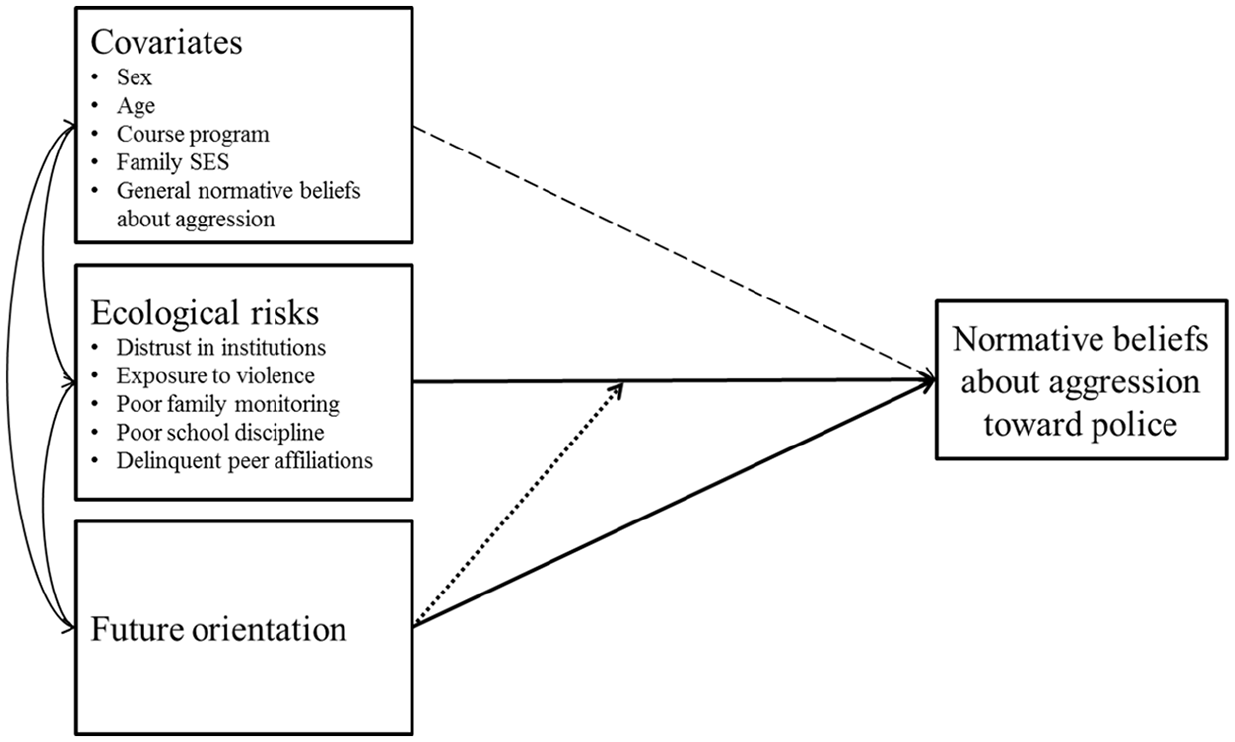
Conceptual model of the associations between ecological risks and normative beliefs about aggression toward police and the moderation of future orientation.
Method
Participants and Procedure
We employed a stratified sampling approach to recruit students from eight universities granted by the University Grants Committee (UGC) to take part in an online survey. During May and June 2020, a research assistant contacted the student unions of each targeted school asking them to distribute the survey hyperlink on the social media platforms of their own university (e.g., school forums, WhatsApp Group). Moreover, the first author also asked colleagues who were working in those universities to send out the hyperlink to their students via internal e-mails.
A total of 1,497 university students visited our survey, and 1,241 of them agreed to participate (82.9% participation rate). Among them, 1,025 students provided complete data on the questionnaires, although a few of them did not provide demographic information or indicate the frequency of their participation in social protests and the use of aggression during protests. The final sample size was 1,025 university students (Mage = 20.92 years, SD = 2.80) and the detailed demographic characteristics are summarized in Table 1.
Demographic Characteristics of Participants.

This study was reviewed and approved by the Human Research Ethics Committee of the first author’s affiliation. Participants were presented the information sheet regarding the study and then they indicated their agreement to join the study before proceeding with the survey. Given the sensitivity of the topic of this study, we highlighted anonymity and confidentiality to increase participants’ motivation to participate. It took participants about 25 minutes to complete the questionnaires. As a token of appreciation, each participant received supermarket coupons of HK$150 upon completion.
Measures
Distrust in institutions
We employed the Trust in Institution Scale (OECD, 2017) to measure the extent to which participants trust various institutions (e.g., police, legal system). This scale has six items originally rated on a 10-point scale (from 1 = do not trust at all to 10 = trust very much). To represent participants’ distrust, we reversely scored the items and therefore a higher score indicated more distrust in institutions. A sample item is “How much do you personally trust the Hong Kong’s politicians?” The Cronbach’s α of this scale was .73 in this study.
Exposure to community violence
We used the Exposure to Violence Scale (Schwartz & Proctor, 2000) to measure the extent to which participants had been exposed to violence in the community via witnessing and victimization. This scale consists of 25 items rated on a four-point scale (from 1 = never to 4 = always) and a higher score indicates more exposure to more community violence. A sample item is “During the past year, how many times have you seen or heard somebody else get hit, punched, or slapped?” The Cronbach’s α of this scale was .93 in this study.
Poor family monitoring
We employed the Monitoring subscale of the Adolescent Family Process Scale (Vazsonyi et al., 2010) to measure the extent to which participants’ family monitors their young adult children’s daily activity and whereabouts. This scale consists of five items that measure maternal monitoring and another five items with parallel wordings that measure paternal monitoring. All the items were rated on a five-point scale (from 1 = strongly disagree to 5 = strongly agree). In this study, we combined maternal and paternal monitoring (r = .50) to represent the sum of family monitoring. To represent poor family monitoring, we reversely coded the items and therefore a higher mean score indicated less family monitoring. A sample item is “My father/mother wants to know who I am with when I go out with friends or on a date.” The Cronbach’s α of this scale was .84 in this study.
Poor university discipline
We employed that Experience of School Rules Scale (National Center for Education Statistics, 2005) to measure the extent to which participants are clear about the university rules and the rules are strictly, fairly, and consistently enforced. This scale consists of five items rated on a four-point scale (from 1 = strongly disagree to 4 = strongly agree). To represent poor university discipline, we reversely scored these items. Thus, a higher score indicates that participants are more unclear about their university’s rules and less perceive that the rules are enforced strictly, fairly, and consistently. A sample item is “The university rules are strictly enforced.” The Cronbach’s α of this scale was .75 in this study.
Delinquent peer affiliation
We employed the Delinquent Peer Affiliation Scale (Elliot et al., 1985) to measure how many friends of participants had engaged in various delinquent acts (e.g., gambling, truancy). This scale consists of 10 items rated on a five-point scale (from 0 = none of my friends to 4 = 7 friends or above). A higher score indicates that participants have more friends engaging in different delinquent behaviors. A sample items is “How many of your friends have engaged in gambling?” The Cronbach’s α of this scale was .84 in this study.
Future orientation
Future orientation was construed as future expectation, future-oriented emotion, and planning for the future. Regarding future expectation, we employed the Future Expectation Scale (Jessor et al., 1988) to measure participants’ evaluation of the likelihood of different things that their future life will encounter. This scale consists eight items rated on a five-point scale (from 1 = very low to 5 = very high) and a higher score indicates positive expectation toward the future. Sample items are “What are the chances that you will have a job that pays well?” The Cronbach’s α of this scale was .86 in this study. Regarding emotion toward future, we employed the Future Emotion Questionnaire (Liebenberg et al., 2015) to measure how positive participants felt toward their future. This scale consists of seven items rated on a six-point scale (from 1 = very little to 6 = very much), three of which measuring positive emotions and the remaining four items measuring negative emotions. We reversely scored the items that measure negative emotions and therefore a higher score indicates participants have more positive feelings toward the future. A sample item is “I feel confident about the future.” The Cronbach’s α of this scale was .89 in this study. Regarding future planning, we used the Future Planning Scale used in the YOUth got talent project (Finkenauer, 2020). This scale consists of three items rated on a six-point scale (from 1 = strongly disagree to 6 = strongly agree), and a higher mean score indicates that participants started to plan and have implemented the plan for the future. A sample items is “I have plans for what I am going to do in the future.” The internal consistency reliability of this scale was .81. In this study, these three scales showed high correlations (rs = .45–.59) and we standardized each component and averaged them to reflect a composite score for future orientation. The internal consistency reliability of the total scale was .91 in this study.
General normative beliefs about aggression
We employed the Normative Beliefs about Aggression Scale (Huesmann & Guerra, 1997) to measure participants’ general normative beliefs about the acceptability of aggression in a situation with neutral, unknown third parties. This scale consists of 12 scenario items (e.g., Suppose a girl hits a boy, do you think it’s wrong for the boy to hit her back?) and eight statements (e.g., It is usually OK to push or shove other people around if you’re mad). All the items were rated on a four-point scale (from 1 = totally wrong to 4 = totally OK) and a higher score indicated that participants are more prone to endorse aggression. The Cronbach’s α of this scale was .89 in this study.
Normative beliefs about aggression toward police
To measure participants’ NBAGG→P in the context of social protests, we modified Huesmann and Guerra’s (1997) Normative Beliefs about Aggression Scale to by framing the context as social protests and by changing the neutral, unknown third parties to protestors and police. For instance, the original scenario “Suppose a girl hits a boy, do you think it’s wrong for the boy to hit her back?” was changed to “Suppose a female police officer hits a male protestor, do you think it is wrong for the protestor to hit her back?” In addition, the original statement “It is usually OK to push or shove other people around if you’re mad” was changed to “It is usually OK to push or shove the police around if protestors are mad during protests.” All the items were rated on a four-point scale (from 1 = totally wrong to 4 = totally OK), and a higher score indicated that participants were more prone to endorse protestors’ use of aggression toward police. The Cronbach’s α of this scale was .95 in this study.
Demographic variables
We also collected a number of demographic variables from participants, including their age, biological sex (1 = male, 2 = female), the study level (1 = diploma or higher diploma programs, 2 = associate bachelor or bachelor programs, and 3 = postgraduate programs, and their family socioeconomic status (SES) combined from fathers’ and mothers’ monthly income. In addition, we asked participants to provide the frequency with which they participated in social protests since June 2019 (0 = never, 1 = occasionally, 2 = sometimes, 3 = often) and the frequency they showed (physical or verbal) aggression during protests (0 = never, 1 = occasionally, 2 = sometimes, 3 = often).
Data Analyses
We analyzed the data in SPSS 18.0 and Mplus 7.0, with .05 as level of significance throughout the analyses. First, we employed Winsorizing approach (Tukey, 1962) to deal with the outliers of each variable to reduce the influence of outliers. Specifically, we replaced the outliers that differed 3 standard deviations (SD) lower or greater from the means with the nearest number within the −3 to +3 SD range. This method maximizes the statistical power since it does not simply exclude the outliers. Then, we conducted descriptive statistics and Pearson correlations to capture the central tendencies and to examine the bivariate associations between the study variables, respectively. Third, we conducted a linear regression analysis to examine the association between normative beliefs about aggression toward police and the frequency of students’ participation in social protests and the use of aggression during protests, controlling for demographic variables (i.e., participants’ sex, age, course programs they were studying and family SES) and general normative beliefs about aggression. Finally, we performed a moderation analysis to examine the main effects of the ecological risks and the future orientation as well as their interactions on normative beliefs about aggression toward police, controlling for demographic and general normative beliefs about aggression. Simple slope tests were examined if significant interactions were found.
Results
Means, Standard Deviations, and Bivariate Correlations of the Main Study Variables
As shown in Table 2, participants reported low-to-medium levels of NBAGG (M = 2.13 out of 4) and medium levels of NBAGG→P (M = 2.59 out of 4). Moreover, 806 (78.6%) participants indicated that they had participated in protests over the past year (20.8% never, 25.2% occasionally, 39.2% sometimes, 14.2% often, and 0.6% missing). In addition, 363 (35.4%) disclosed that they had engaged in verbal or physical aggression during the protests (42.8% never, 22.3% occasionally, 11.7% sometimes, 1.4% often, and 21.8% missing). As for the bivariate associations, all the ecological risks were positively related to NBAGG (rs = .10–.22) and to NBAGG→P (rs = .07–.30). In addition, future orientation was negatively related to NBAGG (r = −.14) and to NBAGG→P (r = −.22). NBAGG and NBAGG→P were correlated with each other (r = .55).
Means, Standard Deviations, and Bivariate Correlations of the Main Study Variables.

Note. NBAGG = general normative beliefs about aggression; NBAGG→P = normative beliefs about aggression toward police.
p < .01. ***p < .001.
The Association between NBAGG→P and Participation in Social Protests and Use of Aggression during Protests
As shown in Table 3, results of hierarchical regression model revealed that after controlling for several demographic variables NBAGG were related to more participation in social protests (Model 2, B = 0.47, p < .001), but it became insignificant when NBAGG→P was put in the model (Model 3, B = −0.06, p = .434). Nevertheless, NBAGG→P was associated with more participation in social protests (Model 3, B = 0.65, p < .001).
The Associations between Normative Beliefs about Aggression toward Police and Participation in Protests.

Note. NBAGG = general normative beliefs about aggression; NBAGG→P = normative beliefs about aggression toward police.
In a similar vein, the association between NBAGG and aggressive enactment was significant in Model 2 (B = 0.39, p < .001) but became insignificant in Model 3 (B = 0.10, p = .169). Nevertheless, NBAGG→P was related to more use of aggression during protests (B = 0.39, p < .001). The results are summarized in Table 4.
The Associations between Normative Beliefs about Aggression toward Police and Use of Aggression during Protests.

Note. NBAGG = general normative beliefs about aggression; NBAGG→P = normative beliefs about aggression toward police.
The Associations between Ecological Risks and NBAGG→P and the Moderation of Future Orientation
The moderation model explained 43.2% variance of NBAGG→P. As shown in Table 5, after controlling for a number of demographic variables and NBAGG, we found that distrust in institutions (B = 0.08, p < .001), exposure to violence (B = 0.19, p < .001), poor school discipline (B = 0.11, p = .002), and delinquent peer affiliations (B = 0.08, p < .001) were positively related to NBAGG→P. Moreover, the main effect of future expectation was also significant (B = −0.06, p = .008). These data suggested that more ecological risks were associated with students’ stronger endorsement of protestors’ use of aggression toward police, and that a positive future orientation was related to less endorsement.
Moderation Effects of Future Expectation in the Associations between Ecological Risks and Normative Beliefs about Aggression toward Police (Bootstrapping = 10,000).

Note. Unstandardized coefficients are presented. R2 = 43.2%. NBAGG = general normative beliefs about aggression.
Moreover, we tested the moderation effect of future orientation for the association of each ecological risk on NBAGG→P. We found that future orientation only moderated the relationship between distrust in institutions and NBAGG→P. We continued conducting simple slope tests to break down the interaction. As shown in Figure 2, the results showed that the positive association between distrust in institutions and NBAGG→P was stronger among participants who upheld higher levels of positive future orientation (B = 0.12, p < .001) than those who had lower levels of positive future orientation (B = 0.05, p < .001).
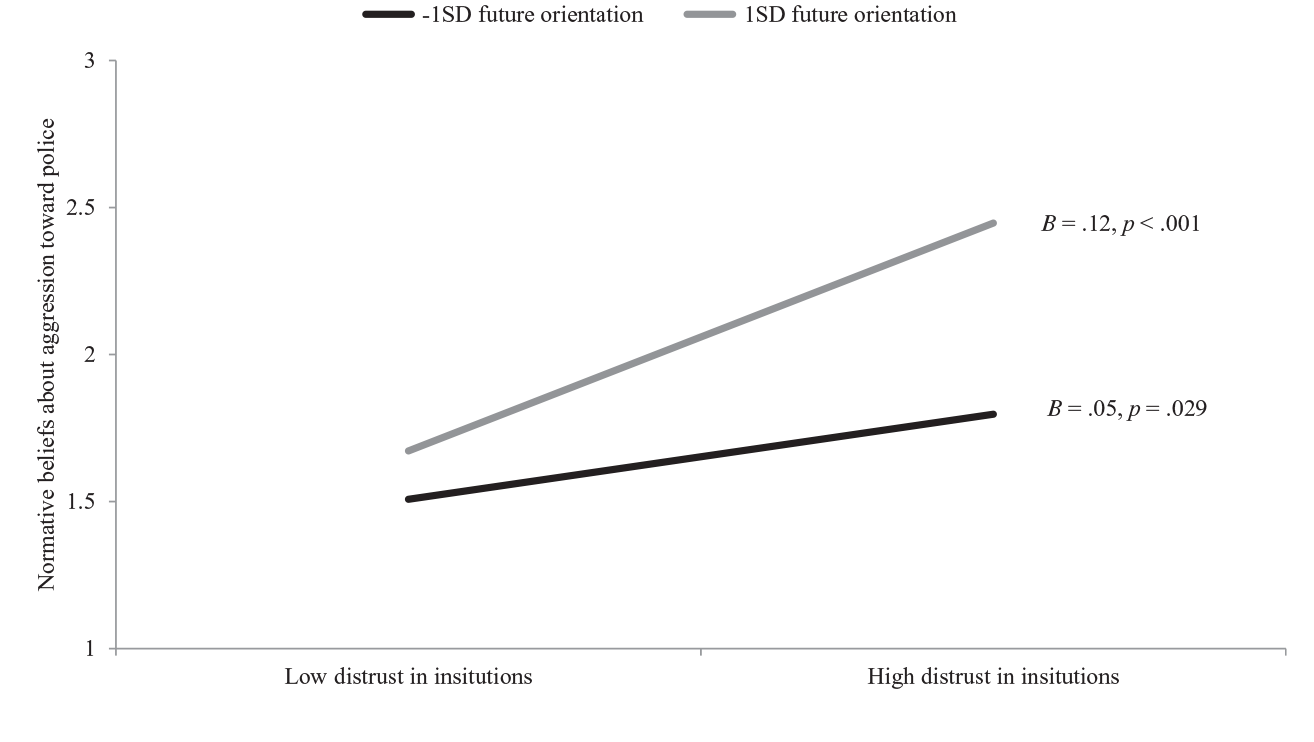
The association between distrust in institutions and normative beliefs about aggression toward police by future orientation.
Discussion
In this study, we examined Hong Kong university students’ NBAGG→P—a phenomenon relevant to social protests and aggression that occurred in Hong Kong during 2019–2020. We also investigated the association of these beliefs with several presumed ecological risks and the protective and buffering role of future orientation. Rich findings were generated and the results largely supported our hypotheses with a few exceptions.
University Students’ NBAGG→P
We found that university students in Hong Kong reported a medium level of endorsing protestors’ use of aggression toward police during protests. Moreover, the results also revealed that NBAGG→P was associated with more frequent participation in protests and more actual use of aggression during protests. These findings supported our hypotheses and are consistent with prior studies which showed a positive relation between NBAGG and aggression (Ang et al., 2017; Kikas et al., 2009; Li et al., 2015; Wright & Li, 2013).
In addition, it is worthwhile to note that NBAGG was not related to participation in protests and use of aggression during protests when NBAGG→P was entered in the regression models. These results suggest the possibility that domain-specific attitudes (e.g., NBAGG→P) may serve as a mediator between general attitude (e.g., NBAGG) and aggressive outcomes. However, testing this idea is beyond the focus of the current study and our data was not suitable to answer this idea given its cross-sectional nature. Future study may employ more sophisticated methods to examine this issue.
The Association between Ecological Risks and NBAGG→P
Largely supporting to our hypothesis, our findings showed that all the presumed ecological risks, except for poor family monitoring, were related to stronger NBAGG→P, even after controlling for the effect of NBAGG and demographic variables. These finding are consistent with prior research that has revealed that ecological risks are related to beliefs about aggression and behavior (de Haan & Nijboer, 2005; Duong, 2014; McMahon et al., 2009; Samek et al., 2016). While prior research mostly examined aggressive behavior in children and adolescents, this study focused on NBAGG→P in the context of social protests among university students. Importantly, we simultaneously examined the role of risk factors at different ecological levels, thus providing more information regarding the relative strength of each risk in contributing to students’ NBAGG→P.
Poor family monitoring has been regarded as a crucial predictor of children’s NBAGG (Duong, 2014) and university students’ aggressive behavior (Vazsonyi & Belliston, 2007), but it was not significantly related to students’ NBAGG→P in the current study. Prior studies suggested that emerging adults (e.g., university students) may be less prone to share their deep thoughts and feelings with parents (Son & Padilla-Walker, 2021; Tanner, 2006). Given that NBAGG→P is an undesirable attitude and belief, students may be reluctant to disclose it to parents. Correspondingly, parents may be less accessible to their young adult children’s antisocial thoughts and may not be able to provide support or discipline.
The Role of Future orientation
Future orientation was first examined as a protective factor against NBAGG→P. Supporting our hypothesis, the results showed that a positive future orientation was negatively related to NBAGG→P. This finding is in accordance with prior studies showing a negative relationship between a positive orientation and aggressive thoughts and behavior (Kooij et al., 2018; Miconi et al., 2020; So et al., 2018). Moreover, future orientation moderated the associations between distrust in institutions and NBAGG→P. Contrary to our expectations, future orientation strengthened, rather than mitigated, the “distrust in institutions—NBAGG→P” relationship. This finding is inconsistent with prior research which unraveled that a positive future orientation attenuated the effect of environmental risks and aggressive behavior (So et al., 2018). A possible explanation is that NBAGG→P may be an adaptive cognitive foundation for individuals to fight for their future and to achieve their future goals in an uncertain society. Individuals with a positive future orientation have optimistic expectations for their future lives (Kooij et al., 2018). However, an unstable society triggers distrust in institutions (Nikolayenko, 2014), and in a society with widespread distrust, people who are suspicious toward institutions and their representatives, and a readiness to use violence flourish most (Hosking, 2017). In our study, university students in Hong Kong reported high levels of distrust in institutions (7.20 out of 10). Under such circumstance, students who sustain a positive orientation toward the future need to be more self-reliant rather than dependent on institutions to achieve their future goals, and upholding an aggressive belief might be crucial for them to navigate the difficulties that cannot be solved by institutions.
Implications to Theory, Practice, and Policy
Theoretically, we found that all the presumed ecological risks were associated with NBAGG→P, except for poor family monitoring. These results support the equifinality proposition of the social-ecological model of resilience (Ungar et al., 2013). This model suggests that risks at different levels of the ecological system are related to (un)desirable outcomes and that risks at some ecological levels may outweigh others. However, while social-ecological model of resilience and risk-resilience model (Masten, 2001) both propose that the effect of ecological risks on life outcomes can be mitigated by individual assets, our findings do not support this suggestion. Our explanation and prior findings (e.g., Hosking, 2017) suggest that it is crucial to consider sociopolitical factors when modeling the interaction between ecological risks and personal assets in predicting life outcomes. A possible way to examine this idea is to revisit the interaction effect between distrust in institutions and future orientation on aggressive attitude and behavior in societies that differ in societal stability, economic status, and public safety.
Practically, although the effect sizes for the associations of various ecological risks and future orientations on NBAGG→P are small, they provide the much-needed information to identify leverage points for interventions that may prevent and/or mitigate aggression and violence during social unrest. For instance, promising ways to mitigate students’ aggressive beliefs can be derived from the factors significantly associated with NBAGG→P: restore students’ trust in institutions, reduce community violence, increase university discipline, provide guidance of students’ choice of friends, and increase students’ positive future orientation. School is an important developmental context (Sameroff, 2010). Despite the fact that university students have more autonomy and receive less monitoring and discipline from university than primary and secondary students (Flanders, 2018), their self-control is still developing (Casey et al., 2019) and they are still vulnerable to external stimuli such as peer pressure and engage in risk-taking behavior (Teese & Bradley, 2008). During the peak period of protests (i.e., June–December, 2019), most university authorities largely held a non-objection attitude toward students’ participation in protests and ignored students’ misbehavior during protests and on campus. This leniency may have encouraged, and even exacerbated, students’ aggressive and violent behavior. To circumvent this, universities need to play a more active role to reduce students’ aggressive social participation. For instance, administers of student policies in universities need to be aware that they need to take a stance toward students’ behaviors that may lead to ethical and moral dilemmas, rather than adopting a neutral attitude (Baldizan, 1998). Moreover, the university could directly aim to counter students’ aggressive social participation, such as requiring them to attend peace education programs (Cuga et al., 2019), and provide them with support and counseling to enhance their moral development and reasoning (King, 2012). For extreme cases, university administers may also consider adopting consistent, fair punitive approaches (e.g., expulsion from residence) to manage students’ misconduct (Stimpson & Stimpson, 2008; Wilkinson & Ivsins, 2017).
In terms of policy-making, the Hong Kong government emphasized the importance of enhancing young people’s positive outlooks and beliefs as one of the ways to restore social reconciliation (PICO, 2019). Our findings from the main effect models provided empirical support for this idea. However, the results from the interaction effect model suggested that enhancing future orientation might be more effective in reducing beliefs about aggression for students who trust, rather than those who distrust, institutions. These findings imply that the government should simultaneously develop and strengthen policies that facilitate young people’s positive outlook and solve the sociopolitical problems such as improving institutions’ trustworthiness and students’ trust in institutions, in particular the police. This is all the more important, because prior research has found that university students who originally think protest should be peaceful would endorse the use of aggression toward police when they question the legitimacy of police actions during the protests (Saavedra & Drury, 2019). In this sense, police department may need to review whether their actions during protest are legitimate regularly.
Limitations
We must acknowledge that this study has several limitations. First, the cross-sectional data prevent us from deducing causality among the study variables. Nevertheless, the current findings provide a foundation for future research that may use longitudinal and experimental designs to examine similar topics. Moreover, although we used a stratified sampling approach, the majority of the current sample was non-random. Readers may need to interpret the findings with caution. Relatedly, we recruited samples only from universities and therefore the findings cannot readily be generalized to non-university young people of same age due to the differences in academic attainment. In addition, only self-report measures were used and some questions were sensitive and vulnerable to social desirability (e.g., how often did you engage in aggression during protests?), our findings may not reflect the actual occurrence of certain behavior (e.g., use of aggression) and observational measures would be helpful to circumvent such caveat. Relatedly, we did not distinguish different types of aggression (e.g., verbal or physical) and did not include other targets students showed aggression at (e.g., public properties), which prevented a more nuanced examination.
Conclusions
Hong Kong university students are social activists and future potential leaders of the society (Pan, 2021). Their participation in social protests is common and an important reflection of citizenship. However, aggressive beliefs and behavior during protests are contradictory to social norms and civilization as well as are related to numerous detrimental outcomes. In this study, we examined Hong Kong university students’ NBAGG→P and the role of several ecological risks and future orientation. We found that university students’ NBAGG→P was related to more participation in social protests and more use of aggression during protests. Moreover, distrust in institutions, exposure to violence, poor university discipline, and delinquent peer affiliation were related to higher levels of such beliefs. A positive future orientation was related to lower levels of such beliefs, but it also exacerbated the positive association between distrust in institutions and NBAGG→P. We believe that these findings advance our understanding university students’ aggressive attitude in the context of social protests and provide important implications on how to mitigate such beliefs, with the aim to promote university students’ positive social participation.
Footnotes
Declaration of Conflicting Interests
The author(s) declared no potential conflicts of interest with respect to the research, authorship, and/or publication of this article.
Funding
The author(s) disclosed receipt of the following financial support for the research, authorship, and/or publication of this article: This paper was funded by FEHD’s Internationalization & Exchange Research Scheme of the Education University of Hong Kong and by Public Policy Research Funding Scheme (Special Round) from the Policy Innovation and Co-ordination Office of the Hong Kong Special Administrative Government (Project Number: SR2020.A5.013).
