







Abstract
Prior research has provided consistent evidence that minority students are more likely than White youth to experience punitive forms of discipline in schools. Scholars have theorized that these disadvantages are closely connected to gender and socioeconomic status, but little research has explored how these factors independently and jointly might moderate the effects of race/ethnicity. Using data from the 2012 to 2018 8th and 10th grade cohorts of the Monitoring the Future survey (N = 53,986), these analyses find that minority students are more likely than Whites to experience suspension/expulsion and office referrals, and this pattern is especially prominent among females. Further, racial/ethnic disparities are amplified for youth whose parents have higher levels of educational attainment, though some differences by gender also emerge.
The past three decades have seen the profound expansion of exclusionary forms of discipline in American middle and high schools. Even as rates of in-school delinquency have steadily declined (Musu et al., 2019), schools continue to rely less on restorative and “medicalized” forms of sanctioning for student misconduct (Ramey, 2015, 2020) and instead have adopted zero-tolerance approaches that involve out-of-school suspensions, expulsions, referrals to the justice system, and other formal disciplinary responses (Hirschfield, 2018; Losen & Skiba, 2010). Additionally, for less serious forms of misbehavior such as in-class disruptions and disrespectfulness, school staff commonly use detentions and office referrals to sanction students (Anyon et al., 2014; Rocque, 2010). The many negative consequences stemming from the “criminalization of school discipline” (Hirschfield, 2008) have been well-documented, with an abundance of research evidence demonstrating that youth who receive suspension or expulsion, as well as other less severe forms of punishment, have a heightened risk of experiencing a decline in academic performance, dropping out, and becoming involved with the criminal justice system (e.g., Kupchik, 2016; Mittleman, 2018; Wolf & Kupchik, 2017).
Within the immense body of research that has examined the various dimensions of this “new disciplinology” (Rocque & Snellings, 2018), one line of inquiry that has received much attention is the influence that students’ race/ethnicity might have on in-school sanctioning. Scholars consistently have reported that Black and Hispanic students are more likely than White youth to be suspended or expelled (e.g., Eitle & Eitle, 2004; Owens & MacLanahan, 2020; Petras et al., 2011) and receive office referrals (Anyon et al., 2018; Rocque & Paternoster, 2011), even after accounting for problem behaviors, academic achievement, and a wide range of other factors. Indeed, the overrepresentation of minority students in punitive school discipline has been identified as a key mechanism through which racial/ethnic disparities in the “school-to-prison pipeline” might emerge (Barnes & Motz, 2018; Dong & Krohn, 2020). This pattern of findings aligns closely with the expectations of critical race theory, which emphasizes the role of educational institutions in perpetuating broader racial/ethnic social inequalities (Blaisdell, 2016; Watts & Erevelles, 2004) as well as the potential effects of implicit biases and stereotypes on teachers’ and school administrators’ disciplinary decision-making (Ispa-Landa, 2018).
Despite the consistency of these research findings, key questions remain regarding the conditions under which Black and Hispanic youth might be disparately likely to receive these outcomes. Specifically, there is considerable theoretical and empirical ambiguity surrounding the moderating effects that gender might have on this relationship, with some prior work highlighting the unique disadvantages experienced by minority male youth (Kupchik & Ellis, 2008; Rios, 2011) but others suggesting that Black- and Hispanic-White disparities are more prominent in the sanctioning of female students (Blake et al., 2011; Morris & Perry, 2017). In addition, while scholars have long observed that students of lower socioeconomic status (SES) are disproportionately at risk of receiving exclusionary school punishments (e.g., Hemphill et al., 2010; Wu et al., 1982), very little quantitative work has explored whether racial and ethnic disparities might be moderated by the educational attainment of students’ parents or other similar proxies for SES (Peguero et al., 2015). Further, using descriptive analyses exclusively, only one previous study to date has investigated possible interactive relationships between race/ethnicity, gender, and SES in the context of school punishment (Skiba et al., 2002). This gap in the extant literature is striking given that intersecting stereotypes surrounding these three characteristics are theoretically likely to influence how school staff might sanction in-school misbehavior.
Using data on seven pooled nationally representative cohorts of 8th and 10th grade students collected between 2012 and 2018 (N = 53,986), the aim of the present research is to examine the direct and interactive effects of race/ethnicity, gender, and parental educational attainment on youths’ likelihood of (1) being suspended or expelled from school and (2) receiving an office referral. In the proceeding discussion, we begin with an overview of critical race theory, and we describe its relevance for understanding how implicit biases surrounding race/ethnicity, gender, and SES might inform the sanctioning decisions of school staff. Next, we provide a review of the literature on unwarranted disparities in school discipline according to these three factors, and we highlight the limited and inconsistent prior research exploring their interactive effects on disciplinary outcomes. Finally, we present the four research questions that we intend to address in the current study.
Critical Race Theory and Implicit Bias
The critical race theory framework is rooted in the notion that the social structure of the United States is fundamentally connected to race, despite persistent claims purporting race-neutrality in many domains (Omi & Winant, 2014). According to this perspective, racial and ethnic inequalities are embedded in all levels of society, and institutions are organized in ways that benefit privileged groups and disadvantage minorities, thereby contributing to and perpetuating long-standing social stratification (Bonilla-Silva, 2006; Delgado & Stefancic, 2017). Schools, therefore, can be understood through this framework as racialized institutions that socialize youth to become accustomed to and subsequently adopt the cultural practices, standards, and values of the White majority (Barajas & Ronnkvist, 2007; Staiger, 2004). Indeed, even the ostensibly “colorblind” policies which schools implement and enforce ultimately create contexts in which minority students are taught to recognize White middle-class behaviors as normative and deserving of emulation (Blaisdell, 2016; Leonardo, 2009; Watts & Erevelles, 2004). In this way, schools “are centers of learning, not just about subjects such as math and grammar, but also about the social rules and ideologies that reinforce inequality” (Anyon et al., 2018, p. 393).
Critical race scholars emphasize the key structural role that schools play in reinforcing long-term racial/ethnic inequalities by providing privileged access to economic opportunities and status to some students but imposing barriers for others (Simson, 2014). However, many argue that these broader disadvantages originate in large part from the dynamics and practices that take place in day-to-day decision-making and the enforcement of school rules (Morris, 2005; Vavrus & Cole, 2002). Specifically, researchers have theorized that the cultural divide between minority students and White staff can give rise to reliance on implicit biases among school professionals that advantage White students but penalize minority youth (Girvan, 2019; Ispa-Landa, 2018; Warikoo et al., 2016). While the misbehavior of Whites might be viewed among teachers as innocuous and deserving of lenient or informal responses, Black and Hispanic students engaging in similar activities might be identified as rebellious, aggressive, and disrespectful to authority (Blaisdell, 2016; Downey & Pribesh, 2004; Okonofua & Eberhardt, 2015). Even for relatively trivial violations of school codes, minority students can be characterized as “hoodlums” (Lopez, 2002) or “troublemakers” (Bowditch, 1993; Ferguson, 2000) in need of corrective action through formal disciplinary sanctions, especially since less serious misconduct incidents can afford teachers a substantial amount of discretion (Girvan et al., 2017).
Relatedly, there is a strong theoretical rationale which expects that school personnel might associate the in-school misbehavior of minority students with racialized, culturally reinforced conceptions of criminal behavior. Public opinion research has long demonstrated that individuals commonly subscribe to stereotypes which characterize Blacks and Hispanics as dangerous, crime-prone, and threatening to public safety (e.g., Chiricos et al., 2004; Welch et al., 2011). Further, these perceptions often are assigned to youth in particular, and prior work has shown that people who typify delinquency as a disproportionately racial/ethnic minority phenomenon tend to hold more favorable attitudes toward punitive social control responses (Metcalfe et al., 2015; Pickett & Chiricos, 2012). In light of these stereotyped images connecting minority youth with delinquent behavior, it is plausible that school staff might view the rule-breaking of Black and Hispanic students as indicative of participation in future offending in adulthood (Carter et al., 2017). As a result, when disruptive events occur and teachers fear a loss of control over the classroom (Vavrus & Cole, 2002), they may rely on these implicit biases and single out minority students for removal and subsequent punishment.
While attributions characterizing Black and Hispanic students as “out of control” (Gregory & Mosely, 2004, p. 25) and defiant “troublemakers” who are destined for involvement with the justice system might be assigned to male and female students alike, it is theoretically likely that notable gender differences will emerge. Specifically, some scholars have noted that the pervasive stereotypes identifying minority youth as aggressive, violent, and predatory relate largely to males, and the image of the young Black male as a dangerous criminal threat remains a persistent feature of media depictions and popular perception (Carter et al., 2017; Ferguson, 2000; Howard, 2014; Rios, 2011). In addition, prior research has revealed that teachers are less supportive and encouraging of Black male students than others, set lower academic expectations for them (Noguera, 2003), and believe that they “require greater control than their peers and are unlikely to respond to nonpunitive measures” (Monroe, 2005, p. 47; see also Kupchik & Ellis, 2008). Therefore, in light of these issues, it is plausible that the disparities between minority and White students in the likelihood of experiencing punitive school discipline outcomes may be more pronounced among male youth than female youth.
In contrast with these expectations, scholars recently have documented the unique disadvantages lived by minority female youth in schools (e.g., Carter Andrews et al., 2019; Morris, 2016). Researchers have theorized that normative constructions of femininity in the United States are often those closely associated with Whiteness, and the enforcement of school rules has been described as organized around the goal of molding Black and Hispanic girls to conform to these behavioral standards (Morris, 2005; Wun, 2018). Indeed, White middle-class norms “imply that girls and women must be silent, passive, and to place harmony in relationships over their own interests, desires, and feelings” (Blake et al., 2011, p. 93), but Black and Hispanic female students frequently depart from these expectations through expressions of assertiveness and independence (Morris, 2007). As a result, minority girls can be especially likely to receive disciplinary sanctions for minor dress code violations, rowdiness and disruptiveness, defiance toward authority, and “unladylike” behavior (Morris & Perry, 2017; Osler, 2006). Because the misconduct of these youth involves violations of norms that are both racialized and gendered, it may be reasonable to expect that Black- and Hispanic-White school discipline disparities might be more prominent among female students than among males.
Finally, beyond the potential interactive effects of race/ethnicity and gender, there is a strong theoretical and empirical connection between these student characteristics and SES, though the expected direction of such a moderating relationship is likewise ambiguous. On one hand, Black and Hispanic students who are economically disadvantaged might be perceived by school staff as living up to cultural stereotypes, and they may view these youth, and males in particular, as less motivated, less academically gifted, unlikely to experience upward economic mobility, and destined for involvement in criminal behavior (Ferguson, 2000; Kao, 2000), thus implicitly characterizing them as more deserving of punitive disciplinary responses. On the other hand, higher SES minority youth, and possibly especially female students, may experience “backlash effects” (Rudman, 1998; Rudman & Fairchild, 2004) whereby they are more likely to experience harsh school punishments because they do not comport with normative stereotypical expectations, thus resulting in their misbehavior being perceived as more deviant or in greater need of disciplinary correction (Fordham & Ogbu, 1986; Peguero et al., 2015). Thus, while higher SES generally advantages students in the context of school discipline (Hemphill et al., 2010), these benefits might be concentrated largely among White youth, as “minority group members may have less latitude for disconfirming stereotypes than do Whites simply because stereotypes about their group are more narrow and confining” (Phelan & Rudman, 2010, p. 267).
Prior Research on Disparities in School Discipline
As middle and high schools in the United States have expanded their reliance on exclusionary responses to student misbehavior in the past several decades, scholars across multiple disciplines have expressed concerns that these trends have been attended by notable racial/ethnic inequalities. Rather than enhancing school safety, adherence to the zero-tolerance model has given rise to the “prisonization of schools” (Mitchell et al., 2020; Payne & Welch, 2010) in ways that disparately penalize Black and Hispanic students (Kupchik, 2010; Rocque & Snellings, 2018; Welsh & Little, 2018). While the adoption of punitive disciplinary approaches has been a pervasive phenomenon, prior research has shown that schools with larger minority student body populations tend to have stricter zero-tolerance policies and security measures (Kupchik & Ward, 2014) and more frequently use suspension, expulsion, and other such sanctions (Payne & Welch, 2010; Welch & Payne, 2012, 2018). Similar school-level patterns also are observed for office discipline referrals and other less severe sanctions (Rocque, 2010; Rocque & Paternoster, 2011; Welch & Payne, 2010), and institutions with more minority students are less likely to engage restorative or “medicalized” forms of discipline (Mitchell et al., 2020; Payne & Welch, 2015; Ramey, 2015).
Although school-level policies represent a key dimension of the racial/ethnic gap in school discipline outcomes, a vast body of work has shown that these disparities persist at the individual student level as well, with Black and Hispanic youth more often receiving suspension and expulsion than comparable White youth (e.g., Bottiani et al., 2017; Eitle & Eitle, 2004; Petras et al., 2011). In-school suspensions and office referrals generally have received less research attention than more formal disciplinary responses, but studies exploring these outcomes have documented similar racial/ethnic disparities (e.g., Anyon et al., 2014, 2018; Kinsler, 2011; Rocque, 2010; Rocque & Paternoster, 2011; Skiba et al., 2011). While some scholars have speculated that these patterns are explained, at least in part, by SES (Skiba et al., 2002; Watts & Erevelles, 2004), differential involvement in problem behavior (Wright et al., 2014), and school characteristics (Raffaele Mendez et al., 2002), much research has shown that racial/ethnic inequalities persist even after accounting for these and many other factors (e.g., Edwards, 2016; Huang & Cornell, 2017; Owens & McLanahan, 2020).
Compared to the vast body of work providing robust evidence regarding the main effects of race and ethnicity on school discipline outcomes, less work has examined whether these disparities are moderated by gender, and the findings from this literature have been mixed. For example, corresponding with the theoretical expectation that minority status is more strongly associated with images of dangerousness and threat for male students than for females (Carter et al., 2017; Rios, 2011), some prior research has shown that Black males represent the race/gender subgroup with the highest probability of experiencing a suspension, expulsion, office discipline referral, or referral to law enforcement (Anyon et al., 2014; Mizel et al., 2016). Other work, however, has found that disparities between minority students and Whites in these outcomes are substantially more pronounced among females than males (Lehmann & Meldrum, 2019; 1 Morris & Perry, 2017; Raffaele Mendez & Knoff, 2003; Wallace et al., 2008), thus providing support for the perspective that school discipline is paternalistic and the misbehavior of Black and Hispanic girls can be perceived as violating behavioral norms that are connected to both race and gender (Blake et al., 2011; Carter Andrews et al., 2019; Morris, 2005, 2007).
While the extant research in this area on the moderating effects of gender has produced inconsistent results, almost no prior work has assessed the potential interactive relationship between race/ethnicity and SES. It has long been the case in the United States that race and SES are closely linked, and for this reason scholars have tried to avoid conflating disparities in school discipline that may exist according to these two factors independently (e.g., Morris & Perry, 2017; Owens & McLanahan, 2020). From this literature, SES has emerged as a particularly notable correlate of exclusionary punishments, with lower SES students consistently more likely than higher SES students to experience these outcomes (Hemphill et al., 2010; Petras et al., 2011; Wu et al., 1982). Though various proxy measures of youths’ SES have been employed in this research, one of the most useful is parental educational attainment (Kao & Thompson, 2003), 2 and studies engaging this measure have found that, net of other factors, students whose parents have more education are substantially less likely to receive punitive school discipline (e.g., Hemphill et al., 2014; Mizel et al., 2016; Sullivan et al., 2013).
With few exceptions, prior quantitative school discipline research typically has treated SES as a control variable in the exploration of other substantive issues, and how SES might moderate the effects of race/ethnicity on school punishment has been considered in only two previous studies, and these have reported contradictory findings. Using data on middle school students from one midwestern school district, Skiba et al. (2002) found that disparate representation in suspensions and office referrals by students’ race and gender did not vary by SES. However, it should be noted that this research was entirely descriptive in nature, and no multivariate methods or statistical controls were employed. The other study to engage this issue was conducted by Peguero et al. (2015), and their analysis of a national sample of 10th grade students revealed that the effects of race/ethnicity on the likelihood of experiencing exclusionary school discipline were indeed conditioned by youths’ family SES. Specifically, while the advantages accompanying higher SES were found to be similar for Black, White, and Asian students, the opposite pattern was observed among Latinos such that higher SES was associated with an increased likelihood of receiving an in-school punishment.
Given the limited prior research in this area and the conflicting patterns of results that have emerged, it is clear that “more research is. . .needed on how racial bias affects students of color depending on their socioeconomic status, gender, and skin color” (Ispa-Landa, 2018, p. 387). To this end, the present study engages pooled data on seven nationally representative cohorts of middle and high school students to address several questions that remain unresolved. First, in an effort to contribute to a body of literature which has produced inconsistent findings, we provide an examination of the interactive effects of gender on racial/ethnic disparities in two school discipline outcomes. Second, the current research represents only the third quantitative study to date to explore whether racial/ethnic inequalities in school discipline are moderated by SES, and it is the second of these to use a multivariate analytic approach. Finally, building upon the descriptive research by Skiba et al. (2002), this study is the first to use multivariate methods to examine a possible three-way interactive relationship between race/ethnicity, gender, and SES on school discipline outcomes.
Research Questions
In light of the preceding discussion, we intend to address the following four research questions. Research Question 1: Corresponding with the prior literature, are Black and Hispanic students more likely than White youth to receive suspensions/expulsions and office referrals? Research Question 2: Are racial and ethnic disparities in suspensions/expulsions and office referrals moderated by gender such that minority youth are especially likely to experience these forms of discipline if they are male or female? Research Question 3: Are racial/ethnic disparities in these two outcomes conditioned by parents’ education such that the effects are stronger or weaker among students whose parents have higher levels of educational attainment? Research Question 4: Is there a three-way interactive relationship between race/ethnicity, parents’ education, and gender in school discipline such that the moderating effects of parents’ education on race/ethnicity are more prominent among males or females?
Data and Methods
The data for the present research originate from the 2012 to 2018 8th and 10th grade surveys from the ongoing Monitoring the Future (MTF) study, which is maintained by the Institute for Social Research at the University of Michigan (Miech et al., 2018). The MTF survey is conducted annually and administered to large, nationally representative cohorts of 8th and 10th grade students enrolled in public and private schools across the U.S. 3 Through the design of the MTF study, participants provide responses to a core questionnaire as well as to the questions contained within one of four distinct survey forms. The questionnaire forms are equivalent across the two grade levels. 4 To ensure that all of the key measures of interest could be included, we restrict our analyses to the subsample of youth who received Form 2 of the survey. Since the content and coding of the Form 2 questionnaire items remained consistent between 2012 and 2018, the combined 8th and 10th grade samples across these seven study years were pooled, thus producing a total sample of 70,715 youth. After removing observations with values missing on the race/ethnicity measure (see below), the final analytic sample size for this study is 55,798.
To protect the anonymity of study participants, no identifying information about the respondents’ schools, zip codes, or neighborhoods is available in the data, thus precluding any multilevel analyses that could consider the influence of macro-level factors. Consequently, these analyses focus exclusively on youths’ individual-level characteristics and experiences. To account for the complex multistage sampling design of the MTF study as well as differences in selection probabilities across schools and participants, we make use of the provided sampling weights, thus ensuring that the findings can be generalized to the national population of 8th/10th graders. 5 Table 1 provides descriptions of the measures utilized in this study, and the descriptive statistics of the study variables for the unweighted and weighted samples are presented in Table 2, with the latter discussed in the proceeding text.
Statistical Coding and Descriptions of the Study Variables.
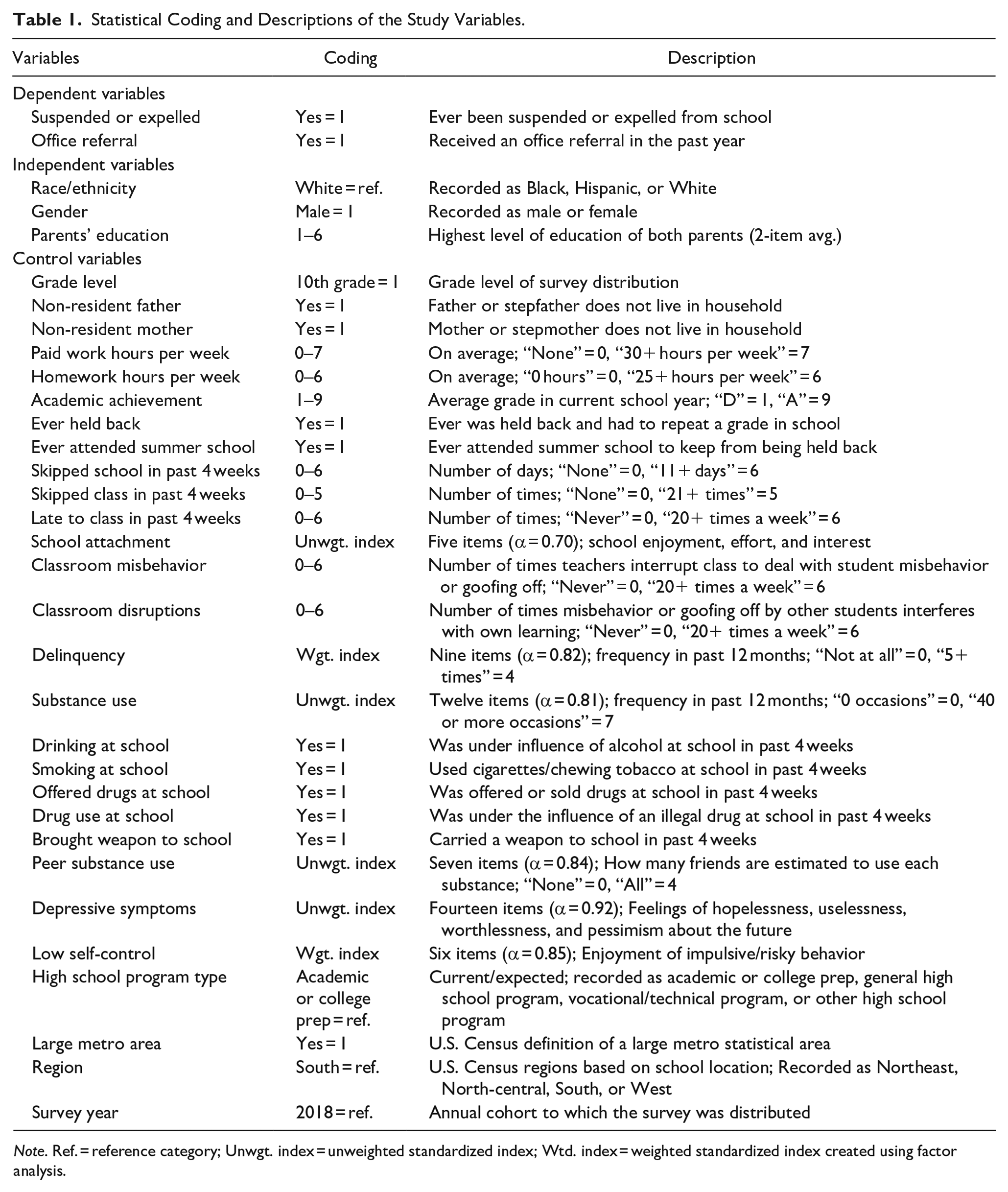
Note. Ref. = reference category; Unwgt. index = unweighted standardized index; Wtd. index = weighted standardized index created using factor analysis.
Unweighted and Weighted Descriptive Statistics.
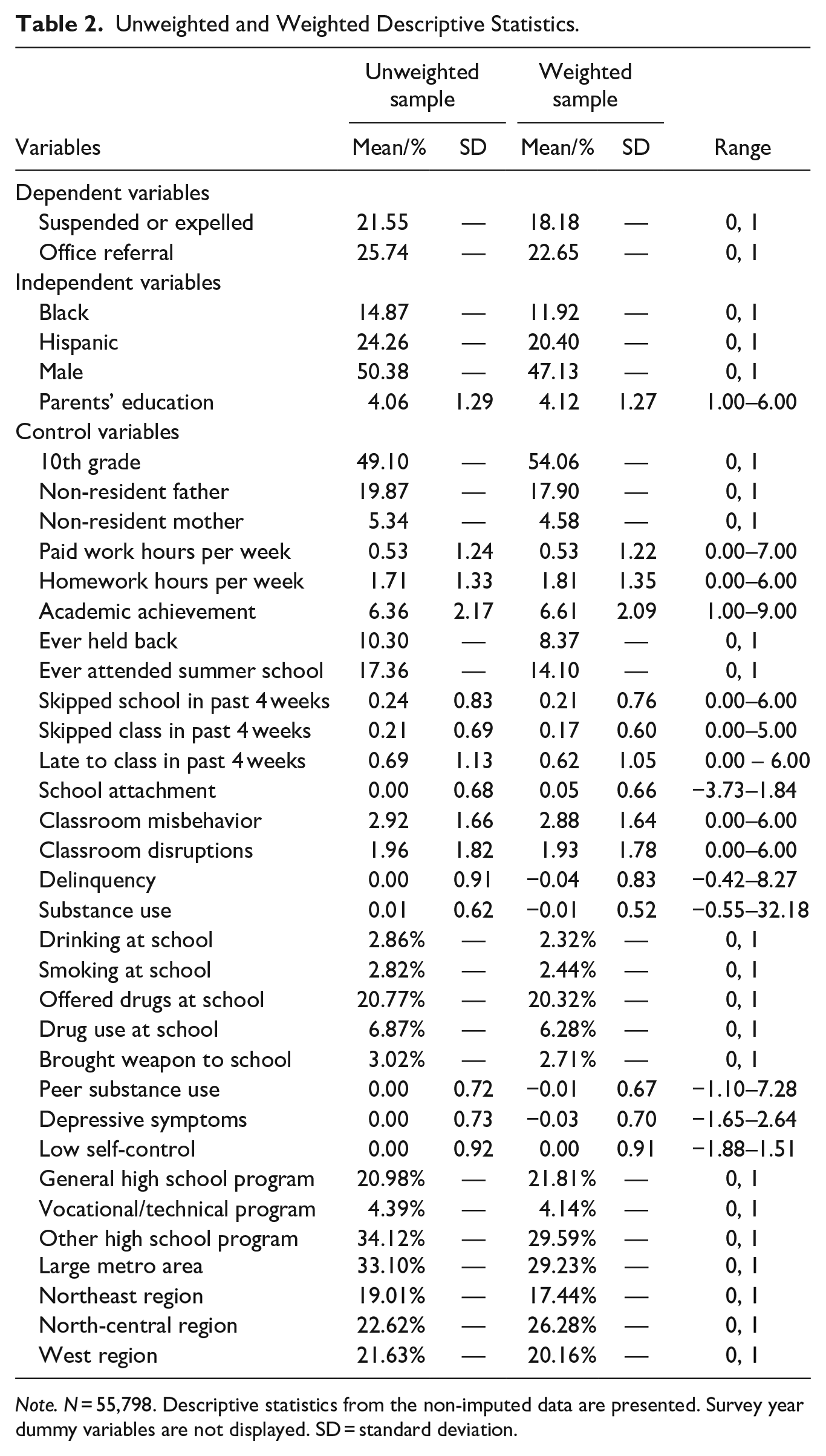
Note. N = 55,798. Descriptive statistics from the non-imputed data are presented. Survey year dummy variables are not displayed. SD = standard deviation.
Dependent Variables
These analyses engage two outcome measures of school disciplinary experiences: suspension/expulsion and office referrals. The former measure originates from a survey item which asks respondents whether they have ever been suspended or expelled from school, with those answering “Yes” coded as 1. Second, to capture an office referral, we use a question which asks, “Thinking back over the past year in school, how often did you get sent to the office, or have to stay after school, because you misbehaved?” The original response options included a 5-point scale ranging from “Never” to “Always;” however, since a substantial majority of participants indicated that they had not received an office referral, we combine all affirmative responses into a single category such that youth who reported at least one office referral are coded as 1. In these data, 18.2% of youth had ever been suspended or expelled, and 22.7% received an office referral in the past year.
Independent Variables
The independent variable of primary interest is race/ethnicity, which is captured using a measure that includes the categories of Black, Hispanic, and White, and respondents are coded as 1 if they reported belonging to that racial or ethnic group only. White is used as the reference category. Respondents who indicated that they are Asian, American Indian or Alaska Native, Native Hawaiian or Pacific Islander, or some combination of multiple racial/ethnic identities were recoded as missing by the MTF data administrators. Since this procedure makes it impossible to distinguish respondents who are not Black, Hispanic, or White from those who skipped the question entirely, all observations with data missing on this variable were dropped before the analyses were conducted, thus reducing the sample size from 70,715 to 55,798. While necessary given data constraints, we note the limitations of this coding scheme below. In these data, 11.9% of respondents are Black, 20.4% are Hispanic, and 67.7% are White.
The second key independent variable in this study is gender, which is measured dichotomously with male participants coded as 1. Approximately 47.1% of respondents are male. Finally, the present research is concerned with parents’ education, which is captured using two survey items. Specifically, respondents were asked, “What is the highest level of schooling your father completed?” and “What is the highest level of schooling your mother completed?” 6 The response options to both questions included “Completed grade school or less” (= 1), “Some high school” (= 2), “Completed high school” (= 3), “Some college” (= 4), “Completed college” (= 5), and “Graduate or professional school after college” (= 6). For analytic purposes, the average value of the responses to these two items is used (r = 0.60), and cases were coded as missing only if participants did not answer or responded “Don’t know or does not apply” to both questions. In these data, the mean value of this variable is 4.12.
Control Variables
As described in Table 1, these analyses include a wide range of control variables which prior research has shown to affect school discipline outcomes and which can be correlated with race/ethnicity, gender, and SES. These include grade level, whether the respondent has a non-resident father or stepfather and/or a non-resident mother or stepmother, and the number of hours per week spent engaged in paid work and homework. We also use as controls multiple measures of academic success, truancy and skipping class, school attachment, and the disruptiveness of the classroom that might foster a punitive disciplinary climate. Additionally, our analyses include a nine-item delinquency index, an index of substance use, several measures of in-school misbehavior, the estimated substance use of respondents’ peers, 7 depressive symptoms, and low self-control. 8 While no identifying information about the participants’ schools was available, we control for current or expected high school program type, whether the respondent lives in a large metro area, and geographic region. Finally, to account for any cohort idiosyncrasies or changes in school discipline practice over the 7-year study period, we include dummy variables for survey year with 2018 used as the reference. The descriptive statistics and coefficients associated with survey year are not displayed in the tables for the sake of parsimony. 9
Analytic Strategy
Since the use of listwise deletion would result in a loss of approximately 35.6% of cases due to item missingness, Little’s (1988) test was conducted, and the results indicate that the data are not missing completely at random. To limit the introduction bias into our findings as well as to make use of the maximum possible amount of information, we imputed the missing data using multiple imputation by chained equations (MICE) and 30 imputations (White et al., 2011). The imputation model included all of the study variables, but we restricted our analyses to only those cases that had an observed, non-imputed value on both dependent variables in accordance with best practices. The final sample contains 53,986 observations.
In light of our first research question, the analyses begin with two binary logistic regression models estimating the additive effects of the predictors of interest on the likelihood of a suspension or expulsion and an office referral. These models assess whether, net of the control variables, Black and Hispanic students are more likely than Whites to experience these forms of school discipline. Next, to examine our second research question, we include multiplicative interaction terms between race/ethnicity and gender in the models to test whether the effects of being Black or Hispanic on the likelihood of receiving a suspension/expulsion and an office referral are stronger or weaker among males relative to females. The third stage of the analysis involves assessing whether the effects of minority status on these discipline outcomes will be moderated by parents’ education such that Black- and Hispanic-White differences are more or less pronounced among those whose parents have higher educational attainment. Finally, concerning our fourth research question, we include three-way interaction terms to estimate the extent to which these latter interactive relationships might vary by gender.
Since this study is concerned with estimating interaction effects in logistic regression models, several issues should be noted. First, scholars have argued that it is often difficult to assess the substantive significance of the coefficients and odds ratios from logistic regression models, and this problem is amplified when estimating interaction effects (Long & Freese, 2014; Williams, 2012). Second, the magnitudes and signs of the multiplicative term coefficients in logistic regression can be misleading since, unlike in linear regression, interactive relationships in nonlinear models are conditional upon the values of the independent variables themselves (Norton et al., 2004). To address these issues, some scholars recommend using the estimated models to calculate the predicted values of one variable at the observed levels of the other variable in the interaction, thus producing an intuitive set of findings that is sensitive to potential variations in the estimated interactive effects (Buis, 2010; Dow et al., 2019). Accordingly, following the findings from the regression analyses, we present the predicted probabilities of each outcome according to the values of the relevant predictors of interest.
Results
Main Effects of Race/Ethnicity, Gender, and Parents’ Education
We begin with an examination of the independent, main effects of the covariates on the likelihood of a suspension/expulsion and an office referral. The binary logistic regression models of these two outcomes are presented in Models 1 and 2, respectively, of Table 3. The findings from the estimates of suspension or expulsion reveal that, net of the control variables, minority youth are more likely than Whites to report ever experiencing either of these forms of discipline, with Black students having a 257.5% greater odds of being suspended or expelled (b = 1.274, Exp(b) = 3.575, p < .001) and Hispanics having a 27.7% greater odds of this receiving this outcome (b = 0.245, Exp(b) = 1.277, p < .001) compared to White students. With regard to gender, being male is associated with an estimated 119.8% increase in the odds of suspension or expulsion (b = 0.787, Exp(b) = 2.198, p < .001). In contrast, youth whose parents have more education are statistically significantly less likely to receive these forms of school discipline (b = –0.126, Exp(b) = 0.882, p < .001).
Logistic Regressions of a Suspension or Expulsion and an Office Referral: Main Effects of Race/Ethnicity, Gender, and Parents’ Education.
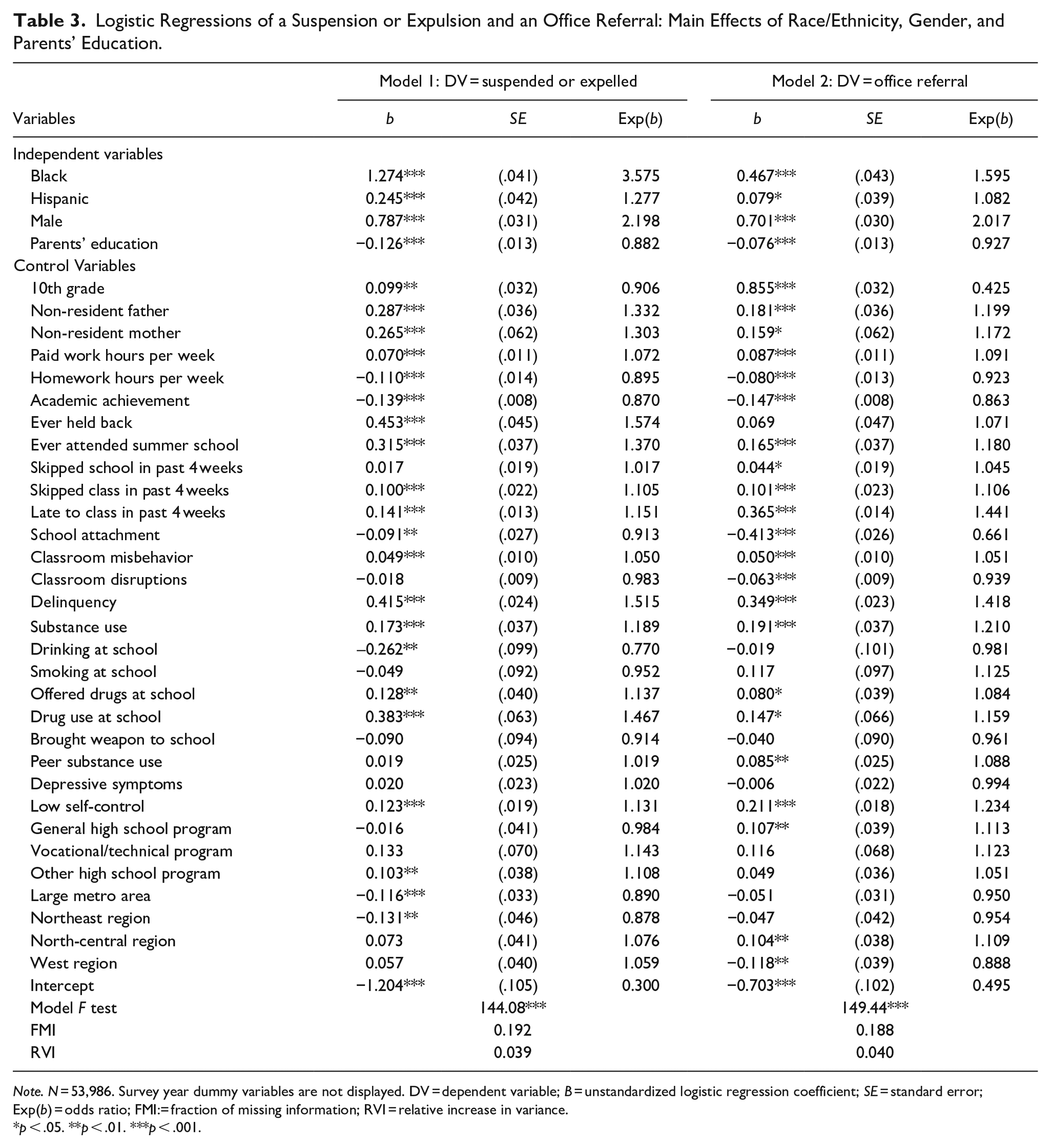
Note. N = 53,986. Survey year dummy variables are not displayed. DV = dependent variable; B = unstandardized logistic regression coefficient; SE = standard error; Exp(b) = odds ratio; FMI:= fraction of missing information; RVI = relative increase in variance.
p < .05. **p < .01. ***p < .001.
A closely similar pattern is observed in Model 2 of Table 3, and these findings reveal that, relative to White youth, Blacks and Hispanics have a 59.5% and 8.2% greater odds, respectively, of having received an office referral in the past 12 months (Black: b = 0.467, Exp(b) = 1.595, p < .001; Hispanic: b = 0.079, Exp(b) = 1.082, p < .05). Additionally, male students have an odds of experiencing an office referral that are 101.7% larger than females (b = 0.701, Exp(b) = 2.017, p < .001). As in Model 1, parents’ education is negatively associated with an office referral, with a 1-unit increase in this variable associated with a 7.3% decrease in the odds of receiving this punishment (b = –0.076, Exp(b) = 0.927, p < .001).
Interactive Effects of Race/Ethnicity and Gender
The proceeding analyses address the second, third, and fourth research questions, which relate to the moderating effects of gender, parents’ education, and both variables on racial/ethnic disparities in school discipline. To preserve space, the three logistic regression models of suspension/expulsion that include the multiplicative terms between these sets of variables are shown in Table 4, while the corresponding models estimating the likelihood of receiving an office referral are shown in Table 5. All six models include the full list of controls.
Logistic Regressions of a Suspension or Expulsion: Interactive Effects of Race/Ethnicity, Gender, and Parents’ Education.
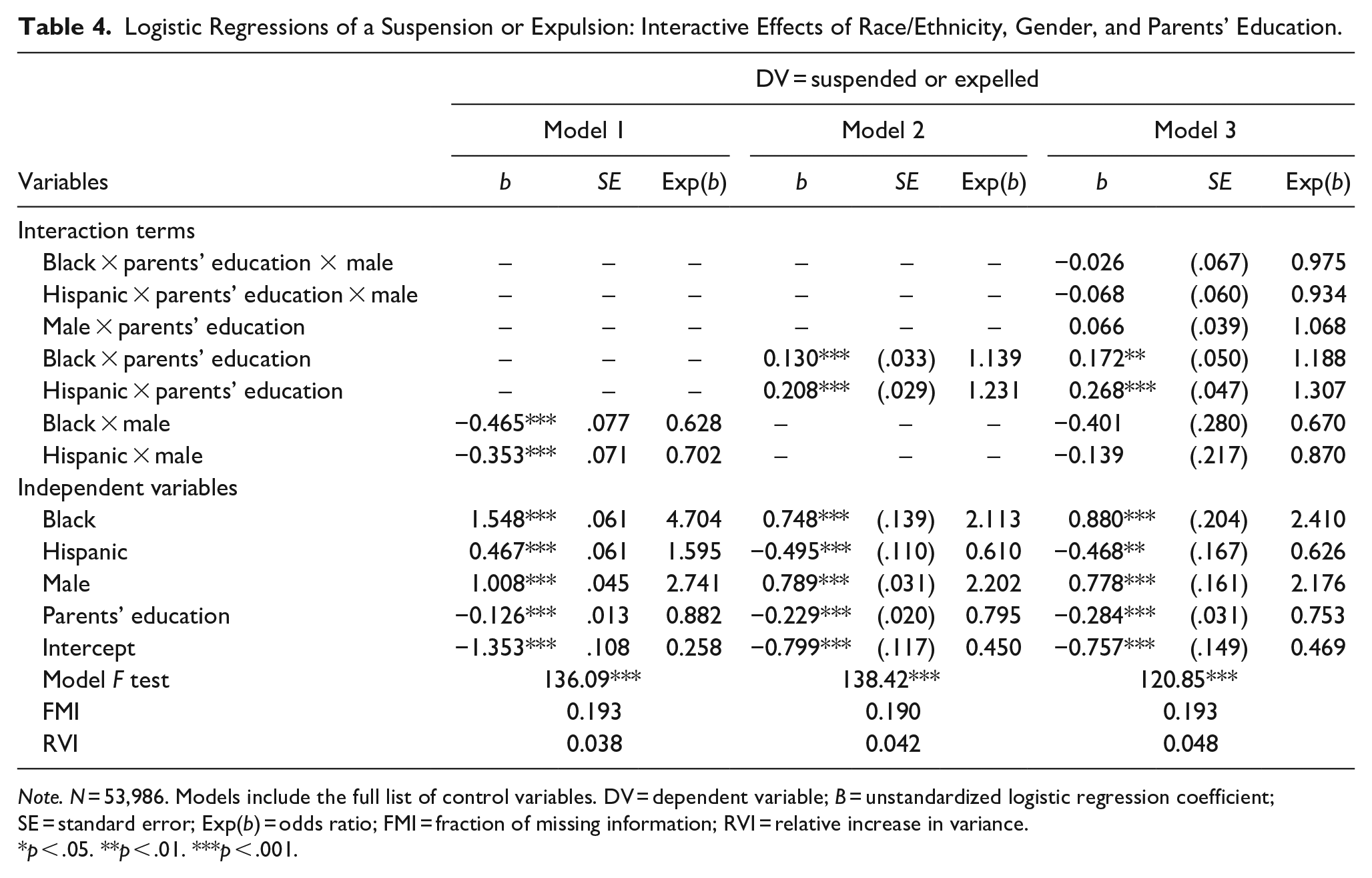
Note. N = 53,986. Models include the full list of control variables. DV = dependent variable; B = unstandardized logistic regression coefficient; SE = standard error; Exp(b) = odds ratio; FMI = fraction of missing information; RVI = relative increase in variance.
p < .05. **p < .01. ***p < .001.
Logistic Regressions of an Office Referral: Interactive Effects of Race/Ethnicity, Gender, and Parents’ Education.
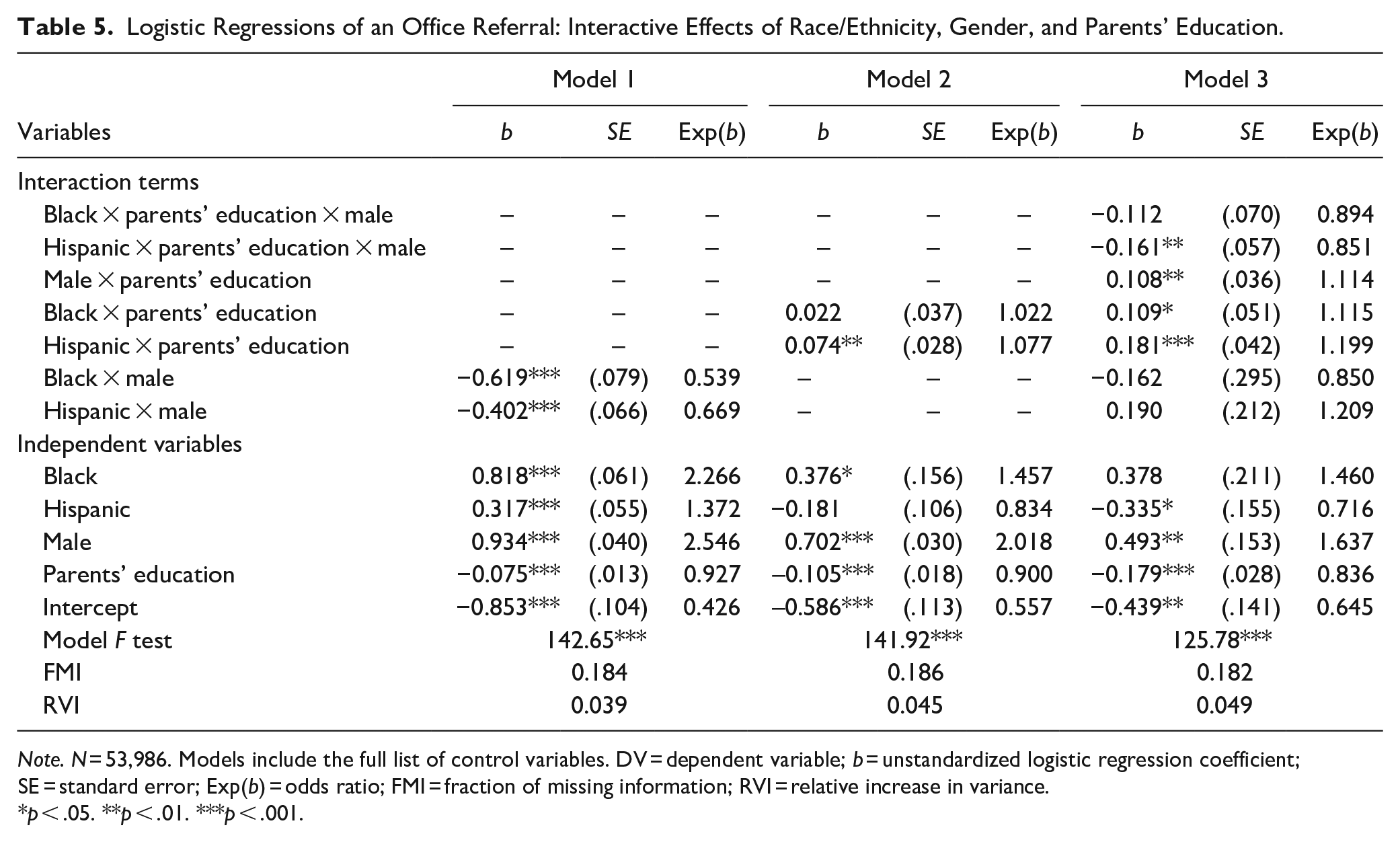
Note. N = 53,986. Models include the full list of control variables. DV = dependent variable; b = unstandardized logistic regression coefficient; SE = standard error; Exp(b) = odds ratio; FMI = fraction of missing information; RVI = relative increase in variance.
p < .05. **p < .01. ***p < .001.
In Model 1 of Table 4, which estimates the interactive effects of race/ethnicity and gender on suspension/expulsion, the coefficients of the two interaction terms are statistically significant and negative, which indicates that being male is associated with reductions in the Black-White and Hispanic-White disparities in the likelihood of receiving a suspension or expulsion. Put differently, racial and ethnic disparities in this outcome are more prominent among females than among males, and being female is associated with a 37.2% further increase in the odds of suspension or expulsion for Black students relative to Whites (b = –0.465, Exp(b) = 0.628, p < .001) as well as a 29.8% additional increase in the odds of this form of discipline for Hispanic youth compared to White youth (b = –0.353, Exp(b) = 0.702, p < .001). When these same interactive relationships are examined in the context of office referrals in Model 1 of Table 5, the coefficients of the multiplicative terms are likewise negative and statistically significant. Indeed, being female is associated with a 46.1% increase in the odds of receiving an office referral for Black students relative to Whites (b = –0.619, Exp(b) = 0.539, p < .001) and a 30.1% further increase in the odds of this outcome for Hispanic youth compared to similar White youth (b = –0.402, Exp(b) = 0.699, p < .001).
The predicted probabilities of both school discipline outcomes by race/ethnicity and gender, holding the covariates constant at their means, are calculated using the coefficients from the two regression models discussed above, and these probabilities are displayed in Figure 1. As shown in the figure, Black males and Hispanic males have predicted probabilities of ever having received a suspension or expulsion of 41.6% and 21.3%, while the probability for White males is 19.4%. These disparities are associated with percent increases of 114.4% and 9.8%, respectively. 10 In addition, Black males (30.7%) have a 15.0% greater predicted probability of receiving an office referral than White males (26.7%), though Hispanic male students (25.0%) have a 6.4% lower probability of experiencing an office referral relative to White males. Notably, the Hispanic-White differences among males associated with both suspension or expulsion and an office referral are not statistically significant.
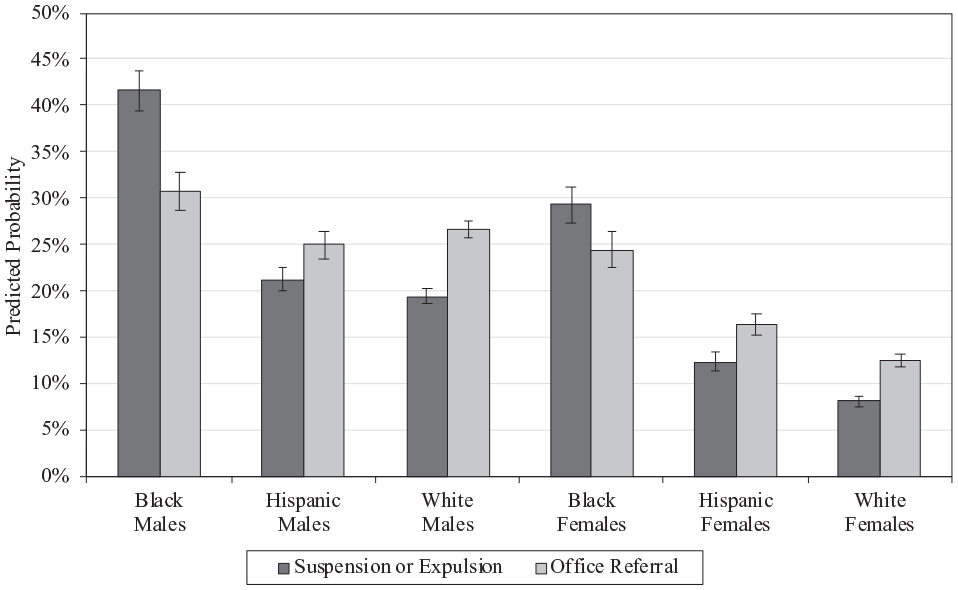
Predicted probabilities of a suspension or expulsion and an office referral by race/ethnicity and gender.
While female youth generally are less likely to experience both forms of school discipline than their male counterparts, the proportional increases in the probabilities of these outcomes associated with minority status are greater for female students than for males. Indeed, Black females have a predicted probability of suspension or expulsion (29.3%) that is more than 2.6 times greater than that of White females (8.1%) as well as 51.0% greater than that of White males. Likewise, Hispanic females’ predicted probability of suspension/expulsion (12.3%) is 51.9% greater than the probability among White females. A similar pattern is seen for office referrals such that Black females (24.4%) and Hispanic females (16.4%) have predicted probabilities that are 95.2% and 31.2% larger, respectively, than the probability among White females (12.5%). All of the racial/ethnic differences in the predicted probabilities of receiving both outcomes among female students are statistically significant.
Interactive Effects of Race/Ethnicity, Parents’ Education, and Gender
With regard to the third research question, which concerns the potential moderating effects of parents’ education on race/ethnicity, multiplicative terms between these variables are included in the main effects models, and these estimates are presented in Model 2 of Table 4 (suspension or expulsion) and Model 2 of Table 5 (office referral). The coefficients of these interactions in the model of suspension/expulsion are statistically significant and positive, which indicates that the differences between minority students and White students in the likelihood of a suspension or expulsion are amplified among youth whose parents have more education. Specifically, a 1-unit increase in parents’ education is associated with a 13.9% additional increase in the odds of a suspension or expulsion for Black youth relative to White youth (b = 0.130, Exp(b) = 1.139, p < .001) and a 23.1% further increase in the odds of this outcome for Hispanics compared to Whites (b = 0.208, Exp(b) = 1.231, p < .001). A somewhat similar pattern is observed in the comparable model estimating the likelihood of an office referral, but the effect sizes are notably more modest. Indeed, these results show that a 1-unit increase in parents’ education is associated with a 7.7% increase in the odds of this form of discipline for Hispanic students relative to White students (b = 0.074, Exp(b) = 1.077, p < .01). Black-White differences in the likelihood of an office referral do not appear to be conditioned by the education level of the youths’ parents.
Model 3 of Table 4 presents the estimates of the three-way interactions involving race/ethnicity, parents’ education, and gender on suspension or expulsion. The coefficients of the multiplicative terms involving all three variables are substantively small and statistically non-significant, suggesting that the moderating relationships between race/ethnicity and parents’ education observed in Model 2 of Table 4 are not more prominent among male students compared to females. In contrast, in Model 3 of Table 5, a statistically significant three-way interaction emerges between Hispanic ethnicity, parents’ education, and being male. Indeed, the coefficient of this interaction term is negative, which indicates that the amplifying effects of parents’ education on Hispanic-White disparities seen in Model 2 of Table 5 are more prominent among female students than among males (b = –0.161, Exp(b) = 0.851, p < .01). Additionally, the two-way interaction between Hispanic ethnicity and parents’ education in Model 3, which can be interpreted as the estimated interactive effect among females only, indicates that a 1-unit increase in parents’ education corresponds with a 19.9% increase in the odds of an office referral for Hispanic female youth relative to White female youth (b = 0.181, Exp(b) = 1.199, p < .001). Similarly, the two-way interaction shows that Black-White disparities are further amplified at higher levels of parents’ education among female youth (b = 0.109, Exp(b) = 1.115, p < .05).
Because three-way interactions in logistic regression models can be difficult to interpret for the reasons discussed above, we present in Figure 2 the predicted probabilities of a suspension or expulsion (Panels A and B) and an office referral (Panels C and D), disaggregated by gender, according to youths’ race/ethnicity and parents’ education. Several clear patterns emerge in this figure. First, across all four panels, parents’ education is generally negatively associated with both discipline outcomes for all racial/ethnic and gender groups. Second, the notable disparities between Black and White students, especially in the estimates of suspension and expulsion, are present at all levels of parents’ education. Third, the negative effects of parents’ education on the predicted probability of suspension/expulsion shown in Panels A and B are especially notable for White students, while the slopes for Black and Hispanic students are proportionately weaker. Indeed, Hispanic students in both gender groups have predicted probabilities of ever having been suspended or expelled that are fairly constant across parental education levels. Finally, while Panel C provides little indication that racial/ethnic disparities in the likelihood of an office referral vary substantially by parents’ education for males, the Black- and Hispanic-White disparities in this outcome among female students shown in Panel D become more pronounced in correspondence with increases in parents’ education levels.
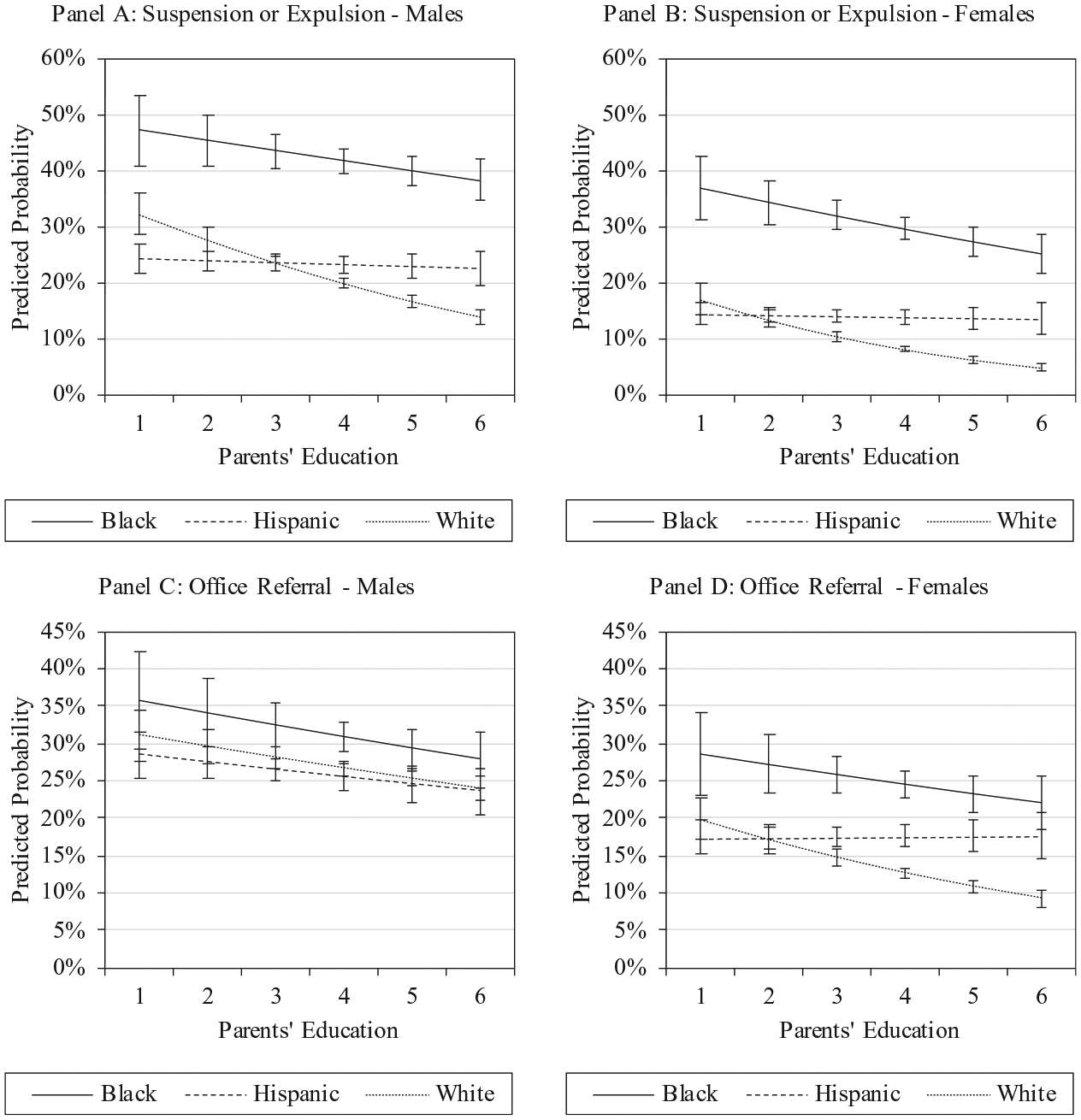
Predicted probabilities of a suspension or expulsion and an office referral by race/ethnicity, parents’ education, and gender.
Discussion and Conclusion
American educational institutions have undergone a notable punitive shift in recent decades as schools commonly rely on out-of-school suspensions, expulsions, and other formal disciplinary responses to address student misconduct (Hirschfield, 2018; Kupchik, 2010; Losen & Skiba, 2010). In addition, milder forms of sanctioning such as in-school suspension and office referrals are frequently used as well, particularly in instances in which school staff have a substantial amount of discretion over the type of punishment, if any, that is to be assigned (Girvan et al., 2017; Vavrus & Cole, 2002). A key concern expressed by scholars in light of these trends has been that the application of in-school penalties is not racially equitable, and prior research consistently has revealed that Black and Hispanic youth are more likely than Whites to experience these outcomes, even after a wide array of individual- and school-level factors are accounted for. In light of critical race theory, these observations may be interpreted as suggesting that schools contribute to persistent and pervasive racial/ethnic inequalities by imposing and enforcing White normative behavioral standards and values (Blaisdell, 2016; Leonardo, 2009).
While there recently have been notable advancements in this body of literature, it remains unclear whether these racial/ethnic disparities might be conditioned by other factors, including youths’ gender and parents’ educational attainment. Indeed, some prior work has highlighted the notable effects of race/ethnicity on suspension, expulsion, and other forms of discipline among males (Carter et al., 2017; Kupchik & Ellis, 2008), though other scholars have found evidence of more prominent disparities among female students (Morris & Perry, 2017; Raffaele Mendez & Knoff, 2003). Parental educational attainment, which has been identified as a useful proxy for youths’ SES (Kao & Thompson, 2003; Lien et al., 2001), is consistently negatively associated with school discipline outcomes, though how it might condition the effects of race and ethnicity has received very little empirical attention (Peguero et al., 2015; Skiba et al., 2002). Using recent data on seven nationally representative cohorts of 8th and 10th grade students, the present study provides the first multivariate assessment of the interactive relationships among race/ethnicity, gender, and SES in the context of school discipline. From these analyses emerged several key findings, and each is discussed in detail below.
Regarding our first research question about the main effects of race/ethnicity on the two school discipline outcomes examined, the findings revealed that Black and Hispanic students are more likely than their White counterparts to be suspended or expelled from school and, to a somewhat lesser extent, receive an office referral. These disparities are particularly remarkable given the vast number of control variables considered in the analyses, including academic success, attachment to school, in-school and out-of-school misbehavior and delinquency, peer substance use, and low self-control. These findings correspond closely with the evidence reported in prior research regarding the disadvantages experienced by minority youth in school punishment outcomes. Indeed, while this possibility cannot be directly assessed using these data, these patterns may suggest that school staff make disciplinary decisions based in part on implicit biases that distinguish minority students as unruly, combative, and prone to engage in delinquent behavior (Downey & Pribesh, 2004; Girvan, 2019; Ispa-Landa, 2018).
Concerning our second research question, the present study’s results indicate that, while Black males represent the race/gender subgroup that is most likely to experience both a suspension/expulsion and an office referral, the effects of race/ethnicity on both outcomes are more pronounced among female students than among males. Further, while Hispanic females are more likely than White females to receive both forms of discipline, no such ethnic differences emerged among male students. Thus, this study’s findings show Black males to be particularly at risk of receiving punitive school discipline, possibly because these youth can be characterized as dangerous and predatory in accordance with culturally pervasive stereotypes. However, these results also indicate that White females receive substantial benefits in school discipline, while Black and—to a lesser extent—Hispanic females are disparately penalized. This latter finding comports with evidence from prior quantitative and qualitative work (e.g., Lehmann & Meldrum, 2019; Morris, 2005, 2007) and might suggest that schools use sanctioning practices to enforce racialized and gendered behavioral norms. Indeed, it is theoretically plausible that minority female students who are perceived as failing to live up to White middle-class feminine standards of passivity and agreeableness, even in rather benign ways, might be perceived as disruptive, insolent, or “unladylike” and disciplined accordingly.
The third key finding from this study is that the educational attainment of students’ parents exerts independent as well as moderating effects on school punishment. Like previous work on the relationship between socioeconomic disadvantage and disciplinary outcomes (e.g., Hemphill et al., 2010, 2014; Mizel et al., 2016; Sullivan et al., 2013), we find that youth whose parents have higher educational attainment are less likely to be suspended or expelled and receive office referrals. Additionally, while there are conflicting theoretical rationales surrounding the anticipated direction of the interaction between race/ethnicity and SES, our results indicate that the observed Black- and Hispanic-White disparities are amplified at higher levels of parents’ education, and these relationships are consistent across both gender groups in the estimates of suspension/expulsion. In fact, while the differences between Black and White youth were found to be most prominent for students whose parents have high educational attainment, it is only among these same youth that Hispanics are more likely than Whites to be suspended or expelled from school. A closely similar pattern is observed in the analysis of office referrals, but only among female students; no interactive relationship between race/ethnicity and parents’ education on this outcome was found among males.
These latter findings have important theoretical implications. The general observation that, relative to their White peers, Black and Hispanic youth of higher SES are especially disadvantaged in suspension and expulsion decisions provides some support for the notion that there are “backlash effects” (Kao, 2000; Rudman, 1998) associated with membership in these status categories. As Phelan and Rudman (2010) explain, “stereotype confirmation is self-validating for perceivers,” and being confronted with information that contradicts these understandings can “cast perceivers into a state of uncertainty” (p. 278) and induce people to act in ways that defend or reinforce their prior beliefs. Thus, while notable benefits in school disciplinary outcomes accompany higher SES overall, these advantages extend in less notable ways to minority youth, whose disconfirmation of cultural stereotypes held by school staff may place them at risk of being singled out for punitive sanctioning. Additionally, the finding that SES does not confer any reduced likelihood of being disciplined at school among Hispanics parallels the observations made by Peguero et al. (2015), who suggest that cultural assimilation by non-native youth is accompanied by “a myriad of challenges associated with migration to a new country, including the U.S. school system, with its unwelcoming reception of these students, racism, discrimination, violence, and social disorder” (p. 79).
The finding from this study that, in the context of office referrals, the interactive effects of race/ethnicity and SES are observed only among females might be interpreted as pointing to the discretionary power of school staff over this form of discipline. Less punitive school sanctions such as in-school suspensions, detentions, and office referrals often have been proposed as promising alternatives to out-of-school suspension and expulsion because the short- and long-term negative consequences for youth associated with these punishments are less severe (see, e.g., McCluskey et al., 2008; Morrison & Vaandering, 2012). However, decisions to impose office discipline referrals typically are made in light of the subjective determinations of school personnel, and often there is some ambiguity surrounding the type of punishment that is warranted in these cases (Girvan et al., 2017; Smolkowski et al., 2016). Thus, for less serious misbehavior incidents in which an office referral might be preferred over an out-of-school suspension or expulsion, White female students who are of higher SES may be extended substantial leniency, while higher SES minority female youth might be subject to the same “backlash effects” as those observed in suspension/expulsion decisions. Indeed, our finding that no similar pattern emerged among males could be interpreted as evidence of the exceptionally high standards of behavior to which socioeconomically advantaged Black and Hispanic female students are expected to conform (Auwarter & Aruguete, 2008; Blake et al., 2011).
Although the present study provides some novel insights concerning the intersection of students’ status characteristics and their relative risk of experiencing punitive school discipline, several limitations of this research should be discussed. First, the available measure of suspension or expulsion conflates these two forms of discipline such that it is impossible to assess if students experienced one, the other, or both. Further, since the survey item asked about lifetime exposure to these events, it is unclear how many times these sanctions were assigned and how recently they occurred relative to the administration of the survey. Despite these limitations, however, this measure was included in the analyses in light of prior research which has shown that both suspension and expulsion from school can have profound negative consequences on a wide range of outcomes over the life course (Kupchik, 2016; Ramey, 2020; Wolf & Kupchik, 2017). Additionally, since suspension/expulsion can be associated with increases in various forms of misbehavior and delinquency, the inclusion of control variables that use more proximate recall periods (e.g., the past 12 months, the past 4 weeks) produces conservative estimates of the relationships of interest. Nonetheless, more precise measures of suspension and expulsion would have been a notable enhancement to this study.
A second limitation relates to the item capturing respondents’ race/ethnicity, as the coding of the measure in the original dataset precluded any analyses involving youth who did not identify as Black, Hispanic, or White. Thus, a priority for future research should be to explore these same interrelationships among other racial and ethnic groups to explore these “unseen dimensions of the racial discipline gap” (Nguyen et al., 2019, p. 1985). Third, although parental educational attainment is an often-used proxy for family SES given the limitations associated with surveys of youth (Lien et al., 2001), this item represents only a single dimension of the comprehensive construct of SES. Further, while this variable was found to be associated with the outcomes and other predictors in theoretically expected ways, our reliance on this measure is predicated on the assumption that school personnel are aware of students’ SES and are apt to make disciplinary decisions in accordance with perceptions connected to it. Unfortunately, this represents a shortcoming of this and many other studies examining the effects of SES on school discipline, and future work is needed which explores alternative dimensions of this construct that can more clearly be connected to the decision-making of teachers and administrators.
Finally, beyond these issues of measurement, it is important to acknowledge the possibility of omitted variable bias. In particular, we were able to include only general measures of misconduct and delinquency as no information was available about the specific misbehavior events which led to the imposition of the school sanctions. While we attempted to lessen the impact of this limitation by controlling for numerous theoretically salient predictors of adolescent offending, it is possible that the observed relationships are an artifact of insufficient measures of the students’ misbehavior. Similarly, the MTF survey contains no information about the attitudes and perceptions of school staff regarding youths’ misconduct as well as the beliefs and stereotypes that these individuals may hold concerning race, ethnicity, gender, and SES (Downey & Pribesh, 2004). As a result, the theoretical mechanisms we describe are speculative, and our findings should not be interpreted as unequivocal evidence of discrimination in school disciplinary practices. Lastly, very little information about the educational institutions themselves was available, and we were unable to use a hierarchical analytic strategy to differentiate school-level effects from those occurring at the individual student level.
Despite these data and measurement limitations, the results from this research emphasize the importance of considering the joint effects of race/ethnicity, gender, and SES when examining disparities in school discipline. Indeed, while some recent developments to this literature have considered the conditions under which the inequalities experienced by minority students might be more or less pronounced (e.g., Edwards, 2016; Girvan et al., 2017; Morris & Perry, 2017; Peguero et al., 2015), the findings from the present study indicate that the effects of race and ethnicity on school discipline outcomes, including sanctions that are informal and commonly assigned, vary in conjunction with gender and SES. Thus, this research suggests that educational institutions should work to implement measures that might reduce school professionals’ reliance on implicit biases in the imposition of disciplinary sanctions. Potential policy solutions that could help accomplish these goals include implicit bias training and professional development for school staff designed to help strengthen relationships between teachers and students and overcome cultural gaps (Anyon et al., 2014; Carter et al., 2017). More generally, however, this study’s findings further highlight the need for schools to decrease reliance on exclusionary school discipline practices in favor of restorative sanctions and positive behavioral interventions, thereby mitigating the “school-to-prison pipeline” and racial, gender, and socioeconomic disparities therein.
Footnotes
Declaration of Conflicting Interests
The author(s) declared no potential conflicts of interest with respect to the research, authorship, and/or publication of this article.
Funding
The author(s) received no financial support for the research, authorship, and/or publication of this article.
