







Abstract
Drawing on theoretical propositions of general strain theory (GST), the current study aims to examine whether general victimization as a source of criminogenic strain predicts two different types of bullying, traditional and cyberbullying perpetrations, and whether negative emotionality, such as trait-based anger and depression, conditions the effects of general victimization on bullying. Using a Korean adolescent sample, we adopt cross-lagged dynamic panel models to investigate the longitudinal effects and interactions of strain and negative emotionality. The results indicate a significant influence of general victimization on both types of bullying perpetrations, as expected, while the conditioning effects of negative emotionality are found only for traditional bullying, which may reflect differences in the nature of the two different forms of bullying.
Bullying is a common and frequent form of delinquency among juveniles (Nansel et al., 2001; Solberg & Olweus, 2003; Wang et al., 2009). It is characterized by repetitive attacks or intimidation resulting in physical and/or psychological harm to the victim (Farrington, 1993; Olweus, 1991). Bullying has been linked to a host of negative consequences such as suicidal ideation, school-related problems (e.g., absences from school and low academic performance), and health/behavioral problems (see Hay et al., 2010; Hinduja & Patchin, 2008, 2010; Jennings et al., 2019; Kowalski & Limber, 2013).
Although bullying is not a new or understudied topic, continued empirical attention is needed to respond to its changing nature. Recently, in addition to traditional bullying in the face-to-face and school contexts, several forms of bullying, such as verbal and relational aggression, have appeared in online settings, which is considered cyberbullying. Due to technological development and increasing online interaction, cyberbullying has quickly become widespread among youth. The virtual world is characterized by anonymity, indirect communication, a lack of instant emotional reactivity, and a lack of physical boundaries, which enables cyberbullying to be embedded in our daily lives and makes it easier for 21st-century youth to be involved in cyberbullying as perpetrators or victims (Kowalski et al., 2012, 2014).
From the perspective of general strain theory (GST), bullying can be understood as criminal coping for youth with higher levels of strain due to their experience of negative life events. The strain-bullying relationship has been examined and was found to be applicable to cyberbullying as well as traditional bullying (Jang et al., 2014; Lianos & McGrath, 2018; Moon et al., 2012; Moon & Jang, 2014; Patchin & Hinduja, 2011). Specifically, although not all studies adopted the theoretical framework of GST, many prior studies examined the association between bullying victimization as a source of strain and bullying perpetration as a coping strategy and found a link between them (see Kowalski et al., 2014; Walters, 2020). That is, as a negative interpersonal relationship, bullying victimization may increase the level of strain for bullying victims, and bullying perpetration is deviant coping with the strain derived from bullying victimization. Compared to empirical attention to the effects of bullying victimization on bullying perpetration, the impacts of general criminal victimization (which includes not only bullying victimization, but also various types of victimization) has thus far received less interest. Furthermore, limited scholarly attention has been paid to whether and how an individual’s negative emotionality, such as trait-based anger and/or depression, moderates the strain-bullying perpetration link as Agnew (2006, 2007, 2013) more recently proposed.
The present study first examines whether general criminal victimization, which is a measure of criminogenic strain, successfully predicts the two different forms of bullying, traditional bullying and cyberbullying. More importantly, this study investigates conditioning effects of negative emotionality (anger and depression) on the strain-bullying perpetration association. We employ two negative emotions, anger, and depression, given their different characteristics: depression is considered an internalizing tactic, whereas anger calls for corrective action (Agnew, 1992, 2001, 2006, 2013). Using five waves of the Korean Youth Panel Survey (KYPS), we apply cross-lagged dynamic panel models to follow longitudinal changes and relations between criminogenic strain, negative emotions, and two forms of bullying while controlling for time-variant and invariant covariates as well as the lagged dependent variable.
Victimization as a Criminogenic Strain and Bullying Perpetration
Roles of Negative Emotionanlity in Criminal Coping
GST proposes that various negative life events experienced by individuals—such as losing something or someone they care about, being treated in a cruel manner by others, and failing to achieve their goals—are major sources of strain, which provokes negative emotions such as anger, frustration, fear, and depression, which, in turn, result in individuals’ criminal and delinquent behavior (Agnew, 1992, 2001, 2006, 2007). For individuals who experience such negative life events, crime is one of the coping stratgies considered as a response to strain to alleviate negative emotional states as well as strain itself. The overall impacts of strain have been documented in not only general delinquency (De Coster & Thompson, 2017; Moon & Morash, 2017; Park & Metcalfe, 2020) but also specific criminal and deviant behaviors such as gang fights, robbery, and assault (Lee & Kim, 2017), property crime (Sigfusdottir et al., 2012), drug use (Carson et al., 2009), self-harm and suicidal ideation (Hay & Meldrum, 2010), and purging behavior (Sharp et al., 2001).
In terms of variation in criminal coping across different types of strain, Agnew (2001, 2007) suggested that some strains are more strongly associated with crime than others when they are seen as unjust, high in magnitude (e.g., severity, frequency, or duration), associated with low social control, and provide some incentive or pressure for criminal coping. He pointed out that victimization is one of the criminogenic strains that meet some of these conditions and is highly likely to cause criminal/delinquent behaviors along with other strains such as parental rejection, parental/peer abuse, negative relationships with teachers, and marital problems. Mostly, victimization is a noxious experience that is often recognized as unjust and that can have a significant adverse impact on one’s physical and psychological well-being. More severe, frequent, diverse, and persistent victimization leads to more negative emotions such as anger, frustration, and depression. Thus, victims may believe that they should fight back or retaliate in response to their victimization to end the source of strain. Otherwise, they may themselves become a predator and seek suitable targets to alleviate their negative emotions through perpetrating the same behaviors by which they were victimized. Drawing on the GST framework, some empirical studies have examined the effects of victimization on criminal coping and found a significant relationship between them (Baron, 2004; Craig et al., 2017; Hay & Evans, 2006; Moon & Morash, 2017; Ostrowsky & Messner, 2005; Teijón-Alcalá & Birkbeck, 2019).
Given the consistent association between victimization and criminal coping, bullying perpetration is believed to be criminal coping in response to the intensive strain derived from prior victimization. For youth, as shown in its frequency and prevalence (Nansel et al., 2001; Solberg & Olweus, 2003; Wang et al., 2009), bullying perpetration may be one of the most conveniently accessible means by which adolescents can deal with their strains. For example, bullying victimization has been well established as one of the strongest predictors of bullying perpetration (Chan & Wong, 2015; Gibb & Devereux, 2014; Hinduja & Patchin, 2008; Jang et al., 2014; Lee, 2010; Marcum et al., 2014; Wong et al., 2014; Ybarra & Mitchell, 2004, 2007; see also Walters, 2020; Kowalski et al., 2014). These findings may imply that, for bullying victims, bullying perpetration can be considered one among the criminal coping strategies by which to remove strain due to bullying victimization. Nevertheless, it remains unclear whether the association between bullying victimization and perpetration manifests the strain-crime link that GST proposes or whether it is another victim-offender overlap that requires further examination to discover its mechanism.
Although there are diverse types of victimization, general criminal victimization with multiple forms of victimization should be a more important source of criminogenic strain; hence, it is more appropriate to examine the applicability of the strain-crime link in regard to bullying perpetration. For example, Turner et al. (2010) found that poly-victimization, which refers to the experience of multiple types of victimization, was more stressful and traumatic than repeated victimizations of a single type; thus, such victimization may be more highly associated with delinquency. Relatedly, Wemmers et al. (2018) found that poly-victimization had the strongest effects on delinquency when non-victimization adverse events as well as negative emotions such as anger and depression were controlled for. Thus, individuals who have experienced more diverse forms of victimization are more likely to feel intensive strain and negative emotions, which, in turn, may lead them to perpetrate bullying.
Despite its importance, the role of general victimization in bullying perpetration has received less attention in the bullying literature, relative to bullying victimization. This is a drawback, given that some studies have shown a significant impact of general victimization on bullying perpetration. For instance, Moon et al. (2012) found a positive association between general victimization and bullying perpetration among South Korean youth. Some other studies have applied composite strain variables, including general victimization items, and found that the greater the level of strain, the higher the likelihood of bullying perpetration (Lianos & McGrath, 2018; Moon & Jang, 2014; Patchin & Hinduja, 2011).
Roles of Negative Emotionanlity in Criminal Coping
To account for the path from general victimization to bullying perpetration, some intervening, and conditioning roles of negative emotions in the strain-crime link should be considered given some propositions in GST. First, it is suggested that experiencing certain types of strain can produce negative affective states, and these negative emotional states, in turn, may lead to criminal coping. For example, victims are more likely to report negative emotions such as anger and depression, compared to nonvictims (Kendrick et al., 2012; Ostrowsky & Messner, 2005; Sigfusdottir et al,. 2010; Turner et al., 2013; Walters & Espelage, 2018), and these negative emotions may increase the likelihood that an individual will engage in bullying (Espelage & Swearer, 2009; Lonigro et al., 2014; Moon et al., 2011; Patchin & Hinduja, 2011; Rieffe et al., 2012; Tanrikulu & Campbell, 2015; Walters & Espelage, 2018; Wang et al., 2011; Yang et al., 2018). Nevertheless, the literature indicates that the intervening role of negative emotions in criminal coping is mixed (for supportive results, see Aseltine et al., 2000; Hay & Evans, 2006; Jang & Johnson, 2003, for no or limited support, see Botchkovar & Broidy, 2013; Mazerolle et al., 2000; Mazerolle & Piquero, 1998; Tittle et al., 2008; see also Agnew, 2006, 2013).
In addition to the intervening role of negative affective states, the recent GST extension (Agnew, 2006, 2007, 2013) suggested that trait-based negative emotionality conditions the effects of strain on crime. Unlike situation-based emotional states, which are an individual’s actual emotional experiences in a certain situation, trait-based emotionality refers to an individual’s emotional disposition or tendency that remains relatively stable across different situations and contexts. Individuals with trait-based negative emotionality tend to get upset, angry, or frustrated easily; thus, if they experience strain, they are more likely to engage in criminal coping as negative emotionality can enhance the effect of strain. Some studies have examined the conditioning role of negative emotionality (Agnew et al., 2002; Botchkovar & Broidy, 2013; Eitle, 2010; Francis, 2014; Kushner et al., 2020).
Specifically, Agnew et al. (2002) applied a cross-sectional analysis using the second wave data from the National Survey of Children to examine whether the effect of strain on delinquency was conditioned by the composite variable of negative emotionality/low constraint measured by multiple questions to parents and teachers about the juvenile’s personal traits, including impulsiveness and having a strong temper/losing their temper easily. They found that negative emotionality/low constraint significantly increased the effect of strain on delinquency, indicating that strain is more strongly associated with delinquency for juveniles high in negative emotionality and low constraint.Using three-wave panel data for U.S. adolescents, Eitle (2010) found that angry disposition, which was measured by items relating to trait-based anger, amplified the effect of chronic stressors on changes in self-reported criminal activity, although the moderating effect was insignificant for the other strain measure, stressful recent life events. That is, a change in exposure to chronic stressors over time had a much greater effect on changes in criminal activity for adolescents with a high-level angry disposition, compared to those with a low- or average-level angry disposition. For the conditioning effect of depression/anxiety, Francis (2014) applied a cross-sectional approach based on data gathered from adolescents in Chicago and found that trait depression/anxiety played a significant moderating role in terms of enhancing the effects of several types of strain, including exposure to violence, sexual victimization, and loss of significant others, on some non-aggressive behavioral outcomes, such as running away, suicidal behavior, and substance use.
Although the majority of research was based on Western samples, there are a small number of studies drawing on non-American/Western data. For instance, Botchkovar and Broidy (2013) show that the conditioning effect of negative emotionality can be meaningful even for a non-youth population in a non-U.S. context. Using a random sample of Russian adults, they measured two different types of negative emotionality: anger and other negative emotions. Because anger is more closely related to externalizing behavior, while other negative emotions such as depression and guilt are more closely associated with internalizing behavior, they examined the conditioning effects of anger and other internalized negative emotions, including depression, guilt, and dissatisfaction, separately. Their findings indicate that anger significantly enhanced the effects of strain on both property and general crime, although it did not successfully moderate the strain-violent crime association. In contrast, other internalized negative emotions did not have any significant conditioning effects. Similarly, Kushner et al. (2020) also applied a cross-sectional analysis drawing on a sample of adults in a non-Western context: two cities in Russia and Ukraine. Several types of victimization, including violent, property, and sexual victimization, were measured and combined to be utilized as a composite variable for strain. For negative emotionality, they also measured two trait-based negative emotions: anger and depression. They found that anger was a significant moderator for the association between victimization and crime. Unexpectedly, however, anger buffered the effect of victimization on violent crime, although it enhanced the effect of victimization on property crime as expected. For depression, it also had a buffering effect on the link between victimization and violent crime, while its conditioning effect on property crime was insignificant.
Overall, anger plays a role in amplifying the direct effect of strain on crime and delinquency as expected (Agnew et al., 2002; Botchkovar & Broidy, 2013; Eitle, 2010; Kushner et al., 2020). However, it was not always the case for some types of strain as well as some types of crime/delinquency as its conditioning effect was insignificant or indicated an unexpected direction (e.g., buffering effects; Botchkovar & Broidy, 2013; Eitle, 2010; Kushner et al., 2020). In terms of the conditioning effect of depression, research findings overall indicate inconsistency despite some studies reporting the expected enhancing effect (Francis, 2014). Compared to anger, the interaction between depression and strain is more likely to be non-significant and to unexpectedly buffer the criminogenic effect of strain (Botchkovar & Broidy, 2013; Kushner et al., 2020).
Despite some empirical supports for the conditioning effect of negative emotionality, therefore, there remain some mixed and unexpected outcomes that should be addressed and examined by further studies. Given the differences in settings across prior studies, the inconsistency might be associated with different sample characteristics (e.g., youth, adults, different cultural contexts), different sources of strain (e.g., family, peer, school-related strain, victimization), different types of behavioral outcomes (e.g., violence, property crime, internalizing behavior), and different research designs (e.g., cross-sectional, longitudinal). To the best of our knowledge, there is a lack of research to date that examines the conditioning effect of negative emotionality on the link between general victimization as a source of strain and bullying perpetration as a coping strategy in a non-Western context with a longitudinal research design.
Thus, the current study aims to examine the following research questions: (1) Does general criminal victimization as a source of criminogenic strain predict the two different forms of bullying perpetration, namely, traditional bullying and cyberbullying? (2) Do the two different types of negative emotionality, anger and depression, condition the direct effect of general victimization on traditional bullying and cyberbullying perpetration?
Methods
Data
Data for this project were obtained from the Korean Youth Panel Survey (KYPS), which is nationally representative panel data collected by the National Youth Policy Institute (NYPI). A stratified, multiple-stage clustering and multiple-point perspective panel design was employed to increase the data representativeness. First, schools were randomly selected across all South Korean cities and provinces, and subsequently, students were randomly selected in proportion to the student enrollment in the selected schools. Participants were provided with a paper and pencil survey, and parents were interviewed via telephone to obtain information regarding their family background, parental education, and socio-economic status. The attrition rate from the initial to the final wave was less than 10%. Respondents were 10 and 14 years old at waves 1 and 5, respectively. The size of the total sample used for the analysis was 2,267. There was no race/ethnicity diversity, and approximately 53% of the respondents were boys (Table 1). Except for the time invariant control measures at wave 1, the other variables were estimated using waves 1 to 5.
Sample Descriptives.
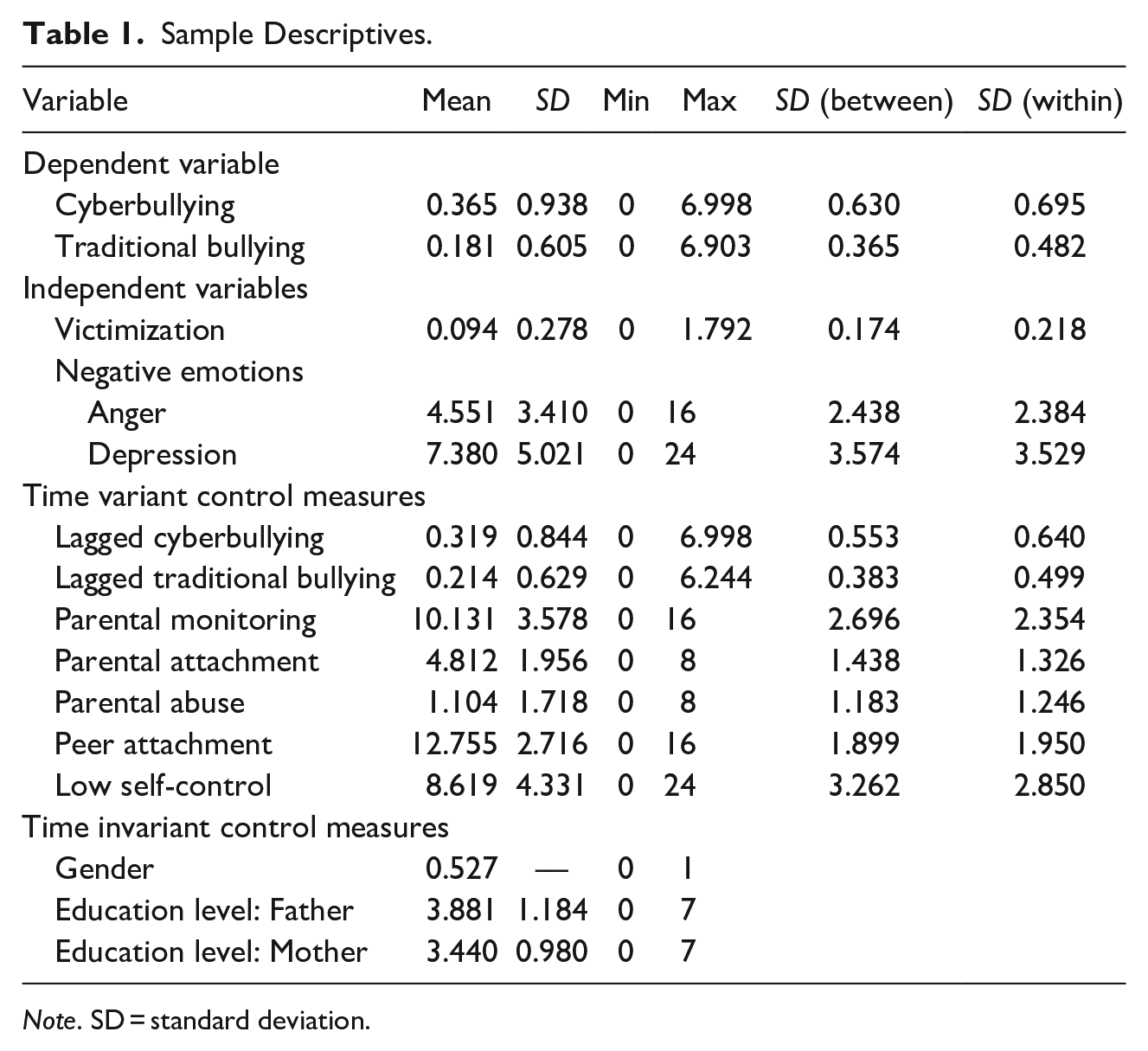
Note. SD = standard deviation.
Dependent Variables
Cyberbullying was composed of items that estimated the bullying behavior perpetrated through the use of technology (Song et al., 2020). Youth were asked to report the number of instances they engaged in cyberbullying over the previous 12 months (e.g., intentional circulation of false information, insult other people online). Because responses were positively skewed, the natural logarithmic transformation was employed after summing the frequencies of the two items. The measure of traditional bullying was assessed by the sum of the frequency of the following behaviors over the previous 12 months: severely teased or bantered other people, threatened other people, and treated other people as outcasts (Kim et al., 2017). Similar to the cyberbullying measure, the natural logarithmic transformation was utilized to deal with the skewed responses.
Independent Variables
Victimization
A measure of victimization was created by summing five items to capture the most common victimization among South Korean youth (Kim & Lee, 2019). Respondents were asked whether they had experienced the following acts over the previous 12 months: (1) threatened, (2) bullied, (3) seriously beaten up, (4) robbed, and (5) seriously teased or ridiculed (no = 0, yes = 1). For less skewed and highly valid estimates (Sweeten, 2012), the variety scale was employed, ranging from 0 (indicating no victimization) to 5 (indicating all five types of victimization), and natural logarithmic transformation was used. The average Kuder–Richardson Formula 20 for the measure was 0.72. Two trait negative emotionality measures were employed. Anger was constructed from four items (e.g., “Sometimes I can’t suppress an impulse to hit other people” and “I consider myself as an explosive soon to go off”; Park & Metcalfe, 2020). A 5-point Likert scale was used to assess each question, and higher scores indicated higher levels of anger. The Cronbach’s alpha was between .77 and .79. Depression was created by summing five items (e.g., “Sometimes I feel extremely sad and gloomy for no apparent reason” and “I am not interested in anything”; Han & Grogan-Kaylo, 2013). A 5-point Likert scale was used to assess each question, and higher scores indicated more severe depressive symptoms. The average reliability of the measure was α = .86.
Time Variant Control Measures
Lagged cyberbullying and lagged traditional bullying were measured in the same manner as the dependent variables described above. Including lagged dependent variables in the estimated models allows for assessment of exogenous independent effects of cyberbullying and traditional bullying over time, without the effect of lagged measures (Williams et al., 2018). Parental monitoring was composed of four items (Kim & Lee, 2019): “When I go out, my parents usually know. . .” (1) “where I am,” (2) “whom I am with,” (3) “what I am doing,” and (4) “when I will return.” Responses ranged from 0 (strongly disagree) to 4 (strongly agree) for each item, and the average Cronbach’s alpha was .87. Higher values represented higher parental monitoring. Parental attachment was measured using two items (Kim & Lee, 2019). Respondents were asked to rate their level of agreement with two statements: (1) “I am comfortable sharing my thoughts and feelings with my parents” and (2) “I often talk about what happens to me outside the home.” A 5-point Likert scale was used for responses, ranging from 0 (strongly disagree) to 4 (strongly agree). The average Cronbach’s alpha was .71. Higher values indicated greater parental attachment. Parental abuse was composed of two items (Kim & Lee, 2019). Respondents were asked to rate their agreement with the following statements: (1) “I often receive verbal abuse from my parents” and (2) “I am often badly hit by my parents.” Response categories comprised a 5-point Likert scale, ranging from 0 (strongly disagree) to 4 (strongly agree). The average reliability of the parental abuse measure was α = .83. Higher values indicated higher parental abuse. Peer attachment was measured using four items in which youth rated their level of agreement (Kim & Lee, 2019): (1) “I want to maintain the friendships I have with my close friends,” (2) “I am happy with my friends,” (3) “I try to share the same thoughts and feelings as my friends,” and (4) “I have candid conversations with my friends.” Responses ranged from 0 (strongly disagree) to 4 (strongly agree). The average Cronbach’s alpha for the measured questions was .78. Higher values indicated higher peer attachment. Self-control was measured via six items (Kim & Lee, 2019), which reflected five dimensions of self-control suggested by Gottfredson and Hirschi (1990): impulsivity, avoidance of difficult tasks for simple tasks, risk-taking, self-centeredness, and short temper (e.g., “I enjoy risky activities,” “I lose my temper whenever I get angry”). Responses ranged from 0 (strongly disagree) to 4 (strongly agree). The average reliability of the measure was α = .71. Higher scores represented lower self-control.
Time Invariant Control Measures
A binary variable of gender represented respondents’ biological sex as girl (coded 0) or boy (coded 1). A measure of parental education level captured the highest level of education completed by father and mother, respectively, ranging from 0 = elementary school, 1 = middle school. . .6 = master’s degree, to 7 = doctoral degree.
Analytic Strategy
As the current study aimed to examine the effects of victimization and negative emotion on bullying behavior, cross-lagged dynamic panel models were used (Allison et al., 2017; Williams et al., 2018). These models have several strengths in exploring the longitudinal links among variables, which enable researchers to simultaneously take into account the impacts of (1) time-variant covariates, (2) time-invariant covariates, and (3) lagged measures of the dependent variables as a control variable. More specifically, the fixed effect model is a widely applied method to estimate time-variant covariates, but it cannot include the time-invariant covariates within the same equation. Although the mixed effect model allows the simultaneous inclusion of both time variant and time invariant measures, it is susceptible to endogeneity issues, which leads to a violation of the model assumption (see RabeHesketh & Skrondal, 2012). Additionally, considering the strong impacts of prior delinquency on subsequent delinquent behavior (Gottfredson & Hirschi, 1987; Matsueda, 1986), inclusion of the previous dependent outcome in the analysis enabled rigorous testing, which is not available in similar analytic techniques such as mixed- and fixed-effects modeling (Allison et al., 2017; Williams et al., 2018). Such benefits of cross-lagged dynamic panel models lead to examine critical questions in criminological studies (e.g., Boman & Mowen, 2018; Mowen et al., 2018).
Analyses for this study proceeded in three phases using STATA 15. The first step entailed a descriptive analysis of all dependent, independent, and control variables. Second, we analyzed the impacts of victimization on cyberbullying and traditional bullying, respectively. Third, we estimated the effects of negative emotions, anger, and depression on two dependent variables. Finally, the interaction terms (i.e., victimization × anger, victimization × depression) were added to the models. The interaction terms were created by multiplying the group mean-centered measures of victimization, anger, and depression (see Hofman & Gavin, 1998; Paccagnella, 2006). The missing responses from the total sample were less than 10% across the examined waves, and full information maximum likelihood estimation was applied to retain the full original sample (Williams et al., 2018). To ensure the sensitivity of the results in regard to the missing responses, we compared the estimates with and without full information maximum likelihood estimation, and the results indicated overall similarities. In addition, multicollinearity diagnostics were conducted, and all of the variance inflation factors were less than 1.82, which implied no collinearity concerns.
Results
Tables 2 and 3 present the results of a series of cross-lagged dynamic panel models assessing cyberbullying and traditional bullying. Overall, the models showed good model fit (root mean square error of approximation below .05 and confirmatory fit index above .95) except for χ2 values. Although our models found significant chi-square statistics, structural equation modeling (SEM) literature generally points out its vulnerability, noting that “the Chi-Square statistic nearly always rejects the model when large samples are used. . . . where small samples are used, the Chi-Square statistic lacks power” (Hooper et al., 2008, p. 54), and acknowledges that “it may be hard to find any reasonably parsimonious model that yields a p value greater than .05” (Allison et al., 2017, p. 8). To overcome this issue, we compared the estimated models with saturated models following the suggestion of Allison et al. (2017). Higher p values for the χ2 values indicated better fitting in the comparison models.
Cross-Lagged Dynamic Panel Data Models Assessing Cyberbullying.
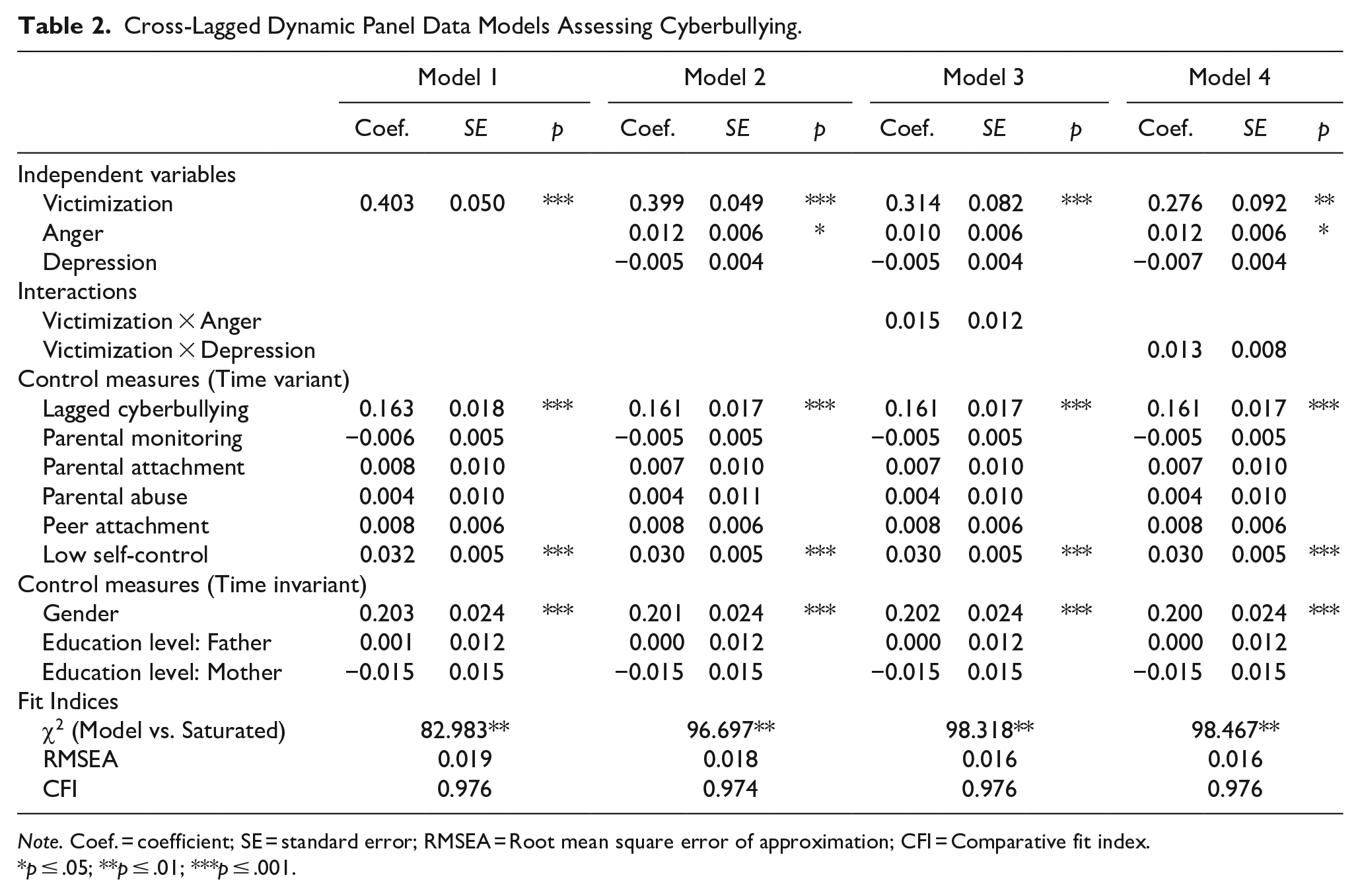
Note. Coef. = coefficient; SE = standard error; RMSEA = Root mean square error of approximation; CFI = Comparative fit index.
p ≤ .05; **p ≤ .01; ***p ≤ .001.
Cross-Lagged Dynamic Panel Data Models Assessing Traditional Bullying.
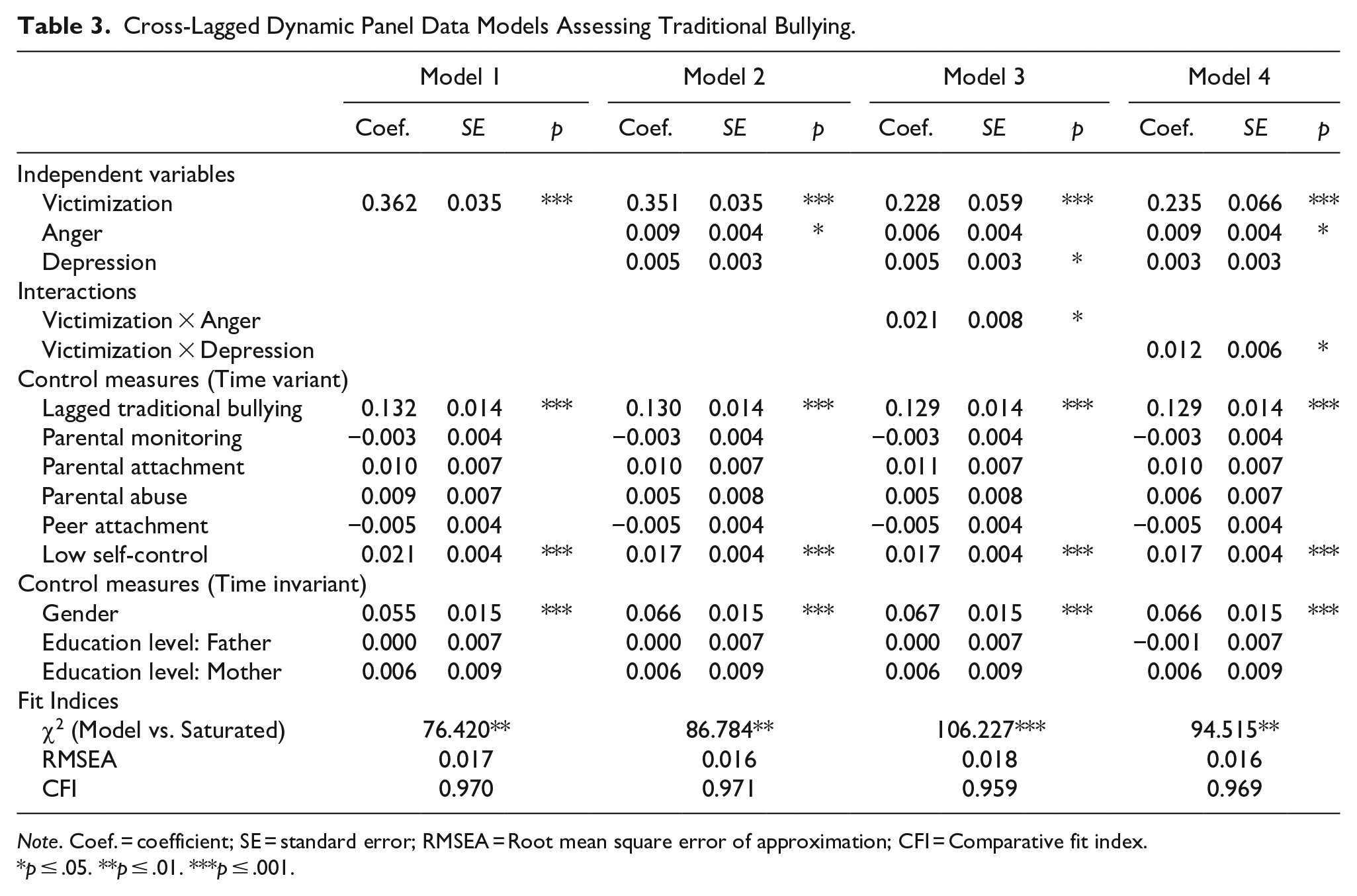
Note. Coef. = coefficient; SE = standard error; RMSEA = Root mean square error of approximation; CFI = Comparative fit index.
p ≤ .05. **p ≤ .01. ***p ≤ .001.
Results of the cross-lagged dynamic panel model assessing cyberbullying are shown in Table 2. Model 1 indicates that victimization was significantly related to cyberbullying perpetration across time. In particular, being victimized was associated with an increase in cyberbullying perpetration. Among time-variant control measures, the measures of lagged cyberbullying and low self-control were associated with increased cyberbullying perpetration. Gender was a significant time-invariant control measure. The other independent variables—negative emotions—were included in Model 2, where victimization remained significant. While anger was associated with increased cyberbullying, depression was not significantly associated with it. Similar to Model 1, lagged cyberbullying and low self-control were related to an increase in cyberbullying perpetration, and boys reported significantly higher levels of cyberbullying than girls. Interaction terms encompassing victimization and negative emotions (anger and depression) were included in Models 3 and 4; however, no significant interaction effects emerged, suggesting that the impact of victimization on cyberbullying was independent of the effect of negative emotions.
Table 3 shows the results of the cross-lagged dynamic panel model assessing traditional bullying. Model 1 demonstrated that experiencing victimization was significantly associated with an increase in traditional bullying perpetration. Girls had significantly lower levels of traditional bullying, compared to boys. The Model 2 results revealed that both victimization and anger were significantly related to traditional bullying perpetration across time; however, depression did not play a significant role. Two-time variant control factors, lagged traditional bullying and low self-control, were related to increased traditional bullying in Models 1 and 2. Models 3 and 4 present cross-lagged dynamic panel model results assessing potential victimization and negative emotional interaction effects on traditional bullying. Model 3 showed a positive and significant interaction effect between victimization and anger, and Model 4 revealed a positive and significant interaction effect between victimization and depression, suggesting that victimization and negative emotions together resulted in significant increases in traditional bullying perpetration. In other words, the findings suggest that youths who are increasingly victimized are more likely to perpetrate traditional bullying, and their likelihood of perpetuation increases further if they are increasingly angry or depressed. Similar to the previous models, three control factors appeared to be significant: lagged traditional bullying, low self-control, and gender.
Discussion
The purpose of this study was to explore the bullying perpetration mechanism via GST. Specifically, we sought to examine how criminogenic strain and negative emotions relate to both cyberbullying and traditional bullying over time. The results of cross-lagged panel models demonstrated the significant influence of strain, which is general criminal victimization, on involvement in cyberbullying and traditional bullying and revealed variations in the interactive effects of victimization and negative emotions by types of bullying.
We found both similarities and differences between the two types of bullying perpetration. First, cyberbullying and traditional bullying displayed similar mechanisms in some aspects. In particular, individuals exposed to victimization were likely to engage in cyberbullying and/or traditional bullying to cope with their stress, which is consistent with the basic GST premise and prior findings (Hinduja & Patchin, 2008; Moon et al., 2012; Walters, 2020). In addition, anger was significantly linked to engagement in bullying, similar to previous studies (Patchin & Hinduja, 2011; Walters & Espelage, 2018). It is important to note that these results appeared to be consistent in the models, including the lagged dependent variable as a control model. Therefore, such findings suggest the role of victimization as a key strain and anger as a crime-inducing negative emotion regardless of its settings (i.e., either online or offline); the results also reveal the common etiology of cyberbullying and traditional bullying perpetration. However, depression exerted no significant independent effects on engagment in bullying. This finding may be due to distinctions between two emotions, anger and depression. While depression refers to self-directed emotions and is thus often related to self-destructive behavior (e.g., drug use; Broidy & Agnew, 1997; Jang, 2007), anger is likely to result in criminal behavior since it interrupts the cognitive processes necessary for legitimate coping, leads individuals to perceive lower costs of crime, and can lower inhibitions around action (Agnew 1992, 2001, 2013). Against this background, anger has received the most scholarly attention, while some studies adopting the GST perspective did not find a link between depression and offending (Aseltine et al., 2000; Piquero & Sealock, 2000).
Another notable finding is that the interactive effects between strain and negative emotion were different depending on the type of bullying—they were significant for traditional bullying but not for cyberbullying. In other words, traditional bullying perpetration follows the theoretical GST expectations; however, the process involved in strain leading to criminal coping by interacting with negative emotions was not found for cyberbullying. This result may be explained by the unique characteristics of cyberbullying (Kowalski et al., 2012; Thomas et al., 2015) and the potential differences in the conditioning effects of negative emotionality by stage. Although some studies identified substantial similarities between cyberbullying and traditional bullying perpetrations (for instance, aggression, strain, and peer influences were significantly predictive of cyberbullying perpetration as well as traditional bullying; Hemphill et al., 2012; Kowalski & Limber, 2013; Patchin & Hinduja, 2011), the two different forms of bullying may also have different features due to their differences in context and modus operandi, which, in turn, may be associated with different conditioning effects of negative emotionality. As Kowalski et al. (2014) highlighted, traditional bullying is more likely to be related to a group process and interpersonal relationships among peers, while cyberbullying is more likely to be associated with intrapersonal reasons derived from an individual’s negative emotions given some unique online space features including anonymity and invisibility.
Relatedly, different motives by the type of bullying might explain the current finding as well. When it comes to traditional bullying, obtaining and maintaining dominant status within a peer group (such as preference and popularity among peers) are considered to be fundamental motives (Pellegrini, 2002; Pellegrini et al., 1999; Vaillancourt et al., 2003). Individuals who bully others tend to believe that they can enjoy social dominance in their peer groups through bullying; it is a necessary means to access the dominant status using power imbalance among peers. In contrast, cyberbullying seems to be weakly related to a desire for social dominance (Ciucci & Baroncelli, 2014), but cyberbullies are more likely to have internal motives such as boredom, seeking fun, jealousy, and revenge (Hinduja & Patchin, 2014). Given the features of online spaces, including anonymity, the lack of physical contact, and disinhibition, cyberspace is a medium that allows youth with internal issues to comfortably reveal their negative emotions and aggressiveness because they may believe that their identity is unknown online; thus, potential perpetrators feel relatively safe engaging in deviance, believing that they can avoid accusations in relation to their wrongdoing. Moreover, they cannot directly see a victim’s suffering, which may have otherwise inhibited their misbehavior (Englander, 2013; Slonje et al., 2013). Considering this background, cyberspace is among the “situations where the costs of crime are low and the benefits are high” (Agnew, 2007, p. 102). That is, engaging in bullying may be quick and easy in the digital world, where it is distinguished from traditional bullying, which requires a certain setting (e.g., face to face in a hallway or schoolyard). Therefore, unlike for traditional bullying, which is more direct and involves interpersonal characteristics, negative emotion resulting from strain may not be essential for cyberbulling.
Although this study contributes to both bullying and GST literature, there were several limitations. First, although Agnew (2001) suggested two other types of strain—vicarious and anticipated strain—the present study only tested experienced strain, and data limitations prevented us from assessing vicarious/anticipated victimization. Therefore, future research testing all three types of strain would provide a more nuanced understanding of the strain-crime association. Second, prior studies have shown that gender plays a differential role in emotional response to strain (Jang, 2007; Jennings et al., 2009; Piquero & Sealock, 2004). Therefore, different results may emerge when gender is employed as a key variable, making it a valuable pursuit for future studies. Furthermore, although two types of bullying data were available, we were not able to employ cybervictimization as a factor due to data limitations, which may reveal differential impacts by victimization type. In addition, considering Agnew’s recent suggestion regarding mixed results for conditioning effects (Thaxton & Agnew, 2018), employing a non-linear and non-additive approach may shed light on the overall bullying mechanism and how strain and negative emotion play roles in cyberspace. Finally, the current study examined cyberbullying and traditional bullying as two outcomes of strain in a limited manner; it did not extend the questions to the reciprocal interactions between cyberbullying and traditional bullying. Prior studies on cyberbullying and traditional bullying found that the earlier involvement of traditional bullying has an impact on subsequent cyberbullying, and similar findings were identified for the path from cyberbullying to traditional bullying (Donner et al., 2015; Hemphill et al., 2012; Kim et al., 2017). Although the current study sample has the potential to estimate the longitudinal connections between cyberbullying and traditional bullying, this study more narrowly focused on the role of negative emotions after victimization mainly derived from a general strain theory perspective. This decision was made to carry out a direct comparison between cyberbullying and traditional bullying as outcomes within a similar methodological and theoretical framework. Future study is suggested to examine the connections and reciprocal interactions between cyberbullying and traditional bullying within a general strain theory perspective to extend the question raised by this study.
Despite the limitations, the results of the present study are pertinent for policy. Given the consistent crime-inducing effects of victimization, bullying intervention programs should assess whether adolescents have experienced victimization and pay close attention to those who were victimized. In particular, practitioners, parents, and teachers should concentrate on victimized youths’ behavior both online and offline. Moreover, including stress-releasing and negative-emotion relaxing techniques in these programs may increase the programs’ effectiveness and help prevent bullying perpetration. In particular, anger management therapy, including behavioral modification, peer group support, and cognitive behavioral therapy, has been shown to be helpful in understanding and controlling anger impulses (Goldstein et al., 2018; Schlichter & Horan, 1981), which should be essential in bully intervention strategies. Although interventions for traditional bullying should consider both victimization history and negative emotion, more comprehensive efforts are needed for cyberbullying because it occurs without the interactive play between two factors. Moreover, parents and teachers should keep in mind the different characteristics of the two types of bullying: in the case of cyberbullying, more attention should be paid to the intrapersonal issue of adolescents, and interpersonal issues need to be better addressed for traditional bullies. Furthermore, those who engage in bullying or posess low self-control should be supervised as these factors are consistently related to both cyberbullying and traditional bullying.
Footnotes
Declaration of Conflicting Interests
The author(s) declared no potential conflicts of interest with respect to the research, authorship, and/or publication of this article.
Funding
The author(s) received no financial support for the research, authorship, and/or publication of this article.
