







Abstract
As we approach the 50-year anniversary of the landmark Furman decision, the time is ripe for a renewed empirical test of the hypotheses Justice Marshall presented in his concurring opinion. Most relevant to this study, he suggested in his second proposition that “people who were fully informed as to the purposes of the penalty and its liabilities would find the penalty, shocking, unjust and unacceptable.” While there has been much empirical testing of this hypothesis, the intent of this study is to add to the existing literature by examining whether specific types of information about capital punishment is associated with opposition to capital punishment. Data were collected by an instructor who taught death penalty classes (n = 122 subjects) to test this hypothesis. Results provide qualified support for Marshall’s second hypothesis that knowledge is significantly related to an increase in death penalty opposition. Moreover, the following factors were significant predictors of overall change in participants’ opinion: cost, deterrence, race of victim, and evolving societies. Surprisingly, the innocence items did not appear statistically significant in altering opinions. Future research should continue to explore further aspects of the Marshall hypothesis such as the effect of different methods of information delivery.
Introduction
According to the 2020 annual Gallup poll on Americans’ attitudes about capital punishment, support for the death penalty is at its lowest levels since 1972 (Death Penalty Information Center, 2020). About 55% of Americans support capital punishment for those convicted of first degree murder (Jones, 2017). This percentage represents a significant decline from its peak of 80% in 1994, and support has continued to experience a steady drop since that date (DPIC, 2020). Similar to public opinion, the administration of the death penalty has also declined over the last few decades (see Harmon & McCord, 2019; McCord & Harmon, 2017). Although administration and public opinion is at its lowest level, it is noteworthy to mention that under the Trump administration, the federal government executed 13 federal death row prisoners in a 6-month period from July 2020 to January 2021, after a 17-year hiatus on federal executions (Schulberg, 2021). The last time there were more than 10 federal executions in a year took place under President Grover Cleveland in 1896 (there were 14 executions that year) (Tarm, 2020). This execution spree may be indicative of a public majority that still seems to support this position under certain conditions (Jones, 2017) or simply reflect the preferences of one presidential administration. Moreover, this surely provides some legislatures a strong basis to continue to sentence defendants to death and allow executions to be carried out.
Importantly, the current viability of the death penalty in numerous states is an ongoing debate which makes this topic extremely crucial and timely. The relative validity of this percentage in gauging public sentiment may not be accurate and is often used in the legal analysis by the Supreme Court to establish the constitutionality of capital punishment under the Eighth Amendment proscription against “cruel and unusual punishment” based on “evolving standards of decency” (Trop v. Dulles, 1958, p. 101). Several significant Supreme Court decisions that have restricted the death penalty in various contexts have cited public opinion as a crucial part of the rationale in their rulings (see Atkins v. Virginia, 2002; Kennedy v. Louisiana, 2008; Roper v. Simmons, 2005). Falco and Freiburger (2014) suggest “strong public support is arguably the number one reason the death penalty continues to be used as a form of correctional policy in our criminal justice system” (p. 830). In other words, it is imperative to capture a valid indicator of public opinion, as this percentage is typically used by the Supreme Court in their continued legal analysis of capital punishment under the Eighth Amendment. As stated by Justice Marshall in his concurring opinion in Furman, the following are his set of hypotheses:
(1) “American citizens know almost nothing about capital punishment” (p. 362).
(2) “People who were fully informed as to the purposes of the penalty and its liabilities would find the penalty, shocking, unjust and unacceptable” (p. 361).
(3) “Proponents of the death penalty based primarily on the principle of retribution, will not alter their death penalty opinion based upon information” (p. 363).
The most well-known and extensively tested Marshall hypothesis out of the three was his second conjecture that a fully informed citizenry “would find the penalty shocking, unjust, and unacceptable” (p. 361). As a result, tests of this hypothesis have largely confirmed that the Gallup poll percentage may not be a valid indicator of attitudes among a truly informed citizenry (Bohm, 1989; Bohm et al., 1990; LaChappelle, 2014; Lambert & Clarke, 2001; Sandys, 1995; Sarat & Vidmar, 1976; Wright et al., 1995). The current study is significant for numerous reasons. First, previous studies were concluded nearly a decade ago (see Cochran & Chamlin, 2005; Cox, 2013; Kennedy-Kollar & Mandery, 2010; Lambert & Clarke, 2001; Michel & Cochran, 2011). Second, there has been much scholarly and public discourse surrounding concerns with the death penalty such as racial bias, cost, innocence, and methods of execution (American Civil Liberties Union, 2021; Death Penalty Information Center, 2019, 2021a, 2021b; Harmon et al., 2020; Tabak, 2021). Third, public opinion plays a crucial role in Supreme Court death penalty jurisprudence (Atkins v. Virginia, 2002; Coker v. Georgia, 1977; Kennedy v. Louisiana, 2008; Roper v. Simmons, 2005). Finally, there has been a movement toward abolishing the death penalty in countries throughout the world (Amnesty International, 2018). Thus, the current analysis will consist of a replication examination of Marshall’s second conjecture. While there have been many studies testing the Marshall hypotheses to date, it is of paramount importance in this 50th Anniversary year, to replicate previous findings and determine what type of specific information is essential in impacting opinions on this timely and controversial topic.
Literature Review
Early Marshall Studies
Immediately after the Furman decision was decided in 1972, scholars began empirical tests of the Marshall hypotheses. Early pioneering studies provided mixed support for these hypotheses (Sarat & Vidmar, 1976; Vidmar & Dittenhoffer, 1981. In a landmark study, Sarat and Vidmar (1976) randomly selected a sample of 181 adults from Amherst, Massachusetts in 1975 who were interviewed by a trained research team. The results of their study found qualified support for Marshall’s second hypothesis. For example, while Sarat and Vidmar (1976) found a drop in support after subjects were given information, particularly information regarding the utilitarian aspects of the death penalty, this drop may not be enough to “constitute a majority of opposed subjects” (Bohm et al., 1991, p. 380).
Another influential study by Vidmar and Dittenhoffer (1981) gathered data based on 39 University of Western Ontario undergraduates, who were recruited on a volunteer basis to test the second of the Marshall hypotheses in a Canadian context. Although there were several methodological limitations with the study, such as a small student sample, and a limited amount of time for subjects to digest information, the findings did show that “opinion in the experimental subjects changed from 33 percent opposing capital punishment to approximately 71 percent opposing it,” thus providing support for the Marshall hypothesis (p. 53).
A surprising result of early research was found by Lord et al. (1979). The researchers recruited 48 students to participate in their study as a partial fulfillment of their course requirements: 24 were proponents of capital punishment, while 24 others were opponents of capital punishment. The major finding was contrary to Marshall’s supposition: they found that information actually bolstered subjects’ initial opinions. They termed this effect “polarization” based on biased assimilation (Lord et al., 1979, p. 2100).
The methodology utilized in early studies failed to provide a significant length of time for either information delivery or processing. In addition, the strength of the stimuli utilized were often weak and limited, amounting to reading a single opinion essay (see Lambert & Clarke, 2001) or a brief scenario pertaining to only one death penalty topic (e.g., socioeconomic discrimination) (see Cox, 2013) or one scripted lecture delivered on a single day in an introductory criminal justice course (see Kennedy-Kollar & Mandery, 2010). Such limited interventions make it difficult to reach Justice Marshall’s standard of being fully informed about the death penalty. As acknowledged by Cox (2013), “It also must be mentioned that participants in this research likely did not reach what Justice Marshall called ‘fully informed’ about the death penalty . . . Providing a greater depth and breadth of information (for example, with a semester-long course) might have resulted in a greater change in death penalty attitudes among participants” (p. 455).
Bohm (1989) and Bohm et al. (1990) were the first to use a full semester-long college classroom 1 as the vehicle to impart knowledge to create “fully informed people.” Numerous common findings in these tests have been reported and suggest the following: students are largely uninformed about capital punishment, transmission of information tends to reduce support for capital punishment, and retributivists tend to stick to their original opinions regardless of gained information about capital punishment (Bohm & Vogel, 1991; Bohm et al., 1990).
Other major findings suggest support for the possible polarization effect that was identified by Lord et al. (1979). Additionally, changed opinions tend to “rebound” back to original pre-information opinions after a period of time (Bohm, 2003; Bohm & Vogel, 2004). In contrast, Sandys (1995) found an exception to the rebound effect. She conducted research using 23 students enrolled in a death penalty course. The first part of the semester was devoted to “the facts” concerning the death penalty such as history and methods of execution (p. 42). The second half of the semester was devoted to “controversial topics” such as innocence, cost, and discrimination that were expected to “spark disagreement among students” (p. 42). At the end of the semester, students selected one of the controversial topics to present to the class. The students themselves played a major role in leading class discussions. In a follow-up survey approximately 1 year after the class, students’ attitudes did not rebound back to their initial opinions. As a result, the rebound effect originally found by Bohm may be time sensitive to the number of years that have lapsed post-information delivery. Finally, Bohm’s studies found that specific information regarding racial discrimination and innocence issues tend to be the most persuasive in changing opinions.
Specific Knowledge Items and Marshall’s Second Hypothesis
In the 1990s, scholars began examinations on what specific types of information have been more influential in changing people’s opinions. By way of an example, Lambert and Clarke (2001) found that information solely on the innocence issue resulted in a statistically significant reduction in support for the death penalty. In contrast, surprisingly, information on deterrence did not result in a reduction of support for the death penalty. Moreover, Bohm et al. (1990) found that “administrative considerations in application such as racial discrimination, arbitrariness, and the possible execution of innocents were the only significant factors that were influenced by participation in the death penalty class. In contrast, general deterrence, retribution, incapacitation, religious reasons and support for law enforcement were not influenced significantly by participation in the death penalty class” (p. 183). Moreover, Bohm and Vogel (1991) sought to identify “the specific stimuli that produces change in death penalty opinions when such changes occur” (p. 70). An interesting finding was that change of opinions were more dramatic and significant among black students. More specifically, black males were more likely to change their opinions to strongly oppose the death penalty on post-test. The main reasons black students changed their opinions were based upon information related to “racial discrimination and the possible execution of innocent people” (p. 78).
In another follow-up study conducted by Bohm et al. (1993), they found “the only significant influence on the four death penalty opinion questions [was] race and the influence was profound” (p. 42). Another follow-up study by Bohm and Vogel (1994) examined whether there existed significant differences in factors related to uninformed as opposed to informed death penalty opinions. They utilized a control group methodology to explore this question and found that there were “certain core factors” that were significantly related to both types of opinions—including race, the desire to seek revenge, and general deterrence. Again, they found that the influence of race was substantively significant primarily based on the history of proven racial discrimination in the administration of the death penalty in the United States. In a more recent study, Michel and Cochran (2011) examined the more complex effect of death penalty “knowledge gains” on changes in support along racial and gender lines (p. 291). While Cochran and Chamlin (2005) provide general support for the hypothesis that knowledge levels impact change in death penalty attitudes and beliefs, the specific types of knowledge items were not separated out to determine or identify which information may be responsible for the changes in opinion.
Given the current rise in concern related to racial discrimination as well as other death penalty issues such as cost and innocence, we seek to fill this gap by identifying the type of specific information about capital punishment that alter opinions about its use in more recent years.
Methodology
Similar to many of the previously mentioned studies, the methodology used to test the Marshall Hypothesis in the current study involved collecting data from university students enrolled in a death penalty course. In this case, the same instructor who taught a capital punishment course at the undergraduate and graduate level via in-person, on-line, and hybrid formats, 2 collected data on support for the death penalty both before and after taking a full semester-long course.
Participants in death penalty classes were surveyed (n = 122 subjects). The study received IRB approval, and students provided their informed consent to participate in the survey. On the first day of class, a pre-test was given assessing knowledge of the death penalty and degree of support. At the end of the semester, the same survey or post-test was distributed to determine if opinions had changed over time. The survey was adopted from Lee et al. (2014) and is summarized on pages 650 to 651. It should be noted that the primary author and course instructor made extraordinary efforts to not reveal their position on capital punishment. Furthermore, the information provided across the course reflect both arguments for and against the death penalty. No effort was made to overload participants with information that would artificially sway opinion one way or the other. Participants were made fully aware that there would be no relationship between their personal opinions and their grades on assignments, papers, and participation. Thus, we followed a similar approach as Phillips and Lapuck (2015) in creating a “neutral college classroom experiment” (p. 373).
The same material was presented in all of the classes; all classes required the same readings, and the instructor assigned similar course requirements including papers and discussion forums. There was a heavier workload for the graduate courses. The required readings were: Latzer and McCord (2011) “Death Penalty Cases” and Acker et al. (2014) “America’s Experiment with Capital Punishment.” All class lectures and debates included: special emphasis on landmark Supreme Court cases involving the death penalty (starting with Furman), penological objectives of the punishment, arguments about general deterrence and retribution, incapacitation, rehabilitation, costs, the morality and legality of executing special populations such as persons with intellectual disabilities or mental illness or juveniles, racial discrimination, executions of the innocent, and methods of execution.
Variables
The primary dependent variable in the study is opposition to the death penalty. This was measured using Lee et al.’s (2014) death penalty opinion items (pp. 650–651). A total of 36 statements were presented at both pre-test and post-test to assess variation in death penalty views. Sample statements include: “I support the death penalty for all people convicted of first-degree murder”; “I support the death penalty for the adult murderers of children”; and “I could flip the switch in an execution by electrocution.” Level of agreement with each statement was captured using a 5-point Likert scale ranging from strongly agree to strongly disagree.
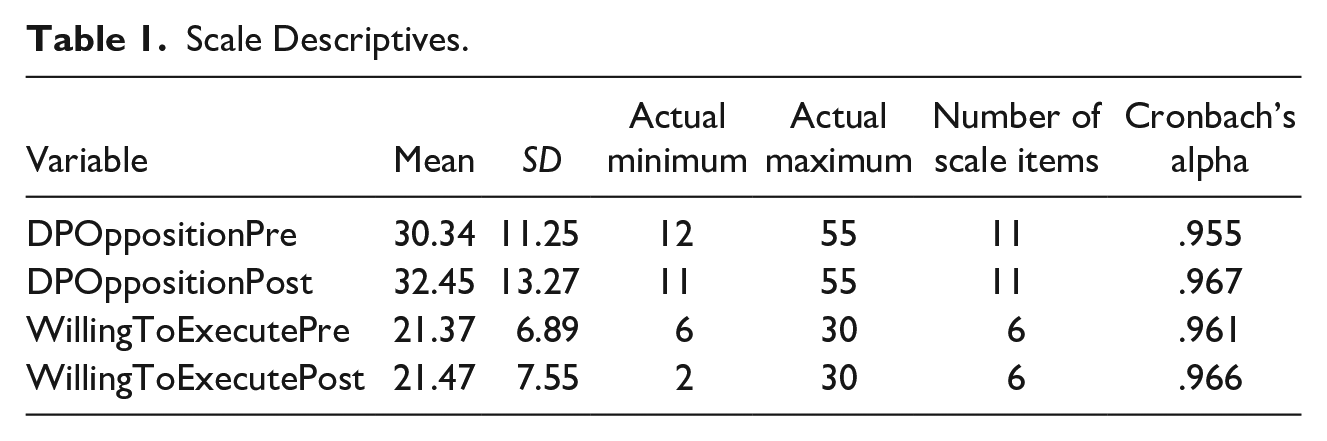
The current study focused on two subscales. The first scale, Opposition to the Death Penalty (DPOppositionPre & DPOppositionPost), includes 11 items that focus on levels of support for the death penalty for a number of different crimes (e.g., first-degree murder, murder of law enforcement, murder of children, serial killers, people who kill during a rape, etc.). The second scale, Perceived Willingness to Execute (WillingToExecutePre & WillingToExecutePost), includes six items that focus on willingness to witness or participate in an execution. Sample items include “I could inject the chemicals in a lethal injection execution” and “I could witness an execution.” To assess the internal reliability of the items within each scale, Cronbach’s alpha was used. Table 1 presents descriptives and scale reliability for each of the scales used. All four scales suggest high internal consistency with Cronbach’s alphas of .95 and above. Higher scores indicate more opposition to the death penalty and less willingness to execute.
Scale Descriptives.
Another key variable in this study is knowledge about the death penalty. This was assessed using Lee et al.’s (2014) death penalty knowledge items (pp. 650–651). Sample statements include “it is generally cheaper to pursue the death penalty and execution than to incarcerate an individual for the rest of his/her natural life” and “according to the United States Supreme Court, 16-year-olds can be sentenced to death in the United States today.” Response options for each item were true, false, or don’t know. Items were later recoded; in this recoding, correct responses earned a score of 1, whereas incorrect or “don’t know” responses earned a score of 0. The coding of this variable follows the same method used by Lee, Bohm, and Pazzani where “the ‘don’t know’ category was scored as an incorrect answer and was used to discourage subjects from simply guessing and potentially distorting the results” (p. 651). The focus of the analysis is on whether or not the individual is knowledgeable about each of the items in the index, so the coding was used to focus on having the knowledge about each item or not.
Although 21 knowledge items were given at pre-test and post-test, the analysis only includes 18 of those items. Three items were removed from analysis because the instructor did not present much information on those subtopics. Scored knowledge items were added (to form an index) to provide a total knowledge pre-test score and total knowledge post-test score. Higher scores on each scale indicate more knowledge of the death penalty. In addition, the researchers examined the distinct types of knowledge areas and sought to assess whether knowledge in some areas influenced death penalty support to a greater degree. Some of the key areas of knowledge include costs, race of victim, innocence, deterrence, and evolving societies.
A number of independent variables were included in the study. Demographic variables such as sex, race, religiosity, political party identification, and crime salience variables (prior victimization and fear of crime) were included in the analysis. Educational variables included level of education (undergraduate/graduate) and method of delivery (face-to-face, hybrid, online).
Hypotheses
A number of hypotheses were tested in this study based upon the previous research discussed above and Justice Marshall’s second hypothesis that as people become more informed about the death penalty, they will become more opposed to its use. We propose the following:
Analysis and Results
Characteristics of the Sample
The total sample (n = 122) included 37.7% males and 62.3% females. The proportion of females in the sample is consistent with female representation on college campuses in the United States. Given the small sample size, the lack of variation, and the limited cases per non-white category, race was dichotomized into white (83.6%) and non-white (16.4%). Political affiliation was reported as Democrat (29.8%), Republican (41.3%), Independent (23.1%), and other (5.8%). Participants’ religious identification was Catholic (47.5%), Christian Non-Catholic (32.8%), and other (19.7%). Their reported religiosity included “very religious” (10.7%), “somewhat religious” (61.5%), and “not religious” (27.9%). Data collection occurred at a small Catholic university in the Northeast, so the proportion of respondents who identify as Catholic and somewhat or very religious was expected.
The survey also assessed crime salience variables such as fear of crime and prior victimization. Participants were asked “how afraid are you of becoming a victim of a violent crime?” and the responses included “very afraid” (7%), “somewhat afraid” (31.3%), and “not afraid” (61.7%). Victimization was measured using the question “have you or a close family/friend been a victim of a violent crime?” Among the participants, 74.8% reported no knowledge of victimization while 25.2% reported prior victimization for themselves or a close friend/family member.
Educational variables such as of level of education and method of delivery were also included in the study. There was a perfect split between undergraduate (50%) and graduate students (50%). In terms of method of delivery, the course was offered in online, traditional face-to-face, and hybrid options. The majority of participants (58.2%) took the course face-to-face, while 27% took it online, and 14.8% took the hybrid version of the course.
Data Analysis
The analysis begins with pre-test and post-test means comparisons for both knowledge and death penalty opposition. Paired samples t-tests were chosen given the presence of an interval-level dependent variable (i.e., knowledge about the death penalty and death penalty opposition scores) and an independent variable that can be broken into two groups (i.e., pretest scores and post-test scores). To further examine factors impacting death penalty opposition at post-test, we conducted bi-variate regression analyses on each of the independent variables in the study (class level, method of delivery, religiosity, fear of crime, victimization, race, gender, and knowledge). All theoretically important variables were subsequently included in a multiple regression model (see Table 2). The multiple OLS regression model was specifically chosen given the presence of normally distributed dependent variables and to allow the researchers to control for the influence of more than one independent variable on the dependent variable. Although multiple regression models call for the use of all interval level data, it is not uncommon in criminal justice research for lower levels of measurement to be used, particularly with dichotomous independent variables (e.g., gender and race).
Multiple Regression Model.
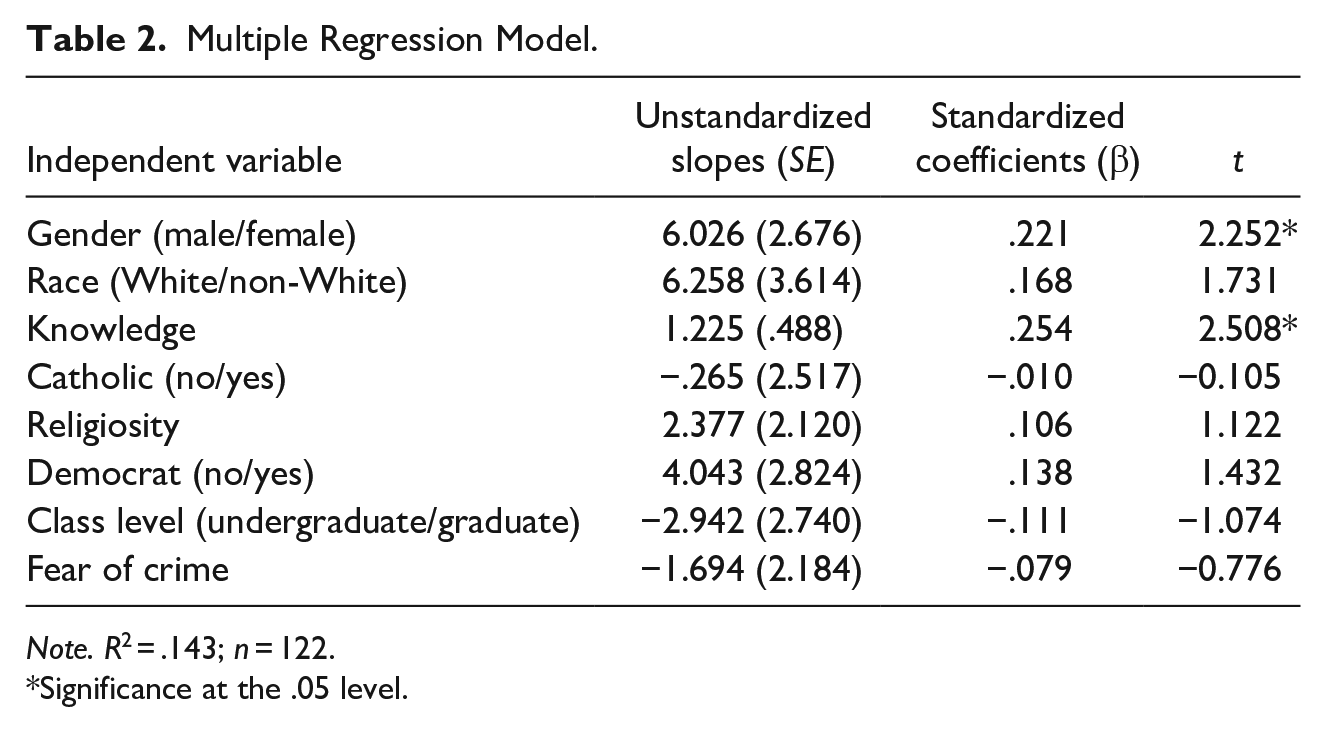
Note. R2 = .143; n = 122.
Significance at the .05 level.
After conducting the initial analysis, the researchers wanted to dig deeper and examine the influence of specific knowledge items on death penalty opposition at post-test. The intent is to begin to assess the types of information about the death penalty that are associated with higher levels of death penalty opposition. Independent samples t-tests were conducted to examine differences between groups (i.e., those who got a knowledge item correct and those who got that same knowledge item wrong) and to see if those differences influence their death penalty opposition. We also took this a step further by examining knowledge items among a subsample of participants whose opposition to the death penalty increased from pre-test to post-test. The remaining sections will walk the reader through the analysis and present the findings.
Pre-test and post-test differences
A primary test of the Marshall Hypothesis is whether or not those who are more fully informed about the death penalty have more opposition to its use. We first began to examine this relationship by assessing whether, in fact, participants became more informed about the death penalty after completing the course. Using a paired samples t-test, we compared the mean knowledge scores at pre-test and at post-test. The results show the average score on the knowledge pre-test instrument was 49% correct (M = 8.84, SD = 2.82) and on the knowledge post-test instrument was 64% (M = 11.5, SD = 2.78). Mean percentage scores (i.e., 49% at pretest and 64% at post-test) are the average scores on the knowledge test (calculated by taking the average number of questions answered correctly—earning one point for each correct answer, divided by the total number of 18 possible points, and multiplied by 100 to create a percentage score for descriptive purposes). The results of the t-test suggest that, on average, participants increased their knowledge score by 15%. The paired samples t-test found this difference to be statistically significant (t = −9.9862, p < .05). This finding supports Hypothesis 1 (i.e., participants will have increased knowledge scores about the death penalty from pre-test to post-test).
Similarly, we looked at mean differences in death penalty opposition at both pre-test and post-test. Comparing death penalty opposition at pre-test (M = 30.3, SD = 11.25) and post-test (M = 32.45, SD = 13.27), the results demonstrate that, on average, participants’ opposition to the death penalty increased by 2.15 points after taking the death penalty course. Again, the paired samples t-test found this difference to be statistically significant (t = −3.115, p < .05). This finding supports Hypothesis 2 (i.e., participant opposition to the death penalty will increase from pre-test to post-test). It should be noted that this difference, while significant, is fairly modest in size. No significant differences were found in participants’ perceived willingness to execute scale between pre-test and post-test.
Multiple Regression Results
The multiple regression model indicates that gender and knowledge at post-test significantly predict death penalty opposition (p < .05). Race was found to be marginally significant (p < .10) with students of color holding more opposition to the death penalty than white students. Women were found to have significantly greater opposition to the death penalty than men. This result is similar to findings in previous research (Bohm & Vogel, 1991, 1994; Bohm et al., 1993). Importantly, knowledge, once again, was found to predict death penalty opposition and in the multivariate model became significant at the .05 level (p < .05). In fact, knowledge at post-test was found to be the strongest predictor of death penalty opposition (β = .254) in the model. The result supports the Marshall Hypothesis in that people who are more informed about the death penalty are more opposed to its use. This finding provides continued support for Hypothesis 3 (i.e., participants with higher levels of knowledge at post-test will have higher levels of death penalty opposition).
Analyses were also run on the willingness to execute scale. Knowledge at post-test did not significantly impact respondents’ willingness to execute. The only significant predictor was gender (p = .000). Women were significantly less willing to execute than men.
Specific Knowledge Items
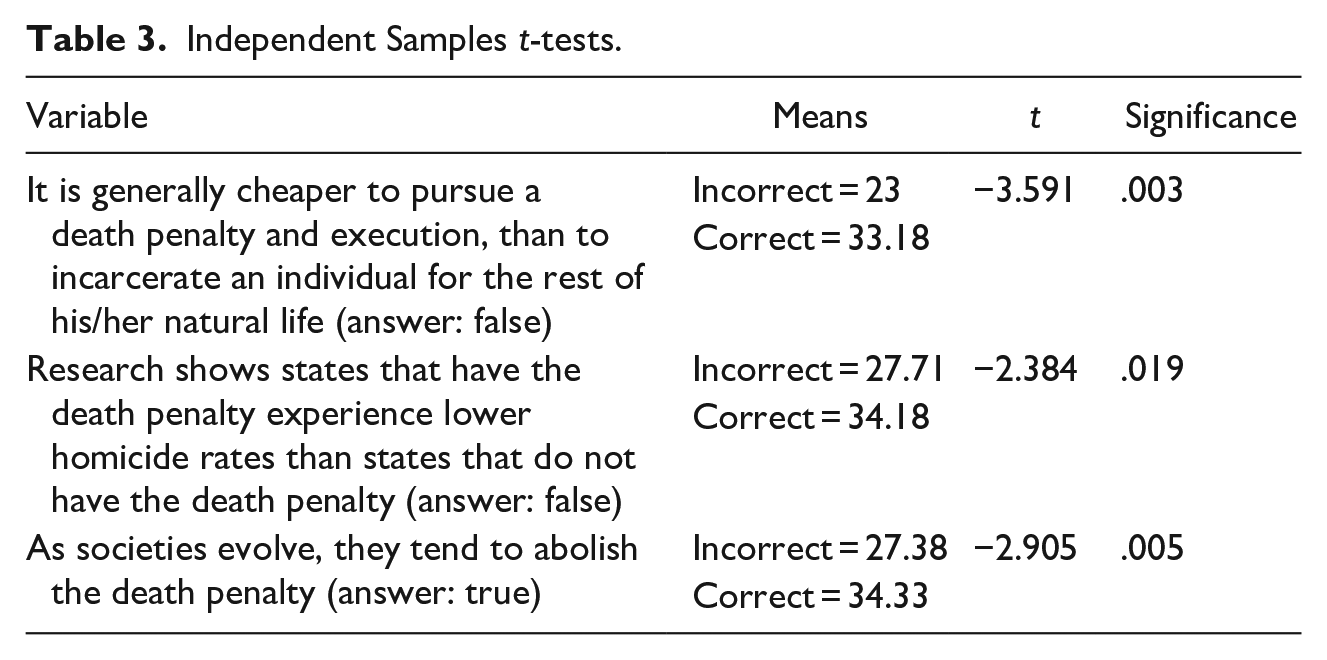
Knowing that knowledge predicted death penalty opposition in our sample, we sought to examine this relationship in more detail. Specifically, we were interested in examining what types of knowledge were associated with increased opposition to the death penalty. To do this, we examined the relationship between individual knowledge items on mean scores on the death penalty opposition scale using independent samples t-tests. The grouping variable was knowledge; whether respondents got the knowledge item correct (1) or incorrect (0). Of the 18 knowledge items tested, three (3) of them were found to be associated with significantly different means in opposition scores (see Table 3). For example, participants who were knowledgeable about the cost of the death penalty were found to have higher opposition scores. Similarly, participants with knowledge about deterrence (or lack thereof) were also more opposed to the death penalty. Finally, participants who recognized that as societies evolve, they often abolish the use of death penalty, had higher opposition scores. These findings support Hypotheses 4 (i.e., participants who have knowledge about the costs of the death penalty will have higher levels of opposition), 7 (i.e., participants who have knowledge about deterrence and the death penalty will have higher levels of opposition), and 8 (i.e., participants who have knowledge about evolving societies and the death penalty will have higher levels opposition).
Independent Samples t-tests.
To take this analysis one step further, we performed similar assessments of each knowledge item with a subsample (n = 89) of only those participants whose death penalty opposition increased from pre-test to post-test. The Marshall Hypothesis suggests that knowledge about the death penalty will lead to increases in opposition, so we looked at those participants whose opposition increased and examined each of the 18 knowledge items and their opposition scale scores. The significant relationships are noted in Table 4.
Independent Samples t-Tests With Increased Opposition at Post-Test Sub-Sample.
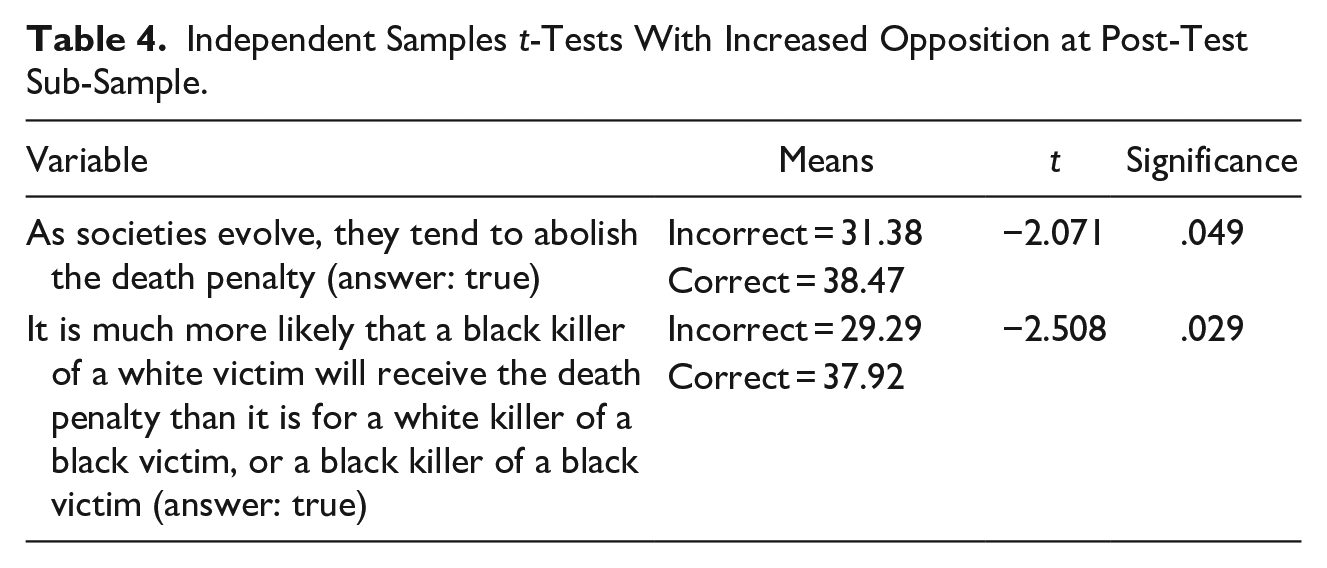
It is important to note that knowledge about cost once again played a role in participant opposition but it was not one of the significant items. This is because all but one person in the sub-sample got the question about cost correct so there was no true comparison in the grouping variable. It is, however, interesting to note that among those whose opposition increased after taking the class, more than 98% of them got the cost item correct. The analysis with this subsample also saw a similar relationship with the item about societal evolution and death penalty abolition. However, a new theme that emerged was the influence of information about race on death penalty opposition. Participants in this sub-sample who were knowledgeable (88%) about the influence of race of the victim on receiving the death penalty held significantly higher levels of opposition. This finding supports Hypothesis 5 (participants who have knowledge about the influence of race on the death penalty will have higher levels of opposition).
Given recent attention and previous research focusing on innocence and exonerations among those sentenced to death, the researchers predicted that knowledge about innocence would have a significant influence on death penalty opposition. In addition, the instructor presents an entire unit on innocence and wrongful convictions in the course. Surprisingly, the results of our analysis did not find significant differences in opposition based upon knowledge about innocence. Thus, the findings failed to support Hypothesis 6 (participants who have knowledge about innocence and the death penalty will have higher levels of opposition).
Limitations
Although this research offers an updated replication of the impact of specific types of knowledge on death penalty opinion, several limitations warrant discussion. First, the data collected included a modest sample size which therefore may have yielded results that must be interpreted with an abundance of caution. Moreover, this study is limited to surveys that were distributed to classes in one private Catholic University in the Northeast in a non-death penalty state. It is possible that the significant findings of increased opposition among the sample could be less a function of information as opposed to a desire to align with the official position of the Catholic Church (Phillips & Lapuck, 2015). Nevertheless, it is important to note here that less than half of the sample identified as Catholic; and out of this sub-sample, only three participants answered that they were “very religious.” These findings may not be generalizable to other states, particularly those located in the more active “death belt in the South.” Furthermore, the sample was predominately female, and research demonstrates that females tend to be anti-death penalty (Anderson et al., 2017). All surveys were distributed in-person on the first and last day of class (regardless of method of instruction); however, the possibility of social desirability bias exists. Finally, some of the survey items can be interpreted as subjective to a certain extent. While the measures are not perfect, they are a good starting point to tap into the impact of knowledge on opinions. They also provide consistency with our replication of previous studies conducted by Bohm et al.
Discussion and Conclusion
In light of the current controversy surrounding capital punishment issues and the upcoming anniversary of the Furman decision, the goal of the current study was to examine Marshall’s second proposition. This was accomplished, and the results lend qualified support for his second conjecture. With increased knowledge and information gained over the course of a full semester of instruction, participants’ support for the death penalty significantly decreased. This drop, admittedly modest, probably occurred given the neutral approach to presentation of the material taken by the first author. As a result, our findings seem to support Phillips and Lapuck (2015), since the teaching approaches in both studies were very similar. Although the results demonstrate a statistically significant effect, the extremely small magnitude of the impact suggests that the “neutral approach” may be a key factor in driving the lack of a dramatic change in opinions. Nevertheless, the specific knowledge information impacting participants’ opinions were driven by cost, deterrence, and evolving societies, which were all significantly related to change in opinions. While much of the prior research did not find support for these specific knowledge items, perhaps these issues are becoming more salient to participants than they were over 20 years ago. It is also plausible that the death penalty has become even more expensive, and that this is now a more notable issue resulting in the bankruptcy of high volume, active, death penalty counties (Baicker, 2004; Rupp, 2003). Moreover, numerous states in 2009 including: New Mexico, Kansas, Montana, Nebraska, Colorado, New Hampshire, Connecticut, and Maryland repealed their laws, due in part, to the high costs associated with capital punishment (see DPIC, cost accessed 1/10/21). The dramatic and unfolding impact on county budgets of the recent pandemic may lead to additional states curtailing use of the death penalty, at least in the short term. Internationally, as noted earlier, a large number of countries have recently moved toward abolition (Amnesty International, 2018; Bohm, 2016).
It was noteworthy that the innocence items that were analyzed were not significantly related to change in opinions. It appears that criminal justice students who are proponents of capital punishment may consider “innocence” to be an inevitable error in a real-world system of justice. While students tend to support reforms to improve the system and alleviate both problems of innocence and race, perhaps the false ideal that DNA is the failsafe for wrongful capital convictions makes this issue seem less problematic than racism which doesn’t seem to offer an “easy solution.”
In contrast to innocence, racial bias was a significant factor in opposition to capital punishment. Such a finding is not new, as the early studies on the Marshall hypotheses by Bohm et al. recognized the profound impact of race on death penalty opinions. In regards to these findings regarding race, Bohm et al. (1993) stated that these findings are not surprising “because race always has been the principal distinguishing factor in the death penalty opinions of Americans. Blacks have always been less likely to support capital punishment than have whites, which probably is attributable to the widely known record of racial discrimination in the United States generally and to the perhaps lesser known history of racial discrimination in the administration of the death penalty in particular” (p. 42). Another follow-up study by Bohm and Vogel (1994) examined whether there existed significant differences in factors related to uninformed as opposed to informed death penalty opinions. Again, they draw a similar conclusion regarding race: “blacks always have been less likely to support capital punishment than whites, which can be attributed generally to the documented history of racial discrimination in the administration of the death penalty in the United States” (p. 146). While some of the earlier studies on death penalty opinions found independent effects of race and innocence, future research should examine the possible interaction effect of these two variables. For example, information related to the significant prevalence of race and wrongful capital convictions could be a potentially compelling factor in swaying opinion (see Davies, 1991 for Clarence Brandley case; see Earley, 1995 for Walter McMillian case; Harmon, 2004; Radelet et al., 1992).
It may turn out that knowledge about the death penalty and being “fully informed” is an elusive concept, or at least a moving target that will continue to evolve over time. While certainly a semester-long experience brings us closer to being fully informed than reading a single essay or hearing one lecture, it may still fall short of achieving Justice Marshall’s conception of “fully informed” subjects. This may be particularly true if the instructor is intentional in their effort to present a balanced approach to arguments based on both proponents and opponents of the death penalty. Future research should consider the overall, inclusive university experience to examine the impact of multiple courses or a curriculum inclusive of numerous courses that raise awareness and increase understanding of the factual information surrounding the legal, fiscal, and moral impact of capital punishment. This would permit an examination of the cumulative effect of knowledge transmission over time on opinions. An emerging consequence of the pandemic is the development of increased hybrid and online course offerings. Indeed, many instructors have reformulated and redesigned their courses to be delivered in such a model. This offers tremendous opportunities for future research to test more nuanced conditions of delivery method and its subsequent impact on students’ opinions.
The focus of the present study is on change in public opinion and the trend of capital punishment over the past 50 years; however, it should be noted that the death penalty has been declining since the Middle Ages resulting in fewer executions, increased restrictions on death eligible crimes, and the use of less gruesome and more humane methods of execution (see Pinker, 2011). While it has been nearly one-half a century since Justice Thurgood Marshall laid out his hypotheses in Furman v. Georgia (1972), 100s of developments have occurred related to capital punishment: moratoriums, reinstatements, expansions, adoption of lethal injection, mental health and age restrictions, blue ribbon commissions, celebrated cases, national conferences featuring inmates who served death row sentences, as well as high profile exonerations. In addition, the emergence of DNA testing and increasing efforts and resources directed at exonerating those wrongly convicted have raised the profile of capital punishment and shed light on the impact and devastation of such a flawed system (Murphy, 2021; Scheck et al., 2000). All of the above variables need to be accounted for and examined as they can have a dramatic effect on support for the death penalty at both the national and state levels. As the 50-year anniversary of Furman v. Georgia (1972), approaches and overall national support for the death penalty continues its seismic shift, the time is ripe for a renewed empirical focus on opinions toward the death penalty. As students represent future criminal justice practitioners, the knowledge that is significant to changing their opinions is extremely relevant as an area of focus for continued research on this controversial topic.
Footnotes
Acknowledgements
We would like to acknowledge Courtney Hope Fell and Nicole Perry for their exceptional research assistance in the preparation of this article. We would also like to give special thanks to Michael Perlin for his helpful suggestions, comments, and contributions to this research.
Declaration of Conflicting Interests
The author(s) declared no potential conflicts of interest with respect to the research, authorship, and/or publication of this article.
Funding
The author(s) disclosed receipt of the following financial support for the research, authorship, and/or publication of this article: This project was supported by an internal grant awarded by the Research Council at Niagara University in Summer 2020.
