







Abstract
On March 16, 2021, a shooting in Atlanta killed eight people, six were women of Asian descent. This creates a new atmosphere online and offline to discuss hate crimes, racism, and violence against Asian Americans in the United States. The current research utilizes structural topic modeling and text mining to explore how the 2021 Atlanta shooting ignited debates and public discourse on the #StopAsianHate-related conversations on Twitter. The study analyzes the first 7 days of the shooting to explore the temporal patterns and emergent topics of Twitter discourses. Findings show that salient topics and temporal patterns differ from day to day, but topics such as “stand with AAPI community” and “stop racism” are prevalent throughout the 7-day period. This study discusses social media’s role in shaping and reporting public discourses, that is, how digital justice is exercised, and offers social and policy implications. There can be implications for social media’s role in shaping and reporting public discourses on social phenomena with digital justice.
Introduction
A shooting that occurred on March 16, 2021, in Atlanta, Georgia, killed eight people, six of whom were women of Asian descent. The suspect, 21-year-old Robert Long, arrived at Young’s Asian Massage, where he killed two women, then drove 30 miles to Gold Spa in Cherokee county, shooting three women. He then walked across the street into Aromatherapy Spa and killed another woman (Atlanta-Georgia Constitution, March 16, 2021; New York Times, March 20, 2021). Of the eight total victims, six of them were women of Asian descent.
While the man who shot the women spoke of the motive as sexual addiction (The Washington Post, March 9, 2021), 1 the incident came during a rise in crimes against Asian Americans during the coronavirus pandemic. The shooting prompted the Asian American communities to react, calling the shooting a hate crime against a particular race. President Biden also supported the hate crime argument, stating that the incident occurred during “the brutality against Asian-Americans for the last couple months” which he called “very, very troubling.” The attacks have not let up as hate crimes hit record levels, prompting Biden to sign an executive memorandum last month acknowledging that “inflammatory and xenophobic rhetoric has put Asian American and Pacific Islander (AAPI) persons, families, communities, and businesses at risk” (Srikanth, 2021).
The current research explores anti-Asian hate crime through a lens of social media with a case study of the recent Atlanta shooting in March of 2021. Specifically, the present study focuses on the recent Atlanta shooting that occurred on March 16, 2021 by examining the use of the #StopAsianHate movement and hashtag on Twitter. To adequately analyze the large number of tweets generated within a short period of time, this research uses topic modeling, which is an appropriate method to understand and estimate a number of topics by summarizing and understanding substantially large-scale text data. This research investigates what the emergent topic themes and discourses on “StopAsianHate” on Twitter are temporal patterns, and how the top three topics of each day convey messages.
We examined the first 7-day period following the March 16 incident, which included the dates from March 16 to March 22, 2021. There are rationales for this timeframe. First, Twitter’s standard search API allows us to collect data from the past 7 days (Twitter Developer, 2021). Second, Twitter is a good tool for understanding instant, immediate responses from the public. Third, by looking at the first week’s tweets, we are able to see how the discussion centered around the Atlanta shooting became a watershed of support for Asian Americans/Asians in the United States. Examining this case is meaningful, particularly because this is the AAPI’s first massive online social justice movement; therefore, AAPI’s first social justice movement could be said to have been born on Twitter.
To the best of our knowledge, this current study is one of the first studies on emerging #StopAsianHate phenomenon, in particular, using social media. This study contributes to the existing body of literature by addressing and investigating the very recent phenomenon that has brought new academic and media attention. As there are limited studies on #StopAsianHate issues, we will draw implications from the Black Lives Matter movement.
Literature Review
Positionality of/Labeling Asian Americans in the United States
Asian Americans 2 have been influential in a variety of ways throughout US history. Moreover, the immigration history of the Asian American population reflects the population’s diversity. South Asians have lived in the United States since the 18th century, while their presence became more visible in the late 1800s (Bhatia & Ram, 2018; South Asian American Digital Archive, 2021). Chinese settlers first came to America in the 1850s and represent the third largest foreign-born group in the USA after Mexicans and Indians. As they came to America fleeing from the economic hardship and political turmoil of their home nation, they took upon agriculture, mining, construction, or manufacturing work (Hooper & Batalova, 2015). Similarly, Korean immigrants, when they first came in 1903, first settled in Hawaiian sugar cane farms, working as agricultural laborers (Min, 2011; Yum, 1982). Japanese immigrants as well, also began work in mines, railroads and agriculture, when they first arrived during the 1890s (Higgs, 1978).
Beginning in the late 19th century, Asian Americans were referred to as the “yellow peril”; a term that symbolized the Western fear of oriental—non-white other, that is—East Asians peoples’ invasion and domination of the West (Okihiro, 1994; Saito, 1997). In addition to this discriminatory term, there was also physical violence. Chinese, for instance, experienced harassment during the establishment of Chinatowns in the late 1800s (Chen, 2000). More recently, ostracization has occurred toward South Asians, specifically toward Sikhs after 9/11 for wearing the turban, as Islamophobia increased following the terrorist attack (Arora, 2013; Dmello, 2021). Thus, despite their economic and academic success, South Asians were found to experience insecurity and anxiety. As South Asians were increasingly profiled after 9/11, they began to choose educational and career tracks in the STEM field to become indispensable US citizens (Shams, 2020). As such, despite a rich, lengthy Asian American immigration history, Asian Americans have been identified as perpetual foreigners (Ancheta, 2006; Chen, 2000; Saito, 1997; Wu, 2015).
Along with social discrimination, the state has also encouraged and implicitly/explicitly reinforced exclusionary policies such as the Chinese Exclusion Act in 1882 (Hooper & Batalova, 2015). This federal law restricted Chinese immigrants from entering the US as laborers and prohibited them from obtaining US citizenship. The law was repealed in 1943, but until the Immigration and Nationality Act of 1965 lifted the bar for non-European immigrants from entering the US, Chinese immigration was allowed only in small numbers (Hooper & Batalova, 2015). Another case occurred during World War II when President Franklin Roosevelt signed Executive Order 9066 and put people of Japanese descent into internment camps in response to the Pearl Harbor attack. As a result, about 120,000 persons, mostly US citizens, were forced to move to military zones in California, Washington, Idaho, Oregon, Utah, Arizona, Wyoming, Arkansas, and Colorado from 1942 to 1945 (Camp, 2016). 3
However, the negative image of Asians shifted due to a new term that was coined to refer to East Asians and South Asians in the 1960s: “model minority” (Kiang et al., 2017). When the Immigration and Nationality Act of 1965 was lifted, the US labor market was experiencing a shortage of skilled professionals such as doctors and nurses, therefore, favored those with a particular educational background from Asia (Kiang et al., 2016; Rangaswamy, 2000). This new group of immigrants, with their hard work ethic and perseverance, achieved high occupational and academic success (Museus & Kiang, 2009). Since this time, due to their achievements, they have been referred to as the model minority group (Kiang et al., 2017). The term has generally been used to refer to East Asian Americans, namely, Chinese-, Taiwanese-, Korean-, and Japanese Americans as well as Indian Americans (Kramer, 2003). Though the term has had some virtue in helping overturn once preconceived negative notions (Cheng & Yang, 2000), it has been controversial. First, it disregards diversity within the Asian American community, overgeneralizing the group as homogenous (Kiang et al., 2016). Second, the term has placed significant pressure on Asian Americans, especially youths, to outperform to meet social expectations (Cheryan & Bodenhausen, 2000; Ngo & Lee, 2007; Wong & Halgin, 2006). Lastly, the term has been criticized for being used politically to support “colorblindness,” a dominant racial ideology in the post-civil right era, which suggests unrestricted mobility, free of racism and social injustice in the American society as ethnic minorities made it on their own with their own efforts (Kim, 1999, 2000; Wu, 2002). In these ways the term has been ambivalent; scholars argue that the terms model minority and yellow peril are not bipolar, rather, at two ends of a continuum (Lee, 1999). The yellow peril denotes a “masculine threat of military and sexual conquest” while the model minority denotes a “feminized position of passivity and malleability (Okihiro, 1994),” thereby, using model minority when comparing with other racial minorities but switching to yellow peril when they outdo White Americans (Lee, 1999; Okihiro, 1994). Therefore, scholars argue that the model minority is only “a benign image” of the yellow peril (Okihiro, 1994); both terms connoting Asian Americans as “the other.”
Asian Americans in the Context of COVID-19
In recent years, consistent with negative perceptions of Asian Americans in the US, the COVID-19 pandemic has again heightened negative emotions toward Asian Americans. Since the coronavirus has been identified to have begun in Wuhan’s wet markets (Centers for Disease Control and Prevention, 2020), and first reports of the disease being labeled as the “Chinese virus,” some began to see Asian Americans as carriers of the disease (Levenson, 2020; Maitra, 2020). In fact, NBC News, on April 28, 2020, reported that 30% of Americans reported having witnessed someone blaming Asians for the coronavirus (Ellerbeck, 2020). Such views have led to racial tensions that not only increase anxiety Asian Americans feel, but have also heightened racial attacks (e.g., verbal and physical) toward Asian Americans that could be identified as hate crimes. Hate crimes are defined as, “crimes that manifest evidence of prejudice based on race, gender and gender identity, religion, disability, sexual orientation, or ethnicity (Hate Crime Acts, 2009; 2021).”
Scholars posit that the current hate crime against Asians during the pandemic is not independent from seeing the Asian as perpetual foreigners, the “other” frame that have been used to identify Asian Americans (Tessler et al., 2020). Given that the virus had been identified as foreign, originating from Asia, some members of society have blamed their feelings of prejudice, xenophobia and acts of violence against Asian Americans specifically (An et al., 2021; Schild et al., 2020; Tessler et al., 2020). In fact, according to Stop AAPI Hate, from March 19th to April 23rd, 1,500 alleged cases of anti-Asian hate crimes were reported (AAPI, 2021). While these reports were mostly concentrated in New York and California, cases rose in 45 states across the US (AAPI, 2021). While there were numerous hate incidents, most of the discriminations have been verbal harassment, calling Asians “coronavirus,” or “disease,” or to “go back to China” (Anti-Defamation League (ADL), 2020). In all of the verbal harassment reports, anti-Asian racial slurs were also present (An et al., 2021; Buscher, 2020; NBC News, 2020; Sheldon, 2020).
Scholars suggest that such wide-spread incidents of hate crimes during the COVID-19 pandemic, is leading the reemergence of vibrant panethnic Asian American identity (Tessler et al., 2020). In fact, in the wake of the Atlanta shooting, members of the Asian American communities surged using microblogging, Twitter, expressing their outrage and grief toward the shooting that killed six women of Asian descent. In the week immediately following the shooting, there were more than 400,000 tweets that used the #StopAsianHate hashtag.
However, why members of the Asian American communities have expressed their feelings using microblogging, as well as their purpose in using such a platform, is unknown. Moreover, how and whether this hashtag movement is raising awareness, bringing solidarity, showing support and giving a voice to Asian American community needs further exploration. Therefore, the current study seeks to better understand why Asian Americans are using social media platforms to react to hate crimes happening in the US; specifically, we examine the use of microblogging in response to the Atlanta shooting incident, which caused a spike in the use of the #StopAsianHate hashtag to understand the social movement phenomena that is on the rise amongst Asian American communities in reaction to these hate crimes. We posit that the increased use of a hashtag is not only to show their anger and frustration, but also to spark a social movement much like African American communities have through the #BlackLivesMatter (hereafter referred to as BLM) movement.
Twitter as a Space of Political Action
The recent #StopAsianHate movement cannot be discussed without discussing the #BLM movement. The BLM movement began in the wake of George Zimmerman’s verdict, acquitted of all charges for shooting unarmed African-American teenager Trayvon Martin on July 13, 2013 (Edrington & Lee, 2018; Ince et al., 2017). Upon release of the verdict, Patrisse Cullors, Alicia Garza, and Opal Tometi used the hashtag #BlackLivesMatter on the microblogging site Twitter (Tillery, 2019). Since the first use of this term on July 13, 2013, it gained traction and has been used in response to cases where unarmed African Americans died at the hand of police officers (Freelon et al., 2016; Garza, 2014; Tillery, 2019).
Social media has a few qualities that are appealing for such movements. First, the “contents” are user driven; unlike traditional media, social media such as Twitter encourages users to create and raise their ideas. Second, social media, by its own nature, is a “decentralized method for creating and disseminating ideas” (Ince et al., 2017, p. 1817). Therefore, social media is “now an arena where social movements promote their message, articulate their core beliefs, and offer a frame to the public” (Ince et al., 2017). Today’s use of social media for movements, combined with certain social media features, allows the general public to easily get involved in these movements on by simply sharing the content, or more deeply, talking to other users, questioning legitimacy, contacting leaders who have social media presence, and/or contributing to the overall discussion on the movement at hand (Ince et al., 2017).
Use of social media for these movements often involves use of Twitter. A microblogging service developed in 2006, Twitter allows users to post live messages (tweets) up to 280 characters to a virtual audience. Users can “follow” other users to receive their tweets; and the tweets of the subscribed users show on the user’s own Twitter page in reverse chronological order. Characters in tweets are not only limited to words but can also include hashtags (#), use of @ character to mention a particular user, and hyperlinks (e.g., to a YouTube video or a blog). Word-limitation and its ability to disseminate a wide range of information allows users to quickly receive new messages and learn of new information from various perspectives (Gleason, 2013; Zappavigna, 2011).
In social media such as Twitter, hashtags function as indexing or labeling. The use of a hashtag enables users to easily search existing contents that are related to a particular issue, and also allows the users to create categories on an organized collection of texts. Introduction of a tag or a key term to label something can help organize texts, help begin a string of conversations, and contribute to the meaning of a discursive topic (Ince et al., 2017; McCaughey & Ayers, 2003).
Different from other types of communication (as there is no communal expectation for anyone to respond to a tweet), Twitter has evolved into a sphere for “public conversation” where multiple actors can participate in fluid and highly intertextual manner (Zappavigna, 2011, p. 790). In the BLM movement, use of hashtags allowed like-minded people to create an online community, expanding the conversation, eventually leading to off-line mobilizations. While grassroot organizations were formed to continue the social movement off-line, Twitter remains the main site where activists make representation in a public space (Cox, 2017; Freelon et al., 2016; Ince et al., 2017). Moreover, studies show that they engage in deep conversations on race relations on Twitter (Carney, 2016; Nakamura, 2008).
Yet, ways in which social movements have been carried out on Twitter differ from previous social movements, for instance, the Civil Rights Movement of the 1960s (Harris, 2015; Rickford, 2016). Specifically, resources mobilization theorists have posited that purposive activists engage in social movements to mobilize resources such as labor, money, communication networks, and facilities (McAdam, 2010; Morris, 1981, 2000), thereby, paying attention to the environmental changes in the political opportunity structure become important for leaders of social movement organizations (Freeman, 1975; McAdam et al., 1988; Morris, 1993). Whereas the political process theories argued that “sending the right signal” (Tillery, 2019, p. 304) to the governing elites is what brings changes in the political opportunity structure (McAdam, 2010; McAdam et al., 2001). Yet, since not all recent social movements fit under the previous two models, scholars have proposed a new social movement paradigm, where the participants engage more in “express behavior” (Turner, 1981); with this, the focus is on “performing and representing their distinctive identities within post-industrial cultures” (Johnston et al., 1994, p. 3). In fact, studies that examine Twitter hashtags of BLM found that while the BLM social movement shares characteristics of the previous models, it carries stronger characteristics of the new social movement with a strong focus on express behavior tweets.
Despite a sharp increase in racial hate crimes in recent months, the proponents of the #StopAsianHate movement have remained relatively quiet. While there were more than 1,500 reported hate crimes, it was not until the March 16 incident in Atlanta, that Asian American communities began to react on Twitter. Using a hashtag of “StopAsianHate” and/or mentioning “StopAsianHate” in tweets is not entirely new, however, the Atlanta spree took this movement to a different level. In fact, the first tweet mentioning #StopAsianHate appeared on August 11, 2011. Yet in 2011 and 2012, only two tweets used the hashtag respectively. With at least a pause of 2 years, two tweets, on November 24, 2014 and July 22, 2016, included “StopAsianHate.” Following the coronavirus outbreak and lockdown in the US in March of 2020, more tweets including the hashtag started to emerge. By examining the use of #StopAsianHate hashtags the following week of the Atlanta shootings, the current study seeks to examine how hashtags are creating and using the new terms to bring conversations, people, and meanings about the social movement amongst Asian American communities and their adherents.
Data and Methods
Data Collection and Management
We use Twitter’s search Application Programing Interface (API), which allows researchers to collect all available real-time tweets with specific keywords or hashtags within a certain period of time. For this study, we focused on utilizing Twitter’s API to collect tweets on anti-Asian hate/crime/Asian support movements from March 16, 2021 to March 22, 2021. Both R and Python were used for data collection and text preprocessing. The primary aim of the study is to answer the research questions at the outset of the sentiment/movement supporting Asian Americans in the United States. This study selected the 7-day period directly following the Atlanta shooting because this particular period is critical in examining public discourses about the phenomenon. The data collection was completed between March 23 and March 24, 2021 by the first author. As a (tweet) movement on Asian/Asian Americans is fairly new and is driven by the recent shooting that happened on March 16, 2021, several hashtags and keywords emerged on/around the incident date, namely: “StopAsianHate,” “AsianLivesMatter,” “StopAsianHateCrimes,” “StandwithAsians,” and “AsiansAreHuman.” Figure 1 presents the number of tweets in English during the specified time period, utilizing the aforementioned five keywords. This figure clearly indicates “StopAsianHate” as the most tweeted, predominant one. Thus, this current research focuses on “StopAsianHate” over the other four keywords. The total number of tweets generated during the 7-day period after the Atlanta shooting was 418,898.
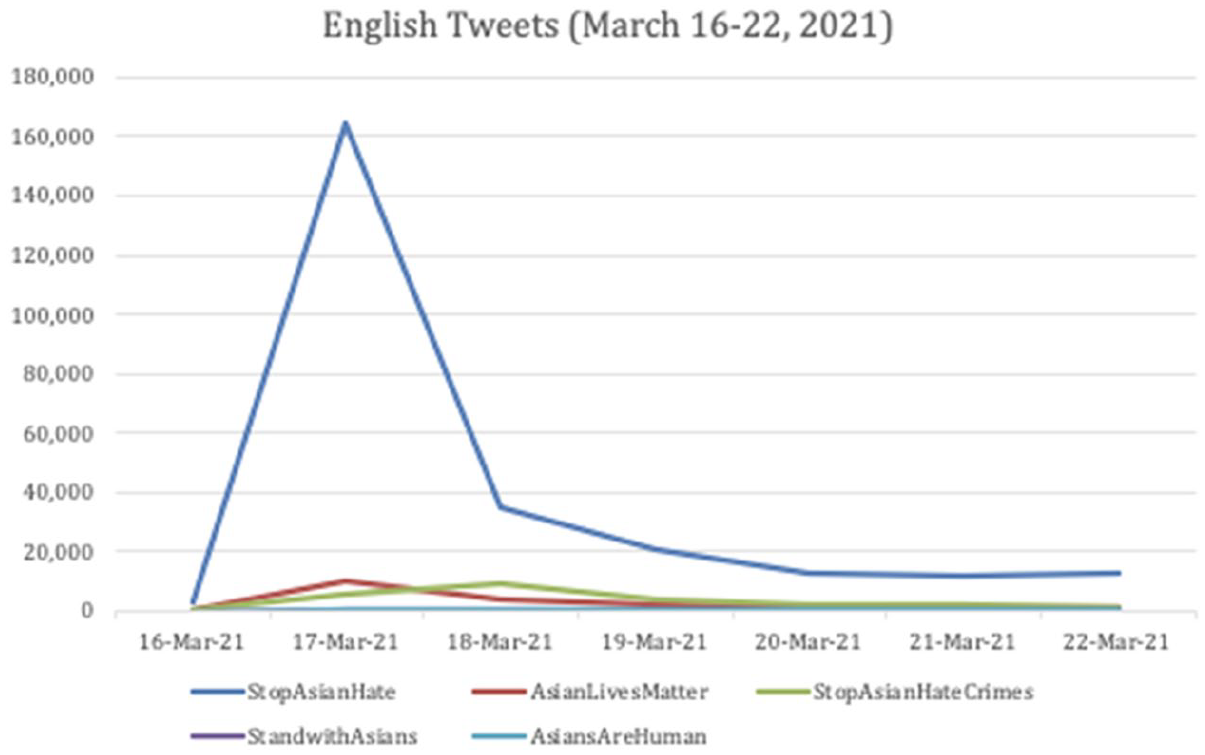
The number of English tweets related to stopasianhate issues.
Twitter data is unlike survey data, as the nature of data is predominantly textual and unstructured. Thus, it is necessary to follow specific ways of data management and pre-processing. In order to focus on tweets and retweets in English, we removed tweets and retweets in languages other than English. This allowed us to harvest 259,456 English tweets. The dataset includes tweets, hashtags, date, time, language, and other metadata. The focus of this research on the #StopAsianHate movement, is essentially about sentiment, feelings, support, and engagement for Asian Americans.
Preprocessing of the data includes removing stop words, unnecessary and unreadable/special characters, emojis, URLs, hyperlinks, hash symbols, usernames, and numbers. This process enables us to focus on clean text for further analyses. All tweet data was converted to lowercase, and words were transformed into their original, root form. Once these preprocessing steps were completed, the tweets in the dataset were converted into a corpus. Then, these are converted into a document-term matrix and eventually calculated as the term frequency-inverse document frequency (TF-IDF). TF-IDF is a statistic based on the importance of a word in a corpus. While preprocessing of data is a very important, prerequisite step for text mining, this often pose a challenge in conducting probabilistic topic modeling (Bicalho et al., 2017).
Analyzing Latent Topics From Structural Topic Modeling
To investigate the salient topics in relation to #StopAsianHate on Twitter, we used topic modeling as a type of text mining. Topic modeling is used to identify the most common topics in the tweets as well as to categorize clusters and find themes based on the keyword analysis. It is used to determine latent semantic structures that link documents through the identification of commonly co-occurring word sets (Boyd-Graber et al., 2017). Topic modeling may provide a way to make central concepts operational with potential theoretical insights (DiMaggio et al., 2013). While topic modeling is more frequently used in disciplines such as data science and communication, this method has also started to take place in criminology in the last several years (Kuang et al., 2017).
Among other topic modeling methods, this research uses the Structural Topic Modeling (STM) in R. STM incorporates “covariates or additional document-level information in the process of inferring topics” (Roberts et al., 2019). This enables us to look at how the keyword “stopasianhate” has been framed and understand the discourse and dynamic of the #StopAsianHate movement on Twitter.
To assess the optimal number of topics, we used two indicators, namely held-out likelihood and residuals. Held-out likelihood compares how well a model predicts the occurrence of words within a document (Wallach et al., 2009), signifying its level of generalizability, whereas residuals assess “overdispersion of the variance of the multinomial within the data generating process of STM” (Wallach et al., 2009). In other words, the higher the score for the held-out likelihood and semantic coherence, the more the number of topics (k) is appropriate. The fewer the residuals of a particular number of topics, the more relevant these topics are than others. Figure 2 shows each period’s held-out likelihood in our dataset. 4
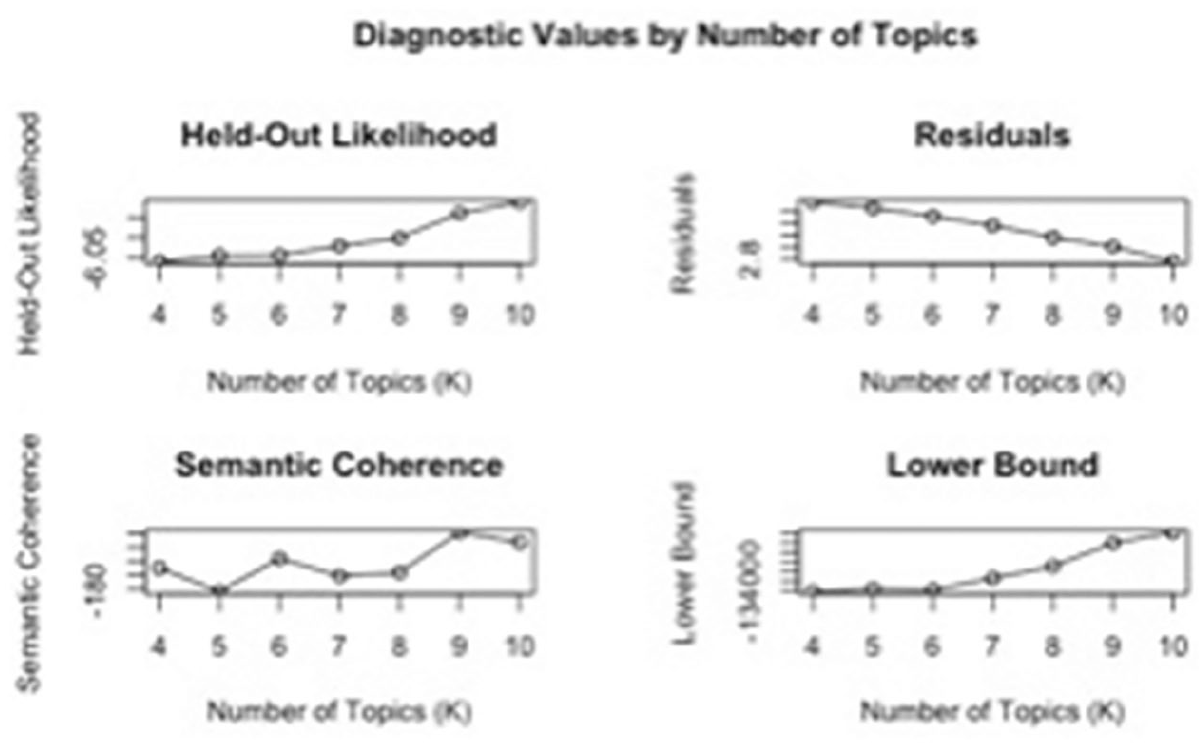
Held-out likelihood by date/data (Day 1).
The STM analysis is followed by meaning-making and coding processes. Since each of the topics explored were made up of 10 singular words, 5 the authors individually analyzed each possibility by combining two or three words for further interpretation. For instance, the third most frequent topic (13.3%) of Day 2 was topic 8 and included the following 10 words: communit(y), american, will, stand, love, famil(y), support, heart, attack, aapi. Thus, words were put together to produce a semantically meaningful message, such as “American community will stand,” “family support,” and “attack AAPI.” We tried multiple variations of word combinations to find sensible meanings, and if unclear, potential word combinations were entered in the Twitter search box to see if they were in-line with the actual data. These two findings were compared and contrasted to find the most accurate and valid meanings (see Table 2).
Results
Daily Trends of #StopAsianHate-Related Topics
This section presents the emergent topics and themes identified using topic modeling, in particular STM, which gives us an estimation of how relevant each topic ultimately was. In total, 63 semantically coherent topics emerged across 7 days. Using held-out likelihood and residuals, eight to nine topics emerged each day as the most appropriate fit for the model. Specifically, eight topics that met the threshold for relevance were generated on Days 4 and 5, and nine topics emerged from the data on the rest of the days in the experiment.
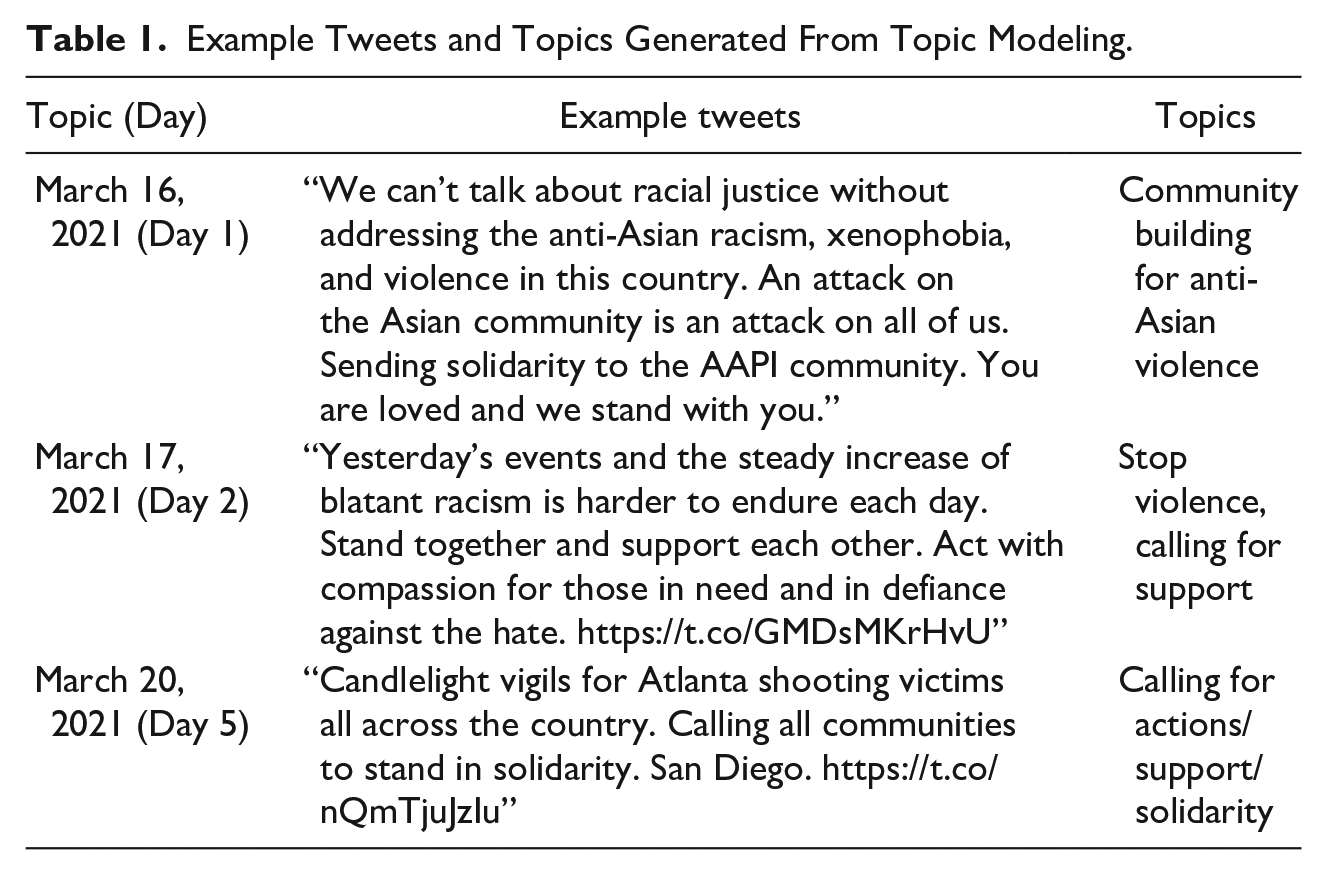
The most salient topics that emerged in the 7-day window include “community building for anti-Asian violence” (Topic 1, Day 1), “stop the violence” (Topic 3, Day 2), and “solidarity for the community” (Topic 3, Day 5). Based on these sentiments, larger themes that emerged from the STM reflect the essence and message of the #StopAsianHate movement. Such messages urge us to recognize both the increase in anti-Asian violence as well as the need for support and solidarity actions. Table 1 shows example tweets from each day with interpretations of themes around the most salient topic of the day. The STM results provide two levels of findings—topics and keywords.
Example Tweets and Topics Generated From Topic Modeling.
Top Three Most Salient Topics of Each Day
These findings highlight which topics emerged publicly on Twitter, and which keywords contributed most significantly to each topic that appeared (see Figure 3 and 4). The week when the shootings initially took place was an important point in time, as the moment when incident-specific discourse began to take form. Similar topics emerged and continued to be observed during the 7 days immediately following the Atlanta shooting, including “Stop Asian hate,” “community building for AAPI,” “urging actions for and from AAPI,” and “blaming racism and white people.”
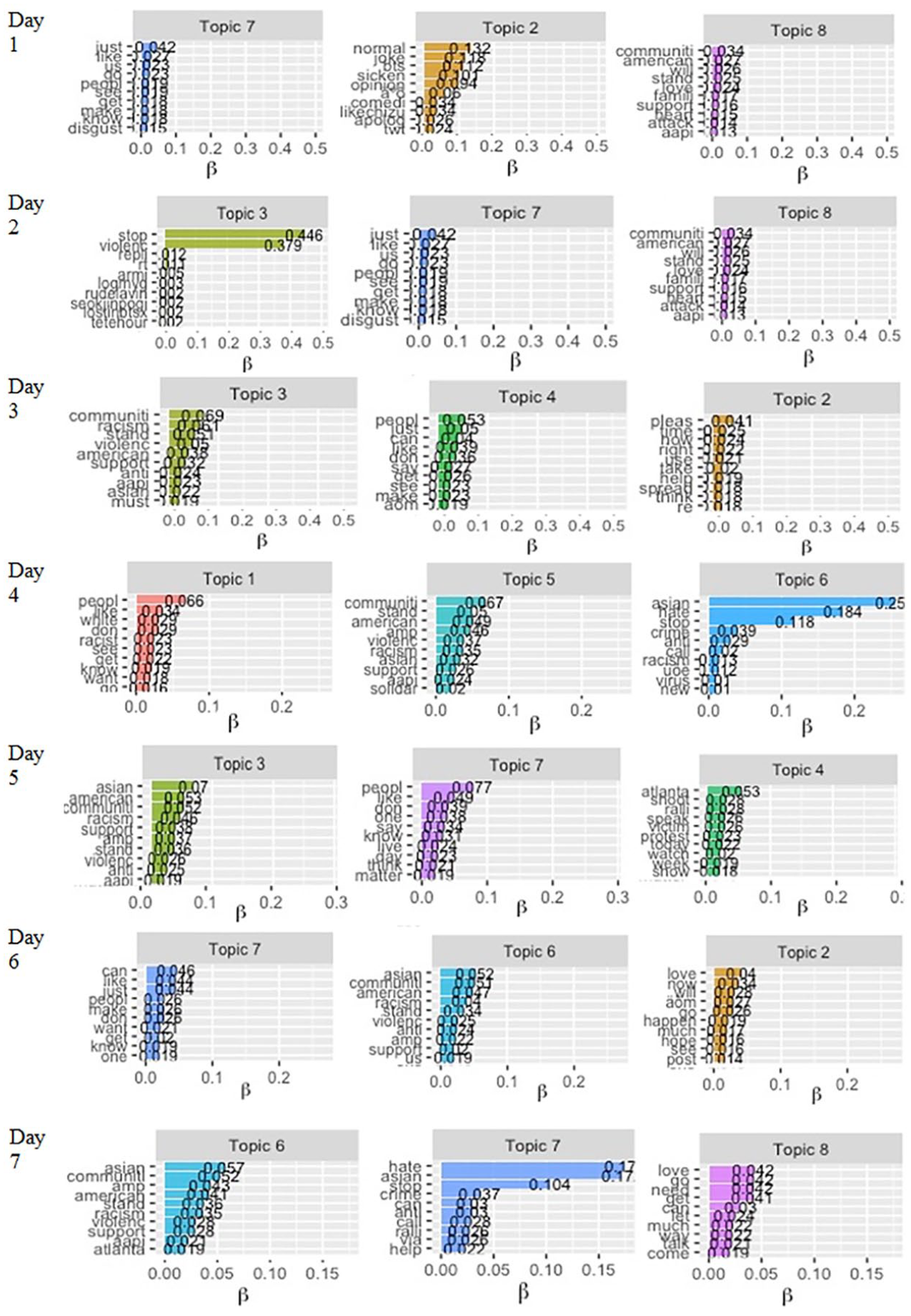
Highest word probabilities for top three topics of each day.
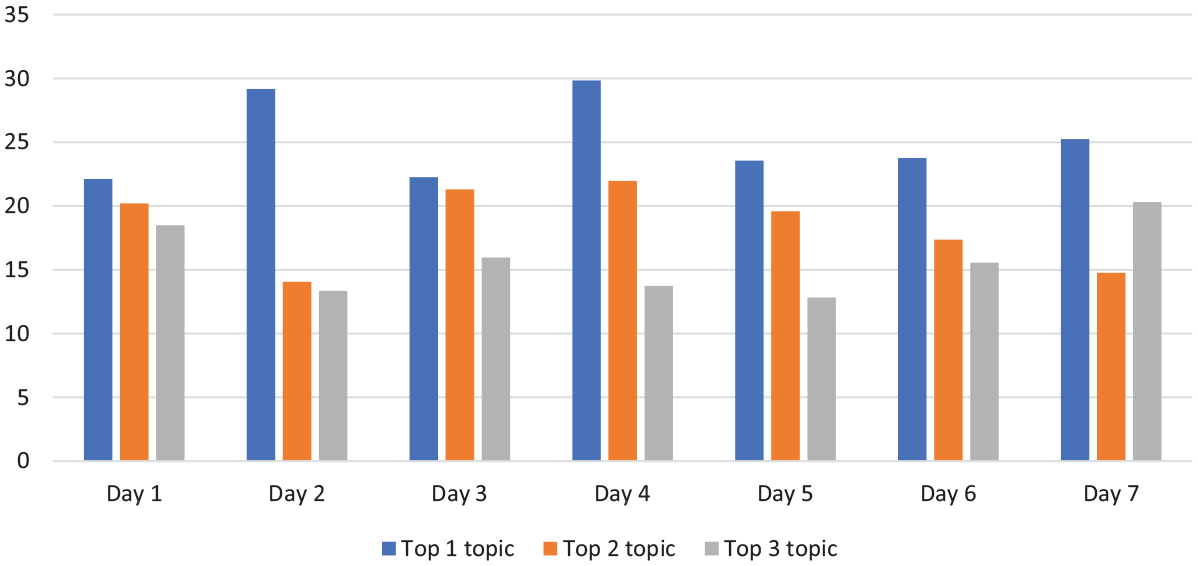
Top three topics of each day: topical changes and percentages.
In Table 2, we highlight the top three most relevant topics that emerged each day. The total percentage of tweets that addressed these three topics averaged 50.7% during the 7-day period, which exemplifies the significance of these topics. Daily trends show an interesting pattern, reflecting the themes of seeking support against racism and violence, and urging Americans to support AAPI, among others.
Top Three Topics of Each Day (By Topic Proportion).
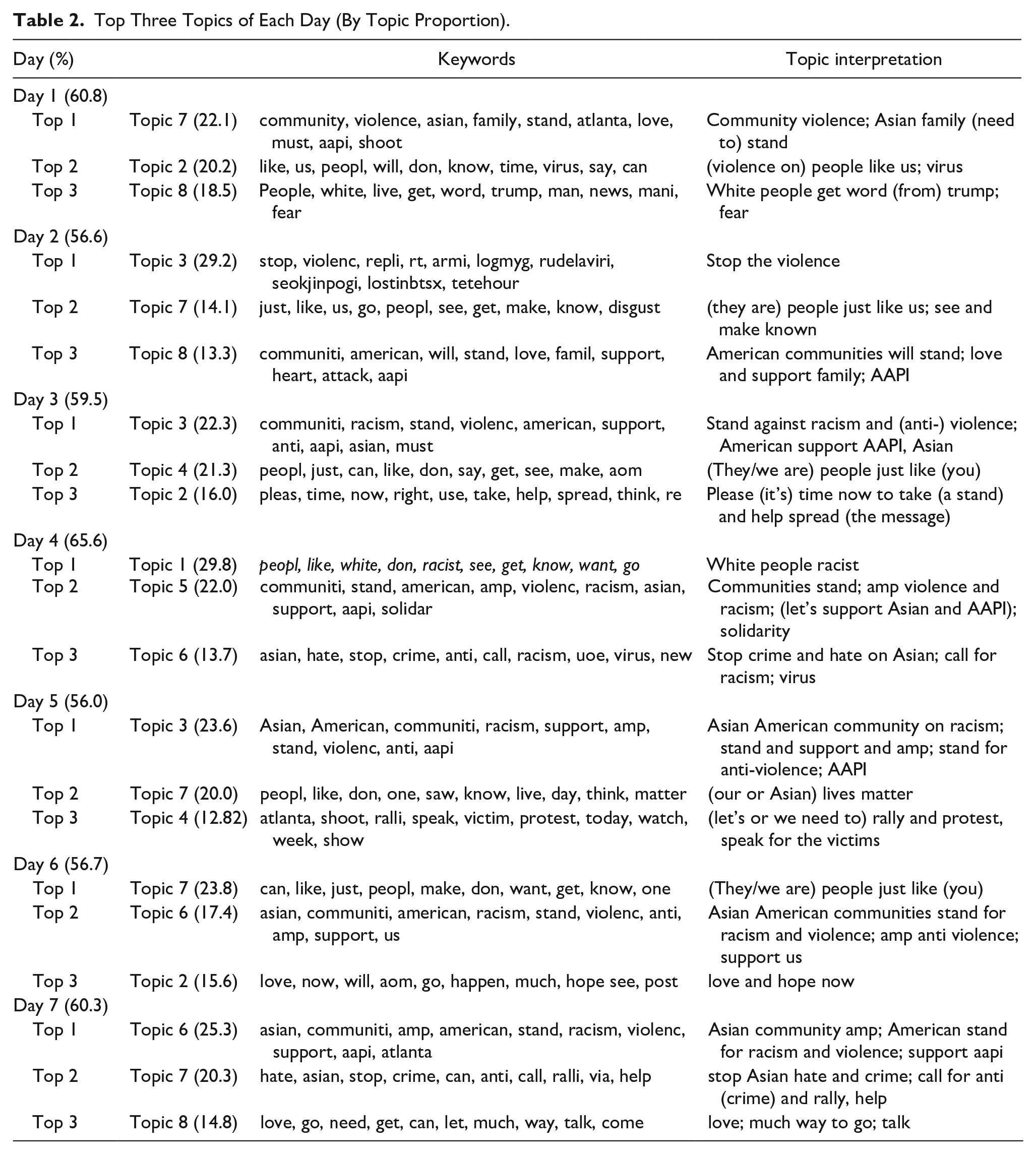
Once meaningful messages were identified from each topic (made up of approximately 10 words; see Table 2) they were labeled. Topic Community 1 (“community building for anti-Asian violence”) and Topic Community 2 (“our lives matter”) appeared on all of the days. These two topic communities were present in the Twitter discourse on the day of the shooting, in 22.1% and 20.2% of tweets, respectively. However, different patterns emerged over time. In the case of Topic Community 1, the percentage of relevant tweets did not change much between Day 3 and Day 5; however, these topics did not gain as much attention on Day 6. On the last day, though, discussions of community building reemerged on Twitter. On the other hand, the volume of tweets related to Topic Community 2 increased exponentially from Day 2 to Day 4, before declining significantly.
Unlike these two topic communities, Topic Community 3 (“stop anti-Asian hate (crime) and racism”) and Topic Community 4 (“blaming/urging”) did not appear every day. “Stop anti-Asian hate (crime) and racism” tweets appeared the most on Day 2, during the first week following the shootings. This is perhaps because the racial motive being the Atlanta shooting was still under scrutiny. During and after the first 24 hours following the incident, the public on Twitter realized the urgency of the issue and the need to halt anti-Asian hate and racism. This topic cluster (i.e., hate and racism) became mutually exclusive in the sense that as the “our lives matter” discourses become more prevalent, Topic Community 3 becomes less visible.
Topic Community 4 is a combination of categories related to assigning blame and urging AAPI to realize the precariousness of their situation. This topic group appeared in four out of the 7 days, namely Days 2, 4, 5, and 7. Adherents of the movement were active, for instance, in voicing their opinions and blaming antagonists for racism against Asian Americans. Here we see that along with blaming and calling out perpetrators of hate crimes and violence, adherents of the AAPI movement were also urging supporters to become more engaged through taking action, spreading the word, and building solidarity between AAPI communities.
Looking into these topics more closely, the top three that were best represented during the 7-day period show us the following: First, there seemed to be a shift in discursive focus as the days progressed. On the first day, the top topics focused on informing or warning other “possible victims” about what was going on. For instance, sentiments such as “(violence on) people like us,” “white people get word from Trump,” and “community violence on Asian[s]” show that people are focused on broadcasting current events.
On the second day, the discussions shifted to finding support networks, with keywords being put together to create phrases such as “American community stand,” “love and support family,” and “see and make known.” Such articulations show that the focus shifted to rally support and call for possible allies who are willing to step up to help protect Asian American communities. Such a step could be also identified as a preparation stage for the following step, which is the call-for-action.
On the third day, taking action became a prevalent theme. For example, the popularity of phrases including “stand against racism and violence” and “American support AAPI” show that focus has shifted to taking action as opposed to waiting for justice to arrive. As such, online discussions highlight the importance of action and solidarity.
On the fourth day, the shift in words signified a focus on calling out “the others,” exposing underlying and surface-level anger. Antagonists were called out as “racists,” alongside language including “stop the hate.” At this stage, there is name calling and othering, where the adherents or supporters of AAPI communities were finally naming names in larger numbers to warn and discourage future hate crimes. Along with name calling and attempts to deter the propagation of hate, there was a continued call for action, and specifically a call for solidarity among supporters.
On the fifth day, keywords focused on a specific call-for-action. In-group members strongly articulated calls for political participation, such as “rallies and protests” to “speak for victims.” On the sixth day, there is a continued call to supporters with adherents trying to build support and present their goal or ultimate yearning, which is “love and hope” surrounding and protecting AAPI communities.
On the last day of the analysis, the language of support, stopping the violence, love, the future, and the importance of “talk” and creating changes in the “law” were articulated. As such, there are evident transformations in the discourse on Twitter as the days progressed. The most urgent matter shifted from: (1) inform/warn others of the community violence, (2) call for a support network and stop the hate/violence, (3) call for action, (4) the othering, stopping words toward the antagonists, call for solidarity, (5) call for specific action toward the in-group, call for political participation, (6) presentation of future goals, and (7) conversation around continued support and love for the AAPI community; stopping violence; the future and need for continued conversations.
Discussion
Tweets offer us a good tool for understanding the actor’s opinions and thoughts about the Atlanta shooting incident. Findings of the top three topics provide the following insights into the social movement on Twitter surrounding Asian hate crimes. First, despite the short period of time (a 7-day period following the Atlanta shooting) there were several shifts in the focus of the conversations on Twitter. Call for action actively began by the third day, with significant talk about how to utilize this to encourage legal changes by the fifth day. Rather than focusing on articulation of victimization and blaming the antagonists, adherents of this social movement were focused on providing constructive suggestions, finding solutions, and making changes that could change the system.
Second, in line with previous research on social movements, the current case also resulted in many conversations about political participation, yet, specific time and location for political action (e.g., to vote for whom or when; when and where to rally or protest) were not discussed in detail. Perhaps due to the current pandemic, which presents challenges to offline protests and rallies, such actions were not discussed in-depth. Moreover, perhaps relatedly, since there was no discussion of specific action, there weren’t many words on resource mobilization (e.g., donate, bring coffee for protesters). Thus, while studies have shown that in the BLM movement, express behavior was used twice as much as resource mobilization, we were unable to make such a comparison as offline protests were not carried in this particular social movement (Tillery, 2019). Perhaps when the pandemic becomes under control thus offline gathering becomes more possible, future studies can examine whether there are talks of resource mobilization when rallies and protests are being held, to investigate what conditions cause participants to mention political processes more in-depth.
Furthermore, while there were express behaviors linked to the movement (Turner, 1981), these were difficult to identify as the topics were not encapsulated in the form of a phrase or clause, but rather conveyed in a singular word (nouns, verbs, adjectives etc.). It was challenging for users to make a sense of their frustration, anger, disgust, and grief in just one word. On the other hand, perhaps the limited number of expressive words that emerged from this context was linked to the final verdict of the Atlanta shooting, which reflected greater racial justice than the Zimmerman verdict. Perhaps later studies can examine conversations by observing one tweet as a unit of analysis. Thus, the findings of the current study cannot make a suggestion as to whether or not (or to what extent) supporters used express behaviors in the current social movement.
Third, in the process of changing discourse, we were able to see significant articulation of the dividing lines between supporters and perpetrators. Those who supported racism or committed the crimes were referred to as racists or white people, while “we,” “us,” “AAPI,” and “communities” were used to refer to the adherents or supporters. Thus, in-group members versus the othering effects were evident by the fourth day. While such articulation could be referred to as a grouping process for more effective action later on, calling out on the wrongdoers could be related to the phenomenon of othering that Asian Americans in the US have experienced throughout history. Despite the long history of immigration and success Asian Americans have achieved in recent history, they have been referred to as the yellow peril or model minority, forever being identified as the other, perpetual foreigner; here, we see reversal of the “othering,” where Asian American communities are calling out white people or racists for their wrong-doings. Yet, different from the othering Asian Americans received, because the othering is specifically related to particular actions (e.g., hate crime), there followed call for action toward the antagonists (e.g., stop Asian hate).
Also, somewhat relatedly, as African Americans have been found to engage in deep conversations about race online (Nakamura, 2008), adherents or members of AAPI were found to engage in race-related conversations more openly and actively. This is contrary to studies on Asian Americans’ communication styles, which have been identified as indirect to maintain harmony with others (Gudykunst, 2001; Kim et al., 1994). Previous research has also showed that this population is typically obliging and avoiding when addressing conflict, more so than their counterparts (Trubisky et al., 1991). Relatedly, Asians in Asia were found to use less self-closure in SNS communication compared to individuals in Western countries (Cho & Park, 2013). As such, in the current social movement, AAPI communities and their adherents are showing communication styles that are contrary to previous studies. Perhaps the current #StopAsianHate movement is calling for Asian Americans to become active, honest and frank about their feelings and thoughts when it comes to racially charged crimes and discrimination; racial discrimination has negatively impacted Asian Americans when it comes to their physical and mental health (Asamen & Berry, 1987; Phinney et al., 1998).
This study is not without limitations. While the majority of tweets in our dataset are in English, only English tweets were included in the analysis. Only 7 days (but if possible, show that the number of tweets and hashtags dropped in large numbers after 7 days). Also, some of the topics in topic modeling data (e.g., see, say) were excluded in the coding process because they were unable to be placed in a particular coding scheme. This was because of the nature of the topic modeling findings, as the findings are not in a particular phrase or a sentence; some words, when left without the context, are difficult to make sense of. Future studies can also investigate tweets with a tweet as a unit of analysis. While topic modeling provides insights into topics emerged in our data, understanding further interpretations of #StopAsianHate-related topics/discussion on Twitter can be further studied by using more tangible analytic guides such as framing.
A 7-day framework is good to monitor trends and topics associated with certain keywords, hashtags, or phenomena on Twitter. Twitter gives us instant, real-time data and responses about keywords, hashtags, or phenomena. In the current case, Twitter provided a space for “digital justice” for what had previously been a marginalized group. As the first massive online social movement for AAPIs, the current case is meaningful. Never in history have AAPI communities come together to hold a position, especially on the issue of social discrimination. The sheer volume of discussion (here, 418,898 tweets in just 7 days) is telling. Moreover, the findings are significant as they suggest a shift in the discursive focus as the days progressed; rather than focusing on victimization, much discussion was focused on finding strategies to solve the problem and the process of bringing out agency to ultimately make necessary changes. Future studies can further investigate those articulations related to their understanding of power and power dynamics between racial groups.
Racism against minorities is not a novel phenomenon in the US. However, violence and hate crimes against Asian Americans as well as racism toward them arguably increased with the coronavirus pandemic (AAPI, 2021). The virus has been widely associated with China, due to its supposed origins, and this has played a critical role in shaping and increasing the incidences of anti-Asian hate crime and violent behaviors toward Asians in many places around the world. Although the phrase “Stop Asian Hate” existed before the 2021 Atlanta shooting, the incident played a significant role in shaping public online discourses on Twitter. This became a very recent phenomenon in both online and offline spaces as an “issue” that people, in particular Asian Americans, could actively voice their opinions on. Increased awareness and recognition of and urging participation and justice for Asian Americans during the first week after the Atlanta shootings were captured on Twitter.
Moreover, East Asians were more or less shown to be the major victims of the US backlash against the spread of the coronavirus in March, since China was pinpointed as the supposed origin of the virus, and therefore became the main adherents of the Twitter social movement to protect Asian Americans. Nevertheless, the active participation of South and Central Asians in the #StopAsianHate movement should not be disregarded. Policymakers need to take note of the movement and recognize the need to pay more attention to social and structural discrimination toward AAPIs and make necessary changes. Positive changes are being made, for instance, with the COVID-19 Hate Crime Act being signed into law on May 20, 2021 (Sprunt, 2021). Yet, policymakers need to continue to pay attention to racial hate crimes toward Asian Americans in the age of the coronavirus pandemic, but also the use of discriminatory terms such as “model minority” and “yellow peril” that continue to put AAPIs into the Other, foreigner frame in a society they have been part of for generations.
Although some limitations exist in this current study, this paper contributes to our understanding of the emerging #StopAsianHate phenomenon, in particular, in the context of social media. This opens a new avenue for researching anti-Asian hate and violence as well as supporting the Asian American community. Public opinions on Twitter show that social media plays an important role in creating a platform to raise awareness, unite, speak out for/against, and to support each other. Future endeavors to investigate this issue in other media and online platforms need to be addressed.
Footnotes
Declaration of Conflicting Interests
The author(s) declared no potential conflicts of interest with respect to the research, authorship, and/or publication of this article.
Funding
The author(s) received no financial support for the research, authorship, and/or publication of this article.
