







Abstract
This study aims to provide a theoretically grounded analysis of the crime-commission process of solo females involved in sexual offending, using crime scripts. The sample includes 93 cases of sexual assaults perpetrated by female offenders in an extrafamilial context. Latent class analysis was used to identify the scripts involved in female sexual offending as well as to explore the relationship between each step of the crime-commission process. Also, additional variables related to victim, offender, and location characteristics were used to test the external validity of the model. Results suggest four different scripts used by females: Daytime Indoor, Coercive Outdoor, Coercive Indoor, and Nighttime Indoor. Theoretical and practical implications are discussed.
Introduction
Official data suggest that rates of sexual assaults committed by females is low. Depending on the type of methodology used, women involved in sexual victimization represent between 1% and 6% of all incarcerated offenders (Cortoni et al., 2010; Embry & Lyons, 2012; Giguere & Kurt, 2007; Vandiver & Walker, 2002). However, these estimates remain unreliable, arguably due to the dark figure for sexual crimes involving females being higher than that described by the official data (Cortoni et al., 2017; Saradjian, 2010). For instance, findings from a meta-analysis showed that sexual assaults committed by women were six times higher in victimization surveys than in official data (Cortoni et al. (2017). Although instances of female sexual assaults involving female offenders remain rare, the phenomenon is more prevalent than official statistics suggest. Since the 1980s, several studies have helped further our understanding of this particular phenomenon. Findings from these studies indicate that crime perpetrated by female offenders present distinct characteristics when compared to crimes perpetrated by male offenders (see e.g., Johansson-Love & Fremouw, 2009; Williams & Bierie, 2015). Studies also suggest that sexual assaults perpetrated by females presents distinct characteristics depending on co-offending or solo-offending crime patterns (see e.g., Ten Bensel et al., 2019). Finally, researchers found that females involved in sexual offending constitute a heterogeneous population with distinct characteristics and motivations (see e.g., Cortoni & Stefanof, 2020; McIvor, 2017; Vandiver et al., 2017 for an exhaustive review).
Although informative and useful, several limitations associated with these studies have restricted the scope of these results. First, most empirical findings used samples that include both solo and co-offending cases, despite important differences between both types of female sexual offending. Second, previous research has merged together both intrafamilial and extrafamilial cases, despite the well-documented impact of victim-offender relationships on the crime-commission process (see e.g., Fischer & McDonald, 1998; Martijn et al., 2020; Seto et al., 2015; Valle et al., 2018). Third, most studies remain descriptive and do not consider the crime as a dynamic process composed by a sequence of choices and actions taken by the offender to successfully complete the crime. Given these various limitations, the current study proposes to test whether different scripts of solo females involved in extrafamilial sexual offending exist and to identify the relationships between different steps of the crime-commission process (see Chopin & Beauregard, 2020b).
Typologies and Motivations of Female Sex Offenders
Studies have shown that females involved in sexual offending present several differences when compared to their male counterparts (see e.g., Johansson-Love & Fremouw, 2009; Vandiver & Teske, 2006; Williams & Bierie, 2015). Considering these differences, studies have focused on the identification of typologies specific to females involved in sexual offending. Most of these classifications have combined crime scene behaviors with offenders’ characteristics to infer criminal motivations (see e.g., Cortoni & Gannon, 2016; McIvor, 2017; Robertiello & Terry, 2007 for a comprehensive review). The first empirical typology was published by Mathews et al. (1989) and based on a sample of 16 women. This typology proposed three categories of female sex offenders: the teacher/lover (i.e., abusive acts with underage victims that they construed as romantic or sexually mentoring), the predisposed women (i.e., previous sexual victimization, acted alone with their own children), and the male coerced (i.e., associated with male partners to commit sexual aggression). Years later, Vandiver and Kercher (2004) proposed a typology using a sample of 471 females involved in sexual offending. They identified six categories of offenders: heterosexual nurturers (i.e., no previous convictions, targeting only young male victims), non-criminal homosexual offenders (i.e., no previous convictions, targeting only young female victims), female sexual predators (i.e., several previous criminal convictions, targeting both young male and female victims), young adult child exploiters (i.e., no previous convictions, targeting only children), homosexual criminals (i.e., several previous criminal convictions, targeting older female victims), and aggressive homosexual offenders (i.e., no previous criminal convictions, targeting older female victims). These categories are mainly influenced by offender and victim characteristics, as well as the severity of the victimization. Despite the large sample used, this typology is limited in scope as it relies mainly on a small number of variables such as demographics of the protagonists, the type of sexual assault committed, and the presence or not of previous criminal convictions. Moreover, the cases included in this study presented a high level of heterogeneity (i.e., solo offenders, co-offenders, intrafamilial, extrafamilial) that was not taken into account when identifying the classification.
Sandler and Freeman (2007) attempted to replicate Vandiver and Kercher’s typology with another large sample of 334 cases and additional variables (i.e., drug arrest, incarceration, re-arrest). They identified a six-cluster solution: Criminally-limited hebephiles (i.e., similar to Vandiver and Kersher’s heterosexual nurturers), criminally-prone hebephiles (i.e., young offenders with high rates of re-arrest and incarceration terms targeting adolescent victims), young adult child molesters (i.e., similar to Vandiver and Kersher’s young adult child exploiters), high-risk chronic offenders (i.e., young offenders with the highest rate of previous criminal history, targeting child victims), older non-habitual offenders (i.e., older offenders with low rates of previous criminal convictions targeting pre-teen victims), and homosexual child molesters (older offenders targeting exclusively young female victims). This typology presented only a few differences with the Vandiver and Kercher classification as to the criminal career. The typology confirmed in some aspects the findings from Vandiver and Kercher (2004) but once again using a small number of variables mainly based on previous criminal histories. Such an approach neglected to examine closely how the crimes were committed. In other words, all these typologies have focused on answering the « Who? » but not the « How? ».
Wijkman et al. (2010) tried to fill that gap by proposing a four-category typology using a sample of 111 adult female offenders. This typology included information related to offender, victim, and offense characteristics. Specifically, they identified the young assaulters (i.e., young solo offenders who committed acts, frequently accompanied by violence, such as fondling or oral sex, often during babysitting situations), the rapists (i.e., targeted male or female victims who were often not family members), the psychologically disturbed co-offenders (i.e., committed a variety of offenses against children, or acquaintances), and the passive mother (created opportunities for the abuse of male or female children or stepchildren but took no direct part in it). Following this study, Wijkman et al. (2014) proposed another typology but this time based on the motivation for the crime, using 66 cases of juvenile females involved in sexual offending. They identified six groups: emotion regulation (i.e., taking revenge, decreasing anger, having fun by humiliating someone, taking advantage of physically/psychologically vulnerable children), group pressure (i.e., only for co-offenders, afraid of their co-offenders and therefore co-offended), for profit (i.e., extremely self-centered and committed the offense because they themselves would profit from it), experimentation (do not exactly know how to sexually behave and consequently they display sexual aggressive behavior), disorder (i.e., result of dissociative or paraphilic disorders), and not classifiable.
Finally, Almond et al. (2017) proposed a typology based on the crime scene behavior analysis of 73 cases of females involved in sex offending. They identified three categories of crime scene behaviors: Control (i.e., motivated by power and victim exploitation), hostility (i.e., motivated by anger and victim degradation), and involvement (i.e., motivated by the development of pseudo-intimate relationships with their victims).
Although interesting and informative, these typologies have been identified without any theoretical guidance or support. Thus, the variables that helped to identify these classifications seem to have been chosen not for their theoretical relevance but for their availability instead. Therefore, it is important to build on this previous knowledge and adopt a theoretical framework that will help improve our understanding of the crime-commission process of females involved in sexual offending.
Crime Script and Sexual Offending
The crime script is a concept borrowed from the field of cognitive sciences (see Abelson, 1976, 1981; Schank & Abelson, 1977) and applied to criminology. It was first adapted by Cornish (1994) to organize specific knowledge about crime to improve its understanding. Specifically, this approach consists of dividing the criminal event into several steps (i.e., preparation, entry, pre-condition, instrumental pre-condition, instrumental initiation, instrumental actualization, doing, post-condition, exit; see Cornish, 1994). Crime script analysis is grounded in the rational choice approach and used in criminology to understand how offenders make decisions (Clarke & Cornish, 1985; Cornish & Clarke, 1986, 1987). It rests on the assumption that decisions and actions made by offenders follow a cost-benefit analysis of the situation. Crime script analysis is based on a macro-analytic application of rational choice theory suggesting that offenders make a series of decisions and actions to successfully complete their crime (e.g., choose a victim, choose a location, choose a manner of approach; Cornish & Clarke, 1986, 1987). Dehghanniri and Borrion (2021) suggest that there is no universal procedural framework for the analysis of crime scripts, as the number and types of different steps may vary according to the type of crime analyzed. The script approach has been applied to several types of crimes (e.g., cybercrimes, drug offenses, environmental crimes; see Dehghanniri & Borrion, 2021 for review) but the field of sexual violence seems to be the one where its application has been the most extensive over the past few years. Specifically, scripts elaborated in the field of sexual aggression focused on child sexual abuses (Chopin & Beauregard, 2020b; Cornish, 1998; Leclerc et al., 2011, 2013; Proulx et al., 1995), child sex trafficking (Brayley et al., 2011), compensated dating (Li, 2015), human trafficking (Savona et al., 2013), internet-mediated sex tracking (Lavorgna, 2014), online sexual exploitation of minors (Fortin et al., 2018), sexual assault perpetrated by male offenders (Beauregard & Leclerc, 2007; Beauregard, Proulx et al., 2007; Beauregard, Rossmo et al., 2007; Chiu & Leclerc, 2017, 2021; Cook et al., 2019; Deslauriers-Varin & Beauregard, 2010), as well as sexual crimes involving elderly victims (Chopin & Beauregard, 2020a). Despite this extensive literature, no studies to date have focused on sexual assaults perpetrated by female offenders.
Aim of Study
The current study aims to provide a theoretically grounded and in-depth analysis of the crime-commission process of solo females involved in sexual offending. Although there has been a multiplication of typologies of females involved in sexual offending over the years, they failed to be guided by solid theoretical framework, as well as to consider the entire criminal event. Given that studies have shown that the decisions and actions taken by offenders are rationally linked and influenced by their own characteristics, those of the victims, as well as those of the situational context, it is of the utmost importance to propose a model taking into account the links between these different aspects. Therefore, the goal is to provide a crime-script analysis of sexual assaults perpetrated by solo females in an extrafamilial context. The main objective is to empirically determine whether solo female extrafamilial sexual assaults present different scripts as suggested by the various typologies and if so, then how the different scripts are influenced by offender, victim, and crime characteristics.
Methodology
Sample
The sample used in this study comes from a national database operated by the French Ministry of Interior. This sample includes 93 cases of extrafamilial (i.e., acquaintance and stranger relationship) sexual assaults perpetrated by female offenders that occurred in France between 1990 and 2018. 1 The extrafamilial context suggests that offenders and victims may be acquaintance (i.e., excludes familial relationships) or strangers (i.e., describes situations where offenders and victims were totally unknown to each other at the time of the offense). The database used in this study is maintained by a limited number of crime analysts who have been trained specifically for this purpose and are experts in extra-familial sexual crimes. Detailed and unique information on the crime-commission process comes from investigation files that are completed by criminal investigators as well as offenders’ and victims’ interviews, whereas forensic awareness strategies information come from forensic services, legal medicine, and interviews with victims. All this information is compiled, analyzed, and entered in the database according to a specific grid. These crimes analysts are experts in violent crimes and followed specific trainings to complete the grid. Given the current procedure in place with regards to this specific operational database, the information entered by the analysts was triangulated from the different sources available (e.g., investigations, offenders’ interviews, forensic reports) as well as following consultation with the different practitioners involved in each case to have the most accurate representation of the crime. Although it is still possible to have missing values as the information may not always be known, this was not the case with the variables examined in this study.
The data were extracted from various sources of information and were compiled from investigative reports, offenders’ and victims’ interview reports, medical reports provided by pathologists, psychological reports provided by a team of forensic psychologists, and reports provided by forensic experts.
The selection of cases used in this study was based on several criteria. First, it was decided to include only cases of solo female offenders. While solo and co-offenders have often been analyzed as one group, studies have shown that they present different crime-commission processes (see e.g., Vandiver, 2006). Second, cases ending with a lethal outcome were excluded as studies have shown that sexual homicides present also different crime-commission processes as well as different motivations (see Chopin & Beauregard, 2019 for a review).
Research Subjects
Victims included in the sample were mostly females (54.83%), who were on average 26.35 years old (SD = 16.04, range = 5–67). Most victims were in a relationship at the time of the crime (61.29%) and they have been assaulted while involved in domestic activities (22.58%), walking/jogging (19.35%), while visiting someone (19.35%), or while sleeping (16.12%). Only a few victims were intoxicated with alcohol (6.45%) or drugs (12.90%) at the time of the crime. Approximately one fifth of victims (19.35%) reported having an active social life (i.e., partying, participates in social situations and attends events where other people, including acquaintances and strangers, gather), while only a few of them (6.45%) reported a loner lifestyle (i.e., victims having few social interactions with others).
Offenders were all females, aged on average of 25.03 years old (SD = 8.40, range = 14–48). Similar to the victims’ profiles, they were mostly single at the time of the crime (61.29%) and approximately one fifth (19.35%) of offenders had consumed alcohol prior to the offenses, whereas 22.58% of them had used drugs. Approximately one fifth of offenders (19.35%) had a previous criminal history as well as paraphilic behaviors (i.e., type of behavior associated to any paraphilias but without having to meet the diagnostic criteria).
Measures
A total of 36 variables was examined in this study. Among this set of variables, 12 dichotomous variables (i.e., coded 0–1) were used to build the script model, while 24 variables (i.e., two continuous variables; 22 dichotomous variables coded 0–1) were used to test the external validity of the model. These variables are related to victim, offender, and crime characteristics.
Script analysis
Based on previous studies looking at scripts of sexual assaults, 12 variables were identified to create the crime script (Beauregard, Proulx et al., 2007; Chiu & Leclerc, 2021; Chopin & Beauregard, 2020b; Deslauriers-Varin & Beauregard, 2010; Leclerc et al., 2011). As a first step, the setting, was operationalized with one variable: (1) Relationship: Stranger (i.e., offenders and victims did not know each other). Such variable is not always present in script studies, but the most recent studies showed that this information is fundamental to understand the different scripts (Chopin & Beauregard, 2020b). Moreover, studies identified that female sex offenders targeted both acquaintance and stranger victims (e.g., Vandiver, 2006; Wijkman et al., 2010). The entry to setting, the second step, was operationalized with two variables: (2) Meeting place: Indoor (i.e., the contact location was an indoor place), (3) Aggression occurred during the evening (i.e., 6 p.m.–6 a.m.). To describe the third step labeled strategies to approach the victim, one variable was used: (4) Offenders used a con as a strategy to approach the victim (e.g., befriended the victim. posed as an authority figure, offered assistance). As the fourth step—proceed to main crime location—we used a variable to describe the crime location: (5) Crime place: Indoor (i.e., the crime location was an indoor type of place). To operationalize the continuation, the fifth step, we used one variable: (6) Offenders used strategies to reassure their victims (e.g., the offender explains that she is not going to hurt the victim, the offender explains that everything is going to be fine, the offender explains that it is a natural act). For the sixth step, interaction, we used one variable related to the victims’ resistance: (7) Victims participate without resistance. The crime completion, the seventh step, was operationalized with three variables: (8) Sexual intercourse (i.e., the offender forced the victim to engage in sexual intercourse, which suggests that the offender was penetrated vaginally and/or anally by the victim), 9) foreplay (i.e., the victim underwent fellatio, cunnilingus, masturbation), and (10) fondling (i.e., the offender fondled, forced the victim to kiss her). The end of contact, the eighth step, was operationalized with one variable: (11) Victim was intentionally released. Finally, the strategies to avoid detection, the ninth step, was operationalized with one variable: (12) Offenders acted on victims (i.e., offenders told/threatened/bribed victims not to report).
Victimological characteristics
A total of 10 variables were used to determine whether victimological characteristics were associated with the main scripts. These variables describe demographic characteristics, lifestyle risk factors, as well as routine activities. As to the demographic characteristics, we used two variables: (13) Victim was a male, (14) Victim age at the time of the offense (i.e., continuous variable). As to the risk factors, we used four variables: (15) Victim was intoxicated with alcohol/drugs (i.e., toxicology report suggests that the victim was under the influence of alcohol/drugs at the time of the crime), (16) victim had an active social life (i.e., partying, participates in social situations and attends events where other people, including acquaintances and strangers, gather), (17) victim avoided social contact with others (i.e., victims have a loner lifestyle with few social interactions), and (18) victim presented physical/psychological disabilities. Finally, four variables describe victims’ routine activities at the time of the assault: (19) Victim was involved in domestic activities (e.g., watching TV), (20) victim was sleeping, (21) victim was walking alone on the street, and (22) victim was visiting someone.
Offender characteristics
A total of five variables were used to describe offender characteristics: (23) Offender was single, (24) offender age, (25) offender was intoxicated with alcohol/drugs (i.e., identification of alcohol/drugs intoxication was made on the basis of offenders’ testimony as well as coroner toxicology analysis), (26) offender had previous criminal convictions, and (27) offender presented paraphilic behavior (i.e., type of behavior associated with any paraphilias but without having to meet the diagnostic criteria).
Contact and crime location characteristics
A set of nine dichotomous variables was used to describe contact and crime locations. As to the contact location, we used five variables: (28) Residential area (i.e., victim’s residence, offender’s residence, common areas of a residential building, (29) victim’s residence (i.e., this variable is a subtotal of the residential area variable), (30) offender’s residence (i.e., this variable is a subtotal of the residential area variable), (31) entertainment location (e.g., bar, nightclub), (32) public/outdoor location (e.g., school, library, hospital, public washroom, public park, street, pathways, trail, wood). We used exactly the same variables for the crime location, with the exception of entertainment location where no cases were identified: (33) Residential area (i.e., victim’s residence, offender’s residence, common areas of a residential building, (34) victim’s residence (i.e., this variable is a subtotal of the residential area variable), (35) offender’s residence (i.e., this variable is a subtotal of the residential area variable), (36) public/outdoor location.
Analytical Strategy
The first step of this study was to identify whether sexual assaults involving female offenders presented various scripts. A latent class analysis (LCA) using Latent Gold V6.0 software package was conducted to identify scripts on the basis of 12 dichotomous variables. LCA is a statistical procedure that allows for the identification of heterogeneity that is not directly observable or measurable in order to detect underlying patterns in a set of data or subgroups of individuals who share important behavioral characteristics (Collins & Lanza, 2010). The goal is to identify mutually exclusive classes (i.e., nonoverlapping) on the basis of dichotomous variables (Collins & Lanza, 2010; Lanza et al., 2003, 2007). We computed seven models from one-to-seven solutions (see Table 1). The Bayesian Information Criterion (BIC) as well as the Vuong-Lo-Mendell-Rubin Adjusted likelihood ratio test was used to evaluate the model fit and determine the number of classes to use in LCA. A lower BIC value indicates an improvement in the fit of models (Schwarz, 1978).
Fit Indices for Latent Classes.
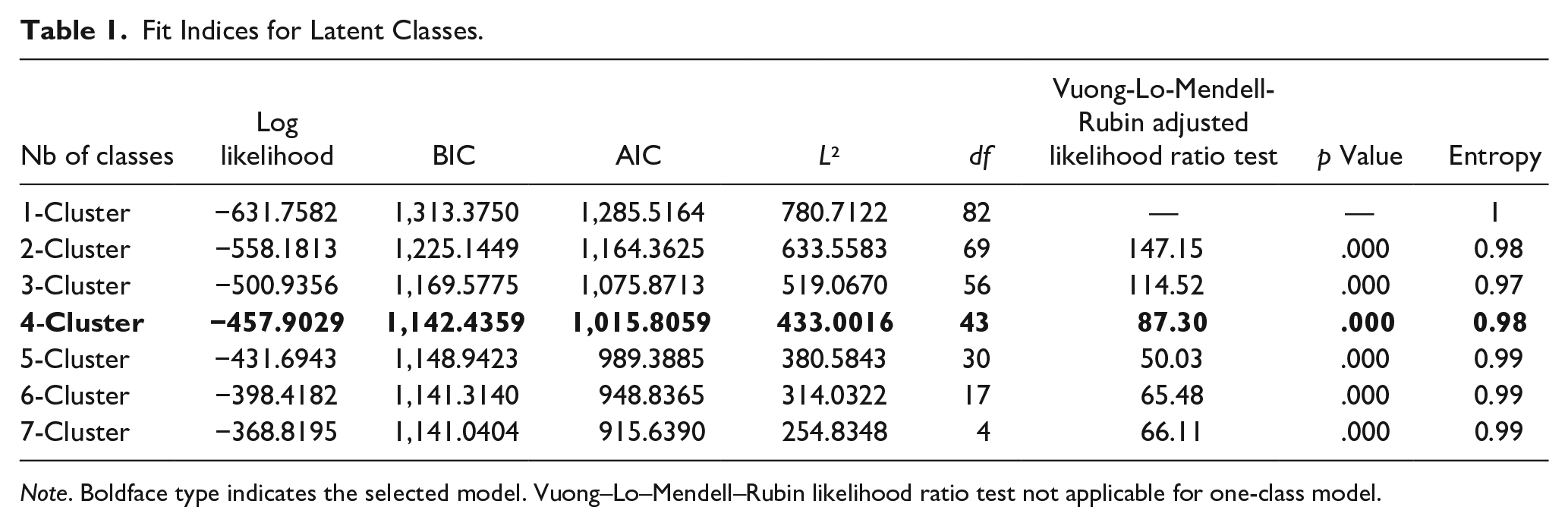
Note. Boldface type indicates the selected model. Vuong–Lo–Mendell–Rubin likelihood ratio test not applicable for one-class model.
As a second step, we used additional variables (i.e., victimological, offender, and contact and crime location characteristics) to test the external validity of the model as well as to improve its depth. Bivariate analyses (i.e., Chi-square analysis and Kruskal-Wallis test 2 ) were used to identify significant differences between the different classes. Conducting several comparison tests with a limited sample size raised the question of Type I errors. Therefore, we calculated the family-wise error rate (FWER) with α = .05. The results suggested that the risk of obtaining a false positive was 62.26%. In order to reduce the possibility of a Type I error due to the multiple comparisons, a Bonferroni corrected alpha was used so that p values were considered significant only if they were below .002 (.05/24 variables). With α = .002, the risk of a Type I error is less than 4%.
Results
Table 1 describes the model fit indices for the LCA models and it appears that the 4-class solution was the best fitting class solution according to the BIC. Up to class 4, BIC decreases, while from class 5 BIC starts to increase. A smaller BIC suggests that the trade-off between fit and parsimony was achieved. Entropy for the 4-class solution is .98, suggesting that predictors we used to operationalize script dimensions are fair to classify the cases and that classes are almost perfectly distinct (entropy score of 1 indicate a perfect delineation of classes; see Celeux & Soromenho, 1996). The Vuong-Lo-Mendell-Rubin Adjusted likelihood ratio test indicates that the four-class model significantly improved upon the fit of the three-class model.
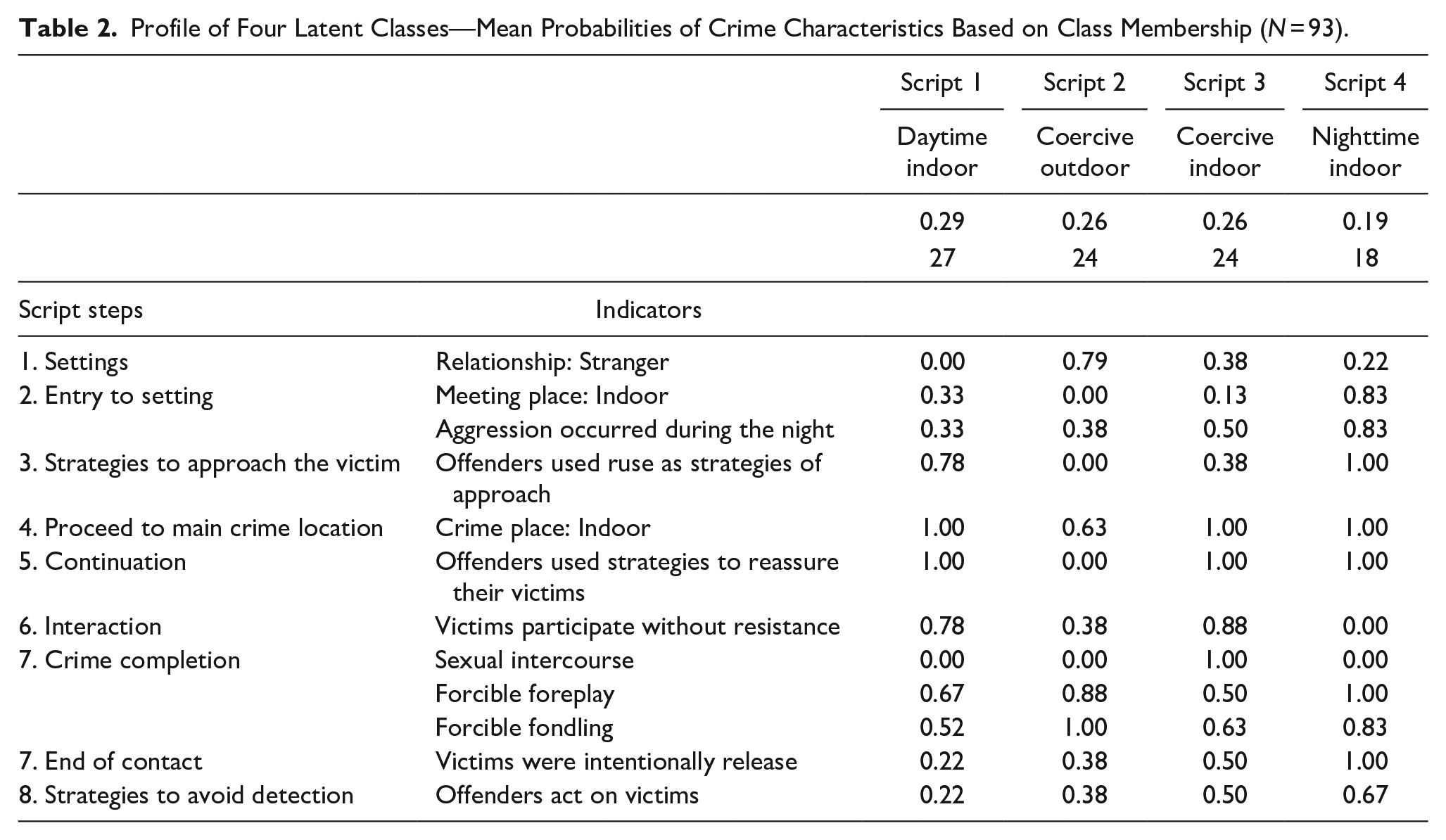
Table 2 and Figure 1 describe the 4-class solution representing the four different scripts adopted by female offenders involved in extrafamilial sexual offending. The largest class corresponds to script 1, including 29.03% (n = 27) of the cases, while the smallest is script 4 including 19.35% (n = 18) of the cases.
Profile of Four Latent Classes—Mean Probabilities of Crime Characteristics Based on Class Membership (N = 93).
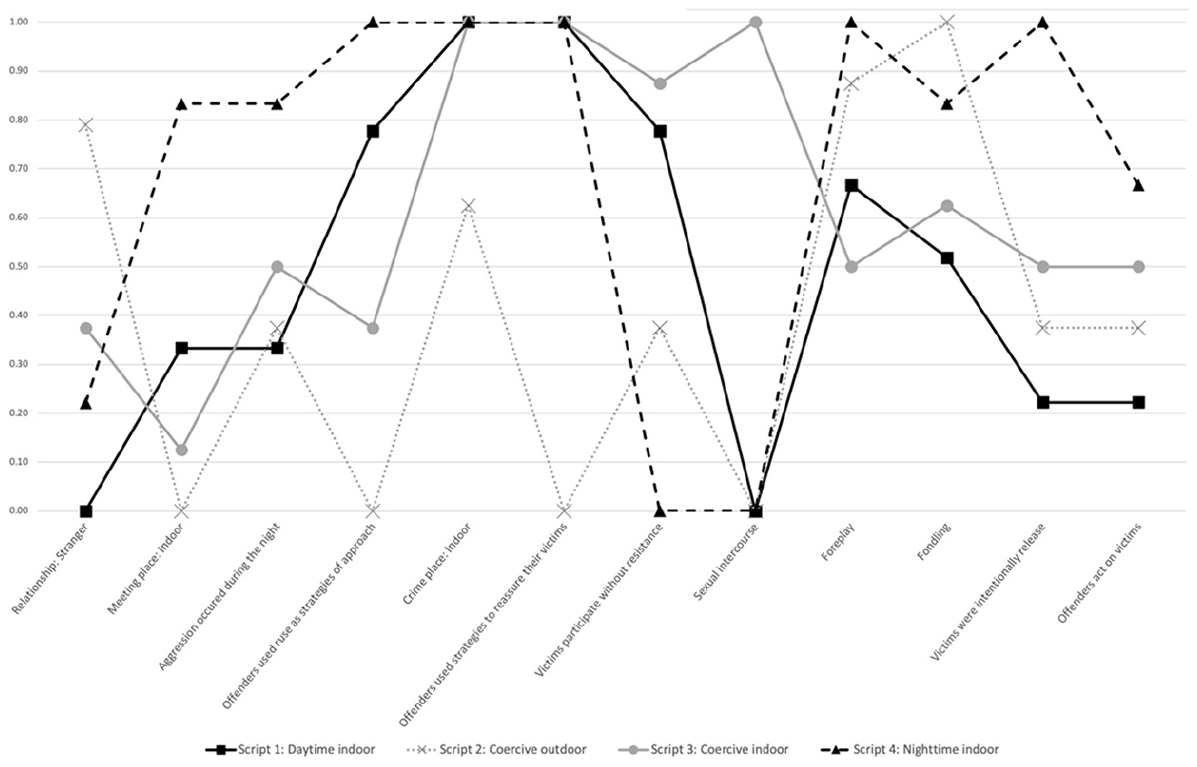
Profile of four latent classes—Mean probabilities of crime characteristics based on class membership.
Script 1 includes offenders who are acquainted with their victims (stranger relationship = .90 3 ) and are less likely to meet them in an indoor location (.33) during the night (.33). Victims are more likely to be approached with a con strategy (.78), while the assaults are more likely to take place at an indoor location (1.00). Offenders are more likely to use strategies to reassure their victims (1.00) who did not resist (.78). Offenders are more likely to commit acts of foreplay (.67). Finally, victims are less likely to be intentionally released (.22) and offenders do not act on victims (.22) to avoid police detection.
Script 2 includes offenders who are strangers to the victims (.79) and are less likely to meet their victims at an indoor location (.00) during the night (.38). Victims are not approached with a con strategy (.00), while the assaults are more likely to occur at an indoor location (.63). Offenders do not use strategies to reassure their victims (.00) who are more likely to resist the attack (absence of resistance = .38). In terms of sexual acts, offenders are more likely to commit acts of foreplay (.67) and fondling (1.00). Finally, victims are less likely to be intentionally released (.38) and offenders are not likely to act on victims (.38) to avoid police detection.
Script 3 includes offenders acquainted with their victims (stranger relationship = .38) who are less likely to meet them at an indoor location (.13). Victims are less likely to be approached using a con strategy (.38) and the assaults are taking place at an indoor location (1.00). Offenders use strategies to reassure their victims (1.00) who did not resist (.88). Offenders adopting this script are forcing the victim to have sexual intercourse (1.00) and they are likely to commit acts of fondling on the victims (.63).
Script 4 includes offenders acquainted with their victims (stranger relationship = .22) who are more likely to meet them at an indoor location (.83) during the night (.83). These offenders use a con strategy to approach their victims (1.00) and assault them at an indoor location (1.00). Offenders are not reassuring the victims during the assault (.00) as they are resisting the attack (.00). Offenders commit acts of foreplay (1.00) and they are likely to also fondle the victims (.83). During this script the victims are intentionally released (1.00), while offenders are likely to act on victims to avoid police detection (.67).
External validity of the 4-class model was tested using 24 covariates. To avoid Type I errors due to the multiple comparisons, Bonferroni corrected alpha (α = .002) was used. Findings suggest that 17 of the 24 variables (70.83%) we examined present significant differences between the four scripts.
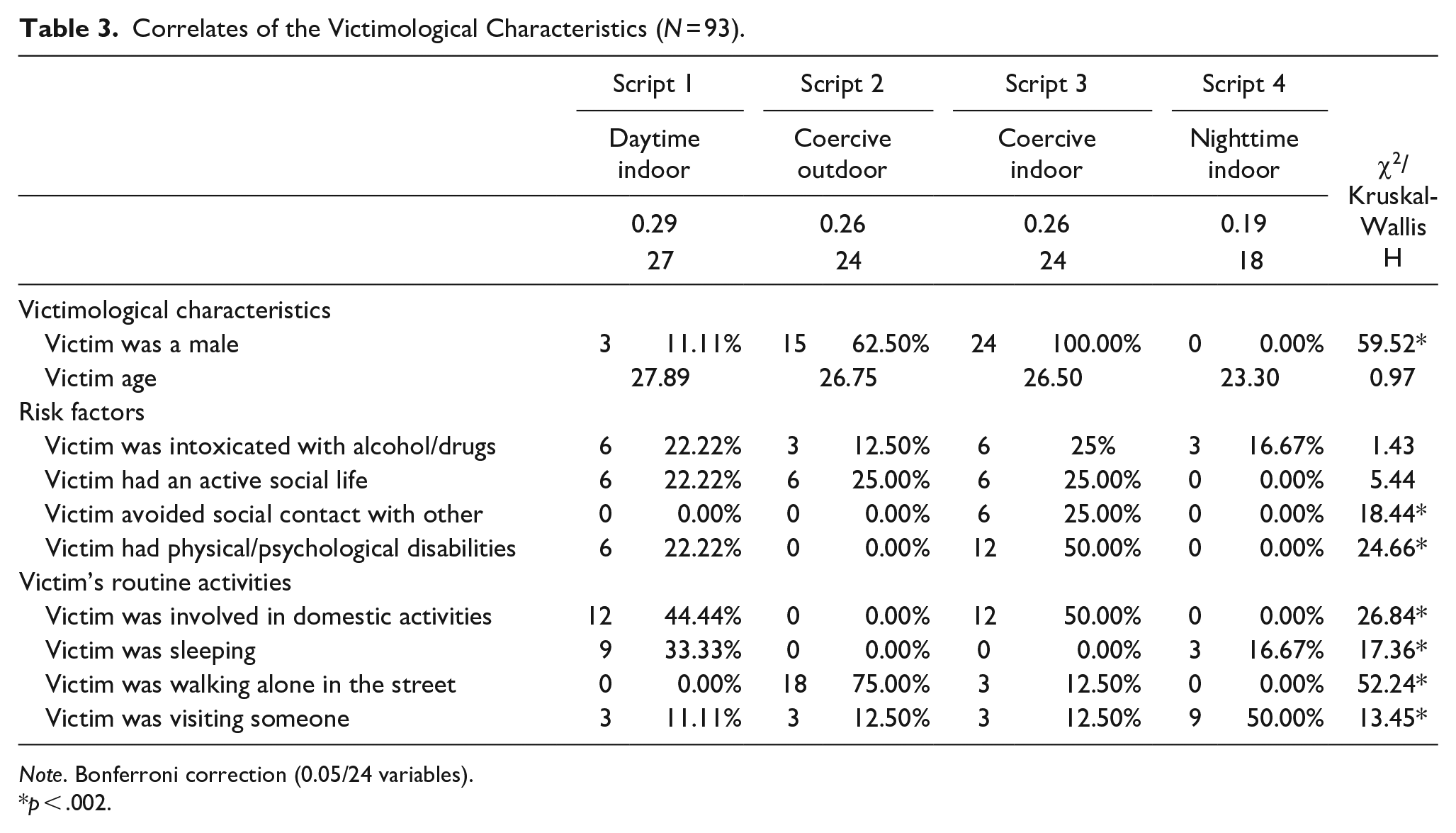
Victimological characteristics
Findings (Table 3) show that male victims are more likely to be involved in scripts 2 and 3 (χ2 = 59.52, p < .001). Also, victims with loner lifestyles (χ2 = 18.44, p < .001) and physical/psychological disabilities (χ2 = 24.66, p < .001) are more often assaulted in script 3. Moreover, victims involved in domestic activities are more likely to be assaulted by offenders adopting scripts 1 and 3 (χ2 = 26.84, p < .001), while victims who were sleeping are more often assaulted by offenders adopting scripts 1 and 4 (χ2 = 17.36, p < .001). Victims who were walking on the street are more likely to be assaulted by offenders from script 2 (χ2 = 52.24, p < .001), while victims who were visiting someone are more often assaulted by offenders from script 4 (χ2 = 13.45, p < .001).
Correlates of the Victimological Characteristics (N = 93).
Note. Bonferroni correction (0.05/24 variables).
p < .002.
Offender characteristics
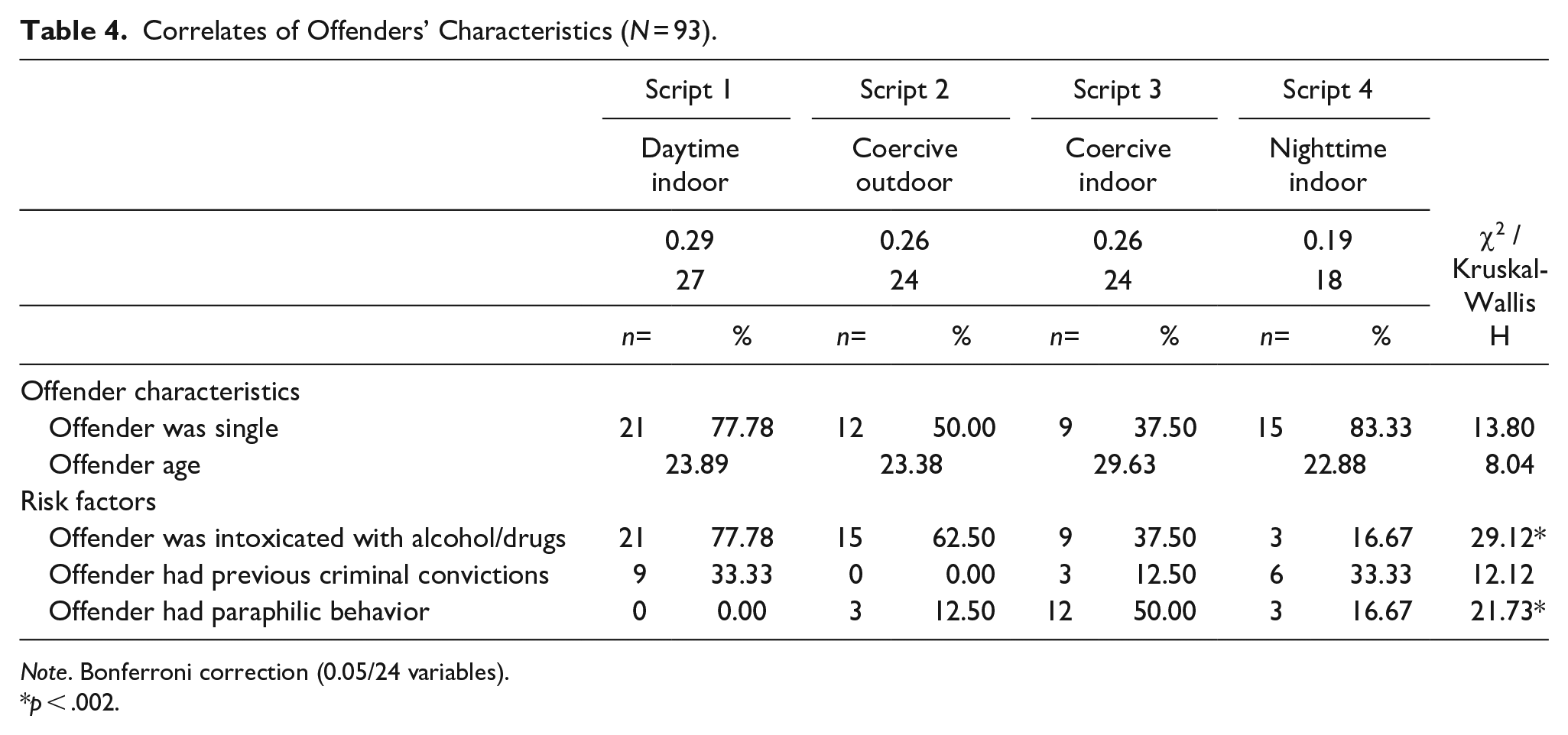
Results (Table 4) show that offenders adopting scripts 1 or 2 are more likely to be intoxicated with alcohol/drugs (χ2 = 29.12, p < .001) during the crime, whereas offenders from script 3 are more likely to report paraphilic behaviors (χ2 = 21.73, p < .001).
Correlates of Offenders’ Characteristics (N = 93).
Note. Bonferroni correction (0.05/24 variables).
p < .002.
Correlates of contact and crime location characteristics
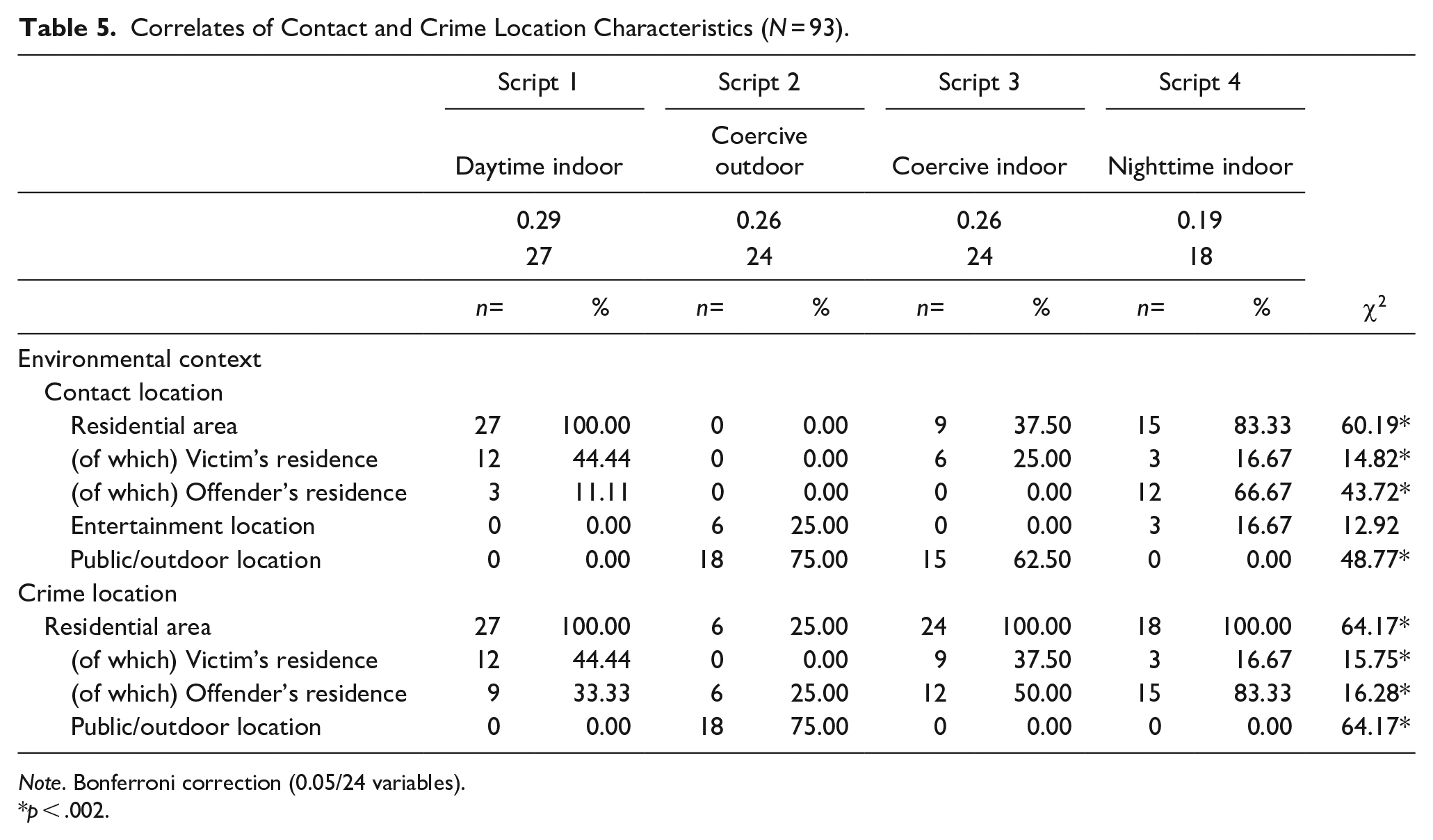
Results (Table 5) show that in scripts 1 and 4 offenders more often choose a residential area to approach the victim (χ2 = 60.19, p < .001). More specifically, offenders from script 1 are more likely to choose the victims’ residences (χ2 = 14.82, p < .001), while offenders from script 4 are more likely to choose their own residence (χ2 = 43.72, p < .001). Results also show that offenders from scripts 2 and 3 are more likely to choose public/outdoor locations to get in contact with the victims (χ2 = 48.77. p < .001). As to the crime locations, offenders from all scripts except script 2 are more likely to choose a residential area (χ2 = 64.17, p < .001). Specifically, offenders from script 1 are more likely to choose the victims’ residences (χ2 = 15.75, p < .001), while in scripts 3 and 4 offenders are more likely to choose their own residence (χ2 = 16.28, p < .001). Finally, offenders from script 2 are more likely to choose public/outdoor locations (χ2 = 64.17, p < .001).
Correlates of Contact and Crime Location Characteristics (N = 93).
Note. Bonferroni correction (0.05/24 variables).
p < .002.
Discussion
This study aims to understand the extrafamilial sexual victimization involving solo female offenders. In order to complete a comprehensive examination of the crime-commission process of women involved in sexual offending, the crime script approach was used. As noted by Cornish (1994), crime script analysis is grounded in the rational choice approach and used in criminology to understand how offenders make decisions. Specifically, goals of this study were to identify heterogeneity in the crime-commission processes of solo females involved in sex offending, and to examine the relationship between each step of these processes. For this purpose, we computed a LCA with a sample of 93 cases involving solo female offenders. LCA allowed for the identification of four distinct scripts from the 12 variables included in the main model. Moreover, most additional variables we used to assess the external validity of the main model presented significant differences.
Daytime Indoor Script
The first script identified is the most prevalent. Females who used this script were more likely to target acquaintance female victims. These offenders were intoxicated at the time of the offense and assaulted their victims in their own residence during daytime. They used various strategies to obtain the victim’s cooperation (i.e., con, reassurance) and committed acts of foreplay and fondling. The risk of interruption (i.e., victim escape, third party intervention) during the assault is important. From an offender’s perspective, this script is contextually risky, characterized by the crime committed in a residential area during daytime. Such pattern increases the probability for offenders to be recognized and interrupted by another person. Risk taking may be partly explained by the offender’s use of alcohol prior to the assault, as several studies suggested that human cognition can be affected by alcohol consumption, that reduces an individual’s ability to make a rational cost–benefit analysis (Assaad &Exum, 2002; Chopin & Beauregard, 2021; Exum, 2002). Such interpretation is supported by the fact that most offenders adopting this script are interrupted before the end of the assault, and, thereby unable to intentionally release their victims. This is similar to the young assaulters identified by Wijkman et al. (2010) who were likely to be interrupted by witnesses (e.g., children) present at the crime location (e.g., victim residence). Although the issue of alcohol/drug use among females involved in sexual offending has been explored in a few studies (Johansson-Love & Fremouw, 2009), our study is the first to establish a clear association with a specific crime-commission process.
Furthermore, our findings show that females adopting this script were more likely to use a con, a ruse, as well as reassuring behaviors with the victim, which is congruent with previous studies showing that females involved in sexual crimes are less likely than males to use violence (Almond et al., 2017; Ten Bensel et al., 2019; Vandiver, 2006). It is likely that women involved in sexual offending—similar to male child sexual abusers—try to gain the victim’s cooperation to facilitate the completion of sexual acts (i.e., foreplay, fondling). This approach seems to be successful insofar as no victims in our study sample resisted the attack.
Coercive Outdoor Script
The second script is characterized by the offending of male victims by strangers, at an outdoor location. Offenders are more likely to be intoxicated with alcohol/drugs, to use a coercive approach, and to commit acts of foreplay and fondling. Interestingly, this script is similar to the emotion regulation cluster described by Wijkman et al. (2014) and the hostility motivation cluster identified by Almond et al. (2017). These clusters included female offenders using a coercive approach and physical violence to humiliate their victims, which is typical of the crime-commission process of stranger male offenders motivated by anger (see e.g., Barbaree et al., 1994; Pardue & Arrigo, 2008).
Similar to the Daytime Indoor Script, the results suggest that alcohol/drug intoxication in offenders is associated with both a risky offending context (i.e., during the day, at a public location) as well as the use of coercive strategies to approach the victims. These findings are not surprising given that the use of alcohol by offenders has often been associated with the level of violence used during the crime (Ullman et al., 1999a, 1999b). It may be hypothesized that for this script, the level of intoxication is more important than in the Daytime Indoor Script, leading offenders to adopt more violent and risky behaviors.
Sexual assaults committed by women who did not know their victims at the time of the assault are unusual and have been the focus of little attention in previous studies (Ten Bensel et al., 2019; Vandiver, 2006; Vandiver & Walker, 2002). Despite being approximately one third of the cases included in the current sample, almost all cases involving a stranger relationship between the offender and the victim were classified in the same script, confirming the importance of the victim-offender relationship in the crime-commission process. Our findings also indicated that in most cases, offenders did not intentionally release their victims. This result is coherent with the other crime characteristics (i.e., during the day, at a public location), as these characteristics are associated with the presence of potential witnesses that may precipitate the end of the assault (e.g., help the victim, make the offender run away).
In addition, our results also suggest that victims in this script were more likely to resist, which is congruent with studies indicating that victims are more likely to resist when offenders use physical violence (Nurius et al., 2000; Siegel et al., 1989; Ullman & Knight, 1992). It is also plausible that due to the victim resistance, offenders decided to stop the assault and flee the crime scene.
Coercive Indoor Script
This script is mainly characterized by the sexual offending of male victims who were known to the offender at an indoor location. This is also the only script in which offenders have sexual intercourse (i.e., anal/vaginal penetration of the offender by the victim) with their victims. Females who use this script meet their victims at an outdoor location while the assault is committed in a residence. In terms of individual characteristics, we observe that victims were more likely to be loner and to present physical and/or psychological vulnerabilities. Offenders, on the other hand, are more likely to exhibit paraphilic behaviors. This script is very similar to the rapist category identified by Wijkman et al. (2010). The major difference we identified is the exclusive presence of male victims in our results. This difference can be logically explained by the fact that we focused our study on solo female offenders, while previous study used heterogeneous samples of female offenders (i.e., both solo and co-offenders). In the context of co-offending, it was mostly male offenders who were involved in sexual interactions with victims, who were more likely to be females (Vandiver & Kercher, 2004).
Also, we observe that offenders targeted victims they knew and who were more likely to present vulnerabilities. This observation is congruent with the study by Wijkman et al. (2014) which identified that some female offenders targeted physically/psychologically vulnerable victims. This may suggest that offenders targeted vulnerable victims to overcome resistance as well as increase their cooperation to successfully complete sexual intercourse. This hypothesis is congruent with previous studies showing that sexual offending victims who know their offenders and present vulnerabilities were less likely to resist (Atkeson et al., 1989; Burnett et al., 1985; Koss et al., 1988; Ullman & Siegel, 1993). Moreover, we cannot exclude the possibility that in some cases, this script corresponds to a statutory rape (i.e., nonforcible sexual activity in which one of the individuals is below the age of consent) often described in female sex offender studies (Cortoni et al., 2017; Ten Bensel et al., 2019; Wijkman et al., 2010). This possibility is reinforced by the fact that the contact location and the crime location are distinct places, suggesting that the offender and the victim moved together from one place to another one (Wijkman et al., 2010). This pattern of crime scene behaviors may fit the involvement motivation identified by Almond et al. (2017), where females involved in sex offending are primarily motivated by the development of pseudo-intimate relationships with their victims.
Finally, we observe that offenders who adopt this script are more likely to exhibit paraphilic behaviors. Such characteristic has rarely been associated with females involved in sex offending (see Cooper et al., 1990; Wijkman et al., 2014) but appears compatible with the overall script. Thus, we can suggest that females involved in sex offending who have full sexual intercourse with their victims were more often driven by deviant sexual fantasies, similar to male offenders (Chopin et al., 2020).
Nighttime Indoor Script
This last script is the least prevalent and it is the only one that occurs during nighttime, in the offender residence. This script is similar to the young assaulters category described in previous studies (Vandiver & Kercher, 2004; Wijkman et al., 2010). In contrast to the description proposed by Wijkman et al. (2010), the victims involved in this script are not family members related to the offenders but acquaintances and are only females. This difference may be explained by the homogeneity of the current sample where no intrafamilial nor co-offending cases were included. These victims were assaulted while visiting someone they knew, which reinforces the hypothesis that they were assaulted by their host or a relative (e.g., host’s daughter). As described by Wijkman et al. (2010), this could be a situation where a child is babysat overnight by someone familiar to the victim (e.g., neighbor, friend, babysitter). It is also possible that it concerns older victims who spend a night at an acquaintance’s residence. In cases where both offenders and victims were young, this script could be motivated by the experimentation of new sexual behaviors as described by Wijkman et al. (2014). The results indicate that offenders use a non-coercive approach to reassure the victim who is likely to resist. Despite the victim resistance, the offender successfully completes the assault (i.e., foreplay, fondling) and intentionally releases the victim while encouraging her not to report the acts. The favorable context of the crime—namely during nighttime and in the offenders residence—increases the likelihood that the crime will be successfully completed, limiting the possibility of third-party intervention.
Conclusion
This study was the first to investigate crime scripts used in solo female sexual offending in an extrafamilial context. Findings show that solo females involved in sex offending use four distinct scripts: daytime indoor, coercive outdoor, coercive indoor, and nighttime indoor scripts. The results show that scripts used in female sexual offending are largely influenced by the situational context as well as the offender and victim characteristics. Congruent with a rational theory approach, the findings suggested that the choices and actions taken during the crime-commission process are impacted by the context of the crime. In light of the general findings from this study as well as the literature on sexual offending involving male offenders, we may hypothesize that crime scripts by female offenders are less characterized by violence and coercion. Without a comparative group however, it is not possible to confirm this suggestion. Future studies should investigate differences and similarities in crime scripts between females and males involved in sexual offending.
While innovative and informative, this research is not without limitations. First, this study is based on official data which are known to present limitations in terms of validity and vulnerability (see e.g., Aebi, 2006). As discussed by Cortoni et al. (2017), the dark number (i.e., the number of cases never reported to authorities) of sexual assaults involving female offenders is important. Consequently, scripts identified in this study concern only cases known by the authorities and we cannot exclude that cases which were never reported to the police present different characteristics. Second, the use of quantitative analysis with the crime script approach present limitations (see Chopin & Beauregard, 2020b for a comprehensive discussion on this point). The use of quantitative data does not allow to reflect the complexity of all the situations, and provide a simplified modeling of the reality (e.g., not possible to consider all the interactions, not possible to consider all the steps, not possible to consider the temporality surrounding the crime-commission process). Finally, we used information from an operational database and some of the methodological procedures used by the research community are not employed nor are they realistic to apply in this context (e.g., accurate measures of information comparability, inter-rater reliability measurements).
This study presents several implications which could benefit both researchers and practitioners. Despite a growing interest in studying female sexual offending, there is still a dearth of empirical knowledge on the topic. As to the theoretical implications, the results of this study allow a more specific understanding of the phenomenon compared with existing typologies. First, the proposed model is grounded in a strong theoretical framework that confirms the presence of cost-benefit analysis in the decision-making process adopted by females involved in sexual offending. Second, the results are more precise than the previous typologies since they only focus on the solo-offending phenomenon. Third, the results offer a detailed and organized understanding of the crime-commission process by considering it as a dynamic set of interrelated choices and actions. Interestingly, the model offers a complete perspective by suggesting an association between the characteristics of the offender, those of the victim and the process used to perpetrate the crime. As to the practical implications, the identification of crime scripts is very useful for situational crime prevention (Cornish, 1994). Identifying specific and detailed crime patterns allows for easier identification and preventing opportunities by increasing the efforts and the risks of committing this crime. Prevention programs should challenge the myth of female sexual assault and target particularly vulnerable potential victims. We identified that the circumstances in which these assaults occur are heterogeneous, and it is important for parents to be vigilant when their children spend time with an adult, regardless of their gender. Beyond formal supervision, to detect inappropriate acts, regular discussion with children should be conducted about activities that took place with adult females during the day. It is also important to raise the awareness of potential young victims about the privacy of their bodies in order to increase the denunciation of inappropriate acts even when they are perpetrated by women and may take a different form than those committed by male offenders.
Many research avenues should be considered in the future, including the comparison of female offenders crime processes to those of male offenders or the identification of risk factors associated with female sexual offending. Ultimately, the accumulation of empirical data on the topic could lead to the development of risk assessment scales, as well as intervention programs designed to account for the distinctiveness of females involved in sexual offending. Studies should also attempt to replicate these scripts with other sources of data to test whether they can be generalized outside the context of this particular study. The crime script approach should also be applied to sexual assaults perpetrated by women with co-offenders, this research would help to improve the knowledge on this specific type of offending as well as for intrafamilial context. Finally, the use of a qualitative design would provide a deeper understanding of the decisions and actions taken by females involved in sex offending as well as the factors influencing these decisions.
Footnotes
Acknowledgements
The authors would like to acknowledge Mr. the Police Chief of the French Central Office for the Repression of Violences against Persons (Office Central de Répression des Violences aux Personnes) and Mrs the Central Director of the French Judicial Police (Direction Centrale de la Police Judiciaire).
Declaration of Conflicting Interests
The author(s) declared no potential conflicts of interest with respect to the research, authorship, and/or publication of this article.
Funding
The author(s) disclosed receipt of the following financial support for the research, authorship, and/or publication of this article: This work was supported by the Swiss National Science Foundation under Grant no. P400PS_190994.
