







Abstract
School resource officer (SRO) behavior varies across schools, but little is known about what shapes their behavior. Social ecological theories state that features of communities shapes individual behavior, including police officers. This may similarly apply to SROs. This study uses the 2015 to 2016 School Survey on Crime and Safety to test the extent to which three aspects of a school’s context related to behavior management (i.e., security measures, disciplinary environment, and restorative practices) shape SROs’ involvement in three roles: law enforcement, teacher, and mentor. Using a generalized structural equation model to examine the relationships between school context and SRO roles, consistent with ecological theories, we find that school context shapes SRO roles. Implications and future research are further discussed.
School resource officers (SROs, i.e., sworn police officers assigned to schools) are common in the United States nationwide despite their controversy. SROs serve three roles in schools, including the mentor, educator/teacher, and law enforcement officer (Canady et al., 2012). While initially introduced to maintain school safety, critics suggest that SROs excessively monitoring student behavior criminalizes marginalized students (Annamma, 2017; Kupchik & Monahan, 2006; Morris, 2016). For instance, schools with police arrest and suspend Black students at higher rates (Homer & Fisher, 2020; Weisburst, 2019), use more exclusionary practices such as suspensions (Fisher & Hennessy, 2015), and report more crimes to the police (Na & Gottfredson, 2013; Sevigny & Zhang, 2016). In addition, schools with SROs who take a more reactive, law enforcement approach show poorer student outcomes (Fisher & Devlin, 2019; McKenna & White, 2018). Nevertheless, SROs as a school safety strategy have received widespread public support, including the Trump and Obama administrations. While the police killings of George Floyd and Breonna Taylor in early 2020 have led many schools nationwide to remove SROs (Balingit et al., 2020), others have chosen to retain their SRO programs (Hui, 2020). Therefore, understanding what shapes SRO roles may help prevent further detrimental effects.
While SROs work with students, schools’ broader context regarding monitoring, controlling, and behavioral management strategies might shape their roles. Community studies find that context shapes police behavior and is likely to apply to school context and SRO roles. For example, neighborhoods perceived as dangerous often draws out harsher police practices (Terrill & Reiseg, 2003). In this vein, schools’ various use of behavioral management strategies might shape SRO roles. Indeed, prior research has found that multiple school contextual features shape SROs’ involvement in school discipline (Curran et al., 2019).
The purpose of the current study is to examine how schools’ approaches to student behavioral management shape SRO roles. Drawing on ecological theories, which emphasize that contextual features shape individual behavior, we examine three distinct school elements that might shape SRO roles: security measures, exclusionary, and restorative practices. To do so, we use data from the 2015 to 2016 School Survey on Crime and Safety (SSOCS), a nationally representative survey of school administrators, to assess the extent to which each of these three contextual features shapes SRO roles. These findings may guide schools in choosing whether to keep or remove SROs or shape their involvement in schools.
Context Shapes Individual Behavior
The role of context in shaping SRO roles can be understood through the social ecological model, a framework used to understand human development (Bronfenbrenner, 1979; Bronfenbrenner & Ceci, 1994; Bronfenbrenner & Morris, 1998). The social ecological model posits that there are five social ecological levels, each which shape and is shaped by elements of the other ecological levels (Bronfenbrenner, 1979). It has also been used to understand how contextual factors, such as school’s broader environment with faculty, students, and policies shape SRO roles and their involvement in student discipline (Curran et al., 2019).
The social ecological model states that the ecological system is comprised of the macro, exo, meso, and microsystems, which include cultural contexts, belief systems, social, and physical environments. Like police, we maintain that both cultural and physical school environments may impact SRO roles. Cultural theories similarly posit that culture shapes individuals’ repertoire of behavioral tools from which they are able to access in response to certain stimuli (Hannerz, 1969; Kirk & Papachristos, 2011; Swindler, 1986). This repertoire of tools helps us understand how community context shapes individual behavior. For example, place of residence similarly shapes acceptable and normative behavior (Kirk & Papachristos, 2011), where deviance is readily acceptable in certain neighborhoods (Anderson, 2000; Sampson & Wilson, 1995). Thus, the cognitive landscapes and cultures of disadvantaged neighborhoods might normalize behavior that would not otherwise be accepted in conventional society (Anderson, 2000; Sampson & Wilson, 1995; Stewart & Simons, 2010). Environmental cues suggesting poor cohesiveness can also create residential perceptions of disorder, which has been linked to poorer health (Ross & Mirowsky, 2001). It also leaves outsiders with assumptions of an unsafe and threatening environment.
Community context can similarly shape police officers’ repertoire of tools that shape their perceptions of appropriate behavioral responses in certain settings. Research shows that officers’ perceptions of neighborhood safety dictates whether they will resort to violence (Smith, 1986; Sun et al., 2008; Terrill & Reiseg, 2003), particularly in neighborhoods with a growing minority population (Kane, 2002). Broken windows policing similarly posits that visible disorder, such as broken windows or graffiti, encourages crime (Kelling & Wilson, 1982). This line of thought might apply to schools, where SROs’ perceptions of the school might shape their “toolkits” of acceptable behaviors from which to draw on. For instance, a school culture espousing a zero-tolerance approach to minor infractions may lead SROs to be more involved in monitoring and responding to student behavior. Similarly, schools reflecting a controlling environment through security measures and harsh punishments might draw out SROs’ law enforcement role. Conversely, schools relying on restorative practices might draw out SROs’ mentor or teacher role. We expand upon these possibilities below.
Context and SRO Roles
The National Association of School Resource Officers (NASRO), the largest SRO professional organization, describes SRO roles under a triad model, including a law enforcement officer, mentor, and educator role (Canady et al., 2012; Girouard, 2001; NASRO, n.d.). SRO law enforcement tasks include crime response and prevention, the mentoring tasks include informal counseling, and teaching tasks include educating students and school personnel on legal issues and crime preventative measures. This model expects all SROs to practice these three roles, yet it does not expect equal practice across schools. Although the law enforcement role is most prioritized (Coon & Travis, 2012; McKenna et al., 2016), SROs are still likely to engage in additional roles (Fisher & Devlin, 2019; McKenna et al., 2016). Though unstandardized, SRO training received tends to focus on law enforcement activities. For example, a majority of SROs reported receiving active shooter training whereas fewer SROs reported receiving training related to trauma or understanding the teen brain (Kurtz et al., 2018). Therefore, the inconsistent training requirements for some departments (Education Commission of the States, 2019) has led to a wide range of on-the-ground practices among SROs.
Although SRO roles are expected to vary across schools, little evidence exists for how or why they may vary. We posit that SRO roles are shaped by schools’ cultural context and physical environment in which they work. Prior research has shown that level of disadvantage predicts SRO roles, where SROs in more disadvantaged schools engaged in their law enforcement role compared to SROs in less disadvantaged schools that engaged in their teacher role (Kupchik, 2010; Lynch et al., 2016; Nolan, 2011). There has been little empirical investigation into how school context—beyond disadvantage—may shape SROs’ behavior (Curran et al., 2019), though we suspect that schools’ broader culture in managing student behavior and physical security features might shape SRO roles. We consider three contextual features in particular: security measures, exclusionary practices, and restorative practices.
Context As School Security Measures
Security measures are one common approach that schools use to manage student behavior. Although school shootings have increased schools’ use of security measures (Addington, 2009; Curran et al., 2020), they are part of a broader trend toward securing schools in ways that anticipate the constant possibility of crime (Kupchik & Monahan, 2006; Simmons, 2017; Simon, 2007). This trend has increased school control and surveillance, despite them being among the safest places for children (Cornell et al., 2015), and the decades-long decrease in school violence (Musu et al., 2019).
Schools’ security level as an environmental feature might shape SRO roles. As Simmons (2017) notes, a high presence of security measures creates a culture of control which is linked to the “carceral continuum” (Foucault, 1979; Shedd, 2015, 2011) where prison punitive and controlling practices have permeated throughout all parts of society. Thus, SROs may perceive school security measures as environmental cues that schools might be unsafe and therefore prioritize student discipline and control. For example, schools requiring students to walk through metal detectors may give SROs the idea that students are armed and therefore need to maintain surveillance to reduce potential threats. These cues might then shape SROs’ repertoire of tools to be geared toward their law enforcement role to create a safe environment. Therefore, we expect schools with higher security levels to draw out SROs’ law enforcement role.
Context As Exclusionary Practices
Exclusionary practices like suspensions or expulsions are an additional approach used to manage student behavior. In the 2015 to 2016 school year, approximately 2.7 million students received at least one school suspension, disproportionately impacting non-White students (U.S. Department of Education, 2018). A growing fear of crime and violence in schools in the 1990’s led to the adoption of zero-tolerance policies, requiring mandatory exclusionary responses to certain offenses. These policies have led to a proliferation of broad and inconsistent exclusionary practices (Jones et al., 2018) for minor student misbehaviors such as tardiness, noncompliance, language, defiance, and minor physical contact (Skiba & Sprague, 2008). This mirrors broken windows policing (Cohen, 2013) and reflects a school pedagogy that focuses on “teaching to the rules” (Kupchik, 2010), where students learn to prioritize behavior over education. Although Obama-era guidance recommended against zero-tolerance policies and exclusionary discipline (U.S. Department of Education, 2014), the Trump administration has rescinded this guidance, citing the need to use exclusionary discipline to maintain order in schools (DeVos et al., 2018).
Exclusionary environments might also influence SRO roles. For example, harsh discipline mirrors broken windows policing that affirms the carceral continuum’s extension into schools where students learn to comply with authority (Foucault, 1979). In fact, zero tolerance policies and SROs can be seen as inseparable and mutually reinforcing (Finn et al., 2005), a finding that reflects SROs’ involvement with school discipline in both formal and informal ways (Curran et al., 2019; Kupchik, 2010). However, little research has examined how schools’ exclusionary environments shape SRO roles. Therefore, we posit that a heavy reliance on exclusionary practices will draw out SROs’ law enforcement role.
Context As Restorative Practices
Restorative practices are another approach to managing student behavior. Restorative practices work to reintegrate students rather than punishing them. This might include teaching wrongdoers to hold themselves accountable (Amstutz & Mullet, 2005), to rebuild their dignity (Schiff, 2013). Therefore, accountability assures a positive change in behavior while still accepting them as members (Braithwaite, 1989). Thus, restorative practices are beneficial because they address the inherent causes student misconduct and lower their frequency.
Although research has not yet examined the link between restorative practices and SRO roles, ecological theories would lead us to suspect that school’s restorative environment might shape SRO roles. Specifically, a restorative environment that emphasizes rebuilding and repairing connections rather than removing students might draw out SROs’ mentoring role. This would ultimately reduce the need for student discipline and removal. Therefore, we suspect that schools with restorative environments will draw out SROs’ mentoring or teaching role.
The Current Study
Given the extant body of literature showing that contextual environments shape individual behavior (Bronfenbrenner, 1979), including the police (Kirk & Papachristos, 2011), we might expect school context to similarly shape SRO roles. This line of work is important because SRO behavior varies by schools. In fact, schools with greater levels of student control might influence SROs to present themselves as more of an authority figure versus an educator or mentor. Alternatively, schools that emphasize student integration might draw out SROs’ teacher or mentor role. Therefore, this study is guided by the following research questions. What is the relationship between schools’ level of security and SRO roles? Second, what is the relationship between schools’ level of exclusionary practices and SRO roles? Third, what is the relationship between schools’ restorative practices and SRO roles? In answering these questions, we make two contributions to the current literature. First, we extend the literature by using environmental characteristics as predictors of SRO roles. Second, we contribute to the policing literature by examining how different environments and settings shape police behavior.
Methods
Data and Participants
The data used in the current study come from the public use version of the 2015 to 2016 School Survey on Crime and Safety (SSOCS). The SSOCS is a nationally representative and cross-sectional survey that is taken by nearly 4,800 public school administrators. It accounts for several school factors such as school size, urbanicity, school level, and many more. The SSOCS is used by the U.S. Department of Education to collect school-level data on crime and safety, and asks questions regarding school security measures, disciplinary actions, restorative practices, as well as crime related school characteristics. The surveys are administered in the spring semester to maximize the collected data. Although there were 2,096 completed surveys, our analysis included only schools with SROs, yielding a sample size of 1,360.
Measures
Dependent variable
To measure SRO roles, we drew on ten survey items (see Table 1) asking respondents whether SROs engaged in certain activities. We sought to combine these items by drawing on NASRO’s triad model, which identifies law enforcement, teaching, and mentoring as three broad roles. A statistically significant Bartlett’s test of sphericity (p = .000) and KMO value of .87 suggested sufficient correlations for a factor analysis. Therefore, we proceeded with an exploratory factor analysis (EFA) with the ten items. Factor loadings suggested three roles consistent with NASROs model (Pituch & Stevens, 2016, p. 363). Using our EFA results as a guide, we ran a confirmatory factor analysis (CFA), where the fit indices suggested a good fit. The three factors from this model—law enforcement, mentor, and teacher—represent the three dependent variables examined in the study.
Three Factor Model for SRO Roles.
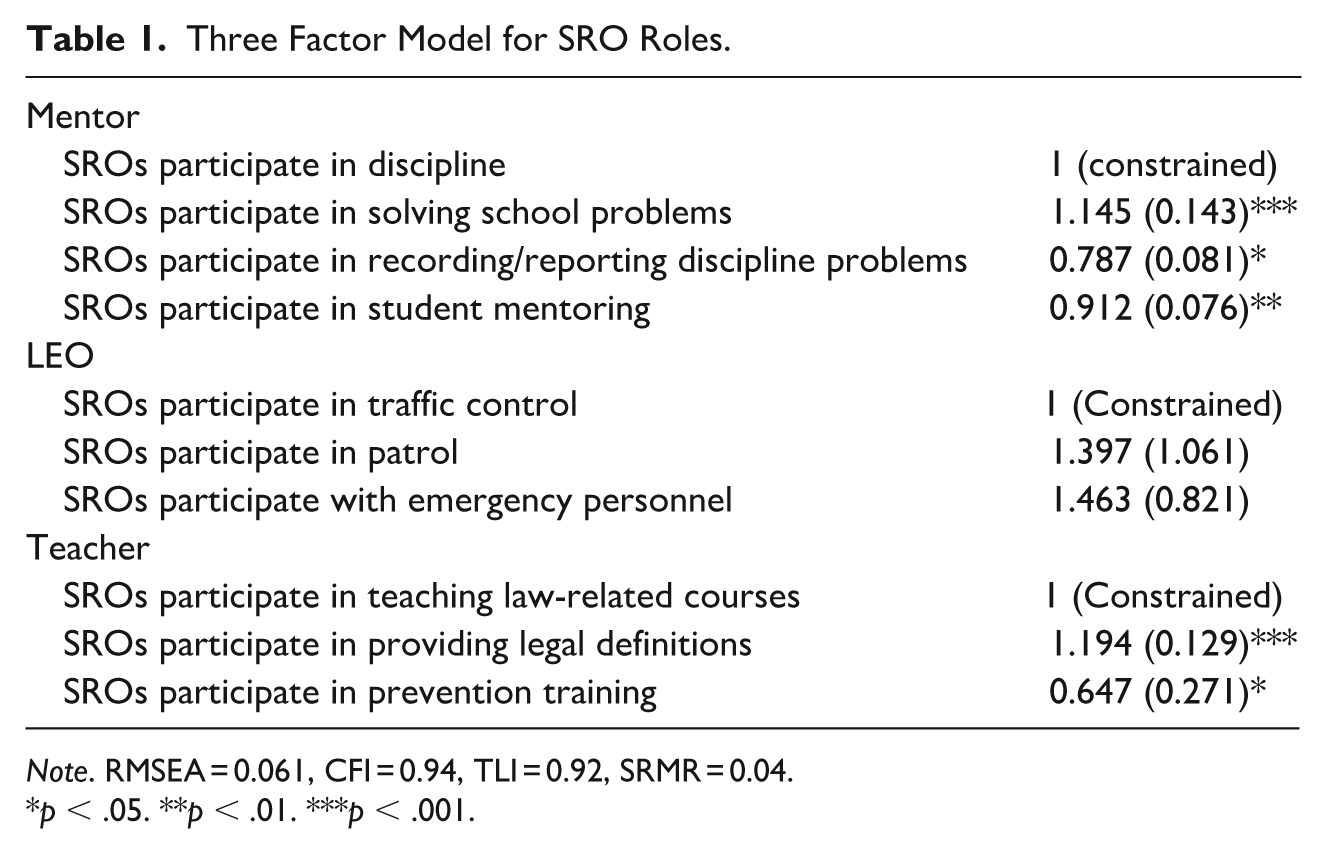
Note. RMSEA = 0.061, CFI = 0.94, TLI = 0.92, SRMR = 0.04.
*p < .05. **p < .01. ***p < .001.
Independent variables
Security measures
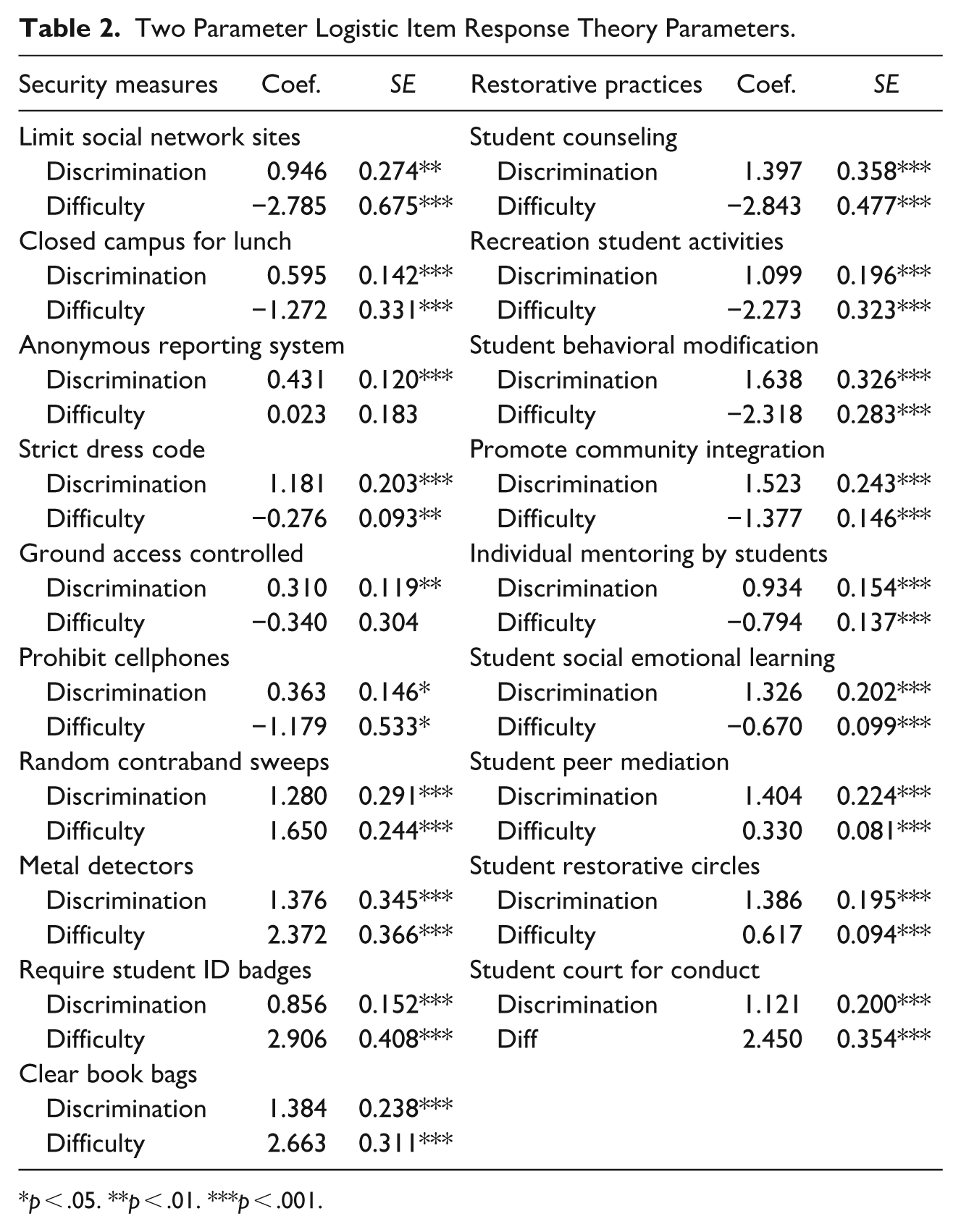
School security was measured using 24 dichotomous variables that asked school administrators about the presence of security measures in their schools, such as having locked gates, metal detectors, and surveillance cameras. Consistent with prior research (Fisher et al., 2018), we ran a two-parameter logistic item response theory (IRT) model to construct a latent variable that measures school security. IRT was used given its suitability for creating latent variables that are not easily measurable. We used a two-parameter model over the one-parameter model because it provides us with difficulty parameters as well as discrimination parameters (Harris, 1989). Security measures with discrimination parameters greater than 2 and difficulty parameters greater than 3 were removed (Harris, 1989). This resulted in a security measure construct composed of ten security measures (See Table 2), where higher IRT scores indicate more security measures used and lower IRT scores indicate fewer security measures.
Two Parameter Logistic Item Response Theory Parameters.
p < .05. **p < .01. ***p < .001.
Restorative practices
School restorative practices was measured using 10 dichotomous variables that asked school administrators about alternatives to student discipline such as peer mediation groups, counselors, and community integration. We used a two-parameter IRT model with identical parameter restrictions as our last construct. This resulted in a restorative practice construct composed of nine restorative measures (See Table 2), where higher IRT scores more restorative practices used and lower IRT scores indicate fewer restorative practices used.
Exclusionary disciplinary practices
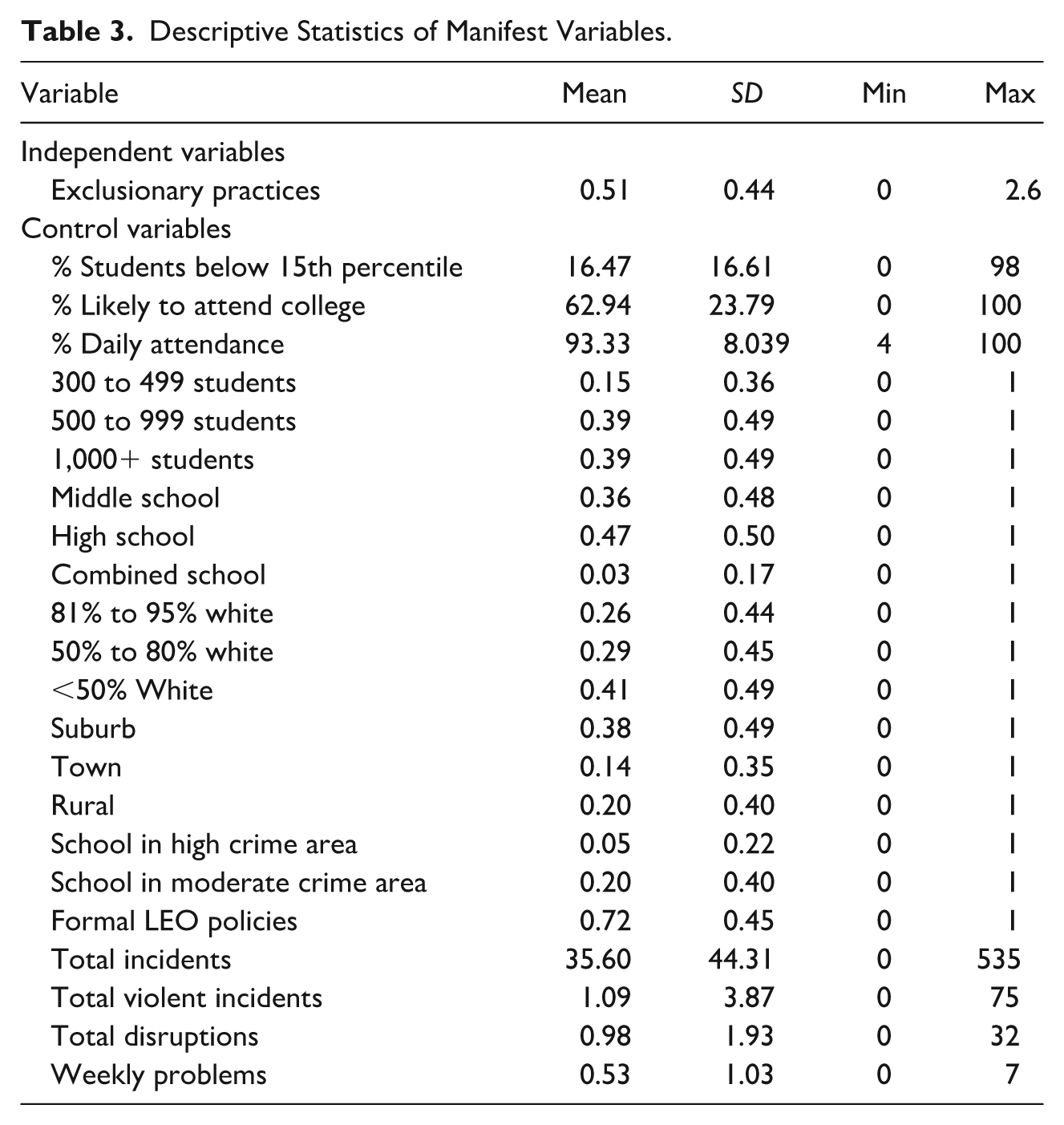
To measure schools’ exclusionary disciplinary practices (See Table 3), we computed the proportion of student offenses that were responded to with exclusionary discipline. Administrators were asked about the “total removals with no continuing school services for specified offense,” “total out-of-school suspensions greater than five days but less than the remainder of school for specified offense,” and the “total transfers to specialized schools.” Responses were combined and divided it by the “total students involved in specified offenses,” where higher values indicate a high reliance on exclusionary practices.
Descriptive Statistics of Manifest Variables.
Control variables
The control variables (see Table 3) were introduced in a stepwise fashion to rule out any spurious relationships. Like previous research (Devlin & Gottfredson, 2018), we include demographic controls like schools’ percent of students that are below the 15% percentile on standardized tests, the percent of students that are likely to go to college, and the percent of student daily attendance. We also included dichotomous variables controlling for school characteristics, such as school size, location, student population, school level, and racial composition. Next, we include two dichotomous controls for crime where schools are located, and a dichotomous variable controlling for schools with formal law enforcement policies. Lastly, we control for schools’ student behavioral problems by including four continuous level variables that measured the total number of reported incidents, violent incidents, and school disruptions.
Analytical strategy
To assess the relationship between a school’s context and SRO roles, we used a structural equation modeling (SEM) approach. SEM is a powerful modeling approach that allows for the inclusion of latent variables, which was necessary here to accommodate the IRT modeling of school security measures and restorative practices as well as the CFA model of SRO roles. Another advantage of SEM as an analytic approach is that in addition to estimating individual parameters of interest, it provides information about the overall fit of the model to the data. To assess model fit, we used a suite of fit indices including chi-square (χ2), the root mean square error of approximation (RMSEA), the comparative fit index (CFI), and Tucker-Lewis index (TLI). The χ2 test provides a significance test of whether the model is a good fit to the data; a significant χ2 value indicates a lack of fit. RMSEA values range between 0 and 1, with lower values indicating better fit. RMSEA values below .05 indicate close fit, and values above .10 indicate poor fit. The CFI and TLI—which are highly correlated—also range between 0 and 1, but higher values indicate better fit. Values greater than .95 are indicators of good fit, while values between .90 and.95 indicate marginal fit (Hu & Bentler, 1999).
We ran the analysis using a series of four SEMs, each building on the last. The first model regressed the three SRO roles on security measures, restorative practices, and exclusionary discipline. The second model controlled for schools’ student composition and school setting. The third model controlled for the crime levels of the community surrounding schools and whether they have SRO formal policies. The final model controlled for school misconduct. We had no multicollinearity issues. Replicate weights were used to account for the complexity of the survey, and all analyses were completed using Stata 15 and Mplus 8.
Limitations
One major limitation we face is that the data are collected from school administrators rather than SROs. Collecting data from SROs would potentially provide us with more meaningful responses as to how school context shapes their behavior. However, the survey instructs school administrators that are most knowledgeable on school crime and policies used to provide a safe school environment to complete the survey. Although school administrators’ perceptions may vary from those of SROs—they might underestimate the extent to which SROs are involved in schools—prior research has shown a high degree of similarity between school administrators and SROs in assessing the roles and activities of SROs (Coon & Travis, 2012). Future research may benefit from comparing perspectives from multiple stakeholders. Second, the SSOCS survey is cross-sectional data which can convolute our assumption of causal order. Longitudinal data could address this by capturing pre and post assessments of how school context might shape SRO roles. Finally, our key constructs measured imprecisely, often relying on binary indicators of the presence of certain school features or SRO actions. Although latent variables were used to address potential measurement error, the items we used may not fully represent the scope of our underlying constructs, particularly in regard to SRO roles, school security measures, and restorative practices. Future research could benefit from a more thorough measurement of these key constructs, including a focus on the frequency and duration of SRO roles, and the extent to which school security measures and restorative practices are used.
Results
Model Without Controls
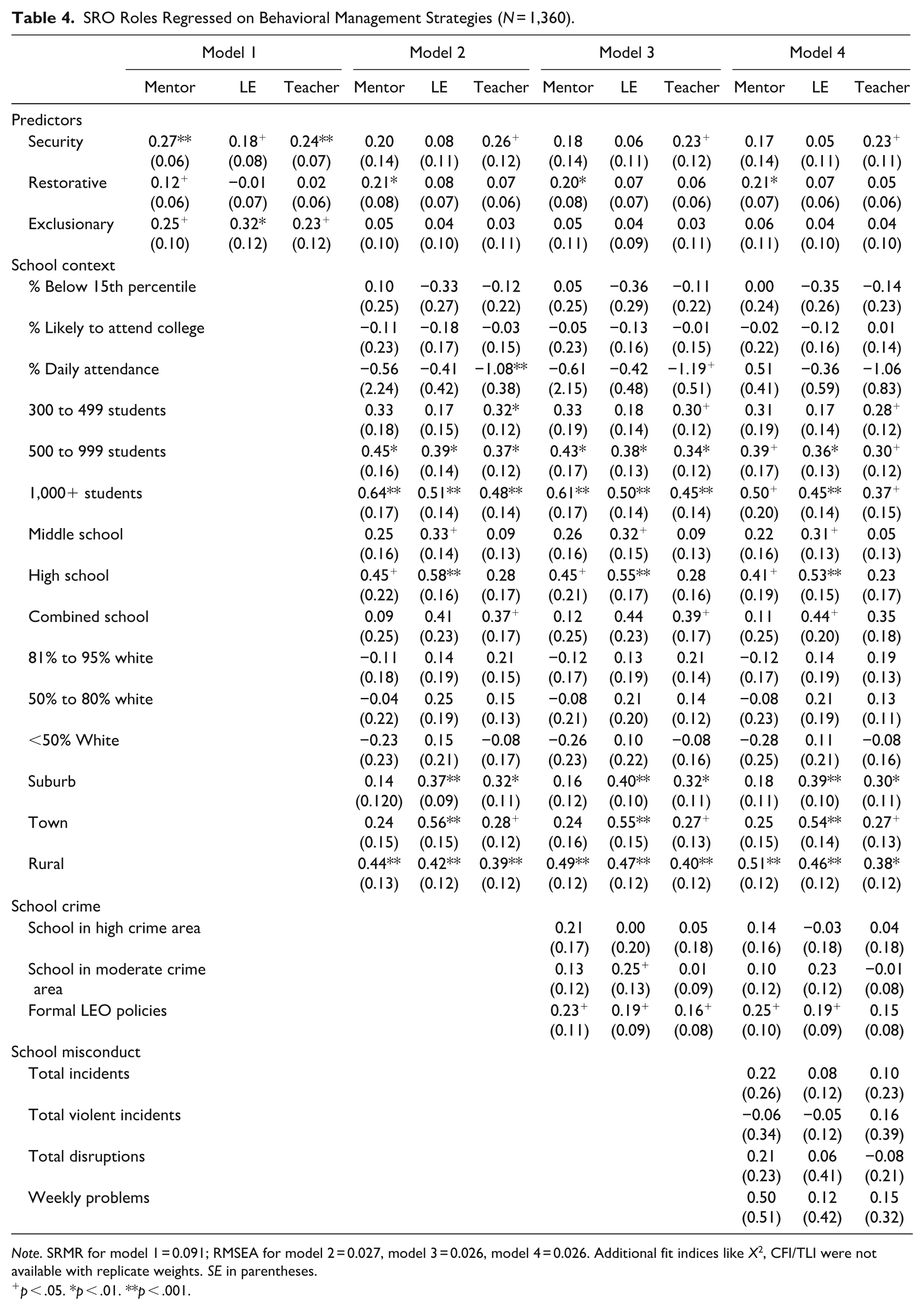
As shown in Table 4, model one included the three SRO roles as dependent variables and security measures, restorative practices, and disciplinary practices as independent variables with no other controls. Security measures significantly predicted all three SRO roles. Specifically, a one-unit increase in security measures increased SROs’ mentor role by .27 standard deviations (b = .27, SE = .063, p = .000), law enforcement role by .18 standard deviations (b = .18, SE = .08, p = .021), and teacher role by .24 standard deviations (b = .24, SE = .07, p = .001). Restorative practices only significantly predicted SROs’ mentor role. Specifically, a one-unit increase in restorative practices increased SROs’ mentor role by .12 standard deviations (b = .12, SE = .06, p = .041). Exclusionary practices also predicted all three SRO roles. Specifically, a one-unit increase in exclusionary practices increased SROs’ mentor role by.25 standard deviations (b = .25, SE = .10, p = .012), law enforcement role by .32 standard deviations (b = .32, SE = .12, p = .005), and teacher role by .23 standard deviations (b = .23, SE = .12, p = .045).
SRO Roles Regressed on Behavioral Management Strategies (N = 1,360).
Note. SRMR for model 1 = 0.091; RMSEA for model 2 = 0.027, model 3 = 0.026, model 4 = 0.026. Additional fit indices like X2, CFI/TLI were not available with replicate weights. SE in parentheses.
p < .05. *p < .01. **p < .001.
Models With Controls
Model two introduced controls related to schools’ student composition and school settings. The relationship between security measures and SROs’ mentor and law enforcement roles were attenuated to non-significant and the teacher role remained significant. Specifically, a one increase in security measures increased SROs’ teacher role by .26 standard deviations, net of controls (b = .26, SE = .18, p = .028). The coefficient between restorative practices and SROs’ mentor role strengthened. A one-unit increase in restorative practices increased SROs’ mentor role by .207 standard deviations, net of controls (b = .207, SE = .081, p = .010). The relationships between exclusionary practices and SRO roles were attenuated to non-significant.
Model three controlled for the level of crime around schools and for schools’ use of SRO formal policies. The relationship between security measures and SROs’ teacher role was slightly attenuated. Specifically, a one-unit increase in security measures increased SROs’ teacher role by .23 standard deviations, net of controls (b = .23, SE = .12, p = .048). The relationship between restorative practices and SROs’ mentor role was also slightly attenuated. Specifically, a one-unit increase in restorative practices significantly increased SROs’ mentor role by .20 standard deviations, net of controls (b = .20, SE = .08, p = .010). The relationships between exclusionary practices and SRO roles remained nonsignificant.
Model four controlled for school misconduct. Security measures remained a significant predictor of SROs’ teacher role with a slight attenuation. Specifically, a one-unit increase in security measures increased SROs’ teacher role by .23 standard deviations, net of controls (b = .23, SE = .11, p = .045). The relationship between restorative practices and SROs’ mentor role strengthened. Specifically, a one-unit increase in restorative practices increased SROs’ mentor role by .21 standard deviations, net of controls (b = .21, SE = .07, p = .003). The relationships between exclusionary practices and SRO roles remained nonsignificant.
Sensitivity Analysis
For more robust findings, we ran alternative models with each individual SRO role as its own dependent variable and compared it to the CFA model. The coefficients were in the same direction as the full SEM results, although magnitudes varied. Each of the individual items that constitute the mentor factor had coefficients in a similar direction, but only SROs solving school problems was significant. The three law enforcement items showed similar relationships with the law enforcement factor. There was consistency in the teacher factor as well. Unlike the CFA models, restorative practices significantly predicted one individual teacher item.
Discussion
Existing literature has shown that community characteristics shape police behavior, where poorer areas receive harsher police treatment. Schools alike have their characteristics that might similarly shape SROs’ behavior. The purpose of this study was to determine whether school context such as security measures, disciplinary actions, and restorative practices shape SRO roles. Consistent with NASRO’s triad model, we found three SRO roles: law enforcement, teacher, and mentor. In unadjusted models, school security measures and exclusionary practices predicted all three SRO roles and restorative practices only predicted SROs’ mentor role. Many of these relationships were attenuated to nonsignificance once controls. Security measures still predicted SROs’ teacher role and restorative practices still predicted SROs’ mentor role.
Our findings show partial support for the ecological theories, which provide a basis for understanding how environments shape individual behavior (Bronfenbrenner, 1979; Bronfenbrenner & Ceci, 1994; Bronfenbrenner & Morris, 1998), including police behavior (Smith, 1986; Sun et al., 2008; Terrill & Reiseg, 2003). SRO roles were broadly shaped by school context and in some instances in unexpected directions. As expected, schools with stronger restorative environments shaped SROs’ mentor role. However, we did not expect security measures to predict SROs’ teacher role. SRO roles were also broadly shaped by school characteristics like school size and location. This provides support for theories positing that context shapes behavior and demonstrates, particularly in school settings.
There were also unexpected relationships, like exclusionary practices predicting SROs’ teacher role. This is likely attributable to the overlapping between SROs’ law enforcement and teacher roles. For example, the educator role is composed of tasks that educate students on criminal justice aspects such as teaching legal definitions, law related courses, and crime prevention. This also reflects how the carceral continuum has seeped into schools where students learn to comply with authority. Therefore, even in times where SROs are acting as informal social control, they are still driven by criminal justice logics.
Although not central to our study, school location significantly predicted SRO roles. What is interesting is that in rural areas, SROs’ mentor role was more prominent followed by the teacher role and may be attributed to accessible funding and resources that less crowded schools have (Hunt et al., 2019; Ruddell & May, 2011). Moreover, the demographics of schools outside of cities tend to be more homogenous and might be shaping SRO behavior (Pentek & Eisenberg, 2018). This might be a parallel pattern where non-Whites receive harsher treatment, further marginalizing them (Soler et al., 2009). Therefore, this might be an area that future research looks into to further understand how school context shapes SROs’ behavior.
One area for further inquiry may be the role of school administrators and their orientation toward behavior management. Some ethnographic work has shown that school administrators are reluctant to intervene in SRO actions in fear of facing legal repercussions (Simmons, 2017). However, it could be possible that their orientation on discipline and behavioral management strategies might have an effect on school contextual features. This might be the case given that prior research identifies the relationship between SROs and school administration as central for shaping how SROs are involved in school discipline (Curran et al., 2019). Therefore, future research should examine how school administrator’s orientation on discipline and behavioral management strategies might broadly shape both school practices and SRO roles.
Policy Implications
This research furthers our understanding of what shapes SRO roles, which can be used to minimize detrimental student outcomes. First, SROs should not be involved in daily school affairs, which could be done by ending school-based law enforcement. Schools choosing to keep their SRO program could prioritize behavioral management strategies that have no criminalizing outcomes. For example, restorative practices address student behavior while also drawing out less SRO law enforcement behavior. SROs could also be excluded from restorative practices. If they are involved, their actions should align with the school’s broader restorative practices.
Second, schools could rely on experts in student behaviors, such as school counselors, social workers, and school psychologists. Although SROs have a mentor role, they are first and foremost law enforcers; this may lead to problematic outcomes for students. For example, SROs might feel that arresting and introducing students to the courts system may help deter them from delinquency. However, doing so may facilitate the school to prison pipeline (Owens, 2017). Even if the interactions do not culminate in arrest, police contact among youth can lead to harmful trajectories (Wiley et al., 2013), particularly among Black youth (McGlynn-Wright et al., 2020). Alternatively, counselors and mentors are capable of helping students but are unable to arrest them and may not bring the same negative consequences. Theus, providing mentorship through non-law enforcement personnel may benefit students and the school.
Third, schools might also focus on school climate improvement. School climate refers to “patterns of people’s experiences of school life and reflects norms, goals, values, interpersonal relationships, teaching and learning practices, and organizational structures” (Thapa et al., 2013, p. 358). One particularly promising approach to school climate improvement is authoritative school climate, which provides a high degree of disciplinary structure with supportive relationships between students and adults (Cornell et al., 2015). Thus, rather than investing in SROs that may bring their own ideas about what might constitute appropriate and productive behavior management strategies, schools are likely to benefit more from having a code of conduct that is clear, fair, and consistently enforced and ensuring that every student has a strong and supportive relationship with at least one adult in the school.
Conclusion
Although the literature has shown detrimental student effects from the use of school security measures and SROs, little research has linked how school context might shape SRO roles. In the current study we examined whether there is a relationship between three aspects of school context related to behavioral management and SRO roles. We found partial support for ecological theories in that schools’ broader context shaped SRO roles. Specifically, an increase in security measures predicted SROs’ teacher role and restorative practices predicted SROs’ mentor role. These findings suggest that schools would benefit from examining not only their use of SROs, but broader systems of managing, controlling, and responding to student behavior.
Footnotes
Declaration of Conflicting Interests
The author(s) declared no potential conflicts of interest with respect to the research, authorship, and/or publication of this article.
Funding
The author(s) received no financial support for the research, authorship, and/or publication of this article.
