







Abstract
What role do extra-legal factors play in whether defendants plead guilty to a criminal offense? In this study, we provide qualitative evidence that pretrial detention is a contributing factor in adjudication outcomes. Many of our subjects reported that the prospect of being held in unsanitary and unsafe jails was sufficient to induce their acceptance of a plea, even when they maintained their innocence. Others worried that being held pre-trial would have a negative impact on employment and family responsibilities, and so chose to plead. Our quantitative analyses bolster these self-reports: in a national sample, defendants held in custody pre-trial are significantly more likely to enter a guilty plea, all else equal. These findings have important implications for individual outcomes, but also for the accountability of the criminal justice system as a whole.
In American criminal courts, guilty pleas account for up to 95% of convictions (Cohen & Reaves, 2012). As Justice Kennedy wrote in a recent decision, “Plea Bargaining is not some adjunct to the criminal justice system; it is the criminal justice system” (Missouri v. Frye, 2012). Given this reality, it is somewhat surprising that plea deals have not received more attention in scholarly research. When they have been the subject of inquiry, the assumption is often that because attorneys exercise a great deal of discretion in prosecutorial decisions (Devers, 2011), defendants will choose to accept a plea bargain in order to reduce the risk of a higher sentence at trial. Summarizing this prevailing wisdom, Posner (2014) writes: “If a settlement did not make both parties to a criminal case better off than if they went to trial, one or the other would invoke his right to trial” (p. 578).
The aim of this study is to gain insight into defendants’ experiences with and perceptions of plea bargaining. We are especially concerned with two key questions: What role do extra-legal factors play in defendants’ decisions to accept or reject a plea deal? In particular, what is the role of pre-trial detention in encouraging individuals to plead?
We employ two distinct approaches to answering these questions. First, we conducted in-depth, one-on-one interviews with 54 individuals involved in plea bargains. This included 22 criminal defendants in Bronx County, New York who had been charged with minor offenses (such as trespassing, turnstile hopping, and possession of marijuana) and 20 individuals convicted of felonies in Alameda County, California. In both samples, some of our interview subjects had chosen to plead guilty and others had not. In addition, we interviewed 12 defense attorneys to gather their insights into the plea-bargaining process.
Our qualitative evidence makes clear that features of the adjudication process are often, in and of themselves, a central consideration in whether respondents decide to plead guilty. Indeed, for many, the threat of pretrial detention was a decisive factor. Our subjects reported that the prospect of being sent back to unsanitary and unsafe jail facilities was sufficient to make them accept a plea at arraignment. Others worried that continued detention might negatively impact pressing obligations in their lives, such as employment and family responsibilities. These factors combined to pressure defendants into taking the plea deal that was offered, even when they felt that it was unfair or when they maintained their innocence.
We further test the relationship between pretrial detainment and adjudication outcomes using quantitative data from the State Court Processing Statistics (SCPS). The SCPS data detail a large sample of felony cases drawn from a representative sample of 40 large counties in the United States. Our quantitative analyses confirm what is suggested by our interviews: defendants who are held in custody before trial are significantly more likely to enter a guilty plea, even once we account for other factors. Using emergency releases as a way to reduce the underlying differences between those who are released and those who are detained pre-trial, we find that being held before trial increases the likelihood of being found guilty by roughly 11 percentage points. As we discuss in the concluding sections, these findings have important implications for individual outcomes, but also for accountability in the criminal justice system as a whole.
Plea Bargains in Theory and Practice
Plea bargaining, defined by Alshuler (1979, p. 1) as “the defendant’s agreement to plead guilty to a criminal charge with the reasonable expectation of receiving some consideration from the state,” is not a new phenomenon. In fact, for as long as there has been common law, an accused criminal has had the choice to convict himself by accepting responsibility for his crime. It was not until the mid-19th century, though, that plea bargaining became increasingly common in the United States (Alschuler, 1979, p. 215). By 1839, for instance, 25% of all felony convictions in New York involved a plea (Moley, 1928, p. 108). Just half a century later, plea bargaining rates accounted for 75% of all dispositions (McConville & Mirsky, 1995, p. 466) and by 1925, fully 88% of all convictions resulted from guilty pleas (Moley, 1928, p. 105).
Reliance on plea bargaining continued to rise in the decades that followed (Fisher, 2003). As caseloads ballooned at rates that far outpaced growth in court capacity, observers of the criminal justice system began to suspect that plea bargaining had become the only way to rapidly process an increasingly overwhelming docket (Feeley, 1979, p. 28–29; Gazal-Ayal, 2006). Supreme Court Justice Burger, for example, calculated that reducing the number of guilty pleas from 90% to 80% would increase the demand for judges, jurors, court reporters, bailiffs, clerks and courtrooms by a full 100% (Savitsky, 2009). By the time that the “war on crime” took hold in the latter half of the 20th century, plea bargaining had become a ubiquitous part of court practice.
Despite growing concern about criminal justice in America, however, scholars have generally not focused on this important aspect of the judicial process. In particular, just a handful of studies have examined how plea deals are understood by criminal defendants themselves and what this means for adjudications of guilt or innocence. Prior work on plea bargaining provides nuanced insights into the incentives and costs of plea bargaining for various actors, and explores the benefits and pitfalls of plea deals to the system itself, but early studies of plea bargaining often ignored the defendant all together.
For example, Alschuler (1968) conducted in-depth interviews in ten urban jurisdictions in an effort to produce a rich, multi-dimensional picture of the plea-bargaining process in America. He talked to judges, prosecutors, defense attorneys, and other courtroom officials, but did not directly address defendants. Nearly 10 years later, Heumann (1978) published a similarly limited study entitled, Plea Bargaining: The Experiences of Prosecutors, Judges, and Defense Attorneys. As the title suggests, Heumann’s study did not consider the effect of plea bargaining on the defendant. Another early study, authored by Church (1982), investigated the effect of one prosecutor’s policy of outlawing plea bargaining in the form of charge reduction in drug cases. The study focused solely on how the new policy affected prosecutors and judges, and what they had done to adapt. Though it also examined defense attorneys’ responses to the policy, it did not take the defendant into account in either its investigations or conclusions.
More recent work has begun to incorporate the role of the defendant into theories of the plea-bargaining process. Yet while this is a welcome development, several questionable assumptions emerge. First, many scholars describe the defendant as choosing whether to accept a plea offer or go to trial. Some studies acknowledge that defendants frequently do not have necessary or sufficient knowledge to make fully informed decisions about their situation. They are, therefore, more likely to depend on their attorney to offer analysis and advice, if not to act as de facto decision-maker (e.g., Hollander-Blumoff, 1997). Other studies, however, continue to implicitly or even explicitly assume that the defendant is ultimately responsible for (and capable of) making his or her own choice.
More concerning is the assumption that defendants make decisions based wholly or at least primarily on the punishment being offered, relative to the expected outcome should they go to trial (Baker & Mezzetti, 2001; Easterbrook, 1983; Landes, 1971). Indeed, the very name of the practice suggests that it involves parties “bargaining” for their respective interests (Savitsky, 2009). This paints the practice of plea bargaining in a fairly positive light: more choice offers more flexibility, increasing the likelihood that a defendant will emerge from the process with a satisfactory outcome—after all, he bargained for it. As one criminal defense attorney with whom we spoke told us, “I think it’s always better to have more options, rather than less.” In addition, the opportunity to take a guilty plea provides the defendant with a certainty of outcome that some argue is invaluable. As another attorney explained, going to trial is “just not worth the risk. It’s like 100% chance of no record [when the plea offer is to a violation] versus 50% chance of a record. It’s almost never worth it.”
In this formulation, the defendant’s decision is based largely on his or her perceptions of the adjudicated outcome. This basic idea is echoed in a host of scholarly work (Alschuler, 1968; Nagel & Neef 1967; Rhodes, 1976; Weimer, 1978). In contrast, few studies acknowledge the impact other factors might have on a defendant’s decision-making process. This includes the time elapsed between arrest and resolution, the amount of bail set, and the amount of time spent in pre-trial detention (Adelstein, 1978; Covey, 2009; Landes, 1971).
The Potential Importance of Pre-Trial Detention
Models that characterize defendants as rational decision-makers stand in stark contrast to legal and criminological scholarship centralizing the role of the defendant in the adjudication process. In this literature, the broader context of the criminal justice system is seen to exert a powerful force on adjudication. Criminal defendants—who have often been routinely harassed and profiled by the police, and who frequently hail from neighborhoods that have been disproportionately scrutinized for criminal activity—rapidly lose their bargaining power (Savitsky, 2009, p. 113). Many police departments have long relied on accusatorial interrogation practices, in which detectives alternate between implicit promises of leniency and threats of harsher treatment. The suspect thus perceives that he has no choice but to confess (Leo, 2008, p. 230). Faced with the pressure of a harsher punishment if the case goes to trial and they are convicted, even truly innocent defendants might plead guilty rather than risk having to pay this “trial tax” (Bibas, 2004; Bogira, 2005, p. 334).
In addition, critics of plea bargaining express concern that pre-trial detention might itself be coercive. Today, nearly half a million people are being held in detention awaiting either adjudication or sentencing. This accounts for roughly two-thirds of those in local jails (Digard & Swavola, 2019). In California, for instance, about 62% of those recently held in county jails had not yet been sentenced (Tafoya, 2015). Similarly, a majority of inmates at New York’s infamous Rikers Island are there awaiting trial or have been sentenced to a year or less. On average, individuals charged with a felony were detained for 51 to 55 days pre-trial, while those charged with a non-felony spent 18 days detained (Phillips, 2012).
Several recent studies have attempted to estimate the effects of pretrial detention on defendant outcomes. Heaton et al (2017) find that pretrial detention in Texas is associated with an increase in convictions. Didwania (2016) finds similar effects on sentence length using data on federal defendants. In another study, Peterson (2020) finds individual defendants detained pre-trial submit a guilty plea 2.86 times more quickly than those who were not detained.
Researchers also have analyzed the effects of pretrial detention using random or quasi-random judge allocation across defendants. Leslie and Pope (2016) leverage judges’ leniency as an instrument for pretrial detention and find an increase in the probability of conviction for those detained pretrial. Dobbie et al. (2018) also use the quasi-random assignment of bail judges, finding that pretrial detention significantly increases the probability of a conviction, primarily through an increase in guilty pleas.
These studies are persuasive in suggesting an important effect of pre-trial detention on pleas. More broadly, extant research points toward the myriad ways that pre-trial detention might induce both emotional and financial hardship (Feeley, 1979, p. 30–31). This can include being fired from employment for missing days of work, financial strain from lost wages or having to post bail, and emotional stress imposed on parents, children and partners as they wait for a family member to come home (Devers, 2011; Dobbie et al., 2018). These stressors are especially severe for economically disadvantaged defendants (Gerstein, 2013, p. 1515). As one attorney observed, “For a lot of people, taking a day off from their job, or childcare. . .is a much worse consequence than taking the plea they’re offered.”
In addition to these concerns, we suspect that conditions of confinement during pre-trial detention might also press defendants to accept a negotiated plea. Unlike prisons, pre-arraignment cells frequently are not subject to annual reporting and often do not allow visitors, so their conditions are not visible to most of the public (Hounmenou, 2010, p. 1). For example, the New York State Commission of Correction’s manual states that the commission “must visit and inspect all institutions used for the detention of sane adults charged with or convicted of a crime (Hounmenou, 2010, p. 9).” However, this direction does not apply to pre-arraignment detention facilities, as individuals held in those facilities have yet to be charged with a crime. As a result, the conditions in many of these facilities, colloquially known as “bullpens,” are notoriously bad; in New York, the Appellate Division characterized conditions in pre-arraignment detention as “harsh,” “chronically overcrowded,” and “squalid” (People ex rel. Maxian v. Brown 1990).
Poor conditions of confinement can place additional pressure on defendants to plead guilty, regardless of their culpability (Redlich, 2010). The attorneys with whom we spoke were cognizant of these potentially coercive effects, noting their belief that pre-arraignment detention is often a deciding factor. As one attorney explained to us in an interview, “People are pleading out not necessarily because they’re guilty or because they don’t want to go to trial, but because they don’t want to go to jail.”
Data and Methods
We begin by assessing the role of extra-legal factors in the plea bargaining process. To do this, we conducted semi-structured, one-on-one interviews with a sample of criminal defendants in the South Bronx as they came out of arraignment. From the end of October 2011 through the beginning of November 2011, we interviewed 22 defendants who had been charged with misdemeanor offenses. These subjects were selected as a stratified random sample from the total population of defendants whose cases came up during this time period, after excluding a subset of defendants based on charge, bail amount, and English proficiency. 1 We stratified our sample by plea status in order to provide a point of comparison to those who did plead guilty, and to explore whether views of the system differed in substantial ways between groups. Of the 22 interview subjects, 13 pled guilty at arraignment and 9 had their cases continued. 2
In 2014, we interviewed a group of 20 individuals in Alameda County, California who had been charged with misdemeanor or non-serious felony offenses. Unlike the earlier sample, all of these subjects had been convicted of a crime and had served time in prison. However, as in our Bronx sample, some had pled guilty while others had gone to trial. We again excluded those who were not eligible for a plea agreement, as well as those who did not speak English.
All defendants were asked a series of preliminary questions about their age, race and ethnicity, employment status, place of birth, and educational background. 3 Other preliminary questions included how long each defendant spoke to his or her attorney, whether the defendant had any prior contact with the criminal justice system, and whether the defendant had received government assistance for housing or to participate in an education program. We then asked each defendant a set of in-depth questions regarding their current situation and recent experience with the criminal justice system.
For those defendants who pled guilty, thereby disposing of their cases, we asked about the specific background of their case, including why they were initially detained by police, what they were arrested for, what they were charged with, and for what crimes they were convicted. We also asked each defendant about the specific factors he or she might have taken into account when deciding whether to plead, in an attempt to understand their decision-making. Finally, we asked those who had pled guilty if they felt they had missed anything by forfeiting their right to trial, and we asked all subjects if they felt they had been treated fairly, as well as their feelings about whether justice in their case had been achieved.
Because some of the defendants in the Bronx who did not plead guilty still had criminal cases pending, we were not able to ask them some of the same detailed questions about the specifics of their cases. However, we did ask corresponding questions about their perceptions of and experience with the criminal justice system, as well as their views on the ability of the system to deliver justice in their case further down the line. We likewise asked these defendants if they felt they had been treated fairly in the process, both by the police and by court personnel. All interviews were recorded, and we spent between 20 and 40 minutes with each subject.
In addition to the defendants with whom we spoke, we interviewed twelve defense attorneys about their experiences with plea bargaining, nine in the Bronx and three in California. We asked the attorneys about their views regarding the pros and cons of allowing defendants to plead guilty at arraignment, about the processes they went through to negotiate plea bargains for their clients, as well as how they think the practice of plea bargaining influences the criminal justice system as a whole. On average, each of these interviews lasted between 20 and 30 minutes.
To further investigate the relationship between pretrial detention and sentencing outcomes, we then turn to a quantitative analysis using the State Court Processing Statistics (SCPS) data—formerly the National Pretrial Reporting Program. The SCPS provides detailed information on a sample of state court felony cases for the period 1990 to 2009, covering 40 jurisdictions that are representative of the 75 largest counties in the United States. These counties account for more than a third of the U.S. population and 50% of all reported crimes. SCPS tracks felony defendants through the adjudication process, from charging to case disposition.
We begin by employing a selection-on-observables design, which takes advantage of the rich set of variables offered in the database. In addition, we leverage a subset of our data by focusing our analysis on individuals who were released from pre-trial detention on an emergency basis. Generally speaking, an emergency release is the discharge of an inmate from jail or prison custody due to overcrowding or some other urgent situation. These releases can result from a court order to reduce the number of detainees below an institution’s design capacity, or to come into compliance with a negotiated or voluntary cap related to crowding, budget expenditures, or some other rationale. By comparing those who are emergency released with individuals who are most similar but were not emergency released, we have an additional way of testing for effects in a sub-sample where we can substantially reduce underlying differences.
Qualitative Results
Of the subjects who took the plea deal offered to them at arraignment, 38% felt that the prosecution had no evidence to implicate them in the crime for which they were being charged, but had decided to plead guilty anyway. John, for example, told us that he had been arrested while leaving his apartment building to get his daughter some Chinese food for dinner. 4 Having just gotten home from his job as a boiler mechanic, John still had the box cutter he uses for work clipped to his pants pocket. John asked the police officers why they were stopping him and was told that he lived in a Clean Halls building, 5 and that was sufficient reason. When they were unable to arrest John for trespassing—he was able to produce an ID, pay stubs and a utility bill, all of which proved he was a resident of the building—the officers arrested him for carrying the box cutter. He was charged with criminal possession of a weapon. John ultimately pled guilty to disorderly conduct.
When asked if he felt the prosecution had a lot of evidence against him, John was adamant they did not, saying, “There was no evidence. The only evidence they had was the fact that I did have a box cutter. But what was I doing? When you charge someone with criminal possession of a weapon, that person has to be doing something criminal with that! I wasn’t doing anything criminal, so they had no real evidence. They had no evidence whatsoever.” According to John, though, the details of his case were not what influenced his decision to plead. Instead, he had accepted a deal because the conditions in the Bronx jail were miserable, and also because he did not feel he could afford to miss more work to fight the charges. John explained: I wasn’t treated fairly, because I still have to pay $120 when I didn’t do anything, because I pled guilty. If I would have pled not guilty, it would have been a whole different story. I would have had to come back to court and go through a whole bunch of things I do not want to go through. I have to pay these guys $120 out of my hard-earned money because of the NYPD’s neglect.
Another man we interviewed, Cameron, similarly reported feeling there was no legitimate evidence against him. Cameron told us he had been walking on the sidewalk outside a friend’s house when the police stopped and began searching him, claiming the house he had just come from was a “drug den for PCP.” When a search of his pockets ostensibly turned up an empty crack bag, he was arrested and charged with criminal possession of a controlled substance. When we asked him about the evidence the prosecution had against him, Cameron contended that the cops had planted the crack bag on him: “They [the arresting officers] lied once ‘cause I didn’t have no crack bag on me. I don’t do crack. Cause, you can see I have money in my pocket. If I smoked crack, I wouldn’t have money in my pocket.”
When we asked Cameron what he thought the outcome would have been had he decided to go to trial to fight the charges that he insisted were false, he said he firmly believed he would have won, saying unequivocally, “I would’ve beat it if it went to trial.” Yet, despite his claims of innocence and his assertion that he would have been vindicated, Cameron, like John, pled out to the violation. We cannot know for sure whether Cameron had committed the crime of which he was accused; he certainly might have. But like John, his stated reason for taking a plea deal had nothing to do with guilt or innocence. Instead, it was that he could not afford to continue to court for a trial and did not want to spend any more time in jail.
Similarly, Lawrence, a freelance R&B artist who was charged with possession of marijuana, felt there was no real evidence against him. Yet, Lawrence pled guilty to unlawful possession of marijuana, which carried with it a $25 fine plus court fees. While Lawrence did admit to having marijuana on him, he felt strongly that the police should never have searched him in the first place. When asked if the District Attorney had evidence against him, Lawrence said, “No, they didn’t. No. . .it’s unacceptable.” However, as both Cameron and Lawrence’s stories suggest, defendants’ perceptions of the strength of evidence against them was frequently not the only—or even the primary—consideration when choosing whether to plead guilty. Instead, it was pre-trial detention and its accompanying costs that drove many defendants’ decisions.
The Pressures of Time and Money
Relative to those who continued to trial, our interview subjects who chose to plead guilty were more likely to report feeling compelled to end their cases quickly. A number of defendants explicitly mentioned concerns about employment as factoring into their decisions to take plea agreements, explaining that missing a day of work while in pre-trial detention and foregoing the associated wages was simply not a feasible option. Alex, for example, was charged with misdemeanor possession of marijuana. When asked why he took the plea offer, he explained that his job and family were his highest priorities and so he could not afford to miss another day of work; Alex is a self-employed barber, and every day of missed work reduces the amount of money he is able to take home. Having lost a day already to arrest and pre-arraignment detention, Alex opted to make sure he could get to work the next day by pleading out.
Similarly, Daniel’s job as a host for a bus company in Chinatown was front of mind when he decided to take a plea bargain for turnstile jumping. When we asked Daniel why he decided to end his case that day, he said: “I’ve gotta go back to work. It’s not an option to be laid off my job. . .I’m all work. That’s all I’m about right now. Work. Work. Work.” Daniel explained that his paycheck barely covers his basic needs, and he is currently homeless. When we asked if he had considered fighting the charges against him, he said simply, “I’ve got things I gotta do. I’ve gotta go back to work. So I can’t afford to sit up and lay up. I can’t afford to do that.” For Daniel, as for Alex, getting released was more important than anything else. Neither could afford to miss more work than they had already, so pre-trial detention was unacceptable. As Daniel told us he had learned from his previous experiences, “You never wanna prolong something that’s not even that serious. . .I notice every time I end up sittin’ in jail, I lose everything I worked for.” In our interviews, those working for an hourly wage or holding low-income jobs appeared to feel especially vulnerable to these extra-legal factors.
Likewise, the pressures of detainment were described as particularly severe for those who already had a criminal record. Like Alex and Daniel, Wayne worried that his livelihood could be affected by his latest arrest; he had also been picked up for turnstile jumping on his way to work. He told us about his job at a bowling alley, saying he had used his one phone call from jail to contact his place of employment and let them know that he would not be in that day. He told us with concern: “Been [working] there five and a half straight years. Hopefully I’ve got work tomorrow. . .I’m supposed to work tomorrow, so I’ll find out tomorrow.” Knowing how lucky he was to have a job despite his extensive criminal record, Wayne was realistic about how hard it would be to find another job if his current employment was terminated. He explained that his criminal record “is something I have to explain in the interview. . .if they even interview me.” Wayne pled guilty to a theft of services charge.
Wayne was convinced that if he had gone to trial, he “would’ve messed up [his] life.” Wayne’s situation was not unique among our interviewees; eighty-five percent of the defendants who pled out at arraignment had criminal records, and all but two of these subjects had extensive rap sheets. One of the attorneys we interviewed explained that the pressures of pre-trial detention worried him most for these clients: The category that’s most troubling to me would be the clients who have a long record for drugs, for example, or other small offenses that usually lead to misdemeanor charges, like trespassing or petit larceny. . .They’ll come through arraignments and are charged with marijuana possession as a misdemeanor or trespassing and they’ll have viable defenses and it’ll seem obvious to me and obvious to a lot of judges, I think, that the client is not guilty of what is charged. The majority of judges will hold those people in [pretrial detention] as a result of their prior record, and so these people will just take a plea to get out.
Wayne called the practice of taking plea offers at arraignments “buying time” and explained, “It’s cleaner [to end your case] here cause sometimes they send you to upstate or Rikers Island.” Another interviewee, Dina, was similarly afraid that her criminal history meant she would have been remanded if she had not taken the plea offer. If she had tried to fight the charges against her, she said, “They probably would’ve asked for Rikers time because of my record.” Kyle, too, felt that his record would have meant more time in detainment; if bail had been set, he expected to spend “maybe a week, 14 days in jail.” Instead, he pled guilty to stealing a box of candy bars from the corner store.
Conditions of Confinement
Notably, those who pled guilty perceived the conditions of confinement to be much worse than those who had continued. In fact, subjects who pled guilty often directly attributed their decision to characteristics of the “bullpen.” Among those who pled guilty, only one felt that this was not at all an issue. Even this interview subject, though, would only say that conditions in pre-arraignment detention facilities “were bearable.” All our other subjects who took a plea described conditions as deplorable, overcrowded and filthy. As one defendant explained, “There’s nowhere to sleep. . .There’s 100 people in there, some of them dope sick. . . .Two people had seizures while I was in there.” Another subject described the cells as “packed” and one subject put it simply, saying, “It’s dirty. . .filthy. . .it’s jail.” Others described food and milk spilled all over the floor, as well as clogged toilets overflowing their contents.
Holding cells were also described by many as suffering from a rampant pest problem. A number of subjects cited roach and bedbug problems as the most disturbing aspects of conditions in the cells. One told us: “There are bed bugs in there. . .there are a handful [of people] that’s in there that have been bitten all over their bodies by bed bugs.” As one of the attorneys with whom we spoke explained, “Once you’re in, 90% of the people or more are like, ‘I want to get out. What do I have to say to get out?’ It doesn’t matter if you did it, how good your case is. They want to get out, and that’s what people do.”
In contrast, those who chose not to plead guilty had more sanguine perceptions of pre-trial confinement. Craig, for example, explained, “The bullpen’s always fine. I mean, you come in, you get searched. . .I’m gonna be honest with you, it’s a lot better than it used to be.” Similarly, Charles was relatively ambivalent about his experience in the holding cells. When we asked him how he found the conditions, he said it was fine, telling us, “It was just cold. And I get tired of eating the cheese sandwiches.”
A particularly striking difference between the two groups’ perceptions of pre-trial detainment was the way they viewed the correctional officers (COs) who monitored the detention facility. Without exception, respondents who did not plead guilty felt that officers behaved acceptably. When we asked him, Dylan said simply, “The COs, they cool.” Craig similarly told us that the officers in charge of the bullpen treated him respectfully. Another defendant we spoke with explained that he had no issue with the officers but simply chose not to interact with them, and yet another said that the officers in the holding cells “didn’t pay me no mind.” One subject even expressed sympathy with officers, telling us: “They’re doing their job, doin’ what they’re supposed to. . .They deal with a lot of stuff back there. I see a lot of guys do stupid stuff and make it harder for them.”
These comments stand in stark contrast to the rude and unprofessional officers described by those who pled out. As one man explained, “The COs do talk to people very, very nasty. Always.” Others in this group agreed, saying officers have “very nasty attitudes.” In combination with more general perceptions of pretrial detainment conditions, this disrespect pushed some into pleading out at arraignment. Subjects reported that the prospect of spending any more time in jail was enough to make fighting their charges unthinkable. As one person explained, “It’s called bullpen therapy back there. . .Nobody wants to stay in there. People don’t want to go back. They will do anything to come out. Just like I did.” Another subject echoed this view, emphasizing, “No one wants to go through bullpen therapy.”
Quantitative Results
Analyses of the SCPS data build on our interview results, allowing us to quantify the relationship between pre-trial detention and plea bargaining outcomes. In Table 1, we show a simple comparison between detained and released individuals. The results suggest that those detained are more likely to be found guilty, more likely to have entered a guilty plea, and less likely to have their case still pending after 1 year. Observed differences in outcomes between those who are detained pretrial and those who are released persist across almost all offense types, with the exception of murder. Specifically, when we reproduce the results of Table 1 but disaggregate defendants by the most serious charge, we consistently find that those detained are more likely to have entered a guilty plea. 6 Effects of pretrial detention on pleading guilty range from a difference of 16 percentage points among those accused of rape, to a high of 29 points for those held for motor vehicle theft.
Adjudication Outcomes by Whether the Individual is Detained Pretrial.
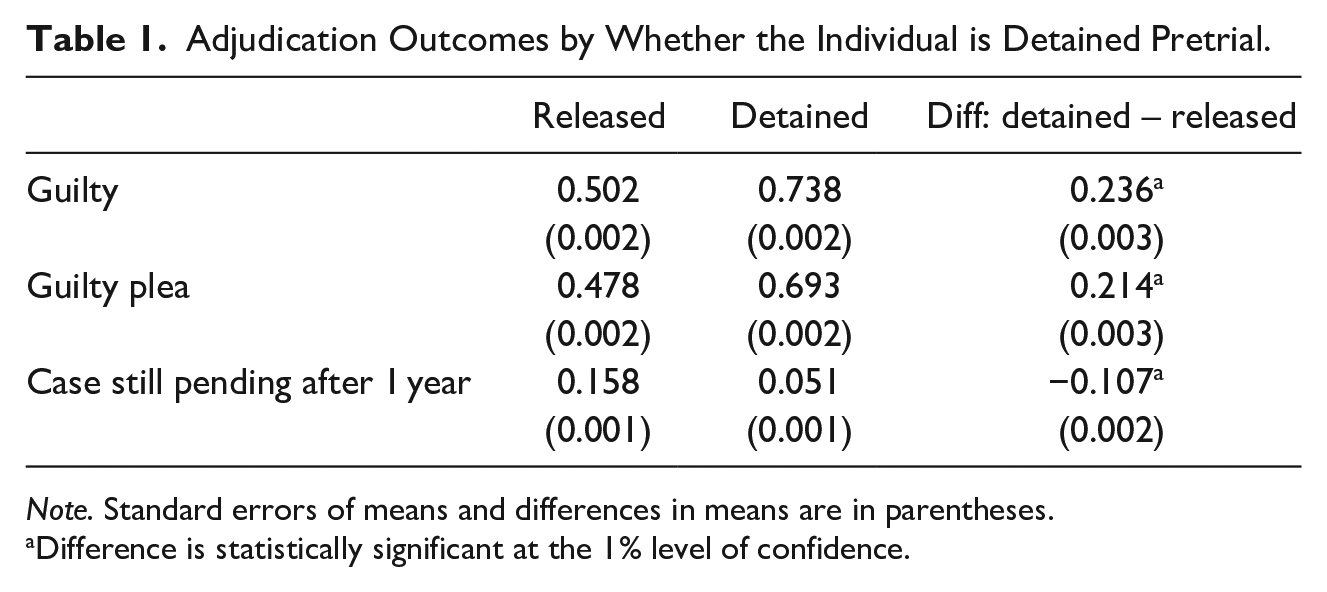
Note. Standard errors of means and differences in means are in parentheses.
Difference is statistically significant at the 1% level of confidence.
These basic comparisons do not take into account other differences between those who are released or detained, however. In order to account for these differences, we estimate the following model

where Sentence ijt characterizes the sentence outcome for defendant i in county j in year t. X is a matrix of covariates that incorporates a rich set of variables available in the SCPS data that may affect the likelihood of being pretrial assigned. This includes number of charges, gender, age (measured as a quadratic), as well as a set of criminal history variables (i.e., number of prior prison terms, jail terms, felony arrests, felony convictions, misdemeanor arrests, and misdemeanor convictions). Criminal history variables are entered using dummy variables, and we include dummies for missing values of these variables. We can observe up to 10 prior counts of each of these measures. We also control for a flexible specification of the bail amount. In addition, we incorporate year-county-offense group fixed effects.
Our coefficient of interest is δ, which captures the within-group variation of being assigned to pretrial detention on sentence outcome, after controlling for the set of variables specified in X. We run three linear probability models, using a dummy variable for each sentencing outcome as each dependent variable. There are 4,109 year-county-offense group effects included in the final specification.
As Table 2 shows, even controlling for a large set of covariates, being detained is strongly correlated with entering a guilty plea. Again, it is also associated with being found guilty, and inversely related to the likelihood of a case still pending after 1 year. The magnitude of the coefficient is sizable; being detained pretrial increases the likelihood of being declared guilty by 17 percentage points, and increases the likelihood of a guilty plea by 16 points. Coefficients are consistent across different specifications of the models.
Linear Probability Model Estimates of the Effect of pre-Trial Detention on the Likelihood of a Guilty Verdict, a Guilty Plea, and the Likelihood that the Case is Still Pending After 1 year.
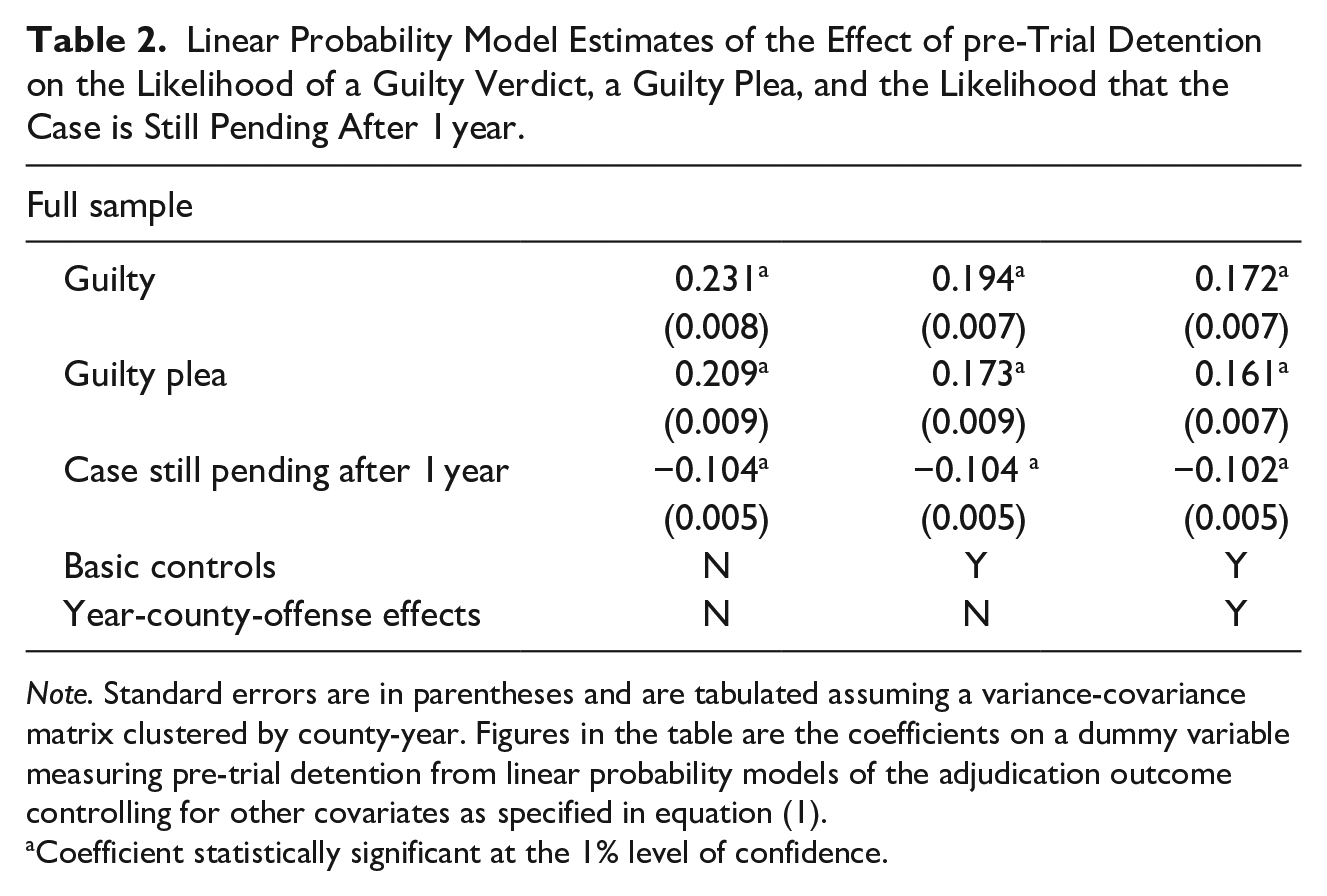
Note. Standard errors are in parentheses and are tabulated assuming a variance-covariance matrix clustered by county-year. Figures in the table are the coefficients on a dummy variable measuring pre-trial detention from linear probability models of the adjudication outcome controlling for other covariates as specified in equation (1).
Coefficient statistically significant at the 1% level of confidence.
While we do not have a direct measure of a defendant’s ability to post bail, we are able to examine whether there are differences in the likelihood of being detained when a higher bail is set. We run the same set of regressions with a restricted sample that includes only those with observable and set bail amounts. Results from this set of regressions are displayed in Figure 1. The final regressions control for 3,707 year-county-offense effects and we include an additional control for bail amount, entered as a quadratic. Interestingly, results are very similar when the sample is restricted to those with a set and observable bail amount, and the data suggest an upward trend in the relationship between bail amount and the estimated effects of detention on the likelihood of pleading guilty.
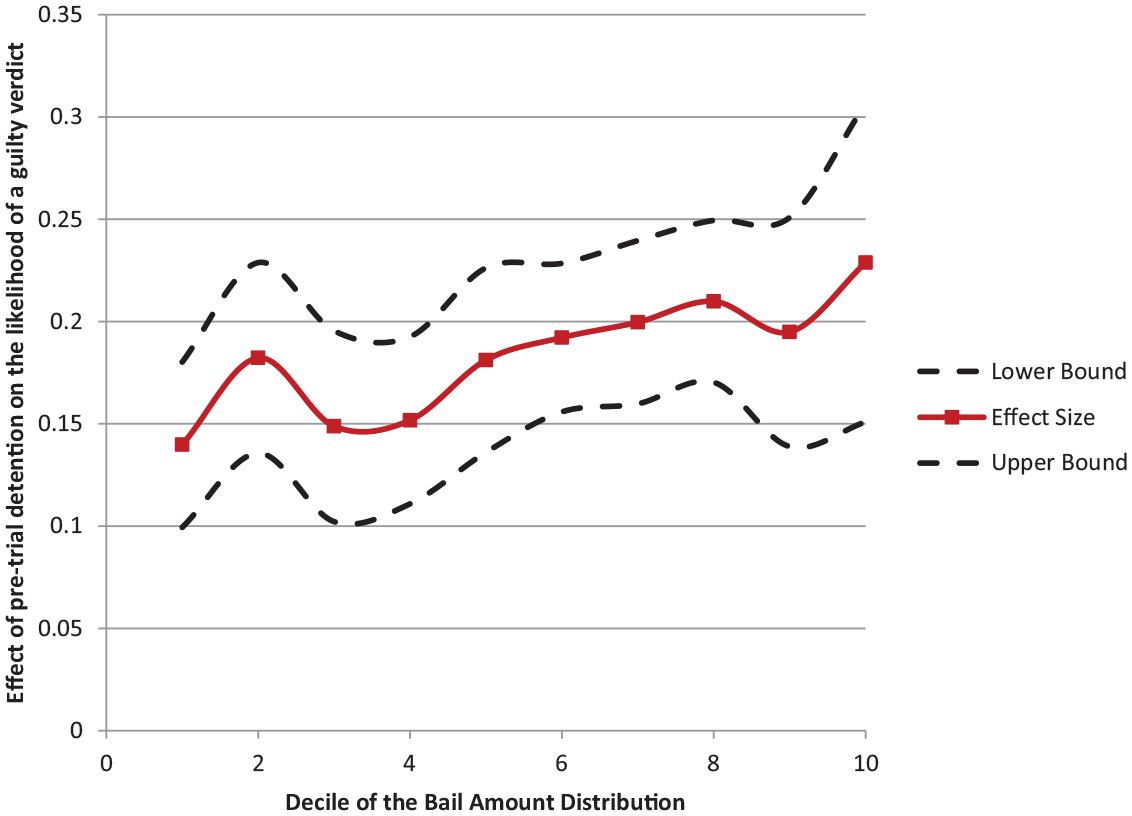
Estimated effects of pre-trial detention on the likelihood of a guilty plea by decile of the bail amount distribution.
As a final test, we restrict our sample to include only observations in county-year-offense cells with at least one emergency release and one non-emergency release. Table 3 shows coefficients from linear probability models on our dummy variable measuring being emergency released. Again, we estimate effects on all three adjudication outcomes and we again control for other covariates. As in our initial analyses, we are able to detect a direct effect of detention on the probability of being found guilty and of accepting a guilty plea. Being emergency released predicts a decrease of 11 percentage points in the likelihood of being adjudicated as guilty and a decrease of 7.5 points in the likelihood of pleading out. These effects are smaller than the previous estimates, but remain statistically significant at conventional levels.
Linear Probability Model Estimates of Being Emergency Released on the Likelihood of a Guilty Verdict, a Guilty Plea, and the Likelihood that the Case is Still Pending After 1 year.
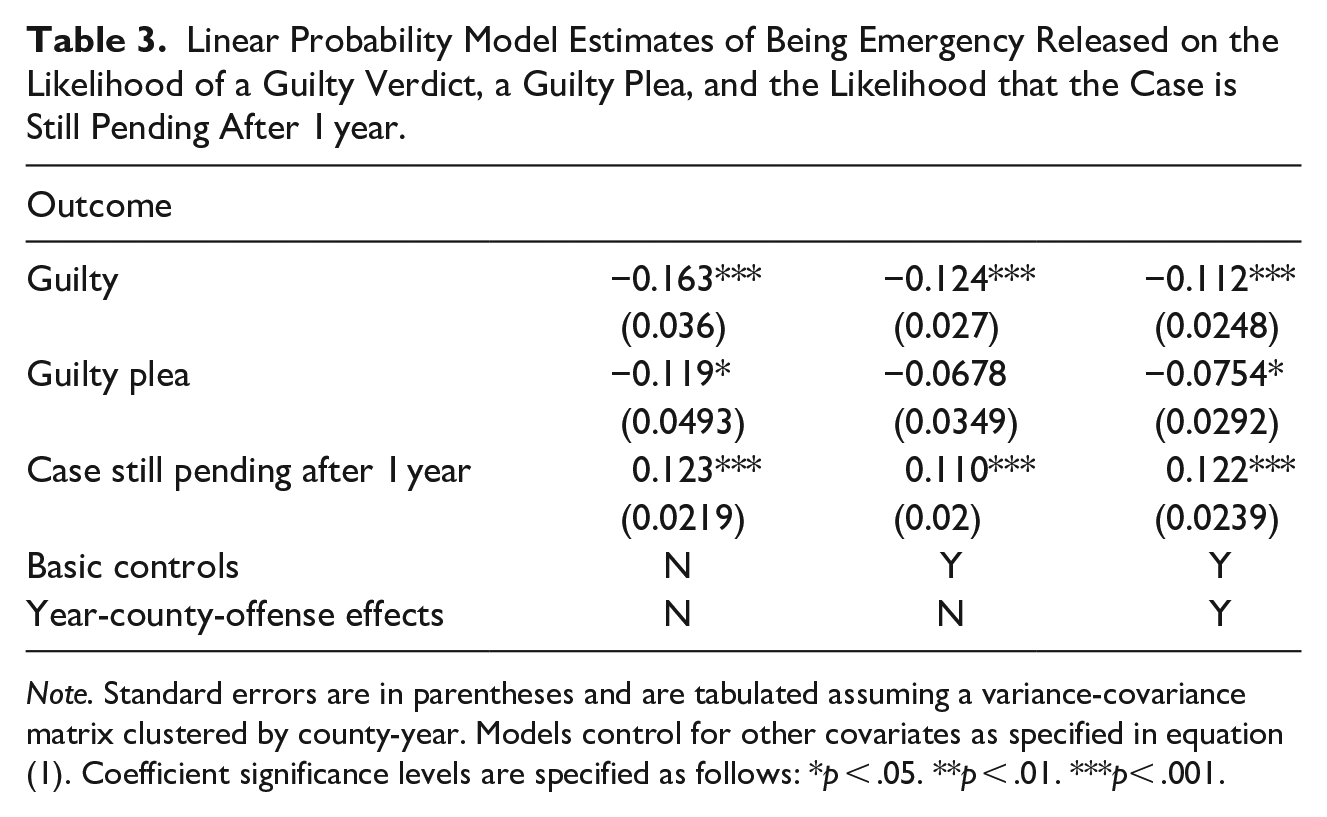
Note. Standard errors are in parentheses and are tabulated assuming a variance-covariance matrix clustered by county-year. Models control for other covariates as specified in equation (1). Coefficient significance levels are specified as follows:
p < .05. **p < .01. ***p< .001.
Implications for Individuals and the Administration of Justice
Our interviewees described a variety of extra-legal factors that led them to plead guilty. This included feeling that it was not financially feasible to remain in jail while awaiting trial, feeling as if their record would negatively affect them in decisions about bail or about where they would be detained, and wanting to avoid adverse conditions in detention. These concerns were particularly acute for indigent defendants, and those with extensive criminal histories.
We offer a few caveats to our qualitative results. First, these interviews come from a relatively small sample in just two jurisdictions. Additionally, we lack independent data to validate what our interviewees reported about the facts of their cases or their experiences with the criminal justice system, including during pre-trial detention. However, in our analysis, we are primarily interested in defendants’ own perspectives and the narratives they use to make sense of their personal experiences. We therefore report their perceptions, taking the information they offer at face value.
Moreover, the conclusions we draw from our interview results are bolstered by our quantitative analyses. In the SCPS data, we find strong support for a relationship between pre-trial detention and criminal justice outcomes. In a large and representative sample of defendants, those who are held in detention are more likely to be found guilty and plead guilty than those who are released, all else equal. This remains true when we compare subsamples of individuals who are emergency released and those who are not.
The decision to plead is important, not only because it can lead to a life-long criminal record but also because it can have significant consequences for perceptions of justice. In our interviews, those who chose to take a guilty plea had significantly more negative perceptions of the adjudication process and the criminal justice system than did defendants who still had an upcoming trial. When asked if he felt justice had been achieved in his case, for example, Alex said, “No. The police got their justice, but I didn’t get mine.” Jason, too, felt justice had failed in the resolution of his case. “No. . .there was no justice. They [the police and courts] got what they wanted, period. They got money. They got money from me being here. They’re going to get money after I leave here, so they got what they wanted.”
Even many who expressed satisfaction with the outcome of their case generally equated “justice” with being out of jail, rather than feeling they had been treated fairly or the correct outcome had been achieved. For instance, although Nate said he felt as if justice had been achieved, he clarified that justice for him meant having his freedom. As he explained, “My rap sheet is terrible. . .it’s just drugs, drugs, drugs, so it could’ve been much worse. . .I just wanted to go home.” Another subject simply told us, “The only justice was that I’m actually going to leave from this courtroom. That’s the only justice.”
At the same time, the majority of defendants with whom we spoke did not seem to have considered the collateral consequences that might result from a guilty plea. As one attorney acknowledged: “Sometimes there’s a gap between what the lawyer knows and can understand in his or her head and what can be communicated for the client to actually appreciate what it means.” This can have profound consequences, as a failure to grasp the full implications of a guilty plea means defendants might encounter unexpected punishments attached to their conviction, sometimes years after they have completed their official sentence. As one attorney explained, “I always worry if, at arraignments, my clients are fully understanding. . .what is happening, what is going to go on when they take this plea or what the consequences will be for his life. I can’t ever guarantee that.”
Finally, even beyond their effects on individual defendants and their families, there is reason to suspect that plea bargaining and pre-trial detention have broader implications for oversight and accountability in the criminal justice system as a whole. An overwhelming number of the defendants with whom we spoke felt they had experienced some form of police aggression, and a large majority believed that the police had not respected their rights. Some told stories of either outright physical violence or what they believed had been unfair, or even unlawful, searches and seizures. Nate, for example, was stopped by police after visiting with his kids at their mother’s house. According to Nate, the police said they had stopped him because he was wearing a fatigue jacket and there had recently been a shooting in the area. Nate explained the stop saying, “He [the police officer] just said, ‘Come here.’ He didn’t read me my rights or nothing. I said, ‘What’s the problem officer?’ He said, ‘Have you got anything on you?’ Then he dug his hands in my pants, and I was like, ‘What you doin?’ Cause what if there was something sharp and he didn’t even ask me? And then he found the weed in my pocket.”
Lionel, who was arrested for driving without a license, reported a similar experience. When we first asked why he had been stopped by police, he said, “Still until this exact moment, I have no idea. I wasn’t doing anything.” After further probing, the only thing Lionel would posit was that, “It’s because of the car. I have a Honda Accord and Hondas, they usually get stopped for no reason. . .Cause they’re used for street racing and they usually get stolen and things like that.” Again, Lionel firmly believed that there had been no legitimate reason for his initial contact with police. But once he was stopped, the police discovered Lionel was driving with a suspended license, so they charged him with a misdemeanor. Lionel opted to take the deal offered to him, pleading guilty to unlicensed operation of a motor vehicle.
Other defendants voiced more general complaints against the police. Like Nate, some respondents noted that they had not been read their rights, and one reported that the cops in his experience never read people their rights; they would only do so if asked. One subject expressed frustration that police seemed to do whatever they wanted, without regard for how it affected people in his community. He explained: Because of the fact that these cops are not from here, they don’t care about anybody here in the city and they come to arrest people. That’s their goal. They have to meet a quota and so they try to make that quota. And they don’t care how they make that quota. They don’t care whose lives they mess up in the midst of that. So, they just do it.
Other defendants echoed the feeling that police officers had little compassion or consideration for how their actions affected citizens’ lives. One interviewee said he felt as if the officers with whom he has come into contact simply cannot relate to him on a human level. “They act like they’re not humans before they’re cops,” he said. “I don’t know what it is that they put them through in the police academy that they lose all type of human morals, but it sucks. It’s bad.”
The result, we suspect, might be a vicious cycle. If an illegal stop uncovers evidence of criminal behavior, an individual defendant is arrested. However, if the crime is then adjudicated without going to trial, the illegal stop itself goes unchallenged. In the most extreme cases, innocent people may be pleading guilty before a defense attorney has a chance to uncover the facts of the case, or to gain a complete understanding of the prosecution’s evidence. In fact, accepting a plea deal may be more attractive to people who are innocent of their charges, relative to defendants who have a lot of evidence against them, because prosecutors might offer the best deals in cases they perceive to be weak. As one attorney we spoke to explained, “People will say, ‘I’m innocent, I’m innocent, I’m innocent,’ but then, at the end of the day, to have a violation option as opposed to having to take a misdemeanor is a huge incentive for them to take a plea.” When asked if she believed innocent clients pled guilty, one attorney said without hesitation: “Absolutely. I see it every single day. . .Even people who initially will start out and say, ‘It wasn’t mine, I didn’t have it,’ after they come back to court two or three times and they realize the case isn’t going to get dismissed. . .they often do end up taking a plea.”
One potential way to address these concerns would be to institute reforms that ensure greater transparency. Unlike trial proceedings, which are usually open to the public and from which a detailed transcript and court documents are produced, the plea bargaining process is largely private and undocumented. Prosecutors maintain nearly unfettered discretion over whether and when to offer (or withdraw) a plea deal. They can choose the starting point for offering a deal, decide what charges to file, reduce the seriousness of charges, drop less serious charges, and even drop charges that might incur a jail or prison sentence. Moreover, records of the negotiation process are generally not available to researchers, policymakers or the public; in many cases, formal records documenting these negotiations might not be kept at all.
Attentive to the potential that discretionary decisions might introduce racial biases and result in inequitable outcomes, advocates have called for better documentation of plea bargains, as well as requirements that prosecutors collect and share data. Other procedural reforms might likewise improve plea bargaining. For instance, mandating a formal phase during which each party must present their version of events for the record, as occurs during a trial, could help ensure “the values of voice, neutrality and respect” become a part of plea bargaining “without robbing [it] of its efficiency advantages over the trial process” (O’Hear, 2007, p. 217–218). To the extent that the details of plea bargains—which arguably represent one of the most fundamental aspects of the American court system—remain invisible, it is difficult to imagine how the failings of the nation’s criminal justice system can be addressed (Subramanian et al., 2020). Increasing the transparency of plea bargaining could lead to substantial reform by enabling greater oversight and accountability at all stages of the process.
Inevitably, however, some of what occurs during plea bargaining would remain difficult to document or systematically assess. As a recent report by the Vera Institute of Justice argues, “Plea bargaining neither occurs at a single moment in time, nor is it a definitive quantifiable product that remains constant. Rather, it is a complex, interactive dialogue involving multiple people and various considerations, many of which are beyond the purview of current criminal justice data collection capabilities (such as transaction costs, financial access, or psychological and cognitive biases) and, therefore, remain largely untested and unaccounted for in current research” (Subramanian et al., 2020). Recognizing these concerns, others have recommended more radical reforms, including the elimination of plea bargains entirely.
Theories of plea bargaining sometimes assume that abandoning the practice of plea bargaining would lead to the collapse of the criminal justice system as we know it. Thus, while plea bargaining might not maximize individual utility, it remains necessary for the functioning of an overburdened system (Bibas, 2004; Baker & Mezzetti, 2001; Bar-Gill & Ben-Shahar, 2009; Savitsky, 2009). In this sense, plea bargaining is a “coordination trap”: criminal defendants are unable to act collectively to refuse plea offers, thereby overwhelming the dockets and calling the prosecutor’s bluff. Given the shortage of available resources that precludes prosecutors taking all defendants’ cases to trial, though, the real alternative for most cases would likely be no prosecution at all (Bar-Gill & Ben-Shahar, 2009). This is especially true for defendants charged with misdemeanor offenses.
In this way, limiting the institution of plea bargaining might force all major players in the criminal justice system to recalibrate when deciding which cases to actively pursue (Church, 1976; Savitsky 2009; Weninger 1987; but see also Guidorizzi, 1998). As it stands today, over-arresting and overcharging are often the norm, because plea bargaining allows for a high volume of cases to be disposed of quickly and efficiently. If the plea bargaining option were removed or could be less routinely applied, prosecutors would be forced to become more selective about which cases they choose to pursue, and police might follow suit by becoming more judicious in their arrests. In this alternative scenario, many of the problems our interview subjects voiced would quickly disappear, as questionable cases that now plead out might instead simply never have been pursued.
Supplemental Material
sj-docx-1-cad-10.1177_0011128721999339 – Supplemental material for Pleading for Justice: Bullpen Therapy, Pre-Trial Detention, and Plea Bargains in American Courts
Supplemental material, sj-docx-1-cad-10.1177_0011128721999339 for Pleading for Justice: Bullpen Therapy, Pre-Trial Detention, and Plea Bargains in American Courts by Amy E. Lerman, Ariel Lewis Green and Patricio Dominguez in Crime & Delinquency
Footnotes
Acknowledgements
The authors are grateful to Professor Steve Raphael for his assistance in accessing the SCPS data.
Declaration of Conflicting Interests
The author(s) declared no potential conflicts of interest with respect to the research, authorship, and/or publication of this article.
Funding
The author(s) received no financial support for the research, authorship, and/or publication of this article.

Supplemental Material
Supplemental material for this article is available online.
Notes
Author Biographies
References
Supplementary Material
Please find the following supplemental material available below.
For Open Access articles published under a Creative Commons License, all supplemental material carries the same license as the article it is associated with.
For non-Open Access articles published, all supplemental material carries a non-exclusive license, and permission requests for re-use of supplemental material or any part of supplemental material shall be sent directly to the copyright owner as specified in the copyright notice associated with the article.
