







Abstract
The current study provides the first estimates of criminal victimization prevalence among Nomads and members of the VanLife community. People who live and travel in manufactured recreational vehicles, retrofitted vans or buses, and cars are a heterogenous group who face an unknown risk of life on the road. Analyses reveal high victimization prevalence rates. Guided by lifestyle-routine activities theories, regression analyses reveal that gender, Latino ethnicity, income, and education affect risk of rape, aggravated assault, physical threats, property crime, aggravated property crime, and financial identity theft. Disaggregated analyses highlight those demographics that impact victimization risk for year-round Nomads versus part-timers. Questions about the lifestyles-routine activities of Nomads emerge from the analyses and directions for future research are offered.
“Don’t let the fear of crime in RV trailers keep you from a great vacation. Camping is safe and a great way to get away from it all-especially crime.” (Painter, n.d.)
The Recreational Vehicle (RV) Industry Association estimates that some one-million Americans currently live full-time in RVs, while over 10 million households own some type of RV (Long, 2018). The Nomad population, people who travel and dwell in vehicles at least part time, is growing as families, people of color, and those under 45 are joining traditional RVers (Long, 2018). Tips for getting started, retrofitting a van, and cooking on the road abound in the many social media groups, posts, blogs, and YouTube videos created for this population. The number of Instagram posts related to #VanLife increased from 4 million in 2019 to 11 million as of September 2021 (Gretzel & Hardy, 2019; Lewak, 2021). While many #VanLife posts are photos of beautiful scenery or cool rigs, or questions, the murders of a 66-year old woman in her RV in January 2019 (Woodbury, 2019) and then of a couple who were RV camping on a Corpus Christi, TX beach in October 2019 led to articles in social media forums about how to stay safe while vehicle dwelling (Agredano, 2019). Yet, social media advice articles, specifically on boondocking, claim that RVing is safer than staying home, while also admitting that there are no official victimization data for vehicle dwellers (e.g., Helgeson, 2018; Smith, 2020).
According to Peterson (2015), “truth be told, RVing is a fairly safe way to travel. Campgrounds don’t attract much of a notorious criminal element, and RVs usually don’t rank high among the richest scores for thieves and ner-do-wells. However, the fastest way to become a statistic of a criminal act. . .is to think it can’t happen to you. So goes the first rule in avoiding crime: Accept that crime does indeed exist and that you are not immune.” While campgrounds may allow for some protections and collective guardianship they are not without risk, and many RVers and van dwellers boondock in isolated areas, in parking lots, or on city streets and rural roads. Of course, Peterson, writing for the KOA (Kampgrounds of America), is right that crime exists, but what are the risks of vehicle dwelling? After the murder of Gabby Petito in 2021, journalists reported anecdotal stories of the challenges of traveling solo, the stress of traveling with a partner in a small space, the daily challenges of van-living, worrying, especially when sleeping, about threats or attacks by strangers, as well as the constant worry about theft (Karimi, 2021; Lewak, 2021).
Extant literature has documented the average victimization rate for the general domiciled population, the at-risk population, and homeless persons. However, to our knowledge, there is no published study assessing the extent of victimization among the heterogeneous Nomad population. What is the victimization rate among Nomads and how does it compare with known victimization prevalence? Further, variations in victimization risk in the general and at-risk domiciled populations, and among the “street homeless” are known to be associated with demographic characteristics. Does victimization risk vary similarly among the Nomad and van-life community? Painter’s (n.d.) assertion of the safety of camping and the often-romanticized images of van-living in social media may be premature or misleading. Understanding their actual risk is essential for Nomads because awareness is protective. In the current paper, we provide the first data on the prevalence and correlates of victimization among Nomads testing the applicability of victimization theories for this unique population.
Nomads
Just over 100 years ago, recreational vehicles (RVs) and trailer campers first rolled off production lines, though it was the development of the interstate highway system after WWII when RVing blossomed in the U.S. (Morrison, 2010). While RVing may have started as a part-time vacation modality for white retirees (Long, 2018), the people, their reasons for living in a vehicle, and the options for doing so have changed dramatically. More people are living in a variety of manufactured motor homes/RVs, retrofitted buses/vans, cars, and other “rigs” every year. Today, the population of vehicle dwellers is quite diverse including full-time RVing retired persons, part-time vacationers, digital Nomads (i.e., those who vehicle dwell and work remotely through internet hot spots), seasonal and “gig” workers with and without families, families facing prohibitive costs of housing, and folks who are just one step away from shelter or street living (e.g., Arora, 2018; MBO Partners, 2020; Müller, 2016; Pruss & Cheng 2020).
We use the term Nomad as an umbrella term to label a diverse group of people who are living full or part-time in any vehicle for any reason. While motivations for contemporary nomadic lifestyles are varied and likely impact victimization risk, nuanced names for people living in vehicles do not yet involve terms to distinguish among variants and motivations, with the exception of “digital Nomads” who are estimated to number around 11 million (MBO Partners, 2020). That said, Jessica Bruder’s 2017 book Nomadland and Chloé Zhao’s 2021 movie of the same name may encourage the use of “Nomad” to specifically describe those who live in vehicles for economic reasons and travel for seasonal or “gig” work. Subreddits on reddit.com describe the diverse population as: people living in RVs, people living in cars or vans, and people “that live a carefree, mobile, and active lifestyle on the road” (r/Van Life, 2013). In this paper, we alternately use Nomad and vehicle dweller and refer to the van-life or Nomadic population to encompass all people living in vehicles for any reasons.
Theoretical Perspectives of Victimization
Rather than focus on the causes of criminality among offenders, victimization theories assume the existence of potential offenders and focus on other risk factors. In their routine activities theory, Cohen and Felson (1979) argue that criminal offenses take place when a motivated offender and an attractive or suitable target/victim converge in time and space in an environment devoid of capable guardians. The characteristics of individuals such as sex, age, marital status, and income shape their routine or daily activities, including for example, where people work, which then increase or decrease victimization risk (e.g., Bunch et al., 2015; Cohen & Felson, 1979). Thus, those who live or work in high-crime areas, for instance, are more likely to encounter motivated offenders in contexts with little guardianship, than those working in low-crime areas or those employed in the home (Cohen et al., 1981; Lynch, 1987). Lifestyle-exposure theory posits that the lifestyles of individuals, including the routine, the unusual, and the potentially risky, affect the chance of victimization (Hindelang et al., 1978; Miethe & Meier, 1994). Due to the overlap in the two theories, some refer to them as one; a lifestyle-routine activities theory that, “explains victimization as a function of differential criminal opportunity due to differences in routine behaviour” (McNeeley & Wilcox, 2015, p. 923; see also Tseloni, 2000).
Both theories seek to explain differential victimization risk among diverse populations understanding that risk is not shared equally, and studies start with demographic characteristics of individuals to explore how, for example, gender, age, income, and marital status affect victimization risk. Hypotheses derived from these theories are typically tested by examining the demographic correlates of victimization and arguably provide considerable support for the lifestyle-routine activities framework (for a review see Bunch et al., 2015). Among domiciled populations, scholars also examine neighborhood factors, work status and location, commuting patterns, and risky behaviors such as casual sex, night-time activities, drug use, and low self-control among others (e.g., Reisig & Golladay, 2019). While most studies speculate as to how demographic characteristics affect routine activities/lifestyles and how these behaviors then impact risk of victimization, few actually test for mediation (see Bunch et al., 2015). 1 In one of the more robust attempts, Bunch et al. (2015) report that some of the effects of gender, age, income, and marital status are at least partially mediated by frequency of shopping and night-time activities.
Lifestyle-routine activities theory has been applied to the “street” homeless population too and studies find they are more likely to be victimized than the housed population (Fitzpatrick et al., 1993, 1999; Gaetz, 2004; Hoyt et al., 1999). The elevated risk of victimization among the homeless when compared to the housed population is attributable to differences in demographics including age, gender, race/ethnicity, and income; factors including criminal history, mental health, and substance use; and routine activities/lifestyles (Ellsworth, 2019; Fitzpatrick, et al.,1993; Gaetz, 2004; Lee & Schreck, 2005). A majority of the street homeless reside in high-crime inner-city areas (Lee & Schreck, 2005), and thus are more likely to come into contact with motivated offenders and lack a protective barrier between themselves and such offenders, rendering homeless individuals easy or attractive targets. To protect themselves or decrease target suitability, homeless people may pair up to promote “strength in numbers”, they may sleep during the day instead of night and they may keep their finances and assets confidential (Lee & Schreck, 2005). Nevertheless, despite such efforts, the homeless population has higher victimization rates than the more commonly studied general population. Citing Fischer (1992), Ellsworth (2019, p. 96) states “To live on the streets is therefore to live under constant threat of all manner of violence.” Living in a vehicle on roadways and in campgrounds may offer risks and needs for target hardening that are similar to both those living on the streets and in domiciles because vehicles are homes yet they are more vulnerable that traditional domiciles.
Nomads likely use similar target hardening and protective methods to both the domiciled and street homeless populations. Since there has not been any research on this, we offer a few speculations to contextualize how Nomads may be at risk. Choice of vehicle is a likely factor because some may be equipped with better security (e.g., deadbolts) than others; this may reflect the variability of target hardening capacity of domiciles. Choice of vehicle, however, is constrained by economics and motivations for van-living. Posts on the #VanLife subreddit encourage people to add deadbolts if they can, to equip vehicles like vans or RVs which provide access between the sleeping area and the vehicle cab with auto start technology, and when that’s not possible, to keep keys in near reach. Truck campers and other vehicles without access to the cab cannot be protected in this manner. Soft or canvas sided campers are easily breached; subreddit posts reveal that the likelihood of windows being broken or vehicles breached is not uncommon. Painter (n.d.), writing about crime and safety in RV parks, campgrounds, and when boondocking, also recommends using shades, keeping lights on, camping with others, and leaving valuables stowed or at home.
Choice of location to park likely impacts risk and these choices are also likely constrained by demographics and motivations for the van-life. Campgrounds, like residential neighborhoods, vary in their level of security from locked gates to completely open areas. Woodbury (2019), a long-time RVer and editor of RV Travel, reports changes in the last decade or two in the ways people use RVs and who stays in RV parks and suggests that about 20% of the 13,000 RV parks in the U.S. today are more like low income, residential trailer park communities than traditional temporary recreational RV parks. Additionally, many parks have seen an increase in permanent RVers or full-time Nomads, who cannot afford to rent or own their own homes (Woodbury, 2019). One might speculate that off-grid vehicle dwelling in the wilderness, on BLM land, in national parks or national forests, or on beaches reduces the likelihood of encountering motivated offenders but data are difficult to find on victimization in these areas. 2 Some off-grid Nomads camp together at meet-ups which may offer protections. But, camping near the Mexican border, for example, may increase risk. The National Park Service (NPS) advises people staying in the very popular Big Bend National Park in Texas—which has high density electric hookup sites and allows for isolated boondocking—to keep vehicles locked and valuables hidden, suggests avoiding strangers who ask for assistance or water, and requests visitors keep watch for and report suspicion of illicit drug or human smuggling (NPS, 2021). There are times when Nomads driving between safer isolated camping spots may need to park on roadsides or in parking lots increasing their risk and exposing them to similar dangers as unsheltered or “street” homeless.
While an application of victimization theories is for people to adjust their activities and target hardening strategies, such an adjustment is not always possible. Demographic characteristics of people shape the extent to which they can actually control their routine activities and protect targets. Given the lack of research on Nomads, examining demographics and frequency and tenure as vehicle dwellers as predictors of victimization is an important first step.
Extant Research and the Current Study
Our purpose is four-fold. Importantly, we offer the first estimates of violent, property, and financial victimization prevalence among the Nomad population using a large convenience sample. We contextualize these rates by comparing them to estimates of victimization among the general and at-risk domiciled populations, and the homeless population. Second, drawing on known demographic correlates of victimization risk for these populations, we offer an exploratory, partial test of lifestyle-routine activities theory for Nomads. Third, ideas about intersectionality lead us to examine the extent to which race and Latino ethnicity, and race and sex interact to affect victimization prevalence of Nomads. Finally, we estimate the impact of demographics on victimization for full and part-time Nomads separately. In doing so, we suggest that the associations between demographics and victimization prevalence is conditioned by full versus part-time vehicle living.
Contextualizing Nomad Victimization Prevalence
Drawing upon lifestyle-routine activities theory, we hypothesize that Nomads as a group have a higher victimization prevalence than the general domiciled population. As noted above, there are numerous reasons as to how Nomads might be at risk of meeting motivated offenders when they are experiencing weakened guardianship or weakened ability to secure targets. Thus, we also compare Nomad victimization prevalence to that of the at-risk domiciled population and the homeless population which likely have routine activities that are riskier than the general domiciled population. In addition to expectations of at least some shared routine or risky activities, the demographics of homeless people according to The 2020 Annual Homeless Assessment Report (Henry et al., 2021) reveal some similarities as will be seen later.
Partial Test of Lifestyle-Routine Activities Theory
Analyses of the NCVS focus upon those personal characteristics most robustly related to victimization namely, gender, age, race, ethnicity, income, and marital status. Men are more likely to be victimized than women (e.g., Lauritsen, 2001), but in recent years, the gap between men and women has narrowed (Morgan & Truman, 2020; Warnken & Lauritsen, 2019). 3 Of those 12 years of age and older, 1.3% of women are estimated to have experienced a serious crime (including violent and property offenses) in the last 6 months compared to 1.4% of men (Morgan & Truman, 2020). Additionally, 1.7% of Hispanics/Latinos, and among non-Hispanics: 1.2% of white persons, 1.6% of Black persons, 0.8% of Asians, and 2.6% of those of other races (including non-Hispanic Native Hawaiians, other Pacific Islanders, American Indians, Alaska Natives, and those of two or more races) are estimated to have experienced at least one serious crime in the last 6 months (Morgan & Truman, 2020).
Some studies find income is negatively associated with violent victimization and household property crime, a finding explained by the greater likelihood of lower income persons to reside in higher crime areas and have weakened guardianship or target hardening capacity, while others report a positive income-personal theft association due to having more attractive targets (e.g., Bunch et al., 2015; Lauritsen, 2001; Morgan & Truman, 2020). Additionally, younger people are more likely to become crime victims than those who are older and married people are less likely than singles (e.g., Lauritsen, 2001; Warnken & Lauritsen, 2019). Few studies examine the relationship between education and risk and results are mixed; in a study of Seattle residents in 2002 to 2003, education reduced assault victimization risk (McNeeley & Wilcox, 2015) while Tseloni (2000), using 1994 NCVS data, found that education increased risk of personal victimizations.
As in the general population, there are differential risks within the homeless population. Among the homeless, those with higher incomes are at greater risk of victimization (Fitzpatrick et al.,1993). Extant research on age is somewhat inconsistent with some showing a greater risk of victimization among younger people (see Pain & Francis, 2004) while more recent research showing a greater risk among older homeless individuals (see Meinbresse et al., 2014). Gaetz (2004) finds that for all victimization types except robbery, young homeless women are more likely to be victimized than young homeless men. Homeless racial minorities have a higher risk of criminal victimization than homeless non-minorities/whites (Lee & Schreck, 2005) mirroring the odds of victimization of racial minorities in the general population. Also, of importance is duration of homelessness which affects exposure; those who are homeless for a longer period of time have greater victimization risk than those who have been homeless for a shorter duration (Meinbresse et al., 2014). 4
Expectations
While men are generally at greater risk for some forms of victimization, young homeless women are at greater risk. Given the unique context of vehicle dwelling, we hypothesize that women will be at greater risk of victimization. Our expectations regarding age are more exploratory: young people are generally more at risk due to active, nighttime, and risky lifestyles but on the road, the lifestyles of the young and old may be more similar and age may affect risk in a non-linear fashion. Extant studies direct us to expect that racial minorities and people of Latino ethnicity will also be at greater risk on the road. Limited research on education and victimization risk lead us to surmise that those with more education may be able to utilize such capital in planning and executing life on the road in the safest manner. Yet, education may also be a proxy for income and assets which could increase the perception among offenders of desirable targets. Similarly, extant research on income is ambivalent. Low-income vehicle dwellers may be at higher risk of select victimizations just as in the general population because finances could determine choice of camping location (i.e., stealth camping, free boondocking vs. fee-based private or public parks) and type of vehicle. Income may also affect the ability of vehicle dwellers to protect their vehicles and guard attractive potential targets. Contrarily, higher income individuals may have material items unavailable to lower income individuals, making them more attractive to offenders. As such, both low and high income earners may experience increased risk for different reasons. Married persons are generally found to have lower risks of victimization because they are more often involved in family or home-based activities while singles are more likely to engage in activities that increase exposure to motivated offenders (e.g., Bunch et al., 2015). If the lifestyles/routine activities of married and single persons in the general population match those of Nomads, we might expect a similar finding.
Finally, experience as Nomads may result in differential risks. Both the frequency of vehicle dwelling (i.e., full-time vs. part-time) and tenure as a vehicle dweller could affect victimization risk in a complex manner. To begin, more time on the road could increase exposure to motivated offenders. Full and part-timers likely operate differently for many reasons, only one of which is that part-timers are more likely to have a physical residence to return to. Those new to van-life may be less prepared for or aware of victimization risk, leading to higher risk. Expert (long-term) vehicle dwellers, while having a greater likelihood to meet motivated offenders due to their time on the road, may engage in more efforts to increase guardianship or target hardening making themselves less attractive and suitable as targets.
Supplemental Intersectional Analyses
Additionally, we argue for the importance of examining interactions between select demographic correlates of victimization. Intersectionality theory argues that our social locations including our combined gender, race, and ethnicity, among others might differentially shape routine activities and lifestyles (e.g., Warnken & Lauritsen, 2019). Risk is not shaped by any one demographic but by combinations that likely shape routine activities and lifestyles. Warnken and Lauritsen (2019) examine the intersection of race and sex among those at greatest risk of serious violent victimization (i.e., less than 35 years of age, urban dwelling, and earning under $25,000), finding that non-Hispanic Black men had the highest prevalence rate (15.4%) followed by non-Hispanic White men (13.5%), persons of other or multiple races (12.3%), and Hispanic men (11.4%). For women at greatest risk, the pattern by race/ethnicity is the same but women’s prevalence rates are lower than those of their male counterparts ranging from 9.7% to 13.1% (Warnken & Lauritsen, 2019). As such, in supplemental analyses, we explore potential interactions between race and ethnicity and between gender and race.
Correlates Conditioned by Full Versus Part-Time Vehicle Dwelling
In this first study of its kind, we contend it is important to examine how known demographic correlates of victimization differentially affect risk for full and part-time Nomads who differ from each other in various ways. Nomad status (e.g., year-rounders vs. weekenders, seasonal travelers) may interact with all our demographics in determining risk and so we explore how the correlates affect victimization prevalence for full and part-timers separately.
Current focus
We offer this first study on Nomads as a starting place to understand the correlates that might shape activities, lifestyles, and situations that affect risk. Our focus is on how personal characteristics and our two Nomad status variables (tenure and full-time vs. part-time) affect victimization prevalence. While Bunch et al. (2015) make a strong case for examining longitudinal data and testing mediational hypotheses, due to the diversity of the Nomad population and lack of any victimization research on this group, we offer the first step in any mediational analysis: the determination as to whether and how demographics, Nomad status, and tenure are related to victimization prevalence. In the conclusion, we link our results to recommendations for future research on the role of vehicle choice, camping location, and lifestyles and routine activities.
Methods
Sampling Strategy and Sample
The goal was to recruit both part and full-time “VanLife” adults who live and travel in a vehicle. COVID-19 restrictions required the investigators to use a convenience sampling strategy focused exclusively on online recruitment of participants. Social media announcements requested that visitors to various sites about Nomads and van-life communities take a short, linked survey on victimization experiences and fear of crime among Nomads. 5 Additionally, we invited via email, specific vloggers, bloggers, and influencers who were known Nomads. All respondents provided active consent prior to starting the survey. Data were collected between April 2020 and March 2021.
Initially, to provide as much information as possible, the 1,000 questionnaires completed by full and part-time Nomads are utilized to explore demographic characteristics despite some missingness on select variables. For bivariate and multivariate analyses, we omit those who are missing race, education, marital status, income, age, or tenure because too few are missing on any one variable to retain them in a dummy coded category for missing (f = 18). There are, however, a sufficient number missing on Latino ethnicity (f = 27) and who considered their sex to be other, preferred not to say, or skipped the question (f = 27) that we retain them and control for their missingness with dummy coded variables. Due to differential missingness on the victimization questions, a slightly different N (950–979) for each analysis is utilized to maximize sample power.
Variables
Prevalence of victimization while residing in vehicle
Respondents were asked whether they experienced a particular form of victimization in the last 12 months while residing in their vehicle. We dummy coded all our prevalence variables (e.g., 1 = yes, at least once, 0 = no). Respondents were asked whether they experienced (1) credit card theft or use without permission, (2) illicit use of their existing bank accounts, telephone accounts, or debit cards, and (3) use of personal information to open new bank accounts, open credit cards bank, take out loans, or otherwise run up debts. If respondents said yes to any of these related crimes, we constructed one indicator of a financial identity theft. To measure property crime, we asked if they were a victim of a property crime including attempted or completed vehicle theft, attempted or completed burglary, or whether their property was vandalized. For aggravated property crime, we asked if the offender(s) used a gun or firearm during the property crime. To measure threats of physical violence, we asked if the respondents if anyone threatened to hit, attack, or assault them. To measure aggravated assault, we asked if the respondent was injured by someone with a weapon or physical force. Finally, respondents were asked if they experienced a forced attempted or completed rape. 6 All victimization questions were borrowed from a survey constructed by a team for May, Hardin, and Kline’s report on victimization and fear in a sample of Kentuckians (2008).
Housing at time of survey
We asked respondents whether they currently resided in a house, apartment, motor home or RV, van, car, or none of the above. While this list is not nuanced, a limitation of the wording, no respondent selected none of the above. We constructed a dichotomous variable representing housing at the time of the survey where 1 = house or apartment and 2 = any vehicle.
Nomad status
All respondents were asked if they currently lived full (e.g., year-round) or part-time (e.g., weekends, specific seasons) in their vehicle. While it may seem counterintuitive, many of those who happened to be residing in a domicile at the time of the survey were actually full-time vehicle dwellers. The survey took place during the 2020 to 2021 pandemic including times when communities were in lockdown. Respondents may have been temporarily in a domicile, as such we gave primacy to their declaration of being full-time vehicle dwellers despite being in a domicile at the time of the survey.
Tenure as a Nomad
Full-time vehicle dwellers were asked how long they lived full-time in their vehicle and part-time vehicle dwellers were asked how long they lived part-time in their vehicle. Answer options included <6, 6 to 12, and over 12 months. A dummy set was created from these options for use in regression.
Demographics
Respondents were asked what their gender was with male, female, other, and prefer not to say as answer options. A dummy set was constructed for male, female, and other (i.e., other (f = 15), prefer not to say (f = 3), and skipped (f = 9)). Age was offered in ranges including 18 to 24, 25 to 34, 35 to 44, 45 to 54, and 55 or older. A dichotomous dummy coded variable where 1 = 35 or older was constructed after preliminary regression analyses suggested few if any differences in prevalence by the finer gradations of age. Respondents self-reported their race as white, African American, Asian, Native American, Native Hawaiian or Pacific Islander, other, or prefer not to say. Native Americans and Native Hawaiians or Pacific Islanders (NAs/PIs) were combined. Those who selected white and another racial group, were coded in the non-white racial group, and those who selected three or more were coded as other. Twenty respondents did not select any of the above options and were set as missing. A dummy set for Latino ethnicity included a category for Latino or Hispanic, another for non-Latino/non-Hispanic, and missing. Highest degree completed included high school, some college, Bachelor’s degree, Master’s degree or higher, and trade school. For the dummy set we collapsed some college with trade school and high school after preliminary analyses revealed similar victimization patterns. Marital status was coded in the following manner: “single, never married,” “married or in domestic partnership,” and widowed, separated, or divorced. The latter three were collapsed into one category for the dummy set.
Respondents selected 1 of 17 income ranges for their annual household income where the lowest was less than $5,000 and the highest was $200,000 or more. For our purposes, we divided the income ranges into groups containing roughly 25% of the sample. While it would be ideal to map on to U.S. criteria for the poverty line, such data are based on size of family which we did not collect. We collapsed income into rough groupings of 25% of our sample such that 1 = less than $12,499, 2 = $12,500 to 29,999, 3 = $30,000 to $74,999, and 4 = $75,000 or more.
Analytic Strategy
Descriptive statistics are examined for the full 1,000 person sample. The 18 people missing on at least one demographic variable other than Latino ethnicity and gender are excluded from subsequent analyses. Participants missing on select victimization questions are included in analyses where they have valid data. Bivariate cross-tabulations are conducted to compare demographics of full- and part-time Nomads and to examine correlates of prevalence. Logistic regression is used to examine partial effects of the demographic variables and Nomad-related variables on each dichotomous prevalence measure. Supplemental analyses are conducted to examine the intersection of race and Latino ethnicity as well as the intersection of race and sex because victimization risk varies by not just one element of identity but by their unique combinations. We also estimate regression equations separately for full and part-time vehicle dwellers.
Results
Who Are the Nomads in Our Sample?
As presented in Table 1, our vehicle dwellers (N = 1,000) are a diverse group; we compare their demographics to those estimated for the homeless population. The demographics of Nomads are more similar in some ways to the unsheltered homeless population than those sheltered. Our Nomads are more likely to be men (65.8%) than women while about 69% of the unsheltered homeless and 55% of those sheltered are men; 1.3% of the sheltered and 0.5% of the unsheltered homeless are gender nonconforming (Henry et al., 2021). Our Nomads are most likely to be between 25 and 34 years of age or 35 to 44 years of age while 88% of unsheltered and 65% of sheltered homeless are 25 and older. Approximately 56% of Nomads are white, 7.8% are Black, 5.3% are Asian, 26.7% are Native American, Native Hawaiian, or Pacific Islander (NA/PI), 4.1% are of other races, and 0.2% did not report race. The percent of unsheltered homeless persons who are white is 57% and of the sheltered, 42.8%. That said, unsheltered and sheltered homeless persons are more likely to be African American (27.2% and 47.2%, respectively), and less likely to be Native American/Pacific Islander (6.8% and 3.5%), and more likely to be non-Latino (76.5% and 78.2%) than our Nomad sample (Henry et al., 2021). While 51% of Nomads are non-Latino, fully 44.3% of the sample reports Latino ethnicity. Some college or trade school is the modal education (40.9%) followed by having a college degree (34.8%). The median household income is between $30,000 and 34,999 while the mean falls in the range of $25,000 to 29,999.
Who Are Our Nomads?
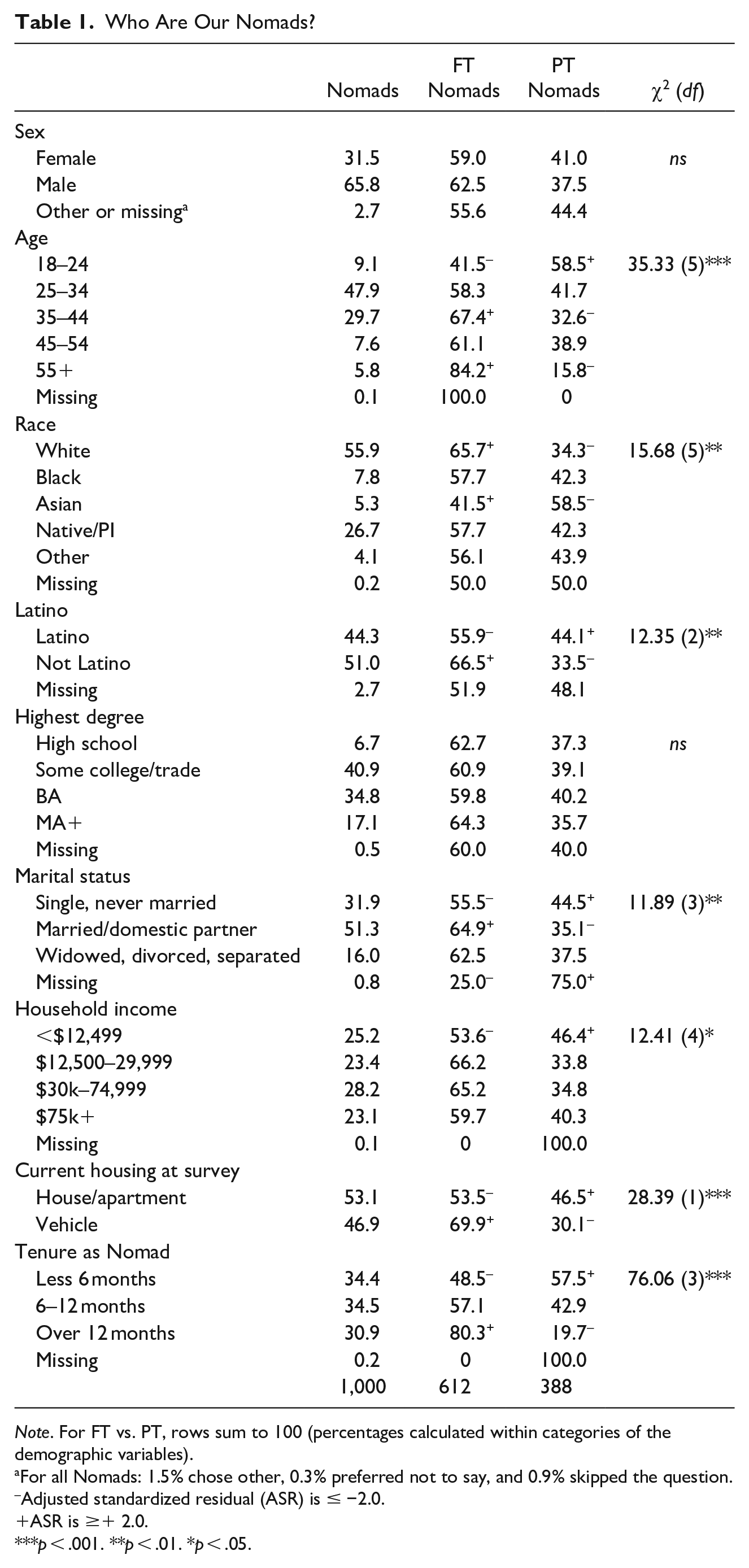
Note. For FT vs. PT, rows sum to 100 (percentages calculated within categories of the demographic variables).
For all Nomads: 1.5% chose other, 0.3% preferred not to say, and 0.9% skipped the question.
Adjusted standardized residual (ASR) is ≤ −2.0.
ASR is ≥+ 2.0.
p < .001. **p < .01. *p < .05.
At the time of the survey, 53.1% of our sample were residing in a house or apartment and 46.9% were in a vehicle. Despite this, 61.2% of our sample report that they are full-time Nomads suggesting that for many, they were temporarily residing in a domicile. Slightly more than a third of respondents were new to living in a vehicle and 34.5% had been doing so for 6 to 12 months while 30.9% had been doing so for over a year.
Full-time versus part-time Nomads
People living on the road categorize themselves as full-time (e.g., year-round) or part-time (e.g., weekends, specific seasons); to understand the demographic differences of these groups, chi-square tests of independence are examined. Sex and education are statistically independent of full versus part-time status but other demographics are significantly associated with status (see Table 1). In general, older respondents are full-timers: only 41.5% of those aged 18 to 24 are full-timers compared to 84.2% of those 55 or over. About 65% of white respondents are full-timers compared to 57.7% of Black respondents, 41.5% of Asian respondents, 57.7% of NAs/PIs, and 56.1% of those of other races. Almost 56% of Latinos are full-timers compared to 66.5% of non-Latinos and 51.9% of those who skipped the Latino ethnicity question. Around 56% of single or never married respondents are full-timers compared to 65% of married respondents, and 62.5% of those widowed, divorced, or separated.
Those in our lowest income category (<$12,499) and highest (over $75,000) are less likely to be full-time compared to those in the two middle categories. Approximately 48% of those living in a vehicle for 6 months or less are full-timers compared to 57.1% of those living in a vehicle for 6 to 12 months, and 80.3% of those living in a vehicle over 12 months. In other words, the longer the respondent has been living a Nomadic life the more likely they are to be full-timers in our sample.
Victimization Prevalence Among Full and Part-Time Nomads
Our sample of Nomads reports a high rate of criminal victimizations. Using the maximum sample available for each type of victimization, and as seen in the first row of Table 2, 19.9% report at least one rape, 23.7% report at least one aggravated assault, 33.3% report being physically threatened, 37.6% report at least one property crime, 23.1% report at least one aggravated property crime, and 31.7% report at least one financial identity theft as occurring in the last year while residing in their vehicle. These prevalence rates far exceed those based on the NCVS for the total population, surpass prevalence rates for those at greatest risk of serious violent victimization (Warnken & Lauritsen, 2019), and even exceed the estimated rates of violent victimization among the “street” homeless as detailed below.
Correlates of Victimization Prevalence While Residing in Vehicle.
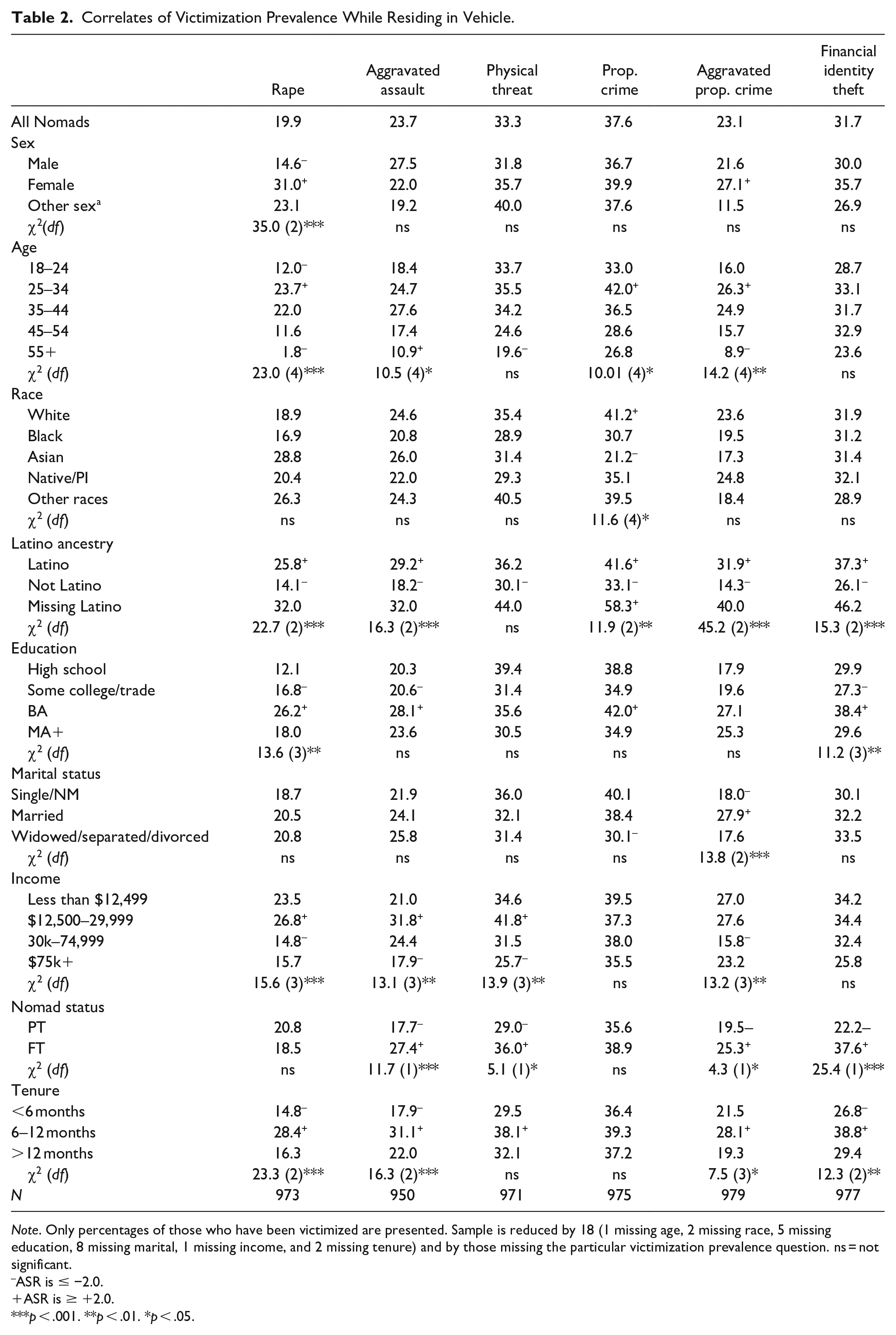
Note. Only percentages of those who have been victimized are presented. Sample is reduced by 18 (1 missing age, 2 missing race, 5 missing education, 8 missing marital, 1 missing income, and 2 missing tenure) and by those missing the particular victimization prevalence question. ns = not significant.
ASR is ≤ −2.0.
ASR is ≥ +2.0.
p < .001. **p < .01. *p < .05.
According to a report on the 2019 NCVS, prevalence rates for the total population aged 12 and older are quite low such that 1.1% are estimated to have experienced any violent crime in the last 6 months, 0.08% a rape or sexual assault, 0.12% a robbery, 0.93% any assault, 0.25% an aggravated assault, and 0.71% a simple assault (Morgan & Truman, 2020). Approximately 1.2% of households experienced a burglary, 0.33% a motor vehicle theft, and 5.53% some other theft. Prevalence rates averaged across such a heterogeneous population may obscure variations in risk by key demographic variables, however. The prevalence rates for those most at risk of serious victimizations (i.e., under 35 years old, urban, earning under $25,000) range from 11.5% of Hispanic men to 15.4% of non-Hispanic men and from 9.7% for Hispanic women to a high of 13.1% for non-Hispanic Black women (Warnken & Lauritsen, 2019).
A recent comprehensive review of 33 studies published between 1980 and 2017 of adult homeless persons compared their victimization prevalence rates to those of the general population using the NCVS. Ellsworth (2019) summarizes the results: “When pooled, extant data on homeless street crime indicates that assault occurs roughly 11 times more frequently; . . .robbery may be more than 12 times more prevalent, while theft may occur more than 20 times as frequently as in the general population" (112). Across the studies the median robbery prevalence is 22%, 19% for assault or beating, and 54% for theft (Ellsworth, 2019).
Regression of Prevalence on Demographics and Nomad Status Characteristics
While we briefly compare the regression results to the bivariate cross-tabulations in this section, for the sake of space we do not provide a detailed discussion instead, we encourage the reader to study Table 2. Using logistic regression, we regress each victimization type on the full set of predictors to examine their net effects. These analyses examine the odds of experiencing at least one incident in the last 12 months while residing in a vehicle. 7
As seen in Table 3, and contrary to the bivariate results, logistic regression reveals that rape, physical assault, aggravated property crime, and financial identity theft victimizations are more likely to be self-reported by women controlling for all else. Women are three times as likely as men to report rape, 1.4 times as likely to report aggravated assault, 1.7 times as likely to report aggravated property crime, and 1.3 times as likely to report a financial identity theft, controlling for other demographics. “Other” sex respondents are not different from men in their self-report of any victimization.
Logistic Regression of Prevalence of Victimizations While Residing in Vehicle on Demographics.
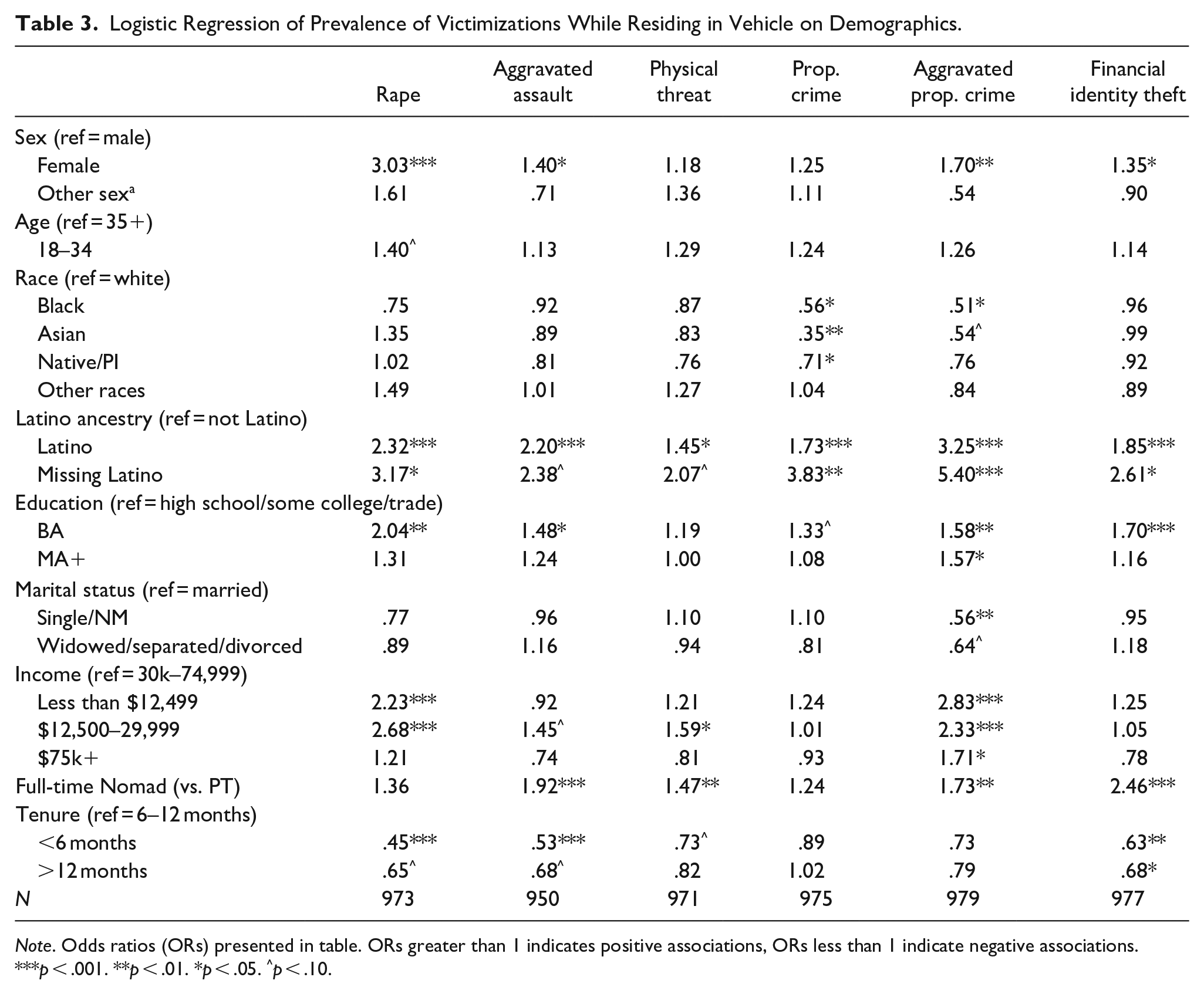
Note. Odds ratios (ORs) presented in table. ORs greater than 1 indicates positive associations, ORs less than 1 indicate negative associations.
p < .001. **p < .01. *p < .05. ^p < .10.
Mirroring the bivariate results but contrary to our hypothesis, respondents’ self-reported race appears to be largely unrelated to victimization prevalence with the following exceptions. When controlling for Latino ethnicity, Blacks, Asians, and NAs/PIs are all significantly less likely to experience property crime than Whites. Further, being a Black Nomad reduced the odds of reporting aggravated property crime by a factor of 0.51 compared to white vehicle dwellers. We also found, that while controlling for race, Latinos have significantly greater odds of all six victimizations compared to non-Latinos. Interestingly, those who refused to answer the question about Latino ethnicity are also significantly more likely to report all six types than non-Latino respondents.
Bivariate analyses suggest risk is lower for younger and older Nomads with prevalence higher amongst middle aged persons; age (being 35 or older vs. younger) is largely unrelated to risk of victimization in the regressions. Single and never married respondents are less likely than married respondents to experience an aggravated property crime (OR = 0.56, p < .01) but marital status is otherwise unrelated to other victimizations, mirroring the bivariate analyses. Differing in some ways from the bivariate results, those with a college degree compared to a high school education, some college, or trade school are significantly more likely to experience rape (OR = 2.04, p < .001), physical assault (OR = 1.48, p < .05), aggravated property crime (OR = 1.58, p < .01), and financial identity theft (OR = 1.70, p < .001). Those having a master’s degree or higher are only more likely to experience aggravated property crime compared to those with high school, some college, or trade school.
While income is related to four of the six victimizations in the bivariate analyses, when controlling for all else, income only affects differences in risk of rape and aggravated property crime. Those with incomes in the two lower income categories compared to those in the reference group ($30,000–74,999) are at higher risk (over two times as likely) of both victimization types while those who earned $75,000 or more are also more likely to experience aggravated property crime (OR = 1.71, p < .05).
Finally, being a full-time year round Nomad compared to part-timer increases the risk of aggravated assault (OR = 1.92, p < .001), physical threats (OR = 1.47, p < .01), aggravated property crime (OR = 1.73, p < .01), and financial identity theft (OR = 2.46, p < .001). These results are expected as full-timers by definition have more exposure time than part-timers; this variable is largely a control enabling examination of partial effects of the demographics and tenure as a vehicle-dweller. Tenure as a Nomad also matters for several victimizations. Newbies (those who have been living in a vehicle for less than 6 months) compared to those who have been living this way for 6 to 12 months were significantly less likely to report having experienced a rape, a physical assault, and a financial identity theft in the last year. 8 Experienced vehicle dwellers, those living on the road for over a year, are significantly less likely to experience a financial identity theft (OR = 0.68, p < .05).
Supplemental analyses of statistical interactions
While the U.S. census considers race and ethnicity, specifically Latino ethnicity, to be distinct, clearly race and ethnicity intersect in people’s lives and as such may impact their risk of victimization controlling for other demographics. To examine the intersection of race and Latino ethnicity, we tested the associations between race and victimization prevalence by Latino ethnicity using cross-tabulation because adding a 10 category dummy set (5 racial groups × 2 ethnicity groups) to our logistic regression equations was not advised given some small group sizes. Recall, as seen in Table 2, race is only significantly associated with property crime while Latino ethnicity is significantly associated with all victimization types except physical threats.
Cross-tabulations of victimization by race controlling for Latino ethnicity reveal an interaction between the two as they influence prevalence risk. Table 4, Panel A reveals that race is significantly associated with all victimization forms for Latino Nomads and the strength of the associations are moderately strong (V > 0.10) or strong (V > 0.30). For non-Latino Nomads, race is significantly associated with rape and aggravated assault only. Together these results indicate that race and Latino ethnicity interact to affect prevalence rates. For some racial groups, having Latino ethnicity increases victimization risk while for others it lowers it.
Cross-Tabulation of Victimization Prevalence by Race Controlling for Latino Ethnicity and Gender.
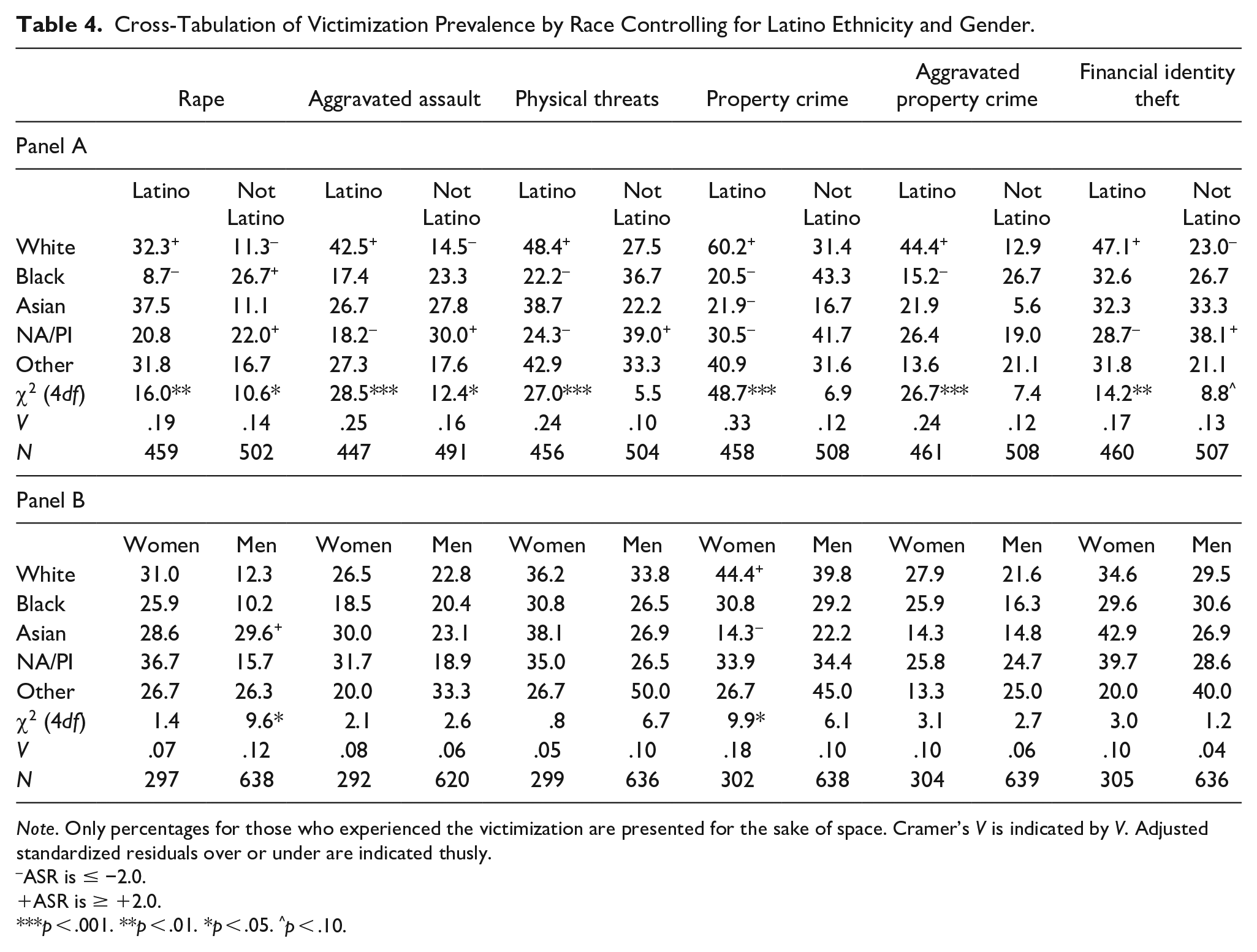
Note. Only percentages for those who experienced the victimization are presented for the sake of space. Cramer’s V is indicated by V. Adjusted standardized residuals over or under are indicated thusly.
ASR is ≤ −2.0.
ASR is ≥ +2.0.
p < .001. **p < .01. *p < .05. ^p < .10.
Overall, Latino whites have the highest prevalence rates among Latinos across all victimizations except rape. Non-Latino whites have lower prevalence rates compared to other non-Latinos for rape and aggravated assault. Furthermore, Latino white Nomads have higher prevalence rates than non-Latino white Nomads across all victimizations. For example, 42.5% of Latino white Nomads reported aggravated assault compared to 14.5% of non-Latino white Nomads. For Asian Nomads and Nomads of other races we see a similar pattern. Latino Asian Nomads have higher prevalence rates for rape, physical threats, property crime and aggravated property crime compared to Asians who are not Latino. Those of other races who are Latino have higher prevalence rates than those of other races who are not Latino for all victimizations except aggravated property crime.
Conversely, for Blacks and NAs/PIs, Latino ethnicity reduces risk with a few exceptions. For Black Nomads, being non-Latino appears to increase victimization risk except for financial identity theft. For example, 26.7% of non-Latino Black Nomads reported a rape compared to only 8.7% of Latino Black Nomads and 43.3% of non-Latino Blacks experienced property crime compared to 20.5% of Latino Blacks. Similarly, for NA/PI Nomads, those who have Latino ethnicity are at lower risk of victimization than those without Latino ethnicity for rape, aggravated assault, physical threats, property crime, and financial identity theft. For example, 30% of non-Latino NAs/PIs experienced aggravated assault compared to 18.2% of Latino NAs/PIs. Conversely, 26.4% of Latino NAs/PIs experienced aggravated property crime compared to 19.0% of non-Latino NAs/PIs.
In another set of supplemental analyses, we examine the intersection of sex and race for those who identified as men or women. As seen in Table 2, sex is associated only with rape and race is associated only with property crime. Table 4, Panel B reveals that race is not significantly associated with any victimization when we control for sex except for among men in the case of rape and among women in the case of property crime. Among men, 29.6% of Asian Nomads experienced rape compared to 12.3% of whites, 10.2% of Blacks, 15.7% of NAs/PIs, and 26.3% of those of other races. Among women, whites are overrepresented (44.4%) as victims of property crime while Asians (14.3%) are underrepresented. We also examined sex differences in prevalence by race and can report that the sex difference among whites in rape risk (31% of white women vs. 12.3% of white men) is significant (χ2(1) = 27.4, p < .001) as is the sex difference among NAs/PIs (36.7% vs. 15.7%, χ2(1) = 12.1, p < .001). The sex difference in risk of aggravated assault among NAs/PIs (31.7% of women vs. 18.9% of men) is also significant (χ2(1) = 4.3, p < .05). These analyses suggest that, in this sample, the relationships between race, sex, and victimization are mostly additive with a few exceptions. 9
Separate Regressions of Prevalence Rates for Full and Part-Time Nomads
Year-round Nomads and weekenders or seasonal Nomads differ in important ways: (1) age, race, Latino ethnicity, marital status, income, and tenure are all significantly associated with full or part-time status and (2) being a full-time Nomad, net demographic effects, increases the prevalence of aggravated assault, physical threats, aggravated property crime, and financial identity theft relative to being a part-timer. As such, an exploratory examination of the variations in correlates of prevalence by full or part-time status is warranted. Table 5 reports ORs for full and part-time vehicle dwellers in separate models instead of traditional interaction tests in order to examine the point estimates of each variable for each group separately (for a similar strategy see Craig et al., 2018). This discussion will focus on the major differences across equations.
Logistic Regression of Prevalence of Victimizations While Residing in Vehicle on Demographics by Full or Part-Time Nomad Status.
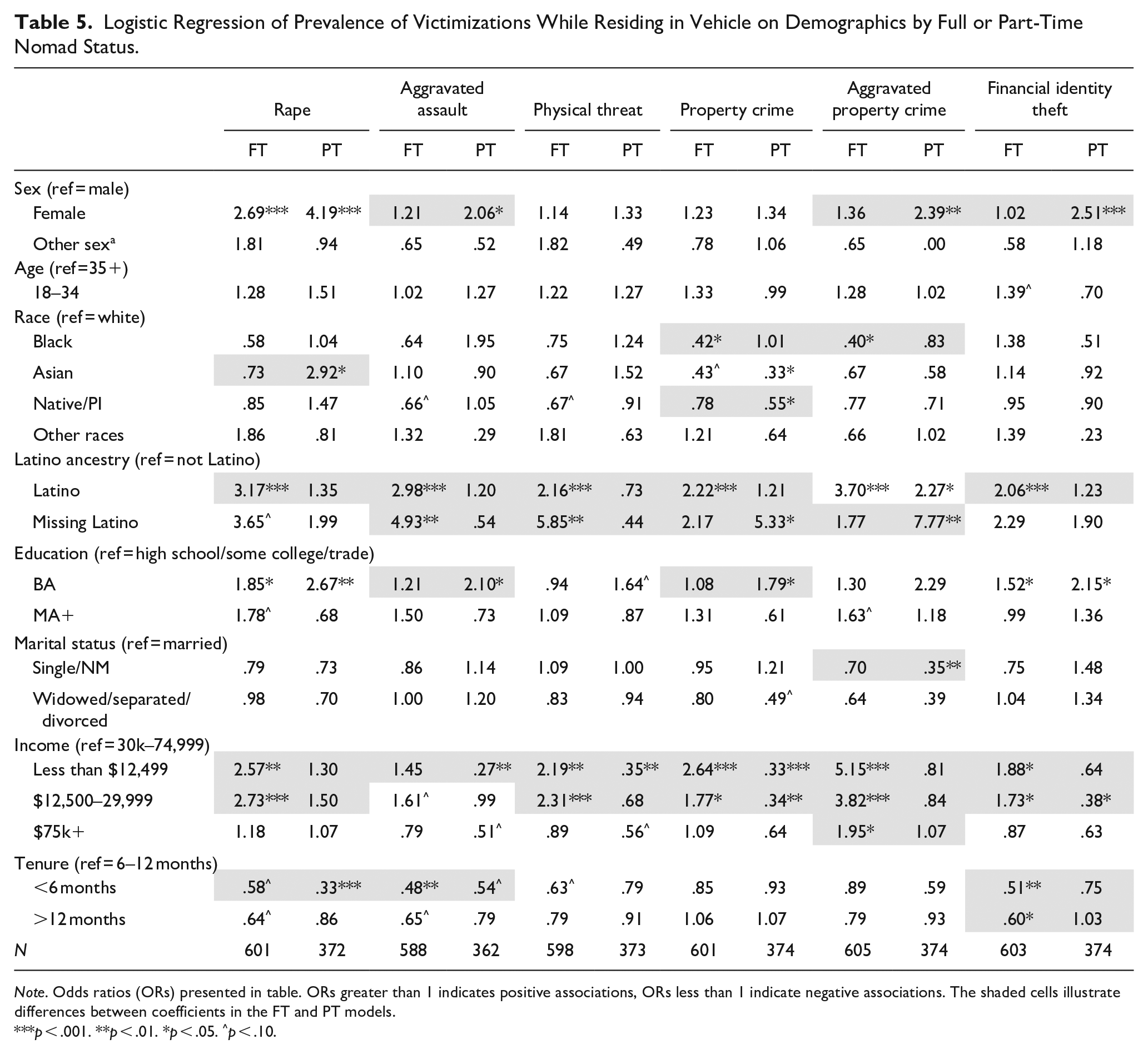
Note. Odds ratios (ORs) presented in table. ORs greater than 1 indicates positive associations, ORs less than 1 indicate negative associations. The shaded cells illustrate differences between coefficients in the FT and PT models.
p < .001. **p < .01. *p < .05. ^p < .10.
In the total sample equations, being female increases the risk of rape. That said, being female increases the odds of aggravated assault, aggravated property crime, and financial identity theft in the equations for part-timers only and was not significant for full-timers. Race has no effect on rape for the total sample, however, part-time Asian vehicle dwellers compared to white Nomads are at increased risk of rape while Asian full-timers are not. Race is related to property crime in the total sample model such that white Nomads are at increased risk compared to racial minorities. That pattern holds but we now learn that Black full-timers are significantly less likely than white full-timers to experience property crime and aggravated property crime, while Black part-timers do not differ from white part-timers in either case. Conversely, NAs/PIs who are full-timers do not differ in risk of property crime compared to white full-timers, though part-time nomadic Native Americans/Pacific Islanders are at lower risk than white part-timers.
Latino ethnicity increases the risk of all victimization types using the total sample. In the equations for rape, aggravated assault, physical threats, property crime, and financial identity, it is only full-time Latino vehicle dwellers that have elevated risks not part-time Latino Nomads. In the case of aggravated property crime, both full and part-time Latino vehicle dwellers have elevated risk compared to non-Latino Nomads.
Although college educated full-time Nomads are no different from less educated full-timers in risk of aggravated assaults and property crime, college educated part-timers are at higher risk of both. In the total sample models, income is mostly related to risk of rape and aggravated property crime. In Table 5, income matters for all forms of victimization. In the case of rape, full-timers in the two lowest income groups are at significantly greater risk than those who earn $30,000 to 74,999 while income has no effect on rape risk for part-timers. Full-timers in the lowest income group do not differ from the reference group in risk of aggravated assault while being a part-timer in the lowest income group reduced the odds of assault by a factor of 0.27. Interestingly, being full-time and in one or both of the lowest income groups increases the risk of physical threats, property crime, aggravated property crime and financial identity theft while being part-time and in one or both of the lowest income groups either significantly reduces the risk of these victimizations or is not significant. And in the case of aggravated property crime, the highest income earners who are full-timers are at greater risk than middle income earners while their counterparts among part-timers do not differ from the middle-income earners. Finally, being a newbie versus having been on the road for 6 to 12 months significantly reduces the odds of rape for part-timers. Conversely, being a newbie significantly decreases the odds of aggravated assault and financial identity theft for full-timers but not part-timers.
Conclusion
Official statistics on victimization risk for the growing group of people living as Nomads in the U.S. are non-existent. The 2021 murder of Gabby Patito and the murders of three people in two different incidents in 2019 increased social media discussions of the safety of RVing and van-living (Agredano, 2019; Woodbury, 2019). In the first study of its kind, we offer estimates of victimization prevalence for this diverse and unique population. When compared to victimization prevalence in the general and at-risk domiciled populations and among homeless persons, we find that Nomads experience victimizations at levels close to the street homeless and far exceed those for the general population. Approximately 20% report a rape, 24% report an aggravated assault, 33% report a physical threat, 38% report a property crime, 23% report an aggravated property crime, and 32% report a financial identity theft as occurring at least once in the last year while residing in their vehicle. A meta-analysis of numerous studies of the street homeless estimated the median robbery prevalence to be 22%, 19% for assault or beating, and 54% for theft (Ellsworth, 2019).
As the first study to estimate victimization prevalence among Nomads, results support the basic tenet of the lifestyle-routine activities framework—that persons’ demographics affect risk—and suggest it is a viable framework for understanding this population. With detailed results noted above, here we highlight key findings, offer speculations for the patterns, and make suggestions for further research.
As hypothesized women are more likely to experience rape, aggravated assault, aggravated property crime, and financial identity theft but not physical threats nor property crime net other factors. The disaggregated equations suggest that it is part-time women vehicle dwellers that have higher odds of these four victimizations. In fact, except for rape, full-time women Nomads are not at greater risk than full-time men for the latter three victimization forms. Part-time women Nomads may be engaging in van-lifestyle choices or have unique daily routines that increase their risk over those who are full-time. Because we controlled for marital status, education, income, and more, that sex is a significant correlate demands further attention regarding how women and men’s lifestyles on the road might otherwise differ in ways that increase women’s risk. Family or “vehicle-household” composition is an additional factor that might matter—who women travel with, if anyone—likely shapes their risk. Also, it is possible that lifestyle choices and daily routines would mediate some or all the relationship between sex and victimization (Bunch et al., 2015).
Racial group membership is largely unrelated to victimization prevalence when examined net other factors including Latino ethnicity. In fact, contrary to hypotheses derived from the extant literature on the general and at-risk domiciled populations, Black, Asian, and Native American/Pacific Islander Nomads are less likely to experience property crime compared to white Nomads and Black Nomads also are less likely to experience aggravated property crime. On the other hand, having a Latino ethnicity significantly and substantially increases the odds of all six victimization types.
This most robust finding, that Latino Nomads have higher victimization prevalence, is further illuminated when analyses are disaggregated by full versus part-time status. Across all forms of victimization, it is full-time Latino Nomads that are more likely to be victimized compared to full-time non-Latino Nomads. Part-time, vehicle-dwelling Latinos do not differ at all in victimization prevalence from part-time non-Latino vehicle dwellers. Data on how full-time Latino vehicle dwellers live on the road and how their lifestyles-routine activities may differ from that for non-Latino Nomads would illuminate this finding further. Understanding the different reasons for van-life living and how motivation shapes lifestyle-routine activities and exposure might explain this pattern.
While race and ethnicity are conceptually distinct social constructions, they intersect to affect individuals’ life experiences including criminal victimization. Our supplemental cross-tabular analyses reveal that race and ethnicity significantly interact revealing differential risks that are not identifiable in the models that simply controlled for race and ethnicity separately. The primary finding is that for whites, Asians, and those of other races, also being Latino increases most prevalence rates. While for Black and NA/PI Nomads, it is the non-Latinos among them that have higher prevalence rates. These results suggest that examining the intersection of race and Latino ethnicity is essential to reveal nuanced prevalence risks.
How and why race and Latino ethnicity intersect to shape prevalence risk requires further study. On the one hand, race and Latino ethnicity may intersect as they affect lifestyles or routine activities that increase or decrease exposure to potential offenders including where and how Nomads camp. On the other hand, their intersection may affect the perceived suitability of victims and targets in the eyes of offenders who may choose targets based on perceived race, accent or spoken language, and ethnicity. Our survey was conducted during the final year of the Trump presidency, a time when anti-Latino sentiment was high (Anguiano, 2019). While outside the scope of lifestyle-routine activities theory, future research should examine perceived race/ethnicity of the offender like the NCVS does and even whether victims heard slurs or perceived bias to be a motivation.
Victimization research on the role of education in shaping prevalence risk is equivocal. In this sample, college educated Nomads, net other effects, were more likely to report rape, aggravated assault, aggravated property crime, and financial identity theft. This pattern varied in the disaggregated analyses such that college education increased risk of rape and financial victimization for both full and part-timers while college education increased risk of aggravated assault and property crime only for part-timers. The fact that the multivariate findings related to education differ from the bivariate suggests that education is correlated with and may interact with other demographics included in the model. How years of education and type of education affect social capital, knowledge of victimization risk, Nomad routines and lifestyles requires further attention.
As Bunch et al. (2015) recommended, we distinguished between single/never married persons, married or partnered persons, and previously married persons, but the analyses find little impact of marital status on victimization risk. Besides distinguishing between never married and previously married single persons, additional information would help tease out pathways between relationship status and risk. Both never married and previously married people may be engaging in behaviors (or not) to find partners. The key may not be marital status per se, but whether people are engaging in partner-seeking activities which may increase interactions with strangers, night-time outings, and other behaviors that may increase exposure to offenders (see also Bunch et al., 2015). Future research should examine partner-seeking activities among Nomads which may manifest differently for this group than for the general population. The Gabby Petito case also suggests the need to examine intimate partner violence among Nomads.
While most prevalence studies find that poorer individuals have higher prevalence rates, a positive relationship between income and personal theft has been noted (e.g., Bunch et al., 2015). We found that lower income Nomads compared to middle income earners have elevated risk of rape, aggravated assault, and aggravated property crime. But also, that Nomads in the highest income group are at greater risk for aggravated property crime than the middle-income earners. The disaggregated analyses revealed that these patterns held for full-time Nomads—lower income, full-timers are at increased risk for five of the six victimization types. But, part-time Nomads earning lower incomes do not differ from middle-income earners and when they do they are actually at decreased risk of victimization. Low income, full-time vehicle dwellers, while a diverse group themselves, may have fewer options when it comes to deciding where to camp; it may be impossible at times to avoid more risky places including the estimated 20% of RV parks that resemble low income trailer parks (Woodbury, 2019). Lower income, part-time vehicle dwellers, because they are weekenders or seasonal RVers, may have a greater need to have clear plans for camping, electricity, water, and internet access and thus either preemptively choose locations that have fewer risks associated with them or they move on or go home if risk is of concern—because they can. Alternatively, some lower income, part-time vehicle dwellers could be stealth camping in vans or cars and otherwise keeping a low profile reducing their exposure to offenders. Teasing out these alternatives requires further study.
Being a full-time vehicle dweller elevated risk for aggravated assault, physical threats, aggravated property crime, and financial identity theft. This was not unsurprising and supports the general tenet of lifestyle-routine activities theory that greater exposure via daily activities, lifestyle choices, and space or place (e.g., where Nomads camp) increases risk. Being on the road full-time would certainly increase exposure to potential offenders as well as shape daily routines and lifestyles. Results regarding tenure as a Nomad beg for further analysis and are complicated by the focus upon victimizations in the last year because not all respondents have been residing in their vehicle for a year. We compared newbies (less than 6 months on the road) and long termers (over 12 months) to those with moderate experience because the bivariate analyses reveal those with moderate time on the road are at greater risk of most victimizations. Having a long tenure as a Nomad does not affect risk compared to having moderate tenure (6–12 months) except in the case of financial identity theft where it lowers risk. Our results regarding newbies complicate the story. Newbies are significantly less likely than those with moderate tenure to report a rape, an aggravated assault, and a financial identity theft. In this case, the likely explanation is exposure—having been on the road for 6 months or less would likely reduce exposure to potential offenders but newbies could also behave in ways that otherwise reduce risk. That said, because newbies have been on the road less than 6 months, they have a shorter time period during which they might have been victimized compared to long-termers.
When we examine the impact of tenure on risk for those who are full time and those who are part time in separate equations, we learn a bit more about the likely complicated relationship between full versus part time status and tenure on the road. Among full-timers, being new to van-living reduced risk of aggravated assault and financial identity theft compared to living on the road 6 to 12 months. Among part-timers, being a newbie reduced risk of rape only. Among full-timers, having a long tenure as a vehicle dweller compared to being on the road 6 to 12 months reduced risk of only financial identity theft. Among part-timers, having a long tenure as a Nomad does not affect victimization risk compared to moderate tenure. These findings suggest the lower risk among newbies, which could due to question wording, and long-termers, might indicate real differences in lifestyles and routine activities that need to be included to explain the differential risks of tenure for “year-rounders” and “weekenders.”
Strengths, Weaknesses, and Future Research
The current study provides the first ever victimization prevalence rates for Nomads and members of the #VanLife population. To answer the question posed in the title, life on the road involves higher risk of criminal victimization than that found in the general population. As an exploratory study informed by the lifestyle-routine activities theoretical framework, our study achieves its purpose while offering numerous follow-up research directions. Our hope is that it is a springboard for future research that elaborates upon the research questions and analyses employed here.
While a non-random convenience sample cannot represent a population, we offer the following. Our sampling strategy—inviting known Nomads and van-life influencers to participate and promote the survey, and advertising on several Nomad and van-life subreddits—was successful in yielding a large sample and may help us understand the kinds of people who are represented. The Nomad population is in the millions and no list exists from which to systematically select a random sample yet, our strategy likely attracted people who (1) identify as Nomads or as part of the #VanLife population, (2) use social media to read about and connect with others in Nomad/van-life communities, and (3) have access to the internet and devices to enable such access. Our sample may over-represent Nomads who have chosen this lifestyle and perhaps, is less representative of lower income families facing unemployment, high rents, or even eviction—unless these people are also turning to #VanLife social media for advice. Further, while some participants found the survey through Nomad influencers’ social media, most were recruited through the subreddit forums which while mainstream, may represent niche sites.
Our purpose required we include questions on known demographics of victimization prevalence and our method required a simple electronic survey with straightforward questions. It was not possible to utilize an instrument such as the complex NCVS which requires an interviewer to navigate it. That said, the current findings suggest the utilization of an in-depth survey instrument that gathers details about incidents but also nuanced information on lifestyles and routine activities would illuminate how and why some Nomads experience high prevalence rates. Questions about family or “vehicle-household” composition and detailed travel itineraries would be useful. To avoid the interpretive challenges related to tenure as a Nomad and victimization prevalence in the last year, days on the road might be a better measure of tenure and would enable prevalence rates to be calculated per some fixed time period. Ensuring that affirmative answers to victimization questions represent unique incidents, as the NCVS does, would yield more robust prevalence statistics.
Given that Bunch et al. (2015) found support for the hypothesis that some demographics indirectly affect risk through lifestyles-routine activities, data on potential mediators for the Nomad population should be gathered. For this population, questions about where people camp, with whom, and duration in each camp are needed. Whether people engage in any target hardening actions or any other protective measures should be examined. The analysis of the subset of our sample with a known vehicle type reveals that those in MH/RVs are at much greater risk of victimization than those in vans or cars. We speculate that many of those in MH/RVs need to stay in private or public campgrounds or RV parks where they can hook up to electricity and water while those in vans or cars can stealth camp reducing their visibility to potential offenders. Thus, questions about vehicle type and whether it enables off-grid living or not, day-time and night-time activities, frequency of leaving camp (whether from campgrounds, RV parks, or when boondocking) for work, leisure, or restocking supplies, and whether people form bonds with neighboring campers or keep to themselves would provide data that could reveal the lifestyle-routine activities that mediate and potentially moderate (see McNeeley & Wilcox, 2015) the relationships between demographics and victimization risk. Studies informed by the lifestyle-routine activities framework often focus on public versus private activities—this division is complicated for the Nomad population and needs elaboration.
A comprehensive understanding of the lifestyles-routines of Nomads is necessary to fully test the theoretical framework and better understand their rather high victimization prevalence. Such knowledge also would inform safety policies for RV parks, private and public campgrounds, and interstate rest stops where many layover, and would inform individuals about protective measures they can enact wherever they camp. To increase the safety of life on the road, scholars need to better understand the lifestyles and routine activities of Nomads.
Footnotes
Declaration of Conflicting Interests
The author(s) declared no potential conflicts of interest with respect to the research, authorship, and/or publication of this article.
Funding
The author(s) received no financial support for the research, authorship, and/or publication of this article.
