






Abstract
Hacking, particularly among youth, is a relatively new form of deviance and its etiology is not well understood. Moreover, there is a lack of developmental approaches to understanding youth hacking, and the majority of studies on predictors of hacking have been cross-sectional. In light of this, we draw on prospective longitudinal data on a sample of Korean youth to explore theoretical predictors of youth hacking through a developmental lens. Cross-lagged dynamic panel models are employed to examine time-variant and time-invariant theoretical predictors of hacking. Results show that well-known criminological predictors are significantly associated with youth hacking, which implies the applicability of traditional criminological theories in online deviance. Limitations, suggestions for future research, and implications for practice are discussed.
Keywords
With the ever-increasing use of technology in our daily lives, computer hacking is a growing concern. Hacking entails using computers and technology to gain access data and computer systems (Grabosky, 2016; Holt, 2007). Often involving accessing data via illegal means, hacking is frequently used in the commission of crimes. Fraud and theft from hacking contribute to vast economic losses around the world (Furnell, 2002; Lewis & Baker, 2013). Both scholars and policy makers have emphasized the urgent need to understand the etiology of hacking (Holt & Bossler, 2015; Leukfeldt, 2017; National Crime Agency [NCA], 2017). Youth hacking is of particular concern, as hacking behaviors often begin in adolescence (Holt, 2007, 2010; Steinmetz, 2015). During this time, hacking tends to involve minor behaviors that transition into more severe infractions in adulthood. Thus, effective policy targeting hacking requires an understanding of the development of hacking among youth.
As a relatively new form of deviance, youth hacking has received much less empirical attention compared to other forms of delinquency. Studies have cross-sectionally examined the utility of several criminological theories to understand youth hacking. These studies have shown that involvement in youth hacking can be explained, at least partially, by processes from self-control theory, social learning theory, and social bonding theory (Back et al., 2018; Bossler & Burruss, 2011; Fox & Holt, 2021; Holt et al., 2012; Marcum et al., 2014; Udris, 2016). These studies have provided valuable insight into hacking behaviors from a criminological perspective.
Yet, work on theoretical explanations of youth hacking remains limited in several key ways. First, these studies have largely focused on Western samples, excluding other important cultural contexts such those in East Asia, despite scholars specifically singling out Asia as one population in which hacking studies should focus (Holt et al., 2021). Second, despite the increased incidence of hacking and its negative consequences, “there is relatively limited research assessing the risk factors influencing juvenile hacking among representative samples of youth” (Fox & Holt, 2021, p. 945), primarily focusing on subculture of hackers (Bossler & Burruss, 2011). Third, cybercrime scholars have stressed the necessity of studies on juvenile hackers since most hackers begin engaging in hacking pre- or early-adolescence (Holt, 2007, 2010; Steinmetz, 2015), while the majority of prior hacking literature has relied on college student samples (see Holt et al., 2020; Marcum et al., 2014). Fourth, research has yet to explore longitudinal changes of hacking over time, as prior studies have been largely cross-sectional and have not adopted a developmental and life course orientation. An emerging body of work shows that hacking is a long-term pattern of behavior that typically begins in adolescence and increases in severity over development (Holt, 2007, 2010; Steinmetz, 2015), highlighting the importance of investigating the early development of hacking in youth.
In light of the pressing need for to understand the etiology of the development of juvenile hacking from diverse samples, the current study examines the extent that processes from three theoretical perspectives—self-control theory, social learning theory, and social bonding theory—account for hacking over time among a longitudinal sample of South Korean adolescents. Such an investigation is key to understand the development of a growing form of criminal behavior and inform appropriate prevention and intervention strategies.
Hacking
Hacking is a rather new form of criminal behavior generally involving the use of computers and technology to access computer systems and data without authorization (Grabosky, 2016; Holt, 2007; Yar, 2005). Requiring specialized knowledge of technology, specific hacking behaviors range from minor acts, like breaking into technology to steal internet access, to more malicious behaviors such as theft of personal and financial information or the creation of viruses intended to damage computer systems. Hacking presents critical threats to individuals and businesses and can result in enormous financial losses (Grabosky, 2016; Lewis & Baker, 2013). Given the positive relationship between access to computers and cyber-delinquency (Bae, 2017), the rapid growth in technology poses concerns about online victimization. Moreover, the increases and changes in technology use have made it difficult for law enforcement to address the threat of hacking (Nhan & Huey, 2013). Such concern has led to the rise of computer security, an entire industry dedicated to defending networks from hacking (Holt & Bossler, 2015). Indeed, policy makers and researchers alike have underscored need to understand the etiology of this rapidly growing form of crime (Holt & Bossler, 2015; Leukfeldt, 2017; NCA, 2017).
Much of the knowledge on how hacking begins has come from qualitative interviews in which hackers have retrospectively recounted their experiences hacking. This work has shown that most hackers begin engaging in hacking behaviors in pre- or early-adolescence (Holt, 2007, 2010; Steinmetz, 2015). Hackers in Holt’s (2007, 2010) interviews described their early involvement in hacking, which often began with a general interest in technology and computers, access to technology, curiosity and a desire for exploring technology, and advancing their knowledge of computer systems. Making minor modifications to computer systems through trial and error served as an important method of learning. Participants described hacking as a gradual process in which skills increased as they used and gained mastery of technology. Individuals eventually sought out other hackers with whom they exchanged knowledge, and involvement in hacking communities increased skill. In general, as individuals progressed in their hacking careers, they engaged in more advanced hacking behaviors. This pattern of development was mirrored in Steinmetz’s (2015) qualitative study on early experiences with technology and initiation into hacking, which also found that most participants were introduced to hacking through their first experimenting with using computers, which was later amplified by interest in hacking gained from media and social connections. As this group of hackers’ interests persisted, they too became part of hacking communities which, in turn, further developed their level of skill and expertise in hacking.
Given that hacking often begins in in pre- or early-adolescence and escalates thereafter, policy makers and researchers have highlighted the need to enhance our understanding of hacking during this life stage (Holt & Bossler, 2015; Leukfeldt, 2017; NCA, 2017). Compared to other forms of delinquency, delinquency taking place on computers and the internet presents unique challenges for detection and intervention. Surveillance and monitoring of youth’s technology use is somewhat difficult for parents, teachers, and law enforcement (Holt & Bossler, 2015; Nhan & Huey, 2013; Yar, 2005). Further, there is a relationship between online and offline delinquency; that is, those who engage in internet-based forms of deviance, such as hacking, are more likely to engage in delinquency and exhibit aggression in person as well (Y. Lee et al., 2021; Nam, 2021). The difficulty in surveilling and monitoring technology use and the connection between online and offline delinquency make it all the more important to understand the etiology of and developmental changes in hacking.
Theoretical Explanations of Youth Hacking
In response to the growth in internet and technology-based crimes and increasing recognition of the need to understand their etiology, research has begun to explore how existing criminological theories can explain hacking behaviors. Much of the theoretically-informed work focusing on hacking has focused on self-control, social learning, and social bonding theories. These studies have demonstrated the relevance of theoretical risk factors in understanding between-person differences in hacking.
Self-control theory, which emphasizes the role of an individual’s low self-control in influencing deviant and criminal behavior (Gottfredson & Hirschi, 1990), has been commonly applied to delinquency, with a host of empirical studies documenting the relationship between possessing low self-control and likelihood of being victims and perpetrators of crime (Hay & Meldrum, 2015; Pratt et al., 2014). Those with low self-control are said to be short-sighted and have a strong desire for immediate gratification, as well as a general inclination for risk-seeking, which increases the likelihood of both victimization and delinquency. Although the vast majority of work on low self-control has focused on its connection with in-person delinquency, the strong relationship between online and offline delinquency (e.g., Y. Lee et al., 2021; Nam, 2021) and the nature of low self-control as a trait make it likely to assume that low-self-control is related hacking. Indeed, low self-control theory is one of the most heavily tested criminological explanations for hacking. Several analyses of the Second International Self-Report of Delinquency (ISRD-2) study have found that low self-control was associated with youth’s lifetime and past year reports of hacking. Fox and Holt (2021) pooled all 31 countries from the ISRD-2 sample and found that low self-control was a robust predictor of lifetime hacking after accounting for a rich set of covariates. Back et al. (2018) analyzed eight countries from the ISRD-2 separately (US, Venezuela, Spain, France, Germany, Poland, Hungary, and Russia) and confirmed that low self-control was positively associated with past year hacking in all eight countries. Studies drawing on other samples have also confirmed the link between low self-control in past year hacking in a sample of 435 middle and high school students in Kentucky, US (Holt et al., 2012), 435 middle and high school youth in rural North Carolina, US (Marcum et al., 2014), 566 students in a Southeastern university (Bossler & Burruss, 2011), and 1,411 youth in a secondary school in South Australia (Holt et al., 2021).
Social learning theory (Akers, 1985, 1998) focuses on how criminal behavior is learned through the process of interacting with others. Differential association, or regular direct interactions, with criminal or deviant peers is said to greatly increase one’s likelihood of engaging in these behaviors themselves. In the process of associating with deviant peers, individuals learn definitions, or attitudes, regarding the acceptability of criminal behavior. Individuals imitate the behaviors modeled by those in their social circle, which are then continuously reinforced by their peers. A large body of studies have demonstrated empirical support for social learning processes among delinquency, particularly in the offline context (Hoeben et al., 2016). However, work has also explored social learning explanations for online delinquency. Studies of applying social learning theory to youth hacking, primarily testing differential association, have shown that delinquent peers indeed play an important role in hacking behaviors. Young and Zhang’s (2007) survey of 127 adults at a hacker’s conference in Las Vegas showed that the frequency of interactions with other hackers was related to odds of past year involvement in hacking. Several studies have examined social learning as the proportion of peers who engage in cyber-deviance, finding that the measures were positively related with and past year hacking (Bossler & Burruss, 2011; Holt et al., 2012; Marcum et al., 2014). Fox and Holt (2021) opted to examine several dimensions of antisocial peer influence, including illegal acts accepted by peer group, commits illegal acts with peer group, and peers in gang, and found that all three dimensions increased risk of lifetime hacking. Perhaps the most comprehensive test of the social learning process in relation to hacking was Bossler and Burruss’s (2011) study of a sample of college students, which relied on a second-order factor model comprised of differential association, definitions, differential reinforcement, and imitation. The analysis found that social learning indeed explained past year hacking behaviors, as well as cushioned the link between low self-control and hacking.
Social bonding theory (Hirschi, 1969) assumes that the presence of strong bonds to “conventional,” or law-abiding, society prevents individuals from engaging in criminal behavior. Such bonds are comprised of attachment (close affective ties to conventional others), commitment (investment in conventional activities and goals), involvement (time involved in conventional activities), and belief (acceptance in conventional norms), which are posited to be negatively related to the commission of crime and deviance. Studies on hacking have examined elements of bonding, particularly commitment and attachment. Young and Zhang (2007) found that greater commitment to conventional activities and stronger belief in social norms were both negatively related to past year hacking. Udris’s (2016) analysis of 30 countries in the ISRD-2 sample showed that both parental control/monitoring (measured as knowledge of respondents’ friends) and school attachment were negatively related to lifetime hacking. Back et al.’s (2018) analysis of the same data examined three forms of bonding (attachment to parents, attachment to parental supervision, and school attachment), and found that they predicted hacking differently depending on measure and country. Specifically, a negative relationship between parental supervision and hacking was observed for some countries (Venezuela, Spain, France, Germany, Poland, and Hungary), while a negative relationship between school attachment and hacking was found for some countries (Spain, Germany, and Russia), while parental attachment was not associated with hacking in any of the eight countries.
Limitations of Prior Work
Although studies have provided valuable insight into the theoretical factors that explain hacking in youth, this body of work has centered on how theoretical factors vary between individuals (i.e., hackers vs. non-hackers). Scholars have argued for the need to understanding criminal phenomena as a pattern over time and considering existing theory in a life-course framework (Cullen, 2011). Developmental and life-course approaches focus on the development of deviant and criminal behavior throughout life, how risk and protective factors vary by age, and how experiences life can impact the course of long-term trajectories of behavior (Farrington, 2010; Laub & Sampson, 2003). Such orientation emphasizes differences and changes in behavior and experiences over time, which is key for understanding how features of youth’s deviance vary and are differentially connected to experiences throughout life (Farrington, 2010; Laub & Sampson, 2003). For instance, deviance in youth is particularly important from a developmental perspective, since offending begins in pre- and early-adolescence, peaks in mid-adolescence, and early offending is a robust predictor of severe and persistent offending throughout life (DeLisi & Piquero, 2011; Farrington, 2010).
In contrast, studies of youth hacking have largely neglected to explore how theoretical predicators explain differences in the developmental patterns of youth hacking over time. This body of work has relied on cross-sectional samples and focused on whether youth perpetrated hacking at some point in their lifetime (Fox & Holt, 2021; Udris, 2016) or in the past year (Back et al., 2018; Bossler & Burruss, 2011; Holt et al., 2012; Marcum et al., 2014; Young & Zhang, 2007). Our understanding of theoretical explanations for hacking are limited to between-individual differences (i.e., lower self-control, more deviant peer association, and less social bonding among hackers than non-hackers). Work is lacking on how theoretical processes can differently impact variation in hacking behaviors over development. Recently, scholars have even noted the necessity of work examining developmental nature of hacking behaviors, highlighting the need for work “to identify the points in the age-crime curve where hacking behaviors accelerate in frequency, severity, and complexity” (Holt et al., 2021, p. 682). As previously reviewed, a small body of work has provided initial evidence that hacking behaviors begin in youth and vary over development. This work suggests that those who engage in hacking gain experience and knowledge of the craft as they age, ultimately progressing to more advanced and severe hacking behaviors through the course of hacking careers (Holt, 2007, 2010; Steinmetz, 2015), making it keenly important to understand the early development of hacking in youth. However, the ways in which theoretical explanations impact hacking over time remain unexplored, despite their relevance for refining policy. Importantly, compared to between-individual findings, information on changes in hacking across development is better suited to inform prevention and intervention strategies as they can speak to how to prevent the continuation and escalation of these behaviors (Farrington, 2010).
In addition, work on understanding juvenile hacking is largely Western-centric. This regional focus, unfortunately, leaves less understood about the nature of hacking in other cultural contexts. An exception is several studies that have used a cross-sectional sample of youth from 31 countries in the Second International Self-Report of Delinquency (ISRD-2) study (e.g., Fox & Holt, 2021; Holt et al., 2020; Udris, 2016). Studies drawing on this data have drawn on a combination sites drawn from North America, South America, and Europe. However, the ISRD-2 study sample excludes several important regions, leading some scholars to call for of studies on youth hacking which focus on other contexts, such as those in Asia (Holt et al., 2021). We focus our attention on youth hacking in South Korea.
Cultural Context of South Korea
Cable service became widely available in 1995 in South Korea and broadband internet was introduced in 1998. Since then, internet usage very quickly became widespread through strong governmental support and policy. According to the Organisation for Economic Co-operation and Development (OECD), South Korea has been ranked number one in the world in terms of internet access since 2001. The percentage of households with access to the internet in South Korea was 70.2% in 2002, 86% in 2004, and 94% in 2006 (OECD, 2008). In 2020, almost every household in South Korea (99.75%) had access to internet, which is higher than other developed countries. In comparison, the prevalence of internet access is 94.7% in Canada, 88.1% in Italy, 79.88% in the United States, and 60.55% in Mexico (OECD, 2020, 2021).
Unlike the decreasing trend of offline crime in South Korea, the overall rate of cybercrime has sharply increased (Korean National Police Agency, 2019, 2020, 2021). Relative to the previous year, there has been a 13.6% increase in 2018, a 20.7% increase in 2019, and a 29.7% increase in 2020. Also, illegal online/network intrusion, including hacking and distribution of malware programs, increased by 26% in 2019 and 19.4% in 2020. A growing number of studies have relied on Korean samples to shed light on online deviance. For instance, similar to Western studies, low self-control has been shown to be significantly related to cyber deviance (B. H. Lee, 2018; Moon et al., 2010). In addition, work has shown that parental attachment predicts internet delinquency among Korean adolescents (Cho et al., 2016). However, very little research has drawn on a developmental perspective to examine a specific type of cybercrime, such as hacking, in this context.
Current Study
Despite research offering initial explanations of youth hacking based on criminological theories, these studies have lacked longitudinal and developmental approaches, leaving it unclear how theoretical explanations can explain the changing developmental features of youth hacking. Moreover, these studies have relied on Western samples, leading scholars to call for hacking studies drawing on samples of youth from other cultural contexts to shed light on whether and how cultural distinctions may exist (e.g., Holt et al., 2021). To that end, the current study draws on prospective longitudinal data on a sample of Korean youth to explore theoretical predictors of variation in youth hacking participation through a developmental lens. Cross-lagged dynamic path models are employed to examine theoretical predictors of longitudinal changes in hacking in adolescence. Grounded in the theoretical perspectives reviewed above, we hypothesize the following relationships:
(1) Following the logic of self-control theory, there will be a positive relationship between youths’ low self-control and hacking participation over time.
(2) Based on the expectations of social learning theory, delinquent peer association will be positively related to youths’ participation in hacking over time.
(3) In line with social bonding theory, the strength of youths’ social bonds will positively correspond with their participation in hacking over time.
Method
Data
Data were drawn from a nationally representative longitudinal sample of Korean adolescents from the Korean Youth Panel Survey (KYPS). Using a stratified multistage cluster sampling, the National Youth Policy Institute, a government think tank, designed the survey and led data collection. Surveys were administered to adolescents and their parents. Self-report questionnaires were used to survey youth regarding delinquency, career plans, and relationship with key social actors (i.e., parents, teachers, and peers), while parents were given telephone surveys which asked information on family backgrounds, the education level of parents, and socioeconomic status. The data collection began in 2003 when the participants were in their second year of middle school (similar to eighth grade in the United States; age 14). The respondents were followed every year until 2008 (age 19). The current study used waves 1 through 5, when respondents were junior high and high schools. The overall retention rate across waves was about 80%. Independent samples t-tests showed that there were no significant differences in major criminological factors (e.g., victimization, self-control, parental/peer/teacher attachment, parental monitoring, and peer delinquency) between youth who dropped out of the study and those retained in the current analytic sample at the p < .05 level. Both boys (50%) and girls (50%) were equally distributed and there was no ethnic diversity (N = 2,721). The average household income was the equivalent of roughly 2,800 U.S. dollars per month, which was measured at wave 1. The average parental education for both the father and mother was high school graduation.
Measures
Dependent variables
Hacking
One question was used to measure the frequency of respondents’ hacking behavior (“How many times have you hacked others’ computers or websites during the last year?”; Cho et al., 2016). Natural logarithmic transformation was used to adjust for skewness of responses.
Time variant factors
Lagged hacking was measured in the same manner as the previous dependent variable. Including a variable for lagged hacking allowed us to estimate hacking while accounting for prior hacking in the model. To be specific, previous hacking at wave 1 was used as a control variable when estimating hacking at wave 2. A measure of violent delinquency was constructed by combining five items: whether respondents engaged in assault, threatening others, robbery, bullying, and a gang fight in the last year (no = 0, yes = 1). A variety scale was used since it is “highly correlated with measures of seriousness of antisocial behavior yet are less prone to recall errors than self-reported frequency scores, especially when the antisocial act is committed frequently” (Steinberg et al., 2015, p. 5). Therefore, a score of 0 indicates that a given adolescent did not engage in any of five types of violence above, while a score of 5 reflects that they committed all of them. Victimization was composed of the sum of six questions (e.g., whether threatened, bullied, seriously beaten up, robbed, sexually assaulted, and seriously teased), using a variety scale. Self-control was measured using six questions on impulsivity, avoidance of difficult tasks in favor of simple tasks, risk-taking, self-centeredness, and short temper (e.g., “I enjoy risky activities,” and “I lose my temper whenever I get angry”). A 5-point Likert scale was used (strongly disagree = 1, strongly agree = 5), with higher scores representing lower self-control (α = .712). Delinquent peer association was constructed via three steps. Respondents were asked about their total number of best friends, and then the number of best friends who drank alcohol, smoked, were truant, or had engaged in assault, robbery, and/or larceny, separately. We calculated the ratio of deviant peers by dividing the number of delinquent friends by the total number of best friends. The sum of four items were used to assess peer attachment (e.g., “I have candid conversations with my friends”; α = .865), the sum of two items for parental attachment (e.g., “I am comfortable sharing my thoughts and feelings with my parents”; α = .723), and the sum of three items for teacher attachment (“I can share and discuss my problem with teachers”). The attachment measures were rated on a 5-point Likert scale from 1 (strongly disagree) to 5 (strongly agree), in which higher values indicated greater attachment with peers, parents, and teachers, respectively. A measure of parental monitoring was comprised of the sum of four questions (e.g., “When I go out, my parents usually know where I am”; α = .844) and parental conflict was measured via the sum of two questions (e.g., “I often saw my parents hit each other”; α = .779). Response categories range from 1 (strongly disagree) through 5 (strongly agree), with higher scores representing greater parental monitoring and parental conflict, respectively.
Time invariant factors
Participants were asked to identify their gender (female = 0, male = 1). Parental education level represents the highest level of education completed by the father and mother, respectively (0 = no education, 1 = elementary school . . .6 = master’s degree, and 7 = doctoral degree). Time invariant variables were only reported in wave 1.
Analytic Strategy
Analyses were conducted using STATA 15. We estimated descriptive statistics to provide basic information about the variables, and a cross-lagged dynamic panel model was then estimated to investigate the development of hacking and its theoretical predictors over time. A cross-lagged dynamic panel model is a useful analytic tool since the model enables researchers to assess the longitudinal association between variables while accounting for a lagged dependent variable (Allison et al., 2017; Williams et al., 2018). Given the well-established impact of prior delinquency on subsequent delinquent behavior (Gottfredson & Hirschi, 1987; Matsueda, 1986), a cross-lagged dynamic panel model is particularly advantageous and ensures for a rigorous analysis. Full-information maximum likelihood estimation was employed to handle missing data.
Results
Descriptive statistics for all measures can be found in Table 1. For example, the mean of the dependent variable, hacking was 0.017 with a SD of 0.171 (range = 0–4.111). The SD (between) and SD (within) were 0.101 and 0.138, respectively, which reflects changes in hacking across waves. In terms of independent factors, the mean of lagged hacking was greater (M = 0.035, SD = 0.244, range = 0–4.111) than that of the dependent variable. Lagged hacking also showed changes over time (between SD = 0.144, within SD = 0.197). The means of violent delinquency and victimization were 0.074 (SD = 0.354, range = 0–5) and 0.076 (SD = 0.378, range = 0–6), respectively. Respondents scored 15.956 on average (SD = 3.968) on the self-control index, 0.027 (SD = 0.093) on delinquent peer association, 16.935 (SD = 2.538) on peer attachment, 6.677 (SD = 1.849) on parental attachment, 13.639 (SD = 3.314) on parental monitoring, 3.609 (SD = 1.733) on parental warmth, 10.581 (SD = 2.244) on parental conflict, and 7.851 (SD = 2.556) on teacher attachment, respectively.
Sample Descriptives.
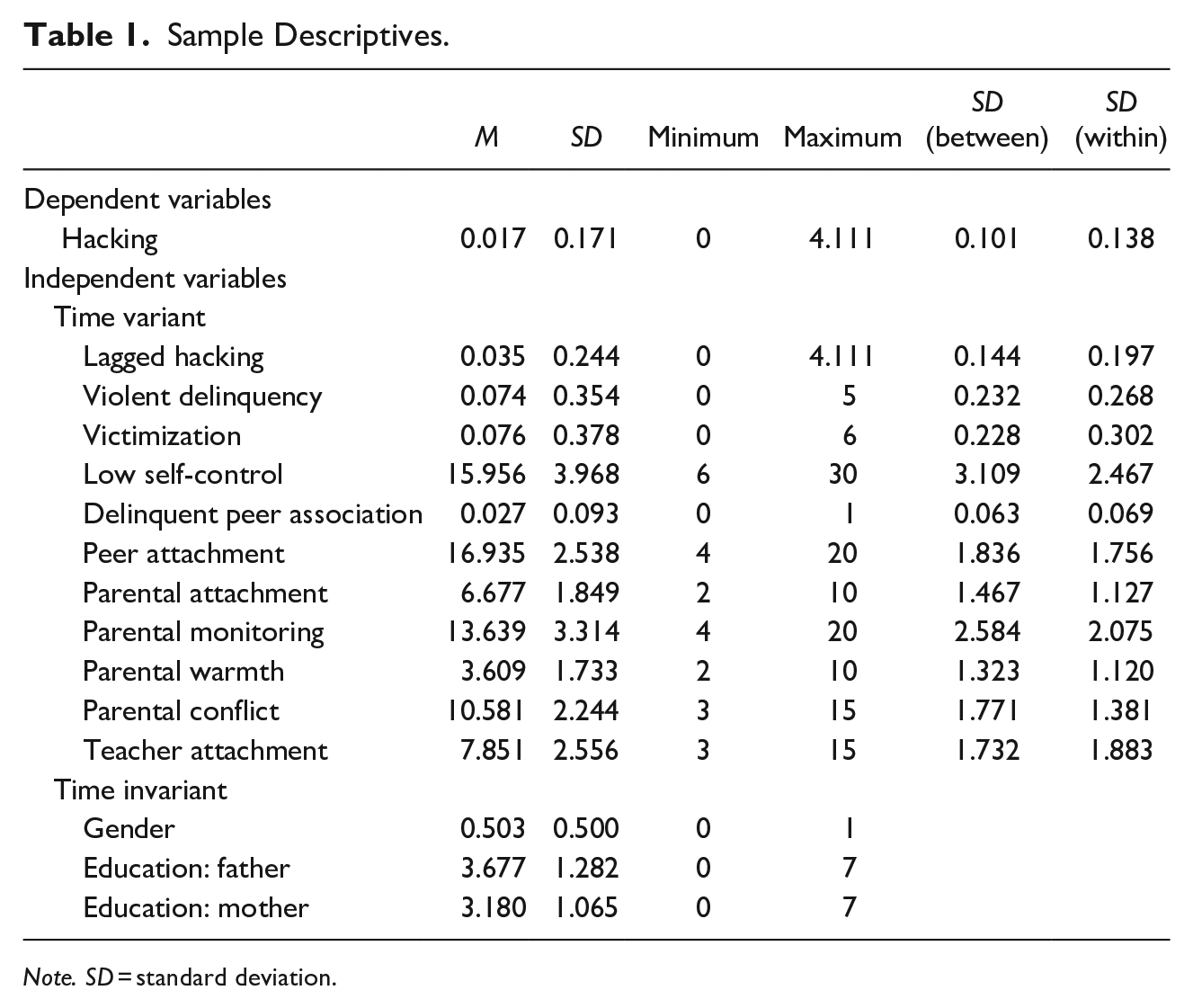
Note. SD = standard deviation.
Table 2 summarizes the results of the cross-lagged dynamic panel model assessing hacking over time. There were four significant time-variant factors: Lagged hacking (β = .055, SE = 0.008, p < .001), violent delinquency (β = .045, SE = 0.013, p < .001), level of self-control (β = .055, SE = 0.015, p < .001), and delinquent peer association (β = .027, SE = 0.011, p < .05) were significantly related to hacking. To be specific, results demonstrate that previous involvement in hacking was associated with a 0.055 unit increase hacking perpetration across time, and violent delinquency was related to a 0.045 unit increase in hacking perpetration across time. Low level of self-control was associated with a 0.055 unit increase in hacking over time, and increased delinquent peer association was associated with 0.027 unit increase in hacking across time. Gender was the only significant time-invariant variable (β = .026, SE = 0.008, p < .01); that is, males reported a 1.2% increase in hacking compared to females. In sum, adolescents who previously engaged in hacking and violence, had low self-control, affiliated with deviant peers, and were male engaged in significantly more hacking than their counterparts.
Cross-Lagged Dynamic Panel Model Assessing Hacking.

Note. SE = standard error; RMSEA = root mean square error of approximation; CFI = comparatives fit index.
p < .05. **p < 01. ***p < 001.
Discussion
Cybercrime research has increased with the widespread use of the Internet and ongoing technological developments over recent decades. However, there have been relatively few empirical attempts to assess the development of hacking among youth across international backgrounds. Responding these voids in the literature, the present study explored juvenile hacking over time from a developmental life-course perspective and examined its relationship with multiple time-variant and time-invariant factors informed by criminological theories. We anticipated that low self-control, delinquent peers, and social bonding variables would explain juvenile hacking participation over time.
In line with self-control theory, we postulated that low levels of self-control would be related to increased hacking participation over time. Results confirmed this hypothesis, consistent with prior work showing the relationship between self-control and hacking (Back et al., 2018; Bossler & Burruss, 2010; Fox & Holt, 2021; Holt et al., 2012, 2012; Marcum et al., 2014). Given that level of self-control is related to restraining individuals from temptation (Gottfredson & Hirschi, 1990), those with low self-control may be unable to resist the immediate rewards anticipated from hacking and find it difficult to consider long-term consequences of their behavior. Considering that one of the unique features of cybercrime is anonymity, behaviors stemming from poor self-control are very likely manifest in the digital world. Hacking may also provide a sense of thrill and rush that young hackers may pursue (Bossler & Burruss, 2011).
We found that, as hypothesized, peer delinquency increased hacking participation over time. This finding echoed prior work on the link between peer delinquency and hacking (Fox & Holt, 2021; Holt et al., 2012; Marcum et al., 2014; Young & Zhang, 2007). This finding may indicate that youth can learn hacking behaviors from their deviant friends. Their behavior can be reinforced by association with deviant peers who provide rewards for hacking behavior. Deviant peers can also provide opportunities to engage in cyber deviance and play an important role in modeling the use of techniques of neutralization for online deviance (Holt & Bossler, 2014).
Counter to our expectations, we did not find evidence that factors from social bonding theory explained deceases in participation in hacking over time. This result diverged from prior work documenting the relationship bonding related factors and hacking (Back et al., 2018; Udris, 2016; Young & Zhang, 2007). This may be related to differences in operationalization of social bonding factors. For instance, Young and Zhang (2007) directly measured commitment to conventional activities and stronger belief in social norms and others examined school attachment (e.g., Back et al., 2018; Udris, 2016), which differed from our measure of teacher attachment. Although Back et al. (2018) and Udris (2016) measured some social bonding factors similarly to the current study, differences in context are important to note. Back et al. (2018) found that measures of social bonding decreased hacking for some countries and not others. Considering that our study did not find a relationship between these variables and hacking, it may be possible that the salience of social bonding variables is culturally and regionally specific in regards to hacking. In the case of South Korea, although the proliferation of the internet and internet-related technology spread relatively earlier in South Korea than in other countries, awareness of its potential side-effects (e.g., online crime) was slowly noted (Choi, 2014; H. Lee, 2008). Hence, confusion is a likely consequence when a society like South Korea, characterized by collectivism, embraces the individualized cyberworld (Choi, 2014). In this context, the fast-growing internet may diminish the power of the traditional social agents and institutions that play a significant role in social control (H. Lee, 2008). Relatedly, compared to youth who were born as digital natives, those parents and teachers essential for the formation of youth’s social bonds are part of the older generation and may have difficulty following this fast-growing new world. This may afford limitations in their supervisory roles in youths’ online deviance.
Furthermore, the current analysis documented a positive link between violent delinquency and hacking across adolescence. In other words, adolescents who exhibited behavioral aggression were also likely to engage in different types of delinquency, hacking in this case. This finding provides insight into the nature of the overlap between offline and online delinquency, which was also found in previous cyber deviance studies (Donner et al., 2015; Kim et al., 2017; Kowalski et al., 2014). The significant influences of low self-control, delinquent peers, and violent delinquency as an overlapping pattern may reflect a general criminal propensity and imply that “the general nature of criminality in on-line spaces has not changed” (Holt & Bossler, 2014, p. 33). Against this background, virtual criminality can be understood as “old wine in new bottles” (Grabosky, 2001). Given the distinctive nature of the cyber world, including anonymity, lack of face-to-face interactions, and disinhibition (Kowalski et al., 2012; Thomas et al., 2015), virtual space can be a convenient stage for individuals with criminal propensity.
Similar to the role of prior hacking, we found behavior continuity in hacking in mid- to late adolescence; prior engagement in hacking was related to the increased likelihood of hacking over time. That is, youth who were previously involved in hacking were likely to continue their behavior across ages, which may imply the continuous pattern of hacking over time. This finding can be understood through qualitative hacking literature. Studies using interviews with hackers found that hackers initiate their behavior in adolescence and their hacking behaviors evolve over time with increasing skills and knowledge through practice (Holt, 2007, 2010; Steinmetz, 2015). However, our finding is somewhat limited since we were not able to examine the gradual escalation in hacking severity due to data limitations. Nonetheless, this result provides evidence that cyber delinquency also follows the age-crime curve, much like traditional offending, and emphasizes the necessity of a developmental life-course perspective for understanding this form of crime.
Lastly, we found that gender was another significant correlate of hacking. This result is in congruence with prior studies demonstrating that males are more likely to engage in hacking than females (Holt et al., 2020; Steinmetz et al., 2020; Yar, 2005). Similar to traditional crime, males account for the majority of hacking (Holt et al., 2020; Yar, 2005). Some scholars have attempted to explain such gender disparity through the constructions of masculinity and gendered socialization. Boys are raised and socialized to aspire “hard mastery” (Turkle, 1984). For this reason, the subculture of hacking, which stresses competition and dominance, may not be appealing to girls (Taylor, 1999), while boys may feel a sense of power and domination while hacking (Taylor, 2003). Considering the characteristics of Korean society, this finding is not surprising. Despite recent efforts to enhance gender-equality for the last few decades, South Korea is still very much rooted in Confucian values emphasizing clear gender roles and strict gendered hierarchy, which may contribute to gender differences in hacking.
Despite notable findings, the present study is not without limitations. First, we only rely on one measure of hacking, like much prior work on juvenile hacking (Back et al., 2018; Fox & Holt, 2021; Holt et al., 2012, 2020; Marcum et al., 2014; Udris, 2016; Young & Zhang, 2007). Future studies may wish to examine diverse forms of hacking behaviors, like Holt et al. (2021) who measured four forms of hacking (device hacking to look at content; device hacking to add, delete, or change content; account hacking to look at content; account hacking to add, delete, or change content), and found some differences between predictors of each. Relatedly, considering the wide spectrum of hacking behaviors (e.g., individual website hacking to governmental system hacking or terrorism), it is valuable to assess how the severity of forms of hacking evolve over time and the extent that traditional criminological theories can explain this progression. Next, although this study explored the development of hacking in adolescence, further explorations are needed to investigate the desistance of hacking, which would require examination of hacking activity beyond adolescence. Finally, given the scarce of research on the gender disparity in hacking, future studies examining features of the gendered pathway into hacking would add to the cybercrime literature. Finally, our study only identified significant risk factors such as offline delinquency, low self-control, and peer delinquency, but failed to find meaningful protective factors. Cybercrime literature would benefit from future work revealing protective factors that could enhance preventive efforts.
Limitations notwithstanding, the current study makes several important contributions to understanding the development of hacking. The roles of self-control and peer delinquency in explaining hacking demonstrate the applicability of traditional criminological theories in online offending (Fox & Holt, 2021). Moreover, we find that the developmental life-course perspective served as a useful theoretical framework to explicate the development and continuity of juvenile hacking over time. Contrary to prior work investigating theoretical explanations of hacking using cross-sectional data, the current study relied on a longitudinal sample to examine how these theoretical factors explain individual changes in hacking over time. Thus, our study builds upon prior work by highlighting established risk factors from criminological theory—low self-control and delinquent peers—have an ongoing influence on hacking participation over time. Findings from the current study advance our understanding of juvenile hacking by exploring its development across ages and uncovering various correlates of cyber delinquency using an international sample.
The results of the current study also offer insight for practice. Given the co-occurrence of offline and online delinquency, programs targeting either type of deviance could play a role in decreasing the counterpart. This point could help design more efficient intervention since it may be unnecessary to develop separate programs targeting each type of delinquency. Relatedly, cybercrime prevention needs to consider well-documented criminological predictors for traditional delinquency such as low self-control, delinquent peers, and previous deviant behavior. Also, considering that hacking begins adolescence, prevention and intervention should start in early stage of life. Although we did not find evidence of the significant roles of parents and teacher in this study, their importance in supervising the youth’s behavior and guiding them (Elsaesser et al., 2017; Kowalski et al., 2014; Song et al., 2020) should not be ignored. Rather, providing training designed to help parents and teachers who may not be familiar with the virtual world may be important to prevent cyber deviance and increase the effectiveness of intervention programs. In addition, the gender gap should be considered in practice and policy. More attention should be focused on males since they are more likely to engage in hacking than females.
Footnotes
Declaration of Conflicting Interests
The author(s) declared no potential conflicts of interest with respect to the research, authorship, and/or publication of this article.
Funding
The author(s) received no financial support for the research, authorship, and/or publication of this article.
