







Abstract
Correctional officers are shouldered with important responsibilities designed to reinforce institutional security, yet work under hazardous conditions that can jeopardize their wellbeing. Among the myriad dangers they confront, COVID-19 has now presented itself as an additional threat to officer wellness. Presently little is known about how the coronavirus pandemic has affected officers, or their respective institutions. Semi-structured interview data collected from correctional officers working in a large, urban county jail located in the southeastern United States (N = 21) revealed how COVID-19 significantly disrupted institutional operations, compounded health concerns for officers, and created a climate of confusion over procedures designed to contain spread of the virus. Policy implications are discussed.
Introduction
Coronavirus disease (COVID-19) is a contagious and potentially lethal illness that has devastated the international community for over two years now (Ryckman et al., 2022). Contraction of the virus can result in experiencing either no symptoms to instead suffering more severe conditions such as dry cough, fever, fatigue, anosmia, and even death in the most extreme of circumstances (Okoro et al., 2020). Ever since its first confirmed diagnosis in November, 2019, over 607,000,000 cases of coronavirus have been reported throughout the world, 6.5 million of which resulting in a fatality (World Health Organization Coronavirus Dashboard, September 16, 2022). 1 Even amid vaccine rollout campaigns, lives have still been completely uprooted by the virus as people have lost loved ones, passed away following a positive diagnosis, had their personal business operations suspended, or were terminated from their occupations (McPhillips, 2022). One group of individuals though hit particularly hard by the pandemic has been the correctional officer (CO) working in county jails.
According to Martin-Howard (2022), in comparison to any other essential employee, the jail officer is by far at “greatest risk for physical and mental health issues. . .related to COVID. . .while potentially exposing themselves, their families and communities they reside in to COVID-19 on a daily basis” (p. 4). Much of this is can be attributed to the hazardous and unsanitary conditions under which they must work. It has been noted that, because of the transient nature of the jail population, the health statuses of these individuals, coupled with the very structure of jails, they serve as reservoirs for outbreaks of respiratory illnesses such as COVID-19 (Ryckman et al., 2022). These detention agencies are further home to countless numbers of immunocompromised individuals, as well as a burgeoning number of aging inmates with pre-existing health conditions who are forced to cohabitate in communal settings where protocols to minimize viral transmission are near impractical. Jails, moreover, are frequently overcrowded, lack sufficient hygiene resources, are poorly ventilated, and are generally known for delivering inadequate healthcare services to their custodial clients (Novisky et al., 2020). Combined, these conditions serve as a breeding ground for easy transmission of the coronavirus. While nearly all segments of society have suffered in some manner by this disease, jails, it can be argued, have disproportionately been impacted more, and it is the correctional officer who is at the epicenter of this virus (Martin-Howard, 2022).
Correctional officers represent the backbone of the jail system since it is these individuals who maintain safety within their respective institutions (Ferdik & Smith, 2017). Without their invaluable contributions, jails would essentially cease to function, thus leading to widespread safety concerns for communities (Ferdik, 2016). Because of the vital role jail officers play across society, coupled with COVID-19’s harmful potential, particularly within the jail setting, it becomes paramount to understand how this pandemic has affected both officers and jail operations. To date, only a handful of studies have empirically addressed these issues (Kocsis, 2021; Martin-Howard, 2022). Semi-structured interview data were therefore collected from a purposive sample of correctional officers employed in a large, urban county jail located in the southern United States (N = 21) to understand from these staff members how COVID-19 has impacted them both personally and professionally.
Literature Review
Correctional Officers and the COVID-19 Pandemic
Ryckman et al. (2022) discovered that by December 1, 2021, the total number of confirmed coronavirus cases among jail staff was estimated at 97,588, with 377 of whom passing away following contraction of the virus. What is more, Nowotny et al. (2021) declared how jail staff “reported consistently higher rates of COVID-19 compared to the general population” (abstract). Flynn (2020) even noted how the novel coronavirus, during its early stages, spread at a faster rate in U.S. jails than “it did in Wuhan, China, in Italy, or in NYC” (p. 1477). Overall, what this information indicates is that jails in particular have been hit hardest by COVID-19, and jail officers are a vulnerable labor force population susceptible to the deleterious consequences of this virus.
It has been well documented that jail officers work under hazardous conditions marked by elevated threats to their wellbeing (Ferdik, 2016; Lambert et al., 2016). COVID-19 seems to have only exacerbated this issue. Given this, it therefore becomes somewhat surprising that relatively few scholars have directly questioned officers about how the coronavirus has worsened job-related matters for them. Jail officers sometimes represent a forgotten occupational group. This is problematic in regards to the pandemic given how, again, jails process countless numbers of individuals on a daily basis, house immunocompromised people, and by their very structural characteristics, are ill-equipped to prevent the spread of airborne illnesses. Even Lambert et al. (2016) remarked on these points by explaining that jail staff are “a largely ignored work group in the area of institutional corrections. . .and further research on the wellbeing of this subculture is needed” (p. 2).
While some studies have explored the impact of COVID-19 on the broader corrections system (Hyatt et al., 2021; Jung & Han, 2021; Mekonnen et al., 2021; Norman & Ricciardelli, 2022; Okoro et al., 2020), only two specifically examined how institutional correctional officers have been directly affected by this pandemic. In the first, multivariate estimations performed by Kocsis (2021) found that disruptions to prison system operations, coupled with heightened safety concerns, contributed to elevated stress among COs working in federal Canadian penitentiaries. In the second, Martin-Howard (2022) conducted semi-structured interviews with 15 Black, female COs working in Rikers Island and found how participants were not receiving required mental health services from the Department of Corrections, and experienced significant stressors as a result of COVID-19, including staff attrition, reduced morale, and increased workloads.
Purpose of the Current Study
Previous studies exploring how the coronavirus has affected jail-based COs and their institutional operations are hampered by several methodological shortcomings. First, with the exception of just two studies (Hyatt et al., 2021; Martin-Howard, 2022), all took place outside the United States. Though this research is informative, the U.S. continues to lead the globe in incarceration and positive COVID-19 infection rates (Martin-Howard, 2022; McPhillips, 2022). Considering these points, and how the coronavirus has rampaged its way through U.S. detention agencies, it remains just as important now as ever to study how both COs and their respective institutions have been affected by the dynamic COVID-19 pandemic. Using qualitative methodologies to do so, particularly in reference to jail officers, is advantageous given how they provide rich, nuanced data, and a “considerable portion of criminal justice involvement occurs at the municipal level” (Martin-Howard, 2022, p. 2). Further, the Martin-Howard (2022) study represents the only analysis to specifically ask jail COs about the effects of the pandemic on them and their respective facilities, yet sample selection was restricted exclusively to Black, female COs. While undoubtedly representing an understudied and under-appreciated group, acquiring perspectives on the virus held by a more diverse pool of officers can broaden understandings of the wider institutional and personal effects of this virus.
As additional points to this study’s utility, given how only one study to date has empirically examined the lived working experiences of U.S. jail officers as they continue to confront the fluidity of the coronavirus, it is extremely important to add to this limited body of work. Jails serve vital functions across society as these facilities are required to help process bail requests of recently arrested individuals, house diverse populations of arrestees, and maintain their safety (Martin-Howard, 2022). It is the frontline correctional officer who guarantees that each of these important tasks is fulfilled. Officers are already exposed to numerous workplace hazards that can jeopardize their health, and when these are compounded by COVID-19, this increases security risks in jails, which can spillover into surrounding communities (Ferdik, 2016).
Also, research finds that jails have had a rather poor history in dealing with infectious disease outbreaks. Regarding the 2009 H1N1 influenza, Nelson and Kaminsky (2020) wrote that “research chronicled an across-the-board mitigation failure that included jails in poor pandemic planning and response efforts. . .We’ve seen a repeat of that behavior with COVID-19 where there has been inadequate consideration of the health and wellness of. . .collective jail populations” (p. 513). It is understandable that health risks are common within these institutional settings, yet lessons from the past must be applied to the present. Acquiring insights from frontline COs about how COVID-19 has affected officers and their jails can hopefully inform healthcare practitioners, correctional scholars and other interested stakeholders about how to avoid past mistakes, and institute policies that can offset complications from any future pandemics.
Methods
Sample and Data Collection Strategies
To capture how the coronavirus affected corrections officers and their respective jail, the research team conducted semi-structured qualitative interviews over the telephone with 21 (N = 21) COs working in a large, urban county jail located in the southeastern United States. 2 This particular jail system was selected because the state in which it is located, at the time of interviews, was experiencing the highest COVID-19 death rates across the entire United States (Mojica, 2022). As will be uncovered later, many of the state’s COVID-19 deaths and positive infection rates were from this jail, which contributed to severe officer shortages across the facility. As such, given the understaffing at this institution, partially attributed to COVID-19, coupled with the comparatively higher coronavirus infection/death rates of this state, it offered an important location in which to conduct this study.
Interviews were scheduled at times that did not interfere with officer work, that were most convenient for respondents, with each one taking place between November, 2021 and February, 2022. Each interview lasted between 45 and 60 minutes, and was conducted by the lead author. Permission to conduct the study, as well as access to officers, were each granted by jail administrative staff, as well as a University human subjects review board panel. Participants were read aloud informed consent forms at the beginning of each interview apprising them of the voluntary and anonymous nature of the study, while also being provided copies of the questions ahead of time. A purposive strategy (Hesse-Biber & Leavy, 2011) was employed to recruit participants based upon the following criteria:
(1) Officers must have been employed for a minimum of 6 months during the COVID-19 pandemic in order for them to have had experience working in this field during the outbreak.
(2) Officers must have been responsible for duties requiring them to be in close contact with inmates and other staff.
Recruitment of potential study participants involved the following procedures. First, the lead author issued an email to the Sheriff of the county jail system explaining the intention of the research. After agreeing to allow staff members to be interviewed, a notification about the study was submitted to one of the Captains by the Sheriff. From there, the lead researcher drafted a detailed study invitation letter that was then forwarded via email from the Captain to all eligible study participants. In total, there were 217 officers who conformed to study eligibility criteria. As will be detailed later, a total of 21 officers were interviewed to reach the commonly accepted theoretical saturation point of 20 interviews for themes to emerge in qualitative research (Morse, 1994). It should be noted that of the 217 potential respondents, only these 21, who were quite eager in wanting to be interviewed, responded to the Captain’s invitation, leading to a 9.7% response rate (21/201). Once the Captain received confirmation of participant willingness to be interviewed, he forwarded their respective work-based email addresses to the lead author, who then made independent contact with these staff to schedule interview times. A conversational tone was adopted for each interview to allow respondents the opportunity to relay as much information as possible to each question (Hesse-Biber & Leavy, 2011). An interview guide was used for each interview, with items within it borrowed and amended from Martin-Howard (2022). Three main questions were asked of interviewees to better understand the total effects of the COVID-19 pandemic on officers and their respective jail (e.g., “Overall, what are your general thoughts of the Covid-19 pandemic,” “How has it affected you and the operations of your jail,” and finally, “What do you believe are the long-term implications of this virus for both you and your respective jail?”). Every interview was audio-recorded with the permission of the respondent in order to accurately capture their statements, and then transcribed for analytic purposes.
Table 1 below provides a demographic portrait of the sample. It will be seen that the average age of respondents was 37.61, with a range of 26 to 51. Over 80% of the sample was male, and just under 50% was Caucasian. Interviewees had an average employment tenure in corrections of just under 9 years, with approximately 50% of the sample occupying the position of line-level correctional officer at the time of data collection. As disclosed in the Table 1 note, these demographics matched very closely those of the remaining officers not included in the study, indicating a degree of representativeness, at least along these identity characteristics.
Sample Demographics (N = 21).
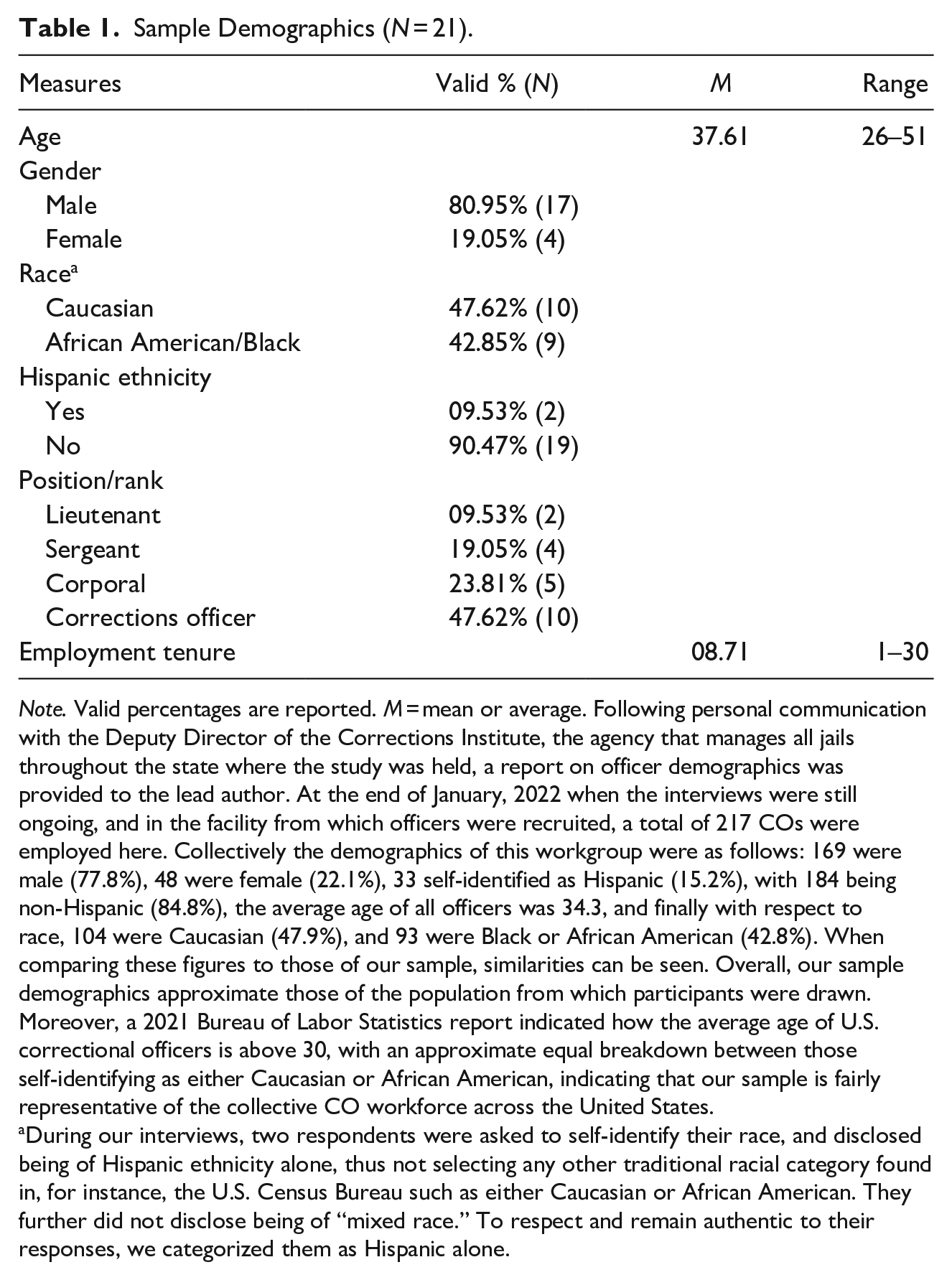
Note. Valid percentages are reported. M = mean or average. Following personal communication with the Deputy Director of the Corrections Institute, the agency that manages all jails throughout the state where the study was held, a report on officer demographics was provided to the lead author. At the end of January, 2022 when the interviews were still ongoing, and in the facility from which officers were recruited, a total of 217 COs were employed here. Collectively the demographics of this workgroup were as follows: 169 were male (77.8%), 48 were female (22.1%), 33 self-identified as Hispanic (15.2%), with 184 being non-Hispanic (84.8%), the average age of all officers was 34.3, and finally with respect to race, 104 were Caucasian (47.9%), and 93 were Black or African American (42.8%). When comparing these figures to those of our sample, similarities can be seen. Overall, our sample demographics approximate those of the population from which participants were drawn. Moreover, a 2021 Bureau of Labor Statistics report indicated how the average age of U.S. correctional officers is above 30, with an approximate equal breakdown between those self-identifying as either Caucasian or African American, indicating that our sample is fairly representative of the collective CO workforce across the United States.
During our interviews, two respondents were asked to self-identify their race, and disclosed being of Hispanic ethnicity alone, thus not selecting any other traditional racial category found in, for instance, the U.S. Census Bureau such as either Caucasian or African American. They further did not disclose being of “mixed race.” To respect and remain authentic to their responses, we categorized them as Hispanic alone.
Plan of Analysis
Transcript analysis proceeded in sequential, iterative phases using the encoding software program, Dedoose (n.d.; http://dedoose.com). A grounded theory, discourse-analytic framework guided the research team’s interpretation of the responses (Hesse-Biber & Leavy, 2011). Initially this involved using inductive reasoning to carefully inspect the transcripts to identify interrelationships between them. To enhance inter-rater reliability, all officer answers were independently evaluated by two members of the research team to see if similar conclusions were drawn about the meaning of the data. As the research team read through the transcriptions, memos were drafted to synthesize this information. A thematic analysis approach was then adopted to determine the similarity of memos emerging from these separate, independent analyses. This process involved familiarization with the data through multiple readings of transcripts, and the generation of initial codes (see Evans et al., 2013). Using a consensus approach (Evans et al., 2013), focused coding procedures followed in which key concepts, or themes were identified (Charmaz, 2006). Viewed as a pattern construction technique, focused coding involves researchers in tandem “examining all the data in a category. . .and then comparing pieces of data with other pieces in order to build a clearer, working definition of a concept, which is then named” (Hesse-Biber & Leavy, 2011, p. 311). Themes emerging from these analyses are presented below.
Finally, and in regards to our sample size, it sufficiently exceeds the commonly accepted theoretical saturation point of 20 interviews for themes to emerge in qualitative research (Morse, 1994). Moreover, the current sample size is more than triple the mean sample size found in a meta-analysis of 560 qualitative studies that utilized interviews and found that theoretical saturation could be achieved with as few as six interviews (Mason, 2010). In fact, in this study, theme repetition began to occur at approximately interview 7. A further 14 interviews were conducted, again, to at least reach the minimally accepted 20, and because of the expressed eagerness on the part of these officers to be interviewed.
Findings
Respondents were vocal about the deleterious impacts the COVID-19 pandemic had on both themselves, and their institution. Themes emerging from analyses generally centered on the harmful institution-wide effects of the virus, as well as the severe health risks it created for staff. In alignment with their statements, presentation of the results is therefore divided into two sections: (a) institutional effects of the coronavirus and (b) its personal effects on officers. For anonymity purposes, we designate which officer provided which quotation by writing (O. #) at the end of their statement.
Institution-Wide Effects
Incompatible, Uncertain, and Capricious Health Protocols 3
Every single officer expressed confusion and annoyance at the lack of consistency in policies designed to contain spread of the virus, which were additionally perceived as incongruous with jail operations. Jails are required to process countless numbers of individuals, ensure those who can bond out are successfully able to do so, house diverse populations in confined quarters, and do all of this in expedient manners (Martin-Howard, 2022). COVID-19, as well as the policies targeted at containing it, significantly delayed operations, imposed restrictions on officer movement, created uncertainty, with the health protocols viewed as inconveniences. One officer provided a succinct illustration of how all of this was manifesting itself: Dude, it’s like the zombie apocalypse here. The health policies have drastically slowed things down. Before the pandemic and on any given day, if I needed to take an inmate to the video attorney visit booth right, to get a conference with his attorney, I just walk him to the facility, no problem. Now, I gotta shut down all movement in the hallways, stop every other activity, I gotta put on the PPE (personal protective equipment), put him in the PPE, walk him there, sit him down, keep that area clean, shut down all other inmate movement, walk him back, then go clean the area with the disinfectant spray, and wait 15 minutes to let it dry. I’ve just knocked an entire hour out of my day for one attorney call. Now there might be 10 other inmates who need an attorney visit. I’ve got nobody to help in the hallway, so it gums up the whole process. We’re used to moving large fast paced, large groups of people different places throughout the day to get all activities done, and one attorney visit can just gum up my day (O. #2).
This same officer added that “all of these health protocols have just been a gigantic pain in the ass. . .The health department has no idea what it is like to run a facility. . .Particularly at the beginning, no one was telling us anything, we had no idea what was going on, and it just felt like we were playing catch up all the time” (O. #2).
In addition to the health protocols severely disrupting what should be routine jail operations, they appeared to be in a constant state of fluctuation. Officers indicated how 1 day they would be required to quarantine coronavirus positive inmates for 21 days, then for 14, then for 10. These changes would occur at random, unannounced intervals. There was additional uncertainty as to when inmates could be released from quarantine, or if their tests were even valid as many officers questioned the accuracy of such results. At times, some inmates would test positive, then the very next day, test negative. Any inmate though who tested positive was immediately escorted to quarantine with other inmates who were actually sick which, in turn, now likely exposed the first inmate to possible COVID-19 infection who may not have been ill in the first place. All this uncertainty generated frustration for officers, and exacerbated the already challenging nature of their job.
Adding to this and at the beginning of the pandemic, PPE that included masks was not only in short supply, but the requirements to wear it were in constant fluctuation. First officers were mandated to use PPE, then they were not, then policies shifted again to wear they had to wear protective equipment, and as of when the interviews took place, again these regulations were relaxed to where masks were only recommended. Such repeated policy change placed undue strain on staff. Mostly this was because the officers felt confused as to what was being expected of them, or what would possibly change again the next day. Further, for inmates who tested positive, they were required to be transported to another facility within the entire jail for quarantining purposes, and officers felt that this constant movement was antithetical to viral containment efforts. One officer remarked how “there was a lot of misunderstanding as to why there were so many movements of inmates because it would seem that for an infectious, you know, disease, keeping people moving around is not the way to go” (O. #8).
Additionally, 15 of the 21 officers interviewed further explained how standard lexicon used in the jail now became ambiguous. “Code red” once exclusively signified that someone in the jail was in distress, and all available officers were required to respond. Now, this term could either mean that someone requires help, or that the jail has just admitted an inmate testing positive for COVID-19, thus requiring quarantine transportation. When either of these code red situations occurs, an alarm is signaled across the loudspeakers. Officers expressed confusion over what the alarm now meant. Is there someone actually in distress requiring immediate assistance, or does this mean the inmate must be transported to the quarantine unit upon entry into the jail? Such ambivalence only served to heighten officer anxiety levels. A similar finding was noted by Martin-Howard (2022) where she explained that at Rikers Island, there are “16 different codes in the unit that are used for officers who call out sick, ranging from cancer to. . .slips and falls, and (now) COVID-19” (p. 1258). Evidently even within other jail facilities too, the coronavirus pandemic has interfered with routine operations. By instituting new changes to institutional policy, this can engender widespread confusion among officers, and potential disarray within the facility. Several studies have noted that correctional officers desire consistency in their job since it provides for a calmer and more serene state of mind (Ferdik, 2016; Ferdik & Smith, 2017; Lambert et al., 2016). For these officers, the pandemic is most certainly not allowing this.
Finally, though only two officers referenced this final issue, it deserves mentioning because it typifies the capriciousness of COVID policy enforcement, at least according to these officers. During an isolated incident involving these staff members who were called to disrupt a violent inmate altercation, they were later formally reprimanded because they were not wearing facial coverings when arriving on scene. As mentioned above, for a period, face masks were required per state policy. When the “code red” was signaled, this time indicating a physical fight between two inmates, these officers immediately responded to render assistance, yet in the moment whereby consumed with adrenaline, just neglected to grab their masks. As one of the officers recalled: One of the biggest things that I think killed morale around here was when, after so many months of dealing with all this covid, we had an emergency situation and a couple of us responded to it, hostile aggression between two inmates. Well, use of force was clean, yet we were all confused when later that day we were summoned to the lieutenant’s office for formal disciplinary action. He’s like, ‘well, y’all responded, but y’all responded without your masks’. You can’t understand how deflating that was. I am risking my very life, and you discipline me for a piece of cloth (O. #17).
Similar to comments made about changes to “code red,” for these two officers, there was a perception that administrators were unsympathetic to the newfound challenges encountered by officers. Abrupt, unannounced, and capricious changes to institutional policy were taking effect on nearly an everyday basis, exacerbating in the process already strained states of mind for the officers, with some believing that their superiors were being unnecessarily punitive, and unappreciative of how increasingly difficult the CO job was becoming because of the pandemic. Even in Martin-Howard’s (2022) study, it was reported that all 15 of her sample members did not believe “administration and senior staff at Rikers Island provided. . .officers. . .with resources to assist with their mental health” (p. 1260). In addition to these two officers who were formally reprimanded, others as well perceived administrative personnel as unsympathetic, just like sample members in Martin-Howard’s analysis. Collectively these findings underscore the point that staff during the tumultuous time of the COVID-19 pandemic feel isolated, and are in dire need of reassurance and assistance.
Inmate Aggression/Disobedience
Frustration over the pandemic was not restricted exclusively to custodial staff. Incarcerated individuals were also angered over a variety of issues, namely, their inability to communicate with others on the outside, move freely within the jail, participate in recreational activities, go to court, while additionally being embittered by the lack of information regarding on-goings within the jail. Especially for those under quarantine, they grew increasingly irritated over not knowing their test results, believing that any result was inaccurate, and feeling as if they were being punished on top of being imprisoned. They are already incarcerated, and now their liberties are restricted further. This contributed to facility-wide tension between staff and inmates. Several inmates acted upon this anger by engaging in aggressive acts that exacerbated safety concerns. Officers were very cognizant of this displeasure experienced by inmates, and even sympathized with them. As one officer put it: Being in jail is hard anyhow, but when you add being quarantined and kept away from everybody and not being able to have access to what you normally would have access to, well, not surprisingly, this can lead to some problems. Not knowing what’s going on, not talking to your family, and not doing anything productive with your life because of the virus, well, I can understand how they feel, and I certainly feel for them’ (O. #20).
Asked whether there were actual instances of inmates behaving disruptively within the jail because of quarantining, or COVID-19 related policies, this same officer offered the following account: I remember in the beginning you know one who came in almost off the street, got immediately put into a quarantined pod just because of answering some Covid screening questions. No test, just answers to the screen, and was put in the pod. She began acting out, banging her head against the doors and walls, breaking the toilet by flushing mounds of paper in there, and kicking the door. Lest it be said, she had to be restrained, and we had to do so wearing our PPE, which as you can imagine, was not easy (O. #20).
Such stories were neither unique, nor uncommon as many officers provided similar accounts of disruptive inmate behavior due to the additional strains imposed by COVID-19 and its related health protocols.
Of the 21 officers interviewed, 17 reported how inmates afflicted with mental illness posed the greatest challenges in terms of ensuring their compliance with institutional regulations, of which now COVID-19 policies became a part. Enforcing mask wearing, and suppressing their aggression with quarantining procedures, among other health-related guidelines, were accompanied by severe difficulties with this particular demographic. As one officer stated: 90% of the inmates will comply 90% of the time, but you will have that 10% who 10% of the time just aggravate you. They are not necessarily acting, ya know, out, but, uh, sometimes it is hard for them to understand that we are enforcing these mandates for their own good. Of course I am talking here about those poor ones with mental issues. We get a lot of them, and getting them to wear masks, or comply with health protocols is such a frustrating task, ya know? In my experience, I have found that if you talk, not yell, to them, explain your reasoning, and try to befriend them, that will go a lot farther than using force (O. #13).
This officer recognized that mentally ill inmates may be constrained by their disability, and are not deliberately behaving uncooperatively, but rather are a victim of their condition. Because of this, the staff member appreciated the challenges confronting this inmate, and opted to address them using non-confrontational methods. Apart from dealing with inconsistent protocols and unruly inmates, other institutional consequences resulting from the pandemic were cited by respondents.
Personnel Shortages and Work Overload 4
At the time of the interviews, this particular jail was operating at an over 40% understaffing rate. Though this certainly is not an uncommon phenomenon for corrections (see Ferdik & Smith, 2017), in this agency some of this was attributed to officers contracting the virus. Many fell ill, and were required to leave work for extended periods of time and quarantine, per health department protocols. This, in turn, left an already exhausted staff to assume greater workloads. About 15 of the 21 respondents confirmed how many officers, once they did test positive, never returned to work, and in fact submitted resignation notices. One lieutenant recounted how: “Right after completing basic training, I had an officer call me and say ‘Sir, I have a family and I just cannot expose them to this. I’m sorry’” (O. #4). The individual in question here was referring to not exposing his family to either possible COVID-19 contamination, or the myriad other dangers associated with correctional work. Staff attrition has been so severe at this facility that during certain points of the pandemic, the Sheriff had to request that both police officers and state-run prison correctional officers volunteer their time in booking to help compensate for the lack of available personnel. Because of a depleted workforce, officers remarked how they were unable to enforce institutional regulations. As noted by one respondent: I helped my corporal run rounds in another section of the jail because they did not have enough people. I went in and did rounds for him because I helped him, they were so short. . .I showed up and you could smell tobacco in every one of the pods I went in. That’s against the rules, that’s against policies, but because you don’t have the staff to enforce it, you can’t enforce it. Um, and so, inmates see that and they’re going to take advantage of it, that’s just what they do. . .so…..yeah…. (O. #3).
Additional shifts had to be taken by available staff, and the proportion of inmates to officers increased, all as a result of the jail either not being able to recruit, or because existing staff were ill. One officer remarked on this final point by explaining how “we are supposed to have one officer per every 100 inmates. We are so short staffed that today, for instance, we have 6 officers to 850 inmates” (O. #15), which when converted, produced a disproportionate ratio of staff to incarcerated individuals of 1 to 141.6. 5 What compounded staff shortage problems further, especially at the onset of the pandemic, was a deficiency of available resources. At one point, the jail was having to house so many positive COVID-19 inmates that they outnumbered available bed spaces in quarantine units. Quarantined inmates were essentially being sequestered in crammed environments on top of one another because of the lack of space to accommodate them. As mentioned above, this contributed to greater levels of aggression on their part.
Professional roles assumed by correctional officers customarily include custodial and caregiver/social worker (Ferdik & Smith, 2017; Lambert et al., 2016; Smith, 2015). Officers are expected to simultaneously be both rule enforcers, as well as counselors, or therapists to the inmate population. This can sometimes engender role conflict, or role ambiguity for staff (Ferdik & Smith, 2017). As a result of the pandemic, a new role has been required of them—that of medical professional. Part of the job of correctional officer is to remain on guard for potential medical emergencies. With the arrival of the coronavirus though, they now have to have advanced knowledge of what its symptoms are, be able to distinguish them from other related illnesses (i.e., flu and cold), ascertain whether an inmate is feigning illness, provide assistance where necessary, and alert medical staff to the possibility of a COVID-19 infected inmate. These constitute additional demands placed on an already strained staff. One officer captured this sentiment in the following words: Yeah, since this pandemic, I’ve worked like all positions. You have to recognize certain symptoms cause inmates will lie. . .There have been other times I’ve had to call medical and say hey this inmate is sick, he’s exhibiting x, y, and z, and you need to know what x, y, and z actually stand for, right? I need to come check him out, see what’s going on, and that requires me to be as perceptive as possible (O. #12).
Pandemic/CARES ACT Manipulation
Over half of all interviewees (12/21) expressed concern that other staff members were exploiting the pandemic for personal gain. Passage of the CARES ACT afforded many Americans COVID-19 relief funds, unemployment compensation, and according to some respondents in regards to their colleagues, it gave them license to not work anymore. In reference to their co-workers, one officer shared the following sentiment: The biggest ripple effect I’ve seen from this pandemic is when the CARES ACT was in play how many people just stopped coming into work. You know if they’re gonna get their overtime, or their paychecks regardless, and they’re gonna get an unemployment check. . .I think just this CARES ACT was one of the most detrimental things with people getting money for nothing. This is just another indication of the self-entitlement society we’re living in (O. #7).
Another added to this with the following remark: Damn right, they’re lazy! Just don’t want to do anything. I kind understand the working from home bit, you know it’s safer. You don’t have to go out as much, but you know those people who are just living off the government, that ain’t right. I understand if you cannot work, but for those who can and choose not to, you know you’re taking advantage of opportunities other people sorely need (O. #4).
These viewpoints were shared across a number of our sample members, with many of whom believing that government subsidies were a major contributing factor to staff attrition which, in turn, was leading to higher inmate-to-staff ratios, and greater levels of institutional disorder.
Personal Effects
Hypersensitivity/Paranoia
All interviewees expressed how the onerous aspects of their job exposed them to elevated levels of stress, mental anguish, and anxiety. However, the global COVID-19 pandemic, and specifically its effects within the jail, only served to worsen these health conditions. In particular, it is the hypersensitivity and hypervigilance to possible coronavirus infection that has compounded their mental strain. Officers are more aware and vigilant of the people they converse with, the surface areas they touch, and even simply the air they breathe. One officer described feeling “paranoid at the thought of possibly bringing this to my family and inadvertently infecting them” (O. #21). Concerns over becoming contaminated by the virus were shared by our entire sample, and officers took preventative action to ensure this did not occur. Nearly every officer (19/21) indicated how before entering their home following a shift, they would bleach their boots, leave their clothes outside, and if possible, take a shower using a hose in the yard. Such measures were intended to not only keep themselves safe, but more importantly for them, their loved ones. On top of all the thoughts officers already have, now they have to worry about infecting others. One officer captured these sentiments when explaining how: We have to hand search people, we have to wrestle with people. We’re exposed to fluids. Um, so when dealing with a population, especially the mentally ill, who don’t care about this pandemic, or just are unable to, and they’ll spit and piss on you, our awareness of spacing certainly enters our mind more now than ever before. We certainly try to keep our distance now, and interact with offenders, where possible, from afar (O. #14).
A certain level of apprehensiveness has entered the minds of officers, which complicates their job because a great deal of what they are required to do is interact with the inmate population within confined settings. If they fear getting close to an inmate, this could potentially raise security issues across the facility for failure to intervene when necessary. In regards to the pandemic engendering heightened senses of concern, one officer mentioned how: I’m now a germaphobe. I always wear gloves no matter what I am doing in the jail, like I’ll have gloves, those disposable gloves, possibly I’ll go through a whole box in one night. I sanitize constantly, and tell inmates to wear their masks whenever interacting with me. I ain’t trying to get sick (O. #18).
Burnout, Stress, and Reduced Morale
Emotional exhaustion and stress are intrinsic features of correctional work. Numerous studies have documented how COs suffer high levels of anxiety and burnout (Ferdik, 2016; Ferdik et al, 2014; Ferdik & Smith, 2017). The COVID-19 pandemic has apparently only exacerbated these conditions. Every single member of this study’s sample expressed some degree of either burnout, stress, reduced morale, or all three. Preoccupations over possible contamination, inmate misbehavior, staff attrition, among the manifold other issues cited thus far, all contributed to exacerbated health problems for respondents. One officer provided a summary of these issues when saying: Um I’m seeing more like a burnout you know. . .and morale has certainly dipped too. I’ve been here 7 years and I’ve never seen it this bad as far as staffing levels and stress. We are all concerned for our welfare, the welfare of the inmates, and this constant uncertainty is not making things better. There is too much on our plates. You can definitely tell with the staff um that a lot of people leave because of basically burning out and just not being able to take it anymore. This kind of creates a backlog effect, people you know really get stressed about this job and covid, and if they leave, who’s left to pick up the slack? We are definitely in need of help (O. #9).
Discussion
Officers working across our nation’s jails are the lifeblood that sustain these organizations since they are responsible for numerous tasks designed to uphold institutional security (Ferdik & Smith, 2017). These invaluable workforce members are asked, however, to fulfill such crucial missions under hazardous working conditions that can threaten their livelihood. For over two years now, officers have been confronted with a newly emerging threat—the coronavirus. Few studies to date have explored how the dynamic and evolving COVID-19 pandemic has directly impacted both officers and their respective institutions (Martin-Howard, 2022; Mekonnen et al., 2021; Okoro et al., 2020; Zhang & Wang, 2021). In-depth interview data were collected from a purposive sample of officers employed in an urban jail to understand from these frontline staff the personal and professional effects the coronavirus pandemic has had on them.
Before discussing the implications of this study’s results, it is important to initially address its design weaknesses. First, as with all qualitatively-based studies, the issue of generalizability presents itself. Though our sample matched closely the demographics of the population from which it was drawn, it nevertheless must still be emphasized that because this study was conducted in a single jail located in a historically conservative region of the United States, the perspectives of these officers should not be taken as a reflection of those of other officers. COVID-19 has had varied impacts on diverse populations, including jail officers, and for such a reason, it is important to interpret these results with the requisite degree of caution, and add to them by exploring pandemic experiences of other COs working in different custodial settings throughout the nation. Second, though interview guide questions were culled from extant, empirical sources (see Martin-Howard, 2022), they, to the best of the authors’ knowledge, have only been used in these two studies. Their reliability and validity have yet to therefore be confirmed. Third, no study to date has specifically inquired into perceptions of the COVID-19 pandemic held by corrections administrative staff such as either Sheriffs, or Wardens. These individuals oversee the budgets, staffing, and general operations of their facilities. Their insight could illuminate other ways the COVID-19 pandemic has impacted institutions. Future scholars interested in expanding this body of knowledge are encouraged to interview more officers, as well as include in their samples administrators so that broader understandings of this topic can be generated. Methodological limitations aside, our study still offers important points of discussion.
In the current study, representing an effort to add to the knowledge base on CO wellness, sample members reported a number of adverse outcomes resulting from the pandemic, separately classified as institution-wide, and personal effects. Of note regarding our findings is that, despite interviewing a more diverse pool of respondents relative to Martin-Howard (2022) who focused exclusively on the perceptions of the COVID-19 pandemic held by only Black, female COs, our findings, coming from a more heterogeneous sample, mirrored hers. Irrespective of the institution, its geographic location, or officer demographics, similar results were uncovered between both investigations. Though two studies alone may not signal a widespread COVID-19-related problem for COs, they may still be indicative of an underlying issue that merits increased scholarship and perhaps even professional intervention. Officers of various demographic backgrounds and from different jail settings reported fairly consistent problems directly resulting from the coronavirus pandemic. To better understand the extent of these issues across corrections agencies, it would behoove scholars and practitioners to research in more depth how the pandemic has affected officers so that appropriate remedies can be provided to them.
Speaking now directly to findings from the current study, and in reference initially to institution-wide effects of the pandemic, every single officer expressed annoyance over the lack of continuity and logic in health protocols intended to contain spread of the virus. They were frustrated over the multiple barriers impeding them from expediently doing their job, over how physical constraints imposed by PPE would create behavioral problems across the jail, the use of suddenly ambiguous terminology (i.e., code red confusion), uncertainty over the future and what policy would allow them to do, in addition to being angered by perceived unfair/capricious disciplinary practices. Taken together, the coronavirus pandemic and its concomitant regulations have heavily disrupted jail operations, and created a cumbersome work cycle for officers.
Members of the incarcerated population were also caught in the crossfires of COVID-19 policies. According to a majority of our respondents, inmates were angered by additional restrictions imposed on their bodies and movement. Officers were sympathetic to their frustrations, and even tried to allay them by presenting themselves as sounding boards, allowing them to voice their troubles. Nonetheless, levels of agitation were so high among some that they reacted violently, requiring officers to expose themselves to COVID-19 infection by physically subduing inmates. This finding confirms admonitions proposed by Novisky et al. (2020) who warned that COVID-19 mitigation efforts could produce unintended consequences such as inmate defiance due to their being embittered by increased restrictions on their movement.
Personnel shortages in corrections are nothing new as facilities worldwide continue to operate in crisis mode (Ferdik, 2016; Lambert et al., 2016). However, COVID-19 now serves as an additional impediment to recruitment, as well as another reason cited by officers for voluntarily resigning, or refusing a job offer altogether. This has left existing staff to carry a heavier burden with fewer resources. COs voiced strong concern over their inability to maintain operations under such conditions. Staff are being stretched to unsustainable levels, with these sentiments not unique to this sample. As reported by Martin-Howard (2022), COs in her study exposed to excessively strenuous working conditions reported higher levels of burnout and exhaustion which, consequently, led to “disastrous outcomes for their facilities. . .in mid-August 2021, in fact, COs rallied against these conditions at the Queens entrance to the bridge in Rikers Island chanting ‘stop the triple shifts’” (p. 16). Human beings require a healthy work-life balance in order to function, yet officers have never really had this luxury, and with the advent of COVID, such a balance is almost certainly out of their reach.
COVID-19 has revolutionized aspects of society in ways not seen for generations. For many, life migrated to a digital-only platform, businesses, stores and academic facilities, among other institutions, temporarily closed (some have remained so as of the writing of this manuscript), and people have worn cloth coverings over their faces (Ganesan et al., 2021). Life as we once knew it has been fundamentally overturned. Current living conditions, coupled with extreme policy vicissitudes have been blamed for what will likely result in a wave of enduring problems even if COVID-19 should ever be resolved. Mental health experts warn that “prolonged lockdowns, quarantine, isolation. . .and constant policy shifts. . .will create a ‘second pandemic’ with severe mental health issues and suicides” (Ganesan et al., 2021, abstract).
Correctional officer work is already taxing enough. Stress, burnout and reduced morale have nearly always been reported by these professionals (see Ferdik & Smith, 2017; Lambert et al., 2016). With the introduction of COVID-19, coronavirus health protocols and their myriad associated problems, CO mental and physical health seem to be under siege now more than ever before. In fact, every single officer across this study reported some degree of mental distress directly in relation to the coronavirus. Similar feelings have been reported by others ever since the beginning of the pandemic. Research from Ganesan et al. (2021) found how suicide rates have “increased markedly since Covid-19. . .with people also experiencing sleep apnea, acute stress, anxiety, and depression. . .The likelihood of these outcomes has been far higher in frontline workers” (p. 68). Considering all of this, we propose a number of policy recommendations that could be especially helpful to officers as they remain entangled in this still ongoing health crisis.
Concluding Remarks
Several authors have proposed strategies to offset the deleterious impacts of the coronavirus pandemic on correctional officers. From the standpoint of safeguarding them from possible COVID-19 infection, even as case rates continue on the downward trend as of the writing of this manuscript, COVID is still an issue, and apart from vaccines, it is strongly encouraged that corrections facilities continue to invest in personal protective equipment (PPE), inclusive of masks and sanitizing products. Though some officers in this study found the PPE physically constraining, these suits nevertheless provide armor against airborne illnesses, common in detention settings such as jails (Oladeru et al., 2020). Some respondents in this study noted shortages in PPE at the outset of the pandemic, and it may be beneficial for corrections agencies to continue to invest in this equipment to safeguard the collective welfare of institutional populations. Some scholars have even called for reductions in overcrowding through the release of inmates, and discontinuing admission of new ones, especially minor law violators (Sears et al., 2020). At the beginning of the pandemic, such policies were being executed across U.S. detention facilities, yet faltered over time. In New York City, for instance, while “hundreds of individuals were released by August, 2020 bringing the incarcerated population to under 3,900, by summer of 2021, more than 5,500 people were detained in the city’s jails” (Martin-Howard, 2022, p. 18). One officer in our study echoed these same trends by explaining how “we noticed that arrest rates started going back up, and with this, the amount of people we were having to quarantine due to COVID was also going up” (O. #1). 6 Jails are hotbeds for respiratory illnesses such as COVID; hence, any strategy aimed at reducing confinement of large numbers of people in poorly ventilated structures may be worthwhile.
Defiant conduct on behalf of incarcerated persons can be responded to with verbal judo tactics, or what has been termed referent power, consisting of fair, courteous and respectful treatment of others (Raven, 1992). Research has found that when individuals are treated in such ways, they will most likely respond in turn (Raven, 1992). Studies have found that COs overwhelmingly favor referent power over other bases such as coercive or expert as means of ensuring inmate compliance with institutional regulations (see Ferdik & Smith, 2015). As was done by officers in our study, for those other COs dealing with potentially hostile inmates, adoption of referent power mechanisms may be more effective at addressing any resentment or anger displayed by individuals under custody during the pandemic.
Finally, officers in this study remarked that what was frustrating them the most was the perceived lack of compassion demonstrated by superiors. They felt as if they were not being appreciated or understood during such a turbulent time. In an effort to be there for their line-level staff, Goorley (2020) strongly advised correctional administrative personnel to make themselves available to officers and discuss with them any issues they are experiencing, while also offering counseling where possible. This must include maintenance of open lines of communication, and leading through mentorship. As explained by Goorley (2020), the additional trauma and stress created by the pandemic “requires strong, yet compassionate leadership to meet the emotional and psychological needs of corrections staff. . .For jails actively addressing COVID-19 outbreaks and reductions in productivity, private discussions with struggling officers could include inquiries such as ‘I have a sense you are feeling’, and then elaborating on these” (p. 22). Running a corrections facility in such sympathetic and understanding ways not only can alleviate stress for officers, but this can further help to ensure an agency is run efficiently (Goorley, 2020).
Oladeru et al. (2020) perhaps summarized best the important and sometimes neglected issue of CO health, especially during this pandemic, when writing how officers “need the nation’s reassurance during this dire time that they will not be abandoned and further stigmatized” (p. 267). As has been emphasized throughout this paper, the job of correctional officer is already strenuous and the coronavirus pandemic certainly has not improved matters. Now more than ever, they need our attention and understanding, and hopefully continued scholarly focus on their welfare can help them navigate the troubled waters of their profession. Along this point, more research is needed specifically on officers employed in densely populated urban jail facilities where risks associated with COVID-19, according to extant research, are exacerbated greatly, even in comparison to other correctional workers (i.e., prison and parole officers; Kocsis, 2021; Martin-Howard, 2022; Norman & Ricciardelli, 2022). While nearly everyone across the globe has suffered adverse consequences resulting from the virus, jail officers, due to the conditions of their employment, are at heightened risk for pandemic harm, and increased focus on this professional workgroup is highly warranted.
Footnotes
Declaration of Conflicting Interests
The author(s) declared no potential conflicts of interest with respect to the research, authorship, and/or publication of this article.
Funding
The author(s) received no financial support for the research, authorship, and/or publication of this article.
