







Abstract
Is education fever in China, embodied in parents’ high expectations of and heavy investments in children’s education, a source of strain for the offspring? Using a nationally representative sample of children from 6th to 12th grade, we examine the effects of education fever on adolescent deviance in China, controlling for a range of individual and family characteristics. The regression results revealed that parental investment increased adolescents’ deviant behavior even when children’s academic performance and family socioeconomic status were controlled, whereas parental expectation did not affect adolescents’ deviant behavior. These findings demonstrated that education fever, particularly in the form of heavy parental investment, constitutes a salient source of strain for Chinese adolescents and its deviance-promoting influence should not be ignored.
Keywords
Introduction
Education fever has been a phenomenon in China for over a millennium and come to a boil in the recent two decades. It is also highly prevalent in other Asian countries, such as Japan, South Korea, and Singapore, partially due to their shared Confucian heritage culture with China (Tan & Yates, 2011). Not only is there fierce competition among students but parents also have unrealistically high expectations of and invest relentlessly in their children’s education. Almost all Chinese parents, for example, expect their children to go to college (China Youth and Children Research Center, 2001), although the percentage of the college-educated population is only 7.4 percent (National Bureau of Statistics, 2021). Moreover, raising a child in China from birth to adulthood costs parents an average of 485,000 yuan ($76,662) in total (Liang et al., 2022), 16 times the country’s per capita disposable income, significantly greater than the corresponding expenses/incomes ratios in Australia, Germany, and the United States (Financial Times, 2022). Parents in major cities such as Shanghai and Beijing especially spend exceedingly on their children, registering respectively 1.03 million yuan ($152,032) and 968,642 yuan ($143,475; Liang et al., 2022). The educational investment makes up a large portion of these childrearing costs. Aside from the traditional school-based expenses, educational investment also includes the costs of shadow education, extra-curricular activities, programs that assist children in preparing to study abroad, and even purchases of expensive school-district houses.
Facing the extraordinarily high levels of parental investments in and expectations for their academic performance, many adolescents in China are in a very stressful developmental environment (Tan & Yates, 2011). The tremendous amount of resources—financial, time, or emotional—that parents put into children’s education constitute a major source of strain, and subsequently an indelible risk factor for deviance and delinquency, that existing criminological research has yet to recognize or investigate. Deviance research has long spotlighted schools and families as two major social settings and institutions in shaping children’s behaviors, examining the influences of peer relations, school exclusion, and delinquent peers (Gottfredson & Hirschi, 1990; Megens & Weerman, 2012), and relationship with parents, household arrangements, and parental supervision and control (Demuth & Brown, 2004; Foster & Hagan, 2013; Giordano, 2010). But few studies investigate the effect of academic stress on delinquency. Moreover, for those few that do, they focus exclusively on children’s academic aspirations, expectations, and achievements, rather than on their parents’ expectations and investments (X. Chen & Cheung, 2020; X. Wang et al., 2020). Education fever, however, applies more to parents than children and thus cannot be fully understood without measuring and assessing parents’ behaviors and their consequences. This study extends the current research on academic strain and delinquency by examining the effects of parental educational expectations and investment on children’s deviant behaviors.
Relying on a nationally representative sample of 1,341 children and adolescents from grades 6 to 12, this study assesses the relationship between parents’ expectations of and investment in children’s education and children’s deviant behaviors, controlling for a range of theoretically important variables indicating children’s academic performance, parental bonds and monitoring, children’s demographic and personality traits, and household and area characteristics. We utilize, and extend, Agnew’s general strain theory (GST) to explain children’s deviant behaviors in China, highlighting a unique, education-based source of strain that connects the domains of family and school and goes beyond the commonly studied family- or school-bound strain such as parental neglect and failure in school performance or school-victimization. This education-fever-induced strain comes mostly from the money, time, and energy that parents invest in children’s education, and when high in magnitude, viewed as unjust by the children, and children’s academic performance does not meet parental expectations and investment, such strain can ultimately lead to deviant behaviors. This study contributes to the literature on education and GST by contextualizing strain in the Chinese context of education fever and revealing important, previously overlooked, aspects of educational stress that account for adolescent deviance.
The Education Fever in China
Education fever is a social phenomenon characterized by parents’ feverish aspirations and support for their children’s educational attainment and achievement, particularly concerning obtaining academic credentials and higher degrees (Kim et al., 2005; Yu & Suen, 2005). It involves high expectations as well as high investments of parents in their children’s education. Although most parents around the world place a great value on children’s education and are expected, and prepared, to invest in it to some extent, Chinese parents appear to be at an international extreme, at least in terms of their financial and emotional commitment (Mok et al., 2009). They not only closely follow their children’s academic performance, but also expect their children to excel academically, be at the top of their class, and be admitted to a decent university, or else their children are thought to have no future. Many Chinese parents, including those not financially well-off, send their children to costly private tutoring and extracurricular training classes and even purchase expensive school-district apartments just to get their children admitted to good schools (Feng & Lu, 2013; Zhou & Wang, 2015). Those who are wealthier send their children abroad for a better quality of education (Bodycott, 2009). Among those after-class educational activities, private supplementary tutoring paralleled with formal schooling has become a multibillion-dollar industry. Known in the education literature as “shadow education,” a term denoting a sense of dishonesty and even ghostliness in the United States (Baker et al., 2001; Manzon & Areepattamannil, 2014; W. Zhang & Bray, 2020), private tutoring in China is rather publicly accepted and even embraced. It has been a key component of the national education fever, at least before the recent governmental crackdown on private education (Stevenson & Li, 2021).
This obsession with education among Chinese parents is partially rooted in the traditional Chinese culture that emphasizes academic success and the resulting labor and social mobility (Chan & Bray, 2014). In a sense, the education fever has lasted for over a 1,000 years in China, driven chiefly by national institutional exams, including the Civil Service (Keju) exam in history and the National College Entrance Exam (Gaokao) contemporarily (Yu & Suen, 2005). Historically, the Civil Service exam system selected candidates for high-level, high-power positions that came with prestige, legal privileges, power, and financial rewards for the entire family and ancestry. Today, a strong academic performance that leads to a university degree and then a professional or managerial career remains the principal path to upward mobility for many (J. Liu & Bray, 2022; Yu & Suen, 2005). Aside from a deep cultural and traditional root, the phenomenon of education fever is boosted by contemporary socioeconomic factors, including labor market reform and competition, inequalities in educational resources, and the marketization of education (Y. Chen et al., 2021). The generation born and raised under China’s one-child policy especially faces high levels of investment, hopes, and pressure from parents to compete for elite status in the educational system as well as the labor market (Fong, 2004). In a study conducted by China Youth and Children Research Center (2001), almost all parents (97%) expect their children to have at least 2 years of college education; more than two-thirds (70.5%) expect at least a master’s degree, and close to half (44.5%) hope for at least doctoral education.
Such high expectations for children’s educational achievement are prevalent among urban middle-income parents and link to the phenomenon of middle-class anxiety (Y. Chen et al., 2021). The extensive investment in shadow education by elite and middle-class families for their children represents parents’ wishes to use education to maintain their family’s social status and ensure the future of the next generation (Mori & Baker, 2010). Rural parents, on the other hand, are also anxious about their children’s education. Shadow education, for example, is widespread among rural, low-income, and poorly educated families too (J. Liu & Bray, 2022). Investing in after-class educational activities including tutoring has increasingly become a big part of parental role construction and an indicator of parents fulfilling responsibilities toward their children (Peng, 2021). A faith in counting on education for intergenerational mobility is especially common among rural-to-urban migrants, who acquire the urban norms of parental role and invest more in their children’s education compared to other rural parents in the hopes to break the cycle of poverty and achieve higher SES in the future (Ren et al., 2021). Some migrant mothers even forsake their city employment and return to their hometowns to fully devote themselves to supervising their school-age children’s studies.
Given the current slowdown of China’s economic development and increase in social class solidification, the education fever will likely continue, generating tremendous pressure and anxiety for both parents and children. In 2021, the buzzword “Jiwa” (鸡娃) emerged in China’s cyberspace, which means pumping children with chicken blood to stimulate energy and promote learning. Jiwa parenting features parents’ strong sense of responsibility, infused with high levels of stress and anxiety, to help their children to succeed, especially academically, even if they do not enjoy or agree with it (Newman, 2021). Under Jiwa parenting, children continue to be crushed under the weight of parents’ mounting expectations and excessive investments in their education.
While education remains one of the few relatively fair and reliable paths to social ascent or, at the very least, social status maintenance, the extreme pursuit of children’s educational attainment reflects educational parentocracy (Peng, 2021) and brings educational rat races. As described by the term “involution” (内卷), another buzzword in China since 2020, people have become locked in an endless yet also meaningless competition that sweeps major areas of society including labor and marriage markets (Y.-L. Liu, 2021). The drastic, pervasive, and chronic strain stemming from the competition and associated phenomena such as Jiwa and involution is affecting not only middle-aged parents and young adults, but also children who are likely to experience more stress, anxiety, confusion, and even despair than before.
Theoretical Background and Literature Review
Education Fever as a Salient Source of Strain Causing Deviance
Strain theory was first introduced by Merton (1938), in which he forwarded that strain results from not achieving limited but universally prescribed goals. He claimed that the main cause of strain is a cultural imbalance that places monetary success over legitimate means of achieving the goal. Building upon Merton’s theory, Agnew (1992) hypothesized that certain adaptations to strain cause crime and delinquency. He proposed three major sources of strain that individuals may confront that lead to crime and delinquency: the failure to achieve positively valued goals, the removal of positively valued stimuli, and the presence of negative stimuli (Agnew, 1992). To further identify the types of strains that are more likely to result in crime and delinquency, Agnew (2001) argued that when the strains are (1) perceived as unjust, (2) perceived as high in magnitude, (3) associated with low social control, and (4) create some pressure or incentive to engage in criminal coping, they are most likely to lead to crime and delinquency. Additionally, he contended that strains or stressors increase the likelihood of crime and delinquency by eliciting negative emotions. Such emotions as anger, depression, and frustration drive individuals to take corrective actions, including committing criminal or delinquent behaviors, to relieve stress, exact revenge, and alleviate negative emotions (Agnew, 1992).
We propose that education fever, expressed in the form of unrealistically high expectations of and high investment in children’s education, is one of such strains leading to deviant and delinquent activities. Adolescents face a variety of stressors in their daily lives, such as challenging interpersonal relationships, concerns about the future, financial pressure, emerging adult responsibilities, along with academic performance pressure and school and leisure conflict (Byrne et al., 2007; Kaplan et al., 2005; Y.-L. Liu & Lu, 2011). Among these factors, examination stress, a major academic stressor, is one of the most significant stress sources affecting adolescents’ psychological well-being (Xiang et al., 2019). Examination performance is the dominant criterion in evaluating student performance in some Asian countries, including China. Struggling in a highly-competitive social system, Chinese students, especially those from the last grade in elementary school to the graduating seniors in high school, tend to regard academics, particularly examinations, as the greatest challenge in their lives (Sun et al., 2013).
According to Agnew (2001), the strain of failing to achieve positively-valued goals produces the strongest drive for crime and delinquency when the goal is considered unjust. A stressful event or condition is more likely to be perceived as unjust when individuals believe it entails a voluntary and intentional violation of a relevant justice norm. In the setting of family, Agnew (2001) believed that the strain caused by parental supervision is deserved rather than unjust because it is a form of exercising parents’ legitimate authority. Similarly, Agnew (2001) contended that educational strain is not unjust, but rather normal, albeit excessive. The high parental expectations and investments in their children’s education in China, however, despite appearing normal exercises of parents’ legitimate authority to many parents, may be deemed by children as pursuing unjust goals and imposing unfair treatment.
First, children may feel they are “forced” to achieve unrealistic, hence unjust, goals of academic performance that are beyond their capabilities and/or aspirations. Not only do intensive extra-curriculum activities, including pricy tutoring, leave children with no spare time but also push them to partake in a rat race that expects every child to be an overachiever. Similarly, when parents concretize their high expectations and investment by purchasing an overpriced apartment so that children can attend a key-point school or sending children overseas for better education, children can be overwhelmed with tremendous pressure and stress, with no room for failure or mediocrity. Second, children may feel a lack of voice in the making of decisions significant enough to interrupt their routines or even completely change their lives. Influenced by the traditional culture of family hierarchy, many Chinese parents have authoritarian parenting styles, with parents making decisions for children without input from the latter (M. Wang & Qi, 2017). Parent-child conflicts resulting from the disjunction between what children want or are capable of and what adults force upon them can be considered unjust by children longing for a democratic family as well as unconditional love and understanding from parents. These processes reflect Agnew’s argument that if the procedure for the making of decisions that bring strain is unjust, especially if no convincing rationale is provided for the decision, the strain may be perceived as unjust.
Strain under the Chinese context of education fever is also high in magnitude due to its duration, frequency, and expected continuance into the future (Agnew, 2001). The academics-based strain for children amidst the education fever tends to be long-term and persistent, beginning in primary school or even kindergarten and lasting until at least the National College Entrance Exam. The strain is diffuse and ubiquitous, unmeasurable in frequency, creating difficulty for children to cope conventionally. Besides, it also threatens children’s “core goals, needs, values, activities and/or identities” (Agnew 2001, p. 335). Performing well academically becomes their primary goal, task, and obligation. Daily activities are organized around the priority of getting good grades, and admission to universities, particularly prestigious ones, represents a major evaluative standard of children’s success and defines their identities (Crystal et al., 1994). Strains caused by exceeding parental educational expectations and investments thus are high in centrality for children experiencing them. Last but not least, not only the strain brought by China’s education fever is lasting and pervasive, but it is also ongoing and increasing as children grow older and when it gets closer to the National College Entrance, hence the recency of the strain (Agnew, 2001).
Although previous research based on Western data found that crime is linked to poor school performance rather than the failure to achieve educational success (Agnew, 2001; Maguin & Loeber, 1996), we argue that in the context of China, the strain caused by the education fever should entail the potential failure to achieve educational success besides the presence of negative stimuli (e.g., poor school performance), given the heavy parental expectations and investments. Therefore, this study investigates the effects of parental investment and expectation on children’s deviance, net of the traditionally examined variable of children’s academic performance. We also include depression as a key mediator between parental expectation and investment and adolescent deviance, as academic stress has been shown to increase students’ chances of developing depression (Zhu et al., 2021).
Empirical Evidence on Academic Stress and Adolescent Deviance
A substantial body of research in education has demonstrated the negative impact of academic stress on child development. In China, academic stress has been found to damage children’s academic development (Y.-L. Liu & Lu, 2011; Ye et al., 2018) and psychological and physical health by increasing levels of anxiety and depression and decreasing physical activity and sleep (Zhu et al., 2021). Noticeably, Chinese students experience more academic stress than their Western counterparts do (Y.-L. Liu & Lu, 2011), and the negative effect of academic stress is stronger among Chinese students, especially concerning mental health (Greenberger et al., 2000).
Many empirical studies have investigated the relationship between school and delinquency in China, suggesting that strong school attachment, a positive school environment, and positive relationships with teachers reduce the likelihood of adolescent delinquency (W. N. Bao et al., 2014; Z. Bao et al., 2015; Pyrooz & Decker, 2013; L. Zhang & Messner, 1996). Meanwhile, a substantial body of research has investigated the strain caused by poor academic performance and its impact on delinquency (e.g., Morash & Moon, 2007). Academic achievement, on the other hand, has been shown a salient protective factor against delinquency (J.-K. Chen & Astor, 2010; Cheung, 2016). Yet, no study has looked at the strain caused by high levels of parental expectation and investment in children’s education. An emerging group of studies has examined the impact of academic stress on delinquency. But they focus primarily on the aggregate strain of school or classroom (X. Chen & Cheung, 2020; X. Wang et al., 2020; J. Zhang et al., 2020). Only two studies have tested the effects of academic expectations on delinquency (X. Chen & Cheung, 2020; X. Wang et al., 2020). X. Wang et al. (2020) measured adolescents’ material strain using the gap between material aspiration and expectation and found that school type (i.e., high school v. vocational school) predicts this strain. The other study by X. Chen and Cheung (2020) used the anticipated educational goal blockage (i.e., the gap between students’ educational aspiration and expectation) as both an individual-level strain item and an aggregate-level strain item, finding that the anticipated educational goal blockage along with other school-related strains have positive correlations with adolescent delinquency. Both studies measured students’ education expectations rather than parents’ and failed to take parental investment into account, leaving a gap that this study attempts to fill. As previously discussed, excessive parental expectation and investment in children’s education are the core of education fever and a major source of strain for Chinese adolescents that warrant more theoretical elaboration and empirical investigation.
Current Study
Many empirical studies have tested the sources and characteristics of strain and supported Agnew’s general strain theory (e.g., Moon et al., 2008; Rebellon et al., 2012). However, no research has adopted GST to examine the phenomenon of education fever in China and other similar societies. To address this gap, this study extends the applicability of GST to the contemporary Chinese context by accentuating parental expectation of and investment in children’s education as a distinct source of strain that, with its perceived unjustness and high magnitude, has a high likelihood of leading to adolescent deviance in China.
Relying on data from a nationally representative sample, we investigate parental expectation of and investment in children’s education as a major source of strain that explains adolescents’ deviant behaviors, after controlling for the effect of children’s academic performance. Further, as delinquency is often associated with social control and self-control variables (Cheung, 2016; X. Wang et al., 2020), we controlled for these theoretically-relevant variables in addition to a set of individual and household characteristics commonly used in the delinquency literature. Our specific hypotheses are:
(1) A higher level of parental expectation is associated with a higher level of children’s deviance, net of all controls.
(2) A higher level of parental investment in children’s education is associated with a higher level of children’s deviance, net of all controls.
(3) The associations between deviance and parental expectation and investment are mediated by children’s depression.
Data and Measures
Data
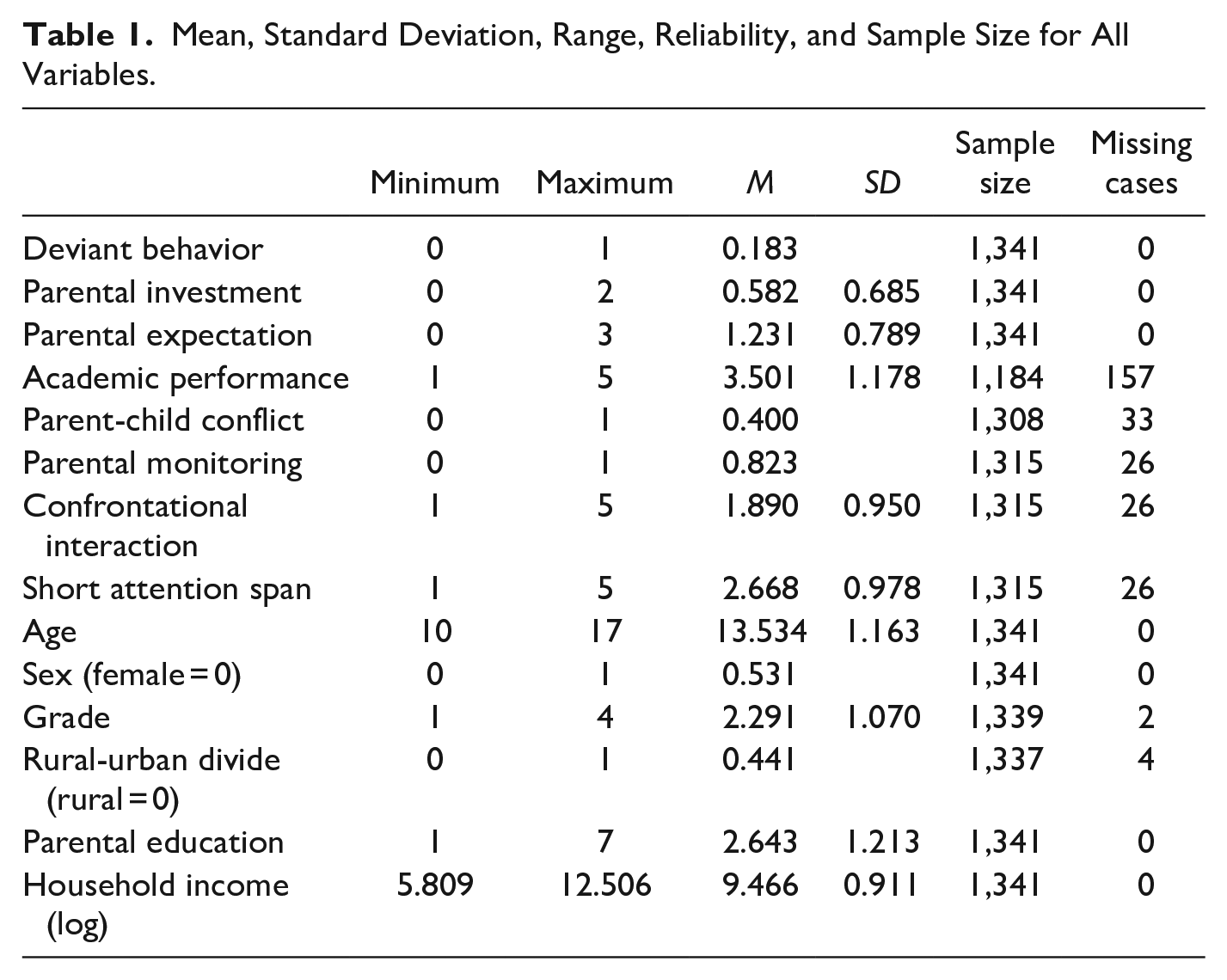
The data for this study came from the China Family Panel Studies (CFPS), a nationally representative, annual longitudinal survey of Chinese communities, families, and individuals. The CFPS is funded by Peking University and the National Natural Science Foundation of China and maintained by the Institute of Social Science Survey of Peking University. CFPS implemented its baseline survey in 2010, representing 95% of the Chinese population (Xie & Hu, 2014), and conducted five waves of follow-up surveys biennially from 2012 to 2020, using a multistage probability proportional to size sampling with implicit stratification. The current study analyzed data from the 2018 survey. It is the most recent wave that asked questions related to our outcome measure. We kept children and adolescents who completed the survey on their own on these deviance questions (rather than parents helping answer these questions) for greater validity of the data (n = 2,369). Because parents invest in children’s education more intensively when they are graduating from primary school and in middle and high schools compared to earlier years, we included respondents who were 6th to 12th grade in the sample. That is, children who were in 1 to 5th grades in primary schools (n = 986) and adolescents who were in professional schools (n = 15) were excluded from this study, yielding a final sample of 1,341 children and adolescents. Among them, 53.1% were boys and 44.1% lived in urban areas. Their ages ranged from 10 to 17 years, with an average of 13.53 years. Due to the survey design of CFPS, most of the respondents were in primary school and junior high school, with 29.9% in primary grade 6, 28.2% in junior 1, 24.9% in junior 2, and 17.0% in junior three or higher grades. Table 1 provides more information on the characteristics of the sample.
Mean, Standard Deviation, Range, Reliability, and Sample Size for All Variables.
Measurement
The dependent variable deviant behavior was measured by asking the children and adolescents if they had ever skipped a class, smoked, drunk alcohol frequently (three times per week in the previous month), visited public places where minors are not permitted (i.e., KTV, disco bar, and net bar), or had a boyfriend/girlfriend in the previous 12 months. In addition to smoking, drinking, and visiting net bars, which have been used to measure deviant behavior in the literature (e.g., X. Chen, 2021), the other items are also being formally or informally forbidden or disapproved of and thus seen as deviant for primary, middle and high school students in China. Each of the items was coded as 1 = yes and 0 = no. After adding them all up, the final index of deviant behavior was transformed to a dichotomous variable considering its highly skewed distribution: 0 = no deviant behavior at all, 1 = one or more deviant behaviors. Eighty percent (81.7%) of the respondents had engaged in no deviant behavior, whereas 18.3% had engaged in one or more deviant behaviors.
Parental expectation and educational investment, which denoted the fever of education among Chinese families, were the key independent variables. Parental expectation was measured by asking parents whether had expected the child to achieve full marks in exams, thought about sending the child to study abroad, and expected the child to finish a bachelor’s degree and above. These items in the dataset are similar to the High Parental Expectations scale’s questions (Fuligni, 1997). The final additive index of these three binary items (1 = yes, 0 = no) had values ranging from 0 to 3. Educational investment, then, was assessed by recording whether parents had sent the child to participate in tutoring in the previous month, started saving money for the child’s education, paid a sponsorship fee, pulled some strings, or had ever moved or changed the place of household registration for the child to be admitted into the school. These items represent Chinese parents’ major forms of investment in children’s education and thus address the specific context of education fever in China. The final index of educational investment was created by adding these five binary items (1 = yes, 0 = no) and then recoding the additive scale to consist of three values ranging from 0 to 2, with 2 representing reporting two or more items of investment.
Then, depression was a composite variable with the final score being the sum of scores for a subset of eight CES-D (Center for Epidemiologic Studies Depression) scale questions. The Cronbach’s α was .77. The scores among our sample children were 12.02 on average, ranging from 8 to 28, with higher values indicating more severe depressive symptoms.
A net of individual and household characteristics associated with deviance were also included in the models as covariates. To prevent the potential confounding effect of academic performance, children’s academic performance was controlled by asking children where they ranked in class on the most recent middle or final exam. In China, primary, middle, and high schools use a rank-based grading system instead of a grade-point-average system. These middle or final exams are comprehensive, inclusive of multiple subjects, and are highly valued by students and parents. Student ranking in these exams is shared with all students and parents and provides insight regarding how a child performed compared to other students, hence a typical measure of academic performance in China.
Children’s age, gender (0 = female, 1 = male), and grade were included as these were common demographic measures used in the literature. We also controlled for the rural-urban divide of respondents’ living regions (0 = rural area, 1 = urban area) because of China’s uneven rural-urban development. Concerning family characteristics and the reality of high inequality in China, we controlled for parental education, the average education level of both parents, and household income, which was coded into the log of the annual net family income per capita. Moreover, we controlled for parent-child conflict (assessed by asking the respondents if they had quarreled with their parents in the previous month; 1 = yes, 0 = no) and parental monitoring (assessed by asking respondents if their parents knew whom they were with when they were not at home; 1 = yes, 0 = no). These two variables represented typical measures of parent-child bonding and control in the deviance literature. Two sets of individual characteristics—confrontational interaction and short attention span—were also included as covariates because they are linked to self-control, another important factor that affects adolescent delinquency (Roberts et al., 2009). The measure confrontational interaction was a one-item scale, asking the respondents if they often argued with other kids; the measure short attention span consisted of two items, asking if respondents found it difficult to pay attention and got distracted easily. Response categories for items of both indexes ranged from 1 to 5, with 1 representing totally inapplicable and 5 representing totally applicable. The Cronbach’s alpha of short attention span was over .6, indicating moderate reliability.
Table 1 provides a detailed description of our variables (mean, standard deviation, range, and sample size).
Analysis
To investigate the associations between parental expectation and investment in education and the child’s deviant behavior with confounding factors controlled, a series of binary logistic regression models were conducted. We applied the Full Information Maximum Likelihood (FIML) approach to address missing data, which provides efficient estimations of statistical parameters and less biased estimates of standard errors compared with other missing data imputation methods (Schafer, 1997). A preliminary missing data analysis indicated that the assumption of MAR (missing at random)—the assumption employed by FIML—was valid. The results revealed that the scores of parental education, parent-child conflict (quarrel), and parental monitoring (whether parents know where the child was) were slightly lower in the missing data; however, missingness was not significantly associated with the dependent variables (CESD and deviant behaviors) and other independent variables. All our multivariate analyses were conducted in Mplus 8 (Muthén & Muthén, 2012).
Results
The Level of Educational Expectation and Investment
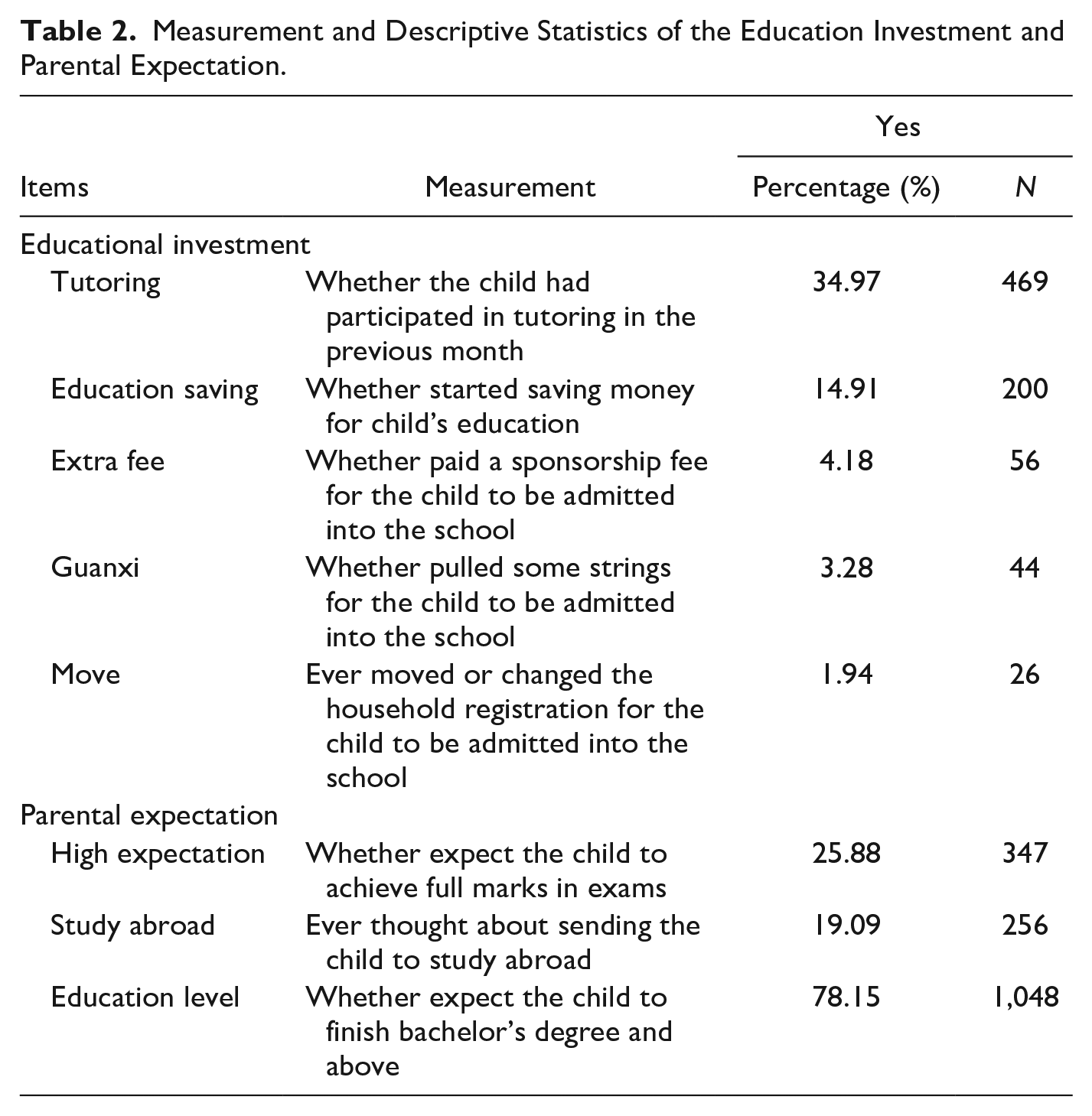
Table 2 shows the frequency distributions of the five items that form the educational investment variable and the three items that form the educational expectation variable. Among the parents of our sample adolescents, 78.2% expected their children to receive at least a bachelor’s degree, one quarter (25.9%) of them had expected the child to achieve full marks in exams, and 19.1% had ever thought about sending their children to study abroad. When combined, more than 51% of the parents held one of the expectations, and 26% held two. With regard to investment, 35.0% of the parents had sent their children to participate in tutoring in the month before taking the survey. About 15% had started saving money for a child’s education. A relatively small proportion of parents had made extra efforts for their children to get admitted into certain schools—most often key-point schools with significantly better teachers, facilities, and academic performance. Specifically, 4.2% had paid a sponsorship fee, 3.3% had pulled some strings, and 1.9% had moved or changed the household registration to get their children into key schools. Taken together, more than 46% of the parents in our sample had made at least one of these investments in their children’s education.
Measurement and Descriptive Statistics of the Education Investment and Parental Expectation.
The Effect of Educational Expectation and Investment on Deviance
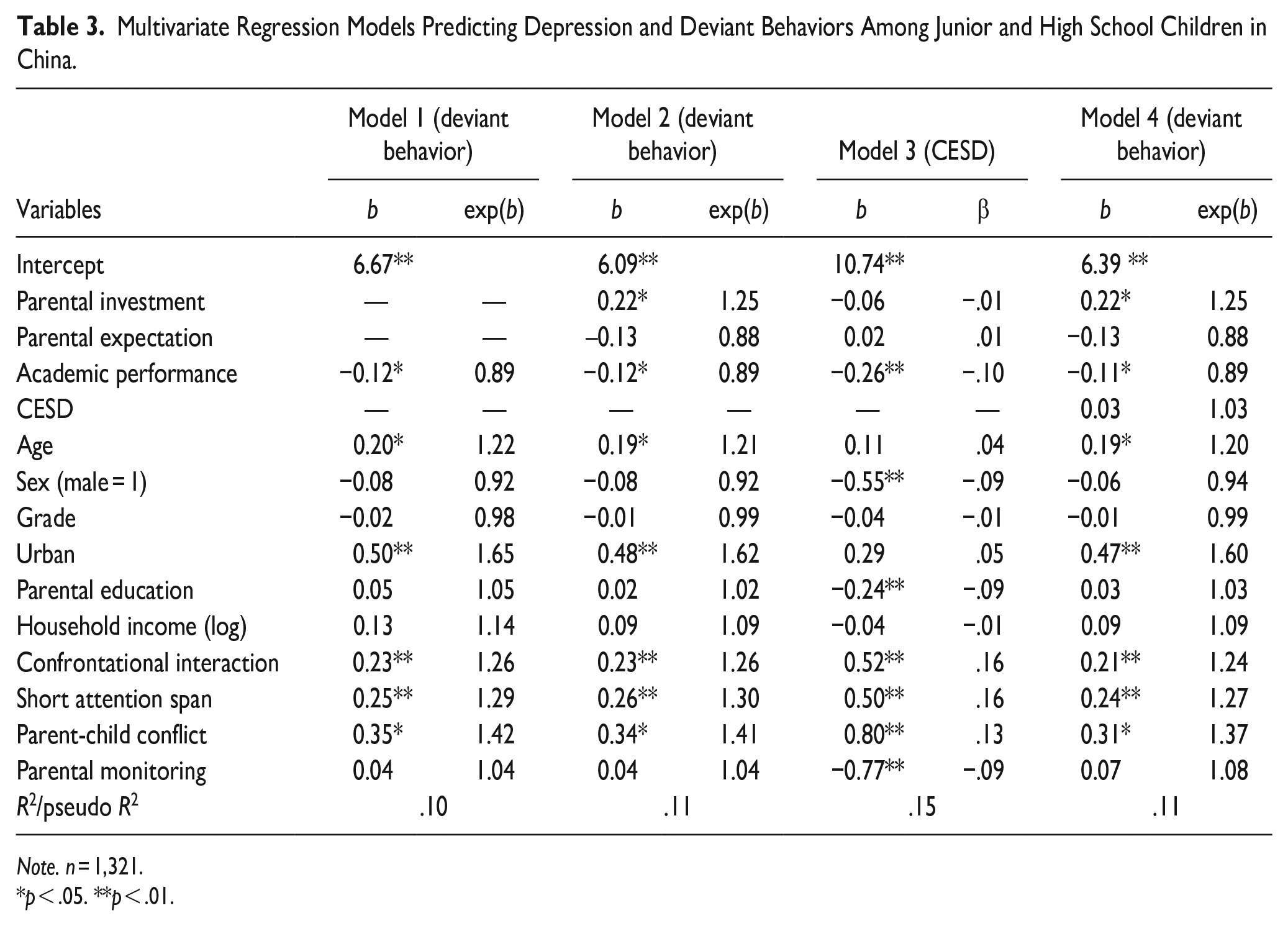
Table 3 reports the results of binary logistic regression analysis on children’s deviant behavior. Model 1 assessed whether academic performance, along with individual and family characteristics, was associated with children’s deviant behavior. According to the result, children’s academic performance was negatively related to their deviant behaviors (exp(b) = .886, p < .05). An older age (exp(b) = 1.22, p < .05) and living in urban areas (exp(b) = 1.65, p < .01) were connected to more deviant behaviors. Additionally, children who had exhibited a confrontational interaction style (exp(b) = 1.26, p < .01), had a short attention span (exp(b) = 1.29, p < .01), and had a conflict with their parents (exp(b) = 1.42, p < .05) had significantly more deviant behaviors than those who had not.
Multivariate Regression Models Predicting Depression and Deviant Behaviors Among Junior and High School Children in China.
Note. n = 1,321.
p < .05. **p < .01.
Model 2 presented the results of the logistic regression analysis on the relationship between education fever and children’s deviant behavior, controlling for educational performance and individual and family characteristics. According to the results, the investment that parents made in children’s education significantly increased children’s deviant behaviors (exp(b) = 1.25, p < .05), net of all controls including family socioeconomic status. That is, regardless of children’s family socioeconomic condition (e.g., household income and parental education levels), greater investment is linked to greater deviance. Meanwhile, the parental expectation of children’s education yielded an insignificant effect on children’s deviant behavior. After including the expectation and the investment variables, the correlation between academic performance and deviant behavior remained significant (exp(b) = 0.89, p < .05), indicating that children with better academic performance reported a lower level of deviance. Similar consistencies were found in the correlations of children’s deviant behavior with their age (exp(b) = 1.21, p < .05), living in urban areas (exp(b) = 1.62, p < .05), experiencing a confrontational interactional style (exp(b) = 1.26, p < .01), having a short attention span (exp(b) = 1.30, p < .01), and having conflict with parents (exp(b) = 1.41, p < .05).
Model 3 and Model 4 tested the role of depression as a mediator in the relationship between education fever and children’s deviant behavior. As the results show, parental expectation and parental investment had no effect on CESD (Model 3). At the same time, CESD had no effect on deviant behavior (Model 4). In other words, depression does not mediate the association between parental expectation/investment and children’s deviant behavior. Nonetheless, the correlation between academic performance and CESD was significant (b = −0.26, p < .01), suggesting that children who performed better in exams had a lower risk of depression.
Discussion and Conclusion
The historical educational enthusiasm in China has been brought to a new height during the recent two decades when education fever spreads nationwide across social classes and areas. While previous research has examined the effects of academic stress on children’s development, it largely overlooked the roles of parental expectation of children’s academic performance and investment in both compulsory education and shadow education of their children in shaping deviance. Particularly, deviance-promoting strain may be caused by high parental expectations regardless of children’s academic performance, and heavy parental investment that can take a toll on both parents and children in China. Drawing on a nationally representative sample of adolescents in China, our study demonstrates that education fever is a prevalent, but largely neglected, source of strain for Chinese children, and it results in unintended consequences such as children’s use of deviant coping methods.
The first contribution of this study is that it extends Agnew’s theoretical propositions by identifying a new type of education-based strain generally ignored or overlooked by previous GST literature. Agnew (20001) posited that it is poor academic performance rather than the failure to achieve positive educational goals that causes crime and delinquency. Our study suggests that regardless of children’s academic performance, education fever contributes to deviance. Perhaps “failure” is in the eyes of the beholder and the perception of “poor” performance is relative. In an environment filled with education fever, when parents invest inordinate amounts of money, time, and energy in children’s education, children are expected to be overachievers who must partake in the endless cycles of competition or otherwise considered a “failure.” As a result, children stretch themselves to study hard and constantly, sacrificing other aspects of life and suffering tremendous pressure and stress, potentially leading to deviant behaviors.
Another important finding of this study is that parental investment is a strong predictor of children’s deviance, more significant than parental expectation in affecting deviance. Children whose parents put a greater amount of investment into their education report more deviant behaviors, suggesting higher levels of strain that they are subject to. This effect remains significant after controlling for children’s academic performance, levels of self-control (e.g., attention span and confrontational interaction), and social control (e.g., parental monitoring), as well as other family and individual traits (e.g., household income and parental education). Parents’ expectations of their children’s success, on the other hand, are unrelated to children’s deviant behaviors. This finding perhaps is not surprising given the traditional emphasis of Chinese culture on education that may have desensitized children’s responses to parents’ high educational expectations. Instead of being a source of strain, parents’ high expectation of children’s academic performance has been a reality that Chinese children and adolescents have grown accustomed to since young age.
The differential effects of parental investment and expectation reaffirm the value to continue assessing the role of parental investment as a source of education-related strain and a predictor of children’s deviant behaviors. Indeed, parental investment goes beyond parental expectations that previous research in Western societies tends to focus on, by entailing an intensive financial and material commitment that transcends ambitions. This study shows that at least in the Chinese context, exceeding parental investment has constituted a salient source of deviance-producing strain for children and adolescents. Being a type of strain that is likely frequent, chronic, strong, and recent, as well as potentially viewed by children as unescapable and unjust, leading to deviant behaviors. These findings supported Agnew’s general strain theory and demonstrated that education fever, embodied chiefly by Chinese parents’ excessive investments in their children’s education, creates a stressful and harmful environment for Chinese children and adolescents. Surprisingly, we found no evidence that parental investment or expectation affects children’s depression levels, and the latter does not mediate the effect of strain caused by parental investment or expectation on deviance. This finding suggests that high level of parental involvement and care does not increase children’s depression. Future research, upon the availability of data, should investigate additional types of negative emotions, such as fear, inadequacy, guilt, anxiety, and anger. We did, however, confirm that poor academic performance increased their chances of depression.
Our findings also confirm the existence of education fever in China. Most parents of the sample adolescents had been involved in at least one of the investment items, ranging from sending children to costly private tutoring to purchasing expensive school-district apartments to get their children enrolled in good schools. As repeatedly mentioned in this paper, the strain stemming from the constant rat race, Jiwa parenting, and involution negatively impact adults and children across an overwhelming majority of the population. To cope with the seemingly hopeless social competition, some millennials claimed to “lie flat” (躺平) and live an intentionally disheartened lifestyle, advocating a defeatist attitude toward life and careers in contrast to the traditional values of ambition and grueling work ethics. This reflects the fact that the strain has become too ubiquitous to resist, therefore young adults could only adopt a relatively negative and introverted method as their response. For children and adolescents, however, “lie flat” is likely not an option as parents will not allow it to happen in a culture of persisting education fever. As children in China are expected and socialized to obey their parents’ arrangements and fulfill their parents’ expectations, strain can remain particularly high among children and adolescents, generating deviant behaviors.
These findings and their implications warrant policies and measures to cool the education fever down, or at least to reduce students’ academic stress. China’s central government enacted the “double reduction” (双减) policy in July 2021 to reduce the homework and off-campus training burdens of students in compulsory education (i.e., students from grades one through nine). Following the implementation of this policy, the government prohibited profitable extra-curricular counseling for most school-age children. As a result, many educational and training institutions were closed, and opportunities for shadow education appeared to decrease. Although there is currently no empirical research on the actual effect of the “double reduction” policy, it has failed to address the fundamental issue of the fierce social competition in promoting education fever and may even have the potential of widening the inequalities in educational opportunities and resources as rich families can continue to utilize expensive private tutoring services. In addition, given the impact of the COVID-19 pandemic and changes in China’s population structure, the country is going through high unemployment and social competition appears to be more fierce than ever (Bloomberg News, 2022). Thus, we argue that the education fever and the concomitant strain will likely persist and even intensify in the future, calling for continuing attention to the effect of education fever on children’s development including deviant behaviors.
This study has some limitations that point to further research directions. First, because CFPS does not ask about crime and delinquency, we did not use established scales commonly used in criminology studies. Instead, we constructed the variable of deviant behavior based on relevant questions from the CFPS survey. Future research should test if our theoretical model can explain adolescent delinquency as well, especially those more serious forms of delinquency. Similarly, we created the indexes of parental expectation and educational investment using variables available from the dataset. Although our measurement served the purpose of this study well by highlighting some major forms of parental educational investment in the specific context of education fever in China, future research should validate our findings by using similar scales as well as extend our measures by including both generally-established and culturally-specific measures. Second, while our study is the first to use a nationally representative sample to study parental expectations of and investment in children’s education among studies of juvenile deviance in China, the sample does not include school dropouts, juveniles in professional schools, and juveniles involved in criminal justice institutions. Despite being small in numbers, these groups of children and adolescents are at higher risks of deviance than sample students and the levels and consequences of their parents’ educational expectations and investment remain unexamined. Future studies should take these children and adolescents into account when studying the influence of education fever on deviance. Third, due to the constraint of data, this study uses one wave of CFPS and cannot draw definite conclusions on causal relationships. Future research should collect longitudinal panel data with shorter time gaps between waves and a lower sample attrition rate. Fourth, also due to the limitation of using secondary data, we cannot include some potentially important predictors in the analysis. For example, as there are no questions about self-control in the CFPS questionnaire, we used confrontational interactional styles and a short attention span as covariates, which capture some key dimensions but not all elements of the concept of self-control. Likewise, because there are no questions about peers in the CFPS questionnaire, we were unable to control for association with delinquent peers, another potentially significant risk factor for deviance. Although the academic performance variable is often found related to both self-control and association with delinquent peers (Sankey & Huon, 1999), future studies should investigate the effects of self-control and delinquent peers directly. Finally, we conceptualized educational strain in the context of China as being of high magnitude, based on the measurement of stress magnitude proposed by Agnew. Yet, we were unable to test it, leaving it as a question for future research.
Recognizing these limitations, the findings nevertheless have provided new insights into the risk factors of adolescent deviance in China. While previous research primarily focused on micro-level factors, such as gender, self-control, and attachment (Weng et al., 2016), our study examines the correlates of delinquency from a broader societal context. Our findings demonstrate that education fever, particularly involving massive educational investment, has formed a culturally distinct source of strain that leads to children’s deviant behaviors. Extending the arguments of GST, we reconfirm the values of constructing and testing culturally sensitive measures and theories (Braithwaite, 2015; J. Liu, 2018; Messner, 2015) and lays the groundwork for future research on adolescent deviance and delinquency in China and other Asian countries that experience similar education fever.
Footnotes
Declaration of Conflicting Interests
The author(s) declared no potential conflicts of interest with respect to the research, authorship, and/or publication of this article.
Funding
The author(s) received no financial support for the research, authorship, and/or publication of this article.
