







Abstract
To examine if police expressions of solidary with protesters improve public opinion toward the police, we embedded a picture- and information-based experiment in a YouGov survey (N = 1,150), wherein respondents were randomly exposed to police expressions of solidarity with protesters. We also randomized whether the pictured officers were wearing riot gear. We find little evidence that expressions of solidarity or riot gear significantly affect public affinity for the police or support for accountability reforms in policing. Past studies show that outside of the context of protests, officers’ behavior toward civilians has asymmetric effects, such that positive actions matter less than negative ones. Our findings suggest that this may be true within the protest context as well.
While already amid a legitimacy crisis after the killings of unarmed Black victims such as Eric Garner, Michael Brown, and Philando Castille, the protests that erupted after the murder of George Floyd initiated a new vigor to challenges to police legitimacy. Those protests were the largest and most diverse in U.S. history (Fisher & Rouse, 2022). Likewise, and even if generally unpopular, the defund and abolish movement was introduced to mainstream discourse and became a serious proposal among some activists. That is, Floyd’s murder—which most of the public found egregious (Skelley, 2020)—legitimized criticisms of systemic racism within police departments, as evidenced by sharp increases in public perceptions of police unfavorability (Reny & Newman, 2021). By expressing solidarity with protesters, some law enforcement agencies tried to stop the bleeding of their public support by expressing their shared outrage over the murder of George Floyd.
It started in Flint, Michigan, where the county Sheriff decided to take off his helmet and march with protesters. Chris Swanson, the Genesee County Sheriff, was quoted as saying: This is the way it’s supposed to be — the police working with the community. . .When we see injustice, we call it out on the police side and on the community side. All we had to do was talk to them, and now we’re walking with them. The cops in this community, we condemn what happened. That guy [Derek Chauvin] is not one of us. (May, 2020)
Other departments in many cities, including Camden, Houston, Denver, Miami, and New York City, quickly followed suit, attempting to morally align themselves with protesters by expressing solidarity with them. The Denver Police department chief, for example, linked arms and marched with protesters. Other police officers and high-ranking administrators displayed similar acts of solidarity, including hugging and shaking hands with protesters (Silverman, 2020). In Camden, the police department marched with protesters and initiated broader community engagement efforts, such as neighborhood block parties and potlucks (Verma, 2020). Former President Barack Obama commended the Genesee County Sheriff’s Department and Camden County Police Department specifically for their supportive response to BLM protests. Speaking on the protests and protesters, Obama (2020) wrote, “They deserve our respect and support, not condemnation—something that police in cities like Camden and Flint have commendably understood.” The goal of participating law enforcement agencies was seemingly to signal that they share a normative concern about the appropriate wielding of their powers as an institution authorized to use force against civilians, as well as recognize the concerns of those protesting them. The question that remains is: Does such signaling affect public opinion and, if so, for whom?
Our study explores the efficacy of symbolic solidarity demonstrations in fostering public trust. Though purely symbolic, by demonstrating outrage over the murder of George Floyd (signaling shared values) and acknowledging the voice of civilians who are concerned about police violence, officers may generate trust and identification among observers that identify with BLM protesters and their cause (e.g., Jackson, 2018; Radburn & Stott, 2019). In fact, although not focusing on protests specifically, existing theory and research indicate that the public’s policing attitudes often hinge on beliefs about whether officers are normatively aligned with civilians—that is, hold similar values (Huq et al., 2017; Jackson & Sunshine, 2007). In addition to being a means of deescalating tension at protests, police expressions of solidarity with BLM protesters were an apparent attempt to morally align themselves among civilians that perceive the police as racist.
Another question our study addresses is whether officers’ efforts to demonstrate solidarity with protesters are undercut when they wear riot gear. Stated differently, law enforcement’s ability to generate moral identification by expressing shared values with protesters may be counteracted by their use of riot gear. Riot gear may strain civilians’ ability to relate to an officer “who looks and acts like a soldier or robot” rather than a human being (Maguire & Oakley, 2020, pp. 54–55). Additionally, academics and practitioners alike express concern that officers seen in riot gear can, rather than deter protesters, provoke them (Maguire & Oakley, 2020; President’s Task Force on 21st Century Policing, 2015). Building on Mummolo’s (2018) findings that militarized policing may alienate the public, we experimentally test whether solidarity-expression efforts fail when the police joining protesters are clad in riot gear.
The contribution of the current study is thus twofold. We provide the first experimental test of whether officers’ displays of solidarity with BLM protesters—perhaps the clearest affirmation of shared values with protesting civilians and recognition of their voice—affect public opinion on policing. Second, we test whether any beneficial effects of such displays are diminished when officers wear riot gear. To do so, we embedded an information- and picture-based experiment in a survey administered in 2021 to a population-matched (by YouGov) national sample (N = 1,150). We test the effects of the experimental manipulations on two outcomes: affinity for the police and support for accountability reforms in policing (e.g., civilian oversight boards). We also test for effect heterogeneity, exploring whether the manipulations have similar effects across theoretically relevant cleavages (e.g., race, political party, racial attitudes, procedural justice perceptions).
Moral Alignment: Prior Theory and Research
Moral alignment—also referred to as normative alignment—is a component of police legitimacy. Grounded in the work of Durkheim, which argues that legal authorities are tasked not only with maintaining order but also with embodying group values, moral alignment refers to the degree to which the police are perceived to represent the values of civilians and their communities (Jackson et al., 2012; Jackson & Sunshine, 2007; Sunshine & Tyler, 2003a). That is, the police are not solely law enforcers, but representatives of a community’s collective conscious. When the police are seen as preservers of normative values and boundaries, individuals naturally develop an affinity with the institution that has a chief role in maintaining shared group values. Underlying legitimation through normative alignment is a psychological process in which individuals are motivated to identify with legal authorities (Bradford et al., 2014; T. R. Tyler & Blader, 2003).
According to the procedural justice literature, the way police cement their role as community guardians and engender normative alignment is through interpersonal interactions with the public that not only demonstrate law enforcement’s proper behavior, but also signals inclusion in the superordinate group the police represent (Huq et al., 2017). That is, high-quality treatment results in civilians identifying more strongly with the police who they perceive to hold shared values about the normative expectations of authority (Huq et al., 2017; Jackson & Sunshine, 2007). Additionally, high-quality treatment from officers signals to civilians that their values matter and affirms their status as respected group members (T. R. Tyler & Blader, 2003). Rooted in social identity theory (Tajfel & Turner, 1979), policing interactions in this framework supply civilians with information about their status and inclusion within society (T. R. Tyler & Blader, 2003). The recognition of individuals as respected members of society and the identification it results in are a precondition of moral alignment (Oliveira & Jackson, 2022). Applying these ideas, previous studies have shown that high-quality interactions with police officers increase civilians’ identification with and confidence in the police (Huq et al., 2017; Jackson & Sunshine, 2007; Murphy et al., 2022). However, a lack of perceived normative alignment may not result solely from experiencing procedural injustice, but rather from a broader socio-political and structural context that imposes on citizens of race-class subjugated communities “cumulative, collective experiences of procedural and substantive injustice” (Bell, 2017, p. 2105; see also Oliveira & Jackson, 2022).
The daily reality of racial profiling, excessive use of force, incessant surveillance, and other systemic injustices (Epp et al., 2014; Lerman & Weaver, 2014; Stuart, 2016), which sparked the historic protests, disrupts the potential for normative alignment among those subject to the brunt of these practices (Oliveira & Jackson, 2022). Supporting this idea, Jackson et al. (2023) found that perceptions of over-policing and under-policing in Black communities (systemic racism) were negatively related to police legitimacy, independent of other theoretical predictors (e.g., procedural justice, bounded authority). Consequently, engendering normative alignment is about not merely improving police interactions, but also initiating broader systemic changes in policing that indicate law enforcement agencies are adhering to shared values and expectations. How, then, might symbolic gestures of solidarity facilitate normative alignment with those lacking the feeling?
Although police legitimacy research typically focuses on procedural justice as a primary antecedent of normative alignment (Jackson et al., 2012; Oliveira & Jackson, 2022), police departments may also employ symbolic efforts at the organizational level to foster legitimacy (Worden & McLean, 2017a). This observation is especially pertinent in the context of protests (Maguire & Oakley, 2020; O’Brien et al., 2020). As Radburn et al. (2018, p. 69) explained, “many encounters between police and public, particularly in crowd events, have a quite different form . . . people experiencing policing may do so not as an individual but as a member of a social category such as a protester, football fan, or broadly disinterested observer of the policing of others in crowds.” In their study, Radburn et al. (2018) found that the identity of protesters in a survey experiment influenced identification with the police, highlighting how evaluations of police responses to protests is contingent on the interaction of identity and context (e.g., intergroup conflict, history; see also Radburn & Stott, 2019). Jonathan-Zamir et al. (2021) made similar theoretical arguments, emphasizing that the beneficial effects of high-quality treatment extend beyond one-on-one interactions with officers to how police departments interact with social groups and communities more broadly. In the context of the current study, the symbolic message of unity and solidarity with protesters stands in sharp contrast to the repressive policing that reifies the marginal status of protesters by symbolizing the domination of race-class subjugated communities (Gamal, 2016; Hinton, 2021; Purnell, 2022). Rather, acts of solidarity and unity are akin to respectful, procedurally just treatment that suggests police view individuals as “equal social, moral, and political agents” at the group level (Oliveira & Jackson, 2022, p. 129).
Theoretically, by expressing solidarity with protesters, participating police departments may engender perceived moral alignment. Indeed, protests over policing may be an especially important context for signaling moral alignment because “protesting is one of the last and most significant steps in the public’s effort to communicate its concerns to authorities” (Novick & Pickett, 2022, p. 4). Although the specific actions of various law enforcement agencies differed, law enforcement agencies that did symbolically embrace protesters ostensibly shared the same general goals: to demonstrate their mutual outrage toward the murder of George Floyd, as well as to recognize and legitimate the concerns of protesters. Though police acts of solidarity are merely symbolic, it is a symbolic action that is oriented toward displaying unity and shared concern over proper and just behavior, and even symbolic actions may generate legitimacy (Worden & McLean, 2017a). The act of solidarity, that is, is meant to send a message that police have the same moral value of respecting human life and dignity. Thus, the intended message is one that suggests that police share the common goal of reducing police violence, even if they do not share the same views about how exactly to accomplish this goal.
Expressing shared values by showing respect for the legitimate concerns of those protesting against police violence, as well as acknowledging the voice of protesters, may enhance the societal ties between the public and the police. As police interactions are “teachable moments” (T. R. Tyler et al., 2014), efforts to engage with protesters rather than strictly control them may be especially influential (Maguire & Oakley, 2020). Officers’ validation of the concerns of protesters may result in civilians feeling prouder to identify with the police (Blader & Tyler, 2009; T. R. Tyler & Blader, 2003). There is some empirical evidence for this contention as well. In the United Kingdom, Stott et al. (2012) found that the transition from deterrence-based crowd control tactics to those aimed at fostering dialogue increased identification with the police among “football hooligans” based on qualitative interviews with fans. Theoretically, identification with the police, in turn, leads to an internalization of the goals, values, and motivations of policing (Kyprianides et al., 2021; Trinkner, 2019). Based on these theoretical insights, we hypothesize that:
H 1: Exposure to officers’ expressions of solidarity with BLM protesters will increase civilians’ affinity for the police.
By generating moral alignment, police departments’ efforts to express shared values may also affect the perceived need for police reform. Specifically, such displays may result in the police being viewed as more trustworthy and, therefore, less in need of additional accountability mechanisms to curb officer misbehavior. Additionally, if expressions of solidarity do generate moral alignment, which leads observers to internalize the goals of policing (Trinkner, 2019), it may result in a hesitancy to establish wide-ranging reforms that could limit the ability of the police to fight crime. Indeed, previous survey research has linked police legitimacy with a willingness to empower the police (Metcalfe & Hodge, 2018; Moule et al., 2019; Sunshine & Tyler, 2003b). Empowerment refers to providing the police discretionary authority by giving them more leeway in their crime control efforts (Sunshine & Tyler, 2003b). Accordingly, the second hypothesis that we test is as follows:
H2: Exposure to officers’ expressions of solidarity with BLM protesters will reduce civilians’ support for accountability reforms in policing.
Potential Effects of Riot Gear on Public Opinion
Since the militarized response to protests in the aftermath of the Michael Brown shooting, the militarization of the police has become a salient political issue and target of police reform activists (Gamal, 2016; President’s Task Force on 21st Century Policing, 2015). At issue is not only the practical significance of police militarization (e.g., aggressive policing disproportionately experienced by communities of color; Meeks, 2006), but the symbolic connotation as well. By blurring the line between peace officer and soldier, riot gear may aggrandize the perception of police as the “visible sign of majority domination” (Bayley & Mendelsohn, 1969, p. 195). Riot gear may symbolize aggression, control, and occupation (e.g., President’s Task Force on 21st Century Policing, 2015), which might undercut civilians’ ability to identify or empathize with the police (e.g., Meeks, 2006; Mummolo, 2018). For these reasons, officers clad in riot gear can antagonize and embolden protesters (Maguire & Oakley, 2020; President’s Task Force on 21st Century Policing, 2015). As Edward Maguire told the President’s Task Force on 21st Century Policing (2015, p. 25), “When officers line up in a military formation while wearing full protective gear, their visual appearance may have a dramatic influence on how the crowd perceives them and how the event ends.” Even for civilians who are not present at protests, seeing pictures or videos of officers in riot gear opposing protesters is likely to have similar effects.
Indeed, some experimental research suggests that exposing civilians to images of militarized officers (e.g., wearing riot gear uniforms and brandishing semi-automatic rifles) may decrease their support for the police (Mummolo, 2018). Similarly, studies conducted by Simpson (2017, 2020) suggest that the public views police more favorably when officers are seen wearing accessories (e.g., yellow vest) and doing activities (e.g., bike/foot patrol) that signal guardianship and views them less favorably when officers carry accessories (e.g., sunglasses, baton, black gloves) that signal aggressive intentions. The existing evidence is not unequivocal, however. Another recent study that randomly assigned participants to see an image of police officers pointing rifles at protesters while in riot gear did not find that it significantly affected perceived police effectiveness, misconduct, or bias either at the national or local level (Wozniak et al., 2021). Importantly, however, that study was conducted before the murder of George Floyd. Popular concern with police militarization may have grown since the 2020 to 2021 BLM protests, as some evidence suggests that public opinion on policing shifted starkly during this time period (Reny & Newman, 2021). Perhaps even more relevant, the experimental treatment in Wozniak et al. (2021) made it impossible to isolate the effects of officers’ uniform choice (wearing riot gear) from their actual use of force (pointing rifles at protesters). Additionally, none of the studies to date tested how exposure to riot-gear-clad officers who are otherwise engaging in normatively positive behavior (e.g., expressing solidarity with protesters) influences public attitudes.
H3: Respondents will express less affinity for the police when presented with images of officers expressing solidarity with protesters in riot gear compared to respondents presented with images of officers expressing solidarity in their normal uniforms.
H4: Respondents will express more support for police accountability reforms when presented with images of officers expressing solidarity with protesters in riot gear compared to respondents presented with images of officers expressing solidarity in their normal uniforms.
Effect Heterogeneity: Why Different Groups Might
Respond Differently to Protest Policing
If there is one takeaway from recent research on public attitudes and reactions to policing, it is that they often vary depending on civilians’ race, political identification, and pre-existing attitudes (e.g., about race or policing) (Bradford et al., 2014; Metcalfe & Pickett, 2022; Pickett et al., 2022; Reny & Newman, 2021). By extension, it is also possible that any effect of officers’ solidarity-expression efforts at protests may be heterogeneous depending on civilian characteristics (demographic, political, and attitudinal) that engender different baseline orientations toward the police (Kyprianides et al., 2021; Stott et al., 2012). After all, in joining protesters in solidarity, police signal their shared values with groups that generally have less trust in the police specifically. Conversely, civilians who are already morally and politically aligned with the police may be aggravated by officers joining BLM protesters in solidarity, as it legitimizes the protest goals, which may contradict such civilians’ racial and political interests (e.g., Gamal, 2016; Metcalfe & Pickett, 2022). Seeing police officers lending legitimacy to BLM protesters, for instance, may anger racially resentful participants because such actions betray their perceived racial allyship with police (Carlson, 2020). Similarly, those that exhibit less faith in police may be impacted more positively by police expressions of solidarity, as those expressions include symbolic efforts by the police to acknowledge systemic problems in policing. Thus, we examine if the effects of the experimental conditions hinge on the race, political identification, racial attitudes, and global procedural justice evaluations of respondents.
The theoretical possibility of moderation extends to the potential nullifying impact of riot gear on any beneficial effects of officers’ solidarity-expression efforts. For instance, prior research shows that political beliefs, as well as race and procedural justice evaluations, are related to support for police militarization (Fox et al., 2018; Moule et al., 2019). In the same way, certain civilians (Black Americans, Democrats, racial progressives, and those perceiving less procedural justice) may be more sensitive to officer uniforms in the context of protest policing. For these reasons, then, we also test whether the effects of officers’ solidarity-expression efforts and uniform choices exert different effects among subgroups of Americans defined by race, political affiliation, policing attitudes, and racial resentment.
Method
The data for our study come from a YouGov survey administered in March 2021 (N = 1,150) and include a large oversample of Black Americans (N = 517) to effectively examine the moderating role of race. YouGov, a leading survey research platform designed for model-based inference, utilizes a synthetic sampling frame (based on probability samples) to administer a survey to a nationwide sample drawn from its online panel of millions of U.S. residents. Surveys administered by YouGov are representative on core demographics such as race, age, sex, and education (Ansolabehere & Schaffner, 2014; Schaffner et al., 2021). Extensive evidence shows that YouGov data are high quality and that even non-experimental findings (prevalence estimates, correlations) from its samples normally generalize to the U.S. public (Ansolabehere & Schaffner, 2014; Graham et al., 2021; Simmons & Bobo, 2015). There is also substantial evidence that experimental findings—the focus of our study—in online samples are even more likely to generalize (Mullinix et al., 2015; Peyton et al., 2021).
Experimental Procedure
Following previous studies that have used both text- and image-manipulations to study policing attitudes (Mummolo, 2018; Wozniak et al., 2021), we utilized a between-subjects design in which participants were randomly assigned to one of four experimental conditions. More specifically, our experimental design provided informational stimuli designed to convey normative alignment and generate positive emotions toward police. Evidence suggests that individuals may strongly react emotionally to news stories, especially when there is accompanying imagery (e.g., Höllerer et al., 2018; Klein & Amis, 2021; Maier et al., 2017). In the riot gear condition, there is an additional and contradictory stimulus, militarization, which may activate associated concepts such as police aggression, state control and repression, and racial and social injustice more broadly (Blaskovits et al., 2022; Mummolo, 2018). Previous studies have suggested that text- and image-manipulations have the potential to influence policing attitudes, as they have found significant and sizeable effects of such manipulations (Mullinix et al., 2021; Mummolo, 2018).
In our study, the first condition was a true control condition, and thus participants were not exposed to any information. In the second condition, the first treatment group, participants read the following text about officers joining BLM protesters in solidarity: As you may know, after the police killing of George Floyd in May 2020, protests erupted across the United States. Protesters demonstrated against police violence and in support of the Black Lives Matter movement. In numerous cities across the country, both large and small, POLICE OFFICERS JOINED PROTESTERS, expressing SOLIDARITY with them and SUPPORT for their cause. In cities such as Atlanta, Denver, and New York, police officers marched alongside protesters, kneeled with them, prayed with them, embraced them, and even held up their protest signs.
The first treatment group only received the above information, without any associated images. However, because pictures are more concrete than text descriptions, and may resonate more with observers and generate more visceral emotional responses (Reinka & Leach, 2017), the next two treatment groups received the same text as the first treatment group but with images appended to it. The inclusion of images is particularly important because much of the public’s vicarious exposure to policing now involves image-plus-text exposure, due to the rise of smartphones and social media (Brown, 2016; Toch, 2012; Vera & Krishnakumar, 2022). Thus, in addition to the text, participants in the second treatment group saw pictures of officers in their traditional uniforms kneeling, holding signs, and/or embracing protesters (see Figure 1). In the final treatment group, participants received the same text, but saw images of officers joining protesters in solidarity while wearing riot gear (see Figure 1). In other words, the images (and text) used for the second and third treatment groups held constant officers’ behavior and varied only their uniforms.
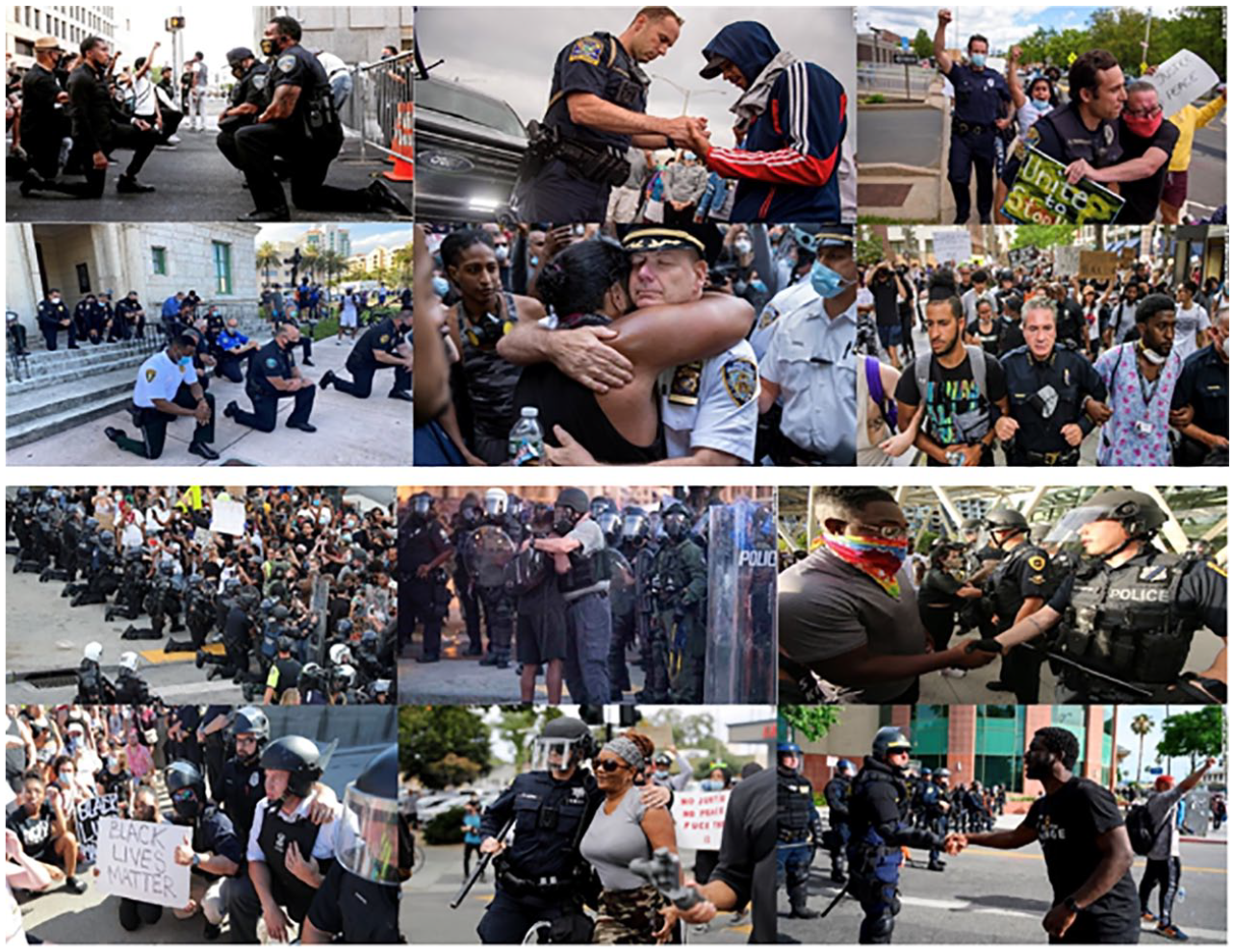
Photos shown in survey experiment.
To examine the validity of our experimental treatments, we analyzed responses to an open-ended, follow-up question that asked respondents in the treatment groups: “When you think about the way these police supported protesters, how does it make you feel?” Responses to that question were varied, but the vast majority included positive reactions toward law enforcement. Many of these responses either expressed general happiness about the news story (e.g., “happy”), hope, and optimism about the future of policing (e.g., “Unity like they understand the problem”), or support for law enforcement (“It makes me feel good and at a point in my life where I can see all cops are not bad cops”). This analysis gives us confidence that not only did our experimental treatments elicit reactions and thoughts from our participants but also that these reactions were largely in line with our theoretical expectations. That is, many respondents specifically mentioned that their faith in policing had been reaffirmed in some capacity.
Dependent Variables
We examine the effects of the experimental manipulations on two dependent variables theoretically related to moral alignment. The first is a 10-item index (α = .935) measuring expressed affinity with the police (McManus, 2022). Affinity for police can be theoretically conceptualized as an organic outcome of moral alignment that develops contiguously with perceptions of police as protectors of the moral order. Stated differently, affinity for the police reflects the emotional connection individuals have with the police when they perceive that the institution preserves the moral fabric of society. To capture that emotional connection, each item was designed to tap a dimension of identification with the police, including sympathizing with officers (e.g., “When police officers are being disrespected, I feel sorry for them”; “I find it easy to see things from the police officer’s point of view”) and recognizing the difficulty of their profession (e.g., “Before criticizing the police, I try to imagine how I would feel if I were in their place”). Each item was measured on a Likert scale (1 = strongly disagree, 5 = strongly agree). Each item loaded onto one factor (loadings: .653 to .826), and thus we combined them into an index based on factor scores. The full list of items for this index and for the one discussed below can be found in Supplemental Appendix A.
The second dependent variable is an 11-item index (α = .939) measuring support for accountability reforms in policing. If individuals increasingly identify with the police, sharing a common sense of responsibility and simultaneously trusting that police officers will responsibly exercise their power, they might support enhancing the discretionary authority of police (Metcalfe & Hodge, 2018; Sunshine & Tyler, 2003b). Each item was measured on a Likert scale (1 = strongly oppose, 5 = strongly support) and gauged support for a specific dimension of reform. Police accountability is a multidimensional organizational framework (Walker & Archbold, 2018), yet most previous studies have investigated support for individual reforms such as body-worn cameras (e.g., Graham et al., 2019; Goetschel & Peha, 2017), and only a few studies have examined support for a broad range of reforms (for exceptions, see Hanink & Dunbar, 2022; Weitzer & Tuch, 2004). Our police reform scale is perhaps the most comprehensive to date. We asked about reforms that would make police departments more accountable (e.g., “Using computerized warning systems to flag police officers who receive multiple complaints from civilians”), more transparent (e.g., “Mandating the release of body-worn camera footage as a public record, so that all police departments must provide the footage upon request”), and more diverse and inclusive (e.g., “Requiring more sensitivity training for police officers”). Officer diversification, for example, is a reform with growing empirical support (Ba et al., 2021). All of the items loaded together on one factor (loadings: .676 to .828), and thus we combined them into an index using the factor scores.
Moderating Variables
To examine if the effects of the experimental conditions are heterogeneous across theoretically germane respondent characteristics, we conduct disaggregated analyses based on respondents’ race, political party, racial resentment, and global procedural justice evaluations. Here, race is measured as a three-category variable (1 = non-Hispanic White, 2 = Black, 3 = Other), as is political party (1 = Democrat, 2 = Independent, 3 = Republican). Racial resentment is measured with the normal five-item Likert index (α = .895, loadings: .727–.850), and the global procedural justice scale is measured with an 11-item Likert index (α = .972, loadings: .858–.887). The full list of items comprising the racial resentment and global procedural justice indices can be found in Supplemental Appendix A. For the disaggregated analyses, we divide the sample at the medians of these indices.
Analytic Strategy
Given that both dependent variables are continuous, we use OLS regression to estimate the models. All models include robust standard errors. For the analysis, following previous research (Mummolo, 2018; Pickett et al., 2022), we rescaled the dependent variables to range from 0 to 100, so that the coefficients could be interpreted as percentage point changes. A weight association test indicated that weighting did not improve model fit for either dependent variable. Therefore, the data are unweighted in the main analyses (Solon et al., 2015). The findings, however, are substantively the same when the data are weighted. We do not include control variables, as they are unnecessary in experimental analyses, especially when the focus is only on total (rather than indirect) effects of randomized manipulations, as it is in our study (Berk et al., 2013; Elwert & Winship, 2014).
Results
Figure 2 presents the main results for the full sample. The top panel of the figure includes violin plots showing the distributions of both dependent variables (affinity with the police and reform support), by experimental group. The distributions do not noticeably vary across experimental groups, which is contrary to our hypotheses. Preliminarily, this lack of variation suggests the information and images may not have exerted much effect on policing attitudes. The violin plots also show that respondents generally express both high affinity with police and high support for policing reform, suggesting that these are not mutually exclusive attitudes, even though they are negatively related (r = –.246, p < .001). In other words, respondents sympathize with officers and appreciate the difficulty of policing, but also simultaneously desire reforms to increase police accountability and reduce mistreatment of civilians. Lastly, while respondents generally express both high affinity with the police and support for policing reform, they are especially supportive of the latter. Indeed, the results of a t-test comparing the means of these two outcomes reveal that respondents express significantly greater desire for reform than affinity with the police (t = 12.622, p < .001).
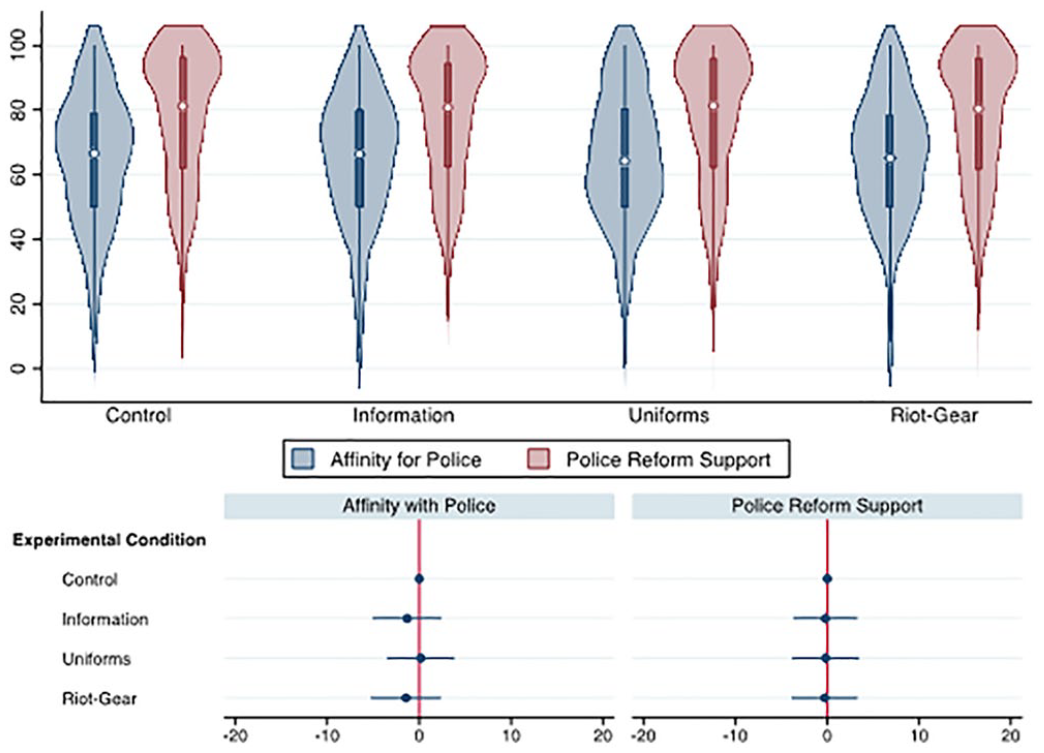
Violin plots of outcome distributions, by treatment condition, and coefficient plot of OLS regressions predicting outcomes.
To test formally whether the information (and images) about officers’ solidarity-expression efforts significantly affected respondents’ policing attitudes, we regressed each dependent variable on the categorical indicator of experimental group membership, which denotes the treatment respondents received. The bottom panel in Figure 2 shows the regression results. As the violin plots suggested, and contrasting our hypotheses, we do not find evidence that exposure to officers’ solidarity-expression efforts significantly affected either outcome. Relative to the control group, which did not receive information or pictures, affinity for police is not significantly higher among respondents who were informed about police joining protesters (b = –1.322, p = .486), nor is it significantly higher among respondents who were informed and who saw pictures of officers in normal uniforms supporting protest goals (b = .170, p = .927). 1 The story is the same for the second outcome, reform support; respondents informed about officers demonstrating solidarity with protesters do not differ significantly from the control group in their support for accountability reforms (b = –.209, p = .905), and viewing images of regularly-uniformed officers’ solidarity-expressive behaviors does not change this finding (b = –.184, p = .920).
Although information about, and visuals of, police joining protesters in solidarity do not appear to influence either outcome, at least when officers are wearing regular uniforms, hypotheses 3 and 4 state that riot gear will cause a backlash effect. Does exposure to officers wearing riot gear, even if those officers are expressing solidarity with protesters, undermine affinity for the police or strengthen support for policing reform? The findings in Figure 2 suggest the answer may be no. Relative to the participants in the control group, respondents who viewed solidarity-expressing officers in riot gear do not differ significantly in their affinity with the police (b = –1.447, p = .451) or support for accountability reforms (b = –.280, p = .877). In summary, then, we do not find support for any of our four hypotheses, at least in the full sample. However, as previously noted, the hypothesized relationships may vary in magnitude across population subgroups with different general orientations toward the police. 2 We explore this theoretical possibility in the next section.
Treatment Effect Heterogeneity
Figure 3 displays the effects of the experimental treatments by race and political party. The top row of Figure 3 shows the regression results disaggregated by race—that is, among White, Black, and other non-White respondents. In this row, there is a panel for each dependent variable: affinity with police and support for police reform. The overall takeaway from the results is that the treatments do not exert sizable or significant effects in any of the racial groups. In fact, only one of the coefficients (out of 18) reaches statistical significance, and it is in the opposite direction hypothesized. Specifically, Black respondents were significantly more supportive of police reform when informed and shown pictures of officers’ behaving positively toward protesters (b = 4.769, p = .044).
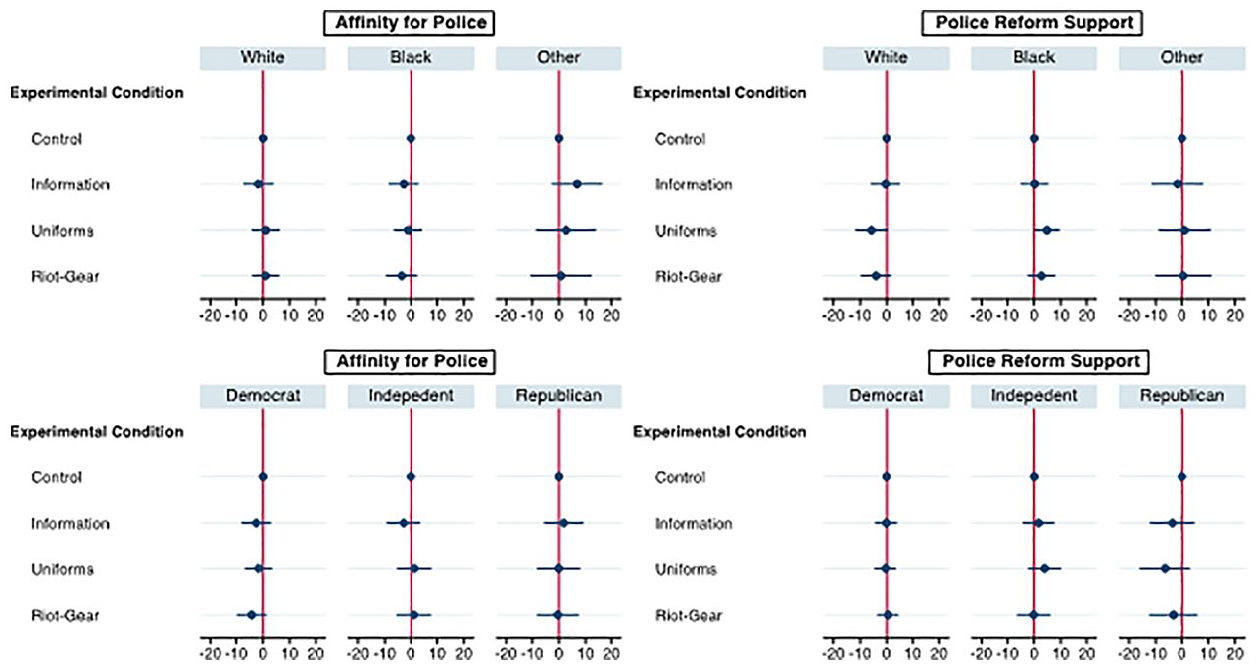
Disaggregated analyses: Coefficient plots by race and political party.
The bottom row of Figure 3 shows the regression results disaggregated by partisan identification. As with race, the main story is one of effect homogeneity. Among Democrats, among Independents, and among Republicans, the findings are the same: receiving information about officers’ solidarity-expression efforts has little effect on either affinity for the police or support for police reform. In all these political groups, the coefficients are small in magnitude and fail to reach statistical significance. Additionally, in all these political groups, the uniform choice of wearing riot gear fails to exert any significant effect on policing attitudes.
The final portion of the analysis examines the possibility of effect heterogeneity by racial and policing attitudes. Here the sample is disaggregated by racial resentment and by general perceptions of police procedural justice. Figure 4 depicts the relevant regression results. The top row in Figure 4 shows the results among respondents low versus high in racial resentment. In each of these groups, we fail to find any significant effects of information or pictures depicting officers’ solidarity expression efforts. This pattern of null effects among both unresentful and resentful respondents does not change when officers are wearing riot gear.
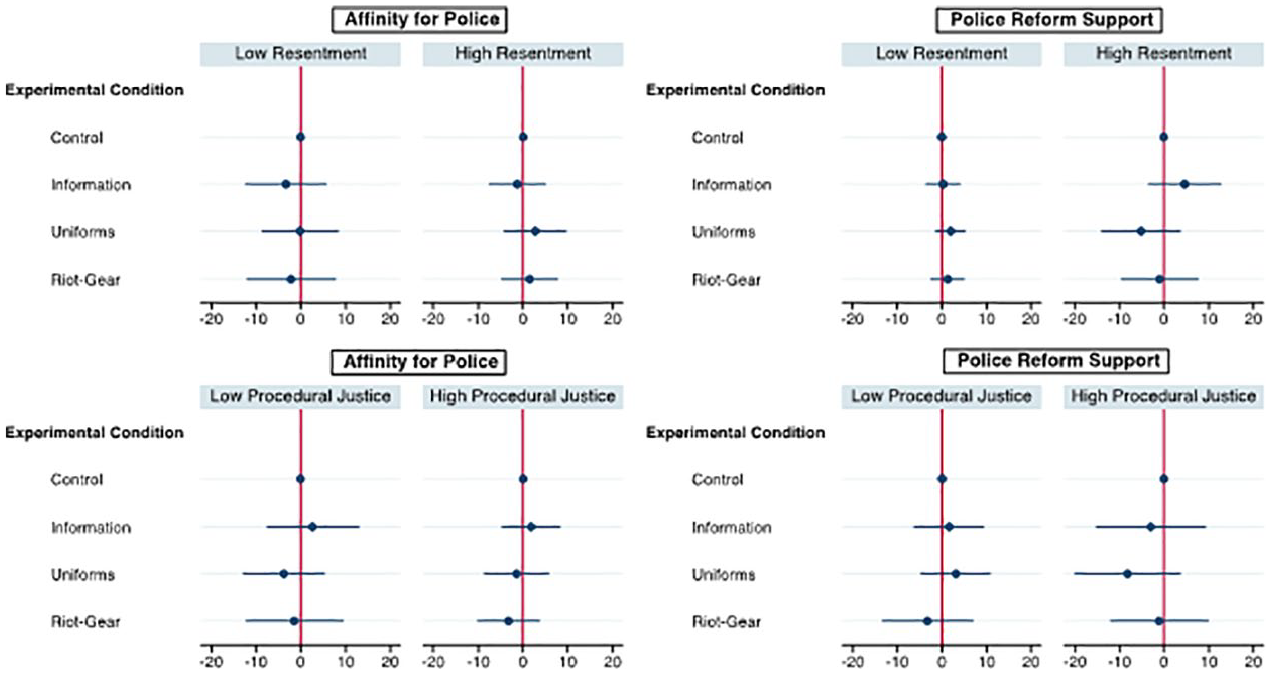
Disaggregated analyses: coefficient plots by racial resentment and perceived police procedural justice.
The pattern observed thus far of effect homogeneity extends to our last disaggregation, which is shown in the bottom panel of Figure 4. In this panel, respondents are divided into those who generally perceive low versus high police procedural justice. In both groups of respondents, information about officers supporting BLM protesters and protest goals fails to significantly affect affinity for police or support for policing reform. Viewing pictures of supportive officers wearing normal uniforms does not change this story: The results are still null in both groups. Likewise, viewing pictures of supportive officers in riot gear does not change the story: The coefficients remain non-significant. Formal tests for interactive effects (using the continuous versions of these two indices, racial resentment, and procedural justice) confirm the absence of significant interactive effects—in other words, they confirm the homogeneity of the null effects.
Discussion
Shortly after racial justice protests erupted across the country in 2020, the Genesee County Sheriff in Michigan spontaneously joined protesters in solidarity (May, 2020). Other law enforcement agencies across the country quickly followed suit in an apparent bid to ease tensions and increase their legitimacy. Although previous experiments have examined the effects of police behavior in individual officer-civilian encounters, returning mixed results (Mazerolle et al., 2013; Sahin et al., 2017), no prior experiments have tested how supportive police responses to protests may affect public opinion more broadly. To this end, the current study examined if officers’ efforts to demonstrate moral solidarity with BLM protesters could increase affinity with the police or reduce the perceived need for policing reform. We also examined if any beneficial effects of such efforts were undermined when officers wore riot gear and whether effects varied across theoretically germane population subgroups (e.g., Black Americans, Democrats).
Our experiment provided no support for any of our hypotheses. Post-replication crisis, it should go without saying that null findings are of crucial importance (Chin et al., 2023; Pridemore et al., 2018; Ritchie, 2020, Sweeten, 2020), both theoretically and from a policy standpoint, and in our study they were pervasive. Reading about or viewing officers joined in solidarity with protesters did not significantly impact affinity for the police or support for policing reform. This effect was found regardless of whether the officers were wearing normal, soft-look uniforms or riot gear. It was true among both White and non-White Americans. It was true on both sides of the political aisle. It was true among participants with high and low levels of racial resentment alike. And it was true among Americans who perceived the police to be procedurally just and among those perceiving low procedural justice.
It might be tempting to explain away the null findings of our experimental manipulations by arguing that perhaps text- and photo-manipulations are not strong enough stimuli to change relatively cemented policing attitudes. However, we are skeptical that our null effects simply reflect the impotence of the text- and image-manipulations we use. These treatments closely mirror those used in past experiments that have obtained significant effects in other contexts, particularly in contexts where the officers’ behavior was negative (e.g., use of force) rather than supportive or positive.
An alternative explanation is possible—one that is theoretically informed and plausible, in our view. Like individual police-civilian encounters (Skogan, 2006; Thompson & Pickett, 2021; Worden & McLean, 2017b), it is negative rather than positive officer behavior toward protesters that matters most to the public—that is, protest policing may exert asymmetric effects. Previous research has generally found that procedural injustice undermines police legitimacy more than procedural justice enhances legitimacy (Skogan, 2006; Thompson & Pickett, 2021). A growing body of literature suggests this asymmetrical effect may occur in the context of protests as well, given that negative treatment of protesters appears to influence observers’ policing attitudes (Novick & Pickett, 2022, Reinka & Leach, 2017). More specifically, previous studies have found that perceived police mistreatment of protesters worsens attitudes toward the police (Reinka & Leach, 2017)—at least among those that do not already distrust the police (Whiteet al., 2018; Wright et al., 2023)—and increases support for police reform (Novick & Pickett, 2022). Our study suggests that one form of positive officer behavior (expressions of solidarity with protesters) may not matter much for broader public opinion, whether done in soft-look uniforms or in riot gear. Our findings, in combination with those from previous work, imply that the impact of police behavior at protests may be asymmetric.
This theoretical possibility makes sense, given that the American public generally values the fundamental right to protest, and they do not generally support police control of peaceful protesters (Metcalfe & Pickett, 2022). Police mistreatment of peaceful protesters not only exceeds what most Americans may consider the normative limits of police power, but also betrays a constitutional right embedded in the national psyche. Positive treatment of protesters, however, may not enshrine the right to protest to the same degree that repressing protests undermines that right. Lacking the same emotionally visceral content as its converse (see Reinka & Leach, 2017), supportive protest policing may be unlikely to provoke meaningful attitudinal change for people not directly involved in the protest. In short, Skogan’s (2006, p. 100) memorable albeit bleak observation may extend to the protest context: “the police may get essentially no credit for doing a good job, while a bad experience deeply influences people’s views of their performance and even legitimacy.”
It is also possible that the effects of officers’ expressions of solidarity are mostly situational, affecting protesters in the moment rather than the public more broadly. Surveys of Occupy Wall Street protesters, for example, found that those who perceive the police as procedurally unjust are more likely to use violence and to endorse using violence against officers during protests (e.g., shoving, kicking, throwing objects; Maguire et al., 2018, 2020; D. H. Tyler et al., 2018). Therefore, there is empirical evidence suggesting that officer behavior does influence the behavior of the crowds they are policing. For protesters that took to the streets after Floyd’s murder, seeing officers express solidarity with the BLM movement may have eased tensions in the moment, particularly when those police expressions were done in normal, soft-look uniforms. For casual observers, however, reading about or seeing police do so may have less effect. Studies conducted outside of the protest context, for example, indicate that experiences with police influence encounter-specific evaluations more than general, global policing attitudes (Johnson et al., 2017; Maguire et al., 2017; Sahin et al., 2017).
Of course, our study is not without limitations. Namely, although our measures are theoretically informed, they do not directly measure moral alignment. Theoretically, moral alignment is an antecedent of felt affinity and reform support (Jackson et al., 2012; Sunshine & Tyler, 2003b). Thus, while our measures are capturing outcomes of moral alignment, they do not capture it directly. Reform support, in particular, may be related to moral alignment in complex ways (McLean & Nix, 2021). Additionally, while the experimental approach employed in our study offers a study design that maximizes internal validity, it is incapable of providing deeply contextualized results that emphasize the interaction between group dynamics and individual identities (Radburn & Stott, 2019). As such, future studies might consider qualitative approaches that prod deeper into the meanings people construct about police acts of solidarity and efforts to align themselves with protesters (Radburn & Stott, 2019). Doing so may also help further elucidate the racial dynamics of individuals’ understandings of and attitudes toward protest policing and systemic racism in policing (see Carlson, 2020).
Police-related protests captivate the American public, dishearten law enforcement officers, and cause profound concern to police administrators (Kochel, 2022). Further, as Maguire and Oakley (2020, p. 19) remind us, “the nature and character of protest policing is in some ways a measure of democracy, revealing how free we really are.” With the increasing visibility and relevance of protests, then, future research examining public attitudes about protest policing remains critical. As Brannen et al. (2020, p. 1) explain, “We are living in an age of global mass protests that are historically unprecedented in frequency, scope, and size.” Protests after the murder of George Floyd, for instance, represented one of the largest and most diverse social movements in modern history (Fisher & Rouse, 2022). Future research should thus continue investigating how both positive and negative police behavior at protests affects protester behavior as well as public opinion more broadly. As such, one specific avenue for future research to investigate is directly comparing the situational effects of positive versus negative police behavior at protests.
Supplemental Material
sj-docx-1-cad-10.1177_00111287231189718 – Supplemental material for Protest Policing, Normative Alignment, and Riot Gear: An Experiment
Supplemental material, sj-docx-1-cad-10.1177_00111287231189718 for Protest Policing, Normative Alignment, and Riot Gear: An Experiment by Andrew J. Thompson, Justin T. Pickett, Amanda Graham and Francis T. Cullen in Crime & Delinquency
Footnotes
Declaration of Conflicting Interests
The author(s) declared no potential conflicts of interest with respect to the research, authorship, and/or publication of this article.
Funding
The author(s) received no financial support for the research, authorship, and/or publication of this article.

Supplemental Material
Supplemental material for this article is available online.
Notes
Author Biographies
References
Supplementary Material
Please find the following supplemental material available below.
For Open Access articles published under a Creative Commons License, all supplemental material carries the same license as the article it is associated with.
For non-Open Access articles published, all supplemental material carries a non-exclusive license, and permission requests for re-use of supplemental material or any part of supplemental material shall be sent directly to the copyright owner as specified in the copyright notice associated with the article.
