







Abstract
Prior research on violent victimization in prison suggests noncitizens may be less likely to experience violence while incarcerated. In an attempt to better understand this relationship, this study examined whether citizenship status predicts risk among a subsample of foreign-born incarcerated people. In addition, we modeled violent victimization separately for foreign-born and native-born individuals to identify any differences in risk factors between groups. We tested these relationships using a sample of 7,326 individuals incarcerated in Minnesota state prisons. The results of Cox regression models showed foreign-born citizens and foreign-born noncitizens had similar risk for violent prison victimization. We also found that some risk factors for victimization differed across native-born and foreign-born incarcerated people.
Keywords
Introduction
In terms of violence, prison is a unique place where potential offenders and potential victims share space together at all times. In addition to this, the current incarceration system suffers from situational problems such as overcrowding; lack of financial, administrative, or human-related resources; and turnover in both the incarcerated and officer populations, all of which can lead to violent conflict in prison (see Wooldredge, 2020). Victimization while incarcerated can, in turn, bring a series of other problems, such as drug use, emotional distress, depression, and recidivism (Haney, 2006; Hochstetler et al., 2004; Listwan et al., 2013; Steiner & Wooldredge, 2015; Steiner et al., 2017; Western, 2021; Wooldredge, 1999; Wooldredge & Steiner, 2014; Zweig et al., 2015). For these reasons, prison administrators are constantly concerned with reducing violence and victimization in prison.
Scholars have presented a number of theories to explain victimization. The major victimization theory is lifestyle-routine activities theory (LRAT; Cohen & Felson, 1979; Hindelang et al., 1978). Simply put, patterns of behavior affect whether a potential offender will meet a suitable target when there is no capable guardianship, allowing a crime/victimization to happen (Cohen & Felson, 1979; Hindelang et al., 1978; for a review, see McNeeley, 2015). At the individual level, Cohen et al. (1981) identified factors that can influence risk of victimization: proximity to potential offenders in terms of distance, exposure or accessibility to potential offenders, guardianship that prevents violations from occurring, and target suitability.
Specific to correctional facilities, incarcerated people’s behavior and experiences have been mainly explained using deprivation and importation theories (Bowker, 1980; Steiner et al., 2017; Wood, 2013; Wood & Buttaro, 2013; Wooldredge, 1998; Wooldredge & Steiner, 2014). To summarize these theories simply, deprivation theory argues that the harsh conditions of the prison environment may cause some incarcerated people to resort to criminal behavior, resulting in a higher level of prison victimization (Clemmer, 1940; Sykes, 1958; Sykes & Messinger, 1960). On the other hand, importation theory holds the position that incarcerated people bring their pre-incarceration personal characteristics and beliefs to prison, thereby increasing or decreasing an individual’s likelihood of prison victimization (Irwin & Cressey, 1962; Steiner et al., 2017).
Based on these theoretical arguments, scholars have attempted to assess the causes of victimization among incarcerated people. This work has identified personal characteristics associated with prison victimization, such as age, race, education level, and mental or physical health (Blitz et al., 2008; Ellison et al., 2018; Jachimowski, 2018; Kuo et al., 2014; McNeeley, 2022; Pare & Logan, 2011; Steiner et al., 2017; Teasdale et al., 2016). In addition, regarding institutional routines and experiences, those who have more extensive criminal histories; are more involved in recreational activities; are less involved in treatment, work, or education; and/or have a history of institutional misconduct experience prison victimization at a higher level (Choi & Wentling, 2021; Copes et al., 2010; Ellison et al., 2018; Howard et al., 2020; Kuo et al., 2014; Lahm, 2009; McNeeley, 2022; Meade et al., 2021; Morash et al., 2012; Pérez et al., 2010; Steiner et al., 2017; Teasdale et al., 2016; Wooldredge, 1998; Wooldredge & Steiner, 2012, 2014).
That said, the literature on prison victimization has not paid enough attention to how these known victimization factors relate to foreign-born 1 individuals. Indeed, only a handful of studies have specifically examined institutional outcomes among the incarcerated foreign-born population (see Piatkowska et al., 2022; Ramos & Alaniz, 2022), and those were mainly concerned with institutional misconduct, not victimization. While the general victimization literature indicates foreign-born people may be at increased risk due to unique characteristics that increase vulnerability (Barranco & Shihadeh, 2015; Caraballo & Topalli, 2023; Cepeda et al., 2012; Davis & Erez, 1998; Decker et al., 2007; Freemon et al., 2022; Fussell, 2011; Negi et al., 2013; Sasseville et al., 2022; Von Hentig, 1948; Zatz & Smith, 2012), a couple of studies suggest risk of violent victimization is lower among incarcerated non-U.S. citizens than their U.S. citizen counterparts (McNeeley, 2022; Piatkowska et al., 2022). Therefore, more research is needed to fully understand how incarcerated foreign-born individuals’ risk for victimization differs from that of incarcerated native-borns.
For example, as has been discussed above, there are personal and institutional factors that influence one’s likelihood of experiencing prison victimization; however, it is unclear whether those factors work the same way for the foreign-born incarcerated population. Identifying factors that have differential effects among the foreign-born population compared to the native-born population could help us to address violence among and/or toward foreign-born incarcerated people. Doing so could be increasingly beneficial for addressing prison violence, as the U.S. is experiencing and expecting a higher number of foreign-born individuals in the criminal justice system. Therefore, this study compares incarcerated foreign-born and U.S.-born individuals’ likelihood of and risk factors for experiencing victimization in prison. We answer these questions using data from approximately 7,300 people incarcerated in the Minnesota Department of Corrections (MnDOC).
Immigration, Crime, and Victimization
It is commonly believed that the foreign-born population would be more engaged in criminal activities. However, a large body of research shows a negative relationship between immigration and criminal and antisocial behavior, at both the individual and community level (i.e., the “immigrant paradox;” for a review, see Ousey & Kubrin, 2018; Sampson, 2008). In fact, although foreign-born people generally have socioeconomic and demographic characteristics associated with lower risk of victimization (Xie & Baumer, 2021), increased vulnerability has been observed for certain types of criminal victimization—such as homicide, intimate partner violence, sexual assault, gang violence, and wage theft (Barranco & Shihadeh, 2015; Caraballo & Topalli, 2023; Cepeda et al., 2012; Davis & Erez, 1998; Decker et al., 2007; Freemon et al., 2022; Fussell, 2011; Negi et al., 2013; Sasseville et al., 2022; Von Hentig, 1948)—partly due to foreign-born people’s tendency to avoid contact with the police and the criminal justice system (Zatz & Smith, 2012).
Specifically, Erez et al. (2009) found that among those foreign-born individuals who experienced victimization, less than half (46%) contacted the criminal justice system in response. Several factors can explain this hesitancy. First, they tend to have negative perception that police officers will be discriminatory against minorities, and their confidence in the police system is usually low (Lasley, 1994; Menjívar & Bejarano, 2004; Mirande, 1980; Weitzer, 1996). Moreover, foreign-born people’s language barrier can work as another prohibitive measure against contacting the criminal justice system when they encounter problems with the law (Menjívar & Bejarano, 2004). Finally, especially regarding those with undocumented/illegal migrant status, the fear of deportation upon contacting the legal system adds another layer to this phenomenon (Khaja & Jaggers, 2018). Due to these characteristics, the foreign-born population is placed in a more vulnerable position in terms of victimization, as potential offenders may be aware of this hesitancy toward the criminal justice system (Davis & Henderson, 2003; Khaja & Jaggers, 2018), making them more attractive targets.
The Current Study: Victimization Among Foreign-Born Incarcerated People
Victimization among incarcerated foreign-born people is especially relevant due to their recent increase among the prison population. According to the Bureau of Justice Statistics (Carson, 2021), 4.3% of individuals incarcerated in state prisons as of December 31, 2021 were identified as non-U.S. citizens. Across states, the percentage of incarcerated people who were non-U.S. citizens ranged from 0.2% (Mississippi) to 20.1% (California). According to this BJS report, 4.5% of the Minnesota state prison population were non-U.S. citizens.
Much less is known about noncitizen incarcerated individuals’ immigration status. In recent studies examining people incarcerated in the Florida Department of Corrections, about 2% of the samples examined were noncitizens, with slightly less than half of those having undocumented legal status (Piatkowska et al., 2022; Ramos & Alaniz, 2022). However, these studies likely undercounted the incarcerated foreign-born population, as individuals released outside of Florida or released to U.S. Immigration and Customs Enforcement (ICE) custody were not included in the samples.
Notably, few studies have examined correctional outcomes across foreign-born and native-born incarcerated people. For example, Piatkowska et al. (2022) completed a study on the relationship between incarcerated noncitizens’ legal status and their misconduct level in prison. Using data from Florida’s Department of Corrections, the authors found that undocumented noncitizens showed a higher likelihood of prison misconduct, but there was no statistically significant difference in misconduct between documented noncitizens and incarcerated native-borns. Similarly, another study using data from Florida found that documented and undocumented releasees had lower recidivism rates than native-borns, but did not significantly differ from each other (Ramos & Alaniz, 2022).
Due to the unique characteristic of being a foreign-born incarcerated person in the United States, scholars have argued they may be at an increased risk of victimization in prison as well as in the broader community. However, despite how feasible this assumption is, few studies have considered the relationship between incarcerated foreign-borns and their victimization experiences while in prison. Piatkowska et al. (2022) hypothesized that foreign-born incarcerated people could experience lower levels of victimization than native-born U.S. citizens because they have generally low propensity for criminal behavior, possibly due to the fear of deportation, which may result in lower target antagonism (see Finkelhor & Asdigian, 1996). This hypothesis was supported by McNeeley (2022), who found incarcerated noncitizens had lower risk of violent victimization compared to their U.S. citizen counterparts, and that this relationship was especially pronounced when examining Black incarcerated people.
Despite these studies, there is still a gap in the literature regarding whether the risk of prison victimization differs between the foreign-born and native-born populations. In order to address this gap in the literature, we conducted analyses separately predicting violent victimization among foreign-born and native-born incarcerated people. We hypothesized that, among those incarcerated individuals who were born outside the United States, U.S. citizenship would influence victimization in prison such that incarcerated foreign-born people who are noncitizens would experience victimization at a higher rate than would foreign-born people who are U.S. citizens. We also examined whether other risk and protective factors—including personal characteristics, custodial factors, and prison routines—differed across native-born and foreign-born individuals.
Methods
Data and Sample
The sample includes all 7,326 adults who were incarcerated in MnDOC correctional facilities on January 1, 2021. This included 6,660 individuals who were native-born U.S. citizens and 666 foreign-born individuals. All variables were taken from the Correctional Operations Management System (COMS) operated by MnDOC. In January 2021, the MnDOC process for incidents of misconduct was updated to begin recording the identity of the victim in all incidents of violence that result in discipline charges. Therefore, independent variables were measured as of or prior to January 1, 2021. The dependent variable (victimization) was measured between January 2, 2021 and September 30, 2022.
Table 1 presents a comparison of the foreign-born and native-born subsamples. Over two-thirds (69.7%) of the foreign-born incarcerated people were non-U.S. citizens. The foreign-born sample was mostly male (96.5%). Almost a third were Black (30.3%), while 26% were Hispanic, 22.9% were White, 19.9% were Asian or Pacific Islander, and 0.5% were American Indian or Alaskan Native. The average age of the foreign-born sample was 38.76 years, with a range between 15 and 83 years. Over a third (35.7%) were incarcerated for a violent offense, and they had served an average of 46.38 months (about 3.8 years) as of January 1, 2021.
Sample Characteristics.
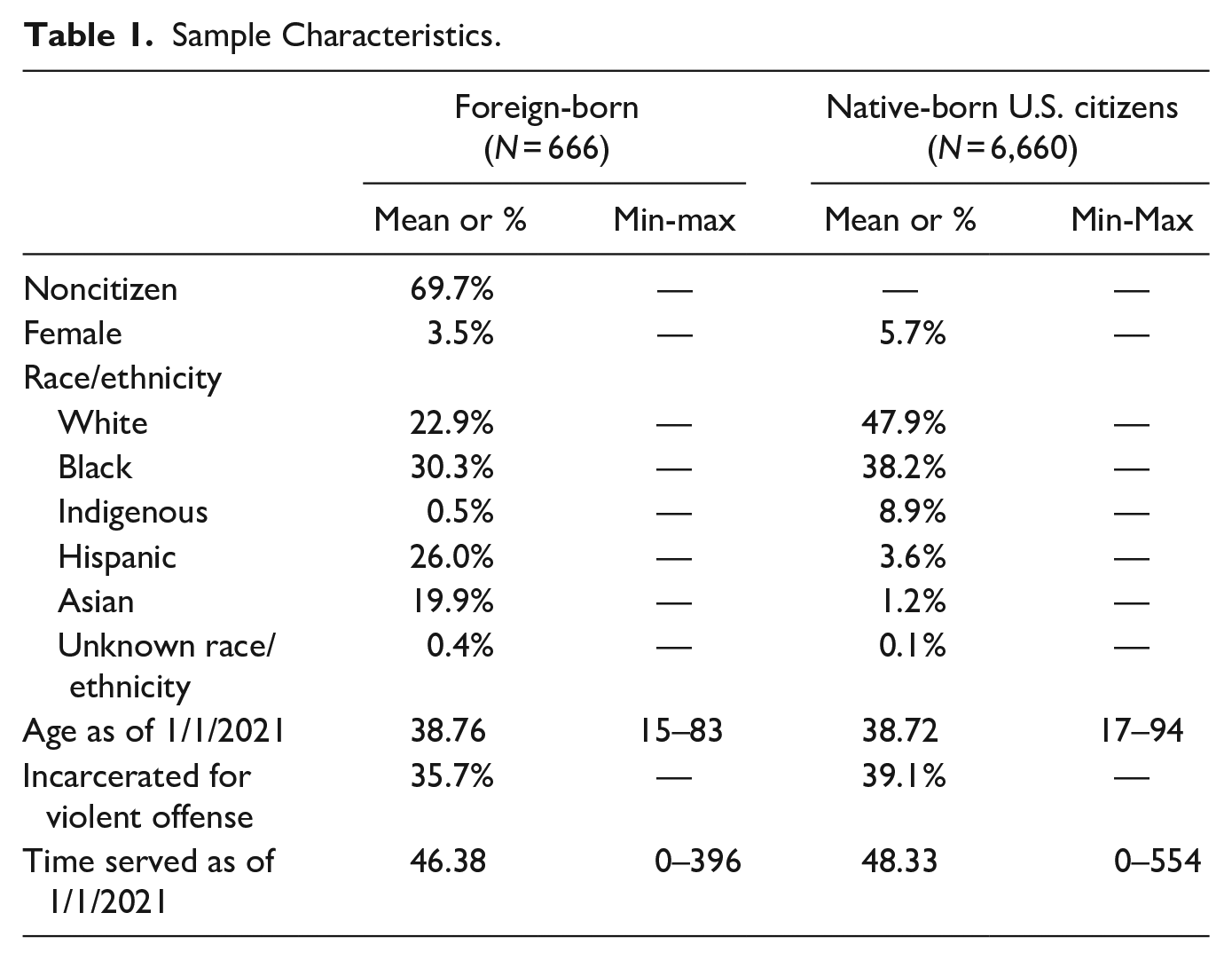
The native-born sample was also mostly male (94.3%). Nearly half (47.9% were White), 38.2% were Black, 8.9% were American Indian or Alaskan Native, 3.6% were Hispanic, and 1.2% were Asian or Pacific Islander. Age ranged from 17 to 94 years old, with an average age of 38.72 years. Thirty-nine percent were incarcerated for a violent offense. The native-born sample had served, on average, 48.33 months (about 4 years) as of January 1, 2021.
Dependent Variable
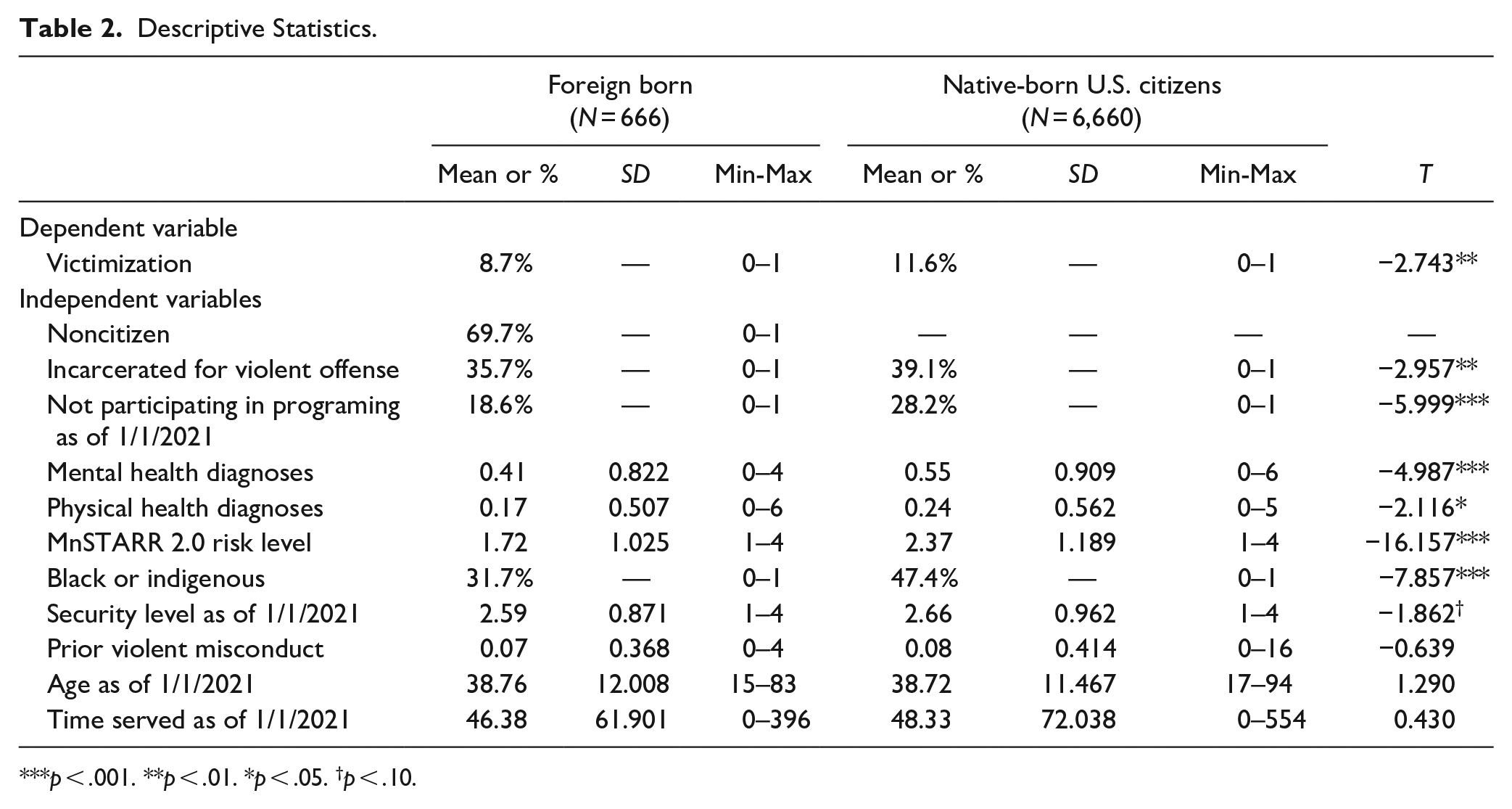
Violent victimization includes experiences of physical assault, fights, being held hostage, or homicide. Because the dates of violent incidents were available, the variable includes both “status” information regarding whether victimization occurred and “time” information regarding the number of days between January 1, 2021 and the individual’s first victimization experience. Descriptive statistics for all variables used in the analyses are presented in Table 2.
Descriptive Statistics.
p < .001. **p < .01. *p < .05. †p < .10.
Independent Variables
Due to the smaller sample sizes in some of our models, there are few events (i.e., cases with a score of 1 on the dependent variable). Scholars argue there should be a minimum of 5 to 10 events for each independent variable included in the models (Peduzzi et al., 1996; Vittinghoff & McCulloch, 2007). With 57 events among the foreign-born sample, the models should include no more than 11 predictors.
First is a binary measure indicating whether the individual is a U.S. citizen (0) or a noncitizen of the United States (1); this is only used when examining foreign-born individuals. Since prior research suggests risk for prison victimization is highest for Black and indigenous people (e.g., McNeeley, 2022), we included a binary variable indicating whether the individual identifies as Black or indigenous (1) or is a member of another race (0). The individual’s prison activities were measured with a binary variable that indicated whether they were participating in education, treatment, or work as of January 1, 2021 (0) or were idle (i.e., not participating in any of these activities) as of January 1, 2021 (1). We also included a binary variable that measured the offense type for which the individual was incarcerated (1 = violent, non-sexual offense, 0 = other offense type). 2 We also included continuous variables measuring the number of mental health and physical health diagnoses, the number of violent misconduct convictions the person received in the 6 months prior to January 1, 2021, their age in years as of January 1, 2021, the number of months incarcerated as of January 1, 2021, and their security level ranging from 1 (minimum) to 4 (maximum) as of January 1, 2021.
To maintain a parsimonious model while controlling for known correlates of prison victimization, we used the MnSTARR (Minnesota Screening Tool Assessing Recidivism Risk) 2.0 risk level as a control variable. The MnSTARR 2.0 (Duwe, 2014; Duwe & Rocque, 2017) is a gender-specific 3 risk assessment instrument calculated using 48 variables such as prior criminal history, prior prison stays, sentence length, program participation, visitation, and gang membership. Scores are classified into one of four risk levels: low risk contains the bottom 40% of scores, medium risk contains the next 20%, high risk contains the next 20%, and very high risk contains those in the top 20% of scores. Prior research suggests risk assessment instruments designed to predict recidivism can be accurate predictors of victimization (Logan & McNeeley, 2023; McCafferty & Scherer, 2017).
Statistical Analysis
Because information on the timing of violent events was available, this study employed survival analysis using Cox regression models. Survival analyses are often used as an alternative to logistic regression because they allow for an examination of not only whether an outcome occurs, but also how quickly that outcome occurs. In our study, Cox regression provides an additional benefit: because an end date is used, it can account for the decrease in exposure time that results when individuals are released from prison before the end of the follow-up period.
Our Cox regression models used both “status” variables that indicate whether an individual was victimized and “time” variables that measure the number of days between January 1, 2021 and the first victimization event. For individuals who were not victimized during the follow-up period, we used a censor date of either September 30, 2022 or their release date (if they were released before September 30, 2022).
To explore whether and how foreign-born status shapes risk for victimization while incarcerated, separate models were estimated for native-born U.S. citizens and those who were born elsewhere. The equality of coefficients test (Paternoster et al., 1998) was used to determine whether differences in coefficients were statistically significant.
Results
Bivariate Results
Table 2 presents descriptive statistics for both the foreign-born and the native-born samples. Violent victimization was significantly lower among foreign-born individuals (t = −2.743, p < .01); 8.7% of foreign-born incarcerated people experienced victimization, compared to 11.6% of the native-born sample.
Table 2 also reveals several other significant differences between foreign-born and native-born incarcerated people. A greater percentage of native-born incarcerated were incarcerated for a violent offense (39.1% compared to 35.7% of foreign-born individuals, t = −2.957, p < .01) and were idle rather than participating in education, treatment, or work (28.2% compared to 18.6% of foreign-born individuals, t = −5.999, p < .001). Native-born incarcerated people had a greater number of recorded mental health diagnoses (an average of 0.55, compared to an average of 0.41 among foreign-born people, t = −4.987, p < .001) and physical health diagnoses (an average of 0.24, compared to an average of 0.17 among foreign-born people, t = −2.116, p < .05), had higher risk levels according to the MnSTARR 2.0 (an average of 2.37 [between medium and high risk], compared to an average of 1.72 [between low and medium risk] among foreign-born incarcerated people, t = −16.157, p < .001), were Black or indigenous (47.4% compared to 31.7% of the foreign-born subsample, t = −7.857, p < .001), and were held in somewhat higher security facilities (an average of 2.66, compared to an average of 2.59 among foreign-born people, t = −1.862, p < .10). There were no statistically significant differences between foreign-born people and native-born U.S. citizens when examining prior violent misconduct, age, or time served.
Multivariate Results
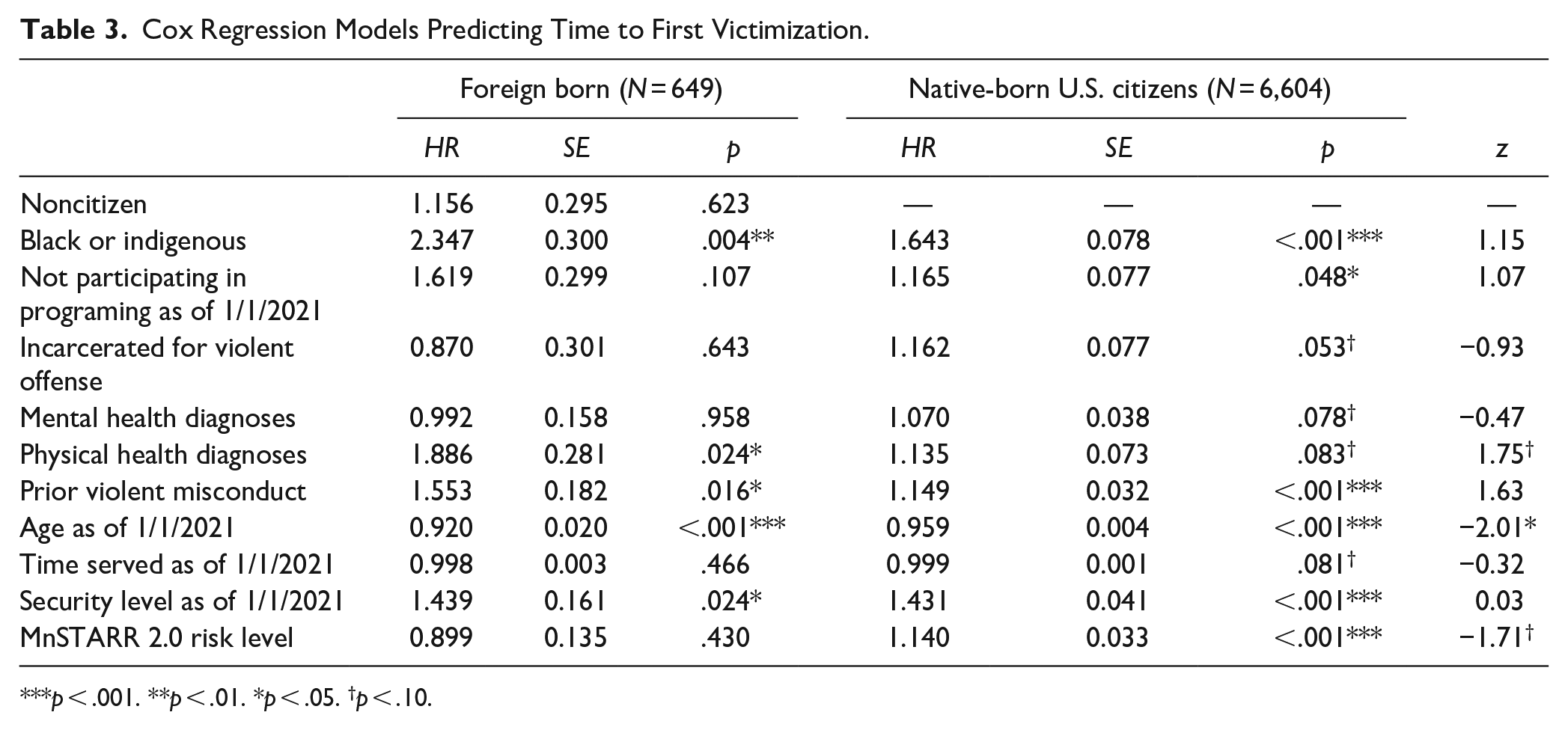
The Cox regression models predicting victimization are provided in Table 3. Interestingly, being a noncitizen was not a statistically significant predictor of victimization among the foreign-born subsample. Among the foreign-born sample, victimization risk was 135% higher among those who identified as Black or indigenous than among those who identified as White (p = .004). Risk for victimization increased by 88.6% for each additional physical health diagnosis (p = .024), 55.3% for each additional prior violent misconduct conviction (p = .016), and 43.9% for each increase in security level (p = .024), while it decreased by 8% for each year of age (p < .001).
Cox Regression Models Predicting Time to First Victimization.
p < .001. **p < .01. *p < .05. †p < .10.
For native-born U.S. citizens, risk of victimization was 64.3% higher among Black or indigenous people compared to White people (p < .001) and 16.5% higher among those who were not involved in programing, education, or work (p = .048). Risk of victimization increased by 14.9% for each additional violent misconduct conviction (p < .001), 43.1% for each increase in security level (p < .001), and 14% for each increase in MnSTARR 2.0 risk level (p < .001), while it decreased by 4.1% for each additional year older (p < .001).
The z scores shown in Table 3 reveal three potential differences in victimization risk between foreign-born and native-born individuals. First, age, while negatively associated with victimization among both foreign- and native-born individuals, was more strongly associated with victimization among foreign-born people (z = −2.01, p < .05). Second, physical health was a stronger predictor of victimization risk among foreign-born people than among native-born people (z = 1.75, p < .10). Third, the MnSTARR 2.0 predicted victimization among native-born incarcerated people but not among foreign-born incarcerated people (z = −1.71, p < .10).
Discussion
The purpose of this study was to assess whether and how foreign-born status and U.S. citizenship shape risk of experiencing prison victimization. In doing so, we extended prior work showing that incarcerated noncitizens were at lower risk of prison victimization than U.S. citizens (McNeeley, 2022). We attempted to shed light on this relationship by examining how U.S. citizenship relates to prison victimization specifically among a sample of incarcerated foreign-born individuals. Among the sample of foreign-born incarcerated people, we found no association between U.S. citizenship and risk of violent victimization in prison. Rather, our bivariate result showing lower risk of prison victimization among foreign-born people (see Table 2) suggests the lower risk of victimization among noncitizens McNeeley (2022) could be a result of lower risk of victimization among foreign-born people more generally, as hypothesized by Piatkowska et al. (2022).
Despite these findings, it is important to note that, because we analyzed administrative data, we were unable to explore relationships that may be especially important when studying foreign-born people. For example, we did not have information on foreign-born individuals’ immigration status (e.g., documented vs. undocumented), country of origin, or other immigration histories. Relatedly, it has been suggested that assimilation into U.S. culture, including English language proficiency, is important for understanding risk of outcomes such as victimization (Ballard & Kubrin, 2023; Desmond & Kubrin, 2009). Unfortunately, due to our use of administrative data, we were not able to incorporate measures of assimilation or language proficiency. Future research should continue to explore whether and how immigration status, country of origin, assimilation, and language proficiency are associated with correctional outcomes such as institutional misconduct and victimization. In spite of these limitations, the null result for citizenship suggests legal status may not be as important a predictor of victimization among foreign-born people as expected. This is consistent with past research showing no difference between documented and undocumented immigrants on other correctional outcomes (Ramos & Alaniz, 2022).
We also examined whether risk factors for experiencing prison violence differed across foreign-born and native-born incarcerated people. The results showed that younger individuals and those with more physical health problems were more likely to experience violence and experienced it more quickly than those who were older or had fewer physical health issues. Notably, age and physical health shaped risk for victimization more strongly among foreign-born people. This is parallel with the intersectionality literature, which shows that when risk factors for an outcome combine, the negative impacts increase (e.g., Bell, 2018; Spohn & Holleran, 2000). In terms of victimization, multiple personal characteristics that indicate vulnerability can compound to produce greater risk of victimization than would result from each characteristic on its own (see Clay-Warner et al., 2016). In particular, youthfulness appeared to be especially risky among foreign-born people. This finding is consistent with the broader literature on immigrant victimization, in which young noncitizens have a higher risk of victimization (Xie & Baumer, 2021). The particular relevance of age for foreign-born incarcerated people may be consistent with findings that noncitizens have a lower likelihood of criminal behavior when compared to their U.S. citizen counterparts (Rumbaut et al., 2006), which in turn reduces the likelihood of experiencing victimization via lower target antagonism. In particular, Watts and Evans (2023) found foreign-born people were more likely than native-borns to desist from crime as they aged. Older incarcerated people are less involved in misconduct in general, reducing their risk of experiencing victimization, and this may be especially true for older foreign-born incarcerated people.
Consistent with past research (Logan & McNeeley, 2023; McCafferty & Scherer, 2017), the MnSTARR 2.0 risk level was an effective predictor of victimization; those with higher MnSTARR 2.0 risk levels were more likely to be victimized and experienced victimization more quickly. However, this was only true among the native-born subsample; MnSTARR 2.0 risk level was not associated with victimization risk among the foreign-born subsample. There are several potential explanations for this finding. First, this could be because risk for victimization is higher for those with higher MnSTARR risk levels, and MnSTARR risk levels were generally lower among foreign-born incarcerated people. Second, it is possible that the predictors of victimization that are used in the calculation of the MnSTARR 2.0—such as prior criminal history, prior prison stays, sentence length, program participation, visitation, and gang membership—are not as important for foreign-born people as they are for native-born people. Finally, it is possible the MnSTARR 2.0 could be less accurate among this population. For example, some data—such as history of prior convictions—may be incomplete when assessing people born outside the United States, especially if they are recent immigrants.
It is also notable that prison activities (including work, treatment, and education) did not predict victimization among foreign-born incarcerated people. Participation in legitimate activities while incarcerated has been shown to be protective (Ellison et al., 2018; Howard et al., 2020; McNeeley, 2022; Teasdale et al., 2016; Wooldredge, 1998), but we only observed this relationship among native-born U.S. citizens. It is possible this was the result of lower statistical power in the analyses predicting victimization among foreign-born people. Still, given past evidence that immigrants are less likely than non-immigrants to recidivate (Ramos & Alaniz, 2022), future research should consider how foreign-born individuals engage with programing while incarcerated and whether their participation has different outcomes compared to native-born incarcerated people.
Some limitations of the study highlight avenues for future research. First, as discussed earlier, we were unable to examine more nuanced measures of legal status, country of origin, immigration history, or assimilation (e.g., English proficiency). We urge scholars working in this area to examine the relationships between these characteristics and correctional outcomes such as victimization. Second, as we used official data to measure victimization, we were not able to account for the dark figure of prison misconduct. It is possible that some violence went undetected by staff or was not included in the discipline data used here because the perpetrator was unknown. It is especially possible that foreign-born people may have been reluctant to report victimization to prison officials, as has been suggested about the criminal justice system more broadly (e.g., Erez et al., 2009; Zatz & Smith, 2012), impacting our results. Still, it has been suggested that self-reports could also undercount victimization (Western, 2021). Future research on prison violence should attempt to triangulate using different sources in order to better capture all incidents of violence. Finally, we used Cox regression because it allowed us to account for differences in time exposed due to some individuals being released before the end of the follow-up period. Future research may benefit from using alternative methods, such as employing a matching technique.
Reducing prison victimization is an imminent issue for prison administrators as it can create a negative living or working environment for both incarcerated individuals and correctional officers. Contrary to what prior literature may have suggested, not having U.S. citizenship was not a significant factor in predicting risk of victimization among foreign-born incarcerated people. Rather, it appears that the relationship between citizenship status and prison victimization observed in past studies could be due to lower risk of violence among foreign-born people more broadly. Therefore, it is important to identify characteristics of foreign-born people that reduce their risk of being targeted for violence.
Accordingly, the results of this study indicated that there are some clear differences between foreign-born and native-born U.S. citizen incarcerated populations in terms of risk factors for prison victimization. Being a minority (Black or indigenous), young, held in higher security level prison, having physical health diagnoses, and prior violent misconduct were statistically significant predictors of experiencing violent victimization in prison among foreign-born incarcerated individuals. Among incarcerated native-born U.S. citizens, in addition to the factors listed above, idle status (i.e., non-participation in programing) and MnSTARR risk level were also useful for predicting violent victimization in prison. When it comes to reducing violent victimization in prison for the foreign-born incarcerated population, it may be especially advantageous to focus on those who are young minorities with physical health diagnoses, as these characteristics are especially likely to influence which foreign-born people experience violence during prison conflicts.
Footnotes
Declaration of Conflicting Interests
The author(s) declared no potential conflicts of interest with respect to the research, authorship, and/or publication of this article.
Funding
The author(s) received no financial support for the research, authorship, and/or publication of this article.
