







Abstract
Research on the transition into adulthood finds that individuals are likely to take on new adult roles which can influence a change in identity. Furthermore, literature on desistance finds that offending tends to decline as individuals transition into adulthood and that this decline can be attributed to changes in internal processes such as developing a new pro-social identity. However, scholarship has yet to conceptualize and measure the development of an adult identity as a latent construct. The current study seeks to establish a new latent time variant measurement I call Latent Adult Attitudes (LAA) and examine LAA’s association with offending. LAA uses a collection of items focused on attitudes towards adult roles to measure a latent construct of adult identity.
Past research concerned with criminal desistance—reductions or an end of offending—has demonstrated that the vast majority of youth will experience increases in their offending during adolescence but will decline as they enter into adulthood (Farrington, 1986; Hirschi & Gottfredson, 1983; Moffitt, 1993; Mulvey et al., 2004). Scholarship suggests the transition into adulthood occurs over time and is accompanied by indicators of adulthood which are associated with feelings of adult status, legitimacy, choice, and responsibility (Benson & Johnson, 2009; Laupa, 1991). For example, past research has identified employment, partnership, parenthood, and continuing education as indicators of adulthood (Bernardini, 2014; Buchmann 1989; Shanahan, 2000). Furthermore, research suggests that these adult indicators come with new social roles and can lead to changes in identity (Becker & Strauss, 1956). Coincidently, research exploring the mechanisms that lead to desistance have also focused on the relationship between changes in identity and offending (King, 2013; Paternoster & Bushway, 2009; Stone, 2015).
Scholarship on the influence of internal changes has found support for the notion that developing a pro-social identity is essential for reducing criminal behaviors (Giordano et al., 2002; Simons & Barr, 2014). Most notable is the work by Paternoster and Bushway (2009) which focuses on individuals’ use of human agency, rationale choice, and the development of new identities to decrease their offending. While past research has established that pro-social identity shifts are associated with reductions in offending (Giordano et al., 2002; Paternoster & Bushway, 2009), and scholarship on desistance has acknowledged the influence of adulthood on offending (Bernardini, 2014; Massoglia & Uggen, 2010), scholars have yet to conceptualize the process of desisting from crime as a latent process of adulthood whereby individuals develop a new adult pro-social identity.
Combining literature on desistance, internal change, and adulthood, I propose a perspective on desistance which argues that reductions in offending are due to a shift in attitudes towards indicators of adulthood, and as individual’s attitudes towards indicators of adulthood change, they develop a new adult identity which leads to decreases and/or the end of offending. The indicators of adulthood are especially important because numerous indicators identified in the adulthood literature have also been established within the desistance literature as “turning points,” or external events in which individuals are bonded to society through informal controls (Sampson & Laub, 1992; 1993). The proposed perspective takes a similar approach but argues that changes in attitudes and the development of a new identity is critical for facilitating the commitment and belief in conventional society that leads to a social bond and desistance from crime even without experiencing a turning point.
To examine the internal processes of adulthood on offending, I propose a new latent variable which focuses on conventional attitudes towards indicators of adulthood and/or turning points, which I refer to as Latent Adult Attitudes (LAA). Theoretically, a conventional adult attitude is committed to, believes in, and values the roles and responsibilities associated with adulthood such as family, work, and education. Individuals who report high levels of LAA should report lower levels of offending due to their adult identity and strong bond with conventional society.
The current study uses 11 waves of data and responses from roughly 1,350 respondents from the Pathways to Desistance study to accomplish two goals. First, I use Item Response Theory models to construct a measurement for Latent Adult Attitudes, and second, I will use a series of mixed-effects models to examine the association between Latent Adult Attitudes and offending across time.
Literature Review
Desistance and Adulthood
Scholars have documented trends in offending across the life-course for decades, generally concluding that offending begins in early adolescences, increases until late adolescences, and then begins to decline as people transition into adulthood (Farrington, 1986; Hirschi & Gottfredson, 1983). While rarely placed within the context of adulthood, the vast majority of studies find that desistance is most commonly occurring when individuals are reaching adult status within society. For example, Hirschi and Gottfredson (1983) documented trends in offending across the life-course with the introduction of the age-crime curve which depicts that the majority of individuals will begin to offend as they reach the age of 12 years, offending will peak around 17 years, and then there is a sharp decline as individuals enter into adulthood. Similarly, Farrington (1986) utilized data from England and the United States and found some variations in offending over time, but their general findings mirrored those of Hirschi and Gottfredson (1983) in which offending increases and peaks during the teenage years and decreases as individuals enter their 20s. Moffitt (1993) continued the trend and examined youth anti-social behavior using longitudinal data with their findings suggesting there are two general groups of offenders: life-course persistent offenders and adolescence-limited offenders. The majority of youth follow an adolescence-limited trajectory of offending consisting of minor delinquency throughout adolescence with a decline as the individuals enter adulthood, while a much smaller group, however, continues to offend into and throughout adulthood. Finally, Nagin and Land (1993) used 20 years of panel data to examine different trajectories of offending and found support for four trajectories, but with the majority of their sample following similar trends to those found in Hirschi and Gottfredson (1983), Farrington (1986), and Moffitt (1993). While past findings support the notion that desistance is most likely to occur during the transition into adulthood, a growing body of research is examining what adulthood is and how the transition occurs.
Adulthood as a Process
Past research focusing on adulthood has identified that the transition is a unique process comprised of the accumulation of new indicators of adulthood (Arnett, 1997; 2003). Adult indicators are often conceptualized as markers of adult status that are attached to adult roles and responsibilities (Benson & Johnson, 2009; Laupa, 1991). Past research has identified a number of these indicators as gaining employment, living independently, starting a family via partnership or parenthood, and continuing education (Bernardini, 2014). Coincidently, some research has even identified the abandonment of law violation as a marker of adulthood (Bernardini, 2014). What makes these adult indicators influential is that they have the tendency to increase an individual’s feelings of legitimacy, choice, and responsibility (Benson & Johnson, 2009; Laupa, 1991), which may directly and indirectly influence an individual’s commitment, belief, and general investment in conventional society. Markers of adulthood such as employment, education, parenthood, and partnership have all been considered turning points and shown to have a negative association with offending due to their ability to function as a stake in conformity (Ford & Schroeder, 2010; Sampson & Laub, 1992; 1993; Uggen, 2000).
Furthermore, much like desistance, numerous scholars have identified that transitioning into adulthood is a process that occurs over time (Arnett, 1997; 2003; Benson & Johnson, 2009) whereby individuals alter their adult identity as they take on new adult roles with subjective meanings (Becker & Strauss, 1956). Benson and Johnson (2009) examined how indicators of adulthood changed individuals’ adult identities and found support for the premise that youth transition into and out of their adult roles, consistently changing their adult identity as they age.
In sum, offending decreases as individuals enter into adulthood which is a process in which individuals take on indicators of adulthood which leads to the development of a new identity. Unsurprisingly, scholars have examined the influence of internal change, such as the development of a new identity in promoting desistance.
Internal Processes of Desistance
A body of research focused on criminal desistance has offered a perspective on internal changes which theoretically should lead to changes in our identity, thoughts, or attitudes and result in the abandonment of criminal behaviors (Giordano et al., 2002; Paternoster & Bushway, 2009). Furthermore, scholars have begun to argue that internal changes do not only accompany structural forces, but that they themselves have a direct relationship to offending and the corresponding desistance process (Harris, 2011; Simons & Barr, 2014). Highlighting the importance of human agency—or the ability to make choices within our environment—perspectives focused on internal processes believe that individuals have the ability to change the way they think about criminal offending which corresponds to changes in offending (Giordano et al., 2002; Paternoster & Bushway, 2009). Empirical support for internal processes is growing and more specifically, support for identity to play a critical role in desistance is growing.
Most notable to the notion that identity shifts may lead to desistance comes from the work of Paternoster and Bushway (2009) in their theory of on identity, rational choice, and criminal desistance. Drawing on some of the work of Giordano et al. (2002), Paternoster and Bushway (2009) proposed a theory of desistance that focuses on individuals’ “working selves,” which consist of preferences that direct behaviors and offending. The authors argued that individuals can envision a “future self” which consists of the desires and goals of what the individual wants to become, but also envision a “feared self” which evolves from anxiety and worry about current behaviors. Through the use of human agency, individuals then rationally weigh the costs and benefits of their working selves and feared selves until they gain motivation to change. This motivation leads to a change in preferences, which then results in changed behaviors and decreases in offending. Following the work of Giordano et al. (2002) and Paternoster and Bushway (2009) other researchers in the field have found similar results which emphasize the importance of internal changes in discontinuing criminal behavior.
Simons and Barr (2014) examined the mediating effect of internal change on the association between romantic relationships and desistance and found a strong relationship between quality of relationships and offending but that this association was strongly mediated by a reduction in commitment to criminogenic knowledge structure, or criminal identity. In addition, Harris (2011) interviewed 28 criminal offenders to further understand the importance of internal shifts in relation to social and structural support and found that individuals must fully commit themselves internally to avoiding illegal behavior, but both social and structural support help foster this commitment.
Bachman et al. (2016) used a sample of formerly incarcerated males and females to examine the influence of internal change. Qualitative results demonstrated that the vast majority of respondents who had success desisting from crime had first experienced changes in their identity from offender to pro-social. Similarly, Paternoster et al. (2014) used survival analysis to examine the effect of good identities and intentional self-change on desistance with results indicating that those who created a new pro-social identity and moved past their identity as a drug user reported longer absences from substance use.
Rocque et al. (2016) examined identity shifts and desistance with results of growth-curve models demonstrate that pro-social identity increases as individuals age and is also negatively associated with offending. These results emphasize the importance of internal changes and that internal changes may be more likely to occur as individuals age. King (2013) echoed these findings using a sample of males on supervised probation with qualitative results suggesting that identity reconstruction occurs in the early phases of the desistance process and is critical for decreases in offending. Last, Stone (2015) used a sample of pregnant women and mothers who had used substances to examine desistance and identity. Qualitative results demonstrate that most women who desisted from substance use reconstructed an identity that emphasized moral agency and ignored stigmatizing discourse surrounding substance use. In sum, there is a growing body of empirical support demonstrating that internal changes are critical for the process of desistance However, the current body of literature has been limited by issues of measurement.
Limitations of the Scholarship on Internal Changes
While changes in attitudes and identity are observable through an individual’s actions, the development of the identity itself is an abstract unobservable process which cannot be simply quantified like an individual’s height in inches, weight in pounds, or offending in number of convictions. Therefore, it is critical that the internal processes of desistance be measured as an unobservable latent construct which scholarship has yet to do. For example, Healy (2014) suggests internal change has lacked consistency in the definition and measurement of key variables such as identity. Furthermore, quantitative measurements have ranged from commitment to criminogenic knowledge structure (Simons & Barr, 2014), to pro-social identity (Rocque et al., 2016), to measurements of “good identities” (Paternoster et al., 2014). Furthermore, individuals may vary in their motivations to offend, and as such, positive attitudes toward certain aspects of their lives may not contribute to notable declines in offending the same across people. However, as an overall latent construct, identity can be measured by a variety of attitudes and explored as a whole construct instead of simple pieces related to a much larger concept.
Second, and widely supported by qualitative findings (Giordano et al., 2002; Paternoster et al., 2014; Rocque et al., 2016), internal changes occur over time and their influence may not be immediately noticed. For example, identity shifts are not instantaneous changes that are marked by an observable event, but rather take place over time with the accumulation of new observable roles. Therefore, singular measurements of pro-social identity are either too broad and ambiguous or are not fully capturing the various dynamics of internal change and a time variant measure of these processes is needed. To overcome these limitations, I propose a new perspective on the internal mechanisms of desistance and a new latent time variant measure I call Latent Adult Attitudes (LAA). I now turn to a discussion of the theoretical foundation of LAA and its hypothesized relationship with desistance.
Latent Adult Attitudes and Desistance
Drawing from prior research on criminal desistance and contemporary indicators of adulthood, I argue that the decrease in offending when individuals transition into adulthood may be due to changes in identity as one’s attitudes toward adult indicators become more pro-social or conventional. Taken together, this collection of attitudes toward adult indicators comprises a larger latent construct which captures the development of an adult identity that accompanies the transition into adulthood. Furthermore, the vast majority of youth will experience the development of an adult identity and will desist from offending—depicted by the age-crime curve (Hirschi & Gottfredson, 1983)—while a much smaller proportion of individuals will fail to develop an adult identity and offending will continue.
To measure this larger latent construct, I propose a new time variant measure I am calling Latent Adult Attitudes. To measure LAA, I have identified survey questions which ask respondents to report their attitudes about different indicators of adulthood which also happen to coincide with the literature on turning points proposed by Sampson and Laub (1992; 1993), such as employment, partnership, parenthood, education, and offending. For example, an individual who has high levels of adult attitudes would report positively toward statements such as, “it is important to provide a good home for your family,” or “it is important to avoid criminal behavior.” These statements represent internal orientations to conventional values and can exist without the actual occurrence of a specific observable event.
LAA can be appropriately measured as a latent variable using Graded Response models, a form of Item Response Theory models (see full discussion in Methods section) which places the appropriate distribution of weight to each endorsement of a conventional attitude. To my knowledge, the internal changes associated with desistance have yet to be conceptualized as a latent process of adulthood, and subsequently has yet to be measured using a latent variable measurement technique. Furthermore, a time variant measure of LAA allows for the examination of changes in adult attitudes across the life-course, specifically as one transitions into adulthood.
Tying to the work of Sampson and Laub’s (1992, 1993) theory on informal social control, I argue that turning points such as employment, education, and family, are simply markers of adulthood that contribute to desistance internally through the development of a new adult attitude. For example, Sampson and Laub (1992) argue that employment can serve as a turning point, knifing off the past from the future, however, the adulthood literature would argue that employment is leading to an internal change due to the new roles and responsibilities and will lead to the development of a new identity which could be driving the decreases in offending. Similarly, partnership, parenthood, and education are all turning points that are associated with reductions in offending (Kreager et al., 2010; Nguyen & Loughran, 2018; Pyrooz et al., 2017), but also come with new roles and responsibilities which may lead to the development of an adult identity. Furthermore, by measuring the attitudes towards indicators of adulthood, we can examine the influence of an adult identity without the actual occurrence of a specific turning point, meaning that the development of an adult identity may be more influential for desistance than the actual occurrence of a turning point.
Finally, theoretically, tying to the work of Hirschi (1969) and again, Sampson and Laub (1992; 1993), the accumulation of positive attitudes towards conventional adult roles should lead to the development of an adult identity which may consist of shifts in commitments and beliefs in conventional society. This shift should result in a stronger social bond, and subsequently should increase an individual’s social investment which should decrease offending due to a fear of losing their stake in conventionality. As a quantitative measure, high levels or an increase over time of LAA represents the development of an adult identity which should be negatively associated with offending. The current study seeks to explore this new measurement of the internal processes of desistance and examine its relationship with offending over time.
Current Study
Prior research focused on offending across the life-course and the internal processes that lead to desistance have come to two broad conclusions. First, offending occurs primarily during adolescence and starts to decline at the same time that individuals begin to transition into adulthood when people are taking on new indicators of adulthood (Farrington, 1986; Hirschi & Gottfredson, 1983; Moffitt, 1993). Second, internal processes, such as shifts in identity are associated with decreases in offending and can serve as a catalyst for desistance (Giordano et al., 2002; Paternoster & Bushway, 2009). However, scholarship has yet to merge our understanding of adulthood and adult indicators with identity and desistance to examine how an adult identity influences offending over time. The current study seeks to extend our understanding of desistance by conceptualizing the internal mechanisms as a latent process of adulthood focusing on conventional attitudes towards adult indicators. The following study uses 11 waves of data from the Pathways to Desistance study and has two research questions and subsequent hypotheses. First, does a collection of attitudes pertaining to empirically supported indicators of adulthood and conventional adult roles form a measure for Latent Adult Attitudes? I hypothesize that results of a series of Graded Response Models will form a measure for Latent Adult Attitudes. Second, is the construct of Latent Adult Attitudes associated with desistance from crime over time? I hypothesize that LAA will be significantly associated with decreases in offending over time.
Methods
Data
Data for the current research comes from the Pathways to Desistance study (Schubert et al., 2004). Pathways to Desistance is a two-state longitudinal panel dataset collected in Philadelphia, Pennsylvania and Maricopa County, Arizona between the years of 2000 and 2010. Pathways to Desistance researchers sampled a total of 1,354 adolescents males and females who had been previously adjudicated by the justice system. Waves 2 to 7 were collected at 6-month intervals, and waves 8 to 11 were collected in 1-year intervals (Mulvey & Schubert, 2012).
The Pathways data are ideal for the current study for numerous reasons. First, the data are longitudinal which allows for the examination of the process of desistance with data ranging from the youth’s adolescence, during the transition into adulthood, and finally into their early adult lives. Furthermore, with longitudinal data I can nest time within each respondent and examine both between-person differences along with within-person changes for a more complete understanding of the process of desistance. Finally, the sample contains only individuals who have been formally adjudicated in the criminal justice system and are more likely to follow a trajectory that was first highlighted in Moffitt (1993) with the life-course persistent offenders. If a negative association is found between offending and LAA, this would demonstrate that a high level of conventional adult attitudes are critical for desistance, even for those who may not follow the traditional trends in offending.
Dependent Variable
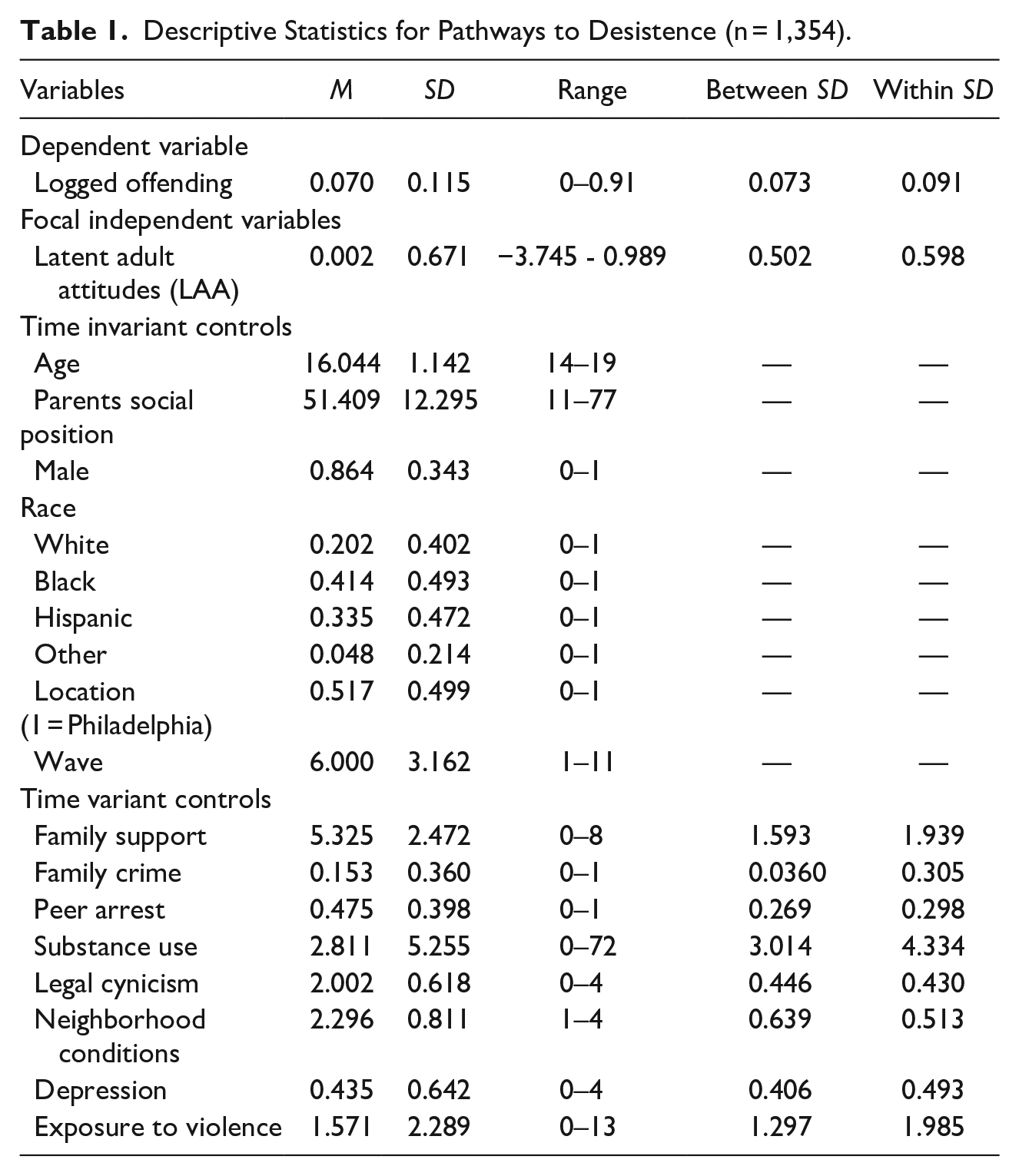
The focal dependent variable for the current analyses is offending. To measure offending I use a proportional variety index which was previously created by Pathways researchers. To measure offending, respondents were presented with a list of 11 aggressive offenses (i.e., shot someone, been in a fight) and 11 income offenses (i.e., shoplifted, bought/received/sold stolen property) and asked to endorse the offenses that they had committed. A “proportion of total offending” measure was constructed in which the numerator is the number of offenses endorsed and the denominator is the total number of offenses asked. Due to a significant positive skew in the distribution of offending, I use the natural logarithm of the measure in the forthcoming analyses. Data for offending is being drawn from all 11 waves and has a mean of 0.070 (1.5 offenses endorsed), with a standard deviation of 0.115 (2.5 offenses), and ranges from 0 (no offenses endorsed) to 1 (all offenses endorsed). The between-person standard deviation is 0.073 (1.6 offenses) and the within-person standard deviation of 0.091 (2 offenses) suggests individuals’ offending varies between waves. Descriptive statistics for offending and all other variables included in the models can be found in Table 1.
Descriptive Statistics for Pathways to Desistence (n = 1,354).
Focal Independent Variable
To construct my focal independent variable, I use an Item Response Theory (IRT) model to estimate a time variant, standardized measure which captures respondent’s adult identity at all 11 waves. IRT originates in the work of Lord (1972), Birnbaum (1967), and Rasch (1960), but scholars within the social sciences have begun to use the method to measure unobservable latent constructs and overcome limitations of traditional scaling techniques (Hambleton & Swaminathan, 2013). For example, in criminological research, Osgood et al. (2002) propose using Graded Response Models—a form of IRT—to overcome weaknesses related to traditional summative scaling techniques to measure self-reported offending. Similarly, Piquero et al. (2008) use IRT models to overcome past limitations in the measurement of self-control, an unobservable latent construct.
The overall goal of an IRT model is to develop a theta, or a measure of one’s ability in regard to the larger latent construct of interest. To do this, IRT uses variation in the item responses to produce an item “difficulty” parameter and a factor “discrimination” parameter that are considered in the construction of theta. The difficulty parameter determines how difficult each item is to endorse and includes that in the creation of theta, thus allowing for the difficulty to be consider in the construction of the measure. Similarly, the discrimination parameter considers the differences in endorsement across different groups and is included in the creation of theta. In addition, unlike general scale creation methods such as confirmatory and exploratory factor analysis, IRT estimates a standard error for each individual (Lord, 1972). The estimated standard error for each individual is contingent on the difficulty parameter of each item, which also allows for more variation and an accurate measurement.
Specifically, in the current study, I utilized Graded Response Models, which are a form of IRT models used with polytomous ordinal variables with at least three or more categories. Different from a traditional IRT approach which uses binary measures, the item difficulty parameter in a GRM is estimated for each response using the value coded as “1” as the contrast group and each subsequent response value is compared to the “1” value to estimate the difficulty (Samejima, 1997). The GRM is appropriate for the current study as the items used (discussed in detail below) are measured in an ordinal manner where lower values represent lower levels of conventional adult attitudes while higher values represent more conventional adult attitudes.
I used seven items derived from the perceptions of opportunity scale (Menard & Elliott, 1996) which asks respondents how important it is for them to (1) obtain employment or career, (2) receive college education, (3) earn a good living, (4) provide a good home for their family, (5) have a good marriage, (6) avoid legal trouble, and (7) have a good relationship with their children. Respondents answered on a 5-point Likert scale where 1 = not at all important and 5 = very important. These seven items were included in the estimation of LAA because they have either been identified in past research as indicators of adulthood which may lead to a change in identity, or they have been identified as important turning points which align with conventional adult roles. For example, items about employment/career and earning a good living have been identified as indicators of adulthood (Bernardini, 2014) but have also been shown to be related to desistance as a turning point (Sampson & Laub, 1992; 1993). Furthermore, providing a good home, good marriage, and good relationship with children have been considered indicators of adulthood (Bernardini, 2014), while partnership and parenthood have been identified as turning points that can bond an individual to conventionality (Andersen et al., 2015; Andersen, 2017; King et al., 2007; Nguyen & Loughran, 2018; Warr, 1998). Finally, continuing education and refraining from offending have been shown to increase feelings of adult status and are widely considered markers of adulthood (Bernardini, 2014; Buchmann 1989; Ford & Schroeder, 2010; Swisher & Denison, 2016).
The results of the Principal Component analysis (see Supplemental Table 1), eigenvalues (see Supplemental Figure 1), and GRM (see Supplemental Table 2) can be found in Supplemental Appendix A and show the results for wave 11. The results from wave 11 are similar to those from waves 1 to 10 and depict how the measure was constructed. IRT functions under the assumption of unidimensionality among the items included in the models (Hambleton & Swaminathan, 2013), meaning that all items included in the measurement are accurately measuring and contributing to the same overall construct. For the current study, all 7 items loaded onto 1 factor structure at all 11 waves, meaning that the assumption of unidimensionality has been met. GRM results demonstrate that all factor discrimination values across all waves are positive, and while there is variation in the item difficulty estimates between waves, they all fall into a reasonable range with no values bringing up concerns or suggesting the item is functioning differently between groups. Furthermore, the LAA measure at each wave takes the form of a standardized variable with a mean of essentially 0 and a standard deviation close to 1. Overall, results of the GRMs to form the latent construct of LAA is reliable and consistent across all waves and the descriptive statistics provide support for my first hypothesis that a latent measure can be constructed to measure LAA.
Time Invariant Controls
I include several time invariant controls, all of which come from wave 1 and serve as control variables in Models 2 and 3. First, I include a control for respondents’ age. Age has a mean of 16.044 and a standard deviation of 1.142 and ranges from 14 to 19 years old at wave 1. I also include a control for respondent’s parents’ social position by using a pre-constructed social positioning index (Hollingshead, 1971). Parent’s social position ranges from 11 to 77 with higher values representing a higher social position based on education and occupation. Parents’ social position has a mean of 51.409 and a standard deviation of 12.295. To account for differences by gender, I include a dichotomized variable to indicate if the respondent is male (86%), therefore, females serve as the contrast group in each model.
I included a dichotomized measure for race/ethnicity, which includes four race/ethnic categories encompassing White (20.2%), Black (41.4%), Hispanic (33.5%), and Other (4.8%). White serves as the contrast in all models. I also include a control for the location of the respondent with a dichotomized variable indicating the individual was located in Philadelphia (51.7% of the sample). Finally, I include a measure for the wave of the data to account for the effect of time. Including a measure for wave and a time invariant measure for age allows the models to account for differences in ages of respondents but also accounts for time within each model.
Time Variant Controls
I include numerous time variant control variables which have been identified by past literature to be associated with desistance and/or offending. For a detailed discussion of the measures see Mulvey et al. (2004) and Mulvey and Schubert (2012). I include two measures related to respondent’s family relationships. I used a measure for family support derived from the Contact with Caring Adults inventory (see Nakkula et al., 1990; Phillips & Springer, 1992), and the mean for family support is 5.325 with a standard deviation of 2.472, a range from 0 (low levels of support) to 8 (high levels of support), and a between-person standard deviation of 1.939 and within-person standard deviation of 1.593. I also include a measure for family offending where respondents were asked how many of their family members were involved in criminal activity during the last recall period. Descriptive statistics demonstrate that on average across all waves, 15.3% of respondents had family members involved in crime, with a between-person standard deviation of 0.360 and a within-person standard deviation of 0.305.
Next, given research highlighting the importance of peers and offending (Warr, 1993), I include a measure for peer arrest which accounts for the proportion of the respondent’s four closest friends who were arrested. Descriptive statistics demonstrate that on average across all waves, 47.5% (or just under half) of the respondents’ four closest friends reported being arrested with a between-person standard deviation of 0.269 and a within-person standard deviation of 0.398. I control for respondent’s substance use as past research has identified substance use has a criminogenic influence on offending (Fazel et al., 2006; Phillips, 2010). To account for substance use, I created a sum scale which draws data from nine individual items which asked respondents how often they used (1) sedatives, (2) cocaine, (3) opiates, (4) ecstasy, (5) hallucinogens, (6) inhalants, (7) nitrate, (8) marijuana, and (9) stimulants. The mean for substance use across all waves is 2.811 with a standard deviation of 5.255, a range from 0 (low substance use) to 72 (high substance use), and a between-person standard deviation of 3.014 and a within-person standard deviation of 4.334. Due to a significant positive skew, I use the natural logarithm of the substance use variable in the models.
I also include a control for legal cynicism as past research shows it is associated with offending (Hagan et al., 2018). To control for legal cynicism, I used a legal cynicism index (see Sampson & Bartusch, 1998). The mean of legal cynicism across all waves is 2.002, the standard deviation is 0.618, with a range from 1 (low levels of legal cynicism) to 5 (high levels of legal cynicism) and has a between-person standard deviation of 0.446 and a within-person standard deviation of 0.430.
I include a measure for neighborhood advantage as past research has shown that the environment surrounding the individual’s home may influence desistance and/or offending (see Sampson & Raudenbush, 1999). Descriptive statistics demonstrate the mean across all waves of data for neighborhood conditions is 2.296 (standard deviation = 0.811), ranges from 1 (worse neighborhood conditions) to 4 (better neighborhood conditions) and has a between-person standard deviation of 0.639 and a within-person standard deviation of 0.513.
I include a time variant measure of depression to account for differences in feelings of negative affect, which past research suggests is associated with offending (Agnew, 1992). To capture depression, I used a pre-existing measure created by Pathways researchers based on the validated Brief Symptom Inventory (BSI; See Derogatis & Melisaratos, 1983). The mean for depression across all waves is 0.435 and has a standard deviation of 0.642, a range of 0 (low levels of depressive symptoms) to 4 (high levels of depressive symptoms), and a between-person standard deviation of 0.406 and a within-person standard deviation of 0.493.
Finally, to capture exposure to violence I include a pre-existing measure created by the Pathways researchers which is a modified version of Selner-O’Hagan et al. (1998) Exposure to Violence Inventory. The exposure to violence measure consists of 13 items which asked respondents if they had been exposed to different violent situations as a victim and as a witness. The mean for exposure to violence across all waves is 1.571 and has a standard deviation of 2.289, a range of 0 (low exposure to violence) to 13 (high exposure to violence). The between standard deviation is 1.297 and the within standard deviation is 1.985.
Missing Data and Analytic Strategy
Like all large data sets, the Pathways to Desistance data deals with issues stemming from missing data. Primarily, the missing data comes from the later waves and may be due to sample attrition which is a common problem with longitudinal data. To overcome these issues, I performed Multiple Imputation by Chained Equations (MICE, White et al., 2011). I used all of the time invariant, time variant, and dependent variable as auxiliary variables. I also used a deletion strategy (see Von Hipple, 2007) which involves creating a variable which identifies respondents in the sample who were missing on the dependent variable, imputing the data using the dependent variable as an auxiliary variable, and then dropping the respondents who were identified as missing on the dependent variable following the completion of imputation. For the current study, I ran 30 iterations to use in the final analyses, which contains all 1,354 respondents and an average of 10 waves of data per respondent.
To take full advantage of the longitudinal nature of the Pathways data, I employ a series of mixed-effects regression models which allows me to nest time within the individual. By nesting time within the individuals, I am able to examine both between-person differences and within-person change in LAA across time (Boman & Mowen, 2017; Long et al., 2009) while accounting for time invariant demographic measures and time variant social and legal measures. Furthermore, I include a lagged measure for LAA to ensure that the previous wave’s level of LAA is not influencing the relationship between the current wave’s level of LAA and offending over time. To test the hypothesis that LAA is negatively associated with offending, I use a model building strategy where Model 1 estimates the bivariate relationship between offending and LAA, Model 2 introduces the time invariant controls, and Model 3 adds the remaining time variant measures.
Results
Before estimating mixed-effects models, I examined the variance inflation factors (VIFs) for all measures used in the analysis and none surpassed 3.00 in any of the models. Low VIFs suggest that the results of the analysis are not biased due to multicollinearity (O’brien, 2007). Furthermore, results of a Hausman test to test the assumption of equality were significant, suggesting that the coefficients in the fixed-effects model were significantly different than the coefficients in the mixed-effects model (Hausman et al., 2005). To overcome the significant Hausman test, I parsed out the effects of all time variant measures to create a level-two between-person effect and a level-one within-person change (Rabe-Hesketh & Skrondal, 2012). Further analysis demonstrated that LAA and family support varied in their significance by the between- and within- effects and must remain separated for the analysis. All other time variant covariates demonstrated less variance, suggesting they could be estimated as a combined effect. Results for the mixed-effects models can be found in Table 2.
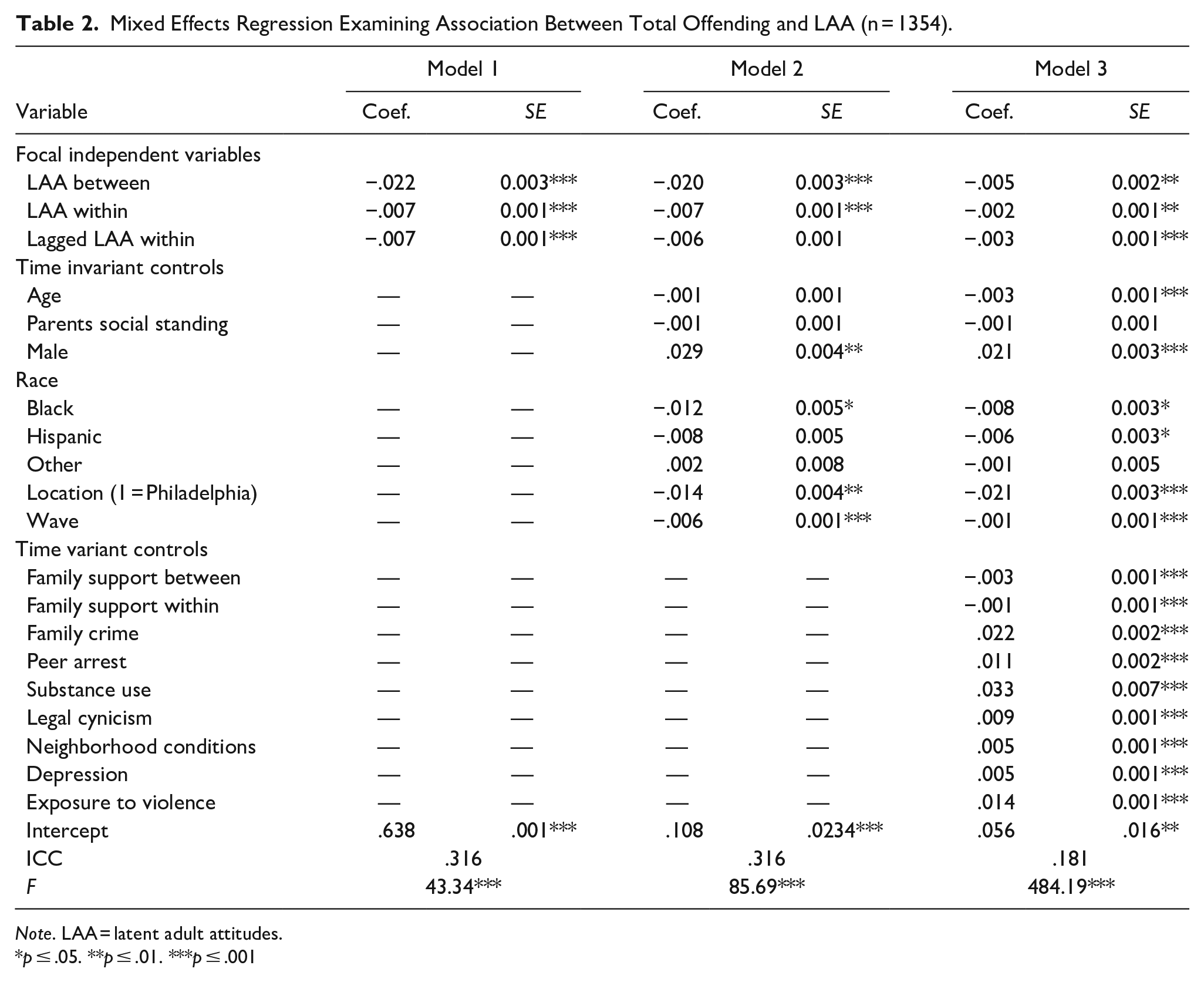
Mixed Effects Regression Examining Association Between Total Offending and LAA (n = 1354).
Note. LAA = latent adult attitudes.
p ≤ .05. **p ≤ .01. ***p ≤ .001
Model 1 in Table 2 shows the results of a mixed-effects model examining the relationship between the proportion of offenses committed and LAA. The model fit statistic demonstrates that the model fits the data well (F = 43.34, p < .001) and the ICC suggests that roughly 32% of the variation in the proportion of offenses committed is within-person change across time. Turning to the substantial results, the between-person measure of LAA is negative and significantly associated with a lower proportion of offenses committed across time. Specifically, a 1-unit increase is associated with a 0.022 decrease in the proportion of offenses committed. Similarly, the within-person measure of LAA is also negative and significantly associated with a 0.007 decrease in the proportion of offenses committed across time for every 1-unit increase.
Model 2 introduces the time invariant demographic controls. The model fit statistic remains significant (F = 85.69, p < .001) and the ICC saw no change at 32%. The results demonstrate similar findings to those in Model 1 with the between-person LAA measure remaining negative and significantly associated with a lower proportion of offenses committed over time. Also similar to Model 1, the within-person measure of LAA is negative and significantly associated with changes in the proportion of offenses committed. The added time invariant covariates also demonstrated significance. Males report 0.029 higher proportion of offenses committed compared to females, Black respondents report 0.012 lower value in proportion of offenses committed compared to White respondents, respondents from Philadelphia report 0.014 lower value in proportion of offenses committed compared to those in Maricopa County, and the association between the wave of data and proportion of offenses committed is negative and significant, with a 1-unit increase in wave corresponding to a 0.006 reduction in proportion of offenses committed across all respondents.
Model 3 in Table 2 introduces the remaining time variant controls. The model fit statistic demonstrates significance and suggest the model fits the data well (F = 484.19, p < .001), and the ICC decreased to 18% of the variation in the proportion of offenses committed is within-person changes across time. Once all control variables were included in the model, the between-person measure of LAA remained negative and significantly associated with proportion of offenses committed across time. Specifically, a 1-unit increase in LAA was associated with a decrease of 0.005 in proportion of offenses committed. Furthermore, the within-person LAA measure remains significant and negatively associated with the proportion of offenses committed across time. Specifically, a 1-unit change in the within-person measure of LAA is associated with a 0.002 decrease in the proportion of offenses committed over time. Also, age is negative and significantly associated with changes in the proportion of offenses committed, and the findings for Males, location, and wave remain consistent from Model 2.
A number of time variant measures were also significantly related to proportion of offenses committed. The between-person and within-person measures of family support are negative and significantly associated with a lower proportion of offenses committed over time, with a 1-unit increase being associated with a 0.003 and 0.001 reduction in the proportion of offenses committed respectively. Family crime demonstrates a positive and significant association with changes in the proportion of offenses committed, with a 1-unit increase in family crime being associated with a 0.022 increase. Peer arrest also has a positive and significant association with the proportion of offenses committed, with a 1-unit increase being associated with a 0.011 increase in offending. Substance use is positive and significantly associated with changes in the proportion of offenses committed, with a 1-unit increase associated with a 0.033 increase in the proportion of offenses committed. Legal cynicism is positively associated with proportion of offenses committed over time, with a 1-unit increase being associated with 0.009 increase in the proportion of offenses committed. The measure of neighborhood conditions demonstrates a positive and significant association with a 1-unit increase being associated with a 0.005 increase in offending. Depression is positive and significantly associated with changes in the proportion of offenses committed, with a 1-unit increase being associated with a 0.005 increase in offending. Finally, exposure to violence is positive and significantly related to offending, with a 1-unit increase in exposure to violence being associated with a 0.014 increase in proportion of offenses committed.
Discussion
The current study used a multi-site longitudinal data set containing formerly adjudicated youth during adolescence and into early adulthood to examine the internal mechanisms of desistance as a latent process of adulthood. Combing literature on adulthood, internal change, and desistance, I set out to test 2 interrelated research questions and hypotheses. First, by conceptualizing the internal processes of desistance as a latent process of adulthood, can a latent measure be formed to measure the larger latent construct of Latent Adult Attitudes? To answer the first research question, I used past literature on internal processes (Giordano et al., 2002; Harris, 2011; Paternoster & Bushway, 2009), adulthood and indicators of adulthood (Bernardini, 2014; Buchmann 1989; Shanahan, 2000), and a series of GRM to form a measure of LAA. The results of Principle Components Analyses demonstrate an essential unidimensional and reliable construct and descriptive statistics revealing a nearly standardized variable for LAA. These results support Hypothesis 1 that a latent measure can be formed using Graded Response models to measure and examine desistance as an internal latent process of adulthood.
The construction of this variable carries a number of implications for the current study and future research. First, a latent measure of LAA can be constructed so desistance can be studied and measured as an unobservable latent process, which past research has identified it to be (Harris, 2011). Furthermore, a time variant measures of the internal latent processes allows for desistance to be examined as it occurs over time instead of at singular points throughout the life-course. Future research should continue to examine desistance as a latent process using latent constructs that can reliably measure the multifaceted process of desistance.
The second research question I set out to answer was related to LAA and its association with offending. I hypothesized that LAA would be negatively associated with offending over time. Again, a negative association would provide support that increases in LAA are the development of an adult identity and the strengthening one’s social bond through shifts in commitments and beliefs in conventionality and thus resulting in a decrease in offending. Results of mixed-effects models demonstrate support for hypothesis 2. First, the between-person measure of LAA is significant in the full model, suggesting those with higher levels of LAA are offending less than those with low levels of LAA. Furthermore, the within-person measure of LAA is associated with decreases in offending across time, suggesting that those who experience an increase in LAA over time are offending less than before the change occurred. These results are supported by the past work of Giordano et al. (2002), Paternoster and Bushway (2009), Bachman et al. (2016), King (2013), and Stone (2015). This body of literature on internal processes has argued that individuals need to experience internal changes to desist from their criminal ways and findings of the current study suggest that the development of an adult identity rooted in conventionality may serve as a catalyst for change in offending. Theoretically, the change from low to high LAA is what strengthens one’s bond to society through shifts in commitments and beliefs in conventional society and is leading to desistance from crime. However, maintaining a high level of LAA is also vital as the between effect suggests those with higher levels of an adult identity are offending less compared to those with lower levels of LAA. This supports the perspective that LAA is a latent process of adulthood that must unfold over time to have a meaningful influence on offending as individuals age into adulthood.
Outside of the theoretical contributions and implications, the current study also carries implication in terms of policy. The findings of the current study may add insight to all three components of the Risk-Need-Responsivity (RNR) model (see Bonta & Andrews, 2007. First, the risk component—focused on identifying people most at risk of reoffending—may be informed by the results as it may help identify youth at risk of reoffending due to a lack of pro-social attitudes towards adult roles. Second, the need component seeks to identify which criminogenic need must be addressed within the responsivity component of the model. Previously, common criminogenic needs identified are social support, substance abuse, and pro-criminal attitudes (Bonta & Andrews, 2007). The results of the current study demonstrate that increases in LAA over time is negatively associated with offending, which underscores the importance of including and identifying criminal attitudes as a need that must be addressed under the premise that individuals will need to transform their pro-crime attitudes into pro-social attitudes. Third, the responsivity component—which aims at responding to the criminogenic need with the proper treatment—can also be informed by the results. Responses to criminogenic needs should include treatment that focuses on promoting pro-social attitudes and values, and programs that are aimed at increasing attitudes towards conventional indicators and roles associated with adulthood. One example of treatment that may be beneficial in constructing more conventional adult attitudes is Cognitive Behavioral Therapy (CBT). CBT is a form of therapy that attempts to change the negative thought patterns and beliefs one holds in order to change an individual’s behaviors (Cuijpers et al., 2013). Past research in the field of criminology has found that CBT can improve individuals’ chances at desisting from crime and decrease offending by changing their thought processes (Lipsey et al., 2007; McGuire et al., 2008; Walters, 2017).
While the results of the current study inform theory and policy, the research is not without limitations and avenues for future research. First, scholarship on emerging adulthood suggests that adulthood may look and occur differently for different groups in society (Benson & Johnson, 2009; Laupa, 1991). The current study set out to examine the general relationship between desistance and latent adulthood, and as such, does not examine heterogeneity in the development of LAA. Future research should consider the differences in adulthood by race, gender, and social class, as variations may exist in how adulthood unfolds, which in turn may have heterogeneous effects on offending. Furthermore, while the current study is able to include a lagged measure for LAA to account for earlier levels of adult identity, the current modeling strategy does not allow for a lagged dependent variable (see Allison, 2015). The inclusion of a lagged dependent variable would allow us to be more confident in the relationship between LAA and offending as follow-up levels of offending are likely influenced by previous observation’s levels of LAA and future research should consider lagging the dependent variable to draw more causal inference.
There are other limitations that arise from the Pathways to Desistance data. First, the analysis examined desistance as a latent process including both males and females. However, this study does not consider the possibility that adult indicators and their effect on offending may vary by gender. Future research should consider this, as there may be gendered processes to LAA—for instance, research shows that females mature more quickly than males (Ahamed & Ghosh, 2012), which has implications for their willingness to engage in identity transformations that subsequently influence desistance. Similarly, race/ethnicity, social class, and neighborhood disadvantage could all influence LAA and there is likely variation in individual’s perceptions of what adulthood is. Future research should consider these differences in exploring how an adult identity is associated with desistance. Next, the data comes from only two locations, and while Philadelphia and Maricopa County are on opposite sides of the United States and offer differing samples, the similarities between the two urban areas make it difficult to generalize the results to the entire population. For example, there is potential that adulthood looks differently for those in rural areas and that the process of desistance also varies by location. Future research should examine differences between rural and urban areas in terms of adulthood and offending. Finally, future research should examine desistance as a latent process using samples of youth who have yet to interact with the juvenile justice system to better understand the internal influences of adulthood across different juvenile populations.
Overall, the current research highlights that internal processes of desistance can be examined over time as a latent process of adulthood. Furthermore, it demonstrates that high levels of an adult identity and the development of an adult identity over time are directly related to reductions in offending over time. These findings provide insight on the internal mechanisms leading to desistance from crime and support the notion that individuals must change or gain pro-social identities to knife off their past criminal behaviors from their future pro-social lives. While future research should examine the various forms and processes of adulthood by race, social class, gender, and location, scholars and practitioners should recognize the importance of adulthood, conventional adult attitudes, and their critical influence on desistance from crime.
Supplemental Material
sj-docx-1-cad-10.1177_00111287231202778 – Supplemental material for Adult Attitudes and Crime: Understanding the Association Between Latent Adult Attitudes and Offending Across Time
Supplemental material, sj-docx-1-cad-10.1177_00111287231202778 for Adult Attitudes and Crime: Understanding the Association Between Latent Adult Attitudes and Offending Across Time by Kyle J. Bares in Crime & Delinquency
Footnotes
Declaration of Conflicting Interests
The author declared no potential conflicts of interest with respect to the research, authorship, and/or publication of this article.
Funding
The author received no financial support for the research, authorship, and/or publication of this article.

Supplemental Material
Supplemental material for this article is available online.
Author Biography
References
Supplementary Material
Please find the following supplemental material available below.
For Open Access articles published under a Creative Commons License, all supplemental material carries the same license as the article it is associated with.
For non-Open Access articles published, all supplemental material carries a non-exclusive license, and permission requests for re-use of supplemental material or any part of supplemental material shall be sent directly to the copyright owner as specified in the copyright notice associated with the article.
