







Abstract
We used an experimental study design with newspaper vignettes to examine how characteristics of gun violence perpetrators including mental illness and previous incarceration influence three categories of firearm policy support in a national sample of U.S. adults (N = 3,387). Depictions of mass shootings elicit greater support for firearm policies than other types such as suicides, accidents, or street-level homicides. Further, depictions of mental illness and previous incarceration increase support for policies regulating who may legally own, purchase, and possess firearms. Demographic characteristics of perpetrators such as gender and race largely do not affect public policy support, although personal characteristics of respondents themselves are predictive of support.
The United States (U.S.) has the highest rate of firearm death among industrialized, high-income nations (Grinshteyn & Hemenway, 2019). Firearm assaults, suicides, unintentional injuries, and homicides account for nearly 40,000 firearm-related deaths in the country each year and more than 120,000 non-fatal injuries (Goldstick et al., 2019; Kaufman et al., 2021). Since 2020, firearm violence has risen in many cities across the country after decades of steady decline (Donohue, 2022; Kim & Phillips, 2021). Despite the human toll of the U.S. firearm violence epidemic and widespread public support for many firearm regulations (Barry et al., 2019; Crifasi et al., 2021; Daniels et al., 2022; De Pinto et al., 2022), major changes to federal firearm safety policies remain largely unrealized. At the state level, for instance, recent referendums on firearm regulation in Maine, Nevada, and California have failed to pass (Cohn, 2022), reflecting continued political conflict around firearm regulation shaped by, among other factors, race, gender, fear of crime, religion, education, political ideology, and racial resentment (Carlson, 2015b; Filindra & Kaplan, 2017; Merino, 2018; Newman & Hartman, 2019; Semet & Ansolabehere, 2011).
This contentious political and regulatory landscape also appears to be influenced by media coverage of firearm violence that depicts victims and perpetrators in curated ways. Prior research documents that media coverage of rare mass shootings far outpaces that of firearm suicides, the most common type of firearm violence in the U.S. (Meindl & Ivy, 2017). White and female victims receive more coverage than male and Black or Latino victims (Pritchard & Hughes, 1997; Weiss & Chermak, 1998) and media outlets are more likely to depict White victims as complex, multifaceted people (White et al., 2021). Similar inequalities exist in media coverage of firearm violence perpetrators such that depictions of Black and Latino perpetrators emphasize the immorality and criminality of these perpetrators more so than coverage of their White counterparts (Duxbury et al., 2018).
Depictions of firearm violence, in turn, affects public opinion toward firearm policies in the U.S. Prior research has shown that greater media coverage of mass and/or school shootings increases support for policies such as universal backgrounds checks, large-capacity magazine bans, and restrictions on firearm access for people with severe mental illness (Jose et al., 2021; McGinty et al., 2013). Other research that has looked a greater range of firearm policies, however, complicates these findings: whereas exposure to media vignettes describing a victim of a mass shooting increased support for regulations on who can legally own, purchase, or possess firearms, vignette descriptions of a victim with mental illness led to less support for regulating firearm use, storage, and carrying (Berryessa et al., 2022). Crucially, this same study found that exposure to vignettes describing a Black firearm violence victim was associated with a significant decline in support for all firearm regulation policies, regardless of the type of policy in question. Thus, it appears that varying depictions of firearm violence may influence public opinion across a range of firearm policy types.
At present, however, research on how depictions of firearm violence affects public support of firearm policy is limited in three important ways. First, prior research that attends to the media’s discussion of firearm violence rarely connects the content of this coverage to firearm policy support (McGinty et al., 2014; Schildkraut et al., 2018). Second, research that does investigate public attitudes toward firearm policies with respect to media coverage often restricts its focus to exceedingly rare mass or school shootings (Guo et al., 2021; Jose et al., 2021; McGinty et al., 2013; Semenza & Bernau, 2022). Third, the research that looks beyond media coverage of the rarest type of firearm violence and its effect on firearm policy support examines only coverage of firearm violence victims (Berryessa et al., 2022). At present, it is unclear if or to what degree variation in the media description of a firearm violence perpetrator affects public support for firearm policies.
To better understand public opinion about firearm policies and identify practical avenues for reducing firearm violence (Pickett, 2019), it is necessary to address the limitations in prior research on the role of media coverage in shaping public support for firearm policies. In this study, we utilize an experimental survey and vignette design with a national quota sample of U.S. adults (N = 3,387) to assess how perpetrator characteristics, shooting incident type (e.g., street crime, suicide, unintentional injuries, or mass shooting), and a variety of personal respondent characteristics shape public support for three unique categories of firearm policies. We focus on two particularly salient factors for firearm violence perpetrators: mental illness and criminal background. This study makes a unique contribution to the literature by using experimental depictions of shooting perpetrators across a range of shooting types to estimate the causal effect of these two factors on public opinions across a range of policies. Following discussion of our study’s limitations and directions for future research on public opinion of firearm policies, we consider the implications of our results for media coverage of firearm violence and the potential for mobilizing public support for reducing firearm violence through policy.
Background
What Predicts Support for Firearm Policies?
A range of individual-level factors predict support for firearm policies. Recent research demonstrates that some of the strongest predictors of policy support include political affiliation (Losee et al., 2021) and firearm ownership (Barry et al., 2018, 2019; Lacombe et al., 2019). In general, Democrats tend to favor stricter firearm policies related to gun control whereas Republicans are more likely to oppose these measures, favoring instead policies that provide greater access and less restrictions for firearms. Similarly, firearm owners are less supportive of firearm policies related to restrictions on concealed carry than those that do not own firearms, although there is much greater parity on issues like firearm safety training and background check policies (Barry et al., 2019).
Demographic characteristics, such as age (Stone et al., 2020), race (Crifasi et al., 2021), and gender (Lizotte, 2019) each influence support for firearm policies. For instance, younger adults appear to have low support for many firearm violence prevention policies compared to those 30 years or older (Stone et al., 2020). Conversely, most older adults support policies related to firearm safety counseling and access prevention for high-risk individuals (Carter et al., 2022). White firearm owners tend to show less support for different firearm policies than their Black and Hispanic counterparts, while women are more likely to support gun control measures than men (Lizotte, 2019).
Despite this line of research, one’s own individual characteristics are not the only factors that shape support for firearm policies. Research increasingly shows that depictions of firearm violence and news media influence how people support firearm policies (McGinty et al., 2013, 2014). Media depictions enable viewers and readers to quickly identify a problem, assign blame for that problem, and then establish an opinion for how to address it (Gamson & Modigliani, 1989). While useful for quickly learning the broad facts about a specific story, this process can distort how people perceive an issue, especially if they come to rely on a limited scope of knowledge or short-hand heuristics to identify the causes of a problem. As a result, media depictions influence how people make determinations regarding their support for policies that solve complex problems (Baranauskas & Drakulich, 2018). Research demonstrates that media depictions influence perceptions of a range of criminal justice policy issues, including firearm safety and regulation (Burton et al., 2021; Jose et al., 2021; Robbers, 2005) as well as capital punishment and support for harsh crime policies like trying juveniles as adults (Britto & Noga-Styron, 2014; Roche et al., 2016).
Most research on media depictions of firearm violence focuses on rare mass shootings, with far less attention paid to other forms of firearm violence like community violence, unintentional injuries, or suicides (Jose et al., 2021). Little research to date has analyzed how characteristics of a given incident depiction, its victims, or its perpetrators influence public support for firearm policies. However, one recent study leveraged a vignette experiment with a sample of U.S. adults to test if certain characteristics of firearm violence victims described in a news story influenced public support for different firearm regulations (Berryessa et al., 2022). Respondents reported less support for firearm regulations when a firearm violence victim was Black compared to when the victim was White, whereas victim gender, mental illness, and age did not affect policy support. Unlike prior studies that focus solely on mass shootings (Jose et al., 2021; McGinty et al., 2013, 2014), this study also manipulated the type of firearm violence incident being described and found that mass shootings generated increased policy support compared to a street firearm homicide. Exposure to depictions of firearm suicides and unintentional injuries did not shift policy support.
The results of the study from Berryessa et al. (2022) suggest that certain characteristics of firearm violence incidents depicted by the media, beyond one’s own personal traits, contribute to how people consider policy solutions to reduce firearm violence. Related research finds that different types of media depictions around firearm violence similarly influence issue salience and may ultimately affect the public’s agenda around firearm policy and firearm violence reduction (Guo et al., 2021; Zhang et al., 2019).
Perpetrator Characteristics for Firearm Policy Support: Considering Mental Illness and Criminal Background
A growing body of literature demonstrates that the depiction of a given shooting incident (including its victims) can shape public support for particular firearm policies. Yet there has been limited research to examine how the characteristics of firearm violence perpetrators influence firearm policy attitudes. This is a critical omission given the frequency with which news media heavily focuses on the perpetrators of firearm violence, especially in coverage of mass shootings (Silva & Greene-Colozzi, 2019). In addition to perpetrator characteristics, such as race, age, and gender, which might shape the public’s policy attitudes toward reducing firearm violence, we consider here two particularly salient individual-level characteristics that media focuses on in coverage of firearm violence: mental illness and criminal background.
Mental illness is a critical yet often misunderstood issue implicated in U.S. firearm violence and firearm policies. Mass shootings by individuals suspected of having psychological illnesses receive extensive media attention (Wilson et al., 2016). The perpetrators of shootings like those at Sandy Hook Elementary, a movie theater in Aurora, Colorado, and a political rally in Tucson, Arizona, are all frequently highlighted as clear case studies of mental illness causing firearm violence (Metzl & MacLeish, 2015). As a result, popular and political commentators often assume a direct relationship between mental illness and perpetration of mass violence, despite the statistical rarity of mass shootings and the lack of evidence that individuals diagnosed with mental illness are more likely than anyone else to commit crimes with a firearm (Metzl & MacLeish, 2015). In fact, evidence suggests that only about 4% of interpersonal violence in the U.S. is attributable to mental illness alone (Swanson et al., 2015). Although people with mental illness are much more likely to be the victim of a violent crime than the perpetrator (Choe et al., 2008), news and media content about mass shootings contribute to enduring negative attitudes and stigma about mental illness (McGinty et al., 2013, 2014; Wilson et al., 2016). This may result in an outsize public focus on policies that emphasize mental health treatment and restrictions on firearm access for those with specific diagnoses, rather than broader legislation for systemic changes like universal background checks and improved firearm licensing infrastructure.
Evidence suggests public attitudes regarding mental illness related to firearm violence shape support for policy responses. In one notable study, McGinty et al. (2013) used a survey-embedded randomized experiment to examine how news stories about mass shootings influence public support for particular gun control policies. The authors found that compared with a control group, respondents exposed to a story about a mass shooting committed by someone with a serious mental illnesses had more negative attitudes toward people with serious mental illness. The same respondents also exhibited greater support for firearm restrictions specifically for people with serious mental illness. Although scholars argue that policies for firearm restrictions based on mental illness will increase stigma and have a limited impact on overall rates of firearm violence in the U.S. (Appelbaum & Swanson, 2010; Swanson et al., 2015), public attitudes driven by the media’s persistent attention on mental illness are nonetheless salient for considering which policies may have enough support to become law (Metzl & MacLeish, 2015). The issues of mental illness and firearm violence appear to be of substantial public concern, despite clear misperceptions regarding how the two are fundamentally related to one another.
The depiction of criminal background for a firearm violence perpetrator is another pertinent factor likely to influence public support for certain firearm policies. Prior violent behavior and involvement in domestic violence are both significant risk factors for firearm violence perpetration regardless of conviction status (Campbell et al., 2007; Cook et al., 2005). As such, federal law prohibits firearm possession by those convicted of felonies and domestic violence misdemeanors, while state laws in places like California and New Jersey often expand prohibitions for additional offenses (Giffords Law Center, 2022; Wright & Wintemute, 2010). Policies related to these prohibitions typically garner support among the general public with parity across both firearm and non-firearm owners (Barry et al., 2018, 2019). Yet evidence is less clear regarding public support for firearm prohibitions based on broader indicators of criminal justice background for perpetrators, such as incarceration history.
Although there is generally consensus that violent felony offenders should be prohibited from possessing a firearm (Kahn, 2014), there remains limited evidence to suggest that those incarcerated for non-felony offenses, such as non-violent misdemeanors or drug-related charges, are at any greater risk for criminally using a firearm. Despite this, incarceration history is broadly stigmatizing for individuals who have been imprisoned, leading to substantial socioeconomic and health-related disparities between those who have been incarcerated and those who have not throughout the U.S. (Feingold, 2021). Research demonstrates that people often perceive those who have been incarcerated as more dangerous and immoral, regardless of the offense for which the individual was incarcerated (Kuehn & Vosgerau, 2022). This stigma applies similarly to individuals with formerly incarcerated relatives, imparting negative impacts on perceptions of personality traits, financial deservingness, and parenting quality (Brew et al., 2022).
The public often imparts a “master identity” or dominant social status upon formerly incarcerated persons that overrides any other personal characteristics or relational attributes about that person (Alarid & Vega, 2010; Asencio & Burke, 2011). People may be fathers or mothers, brothers or sisters, employees or employers, but ultimately the stigma of incarceration history overrides these as the most salient attribute about that person. This stigmatizing process tends to apply across formerly incarcerated persons for many types of offenses (Feingold, 2021). Labeling theories suggest the stigmatizing process for incarcerated persons is similar to that of those with mental illness because each are perceived by “deviant” labels without further attention to the complexities of their personality that may have little to do with their ascribed master identity (King & Smith, 2023; Link & Phelan, 2001). Since research shows that the stigma of mental illness related to firearm violence influences stronger support for restriction-based firearm policies (McGinty et al., 2013), the same is conceivable for a firearm violence perpetrator’s prior incarceration given the similarities in the two stigmatizing processes (Hartwell, 2004; Sugie & Turney, 2017).
Depictions of mental illness and criminal background may be particularly influential for public support of firearm policies and mobilization around certain types of legislation. For instance, people may be supportive of firearm policies that regulate who may legally own, purchase, or possess firearms if they perceive violent firearm users as people with mental illness or a criminal background. On the other hand, issues of criminal background and mental illness may not influence policy support for firearm sales regulation or rules around storage and carrying for firearms since those individual characteristics may be seen as less relevant for those types of policies. As such, we anticipate that issues of prior incarceration and mental illness will be especially salient for policies related to person-based prohibitions of firearms.
Methodology and Data
Considering extant literature, we leverage an experimental study design using newspaper vignettes to assess how various characteristics of a perpetrator of firearm violence influence firearm policy support in a national sample of U.S. adults. We focus here on mental illness and criminal background here while considering a range of additional independent variables in our analyses in light of prior research showing that perpetrator characteristics, like race and gender, as well as incident type, can shape public perceptions of firearm violence (Berryessa et al., 2022; Duxbury et al., 2018; Silva & Capellan, 2019). We offer the following hypotheses focused on mental illness and criminal background to guide our analysis:
Participants
This study uses a sample of U.S. adults (age 18+ years), demographically balanced on U.S. population quotas for gender, race, education, and geographic region, requested from the market research firm, Qualtrics Panel. Qualtrics Panel samples participants from twenty traditional, actively managed market research panels and utilizes quota sampling to ensure that the demographics of the target sample matched national demographics for four demographic quotas: gender, race, education, and geographic region. Although Qualtrics does sometimes use social media to gather respondents, the present study only included participants from managed market research panels and the targeted sample from the panel base was proportioned to the population demographics mentioned above before invitations were sent. A randomized sample of potential respondents, from the aggregate panel sample, were sent email invitations that informed them that a 20- to 30-minute survey was available for their participation, that it was being conducted for research purposes only, and an incentive that would be provided if they completed it. No specific details about the contents of the survey were provided in the invitation to avoid self-selection bias.
Invitations to randomized potential participants from the aggregate panel sample were sent from April to August 2020 until surveys were completed by a sufficient number of participants for the four demographic quotas. In some cases, if intended quotas are not filled, Qualtrics may utilize weighting across each of the four quotas to ensure they were representative of the U.S. population demographics in those categories. In the case of our sample, all intended quotas were met. 1
An a priori power analysis indicated that a sample of at least 3,330 respondents was necessary for our analysis to detect small effects (f = 0.10) while minimizing error and maximizing confidence in statistical estimates (α = .01, power = 0.95). Complete or partial responses were collected from 3,823 individuals. In total, 436 participants were eliminated from data collection because they failed to complete the survey or incorrectly answered either honesty, attention, and/or manipulation check measures. Ultimately, Qualtrics Panel collected complete responses from 3,387 participants. All participants were paid by Qualtrics Panel; the compensation per completed survey was $4.43.
Experimental Procedure and Design
This study utilized a 2 × 4 × 4 × 3 × 2 × 2 fully-crossed, randomized factorial experiment to test how characteristics of perpetrators of firearm violence affect public support for firearm policies. This experimental design enables us to estimate the causal effect of how the portrayal of two factors of interest (mental illness and criminal background) influence support for various firearm policies across a range of firearm violence types. Completion time for the online survey experiment was approximately 25 minutes. Three assessments were embedded in the survey experiment to maximize data quality: an honesty question, an attention check, and a manipulation check on the details of the vignettes. The vignettes were written by the authors of the study after initial review of how short news alerts and articles are typically constructed in general-interest media sources about firearm violence. The vignettes were pretested and a pilot of about fifty responses collected by Qualtrics Panel was done to confirm that the content of the experiment was clear and to confirm data quality.
All participants provide online informed consent. Participants were shown a newspaper article which was visually formatted as a short article in Associated Press. The article stated that the Metropolitan Police Department has released information about a recent firearm-related incident and provided details on the perpetrator of an act of firearm violence. The full text of the vignettes are included Supplemental Appendix A and is similar to that used in Berryessa et al. (2022), except the current study’s vignette described the perpetrator, rather than the victim, of an act of firearm violence.
Independent Variables
Six demographic characterists of the perpetrator and the type of firearm-related event were randomly varied in the article that each participant received. This resulted in a fully-crossed experimental design with six independent variables. Although we focus here predominantly on mental illness and incarceration history, the remaining four are included as pertinent manipulations given prior findings that individual characteristics of victims and perpetrators in media depictions can influence firearm-related policy perceptions (Berryessa et al., 2022; Duxbury et al., 2018; Silva & Capellan, 2019):
Whether the perpetrator suffered from a mental illness (2): article does not mention perpetrator’s mental illness = 0, article mentions perpetrator’s mental illness = 1
Whether the perpetrator was previously incarcerated (2): article does not mention the perpetrator was previously incarcerated = 0, article mentions the perpetrator was previously incarcerated = 1.
Type of firearm violence the perpetrator committed (4): street homicide = 1, mass shooting = 2, suicide = 3, and unintentional injury = 4 2
Gender of perpetrator (2): female = 0, male = 1
Race of perpetrator (4): Black = 1, White = 2, Latino = 3, and Asian = 4
Age of perpetrator (3): young adult/23-years-old = 1, juvenile/16-years-old = 2, and older adult/60-years-old = 3
We use street homicide related to armed robbery in the vignette as the reference category for “type of firearm violence” for two reasons. First, this type of firearm violence is the most common type of interpersonal firearm violence that occurs in the U.S., especially compared to mass shootings (Wintemute, 2015). Relatedly, such “street” firearm homicides are the most commonly reported type of firearm violence, especially in local news media (Parham-Payne, 2014; Weiss & Chermak, 1998). Although mass shootings are extensively covered when they do occur, they are the rarest type of firearm violence. Given these two considerations, we use street homicides as the reference category since it represents a normalized or “typical” incident of firearm violence against which to compare other types of shooting incidents.
Outcome Variables
Drawn from materials used in Berryessa et al. (2022), every participant was presented with the same outcome measures that described twelve common firearm policies implemented across various jurisdictions in the U.S. On a scale from 0 (not at all supportive) to 100 (completely supportive), participants were asked to rate their support on how effective they believed each policy would be in reducing the occurrence of firearm violence that was described in the article that they had read. Each policy and measure were shown on separate pages with a mandatory 30-second timer to give participants sufficient time to read and provide responses.
Description of each policy used in this study were adapted from RAND’s second edition of the report entitled Gun Policy in America (Smucker et al., 2023). 3 Following the results of a factor analysis, we summarized twelve common firearm policies into three categories that shape firearm U.S. policy debates on firearm regulation and control: Category 1 includes policies that restrict who may legally own, purchase, or possess firearms; Category 2 includes policies that regulate firearm sales and transfers; and Category 3 includes policies that regulate the legal use, storage, or carrying of firearms. For the present study, we did not use the thirteenth policy from the report related to Stand Your Ground laws since these laws explicitly deal with expansion of legal use of firearms. Participants’ ratings of the twelve individual firearm policies were used to create three, multi-item averaged composite scores for each of these three firearm policy categories. 4 This resulted in three main outcome variables:
Participants’ support for firearm policies that regulate who may legally own, purchase, or possess firearms (four items; Cronbach’s alpha = .79), including (a) background checks; (b) prohibitions associated with mental illness; (c) minimum age requirements; and (d) surrender of firearms by prohibited possessors.
Participants’ support for firearm policies that regulate firearm sales and transfers (five items; Cronbach’s alpha = .87), including (a) bans on the sale of assault weapons and high-capacity magazines; (b) lost or stolen firearm reporting requirements; (c) licensing and permitting requirements; (d) firearm sales reporting and recording requirements; and (e) waiting periods.
Participants’ support for firearm policies that regulate legal use, storage, or carrying of firearms (three items; Cronbach’s alpha = .83), including (a) restrictions on concealed-carry laws; (b) child-access prevention laws; and (c) gun-free zones.
Control Variables
Participant demographics, including age (continuous variable), race (White Non-Hispanic, Black/African American, White Hispanic, Asian, or Other), sex (male or female), geographic location (South, West, Midwest, and Northeast), and education (high school graduate or less; some college; Associate’s degree; Bachelor’s degree; Master’s degree; Doctoral degree; and Professional degree), were collected at the start of the survey to ensure enough respondents completed the surveys based on Qualtrics’s demographic representativeness quotas.
At the end of the survey, to control for factors previously shown to be connected to support for firearm regulation in this study, participants were asked additional demographic questions related to military service (current or previous military service or no military service); Protestantism (identified as Protestant or did not identify as Protestant); political ideology [rated from extremely liberal (0) to extremely conservative (7)]; whether the respondent or a loved one has been victim of a violent crime (yes or no); community type (urban, suburban, or rural); whether the respondent believes firearms make things safer in relation to crime control (yes or no), and suspicion of the government as untrustworthy/ineffective (average of four measures; alpha = .90). An extended set of more general descriptive characteristics, such as religious identification, household income, sexual orientation, marital status, employment status, and occupation, were collected in order to provide more detail about the personal attributes of those within the research sample. The descriptive information for these extended demographics can be found in Supplemental Appendix C.
Each of these control variables are included in our models to account for documented differences in policy opinions related to firearms (Barry et al., 2019; Crifasi et al., 2021). For instance, older White men who live in rural areas of the country with military experience and more conservative political ideology are the least likely to support changes to firearm safety policy (Losee et al., 2021; Stone et al., 2020). On the other hand, younger women with higher levels of income and education living in cities are far more likely to support enhanced firearm regulations (Lizotte, 2019). A description of these demographic measures is provided in Table 1. All control variables were statistically distinct from one another, with correlations of these variables and further descriptive breakdowns by vignette condition available upon request.
Sample Demographics and Control Variables (N = 3,387).
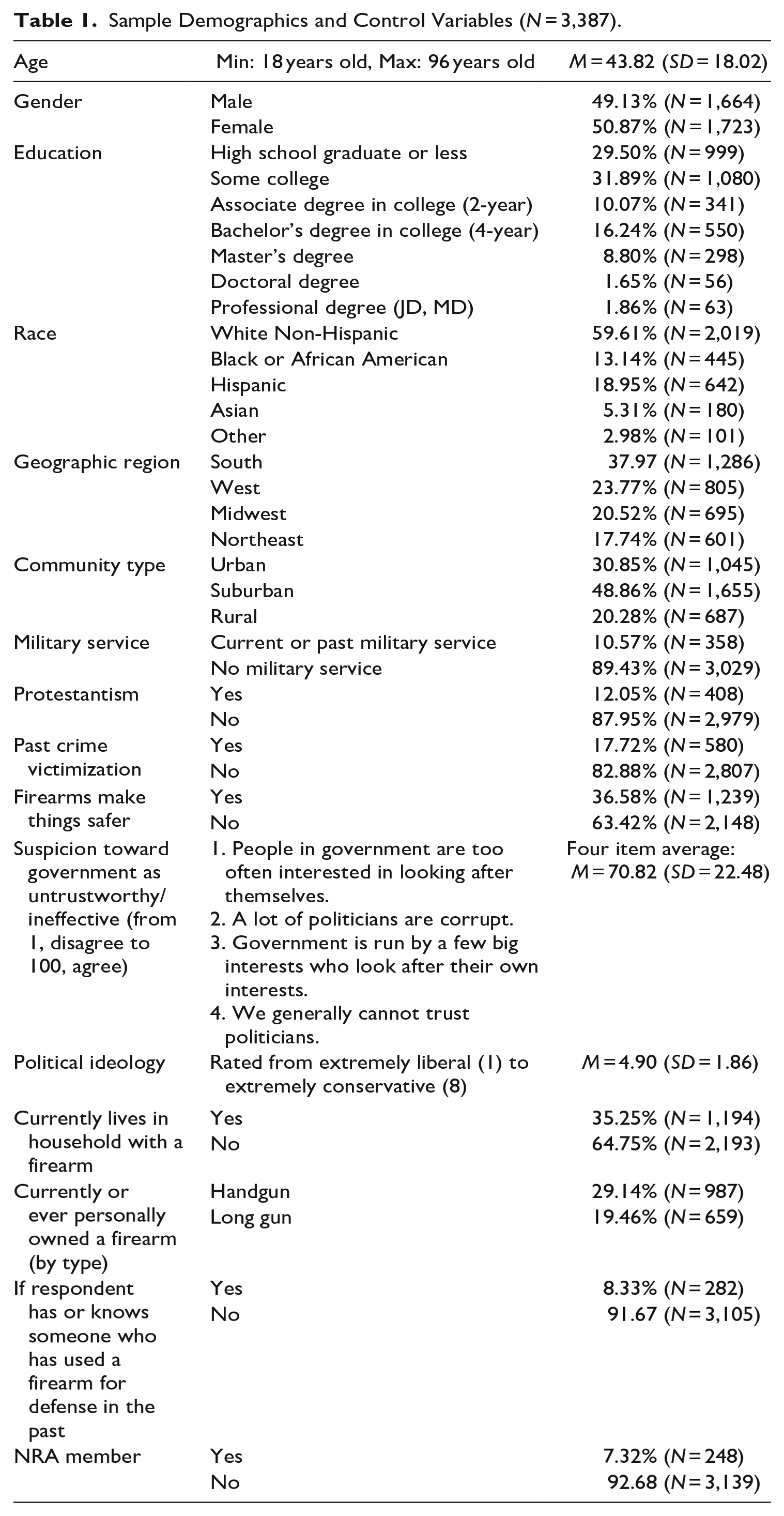
Participants were also asked selected items from the 2015 National Firearms Survey (Azrael et al., 2017) in order to learn about whether their household currently has any firearms (yes or no), they currently own or have ever owned one or more handguns (yes or no), if they currently own or have ever owned one or more long guns (yes or no), if they or someone they know have ever used a gun in self-defense (yes or no), and NRA membership (yes or no). These items related to firearm ownership, access, and use are documented to shape policy support for firearms regulation (Azrael et al., 2017; Barry et al., 2018, 2019; Lacombe et al., 2019).
Analytic Strategy
We assessed for multicollinearity using variance inflation factors (VIF) for all explanatory variables and found it did not create concerns for our models. 5 While controlling for a range of variables associated with public support for firearm policies and other measures, we examined how firearm crime perpetrator characteristics and the type of shooting incident (six independent variables) affects public support for three categories of firearm policies (three continuous outcome measures) using Ordinary Least Square (OLS) regression models. After confirming that the data met the assumptions of OLS, we estimated main effects of the vignette manipulations, as well as interaction effects between all of the vignette manipulations, using linear regression models that regressed support for each outcome variable on the independent variables and control variables. This approach resulted in three models, one for each category of firearm policy.
Results
Demographic and Descriptive Results
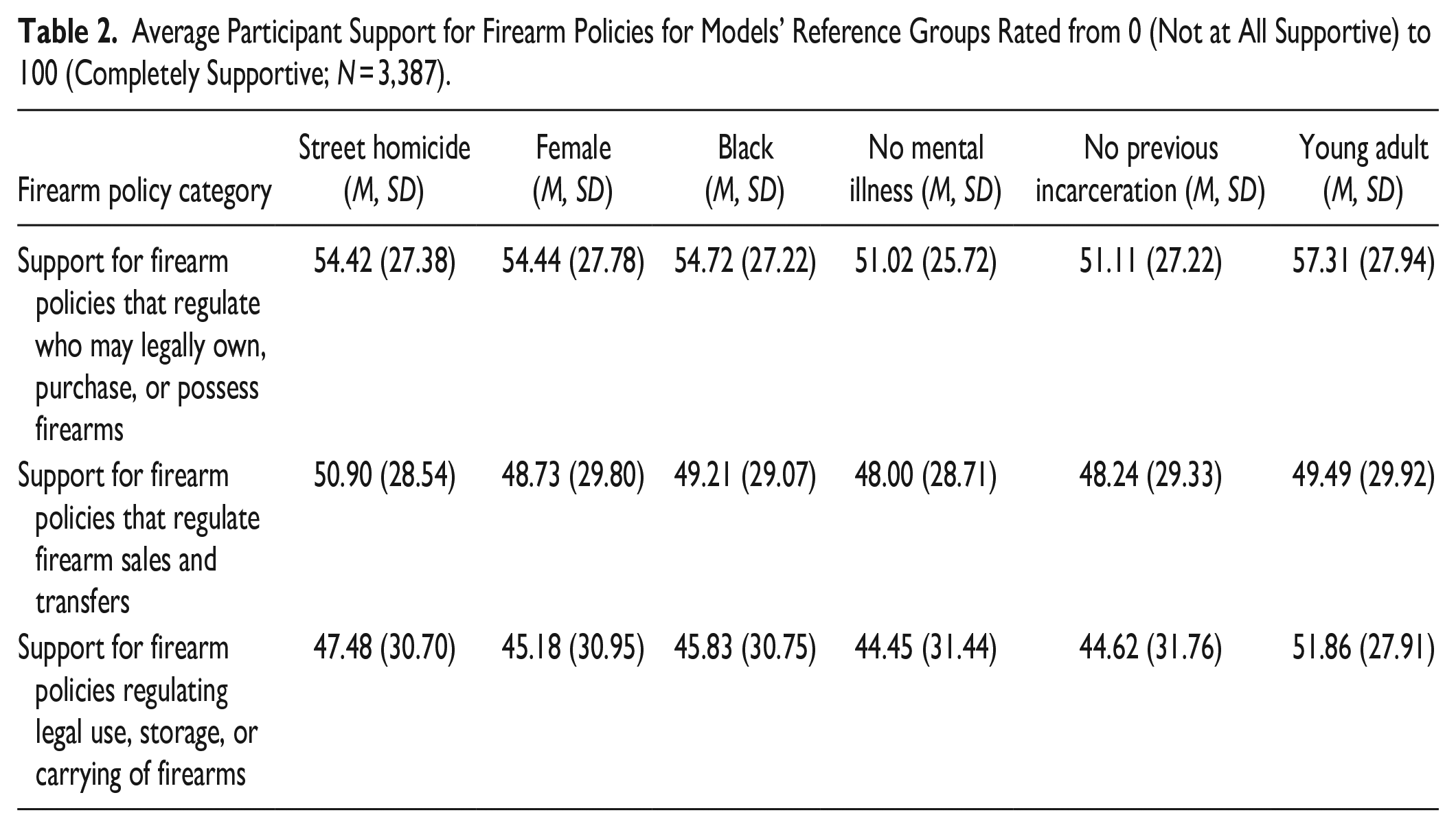
In total, 3,387 respondents took part and completed the study, with demographic information for the sample shown in Table 1. Analyses revealed no significant demographic differences across vignette conditions. Average support across the three categories of firearm policies for the models’ reference categories are shown in Table 2.
Average Participant Support for Firearm Policies for Models’ Reference Groups Rated from 0 (Not at All Supportive) to 100 (Completely Supportive; N = 3,387).
Main Results
Effects for the independent variables and control variables (both standardized and unstandardized regression coefficients, standard errors, p-values) and model statistics are provided in Table 3 across the three categories of firearm policies. In addition to main effects, interaction effects of the independent variables were examined for each model. Given the large number of independent variables and resultant quantity of interactions calculated in our models, we discuss the few significant interaction effects in the text rather than depict all possible interactions in the tables to ensure readability. Non-significant interaction effects are available upon request.
Effects of Perpetrator and Firearm Crime Characteristics on Support for Firearm Policies (N = 3,387).
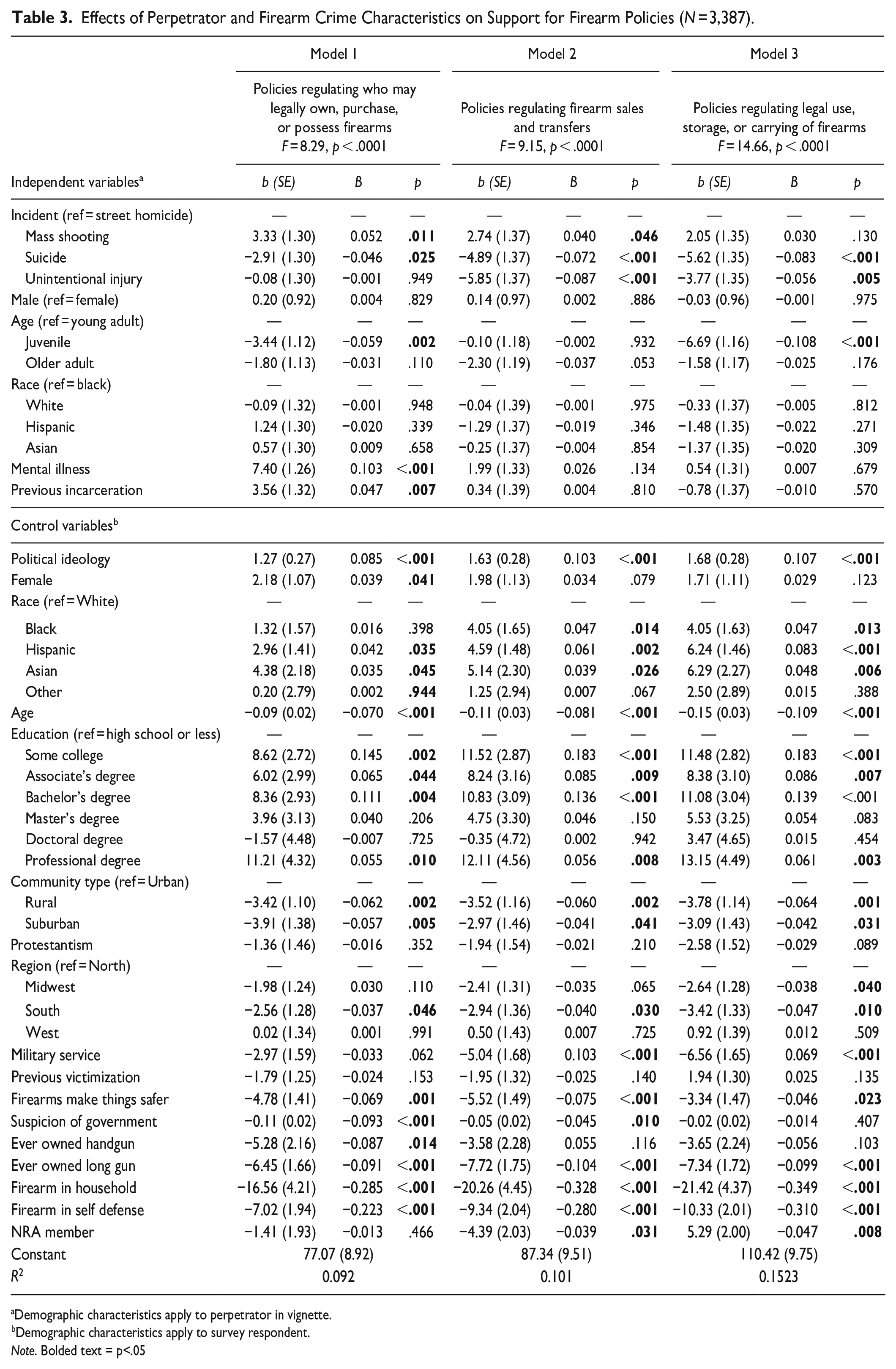
Demographic characteristics apply to perpetrator in vignette.
Demographic characteristics apply to survey respondent.
Note. Bolded text = p<.05
Model 1 shows the effects of the main independent variables on participants’ support for firearm policies that regulate who may legally own, purchase, or possess firearms. Notably, there was no significant association between the gender or race of the perpetrator and participant support for firearm policies that regulate who may legally own, purchase, or possess firearms. Participants reported significantly higher support for policies that regulate who may legally own, purchase, or possess firearms when exposed to a vignette that described the perpetrator of a mass shooting (b = 3.33, SE = 1.30, B = 0.052, t = .55, p = .011), compared to a street homicide. Conversely, participants reported significantly lower support for the same policies when exposed to a vignette that described a person who committed suicide with a firearm (b = −2.91, SE = 1.30, B = −0.046, t = −2.24, p = .025), compared to a street homicide.
Participants reported significantly lower support for this category of firearm policies when a perpetrator was identified as a juvenile (b = −3.44, SE = 1.12, B = −0.059, t = −3.09, p = .002), as compared to young adult, while they showed increased support when the perpetrator was identified as having a mental illness (b = 7.40, SE = 1.26, B = 0.103, t = −4.43, p < .001) or as being previously incarcerated (b = 3.56, SE = 1.32, B = 0.047, t = −2.70, p = .007). Notably, we also found a significant interaction effect (B = 0.296, t = 2.40, p = .017, not shown) between a perpetrator having a mental illness and the vignette depicting a mass shooting. In other words, exposure to a vignette describing the perpetrator of a mass shooting as someone with mental illness was associated with significantly greater support for firearm policies that regulate who may legally own, purchase, or possess firearms, compared to exposure to a vignette depicting a perpetrator of a mass shooting without mental illness.
Model 1 also shows that political ideology, gender (female), race (Hispanic, Asian, or Other Race, compared to White), and having some college, an associate’s, bachelor’s, or a professional degree (as compared to high school or less) predicted significantly greater support for firearm policies that regulate who may legally own, purchase, or possess firearms. In contrast, older age, living in a rural or suburban area (compared to urban), living in the South (as compared to the North), suspicion of the government, believing that firearms make things safer, having personally used or knowing someone who has used a firearm in self-defense, having firearms in one’s household, and owning handguns or long guns were associated with significantly lower support for these policies.
Model 2 shows the effects of the vignette perpetrator’s gender, race, age, mental illness, previous incarceration, and type of firearm violence on participants’ support for firearm policies that regulate firearm sales and transfers. We found no significant effect of perpetrator gender, race, age, mental illness, or previous incarceration on support for this category of firearm policy. Participants reported significantly greater support for firearm policies that regulate firearm sales and transfers when exposed to a vignette describing the perpetrator of a mass shooting (b = 2.74, SE = 1.37, B = 0.040, t = 1.99, p = .046), but significantly less support when exposed to vignettes that described persons who died in a firearm suicide (b = −4.89, SE = 1.37, B = −0.072, t = −3.56, p < .001) or unintentional injury (b = −5.85, SE = 1.37, B = −0.087, t = −4.27, p < .001), as compared to a street homicide. Again, we found a significant interaction effect (B = 0.265, t = 2.17, p = .030, not shown) between participants exposed to a vignette describing the perpetrator having a mental illness and committing a mass shooting, as compared to a vignette depicting a perpetrator of a street homicide not indicated to have a mental illness, and increased support for firearm policies that regulate firearm sales and transfers
Similar to the results for Model 1, non-White participants, those with a liberal political ideology, and those with more than a high school education reported significantly greater support for firearm policies that regulate firearm sales and transfers. Being older, living in a rural or suburban area, living in the South, prior military service, the belief that firearms make things safer, suspicion of the government, having used or knowing someone who has used a firearm in self-defense, having firearms in your household, being an NRA member, and personally owning long guns predicted significantly lower support for these policies.
Model 3 shows the effects of the vignette perpetrator’s gender, race, age, mental illness, previous incarceration, and type of firearm violence on participants’ support for firearm policies that regulate the legal use, storage, or carrying of firearms. We found no evidence of perpetrator gender, race, mental illness, or previous incarceration affecting support for these policies. There was decreased participant support for firearm policies that regulate the legal use, storage, or carrying of firearms if the perpetrator committed a firearm-related suicide (b = −5.62, SE = 1.35, B = −0.083, t = -4.16, p < .001) or unintentional injury (b = −3.77, SE = 1.35, B = −0.056, t = −2.81, p = .005), compared to a street homicide. There was also significantly less support for this category of firearm policy when the perpetrator was identified as a juvenile (b = −6.69, SE = 1.16, B = −0.108, t = −5.77, p < .001), as compared to a young adult. We found no significant interaction effects among the main independent variables in Model 3.
Finally, Model 3 indicates that participants’ liberal political ideology, race (Black, Hispanic, and Asian, compared to White), and having some college, an associate’s, bachelor’s, or a professional degree (as compared to high school or less) significantly predicted increased support for policies that regulate the legal use, storage, or carrying of firearm. Conversely, older age, living in a rural or suburban area, living in the South or Midwest, military service, the belief that firearms make things safer, NRA membership, personally or knowing someone who has used a firearm in self-defense, having firearms in your household, and personally owning long guns predicted significantly lower levels of support for this category of firearm policies.
Discussion
This study leveraged an experimental vignette design to assess how characteristics of firearm violence perpetrators described in short news vignettes affected support for firearm policies. Our results provide novel insight into how two characteristics of firearm violence perpetrators often discussed in media coverage—mental illness and criminal background—affect support for firearm policy. We found support for our three main hypotheses. First, those shown vignettes where a perpetrator of firearm violence was described as having a mental illness demonstrated increased support for firearms policies regulating who may own, purchase, or possess firearms. Second, exposure to vignettes where the perpetrator was previously incarcerated also increased support for firearm policies that regulate who may own, purchase, or possess firearms. Third, respondents exposed to vignettes that indicate either mental illness or prior incarceration for a perpetrator of firearm violence were not significantly more likely to support firearm policies regulating firearm sales and transfer or policies regulating legal use, storage, or carrying of firearms than those in the control groups.
While we confirm longstanding evidence that one’s own race, political ideology, geography, education, political ideology, and firearm ownership are reliable predictors of attitudes toward firearm regulation, we find no evidence that the race or gender of a perpetrator of firearm violence has a direct effect on firearm policy support. We also found that vignettes describing a mass shooting, compared to street firearm homicide, increase support for policies regulating who may own, purchase or possess firearms, as well as firearm transfers and sales. In contrast, compared to street firearm homicides, vignettes describing a firearm suicide cause a significant decrease in support for all categories of firearm support. Similarly, portrayal of unintentional injuries were linked to a decrease in support for policies regulating firearm sales and transfers, as well as policies regulating the use, storage, and carrying of firearms.
Our findings bolster prior research that documents the greater salience of mass shooting depictions relative to other types of firearm violence for public support of firearm regulations (Berryessa et al., 2022), as well as work that documents how coverage of mass shootings vis-à-vis mental illness shapes firearm policy support (McGinty et al., 2013). We build on this research by expanding the range of firearm policies considered, as well as testing how evidence of a criminal record shifts support of this diverse set of firearm policies alongside issues of mental illness. Importantly, our analysis highlights the complex ways even simple news vignettes can shape public support for firearm policies. Description of a perpetrator as having a mental illness does not have a consistent effect across firearm policy categories, nor does a perpetrator having been incarcerated impart the same influence across policies. When considered alongside the particular type of firearm violence incident being described, however, our significant interaction results show that perpetrator mental illness continues to be an especially powerful issue for members of the public weighing policy solutions to mass shootings.
It is important to consider why vignettes describing a perpetrator of firearm violence as having mental illness or having been incarcerated increased policy support for regulation of who can own or purchase a firearm. This finding may indicate that the public still considers firearm violence an individualized issue driven by the immorality of a particular “bad guy,” rather than the large supply of firearms in the U.S. or other structural conditions (Bushman, 2018; Merry, 2019). If people generally believe that shootings occur as the result of an individual deficit, they may be especially likely to support policies that prevent specific individuals from obtaining weapons. However, the regulation of firearm sales, transfers, and firearm behaviors such as firearm carrying or firearm storage may be seen as government overreach, especially if the public perceives “everyday” firearm owners to be distinct from the individuals or groups perceived as responsible for the phenomenon of firearm violence (Carlson, 2015a). Our results provide some support for this potential mechanism: we did not find heightened support for these firearm policies in response to vignettes describing perpetrator with mental illness or who had been incarcerated, implying that stigmatization of these groups may play an important role in shaping support for more person-focused firearm policies (Asencio & Burke, 2011; King & Smith, 2023).
The interaction between perpetrator mental illness and mass shootings helps provide additional context for how stigmatized identities of firearm violence perpetrators shape public firearm policy support. Whereas the main effect of perpetrator mental illness only predicted support for regulation of who may own, purchase, or possess firearms, a vignette describing a mentally ill person who committed a mass shooting also increased support for regulation of firearm sales and transfers. This provides evidence that public opinion on firearm policy may be most affected by media accounts which describe perpetrators in line with prevailing media coverage of mass shootings that depicts shooters as pathological individuals far removed from mainstream society (Silva & Greene-Colozzi, 2019). On balance, our results suggest that efforts to garner support for regulation of firearm purchasing, carrying, and storage may struggle to expand beyond a narrow focus on individuals which aligns with public understanding of who commits certain acts of firearm violence and for what reasons.
The challenges posed by media depictions of firearm violence notwithstanding, the enduring power of the news media to shape public perception provides a unique opportunity for media outlets to report on firearm violence, especially mass shootings, in ways that align public perception with facts around mental illness, incarceration, and violent crime (McGinty et al., 2013). At present, news and social media tend to follow the indelicate adage of “if it bleeds, it leads”—rare but ghastly incidents such as mass shootings capture public attention and help drive viewership and online engagement. There is little reason to expect the monetary incentives driving such coverage to change. Still, it is possible that coverage of mass shootings could be amended to shift public discourse away from simplistic stigmatizing explanations for firearm violence, such as mental illness (Swanson et al., 2015). While still recognizing the for-profit strictures of the contemporary media landscape, every story about firearm violence represents a discrete opportunity to educate the public on the complexity of firearm violence in the U.S. and avenues to address it. Even a small shift in regular media practices, when extrapolated across millions of viewers, could have meaningful effect on how the public thinks about firearm violence and the policies that can help reduce it.
The potential for even relatively small media effects on public support for firearm policies is especially relevant given that some of our estimated effects here, while statistically significant, are quite small. The coefficient for the effect of a mass shooting vignette on support for regulations on firearm sales and transfers, for example, is .04. Similarly, the coefficient for the effect of a vignette describing a perpetrator who was previously incarcerated is .047. Though our large sample size and experimental design mitigate the possibility that our results are the product of random chance or unobserved variation across participants (Button et al., 2013; Krzywinski & Altman, 2013), it remains an open question as to whether our small, precisely estimated effects are reflected in real-world behavior. That said, even small effects can “accumulate” across time or many instances (e.g., interactions or individuals) into practically important behavioral change (Funder & Ozer, 2019). Pervasive media coverage of firearm violence presents precisely the sort of context in which even relatively small effects could be amplified across millions of viewers’ repeated exposures to such coverage. Future research should investigate whether and under what conditions the effects found in this study manifest behavioral change related to firearm violence such as voting, political donation, and grassroots activism.
The utility of our findings notwithstanding, our study has certain limitations. Although the design of this experiment allowed us to make estimates of the causal effect of various features of a tightly controlled news vignette on firearm policy support, it is unclear to what degree our results generalize to the complexity of the real-world media landscape. Our vignettes, for example, were limited to text. Real-world media across television and the internet commonly includes images, video, and audio in its coverage of firearm violence, all of which may alter the effect of news stories about firearm violence on firearm policy support. We therefore recognize that our experimental vignette design represents only the first step in this line of research. Future research might embed these various types of content to better approximate the diversity of media coverage through which the public consumes information about firearm violence. Additionally, researchers should consider a broader analysis of actual media content of different shooting depictions in association with public support for firearm policies where possible to properly contextualize the experimental findings reported here.
Our study also has limitations related to survey and item construction. Survey respondents were limited to quantitative responses regarding support for firearm policies. Future studies may consider providing opportunities for respondents to contextualize their responses for firearm policies with open-ended survey items to better understand the nuance in levels of support across policy types. Our study was also limited to the use of discrete categories to measure for demographic variables such as gender and racial group. To reduce the risk of unintentional survey bias, future researchers might consider expanding the binary gender measure used here into a multi-categorical variable or asking participants instead for their “Assigned Sex at Birth.” Similarly, a greater sample size might enable a more nuanced investigation of policy support across racial groups beyond the four categories examined here.
Our operationalization of firearm violence and our categorization of firearm policies are also necessarily imperfect approximations of a complex social problem and legal landscape. Media vignettes in this study only manipulated the type of firearm violence incident and a handful of perpetrator characteristics: age, race, gender, prior incarceration, and mental illness. This, of course, leaves out a wide range of other perpetrator characteristics which might affect public support of firearm policies, such as alleged gang involvement and the location of a firearm violence incident. Relatedly, our vignettes used specific definitions of various firearm violence types. This is especially salient in the case of vignettes which described a “mass shooting,” wherein we borrowed the conservative definition—four or more people fatally shot, not including the shooter(s)—used by the Federal Bureau of Investigation and non-profits such as Everytown for Gun Safety. There is, however, no single, standardized definition of what constitutes a mass shooting and individual respondents may have different interpretations of the term (Smart & Schell, 2021). Future experimental research could clearly present various definitions of firearm violence types to participants and investigate whether such variation alters the effects found for our chosen definition of mass shootings.
Finally, like the limitations of our chosen operationalization of firearm violence incidents, the categorization of firearm policies we used are only one way to simplify the complex landscape of firearm policy and law. Though our categorization of 12 policies identified by RAND into three distinct groups was supported by a confirmatory factory analysis, future research could expand the range of policies under consideration and categorize them in an alternate manner. By the same token, future research could expand its focus to encompass other firearm-related policies and laws, such as “stand-your-ground” legislation, criminal penalties for firearm trafficking, or regulation of 3-D printed firearms and “ghost guns” (Jacobs & Haberman, 2017). 6
These limitations notwithstanding, insight into the factors that shape public opinion can help both researchers and policymakers understand the feasibility of implementing specific measures to address firearm violence (Pickett, 2019). Our results show this is especially salient in the context of mass shooting events as well as depictions of perpetrators with mental illness and those that have been formerly incarcerated. Despite the recent passing of important federal firearm safety legislation by the Biden administration (Clyde & Miranda, 2022), support for many policies to reduce firearm violence remain politically contentious. It is thus imperative to critically examine how the media can support public awareness and the development of policies most effective for reducing firearm violence throughout the country.
Supplemental Material
sj-docx-1-cad-10.1177_00111287231207388 – Supplemental material for Depictions of Firearm Violence Perpetrators and Support for Firearm Policies: An Experimental Survey Analysis of Mental Illness and Criminal Background
Supplemental material, sj-docx-1-cad-10.1177_00111287231207388 for Depictions of Firearm Violence Perpetrators and Support for Firearm Policies: An Experimental Survey Analysis of Mental Illness and Criminal Background by Daniel C. Semenza, Colleen M. Berryessa and Michael Sierra Arévalo in Crime & Delinquency
Footnotes
Declaration of Conflicting Interests
The author(s) declared no potential conflicts of interest with respect to the research, authorship, and/or publication of this article.
Funding
The author(s) disclosed receipt of the following financial support for the research, authorship, and/or publication of this article: Funding for this project was provided by the New Jersey Gun Violence Research Center at Rutgers University.

Supplemental Material
Supplemental material for this article is available online.
Notes
Author Biographies
References
Supplementary Material
Please find the following supplemental material available below.
For Open Access articles published under a Creative Commons License, all supplemental material carries the same license as the article it is associated with.
For non-Open Access articles published, all supplemental material carries a non-exclusive license, and permission requests for re-use of supplemental material or any part of supplemental material shall be sent directly to the copyright owner as specified in the copyright notice associated with the article.
