







Abstract
This study examines immigrant assimilation theories by focusing on arrest during adolescence and adult life using the National Longitudinal Survey of Youth 1997, a nationally representative panel study that follows children from adolescence through adulthood. The analysis compares outcomes for the first and second-generation of Mexican origin and other parts of Latin America to third- and fourth-plus generation (1) non-Hispanic white, (2) non-Hispanic black, and (3) Hispanic respondents. This investigation employs survival analyses to account for the timing of arrest and other events (e.g., graduation, childbirth, and employment). Results indicate the first generation, both of Mexican and Other Hispanic origin, are less likely to experience arrest than their higher-generation counterparts, regardless of race/ethnicity of the comparison group.
Introduction
The public association between immigrants and crime has been pervasive throughout American history, with immigrants often suffering political scapegoating and restrictive legislation in a response to perceived or actual increases in the crime rate (Hagan et al., 2008; Taft, 1933; Wang, 2012). However, research on the relationship supports a null or inverse relationship, suggesting that increases in recent immigration are not tied to subsequent increases in crime (Lee & Martinez, 2009; Martinez et al., 2010)
The changing structure of the American economy along with shifts in the demographic composition of the United States led researchers in the 1980’s and 1990’s to anticipate that ethnic minorities and immigrants with low levels of human and financial capital would face obstacles in attaining social mobility for themselves and their children (Tienda, 1989; Waters & Eschbach, 1995). While immigrants and their children were better off than those that came before the changes in the U.S. immigration system in 1965, members of the second generation (particularly of Mexican origin) still lagged behind children of American-born parents (Perlmann & Waldinger, 1997). Research suggests that for children in the 1.5 or 2nd generation, success in schooling and in work is often contingent on the human, social, and financial capital of their immigrant parents (Zhou, 1997). Still, studies that compare generations using cohorts from different times find that on average the current second generation has surpassed the first in measures of educational attainment, wealth, and occupational prestige (J. Park & Myers, 2010). J. Park and Myers (2010) find that while all ethno-racial groups show increases in intergenerational mobility, Hispanic and non-Hispanic black individuals still lag behind the non-Hispanic whites. Accordingly, the possibility for intergenerational mobility and academic achievement can differ by ethnic group, and success in school can depend on how far back behind the “starting line” an immigrant child starts.
At the same time that first and second-generation students pursue schooling, they are faced with external pressures or life events that may derail their progress. Arrest is often classified as a “turning point” event during the period of transition from adolescence to adulthood that can make pursuing education more difficult for both immigrants and their native-born counterparts (Rumbaut, 2005). Moreover, arrest and incarceration are linked to growing up in poverty (Kirk, 2008; Orfield & Lee, 2005). National estimates of poverty for children under 18 years show that 28% of non-Hispanic black individuals and 23% of Hispanic individuals live at or below the poverty line compared to 10% of non-Hispanic whites (Irwin et al., 2022). 1 Yet, some studies that explore the process of assimilation for the second generation suggest that net of family resources, certain ethnic or national groups face obstacles to mobility and may experience downward assimilation in the form of poverty, leaving school, early childbearing, arrest, and incarceration (Haller et al., 2011).
This study contributes to this discourse by examining disparities in prevalence and timing of arrest not only by generation or race/ethnicity, but by using immigrant generation, race/ethnicity, and national origin. This analysis compares the occurrence of arrest by ethno-generation while controlling for individual and family characteristics, focusing on a comparison of the first and second-generation of Mexican origin, the first and second generation from other parts of Latin America, and the third, fourth, and higher generations; specifically testing comparisons to third/fourth Hispanics and third/fourth generation non-Hispanic white and black individuals. Specifically, this study explores three questions: (1) How are the timing and frequency of first arrest associated with ethno-generation? (2) How do disparities in forms of capital contribute to ethno-generational differences? (3) Do differences in offending patterns exist by region or country of origin?
Background
Immigrant Generation and Arrest
Known as the “immigration-crime nexus,” high crime rates were posited to be associated with high immigration rates either directly, through immigrant offending, or indirectly, through increased social disorganization that led to higher prevalence of crime. Yet, Martinez and Lee (2006) note that even dating back to the early 20th century empirical analysis failed to find support for the immigrant crime nexus. Rather, recent emerging consensus among scholars of immigration and criminology suggest that immigration is not linked to higher crime rates, but instead is often found to suppress it (Lee & Martinez, 2009; Martinez et al., 2010; Ousey & Kubrin, 2009; Wadsworth, 2010).
Analyses at the city-level often identify null or negative effects between immigration and crime. Using a random sample of 200 metropolitan statistical areas, R. Adelman et al. (2017) aggregate crime data from the UCR at the metropolitan or county-level from 1970 to 2010 and capture percent foreign-born from the U.S. decennial census, finding that the percent foreign-born in a city is negatively associated with most violent and property crime. These estimates appear to hold when considering authorization status as well. Using metropolitan statistical area (MSA) estimates of the unauthorized immigrant population generated by the Pew Research Center and Migration Policy Institute and crime data from 2013 to 2015 (3-year averages), R. M. Adelman et al. (2021) find a null or negative relationship between crime rate.
Neighborhood-level analyses, often conducted at the census tract level, frequently find a negative or null association with crime. Using longitudinal tract-level data on homicide rates and percentage of foreign-born in Chicago, Chavez and Griffiths (2009) find that tracts with overall lower and more stable homicide rates also have a greater proportion of foreign-born residents and recent immigrants compared to more violent tracts. But analyses that examine race and ethnicity-specific crime rates find slightly mediated effect. Looking at Latino victimization in emerging immigrant destinations in the United States, Barranco et al., (2017) find drops in victimization between 2000 and 2010. Although Latino victimization dropped less in emerging destinations, they still find a drop despite increasing immigration in the destinations. The immigrant revitalization perspective suggests that the context of reception and recency of migration can also play a role in suppressing crime. Tract-level analyses from Ramey (2013) indicate that the percentage of the recent immigrant population in majority Latino tracts in emerging immigrant destinations is negatively associated with violent crime, although the mechanisms through which this reduction operates are not directly identified. Using neighborhood-level measures of collective efficacy and friendship/kinship networks in the Project on Human Development Dataset in Chicago, Feldmeyer et al. (2017) find that the null or negative relationship between immigrant concentration and crime works through different mechanisms. In this study, higher immigrant neighborhoods exhibited lower collective efficacy, which is linked to increased violence, but stronger friendship/kinship networks, which are tied to lower violence, resulting in a null effect.
However, some analyses of non-violent crime, suggest the need for type-specific analyses. Using census tract-level crime data and measures on immigrant population composition in Vancouver, Canada, Andresen and Ha (2020) find that net of the overall proportion of the tract that is foreign born and the recent immigrant heterogeneity (i.e., the ethnic diversity in the immigrant population) is positively associated with increases in property crime. Expanding research to include potential discrimination as suggested in segmented assimilation theory, Disha (2019) finds that the proportion of immigrant population in tracts interacted with the proportion of the black foreign-born population is positively associated with concentrated disadvantage and crime.
Yet neighborhood-level analyses of delinquency yield mixed findings. Using survey data from the National Longitudinal Survey of Youth 1997 and neighborhood measures of immigrant population, Desmond and Kubrin (2009) find that percent foreign-born is associated with lower likelihood of engaging in violence for Hispanic youths. Meanwhile, using multi-level data from Waves 1 and 2 for the Project on Human Development in Chicago Neighborhoods from 1995 to 1999, Burrington (2014) finds lower offending for the first generation compared to the third and higher generations. However, this study finds some support for the first generation interacting with neighborhood poverty to reduce self-reported offenses while three-way interactions between immigrant status, percent poverty in the community, and neighborhood supervision characteristics are positively associated with crime. Subsequent studies with this data find that the protective effect of immigrant families on delinquency can vary depending on the socioeconomic status (SES) of both the family and the neighborhood (Burrington, 2018).
Individual-level analyses of immigrant generation and crime find a similar negative or null association between immigrant generation and crime, yet this relationship weakens or changes sign after the first generation. Empirical analyses of arrest and incarceration show that immigrants have lower crime rates compared to the native-born population (Bucerius, 2011). In addition, crime rates for the foreign born tend to peak with longer residence in the United States (Butcher & Piehl, 1998). This notion of an immigrant-crime differential also applies within ethnic groups, with studies suggesting that Hispanic first-generation immigrants offend over the life course at lower rates than their higher generation Hispanic counterparts (Jennings et al., 2013). Moreover, during the transition stage from adolescence to adulthood, first generation immigrants have substantively lower levels of overall offending and are less likely to be involved in serious offending (Bersani, 2014a). Examining immigrant generation and delinquency from a social-network perspective, Chen and Jiang (2020) find that delinquency by immigrant generation is mediated by peer delinquency and by the proportion of one’s friends in the second generation. The gap in offending between the first and second generation appears to account for documentation status as well. Using longitudinal survey data of juvenile offenders, Bersani et al. (2018) examine the offending trajectories of individuals by immigrant generation and documentation status. They find that undocumented youth report less criminal activity prior to their first arrest, subsequently report less criminal activity after the first arrest, and reoffend less than the second generation.
Offending rates for the second generation are often pointed to as evidence that immigrant groups are experiencing downward assimilation (Haller et al., 2011). Studies measuring the annual prevalence of offending show that first generation immigrants peak at approximately 17% reporting involvement in criminal activity, whereas second and higher generations report rates closer to 25% (Bersani, 2014b). 2 In these analyses, criminal activity is self-reported involvement in a crime. 3 Recent research shows that members of the second generation are only “catching up” to their higher generation counterparts, or regressing to the mean (Bersani, 2014b). Using longitudinal data from the NLSY97, Bersani (2014b) examines the frequency and probability over time of offending for third-plus generation Hispanic, black, and white respondents compared to all second-generation respondents. When compared to ethnic sub-samples of the third-plus generation, the author finds the most similar comparison to be non-Hispanic whites, with larger divergence when compared to black and Hispanic respondents of the third-plus generation, suggesting that members of the second generation are “regressing to the mean.” However, this study does not capture differences by ethno-racial groups within the second generation. Additional studies argue that criminality or delinquency may also be related to ethnic identity and acculturation, a hypothesis that raises questions of self-selection and endogeneity (Bui, 2009; Knight et al., 2012). Bui (2009) finds that even after controlling for family-level human and financial capital as well as measures of family closeness and school attachment, the second and third generations score significantly higher on measures of substance abuse and violent delinquency compared to the foreign born. This investigation posits that increased levels of acculturation that lead to child-parent conflict may explain the differences by generation. These studies illustrate that offending in the precarious transition from adolescence to adulthood differs across immigrant generation and ethno-racial group, although few studies account for potential differences by national origin within diverse ethnic groups.
Factors Associated With Arrest
Research on the drivers of arrest frequently associates the event with individual and family-level characteristics. A meta-analysis of research on crime, poverty, and inequality notes that 97% of surveyed studies find a positive correlation between these covariates (Hsieh & Pugh, 1993). National estimates of poverty show that non-Hispanic black individuals have among the highest percentage of people living at or below the poverty line with 20% (Shrider et al., 2021). Hispanic individuals follow them with 17% living at or below the poverty line compared to 8% for non-Hispanic white individuals. Similarly, non-Hispanic black individuals as a group have one of the highest percentages of children living in poverty at 26% in 2021 (Shrider et al., 2021). Hispanic children follow closely behind with a child poverty percentage of 22% compared to 9% for non-Hispanic white children. Household educational attainment also varies substantially by ethnicity. Roughly a quarter of Hispanic children have parents with a bachelor’s degree or higher compared to 59% and 33% for non-Hispanic white and black children respectively. (Irwin et al., 2022). Analyzing family structure shows that the percentage of children living in a two-parent household varies by ethnicity as well (Irwin et al., 2022). 79% of Non-Hispanic white children live with both parents compared to 69% and 42% of Hispanic and non-Hispanic black children respectively. Exploring the family structure of Hispanic children by national origin demonstrates that Mexican-origin children have a lower likelihood of living in a two-parent household when compared with Cubans or non-Hispanic whites (Landale et al., 2006). These figures illustrate the disparities in macro-level socioeconomic measures by ethnicity. The empirical analyses in this study will investigate the ethno-generational differences in arrests while controlling for the macro factors. The assimilation theories described in the next section detail how much these differences in financial and human capital would explain variation in arrest and incarceration.
Perspectives on Assimilation
This section briefly describes prominent assimilation theories and their application to the study of offending. Theories of assimilation tend to differ on the process and mechanisms through which assimilation occurs. Traditional straight line assimilation theory describes the process of new national-origin groups entering the United States and coming into contact with the dominant core group, in this case Anglo-Americans (Thomas & Znaniecki, 1918; Warner & Srole, 1945). Theorists asserted that minority groups would come into contact and initially clash with the dominant social group in the host society before adapting to their new, lower position (R. Park, 1950). Gordon’s (1964) expansions of this theory asserted that immigrants experienced behavioral, structural, marital, and identificational assimilation and would eventually converge upon the “core culture” of the dominant ethnic group (R. Alba & Nee, 1997). Experiencing all of the stages of Gordon’s assimilation indicates that immigrants or their children have adopted the host-country customs, integrated into their institutes and organizations, intermarried, and associate their identity with that of the host country. This process is hypothesized to be linear, with each subsequent generation making gains upon the progress of the previous one and becoming more assimilated compared to past generations (Gans, 1973; Sandberg, 1974). Applied to offending, straight-line assimilation theory would expect that levels of contact with the criminal justice system for first generation Mexican immigrants would be higher than the corresponding levels for third-plus generation non-Hispanic whites. With each successive generation, those of Mexican origin would acquire more financial and human capital and in turn would lower the prevalence of turning point events. Therefore, straight-line assimilation theory would hypothesize that rates for offending would be higher for first generation Mexicans and would decline in later generations as groups became more assimilated. Rates would improve by generation but never overtake the rates of non-Hispanic whites (H1).
Conversely, segmented assimilation theory contends that how national groups assimilate is due in part to how they are received by their host government and society, the existence of co-ethnic networks in the country-of-destination, and the presence of opportunity ladders within immigrant communities (Portes & Rumbaut, 1996; Portes & Zhou, 1993). Portes and Zhou (1993) reference the diverging trajectories of Cuban, El Salvadoran, and Haitian immigrants and their children in Miami as evidence that the conditions at reception can have longstanding impacts on the social mobility of the first and subsequent generations. Here, Cuban immigrants tended to maintain or improve measures of educational attainment or financial capital, attributed to positive reception by the U.S. government and established ethnic enclaves. Conversely, Haitian and Salvadoran immigrants entered with a precarious visa status with limited community resources and did not fare as well. These initial differences may also be exacerbated by exposure to minority oppositional culture in central cities. Second-generation children of immigrants may also experience dissonant acculturation as a function of having adapted to American society and the English language quicker than their foreign-born parents. Examining the prevalence of downward assimilation among the second generation, Haller et al. (2011) suggest that contextual variables that measure the residential and institutional setting for immigrants are important mechanisms of downward assimilation. Specifically, the study points to central city residence, attending a “minority school,” and family structure as determinants of experiencing downward assimilation. Segmented assimilation theory asserts then that immigrant groups’ success can be measured as compared to native-born non-Hispanic white and black individuals. In this context, non-Hispanic black individuals are used as a reference for downward assimilation due to their disproportionate concentration of poverty and lower overall educational attainment compared to non-Hispanic white individuals. Moreover, comparisons within groups can be made to assess whether later generations are performing better than their earlier counterparts.
Subsequent research applying segmented assimilation theory focuses on gaps in the high school dropout rate, early childbearing, and contact with the criminal legal system, finding significant disparities among Hispanics by country-of-origin (Portes & Rivas, 2011). Specifically, the study highlights gaps between Cubans and Mexicans. This work concurs with other research that posits that Mexicans in particular are experiencing downward assimilation to that of a racial underclass (Telles & Ortiz, 2008). Thus, segmented assimilation theory asserts that contact with the criminal legal system for Mexican immigrants would be closer to non-Hispanic black levels of contact rather than whites. Additionally, later generations of Mexican origin will have higher rates of offending than the first generation (H2). 4 For example, arrest rates may increase with successive generations as Mexican-origin respondents become more integrated into the mainstream. In addition, as the mechanisms of segmented assimilation include the context of arrival, community reception, and discrimination, ethno-generational differences may persist even when controlling for differences in socioeconomic status.
Neo-assimilation theory suggests that purposive action, structure and strength of the family unit, and various types of capital within that unit are the key factors in social mobility for immigrants procuring work outside of the immigrant ethnic economy and assimilating into the mainstream society (Alba & Nee, 1997, 2009; Nee & Sanders, 2001). Alba et al. (2011) posit that neo-assimilation and segmented assimilation theories can work in complementary fashion. They do note that the concept of downward assimilation is a valid one, but that the conditions for upward assimilation are biased to upper-middle class standards. The portrayal of the “hourglass economy,” bifurcated into high-skilled jobs or low-skilled menial labor, is described as an unfair characterization of the current labor market. The authors also note that it is possible to have upward mobility and still not reach the elite that requires college education and acceptance into upper-white-collar jobs (a classification many white Americans do not fit). Along these lines, neo-assimilation theory hypothesizes that disparities by ethno-generation on offending will disappear when controlling for individual and family human and financial capital. Differences between Mexicans and non-Hispanic whites should be entirely explained by disparities in financial and human capital (H3). Table 1 organizes these theories and how they hypothesize differences in offending.
Hypotheses of Assimilation Theory for Reporting of First Arrest.
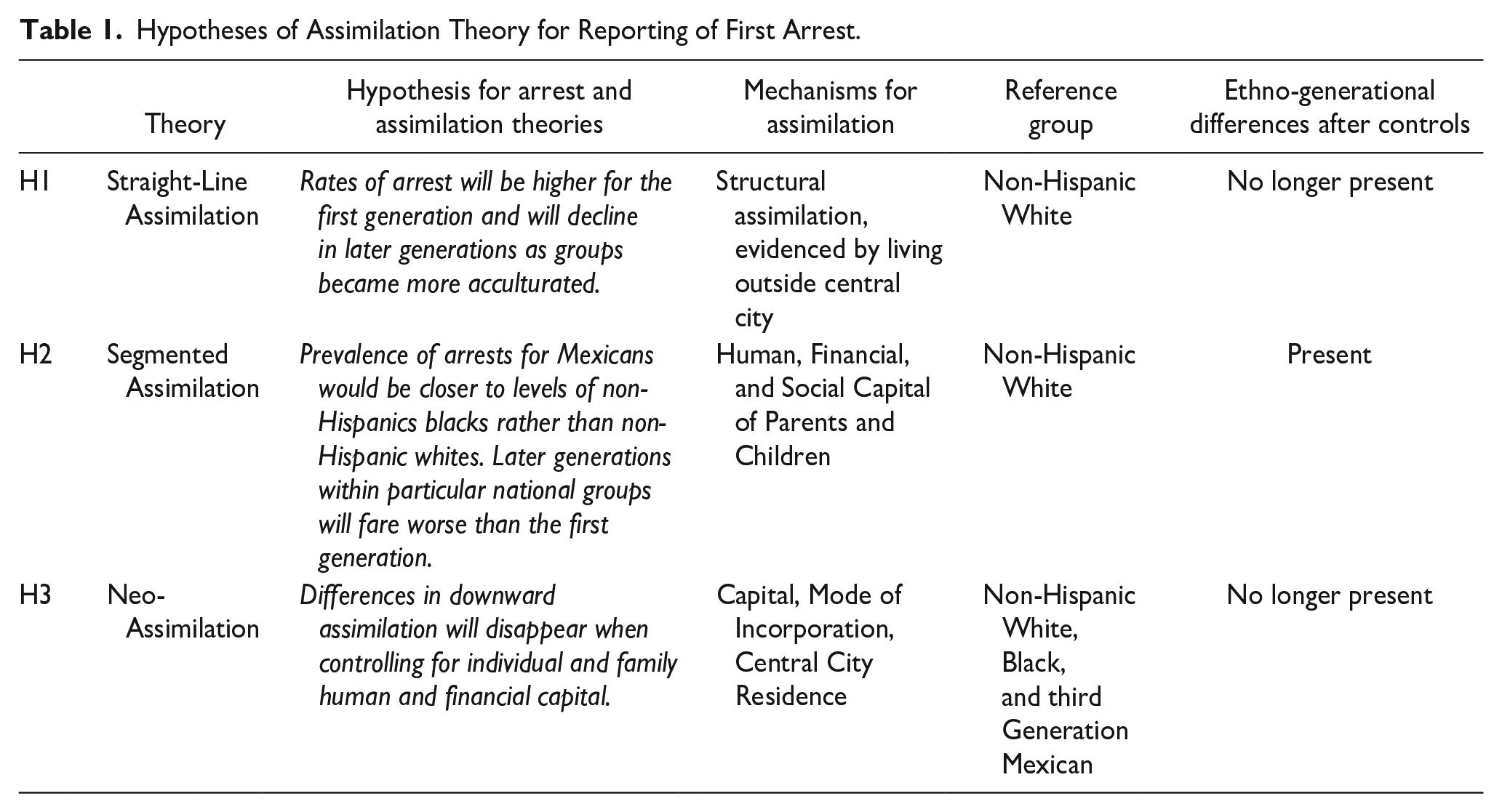
In order to compare these theories, this study utilizes a number of different comparison groups, listed below. Table 1 describes the theoretical comparison group for each hypothesis. In particular, this analysis compares (1) Mexican-origin individuals from the first and second-generation, (2) the first and second generation from other parts of Latin America initially to (3) third/fourth+ generation non-Hispanic whites as a test of classical assimilation, neo-assimilation, and segmented assimilation. Furthermore, this investigation employs comparisons to (4) third/fourth+ generation non-Hispanic black and (5) third/fourth+ generation Hispanic individuals as tests of downward assimilation.
Data and Methods
The data for this study come from the National Longitudinal Survey of Youth, 1997 (Bureau of Labor Statistics, 1997). This longitudinal survey project tracks the life histories of approximately 9,000 youths across the United States who were born between 1980 and 1984. At the start of the study the respondents ranged in age from 12 to 16 years. Data have been collected annually from the respondents, who now range from 36 to 40 years old as of the most recent interview. 5 In order to ensure proper coverage of minority populations, the NLSY97 includes an oversample for Hispanic and non-Hispanic black youths. The sample for this study is limited to third and fourth generation Hispanic, non-Hispanic white, and non-Hispanic black individuals along with first- and second-generation respondents of Mexican origin or first- and second-generation respondents from other parts of Latin America for a total of 7,948 youths. Importantly, given limited sample sizes this analysis does not include first- or second-generation respondents from other regions. Analyses employ custom longitudinal weights that take into consideration traditional weighting factors along with survey non-response and sample attrition.
Measures
Self-Reported Arrest
Arrest is measured in this analysis using retrospective monthly questions dating back to January 1992. 6 The BLS asks survey participants in 1997 about their arrest history dating back five years allowing respondents to answer if they had been arrested in that month, a previous month, or had never been arrested. Depending on the age of the respondent at the time of their interview in 1997, this question captures their arrest history starting from when they were between 7 and 12 years old. 7 However, in order to keep uniform times for all respondents, this study begins time at risk at age 12 years. This exposure variable is created by first setting the end-time as the month and year of the last interview and then replacing this value with the continuous month of first arrest for those who report being arrested.
Ethno-Generation
To study immigrant assimilation as a function of generation, race/ethnicity, and national origin, this study uses a combined measure hereafter referred to as ethno-generation, where respondents are separated into third and fourth-plus non-Hispanic white and black, and Mexican origin or Hispanic of other origin, as well as a category of third and fourth-plus generation Hispanic respondents of unspecified origin. 8 Respondents of Mexican and other Hispanic origin are further classified into the first and second generation. Due to small sample sizes and limited country variation within Asian, European, African, and Middle Eastern groups, this analysis focuses solely on contrasts within Hispanic ethnicity.
To classify respondents into ethno-racial groups, this investigation uses two race and ethnicity variables in the NLSY97 to isolate non-Hispanic white, non-Hispanic black, and Hispanic respondents. 9 To split survey participants into generational categories, this study uses information on whether or not a respondent is first generation (foreign-born), 10 second generation (born in the United States to one or more immigrant parents), 11 third generation (born to American-born parents, but at least one foreign-born biological grandparent), 12 or fourth-plus generation (child of American-born parents and grandparents). This measure utilizes information about the respondent’s birthplace and citizenship status in the NLSY97, which ask if the respondent was born in the United States or elsewhere, as well as where their biological parents and grandparents were born.
As noted, this analysis separately identifies “Mexican-origin” and “Other Hispanic-origin” respondents. Mexican-origin respondents indicate that they are both Hispanic and report that they or their parent(s) were born in Mexico, whereas respondents in the “Other Hispanic” category indicate that they are Hispanic and that they or their parent(s) were born in the Caribbean, Central America, or South America (hereafter referred to as “Other Hispanic”). For second-generation respondents, the country/region of origin of the biological mother is used to assign the respondent’s region of origin except in cases where the biological father is the parent that was born outside of the United States. 13 The Hispanic reference category in these analyses includes third/fourth-plus individuals who identify as Hispanic and the national origin of their grandparents (i.e., Mexican or Other Hispanic countries) is combined.
Additional Static Measures
To capture individual and household characteristics and resources, this study looks at biological sex differences and includes a measure of family structure, denoting if respondents indicate they lived in a household with two biological parents, biological/stepparent mixed households, or single parents (mother or father). In addition, this analysis controls for the number of children living in the house in 1997, parental education (measured as the highest reported year among both parents), and whether Spanish is spoken at home.
Time-Varying Covariates
To capture the inter-related timing of schooling, resources, employment, and childbirth, this study incorporates time-varying covariates that designate when a respondent reaches a milestone (e.g., high school graduate) or experiences a change in status (e.g., household income quintiles). This investigation uses dichotomous time-varying measures for achievement of a high school, GED, associates’, or bachelors’ degree. Further, this study accounts for sustained absence from school, that is, “stopout,” to refer to a consistent period of missed attendance of at least one full month of school or more during a school year from 1991 to 2001. The role of children is captured both with counter variables for all children and all children born when the parent was under the age of 18 years. To assess the impact of employment and resources, this analysis includes the proportion of the month when a respondent reports that they were unemployed as well as their annual household income, broken into quintiles and including observations missing reported household income as a separate category.
Methods
This study proceeds by exploring the bivariate relationship between arrests and ethno-generation before controlling for individual and family characteristics. Inferential models include three panels that contrast all groups with non-Hispanic whites, non-Hispanic blacks, and third/fourth generation Hispanic respondents. Results are presented by first describing the distribution of the dependent and independent variables by ethno-generation and whether the observed values are distributed independently of ethno-generation.
To examine differences in time to experience an event, this study utilizes event history analysis (also known as survival or duration analysis). Event history analysis is useful when studying a qualitative change that occurs at a particular time and its relationship to other covariates (Allison, 1984; Singer & Willett, 2003). This study of first arrest uses a Cox proportional hazards model. 14 This model is specified in the following equation:

Here, the logged hazard at time t is a function of the product of a vector of values for all covariates X and parameter estimates β, and a(t), which can be any function of time. The Cox proportional hazards models produce hazard ratios, which indicate the likelihood of event occurring at any point in time. Exponentiated coefficient values over 1 indicate that the hazard of experiencing an arrest is more likely and values below 1 indicate that the risk of arrest is less. Importantly, event history analysis allows for the inclusion of time-varying covariates and accounts for the ordering of events (e.g., high school graduation before arrest) rather than modeling their correlation as observed at the end of the study period. In this analysis, the Breslow method is used for handling ties in survival data, as this method is necessary when incorporating survey weights. However, unweighted model estimates using the Efron method for ties follow the patterns of the results reported below.
Results
Descriptive Results
Tables 2 and 3 show the distribution of the dependent and independent variables by ethno-generation, illustrating the substantial variation by group. With the exception of gender, the distributions across ethno-generation for all dependent and independent variables were significantly different. Arrest, or whether an individual was ever arrested during the study, is also distributed unevenly across ethno-generation. The total prevalence of arrest in this longitudinal cohort is 35%, 15 with 33% of third- and fourth- plus generation white respondents reporting having ever been arrested in comparison to 41% for third/fourth-plus generation black respondents. There are substantial differences by generation for those of Mexican origin as well. Only 24% of first-generation Mexican immigrants report having ever been arrested compared to 35% and 40%, respectively, for second-generation Mexican Americans and third/fourth-plus generation Hispanic respondents. This same pattern is repeated across generation for Other Hispanic individuals with 23% of the first generation arrested compared to 30% of second-generation Hispanic respondents from other parts of Latin America.
Distribution of Reported Arrest by Ethno-Generation.
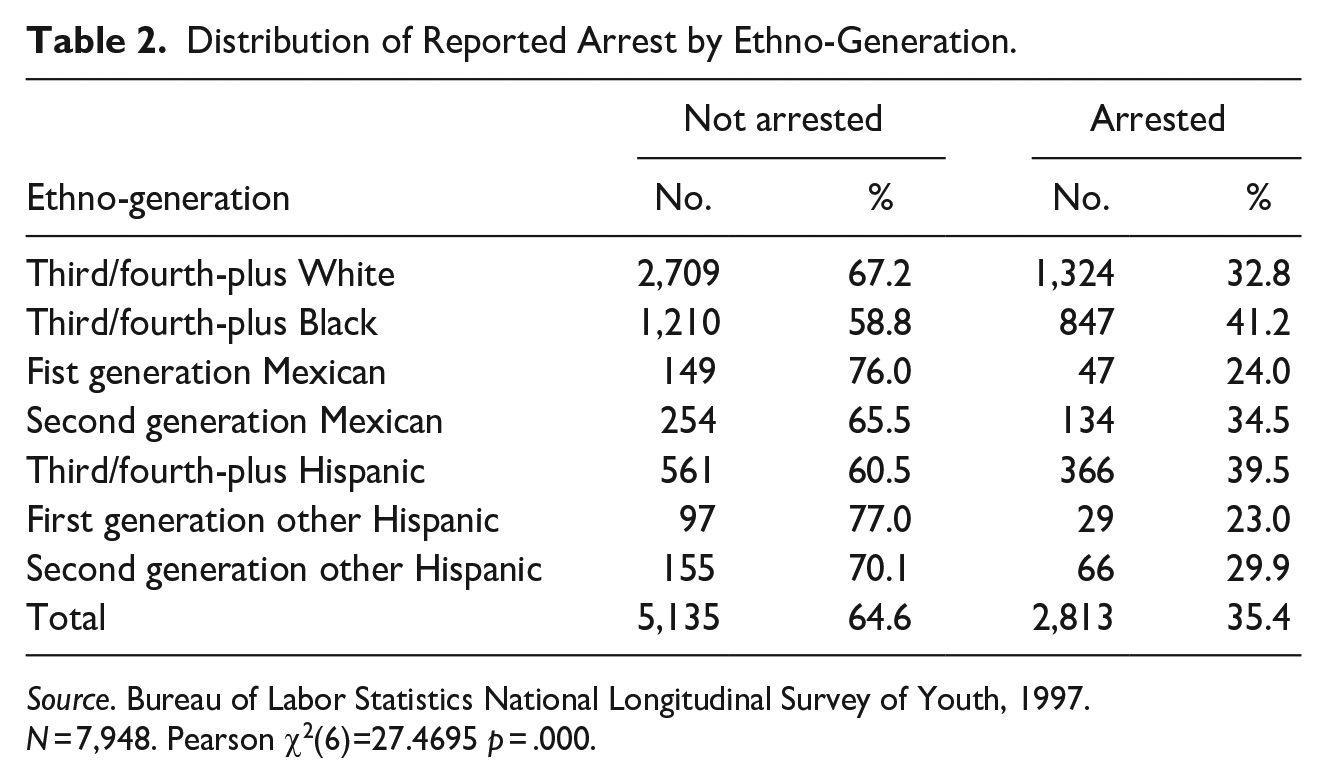
Source. Bureau of Labor Statistics National Longitudinal Survey of Youth, 1997.
N = 7,948. Pearson χ2(6)=27.4695 p = .000.
Distribution of Control Measures by Ethno-generation.
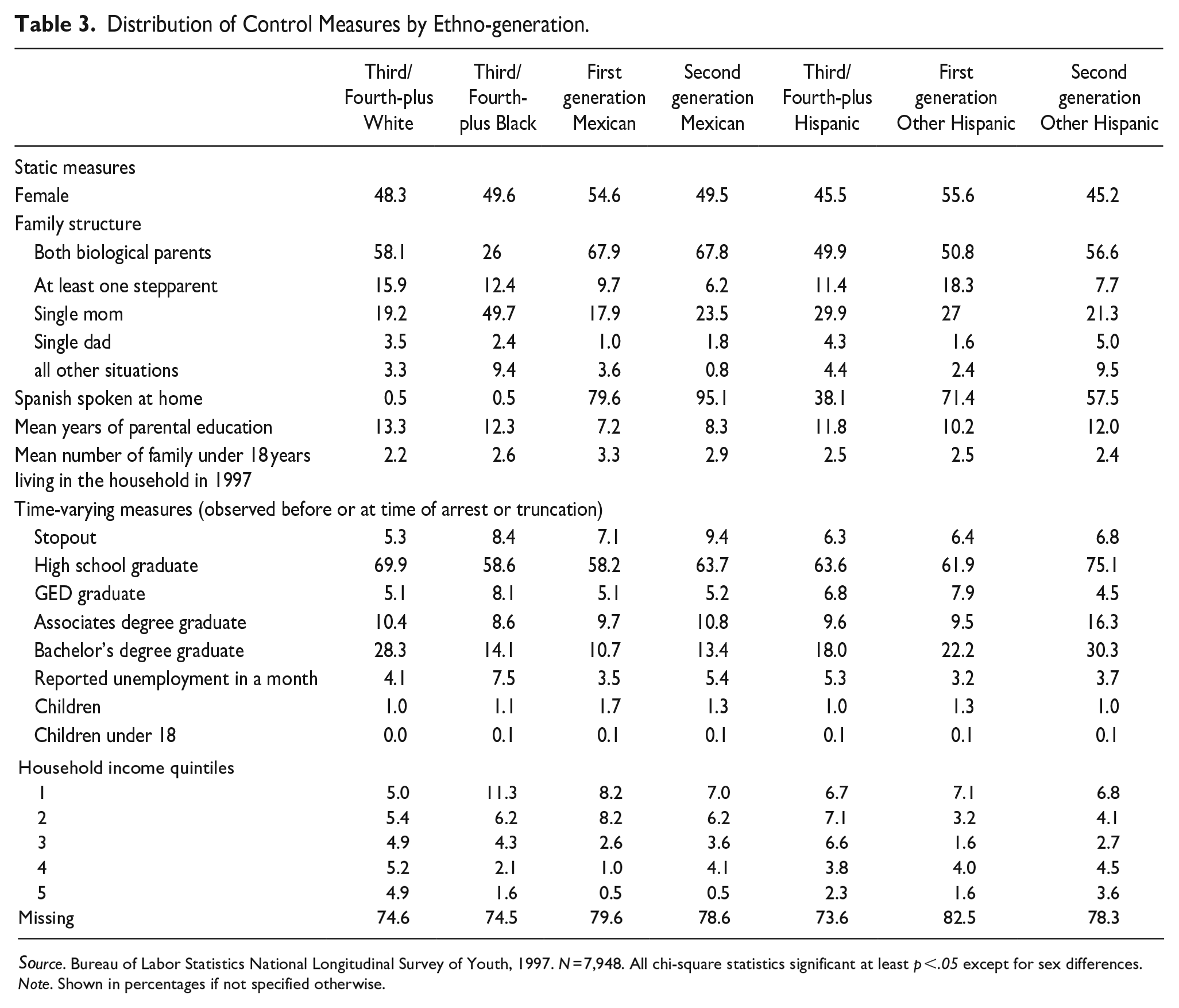
Source. Bureau of Labor Statistics National Longitudinal Survey of Youth, 1997. N = 7,948. All chi-square statistics significant at least p <.05 except for sex differences.
Note. Shown in percentages if not specified otherwise.
Table 3 shows disparities in the distribution of static factors, such as family structure. 58% of white respondents report living with both biological parents compared to only 26% for black respondents. First and second-generation respondents of Mexican origin report the highest percentages living with both biological parents at 68% each. Table 3 also shows substantial variation in time-varying covariates tied to education, income, childbirth, and employment by ethno-generation. White respondents are more likely than any other group, save second generation Other Hispanic respondents, to report high school graduation before reporting their first arrest. This pattern persists in obtaining associates’ and bachelors’ degrees prior to reporting an arrest as well, indicating that, in educational outcomes, Other Hispanic second-generation respondents are performing demonstrably better than their first-generation counterparts and all other reference groups. In contrast, second-generation respondents whose parents were born in Mexico have educational outcomes that are closer to third/fourth-plus-generation white respondents. When examining signs of academic disruption, third/fourth-plus-generation white respondents have the lowest rates of stopout prior to reporting an arrest. Taken as a whole, the descriptive statistics reveal the substantial disparities in life course milestones (i.e., childbirth or graduation), employment, family resources, and family structure by ethno-generational groups.
Figure 1 shows the survival curve by ethno-generation, providing visual evidence of the gap in arrest by generation. Here, first generation Other Hispanic and first generation Mexican immigrants show the lowest rates of offending over time followed by second-generation Other Hispanic respondents. Log-rank tests confirm the pattern of significant differences in timing to first arrest by ethno-generation, with first generation Other Hispanic and Mexican immigrants having the lowest level of observed arrests over time. This provides descriptive evidence for segmented assimilation, as arrest rates get progressively worse by generation. In addition, Table 4 shows the median survival times and the observed versus expected arrests by ethno-generation (i.e., the log-rank test). Here, the median survival times for first and second generation Mexican and Other Hispanic individuals are longer than those for those of the third and fourth generation, regardless of race or ethnicity. This shows the initial differences in timing by immigrant generation, net of overall prevalence of arrest, as the first and second generation take longer on average before reporting a first arrest. Additionally, the log-rank test, including in Table 4, shows that the first generation (of either Mexican or Other Hispanic origin) have the lowest ratio of observed to expected arrests. Observed arrests for both groups amount to only 60% of their expected arrests. Notably, observed arrests for second-generation Other Hispanic individuals have the next-lowest ratio, as their total of observed arrests comprise only 81% of expected arrests, whereas observed arrests for the Mexican origin second generation nearly equal expected arrests. Looking at the proportion of each cohort that survives to age 18 years without an arrest, clear differences emerge by origin group and generation. Here, 85% of first-gen Mexican immigrants make it to 18 without an arrest, compared to 78% of the Mexican origin second generation. In contrast, slightly more than 4 out of 5 people survive to 18 without an arrest for both the first and second generation of Other Hispanic origin. These descriptive results illustrate differences in both timing and prevalence of arrests by immigrant generation and origin.
Survival Characteristics for First Arrest by Ethno-Generation.
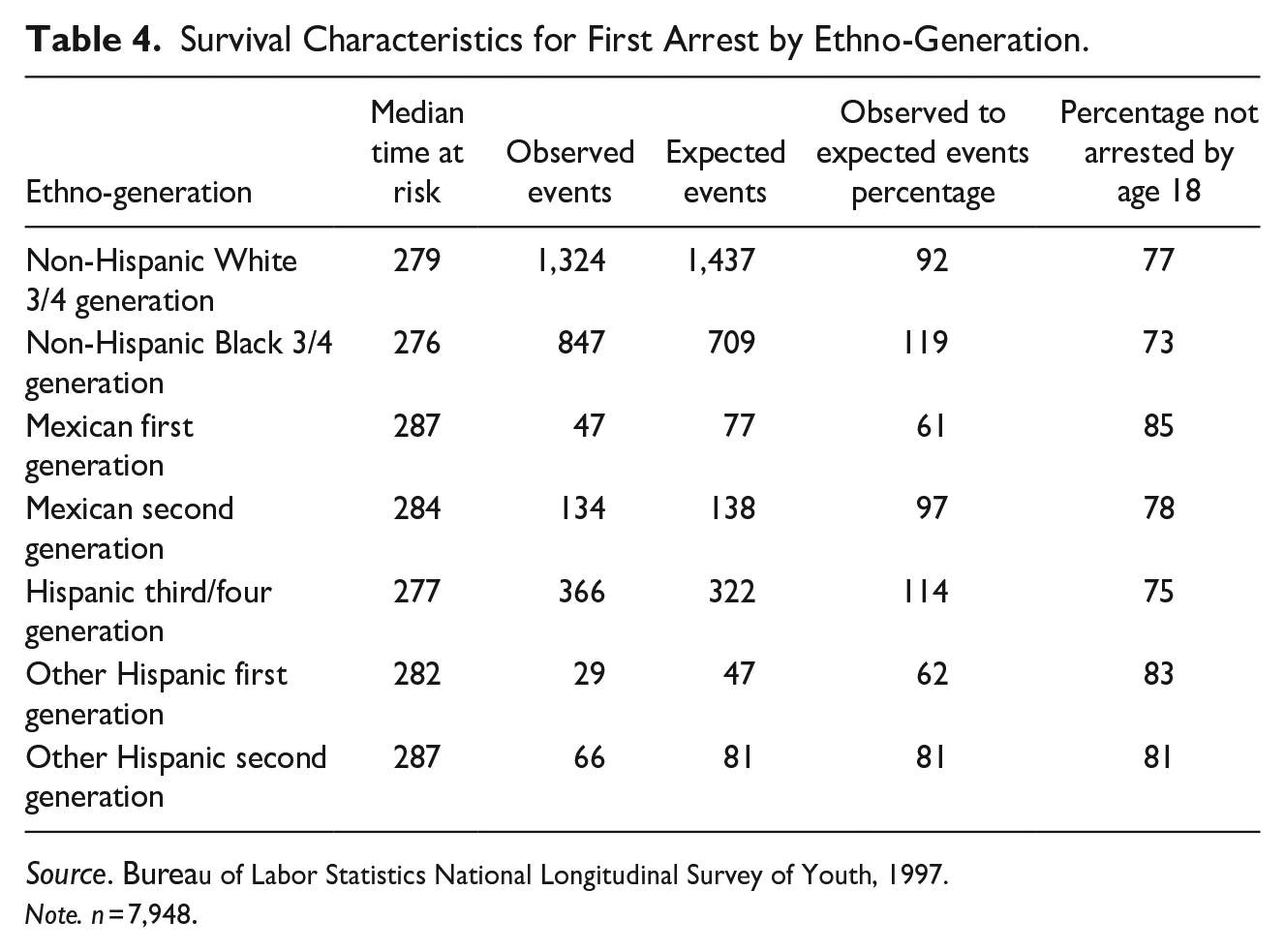
Source. Bureau of Labor Statistics National Longitudinal Survey of Youth, 1997.
Note. n = 7,948.
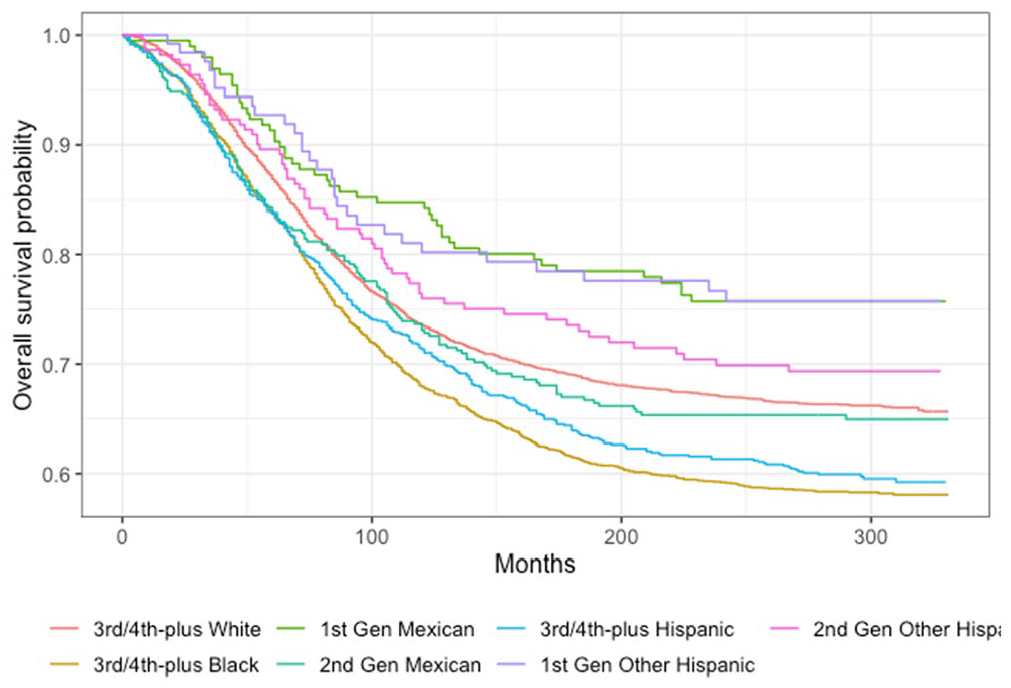
Survival curves by ethno-generation for time to first arrest.
Multivariate Results
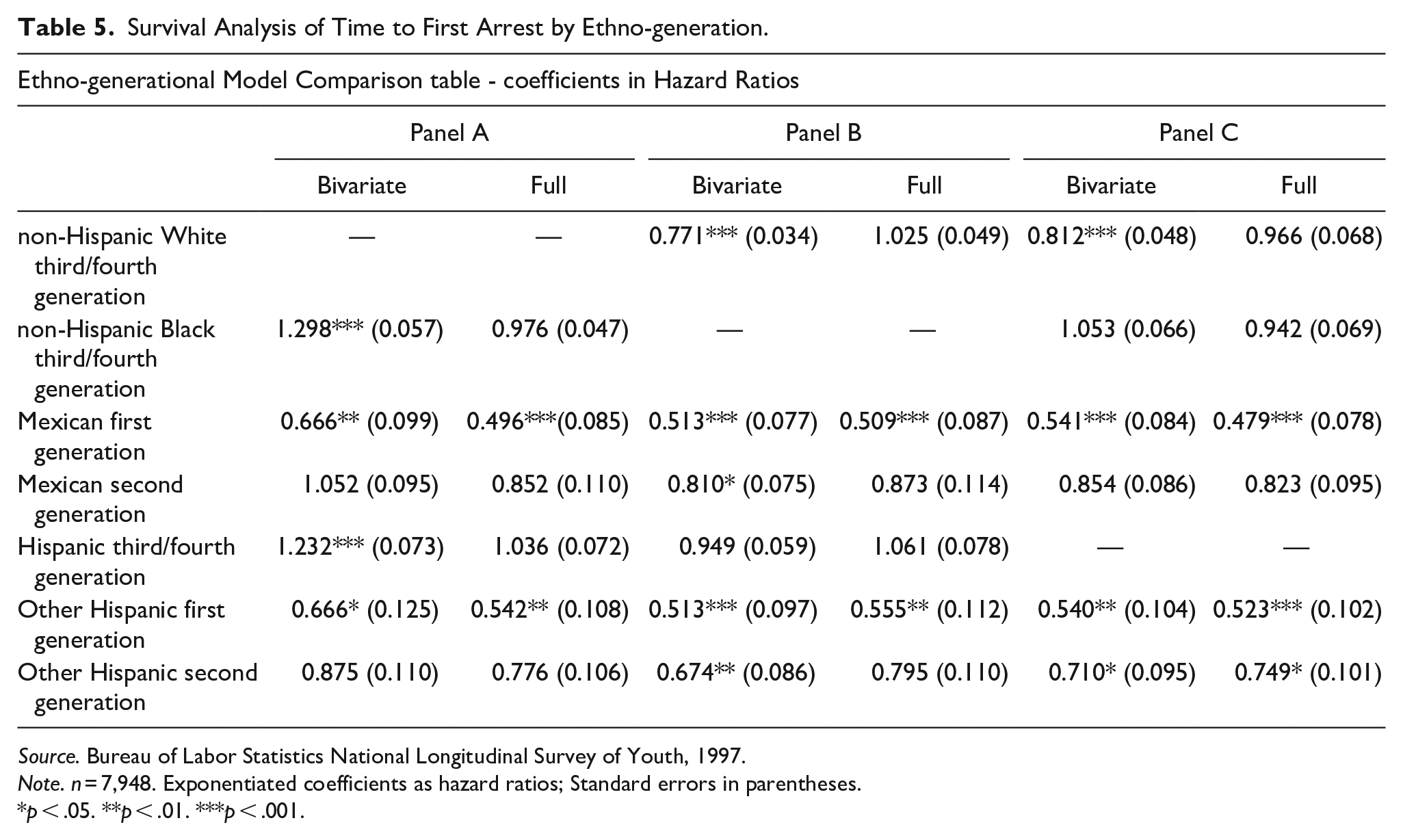
This analysis proceeds by exploring the timing of first arrest. The models first present the results of bivariate differences by ethno-generational group before accounting for individual and family characteristics (Table 5). This involves separate comparisons using white, black, and third/fourth generation Hispanic respondents as references. Panel A shows that prior to accounting for personal and family background, black individuals and third/fourth-plus generation Hispanic individuals have a greater hazard of being arrested when compared to white individuals. Conversely, prior to controlling for contextual factors, first generation immigrants born in Mexico and first generation Other Hispanic immigrants have about two thirds the odds of experiencing arrest than white individuals, which corresponds with their overall lower rates of offending. When accounting for individual and household characteristics in the full model in Panel A, first generation Mexicans and Other Hispanics are even less likely to be arrested compared to whites, contradicting the notion that immigrants are more likely to be arrested.
Survival Analysis of Time to First Arrest by Ethno-generation.
Source. Bureau of Labor Statistics National Longitudinal Survey of Youth, 1997.
Note. n = 7,948. Exponentiated coefficients as hazard ratios; Standard errors in parentheses.
p < .05. **p < .01. ***p < .001.
Comparing ethno-generational groups to non-Hispanic black individuals (Panel B) produces similar results. The bivariate model in Panel B shows that both first- and second-generation Mexicans and Other Hispanic individuals have a lower hazard of arrest compared to black respondents. But including sociodemographic controls removes the significance for all groups except first generation Mexicans and first gen. Other Hispanic immigrants with both groups having roughly half the hazard of non-Hispanic black individuals. A variation on this finding emerges in Panel C, where first generation Mexicans and Other Hispanic first- and second-generation respondents both have a lower hazard of arrest compared to third and fourth-plus generation Hispanic respondents. After accounting for personal and family background in the full model in Panel C, the difference between the first generation and third/fourth+ persists and there is little change in the point estimates. These findings provide some support for segmented assimilation theory, as first-generation Mexicans and first-generation Other Hispanic immigrants offend at lower rates than later generations as well as non-Hispanic black and non-Hispanic white respondents. However, second-generation Mexican respondents do not mirror these advantages, indicating that assimilation for the second generation of Mexican origin involves offending at mainstream levels. Notably, the similarity in offending for second-generation respondents, either of Mexican origin or from other parts of Latin America, persists despite different educational attainment between the groups. However, the second generation of Other Hispanic origin report arrest at lower rates compared to third/fourth generation Hispanic respondents, while the second-generation of Mexican origin do not have significantly slower times to reporting first arrest. As expected in segmented assimilation theory, this suggests that for second-generation Hispanic respondents, there are differences by origin when compared to their later-generation counterparts.
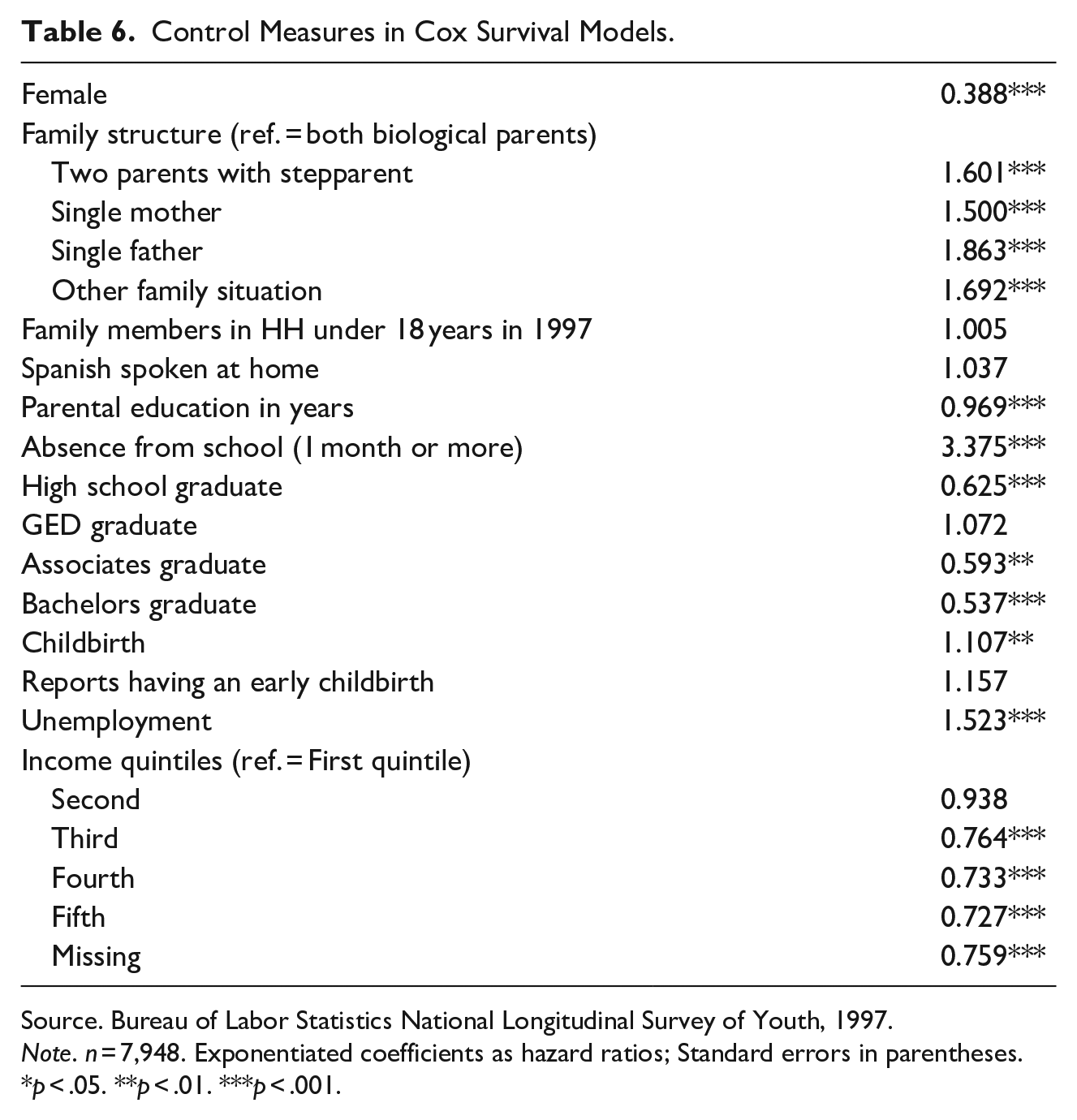
Control variables in this model also highlight important distinctions (Table 6). For example, females are much less likely to experience arrest in general, with at 61% lower risk of arrest compared to males. Family structure is also found to be very significant, with children raised in nearly every household arrangement being more likely to experience an arrest when compared to children raised in a two-biological-parent home. Similarly, years of parental education are also related to lower likelihood of experiencing arrest. Compared to the lowest quintile, household income quintiles 3 to 5 have roughly 25% lower risk of arrest. These findings provide further support that household income and family structure are important components for understanding the correlates of arrest.
Control Measures in Cox Survival Models.
Source. Bureau of Labor Statistics National Longitudinal Survey of Youth, 1997.
Note. n = 7,948. Exponentiated coefficients as hazard ratios; Standard errors in parentheses.
p < .05. **p < .01. ***p < .001.
When incorporating time-varying covariates that occur prior to first arrest or prior to the last interview date, achieving certain educational milestones are protective, whereas missing school, having children, and experiencing unemployment can increase the risk of arrest. Missing multiple months of school in any given year is related with a three-fold increase in the risk of future arrest. Attaining a high school, associates’, or bachelors’ diploma are all associated with a reduction in the hazard of arrest, whereas obtaining a GED is not associated with a lower or higher risk of arrest. Childbirth, after controlling for household income and education, is linked with a slightly increased risk of arrest. Further, an increase in the proportion of the month that one spends unemployed is also associated with a roughly 50% increased risk of arrest. These results serve to support findings that correlate arrest with limited resources.
Discussion and Conclusion
The results for the multivariate models are relatively consistent and support segmented assimilation theory, as first-generation Mexican and Other Hispanic respondents offend at lower rates in comparison to children of American-born parents, regardless of race or ethnicity, even after controlling for differences in individual and family characteristics. Furthermore, second-generation Mexicans appear to “regress to the mean” of mainstream society, given that they show no statistically significant differences in time to first arrest compared to non-Hispanic white or Black individuals or third/fourth-generation Hispanic respondents. This finding also holds for second-generation respondents whose parents were born in other parts of Latin America, although the finding is attenuated when compared to third/fourth-plus generation Hispanic respondents. This suggests there is a substantive shift between the first and second generation linked to increased criminal activity across national origin groups, despite differences in educational outcomes by national origin for the second generation. This gap itself could be evidence of the process of segmented assimilation, suggesting that the differences between the first and second generation are due to more than just differing levels of employment, child-bearing, or reported income. In addition, the differences in the second generation by origin group when compared to third/fourth generation Hispanic respondents provides more support for segmented assimilation in timing to first arrest, as Mexican origin second-generation respondents report similar offending to later generation Hispanic respondents whereas those from other countries do not offend at similar rates. Furthermore, regression models that use only female or male respondents suggest that the pattern of lower offending for the first generation is consistent for both men and women.
Consequently, the results from this study suggest that straight line assimilation theory is not supported when comparing immigrant generations on offending. Instead of successive Hispanic-origin generations improving on arrest outcomes, as would be expected by straight line assimilation theory, each generation reports progressively worse offending rates and the second generation and beyond fail to mirror their first-gen counterparts when compared to third/fourth generation non-Hispanic white people. Thus, straight line assimilation theory, is not empirically supported by the data on the prevalence and time to arrest. Similarly, neo-assimilation theory is not supported by these findings, as differences by immigrant generation and region or country of origin do not disappear when accounting for differences in capital and mode of incorporation. In fact, regional differences persist in the second generation, as the Mexican origin second generation offends at similar rates compared to third/fourth generation Hispanic people while the Other Hispanic second generation offend at lower rates. Taken as a whole, these findings provide the most support for segmented assimilation theory in explaining generational and regional differences in offending.
Limitations
While these findings are consistent when comparing first generation Mexican immigrants and those from other parts of Latin America to differentiate them from third and fourth generation reference groups, they do not purport to identify a causal mechanism wherein immigrants are less likely to offend. Yet, they do show that differences in offending cannot be explained away when accounting for differences in individual and familial education, family structure, reported income, employment, or educational achievement. Additionally, given the limited sample size of first-generation immigrants and an imperfect measurement of documentation status, this analysis cannot assess the impact of documentation status and offending for first generation immigrants. Furthermore, given the sizeable missingness on the income variable, this analysis is likely not accounting for the true role of household income as a correlate of arrest. Importantly, this analysis examines self-reported arrest and may underrepresent individual offending if the likelihood of reporting of prior arrests in a survey setting vary by ethno-generation.
Conclusion
The descriptive and multivariate results in this investigation have implications for the theory of segmented assimilation, providing the most support for this theory while failing to support straight line or neo-assimilation theory. When examining arrest, first generation Mexican immigrants and Hispanic immigrants from other parts of Latin America appear to offend at lower levels compared to third and fourth generation non-Hispanic white and Blacks respondents, even when controlling for a respondent’s personal and family background. Moreover, beyond prevalence there are evident differences in the timing to first arrest, as more of the first generation (both Mexican and of Other Hispanic origin) “survive” to 18 years without being arrested compared to the third and fourth generation. To the extent that the process of segmented assimilation exists in offending, it appears most evident in the gap between the first generation and third/fourth generations. Additionally, the gap in offending between immigrants and the native-born residents exists for Hispanic immigrants across country and region. Further research should expand on these models but incorporate additional regional or more nuanced country-specific comparisons to examine if this pattern persists or varies by immigrant group. Additionally, future research should examine differences in patterns of offending by offense type to explore the composition of offenses by generation. More qualitative research is needed to understand the processes through which concentrated levels of poverty and lower levels of human capital in the household relate to children experiencing downward assimilation through arrest, and why lower levels of offending persist for first-generation immigrants regardless of national origin.
Footnotes
Declaration of Conflicting Interests
The author declared no potential conflicts of interest with respect to the research, authorship, and/or publication of this article.
Funding
The author received no financial support for the research, authorship, and/or publication of this article.
