






Abstract
Previous research suggests that virtual socializing is associated with adolescent substance use and vaping activity. However, at present, very little research has explored the functional form of this relationship. This study extends the current research by testing for nonlinearity in the relationship between virtual socializing and adolescent vaping activity using data from the 2018 eighth and tenth grade cohorts of Monitoring the Future (MTF). Our findings indicate that virtual socializing appears to demonstrate a nonlinear relationship with the likelihood and frequency of adolescent vaping activities. Specifically, our findings reveal a nonlinear relationship wherein virtual socializing is initially associated with increased vaping activity, however after reaching a point, additional virtual socializing is no longer associated with increases in vaping activity.
Introduction
Previous research links adolescent socialization activities with substance use (Greene & Banerjee, 2009; Sun & Longazel, 2008). Numerous studies, for instance, suggest that adolescents who socialize with peers who use cigarettes, alcohol, marijuana, and other illicit substances are more likely to use these same substances (Andrews et al., 2002; Lee et al., 2021; Rocheleau et al., 2020). Moreover, this research indicates that when adolescents spend more unstructured time socializing with their peers without parental supervision (i.e., unstructured socializing), they are more likely to use illicit substances (Augustyn & McGloin, 2013; Leimberg & Lehmann, 2022; Rulison et al., 2015). Coinciding with these findings, there is substantial evidence to indicate that adolescents tend to use illicit substances such as cigarettes, alcohol, and marijuana in social settings such as in small social groups or at parties (Buckner et al., 2012; Lipperman-Kreda et al., 2018; McCabe et al., 2014).
Current research also demonstrates that patterns of adolescent socializing activities have changed in recent years (Arnett, 2018; Common Sense Media, 2017). Specifically, adolescents have been increasingly socializing with their peers through social media, video chatting, and texting (Common Sense Media, 2017). A study by Common Sense Media (2017), for instance, found that on average 13- to 18-year-olds spend approximately 9 hours per day using digital devices. Additionally, a recent study by Pew Research Center revealed that approximately 45% of adolescents report they are “almost constantly” online (Anderson & Jiang, 2018). At the same time, adolescents have been spending considerably less time socializing in person than they have in past decades (Arnett, 2018; Baumer et al., 2021; Tozer 2017).
Dovetailing with these changing trends in adolescent socializing, emerging research suggests that digital media use and virtual socializing are also linked with adolescent substance use (Hanewinkel et al., 2012; Kaur et al., 2020; Meldrum & Clark, 2015; Primack et al., 2009). Research in this area suggests that exposure to substance use through social networking sites such as Facebook and Twitter is associated with increased substance use (Litt & Stock, 2011; Moreno et al., 2012, 2015). Additional research has also found that time spent socializing with peers through social media, texting, and video chatting (i.e., virtual socializing) is also associated with increased chances of using illicit substances. A recent study by Boccio et al. (2022), for example, revealed that adolescents who spent more time socializing virtually are more likely to vape nicotine, marijuana, and flavor compared to adolescents who spent less time engaging in these activities 1 .
The relationship between virtual socializing and vaping could be explained by several factors. First, cell phones, tablets, and computers provide adolescents with access to spheres of socialization that are available 24 hours a day and with limited (if any) parental supervision. As a result, adolescents who are engaged heavily with virtual socializing may spend more time socializing with their peers in unsupervised settings than adolescents who are spending less time utilizing virtual socializing. In essence, the use of virtual socializing increases the overall time of exposure to substance-use-related content and to peers who may share such content. Second, due to the unsupervised nature of virtual socializing, the content adolescents are exposed to virtually may pose a greater risk for substance use. In essence, virtual socializing creates covert venues where adolescents can share content related to substance use. For instance, adolescents may use virtual venues to “show off” their substance use, get approval from their peers, and appear “cool” without concerns of being overheard by parents or guardians. As such, virtual socializing may entail greater exposure to content related to substance use than socializing in person—where the likelihood of a parent or guardian intercepting the information may be higher. This avenue of exposure to substance-use-related content may be even more salient for younger adolescents who may have less autonomy and means of evading their parents controls and supervision. Third, social media algorithms tend to suggest content based on users pre-established interests. As a result, if an adolescent has displayed interest in vaping related activity (i.e., clicked on vaping related content, or followed accounts that post vaping related content) on social networking apps, they may be more likely to presented with additional content related to vaping which may function to increase their risks of engaging in vaping (Massey et al., 2021; Pokhrel et al., 2018). Taken together, due to the characteristics of virtual socializing, adolescents who are heavily involved in virtual socializing may be spending more time being exposed to content that may pose a greater risk for increasing the likelihood of substance use than respondents who are less engaged in virtual socializing.
While previous research indicates that socializing virtually increases the likelihood of substance use (Boccio et al., 2022), at present, the research that has been conducted in this area has assumed that this relationship is linear where increases in virtual socializing would be continually associated with increases in the likelihood of vaping. However, some research has revealed that there are nonlinear effects for peer factors expected to predict deviant behavior and substance use (Rees & Zimmerman, 2016; Tittle, 1995; Zimmerman & Messner, 2011). For instance, Zimmerman and Vasquez (2011) suggest that there may be a saturation or ceiling point at which peer substance use may no longer increase the risks of individual substance use. This may be because after reaching a certain a point, adolescents are already exposed to sufficient pro-substance use messaging to influence substance use and any additional exposure may be seen as “redundant.” Additional research has found a similar saturation effect when examining the relationship between exposure to criminal behavior online and self-reported offending (McCuddy & Vogel, 2015).
Given evidence for nonlinear relationships between substance using peer exposure and adolescent substance use, it would not be surprising if virtual socializing also exhibits a nonlinear relationship with substance use. For instance, moderate involvement in virtual socializing may elevate the odds of substance use for many adolescents as it provides an additional avenue to supplement in-person socializing and for exchanging information related to substance use. To illustrate, adolescents may exchange information related to obtaining and using substances while socializing virtually and then use these substances in in-person social settings. However, once virtual socializing reaches a certain level, it is possible that additional time socializing virtually may detract from time spent socializing in person, and, may therefore, reduce the opportunities to use substances in social settings. As a result, heavy engagement in virtual socializing may be associated with a decrease in the likelihood of substance using activity.
In line with this rationale, some researchers have suggested that digital media use may result in a “displacement effect” where adolescents may spend so much time engaging in digital media use they no longer have time for other activities (Valkenburg & Peter, 2007). In this case, and given evidence that adolescent substance use generally takes place in social settings (Buckner et al., 2012; Lipperman-Kreda et al., 2018; McCabe et al., 2014), it may be that heavy virtual socializing may displace the in-person socializing time needed to engage in substance use. Additionally, it is also possible that adolescents who are heavily engaged in social media use (i.e., spending the majority of their free time socializing online instead of in-person) may have significantly smaller or substantively different in-person peer groups than adolescents who engage in virtual socializing more moderately. As a result, heavy virtual socializers may be exposed to different messaging and content related to substance use than more moderate users. To illustrate, adolescents who are spending extraordinarily high amounts of time socializing virtually may have different interests and hobbies and may be engaging in different activities both virtually and in-person compared to adolescents who spend more normative amounts of time socializing virtually. As a result, they may come into contact with less vaping related content online and spend less time engaging with substance using peers in person—thus, lowering their likelihood of vaping. Finally, it is also possible, that in line with previous research examining the effects of peer substance use (Zimmerman & Vasquez, 2011), that while initial substance use related content may be associated with initial increases in vaping activity, after a certain point this information may become “redundant” and may no longer further increase the risks of vaping activity.
This study extends the current research by examining the functional form of the relationship between virtual socializing and adolescent vaping in order to garner a more thoroughly developed understanding of this relationship. Previous research has assumed that the relationship between virtual socializing and vaping is linear. As such, each additional unit increase in time spent socializing virtually should lead to an increase in the odds of vaping. However, this assumption ignores the possibility that there could be ceiling or saturation effects—wherein after reaching a certain level of virtual socializing, additional virtual socializing will no longer increase the likelihood of vaping and may even decrease the likelihood of vaping. This study expands upon the extant research and examines whether virtual socializing holds a nonlinear relationship with nicotine, marijuana, and flavor vaping.
Methods
Data
This study uses data drawn from the 2018 eighth and tenth grade cohort of Monitoring the Future (MTF). MTF is an annual survey that has been administered yearly since 1972. The survey contains items pertaining to an array of topics including substance use, daily activities, school involvement, temperamental features, delinquency, and victimization. Each year the survey is administered in several different forms—each form containing a different combination of questions. The analyses for this study are restricted to respondents who completed Form 2 (N = 10,018) of the survey as that is the only form of the survey which contains questions tapping both digital media use and vaping. Removing respondents who did not have complete data for the key independent and dependent variables for this study yielded a final analytic sample size of 8,710 respondents. Examination of the missing data using Little’s (1988) test of MCAR (missing completely at random) revealed that the data is not MCAR. Accordingly, the analyses of this study were conducted on the assumption that the data is missing at random (MAR). Missing data on the covariates was handled using multiple imputation with chained equations to produce and merge 20 datasets 2 .
Measures
Outcome Measures
Nicotine Vaping in the Last 12 Months
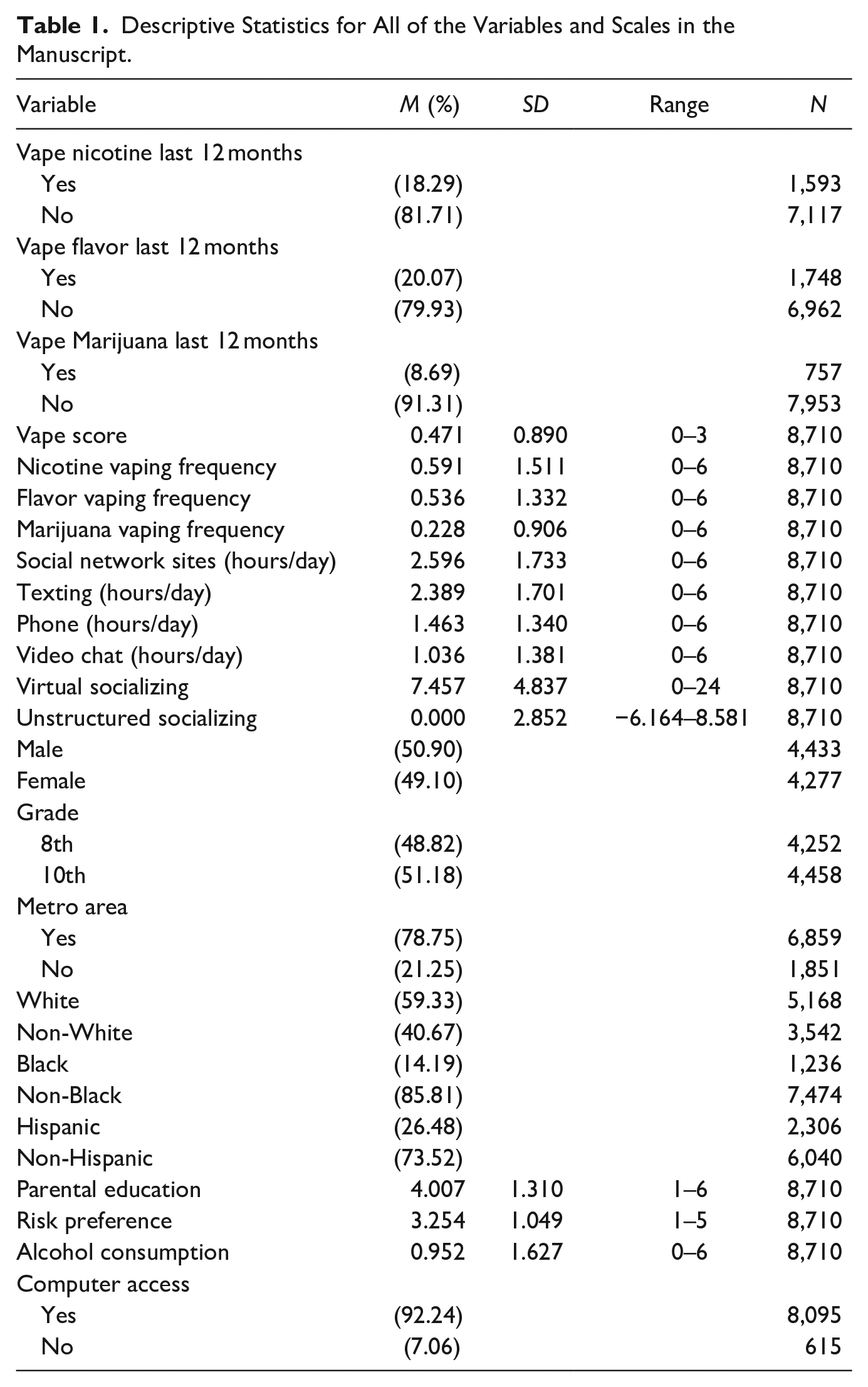
Nicotine vaping in the last 12 months was assessed using one item. Specifically, respondents were asked “On how many occasions (if any) have you vaped NICOTINE. . .during the last 12 months?” Response options for this item ranged from “0 occasions,” “1 to 2 occasions,” “3 to 5 occasions,” “6 to 9 occasions,” “10 to 19 occasions,” “20 to 39 occasions,” to “40+ occasions.” This item was used to measure nicotine vaping in two ways. First, this item was recoded as a dichotomous indicator of vaping nicotine in the last 12 months where 0 = has not vaped nicotine in the last 12 months and 1 = has vaped nicotine in the last 12 months. Second, this item was used as a measure of frequency of vaping nicotine in the last 12 months (0–6) where higher numbers reflect greater frequencies of nicotine vaping in the last 12 months. Descriptive statistics for these variables and all other variables, scales, and indexes included in the study are displayed in Table 1.
Descriptive Statistics for All of the Variables and Scales in the Manuscript.
Marijuana Vaping in the Last 12 Months
Marijuana vaping was assessed using a single item where respondents were asked “On how many occasions (if any) have you vaped MARIJUANA. . .during the last 12 months?” This item contained identical response categories as the nicotine vaping item. Additionally, this item was also employed as both a frequency measure (0–6) and as a dichotomous indicator of vaping marijuana in the last 12 months (0 = no; 1 = yes).
Flavor Vaping in the Last 12 Months
Flavor vaping in the last 12 months was measured using a similar item where respondents were asked to indicate “On how many occasions (if any) have you vaped just FLAVORING. . .during the last 12 months?” This item contained identical response categories as the previous vaping items. This item was also employed as both a frequency measure of flavor vaping in the last 12 months (0–6) and as a dichotomous indicator of flavor vaping in the last 12 months (0 = no; 1 = yes).
Vape Variety Index
After creating dichotomous indicator variables for all three forms of vaping (nicotine, marijuana, and flavor) we then combined the three dichotomous indicators into a vaping variety index (0–3). This index is coded so that higher values indicate that respondents engaged in more forms of vaping in the previous 12 months. The vape variety index is similar to vaping diversity indexes created previously with MTF data (Boccio et al., 2022).
Predictor Measure
Virtual Socializing
A virtual socializing scale was constructed following the example of previous research (Boccio & Leal, 2023; Leal et al., 2022) 3 . Virtual socializing was measured using four items tapping digital media use that involve social interaction. Specifically, respondents were asked to indicate “About how many hours on the average DAY do you spend. . .” “on social networking sites like Facebook,” “video chatting (Skype etc.),” “texting,” and “talking on the phone?” Response options for these items spanned from “none,” “<1 hour,” “1 to 2 hours,” “3 to 4 hours,” “5 to 6 hours,” “7 to 8 hours,” “9+ hours.” Responses to these items were combined together to create a scale of virtual socializing (α = .79) where higher values reflect more time spent engaging in virtual socializing. After constructing the scale, the scale was mean-centered in order to reduce issues with multicollinearity 4 .
Controls
All of the analyses for this study were estimated accounting for nine control variables. First, gender was assessed using a dichotomous indicator for male gender (0 = female; 1 = male). Second, grade was measured using a dichotomous indicator for school grade (1 = eighth grade; 2 = tenth grade). Third, living in a metropolitan statistical area (MSA) was assessed using a dichotomous indicator for living in a MSA (0 = no; 1 = yes). Fourth, racial identity was assessed employing three dichotomous indicators for Black (0 = non-Black; 1 = Black), Hispanic (0 = non-Hispanic; 1 = Hispanic), and White (0 = non-White; 1 = White) racial identities. For ease of interpretation, white was employed as the reference category for all of the models in this study. Fifth, in line with previous research using MTF data, parental education was included as a proxy measure for socioeconomic status (Jackson et al., 2019). Parental education was measured using two items tapping the highest level of education completed by the respondents’ mothers and fathers. The response options for these items ranged from grade school to graduate school. Responses on these two items were averaged in order to measure overall parental education.
Sixth, a scale for risk preference was included as previous research indicates that risk preference is associated with substance use (Keyes et al., 2015) and may also be related to screen time (List et al., 2022). Risk preference was measured using six items assessing respondent’s tendencies to pursue new and risky activities, break rules, explore strange places, do frightening and dangerous things, and hold a preference for exciting and unpredictable friends. These items were combined together in a risk preference scale (α = .86) where higher values reflect higher risk preferences. This risk preference scale is identical to a scale constructed previously with MTF data (Jackson et al., 2019). Seventh, a scale of unstructured socializing was included as a control as previous research indicates that unstructured socializing is related to both substance use and virtual socializing (Boccio et al., 2022). Unstructured socializing was measured employing three measures tapping the amount of time respondents spend socializing with their friends outside of parental supervision. Specifically, respondents were asked how often they go to parties, spend time with their friends informally, and ride around in cars for fun. These items were combined together in a scale of unstructured socializing (α = .65) where higher value reflect more frequent involvement in unstructured socializing. Eighth, following the example of previous research, alcohol consumption was included as a proxy measure for other forms of substance use (Jackson et al., 2019). Alcohol consumption was assessed using a single measure where respondents were asked to indicate the number of occasions in which they have consumed alcohol. Response options for this item spanned from “0 occasions,” “1 to 3 occasions,” “3 to 5 occasions,” “6 to 9 occasions,” “10 to 19 occasions,” “20 to 39 occasions,” to “40+ occasions.” Finally, in order to assess reliable access to a computer, home computer access was measured using a single item where respondents were asked to indicate if they have “access at home to a computer (tablet, laptop, desktop computer?)” This item is coded so that 0 = does not have home computer access and 1 = has home computer access.
Analytic Strategy
All analyses for this study were estimated using StataSE 15 software. The analytic strategy for this study proceeded in a number of linked steps. First, we employed logistic regression to assess the relationship between virtual socializing and the odds of vaping nicotine, marijuana, or flavor net of covariates. Then, we included a quadratic term for virtual socializing in order to examine whether the relationship between virtual socializing and vaping is nonlinear. Second, we employed negative binomial regression to examine the potential nonlinear association between virtual socializing and scores on the vaping variety index. Then, we estimated a similar series of negative binomial regression models (as the vaping frequency measures are overdispersed) to examine the potential nonlinear relationship between virtual socializing and frequency of each of the three vaping activities. Finally, we graphed relationships where the nonlinear term emerged as significant.
Results
In the first step of the analysis, we examined the association between virtual socializing and nicotine and marijuana vaping. As can be seen in Table 2, virtual socializing is positively and significantly associated with the likelihood of vaping nicotine (OR = 1.033, p < .01) and marijuana (OR = 1.032, p < .01) in the previous 12 months. Further examination of Table 2 reveals that the quadratic term for virtual socializing is also significantly associated with both the likelihood of nicotine (OR = 0.993, p < .01) and marijuana vaping (OR = 0.995, p < .01). Graphs of these relationship are presented in Figure 1. Figure 1a displays the nonlinear relationship between virtual socializing and the probability of nicotine vaping. As can be seen, increased virtual socializing increases the probability of nicotine vaping up until a point (approximately a score of 5 above the mean on the virtual socializing scale). After that point has been reached, additional virtual socializing is associated with a decrease in the probability of nicotine vaping. Of note, a score of 5 above the mean on the virtual socializing scales corresponds to more than one standard deviation (4.837) above the mean on virtual socializing representing above average levels of virtual socializing. Figure 1b, which displays the relationship between virtual socializing and the probability of marijuana vaping, presents a similar pattern. Once again, increased virtual socializing is initially related to an increase in the probability of marijuana vaping, however, after a point (around a score of 6 above the mean on the virtual socializing scale), this trend reverses and additional virtual socializing is associated with a decrease in the probability of marijuana vaping. These findings indicate an inflection point for virtual socializing.
Regression Models of the Association Between Virtual Socializing and Vaping Activity in the Last 12 months.

p <.05. **p <.01.
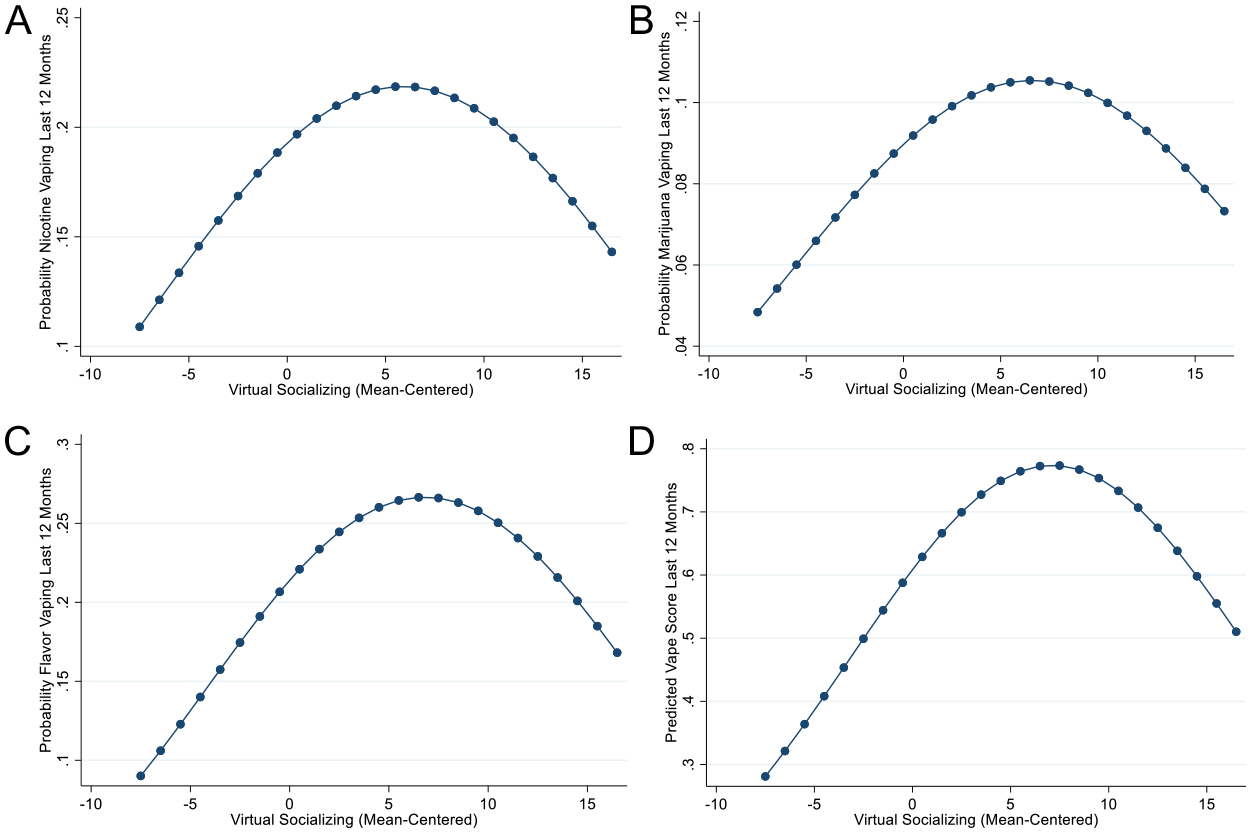
(A-D) Nonlinear relationship between virtual socializing and vaping in the last 12 months.
Then, we examined the relationship between virtual socializing and flavor vaping. The lower half of Table 2 reveals that virtual socializing is positively and significantly associated with the likelihood of flavor vaping (OR = 1.054, p < .01). The quadratic term in the second model is also significantly associated with the likelihood of flavor vaping (OR = 0.992, p < .01) indicating that this relationship is nonlinear. This relationship is graphed in Figure 1c. Examination of the figure reveals that the relationship between virtual socializing and the probability of flavor vaping holds a similar pattern to the relationship with nicotine and marijuana vaping (peaking around a score of 6 above the mean on the virtual socializing scale).
In the next step of the analysis, we examined the relationship between virtual socializing and scores on the vaping variety index. As can be seen in the third model of the lower half of Table 2, virtual socializing is positively and significantly associated with scores on the vaping variety index (OR = 1.035, p < .01). In addition, the quadratic term in model four is also significantly associated with scores on the vaping variety index indicating that this relationship is also nonlinear. A graph of this relationship is presented in Figure 1d. Examination of Figure 1d reveals that increased virtual socializing is initially associated with increased scores on the vaping variety index, however, after a point (around a score of 7 above the mean on the virtual socializing scale), this relationship reverses. For reference, a score of 7 above the mean on the virtual socializing scale is more than 1 standard deviation above the mean.
Given nonlinear relationships between virtual socializing and the likelihood of vaping, we then tested whether the relationship between virtual socializing and frequency of vaping activities may also be nonlinear. Table 3 displays negative binomial regression models examining the relationships between virtual socializing and all three forms of vaping. As can be seen, virtual socializing is positively and significantly associated with frequency of nicotine (IRR = 1.039, p < .01), marijuana (IRR = 1.038, p < .01), and flavor (IRR = 1.058, p < .01) vaping. The quadratic term for virtual socializing also emerged as a significant predictor of frequency for all three forms of vaping (nicotine: IRR = 0.995, p < .01; marijuana: IRR = 0.995, p < .01; and flavor: IRR = 0.994, p < .01). These relationships are graphed in Figure 2. Figure 2a displays the relationship between virtual socializing and predicted frequency scores of nicotine vaping during the last 12 months. As can be seen, virtual socializing initially increases the predicted frequency of nicotine vaping, however, the relationship peaks around a score of 7 above the mean on the virtual socializing scale after which, additional virtual socializing is associated with lower predicted scores of nicotine vaping frequency. Figures 2b and c represent similar patterns of findings for marijuana and flavor vaping respectively (peaking around a score of 7 above the mean on the virtual socializing scale).
Regression Models of the Association Between Virtual Socializing and Frequency of Vaping Activity in the Last 12 Months.

p <.05. **p <.01.
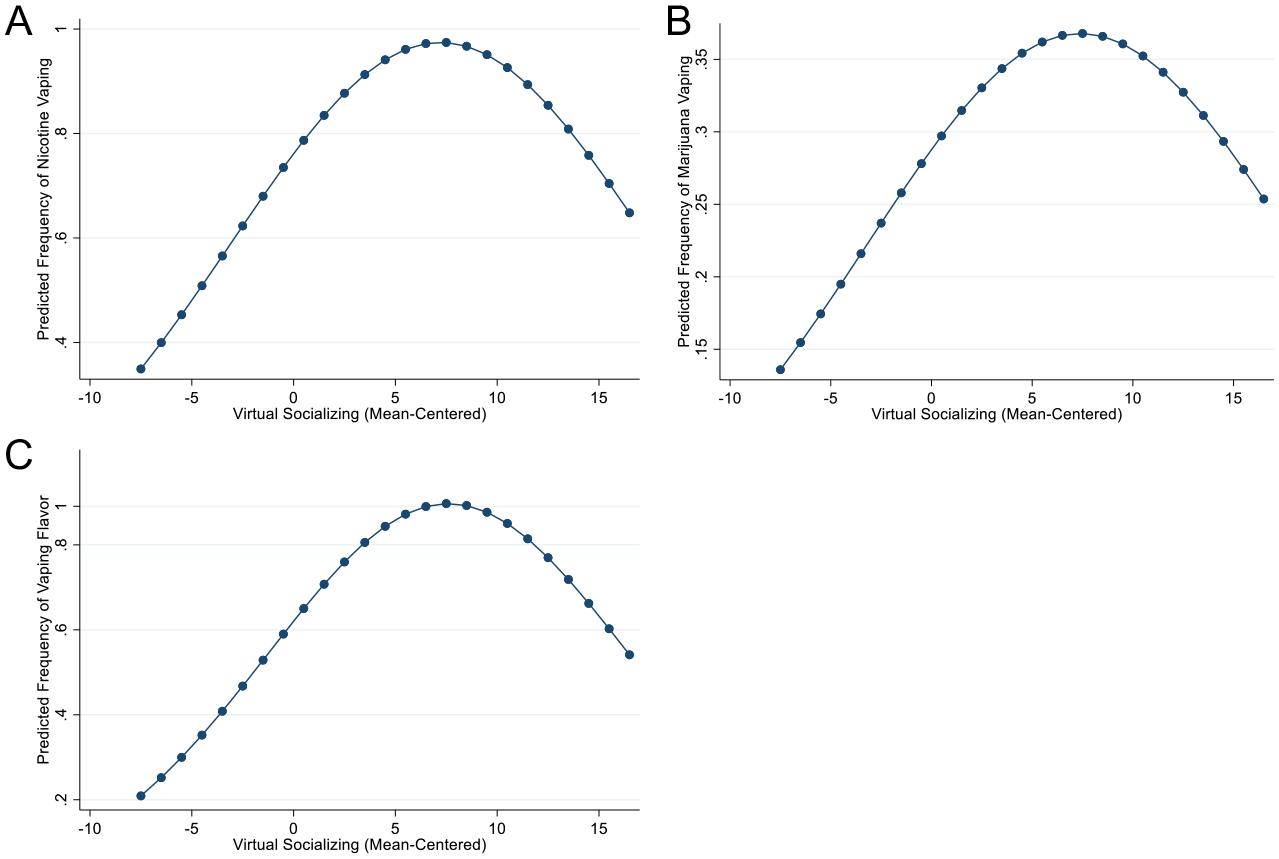
(A-C) Nonlinear relationships between virtual socializing and frequency of vaping in the last 12 months.
Discussion
Previous research links virtual socializing with adolescent vaping (Boccio et al., 2022). However, previous research has assumed this relationship is linear and has not tested for possible nonlinear effects. This is a relevant omission as there are several reasons to believe this relationship could be nonlinear due to potential displacement and saturation effects. This study builds on the existing literature by testing for nonlinearity in the relationship between virtual socializing and adolescent vaping. The results of this study revealed three key findings.
First, consistent with previous research (Boccio et al., 2022; Hull et al., 2014; Kaur et al., 2020; Primack et al., 2009), the findings of this study indicate that virtual socializing is positively and significantly associated with both the odds and predicted frequency of vaping nicotine, marijuana, and flavor in the last 12 months. These findings indicate that respondents who spend more time engaging in virtual socializing are more likely to engage in each of the three forms of vaping and are likely to vape more frequently.
Second, the models incorporating a quadratic term for virtual socializing revealed that the relationship between virtual socializing and the odds of adolescent vaping appear to be nonlinear. Specifically, these results seem to suggest that spending time engaging in virtual socializing initially increases the odds of vaping nicotine, marijuana, and flavor. However, after reaching a certain point, the direction of the relationship appears to reverse, wherein additional time spent engaging in virtual socializing appears to decrease the likelihood of vaping nicotine, marijuana, or flavor. This pattern of findings suggests an inflection point, where a certain level of engagement of virtual socializing is associated with the greatest likelihood of vaping and beyond this point the likelihood levels off and decreases to some degree. Third, a similar pattern of findings was revealed in regards to vaping frequencies in the last 12 months—where initial involvement in virtual socializing was associated with an increase in frequency of vaping nicotine, marijuana, and flavor, but after reaching an inflection point, additional time spent virtual socializing is associated with decreased frequencies of vaping nicotine, marijuana, and flavor.
One possible explanation for this pattern of relationships may be that at lower levels of virtual socializing, virtual socializing activity may be used to supplement in person socializing activities and deviance. In this case, adolescents may use virtual socializing to discuss vaping through covert means and to form plans to obtain vaping equipment and so forth. They may also use this online forum as way to trade information related to vaping and “show off” their vaping activity. After reaching a certain level of virtual socializing, however, increased time spent socializing virtually may “displace” time that would otherwise be spent socializing in person. As such, adolescents who spend extraordinarily high amounts of time virtual socializing may not spend as much time socializing in person which may reduce the risks of engaging in substance use—which most often takes place in in-person settings (Buckner et al., 2012; McCabe et al., 2014). This pattern of findings is consistent with related deviance research, which has suggested that additional time spent using digital media and socializing online may lead to decreases in adolescent delinquency, substance use, and risky activities (Baumer et al., 2021). Additionally, it is also possible that after reaching a certain level of virtual socializing, the messaging from virtual peers regarding vaping activities may become “redundant” and further messaging will have diminishing effects.
Another possibility may be that adolescents who are involved in heavy virtual socializing may have substantially different and/or smaller in-person social groups than adolescents who spent a more moderate amount of time engaging in virtual socializing. Adolescents who are heavily involved in virtual socializing may also be engaged in different patterns of virtual socializing activities where they may be spending time socializing with different peers (perhaps more prosocial) and/or engaged in consuming different forms of content. To illustrate, these adolescents may have different interests and hobbies both in-person and virtually than adolescents who spend more normative amounts of time virtually socializing. As a result, these adolescents are likely exposed to a different array of content while in virtual spheres and may spend less time socializing with substance using peers in person, thus reducing their risks for substance use. Relatedly, adolescents who spend very little time socializing with peers in person may have less interest in consuming content related to popular activities such as vaping among their same age peers leading to lower risks for substance use. Future research will be needed to explore whether adolescents who are engaged in heavy virtual socializing are engaging in substantially different virtual socializing activities than adolescents who are more moderately involved in virtual socializing.
The findings of this study need to be considered in light of four key limitations. First, the data for this study are cross-sectional in nature limiting our ability to assess temporal order in the relationship between virtual socializing and vaping activities. Additionally, as all the variables in this study were measured at the same time, we cannot rule out the possibility that vaping may influence virtual socializing or that the two may have a reciprocal relationship. Further research will be needed to examine how changes in virtual socializing activities may be associated with changes in vaping activities. Second, the items measuring virtual socializing are relatively broad and do not assess all possible forms of virtual socializing. One important omission is the inability to measure involvement in multiplayer video games which are a frequent forum for online socializing among adolescents—in particular for males (Anderson & Jiang, 2018). While, the MTF data does contain an item assessing the amount of time spent playing games on electronic devices, this item does not distinguish between single player and multiplayer games. As a result, this item contains information related to both social and non-social video gaming activities. Moreover, additional analyses revealed that including the video gaming measure in the scale of virtual socializing led to a decrease in inter-item consistency, and, therefore, we did not include this item in the virtual socializing scale. Future research is needed to explore how virtual socializing via multiplayer video games is related to adolescent vaping activities. Similarly, future research should seek to examine relationships between virtual socializing through specific virtual avenues (e.g., texting and video chatting) and apps (e.g., TikTok and Snapchat) and adolescent vaping activity and other forms of substance use. Third, the virtual socializing items in this study are limited to the amount of time spent engaging in each activity and cannot be used to assess who the respondents are socializing with through virtual media. As such, we cannot determine if adolescents are primarily socializing with their in-person peers via virtual socializing or if they are socializing with others they would not normally encounter in person. Additional research will be needed in order to further explore the contexts of virtual socializing and how they are related to vaping activity. Finally, given the nature of the items assessing virtual socializing in this study, which are primarily concerned with hours spent engaging in each activity, we are not able to ascertain the settings in which adolescents are engaging in these various virtual socializing activities. For instance, it is possible that much of the social networking activities and talking on the phone may occur at home and in settings where adolescents are supervised by their parents. Whereas, some of the other forms of virtual socializing (e.g., social networking and texting) may occur more often in social settings outside the home. Unfortunately, the MTF data does not contain items that can be used explore these relationships. Future research will be needed to explore the contexts in which various virtual socializing activities tend to occur and how these settings may differentially influence substance using behavior such as vaping.
The findings of this study have several implications for policy. First, the findings reiterate the importance of socializing in virtual spaces for adolescents’ substance use activities, including vaping. In the modern era, it has become increasingly critical for substance use education programs and interventions to account for the role of socializing in virtual spaces in adolescent substance use, including vaping. In order to adequately achieve this, substance use and drug education curricula should inform youth and their parents about the potential harms of time spent socializing in virtual space (particularly unsupervised and unstructured time). Further, the curricula should provide youth and their families with strategies for parental monitoring of virtual/online activity, including the content viewed, messages sent, and time spent on social media sites as a means to mitigate the risk of adolescent vaping. It may also be worthwhile for schools and youth organizations to consider substance use prevention campaigns that warn of potential dangers of unrestricted and unmonitored time in virtual spaces with peers. Still, complete elimination of these activities are unrealistic in the modern era, and so should instead be counterbalanced with pro-social, conventional activities via sports teams, school clubs, and other social organizations dedicated to adolescent health and well-being. These organizations can leverage social and digital media, for instance, to encourage youth engagement in wholesome, recreational activities to ensure that youth have alternatives to deviant activity, including opportunities to socialize both online and in-person with conventional peer groups.
While the present study is the first of its kind to focus on the non-linear relationship between virtual unstructured socializing and adolescent vaping, education curricula and programmatic initiatives in the future may want to consider how the present findings may be integrated into program content to the extent that findings are replicated. If findings are indeed confirmed and replicated with other samples, some considerations might be to explore ways that a healthy balance of time online and in-person are struck to mitigate the risk of harmful substance use activities. Beyond time spent is a need to investigate how programs provide the tools, skills, and resources to youth to ensure that they can combat harmful messaging and images that they encounter online, even if they limit their time spent. A feedback loop wherein virtual and in-person activities reinforce each other to encourage vaping needs to be disrupted via cognitive behavioral strategies, parental support and monitoring of in-person and online peer groups and activities, and initiatives where youths are presented with appealing peer-involved alternatives to substance use.
Footnotes
Declaration of Conflicting Interests
The author(s) declared no potential conflicts of interest with respect to the research, authorship, and/or publication of this article.
Funding
The author(s) received no financial support for the research, authorship, and/or publication of this article.
