






Abstract
Evidence from several countries indicates that homeless persons, particularly those with a mental illness, are at increased risk of offending and victimization. However, there has been little community-level analysis of the relationship between homelessness and crime rates. In this study, we discuss the criminogenic consequences of homelessness and then use panel data from 261 municipalities over a 21-year period (2000–2020) in Finland to examine how homelessness is related to different types of criminal offenses. Results from random and fixed-effects equations indicate that, net of common covariates, rates of homelessness are associated with increased rates of violent crime, property crime, and public intoxication offenses. The findings suggest that, in addition to mental health treatment, efforts to reduce homelessness enhance community safety.
Introduction
Homelessness is an important pathway to incarceration, particularly among persons with a serious mental illness (Draine et al., 2002). Studies in the U.S. find that a disproportionate number of jail inmates are homeless (Chan et al., 2020; Gonzales et al., 2017; Greenberg & Rosenheck, 2008; James & Glaze, 2006). Studies in European countries also find that homelessness increases the risk of offending and victimization (Alm & Bäckman, 2022; Bashir et al., 2021; Fazel et al., 2008). For example, a study in Sweden using nationwide register data found that homeless persons are at an increased risk of victimization, even after taking socioeconomic factors and mental illness into account (Nilsson et al., 2020). In Finland, despite remarkable progress in reducing homelessness (to just under 4,000 persons), it is estimated that approximately 30% to 35% of released prisoners and 10% to 15% of offenders serving community sanctions are homeless (Lind, 2018).
While the links between homelessness, mental illness, and crime have been established in many individual-level studies (e.g., Fox et al., 2013; McNiel et al., 2005), there has been limited study of community-level relationships between rates of homelessness and criminal justice outcomes. This is surprising, given the long tradition in criminology of conceptualizing crime and disorder as “local-level” phenomena (Sampson et al., 2002). In this study, we first discuss the criminogenic consequences of homelessness. Next, we review the limited macro-level research on rates of homelessness and crime. Then, using panel data from municipalities in Finland, we examine the relationships between rates of homelessness, violent crime, property crime, and public order offenses, taking into account indicators of the prevalence of mental health problems, alcohol use, and a range of socio-demographic structural factors.
Homelessness and Crime
There are many reasons why homelessness is related to crime, including lack of community support and housing services, economic disadvantage, untreated mental illness and substance abuse, and stigma (Draine et al., 2002; Markowitz, 2011; Markowitz & Syverson, 2021). Each of these reasons contribute to the criminogenic nature of homelessness it its own way. Studies in the U.S. for example, estimate that approximately one-third of homeless persons meet diagnostic criteria for a major mental illness (Mechanic et al., 2014). Including substance-related disorders, the figure is closer to 75%. Consequently, surveys of jail and prison inmates find that mentally ill offenders are more likely to have been homeless at the time of arrest and in the year before arrest than those without a mental illness (DeLisi, 2000; James & Glaze, 2006; McCarthy & Hagan, 1991).
Serious psychiatric illness and substance abuse problems impede the ability of persons to obtain stable housing. Lack of housing, in turn, creates strains that exacerbate mental health problems (Calsyn & Winter, 2002). In the absence of adequate mental health and housing services, homelessness becomes an important pathway to the criminal justice system (Markowitz, 2006; Stuart, 2016). Studies in Finland and the U.S. show that prisoners who are homeless upon release are also at an increased risk of re-offending (Aaltonen et al., 2021; Jacobs & Gottlieb, 2020). One study in Australia showed that incarceration increases the longer-term chance that persons will become homeless (Moschion & Johnson, 2019).
Although treatment engagement and medication compliance reduces the risk of violence (Bhattacharyya, 2023), many persons with mental illness “fall through the cracks” of community based services. Services can be effective, but are often fragmented and require active engagement on the part of persons who require them, but may not recognize the need to do so (Dobransky, 2014). Because of social interaction difficulties resulting from symptomatic behavior, homeless persons with a mental illness are at risk of being involved in disputes that lead to aggression and violence (Link et al., 1999; Silver, 2002). Those experiencing psychotic symptoms, for example, may perceive the actions of others as threatening, and respond aggressively (Link et al., 1999). Others may also act aggressively towards persons with mental illness in attempt to “control” disruptive behavior.
Other non-violent criminal behavior among homeless persons could be considered “survival” crimes, such as shoplifting and trespassing (Fischer et al., 2008; McGuire & Rosenbeck, 2004). Similarly, homelessness is also associated with behaviors that jeopardize public order and safety, such as drinking in public, littering, and urinating and defecating in public. Thus, homeless persons are at increased risk of police encounters and arrest for serious crimes, such as assault, as well as a variety of “public order” types of offenses (Dennis & Steadman, 1991; Fischer et al., 2008; Hiday et al., 2001; Lamb & Weinberger, 2001; McGuire & Rosenbeck, 2004; Silver et al., 2002; Teplin et al., 1994).
The presence of homeless persons and associated public order offenses constitute forms of disorder that may generate fear and reduce social cohesion among neighborhood residents, leading to serious crime, such as robbery (Markowitz et al., 2001; Sampson et al., 2002). The visibility of homeless mentally ill persons has led many cities, at various times, to take aggressive policing approaches that contribute further to the overrepresentation of mentally ill persons in jails and prisons (Johnsen & Fitzpatrick, 2008; Teplin, 2000). Moreover, many mentally ill homeless persons often reside in group homes, shelters, or single-room occupancy hotels, or in subsidized housing, all of which are more likely to be located in “socially disorganized” neighborhoods, marked by economic disadvantage and low collective efficacy (Sampson et al., 2002). Studies show that, for persons with a mental illness, living in such neighborhoods increases the risk of criminal offending beyond individual demographic characteristics, highlighting the role of criminogenic contexts in facilitating violence (Silver, 2006; Silver et al., 2002).
The vulnerability of homeless persons also increases their risk of being the victims of crime, well beyond rates found in the general population (Choe et al., 2008; Dennis & Steadman, 1991; Nilsson et al., 2020; Teplin et al., 2005). Insights from the routine activities approach to crime suggests that homeless persons have reduced levels of “capable guardianship” necessary to protect themselves from crime (Felson, 2018; Hagan & McCarthy, 1998). In other words, those spending more time in street locations do not benefit from having other household members, such as family or roommates, or neighbors to protect property and deter offenders. Thus, they are easier targets for offenders. Moreover, the likelihood of victimization among homeless mentally ill persons is increased because of the risks of victimization associated with alcohol use more generally (Felson & Burchfield, 2004).
Homelessness may also be criminogenic because of the detrimental consequences of the stigma associated with it—especially for men—contributing to discrimination in social relations, housing, and employment, limiting the prospects for social reintegration (Markowitz & Syverson, 2021, Phelan et al., 1997). Stigma also helps drive punitive and exclusionary policy responses to homelessness that criminalize activities homeless persons may rely upon to subsist, further eroding health and well-being (Herring & Lutz, 2015; Stuart, 2016). Together, stigma exacerbates the problems homeless persons face and may contribute to the increased risk of reoffending by impeding formation of crime-controlling stable bonds (Markowitz, 2014).
Macro-Level Research
Most research on homelessness and crime has been at the individual-level. The studies that examine macro-level variation in homelessness focus primarily on how demographic structure and economic indicators predict rates of homelessness across metropolitan areas and counties (Byrne et al., 2013; Fargo et al., 2013). It is surprising how little research there is examining the relationship between homelessness and crime at the aggregate-level, given the long tradition of community-level research on crime and disorder (Sampson et al., 2002). This may be due, in part, to the difficulties in obtaining valid and reliable measures of homelessness, particularly at more appropriate “local” levels (Schneider et al., 2016).
There are, however, a few exceptions to the lack of macro-level research on homelessness and crime. One is the study by Markowitz (2006), showing that, across a sample of U.S. cities, higher rates of homelessness (as measured by a special U.S. census count) were associated with higher levels of crime, in large part, due to inadequate public inpatient psychiatric treatment capacity. While that study controlled for a range of economic and demographic variables, it was cross-sectional, and used limited measures of homelessness that captured mostly “visible” homelessness. Another cross-sectional study found that, after controlling for a variety of socio-demographic factors, higher rates of homelessness were associated with higher homicide rates across a sample of metropolitan areas (Fargo et al., 2013). Most recently, a study by Ee and Zhang (2022), using data from Los Angeles neighborhoods, found that homelessness was associated with increased crime, after controlling for other macro-level correlates. However, that study was also cross-sectional. Importantly, while these studies show ecological correlations, they are unable to employ panel data methods that examine how changes in homelessness lead to changes in crime, as well as account for unobserved sources of heterogeneity (Allison, 2009). Data from Finland (described below) allow us to provide a comparative perspective, and examine the relationships between homelessness and crime using consistent measures of homelessness over an extended period, for a large number of municipalities.
Homelessness and Crime in Finland
Finland is recognized worldwide for its implementation of the “housing first” approach to reducing homelessness. The guiding principle of this approach is to provide apartments for homeless persons, and then other issues, such as mental health, substance abuse, and employment can be addressed (Y-Foundation, 2018, 2019). There is also emphasis on not relying on homeless shelters as a solution. This is in contrast to policies where persons must often “get sober” and obtain employment before they can obtain housing (Baxter et al., 2019). The Finnish approach has resulted in a substantial decline in homelessness. In 1990, there were an estimated 3.1 homeless persons per 1,000. By 2020, that number had declined by about 75% to .8 per 1,000 (Housing and Finance Development Center of Finland, 2021). Excluding persons staying with friends or family, the rate of homeless persons declined by 53% (1.5–0.7/per 1,000). Despite this progress, recent estimates indicate that around 4,000 persons in Finland remain homeless. Figure 1 shows trends in rates of homelessness, violent crime, and violent crimes committed under the influence of alcohol or drugs in Finland from the mid-1990s to 2020.

Violent crime and homelessness per 1,000 in Finland 1995 to 2020.
In Finland, about one-fourth of the homeless population are considered persons experiencing “long-term” homelessness. Long-term homelessness refers to chronically homeless persons who have significant social/health problems (e.g., debt and substance abuse/mental health problems). According to recent estimates, men constitute about 75% of the homeless population. Young persons (under 25 years) make up about 22% of the homeless population. The bulk of homeless persons (70%) temporarily live with friends or relatives, while about 17% live outside, in stairwells, or in overnight shelters. About 8% are in emergency hostels, and a small portion (9%) are in institutions (e.g., rehab units and hospitals; Housing and Finance Development Center of Finland, 2021).
Despite having a relatively strong social safety net (e.g., in terms of universal healthcare, comparatively generous family leave, unemployment support, housing subsidies, and tuition-free education), mental health problems, crime, and homelessness are closely related in Finland, and vary considerably across communities (Karolaakso et al., 2021; Pirkola et al., 2009; Sadeniemi et al., 2021). In a Finnish birth cohort study, those with psychiatric disorders accounted for almost half of all crimes (Elonheimo et al., 2007). Prison inmate health surveys indicate that about 78% to 84% of prisoners have a substance abuse problem, about 1/3 have been hospitalized for psychiatric reasons, and half have received outpatient psychiatric treatment (Joukamaa et al., 2010). Half of deaths in prison are suicides (Joukamaa, 1997). Evidence suggests that a sizable portion of released prisoners in Finland—many with mental health and substance abuse problems—face difficulties finding housing, which can increase the risk of re-offending (Aaltonen et al., 2021). About 1/3 of prisoners are in need of housing upon release, and about 10% to 15% of offenders serving “community sanctions” are homeless (Aaltonen et al., 2021; Lind, 2018).
Because of comparatively lower levels of economic inequality and availability of micro-level registry data, research on crime and other social problems in Finland tends to be more individually oriented (Aaltonen & Mikkonen, 2018). There is, however, precedent for examining macro-level relationships involving community problems. For example, Hirschovits-Gerz (2019) described patterns of mental health service provision, need, homelessness, and crime rates in seven large municipalities. While she showed there is indeed variation in these indicators, she pointed to the need to study a larger number of municipalities over a longer timeframe to examine the associations among these variables. Most recently, Markowitz (2023) found that mental health problems and alcohol use were associated with violent crime across communities in Finland. He also found that provision of supportive housing for persons with mental health problems was associated with lower crime rates. In general, this research indicates significant variation in social problems across communities in Finland (Karolaakso, et al., 2021). However, research has not yet directly examined community-level relationships between homelessness and crime there. Data from Finland presents an opportunity to examine the relationship between homelessness and crime in a context with comparatively lower inequality than the U.S. (Blanchet et al., 2022).
Present Study
In this study, we examine relationships between homelessness and different types of criminal offenses in Finland (violent, property, and public order). Finnish data provide distinct analytic advantages for community-level analysis. Although funding for healthcare and housing services comes from both local and state (national) taxation, the provision of services has been the responsibility of the municipalities, including housing services for persons with mental health and substance abuse problems (Alanko, 2017; Korkeila, 2021). Surveys are administered annually to municipal authorities to indicate the number of homeless persons. Thus, it is possible to derive aggregate rates of homelessness for each municipality and link it with data on crime and other indicators over an extended timeframe.
In our analyses, we take advantage of data that also includes a measure of “hidden” homelessness, those persons who are homeless, but not (publically) visibly so (e.g. staying with others temporarily; Deleu et al., 2023), to examine its effects on crime. Given the enhanced risk of violence when substance use is involved, we also estimate models of violent crime committed while under the influence. We estimate a series of fixed and random-effects models for municipal-level outcomes (explained in detail below), including controls for the prevalence of mental health problems, alcohol use, municipal expenditures, and demographic factors that may be related to both homelessness and crime (Elliott & Krivo, 1991; Lehti, 2014; Savolainen, 2005). Given the criminogenic processes associated with homelessness discussed above, we expect that communities that have higher levels of homelessness will also have higher rates of crime.
Methods
Excluding the municipalities of the autonomous Åland island region, we were able to obtain panel data for study variables for a 21-year period (2000–2020) for 261 municipalities, although due to missing data, the exact number of observations varies in each equation, depending on the outcome and explanatory variables included (explained below). 1 Data for all indicators come from THL (Finnish Institute for Health and Welfare) and Statistics Finland.
Measures
Homelessness
Estimates of homelessness in Finland are based on data provided by municipal authorities in annual surveys. A homeless person is defined as anyone living outdoors; in temporary or other types of shelters; in various institutions due to a lack of residence; and temporarily with friends or relatives. The indicator is expressed as the number of lone homeless persons per 1,000 inhabitants. 2 We examine effects including and excluding homeless persons staying with family or friends, who may be less vulnerable to the criminogenic effects of homelessness. The majority of homeless persons are men and include those who may not be willing to use housing services or are not capable of retaining accommodation provided for them. Homelessness in Finland is more prevalent in larger municipalities (Housing and Finance Development Center of Finland, 2021).
Crime and Disorder
We focus on four measures of criminal offenses. First is the reported number of violent crimes per 1,000. These include mostly minor and aggravated assaults, and a small number of homicides. A significant portion of violence in Finland involves alcohol (Savolainen, 2005). An estimated 80% of homicides, 70% of assaults, and 56% of robberies involve alcohol or other drugs (Lehti & Sirén, 2020). Given this, along with the considerations regarding the role of substance abuse in violence among persons with mental health problems discussed above, second, we examine relationships involving the number of violent crimes while under the influence of alcohol or drugs per 1,000 (VUI). Third, we examine property crimes per 1,000. These are predominately thefts and a very small number of robberies. Fourth, as a measure of public order offenses, we examine intoxicated persons taken into police custody per 1,000. Persons who are intoxicated and disruptive may be taken into police custody. Depending on the risk of harm, officers have the discretion to transport intoxicated persons to hospitals, detoxification centers, their homes, or to a police department cell (Eteläpää, 2010). They may also be fined. Of course, like all research using official statistics, the number of recorded offenses are under-estimates, as many are not reported. However, we are interested primarily in the covariation of offenses with homelessness.
Control Variables
We include a set of control variables associated with crime and homelessness in prior studies (Sadeniemi et al., 2021; Savolainen, 2005). These include the mental health index and alcohol consumption in each municipality, both of which may be underlying causes of homelessness and crime. The mental health index, used in prior macro-level studies in Finland (Ala-Nikkola et al., 2014, 2018; Hirschovits-Gerz, 2019; Markowitz, 2023; Sadeniemi et al., 2014), is a composite index of three, equally weighted indicators: the number of suicides and attempted suicides, reimbursements for psychosis medication, and number of persons receiving disability payments for mental health problems. The index is on a scale from ±100, where 100 is the average score for the country as a whole. Thus, the index provides an estimate of the burden of illness in a municipality and consequent demand for services in the community compared with the country as a whole. Excessive alcohol consumption has long been considered an important problem in Finland and is a consistent predictor of violent crime in other Finnish community-level studies (e.g., Burchfield et al., 2022; Markowitz, 2023; Savolainen, 2005). Alcohol sales in Finland are highly regulated and taxed. It is measured as the number of liters sold per 1,000 persons in each municipality. We also include percent of the population age 15 to 29 years, percent unemployed, and population size (in 1000s). Finally, we include a measure of municipal social and health expenditures, expressed as 100s of euros per capita. 3
Analysis Strategy
First, we report descriptive statistics for all study variables, providing perspective on the extent to which there is variation in crime, homelessness, and other predictor variables within municipalities over time compared to variation between municipalities. We then estimate a series of linear multiple regression equations to examine relationships between homelessness and offenses (violent crime, violent crime under the influence, property crime, and public intoxication). We estimate two types of equations: (1) random-effects (generalized least squares) and (2) fixed effects (maximum likelihood), comparing findings between the outcomes and between the different estimation techniques. Random-effects models assume that omitted variables are uncorrelated with the explanatory variables in the model, but have smaller standard errors. Alternatively, fixed effects models, which may have larger standard errors, are more appropriate if omitted variables are correlated with the explanatory variables in the model, and have time-invariant values with time-invariant effects (Allison, 2009). For example, some northern municipalities may have particular cultural differences, lack detox facilities, or have long travel distances that inhibit formal intervention for some offenses. This is a tradeoff—by estimating fixed effects, we can better explain variation in crime, but in an unbiased way. By estimating random effects, we run the risk of some bias in our parameter estimates (Clark & Linzer, 2015). Thus, we are interested in comparing results from both types of equations.
We estimate the series of equations using two measures of homelessness—with and without those staying with family and friends, comparing their effects. In both sets of equations, we include a set of dichotomous (“dummy”) year variables, thus taking into account unmeasured sources of variation over time, for example, as homelessness-reduction initiatives were implemented in stages in Finland over the study period (Pleace et al., 2016; Turunen & Granfelt, 2023) and reforms in recording domestic violence were implemented (Aalotonen et al., 2014).
Results
Descriptive Statistics
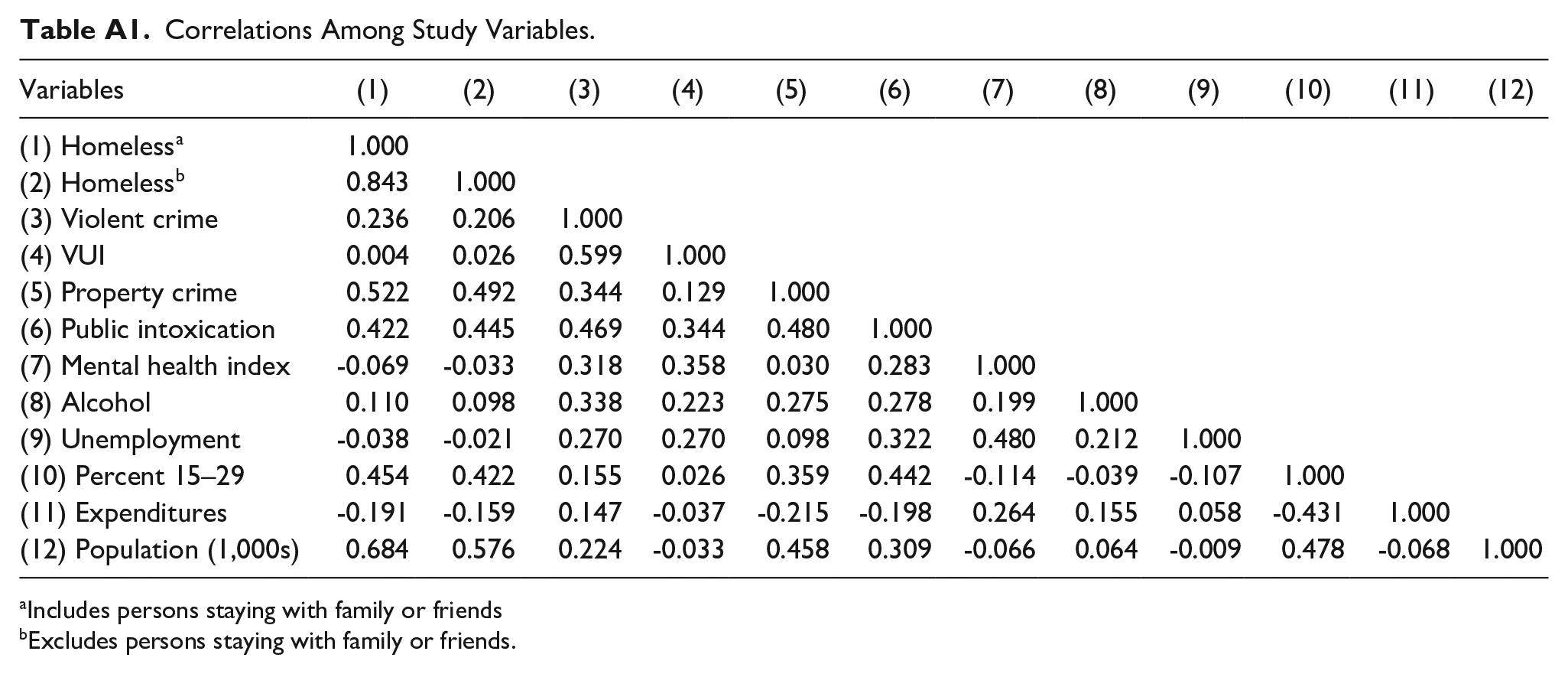
Descriptive statistics for all study variables are shown in Table 1. Note there is wider between-municipality variation in homelessness, consistent with the observation that homelessness is concentrated in the larger municipalities in Finland. There is also generally comparable amounts of between and within-municipality variation in violent crime and VUI rates, but property crime and public intoxication have more between-municipal variation. Some of the within-municipality variation in crime rates may be due to smaller municipalities having lower population-adjusted rates that can vary considerably from year to year. In the Appendix Table A1, we present a pooled correlation matrix of the key variables.
Descriptive Statistics.
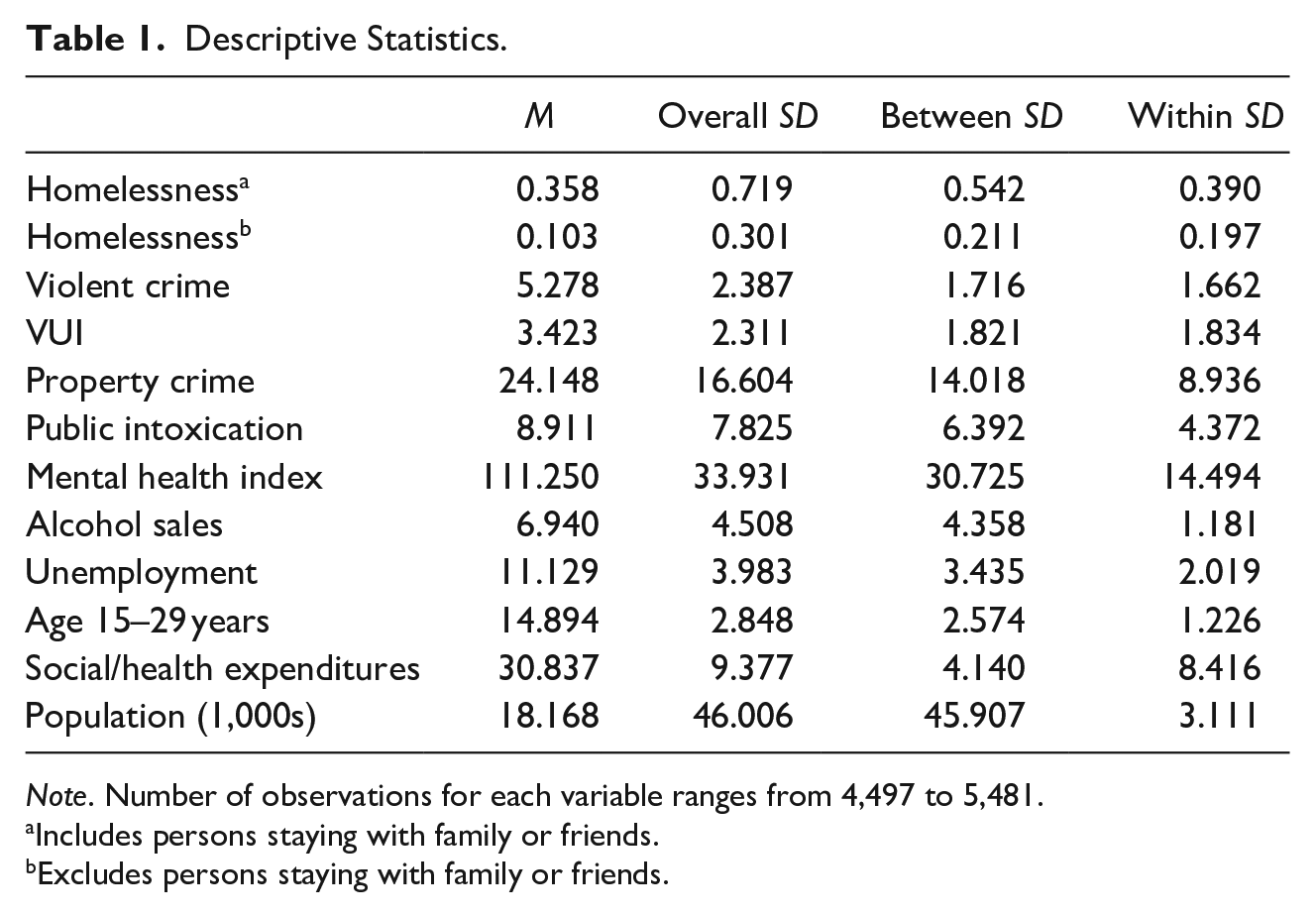
Note. Number of observations for each variable ranges from 4,497 to 5,481.
Includes persons staying with family or friends.
Excludes persons staying with family or friends.
Multivariate Equations
Next, we turn to results from the random and fixed-effects multiple regression equations that estimate the net associations between homelessness and the criminal offenses (equations (1)–(8)), shown in Table 2. 4 Here, we see that homelessness is associated with variation in violent crime in the random effects equation (1), but not in the fixed-effect equation (equation (2)). Homelessness is not significantly associated with VUI in either the fixed or random effects equations (3) and (4). However, homelessness is significantly associated with increases in property crime and public intoxication in both types of equations (equations (5)–(7)). Alcohol consumption, unemployment, and the mental health index are also generally associated with increased rate of offenses. Expenditures on social and health services per capita is also negatively associated with public intoxication.
Municipal-level Associations Between Homelessness and Crime.

Note. Year effects not shown. β = unstandardized regression coefficient (SE in parentheses).
p< .05. **p< .01. ***p< 001.
Next, we turn to results from equations that estimate the net associations between homelessness and the criminal offenses, but using the measure of homelessness that excludes persons staying with family or friends (equations (1)–(8)), shown in Table 3. Here, we again see that homelessness is associated with variation in violent crime in the random-effects equation (equation (1)), but not in the fixed-effects equation (equation (2)). Homelessness is significantly associated with VUI in the random effects equation (3), and its effect is just under the conventional level of statistical significance in the fixed-effect equation (equation (4), p = .08). Again, homelessness is significantly associated with increases in property crime and public intoxication in the random (equations (5) and (7)) and fixed-effects models (equations (6) and (8)). In general, the association of homelessness with VUI, property crime, and public intoxication is substantially larger when using the measure of homelessness that excludes persons staying with family or friends. The associations of homelessness and crime are generally stronger for property and public intoxication offenses, compared to violent crimes. With the alternative measure of homelessness, expenditures on social and health services per capita is again negatively associated with public intoxication.
Municipal-level Associations Between Homelessness and (excluding persons staying with family or friends).
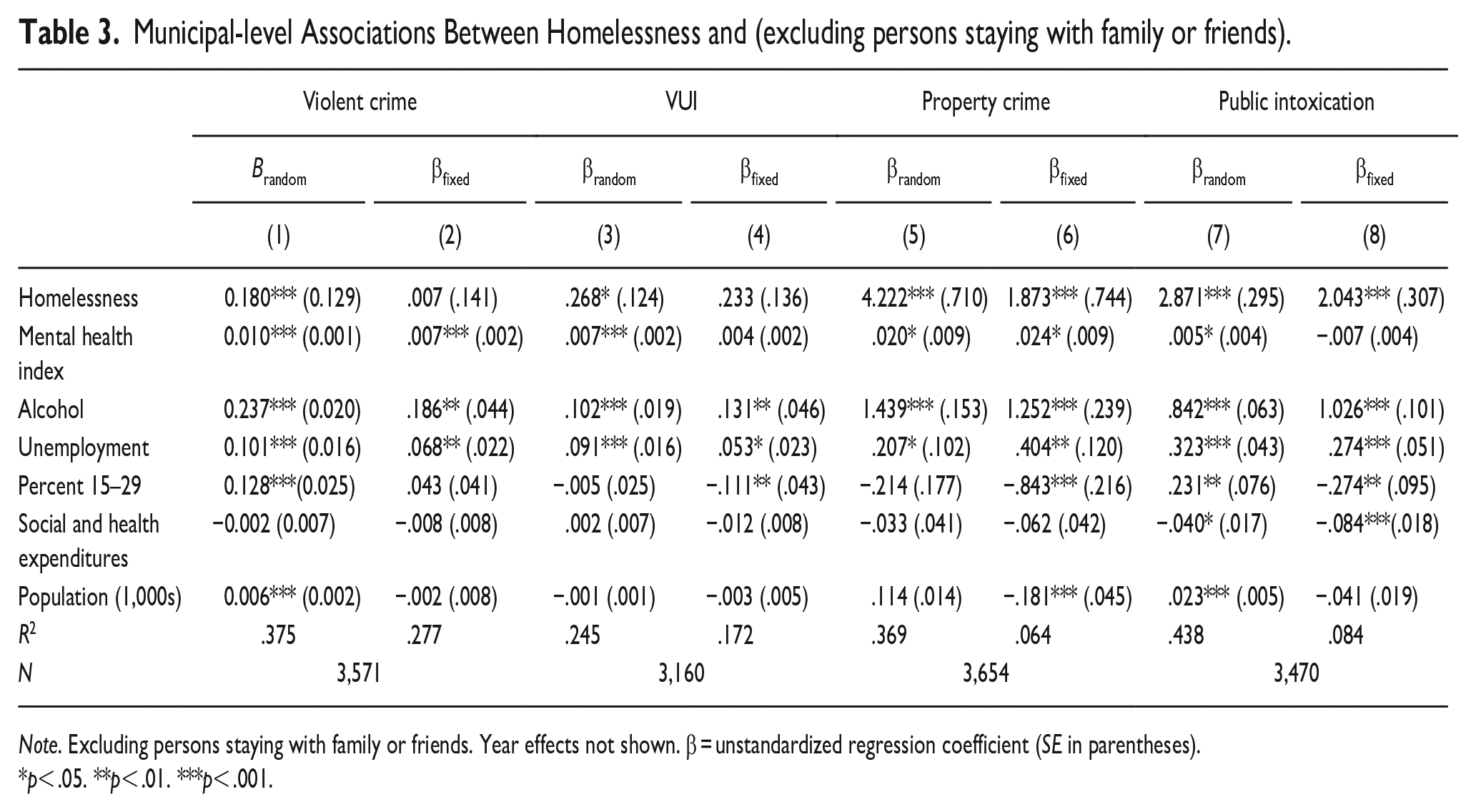
Note. Excluding persons staying with family or friends. Year effects not shown. β = unstandardized regression coefficient (SE in parentheses).
p< .05. **p< .01. ***p< .001.
Supplementary Analyses
In order to see whether the relationship between homelessness and crime is robust to the types of cities included, we estimated two sets of alternative models. Since many smaller, outlying municipalities in Finland do not have any homeless persons, we first restricted the analysis to the municipalities that reported having any homeless persons over the study period, effectively limiting the analysis to the 161 largest municipalities, where it is likely many troubled persons drift. This yielded the same substantive effects of homelessness on the offense outcomes as those presented in Tables 2 and 3. Next, we performed the analysis omitting Helsinki, where the largest share of homeless persons in Finland is located. Again, the results are very similar to those we present. 5 As a way of considering the robustness of the findings to concerns of timing, we re-estimated the series of models using 1-year lagged values of the homelessness variables (Moschion & Johnson, 2019; Semenza et al., 2023). This did not yield any substantive differences compared to the estimates presented.
Discussion
Using data from a Nordic social welfare democracy with a relatively strong social safety net and substantial progress in reducing homelessness, we find that, despite these gains, homelessness is associated with rates of a variety of criminal offenses, both across, and within municipalities over time. These results are consistent with the few U.S. based macro-level studies that show a positive relationship between homelessness and crime across cities (Markowitz, 2006), metropolitan areas (Fargo et al., 2013), and neighborhoods of a major city (Ee & Zhang, 2022). The present study advances this line of research by examining the relationship between different types of homelessness and criminal offenses, across communities over an extended period, permitting the use of panel data analytic techniques that take into account unobserved sources of heterogeneity.
Several interesting patterns also emerge from the findings. Somewhat stronger effects of homelessness are found when using a measure that excludes persons not staying with family or friends. Persons without the support of family or friends may be more vulnerable to the criminogenic effects of homelessness, in terms of the opportunities created by time spent on the streets or in temporary types of shelters. In these environments, there may be greater exposure to others who likely share similar mental health and substance abuse problems, increasing the likelihood of disputes (Link et al., 1999; Silver, 2002). Moreover, homeless persons on the streets, particularly when drinking excessively, are more vulnerable to charges of public intoxication. At the same time, persons who are unable to stay with family or friends are likely to have somewhat “worse” or more chronic mental health problems that exhaust the tolerance of those closest to them (Housing and Finance Development Center of Finland, 2021; Karp, 2002).
We find the association between homelessness and crime is generally stronger for property and public intoxication offenses, compared to violent crimes. This may be due to the substantial portion of violent crimes that take place “behind closed doors” that are not reported, compared to those offenses that take place in publically visible locations (Mäkelä & Warpenius, 2020). Police may also, at various times, make concerted efforts to enforce public order laws, thereby increasing the number of publically visible offenses recorded (Teplin, 2000).
While we are able to show the associations between homelessness and different types of crime at the aggregate level, it is quite possible that places with more homeless persons not only have more crime as a result, but that places with more crime also end up having more homeless persons, given the relatively short-term prison stays in Finland. Persons discharged from prison in particular, may have difficulty securing employment and housing, resulting in homelessness. Evidence from individual-level studies show that ex-inmates are at increased risk of homelessness and precarious living situations (Moschion & Johnson, 2019). However, these relationships may vary considerably across countries. In general, the relationship between homelessness and crime is likely to be cyclical (Kushel et al., 2005).
Although the results show that rates of homelessness are related to crime, it is difficult to say precisely whether this relationship is due to homelessness per se, or, because homeless persons are more “troubled” in various ways, places with more homeless persons are simply those where more “troubled” (thus crime-prone) persons are “selected” into Airaksinen et al. (2021). Despite these considerations, in our analyses, the relationship between homelessness and crime persists, after controlling for the extent of mental health problems and alcohol use. Therefore, it is likely that a certain level of homelessness in municipalities is indeed criminogenic at the community level. Our findings are consistent with those of a randomized study in the U.S. that found supportive housing helped people avoid police contacts, arrests, and jail days, particularly for property crimes and public order offenses (Cunningham et al., 2021). Provision of supportive housing, especially with fewer restrictions and when combined with “wrap-around” services for mental health issues is a way to help limit persons’ costly involvement in the criminal justice system.
We also find that municipalities with more mental health problems, as indicated by comparatively worse mental health index scores have higher levels of the criminal offenses we examined. According to reports on the housing first approach in Finland, challenges remain in preventing chronic homelessness among persons with mental health and substance abuse problems who have exhibited violent behavior that impedes placement in stable housing (Pleace et al., 2015). A critical aspect of reducing crime associated with homelessness is provision of integrated services that facilitate transition into stable housing, particularly upon release from hospitalization or prison (Pleace, 2017; Somers et al., 2013). Unemployment is also similarly associated with higher crime rates. Therefore, in addition to mental healthcare and housing, community efforts that foster employment are not only important in facilitating recovery and reintegration, but may also help reduce crime.
Further research is also needed to determine the extent to which our findings regarding the macro-level effects of homelessness are generalizable to other Nordic countries. There are some differences between Nordic mental healthcare systems in terms of processes of referral for specialty treatment and supportive housing provision (Benjaminsen et al., 2020). In addition, alcohol abuse and recidivism are higher in Finland compared to the other Nordic countries (Aaltonen et al., 2017). The findings from this municipal-level study regarding the relationship between homelessness on crime are consistent with a U.S. study using cities as the units of analysis (Markowitz, 2006). However, the U.S. has significantly greater economic inequality, lacks a universal healthcare system, and does not have a unified national strategy to reduce homelessness. Consequently, the over-reliance on shelters and “tent cities” rather than permanent housing likely contributes to a significant proportion of crime associated with homelessness in the U.S.
In sum, our findings advance macro-level research on the relationship between homelessness and crime. Our focus on Finland allowed us to examine the relationship with a consistent set of indicators over a substantial length of time, in a country with a comparatively strong social safety net. Under these conditions, our results suggest that, in addition to mental health and substance abuse treatment, efforts to reduce homelessness may not only be integral to facilitating recovery and reintegration, but also help reduce crime.
Footnotes
Appendix
Correlations Among Study Variables.
| Variables | (1) | (2) | (3) | (4) | (5) | (6) | (7) | (8) | (9) | (10) | (11) | (12) |
|---|---|---|---|---|---|---|---|---|---|---|---|---|
| (1) Homeless a | 1.000 | |||||||||||
| (2) Homeless b | 0.843 | 1.000 | ||||||||||
| (3) Violent crime | 0.236 | 0.206 | 1.000 | |||||||||
| (4) VUI | 0.004 | 0.026 | 0.599 | 1.000 | ||||||||
| (5) Property crime | 0.522 | 0.492 | 0.344 | 0.129 | 1.000 | |||||||
| (6) Public intoxication | 0.422 | 0.445 | 0.469 | 0.344 | 0.480 | 1.000 | ||||||
| (7) Mental health index | -0.069 | -0.033 | 0.318 | 0.358 | 0.030 | 0.283 | 1.000 | |||||
| (8) Alcohol | 0.110 | 0.098 | 0.338 | 0.223 | 0.275 | 0.278 | 0.199 | 1.000 | ||||
| (9) Unemployment | -0.038 | -0.021 | 0.270 | 0.270 | 0.098 | 0.322 | 0.480 | 0.212 | 1.000 | |||
| (10) Percent 15–29 | 0.454 | 0.422 | 0.155 | 0.026 | 0.359 | 0.442 | -0.114 | -0.039 | -0.107 | 1.000 | ||
| (11) Expenditures | -0.191 | -0.159 | 0.147 | -0.037 | -0.215 | -0.198 | 0.264 | 0.155 | 0.058 | -0.431 | 1.000 | |
| (12) Population (1,000s) | 0.684 | 0.576 | 0.224 | -0.033 | 0.458 | 0.309 | -0.066 | 0.064 | -0.009 | 0.478 | -0.068 | 1.000 |
Includes persons staying with family or friends
Excludes persons staying with family or friends.
Declaration of Conflicting Interests
The author declared no potential conflicts of interest with respect to the research, authorship, and/or publication of this article.
Funding
The author declared the following potential conflicts of interest with respect to the research, authorship, and/or publication of this article: This research was supported by grants from the Fulbright Finland Foundation and The American-Scandinavian Foundation. I am grateful for the support provided by the University of Helsinki Institute of Criminology and Legal Policy.
