






Abstract
This study aims to deepen the understanding of software piracy through a developmental perspective and risk and protective factors approach. We employ group-based trajectory modeling to identify the trajectories of software piracy and investigate the influence of various risk and protective factors via a series of multinomial logistic regressions. Youth engagement in software piracy generally increases over time, but there exist different patterns (i.e., increasing, decreasing, adolescent peak). In addition, various risk and protective factors demonstrated varying degrees of ability to distinguish software piracy trajectories. The findings of the study suggest the necessity of a comprehensive approach to software piracy prevention programs.
Introduction
As information and communication technology (ICT) advances, our societies are transformed into a whole new world. While this new world may appear shining, shimmering, and splendid, there is an unfortunate cost associated with it, cybercrime such as software piracy. Software piracy is defined as “the unauthorized use or illegal copying of computer software” (Limayem et al., 2004, p. 414). Software piracy is a widespread type of cybercrime that has a significant impact. At the individual level, software piracy increases the risk of malware and virus infection, posing threat to users’ security systems (Business Software Alliance, 2018). Also, software piracy has resulted in substantial financial losses. According to the Business Software Alliance (2018), the global rate of unlicensed software on personal computers was 37%. Comparatively, the software piracy rate in South Korea was 32% in 2017, equating to a commercial value of around $598 million. Along with the economic costs, the indirect consequences of software piracy can cause loss of employment opportunities, reduced tax revenue, increased prices, and decreased motivation among creators and producers (Burruss & Dodge, 2018; Martínez-Sánchez & Romeu, 2018; Morris & Higgins, 2010).
In response to the widespread prevalence of software piracy, a growing body of research across various disciplines has begun to investigate this issue (Chavarria et al., 2016). Despite the efforts, several gaps still exist in the literature on software piracy. For example, while software piracy is becoming an increasingly prevalent aspect of youth culture (J. E. Kim & Kim, 2015; Malin & Fowers, 2009), only a small number of studies have been conducted using a youth sample, with the majority of studies instead relying on college students (K. Jennings & Bossler, 2020; J. E. Kim & Kim, 2015; B. Lee et al., 2018; Lowry et al., 2017). Given the increasing use of technology among adolescents in recent years, it is important to conduct further research on this specific group of individuals who are well-versed in the digital realm. Another limitation in previous research on this topic is the focus on demographic factors of offenders such as gender and age, while leaving the roles of other social and individual factors underexplored. This highlights the necessity for further studies spanning across various risk and protective factor domains (Fox & Holt, 2021). Moreover, the majority of studies on software piracy heavily rely on cross-sectional data with convenience samples (K. Jennings & Bossler, 2020; Lowry et al., 2017). Additionally, cybercrime researchers argue that cybercriminals are not a homogeneous group characterized by uniform attributes and consistent predictors (Fox & Holt, 2021; Song et al., 2020). Rather, those studies imply the existence of heterogenous subgroups among cybercriminals. However, until recently, there have been few empirical studies that use longitudinal data to capture various developmental patterns of software piracy over time. This underscores the need for a deeper understanding of the development of software piracy.
In an effort to fill these gaps, the primary goal of this study is to deepen our understanding of the widespread online deviant behavior of software piracy through a developmental lens. Specifically, this study has two aims. First, we seek to explore how the phenomenon evolves over time by taking into account the dynamic features inherent to adolescence and youth behavior. To do so, the present study employs group-based trajectory modeling (GBTM) to identify the diverse developmental trajectories of software piracy. Second, we investigate the influence of various risk and protective factors from multiple domains on shaping different pathways of software piracy from mid to late adolescence (see Fox & Holt, 2021). This approach allows for a comprehensive examination of the underlying mechanisms driving the development of software piracy. Considering the repeatedly identified diverse trajectories of antisocial behaviors during adolescence (Loeber & Farrington, 2012; Moffitt, 2003), and the growing use of technology among the young population (K. Jennings & Bossler, 2020), it is important to track adolescents’ online behavior over time, rather than using a cross-sectional approach. Analyzing developmental patterns of software piracy can yield valuable insights for preventing the behavior, particularly for those who have altered their involvement in software piracy. Furthermore, this line of research has important implications for documenting latent subgroups of adolescent software pirates who exhibit variation in their development of software piracy and for the identification of risk and protective factors that may increase or decrease the online misbehavior, which can lead to more tailored prevention and intervention policies and practices.
Developmental Approach to Software Piracy
Despite being a relatively new phenomenon, software piracy has attracted substantial attention from the public, businesses, and related industries due to its direct and indirect costs. Academia has also accumulated substantial knowledge on the topic over the last few decades (Chavarria et al., 2016). However, most studies have relied on cross-sectional data. While this is understandable due to the scarcity of longitudinal data on cybercrime (Burruss & Dodge, 2018; K. Jennings & Bossler, 2020; Lowry et al., 2017), cross-sectional studies have inevitable methodological limitations in their inability to track variability or stability of the outcome variable over time. Consequently, only a handful of studies in the cybercrime literature have utilized a longitudinal design.
Moreover, to date, little attention has been given to how software piracy evolves over time, despite its high prevalence. Given that developmental life-course criminology has improved our understanding of the long-term patterns of offending, it is necessary to apply a developmental approach to this online behavior to better understand its nature. As offline crime and cybercrime share some similarities (Burruss & Dodge, 2018; Donner et al., 2015; J. Kim et al., 2022; van de Weijer et al., 2021), it seems reasonable to hypothesize heterogeneity in the cybercrime population and various developmental patterns of online deviance, showing distinctive long-term trajectories. In addition, a growing number of studies have begun to uncover age-graded patterns of cybercrime (K. Jennings & Bossler, 2020; Kong & Lim, 2012), highlighting a strong necessity to examine individual-level variability and stability over time.
Recently, some studies have started to investigate the heterogeneous developmental paths of online offenders. For example, studies employing group-based trajectory models (GBTM) discovered several unique trajectories among Darkweb members in child sexual exploitation forums (van der Bruggen & Blokland, 2022) and online posting behavior in violent right-wing extremist forums (Scrivens et al., 2022). Additionally, a few studies have captured various latent groups of hackers, such as the two groups of website defacers reported by Burruss et al. (2022). Using GBTM, van de Weijer et al. (2021) identified six unique trajectories of hackers, with sporadic, declining, and chronic patterns. Also, the developmental approach has been used in cyberbullying perpetration (Song et al., 2020) and cyberbullying victimization studies (Y. Lee, Harris, et al., 2022) more recently. Overall, these studies found that most online offenses are committed by a small group of offenders as a typological approach suggests (Moffitt, 1993, 2003) and that there are heterogenous groups of cybercriminals similar to street criminals that evince various developmental pathways of involvement in cybercrime over time. Having said this, few studies have applied the developmental framework and approach to software piracy specifically.
In addition, the developmental perspective presents a contemporary approach to understanding software piracy. Classical criminological theories predominantly focused on specific theoretical concepts, prioritizing parsimony as a key value of the theory. While the developmental perspective takes a more comprehensive approach. It does not propose entirely novel ideas for explaining antisocial behaviors; rather, it suggests a method for incorporating pre-existing knowledge to offer comprehensive explanations. For example, social learning theory suggests the dynamic learning process of software piracy through association with delinquent peers (Higgins & Marcum, 2011). Routine activity theory (Cohen & Felson, 1979) also suggests that supervision is a crucial factor in cybercrime as it creates opportunities for motivated offenders. Additionally, control theory specifies that emotional attachment is essential for influencing an individual’s construction of self-control and acts as a protective factor against software piracy (Fox & Holt, 2021).
The developmental perspective incorporates these explanations into its theoretical foundations, although the application of these theoretical factors varies based on the characteristics of offenders and their life stages. For instance, Moffitt (1993, 2003) suggests that the risk and protective factors for two different offending groups, life course persistent offenders, and adolescent-limited offenders, differ due to their distinctive developmental patterns and motivations. Also, Thornberry and Krohn (2005) propose that risk and protective factors from different life domains exhibit age-varying changes in their magnitude of explanations. Earlier offending is more likely to be explained by parental factors, while later adolescent offending is attributed to peer factors. Additionally, Farrington (2005) integrates criminological theories such as strain, control, and social learning to construct the idea of antisocial potential. The continuity in offending is determined by antisocial potential, with control and social learning factors exerting long-term influences, while short-term influences originate from opportunities and victims. In conclusion, the developmental approach systematically investigates the nuanced interplay of risk and protective factors in software piracy, providing a comprehensive understanding of diverse patterns (see Hawkins et al., 1992; Patterson & Yoerger, 1997).
Risk and Protective Factors
Based on a developmental approach, the present study examines four categories of risk and protective factors—individual, parental, peer, and school—that have been identified in criminological theories and past research (Cohen & Felson, 1979; Fox & Holt, 2021; Higgins & Marcum, 2011).
Individual Factors
Gender
Gender is an important factor in understanding criminal behavior. An increasing number of studies have found that males are more likely to commit cybercrime, including software piracy, than females (J. E. Kim & Kim, 2015; Moon et al., 2013; Tomczyk, 2019), while there are also varying findings in the literature (Baek et al., 2018; Higgins, 2004; B. Lee et al., 2018). For instance, Tomczyk (2019) found that adolescent males exchanged pirated music and software far more than their female peer counterparts. Moon et al. (2013) explored why males commit more software piracy behaviors than females and determined that males had more opportunity (e.g., more time spent on the computer and less parental monitoring) for engaging in software piracy compared to females. In contrast, B. Lee et al. (2018) revealed different results for the relationship between gender and software piracy. In this vein, females were more likely to upload copyrighted content onto their social media accounts than males, which was attributed to higher social media usage among teenage girls (B. Lee et al., 2018). Other studies have not identified a gendered effect on software piracy behaviors (Baek et al., 2018; Higgins, 2004), resulting in inconsistent findings in the literature on gender and software piracy.
Violence and Victimization
In the criminology literature, there is widely documented evidence regarding the overlap between victimization and offending, with shared characteristics being observed for victims and offenders (W. G. Jennings et al., 2012). This connection is also evident in the realm of cybercrime, where prior victimization in real life is correlated with an increased likelihood of engaging in criminal behavior online (Hinduja & Patchin, 2008; Jang et al., 2014; Y. Lee, Kim et al., 2022; Yoo, 2022). An analysis of a Korean youth sample showed that adolescents who were victims of offline delinquency were more likely to engage in online delinquency (Jang et al., 2014). Similarly, exposure to traditional victimization has been revealed as being significantly related to an increase in cybercrime (Y. Lee, Kim et al., 2022). Furthermore, a meta-analysis on this topic indicated that adolescents who participated in traditional delinquency and who were victimized by traditional delinquency were significantly more likely to engage in online deviance themselves (Kowalski et al., 2014). Hemphill and Heerde (2014) found similar results in Australia with young adults who engaged in offline bullying also perpetrating cyberbullying. Also, prior studies have found a significant association between traditional deviance and both media piracy (Chen et al., 2021) and software piracy (Tomczyk, 2019). J. E. Kim and Kim (2015) similarly found that the likelihood of participating in software piracy increased as adolescents engaged in deviant behavior in real life.
Socioeconomic Status
Studies evaluating the influence of socioeconomic status on software piracy behaviors have had mixed results (Baek et al., 2018; Fox & Holt, 2021; J. E. Kim & Kim, 2015; Tomczyk, 2019). Some empirical studies have found that individuals with lower socioeconomic status were more likely to engage in software piracy compared to individuals with higher socioeconomic status (B. Lee et al., 2018). In contrast, Tomczyk (2019) found that students living in a high income family were more likely to engage in pirating activities compared to students from lower income families. This could also be interpreted that individuals are given greater access to the internet in families that have greater income and are more likely to have their own technology devices. Therefore, the youth are able to gain more opportunities to commit cybercrime since they have the technology and means to access it.
Parental Factors
Parental Attachment and Warmth
Parents play a vital role in shaping the development and behavior of youth. Similar to extant research on conventional delinquency, the relationship between parents and youth has been explored in the context of cybercrime and software piracy as well. However, these results have largely been inconclusive with regards to the precise role of parents in the online misconduct of their children. For instance, using data from the second International Self-Report Delinquency Study (ISRD-2), a cross-national study found that poor parental attachment was linked to an increased odds of software piracy (Udris, 2016). Similarly, Makri-Botsari and Karagianni’s (2014) results indicated that youth who experienced strained relationships with their parents tended to engage in more cybercrime than those who had healthier relationships. Other research has reported parental warmth as a predictor of less problematic behavior in the online world (Kokkinos et al., 2016), a finding which has also been supported in longitudinal research (Kong & Lim, 2012). Having said this, there have also been studies that have produced conflicting results. For example, some studies failed to find significant effects for parental attachment on cybercrime (Yoo, 2022) or software piracy (Moon et al., 2013). These mixed findings indicate a need for further investigation in this topic.
Parental Monitoring
Parents are one of the most important guardians in a child’s life as they are supposed to protect their children and direct them toward prosocial behavior through monitoring. Despite the importance of parental monitoring, there have been only a few empirical studies that examined its effect on software piracy among adolescents. The majority of this research has found that the role of parental monitoring does not reduce piracy behaviors. Specifically, Chen et al. (2021) found that parental monitoring was not significantly associated with media piracy, illegal website visits, pornography website visits, and aggressive remarks within a population of adolescents in Taiwan. Similarly, a study by J. E. Kim and Kim (2015) of Korean adolescents failed to detect a significant association between parental monitoring and software piracy behaviors. In contrast, Tomczyk (2019) observed a significant protective effect for parental monitoring on software piracy as adolescents who lived in families with clear boundaries and strict rules for media use were found to exhibit less software piracy.
Parental Education
Previous criminological literature has examined various types of parental factors, but there is a small number of studies that examine the effect of parental education on cybercrime and software piracy. In one such study, J. E. Kim and Kim (2015) determined that adolescents whose fathers had higher levels of education were more likely to commit software piracy. Alternatively, other studies have suggested that parental education has no significant impact on cyberbullying (Makri-Botsari & Karagianni, 2014) and cybercrime behaviors including software piracy (Donner et al., 2014).
Peer Factors
Peer Attachment
The significance of peers during adolescence is undeniable. As children begin their school years, the influence of peers grows stronger, as the influence of parents wanes. A growing number of studies explored how peers affect problematic online activities. For instance, peer attachment played a deterrent role in decreasing online misbehavior (J. Kim et al., 2017; Wright et al., 2021), while a lack of supportive friendships was a significant predictor of cyberbullying perpetration (Charalampous et al., 2018) and various types of cybercrime behavior (Wang et al., 2023). Similarly, peer support exerted the greatest deterrent effects on online deviance relative to offline bullying (Williams & Guerra, 2007). In contrast, some studies have found an insignificant relationship between peer attachment and participation in cybercrime (Ding et al., 2020; Udris, 2017). Although these studies provided insights on the general role of peers in cybercrime behavior, they did not specifically examine the link between peer attachment and software piracy, highlighting the need for additional studies on this topic.
Delinquent Peers
Delinquent peer association has long been documented as one of the strongest predictors of delinquency and crime (Akers, 2009; Warr, 2002). By being involved with deviant peers, youth are more likely to have deviant opportunities and less likely to be supervised by their guardians which leads to a higher probability of delinquency. Although the link between the two is well-established in the field of criminology, the role of delinquent peer association in online delinquency seems less clear. Prior studies have shown that adolescents who associate with delinquent peers are significantly more likely to commit software piracy behaviors (Higgins, 2004; Higgins & Makin, 2004; B. Lee et al., 2018; Navarro et al., 2014). However, the association between peer delinquency and individual delinquency is weaker in the case of cybercrime compared with traditional delinquency (Weulen Kranenbarg et al., 2021).
School Factor
Teacher Attachment
Teachers are another important social actor who are responsible for shaping children’s behaviors. Despite their substantial impact on youth socialization, there is a very limited number of studies that have investigated the role of teachers in the literature on cybercrime and software piracy. For example, Yoo (2022) determined that teacher attachment was not a significant predictor of cybercrime, but affectional ties with teachers played a significant role in traditional delinquency among youth. Similarly, Udris (2017) demonstrated that school attachment, including the relationship with teachers, was not associated with cybercrime.
Current Aim
The current state of knowledge on software piracy is limited by a lack of long-term, comprehensive studies. As such, the field is in need of a deeper understanding of how engaging in software piracy may change over an individual’s life. This study aims to address these gaps by exploring the developmental trajectories of software piracy over time and examining the role of risk and protective factors in the development of this behavior during adolescence. Using a nationally representative sample of adolescents from South Korea, this study aims to answer two unexplored research questions. First, are there distinctive developmental pathways of software piracy over time? Second, if so, which risk and protective factors predict the different longitudinal progression of software piracy across mid-to-late adolescence?
Method
Data
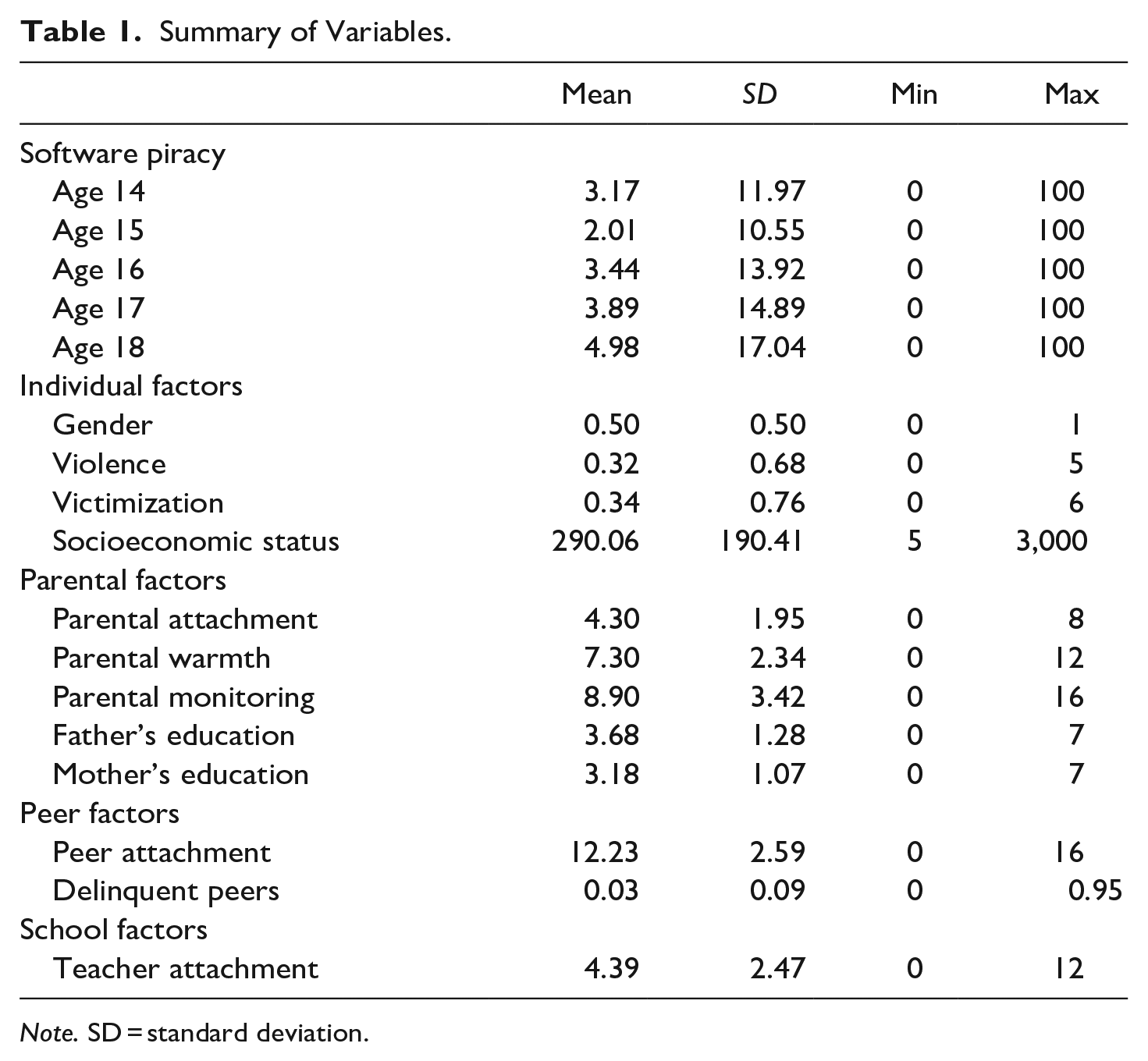
The data used in this study were obtained from the Korean Youth Panel Survey (KYPS), a nationally representative, long-term sample of Korean adolescents. The National Youth Policy Institute, a government research organization, designed the survey using a stratified, multi-stage cluster sampling method and oversaw data collection. Adolescents and their parents were surveyed through self-report questionnaires and telephone surveys, respectively. The data collection started in 2003 when the participants were in their second year of middle school (equivalent to eighth grade in the U.S.; age 14) and continued annually until 2008 (age 19), with an overall retention rate of 80%. This study utilizes the first five waves, when the respondents were in junior high and high school (N = 2,721). The sample consisted of an equal representation of both boys and girls (50% each) with no ethnic diversity (Table 1). The average monthly household income was about 290 (approximately $2,200 in U.S. currency), and the average parental education was high school graduation for both the father and mother.
Summary of Variables.
Note. SD = standard deviation.
Measures
Dependent Variable
Software piracy was estimated using a single item that asked participants “How many times have you used illegal/unauthorized software downloaded from the internet during the last year?” (Ding et al., 2020; Udris, 2017).
Individual Factors
Gender was determined based on self-identification, with female coded as 0 and male coded as 1. Violence was measured by the sum of five questions (assault, threatening others, robbery, bullying, and a gang fight).Victimization was assessed by summing six questions (e.g., being threatened, bullied, seriously beaten up, robbed, sexually assaulted, and seriously teased). The measures of violence and victimization used a variety scale, with a score of 0 indicating that the respondent did not engage in any violence or did not experience any victimization, respectively. Socioeconomic status was determined using a single item about the monthly family income accumulated.
Parental Factors
A measure of parental attachment was comprised of the sum of two questions (α = .723) (e.g., “I am comfortable sharing my thoughts and feelings with my parents”). Three items were used as a measure of parental warmth (α = .774) (e.g., “My parents always show their affection for me”). Parental monitoring was examined via four questions (α = .844) (e.g., “When I go out, my parents usually know where I am”). A 5-point Likert-type scale was used, with higher values representing greater parental attachment, warmth, and monitoring, respectively. Parental education level represents the highest level of education completed by the father and mother, respectively (0 = no education, 1 = elementary school . . .6 = master’s degree, and 7 = doctoral degree).
Peer Factors
Peer attachment was comprised of combining four items (α = .753) (e.g., “I have candid conversations with my friends”). The measure of delinquent peer association was established through a three-step process. Participants were first asked about the total number of their best friends, and then about the number of those friends who engaged in delinquent behaviors such as drinking alcohol, smoking, truancy, or had engaging in assault, robbery, and larceny. The ratio of delinquent peers was calculated by dividing the number of delinquent friends by the total number of best friends.
School Factors
The sum of three items was used as a measure of teacher attachment (α = .710) (“I can share and discuss my problem with teachers”). A 5-point Likert-type scale was used, with higher values indicating greater teacher attachment.
Analytic Strategy
We used Stata 14 for data analysis, employing the “traj” command to estimate the trajectories of software piracy. The analysis was carried out in four steps. First, descriptive statistics were performed to provide an overview of the variables in this study. In the second stage, group-based trajectory modeling (GBTM) was utilized to identify the diverse pathways of software piracy during mid-to-late adolescence. To select the best-fit model, three estimation criteria are evaluated as suggested by Nagin (2005): (1) determining the optimal number of trajectory groups by comparing Bayesian information criterion (BIC), (2) selecting the best order of polynomials by comparing BIC scores, and (3) assessing the average posterior probabilities (groupAPP; 0.7) and odds of correct classification (OCC; 5) to confirm the chosen model’s validity. Lastly, multinominal logit regression models were used to examine the ability of risk and protective factors to distinguish the software piracy trajectories.
Results
Table 1 summarizes the descriptive statistics of all study variables. Software piracy was estimated annually from ages 14 to 18, with the mean score indicating a general increase. Comparatively, the standard deviation suggests substantial differences in software piracy among South Korean juveniles, indicating diverse expected trajectories. Risk and protective factor predictors were grouped into individual, parental, peer, and school factors. Individual factors included gender, violence, victimization, and socioeconomic status. The study included equal representation of male and female juveniles with generally low levels of violence and victimization. The average household monthly income was about 290 (approximately $2,200 in U.S. currency). Parental factors were assessed for attachment, monitoring, warmth, and education, with the average parental education being between high school graduation and 2-year college. Peer and school factors were measured by delinquent peers, peer attachment, and teacher attachment, respectively, with the average score showing stronger attachment to peers than to teachers in school.
Table 2 summarizes the trajectory groups and diagnostic statistics. The study followed Nagin’s (2005) method and estimated and compared different trajectory group numbers. The BIC scores increased until the 5-group model and decreased for the 6-group model. Group APP (with 0.7 as the cutoff point) and OCC (with 5 as the cutoff point) were used to evaluate group fit and all four models met the criteria. As a result, the 5-group model was chosen as the best-fitting model for software piracy trajectory estimation.
Summary of Software Piracy Trajectory Groups and Diagnostic Statistics.

Note. Group APP = average posterior probabilities; OCC = odds of correct classification.
Figure 1 displays the estimated software piracy trajectories. The largest group was the non-software piracy group, accounting for 62.4% of the sample. The second largest was the low-stable trajectory group, representing about 25% of the sample. The other three groups were smaller and showed unique patterns: 3.8% represented an increasing trajectory, 3.1% demonstrated a decreasing trajectory, and 5.1% appeared to increase until age 16 followed by a decrease (i.e., adolescent peak trajectory).

Trajectories of software piracy.
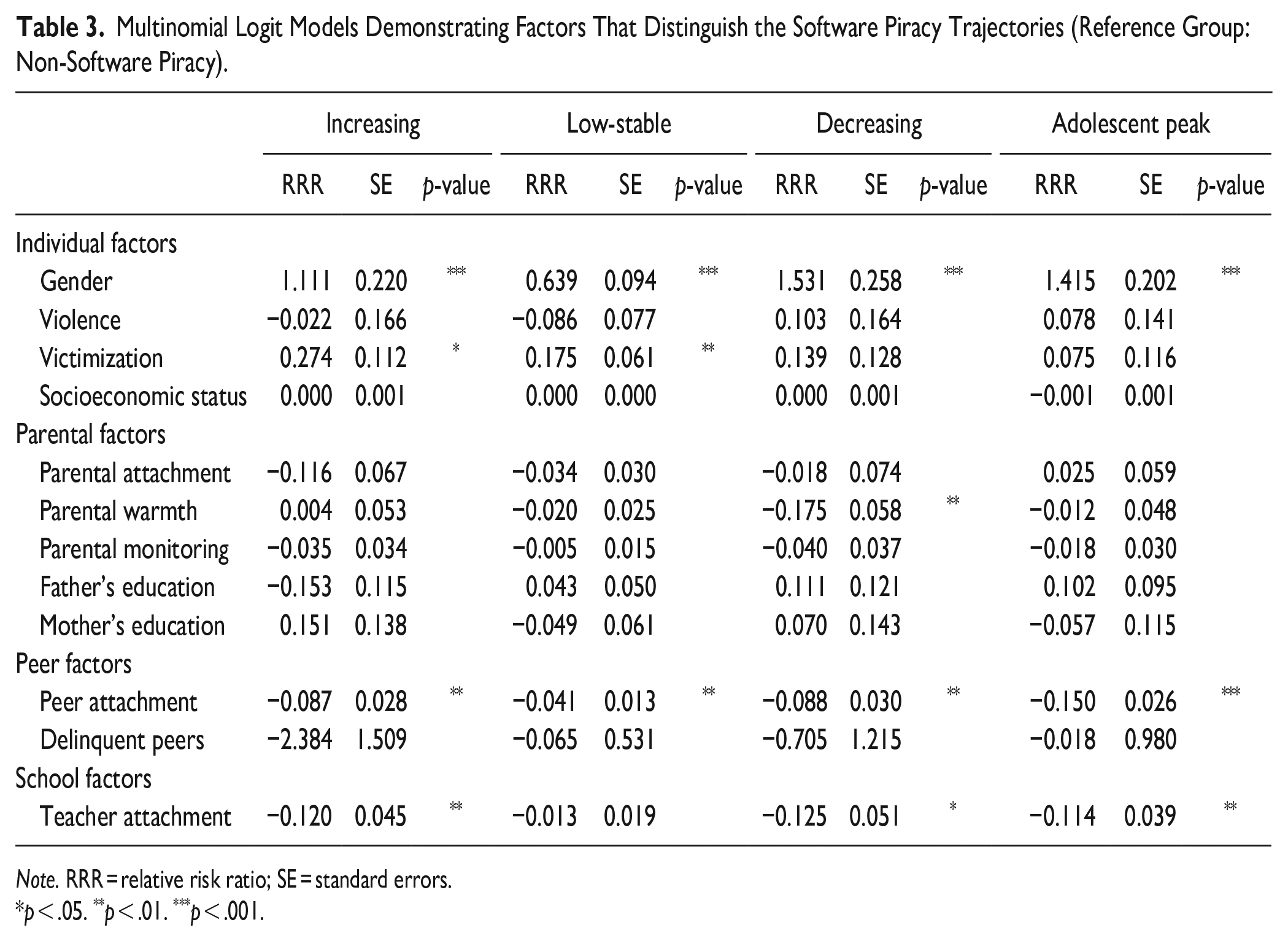
Table 3 summarizes the results of the multinomial logit models that estimate the ability of risk and protective factors to distinguish the software piracy trajectories, with the non-software piracy trajectory as the reference group. Individual factors, such as gender and victimization, were found to be significant discriminators of trajectory group membership. Males were more likely to engage in software piracy in all trajectory comparisons, while victimization was significant for the increasing and low-stable trajectory groups. This suggests that juveniles who experienced victimization were more likely to increase or maintain lower levels of software piracy, compared to the non-software piracy trajectory group. Parental warmth was only significant for the comparison between the decreasing and non-software piracy trajectory groups, indicating that higher levels of parental warmth reduced the likelihood of membership in the decreasing trajectory group. This could also suggest that juveniles with lower parental warmth were already conducting software piracy before age 14. Peer attachment was consistently significant for all trajectory groups, whereas teacher attachment was significant for all trajectory groups except the low-stable trajectory group.
Multinomial Logit Models Demonstrating Factors That Distinguish the Software Piracy Trajectories (Reference Group: Non-Software Piracy).
Note. RRR = relative risk ratio; SE = standard errors.
p < .05. **p < .01. ***p < .001.
Discussion
The current study sought to provide an examination of the developmental patterning of software piracy among South Korean youth from mid-to-late adolescence, and to attempt to discern what risk and protective factors may serve to significantly distinguish the developmental trajectories of software piracy. Several important findings emerged, and these are summarized below.
In the aggregate, engagement in software piracy generally increases over time among youth as they enter their high school years. Yet, there are discernable group-based trajectory differences that can be observed among those who participate in software piracy. While the majority of the cybercrime offenders are classified in a low-stable trajectory, there are several smaller trajectories that exhibit high rates of software piracy but different patterns over time (i.e., increasing, decreasing, adolescent peak). These findings align with previous research on heterogeneous groups in traditional offending. The observed diverse developmental trajectories among these groups indicate variations in etiology and underlying mechanisms. Overall, these results underscore the importance of adopting a developmental perspective and employing an individual-level approach to gain a more comprehensive understanding of software piracy.
Moreover, a host of risk and protective factors for several domains demonstrated varying degrees of ability to significantly distinguish the software piracy trajectories. Consistent with prior research (Hinduja, 2007; J. E. Kim & Kim, 2015; Moon et al., 2013; Navarro et al., 2014; Tomczyk, 2019; Udris, 2017), gender (being male) was a robust factor for increasing the likelihood of classification to any of the offending trajectories relative to the non-software piracy trajectory. Parental warmth was a protective factor from an adolescent peak trajectory (Kokkinos et al., 2016; Kong & Lim, 2012; Udris, 2016). Finally, peer and teacher attachment were similarly consistent factors for discriminating the software piracy trajectories, which is consistent with prior research documenting their protective effects for cybercrime (J. Kim et al., 2017; Wright et al., 2021; Yoo, 2022). These findings demonstrate the relevance and applicability of traditional criminological theories. Also, utilizing the predictors across multiple domains allows us to examine the distinctive influences of each risk and protective factors on different developmental trajectories of software piracy. This advancement in our understanding goes beyond the scope of demographic variables, allowing for a more comprehensive analysis of the phenomenon.
These results have many relevant policy and theoretical implications. For instance, the dynamic shifts in software piracy patterns during adolescence underscores the need for early intervention to prevent the initiation and escalation of such behavior. Also, the risk and protective factors identified in this study as significant discriminators of software piracy trajectories (i.e., gender, victimization, parental warmth, peer attachment, teacher attachment) should be among those focused on in at-home, in-school, community-based, and virtual cybersecurity awareness and prevention programing. Specifically, more attentions should be directed toward boys and individuals who have been subjected to criminal victimization, with the aim of implementing proactive prevention measures and timely interventions. Recognizing the deterrent effects of prosocial interactions, school-based programs that adopt a social-cognitive approach may prove beneficial. These programs should emphasize the roles of peers and teachers, enlightening participants about the adverse consequences of engaging in software piracy while concurrently enhancing their interpersonal skills. Additionally, it is crucial to enhance supervision by competent guardians. This can be accomplished through comprehensive training programs for parents and teachers alike, empowering them with the necessary skills and knowledge to effectively oversee and guide adolescents’ online activities. Furthermore, risky lifestyles or life-style exposure theory has been described as a particularly relevant theoretical perspective for cybercrime prevention (Holt & Bossler, 2014; Reyns, 2010). Risky activities in the cybercrime world involves activities such as downloading free games, clicking links in pop-ups, accessing free software, phishing, online shopping etc. (Choi, 2008; De Kimpe et al., 2018; Ngo & Paternoster, 2011). Software piracy is a specific type of online offending that directly and indirectly exposes an individual to potential online victimization for the reasons described above. Therefore, prevention programs that acknowledge the victim-offender overlap (W. G. Jennings et al., 2012) and that target cybercrime offending and victimization through target hardening and reducing risky life-style exposures in the online environment can serve to address a host of bad outcomes associated with improper or deviant online activity.
This study is not without limitations. First, although this study is longitudinal in nature it is confined to one developmental phase of the life-course, that is, mid-to-late adolescence. Future research should extend this research into emerging adulthood and adulthood when the data permit as online activities and exposures may likely vary over age and opportunity structures that change over time. Second, this is a sample of South Korean adolescents, and as such the degree to which these results may replicate in other non-Western countries is open for future inquiry. Relatedly, although South Korea has consistently ranked as the global leader in internet accessibility since 2001 (Organisation for Economic Co-operation and Development, 2023), further studies are needed to extrapolate the current findings. These studies should encompass diverse samples and incorporate data reflecting varying internet access rates. Third, software piracy was measured using a single measure that asked about frequency during the past year. This poses a potential issue for generalizing the study findings since it limits capturing the comprehensive features of software piracy. Future studies are suggested to adopt multiple measures of software piracy, specifying software types and information on download locations. Fourth, the current study relies on self-reports from juveniles. This means the provided information on software piracy might not be perfect, as individuals may not be fully aware of software piracy or may intentionally conceal their behaviors. Future studies should incorporate official reports or employ the randomized response technique to address bias in self-completed surveys (Chavarria et al., 2016). Fifth, while this study incorporated risk and protective factors from various domains, there are still others (environmental, cultural, etc.) that may play some role in distinguishing software piracy trajectories. Research going forward should attempt to incorporate these risk and protective factors when they are able alongside those examined here. Ultimately, the current study provided an investigation into the developmental pattern of software piracy, produced findings supporting the notion that engagement in software piracy can be classified into distinct trajectories, and demonstrated that various risk and protective factors are useful as defining features of trajectory group membership, all of which have implications for policy and prevention.
Footnotes
Declaration of Conflicting Interests
The author(s) declared no potential conflicts of interest with respect to the research, authorship, and/or publication of this article.
Funding
The author(s) received no financial support for the research, authorship, and/or publication of this article.
