






Abstract
This study followed recent studies venturing into a victimological path of sexual homicide research. In doing so, it aimed to identify possible distinct overarching groups of victims. A latent class analysis based on statistically significant differences in a census of 107 cases in Israel during 71 years (1948–2019) involving four identified groups of victims suggested a typology of two overarching groups of victims: nonmarginalized victims composed of children and women and socially marginalized or stigmatized victims composed of sex workers and gay men. These two overarching groups of victims display distinct patterns regarding victims, offenders, and modus operandi. Future research and policy recommendations are proposed in line with this study’s observations.
Keywords
This study followed recent studies venturing into a victimological path of sexual homicide research. In doing so, it aimed to contribute to current knowledge on sexual homicide victims by identifying distinct overarching groups of victims. The paper begins with a literature review on sexual homicide and victims, followed by a presentation of the research method and findings. Extrapolating empirical observations from latent class analysis (LCA), the paper conceptualizes findings pertaining to two overarching groups of sexual homicide victims displaying distinct characteristics of victims, offenders, and modus operandi. Limitations of this study and directions for future studies are suggested in the conclusion.
Sexual Homicide
Sexual homicide appears to have various concurring labels, among them “sexual murder,” “lust murder,” “lust killing,” and “sadistic lust murder”—all describing a homicide subtype that combines an ingrained sexual element (Beech et al., 2005; Burgess et al., 1986; Chan & Heide, 2009; Greenall, 2012; Holmes & Holmes, 2001; Schlesinger, 2007). The killing may have an overtly sexual element such as vaginal penetration or assault against the breasts, or the sexual element might not always be discernible or clearly indicated in the scene, as in cases of masturbation, erotic arousal, or disrobing or sexually positioning of the victim (Clarke & Carter, 2000; Gacono & Meloy, 1994; Meloy, 2000; Myers et al., 2006; Salfati et al., 2008). Studies examining sexual killers noted such offenders are a distinct type of offender (Chopin & Beauregard, 2019b) with a tendency toward comorbid schizoid, borderline, and antisocial personality disorders (Beaureguard & Delisi, 2021). Such killers display an antisocial orientation and closer affinity with murderers rather than sex offenders (Beauregard et al., 2018; Greenall & Wright, 2015; Sewall et al., 2013). This proclivity for sexual killing does not seem to stem from childhood victimization experiences, but rather their adoption of various problematic behaviors in childhood (Beauregard & Delisi, 2018).
Sexual Homicide Victims
A surge of studies on sexual homicide victims has occurred in recent years (e.g., Beauregard et al., 2022; Beauregard & Martineau, 2015; Chopin & Beauregard, 2019a, 2021a, 2021b), identifying five main groups of victims who seem predisposed to sexual homicide: children (Hickey, 2002), adult women (Ressler, Burgess, Douglas, et al., 1986; Ressler, Burgess, Hartman, et al., 1986), adult men (Beauregard & Proulx, 2007; Geberth, 1996), older women (Safarik et al., 2002), and sex workers (Salfati, 2013; Salfati et al., 2008; Salfati & Sorochinski, 2018, 2019, 2021; Sorochinski & Salfati, 2019).
Overall, studies have noted that adult victims who are smaller and easier to control in terms of size and weight seem to be more attractive to sexual killers (Beauregard & Martineau, 2015). Additional observations indicated that sexual killers of children, men, and older women tend to be strangers, whereas killers of women tend to be acquaintances (Beauregard et al., 2008; Chan & Heide, 2009). Mixed findings have been reported with regard to child victims (Page et al., 2023), although common observations were noted regarding crime scene, with children typically being targeted in public places and older women and men being targeted mainly at their home (Beauregard et al., 2008; Drake, 1999; Safarik et al., 2002).
Unique sexual homicide characteristics have been noted among distinct groups of victims. For example, killers of older women were reported to be younger and of different ethnic groups than the victim (Safarik et al., 2000, 2002). Sexual gratification combined with poor social and interpersonal skills were observed in killings of more vulnerable victims such as children (Beauregard et al., 2008; Hickey, 2002). Killers tend to use manual strangulation to kill children and weapons to overcome stronger victims, such as men (Beauregard & Proulx, 2007; Beauregard et al., 2008). Insertion of foreign objects during or after the crime was correlated with victims who used alcohol or drugs prior to their killing (Beauregard et al., 2022).
However, exploration of possible correlations between groups of victims and distinct manifestations and patterns of sexual homicide across groups of victims is still needed (Chan & Heide, 2009). This study aimed to contribute to further understanding sexual homicide by identifying overarching groups of victims using LCA. So far, LCA regarding sexual homicide has been conducted to identify patterns in offense type (Balemba et al., 2014) and overkilling (Chopin & Beauregard, 2021b). LCA has been conducted regarding sexual homicide victims, too. In that line, Chopin and Beauregard (2019a) reported six distinct offense patterns among child victims and four motivation-driven sexual homicide patterns among older victims. However, overarching groups of victims have yet to be identified. This study endeavored to identify overarching groups of victims with distinct patterns of sexual homicide in five groups of victims already identified in prior studies: children (aged 1–14), women (aged 15–59; Corradi et al., 2017), older women (aged 60–99), sex workers, and men (aged 15–99 years). Consequently, this research’s questions were:
RQ1: Are there any latent overarching groups of sexual homicide victims?
RQ2: In what ways do these overarching groups of victims differ from one another?
Method
The study analyzed patterns of sexual homicide from the establishment of Israel in May 1948 until May 2019. The long span of the study was dictated by the relative rarity of the phenomenon. Due to the lack of relevant data, the study excluded cases in the West Bank, Gaza, and East Jerusalem. The study included 110 cases, confirmed either by police (through media coverage) or legal databases.
Sample Description
The population of Israel, excluding the West Bank, Gaza, and East Jerusalem, was 9.3 million people at the end of 2022 (Bodas et al., 2022). The Jewish majority composes 80% of the total population, whereas the non-Jewish minority, mostly Arab Muslims, accounts for 20%. Since the 1990s, the Israeli Jewish population has been divided into three main social groups: veteran (native-born) Israeli Jews, immigrants from the former Soviet Union (comprising around 10% of the total population), and immigrants from Ethiopia (representing approximately 2% of the total population). The Jewish population in Israel is known for being highly educated, with nearly half of Israeli Jews holding postsecondary degrees (Al Haj, 1995). In recent years, Israel’s high-tech industry has seen rapid growth, and more than 25% of the industrial workforce is now employed in high-tech manufacturing (Baram & Ben-Israel, 2019). Since the founding of Israel, the Muslim Arab population has increased to become a critical minority in Israel. This is the result of a high fertility rate combined with decreased disease and mortality rates (Landau, 1993). According to Al Haj (1995), Arab society in Israel, including the Muslim subgroup, has undergone significant changes in different areas, of which education is probably the most salient. The illiteracy rate among Arabs has decreased rapidly, along with a steady increase in tertiary education (Al Haj, 1995).
Sexual Homicide Definition
Sexual homicide cases included in this research were completed offences, excluding attempts that did not culminate in the killing of the victim. All killings included in this study involved a sexual element (i.e., the crime was sexually motivated, had a sexual element, or featured evidence of sexual activity). To operationalize sexual homicide, this study used the definition outlined by Mjanes et al. (2017). Therefore, each case had to include at least one of the following aspects: (a) the victim’s lack of attire; (b) exposure of the sexual parts of the victim’s body; (c) sexual positioning of the victim’s body; (d) insertion of foreign objects into the victim’s body cavities; (e) evidence of sexual intercourse; or (f) evidence of substitute sexual activity, interest, or sadistic fantasy. The study included the homicide of sex workers only if the killing had one of these sexual aspects. This is because although scholars have assumed that the murder of a sex worker is a sexually motivated offense, this may not always be the case (Salfati et al., 2008). Thus, although acknowledging a possible symbolic sexual element in the killing of sex workers, these homicides were included only if they were targeted in relation to their sexual occupation (based on the offender’s confession) and not killed for example, in relation to a nonsexual crime such as robbery.
Variables
Eleven sociodemographic variables were coded in each case. Seven variables pertained to the victims: group (women, children, sex workers, gay men); age (1–14, 15–30, 31–45, and 61+ years); gender (men, women), ethnic background (Jewish, Arab, foreigner neither Jewish nor Arab); marital status (single, married, or cohabitator); engagement in substance abuse (yes, no); and reported as a missing person (yes, no). In addition, four variables were coded for offenders: gender (men, women), ethnic background (Jewish, Arab, foreigner neither Jewish nor Arab); engagement in the sex industry (yes, no); and victim–offender relations (stranger, habitual consensual sex, acquaintance or family member, cohabiting partner, pimp, or client). Ten variables were coded pertaining to modus operandi: killing scene (victim’s home or workplace, remote place, nearby place, victim’s family home); killing weapon (manual, nonmanual), whether the victim was alone at the time of killing (yes, no), whether the victim was on the way to a certain destination (yes, no), whether the offender acted alone or with accomplices (yes, no), motive for killing (victim’s refusal to have sex, resentment of victim’s sexual identity or occupation, suspicion of victim’s infidelity, domestic violence, financial dispute, escalating argument during sex, offender’s mental problems, while committing another crime, victim’s response to offender’s attack, killing as an act of terror, victim’s wish to separate from offender, and alleged breach of family honor); timing of the killing in relation to the sexual act (after sexual act, during sexual act, no sexual act occurred, before sexual act); additional crimes perpetrated against the victim (none, theft or robbery, kidnapping, arson, and attacking or killing additional victims); who reported the victim’s body (neighbor or passerby, rescue or police forces, family members, killer [in confession to law enforcement]); and whether the offender engaged in precautionary behavior at the killing scene (none, disposal of victim’s body [through burial], tampering with evidence, cleaning the scene or weapon, and relocating victim’s body). Altogether, the study collected and coded 21 variables.
Data Collection
The research methodology involved archival data analysis of legal files used as a database for killings bearing a sexual element. In addition, in cases wherein the offenders were not found or criminally charged, media coverage was used. Additional sociodemographic and criminological variables were collected by extracting missing data from official government publications such as police records, when obtainable, and from media coverage and the internet. Media surveillance has been accepted as a valid methodology in homicide research when official data are scarce or unavailable (Adinkrah, 2014, p. 372; Warren-Gordon et al., 2010, p. 1594). To maximize the reliability of the information acquired, each case required a minimum number of three independent sources: either data covered by all three main newspapers in Israel—Haaretz (1919–present), Yedioth Ahronoth (1939–present), and Maariv (1948–2014; known as Maariv Hashavua from 2014–present)—or data from two of these main newspapers and a legal database.
Each case file, which was the unit of analysis, was reviewed and coded independently by the author and a PhD research assistant using data abstraction Excel tables. To check interpretations of data, a randomly selected subsample of about 25% of the data was tested for intercoder reliability resulting with an average coder agreement of 83%. Results were discussed and differences in coding were resolved accordingly. Due to the small number of older women victims in this sample (n = 4), they were not considered as a separate group but rather included in the women’s group. In addition, due to the small number of heterosexual men (n = 3) and for statistical reasons, they were excluded from statistical analyses.
Statistical Analysis
Descriptive statistics were conducted for the sample of 107 cases and comparative analysis by groups of victims—children, adult women, sex workers, and gay men—were conducted with a significance level of p < .05. Due to the number of comparisons, Bonferroni’s correction was used to determine significant findings: For chi-square tests, the Bonferroni-corrected p-value is p ≤ .006 for 4 × 2 comparisons, p ≤ .004 for 4 × 3 comparisons, p ≤ .003 for 4 × 4 comparisons, p ≤ .0025 for 4 × 5 comparisons, and p ≤ .0001 for 4 × 13 comparisons.
Following descriptive and comparative statistics and based on significant differences in the comparative analysis between the four identified victim groups, LCA was conducted to detect latent classification in the overall sample of sexual homicide victims (Hagenaars & McCutcheon, 2002; Weller et al., 2020) and identify qualitatively different victim groups. LCA is the best option to derive information from data about overarching clusters (Balemba et al., 2014), aiming to inform researchers, police, and policymakers about sexual homicide victims encountered most often in practice.
The LCA was conducted with the overall sample size of 107 cases, using SAS version 9.4. The LCA was based on six indicator variables (collapsing multiple response options into two or three categories): victim–offender relationship was measured as either stranger or acquaintance, with the latter constituting victims whose killers were pimps, sex clients, intimate partners, consensual sexual partners, acquaintances, or family members. Whether the victim was on the way to a certain destination was measured dichotomously. The crime scene was coded as a remote place; the victim’s home or workplace; or the victim’s family home, public place, nearby place, or unknown place (coded as other). Motive was coded as due to (a) the victim’s refusal to have sex versus (b) suspecting the victim’s infidelity, while committing another crime, during an escalating argument during sex (unrelated to sex), the victim’s response to a physical attack, as an act of terror, resenting the victim’s sexual identity, the victim’s wish to separate from the killer, domestic violence, an alleged breach of family honor or a financial dispute, the offender’s mental problems, or other (all categories except the first were coded as other). The murder weapon was measured as manual (such as strangulation) and nonmanual for all others (such as knife or firearm). Additional crimes were measured, with no additional crimes coded as none, theft or robbery coded as theft or robbery, and arson, kidnapping, or killing or attacking additional victims coded as other.
Results
The sample included two cases of serial killing, both perpetrated by Jewish offenders. In one case, the offender killed a women and a sex worker by sexually attacking them and setting their bodies on fire, starting at their vagina. In the other case, the offender killed four sex workers due to resentment of their sexual occupation by setting their workplace on fire. Additional serial killings are possible but have yet to be identified by law enforcement.
Victim Demographics
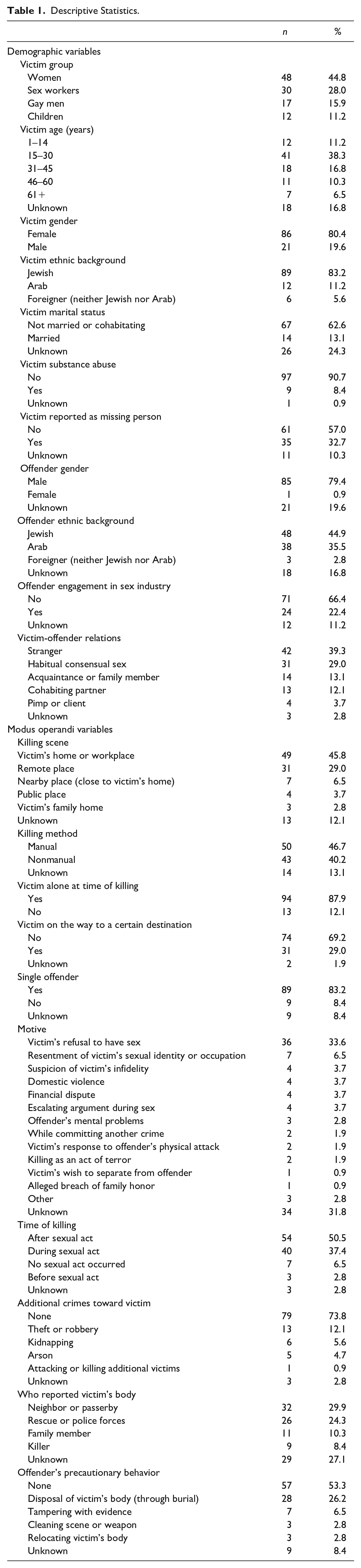
As Table 1 demonstrates, overall, most victims were female (either women or girls) of Jewish ethnic background (80.4%, n = 86; 83.2%, n = 89, respectively). When classified along the four mutually exclusive groups of victims, women represented the largest share (44.8%, n = 48), sex workers had the second highest share (28.0%, n = 30), gay men had the third highest share (15.9%, n = 17), and children (up to age 15 years) had the lowest share (11.2%, n = 12). Most victims did not engage in substance abuse (90.7%, n = 97) and were not married or cohabitating (62.6%, n = 67) at the time of their killing.
Descriptive Statistics.
Offender Demographics
Most offenders were men (79.4%, n = 85), and about half being of Jewish ethnic background (44.9%, n = 48). About a fifth of offenders (22.4%, n = 24) were engaged in the sex industry either as pimps or clients. The most common victim–offender relation was that of strangers (39.3%, n = 42) and second most common was of habitual consensual sex (29.0%, n = 31).
Modus Operandi
The victim’s home or workplace was the most common killing scene (45.8%, n = 49), with offenders using manual (46.7%, n = 50) or nonmanual (40.2%, n = 43) methods. The victims were most likely to be alone at the time of killing (87.9%, n = 94) and were on the way to a certain destination only in about a third of the cases (29.0%, n = 31). Offenders were most likely to act alone (83.2%, n = 89) than with accomplices (8.4%, n = 9), and the most common motive for killing was the victim’s refusal to have sex (33.6%, n = 36). Most victims were killed either after (50.5%, n = 54) or during (37.4%, n = 40) the sexual act, and in most cases, no additional crimes were perpetrated against the victims (73.8%, n = 79). In about half of the cases, the victim’s body was reported either by neighbors or passersby (29.9%, n = 32) or rescue or police forces (24.3%, n = 26). In addition, in about half of the cases, the offenders did not engage in precautionary behavior at the killing scene (53.3%, n = 57).
Comparative analysis of the four groups of victims—women (n = 48), children (up to 15 years old; n = 12), sex workers (n = 30), and gay men (n = 17)—as demonstrated in Table 2, yielded statistically significant differences. In terms of sociodemographic variables, offenders’ engagement in the sex industry as either pimps or clients was not noted among children and women (0.0%, n = 0 each), yet more likely among sex workers (69.2%, n = 18) and gay men (66.7%, n = 6; χ2 = 55.074, p < .006). Children (66.7%, n = 8) and women (50.0%, n = 23) victims were reported as missing persons more often than sex workers (4.0%, n = 1) and gay men (23.1%, n = 3; χ2 = 20.742, p < .006). Significant differences were also noted regarding victim–offender relations: Children were more likely to be killed by strangers (75.0%, n = 9), whereas gay men were more likely to be killed by habitual sex partners (82.4%, n = 14; χ2 = 65.100, p < .0025).
Sexual Homicide by Victim Groups.

Excluding missing values in variables.
p < .006. <.003, or <.0025, based on Bonferroni correction.
Significant differences among the four groups of victims were noted regarding modus operandi. Offenders were more likely to kill victims on their way to a certain destination when the victims were children (58.3%, n = 7) or women (50.0%, n = 24) than when victims were gay men or sex workers (0.0%, n = 0 each; χ2 = 33.310, p < .006). Offenders were more likely to opt for remote places as crime scenes when victims were children (66.7%, n = 8) or women (45.0%, n = 18) than when victims were sex workers (16.0%, n = 4) or gay men (5.9%, n = 1; χ2 = 40.002, p < .0025). Victims who were sex workers (80.0%, n = 20) or gay men (94.1%, n = 16) were most likely to be killed in either at their home or workplace (χ2 = 40.002, p < .0025). Whereas children (75.0%, n = 9), sex workers (48.3%, n = 14), and gay men (70.6%, n = 12) were more likely to be killed after the sexual act, women were less likely be killed after the sexual act (41.3%, n = 19) and slightly more likely to be killed during the sexual act (54.3%, n = 25; χ2 = 28.251, p < .003).
In addition, children (100.0%, n = 12), women (91.7%, n = 44), and gay men (100.0%, n = 17) tended to be alone at the time of their killing, compared to sex workers (70.0%, n = 21, χ2 = 13.622, p < .003). Single offenders were more common among killings of children (91.7%, n = 11), women (100.0%, n = 44), and sex workers (88.0%, n = 22) than gay men (70.6%, n = 12; χ2 = 13.038, p < .005). In addition, offenders were less likely to refrain from perpetrating additional crimes when victims were sex workers (64.3%, n = 18) or gay men (41.2%, n = 7) than when victims were children (83.3%, n = 10) or women (93.6%, n = 44; χ2 = 56.114, p < .0025). Offenders were more likely to engage in precautionary behavior by burying the victim’s body when the victims were children (58.3%, n = 7) than when the victims were women (31.8%, n = 14), sex workers (24.0%, n = 6), or gay men (5.9%, n = 1; χ2 = 31.341, p < .0025).
Given that no prior studies had identified overarching groups of sexual homicide victims, this LCA was of an exploratory nature and tested the classification of cases in two possible overarching groups. Due to the presence of missing values in the data, a missing completely at random test was applied and the assumption was not rejected, with a G-squared value of 101.92 and degrees of freedom of 352 (p > .05). Therefore, all observations, including those with missing values, were included in the LCA. A two-cluster and three-cluster model seemed equally appropriate statistically (AIC = 110.73, BIC = 156.17; AIC = 99.89, BIC = 169.38, respectively). However, the two-cluster model was theoretically more appropriate in terms of clear cluster classification.
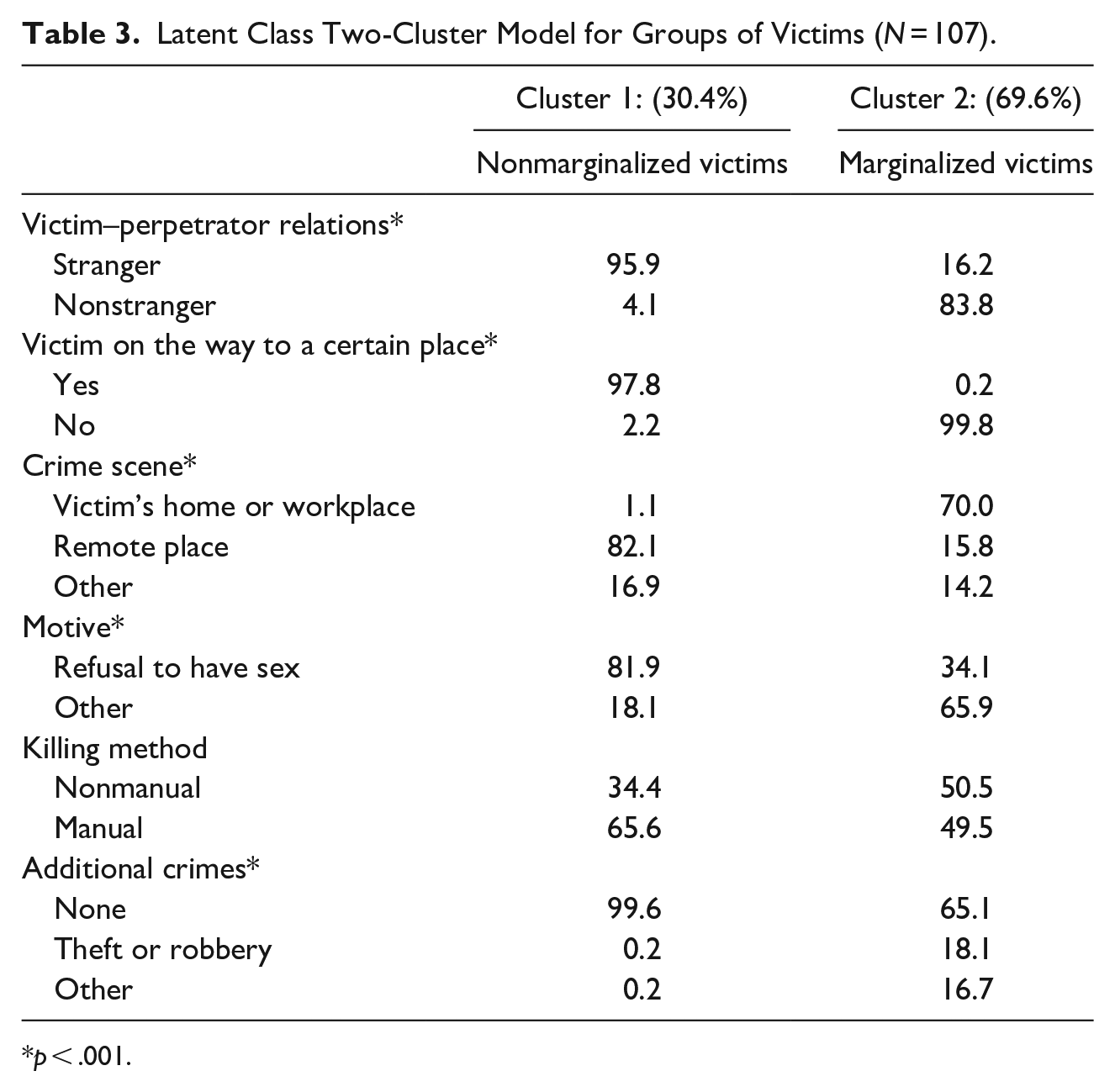
Table 3 presents the LCA results regarding two overarching clusters. The first cluster within the sample is the marginalized group of victims (69.6% of the sample). This cluster involved homicides that were likely to be perpetrated by killers who were acquainted with the victim (83.8%). Victims in this cluster were more likely to be targeted in their home or workplace (70.0%). In addition, these sexual homicides were often perpetrated for reasons unrelated to the victim’s refusal to have sex (65.9%). Offenders tended to use both manual (50.5%) and nonmanual weapons (49.5%) and were less likely to refrain from perpetrating additional crimes against such victims (65.1%).
Latent Class Two-Cluster Model for Groups of Victims (N = 107).
p < .001.
The second cluster that emerged from the sample is the nonmarginalized group of victims (34.4% of the sample), involving a very different type of sexual homicide. Sexual homicides in this cluster are most distinguished by the high likelihood of the offender being a stranger (95.9%) and the killing motive being the victim’s refusal of sex (81.9%). The offenders who committed these killings targeted victims who were on their way to a certain destination (97.8%), tended to choose remote places as the killing scene (82.1%), and were slightly more likely to use manual methods such as strangulation (65.6%). In addition, offenders were most likely to refrain from perpetrating additional crimes toward the victims (99.6%).
Discussion
A general observation pertaining to sex and gender is noteworthy. Although men and women may be victims of sexual homicide, with women being the overwhelming majority of victims, it seems that not all men are prone to sexual homicide victimization. Rather, vulnerable types of men seem to be more prone to being victims of sexual homicide: boys (nonmarginalized) and gay men (socially marginalized or stigmatized).
The fact that the groups of victims in this study (children, women, sex workers, and gay men) belong to vulnerable groups (Beauregard & Proulx, 2007; Hickey, 2002; Safarik et al., 2002; Salfati et al., 2008) may explain how their social or physiological vulnerability made them susceptible to homicide. However, despite shared characteristics that predisposed them to crime, these victims were not a homogenous group, nor did they experience one typical form of sexual homicide. The LCA conducted in this research supported the existence of two overarching groups of sexual homicide victims bearing distinct characteristics of both offender and offense: nonmarginalized victims composed of children and women and marginalized victims composed of sex workers and gay men.
Nonmarginalized victims were likely to be targeted by strangers on the way to a certain destination in remote places for reasons of sexual gratification. These victims more likely to be killed with no additional crimes perpetrated. Contrary to the characteristics of this group’s victims, different characteristics of sexual homicide were noted regarding the marginalized group of victims. These victims were typically killed by acquaintances for reasons unrelated to their refusal to have sex. Offenders of such victims tended to target them at their home or workplace and commit additional crimes against them. The two overarching groups of victims and how they differ are graphically demonstrated in Figure 1.

Sexual homicide by overarching groups of victims.
Although these empirical findings are relatively consistent with previous research, prior reported observations on sexual homicide offenses and offenders seemed to cluster differently, in accord with each overarching group of victims. For example, whereas previous research reported that most sexual homicide killers are strangers (Hickey, 2002), this analysis of the two overarching groups of victims suggests that this is more probable among nonmarginalized victims and less probable among socially marginalized or stigmatized victims.
Furthermore, whereas prior research suggested that sexual killings of sex workers and gay men are perpetrated in remote places (Drake, 1999; Salfati et al., 2008), current findings seem to differ. Remote killing scenes were more probable among nonmarginalized victims than among socially marginalized victims, and the sexual killing of marginalized victims tended to occur in their routine places, either workplace or home.
In addition, although prior literature linked sexual homicide primarily to sexual gratification (Hazelwood & Douglas, 1980; Schlesinger, 2007), this motive seemed to correlate mainly with nonmarginalized victims in the current analysis. The main killing motive among marginalized victims seemed to differ, with motives unrelated to refusal to have sex, such as escalating disputes (Geberth, 2003; Smith et al., 2011; Sorochinski & Salfati, 2019) or catathymia (Schlesinger, 2007).
Conclusion
This study shed light on the phenomenon of sexual homicide by demonstrating the existence of two overarching groups of victims—nonmarginalized victims composed of children and women and socially stigmatized victims composed of sex workers and gay men. The two overarching groups displayed distinct characteristics pertaining to offenders and offenses. The observed overarching groups with their correlating characteristics of victims, offenders, crime scene, and modus operandi may be of assistance to law enforcement investigations, highlighting clues related to the victims’ identity or offenders’ profile that could help police narrow the suspect pool to the most likely subtype of offender. Narrowing the suspect pool can focus the investigation and improve allocation of resources and time to facilitate solvability (Balemba et al., 2014). Sex worker homicides are some of the most difficult cases to solve (Kinnell, 2001) and therefore, the ability to narrow the suspect pool is crucial. In addition, to better protect marginalized populations, the use of urban sociodemographically designated “hot spots” of police surveillance tactics, such as in places where sex workers operate, may reduce sexual homicide among such overarching groups of victims. Surveillance methods such as patrols or cameras, if applied in remote places, may also assist in the prevention of nonmarginalized sexual homicide victims, who as this study showed, are more likely to be killed in remote locales.
This study has limitations. To begin, despite this study being conducted using a nation-based census of cases from a relatively long period of 70 years, it relied on legal files and media coverage, which might have contained biased information despite significant efforts to collect as much information as possible in the most reliable way. Some offender background details may have been affected by what these media sources chose to report or omit; thus, it may be that the true frequencies of some characteristics, such as mental health history or substance abuse, may be higher than what has been recorded here. Therefore, the final results should be interpreted with caution. Future empirical studies with more data from police sources would contribute to validation of these research findings and possible identification of additional latent subgroups of victims. In addition, because statistical analysis requires large samples, this study could not present observations on possible additional subgroups of victims involving heterosexual men, foreigners, and older women, which may display unique forms of sexual homicide or converge with one of the two overarching groups of victims observed in this study. Further studies are required to identify possible additional or alternative overarching groups of sexual homicide victims.
Footnotes
Declaration of Conflicting Interests
The author declared no potential conflicts of interest with respect to the research, authorship, and/or publication of this article.
Funding
The author received no financial support for the research, authorship, and/or publication of this article.
