






Abstract
Gender norms have become a focal point of cultural debate and wedge issues in political elections, leading to discussions on how they may impact political and psychological processes and potentially radicalize individuals who feel threatened by or uncomfortable as the norms shift. We investigated the relationship between beliefs about gender-threatening disinformation narratives and radicalization, and the role of “fragile” masculinity and femininity in this relationship. In an original sample of 1,698 participants, we found that belief in gender-challenging narratives had a direct and positive relationship with radical intentions in men, whereas fragile femininity mediated the relationship between gender identity-challenging narratives and radical intentions. These suggests that threatened gender norms and disinformation are both significant factors in the psychology of radicalization.
In the recent years, political discourse about changing gender norms has grown. Thus, in September 2022, in a televised speech that followed Russia’s large-scale invasion of Ukraine, Russia’s President Vladimir Putin condemned Western values, which “lead to degradation and extinction.” Putin focused specifically on gender roles, asking his Russian audience if they preferred parent №1 and parent №2 instead of mom and dad, and denouncing the West for having “some kind of genders instead of sexes” (Belinger et al., 2022).
Similarly, Italy’s female prime minister Giorgia Meloni lamented the ongoing attack on gender, religious, family, and national identity during her speech at the World Congress of Families in 2019. “I can’t define myself as Italian, as Christian, mother, woman—no! I must be citizen x, gender x, parent 1, parent 2” (Bump, 2022). The video which recirculated after Meloni’s political victory in 2022 was praised among far-right politicians in the U.S. (Harlan, 2022). Sen. Ted Cruz called the speech “spectacular,” and Rep. Marjorie Taylor Greene commented, “beautifully said” (Bump, 2022).
In the U.S., Senator Marsha Blackburn asked Judge Ketanji Brown Jackson to define the word “woman” at Judge Jackson’s confirmation hearing for to the Supreme Court in March 2022 (Bump, 2022). Jackson initially said, “I can’t,” to which Senator Blackburn replied “the fact that you can’t give me a straight answer about something as fundamental as what a woman is underscores the dangers of the kind of progressive education that we are hearing about” (Ward, 2022).
The changes in cultural norms around gender and sexuality have challenged established worldviews. This cultural shift toward evolving gender norms and fluid gender identities contributed to a cultural “unfreezing”—an emotionally tumultuous state were norms and expectations of the past are no longer valid while the new ones have not yet solidified (Ward, 2022). Sizable segments of the society have rejected the changes, at times engaging in political action to undermine and challenge the media that support the shifting gender norms, such as public library offerings, school curricula, pop culture, and even scientific notions (Ankel, 2021). In this context, gender norms have become one of the centerpieces of current cultural debate, and occasionally a rallying cry for political leaders. This paper aims to investigate whether messaging that emphasizes the fluidity of gender and challenges gender roles is related to ideas and intentions that support violence, and whether this relationship depends on the gender of the audience.
Radicalization and Political Violence
Radicalization, broadly defined as the path from normality to committing violent acts, has become an important outcome variable within criminology research, with a focus on understanding the root causes and development of radical behavior (Ahmad & Monaghan, 2019). The causes of radicalization studied by criminologists include factors such as socioeconomic status, educational background, family dynamics, societal influences, mental health conditions, and peer interactions (Lafree et al., 2018). One of the more reliable findings from criminology research is the gender discrepancy in violent crime rates, with women demonstrating lower rates of violent criminal behavior compared to men (Giordano & Copp, 2019; Lafree et al., 2018). In addition, criminology research found that women often need more provocation to commit serious crimes compared to men—for whom violent behavior is more likely to be linked with status frustration (Giordano & Copp, 2019). Other triggers for violent behavior that are more prevalent among women than men include victimization experiences, individual psychological factors, and societal expectations of traditional gender roles, especially caregiving. This gender gap dictates the need for a more nuanced understanding of how different gender-stereotypical factors may contribute to radicalization among men and women.
Similar to the criminology’s findings on gender differences in violent crime, terrorism research also reported consistently different rates of men’s versus women’s involvement in terrorism activity, and different correlates and predictors of their involvement (Bloom, 2012; Brugh et al., 2019; Herschinger, 2014; Ortbals & Poloni-Staudinger, 2018; Phelan, 2023). As with non-political criminal activity, women in terrorism tend to be less engaged with violence (although they play an important and possibly critical role as sources of psychological and logistical support, encouragement, norm maintenance, and conduits of radical values and goals) (Bloom & Lokmanoglu, 2020). It stands to reason, therefore, that political radicalization would manifest differently between men and women especially in the context of gender-norm-challenging narratives.
Recently, and especially in the U.S., the phenomenon of political radicalization has evolved (Moskalenko, 2021), owing to policing efforts as well as to the proliferation of social media: from a small, face-to-face experience heavily influenced by group dynamics to a mass-public experience that takes place largely online, with narratives playing a larger role in radicalization. One such emerging threat is radicalization by disinformation of conspiracy theories that contributed to the violent events of January 6th attempted insurrection in Washington, D.C. as well as to a number of individual violent attacks motivated by QAnon conspiracy theories (Bloom & Moskalenko, 2021; Moskalenko et al., 2023). Another is the misogynous messaging prevalent in the Incel (involuntary celibate) community and in the “manosphere” more generally that have inspired multiple-casualty attacks against women (Moskalenko, González, et al., 2022; Moskalenko, Kates, et al., 2022). Both conspiracy theories of QAnon and misogyny of Incels tout the erosion of traditional gender norms as the cause of many social ills against which they rally, and both call for a forceful re-establishment of traditional gender norms.
Taking together the recent emphasis on gender norms in political rhetoric, as well as the recent trends in radicalization around narratives that highlight threatened gender norms, our goals are to explore the relationship between such messaging and radical intentions. Considering gender differences in violent crime and in political violence, we are particularly interested in gender differences as they relate to radicalization by gender-norm-threatening messaging. Through quantitative data analysis, our research seeks to expand the existing empirical knowledge within the intersection of criminological and psychological research on gender differences when it comes to radicalization.
Gender Norms in Disinformation Narratives
In 2017, a post on an anonymous image board, 4chan, predicted that Hillary Clinton was about to be arrested. That cryptic message that was the first of over 5,000 “Q-drops” that collectively inspired the QAnon phenomenon—an online following numbering in the millions of U.S. adults who believe several conspiracy theories (Moskalenko, Burton, et al., 2023). At the core of these is the idea of a secret global cabal of Satan-worshiping pedophiles that includes prominent U.S. politicians (Bill and Hillary Clinton), multi-millionaires (Bill Gates, George Soros), Hollywood celebrities (Tom Hanks, Lady Gaga, Oprah) and even the Pope (Bloom & Moskalenko, 2021). Prior to the COVID-19 lockdowns, QAnon was a fringe movement with limited appeal; but after 2020 it grew into a cultlike following with millions of believers around the world (Bloom & Moskalenko, 2021). According to public polls by the Institute for the Study of Religion, QAnon followers believe that they are “true American patriots,” and may need to resort to violence to save their country (PRRI Staff, 2022).
Traditional gender norms play an important role in QAnon messaging. For instance, a narrative about kidnapped and tortured children that culminated in the #SaveTheChildren campaign appealed to women, especially white ciswomen, through a meme campaign that portrayed bruised and distressed white children, often muzzled or restrained by non-white male hands (Buntain et al., 2022), which threatened women’s self-perception as effective caretakers and protectors of children (Bloom & Moskalenko, 2022). QAnon’s appeal to women apparently succeeded: women reported stronger beliefs in QAnon narratives than men, and women’s beliefs in a pedophile cabal predicted their radical political intentions as well as support for the January 6th insurrection (Moskalenko, Pavlović, & Burton, 2023). Female QAnon believers were prevalent among insurrectionists storming the Capitol Hill on January 6, 2021, including the two women who died that day: Ashli Babbitt and Rosanne Boyland (Cameron, 2022).
In addition to QAnon conspiracy theories, other disinformation narratives claim that gender boundaries are being intentionally eroded by malevolent actors. For example, the Russian government has been using aggressive anti-LGBTQ rhetoric to define Russia’s national identity in opposition to gender fluidity and sexual minorities (Strand & Svensson, 2021). Through these narratives, the Russian state is portrayed as a savior of traditional values from the “sodomites” of the West (Nastoyascheye Vremya, 2022). One of the main narratives in Russian disinformation campaigns claims that a powerful gay lobby shapes the global agenda and has a total control over the West and specifically the U.S. (Merz, 2021). Russian-backed sources actively spread anti-LGBTQ messaging to motivate Russian men to justify war and violence against Ukrainians, increase their support for Putin’s authoritarian leadership, and give Russian soldiers a sense of superiority over their “emasculated” enemies (Moskalenko & Romanova, 2022).
The Role of Fragile Masculinity/Femininity in Shifting Gender Norms
“Fragile masculinity” or “precarious manhood” refers to the idea that some men see masculinity as tentative rather than stable, in need of assertion and defense, lest one “lose” it and become “less of a man” (DiMuccio & Knowles, 2020, 2021; Vandello et al., 2008). The notion that masculinity can be taken away gives rise to anxiety when masculinity is perceived as threatened, and therefore in need of reassertion. This anxiety in turn results in compensatory beliefs and behaviors designed to restore threatened masculinity (Cheryan et al., 2015; DiMuccio & Knowles, 2020; Vandello et al., 2008). Similarly as “fragile masculinity” captures the perception of a threat to masculine identity, “fragile femininity” refers to the sense of vulnerability or insecurity among women who feel that their feminine identity is uncertain or threatened.
Research found that compensatory beliefs and behaviors related to masculinity threat among men high on fragile masculinity include support for the use of military force (McDermott et al., 2007) and support for war as a solution to political problems (Willer et al., 2013). Additionally, men who score high on precarious manhood expressed more negative views toward homosexuality and more amusement toward sexist and anti-gay humor (O’Connor et al., 2017). In other words, when a man’s fragile masculinity is threatened, one way to remedy the threat is to denounce gender-non-confirming individuals, including LGBTQ: expressing negative views toward them or mocking them.
A study into the psychological mechanisms of fragile masculinity differentiated between an external desire or societal obligation to be masculine and an internal desire to be masculine (Stanaland et al., 2023). The same research argued that the two sources of fragile masculinity resulted in different reactions to threat: men who were extrinsically motivated to be masculine reacted to threats to masculinity through externalized compensatory responses (i.e., aggression, sexism); but men who were intrinsically motivated reacted to threats to masculinity via internalized responses (i.e., anxiety, shame, self-harm).
Empirical studies found a positive correlation between fragile masculinity and political aggression (DiMuccio & Knowles, 2021), including support for policies and political actors who represent masculine values, such as toughness and strength. Consistent with this, online content that presents a threat to masculinity is likely to increase support for violence in the name of a group or a cause (to increase radicalization) for men who are high on precarious manhood (Moskalenko & Romanova, 2022).
Compared to fragile masculinity, “fragile femininity” has been studied far less (Stanaland et al., 2023). This is possibly because prior research did not observe fragile femininity as having effects comparable to those of fragile masculinity (Vandello et al., 2008; Willer et al., 2013). In a seminal study on precarious manhood, Vandello and colleagues (Vandello et al., 2008) argued that women “do not seem to have the same requirements of social proof to achieve and maintain their essential status as women” (p. 1325). They suggested that womanhood “happens” to girls through inevitable biological and physical changes (p. 1325), whereas boys must pass certain milestones to become a man.
One social milestone for women, but not for men, according to these researchers, is a “motherhood mandate” of raising children (Gorman & Fritzsche, 2002). Even though sexual stereotypes are changing, they continue to affect social norms, according to which a good mother either stays at home or “wishes that she did” (Gorman & Fritzsche, 2002); thus, motherhood, more than any other societal role, defines a “real woman” in the eyes of patriarchal society. On the other hand, this concept of manhood is viewed as having a more precarious basis than womanhood; unlike the inalienable essence of motherhood (in the form of procreator), men’s masculinity can be easily lost (Vandello et al., 2008). In sum, prior research suggested that masculinity is perceived by men as more tentative than femininity is perceived by women, that masculinity is more easily threatened and lost, and thus more likely to be guarded and asserted.
However, the rapidly changing social landscape around gender norms suggests that these findings might be outdated and should be revisited. To address this possibility, we aim to explore how messaging that highlights the threat of evolving gender norms affects radicalization of individuals whose fragile masculinity/femininity render them especially vulnerable to such threats.
To summarize, this study seeks to revisit and extend previous research by exploring the psychological role of fragile masculinity and femininity in shaping political beliefs and radical intentions among men and women. We aim to investigate the relationship between political radicalization (support for violence in the name of the cause or group; Moskalenko & McCauley, 2020) and beliefs in gender-threatening disinformation. Specifically, we aim to investigate what role fragile masculinity and femininity play in the relationship between radicalization and gender-threatening disinformation.
Methods
To address our research questions, we conducted an online survey of U.S. citizens. The survey data were collected from August 11 to 13th, 2022.
The study was posted to Prolific, an online participant pool, and required that participants be U.S. citizens over the age of 18. Prolific is like other online participant pools such as MTurk and Crowdflower but it specializes in academic research and requires researchers to compensate participants at least to the equivalent of $9/hour. Prolific allows researchers to select characteristics of participants who are then invited to participate in the study based on pre-collected demographic information. The research project was reviewed and approved by Georgia State University’s Institutional Review Board.
Participants were provided with a brief description of the study and, if they wished to participate, a link which took them to a questionnaire hosted by Google Forms. Participants were informed about a possibility of emotional distress from answering some questions, as well as assured about the anonymity of their responses. They were also reminded that they did not have to respond and could stop or skip questions.
Participants read brief disinformation narratives designed to target either traditional masculine or traditional feminine gender characteristics (below). After reading the disinformation narratives, participants were asked to fill out measures assessing our variables of interest. These included measures of fragile masculinity or femininity (depending on the responder’s gender), and measures of political radicalization. After completing the survey, participants were debriefed about the purpose of the study and the potential exposure to disinformation.
Participants
The final sample included 1,698 participants, with 811 (47.8%) respondents self-identified as female. Typical for online participant pools (Mulder & de Bruijne, 2019), the study participants were relatively young (M = 38.92, SD = 14.02), and educated: almost 70% reporting some college (30%) and bachelor’s degree (40%). The sample was predominantly White (75%), with 48.7% reporting annual income below $40,000, 31.4% reporting income below $80,000, and 19.9% higher than $80,000. To explore differences between men and women in our sample, we further divided our sample into two subsamples, to analyze male (N = 887) and female populations (N = 811) separately.
Measured Variables
The four conspiratorial narratives chosen as stimuli came from real-world disinformation campaigns: two narratives from QAnon, and two from Russian propaganda. By selecting these narratives, we hoped to capture some of the real-world psychological impacts that gender-norm-threatening disinformation may have on its target audiences. The four narratives were selected based on their apparent appeal to either male or female audience in portraying a threat to either male or female gender role. The narratives were matched for length and level of detail.
Beliefs in LGBTQ contagion threat
To analyze how specific conspiracy narratives that hypothetically challenged men’s traditional gender roles related to radicalization among the male subsample, we asked participants how much they believed, on a scale from 1 = “not at all” to 5 = “very much” the narratives about LGBTQ conversion center and about LGBTQ battalions in Ukraine:
Narrative 1: In the Kherson region of Southern Ukraine, Russian troops claim to have discovered a center dedicated to spreading materials to convert people into LGBTQ (Lesbian, Gay, Bisexual, Transsexual or Queer). The center was reportedly funded by NATO and the USA. (Channel 1. Vremya Pokazhet. April 25, 2022).
Narrative 2: Russian state TV says it has discovered an “organization of gays and lesbians” in a building in Mariupol where Ukrainian “nationalist battalions” had been based. It was apparently “funded by USAID” and “virtually under the patronage of the U.S. President and Congress” (Channel 1. Vremya Pokazhet. April 25, 2022).
Familiarity with LGBTQ contagion threat
To assess familiarity with LGBTQ contagion narratives among men, we asked male participants if they were familiar with the above two narratives about LGBTQ conversion and LGBTQ battalions in Ukraine.
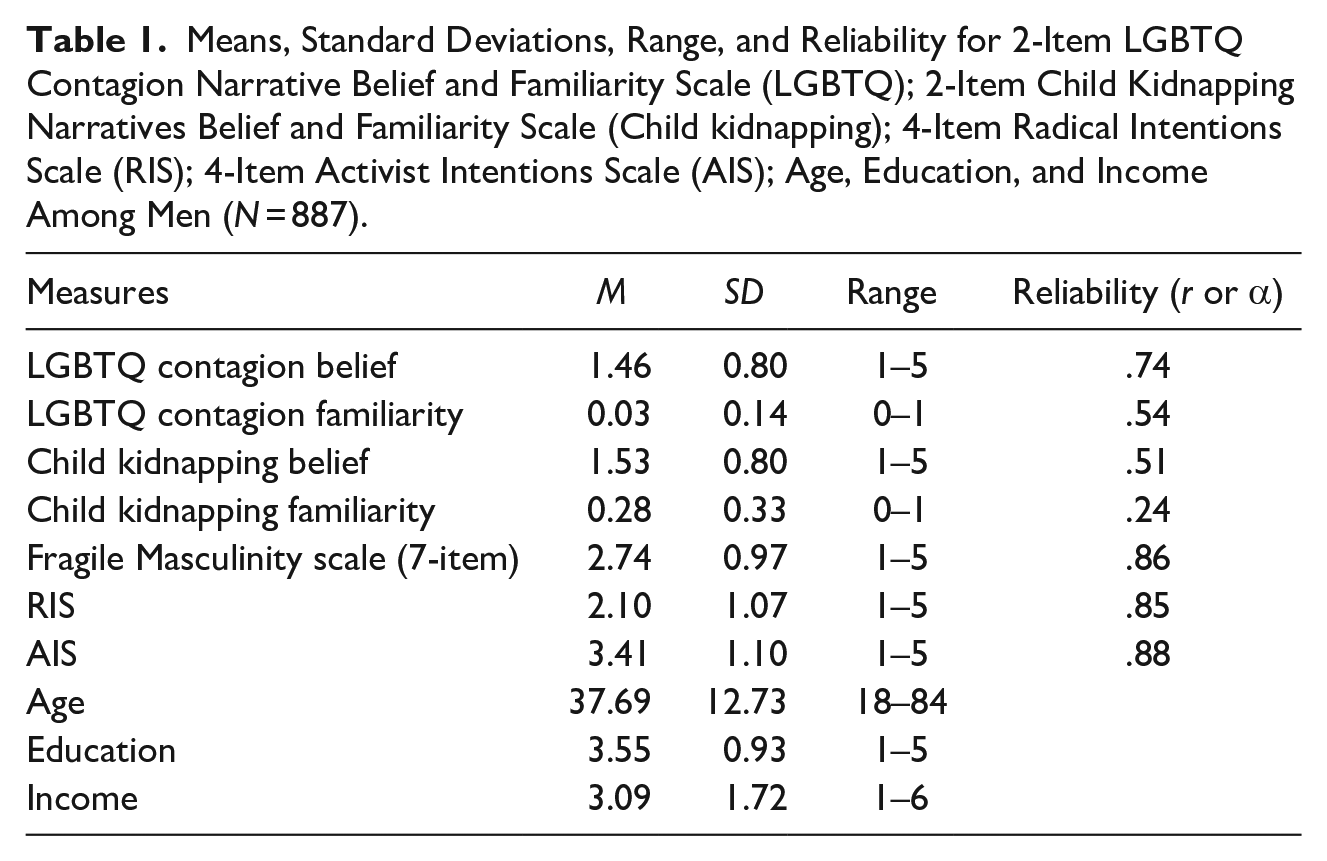
Reported beliefs in Narrative 1 and Narrative 2 were averaged to make up an LGBTQ contagion narrative belief scale. Similarly, familiarity with Narrative 1 and Narrative 2 were also averaged, creating LGBTQ contagion familiarity scale. Table 1 reports Means, Standard Deviations, and correlations for LGBTQ contagion narratives beliefs and familiarity among men.
Means, Standard Deviations, Range, and Reliability for 2-Item LGBTQ Contagion Narrative Belief and Familiarity Scale (LGBTQ); 2-Item Child Kidnapping Narratives Belief and Familiarity Scale (Child kidnapping); 4-Item Radical Intentions Scale (RIS); 4-Item Activist Intentions Scale (AIS); Age, Education, and Income Among Men (N = 887).
Beliefs in child kidnapping narratives
To analyze how specific conspiracy narratives challenging women’s traditional gendered roles were related to radicalization among women in our sample, we asked female participants how much they believed, on a scale from 1 “not at all” to 5 “very much” two narratives about children kidnapping and trafficking.
Narrative 3: A cabal of Satan-worshipping pedophiles that hast taken over the U.S. government and the media is kidnapping and trafficking children for sexual exploitation. The trafficked children are also tortured to harvest from their blood a substance called adrenochrome (Schwarcz, 2022).
Narrative 4: Child traffickers operate covertly, kidnapping children to then use them in child brothels all over the world. These brothels for pedophiles are mainly run by Muslims, whose religion and culture does not prohibit them from having sex with children (Tiffany, 2021).
Familiarity with child kidnapping narratives
To assess familiarity with child kidnapping narratives among women, we asked participants if they were familiar with two narratives about children kidnapping and trafficking.
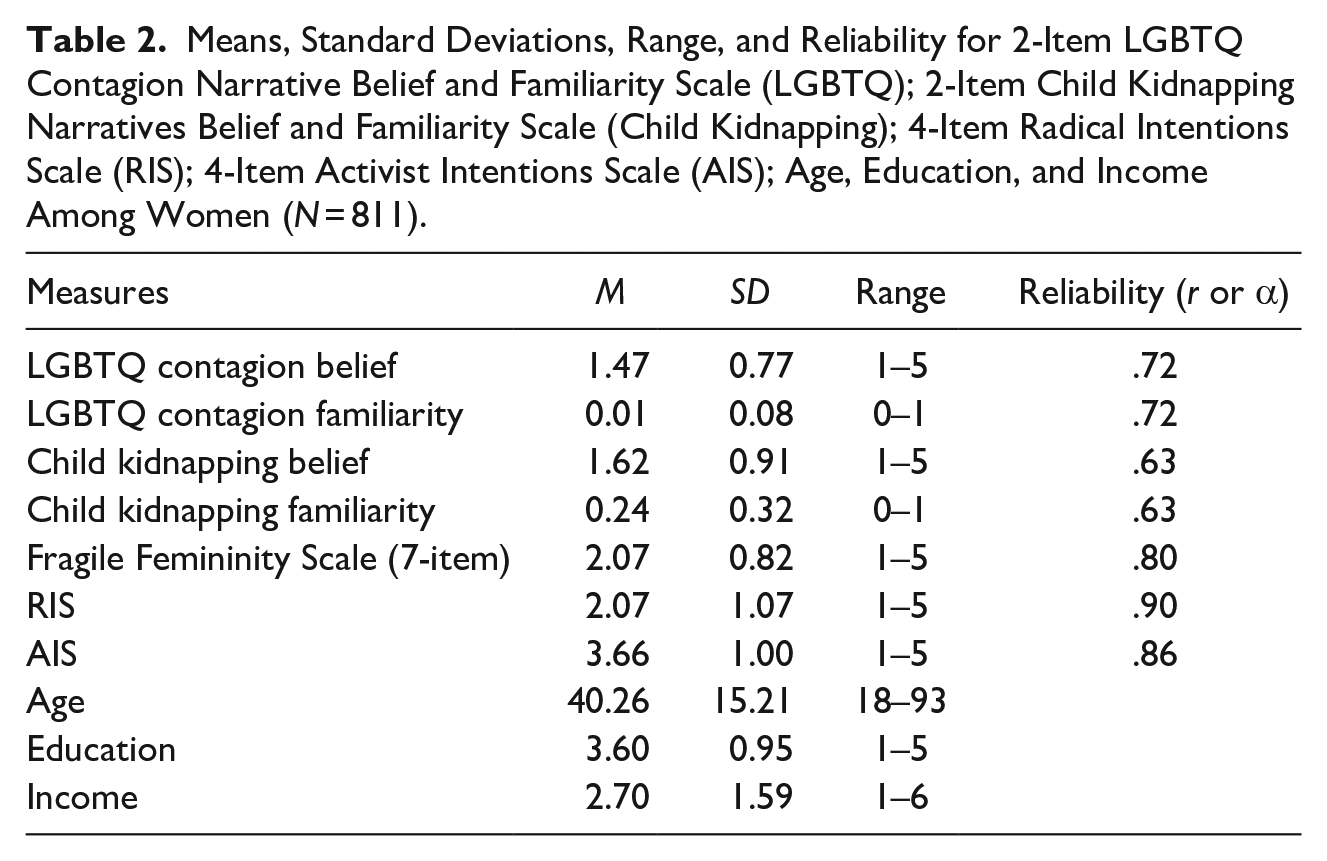
Reported beliefs in Narrative 3 and Narrative 4 were averaged to make up “Child kidnapping narrative belief” scale. Familiarity with both Narrative 3 and Narrative 4 were averaged to make up child kidnapping narrative familiarity scale. Table 2 reports Means, Standard Deviations, and correlations for child kidnapping narrative belief and familiarity among women.
Means, Standard Deviations, Range, and Reliability for 2-Item LGBTQ Contagion Narrative Belief and Familiarity Scale (LGBTQ); 2-Item Child Kidnapping Narratives Belief and Familiarity Scale (Child Kidnapping); 4-Item Radical Intentions Scale (RIS); 4-Item Activist Intentions Scale (AIS); Age, Education, and Income Among Women (N = 811).
Fragile masculinity/femininity
Fragile masculinity among men was measured by using 7-item Precarious Manhood Scale (Vandello et al., 2008). The same scale, adapted by Vandello et al. (2008) to assess fragile femininity was used to assess it among women. Participants were asked how much they agreed or disagreed on a scale from 1 “strongly disagree” to 5 “strongly agree,” with statements such as: “It is fairly easy for a man/woman to lose his/her status as a man/woman”; “A male’s/female’s status as a ‘real man’/‘real woman’ sometimes depends on how other people view him/her” “Some boys/girls do not become men/women, no matter how old they get.” Responses to the scale’s 7 items were averaged separately for men (Table 1) and women (Table 2).
Radicalization
Radicalization was measured by using Moskalenko & McCauley’s 8-item Activism-Radicalism Intentions Scale (ARIS; Moskalenko & McCauley, 2009). ARIS assesses participants’ radicalization by asking them to think of a group they feel closest to, such as religious group, cultural group, or any other group that is important to them and state how much they agree or disagree on a scale from 1 “Strongly disagree” to 5 “Strongly agree” with four items measuring activist intentions, and four items measuring radical intentions. Activism Intentions Scale (AIS) asks about intentions for legal/nonviolent political action (e.g., “I would join/belong to an organization that fights for my group’s political and legal rights”). Radical Intentions Scale (RIS) asks about intentions for illegal/violent political action (e.g., “I would continue to support an organization that fights for my group’s political and legal rights even if the organization sometimes breaks the law”). Table 1 reports descriptive statistics and Cronbach Alphas for RIS and AIS among men; Table 2 reports these values for women.
All analyses were run in SPSS 26. To analyze direct relationships between the discussed above concepts, regression models were used. PROCESS model 4 was used to assess an indirect path from conspiracy beliefs to radicalization (Hayes, 2017).
Results
To test how conspiracy beliefs relate to radicalization, we conducted a series of regression analyses with AIS and RIS as outcome variables analyzing men and women separately. We used demographic variables of age, education, ethnicity, and income as controls.
Men
Among men, we focused on the ability of the two narratives related to LGBTQ contagion threat to challenge traditional masculine patriarchal norms, and in doing so to contribute to radicalization. To test this relationship, we conducted a regression analysis with AIS and RIS as outcome variables. A regression analysis demonstrated that, in men, beliefs in LGBTQ contagion narratives had a positive direct relationship with RIS, and a marginally positive relationship with AIS. (Table 3 reports statistical results for these analyses). Thus, among men, we discovered a strong direct link between beliefs in gender-norm-threatening conspiracy theories and radicalization, controlling for demographic variables. Surprisingly, the same regression model showed that fragile masculinity did not yield a significant direct relationship with either RIS or AIS. Contrary to our expectations, for men in our sample, fragile masculinity was not directly connected to radical intentions.
Regression Coefficients for Models With RIS and AIS as Dependent Variables Men and Women Subsample.
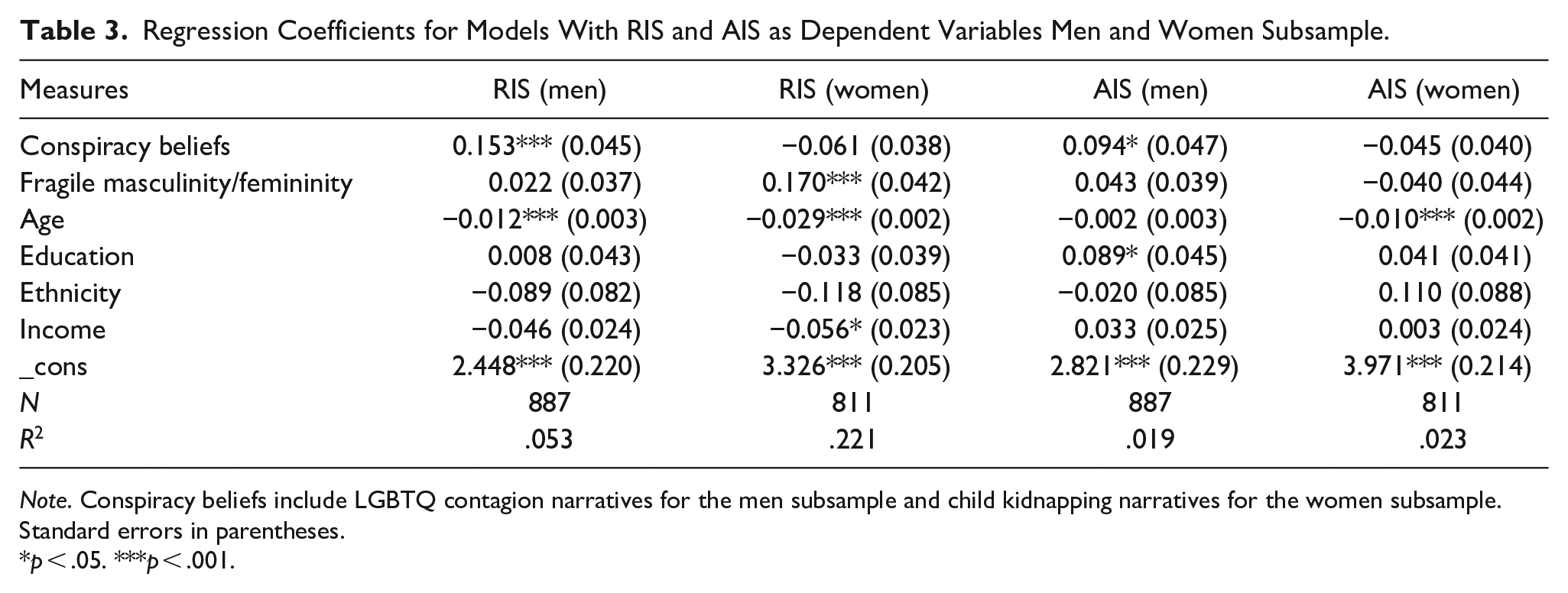
Note. Conspiracy beliefs include LGBTQ contagion narratives for the men subsample and child kidnapping narratives for the women subsample. Standard errors in parentheses.
p < .05. ***p < .001.
To further investigate the role of fragile masculinity, we then tested whether it mediated the relationship between conspiracy beliefs in LGBTQ contagion threats and radicalization. To run a mediation model, we used SPSS PROCESS package. Results of the PROCESS’s mediation model analysis revealed no significant indirect effects of conspiracy beliefs on either RIS (b = 0.0040, SE = 0.007, 95% CI [−0.0098, 0.0191]) or AIS (b = 0.0079, SE = 0.008, 95% CI [−0.0063, 0.0242]) for the men subsample. Therefore, among men in our sample, fragile masculinity was not related to radicalization.
Women
To test how beliefs in conspiracies focused on child kidnapping related to radicalization among women, we ran a regression model with AIS and RIS as outcome variables (Table 3). Results showed that beliefs in these narratives did not have a significant connection to either RIS or AIS among women. There was no significant direct relationship between beliefs in child kidnapping narratives and radical intentions among women. On the other hand, the same regression model uncovered a direct positive relationship between fragile femininity and RIS. There was no corresponding significant relationship between fragile femininity and AIS. Therefore, even though there was no direct relationship between conspiracy beliefs and radicalization among women, fragile femininity did have a positive path to radical intentions.
We then tested whether fragile femininity mediated the relationship between conspiracy beliefs that appeal to women and radicalization, by utilizing SPSS PROCESS. Results of the PROCESS’s mediation model analysis revealed significant indirect relationships between beliefs in child kidnapping narratives and RIS (b = 0.0244, SE = 0.009, 95% CI [0.0089, 0.0442]) through fragile femininity. There were no significant indirect relationship between conspiracy beliefs and AIS (b = −0.0058, SE = 0.007, 95% CI [−0.0204, 0.0067]). Thus, although we found no direct relationship between conspiracy beliefs and radicalization among women, conspiracy beliefs positively influenced radical intentions among women through increased fragile femininity.
Discussion
This study aimed to build and extend earlier research that linked fragile masculinity with gender-norm-affirming behaviors, including expressing anti-LGBTQ sentiments and political radicalization. To that end, we asked male participants to report their beliefs in two disinformation narratives that have been broadcasted by Russian state media, each presenting a masculinity threat through highlighting a threat of LGBTQ contagion; we also measured male participants’ fragile masculinity, their activist intentions, and their radical intentions.
Expanding on previous research, we included women in our study to investigate how beliefs in gender-norm-threatening disinformation about child kidnapping and torture related to fragile femininity and radical and activist intentions. Thus, we asked female participants to indicate how much they believed two narratives challenging traditional women’s roles that circulated in the U.S., about child kidnapping and torture carried out by an international cabal. We also measured women participants’ fragile femininity, their activist intentions, and their radical intentions.
Based on prior research, we expected to observe similar results in men and women, namely a relationship between beliefs in gender-norm-threatening disinformation predicting radical intentions, as well as fragile masculinity/femininity. However, this prediction was not realized in our data. Results for women looked very different than those for men.
Among men, we found a direct relationship between beliefs in LGBTQ contagion threat narratives and radical intentions. In other words, among men in our sample, believing in disinformation narratives that described threats of LGBTQ contagion predicted intentions to engage in illegal or violent action for political causes. Contrary to our predictions, fragile masculinity did not yield significant relationships with either beliefs in LGBTQ contagion threat narratives or with radical intentions. Further, in our study, fragile masculinity did not mediate the relationship between beliefs in LGBTQ contagion threat and radicalization. In other words, in our male subsample, we failed to find the connection between LGBTQ contagion narratives, fragile masculinity, and radicalization suggested by previous research.
One explanation for this surprising finding is that men in our sample were largely unfamiliar with narratives about the threat of LGBTQ contagion. (For comparison, women in our study showed a far greater familiarity with the child kidnapping narratives. See Table 1 for men, and Table 2 for women). Because our male participants apparently did not have much exposure to the threat of LGBTQ contagion that the narratives represented, it is possible that they had not developed psychological defensive strategies to uphold their masculinity, such as radical intentions. This could explain why fragile masculinity was not related to radical intentions in our data as previous research predicted.
Another possible explanation for the lack of mediation between conspiracy beliefs and radicalization by fragile masculinity is that fragile masculinity was not manipulated in our sample. Previous research has suggested that the effects of fragile masculinity are often triggered by inducing a state of anxiety before examining its effects. However, it is possible that the men in our sample were less susceptible to the threats of the narratives we used because these narratives were presented in an abbreviated form different from how they are presented “in the wild”—with images, videos, live commentary, and rhetorical devices to emphasize major points. Therefore, fragile masculinity may not have been threatened by the reduced version of the narratives when the participants could not relate these to the expanded version they may have been exposed to earlier. Telling someone “there is a killer shark terrorizing a sleepy vacation town” is likely to have different emotional effects depending on whether the person has watched the movie Jaws recently and repeatedly than if they had not. So, too, in our study, lack of exposure to the more in-depth threat the narrative represents likely contributed to the reactions (or lack thereof) among our male participants). Since the narratives we used have circulated widely in the Russian media, it would be interesting to test our hypotheses with Russian respondents, to see whether their likely prior repeated exposure to the masculinity threat through these narratives results in a greater anxiety and the use of kinds of defensive strategies that previous research has captured, including increased radicalization.
Among women, the results were markedly different. Unlike with men, there was no direct relationship between beliefs in child kidnapping narratives and radical intentions among women. Also unlike in male participants, we found a direct relationship between fragile femininity and radical intentions in women. There was no corresponding relationship between fragile femininity and activist intentions, suggesting that fragile femininity is discriminately predictive of violent or illegal, but not non-violent and legal political action. At the same time, we found significant indirect effects of fragile femininity, such that it mediated the relationship between beliefs in child kidnapping narratives and radical intentions—but not activist intentions. This result was consistent with our predictions. In other words, women in our sample seemed to have been affected by fragile femininity, which directly predicted their radical intentions, as well as mediated the relationship between beliefs in child kidnapping narratives and radical intentions.
Several considerations follow from these results. The first is that, although earlier research concluded that women might feel more secure in their identities than men, and thus are not as affected by threats to that gendered identity, our findings demonstrate that fragile femininity is indeed affected by sexual identity threats represented by child kidnapping narratives. News stories that suggest some women are unable to keep their children safe from the horrible fate of falling prey to evil pedophilic cabalists has an emotional impact on women, such as increasing fragile femininity, which in turn can increase intentions to engage in violent and illegal political action.
This finding is consistent with earlier findings that reported that QAnon social media child kidnapping campaign known as #SaveTheChildren was especially appealing to women (Buntain et al., 2022) as well as those that found positive correlations between beliefs in QAnon conspiracy narratives, especially those about a child-kidnapping and torturing cabal, and radical intentions among women (Moskalenko, Pavlović, & Burton, 2023).
More generally, our findings offer two important implications. One has to do with the effects of disinformation narratives that are spread either by state propaganda or by non-state radical online movements. We found that in both men and women, gender-norm-challenging disinformation narratives predicted radicalization. Among men, this relationship was direct; among women, it was mediated by fragile femininity. This result suggests that these types of disinformation narratives carry a particular kind of danger of mass radicalization.
Another important finding is the role that fragile gender identities have on radicalization. In recent years, political operatives in the U.S. and abroad have often leveraged the threat to gender norms related to transgender (Astor, 2023) and LGBTQ (Encarnación, 2014) issues. Our findings show that these public debates that often highlight gender fragility are fraught with radicalizing potential. Especially among women in our study, who were considering the more familiar narratives characteristic of QAnon discourse, the result was an increase in fragile femininity, which in turn increased their radical intentions.
To date, the research on the psychology of radicalization has not focused on the role of changing gender roles or the importance of (perceived) fragility of masculinity or femininity, which can be manipulated through a campaign of disinformation. Our study therefore suggests a new direction to understand the complex psychological processes that bring individuals from political neutrality to supporting illegal and/or violent political action. This focus is especially pertinent given the ease with which disinformation can spread through the social media, affecting missions of people.
From this perspective, understanding the role of radicalizing narratives that threaten gender norms is an important frontier for the criminological study of terrorism. To our knowledge, ours is the first study that assessed belief in real-world gender-norm challenging narratives, and linked it with fragile masculinity/femininity, as well as to intentions for radical political action.
Policy Implications
Implications of our findings for policy is twofold. The first is to highlight the role of gender-threatening narratives as an important factor in risk assessment and public safety considerations. Existing empirical work on radicalization already identified hyper-masculinized narratives, such as the “warrior culture,” (Koehler, 2022; Simi et al., 2013) as a risk factor for radicalization. Our findings suggest that equally precarious is the flip side of the hyper-gender affirming narrative: the narratives that tout the risk of losing one’s gender identity. Groups and social milieus that share and spread these kinds of narratives present a greater risk of radicalization as a result.
Second, our findings suggest that a potential strategy to reduce or prevent radicalization is developing counter-narratives that highlight alternative interpretations of gender roles. These may include pre-bunking and debunking of the narratives (Leuprecht et al., 2010; Lewandowsky & van der Linden, 2021; Velte, 2024), with “off-ramping” opportunities offered on social media where these narratives frequently appear. Another possibility for prevention or countering radicalization stemming from gender-challenging narratives can be in the form of information campaigns featuring cultural authority figures who espouse flexible yet secure gender norms (Dowding, 2016), reducing the threat and the anxiety of these narratives, and as a result reducing their radicalizing potential.
Overall, our research suggests that policy makers, security professionals, and practitioners working in the PVE/CVE space need to be vigilant to gender-norm challenging narratives as a potential vehicle to radicalization and violent political action. Although not exactly “fighting words,” (Mannheimer, 1993) some narratives have been empirically identified as capable of boosting mobilization and radicalization (Braddock, 2012); our study suggests that conspiracy theories of QAnon and Russian propaganda that challenge gender fragility are in this category. If validated by additional studies, our findings may offer a useful variable for risk assessment by security professionals, and opportunities for counter-messaging campaigns designed for prevention or countering of radicalization.
Limitations and Future Directions
Interpretation of our results is limited by some of the characteristics of our research design. First, the data were collected at a single point in time, which means that no firm causal conclusions should be made. Additional studies using similar methods should test the reliability of our findings.
Second, the narratives used, chosen for their respective appeal to either fragile masculinity or fragile femininity, turned out to be of significantly different familiarity among our participants, with women being much more familiar with the child kidnapping narrative than men were with the LGBTQ contagion narrative. This difference might explain the different results in fragile masculinity versus fragile femininity’s relation to radical intentions. Future studies may seek to balance the familiarity of the stimuli meant to affect men’s fragile masculinity and women’s fragile femininity to attempt to replicate our findings under those conditions.
Third, the sample we used was not representative, and as a result our findings are limited in their generalizability. Finally, the narratives we used were selected because of their naturalistic nature, meaning they circulated in the real world, and were in situ connected with violent political actions of people who believed in them. However, the naturalistic nature of our selection meant that the narratives were not specifically designed (to our knowledge) for their ability to manipulate variables of interest, namely fragile sexual identity and radicalization. Future research interested in the connections between these factors might generate narratives specifically to test the relationships between them. This study design would also address the issue of differential familiarity with narratives, as they would all be equally unfamiliar.
Conclusion
Our study has extended the existing research on radicalization by exploring how fragile and threatened gender identity relates to political radicalization. We explored the relationship between four real-world disinformation narratives that challenge traditional gender roles, fragile masculinity/fragile femininity, and political radicalization. Two of the narratives came from QAnon conspiracy theories, and two from Russian propaganda. In our study, men and women reacted differently to gender-challenging narratives. Among men, there was a direct correlation between a belief in gender-challenging narratives and radical intentions; in women, fragile femininity mediated the relationship between gender identity-challenging narratives and radical intentions. The study suggests that narratives that highlight shifting gender norms and sexual fluidity are an important factor in psychology of radicalization.
Footnotes
Declaration of Conflicting Interests
The author(s) declared no potential conflicts of interest with respect to the research, authorship, and/or publication of this article.
Funding
The author(s) disclosed receipt of the following financial support for the research, authorship, and/or publication of this article: Sophia Moskalenko, Ekaterina Romanova, and Mia Bloom receive funding from the Department of Defense Office of Naval Research (grant #N00014-21-1-2339).
