







Abstract
Terrorist lethality has emerged as a key metric for evaluating counterterrorism success. Recent research, however, questions whether terrorist mass casualty events (TMCEs) are consistent with existing theories of terrorism and across heterogeneous terrorist ideological motivations. This study examines previously understudied control and learning theories and their impact on the likelihood of TMCEs from 1983 to 2020. Leveraging the Profiles on Individual Radicalization in the United States (PIRUS) dataset, this study examines the causal conditions associated with TMCEs using fuzzy-set Qualitative Comparative Analysis (fsQCA). Across the three ideological motivations examined, too many unique pathways to TMCEs emerged to suggest support for either theoretical perspective. Further, some conditions, including education, were both risk and protective factors suggesting important unexplained heterogeneity.
Introduction
Individual acts of terrorism have had wide-spread influences on health (Quintana-Domeque & Ródenas-Serrano, 2017), politics (Altheide, 2006), economies (Sandler & Enders, 2008), and approaches to policy (Renard, 2021). Compared to most other types of crime, terrorist attacks are fortunately rare (Turner & Klein, 2023), and mass-casualty attacks are a further small subset of terrorist attacks (Schorscher et al., 2022). 1 Despite their rarity, terrorist mass casualty events (TMCEs) have had a disproportionate impact on policy (Arce, 2019), and the large-scale potential for this subset of terrorist attacks to damage vital infrastructure and kill civilians has placed preventing these events at the forefront of global terrorism prevention efforts (LaFree et al., 2014). To enhance and expand terrorism prevention options, increasing attention has been given to trying to predict radicalization to violent extremism and other pre-cursor steps toward terrorism (Garcia-Calvo & Reinares, 2022; Simi & Windisch, 2020; Wolfowicz et al., 2020, 2021), and specifically to identify which factors are conducive to an individual committing a TMCE (Singer & Golan, 2019). These initial attempts have illustrated practical barriers to committing mass casualty terrorist attacks in general, insights from specific case studies, general data patterns among TMCEs, and together have laid the foundation for examining theories of terrorism. Particularly considering the “highly contingent” nature of precursor factors for TMCEs observed (Garcia-Calvo & Reinares, 2022, p. 1), it is vital to examine the generalizability of these findings and to what extent existing criminological theories can explain TMCEs.
Given their consequences, preventing mass casualty events has long been of paramount concern to law enforcement, intelligence agencies, and governments in general (Henry & King, 2004). Indeed, TMCEs have are often seen by civilians to require unique counterterrorism efforts (Crenshaw, 2001), pressuring the development of swift responses and prevention efforts (Nohrstedt & Hansén, 2010). However, the absence of robust and theoretically driven research has limited attempts to respond to terrorism in the past (Lum et al., 2006), increasing the potential for terrorist backlash (Kattelman, 2020). Beyond identifying the potential for increased and more lethal terrorism as a backlash (Fisher & Becker, 2023; LaFree et al., 2009), empirically examining criminological theories of terrorism has been central dispelling terrorism myths and providing an empirical basis for global counterterrorism actions (Fisher & Kearns, 2024). To date however, many major criminological theories including learning and control theories remain underexamined (Fisher & Kearns, 2024), leaving their potential value for driving counterterrorism policy unknown. Coupled with the existing observations that TMCEs are influenced by ideological and circumstantial factors (Garcia-Calvo & Reinares, 2022; Simi & Windisch, 2020; Singer & Golan, 2019), examining whether criminological theories explain some ideological motivations for TMCEs better than others could be used to drive more tailored and nuanced counterterrorism policies.
While not all mass casualty events are motivated by political or social goals or animus toward a particular group, this is the case for most events within the United States (U.S.) with a known perpetrator (Gruenewald et al., 2019). Further, terrorist ideology has been recently observed to influence an actor’s intention to kill or commit a TMCE (Carson & Turner, 2024). Seeking to expand upon this research, this study examines the causal conditions 2 associated with individual radicalization to mass casualty violence in the U.S. Specifically, it builds upon recent advances studying extremist pathways that employed qualitative comparative analysis (QCA) to examine the causes of extremism (see Fahey & Simi, 2019; M. A. Jensen et al., 2020; McCann, 2022a). Drawing upon data from the Profiles of Individual Radicalization in the United States (PIRUS) this study examines the conditions associated with incidents that are and are not mass casualty events. In addition, this study extends the existing literature by investigating whether there is important heterogeneity that can be masked by pooling all ideological motivations together (M. A. Jensen et al., 2020) or examining only Islamic extremists (McCann, 2022a) through examining the impact of factors related to control and social learning theory across actor type (e.g., individuals vs. groups) and ideology (e.g., Islamic vs. Far-right) that could be leveraged to prevent TMCEs. This study finds that across the three ideological perspectives examined that there was a plethora of unique pathways to committing a TMCE rather than a single generalizable set of conditions. Exemplified by the finding that education can be both a risk and protective factor, many individual risk factors including employment and marriage had differential impacts across extremist ideologies. This is inconsistent with most but not all versions of control and learning theories, highlighting the need for increased attention when devising counterterrorism policy and demonstrating additional challenges for criminological theories seeking to explain terrorism. Further, connections to radical friends, a deep commitment to radical beliefs, and being of sufficient age (e.g., peak crime years) were notable risk factors for Islamic extremists, whereas education, radical beliefs, having children, and military service were also important conditions for far-right actors, albeit none were sufficient conditions. Consequently, this study produces evidence that the explanatory value for both learning and control perspectives varies in numerous important ways across motivations for TMCEs, demonstrating the need for additional theoretical elaboration.
Literature Review
Both learning theory and control theories have a rich and long empirical tradition within criminology but remain understudied regarding terrorism (Fisher & Kearns, 2024). As will be discussed below however, the growing terrorism literature has examined many of the key factors for both theories, although only in rare cases has this been the explicit theoretical framing of an analysis (see Becker, 2021). As a full discussion of these theories has been provided elsewhere (see Akers & Silverman, 2014; Fisher, 2021), the following section provides a brief overview for each theory before discussing the existing literature on the empirically established personal, psychological, social, and experiential factors and their impacts on terrorism and TMCEs (Wolfowicz et al., 2021).
Social Learning Theory
According to social learning theory and its precursor differential association theory, all social behavior is learned—including crime and terrorism (Akers & Silverman, 2014). Beginning with Sutherland’s (1947) differential association theory, individuals learn definitions (including rationalizations and attitudes) that are favorable to committing criminal acts along with the necessary techniques and approaches for completing these acts (see also Akers & Jennings, 2015). Later, adapted into social learning theory by Burgess and Akers (1966), contemporary social learning theories hold that the likelihood of an individual engaging in criminal behavior increases when they differentially associate with others who commit crime, express favorable opinions of it, are exposed to favorable models of the crime in-person or symbolically, personally define it as justified, and perceive the benefits to outweigh potential punishments (Akers, 1998). Important variation in the explanatory value of social learning theory has also been observed across criminological studies (see Pratt et al., 2010), and this remains as an understudied theoretical explanation for terrorist violence and TMCEs specifically (Mills et al., 2021).
Control Theories
Control theories are distinct from all other criminological theories as they focus on explaining why people do not commit crime (Costello & Laub, 2020). While many different control theories have emerged since Reiss (1951), these theories are united in their assertion that an individual’s submission or acceptance of rules that cause their actions to line up with accepted norms, morals, and values of a society (Hirschi, 2015). For control theories, crime occurs when there is a relative absence of internalized norms and rules governing behavior that conform to socialized norms and rules (Reiss, 1951). Subsequent control theories have focused upon techniques of neutralization (Sykes & Matza, 1957), containment (Reckless, 1967), social control (Hirschi, 1969), and self-control (Gottfredson & Hirschi, 1990) respectively. While rarely studied with regard to terrorism and especially TMCEs (Becker, 2021), it should be noted that the control theory perspective is the most frequently tested and endorsed theory within criminology (Walsh & Ellis, 1999) with multiple meta-analyses demonstrating that increased self and social control are related to reduced crime and delinquency (Pratt & Cullen, 2000; Piquero et al., 2010, 2016).
Factors Associated With Radicalization to Violence
Much of the research on radicalization and terrorism has been conducted by fields adjacent to criminology including political science, psychology, sociology, and economics (Altier et al., 2014). Although these studies have employed their own theories, it is vital to note that there is meaningful overlap in many of the individual factors in these studies and much can be gleaned for understanding learning and control theories from a close examination of these findings (LaFree & Ackerman, 2009). While it is vital to note that these studies have not directly tested either theory and findings should be viewed with caution due to the high likelihood of omitted theoretically vital factors, much has been learned about the importance of personal, psychological, social, and experiential factors that is relevant to control and learning theories (Wolfowicz et al., 2021). Indeed, across the existing literature, a plethora of factors for explaining radicalization pathways have been identified, with two recent studies of violent extremism in the U.S. using PIRUS (LaFree et al., 2018; McCann, 2022a) providing overviews of various risk factors associated with radicalization. The following section summarizes the factors related to both social learning theory and control theory across these studies and highlights where findings differed across ideological motivations for terrorism and TMCEs.
Personal Background
Personal background factors can include educational attainment, age, gender, and socioeconomic conditions (Monahan, 2012). The literature is clear that the overwhelming majority of terrorists (usually over 90%) are men (see Gill et al., 2013; LaFree & Ackerman, 2009; LaFree et al., 2018), however, left-wing terrorists often have higher female participation (Smith & Morgan, 1994). Most studies find that terrorists are usually no older than their mid-thirties when committing their heinous acts (Berrebi, 2007; Pyrooz et al., 2017). These findings vary however across ideology. For example, Bakker found, to the contrary, that jihadists in Europe were slightly older, whereas Sageman’s (2008) foundational piece on leaderless jihad found that most were in their mid-to-late twenties. As these age distributions are older than those expected for other crimes, this potentially indicates a departure from the predictions of control theories and specifically self control theory which predicts that criminal involvement should peak earlier in life and be in decline by an individual’s mid-thirties (Tittle et al., 2003). Late onset offending is also compatible with learning theories but not with control theories included life-course theory (Sohoni et al., 2014), making age a key variable for differentiating between both theoretical perspectives although it is likely that these impacts would be smaller in magnitude direct factors for each theory (Wolfowicz et al., 2020).
Major educational gaps also exist between across different terrorist ideologies, with Smith and Morgan’s (1994) finding that more than half of left-wing terrorists were college educated, whereas 12% of far-right terrorists attended college. Similarly, Gill et al. (2013) found that far-right actors were less likely to attain higher levels of education, while also finding that lone-wolf terrorists graduated from some college or vocational school at least 22% of the time; with almost one in seven finishing graduate school. In fact, almost a third of jihadists completed college as well. This is atypical for control theories that posit that educational pursuit and attainment is jeopardized by crime (Costello & Laub, 2020), however if the education is necessary for the individual to learn definitions favorable to terrorism then higher educational attainment would be consistent with social learning theory if the individual is in an appropriate socio-cultural environment (Tittle et al., 2012). Numerous studies have also shown that terrorists are typically better off financially than what is ordinarily seen with ordinary criminals (Berrebi, 2007; LaFree & Ackerman, 2009; LaFree et al., 2018), albeit others have found that jihadists and lone wolf terrorists (Gill et al., 2013), struggled with unemployment. Others have found that unemployment had a mixed relationship with radicalization to violence, in that being employed was sometimes a protective factor depending on other conditions considered (McCann, 2022a). From the control theory perspective, one would expect financial attainment to be negatively related to terrorism of all kinds, however employment itself can produce divergent impacts depending on age and the type of employment for both control and social learning theories despite the overall finding that employment is negatively related to crime (Apel & Horney, 2017; Paternoster et al., 2003).
Psychological
Research on the psychological dimensions of extremism typically focus on cognitive processes and/or mental health concerns. Most of the available literature shows a variable, but weak relationship between mental illness and radicalization (see Gill et al., 2020; LaFree & Ackerman, 2009; LaFree et al., 2018). A systematic review revealed that rates of mental health concerns were higher when studies relied on clinical data compared to judicial, police, or open-source data (Gill et al., 2020). A different study of lone-wolf actors found that almost one-third of perpetrators had a diagnosed mental illness or personality disorder (Gill et al., 2013), and Gruenewald et al. (2013) found that far-right lone-wolf extremists who committed homicides were more likely to have mental illnesses than other groups. Work on white supremacists have found that almost 4 in 10 reported having mental health problems, with almost half of individuals reporting a family history of mental illness too (Simi et al., 2016). Strong links have been observed between mental health and reduced social and self control, however for both social learning and control perspectives mental health concerns are neither necessary nor sufficient for criminality (Venables et al., 2018). Concordantly, while this is an important set of factors to consider from the risk factors literature on terrorism and radicalization, mental health variables are unable to distinguish between social learning and control theory perspectives.
The variety of cognitive processes at work in fostering support for violent extremism is difficult to track, measure, and interpret, and the existing research has focused on this relationship across the fields of social psychology and criminology (see Roberts-Ingleson & McCann, 2023). Kruglanski et al. (2014) valuable work on quest for significance theory, which states that one’s loss of significance in the world, when connected to extremist ideological and social ties, can explain a commitment to violent extremism (Becker, 2021). For example, a deep commitment to radical ideologies alongside being a member of a terrorist group were found to be risk factors for violent extremism for both control and learning perspectives (McCann, 2022a).
Social Factors
Social factors are a key point of differentiation between social learning and control theories. Specifically, while peer relationships are a key medium for the transmission of definitions favorable to crime for social learning theory (Warr & Stafford, 1991), from the control theory perspective these influences are instead driven by selection effects as people select into relationships with those who possess similar traits (Boman, 2017). Consequently, for control theory one would expect null findings on the impacts of social and relationship factors after controlling for baseline factors related to social control, while one would predict that these factors would have a statistically significant impact from the social learning theory perspective. Numerous studies have empirically explored the link between various social relationships and political violence; specifically, marital status and proximity to radicalized family members and friends. Moreover, it is unclear whether such relationships have a different impact on violent versus non-violent offenders (LaFree et al., 2018), as marriage rates are likely influenced by the rates of the general population the actors originate from (LaFree & Ackerman, 2009). However, the presence of these types of relationships varies by study. For example, when looking at Islamic extremists, some have found that 75% of terrorists were married (Sageman, 2008), whereas another study found this to be 45% (Berrebi, 2007), and Baker (2006) contends that most jihadists in Europe were single. A study of lone actors found that only a quarter were married (Gill et al., 2014). As such, marriage rates vary, but their impact on radicalization pathways as a risk or protective factor remains unclear (McCann, 2022a).
The role of radical friends and family on radicalization pathways is also highly variable. Jasko and LaFree (2020) observed that having radicalized friends was a risk factor for violence. One study of ISIS members even showed that the largest recruitment influence was a radicalized friend (Speckhard & Ellenberg, 2021). However, others have found that friends did not push individuals to violent outcomes (see LaFree et al., 2018) or that such a relationship is inconsistent (McCann, 2022a). The role of family members in serving as a push factor for violent extremism is also unclear. One study was unable to assess the role of radical family members on violent extremism because it was both rare and the absence of such relationships were ostensibly necessary for not committing violence (McCann, 2022a). A study of lone wolf actors found that more than a third of perpetrators had family members or associates involved in political violence, albeit it’s unclear the effect such relationships actually had on the outcome in question (Gill et al., 2013).
Experiential Factors
Experiential factors can include prior interaction with the criminal justice system, military service, or victimization and trauma and typically have a larger impact on radicalization compared to sociodemographic factors (Wolfowicz et al., 2021). For example, while extremists often have high rates of criminal offending, this is quite variable. A study of lone wolves found that 41% had a prior record (Gill et al., 2013), whereas a study of ISIS formers found this rate was almost three times lower (Speckhard & Ellenberg, 2021). Another study on foreign fighters found rates within this range (Mehra, 2016), with some close to a quarter of all individuals studied, and others focusing on all jihadists in Europe found that about a quarter had a criminal record as well.
The relationship between military service and extremism is also quite mixed (see LaFree et al., 2018). Two studies, one for lone-wolf actors and another on far-right actors, found that about a quarter of all individuals studies had some form of military experience (Gill et al., 2013; Gruenewald et al., 2013). The criminological literature shows that military service is typically associated with desistance from offending (see Sampson & Laub, 1999), but one study of those who radicalized on the far-right found that those with prior service were more likely to have grievances and anger toward society, as compared to those who did not serve (Haugstvedt & Koehler, 2021). This same study found that those with military service were also more likely to have suffered trauma, challenges in relationships, and exclusion from social groups. Particularly for life-course theory and social learning theory, these major events can be seen to either be turning points (Laub & Sampson, 1993) or additional opportunities to learn alternate definitions related to offending (Boman & Mowen, 2018) making these factors important for both theories but not theoretically discriminative.
Numerous studies have shown that terrorists are typically better off financially than what is ordinarily seen with ordinary criminals (Berrebi, 2007; LaFree & Ackerman, 2009; LaFree et al., 2018), albeit others have found that jihadists and lone wolf terrorists (Gill et al., 2013), struggled with unemployment. Others have found that unemployment had a mixed relationship with radicalization to violence, in that being employed was sometimes a protective factor depending on other conditions considered (McCann, 2022a). Nevertheless, the link between poverty or economic hardship and terrorism is quite weak (Krueger & Malečková, 2003; Piazza, 2006), even when specific types of events (e.g., use of chemical or biological weapons) are considered (see McCann, 2022b, 2023).
Taken together, these studies provide evidence that many of the factors predicting crime from both social learning theory and control theories are also evident for terrorism and likely relevant for TMCEs. However, at present it is unclear whether these observed relationships are observable once other factors are included in statistical models, and to what extent they are able to differentiate between those who engage in and refrain from committing TMCEs specifically.
Methods
This study leverages qualitative comparative analysis (QCA) to examine the confluence of conditions in predicting mass casualty violence amongst radicalized persons within the U.S. from 1983 to 2021. 3 This non-inferential technique uses configurations, or “sets” to determine causation of specific phenomenon; implying a complex causal process that is non-linear (Fiss, 2007), leading to its growing use to study political violence (Fahey & Simi, 2019; M. A. Jensen et al., 2020; McCann, 2022a). To discern the causal pathways for actors who pursue both mass casualty and non-mass casualty violence, this study only includes incidents within PIRUS as being coded as “violent.” This study concordantly employs the definitions from the PIRUS database where violence is defined as whether “the individual actively participates in ideologically motivated operations/actions that resulted in casualties/injuries or clearly intended to result in casualties/injuries (but failed), or were they charged with conspiracy to kill or injure but were interdicted in the plotting phase,” and a “radicalized” persons refers to “anyone arrested, indicted, and/or convicted of either engaging or planning to engage in ideologically motivated unlawful behavior, or anyone who belonged to a designated terrorist organization or a violent extremist group” and a “mass casualty event” occurs when “four or more people [are] killed or injured, not including the perpetrator(s), in an attack” (PIRUS, n.d.).
QCA is a set-theoretic technique that enables scholars to examine the relationship between factors or sets of factors (conditions) and a given outcome. QCA relies on Boolean algebra and minimization procedures to determine whether specific conditions and combinations of conditions are causal for a specific outcome. In this manner, QCA is a causal method. For a causal process to occur, the relationship between the conditions and the presence or absence of the outcome in question is examined; thereby more definitively showing that X condition is causal of Y outcome. As the focus is on whether a condition or combination thereof is present or absent in producing an outcome, the findings are not inferential. As such, traditional statistical terms such as effect size, probabilities, and statistical significance are not used and would not be inappropriate.
Most conditions in a traditional QCA analysis (also called crisp-set QCA) are coded as absent (“0”) or present (“1”). This study uses fuzzy-set (fs) coded conditions, allowing the examination of varying degrees of membership on a given condition. Fuzzy-coding can occur for categorical and continuous measures. For example, if having no history of mental illness is “0”, and “1” is coded as having an official psychological diagnosis of a mental illness, “0.67” may denote partial membership of having a mental illness (e.g., speculated by law enforcement or the media in PIRUS) albeit no official diagnosis by a mental health professional was located when data was collected. Continuous or ordinal measures such as education also require fuzzy-set calibration, with the researcher choosing a cutoff value (0.5) that denotes full inclusion in the condition (e.g., having at least a high school diploma). As such, fsQCA enables researchers to incorporate additional nuance into their analyses while ensuring that the algebraic simplification process can render viable conclusions. A description of the specific conditions and instrumentation for this analysis can be found in Supplemental Appendix A.
Descriptive Analysis
Complete baseline and imputed descriptive statistics of the individuals included in the sample are below (see Table 1), whereas complete baseline and imputed frequencies for the conditions included for QCA are reported in Supplemental Appendix A. The analytic sample includes 1,280 incidents that caused or intended to cause casualties or injury to others. The mean age of the sample was 34.8 years, and close to 94% of perpetrators were male. Slightly over three-quarters of the sample were white (76.5%), with 92.9% of individuals being born in the United States. Almost 10% of the sample were immigrants as well. Notably, the sample consists of 66.5% far-right, 16.6% Islamist, 8.8% far-left, and 8.2% single-issue actors. More than half (51.5%) of the individuals in the sample held a deep commitment to radical ideological beliefs, with 77.50% having at least full knowledge of the tenets of said ideology.
Descriptive Statistics for the Analytic Sample Including and Excluding EM Imputation.

For the conditions included in the QCA (see Supplemental Appendix A), almost half of all cases (49.3%) involved a TMCE. Close to half had some criminal history, with almost a quarter having engaged in violent crime (24.8%). Only 11.6% of the sample had an officially diagnosed mental illness, albeit 15.8% likely had some level of mental illness given public evidence available (e.g., news). Almost a quarter (24%) of all individuals had a history of substance abuse (alcohol and/or drugs). Only 64.3% of the sample was employed at the time of the incident, and 21.8% had been a member of the U.S. military at some point in their lives. Most perpetrators (86.7%) had at least a high school diploma, with 27.2% having a minimum of a college or vocational degree. 4
When examining social ties, nearly 4 in 10 (38.8%) of individuals were members of formal extremist organizations or movements. Almost half (49.6%) had at least one friend who was known to have engaged in extremist violence, with 11.5% also having at least one family member who did the same. 5 Slightly more than a quarter of the sample were married (27.6%) at the time of the incident, with 35.4% having at least one child. EM imputed descriptive statistics can be found in the Supplemental Appendix A for the conditions and instrumentation included in the QCA as well as the analytic strategy.
Findings
Necessity analyses are produced for each ideological grouping below. Table 2 shows the conditions for which the outcomes, terrorism mass casualty event (TMCE and ~TMCE), are a subset of the cause (condition). 6 The “Conditions” column represents both versions of each condition (e.g., presence and absence). 7 Conditions with a consistency score of 0.8 < 0.9 were screened for potential separation of data or low cell count concerns as well. The “Decision” column spells out whether we retain this condition for inclusion in the truth tables for each respective grouping. While military never crosses the 0.9 threshold for exclusion from the truth tables for Islamic actors, cross tabulation analyses reveal that a lack of military experience produces a lack of TMCEs for some groups. This suggests that without military participation as a turning point (control) or an opportunity to learn favorable definitions (learning), Islamic actors were unlikely to commit a TMCE. Similarly, family is excluded from truth table analyses for everyone for diametrically opposed reasons. It is a necessary condition for Islamic and far-right actors, yet no far-left actors have any family members with a past of violent extremism, with both sets of findings being consistent with both control and learning theories. Each of our decisions across the conditions can be further supported by the necessity tables included in the Supplemental Appendices B and C.
Necessity Analysis Table for Each Ideological Grouping (Islamic, Far-Right, and Far-Left).
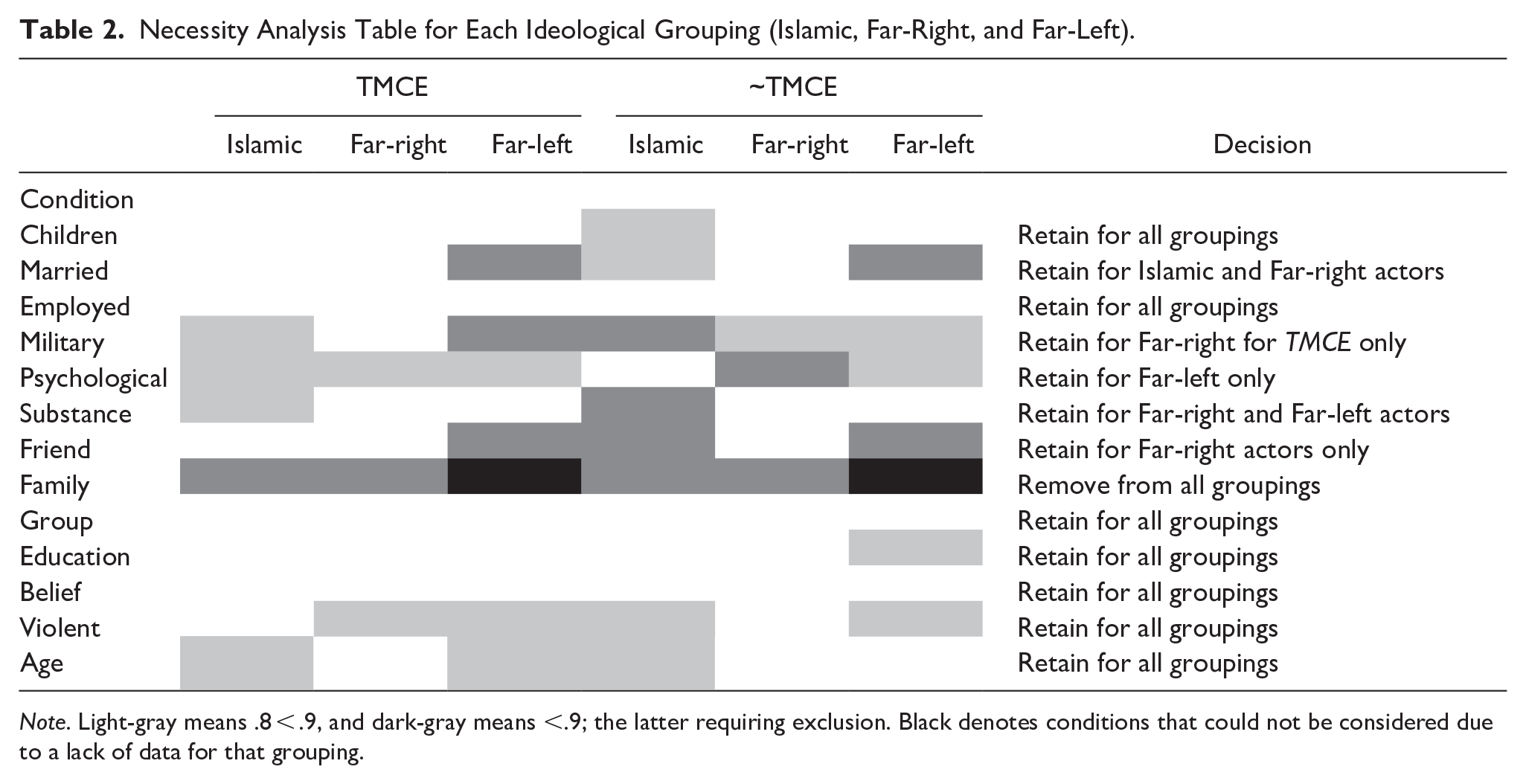
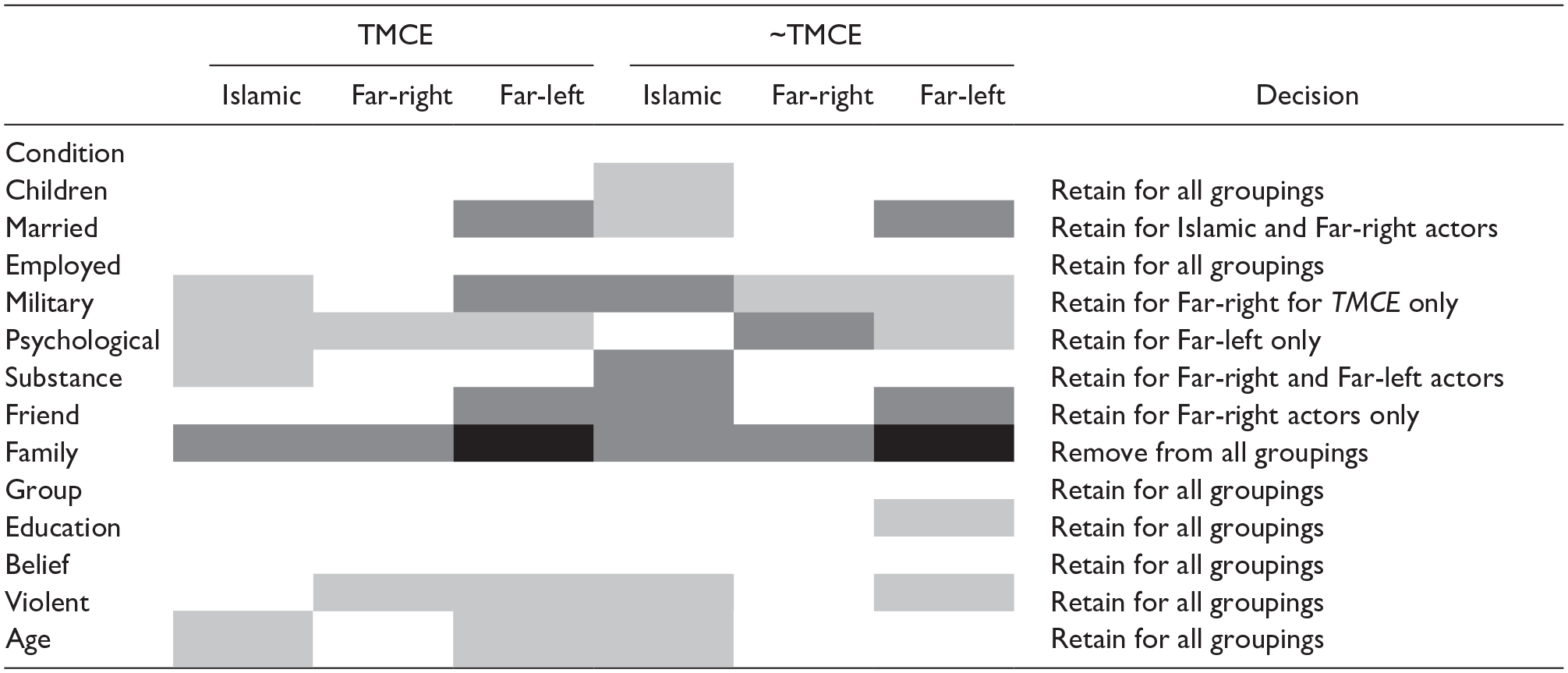
Note. Light-gray means .8 < .9, and dark-gray means <.9; the latter requiring exclusion. Black denotes conditions that could not be considered due to a lack of data for that grouping.
The proceeding sections will denote the truth table analysis and minimization process for each of the three ideological groupings. To conserve space and ensure parsimony throughout, the truth tables (e.g., rows presenting the presence or absence of conditions across the outcome) are outlined in Supplemental Appendix B for Islamic and Far-Right Extremists and all findings related to Far-Left Extremists can be found in Supplemental Appendix C.
Islamic Extremists
The truth tables had a frequency threshold of two cases, given sample size and the need to aim for inclusion of 75% to 80% of cases (see Greckhammer et al., 2013). 8 Due to the aforementioned findings of the necessity analyses, family was removed from the initial truth tables on TMCE. However, because military, substance, and psychological were all close to the 0.9 threshold for the necessity analysis, and the first two conditions were necessary conditions for ~TMCE, these were all removed. 9
Across the truth table, the top six rows show robust consistency, with each row representing between five and nine cases. More importantly, age and education were present across all six rows and children and married were absent. This means that individuals in their prime age-crime years who were more educated (high-school diploma being the cutoff, and having a college or vocational degree being full membership) but were neither married or had children were the most common cases for TMCE. Only one recipe included the presence of a radical friend or membership in an extremist group; somewhat contrary to the anticipated findings based on previous risk factors research and from the social learning theory perspective. However, there are 27 unique recipes provided, with five not producing a TMCE. Put simply, there are dozens of unique pathways to a TMCE amongst Islamic extremists, necessitating Boolean minimization to discern the important risk and protective factors.
The intermediate solution (see Table B1 in Supplemental Appendix B) has good consistency (>.8, see Pappas and Woodside for QCA thresholds) and very good solution coverage for a large sample (n = 212). All but one of the individual solutions presented hit a viable consistency threshold, albeit, all of the conditions operate differently across the solutions provided, except for age, belief, and friend. This means that actors in their prime age-crime years (consistent with control theories), who are deeply committed to a radical Islamic ideology (consistent with control and social learning theory), and who have a friend who has participated in extremist violence were sufficient conditions (incidental to control theories but consistent with social learning theory). A cause (condition) is sufficient but not necessary if it is capable of producing the outcome but is not the only cause that can (see Ragin et al., 2017, p. 36). Moreover, the solutions with the best raw coverage show the presence of radical ideological commitment and age operating in the same capacity; also alongside the absence of children or being married. Given the truth tables and minimized solutions, it seems these three conditions are in fact risk factors for TMCE amongst Islamic extremists. However, the absence of TMCE (~TMCE) needs to be assessed to discern equifinality, or the university of combinations of risk and protective factors that are associated with both TMCE and ~TMCE.
The findings for the absence of TMCE are even more problematic, as the QCA failed to converge, even after additional conditions that were close to be necessary (e.g., married, children) were removed for posterity. Put another way, while our ability to explain TMCE by Islamic extremists is quite good using factors related to control and social learning theories, our ability to explain the lack of TMCE amongst the same group is extremely poor. However, these findings need to be understood within the context that 187 of 212 incidents involving Islamic actors were coded as having committed a TMCE. Put another way, 88% of all cases involving Islamists that were included in our study (e.g., involving violence to some degree) were incidents of TMCE. This is the highest rate by a large margin, when compared to the other three ideological groupings and may be impacting the QCA. As such, this approach can explain the causal process really well for TMCE amongst Islamic actors, but not the absence of it. This inhibits our ability to robustly define the push-pull factors associated with both sides of the TMCE equation and importantly limits the ability to test all control theories that seek to provide an explanation for the absence of crime rather than explain the presence of crime.
Far-Right Actors
The truth tables had a frequency threshold of two cases, 10 and only psychological and family were removed from the truth tables as the latter was a necessary condition for both TMCE and ~TMCE, whereas the former was a necessary condition for ~TMCE and came close to being the case for TMCE (consistency = .873).
The top 11 truth table rows produced lots of unique pathways to TMCE, but with very low consistency. It is not until a row with seven cases (row 12) reaches adequate consistency. The top three rows with adequate consistency (rows 12, 17, and 18) are almost identical recipes, albeit two of three had the presence of marriage, two of three had the presence of the peak age for risk, and only one had the presence of a radical friend. Given the wide array of pathways to TMCE, and the fact that most of the rows in the truth table did not produce TMCE (e.g., “0”), minimization is needed to discern whether any useful patterns can be derived.
The intermediate solution produced decent coverage (0.165) for the sample size (n = 851), but the solution consistency fell right below the desired threshold (0.789). Even if such metrics reached acceptable levels, the raw coverage of the 11 unique solutions are quite poor (Table B2, cf. Table B1). Across the six solutions with adequate consistency, only children, military, education, and belief operate consistently; all demonstrating consistent presence but not providing a basis to differentiate between control and social learning theories. These findings demonstrate that perpetrators with children, military experience, higher levels of education, and a deep commitment to radical far-right ideologies were connected to TMCE which does provide evidence that these factors were not turning points away from TMCEs for far right actors. Each of these conditions were also present in many of the truth table rows for TMCE and the necessity analyses show higher levels of consistency for military, education, and belief (>.6). Given the major drop-off in cases included that met both the frequency and consistency thresholds, low raw coverage scores, and the extreme variation in recipes that produced TMCE, it is difficult to provide strong conclusions as to what conditions are sufficient for TMCE amongst far-right actors.
Greckhammer et al. (2013, p. 65) explain that low coverage “indicates incomplete causal evidence that leaves some paths to the outcome unaccounted for.” Raising the frequency threshold for inclusion in the truth table minimization process improved coverage, but decreased consistency. Put simply, there are too many different pathways for TMCE amongst far-right actors. While raw coverage levels do not need to be high for large samples (Greckhammer et al., 2013), these are still spectacularly low (cf. McCann, 2022a), and the consistency is so low that nothing meaningful can be derived for either theoretical perspective.
The truth table rows for ~TMCE were very similar to those for TMCE, in that most cases included in the top rows did not reach adequate consistency or produce ~TMCE. This finding coupled with the findings for TMCE likely indicate that models for TMCE are poorly specified in that other relevant conditions are not included. It could be that the necessary conditions that were excluded are the most important risk factors for TMCE for this population. This will be explored in the Discussion. The intermediate solutions had high consistency but even lower coverage for ~TMCE (Table B3) and demonstrated that no one condition was consistent across the 10 solutions with adequate consistency. The presence of higher education was included in all but one solution, and the presence of having children appeared in all but three of these solutions which supports the idea that these factors are not needed to learn sufficient definitions that are favorable for committing a TMCE and could be turning points away from committing a TMCE. Notably, the absence of a deep commitment to a radical ideology was only included in one solution, thereby showing its lack of importance for the absence of a TMCE. Relatedly, prior violence was inconsistent across all solutions, and amongst the nine solutions including the condition of group membership, with six constituted the presence of group membership in producing a lack of TMCE. When examining ~TMCE amongst far-right actors, no real sufficient conditions can be established, with the closest being the presence of higher education, albeit that condition operates in the same manner for TMCE.
Discussion and Conclusions
The primary insight gleaned from this study is that even with large sample sizes for a QCA and with a robust outcome to examine (e.g., almost half of all cases involved the presence of a TMCE), there were too many unique pathways to TMCEs across the three ideological groupings examined. This suggests that there is too much heterogeneity in these factors connected to both control and social learning theories to indicate that either theory explains participation in a TMCE better than the other or consistently on its own. Further, the role of various conditions (and their conjunctive combinations) varied quite a bit across the three ideologies examined, and these findings demonstrate that determining which actors will carry out a TMCE or not participate in a TMCE using the available conditions is challenging, subject to methodological limitations (see below), and is likely contingent on ideological motivation.
Across the analyses, findings variable immensely; with some conditions (e.g., education) serving as both risk and protective factors. While similar findings have been observed regarding the impact of employment on crime from the control theory perspective (Paternoster et al., 2003), these findings demonstrate that additional theoretical and empirical work is required to understand the role that education plays on committing TMCEs, especially when attempting to generalize across ideological perspectives. While we were unable to produce a viable QCA on ~TMCE for Islamic extremists, these findings suggest that connections to radical friends, a deep commitment to radical beliefs, and being of sufficient age (e.g., peak crime years) were notable risk factors for distinguishing those who committed a TMCE from those who did not. These findings are consistent with social learning theory and control theories, however one would expect the connection to radical friends to be incidental from the control theory perspective (Boman, 2017). Additional analyses better suited to the acquisition of radical friends would be needed to differentiate these findings however, highlighting important opportunities for future research. Findings demonstrated that education, belief, children, and military are important for far-right actors, however none were sufficient conditions. A wider range of conditions were important for far-left TMCEs, including married, friend, violent, and age. A prior history of criminal violence was sufficient for a TMCE, whereas not having radical friends or being married was necessary for both outcomes which is in contrast to previous findings and theoretical predictions. Further, not having military experience was also a necessary condition, but only for a TMCE. Higher education was both a risk and protective factor (only sufficient for ~TMCE) for this group, whereas having a radical ideology was important for explaining TMCE however the reverse was a sufficient condition for ~TMCE. This underscores the importance of commitment to ideology for explaining far-right TMCEs, while being educated and having radical friends operate similarly irrespective of outcome. This finding is problematic for all theories where peers and education are important explanatory variables for TMCEs and especially for social learning theory.
For Islamic extremists, actors in their prime age-crime years, who are deeply committed to a radical Islamic ideology, and who have a friend who has participated in extremist violence were sufficient conditions. The solutions with the best raw coverage showed that the presence of radical ideological commitment and age operating in the same capacity. Put simply, peak age risk, radical beliefs, and radical friends are all risk factors for TMCE amongst Islamic extremists which is line with the predictions of social learning theory. However, the QCA on the absence of TMCE failed to converge. As such, our ability to explain committing a TMCE by Islamic extremists is good, but our ability to explain not committing a TMCE is very limited suggesting that the observed factors related to control theories did not perform as expected. As mentioned, this is likely the case because 88% of all cases involving Islamic extremists were incidents of TMCE. This is the highest rate across the three groupings. As equifinality of TMCEs for this subsample could not be thoroughly examined, the findings should be taken cautiously for both theoretical perspectives.
The truth tables for far-right actors—for both outcomes—showed very low consistency. While the intermediate solution produced decent coverage, the raw coverage of the 11 unique solutions was quite poor. Across the six solutions with adequate consistency, only the presence of children, military service, more education, and commitment to radical beliefs operated consistently. Each of these conditions were also present in many of the truth table rows for TMCEs and the necessity analyses show higher levels of consistency for these conditions as well. However, given the major drop-off in cases included that met both the frequency and consistency thresholds, low raw coverage scores, and the extreme variation in recipes that produced a TMCE, this demonstrates that the pathway to a TMCE is extremely diverse and inconsistent with both control and social learning theories. Importantly however, the four above conditions did emerge as decent risk factors that should be explored further by scholars and other theoretical perspectives.
When looking at ~TMCE, the results were very similar. It is possible that the necessary conditions that were excluded (e.g., family and psychological) were the most important risk factors for TMCEs for this population and subsequent research is required to explore this further. While the intermediate solutions had high consistency, coverage was extremely low, and no single condition was consistent across the solutions provided, suggesting once again that neither theoretical perspective could explain the existing heterogeneity in the data. Again, the presence of higher education was included in all but one solution, and the presence of having children appeared in all but three of these solutions. Notably, the absence of a deep commitment to a radical ideology was only included in one solution, thereby showing its lack of importance for the absence of a TMCE. Relatedly, prior violence was inconsistent across all solutions, and amongst the solutions including the condition of group membership, a majority constituted the presence of group membership in producing a lack of TMCEs. These findings are both internally inconsistent and do not provide greater clarity for distinguishing risk and protective factors for both outcomes.
The findings for far-left actors were very similar to those for far-right actors, with specific regard to low raw coverage scores and massive variation in solutions provided despite decent solution coverage and consistency. Moreover, married, military, and friend were also removed for both QCAs of a TMCE and ~TMCE, as each were necessary conditions. This limits the comparison of findings across groupings. Similar to the findings for far-right actors, the top truth table rows were not robust indicators of the pathways to a TMCE (or the converse). These findings indicate that the presence of formal group membership and higher educational attainment were important but not sufficient conditions. Even with a much smaller sample population (n = 112) than far-right actors (n = 851), the amount of variation across the conjunctive conditional combinations was substantial. For example, across the solutions that reached adequate consistency, none have good raw coverage scores. This was the case for far-right actors as well. Unexpectedly, the presence of a violent criminal history was a sufficient condition for a TMCE for far-left actors. The absence of having more education and the presence of one’s peak age-crime years were notable, but not sufficient conditions, however, and the presence of radical beliefs appeared in almost all solutions too.
Truth tables for ~TMCE showed that the presence of having more education was important, and amongst the nine viable unique solutions, the presence of having more education was a sufficient condition as it appeared consistently across all solutions. As such, being more educated is a protective factor for ~TMCE. This is also the case for TMCEs too. Put simply, a condition can be logically tied to the production of both outcomes, but the interpretation of such findings renders an impractical conclusion—education can serve as both a risk and protective factor. Similarly, the lack of a deep commitment to a radical far-left ideology was sufficient for ~TMCE, albeit occurring less frequently, and both ~violent and ~psychological appeared to be important, but not sufficient conditions as well for ~TMCE. The role these conditions play on mediating radicalization pathways should be explored more by scholars.
Given the need to distill necessary and sufficient conditions for researchers to understand pathways to a TMCE, we provide the following table (Table 3) to summarize the nature and importance of our findings. Attention is drawn to social (children, married, and friend) and experiential (belief, education, and military) conditions.
Summary Table of Necessary (N), Sufficient (S), and Important but Not Sufficient (I) Conditions for Researchers to Understand Pathways to TMCE for Each Ideological Grouping (Islamic, Far-Right, and Far-Left).
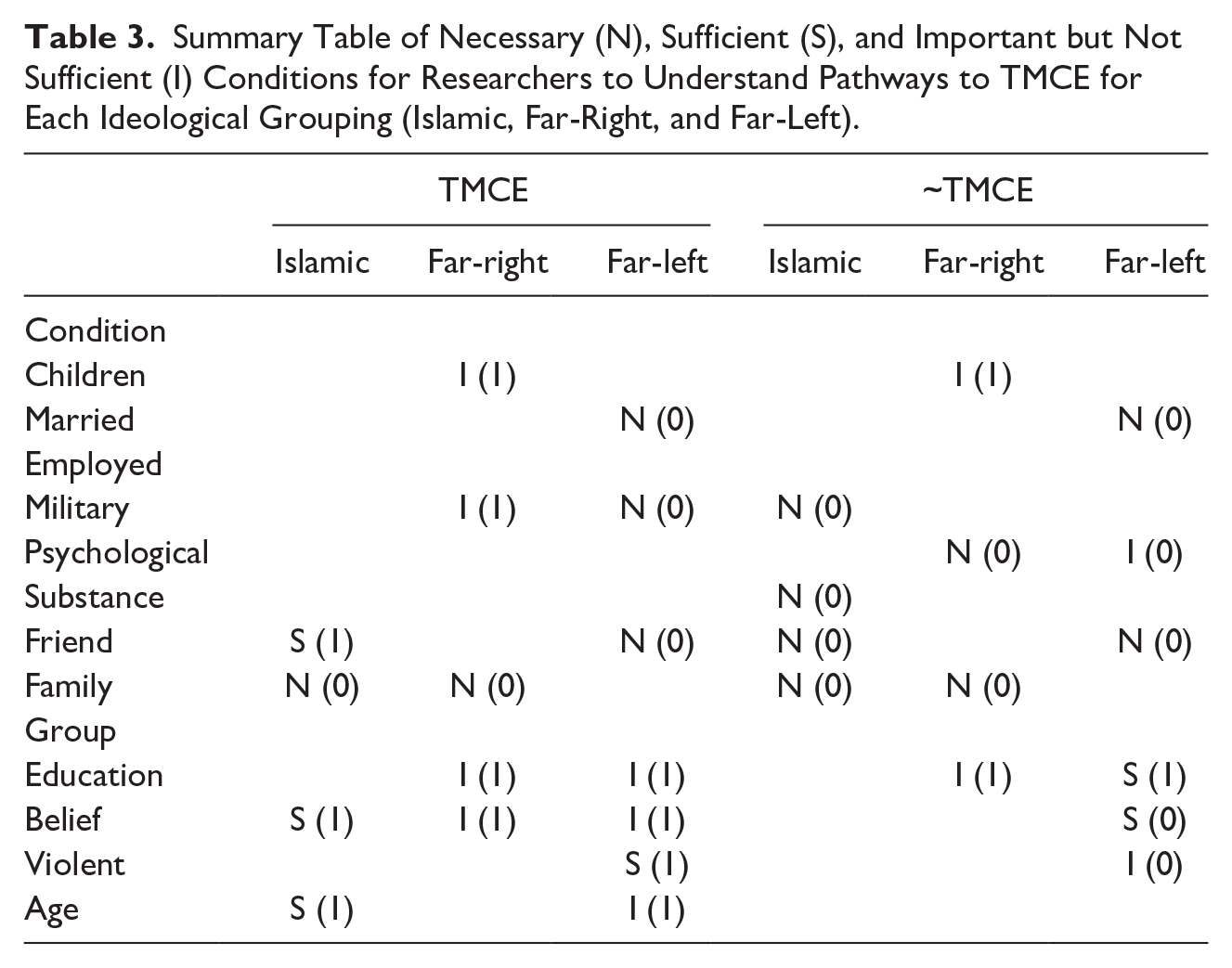
As previously discussed, the role of social relations on TMCEs was variable at best. Having children was important, but only for far-right actors, and operated as both a risk and protective factor indicating once again important heterogeneity within these individuals. However, being unmarried was a necessary condition for both outcomes, but only for far-left actors, which suggests that marriage was not a potential turning point away from TMCEs for those with other ideological beliefs. Again, family was excluded from all QCAs because it was both necessary for each outcome and had really low cell counts. Amongst Islamic extremists, having a radical friend was a sufficient condition for TMCEs, whereas not having a radical friend was a necessary condition for ~TMCE. This demonstrates that social connections are immensely important as a risk factor for Islamic extremists in perpetuating a TMCE. Similarly, the absence of a radical friend was a necessary condition for both outcomes for far-left actors. This suggests that having a radical friend is not meaningful as a risk factor for TMCEs for those following far-left ideologies.
Experiential factors emerged as important when examining TMCEs. Across the QCAs for the three subgroups, it is clear that education played an important role as both a risk and protective factor for far-right and far-left actors, albeit having more education was a sufficient condition for the absence of TMCEs amongst the former group. Having a military background was also an important but not sufficient condition for TMCEs amongst far-right actors. Moreover, the absence of military experience was a necessary condition for TMCEs amongst far-left actors, and for ~TMCE amongst Islamic extremists. Meaning, not having military experience was more causal for TMCEs amongst the former grouping, whereas not having such experience was positive for Islamic extremists. Put simply, it is a risk factor for Islamic extremists, and to a lesser extent, far-right actors, but not far-left actors. Having a deep commitment to a radical ideology was a sufficient condition for TMCE amongst Islamic extremists and was important but not sufficient for the other two groupings on TMCE. However, the absence of such a commitment was a sufficient condition for ~TMCE amongst the far-left. Taken as a whole, being committed to a radical ideology is a risk factor for Islamic extremists and far-left actors, but is less important when examining the far-right, once again reinforcing important differences across ideologies.
Other findings, such as substance or psychological being necessary conditions for ~TMCE across Islamic and far-right actors is hard to parse given the foregoing variability in findings and the low cell counts for such actors when looking at cross-tabulations regarding a TMCE. As such, future research should delve further into these experiential measures to discern their probative value for extremism violence, particularly as others have not found them to be extremely important for radical violence either amongst Islamic extremists (see McCann, 2022a). Notably, being a member of an extremist group or movement was not important across any of the models of groupings. This also seemingly contradicts prior research as well (McCann, 2022a), albeit the outcomes under examination here were much more specific. It may be the case that ties to formal extremist or terrorist organizations are not important when merely distinguishing between extremist violence broadly and extremist TMCEs specifically. The presence of group found some modest importance for far-left actors on TMCEs when looking at some unique solutions, but beyond that, not viable conclusions can be rendered.
Similarly, employment status was too variable across the study to distill articulable findings. It may simply be the case that employment status is both a risk and protective factor, but does not matter when distinguishing traditional political violence from TMCEs. While being in the peak age of crime years was a sufficient condition for TMCEs amongst Islamic extremists, it was only important for TMCEs committed by far-left actors. This comports with the scholarship that Islamic and far-left actors are younger in average and commit their crimes during the traditional peak crime years (see literature view for discussion). Given the low raw coverage scores of unique solutions for far-right and far-left actors, but not for Islamic extremists, it is likely that a lack of ideological specificity impedes the ability to distill concrete logical reductions across the world of conditions available. Put another way, including a variety of different actors, with variable backgrounds and political and social aims, it is likely that the solutions produced do not viably explain the plethora of pathways to a TMCE, because even a grouping of “far-right” extremists is too heterogeneous. As such, future work should explore TMCEs committed by far-right (and far-left) actors by running ideologically-specific (e.g., anti-government/militia) QCAs.
The study encountered two core issues: low raw coverage scores of unique solutions during minimization for far-right and far-left actors, and impractical levels of equifinality amongst the same groups. Solution coverage was concordantly low amongst the recipes provided for all of the analyses, with raw coverage of individual solutions being even lower. Consequently, our models as a whole “do not fully capture the complex causality underlying outcomes” (Greckhamer et al., 2018, p. 483). Another limitation that emerged was that family was not able to be used at all in our analyses. This was because only 5.1% of the entire sample had at least one family member involved in such behavior after EM imputation and re-coding of the variable (from four to two categories). There were zero for far-left actors, while numerous Islamic extremists indeed had family members involved in prior extremist violence. As such, the role of family could not be fully examined here, despite varied importance for different ideological groupings and its theoretical importance.
Lastly, the frequency threshold for inclusion for the QCAs for far-left actors was relaxed to “1” despite having a large sample. When the threshold for inclusion was increased to “2” cases per row, the solution coverage for intermediate solutions for ~TMCE dropped from 0.325 to 0.14. These models have far less cases, and even though the findings also confirmed the importance and directionality of education and violent, these findings should be taken with caution. Put simply, the former analyses were overly inclusive, whereas the latter additional analyses are overly exclusive. While scholars are encouraged to experiment with thresholds to test sensitivity of findings (Greckhamer et al., 2013), it is clear that far-left actors, as a subgroup, are too diverse to study even when a sufficient sample is derived further demonstrating the limitations of both theoretical perspectives.
The most important implication for future researchers stemming from this study is that QCA studies on extremism generally, but TMCEs specifically, need to be ideologically specific. Because of the novel nature of this study, only separate QCAs were run on categories of actors. However, the most robust solutions provided for TMCEs were for Islamic extremists, as raw coverage for solutions was much higher than it was for far-right and far-left extremists. This begs the question as to what the findings might have been if specific ideologies were examined instead, such as far-right racist or white supremacist actors versus anti-government actors. Future research should replicate these analyses with a larger pool of conditions that were not considered here, while providing more ideological specificity when parameterizing models.
Taken together, the findings from this study suggest neither social learning theory nor control theories were consistently supported across the three ideological groups that were examined. Instead, ideologically specific findings emerged such as connections to radical friends, a deep commitment to radical beliefs, and being of sufficient age were notable risk factors for Islamic extremists, while education, radical beliefs, having children, and military service were important conditions for far-right actors. None were sufficient conditions, however. A wider range of conditions were evident for far-left TMCEs, with a prior history of criminal violence being sufficient for a TMCE, while not having radical friends or being married was necessary for both outcomes, and not having military experience was also a necessary condition, but only for TMCEs.
Supplemental Material
sj-docx-1-cad-10.1177_00111287241305041 – Supplemental material for Radicalization Pathways to Terrorist Mass Casualty Violence Across Ideological Motivations: An Examination of Learning and Control Perspectives
Supplemental material, sj-docx-1-cad-10.1177_00111287241305041 for Radicalization Pathways to Terrorist Mass Casualty Violence Across Ideological Motivations: An Examination of Learning and Control Perspectives by Daren Fisher and Wesley S. McCann in Crime & Delinquency
Supplemental Material
sj-docx-2-cad-10.1177_00111287241305041 – Supplemental material for Radicalization Pathways to Terrorist Mass Casualty Violence Across Ideological Motivations: An Examination of Learning and Control Perspectives
Supplemental material, sj-docx-2-cad-10.1177_00111287241305041 for Radicalization Pathways to Terrorist Mass Casualty Violence Across Ideological Motivations: An Examination of Learning and Control Perspectives by Daren Fisher and Wesley S. McCann in Crime & Delinquency
Supplemental Material
sj-docx-3-cad-10.1177_00111287241305041 – Supplemental material for Radicalization Pathways to Terrorist Mass Casualty Violence Across Ideological Motivations: An Examination of Learning and Control Perspectives
Supplemental material, sj-docx-3-cad-10.1177_00111287241305041 for Radicalization Pathways to Terrorist Mass Casualty Violence Across Ideological Motivations: An Examination of Learning and Control Perspectives by Daren Fisher and Wesley S. McCann in Crime & Delinquency
Footnotes
Declaration of Conflicting Interests
The author(s) declared no potential conflicts of interest with respect to the research, authorship, and/or publication of this article.
Funding
The author(s) received no financial support for the research, authorship, and/or publication of this article.

Supplemental Material
Supplemental material for this article is available online.
Notes
Author Biographies
References
Supplementary Material
Please find the following supplemental material available below.
For Open Access articles published under a Creative Commons License, all supplemental material carries the same license as the article it is associated with.
For non-Open Access articles published, all supplemental material carries a non-exclusive license, and permission requests for re-use of supplemental material or any part of supplemental material shall be sent directly to the copyright owner as specified in the copyright notice associated with the article.
