







Abstract
This study investigates how toxic online disinhibition influences cyberbullying through the mediating roles of belonging collapse and bystander complicity. Using a cross-sectional survey of 379 Chinese university students, we tested a sequential mediation model with structural equation modeling. Results indicate that higher levels of toxic disinhibition predict lower perceived belonging and greater passive bystander behavior, both of which are associated with increased cyberbullying perpetration. The findings highlight a psychological pathway from online disinhibition to harmful online behavior and underscore the importance of fostering digital belonging and bystander accountability in cyberbullying prevention. The study contributes to the understanding of complex psychological mechanisms within online aggression and offers implications for platform design and policy.
Keywords
Introduction
Cyberbullying exerts profound negative impacts across personal, professional, and academic domains, often leading to psychological distress, burnout, and diminished life satisfaction (Oksanen et al., 2020; Kowalski et al., 2014; Li et al., 2024). Unlike traditional bullying, its boundary-free nature enables instantaneous mass participation (Kowalski et al., 2014; Mahanta & Khatoniyar, 2019). However, existing research predominantly fixates on cyberbullying behaviors themselves, often overlooking bystander attitudes that may critically exacerbate its impact. Although individual factors such as toxic online disinhibition, sense of belonging, and bystander behavior have been explored, the interplay among these variables—particularly how toxic disinhibition amplifies harm—remains under-investigated.
University students represent a critical high-risk group for cyberbullying, given their intensive social media engagement, psychosocial volatility, and identity exploration (Li et al., 2024; Yang et al., 2021). Their developmental stage makes them particularly vulnerable to online disinhibition effects, which are known to suppress bystander intervention (Chen et al., 2024; Huang et al., 2023). Moreover, interventions targeting this demographic—such as programs aimed at enhancing social belonging—have demonstrated superior efficacy in improving prosocial online behaviors, likely due to their cognitive flexibility and high digital immersion (Sela-Shayovitz et al., 2024). However, it should be noted that while university student samples provide valuable insights into digital peer dynamics, their experiences may not fully represent all age groups or educational contexts. Patterns of cyberbullying, as well as the efficacy of targeted interventions, can vary substantially across different developmental and sociocultural groups.
Sense of belonging, a fundamental psychological need, refers to an individual’s feeling of acceptance within a group (Baumeister & Leary, 1995). Social media provides opportunities for self-expression, connection-building, and validation through online communities (Ellison et al., 2007). Feeling accepted and supported in online spaces encourages positive behaviors and reduces cyberbullying (Valkenburg & Peter, 2009). Conversely, perceived exclusion or neglect could lead to frustration or attention-seeking, increasing the risk of cyberbullying (Wright & Li, 2013). Thus, sense of belonging in online contexts might significantly shape digital behavior.
The online disinhibition phenomenon refers to the tendency to act more freely online, linked to cyberbullying and other antisocial behaviors (Kowalski et al., 2014; Smith et al., 2008; Suler, 2004). Anonymity and depersonalization might amplify the effects of exclusion, making individuals more likely to engage in harmful actions (Suler, 2004). The interaction of online disinhibition with other factors like bystander effect can influence cyberbullying behavior (Fowler et al., 2022; Juvonen & Gross, 2008; Navarro-Rodríguez et al., 2023). Suler (2004) distinguishes between benign online disinhibition (e.g., helping others) and toxic online disinhibition (e.g., cyberbullying; Lapidot-Lefler & Barak, 2012; Wachs et al., 2019; Wright & Wachs, 2020). The absence of face-to-face interaction and the vastness of online environments make harmful behaviors harder to address promptly (Audrezet et al., 2020; Cha et al., 2010; Firdaniza et al., 2021; Joshi et al., 2023).
The role of bystanders is crucial. Cyberbullying involves not only perpetrators and victims but also bystanders’ responses (Brody & Vangelisti, 2016; Machackova & Pfetsch, 2016). Bystanders in cyberbullying contexts may act passively (Brody & Vangelisti, 2016) or intervene (Bastiaensens et al., 2014; Khanolainen et al., 2021; Madoglou & Dimitriou, 2014), influenced by empathy, moral responsibility, group norms, and the cultural dynamics of online platforms (Machackova et al., 2015; Slonje et al., 2013). When intervention is supported by group norms, bystanders are more likely to act, reducing cyberbullying (Jones et al., 2015). Therefore, promoting proactive bystander intervention is a critical component in cyberbullying prevention.
Despite these insights, prior research often isolates variables like belongingness, disinhibition, and bystander behaviors. This study addresses this gap by exploring how these factors interact to influence cyberbullying, aiming to clarify psychological drivers and potential online-offline moral dualities. We conceptualize the collapse of digital belonging as an invisible catalyst—a latent but powerful force that silently erodes prosocial norms and fosters both disinhibited expression and bystander passivity. This metaphor highlights how a diminished sense of community can destabilize moral behavior in online environments, setting the stage for cyberbullying to emerge and persist. To deepen this analysis, we draw upon an integrative framework that bridges social psychology and criminology. Social Identity Theory posits that low perceived belonging can lead to frustration-driven aggression and passive bystander responses, particularly when group norms reinforce such behavior (T. K. H. Chan et al., 2023; Wright & Li, 2013). From a criminological standpoint, Social Disorganization Theory highlights the erosion of formal, informal, and technical control systems in digital spaces, while Rational Choice Theory underscores the reduced cost of online aggression under anonymity (Clarke & Cornish, 1985). Labeling Theory completes this framework by showing how victims are stigmatized and excluded, reinforcing group deviance through social media amplification (Tokunaga, 2010). Together, these perspectives help explain how the breakdown of digital belonging fuels disinhibition and bystander complicity, contributing to the persistence of cyberbullying in networked societies.
Literature Review and Hypothesis Development
Online Disinhibition, Sense of Belonging, and Cyberbullying: Foundations and Dual Pathways
A fundamental human motivation, the need to belong, underpins both psychological well-being and social adjustment (Baumeister & Leary, 1995). Sense of belonging reflects a harmonious relationship between individuals and their environments, effectively reducing cognitive load and fostering positive subconscious adaptation (May, 2011). Social exclusion, conversely, is regarded as a primary source of emotional distress; a lack of belonging may trigger adverse outcomes such as criminal behavior, suicide, or psychological disorders (Baumeister & Leary, 1995). Importantly, sense of belonging is dynamic—it fluctuates with changes in both personal and social circumstances, leading to diverse behavioral outcomes (May, 2011).
In online environments, the nature of belonging becomes multifaceted. Individuals may enhance their sense of belonging not only by establishing virtual relationships but also through participation in online culture, internet language, and platform norms, all of which foster experiences of acceptance and validation (May, 2011). However, a deficit in belonging, especially in adolescence, can heighten vulnerability to aggression, with evidence linking lower belonging to increased rates of physical fights, exclusion, and even cyberbullying (Lawnik & Krucińska, 2019; Stenseng et al., 2014; Underwood & Ehrenreich, 2014). The absence of social support further amplifies aggression and maladaptive behaviors, which in online contexts may manifest as cyberbullying or related forms of digital aggression (Lawnik & Krucińska, 2019).
Online disinhibition theory, first articulated by Suler (2004), provides a foundational framework for understanding the distinctive dynamics of digital environments. Suler identifies several critical components—anonymity, invisibility, asynchronicity, solipsistic introjection, dissociative imagination, and minimization of authority—which together reduce self-monitoring and weaken normative pressure. Online disinhibition manifests in two distinct forms: toxic and benign. Toxic online disinhibition is characterized by reduced self-regulation and increased impulsivity (Suler, 2004). It may manifest as aggression—including anonymous hostility and empathy deficits—but is conceptually distinct from cyberbullying itself. As Suler (2004) and the SIDE model (Postmes et al., 1998) highlight, the affordances of the online environment—especially anonymity and invisibility—fuel deindividuation, depersonalization, and toxic behaviors. Crucially, while toxic disinhibition can increase the risk of aggression and facilitate cyberbullying, it should not be conflated with cyberbullying as an outcome; rather, it constitutes a set of situational psychological conditions that may precede or mediate actual deviant behaviors (Wachs et al., 2019; Wang et al., 2024). Clarifying this distinction avoids the conceptual tautology that can arise when constructs are defined by the behaviors they are posited to predict.
Benign online disinhibition, in contrast, enables positive self-expression, emotional support, and empathy activation. The literature consistently shows that benign disinhibition fosters community-building and strengthens belonging by encouraging open sharing and support among users (Baker, 2014; Maftei et al., 2024; Suler, 2004). Positive digital interactions are associated with increased self-worth, social validation, and cognitive empathy, thus increasing the likelihood of prosocial bystander intervention (Barlińska et al., 2013). This distinction is well recognized in the literature, with benign disinhibition commonly associated with community cohesion, while the negative impact of toxic disinhibition on belonging and bystander dynamics remains more poorly understood and represents an under-explored research gap.
In sum, online environments function as a “double-edged sword”: toxic disinhibition erodes belonging through anonymity and diminished self-monitoring, promoting outsider and reinforcer bystander roles that indirectly fuel cycles of cyberbullying (Jia et al., 2022; Suler, 2004; Wachs et al., 2019); conversely, benign disinhibition strengthens social cohesion and supports prosocial action (Baker, 2014; Maftei et al., 2024). The process by which toxic disinhibition undermines belonging—and thereby increases the risk for negative outcomes—remains insufficiently explored and motivates the current investigation.
The Sequential Dynamics of Cyberbullying
The bystander effect, originally conceptualized in offline settings, is particularly salient in digital contexts where anonymity, depersonalization, and group dispersion are pronounced. In online environments, bystanders’ responses to aggressive or bullying behaviors range from passive observation and reinforcement of harm to active intervention (Brody & Vangelisti, 2016). Toxic online disinhibition can amplify individual aggression and increase the propensity for cyberbullying (Maftei et al., 2024; Wachs & Wright, 2018). Under such conditions, individuals are more likely to disregard the consequences of perpetration and victimization, reduce self-monitoring, and shift from “passive observers” to “active contributors” in bullying episodes (Brody & Vangelisti, 2016).
Digital drift theory (Goldsmith & Brewer, 2015) provides an additional perspective, explaining how the gradual normalization of online hostility and group apathy erodes moral constraints and facilitates bystander inaction. Over time, exposure to hostile group norms and the weakening of feedback mechanisms promote deviant conduct, making bystander apathy more common and difficult to disrupt (Wachs & Wright, 2018). Importantly, prior research indicates that loss of belonging often precedes bystander apathy in offline contexts (Salmivalli et al., 2011), and the distinctive properties of digital environments—such as anonymity, asynchronicity, and depersonalization—amplify this risk sequence (Wachs & Wright, 2018).
Empirical evidence corroborates these pathways. For example, Zhao (2023) found that individuals with prior cyberbullying experience are more likely to exhibit passive or permissive bystander behaviors when witnessing others being bullied. Toxic online disinhibition not only directly increases one’s likelihood of engaging in bullying, but also moderates the relationship between bystanders and perpetrators; the stronger the perceived disinhibition, the more likely bystanders are to transition from passive to active perpetration (Wachs & Wright, 2018). Conversely, benign online disinhibition can foster empathy and prosocial norms, supporting constructive intervention and digital resilience (Baker, 2014; Barlińska et al., 2013).
Within this framework, it is essential to distinguish clearly between mediation and moderation. Mediation refers to the indirect effect of an independent variable (e.g., toxic disinhibition) on an outcome (e.g., cyberbullying) through a third variable (e.g., bystander effect or belonging). Moderation refers to the buffering or amplifying effect of a third variable on the strength or direction of this relationship (see R5-2 reviewer comment). This review explicitly examines sequential and mediating pathways—how toxic online disinhibition first weakens sense of belonging, which in turn shapes bystander behavior, ultimately increasing the risk of cyberbullying—without conflating these mechanisms.
The Interplay of Sense of Belonging and Bystander Effect in Digital Contexts
Sense of belonging remains a central psychological need across both offline and online settings (Baumeister & Leary, 1995; Williams, 2007). When individuals experience a high sense of belonging, they are more likely to exhibit prosocial behaviors, including active bystander intervention in bullying situations. For instance, Tam and Brown (2020) report that adolescents with strong belonging to their school environment are more likely to intervene or seek help when witnessing school bullying or harassment. Conversely, those with heightened social exclusion or low self-identity tend to display avoidant, indifferent, or even enabling bystander behaviors (Stenseng et al., 2014).
In digital environments, the absence of belonging is often amplified by anonymity and depersonalization. Individuals seeking “online refuge” to fulfill unmet belonging needs may, if they fail to receive positive feedback, develop exclusionary or aggressive bystander responses (Knowles et al., 2015; Twenge et al., 2001). When toxic disinhibition and low belonging coincide, bystander effects are especially likely to manifest as passive or permissive responses, further escalating the risk of cyberbullying (Wachs & Wright, 2018). In contrast, strong belonging—potentially cultivated through benign disinhibition—can buffer against these risks and encourage proactive bystander intervention (Aljasir, 2023; Barlińska et al., 2013; Yang et al., 2021).
Prior research has identified links between online disinhibition, belonging, and bystander behaviors (Knowles et al., 2015; Stenseng et al., 2014; Twenge et al., 2001). Although these studies did not formally test mediation models, they support the plausibility of a sequential pathway: toxic disinhibition may erode belonging, which subsequently influences passive bystander responses, ultimately contributing to increased cyberbullying. This study seeks to empirically test this hypothesized mediation pathway. Collectively, this review highlights both the well-established and underexplored pathways linking online disinhibition, sense of belonging, bystander effects, and cyberbullying. While the literature robustly documents the positive role of benign disinhibition in fostering belonging and community-building, the mechanisms by which toxic disinhibition undermines belonging and facilitates negative bystander behavior are less understood.
Notably, although prior research has established individual links between these variables, few studies have empirically examined the full sequential mediation pathway involving sense of belonging and bystander behavior. Addressing this gap, the present study proposes and tests a theoretically motivated chain mediation model. This gap informs the rationale and conceptual framework for the present study.
Method
Participants
A total of 379 Chinese university students participated in this study (225 males, 59.4%; 154 females, 40.6%; Mage = 24.21, SD = 5.54). Participants were recruited through convenience sampling: the survey link was distributed via university class groups on social media platforms (e.g., WeChat and QQ), with the assistance of academic peers and student volunteers who shared the link within their networks across different regions of China (eastern, central, and western provinces).
Eligibility was limited to currently enrolled undergraduate or postgraduate students, as stated on the recruitment page. Participation was voluntary, anonymous, and confidential; participants could withdraw at any time without consequence.
While the sample was balanced in gender and geographically diverse, it was not probability-based. As such, the margin of error was not calculated, and the representativeness of the sample is limited. Potential self-selection bias should also be considered.
Measures
Online Disinhibition Scale
The Online Disinhibition Scale developed by Udris (2014) was used to measure participants’ perceived degree of online disinhibition. This scale consists of 11 items divided into two subscales: Benign Disinhibition (seven items) and Toxic Disinhibition (four items). Responses were rated on a 4-point Likert scale ranging from 0 (disagree) to 3 (agree), with higher scores indicating a stronger disinhibition effect. In line with Udris (2014), subscale scores were calculated by averaging item responses, and no items were reverse-coded. In this study, only the Toxic Disinhibition subscale was used in the analysis, as it directly aligns with the theoretical focus on antisocial online behaviors. Udris (2014) reported excellent model fit indices (TLI = 0.99, CFI = 0.99, RMSEA = 0.05) and satisfactory internal consistency (α = .85 for Toxic Disinhibition), which was replicated in the current study (α = .85).
Short Cyberbullying and Cybervictimization Scale
The Short Cyberbullying and Cybervictimization Scale (Xie et al., 2022) assesses experiences of cyberbullying and victimization with 12 items across two subscales (six items each; e.g., “I post or forward remarks online that embarrass others” for cyberbullying; “I received hurtful messages via WeChat, email, or text” for cybervictimization). Items are rated on a 5-point Likert scale (1 = never, 5 = daily), and subscale scores are calculated as means, with higher scores indicating greater frequency. No items require reverse scoring. In this study, only the Cyberbullying subscale was used in mediation analyses to focus on perpetration. The original scale showed good validity (CFI = 0.98, TLI = 0.97, RMSEA = 0.06, SRMR = 0.02) and reliability (α = .91–.90); Cronbach’s alpha in this sample was .93 for Cyberbullying and .92 for Cybervictimization.
General Sense of Belonging Scale
The General Sense of Belonging Scale (Deng et al., 2020) was used to assess participants’ perceived belonging. The original 12-item scale consists of Acceptance and Rejection subscales (e.g., “I feel accepted by others”; “I feel excluded from social groups”), rated on a 7-point Likert scale (1 = completely disagree, 7 = completely agree). Rejection items were reverse-scored so that higher average scores reflect a stronger sense of belonging. Deng et al. (2020) reported strong psychometric properties (CFI = 0.96, TLI = 0.95, RMSEA = 0.08, SRMR = 0.03; α = 0.93).
In this study, parallel real-life and online versions were adapted by specifying context in each item (e.g., “In online settings, I feel accepted by other netizens”). A pilot test confirmed the clarity and relevance of these adaptations. Each version’s total score was calculated as the mean of all items (with reverse scoring as needed). Cronbach’s alpha was .92 for the real-life version and .87 for the online version, indicating high reliability.
Student Bystander Behavior Scale
The Student Bystander Behavior Scale (SBBS; Thornberg & Jungert, 2013) was used to assess participants’ actions when witnessing cyberbullying. The scale includes three subscales: Defender Behavior (two items), Outsider Behavior (two items), and Reinforcer Behavior (four items), with sample items such as “I tried to get the bully to stop” (Defender) and “I didn’t do anything but was quiet and passive instead” (Outsider). Items are rated on a 5-point Likert scale (1 = never, 5 = always), and mean scores were calculated for each subscale, with higher scores reflecting greater frequency of the corresponding behavior. In this study, only the Outsider Behavior subscale was included in the analysis due to its significant mediating effect in the hypothesized model. The original scale demonstrated acceptable reliability and model fit (α = .82, CFI = 0.94); in this study, Cronbach’s alpha for Outsider Behavior was .77.
Procedure and Data Analysis
After electronic informed consent, participants completed an anonymous online questionnaire on Wenjuanxing, a widely used Chinese survey platform. Ethical approval was obtained from the City University of Macau IRB. Data from 379 participants were analyzed using SPSS 26.0. Pearson correlations examined associations among toxic online disinhibition, online sense of belonging, outsider bystander behavior, and cyberbullying perpetration. Control variables (e.g., gender, age) were omitted to focus on hypothesized psychological mechanisms. Sequential mediation was tested with Hayes’ PROCESS macro (Model 6; 5,000 bootstraps). VIF (1.308–1.437) and tolerance values (0.696–0.765) indicated no multicollinearity among predictors.
Research Hypotheses
Result
Correlational Analysis of Sense of Belonging, Online Disinhibition Effect, and Bystander Behavior
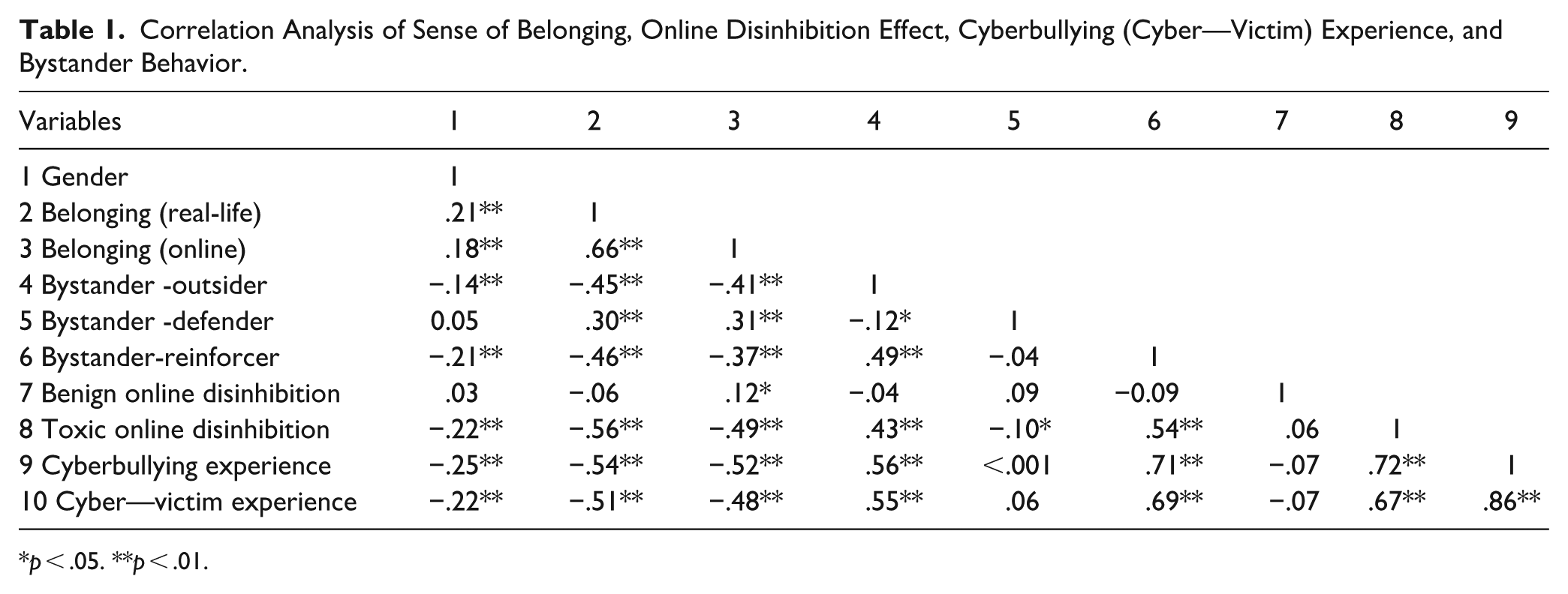
Correlation analyses (Table 1) indicate that individuals with higher Real-life Sense of Belonging (r = –.54, p < .01) and Online Sense of Belonging (r = −.52, p < .01) tend to engage in fewer Cyberbullying behaviors. Likewise, both Real-life (r = −.51, p < .01) and Online Sense of Belonging (r = −.48, p < .01) show negative associations with Cyber-Victim experiences. These results support
Correlation Analysis of Sense of Belonging, Online Disinhibition Effect, Cyberbullying (Cyber—Victim) Experience, and Bystander Behavior.
p < .05. **p < .01.
Turning to the Online Disinhibition Effect, Toxic Online Disinhibition is negatively correlated with Real-life Sense of Belonging (r = −.56, p < .01) and Online Sense of Belonging (r = −.49, p < .01). This finding also aligns with
Further examining cyberbullying and victimization, both variables show positive associations with outsider and reinforcer bystander behaviors. Cyberbullying experience correlates positively with Bystander-Outsider (r = .56, p < .01) and Bystander-Reinforcer (r = .71, p < .01) roles, while Cyber-Victim experience also correlates positively with these two bystander stances (r = .55, p < .01 for outsider; r = .69, p < .01 for reinforcer). These relationships suggest that individuals more involved in bullying dynamics (as perpetrators or victims) may gravitate toward bystander behaviors that either fail to inhibit or actively reinforce aggression.
Notably, both Cyberbullying (r = .72, p < .01) and Cyber-Victim experiences (r = .67, p < .01) correlate positively with Toxic Online Disinhibition. Although this does not directly test
The Chain Mediation Effect of Toxic Online Disinhibition, Online Sense of Belonging, and Bystander Behavior on Cyberbullying
This portion of the study examined whether the Toxic Online Disinhibition Effect (X) influences Cyberbullying (Y) through a two-step chain of mediators: Online Sense of Belonging (M1) and Outsider Bystander Behavior (M2). A sample of 379 participants was analyzed using Model 6 in the PROCESS macro (Hayes, 2013) to assess the proposed chain mediation model. Figure 1 depicts the hypothesized mediation pathway.
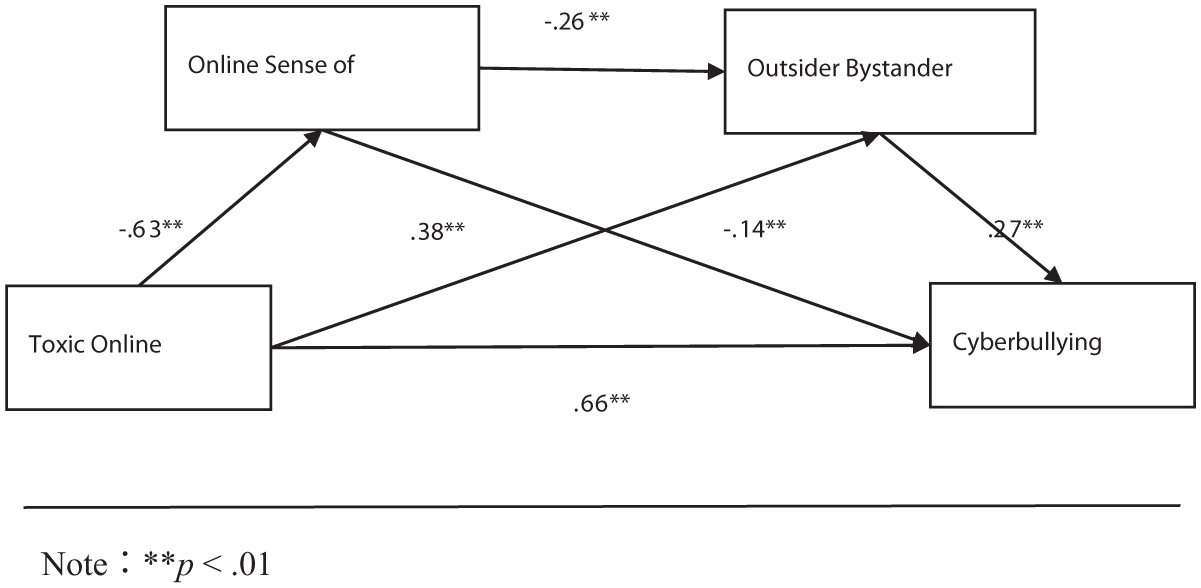
Chain mediation of toxic online disinhibition, online sense of belonging, and bystander behavior on bullying behavior.
Direct and Indirect Effects on Mediators and Outcome
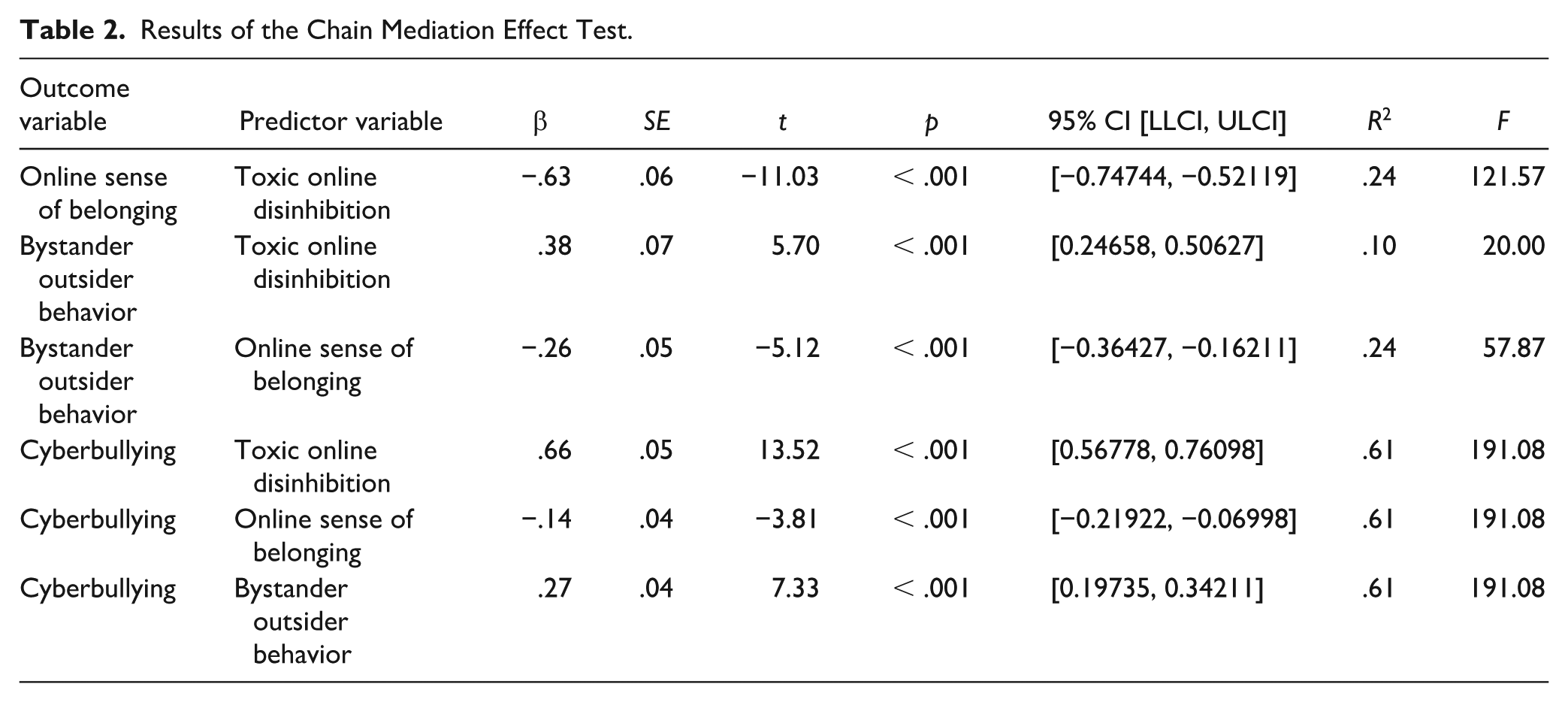
As presented in Table 2, Toxic Online Disinhibition had a significant negative effect on Online Sense of Belonging (β = −.63, p < .001), explaining 24.4% of the variance (R2 = .244, F = 121.57, p < .001). In the subsequent bystander model, Toxic Online Disinhibition positively predicted Outsider Bystander Behavior (β = .38, p < .001), while Online Sense of Belonging negatively predicted Outsider Bystander Behavior (β = −.26, p < .001; R2 = .096). Regarding the final outcome, Cyberbullying, Toxic Online Disinhibition exerted a significant direct positive effect (β = .66, p < .001), while Online Sense of Belonging negatively predicted bullying (β = −.14, p < .001) and Outsider Bystander Behavior positively predicted bullying (β = .27, p < .001).
Results of the Chain Mediation Effect Test.
Chain Mediation Effects and Hypotheses Testing
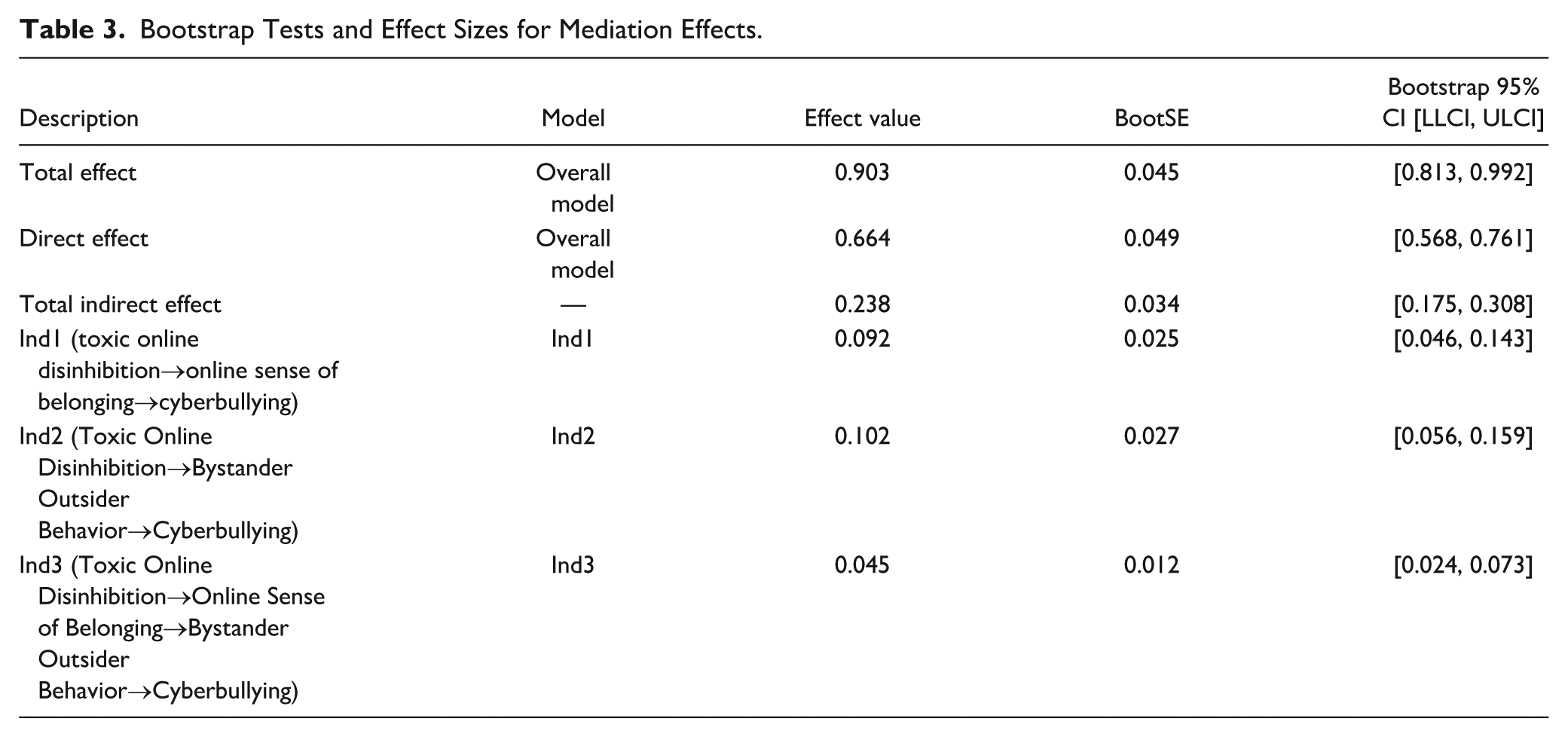
Table 3 summarizes the bootstrap estimates. The total indirect effect is significant (Effect = 0.238, 95% CI [0.175, 0.308]), with specific indirect effects through Online Sense of Belonging (Effect = 0.092, 95% CI [0.046, 0.143]) and Outsider Bystander Behavior (Effect = 0.102, 95% CI [0.056, 0.159]) both reaching statistical significance. In line with
Bootstrap Tests and Effect Sizes for Mediation Effects.
These findings support the proposed framework.
Discussion
Discussion of Findings and Theoretical Considerations
The results of this study provide comprehensive empirical support for the hypothesized pathways among toxic online disinhibition, sense of belonging, bystander roles, and cyberbullying perpetration and victimization.
First, toxic online disinhibition was found to be significantly and positively correlated with both cyberbullying perpetration and victimization (Suler, 2004), confirming
Higher levels of sense of belonging, both offline and online, were associated with a lower likelihood of engaging in cyberbullying perpetration, as well as with a decreased tendency to adopt passive or enabling bystander roles (Piccoli et al., 2020; Pozzoli et al., 2012; Gini et al., 2008), confirming the protective mediation hypothesis in
The findings also demonstrate that individuals adopting passive bystander (“Outsider”) or enabling (“Reinforcer”) roles are more likely to have prior experiences as bullies or victims (Pozzoli & Gini, 2010; Salmivalli et al., 1996, 2011). In such context, bystander may tolerate or even implicitly endorse bullying (Baroncelli et al., 2020; Cheung et al., 2020). These bystander roles are positively linked to toxic online disinhibition (Runions, 2013), suggesting that anonymous and low-constraint environments may foster indifference or permissiveness, thus fueling bullying—confirming
Recent studies show that individuals frequently shift between perpetrator and victim roles in cyberbullying, reflecting the fluid and context-dependent nature of online aggression (H. C. Chan & Wong, 2020; Estévez et al., 2020). The mechanisms behind this overlap remain debated, with questions about whether risky online behavior leads to both roles or if underlying psychological factors like disinhibition are primary drivers (Holt & Bossler, 2008). Our results suggest that toxic online disinhibition is linked to both perpetration and victimization, supporting its role as both a vulnerability and a response in high-risk digital contexts. This aligns with views that disinhibition is amplified by online features such as anonymity and reduced accountability (Suler, 2004). While social support may buffer mental health risks (Ngo et al., 2021), it does not fully explain the overlap of offensive and defensive online behaviors. Given the cross-sectional design, future longitudinal studies are needed to determine whether disinhibition precedes engagement in risky online spaces or is shaped by them.
Crucially, these results empirically validate the sequential mediation proposed in H4: toxic online disinhibition reduces sense of belonging, increasing passive bystander behavior and escalating cyberbullying. Reduced belonging can foster isolation, moral disengagement, and compensatory hostility, while strong belonging enhances empathy and curbs aggression (Hollenbaugh & Everett, 2013; Hu & Xiong, 2024; Martinez, 2024; Underwood & Ehrenreich, 2014). The willingness of bystanders to intervene is shaped by both the disinhibited online environment and their sense of belonging (Gavreliuc et al., 2021; Midgett & Doumas, 2019; Palmer et al., 2015; Tam & Brown, 2020; You, 2023).
It should be noted that “sense of belonging” is a multidimensional construct, encompassing both general digital connectedness and specific online community attachment. In this study, belonging was assessed at a general level, not specific to particular platforms or communities. However, research indicates that risk and protective mechanisms of belonging vary across online settings and group norms. Treating the digital environment as homogeneous may obscure important distinctions between spaces that foster inclusion and those that amplify toxicity. This limitation should be acknowledged, and future research should develop context-sensitive measures of belonging.
By empirically validating the full sequential mediation pathway in a Chinese university sample, this study extends the literature by demonstrating the interplay between toxic disinhibition, belonging, and bystander behavior in shaping cyberbullying. These findings contribute unique insights into how both individual and contextual factors interact within diverse digital environments and comprehensively support all four research hypotheses (H1–H4) proposed in this study.
Limitation and Future Studies
The limitations of this study are primarily as follows. First, the cross-sectional design restricts causal inferences; longitudinal or experimental designs are necessary to clarify temporal sequences and confirm mediation paths more robustly. Although structural equation modeling (SEM) is suitable for testing associations, it cannot confirm causality.
Second, the convenience sampling approach using online questionnaires among Chinese university students limits the generalizability of results. Self-selection bias is possible, as individuals with higher digital literacy or particular interest in online behaviors might have participated more readily. The demographic focus on university students, characterized by heightened identity exploration, social belonging needs, and peer influences, may further constrain applicability. Cultural aspects such as conflict avoidance and face-saving typical of collectivist societies could also influence responses. Thus, replication in diverse populations and cultural contexts is recommended. Additionally, the absence of online engagement metrics (e.g., frequency, platforms used) restricts understanding of contextual influences on cyberbullying experiences, warranting inclusion in future research.
Third, potential construct overlap between the Reinforcer subscale of bystander behavior and cyberbullying perpetration might exist, given their shared aggressive behavioral elements. Although this study exclusively utilized the Outsider role in mediation analysis, future studies should refine measurement tools to more clearly differentiate bystander roles.
Future research should move beyond individual-level analyses to examine how institutional environments and features of online ecosystems (such as platform anonymity, moderation policies, and group norms) influence toxic disinhibition and bystander behavior. In addition, studies are needed to evaluate how interventions—such as mental health programs, peer-led dialogues, or digital literacy training—shape adolescents’ sense of online belonging and their readiness to intervene in harmful interactions. These directions will deepen theoretical understanding and provide an empirical foundation for developing effective, evidence-based interventions.
Conclusion
In conclusion, this study advances the cyberbullying literature by validating a sequential mediation model: toxic online disinhibition undermines sense of belonging, leading to passive bystander behavior and increased cyberbullying. These findings yield two key policy implications. First, educational institutions should foster students’ sense of belonging through digital peer networks and targeted mental health programs, thereby reducing social disengagement. Second, digital literacy curricula should address ethical decision-making and bystander intervention in ambiguous online group contexts to reduce indirect complicity.
Beyond education, the results inform platform governance and youth development strategies. Social media platforms can integrate behavioral nudges and community moderation tools to curb impulsive disinhibition and support proactive bystander interventions. Coordinated efforts by educational authorities, youth organizations, and platforms can enhance prosocial online engagement and contribute to healthier digital ecosystems.
Footnotes
Acknowledgements
Not applicable.
Author Contributions
Mr. Yilihamu Alimu: Conceptualization; Literature review; Data collection; Formal analysis; Writing—original draft; and Writing – final results. Dr. Tulips Yiwen Wang: Supervision; Critical revisions; Writing—review & editing; and Correspondence handling. Mr. Yang Di: Methodology support; Data checking; and Writing—review & editing. Mr. Chen Junyang: Project administration; Literature assistance; and Writing—review & editing.
Declaration of Conflicting Interests
The authors declared no potential conflicts of interest with respect to the research, authorship, and/or publication of this article.
Funding
The authors disclosed receipt of the following financial support for the research, authorship, and/or publication of this article: This work was supported by the Research Elite Funds for Institute of Analytical Psychology, CUM: RE202303.
Ethical Considerations
This study was approved by the Ethics Committee of the City University of Macau (Approval No. [2024-RE-10]).
Consent to Participate
Written informed consent was obtained from all participants prior to participation. The survey was fully anonymous, and participants were informed of their right to withdraw from the study at any time without penalty.
Data Availability Statement
The data that support the findings of this study are available from the first author and corresponding author upon reasonable request.
