







Abstract
Sixty years after Gilbert Geis’s denouncement of the use of racialized crime statistics in America, we revisit an underexplored topic of public sentiments toward the tabulation of arrest statistics by race. Using data from Pennsylvania in 2010 and 2023 (N = 1,856), we examine the trend and correlates of public opposition toward this type of data tabulation. Additionally, we explore the impact of public concern about this data’s possible perpetuation of racial stereotypes. Results indicate a significant decrease, from 2010 to 2023, in opposition to racialized arrest data. Sex, education level, and stereotype concern were significant correlates. Interestingly, the effect of stereotype concern was weaker among Black individuals compared to whites. The sociopolitical implications of these findings are discussed.
Introduction
One of the most used tools in criminological research is official crime statistics (Bachman & Schutt, 2023; Hagan, 2017; Maxfield & Babbie, 2017). As such, thousands of peer-reviewed publications on numerous topics related to arrest patterns in the United States (U.S.) have used official crime data as the foundation of their analyses (Nelson et al., 2014). Particularly, the Federal Bureau of Investigation’s Uniform Crime Reports (UCR) and the National Incident-Based Reporting System (NIBRS), voluntarily submitted by police departments, have become some of the most used sources of crime statistics. In fact, in 2021, NIBRS supplanted the UCR as the national standard for official crime statistics (Bureau of Justice Statistics, 2025). Despite the regularity of their use, these published agency statistics have notable shortcomings (e.g., context or severity of offenses), as the UCR only provides aggregate, hierarchical counts of arrests for eight offenses (both property and violent), and NIBRS provides detailed characteristics on 52 different crimes with 24 offense categories (Bureau of Justice Statistics, 2025). Furthermore, these respected sources of law enforcement data continue to report a controversial offender characteristic—race (and since 2013, ethnicity). Despite the longstanding collection and reporting of such data, nearly 60 years ago—in this journal—eminent criminologist Gilbert Geis provided one of the earliest scholarly publications devoted to the opposition of tabulating “race-crime” statistics. This controversy has continued, albeit more muted, within criminology. Therefore, using Geis’s pioneering arguments, the current study explores the modern use of race-crime statistics and examines public support for their usage.
Race-Crime Statistics
Examination of race-crime statistics is a common fixture in American-based criminological research. Often, criminologists analyzing crime data include race as a control variable to determine whether there are significant racial and/or ethnic disparities in criminal justice outcomes (Gabbidon & Taylor Greene, 2025). While the access and use of these race-crime statistics are common practice, the U.S. and several other countries are anomalies in collecting race and ethnicity in their national official statistics. Despite a 2021 United Nations report on racial injustice urging countries to “collect and make publicly available comprehensive data disaggregated by race or ethnic origin,” many developed countries, including 20 of the 38 nations under the Office of the United Nations High Commissioner of Human Rights (OHCHR), did not collect race-based data in 2021 (Shendruk, 2021). Such nations include major U.S. allies like Japan, Germany, Italy, and France. France, for example, banned the collection and computerization of any official racial data in 1978, and in 2018, the National Assembly removed the word race from its constitution (LaBreck, 2021). France’s color-blind approach is considered “ . . . a modern manifestation of the traditions of universalism deeply rooted in French history” (LaBreck, 2021, p. 1). Ironically, it was a French scholar, Guerry (1833), whose pioneering publication Essays on Moral Statistics in France is credited as one of the earliest works that included substantive analyses of crime statistics. Belgian scholar Adolphe Quetelet also produced some early analytical works of French crime statistics and cartography, including (what would later become an early positivist approach) some racial analyses which separated French citizens into multiple groups with some explanatory suppositions (Beirne, 1987; Mosher et al., 2011). Combining mapping and statistical analyses that displayed crime trends, the work of Guerry and Quetelet became known as the founders of the cartographic school, which represented a precursor to the ecological approach in criminology (see Gabbidon, 2020).
Given the changing sociopolitical landscape in America’s society, including the recent U.S. Department of Education’s 2025 press release aiming to “eliminate harmful Diversity, Equity, and Inclusion initiatives,” and so many countries barring the collection of official statistics by race, one wonders how the American public feels about tabulating such data. Thus, we revisit an earlier project that examined public opinion on the collection of race-crime statistics (Gabbidon & Higgins, 2013). We believe that it is important to revisit the topic in an era when there has been an increasing resistance to discussions of race in activities or programs that celebrate racial accomplishments or differences. Notably, the rhetoric of the current presidential administration echoes a societal shift toward color-blind and post-racial narratives. Accordingly, we seek to determine if there have been changes in public support for collecting race-crime statistics following both the rise of Trumpism 1 in the United States, as well as in the aftermath of the murder of George Floyd in 2020. Before moving into the specifics of our research, we examine theoretical frameworks that contextualize why scholars might support or oppose the collection of race-crime statistics. We also review the debates in the field concerning the collection of race-crime statistics and review the results from the original Gabbidon and Higgins (2013) study.
Theoretical Framework: Ideological Approaches to Race-Based Crime Statistics Collection
When considering the theoretical frameworks often put forth to eliminate the collection of race-based official data, three approaches come to mind. First, there has been a movement to suggest that colorblindness—the exclusion of the mention of the use of race in any aspect of society—will reduce racism in society (see Bonilla-Silva, 2021). This is also based on the view that, following the Civil Rights Movement, there was less discrimination in society, so not long after the landmark cases in the 1960s that approved affirmative action type programs, litigation started to appear that suggested that race should not be included in admissions to elite institutions, and that a meritocracy excluding racial considerations should become the law in all facets of society (see generally, Regents of University of California v. Bakke, 1978). Increasingly in the 1970s and early 1980s and into the present, there continued to be suggestions that race should be eliminated from American society. In 2003, for example, California considered Proposition 54 (i.e., the Racial Privacy Initiative), which aimed at banning state and local governments from using race in official statistics. While the initiative failed, the proposition included an exclusion that allowed for the continued collection of criminal justice race-based data. Moreover, less than a decade later, the election of President Barack Obama was considered additional evidence that a post-racial society had arrived (Tesler, 2016; Tesler & Sears, 2010).
Although the California initiative failed, it was the precursor of things to come. Litigation continued to be pursued regarding the use of race in college admissions and its production of reverse racism, which culminated in the case of Students for Fair Admissions v. Harvard (2023), which eliminated race-based policies and began the dismantling of Diversity, Equity, and Inclusion (DEI) programs that attempted to ensure that underrepresented groups had equal access to opportunities throughout society. This movement toward colorblindness and move away from inclusive policies was highlighted in the Heritage Foundation’s Project 2025 manifesto (Dans & Groves, 2023). Included in the controversial document was the following statement that seeks to create a color-blind society: The next conservative President must make the American institutions of American civil society hard targets for woke culture warriors. This starts with deleting . . . diversity, equity, and inclusion (DEI) . . . and any other term used to deprive Americans of their First Amendment rights out of every federal rule, agency regulation, contract, grant, regulation, and piece of legislation that exists (Dans & Groves, 2023, pp. 4–5)
More recently, federal policy discussions have reflected similar color-blind principles, including proposals to limit the consideration of race in administrative and educational contexts. Whether the removal of official race statistics in the census and justice-related statistics will become part of this plan is not currently known. Nonetheless, the color-blind approach provides one justification for the elimination of race-crime statistics.
Another theoretical framework for the elimination of race-based crime statistics is the belief that tabulating such data contributes to racialization, or the perpetuation of racial stereotypes (see Ahlin & Gabbidon, 2022), especially of Black and Hispanic people. This argument can be found in Geis’s (1965) early article, where he criticized the use of such statistics by mass media and other consumers of crime statistics, who ignored data limitations yet moralized based on their results. Geis’s argument against recording such statistics largely rested on the belief that crime figures were wholly inaccurate; echoing sentiments still being expressed by contemporary criminologists (Mosher et al., 2011), Geis notes that “[a]rrest statistics may indicate the efficiency or inefficiency of a police department as much as they may indicate the quantity of crime in the type of criminals within its jurisdiction” (Geis, 1965, p. 146). Moreover, Geis underscored the potential concern of police overreporting of crimes committed by minorities, and the “ . . . disinclination on the part of the police to arrest minority group members as often as persons from other groups . . . ” (Geis, 1965, p. 145). Further, he stated “[a]rrest statistics do not . . . tell us very much about the criminal activities among minority groups” (p. 146). Again, many of these same concerns remain today (Mosher et al., 2011)—but have not yielded any serious public debate.
While we did not find any rejoinders to Geis’s article after it was published, it is argued by contemporary criminologists that the pervasive stereotype of Black and Hispanic people being violent can lead to discriminatory practices. For example, race-crime statistics are believed to be at the center of the racialization of crime that leads to racial profiling and the perception that Black people commit the most crime in the United States (Ahlin & Gabbidon, 2022; Chan & Mirchandani, 2001; Gabbidon, 2020; Gabbidon & Taylor Greene, 2025; Muhammad, 2010; Peffley & Hurwitz, 2010; Russell-Brown, 2021). This problem is believed to be amplified by the media (Bing, 2010; Covington, 2010; Hall et al., 1978). Nearly three decades following Geis’s plea, Knepper (1996) made a similar appeal. In their views, without the tabulation of race-crime statistics—presumably—there would be fewer instances of racialization.
In contrast to those who argue for the elimination of the collection of race-crime statistics (Geis, 1965; Knepper, 1996; Johnston, 1994; Roberts, 1994, 2001), proponents argue that such data promote race-consciousness by making racial disparities visible, thereby enhancing transparency and fostering accountability within the justice system. In Canada, for example, there was an ongoing debate about the collection of race-crime statistics. While Canadian census data includes racial and ethnic data, the country typically only issues limited justice-related reports that include race (see, most recently, Canadian Department of Justice, 2022). In past years, there has been an academic debate about the value of collecting such statistics. Some proponents believe that if they tell us more about crime, they should be tabulated (Gabor, 1994), while others believe that tabulating such data allows for the identification of racial disparities (Owusu-Bempah & Millar, 2010). Hence, by being able to identify racial disparities, justice agencies can be held accountable when concerns arise.
Despite these competing positions on the collection of race-crime statistics, each side has its limitations. For example, returning to our French example, while the collection of race data is banned in the country, there still exist highly racialized police killings in the country. Most notably, the 2023 police shooting—at point-blank range—of Nahel Merzouk, a 17-year-old of Moroccan and Algerian descent (Turnbull & Schaeffer, 2023). On the heels of the killing, there were protests and riots that were reminiscent of the aftermath of the 2020 George Floyd killing. It has been suggested that these riots were a product of longstanding concerns about the police treatment of minorities in France—despite the absence of the collection of official race statistics (Turnbull & Schaeffer, 2023). On the other side of the debate, those who posit that collecting race-crime data can allow for the remediation of racial disparities in the justice system also need to face a hard reality: the U.S. has collected such statistics since the 1930s, yet they have some of the most significant justice system-related racial disparities across the globe (Owusu-Bempah & Gabbidon, 2020). In other words, collecting race-crime statistics is not the total answer to addressing the issue.
In response to the ongoing debate in Canada on collecting race-crime statistics, Gabbidon and Higgins (2013) conducted a public opinion poll to study two aspects of the debate. First, to determine the level of support for the collection of race-crime statistics. Here, there was some support for the practice. In addition, the researchers found that whites would be more likely than non-whites to support the collection of race-crime statistics. Moreover, age and sex were significant predictors of support for the collection of race-crime statistics. Second, the authors studied whether the public believes that collecting race-crime statistics promotes racial stereotypes. On this question, they again found racial differences, with non-whites being more likely to believe that the collection of race-crime statistics contributes to harmful stereotypes. Sex was also significant, with males being less likely than females to believe that collecting race-crime statistics contributes to stereotypical views. Considering the dramatic changes since the Gabbidon and Higgins (2013) study, we revisited the topic.
Current Study
The current study draws upon three perspectives surrounding the collection of race-crime statistics—colorblindness, racialization, and race-consciousness—to situate contemporary public attitudes within their broader ideological context. While this study does not explicitly test these frameworks, they serve as conceptual lenses that guide our interpretation of how different beliefs and concerns may shape public opinion on this issue. Amid the rise of Trumpism and domestic pushes for colorblindness, as well as international shifts toward collecting race-crime statistics, we examine public attitudes toward race-crime statistics using two cross-sectional public opinion surveys conducted in Pennsylvania in 2010 and 2023.
First, we examined whether public opposition to the collection of race-crime statistics shifted between two waves of data collection on the topic in 2010 and 2023. Second, we attempt to explore how public attitudes toward the collection of race-crime statistics are shaped by examining a set of correlates that may be associated with this issue. Considering that racial/ethnic minorities are typically overrepresented in race-crime statistics, it is possible that tabulation of such data is viewed as contributing to racialized stereotypes. Thus, our main hypothesis is that opposition to race-crime statistics is primarily driven by concerns about its stereotype-generating effect. Additionally, a set of demographic characteristics is also examined to determine which characteristics are associated with opposition to race-crime statistics. Importantly, we examine whether the effects of these correlates remain stable or shift over time. While our data do not allow us to specify what factors may have driven any shifts between 2010 and 2023, identifying any existing changes offers a valuable foundation for discussing their broader implications. Finally, we explore whether the effect of our primary variable of interest—that is, concerns about the stereotype-generating effect of race-crime statistics—varies across different racial/ethnic groups. Given the racialized nature of the issue, it is reasonable to speculate that the effect of such concerns is stronger for individuals from a certain racial/ethnic category. Furthermore, we examine whether such a conditional effect is robust over time or is driven by observations specific to a period of data collection.
Methods
Data
Data were collected from two omnibus, cross-sectional surveys conducted by Penn State Harrisburg’s Center for Survey Research (CSR; Approval No. 00021756). As a cost-effective way to collect data, omnibus surveys allow multiple researchers or organizations to contribute their own questions to a shared instrument, which also includes standard demographic and topic-related items. The current analyses specifically utilized the 2010 Fall Penn State Poll and the 2023 Lion Poll surveys, both of which included a measure of public perceptions on the collection of race-crime statistics. Both datasets are part of CSR’s series of biannual surveys of public policy opinion, sentiments, and agency satisfaction among Pennsylvania adults. The current study utilizes a shared set of variables included in both datasets.
2010 Fall Penn State Poll
Data were collected from telephone surveys conducted from October 4 through November 22, 2010. Twenty interviewers trained and supervised by CSR used the computer-assisted telephone interviewing (CATI) software to conduct data collection (95% CI margin of error = ±3.5%). Random-digit dialing of landline phone numbers (using the single Equal Probability Selection Method) from the Marketing Systems Grouping frame, which corrects for county-level differences in population clustering (e.g., metropolitan locale), was used to randomly select Pennsylvania residential landlines. Additionally, to correct for potential respondent bias, interviews were requested for the adult (within the household) who most recently had a birthday. Survey cooperation rate was 63.8%.
Of note, the data’s reliance on (landline) telephone surveys excluded about 9.2% Pennsylvanian adults living in a wireless-only household (Blumberg et al., 2009), potentially introducing bias in representativeness. However, to mitigate such concerns, CSR implemented post-stratification weighting of the data to better account for underrepresented population demographics, based on combined categories of sex and age. In addition, the current research team further enhanced the weighting scheme by introducing race/ethnicity as an additional post-stratifying factor, using the iterative proportional fitting method (i.e., raking; Kolenikov, 2014). As a result, the 2010 sample consists of 810 Pennsylvanian adults representative of the state’s known characteristics in sex, age, and race/ethnicity (U.S. Census Bureau, 2012).
2023 Lion Poll
Data were collected from March 6 to April 2, 2023, through the 2023 Lion Poll, which utilized self-administered web surveys constructed by CSR via Qualtrics. In addition to the duplication of the 2010 Fall Penn State Poll 2 items, the 2023 Lion Poll included new measures of respondent demographics (e.g., veteran status, political ideology, sexual orientation, etc.). When recruiting participants, a double-opt-in method was used to ensure participants’ consent to the researcher’s future contact and CSR’s compliance with relevant federal laws. Quota-based non-probability sampling was used in order to achieve a sample of adult Pennsylvanians that represented the known population characteristics of the state (i.e., region and the combined age/sex). Although the final participation rate was 2.5%, the functional participation rate is expected to be higher, taking into account the use of quotas, eligibility screening, and invalid email addresses—factors that likely have led to an underestimation of the participation rate.
The 2023 sample was considered representative of the state’s region and age/sex characteristics by CSR; thus, no further post-stratification was implemented. However, for a valid comparison, as well as conducting pooled estimates of the 2010 and 2023 data, the current research team implemented post-stratification weights for the 2023 data, following an identical process used for the 2010 data (Kolenikov, 2014). Consequently, the 2023 sample consists of 1,045 Pennsylvanian adults, representative of the state’s sex, age, and race/ethnicity characteristics (U.S. Census Bureau, U.S. Department of Commerce, n.d.).
Measures
To measure our dependent variable, opposition to race-crime statistics, respondents in both waves—2010 and 2023—were asked, “Do you support law enforcement agencies recording arrest statistics by race?” Since this question was positively worded (“Do you support . . . ”), responses were reverse-coded, so that they are consistent with our conceptualization—opposition to, not support for, race-crime statistics. Thus, responses were coded 1 if respondents indicated opposition (0 = support).
Next, we measured several independent variables that may be associated with opposition to race-crime statistics. Our primary predictor was the level of concern regarding how race-crime statistics may promote racial stereotypes (stereotype concerns). Respondents were asked to answer how strongly they agreed/disagreed with the statement, “The recording of arrest statistics by race promotes racial stereotypes,” then answered them on a 4-point ordinal scale (1 = Strongly disagree, 4 = Strongly agree). A higher score indicated a greater level of concern that race-crime statistics promote racial stereotypes.
Additionally, we measured several demographic and socioeconomic characteristics that may also influence opposition to race-crime statistics: age, race/ethnicity, education, income, sex, and the year of data collection. Respondents’ age (in years) was coded using seven ordinal categories: 1 = “18–24,” 7 = “75+” (age). Race/ethnicity was categorized into four mutually exclusive groups, which were then used to create three dummy variables: (1), non-Hispanic Black, (2), non-Hispanic Other and (3) Hispanic (reference = non-Hispanic white).
To capture the highest level of education received, respondents were asked to select their level of formal education from a given option, which was then used to create dummy variables: (1) High school or less, (2) Some college or 2-year degree, and (3) College (4-year) (reference = Graduate work). To capture the level of income, respondents’ income levels were coded into three groups: low, medium, and high. 3 Two dummy variables were created: (1) low income and (2) medium income (reference = high income). Respondents’ sex was a binary variable, coded 1 for female respondents (0 = “males”) (female). Finally, to indicate the year of data collection in which the respondents were surveyed, those from the 2023 sample were coded as 1 (0 = “2010”) (year 2023).
Analytic Strategy
All analyses were run using Stata MP version 18.0. Data missingness varied across variables, ranging from 0.05% to 14.98% (Table 1). Little’s (1988) test indicated that data were not missing completely at random (MCAR). Then, further examinations using tests of bivariate associations revealed that all variables missing more than 5% of the responses were missing at random (MAR). Variables with minimal proportions of missingness (0.05%–1.08%), however, were excluded from these tests, since they are unlikely to have enough variability to generate reliable results. To maximize the available responses while generating approximately unbiased estimates of the parameters, we utilized multiple imputation using chained equations (MICE; White et al., 2011), resulting in 25 multiply imputed datasets. All parameters in our multivariate models were pooled estimates from these datasets—with one exception: the sub-group analysis of 2010, which required 35 imputations. Following best practices, cases missing on the dependent variable were deleted after the imputation before estimating the parameters.
Univariate Estimates: 2010 Fall Penn State Poll and 2023 Lion Poll, Weighted.
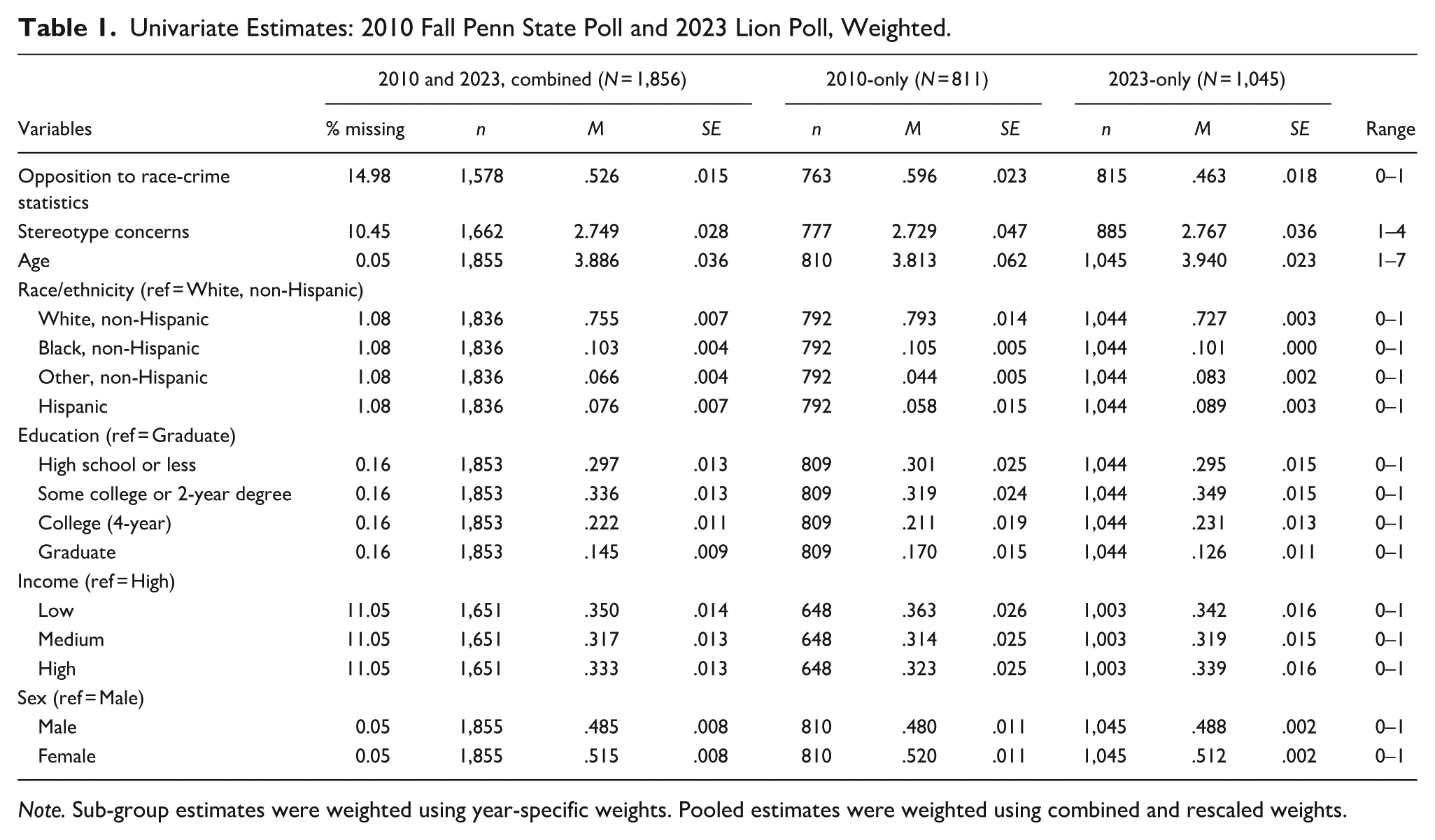
Note. Sub-group estimates were weighted using year-specific weights. Pooled estimates were weighted using combined and rescaled weights.
To present estimates that mirror population trends as closely as possible, all analyses conducted in the current study utilized weights that were post-stratified by sex, age, and race/ethnicity. For sub-group models analyzing the 2010 and 2023 data separately, year-specific weights were utilized, that is, each dataset had a separate weight variable. However, for the pooled analyses of the 2010 and 2023 datasets, we created a new weight variable, which combined the year-specific weights and rescaled them to adjust for their different sample sizes (Korn & Graubard, 1999).
We present the results of our analyses in the following order. First, three different sets of univariate estimates are presented: (1) 2010 and 2023 combined, (2) 2010-only, and (3) 2023-only. Univariate statistics will provide the readers with the context of our research variables and examine any notable changes in the estimates over time. Of particular interest is whether the public’s opposition to race-crime statistics has shifted from 2010 to 2023. Second, to explore whether the independent variables predict opposition to race-crime statistics, we conduct binary logistic regression to estimate the effects of the independent variables. Moreover, to scrutinize whether the effects of the independent variables vary over time, we run an additional series of binary logistic regressions that include multiplicative interaction terms between independent variables and year. Third, to examine whether the effect of stereotype concerns varies across different racial/ethnic groups, we conduct another binary logistic regression that includes a multiplicative interaction term between stereotype concerns and race/ethnicity. Furthermore, to probe whether such a moderation effect is stable over time, we re-run the model separately by year—2010-only and 2023-only.
Additionally, we estimate the average marginal effects (AMEs)—that is, the estimated percentage point changes in the dependent variable driven by a one-unit increase in the independent variable—to enhance the interpretability of the findings. Estimating the AMEs also allows us to conduct second differences tests, which compare the marginal effects of a predictor at different levels of moderating variables (Long & Mustillo, 2021). The results of these tests serve as complementary checks to the moderation analyses based on interaction terms; moderation effects that are statistically significant in both analyses will be considered more robust. All models were checked for multicollinearity before the analysis, and no signs of multicollinearity emerged (VIFs < 2.5).
Results
Univariate Estimates From 2010 to 2023
Table 1 displays the weighted univariate statistics from the combined sample and 2010-only and 2023-only, respectively. Overall, the demographic trends in the 2010 and 2023 data samples are relatively similar, with some modest differences. Between 2010 and 2023, Pennsylvania experienced changes in its racial/ethnic characteristics. Notably, there has been a decrease in the proportion of non-Hispanic White individuals (from 79.3% to 72.7%), whereas there has been an increase in the proportion of Hispanic individuals (from 5.8% to 8.9%). Education levels have also seen some changes, such as an increase in the number of individuals with some college or 2-year degree (from 31.9% to 34.9%), an increase in individuals with 4-year college degrees (from 21.1% 23.1%), and a decrease in individuals with graduate level education (from 17.0% to 12.6%).
Of particular interest was the trend in opposition to race-crime statistics and stereotype concerns—the dependent variable and the primary independent variable. Looking at the results, 59.6% of Pennsylvanian adults were unfavorable of the collection of race-crime statistics in 2010, a figure that has been reduced to 46.3% in 2023. Interestingly, however, the extent to which Pennsylvanians perceived race-crime statistics as producing racial stereotypes has remained at a similar level over time—an average score of 2.729 (Range: 1–4) in 2010 and 2.767 (Range: 1–4) in 2023. Table 1 also presents the univariate estimates of the combined sample of 2010 and 2023. Although these estimates cannot fully capture the detailed trend between 2010 and 2023, they may be interpreted as rough summary indices of the state’s perceptions and characteristics.
Correlates of Opposition to Race-Crime Statistics
The results of the binary logistic regression model predicting opposition to race-crime statistics are presented in Table 2. The model fit indices suggest that the model is fit to the data (F(12, 1535.1) = 18.98, p < .001) and accounts for around 25.7% of the variance in the logarithm of the dependent variable (McFadden R2 = .257). Figure 1 displays the effects of the independent variables on predicted percentage point changes (AMEs). The results show that opposition to race-crime statistics is higher among individuals who are more concerned about the stereotype-generating effects of race-crime statistics (b = 1.400, p < .001, OR = 4.055, AME = 23.7), who have an educational background of high school or lower (b = 0.831, p = .001, OR = 2.296, AME = 14.2) and some college or 2-year degree (b = 0.494, p = .042, OR = 1.638, AME = 8.5%)—than those who had graduate level education—and females rather than males (b = 0.486, p = .001, OR = 1.625, AME = 8.3). Meanwhile, opposition to collecting race-crime statistics decreased from 2010 to 2023 (b = -0.766, p < .001, OR = 0.465, AME = -13.0), consistent with the trend found in the univariate estimates.
Binary Logistic Regression Predicting Opposition to Race-Crime Statistics (N = 1,578).
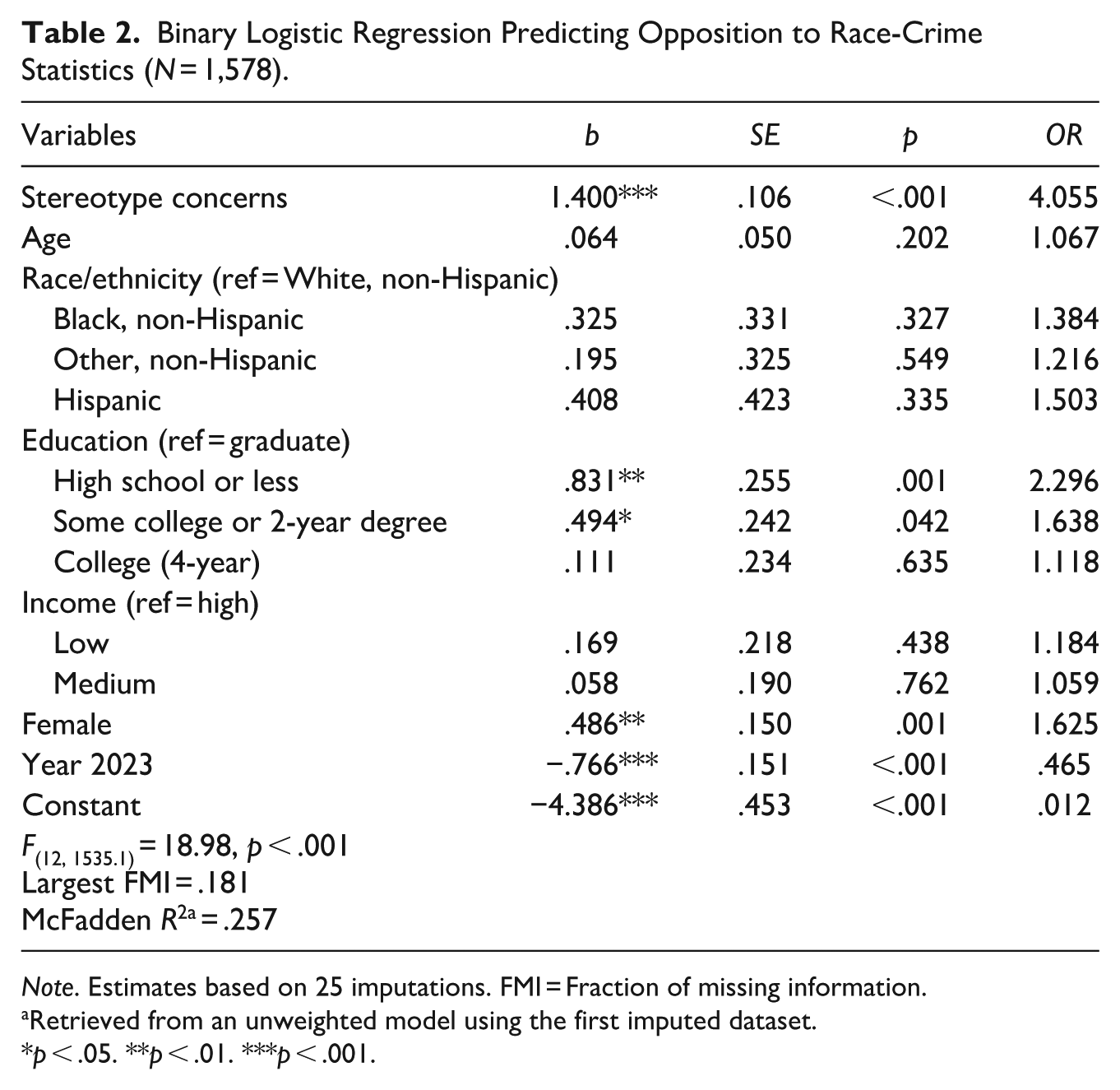
Note. Estimates based on 25 imputations. FMI = Fraction of missing information.
Retrieved from an unweighted model using the first imputed dataset.
p < .05. **p < .01. ***p < .001.
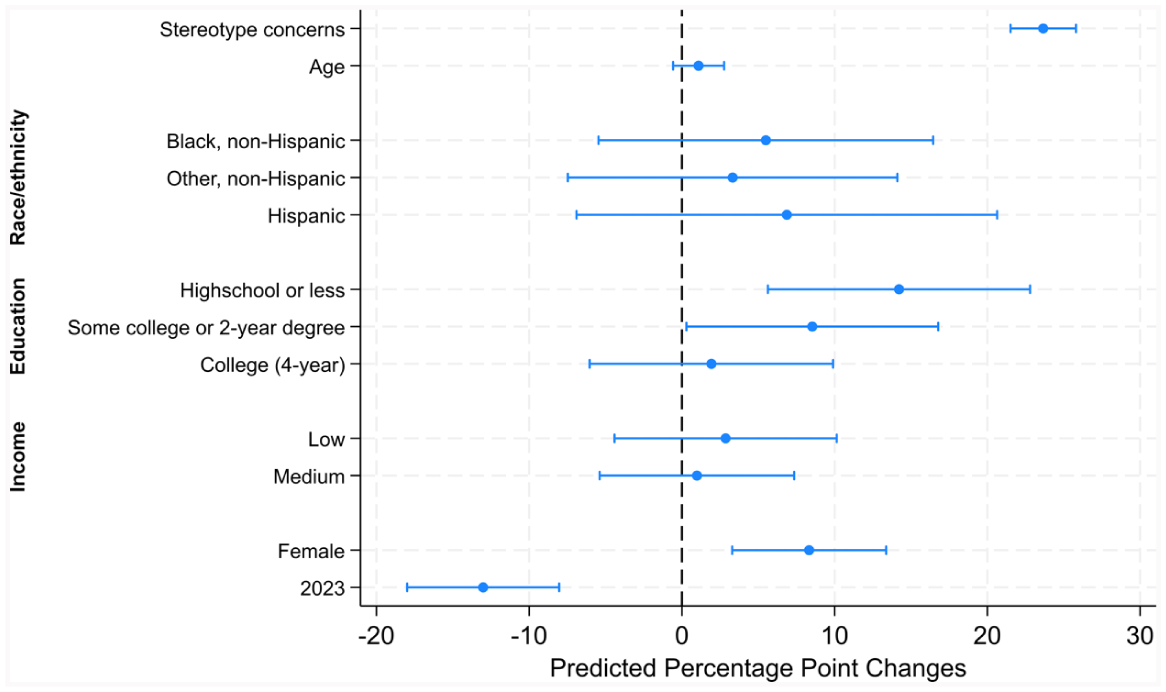
Predicted percentage point changes in the likelihood of opposing race-crime statistics by independent variables (N = 1,578).
Next, to examine whether the effects of the correlates found above are stable from 2010 to 2023, six binary logistic regression models were estimated. The results are presented in Table 3. Among the interaction terms tested, only two reached statistical significance: (1) stereotype concerns × year 2023 (Model 1) and (2) female × year 2023 (Model 6). It appears that the effect of stereotype concerns increased from 2010 to 2023 (b = 0.615, p = .004), whereas the effect of being a female decreased (b = -0.768, p = .012). The remaining interaction terms were not statistically significant, indicating that the effects of age, race/ethnicity, education, and income were stable over time.
Binary Logistic Regression Estimating the Conditional Effects of the Independent Variables by Year (2023 vs. 2010; N = 1,578).
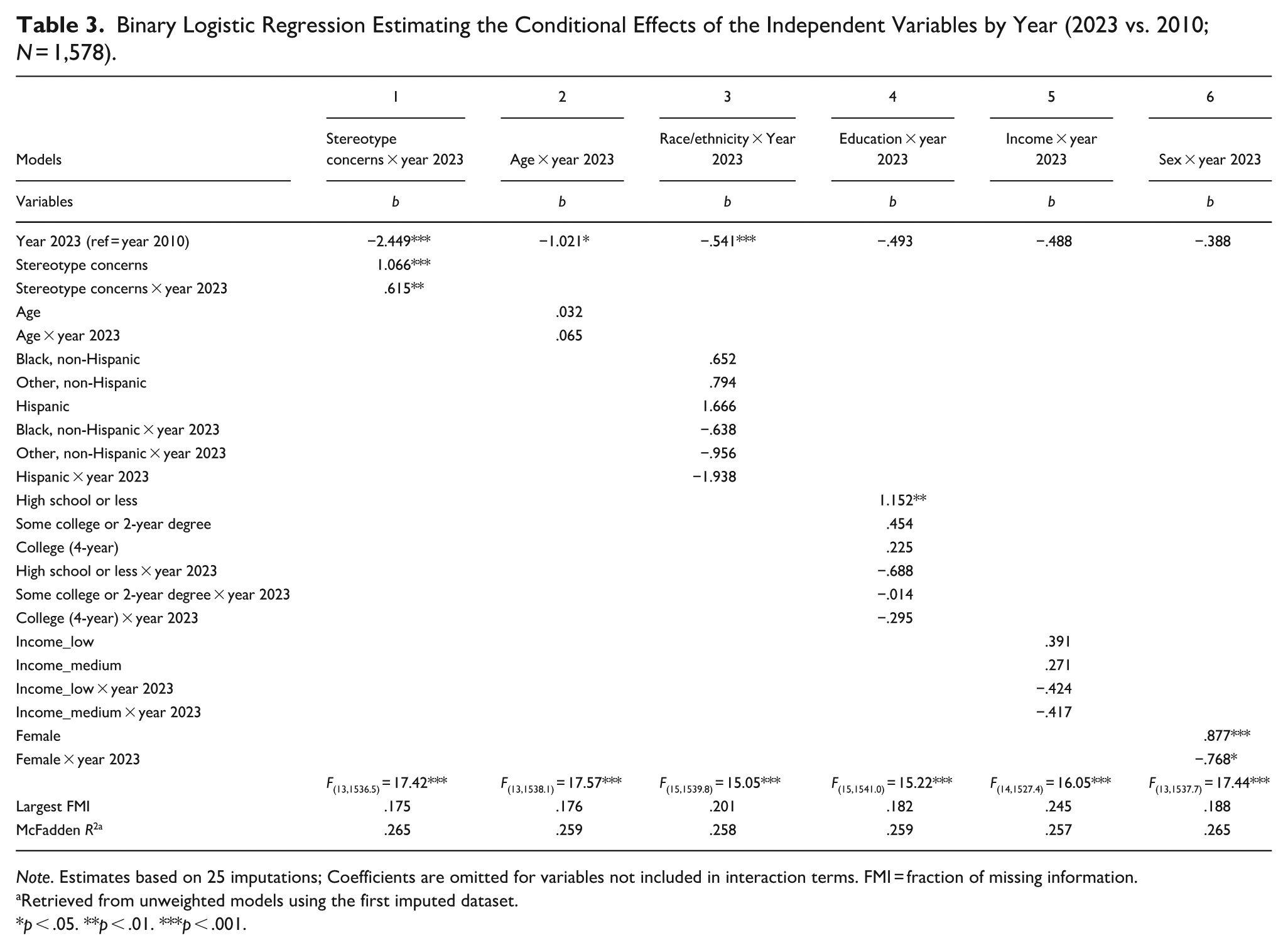
Note. Estimates based on 25 imputations; Coefficients are omitted for variables not included in interaction terms. FMI = fraction of missing information.
Retrieved from unweighted models using the first imputed dataset.
p < .05. **p < .01. ***p < .001.
Figure 2 displays the conditional effects of stereotype concerns and being a female in predicted percentage point changes (AMEs). A one-unit increase in stereotype concerns was associated with an increase in the likelihood of opposing race-crime statistics by 19.7 percentage points in 2010 and 26.3 percentage points in 2023. Additionally, females, compared to males, were associated with a 14.7 percentage point increase in the likelihood of opposing race-crime statistics in 2010. However, in 2023, this effect was reduced to 1.9 percentage points. Tests of second differences also lend support to the conditional effects of stereotype concerns and being a female (Supplemental Tables S1 and S2).
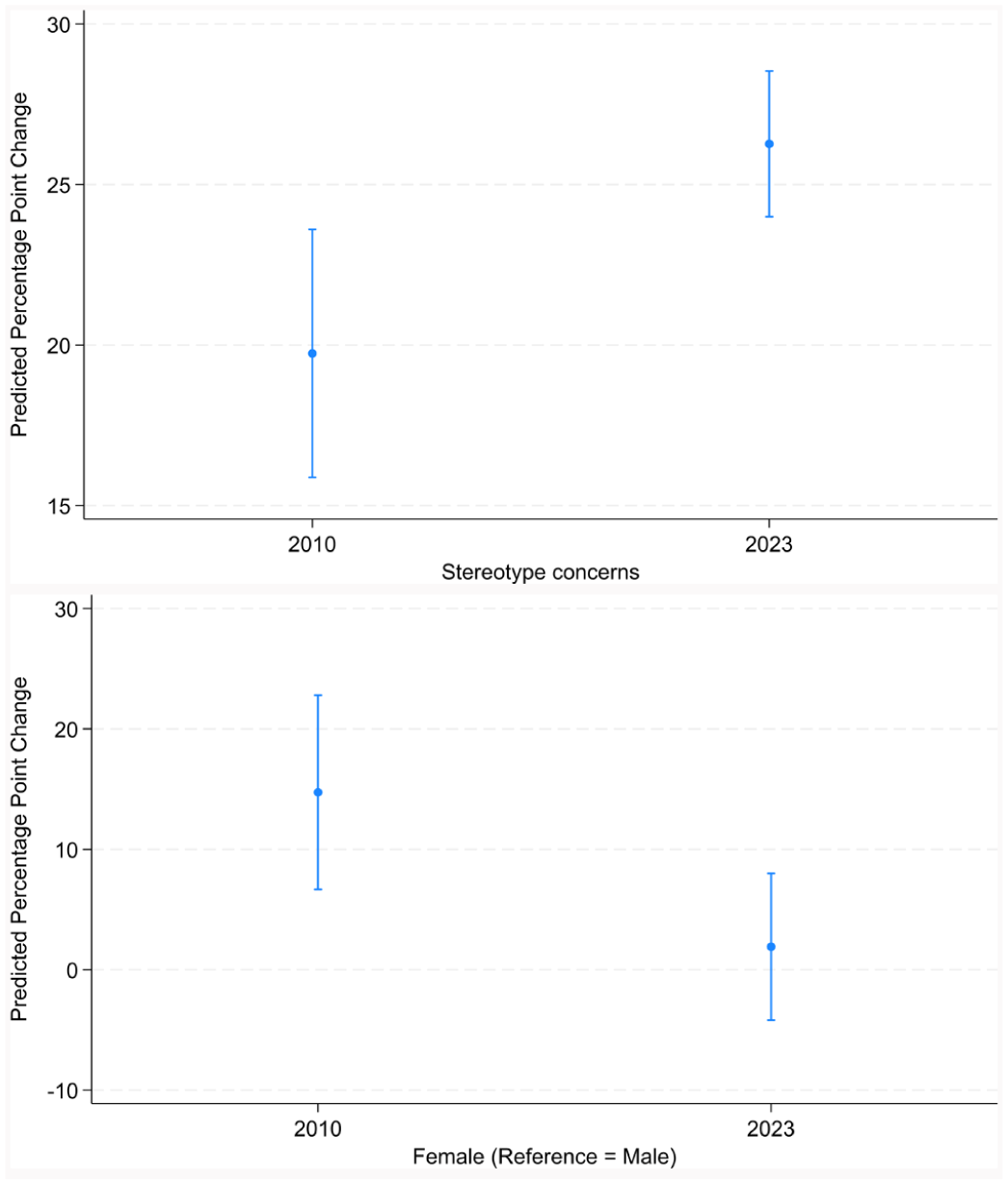
Conditional marginal effects of stereotype concerns and sex by year (N = 1,578).
The Conditional Effect of Stereotype Concerns by Race/Ethnicity
To examine whether the effect of stereotype concerns is contingent upon race/ethnicity, Table 4 presents results from a binary logistic regression model that tests interaction terms between stereotype concerns and race/ethnicity. Notably, the results indicate a statistically significant interaction between stereotype concerns and being non-Hispanic Black (b = -0.772, p = .005, OR = 0.462), suggesting that the effect of stereotype concerns is weaker for Black compared to white respondents. In other words, for Black individuals, a one-unit increase in stereotype concerns was associated with a 15.3 percentage point increase in the likelihood of opposing race-crime statistics; for white individuals, it was associated with a 25.2 percentage point increase (Figure 3). Test of second differences also confirmed a statistically significant conditional effect (Supplemental Table S3).
Binary Logistic Regression Estimating the Conditional Effect of Stereotype Concerns by Race/Ethnicity (N = 1,578).
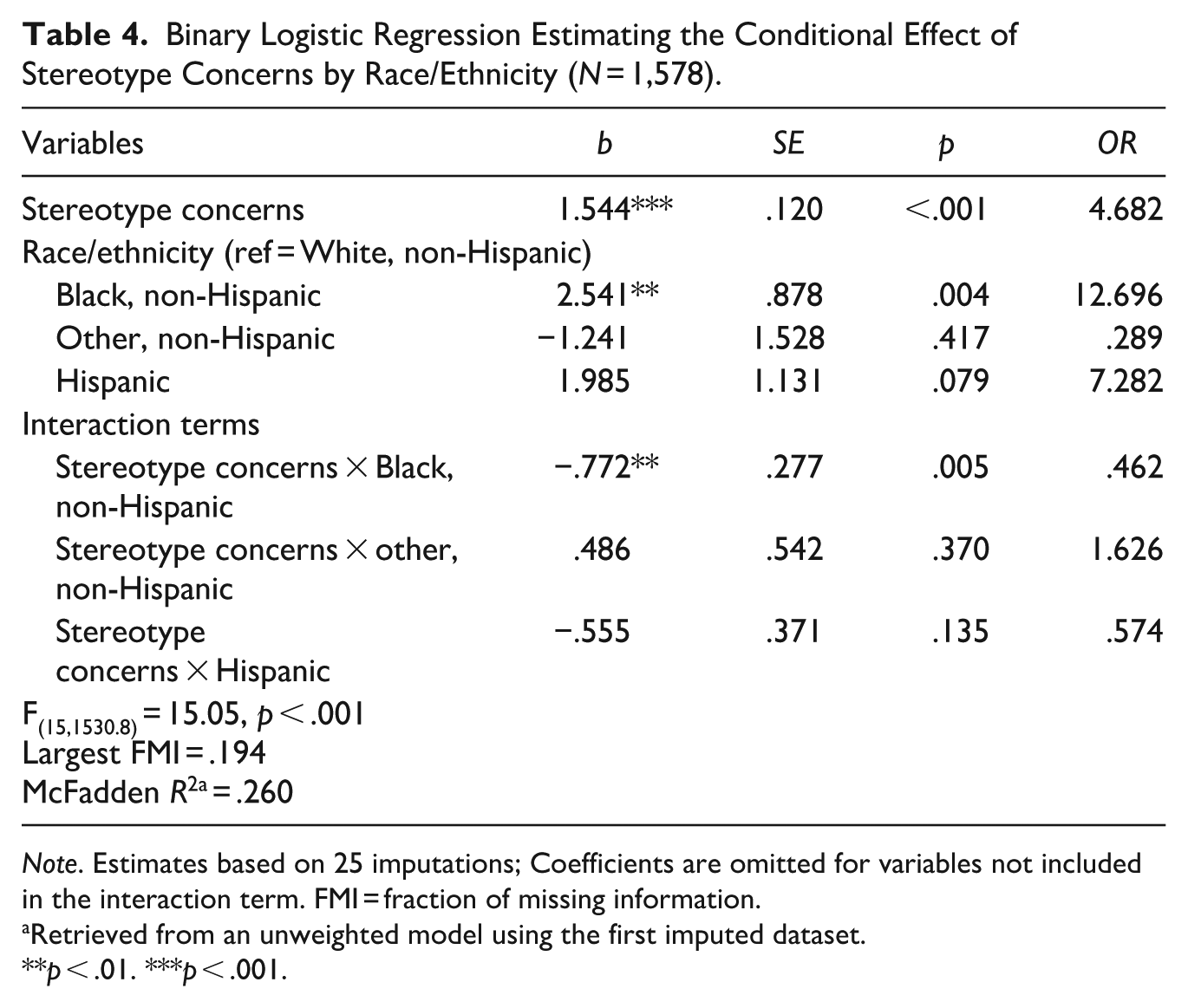
Note. Estimates based on 25 imputations; Coefficients are omitted for variables not included in the interaction term. FMI = fraction of missing information.
Retrieved from an unweighted model using the first imputed dataset.
p < .01. ***p < .001.
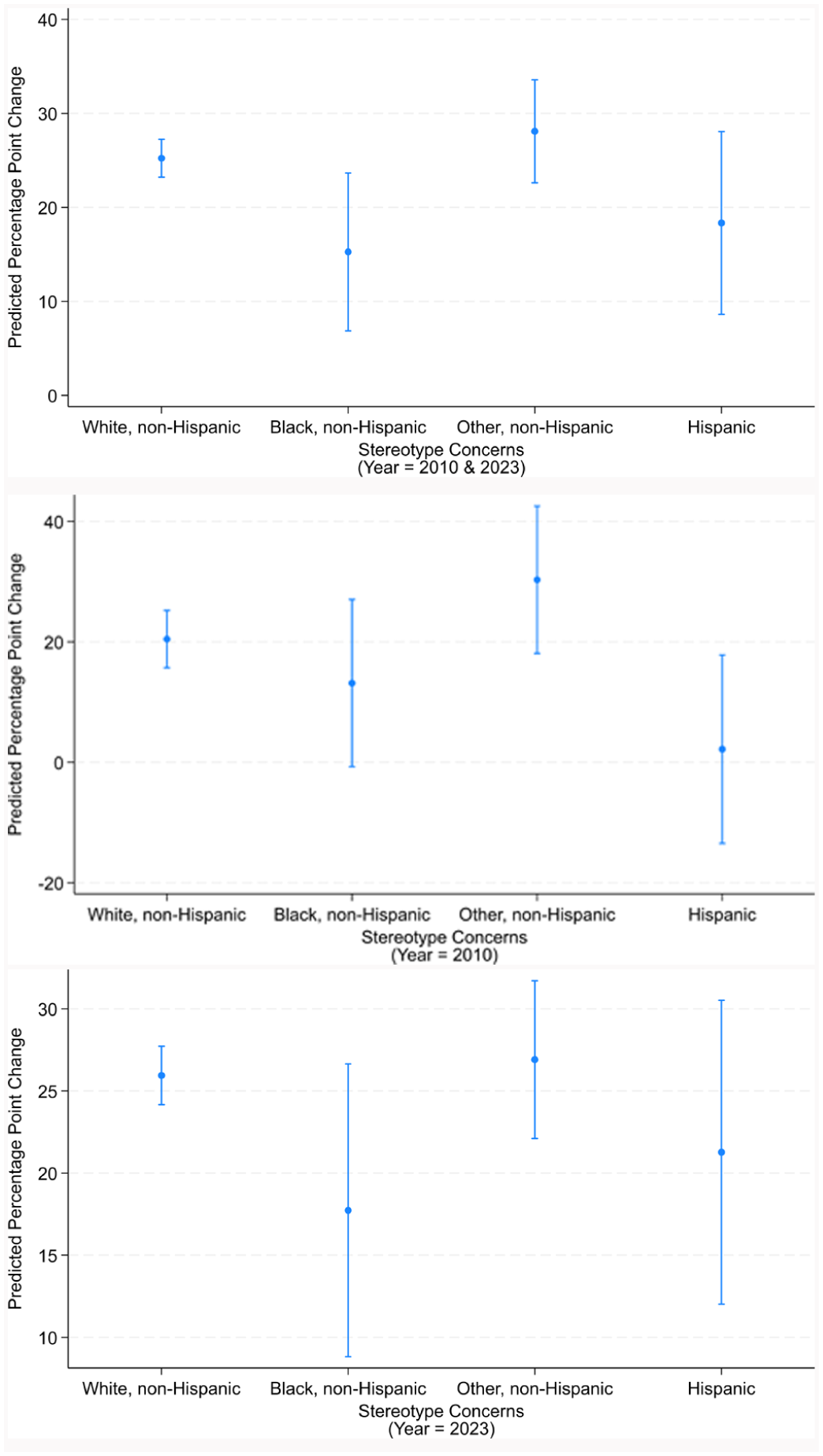
The conditional marginal effect of stereotype concerns by race/ethnicity: full model (N = 1,578) and sub-group analysis by year (2010: N = 763; 2023: N = 815).
Finally, to test whether the conditional effect of stereotype concerns among Black (vs. white) respondents was stable over time, we conducted a subgroup analysis by year (2010 and 2023; Supplemental Table S4). The results suggest that the conditional effect was not statistically significant in 2010 (b = -0.357, p = .416, OR = 0.700) but became statistically significant in 2023 (b = -1.099, p = .003, OR = 0.333), indicating that the statistically significant finding in the pooled analysis may reflect a more recent trend that was captured in the 2023 data. Nonetheless, the conditional effect in 2023 only reached marginal statistical significance in the second differences test (Difference in AME = -0.082, p = .070; Supplemental Table S5) and thus should be interpreted with caution. Interestingly, we found a conditional effect of stereotype concerns by being Hispanic (vs. white) in 2010 (Supplemental Table S5). However, we refrain from drawing any substantive conclusions due to the limited number of Hispanic respondents included in the 2010 sample (n = 8).
Supplemental Analysis of the 2023 Data
Our pooled analyses of the 2010 and 2023 data offer the benefit of examining the broader trend in Pennsylvania; however, a tradeoff was that they could not fully utilize the additional contextual demographic variables observed in the 2023 survey. The 2023 survey included variables, such as veteran status, marital and employment status, sexual orientation, and political affiliation and orientation, variables which the 2010 survey lacked. Therefore, to make full use of the available data, we present the results from a more complete model analyzed with the 2023 data only, as a supplement to our main analysis (Supplemental Table S7; for univariates, see Table S6). 4
Some notable findings emerged. First, the effect of stereotype concerns was consistent with what we have found in the pooled analysis (b = 1.821, p < .001, OR = 6.177); however, those of education and sex were statistically non-significant. Among the additional demographic variables included, being widowed, divorced, or separated—compared to being married or living with a partner—was associated with a higher likelihood of opposing race-crime statistics (b = 0.901, p = .002, OR = 2.461). By contrast, those who leaned toward liberal political ideals were less likely to oppose (b = 0.251, p = .050, OR = 0.778). These results suggest that regarding the issue of race-crime statistics, correlates of public opinion may vary depending on the time of data collection and model specifications.
Discussion
On the 60th anniversary of Gilbert Geis’s trailblazing piece, the current study revisits Gabbidon and Higgins’s (2013) exploration of public opposition to reporting race-crime statistics in the U.S. Using representative samples of Pennsylvanians collected in 2010 and 2023, we gauged the trends and correlates of public opposition toward reporting these statistics. Our initial binary logistic regression models indicated that the likelihood of opposing race-crime statistics decreased by 13.0 percentage points for 2023 respondents relative to 2010 respondents. Additionally, respondents who held stronger beliefs that reporting race-crime statistics promotes racial stereotypes, those who received a lower level of education (i.e., high school level or lower and some college or 2-year degree, compared to graduate level), and females rather than males were associated with significantly higher odds of opposing the collection of race-crime statistics.
To further elucidate whether the role of these significant correlates has changed over the data collection periods, we conducted additional tests of conditional effects, revealing that the effect of stereotype concerns and being a female varied across 2010 and 2023. Overall, stronger concerns about race-crime statistics promoting racial stereotypes predicted substantively higher odds of opposing race-crime statistics, and the magnitude of these effects strengthened from 2010 to 2023 by 6.5 percentage points. This, then, supports that the negative racial implications of reporting race-crime statistics were more meaningful to respondents’ opposition to reporting this data in 2023 versus in 2010. Possibly, during the Obama Administration, greater public attention and scrutinization of racial disparities in the criminal justice system (e.g., the publication of Alexander’s (2010) The New Jim Crow and Muhammad’s (2010) The Condemnation of Blackness) and local incidents (e.g., the killings of Andre Thomas and Lawrence Allen and class action suit concerning stop-and-frisk policies) prompted higher awareness/concern over the past decade (ACLU Pennsylvania, 2023; McKinnon, 2008; Slobodzian, 2014). Alternatively, recent factors, such as Black Lives Matter protests in Pennsylvania (over 100 recorded during summer 2020) and COVID-19 (e.g., the rise of both anti-Asian hate and politicization of safety strategies like stay-at-home orders) may have encouraged a rise in Trumpism, effectively emboldening a form of apathy toward such implications of race-crime statistics (Chinchilla, 2021; Hardison, 2020; Jansen, 2020). However, our finding suggests that the former had a somewhat greater impact than the latter.
Our analyses also offer mixed evidence concerning the impact of biological sex on racial social policy. While biological sex has historically been associated with greater degrees of political/social liberalism among women (e.g., Barnes & Cassese, 2017; Petit et al., 2020), recent trends have seen more white women identifying with conservative politics (Green, 2024). Our findings seem to reflect this broader trend: while females were generally predicted to have increased odds (compared to males) of opposing the collection of race-crime statistics, the magnitude of this sex-based difference almost entirely disappeared in the 2023 sample.
Next, our findings illustrated whether stereotype concerns differentially impacted racial/ethnic groups’ attitudes toward race-crime statistics and whether this conditional effect existed in both 2010 and 2023. Significant interaction effects of stereotype concerns and being Black (vs. white) were observed: the effect of stereotype concerns was lower for Black individuals (15.3 percentage point increase), when compared to white individuals (25.2 percentage point increase). Notably, our subgroup analyses revealed that this pattern is likely a phenomenon of more recent years, as the conditional effect was not evident in 2010 but showed signs of emergence in 2023. As discussed above, increased public discourse on racial political issues in the last decade could have led to increased public awareness of the negative racial implications of race-crime statistics; however, such effects appear to be more salient among white versus Black respondents. This difference may suggest that the mechanisms underlying attitudes toward the criminal justice-related issues may vary across racial groups. For Black individuals, these attitudes are deeply shaped by their lived experiences and the broader context of collective racial subordination (Thompson et al., 2025; Unnever & Gabbidon, 2011); thus, the impact of instrumental concerns such as stereotype threats may be relatively less pronounced. For white individuals, however, the salience of the criminal justice system in their everyday lives tends to be lower (Lerman & Weaver, 2014), meaning that instrumental concerns may hold a practical heuristic value in shaping their attitudes. 5 Furthermore, the finding that this racial gap tends to be more pronounced in recent years suggests that a series of recent social events may have differentially sensitized individuals across racial groups. In other words, even when exposed to the same events, people may interpret and be affected by them differently depending on their racial background.
In addition to these main findings, the supplementary analysis of the 2023 data also offers some insights. An interesting finding is that individuals who have been widowed, divorced, or separated are more likely to oppose the collection of race-crime statistics than those who are married or live with a partner. Perhaps the disruption of a marriage may serve as an indicator that goes beyond marital status itself. It could signal the cumulative disadvantages faced by these families, such as an overall low standard of living and/or disproportionate contact with the justice system (Ghandnoosh, 2023). 6 From this perspective, it could be that individuals who experience more adverse social conditions—implied by their marital status—are more likely to oppose the collection of race-crime statistics. Furthermore, adding another layer to this is the finding that people leaning toward political liberalism are less likely to hold opposition toward race-crime statistics. That is, liberals and individuals in adverse social conditions do not appear to share similar views on this issue. Examining the sources of this divergence would be a promising direction for future research.
Perhaps the most notable takeaway from the 2023 supplementary analysis is that the associations between demographic variables and opposition to race-crime statistics appear somewhat sensitive to the timing of data collection and the inclusion of additional covariates. This may reflect the fact that, unlike the more publicized criminal justice issues, such as the death penalty (Unnever & Cullen, 2007) or racial profiling (Gabbidon & Higgins, 2020; Weitzer & Tuch, 2002), the topic of race-crime statistics collection has yet to be a salient subject of public discourse. As a result, attitudes toward the issue may not have been firmly anchored to certain personal or group identities over the long term. Nonetheless, the effect of stereotype concerns was found to be stable regardless of timing and specification. Therefore, it should be regarded as a key consideration in future research along this line.
Broadly, these results seem to reflect the coexistence of the three ideological orientations identified in prior scholarship: colorblindness, racialization, and race-consciousness. The impact of stereotype concerns parallels the racialization perspective, emphasizing public sensitivity to the perpetuation of racial stereotypes by racialized data. The overall decline in opposition from 2010 to 2023—net of the stereotype concern effect—may signal a weakening adherence to color-blind ideals that discourage the acknowledgment of race in public policy. Meanwhile, the continued effect of higher education on support for race-crime statistics may align with the race-consciousness perspective. Perhaps, those who have been exposed to higher-level education may view race-based information as essential for identifying existing racial disparities and ensuring institutional accountability. Although a direct test of these frameworks is not within the scope of this study, they offer a useful interpretive lens for understanding the possible rationales of public attitudes toward race-crime statistics. 7
These findings also have relevance to Patillo’s (2021) recent work on Black Advantage Vision and racial inequality research. Race-crime statistics perpetuate what Patillo refers to as the Blackness-as-a-problem paradigm. Such research in criminology begins with concerns related to racial disparities across more serious offenses and continues with countless studies comparing Black people to White people across a series of criminal justice domains. Eliminating the comparison of such data would be the first step toward Patillo’s Black Advantage Vision. This vision would also entail moving away from criminological research involving data collection (including race-crime statistics) that solely paints Black people in a negative light. In addition, the challenge that Patillo presents is for the field to put a new lens on studying Black people. In criminology, this lens would find other ways to measure crime and criminality that are not dependent on race-crime statistics. Additionally, this lens would focus on the reality that most Black people are not involved in crime and maintain remarkable resiliency despite residing in so-called disadvantaged communities.
Limitations
While the current results present valuable insights into the correlates of opposition to reporting race-crime statistics, this study is not without limitations. First, as our data is limited to a sample of Pennsylvanian adults, the generalizability of our findings is limited, warranting further research that replicates them on a national level. Second, in the 2010 and 2023 surveys, the question asking about respondents’ opposition to race-crime statistics was presented first, followed by the question about stereotype concerns. Since the order of this presentation did not involve randomization, there is a risk of the former influencing response patterns of the latter (e.g., stereotype concerns serving as a post-hoc justification for respondents’ opposition), which the current study was not able to parse out. Third, due to the limited number of available demographic variables in the 2010 survey, our pooled analysis could not specify the wider range of covariates that were available in the 2023 survey. Although we presented a supplementary analysis for 2023 that incorporated these additional demographic variables, it does not capture the changes over time in the way a pooled analysis does. As the issue of race-crime statistics does not yet appear to be stably linked to any particular social identity, a central question for future research should be whether—and how—such connections may eventually emerge. To this end, we believe it is important to replicate the 2023 survey at subsequent time points.
As a battleground state, the political affiliations, especially by race and sex, of respondents in Pennsylvania are important to contextualizing race-crime statistics reporting as a social policy. For example, our results indicate that stereotype concerns may exert a stronger effect on the likelihood of opposing race-crime statistics for white individuals than for Blacks, in addition to uncovering that this pattern has emerged in more recent years. However, Presidential election exit polls in Pennsylvania during 2020 and 2024 underscore that there are (seemingly) important effects of intersectional identities on social policy (CNN Politics, n.d.-a, n.d.-b), especially in the context of notable rises in white women identifying with conservative politics in Pennsylvania (Green, 2024). Additionally, consideration of regionality and lifetime contact with the criminal justice system may be useful to explore how concerns, such as fear of crime, might influence attitudes toward social policy, such as race-crime statistics reporting (e.g., Nelsen & Petsko, 2021; Ravid, 2018).
Finally, it is important to acknowledge the potential issues associated with conducting a pooled analysis of the 2010 and 2023 data. We created a unified weight variable by combining the year-specific weights and rescaling them according to their relative sample sizes. However, this approach rests on one key assumption, namely, the 2010 and 2023 data represent a common population of Pennsylvanians. Whether such a population truly exists could be subject to debate. Nevertheless, it is considered common practice in population-based studies (e.g., NHANES) to pool data from different periods under such an assumption (Korn & Graubard, 1999). Another limitation of our pooled analysis approach arises from the fact that the 2010 and 2023 data used different survey modes: a landline telephone survey in 2010 and a web-based survey in 2023. Two potential problems arise.
First, it is possible that different types of individuals may have selected themselves into participating in the surveys, resulting in selection bias—perhaps, the gap in the response rates between the two surveys (63.8% vs. 2.5%) may be indicative of this possibility. However, by implementing post-stratification weights to make each dataset representative of its respective population at the time, we sought to ensure that each survey appropriately reflected individuals who might otherwise have been underrepresented. Next, it is possible that the different survey modes may have impacted participants’ response patterns, where attitudinal shifts are actually indicative of mode-induced response tendencies. However, we do not believe that this is likely to be the case. If survey modes were indeed driving the observed changes, one would expect to observe a corresponding pattern in respondents’ stereotype concerns as well. However, our results show a negligible difference between 2010 and 2023 regarding this item. In light of these considerations, although efforts were made to address the limitations of the study, our findings should nevertheless be interpreted with recognition of their constraints.
Conclusion
Overall, the current analyses offer important insights into the understudied topic in public opinion research: opposition toward the collection of race-crime statistics. Revisiting Gabbidon and Higgins’s (2013) examination, the current study reveals the substantive correlates that may shape opposition to race-crime statistics, as well as examining their nuanced and contextual effects. Importantly, our findings warrant further investigation into this topic, as we find that relevant correlates and their effects may fluctuate over time. With recent rises in Trumpism, associated with deepening political and social divide in the nation (e.g., revocation of civil liberties and repeal of programs promotive to racial/ethnic equity), understanding the state and correlates of public opinion on social policy is invaluable, especially those concerning the criminal justice system. We contend that it is an opportune moment to reevaluate Geis’s statement 60 years ago: “Some of this antagonism may be unavoidable, but it will not do to play into its hands—and the [racial] statistics we have been examining seem to tend toward this end—unless strong reasons exist for such a policy.” (Geis, 1965, p. 150).
Supplemental Material
sj-docx-1-cad-10.1177_00111287251395685 – Supplemental material for Revisiting Support for the Collection of Race and Crime Statistics: Results From Two Waves of Pennsylvania Statewide Lion Poll Data
Supplemental material, sj-docx-1-cad-10.1177_00111287251395685 for Revisiting Support for the Collection of Race and Crime Statistics: Results From Two Waves of Pennsylvania Statewide Lion Poll Data by Jangwon Kim, Allison G. Kondrat and Shaun L. Gabbidon in Crime & Delinquency
Footnotes
Acknowledgements
The authors thank Stephanie Wehnau, Director of Penn State Harrisburg’s Center for Survey Research, for generously including the race and crime-statistics measures on the 2023 Lion Poll.
Declaration of Conflicting Interests
The authors declared no potential conflicts of interest with respect to the research, authorship, and/or publication of this article.
Funding
The authors received no financial support for the research, authorship, and/or publication of this article.
Ethical Considerations
This study underwent review and received approval by Penn State Harrisburg’s Center for Survey Research (CSR) from Penn State’s Office of Research Protections to ensure adherence to ethical guidelines and the protection of participant welfare (Approval No. 00021756).
Consent to Participate
Verbal informed consent was obtained from all participants prior to their participation in the survey.
Consent for Publication
This study did not include information on any specific individuals.
Data Availability Statement
The data that support the findings of this study are available upon reasonable request.

Supplemental Material
Supplemental material for this article is available online.
Notes
Author Biographies
References
Supplementary Material
Please find the following supplemental material available below.
For Open Access articles published under a Creative Commons License, all supplemental material carries the same license as the article it is associated with.
For non-Open Access articles published, all supplemental material carries a non-exclusive license, and permission requests for re-use of supplemental material or any part of supplemental material shall be sent directly to the copyright owner as specified in the copyright notice associated with the article.
