







Abstract
Since its introduction by Gottfredson and Hirschi, self-control theory has been widely applied in criminology for its claimed explanatory breadth and presumed invariance across cultures and populations. Yet empirical assessments of its applicability to high-risk groups in non-Western settings remain scarce. This study draws on survey data from two compulsory drug rehabilitation centers in southwest China to evaluate the psychometric structure of Grasmick et al.’s self-control scale and to examine the relationship between self-control and self-reported criminal behavior among incarcerated drug users. Our findings support the scale’s factor structure and affirm that lower self-control is significantly associated with higher levels of offending. Among the six subdimensions, temper and self-centeredness emerged as the most salient predictors of criminal behavior in this incarcerated drug user sample. These findings suggest that the dimensions of self-control most relevant to deviance in the Chinese context may differ from those typically emphasized in Western studies. While some gender variation was observed, the overall effect of self-control on criminal behavior was consistent across male and female respondents. These results lend support to the cross-cultural applicability of self-control theory and underscore the importance of culturally informed rehabilitation strategies in China.
Introduction
Criminological theories have primarily been developed in Western societies, particularly the United States. However, their generalizability has increasingly been tested across global contexts, as cross-cultural applications are essential for refining theoretical models and enhancing their policy relevance (Bennett, 1980, 2004). Among these, self-control theory stands out for its broad appeal and empirical traction, grounded in its claim to offer a generalizable explanation for deviance across populations and cultural settings (Gottfredson & Hirschi, 1990). A substantial body of research affirms the theory’s explanatory power across both general and high-risk populations (Pratt & Cullen, 2000; Wolfe & Hoffmann, 2016), and it has been increasingly incorporated into Asian criminological studies to assess its cross-cultural relevance (Moon et al., 2014; Vazsonyi et al., 2004; Weng & Chui, 2018).
China, shaped by Confucian traditions and collectivist norms, offers a particularly distinct setting for testing the assumptions of self-control theory (J. Liu, 2009; Messner, 2017). Family, education, and interpersonal relationships often exert more sustained influence than in Western societies, raising important questions about the universality of self-control mechanisms. While existing studies in China have generally supported self-control theory among adolescents in school-based samples (Cheung & Cheung, 2008; Chui & Chan, 2016; Jiang et al., 2020), far less is known about its applicability to adult or high-risk groups. As self-control may manifest differently under varying structural conditions and across distinct population groups (Ward et al., 2015), further empirical investigation is needed to capture these contextual variations.
One particularly relevant group for such inquiry is drug users. In China, although the number of registered drug users has declined in recent years, the total population remains substantial (China’s National Narcotics Control Commission, 2024). Moreover, there is robust evidence linking substance use to broader patterns of criminal behavior and self-regulatory deficits (L. Liu et al., 2018). Yet, the applicability of self-control theory to this population in China remains largely unexplored. To address this gap, the present study draws on survey data from two compulsory drug rehabilitation centers in southwestern China to test whether Grasmick et al.’s (1993) self-control scale remains psychometrically valid and behaviorally predictive in this unique context. Specifically, we pursue two goals. First, we assess the construct validity of Grasmick et al.’s self-control scale among incarcerated Chinese drug users. Second, we examine whether self-control, both overall and across its subdimensions, predicts self-reported criminal behavior. By focusing on a high-risk, culturally specific population, this study contributes to the growing literature on the global applicability of self-control theory and offers practical implications for context-sensitive rehabilitation strategies.
Self-Control Theory, Measurement, and the Invariance Debate
The General Theory of Crime, proposed by Gottfredson and Hirschi (1990), identifies low self-control as the central individual-level cause of criminal and analogous behaviors. Self-control is believed to form through early parental socialization and to remain relatively stable throughout the life course (Gottfredson & Hirschi, 1990; Marshall & Enzmann, 2012). Individuals with low self-control are typically characterized as impulsive, risk-seeking, and shortsighted, making them more susceptible to deviant behavior (Longshore et al., 1996; Weng & Chui, 2018). Taken as a core trait, self-control has been widely incorporated into research examining other criminological frameworks, such as social learning and strain theories (Botchkovar et al., 2009; Gibson & Wright, 2001). To operationalize the theory, Grasmick et al. (1993) developed a 24-item attitudinal scale measuring six dimensions of low self-control: impulsivity, preference for simple tasks, risk-seeking, physicality, self-centeredness, and short-sightedness. Their factor analysis supported a unidimensional structure, consistent with the theory’s conceptualization of self-control as a coherent latent trait (Grasmick et al., 1993; Wolfe & Hoffmann, 2016). However, subsequent research has reported mixed findings regarding the scale’s psychometric properties, including inconsistent factor structures, weak subscale correlations, and cultural variability in item performance (Marcus, 2004; Pechorro et al., 2022). In response, several studies have applied item response theory or developed shortened versions that exclude poorly performing items or subdimensions (Higgins, 2007; Piquero et al., 2000). Despite these concerns, the original Grasmick scale remains the most widely used instrument for measuring self-control in empirical research.
A substantial body of scholarship has validated the general predictive utility of self-control. Meta-analyses and large-scale studies have shown that low self-control is significantly associated with a wide range of criminal and analogous outcomes, across both general and high-risk populations (Beaver et al., 2009; Pratt & Cullen, 2000). For example, strong correlations have been found between low self-control and early justice system involvement, arrest, and repeat offending (Beaver et al., 2009), as well as with property crime, violence, and victimization (Holtfreter et al., 2010; Piquero et al., 2005; Turanovic & Pratt, 2014). Beyond crime, low self-control has also been linked to broader life outcomes, including academic failure, unstable relationships, and repeated conflict with authority figures (Chapple, 2005; Tangney et al., 2018; Wolfe, 2011).
However, several empirical patterns complicate the theory’s central claim of invariance. For example, some studies suggest that certain dimensions, such as risk-seeking, are more predictive of deviance than others, while behaviors like smoking may lie outside the theory’s explanatory scope (Arneklev et al., 1993). Other research has raised concerns about the scale’s psychometric properties, reporting inconsistent factor structures and calling for further refinement before it can be considered a definitive measure of self-control (Delisi et al., 2003; Marcus, 2004). Additionally, cross-national studies have produced mixed findings regarding the predictive utility of self-control, particularly in non-Western settings (Messner, 2014). Although the theory explicitly presents self-control as a stable and culture-free construct (Gottfredson, 2017; Vazsonyi et al., 2004), this growing body of critical scholarship raises important questions about its generalizability across demographic groups and cultural contexts (Moon et al., 2014). These concerns underscore the need to revisit the theory’s foundational claim of cross-contextual invariance. The following section reviews empirical research on the applicability of self-control theory across cultures and populations.
Invariance Across Cultures
A central proposition of self-control theory is its universal applicability. Gottfredson and Hirschi argue that self-control is a generalizable construct, functioning consistently across time, place, and populations. Their theory explicitly rejects cultural relativism, asserting that the causes of crime stem from universal aspects of human nature rather than context-specific norms (Gottfredson & Hirschi, 1990). Within this framework, deviance is not defined by culturally bounded legal categories but as violations of broadly shared moral codes. Empirical support for this claim has been reported in studies conducted outside North America (Vazsonyi et al., 2001). Although research in low-crime or non-Western societies remains limited, available findings have been interpreted as broadly consistent with the theory’s assertion that the self-control–deviance link persists across cultural settings (Gottfredson, 2017).
Recent literature has raised concerns that self-control theory may overemphasize individual traits while underestimating the role of environmental, motivational, and cultural influences (Burt, 2020). Within comparative criminology, growing attention has been directed toward how cultural variation shapes the meaning and development of deviance (Messner, 2014; Vazsonyi et al., 2004). Although cross-national studies in Western contexts generally affirm the theory’s predictive utility across cultural and national lines (Vazsonyi et al., 2001, 2021), research in Asian societies has highlighted the need for theoretical recalibration. In collectivist settings shaped by Confucian values, such as Japan, South Korea, and Thailand, self-control remains a meaningful predictor of deviance, but its effects are often moderated by culturally embedded factors like parental monitoring, religious norms, and relational obligations (Kerley et al., 2008; Moon et al., 2014; Vazsonyi et al., 2004). Evidence from South Korea, for example, suggests that self-control may increase rather than stabilize during adolescence, reflecting developmental patterns shaped by the culture of collectivism and Confucianism (Jo, 2015; Yun & Walsh, 2011). Additionally, findings from multiple East Asian contexts suggest that individual-level traits may carry less explanatory weight in shaping behavior than in Western societies, where situational expectations and social conformity play a stronger role (Kobayashi et al., 2010). These patterns lend support to calls for an “Asian paradigm” in criminology, one that emphasizes relational embeddedness and adapts theoretical models to the region’s distinct institutional logics (J. Liu, 2009, 2016; Messner, 2017).
With regard to the subdimensions of self-control, prior research in Western contexts has identified impulsivity and risk-seeking as especially salient predictors of crime and deviance, suggesting that not all facets of self-control contribute equally to behavioral outcomes (Forrest et al., 2019). Comparative studies in Asia have extended this line of inquiry by testing the dimensional structure and predictive validity of Grasmick et al.’s framework in culturally distinct settings (Jo & Zhang, 2012; Vazsonyi et al., 2004). These studies generally affirm the six-factor model’s temporal stability and cross-cultural applicability, while also revealing that the salience of specific subdimensions varies across behavioral domains. For instance, risk-seeking tends to better predict minor norm violations, whereas temper and self-centeredness are more closely associated with violent or relationally disruptive acts (Vazsonyi et al., 2004). Such patterns indicate that although the overarching structure of self-control theory holds across cultures, the salience of subdimensions may shift depending on cultural contexts.
Invariance Across Populations
Beyond culture, another significant challenge to the generalizability of self-control theory arises from differences in population risk levels. Much of the foundational empirical work has relied on low-risk samples, such as students or members of the general public, where behavioral variation tends to be relatively constrained (Wolfe & Hoffmann, 2016). This reliance limits the extent to which findings can be directly extended to higher-risk populations, who are more directly involved in serious or persistent offending. In response, subsequent studies have examined incarcerated individuals and felony offenders, providing more rigorous tests of the theory within high-risk contexts (Bouffard et al., 2015; de Ridder et al., 2012). These studies suggest that the manifestation and consequences of self-control may differ across institutional settings and life experiences, as high-risk populations often face structural disadvantages, social disorganization, or cumulative strain—factors that can shape how self-control is developed, expressed, or constrained (Malouf et al., 2014). Besides, evidence from high-risk populations also demonstrates that traits such as impulsivity, risk-seeking, and temper play distinct roles in behavior within specific social environments. For instance, among homeless street youth, impulsivity and temper significantly influence responses to interpersonal conflicts, mediating offending and victimization through risky lifestyles (Baron et al., 2007). In correctional settings, risk-seeking has been linked to increased vulnerability to victimization, while temper is associated with rule violations and infractions (Kerley et al., 2009). Research conducted in Asian high-risk environments, then, further indicates that differences in risk levels, alongside cultural variations, may influence the applicability of self-control theory across different contexts (Choi & Kruis, 2021; Reyns et al., 2018).
Overall, these findings highlight the importance of expanding self-control theory beyond general population samples to include diverse cultural and high-risk groups. Additionally, there is a noticeable gap in research regarding the relationship between self-control and crime among drug users, despite widespread acknowledgment that low self-control predicts substance use (Ford & Blumenstein, 2013; Gallupe & Baron, 2014; Sussman et al., 2003).
The Case of China
As a society deeply shaped by Confucian traditions and collectivist structures—arguably even more so than other Asian societies—China presents a distinctive cultural and institutional context for evaluating self-control theory. In particular, central to Chinese social life are practices such as guanxi, or dense interpersonal networks, that guide behavioral choices through reciprocal obligations and shared expectations (Bian, 2019; Messner et al., 2007). These networks do not simply facilitate social capital but also function as informal regulatory systems, where certain traits can carry outsized social consequences due to their perceived threat to relational harmony and social cohesion. Unlike many Western societies, familial and educational influences in China persist strongly into adolescence and early adulthood. Youth are embedded in multigenerational caregiving, strong family ties, and disciplinary schooling (Chen & Jiang, 2019; Jiang et al., 2020; Messner, 2014). These institutions play a central role in the moral regulation of behavior, reinforcing culturally specific ideals such as keji (self-restraint or self-conquest), a Confucian virtue emphasized in both parenting and pedagogy (Cheung & Cheung, 2010; Lu et al., 2013). These values shape how self-control traits are socialized and expressed, with deviant behavior in China often moderated by family bonds, academic involvement, and peer associations (Cheung & Cheung, 2008; Jiang et al., 2020; Lu et al., 2013). Importantly, self-control remains a significant predictor of deviance even when these bonds are accounted for and may, in fact, moderate the impact of strain in ways less commonly observed in Western contexts (Cheung & Cheung, 2010). Yet under extreme family or school strain, high self-control may paradoxically relate to increased delinquency (M. Yang & Li, 2025). Considering these cultural and social nuances, it is reasonable to hypothesize that specific subdimensions of self-control might be more salient in China. Traits closely embedded in interpersonal norms, such as temper and self-centeredness, could carry greater weight in a culture that prioritizes harmony and conformity. Conversely, impulsivity and physicality may be more influenced by individual temperament and situational cues, reflecting different pathways through which self-control operates within this unique cultural framework.
Empirical studies on Chinese populations provide some support for this culturally contingent reading. In rural settings, Grasmick et al.’s six-factor scale shows robust psychometric properties, with second-order CFA confirming strong factor loadings (Jiang et al., 2020). School-based studies in Hong Kong further suggest that risk-seeking and self-centeredness consistently predicted both property and violent offenses across genders (Chui & Chan, 2016), while the predictive power of other traits, such as impulsivity, temper, and physicality, varied by gender and offense type, suggesting that local norms, developmental contexts, and relational expectations may shape the behavioral relevance of specific self-control subcomponents. Existing research on high-risk populations in China has focused primarily on adolescents. One study compared the Grasmick et al.’s scale with the Brief Self-Control Scale among high-risk youth, highlighting structural limitations and recommending culturally adapted instruments (Weng & Chui, 2018). Another study examined the factorial structure of the scale across high school students, incarcerated youth, and adjudicated juvenile offenders, finding support for a second-order model while noting variation in item performance across groups (Ren et al., 2018). Nevertheless, high-risk adult populations remain underexamined, despite strong evidence that low self-control is linked to both substance use and deviance (L. Liu et al., 2018). While some studies show that self-control predicts recidivism and institutional violations among incarcerated adults (Messner et al., 2018), few have disaggregated the role of specific subdimensions under conditions of structural vulnerability. This gap underscores the need to examine self-control not just as a stable trait, but as one whose dimensions are variably activated and sanctioned across institutional and cultural contexts.
Drug Users in China
In recent years, China has experienced a marked decline in the number of officially registered drug users, with the total dropping to 896,000 in 2023—a 20.3% decrease from the previous year (China’s National Narcotics Control Commission, 2024). Nonetheless, the overall scale of the drug-using population remains substantial. More importantly, recent meta-analytical evidence indicates that substance use among Chinese adolescents is far from negligible. Lifetime prevalence rates among youth aged 10 to 24 have reached 59.7% for alcohol, 23.2% for tobacco, and 1.7% for illicit drugs, with vocational school students showing particularly elevated rates of tobacco, analgesic, and illicit drug use (R.-J. Wang et al., 2017). These figures underscore the continued relevance of drug users as a critical population for understanding broader patterns of youth deviance and risk behaviors.
Research on Chinese populations indicates that drug users often face distinct psychosocial challenges that set them apart from the general population. Urban left-behind children, for instance, exhibit elevated substance use and emotional difficulties compared to their peers, suggesting early disruptions in family structure and care (F. Wang et al., 2020). Parental control and relationship quality, which are key factors in the development of self-control, have been shown to significantly influence adolescent substance use trajectories (Shek et al., 2020). Moreover, drug use is frequently associated with broader patterns of risk behavior, such as unprotected sex and early sexual initiation, highlighting a tendency toward impulsivity and low self-regulation (S. Li et al., 2013). Among adult drug users, social support plays a crucial role in fostering abstinence motivation, with self-control acting as a mediating mechanism (Xu et al., 2022). These findings collectively point to a pattern in which individuals who use drugs may experience more fragmented support systems and impaired self-regulation, leading to distinct self-control profiles that differ substantially from those in the general population.
Nonetheless, to date, few studies in China have directly examined the applicability of self-control theory among drug users. The limited literature has primarily focused on the correlation between self-control and drug use, particularly in general populations. For example, studies on adolescents suggest that the predictive power of self-control on drug use tends to diminish once family attachment is taken into account (Cheung & Cheung, 2008; G. T. Wang et al., 2002). More recent research has begun to study incarcerated populations, finding that the effect of low self-control on drug use frequency is fully mediated by peer association and permissive attitudes toward drug use (S. Y. Zhang, 2022; S. Y. Zhang & Demant, 2021). These findings, on the one hand, raise important questions about the universality of self-control theory. On the other hand, none of them have directly examined the relationship between self-control and criminal behavior among drug users, revealing a critical empirical gap.
Present Study
Despite the substantial body of research on self-control theory, important questions remain regarding its cross-population applicability and measurement validity. Specifically, does self-control operate consistently across diverse populations and sociocultural contexts? Is Grasmick et al.’s scale a valid and reliable indicator of self-control across different groups and settings? And to what extent does the dimensionality of the scale hold in non-Western, high-risk populations? While previous studies have begun to explore these questions, most assessments in Asian contexts rely heavily on adolescent data. Drug users, in particular, have been largely overlooked in the expanding cross-cultural applications of criminological theory.
To address these gaps, the present study draws on original survey data from two compulsory drug rehabilitation centers in southwestern China. First, we assess the psychometric properties of Grasmick et al.’s self-control scale, with particular attention to its proposed six-subdimension factor structure, among incarcerated drug abusers in China. Second, we test the core proposition of self-control theory that lower self-control predicts higher levels of criminal behavior within this high-risk, culturally specific population. While gender is not the primary focus of this study, we disaggregate our analyses of self-control-crime association by gender to acknowledge the distinct pathways into drug use and crime (Cao & Liu, 2020; L. Liu et al., 2018), as well as the gender-specific social institutions in which self-control operates (Blackwell & Piquero, 2005; Chui & Chan, 2016; Hagan, 1989).
Data and Methods
Sample
The data used in this study come from the self-administered surveys conducted in two mandatory drug rehabilitation centers, Center A for men and Center B for women, in a southwest Chinese city. Mandatory drug rehabilitation centers in China, administered by police or correctional agencies, accommodate individuals arrested for drug use, crime suspects who test positive, or those approved for voluntary placement. Rehabilitation in these closed settings includes medical detoxification (e.g., methadone), legal and moral education, physical exercise, and vocational training. Among the three primary treatment modalities for addressing drug abuse in China (i.e., voluntary treatment, community-based treatment, and mandatory residential treatment), this is the most coercive and intensive form (L. Zhang et al., 2011).
In 2019, the research team conducted fieldwork at both Center A and Center B, where the academic purpose of the study was clearly communicated to participants. The housed drug users were assured that participation in the study was voluntary and would have no influence on their treatment, assessment, sanctions, or release decisions. They were also informed that their responses were anonymous and the data would not be shared with the rehabilitation center administration or any other official agencies. The respondents were assigned into suitable meeting rooms in each center to fill in the questionnaire. They were allowed to ask the research team for clarification if necessary. The center officers and staff were asked to stay out of the meeting rooms during the survey.
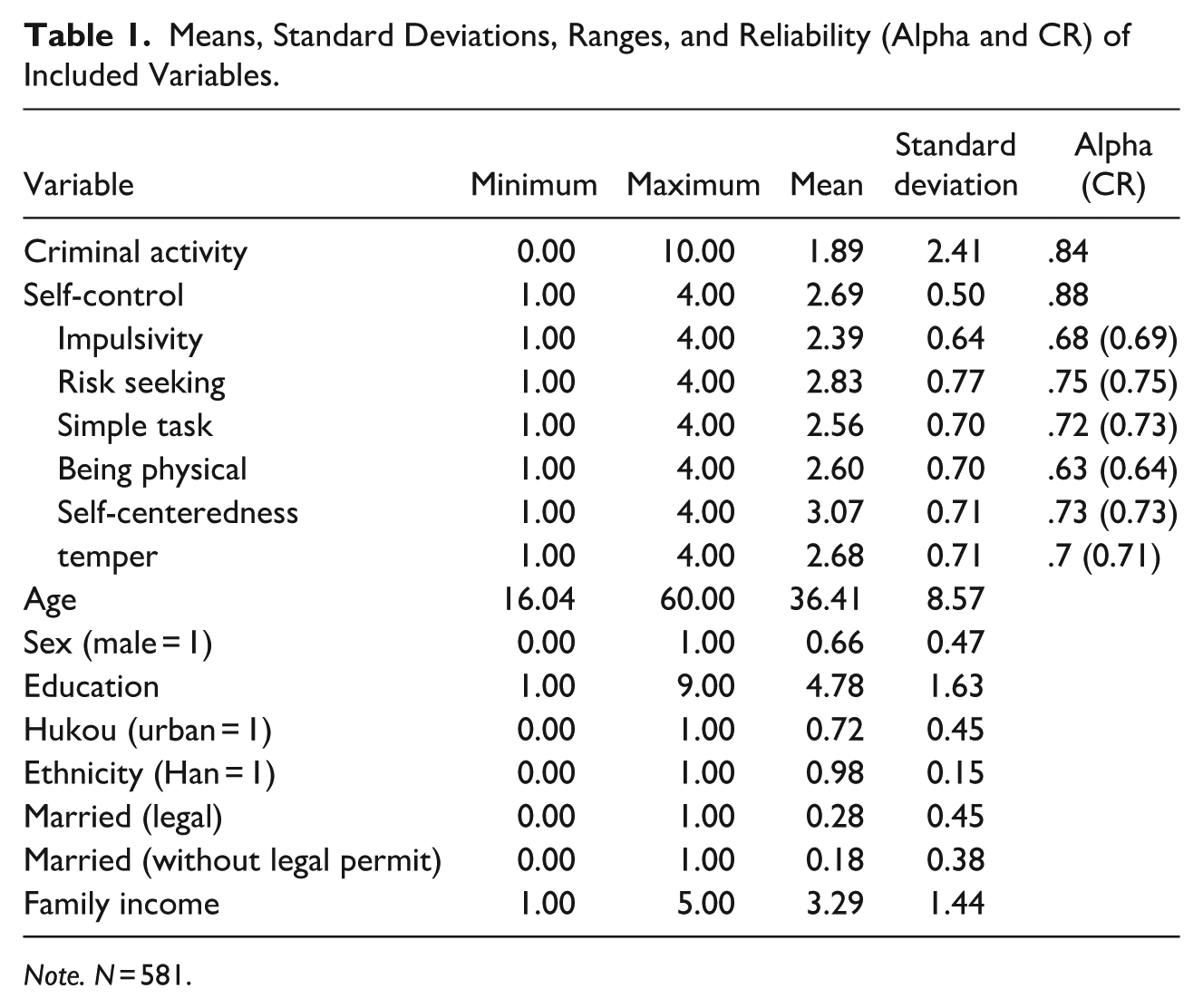
Center A hosted 948 male drug users, and 815 of them were available for the study. Those who were not available included 30 in hospital, 28 on personal leave, 69 being convicted of a crime and in transfer to prison, and six in solitary confinement. Using the roster provided by the rehabilitation center, we conducted a systematic sampling among the available drug users in Center A, and completed surveys were obtained from 398 respondents. There were 209 female drug users in Center B, and we included all of them in the survey. A total of 206 questionnaires were returned. After listwise deletion, the sample in the present study includes 302 male drug users in Center A and 179 female drug users in Center B, resulting in a total sample size of 481 respondents. As shown in Table 1, our sample range in age from 16 to 60, with an average age of 36.41 years. The majority are male (66%) and hold an urban hukou (i.e., classified as urban residents) (72%), and nearly all identify as Han ethnicity (98%). The average education level (4.78 on a 9-point scale) indicates most participants completed junior or senior high school, whereas the average family income (3.29 on a 5-point scale) suggests moderate socioeconomic status. Regarding marital status, 28% are legally married and 18% are in informal unions. We include hukou and ethnicity not only as demographic controls but as institutionalized systems that shape life chances in China. The hukou system, introduced in the 1950s as a population management tool, assigns individuals to rural or urban status based on birthplace and household registration, influencing access to education, employment, healthcare, and housing (Chan, 2019). Han ethnicity, meanwhile, remains closely tied to majority group privilege. Both systems shape the social environments in which self-control is developed and enacted.
Means, Standard Deviations, Ranges, and Reliability (Alpha and CR) of Included Variables.
Note. N = 581.
Measurement
Dependent Variable
The dependent variable in the multivariable regression analyses is self-reported crime. It consists of 12 items, including theft, fraud, counterfeiting, burglary, assault, rape, and robbery during the 1-year window before the current incarceration. A value of zero indicates no crime committed during the 12 months before entering the center, while a value of 1 indicates ever participating in a specific criminal activity. The composite score was created by summing the twelve items, resulting in a variety scale of engagement in criminal activities (α = 0.84).
Independent Variable
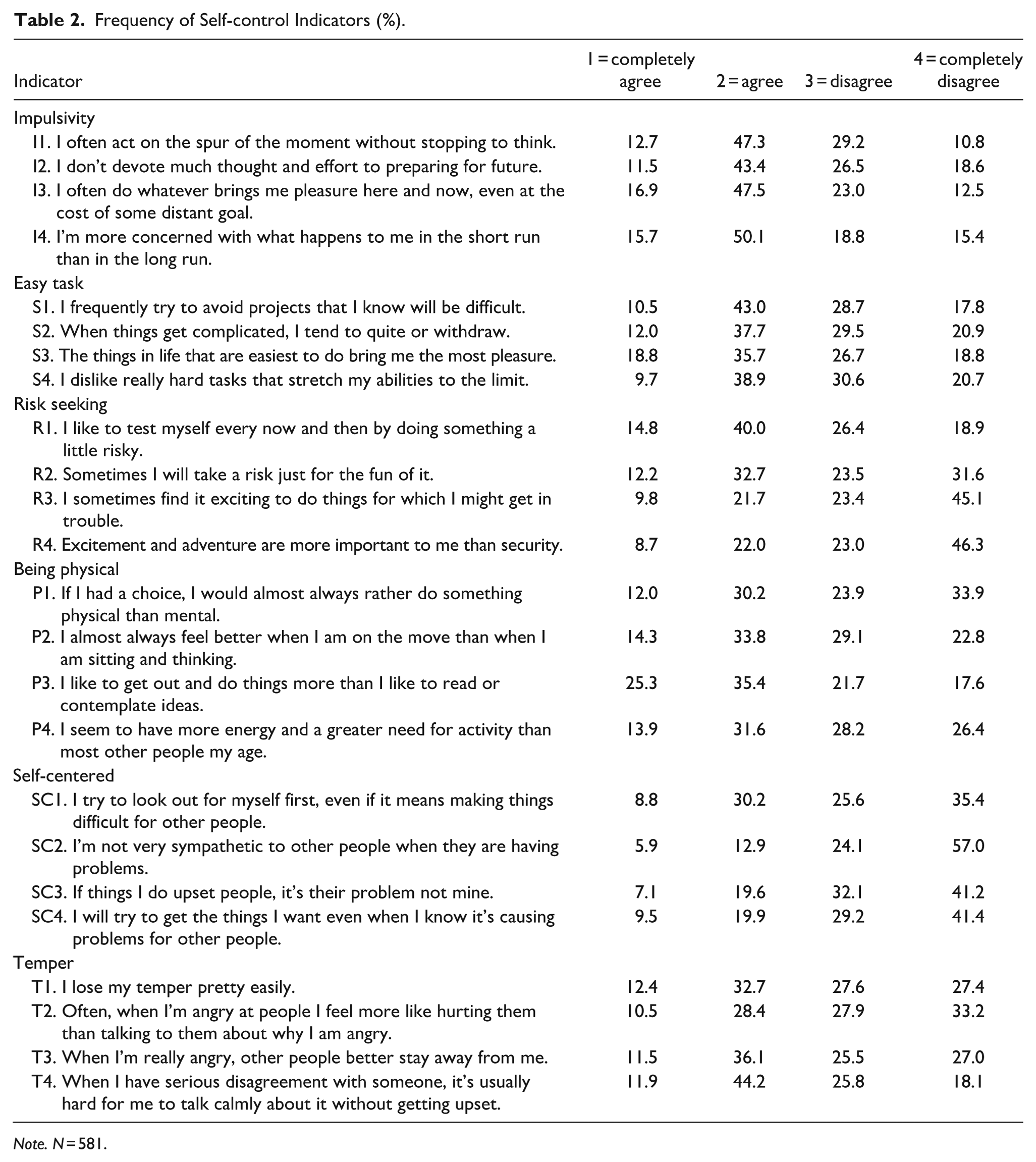
The focal independent variable in our research questions is self-control. The questionnaire features twenty-four statements derived from Grasmick et al.’s (1993) self-control scale. Respondents were asked whether they would act without thinking, care more about short-term pleasure, enjoy risky activities, avoid hard tasks, and lose their temper easily. The responses for these questions followed a 4-point Likert-type format (1 = strongly agree, 2 = agree, 3 = disagree, 4 = strongly disagree). All items were reverse coded from the Grasmick et al.’s original scale so that higher scores consistently reflect stronger self-control. This approach, used in some prior studies (e.g., Kerley et al., 2009), facilitates more intuitive interpretation in regression analyses by aligning higher values with greater protective traits. Please see Table 2 for these individual items and their frequency distribution. A composite score of self-control was created by averaging these 24 items, with a higher number indicating stronger self-control. The same procedure was used to create composite scores for each of the six subdimensions, including impulsivity, risk-seeking, preference for simple tasks, self-centeredness, hot temper, and preference for physical activities. The Cronbach’s α and composite reliability (CR) scores indicate that the global measure of self-control, along with its subdimensions, exhibited acceptable to good internal validity. Specifically, the Cronbach’s α was 0.88 for the global scale, indicating strong reliability, while the subdimensions ranged from 0.63 to 0.75. Similarly, the CR values for the subdimensions fell between 0.64 and 0.75, which are generally considered acceptable to good according to established benchmarks (Cheung et al., 2024; Fornell & Larcker, 1981). Please see Table 1 for details.
Frequency of Self-control Indicators (%).
Note. N = 581.
Control Variable
A series of demographic and socioeconomic indicators were controlled in the multivariable regression models. Age was measured as the actual years of age. Gender was a dummy variable coded “0” for females and “1” for males. Education was measured by asking respondents their levels of education, with response categories ranging from 1 “illiterate” to 9 “college or above.” Hukou was a dummy variable asking respondents whether they had an urban or non-urban residential status (urban hukou = 1, and non-urban hukou = 0). Ethnicity was similarly coded as a dummy variable (1 = Han, 0 = ethnic minority). Marital status was captured using three categories: (1) legally married, (2) married without legal registration (i.e., informal union), and (3) not married. Based on these categories, we generated two dummy variables: one indicating legal marriage (1 = yes, 0 = no), and one indicating informal union (1 = yes, 0 = no), with “not married” serving as the reference group. Finally, family income was measured by asking respondents about their monthly family income, with response categories ranging from 1 (below 500 yuan) to 5 (4,000 yuan or more).
Analytic Strategy
We initiated our analyses by conducting a second-order confirmatory factor analysis (CFA) to explore whether the 24 items of self-control load well on the six sub-dimensions and whether these subdimensions, in turn, align well with the higher-ordered factor structure proposed by Grasmick et al. (1993). This method is commonly used to verify whether the factor structure of a scale aligns with theoretical propositions, allowing researchers to test hypotheses regarding relationships between a latent construct and its sub-dimensions (Kline, 2023; Tabachnick & Fidell, 2018).
Given that Gottfredson and Hirschi (1990) explicitly claim that the self-control scale encompasses six sub-dimensions and each of which is captured by specific items or statements, we specified a second-order CFA to test whether these theoretically proposed relationships are empirically validated in the incarcerated drug offender population. Standard fit indices, including the Chi-square score, Comparative Fit Index (CFI), Root Mean Square Error of Approximation (RMSEA), and Standardized Root Mean Square Residual (SRMR), were used to evaluate the model fit (Hu & Bentler, 1995, 1999). Subsequently, we estimated the effects of the global measure of self-control and its six subdimensions on respondents’ engagement in criminal activities using a series of negative binomial regression models. Additionally, we conducted these analyses separately for gender subgroups due to both theoretical and practical considerations. Theoretically, gender is an established salient factor influencing a person’s propensity and opportunities to engage in criminal activities (Britton et al., 2017; Kruttschnitt, 2013). Practically, as previously mentioned, our data include separate male and female samples from two mandatory drug rehabilitation centers.
Finally, we addressed the missing data problem by adopting the Full Information Maximum Likelihood (FIML) approach, which computes maximum likelihood estimates and standard errors for regression models using observed data points (Enders, 2006; Little & Rubin, 2019). Previous studies have demonstrated that FIML provides efficient parameter estimations and less biased estimates of standard errors compared to traditional techniques (Schafer, 1997). We used the statistical program Mplus8.0 to perform all the multivariate analyses (Muthén & Muthén, 2017).
Results
Second Order Confirmatory Factor Analysis
As previously noted, our first step involved conducting a second-order confirmatory factor analysis using Mplus 8.0. Before conducting this analysis, we first examined the itemized descriptive statistics of the 24 items, which indicates that, in general, these incarcerated drug offenders exhibited relatively low levels of self-control (Table 2). Specifically, more than half of these drug offenders reported “totally agree” or “agree” for 9 out of the 24 items. For instance, regarding the item “I often act on the spur of the moment without stopping to think,” 12.7% reported “totally agree” and 47.3% reported “agree.” Similarly, for the item “I like to get out and do things more than I like to read or contemplate ideas,” approximately a quarter of them (25.3%) “totally agreed,” while another one-third (35.4%) “agreed.” Notably, out of the twenty-four items, the mode was “agree” for two-thirds (n = 16). These results stand in direct contrast to findings from previous studies conducted in China, which collected data from general community samples (Chui & Chan, 2016; Jo & Zhang, 2014) or student samples (Jiang et al., 2020) and reported significantly higher levels of self-control.
We then assessed the validity of the measurement model and tested whether its factor loadings were invariant between male and female groups. The overall measurement model, which treated the six subdimensions as correlated latent factors and constrained the residuals of individual observed items to be uncorrelated with one another, produced acceptable model fit (χ² (df = 237) = 431.57, p < .05, CFI = 0.934, TLI = 0.924, RMSEA = 0.037). To test measurement invariance across sex, we examined configural invariance (Step 1) and metric invariance (Step 2) and whether the two models differed significantly (van de Schoot et al., 2012). Model fit indices indicated acceptable fit for both the configural invariance model (χ² (df = 474) = 714.22, p < .05, CFI = 0.921, TLI = 0.908, RMSEA = 0.041) and the metric invariance model (χ² (df = 498) = 735.98, p < .05, CFI = 0.922, TLI = 0.913, RMSEA = 0.040). Importantly, changes in CFI, TLI, and RMSEA between the two models were minimal, suggesting no substantial difference in model fit (Chen, 2007; Cheung & Rensvold, 2002). To further evaluate this, we conducted the Satorra-Bentler scaled Chi-square difference test (Satorra & Bentler, 2001), which revealed no significance difference between the configural and metric invariance models (Δχ² = 2.853, Δdf = 24, p > .05).
The second-order confirmatory factor analysis (Figure 1) further supports the construct validity of the self-control scale developed by Grasmick et al. (1993) when applied to this special population. Consistent with Gottfredson and Hirschi (1990), we specified a factor structure that identified seven latent factors, including six sub-dimensions (i.e., impulsivity, risk-seeking propensity, preference for simple tasks, preference for physical activities, self-centeredness, and temper), along with the global scale of self-control as the higher order factor. Given that the distributions of the indicators were somewhat skewed, we used the maximum likelihood with robust standard errors (MLR) estimator to account for non-normality in the data (Bollen, 1989). Model fit indices indicate that the model fits the data well. Although the Chi-square score—highly sensitive to large sample sizes—was statistically significant (chi-square = 465.96, df = 246, p < .01), other fit indices such as CFI (0.93), RMSEA (0.04, 90% confidence interval ranging from 0.033 to 0.044), and SRMR (0.05) were close or exceeded acceptable thresholds (Hu & Bentler, 1995, 1999). In other words, the hypothetical model, where the six subdimensions load onto the higher-order factor of self-control, is well supported.
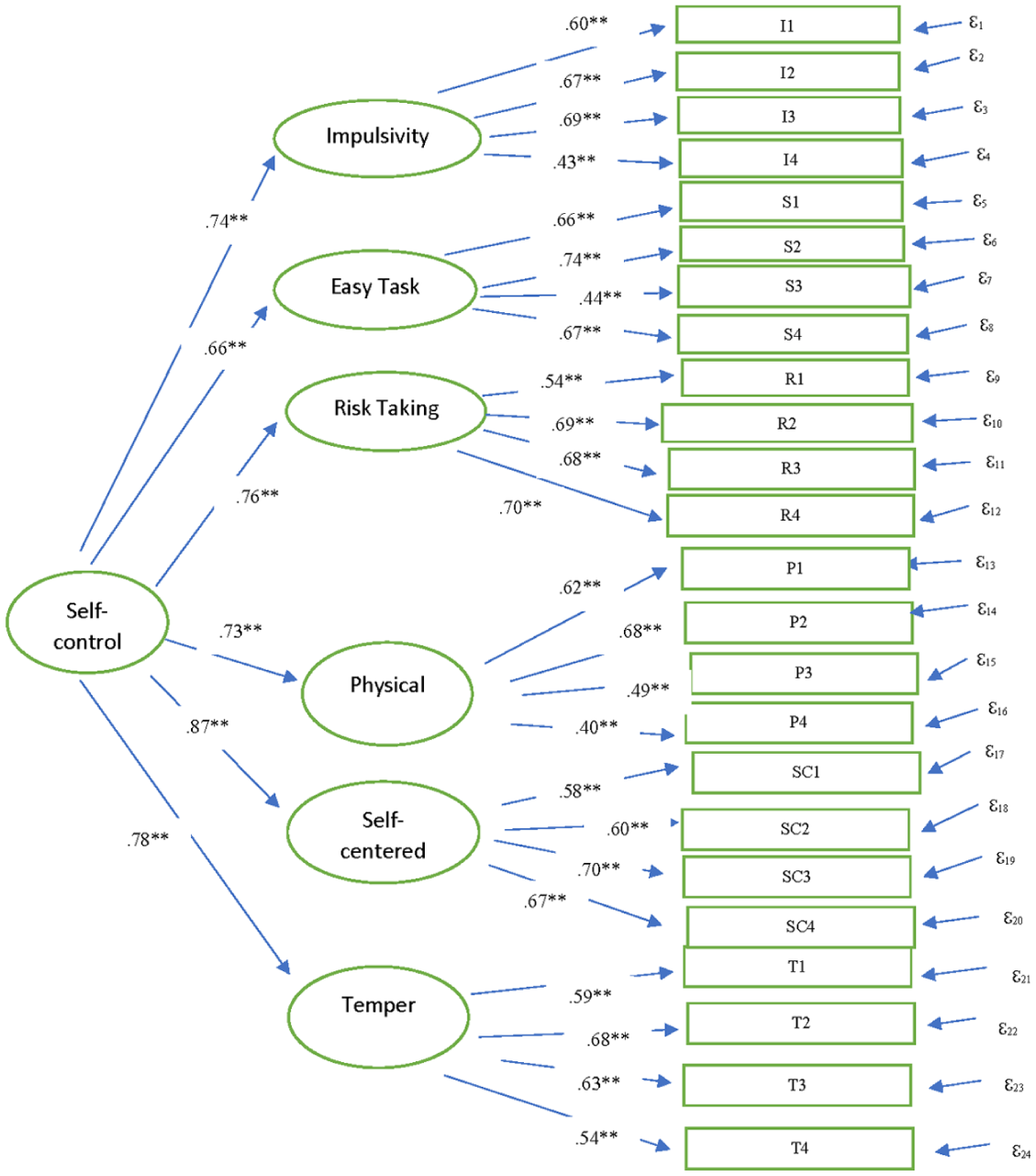
Second order confirmatory factor analysis: self-control among incarcerated drug users.
A close examination of the secondary CFA model reveals that the selected indicators effectively capture the underlying subdimensions of self-control. All the twenty-four items loaded significantly on their respective subdimensions, with factor loadings ranging from 0.40 to 0.74. Moreover, the loadings of all six subscales on the overall latent self-control factor were highly significant and strong—ranging from 0.66 to 0.87—suggesting that a significant portion of the variance of these subscales was explained by the high-order factor. Indeed, for the six latent sub-dimensions, the variance explained by the overall self-control ranged from 43% to 75%.
Multivariable Regression Analysis
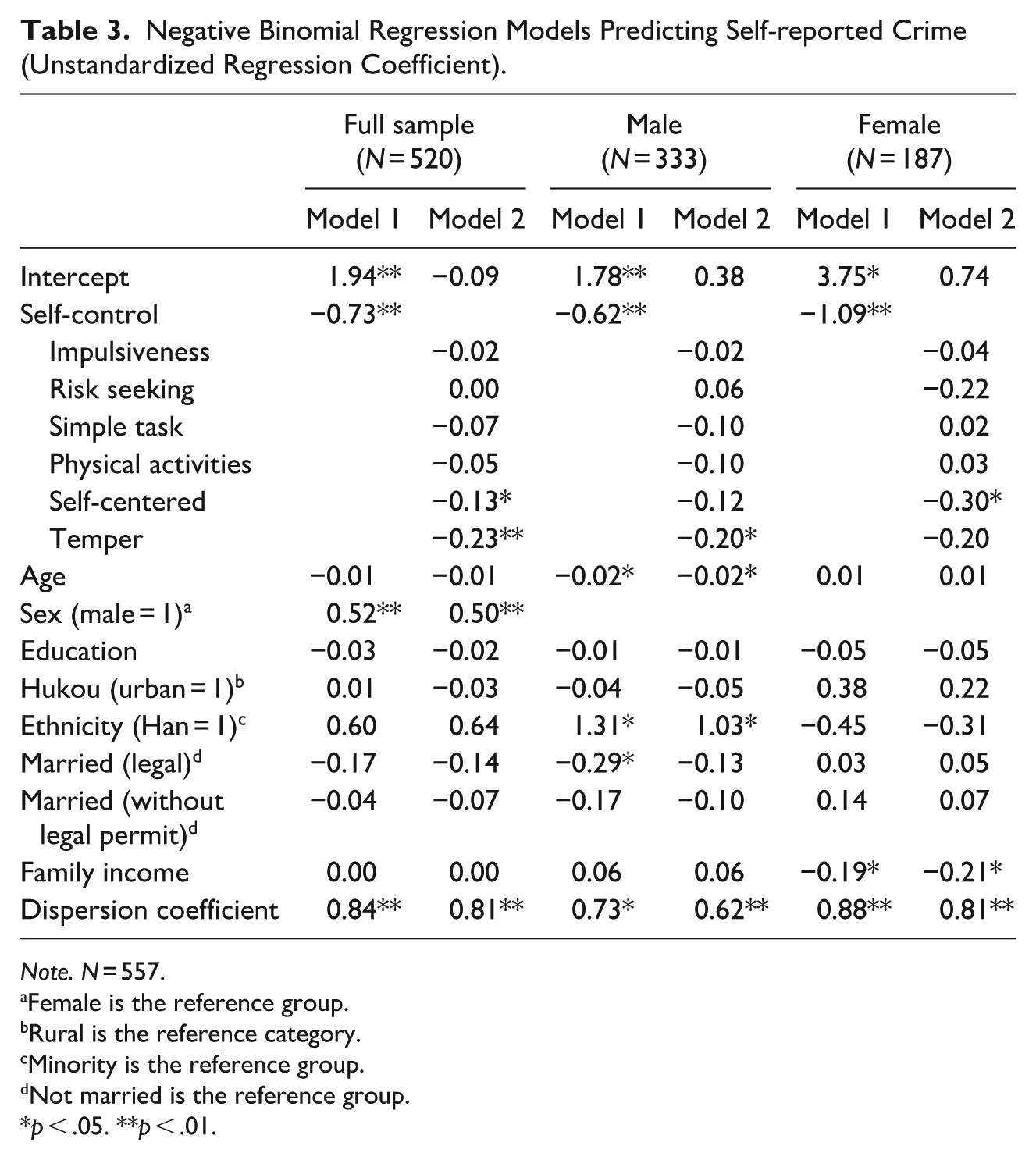
Table 3 displays the multivariable negative binomial regression models investigating the associations between self-control and criminal behavior while controlling for a series of individual and family characteristics. We first examined the relationship between self-control and self-reported criminal activities in the full sample, with Model 1 focusing on the global scale and Model 2 on the six subdimensions. In Model 1, high self-control had a significant and negative effect on self-reported criminal activities, even after accounting for the social-demographic variables. Consistent with Gottfredson and Hirschi, respondents with low self-control reported higher levels of criminal activities (b = −0.73, p < .01). A more nuanced analysis (Model 2) reveals that out of the six subdimensions, being self-centered (b = −0.13, p < .05) and having a high temper (b = −0.23, p < .05) increased respondents’ participation in criminal activities. As expected, gender was also a significant predictor, with the regression coefficients being statistically significant in both Model 1 (b = 0.52, p < .01) and Model 2 (b = 0.50, p < .01).
Negative Binomial Regression Models Predicting Self-reported Crime (Unstandardized Regression Coefficient).
Note. N = 557.
Female is the reference group.
Rural is the reference category.
Minority is the reference group.
Not married is the reference group.
p < .05. **p < .01.
Next, we examined whether the effects of the global scale of self-control and its six subdimensions differ across genders. For the male subgroup, Model 1 indicates that the effect of the global scale of self-control was statistically significant (b = −0.62, p < .01). Out of the six dimensions (Model 2), temper was the only subdimension that was statistically significant, with those with a hot temper more likely to engage in criminal activities (b = −0.20, p < .05). Among the control variables, younger men (b = −0.02, p < .05 in Model 1 and Model 2) and those identified as Han ethnicity (b = 1.31, p < .05 in Model 1, and b = 1.03, p < .05 in Model 2) were more likely to get involved in criminal activities, and those who were legally married (b = −0.29, p < .05 in Model 1) were less likely to participate in crime than those who were not married.
A similar pattern was found for the female subgroup. Overall, the effect of the global scale of self-control was strong and significant (b = −1.09, p < .01, Model 1). Out of the six subdimensions (Model 2), being self-centered significantly increased the respondents’ engagement in criminal activities (b = −0.30, p < .05, Model 2). The effect of temper among females appeared to be the same as that of males, although the regression coefficient was not statistically significant (b = −0.20, p > .05, Model 2), probably due to the smaller sample size of the female subgroup. Moreover, among females, family income was a significant protective factor, with those reporting a higher family income less likely to participate in criminal activities (b = −0.19, p < .05 in Model 1, b = −0.21, p < .05 in Model 2). Finally, a formal equality of regression coefficient test was conducted (results not shown, Brame et al., 1998), revealing that the effects of self-control—regardless of the global scale or the six subdimensions—did not differ significantly across male and female subgroups.
Discussion and Conclusion
Self-control theory has received broad empirical support across various behaviors, contexts, and populations. Yet, research on its applicability to special populations, including offenders, substance users, and those under criminal justice supervision, remains comparatively limited, particularly in non-Western settings like China. To address this gap, this study seeks not merely to replicate prior work, but to extend the application of self-control theory by examining its dimensional structure and predictive claims within a culturally and institutionally distinctive context. Specifically, we draw on original survey data from a unique sample of drug users in the Chinese criminal justice system to evaluate the cross-cultural validity of self-control theory. We investigate two questions: (1) whether Grasmick et al.’s self-control scale demonstrates robust psychometric properties in this high-risk population; and (2) whether self-control predicts self-reported criminal behavior, and how this relationship may vary in culturally specific ways.
Our first major finding provides empirical support for the applicability of Grasmick et al.’s (1993) self-control scale among drug users in the Chinese criminal justice system. Results from the second-order confirmatory factor analysis affirm that the six theorized subdimensions (i.e., impulsivity, risk-seeking, preference for simple tasks, physicality, self-centeredness, and temper) load meaningfully onto a higher-order latent construct of self-control. These results validate the scale’s theoretical structure and demonstrate its robustness in measuring self-control even within a high-risk, correctional population. This extends prior validation efforts conducted mainly among general or student populations (Chui & Chan, 2016; Jiang et al., 2020), supporting the scale’s generalizability to marginalized and offender groups. While concerns about dimensionality and construct validity persist (Marcus, 2003, 2004), our findings reinforce Grasmick et al.’s scale’s utility as a reliable operationalization of low self-control across diverse populations and cultural contexts (Piquero et al., 2005; Wolfe & Hoffmann, 2016).
Our findings also affirm self-control theory’s core proposition that individuals with lower self-control are more likely to engage in criminal behavior, even within a high-risk, culturally specific population. At the same time, the subdimension-level analysis reveals culturally contingent patterns that meaningfully extend the theory rather than merely replicate its premises. In many Western studies, risk-seeking and impulsivity are considered the most salient components, especially related to property offenses and minor norm violations (Forrest et al., 2019; Lagrange & Silverman, 1999). In contrast, our analysis indicates that among Chinese drug users, temper and self-centeredness, two traits more directly tied to interpersonal discipline and relational morality, emerge as the strongest predictors of offending. This pattern offers both theoretical and cultural insight. Self-centeredness stands in tension with collectivist values emphasizing social harmony, filial and communal obligations, and deference to group interests (M. M.-H. Yang, 1994). In such contexts, overt individualism and disregard for others are not merely behavioral deviations but moral violations that can invite social exclusion and stigma (Ho, 1996; Wong & Tsai, 2007). Similarly, temper expressed as emotional volatility contradicts cultural ideals of restraint and harmonious relationships (Bian, 2019), and is often viewed not simply as personal failing but as a relational moral transgression (J. Li, 2006). Thus, the self-control dimensions that most strongly predict deviance in this setting are those most at odds with local norms of relational morality and affective self-discipline. These findings echo prior research in Hong Kong and Japan, where self-centeredness and temper were key predictors of violent or disruptive behavior (Chui & Chan, 2016; Vazsonyi et al., 2004). Together, this cross-cultural pattern underscores the importance of relational and moral dimensions as core components of self-control in collectivist Asian cultures. Their prominence illustrates that the theory’s core structure holds. However, the predictive power of specific subdimensions appears to be shaped by local norms, suggesting its applicability depends on context-sensitive interpretation (Moon et al., 2014; Vazsonyi et al., 2004).
Besides, consistent with previous research, gender emerged as a significant predictor of self-reported criminal behavior, with male participants reporting higher levels of offending (Burton et al., 1998; Shekarkhar & Gibson, 2011). When disaggregating the models by gender, the global self-control scale remained a strong and significant predictor for both males and females, reaffirming the theory’s broad applicability across demographic subgroups (Gottfredson & Hirschi, 1990). While formal tests showed no significant difference in the overall effect of self-control across gender groups, our subdimension-level analyses revealed variation in which traits were most salient. Among male respondents, temper was the only subdimension significantly associated with criminal behavior, aligning with literature linking masculine socialization to emotional impulsivity and externalizing tendencies (Hagan, 1989; Miller & Burack, 1993). In contrast, self-centeredness emerged as the only significant predictor among female respondents. This result is particularly meaningful in collectivist cultures, where women are expected to uphold relational obligations, emotional attentiveness, and social harmony. A lack of such behaviors may be viewed not only as deviant but as a fundamental failure of social role performance (Ho, 1996; Wong & Tsai, 2007). Thus, the same behavioral trait like self-centeredness may carry distinct gendered moral weight depending on prevailing cultural norms. These patterns suggest that while the overall strength of the self-control-crime relationship is statistically similar across genders, the specific traits that drive criminal behavior are shaped by gendered expectations embedded in social and cultural institutions. Compared with school-based adolescent samples where risk-seeking was the strongest predictor of delinquency (Chui & Chan, 2016), our high-risk sample underscores the elevated behavioral salience of emotional volatility and relational deviance in institutionalized adult populations. This highlights the importance of examining self-control as a multidimensional and culturally mediated construct, where subdimension-level analysis offers crucial insights into how deviant behavior is gendered and contextualized.
In addition to self-control, several control variables demonstrated significant associations with criminal behavior, with distinct patterns emerging across gender. Among male participants, younger age, Han ethnicity, and unmarried status were linked to higher levels of offending. These findings are consistent with life course criminology, which emphasizes how early deviance, weaker social bonds, and the absence of conventional adult roles contribute to increased criminal propensity during emerging adulthood (Sampson & Laub, 1995). The overrepresentation of Han individuals in our sample, despite being the ethnic majority, may reflect institutional dynamics, such as urban-centered surveillance or enforcement bias, that warrant further scrutiny. In contrast, among female participants, higher family income was associated with reduced offending, echoing prior research that underscores the protective role of economic resources in mitigating women’s pathways into crime (Chesney-Lind & Pasko, 2018).
Despite the substantial support for self-control theory found in this study, some limitations warrant consideration. First, our reliance on a nonprobability sample of incarcerated drug users limits the external validity of the findings. While the results offer important insights into a high-risk and understudied population, they may not be generalizable to the broader population of drug users in China. Future research should incorporate nationally representative samples to more rigorously assess the psychometric robustness of the scale and the broader applicability of the theory. Second, as noted by Marcus (2004), the conceptualization and measurement of self-control continue to generate theoretical debate, particularly concerning cross-cultural validity. Although our results suggest that Grasmick et al.’s scale exhibits solid construct validity in this context, the uneven salience of its subdimensions, especially the heightened predictive power of temper and self-centeredness, highlights the importance of cultural calibration. Further refinement and cultural adaptation of the measurement instrument are needed. Mixed-methods approaches may be especially useful in capturing the localized meanings of self-regulation and behavioral control. Taken together, our findings not only provide cautious yet meaningful support for the applicability of self-control theory in a non-Western, high-risk context, but also call attention to the importance of dimensional sensitivity and cultural embeddedness in testing criminological theories.
By way of closing, we highlight several policy implications derived from our findings. First, the demonstrated relevance of self-control theory among Chinese drug-involved offenders suggests that behavioral interventions targeting core aspects of self-regulation, particularly emotional restraint and relational awareness, may play a critical role in crime reduction. Given that self-centeredness and temper emerged as the most salient predictors of offending, rehabilitation programs should incorporate culturally grounded components that promote empathy, interpersonal responsibility, and emotional regulation. Second, gender-responsive strategies that address the most salient self-control deficits may enhance intervention outcomes. For males, programs could target temper and impulse regulation, while for females, efforts could focus on strengthening relational connectedness. Third, the consistent predictive power of self-control across genders supports the development of integrated programs that address shared risk factors while remaining responsive to gender-specific needs. More broadly, our findings underscore the importance of embedding crime control efforts within local sociocultural frameworks, echoing calls within Asian criminological scholarship to move beyond the wholesale transplantation of Western models in favor of culturally informed approaches (Belknap, 2016).
Footnotes
Declaration of Conflicting Interests
The authors declared no potential conflicts of interest with respect to the research, authorship, and/or publication of this article.
Funding
The authors received no financial support for the research, authorship, and/or publication of this article.
