







Abstract
This study examines how drug use is situated within relationships between sex market facilitators and individuals who sell sex. Based on interviews with 61 facilitators in New York City and Chicago, we analyze how drugs function within interpersonal dynamics rather than as isolated tools of coercion or individual risk. Using coded interview data and multidimensional scaling, we identify three relational configurations: intimate, controlling, and depersonalizing. In intimate arrangements, drug use reinforces relational ties within shared networks. In controlling arrangements, facilitators create reliance and shape compliance. In depersonalizing arrangements, drugs regulate performance and maximize productivity. These findings suggest that drug use operates as a relational mechanism that varies across interpersonal contexts, organizing power and dependency within relationships.
Introduction
Drug use is widely recognized as a feature of commercial sex markets, yet it is rarely examined within the relationships between those who sell sex and those who organize or control participation. Individuals involved in sex markets often report higher rates of drug use, with drug-using networks also shaping pathways into transactional or coerced sexual exchange (Koegler et al., 2022; Shannon et al., 2015). Although these connections are well-documented (e.g., Bourgois & Schonberg, 2009; Grundetjern, 2015; Maher, 1997; May et al., 1999), drug and sex markets are often analyzed as separate domains. As a result, drug use is typically conceptualized either as an individual-level risk factor associated with participation in sex work or as a tool used by traffickers to control victims by fostering reliance and constraining agency (e.g., Bouché & Bailey, 2020; Koegler et al., 2022; Roe-Sepowitz, 2019). This framing overlooks how drug use is organized through relational systems within the sex market.
In this study, we use the terms sex market facilitators (hereafter facilitators) and sex providers (hereafter providers). Facilitators refer to individuals who organize, manage, or facilitate participation in commercial sex markets, while providers refer to individuals who sell sexual services within these markets. We adopt these terms to avoid labels such as “pimp,” “prostitute,” or “trafficker,” which carry legal and cultural meanings that do not fully capture the variability and fluidity of roles within these relationships.
Existing research examines drug use in exploitation and trafficking contexts, alongside work emphasizing variability in facilitator-provider relationships and the negotiations within them (Hoang, 2015; Horning & Stalans, 2022; Weitzer, 2009). Rather than treating drug use solely as a tool of coercion, the interpersonal model of offending conceptualizes criminal behavior as situated in patterns of interaction characterized by differing degrees of involvement (Canter & Heritage, 1990; Canter & Youngs, 2012; Horning et al., 2015). Social relationships organize how drugs function within illicit markets, where distribution rarely occurs through anonymous exchange but instead through interpersonal networks structured by prior ties, trust, and repeated interaction (Bright et al., 2019; Coomber & Moyle, 2018; Gundur, 2022; Jacques & Wright, 2015). Applied to sex market relationships, relational theory suggests that drug use may function not only as a tool of coercion but also as a mechanism that structures interpersonal distance (Emirbayer, 1997; Powell & Dépelteau, 2013).
Using qualitative interviews with facilitators, the present study examines the interpersonal styles of facilitators in commercial sex markets and the functions of drugs within their interactions with providers. This study develops a relational framework for understanding governance in illicit markets by examining how drug use varies across relationships defined by interpersonal distance and emotional engagement, including forms of attachment and dependency between actors. In doing so, this research shifts the focus from static categorizations of actors or behaviors to the relational processes through which coordination, compliance, and constraint are produced.
Literature Review
Studies of interactions within commercial sex markets show how facilitator-provider relationships blur distinctions between intimacy and exploitation, complicating the binary victim-offender categorizations that dominate much of the anti-trafficking literature (Bernstein, 2007; Hoang, 2015; Horning & Stalans, 2024; Katona, 2017; Marcus et al., 2014; Weitzer, 2009). Individuals who manage participation in commercial sex often describe their relationships with providers using narratives of intimacy and loyalty, at times situating these ties within broader kinship-style networks. These accounts position facilitation within ongoing social relationships that may be framed as collaborative, even as they produce asymmetries in control. Providers, including victims of sex trafficking, may maintain emotional attachments to facilitators, which may persist after exit and shape decisions not to pursue legal action (Casassa et al., 2022). To account for these dynamics, we use a relational framework and the interpersonal model of offending, which conceptualize interaction in terms of varying degrees of emotional involvement and interpersonal positioning.
Prior work shows that facilitation styles vary along a continuum of control and violence, with these patterns often justified through gendered understandings of authority and competence (Horning et al., 2022). Research shows that so-called “boyfriend” or “Romeo” pimping highlights the role of intimacy in recruitment and retention within sex market relationships. Facilitators cultivate romantic or quasi-romantic bonds to build trust and, in some cases, foster reliance (e.g., Katona, 2017; Marcus et al., 2014). These dynamics complicate purely coercive interpretations, such as those outlined by Merodio et al. (2020), by demonstrating how affective ties can enable entry into and continuation within sex market relationships. However, this literature has primarily focused on recruitment, with less attention to how these relational forms evolve over time or organize ongoing interaction, including practices such as drug use.
Control within these relationships is shaped by overlapping illicit market contexts. Prior work identifies variation in coercive strategies across illicit market contexts, with facilitators embedded in drug distribution networks more likely to rely on psychological forms of coercion, and those with gang affiliation associated with greater use of overt violence (Horning et al., 2026).
These findings indicate that coercive strategies are not uniform but are shaped by the broader relational and organizational contexts in which these relationships are situated, raising the question of how drug involvement more directly structures facilitator-provider interactions.
Social Relationships and Drug Use
Ethnographic and network studies of illicit drug markets show that distribution rarely occurs through anonymous exchange but instead operates through interpersonal networks, where trust and prior relationships regulate access and participation (Bright et al., 2019; Coomber & Moyle, 2018; Gundur, 2022; Jacques & Wright, 2015). Within these interactions, drugs function as social resources that organize authority, agency, and dependency within relationships (Coomber & Moyle, 2018; Gundur, 2022).
A related body of work examines drug use as a socially embedded practice. Studies of peer networks and intimate partnerships show that initiation and continued use often occur within relationships that normalize and sustain drug use (Fujimoto & Valente, 2012; Simmons & Singer, 2006; Valente et al., 2004). Rather than reflecting individual decisions alone, drug use emerges through interaction with others, including romantic partners and peer groups whose routines and expectations underpin everyday drug practices. Within these settings, drug use is often organized through shared routines of co-use, reciprocity in access to drugs and resources, and network-based norms of trust and obligation that regulate participation (Simmons & Singer, 2006; Valente et al., 2004). When facilitators are embedded in these networks, these social dynamics shape how interactions with providers are structured, particularly through patterns of shared use, reciprocity, and ongoing interpersonal contact (Fujimoto & Valente, 2012). In these contexts, drug use may be incorporated into interaction through co-use and shared routines, organizing relationships around joint participation rather than exclusively through coercion or control.
These network-based dynamics are not uniform but are shaped by the social positions of actors within them, including gender. Ethnographic studies of street-level drug markets show that women often access drugs through intimate partners or trusted contacts, creating forms of dependency that shape both access and participation (Fleetwood & Leban, 2023; Maher, 1997; Richert, 2022). In these contexts, drug use within close ties, including intimate partners and trusted contacts, can intensify both reliance and emotional attachments. Drug provision and use may reinforce intimacy while also producing asymmetries in control. As a result, drug use becomes intertwined with existing ties in ways that generate interdependency and configure access to drugs and power. These differences reflect variation in relational context rather than contradiction, with drug use taking on different meanings and functions across facilitator-provider interactions.
Theoretical Framework: The Interpersonal Model and Relational Theory
The Interpersonal Model (IPM) conceptualizes criminal behavior as integrated into patterns of interaction defined by varying degrees of emotional engagement and relational distance (Canter & Heritage, 1990; Canter & Youngs, 2012; Horning et al., 2015). Rather than focusing solely on individual characteristics or situational opportunities, the model examines how actors position themselves in relation to others through distinct relational styles. This framework allows us to examine how the function of drug use varies across relational contexts defined by differing relational configurations.
The IPM has primarily been used to understand perpetrators’ styles in single or serial sexual or violent encounters; however, interpersonal relationships between facilitators and providers in the commercial sex market often persist over long periods. We extend the IPM through relational theory to account for the ongoing interactions between facilitators and providers. Relational theory emphasizes that social action and power relations emerge through ongoing interactions among actors rather than from individual attributes or fixed structural positions (Emirbayer, 1997; Powell & Dépelteau, 2013). Within this framework, power develops through interaction as participants negotiate roles and expectations over time.
Applied to sex market relationships, this framework directs attention to how drug use organizes interpersonal dynamics. From this perspective, drug use is not a fixed mechanism of control but varies in meaning and function across relational contexts. By examining facilitators’ narratives through this relational lens, the present study develops a typology that identifies configurations in how drug use is incorporated into sex market relationships. While relational perspectives emphasize the fluidity of social ties, the typology is intended as a heuristic that reflects patterned interaction rather than fixed categories of individuals.
Relational Dynamics at the Intersection of Drug and Sex Markets
Sex and drug markets are typically examined as distinct domains, with sex markets emphasizing governance and control and drug markets focusing on access, distribution, and dependency. When these systems blend, drug use does not simply co-occur with sex market activity but reshapes how these relationships are enacted in practice.
Drug use is often integrated within ongoing interaction between facilitators and providers, shaping everyday dynamics and routines (Iversen et al., 2021; Koegler et al., 2022; Maher, 1997). Despite the prominence of drug use in accounts of commercial sexual exploitation, including trafficking, much of the research has examined drugs primarily as mechanisms of control, particularly through the creation of dependency via addiction, withdrawal management, and conditional access (Bouché & Bailey, 2020; Koegler et al., 2022; Roe-Sepowitz, 2019). This emphasis foregrounds control while leaving less room to examine how the role of drugs varies across relational arrangements between facilitators and providers. In these contexts, drug use can alter the organization of sex work itself, shaping how exchanges are structured, how relationships are maintained, and how authority is exercised.
Within these relationships, access to drugs is organized through interpersonal ties, often reflecting gendered patterns. Drug use may emerge during recruitment or retention and become embedded in ongoing interaction as relationships develop. Shared use may reinforce emotional bonds, while in other cases it intensifies reliance, particularly when relationships precede entry into sex work (Fleetwood & Leban, 2023; Koegler et al., 2022; Maher, 1997; Shelley, 2012). These patterns suggest that drug use does not operate uniformly as a mechanism of control but instead reconfigures how intimacy, dependency, and exchange are organized within facilitator-provider relationships.
Current Study
To address this gap, the present study examines how drug use is incorporated into facilitator-provider relationships in commercial sex markets, focusing on variation in how these interactions are structured. Guided by the interpersonal model of offending and relational theory, we use multidimensional scaling (MDS) to examine associations among these variables and identify patterned relational configurations across facilitator-provider relationships. By identifying these configurations, this study shows that drug use does not operate uniformly as a mechanism of control but instead varies across relational contexts, shaping how interactions between facilitators and providers are organized.
Methods
Research Design
This study uses a mixed-methods design combining qualitative coding with multidimensional scaling (MDS) to identify how relational features cluster across cases. We coded interview transcripts to capture relational features of facilitator-provider relationships, including the function of drug use within exchanges, facilitators’ descriptions of providers, prior relationships between facilitators and providers, and facilitators’ own relationships to drugs. We analyzed the coded variables using multidimensional scaling (MDS) to identify patterns of co-occurrence across cases. This approach groups features that co-occur, making recurring relational configurations visible. We used these configurations to develop a typology of interpersonal drug-use dynamics and interpreted them through qualitative analysis of participants’ accounts.
Sample Recruitment
Individuals were eligible for interviews if they were 18 years of age or older, had actively recruited or managed providers within the past 10 years, and had received goods or money for recruitment or management. Participants could not be actively under the influence of drugs or alcohol at the time of interview and were required to demonstrate sufficient cognitive capacity to provide informed consent.
The full sample included 183 facilitators recruited from Chicago (n = 99) and New York City (n = 84). Chicago interviews were conducted in June 2021 and New York City interviews concluded in August 2022. Because the focus of the present study is the role of drugs within facilitator-provider relationships, we restricted the analytic sample to interviews in which drug use appeared within the interaction between parties. This yielded a subsample of 61 facilitators whose narratives explicitly described drug-mediated relational dynamics. Rather than estimating prevalence, this study focuses on cases where drug use is present to examine variation in how it structures relationships.
Purposive and referral-based sampling strategies were used to ensure diversity in demographic characteristics and sex market experience. Advertisers with connections to the illicit sex trade disseminated study information, including confidentiality protections and interview logistics. Participants completed a 1-hr, audio-recorded interview and received $70 in compensation. Referral incentives ($15 per referral; maximum of three) were used to expand access to hidden networks.
Ecological Sites for Interviews
Recruitment occurred across multiple ecological sites selected based on established community connections. In Chicago, recruitment focused on individuals connected to strip clubs and areas surrounding West Garfield Park. In New York City, recruitment occurred through LGBTQ+ community networks, East Harlem near public housing developments, and shelters in the Jamaica neighborhood near JFK airport.
Although recruitment was site-specific, facilitation activities were often geographically mobile, with 59.6% of participants reporting out-of-state operations. Interviews were conducted either in person or via Zoom, with most occurring in person in both Chicago (94.9%) and New York City (79.8%). Additional details on recruitment procedures and site characteristics are reported elsewhere (Horning & Stalans, 2024).
Sample Description and Selection
The analytic sample included 61 facilitators. Most participants identified as male (70.7%), followed by female (27.6%) and transwomen (1.7%). The majority identified as Black (81.0%), with smaller proportions identifying as Hispanic (6.9%), mixed race (5.2%), Hispanic and Black (1.7%), Puerto Rican (1.7%), or other racial identities including Belizean, Mexican, or Creole backgrounds (1.7%). Participants ranged in age from 19 to 67 years. Educational backgrounds varied, with most participants reporting a high school diploma, GED, or some college education. The participants in this study engaged in street-based and online facilitation, with many using a hybrid approach.
To assess potential selection bias, we compared cases included in the analytic sample with those excluded on several background characteristics. Chi-square analyses indicated no statistically significant differences between the groups in drug addiction, use of violence, or exposure to violence during childhood. Independent samples t-tests likewise showed no statistically significant differences in mean age of entry into facilitation or mean years worked. These results suggest that the selection procedure did not introduce systematic differences between the analytic subsample and the full interview sample.
All procedures were approved by an institutional review board. Interviews were professionally transcribed and verified by the research team, after which audio files were deleted. To protect confidentiality, identifying information and street names were replaced with pseudonyms.
Analytic Strategy
We analyzed interviews to examine how drug use functions within relationships between facilitators and providers. Four analytic domains guided coding: the function of drug use, emotional discourse toward providers, prior relationships, and facilitators’ own relationship to drugs. We coded each variable as present or absent to capture whether specific relational features appeared within a case, using NVivo 15 Collaborate. Although variables were initially coded for frequency, all measures were dichotomized (1 = present; 0 = absent) to facilitate multivariate pattern analysis. A full list of variables and coding definitions is provided in Appendix A.
Coding followed a hybrid deductive-inductive scheme and was non-exclusive, allowing multiple codes to be assigned to the same segment. Two trained coders, both doctoral-level researchers, independently coded the material following five joint training sessions focused on codebook familiarization and pilot application. We assessed intercoder reliability during a pilot phase by randomly selecting three cases for independent double-coding. Percent agreement ranged from 71% to 75%. Following this assessment, we reviewed discrepancies, clarified code definitions, and established reconciliation rules. Using the finalized codebook, we coded the remaining cases.
Multidimensional Scaling and Typology Construction
We used non-metric multidimensional scaling (MDS) to identify which coded features tend to appear together and to visualize relational configurations of drug use, emotional discourse, and interpersonal dynamics. MDS positions variables closer together when they frequently co-occur across interviews, making clusters of relational features easier to identify.
The technique is well suited for categorical data and has been used in prior research to derive thematic structures from narrative material (Horning et al., 2024; Canter & Youngs, 2009). MDS identifies which coded features tend to appear together across interviews. These co-occurrences form clusters that we interpret as relational configurations. Next, we interpreted these groupings alongside interview narratives to identify coherent relational patterns.
Analyses were conducted in R using Euclidean distance measures. The spatial configurations produced by the MDS analysis informed how we classified cases into three interpersonal themes derived from, but adapted beyond, the Interpersonal Model (IPM). While the IPM has traditionally been applied to violent and sexual offending (Canter & Heritage, 1990; Canter & Youngs, 2009), it was modified here to capture variation in relational distance and emotional engagement specific to drug use within sex market relationships. Accordingly, we reframed the original IPM categories as Intimate, Controlling, and Depersonalizing themes to better reflect empirically observed relational patterns.
Results
Frequency Analysis
In the first stage of our analysis, we examined the distribution of the coded variables across cases. Table 1 presents the frequency of each variable, with valid percentages representing the proportion.
Frequency of Relationship, Discourse, and Drug-Related Behaviors.
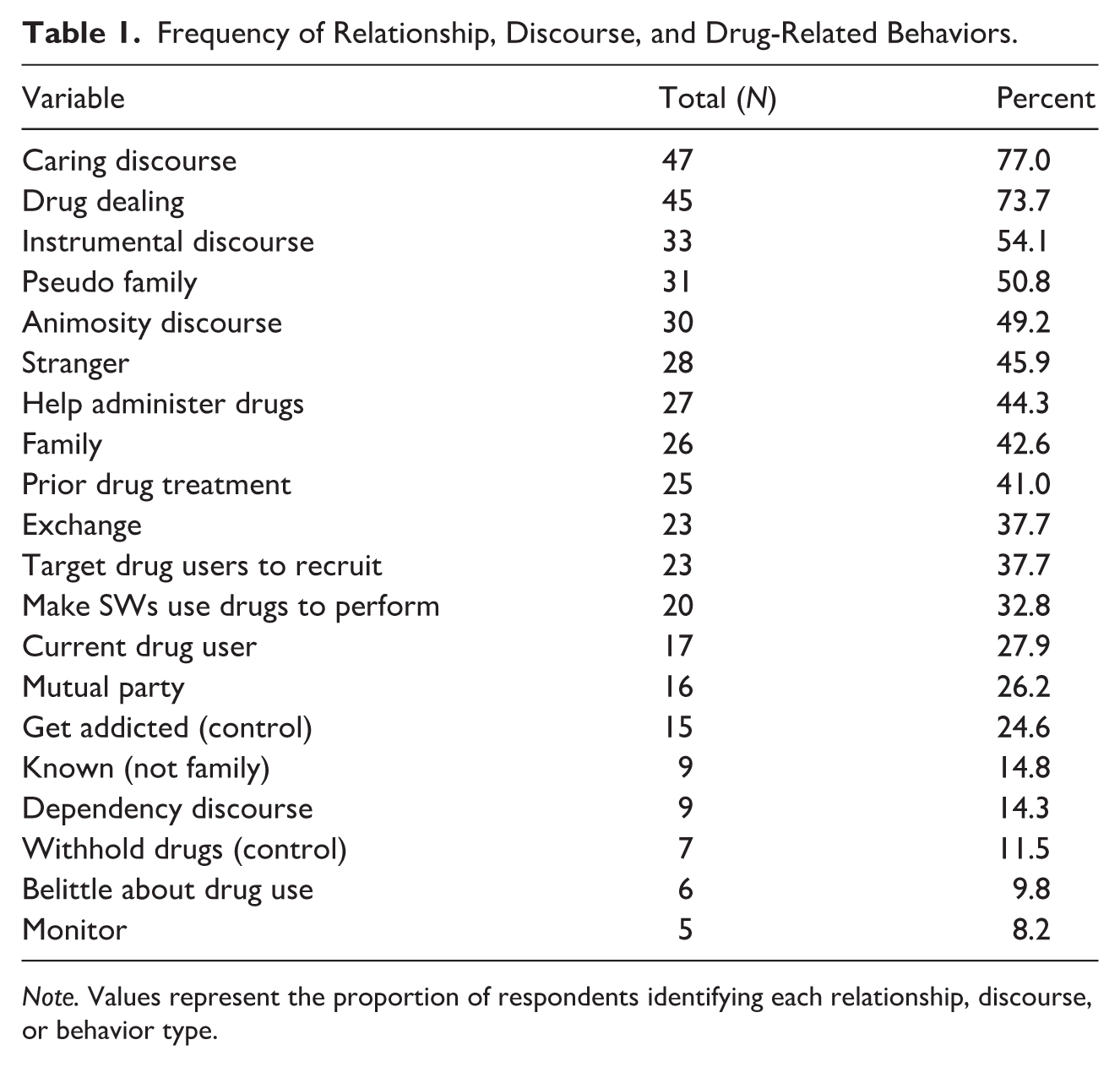
Note. Values represent the proportion of respondents identifying each relationship, discourse, or behavior type.
Variables Occurring in More Than 55% of the Cases
There are various interpretations of what constitutes a high frequency variable, with some models including all variables and others designating the cut-off at 50% (Horning et al., 2015; Salfati, 2003), with our cutoff of 55% reflecting conventions in behavioral theme research. We first identified variables occurring in more than 55% of cases which tend to provide limited discriminatory value for distinguishing patterns across cases.
There are two high frequency variables (see Table 1). Caring discourse appeared in 77% (n = 47) of the cases. This likely reflects both relational dynamics and impression management, where they may frame their relationships in affective or protective terms.
Another high frequency variable was facilitators’ connections to drug dealers in their social support network in 73.7% (n = 45), indicating a high level of embeddedness in drug market environments.
We excluded these variables from further analysis. Two cases contained no remaining coded variables and were removed, resulting in a final sample of 61 cases.
Variables Occurring in 40% to 55% of the Cases
Many of the variables within the 35% to 55% range were either facilitators’ relationships with providers or facilitators’ emotional discourse about providers (see Table 1). Facilitators used instrumental discourse in 54.1% (n = 33) of the cases, showing that many interactions are described by facilitators as transactional, often framing relationships in explicitly exchange-based terms. Additionally, 49.2% (n = 30) of the facilitators expressed animosity discourse showing disdain for providers. Next, the variables centered around the relationship between facilitators and providers with pseudo-family being the highest frequency in this relationship band at 50.8% (n = 31), followed by strangers at 45.9% (n = 28) and family at 42.6% (n = 26), highlighting the range of relational contexts from intimate to more detached ties.
In 44.3% (n = 27) of the cases, facilitators helped administer drugs to providers to prevent withdrawals or crashes, showing a role in managing providers’ drug use. Moreover, 41% (n = 25) of the facilitators attended drug treatment programs in the past, demonstrating familiarity with drug use and its effects.
Variables Occurring in 20% to 39% of the Cases
In the 20% to 39% range, most of the variables related to the function of drugs in the relationship (see Table 1). Of the sample, 37.7% (n = 23) recruited drug users, often targeting individuals perceived as vulnerable, indicating that drug use is present in recruitment strategies. In 37.7% (n = 23) of the cases, the drug-sex relationship was based on exchange or reciprocal responsibility involving benefits for both or providers trading for survival, revealing that drugs may be embedded in negotiated or survival-based arrangements. For 26.2% (n = 16), the drug relationship centered around mutual partying with facilitators and providers collective drug use or getting high for fun or “to party.” In 32.8% (n = 20) of the cases, facilitators described requiring providers to use drugs to regulate mood, endurance, or work capacity in ways the facilitators explicitly framed as performance-enhancing, positioning drugs as tools for regulating labor. 24.6% (n = 15) purposely got providers addicted to drugs to control them, highlighting more explicit use of substances as a mechanism of control. In 27.9% (n = 17) of the cases, the facilitator was a current drug user, suggesting that facilitators’ own drug use may also influence these dynamics.
Variables Occurring in Fewer Than 20% of the Cases
In this lowest frequency band, the focus was on some of the less used discourses about providers and whether they knew the provider but not in a family capacity, so this can include friends or acquaintances (see Table 1). In 14.8% (n = 9) of the cases, the facilitator and provider knew each other prior to selling sex, but they were not family, showing pre-existing social ties outside kinship. In 14.3% (n = 9) of the cases, facilitators used dependency discourse, relying on providers for stability followed by the belittling discourse (9.8%; n = 6) or putting providers down. The lowest frequency variable is facilitators’ monitoring providers drug use (8.2%; n = 5) with few of them keeping track of exact amounts, illustrating limited direct oversight of consumption in most cases.
Multidimensional Scaling
We used MDS to determine the co-occurrence across cases. Model fit reflects the correspondence between the rank order of the original similarity matrix and the distances represented in the MDS solution (Santtila et al., 2003). MDS estimates Euclidean distance configurations that minimize stress. Regarding model fit, a commonly used goodness-of-fit guideline (Kruskal, 1964) suggests that stress estimates between 5% and 10% indicate fair to good monotonic relationships between the model’s distances and the observed similarities. In this MDS, the stress measure was 10.4% after five iterations, indicating a fair to good fit.
Figure 1 presents the spatial configuration produced by the multidimensional scaling (MDS) analysis. Variables that co-occur across cases appear closer together in the plot, allowing clusters of co-occurring variables to be observed. The configuration reflects a three-part structure organized around relational distance and emotional engagement within facilitator-provider interactions. These clusters were categorized into three themes of drug use in facilitator-provider relationships: Intimate, Controlling, and Depersonalizing.
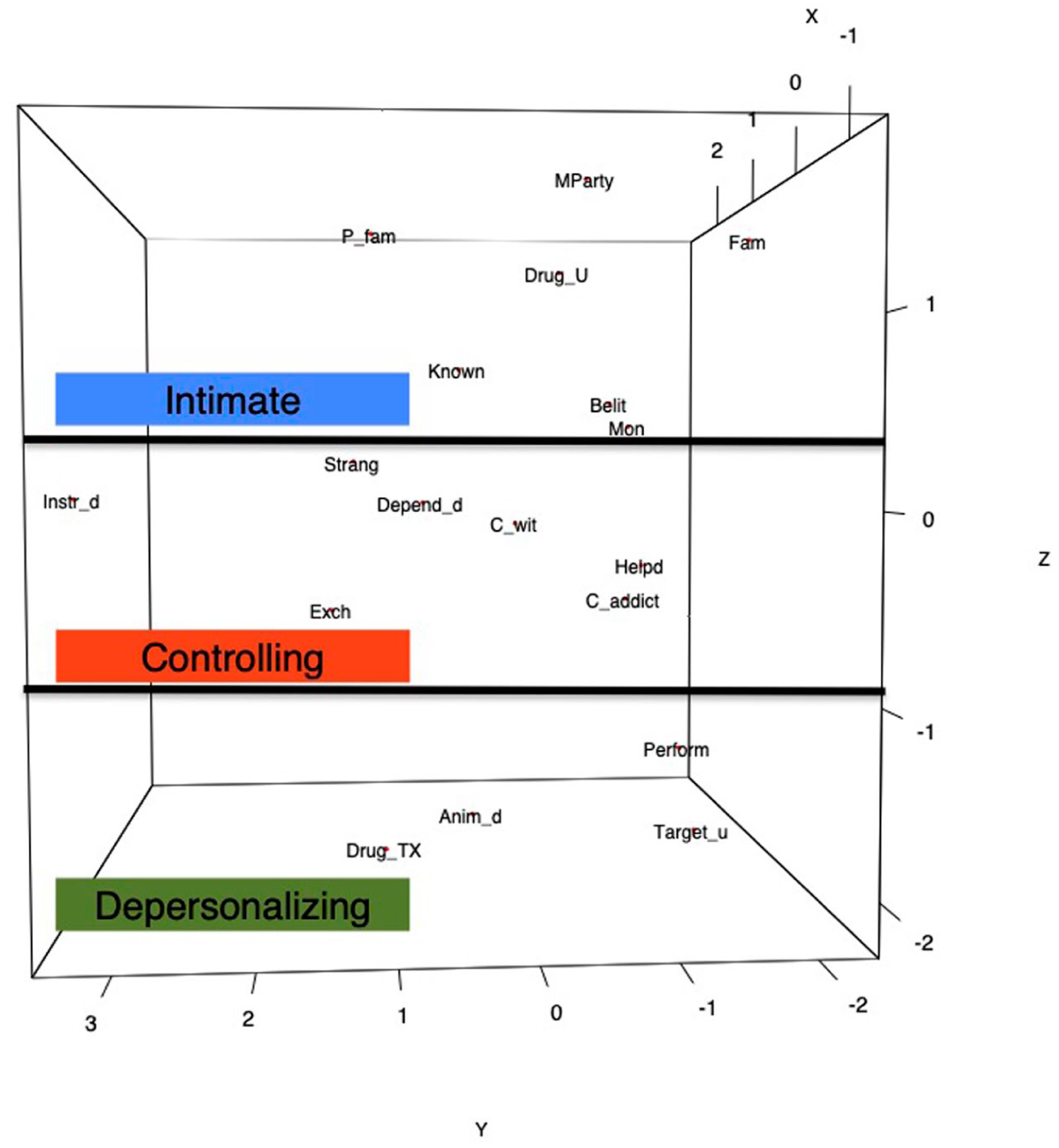
An interpersonal typology of drug use in pimping and trafficking.
Categorization of Intimate, Controlling, and Depersonalizing Constructs.
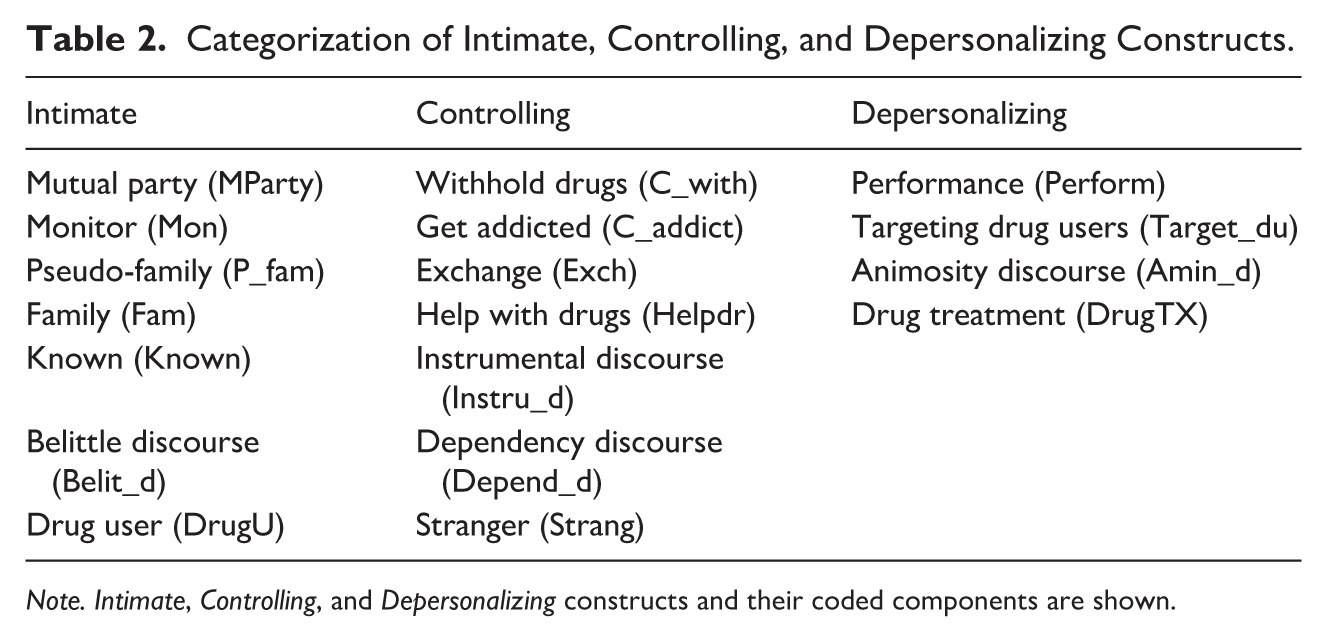
Note. Intimate, Controlling, and Depersonalizing constructs and their coded components are shown.
Interpersonal Configurations of Drug Use
The spatial configuration shown in Figure 1 reflects three distinct relational patterns through which drugs structure facilitator-provider relationships. The Intimate configuration involves relationships embedded in shared drug-use networks characterized by mutual partying and pseudo-family ties. The Controlling configuration reflects relationships that unfold around dependency and compliance, in which drugs function as mechanisms of control. The Depersonalizing configuration involves relationships marked by emotional distance and instrumental use of drugs to regulate performance and productivity.
Next, we classified cases thematically. We examined each of the 61 cases to determine if we could assign them to a dominant theme based upon variables that co-occurred in accounts. We gave every case a score indicating the number of intimate, controlling or depersonalizing themes. We used a 1.5:1 requirement and 62.2% could be classified. Of the total sample 31.1% (n = 19) of the cases were classified as within the controlling theme. Next, 21.3% (n = 13) were in the intimate category. The depersonalizing category was the lowest frequency category with 9.8% (n = 6) of the cases being classified in this way.
Overall, 37.7% (n = 23) of cases were classified as hybrid, indicating that relational features were distributed across multiple configurations rather than concentrated within a single dominant pattern. Among these hybrid cases, the most common combination involved controlling and depersonalizing features (16.4%, n = 10), suggesting that mixed configurations often leaned toward more instrumental and detached dynamics. This was followed by intimate–controlling combinations (11.5%, n = 7), reflecting cases where affective ties coexisted with elements of dependency and regulation. The least frequent pattern was the intimate–depersonalizing combination (4.9%, n = 3), indicating that highly depersonalized dynamics were less likely to occur in relationships characterized by prior familiarity or emotional closeness.
Illustrative Narratives
Intimate Theme
The intimate component appears in cases where the connection between the facilitator and the provider is organized around affective ties, shared drug use and partially overlapping support networks. Shirley, an actor who initially entered as a provider but later became a facilitator, described her relationships with workers: “We either got high together . . . They’d tell me about their childhood, what they were going through.” In these relationships, the facilitator avoids being seen as a recruiter or manager, instead positioning themselves as part of the same social circle, which can deepen relational attachment with providers.
These cases are characterized by the existence of previous relationships or the creation of pseudo-family ties. The cases analyzed frequently use terms, such as “friends,” “associates,” “sisters,” or directly “family” to describe their relationship. Shirley said, “We were mostly like family . . . sometimes we watch each other’s back . . . just sisters,” framing the relationship as one of closeness and relative equality. In another case, the participant described how they started managing individuals who were childhood friends or with whom they had existing affective ties: “I know them personally growing up . . . close friends.” Even when these relationships shifted into work arrangements, the framework remains intimate: first they are friends, then they work together.
Drug provision functions as an extension of this connection, rather than a control tool. In these cases, giving or sharing drugs framed as support. Marvin said that “They get everything, drugs, money . . .” Shirley described a flexible approach to drug provision: “Sometimes I give it to them. Sometimes they have to pay for it. Depends on how I feel.” Even when facilitators recognize that providing drugs facilitates the job, the logic here is distinct from other strategic drug supplying cases. Sharing or helping with drugs becomes part of the relationship, a resource that circulates within a relationship understood as mutual and emotionally embedded.
When these dimensions of an intimate connection (mutual partying, help with drugs, and pseudo-family bonds) meet, they produce a relationship type where facilitators understand themselves as protectors, confidants, or family member. Shirley’s statement captures this dynamic: “We all stuck together. It’s like a family in the street.” In her narrative, the central motivation is not controlling but keeping social bonds that provide meaning and stability in the sex market. This aspect distinguishes the intimate theme from other patterns. Facilitators and providers operate under a logic of support and closeness rather than discipline or instrumentality.
Controlling Theme
The controlling theme reflects relationships that begin between strangers and quickly become structured around the creation of dependency. Facilitators often described encountering people who were already facing significant vulnerabilities such as drug use, homelessness, or a lack of family support. Elijah illustrated this dynamic when he noted that “They don’t have nobody. They’re alone. They’re broke. They don’t got no money and here comes a guy like myself that can put some things together for them so they can put money in they pocket and they all follow.” What appears on the surface as assistance becomes the foundation of a relationship in which the facilitator’s provision of resources creates leverage. Specifically, drugs, housing, food, clothing, and other necessities are offered not as care but as tools that bind providers to the facilitator.
Within the Controlling theme, drugs function as the main currency of domination. Facilitators offer drugs in exchange for labor, withhold them to enforce compliance, or purposely keep providers intoxicated. Clark explained that “drugs was always a factor” and that if a woman hesitated to work, “you just give them a little bit, and it’ll motivate them to get out there to get busy.” When asked directly whether he kept women drugged, he responded simply, “Yeah.” These accounts demonstrate how the management of drug use becomes an actual mechanism of control.
The emotional dynamics within this theme further reveal its instrumental nature. Facilitators described emotional involvement not as mutual or caring but as a deliberate strategy to influence behavior. Clark acknowledged this explicitly, stating, “I played with their emotions,” and later referring to himself as a “professional manipulator.” He also described using sex as a tool of influence, explaining, “I had sex with women to get her open to the point where she would wanna do what I wanted her to do.” In these accounts, emotional involvement was used not to build mutual connection but to make women emotionally rely on the facilitator and control their behavior.
However, dependency is not one-directional. Facilitators themselves also depend on providers for financial survival, emotional validation, a sense of identity, and ongoing psychological power. For instance, Clark noted that he “had to” continue having sex with his workers so they would not question his affection, suggesting that his sense of control and identity as a “player” depended on their continued attachment. This may be one reason why many facilitators were aware of their manipulative behavior but attempted to distinguish themselves from the stereotypical violent pimp. They portrayed themselves as smarter, smoother, and more persuasive, emphasizing communication and emotional skill as their primary tools of influence.
By doing so, they reframed coercion as professionalism and control as care. The facilitator became not the abuser but the organizer, the one who “provides safety” or “puts things together” for others. This self-presentation is an important part of the Controlling theme because it reveals how facilitators rationalize and legitimize the very behaviors that maintain their power.
These elements form a coherent prototype of the Controlling theme. Relationships with strangers create openings for influence. Providing drugs in exchange for basic needs introduces a structure in which dependency is cultivated and sustained. Instrumental emotional discourse reinforces the facilitator’s authority, while the facilitator’s own expressions of dependency operate as yet another mechanism of control. Within this framework, the provider becomes the vehicle through which the facilitator meets their material and psychological needs.
Depersonalizing Theme
The depersonalizing theme emerges when the relationship between facilitators and providers is produced around emotional distance and objectification. In this configuration, drugs function less as intoxicants than as tools for regulating mood, endurance, and work capacity, framed by facilitators as necessary for “performance” and productivity. Unlike relational or controlling patterns, this configuration is not organized by efforts to build closeness, loyalty, or affective dependency. Instead, participants’ accounts reveal a systematic reduction of providers to interchangeable, morally degraded categories, in which the worker is treated less as a person and more as a functional input within an extractive system.
This distancing is most clearly visible in the language used to describe workers. Monica, for example, states that “when there’s a prostitute, their name . . . you might as well say their name is bitch.” This statement does more than convey insult; it reflects a routine linguistic practice through which individuality is erased and naming itself becomes irrelevant. While similar derogatory terms appear across interviews, their meaning depends on context. Delilah, for instance, acknowledges using this language deliberately and in moments of anger, describing it as intentionally degrading. Her reflection suggests that such language forms part of a broader repertoire for managing workers and reinforcing hierarchy, allowing emotional detachment to be sustained through everyday speech.
Depersonalization is also closely linked to the use and administration of drugs, which in this pattern function less as a form of social exchange and more as a tool for performance regulation. In contrast to other patterns where drugs may operate as gifts, rewards, or mechanisms of bonding, here drugs are framed primarily to maintain endurance, regulate the body, and secure productivity. Latoa, a provider who became a facilitator, describes drugs as the motivation that enabled her to keep working, observing that this logic applied to most women she worked with. Monica is even more direct, stating that drugs are essential for persisting in the job. Delilah adds a crucial nuance that clarifies the instrumental nature of this practice: “Not too high. I mean, just enough to work.” Her comment reveals a careful logic of dosing, where intoxication is adjusted to sustain output rather than pleasure or connection. In this configuration, drugs operate as functional regulators that transform the body into something that can keep producing.
Recruitment practices reinforce the depersonalizing prototype. Participants explicitly identify drug users and unhoused individuals as ideal targets, not because of personal or relational ties, but because their vulnerability makes them easier to recruit and retain. Latoa describes “the easy person to recruit” as someone who “just need drugs . . . a person that uses drugs.” Joyce expands on this logic by detailing how minimal gestures (such as buying weed, offering clothing, or providing attention) can function as low-cost investments that secure long-term control. As she puts it, some people “come for a bag of dope and never leave.” Across these accounts, vulnerability does not generate moral obligation or care; it becomes a strategic opportunity. Recruitment is evaluated less in terms of connection and more in terms of poverty, efficiency, and utility.
As in the controlling theme many of the facilitators in this category describe themselves as former drug users or individuals in recovery. However, the context changes. Latoa emphasizes that she has been clean for 20 years, while Joyce and Monica relate recovery journeys shaped by personal and religious encounters. Recovery narratives appear across interviews, but what distinguishes depersonalization cases is that recovery does not necessarily translate into empathy toward providers who also use drugs. In some cases, it is associated with stronger moral distancing and even animosity. This suggests that firsthand experience with addiction can be transformed into instrumental knowledge. It is not used to manipulate the facilitator, but a resource for managing others’ use, calibrating consumption, or sustaining dependency without emotional attachment. Rather than fostering solidarity or empathy, shared histories of drug use are used strategically to support a colder and more calculated administration of the work.
Depersonalization cases highlight how distancing operates alongside calculations of the costs and benefits of managing drug-dependent providers, echoing an economic logic of management. These elements define the depersonalizing theme as an interactive structure in which the provider is treated as an object. The normalization of degrading language, the use of drugs as a productivity tool, the targeting of vulnerable individuals for recruitment, and the strategic deployment of recovery knowledge converge into an articulated pattern: the removal of the provider as a relational subject. In this logic, workers are bodies that produce, consume what is necessary to keep producing, and remain replaceable. Depersonalization thus illustrates how dehumanization operates not only through overt violence, but through routine language, everyday selection practices, and drug-management strategies that render disposability normal, efficient, and systematic.
To assess whether these relational configurations varied by gender, a cross-tabulation analysis was conducted (see Table 3).
Gender by Relational Framing of Drug Involvement.
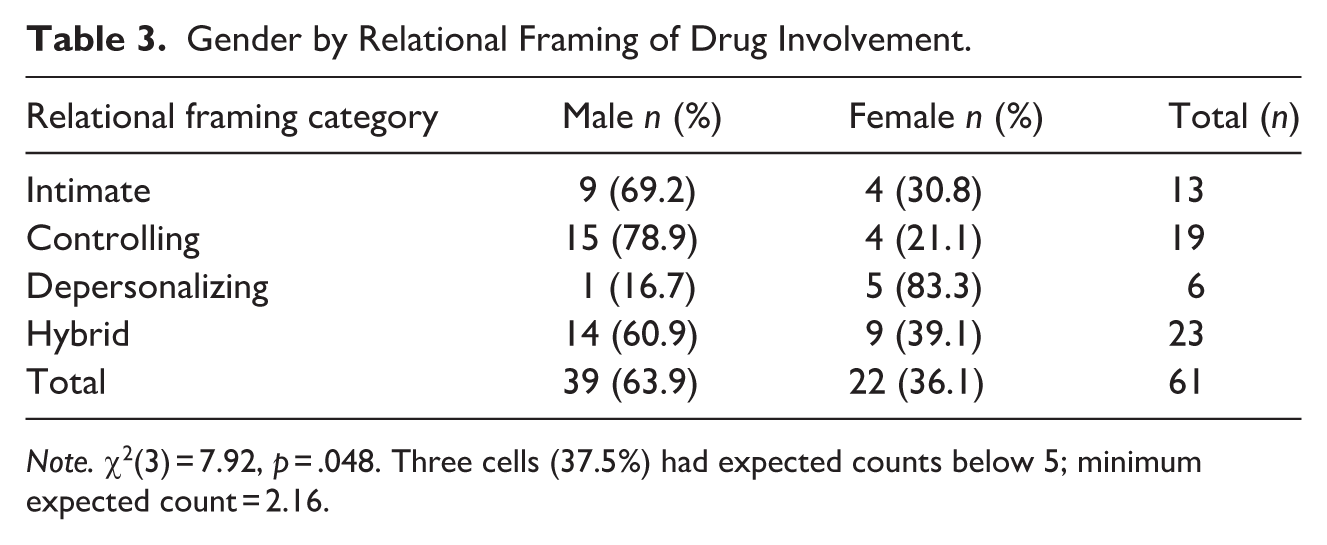
Note. χ2(3) = 7.92, p = .048. Three cells (37.5%) had expected counts below 5; minimum expected count = 2.16.
Gender was significantly associated with relational framing, χ2(3) = 7.92, p = .048, although results should be interpreted with caution due to small cell counts. Patterns varied across relational categories. In the Intimate theme, distributions closely approximated expected values, with men comprising 69.2% (n = 9) and women 30.8% (n = 4), suggesting that gender differences are less pronounced in more relationally embedded contexts. The largest deviation from expected counts appeared in the Controlling theme, where men were overrepresented, accounting for 78.9% of cases (n = 15) compared to 21.1% for women (n = 4), indicating that more instrumental configurations are more likely to involve male participants. A distinct pattern emerged in the Depersonalizing theme, where women comprised 83.3% of cases (n = 5) compared to 16.7% for men (n = 1); although based on a small number of cases, this finding is notable given its alignment with more depersonalized or objectified relational framing. Hybrid relationships showed relatively balanced distributions (60.9% male, n = 14; 39.1% female, n = 9), suggesting that mixed relational dynamics may attenuate gender differences. These patterns suggest that gender structures how individuals are positioned within relational configurations without determining a fixed relational style. Women’s participation extends beyond relational or intimate contexts into more instrumental and depersonalizing configurations, pointing to the possibility of role adaptation within existing network structures.
Conclusion and Discussion
This study develops an interpersonal typology of drug use within sex market relationships that reframes drugs as relational mechanisms rather than uniform tools of coercion. Drug use does not operate independently of social context; instead, its function shifts across interpersonal distance, emotional engagement, and relational history between providers and facilitators. In doing so, the analysis challenges dominant criminological accounts that position drugs primarily as instruments of recruitment and control within trafficking and facilitation relationships (Koegler et al., 2022; Shelley, 2012). Existing work has often conceptualized these relationships within coercive control frameworks, emphasizing domination through dependency and compliance (e.g., Merodio et al., 2020), with drugs frequently understood as tools used to produce and maintain that dependency (Koegler et al., 2022). While this pattern is present in the data, the findings demonstrate that it represents only one configuration among several, rather than the defining structure of facilitator-provider relationships. Across cases, drug use within relationships structures intimacy, dependency, and exchange in facilitator-provider relationships, varying across distinct configurations rather than reflecting a single coercive dynamic.
In configurations characterized by affective closeness or constructed family-like ties, drug use is embedded within shared social practices rather than imposed as a mechanism of control. Participants describe collective drug use as part of everyday interaction, where trust, reciprocity, and informal care organize how drugs circulate. In these contexts, drugs are not primarily used to regulate labor but to sustain relationships, reinforce bonds, and manage shared risk. These dynamics align with research on drug-using networks and social supply, where informal regulation and collective forms of care structure access and use (Coomber & Moyle, 2018; Grundetjern & Sandberg, 2012; Gundur, 2022; Jacques & Wright, 2015). They also complicate existing work on so-called “boyfriend” or “Romeo” pimping, which emphasizes the strategic deployment of intimacy in recruitment and retention (Katona, 2017; Marcus et al., 2014). While prior research often interprets intimacy as instrumental, emerging accounts suggest that affective ties may also be experienced as meaningful social relationships, even when situated within unequal or exploitative market structures. Drug use, in these cases, becomes part of that relational fabric rather than a singular tool of coercion.
A different configuration emerges where drug use is mobilized to structure compliance and dependency within more transactional and emotionally distant relationships. Here, drugs function as leverage within the organization of sex work participation, shaping when and how providers engage in work. While this pattern is consistent with prior research emphasizing substance-based control (Koegler et al., 2022), the analysis complicates such accounts by showing that these relationships are not unidirectional. Facilitators themselves become integrated in these dynamics, deriving identity, validation, or stability from the relationships they manage. Control, in this sense, operates as a relational process rather than as a fixed role, sustained through ongoing interaction rather than imposed from a single position of dominance.
The depersonalizing configuration represents a further shift in relational structure, marked by emotional distance, objectification, and the systematic regulation of bodies for productivity. In this pattern, drugs are used less as social resources or leverage and more as tools for managing endurance, mood, and output. Facilitators explicitly target individuals with drug dependencies and maintain use in ways that maximize efficiency and minimize resistance, reflecting a more extractive logic of organization (Gundur, 2022; Koegler et al., 2022). Notably, many facilitators in this category are themselves abstinent or in recovery, drawing on experiential knowledge of addiction to regulate others’ use while maintaining emotional distance.
Dehumanizing language and moral boundary-making further reinforce this configuration, allowing facilitators to sustain control not only through material resources but through the reclassification of providers as interchangeable and expendable. In this context, drug use operates alongside linguistic and social practices that normalize disposability, moving beyond coercion into a broader process of depersonalization.
These configurations trace a movement across relational forms that parallels, but also extends, the Interpersonal Model framework. While the original model emphasizes interpersonal distance and emotional engagement, the present analysis demonstrates how drug use actively reorganizes those dimensions within sex market contexts. By situating drug use within these relational processes, the study advances criminological theory beyond individual-level risk or singular models of coercion and toward a more dynamic understanding of how illicit markets are structured through social and emotional ties that produce distinct configurations of interaction.
More broadly, the findings underscore the need for integrative approaches that bridge scholarship on drug markets, sex work, and trafficking. Drug use and sexual exchange intersect through ongoing interpersonal processes, structured by trust, obligation, and unequal power rather than discrete acts or static roles (Bright et al., 2019; Coomber & Moyle, 2018; Sandberg, 2012). These relational configurations complicate binary victim/offender frameworks and highlight the limits of interventions premised solely on rescue or enforcement.
When drug use is grounded within interpersonal attachment or shared networks, responses that assume a purely coercive dynamic may fail to address the mechanisms sustaining participation. At the same time, configurations characterized by depersonalization and instrumental control demonstrate how vulnerability can be systematically produced and maintained through relational and organizational practices. Understanding how drug use operates across these configurations provides a more nuanced foundation for interpreting variation in sex market dynamics and for developing responses that are responsive to the interpersonal contexts in which exploitation occurs.
These findings suggest that interventions targeting trafficking and exploitation must move beyond models that assume coercion operates uniformly. When drug use is embedded within relational ties, responses focused solely on enforcement or rescue may fail to disrupt the interpersonal dynamics sustaining participation. Harm reduction and intervention strategies should account for the relational contexts in which drug use operates, including the role of social bonds and dependency within informal social networks. Policies that recognize variation in relational configurations may better identify points of intervention across different forms of exploitation.
Future Directions
Future research could more explicitly map the social networks underlying these relational configurations. Social network analysis could illuminate how family or pseudo-family ties shape drug use and sex market participation across dyads and triads. Comparative analyses of ego networks among drug-using and non-drug-using participants could further clarify how emotional ties and homophily structure vulnerability and exit.
Attention should also be directed to how gender shapes relational configurations within illicit markets. While the present findings suggest that gender differences are contingent on relational form, with greater differentiation in more instrumental and depersonalized contexts, larger samples are needed to assess the stability of these patterns and to explore how gender intersects with drug use and coercion across diverse settings.
Finally, longitudinal research examining relational histories, including shared trauma and prior social bonds, would deepen understanding of how these dynamics evolve over time and condition both exploitation and resilience within sex market contexts. Such approaches would help capture how relational configurations shift, stabilize, or break down across the life course of involvement.
Footnotes
Appendix A
Acknowledgements
We thank all the participants for their time and willingness to participate in the study.

Ethical Considerations
This study was approved by the Institutional Review Board (IRB) at the University of Massachusetts, Lowell.
Consent to Participate
Informed consent was obtained from all participants.
Funding
The authors disclosed receipt of the following financial support for the research, authorship, and/or publication of this article: This work was supported by the National Institute of Justice [Federal Award No. 2019-R2-CX-0067].
Declaration of Conflicting Interests
The authors declared no potential conflicts of interest with respect to the research, authorship, and/or publication of this article.
Data Availability Statement
Due to the sensitive nature of this data, the interview data is not publicly available.