







Abstract
Airport security involves one of the most ubiquitous identity checks individuals face, and yet there is very little research devoted to the experiences of transgender (trans) people with the Transportation Security Administration (TSA). This study attempts to examine the broad experiences of individuals who identify as trans with TSA. It uses the U.S. Transgender Survey (2015) data to gain a better understanding of what interactions members of the trans/non-binary community TSA entail and to what extent physical presentation impacts those experiences. Further, this study uses item response theory-based analysis to better characterize the commonality and severity of experiences trans individuals are exposed to, particularly when their physical appearance reads as ambiguous. Implications for future research and policy regarding gender-affirming care are considered.
Introduction
As trans and nonbinary gender identities become more recognized and visible in society, it becomes increasingly important to understand the spaces and interactions that present obstacles and/or sites of cis-normative gatekeeping. Further, understanding the experiences of those who fall outside of gender norms is crucial in order to improve systems and processes (Kutateladze, 2022). Foucault (1990) highlights gender as constructed through social norms and institutions, the latter of which have the power to regulate and discipline bodies, sometimes through the force of law. Gender performance (Lorber, 1994) is therefore a key element in how institutions (and the state) reinforce societal norms. This study examines how this “enforcement” of gender norms plays out as trans and non-binary individuals interact with the Transportation Security Administration (TSA).
Emergent scholarship (Girardi, 2021; Goodman et al., 2022; Lerner et al., 2020; Wall et al., 2023) examines the interactions of transgender and nonbinary individuals with social institutions (i.e., healthcare, police) that rely on the categorization of people into distinct normative groups. Such state-level identity management work historically relied upon the use of (binary) gender categories to make operations more “efficient” (Currah & Mulqueen, 2011). This reliance on binary classifications in an increasingly non-binary world (Clarkson, 2019; Kang & Kang, 2020) leads to heightened scrutiny of those whose visible gender expression falls outside the gender binary. As more individuals who resist or challenge those binary categories through their physical presentation, markers on their identification, or use of specific pronouns interact within those institutions, tensions often result, highlighting the limits of those systems in serving an increasingly diverse population.
Although limited, an emerging field of inquiry examines the interactions between trans and nonbinary individuals and social institutions that rely heavily on (largely) binary classifications to help identify risk. The cis-normative assumptions underpinning the procedures and practices of these institutions leads to higher levels of surveillance, suspicion, and even discrimination against trans and non-binary individuals, significantly impacting their ability and willingness to interact with such institutions (Avalos, 2022; Dwyer, 2011; Girardi, 2021; Kattari et al., 2019; Lerner et al., 2020; Rossman et al., 2017). As these practices and policies become more common, the disciplining of gender boundaries by state actors becomes more apparent.
Because TSA remains one of the most common sites of identity checks, those whose physical appearances are considered “atypical” in some way are likely to have very different experiences than those whose bodies fall into the gender binary. As such, it is critically important to examine the outcomes of such interactions among trans and non-binary individuals.
Determining Gender
Gender is one of the key organizing principles in modern society. It is one of the first categories individuals are sorted into in social and institutional settings. As gender categories expanded and shifted in recent decades, scholarly efforts to understand the bases and antecedents of gender categorization, as well as the consequences of the blurred and expanded categories, emerged. As a result, scholars in social sciences are now beginning to consider best practices in allowing for broader gender categorizations. Such efforts are complicated by a lack of shared definitions and understanding. Specifically, there is no universal agreement with regard to terms, definitions, or boundaries of gender categories. Further, the norms and beliefs by which binary gender organizes behavior in public spaces persist and reinforce traditional gender stereotypes (Ridgeway & Saperstein, 2024), resulting in strong resistance to altering categories.
There are various ways in which individuals may sift others into gender categories–or “determine gender” (Westbrook & Schilt, 2014). Gender presentation often acts as a shorthand, or “cultural genitalia” (Kessler & McKenna, 1985) to indicate gender, which is presumed to coordinate with biological sex. Based on these cues, and perhaps others, such as name or voice, it is common for individuals in a standard, gender integrated, social situation to simply categorize according to a binary approach to gender. This is called “identity-based” categorization (Schilt & Westbrook, 2009). However, in sex-segregated situations or those in which actual genitalia seem relevant, those biological factors surpass other factors in importance and people tend to rely on biologically-based notions of sex in their categorization of gender (Schilt & Westbrook, 2009). When there is a mismatch between gender presentation (or identity categorization) and biological criteria, the challenge to the gender system (specifically, the gender binary) often evokes negative reactions (Stern & Rule, 2017).
Furthermore, culturally salient gender-based ideas about vulnerability and danger also translate into a reality where segregated spaces are not policed equally (Westbrook & Schilt, 2014). Related work demonstrates that, even for those who “pass” within a gender binary, their identities can evoke a ‘distinctiveness threat’ (Broussard & Warner, 2018). That is, because trans individuals are perceived as blurring the boundaries between traditional gender categories, their identities or appearances may prompt discomfort among those around them. Those whose gender category is more difficult to determine easily (i.e., those who do not “pass”) also experience more negative responses.
The airport, as such, is an integrated space, where general social interactions are likely to rely on some measure of identity categorization. Airport security, however, by its very nature, imposes a sex-segregated frame onto this space based on physical appearance, which then introduces biological expectations (via the algorithm used in scanning machines to differentiate between men and women) and flags nonconforming bodies. Beyond that, gendered expectations of danger and risk also may impact how anomalies are handled. State actors have long been identified as one of the key forces in constructing and maintaining gender categories (Meadow, 2010).
Gender Scrutiny by Law Enforcement
The issues raised when trans and nonbinary individuals interact with those tasked with maintaining safety and protection, therefore, can be problematic. Because law enforcement has the authority and power to enforce the law and restrict freedom, the outcomes are amplified when law enforcement actors deem someone to be deviant. Those not appearing to fit into the gender binary are widely perceived as deviant, or even dangerous (Girardi, 2021; Osborn, 2023). Because the police are charged with identifying risks, LGBTQ+ people generally, and particularly those not visually appearing to fit within the gender binary, are more likely to be surveilled by police (Osborn, 2023). Avalos (2022), in reviewing the existing literature on transgender individuals’ interactions with the criminal justice system, reinforces the idea that those not fitting within a gender binary based on appearance are more likely to come under police scrutiny and more likely to be involved in a police-initiated encounter. This disproportionate level of scrutiny is highest for those who are ‘visibly queer’ (Dwyer, 2011; Girardi, 2021), people of color, and trans women (Avalos, 2022; Goodman et al., 2022; Mallory et al., 2015). This finding is consistent with work examining experiences of trans women in immigrant detention centers, which suggests that carceral settings favor cisgender bodies and experiences in ways that lead to negative outcomes for trans people (Vogler & Rosales, 2022).
Although limited, scholarship that has examined police encounters reports experiences with discrimination, harassment, and even victimization by police among trans people (Avalos, 2022; Goodman et al., 2022; Mallory et al., 2015; Osborn, 2023). Indeed, it is not uncommon for police to attribute whatever the “problem” is (e.g., report of victimization) as being related to a person’s gender identity (Girardi, 2021). Interviews with trans individuals reveal that they are treated with mistrust and their victimization experiences are frequently minimized or directly attributed to their “transness.” Indeed, previous research indicates that among LGBT individuals, transgender people are the most likely of this group to report hate related victimization (Kutateladze, 2022); and they are also more likely to be subjected to invasive body searches by law enforcement (Osborn, 2023). This mistrust continues throughout the system, leading to what has been called the “discrimination to incarceration pipeline” (Avalos, 2022). Consequently, these tensions result in a lower rate of reporting victimization, mistrust, and negative attributions of police among LGBTQ+ individuals, particularly those whose appearance challenge the gender binary (Goodman et al., 2022; Owen et al., 2017). There also is evidence that discrimination encountered by trans and nonbinary individuals for not ‘fitting’ into the gender binary has negative impacts throughout the criminal legal system (Jenness & Rowland, 2024).
Given the limits and tensions created by gender categorization, particularly when paired with those who are tasked with maintaining safety and ‘order,’ it is not surprising that literature examining police interactions with trans and non-binary individuals provides a relatively grim picture. There is a widespread expectation (if not actual experience) of negative interactions with police. Moreover, such negative experiences often are generalized, causing many trans individuals to avoid interactions with state actors of any kind (Kutateladze, 2022). Much less research regarding the interactions of trans and non-binary individuals with TSA exists. Given the reliance on body scans that enforce a gender binary and its law enforcement orientation, it seems critically important to understand these interactions and their impacts within the setting of TSA screening (Clarkson, 2019).
Traveling While Trans
Airport security is one of the most common sites of widespread surveillance in our society. Every person who travels by air has their identity verified and must submit to security checks by electronic scanners and, somewhat less frequently, physical pat-downs. Notably, interactions with TSA are more common than those with police. The scope of research examining interactions of trans and nonbinary individuals with TSA is limited, and what does exist originates from tourism research involving interviews with small samples of trans travelers. Likewise, little or no systematic research examining the frequency, quality, and outcomes of TSA interactions has been done. This is particularly problematic given the reliance of such security on identity documents identifying one’s “legal” (e.g., legally recognized) sex often combined with biometric screening (e.g., body scans), which together are utilized to distinguish between “safe” (or bodily normed) populations and individuals from those who do not fit such expectations, who thus are categorized as potentially “dangerous” (Clarkson, 2019). This study represents a first step to such an inquiry.
Interviews with trans and gender nonconforming individuals reveal that although travel often provides an opportunity for identity negotiation and exploration, it is also fraught with anxiety and extensive self-monitoring (Reddy-Best & Olson, 2020). As a result, travel plans involve significant emotional labor before and during travel. One of the most often cited sources of anxiety is TSA screenings. There is concern about inappropriate touching, harassment, and whether their documents will be questioned (Olson & Reddy-Best, 2019). This stress is particularly acute for those who visibly stand out as challenging the gender binary (i.e., who don’t “pass”) (Olson & Reddy-Best, 2019). This makes TSA screenings a particularly important interaction to study.
Transportation Security Administration checks are part of the experience of air travel for everyone. Although the Patriot Act and other policy changes after the terrorist attacks of 9/11/01 altered the experience for all travelers, the process is particularly fraught for those in the trans and non-binary community. One needs to remove specific items from their person and their personal carry-on and be scanned. Individuals then proceed through a full body scanner, which today typically is based on millimeter wave advanced imaging technology, which) replaced metal detectors and other X-Ray machines at the majority of commercial airports (TSA.gov). This technology provides a more detailed scan and can detect both metal and non-metal objects than its predecessors, with the critical difference that, because of its use of automated target recognition (Albert & Smith-Carrington, 2023), TSA agents are required to indicate whether the person about to be scanned is male or female by pressing the appropriate button. This determination is made entirely based on a visual assessment by the TSA officer, which nearly always reflects a binary understanding of gender and bodies (Albert & Smith-Carrington, 2023). Security officers rely on their own normative assumptions based on the physical appearance of the traveler and, sometimes, the gender markers on a traveler’s official documents (Currah & Mulqueen, 2011). The machine then uses an algorithm to note any “anomalies”—bulges or contours where they would not be expected – based on the sex/gender category selected by the TSA agent. When anomalies are detected, passengers are often required to undergo additional screening in the form of pat-downs, additional questions, or supplementary searches (Albert & Smith-Carrington, 2023; Kang & Kang, 2020).
Because trans and non-binary individuals (those with atypically gendered bodies) are particularly likely, depending on their physical presentation and/or use of strategies to accentuate or minimize specific areas of their bodies, to be designated by the binary scanner as ‘anomalous,’ their likelihood of triggering additional security activities (Currah & Mulqueen, 2011) and/or having a more protracted interaction with TSA agents than cis-gender people is increased.
This is further complicated by the requirements to provide legal identity documentation, which specifies one’s biological sex. As Clarkson (2019, p. 621) notes, US trans citizens must navigate obtaining “an assemblage of legal sex designation possibilities, depending on which medical procedures they have or have not completed, where they were born, and where they currently live,” to be prepared for security procedures. More specifically, different jurisdictions have different evidence requirements for specification of sex on identity documents, and these requirements have been anything but stable over time.
Prior research highlights the increased likelihood of microaggressions and harassment experienced by trans people when law enforcement officers make presumptions about gender that do not match ID documentation (Osborn, 2023). Because TSA agents must engage in this process, the likelihood that trans travelers will be subject to such treatment increases. This study seeks to better understand the nature and outcomes of interactions with TSA screenings, where security personnel must piece together these disparate forms of identity recognition to identify the potentially “dangerous” traveler. 1
Methods
Data and Sampling
For the current investigation, we analyzed data from the 2015 U.S. Transgender Survey (USTS). The USTS was collected by the National Center for Transgender Equality (James et al., 2019). Participation was restricted to individuals aged 18 years or older. Surveys were provided in either English and Spanish via online format between August and September 2015. The survey team recruited a broadly representative sample of transgender and non-binary individuals living in all 50 US states, the District of Columbia, and three U.S. overseas territories (American Samoa, Guam, and Puerto Rico). The data utilized convenience and snowball sampling. Recruitment of participants was multifaceted and included outreach via Transgender or LGBTQ organizations, healthcare settings, support groups, and online communities, including more than 800 different organizations, with direct recruitment occurring in more than 400 of these organizations. The total sample for the survey is 27,715. This analysis is, however, focused on those who have traveled by air (and therefore gone through TSA in the past year. Therefore, the final sample for our analyses was 14,612 trans-identifying persons. 2
Measurement
Dependent Variables
The survey items captured a variety of negative outcomes. These items differ considerably in potential victim impact. Therefore, it was important to distinguish between common outcomes that are upsetting and rarer, more severe outcomes. As the foundation for comparison, a two-category distinction between the lesser versus more severe negative experiences, based on their degree of aggression and disruptiveness/potential costs for the traveler, was created. Thus, analyses presented include two dependent dichotomous outcomes: harassment (insensitivity) and coercive enforcement.
Harassment(insensitivity)
Harassment(insensitivity) against trans people, for the purposes of this analysis, are discriminatory comments or behaviors that convey negative or derogatory messages about a person’s gender identity. These actions included both verbal and non-verbal actions that create a hostile or invalidating environment but would not typically be considered potentially serious criminal victimization, violence, or substantially disruptive from the traveler’s plans. These behaviors were measured based on a series of questions that asked respondents “When you went through airport security in the past year, did a TSA officer do any of these things to you? Mark all that apply” The options included: “They questioned the name or gender on my ID,” “They used the wrong pronouns with me (he/she) or the wrong title (Mr. or Ms.),” “They patted me down due to gender-related clothing or items (such as a binder or packer),” “I was patted down by a TSA officer of the wrong gender,” “They searched my bag due to a gender related item (such as a binder, packer),” “They asked me to remove or lift clothing to show a binder, undergarment, or other sensitive area,” “They took me to a separate room for questioning/examination,” and “They announced or loudly questioned my gender, body parts, or sensitive items (such as a binder or packer).” Each item was dichotomously coded 1 if yes and 0 if no.
Coercive Enforcement
The second dependent variable, Coercive enforcement, focuses on more serious, and potentially criminal, experiences that could result in significant psychological, emotional, financial, and physical harm. These behaviors were measured based on affirmative responses to any of the following items: “They called the police about me,” “I missed my flight due to screening,” “I was not allowed to fly,” “They detained me for over an hour,” “They physically attacked me” and “I experienced unwanted sexual contact (beyond a typical pat down by a TSA officer).” Affirmative responses to each of these items were considered yes = 1 and no = 0 otherwise.
Independent Variables
Visual Conformity
Consistent with Goffman’s concept of “passing” (Goffman 2002), although closer to the more current and nuanced understanding of “recognition” (Connell (2009), a measure of the extent to which a transgender person visually conforms to social expectations regarding gender presentation was included. Visual conformity was measured based on a single item that asked respondents to rate their agreement with the statement “People can tell I am trans even if I don’t tell them.” Response options ranged from Always (1) to Never (5), with the midpoint being sometimes (3). Therefore, a higher score on this item reflects greater “passing.”
Military Service
Because military personnel often are treated deferentially when commercially flying, it was important to include military service status. Military service was measured based on a single item which asked respondents “Have you ever served on active duty in the U.S. Armed Forces, Reserves, or National Guard?” Respondents who answered they were currently on active duty were coded as 1 while all others recorded as 0 (not active duty).
Name Change
Whether or not the respondent had modified their legal identification could be a potential correlate for victimization risk, both because having gender concordant IDs has been shown to have positive impacts on the experiences of trans people (Scheim et al., 2020) and because ID markers are one of the ways TSA may approach a traveler when making their binary distinction (Currah & Mulqueen, 2011). Therefore, we incorporated a measure based on the question “Did the court grant your name change?” Responses were dichotomized as yes (1) and no (0).
Data Analysis
As previously noted, because the the two outcome variables differ considerably in their severity, they were separated into microaggressions and major disruptions. Nonetheless, considerable variation in the severity of experiences remains within categories. Standard approaches to data analysis ignore this variation. For example, one strategy is to simply dichotomize the responses into yes or no and then analyze the data via logistic regression. This has the effect of treating an affirmative response to being called by the wrong pronouns as conceptually equal to an affirmative response to being forced to lift or remove clothing, for example. Alternatively, a count-based or Poisson regression approach would count the number of items endorsed. Although this would capture having experienced multiple types of responses, it too treats an affirmative response to one item as being equivalent to any other item. Thus, traditional approaches to data analysis ignore the conceptual severity of the items themselves, which we argue misrepresents the truth of the experiences being captured. Our approach, based on item response theory (IRT) scaling, allows our analysis to account for severity (Osgood et al., 2002). This approach relates observed responses on the items to a continuous latent variable (a trait), which explains why respondents gave the answer to the item. This is estimated via a logistic link function, due to the dichotomous nature of our items (endorsed or not). We estimate the 2-parameter logistic IRT model, because it allows for both item difficulty and item discrimination. Item difficulty is simply the proportion of the sample who endorse the item (in our case indicating yes to being victimized in this specific way). Item discrimination indicates how well an item differentiates based on the latent trait itself (ability or propensity). Values for the IRT model are presented in Table 1.
Item Parameters from Two Parameter IRT Model.
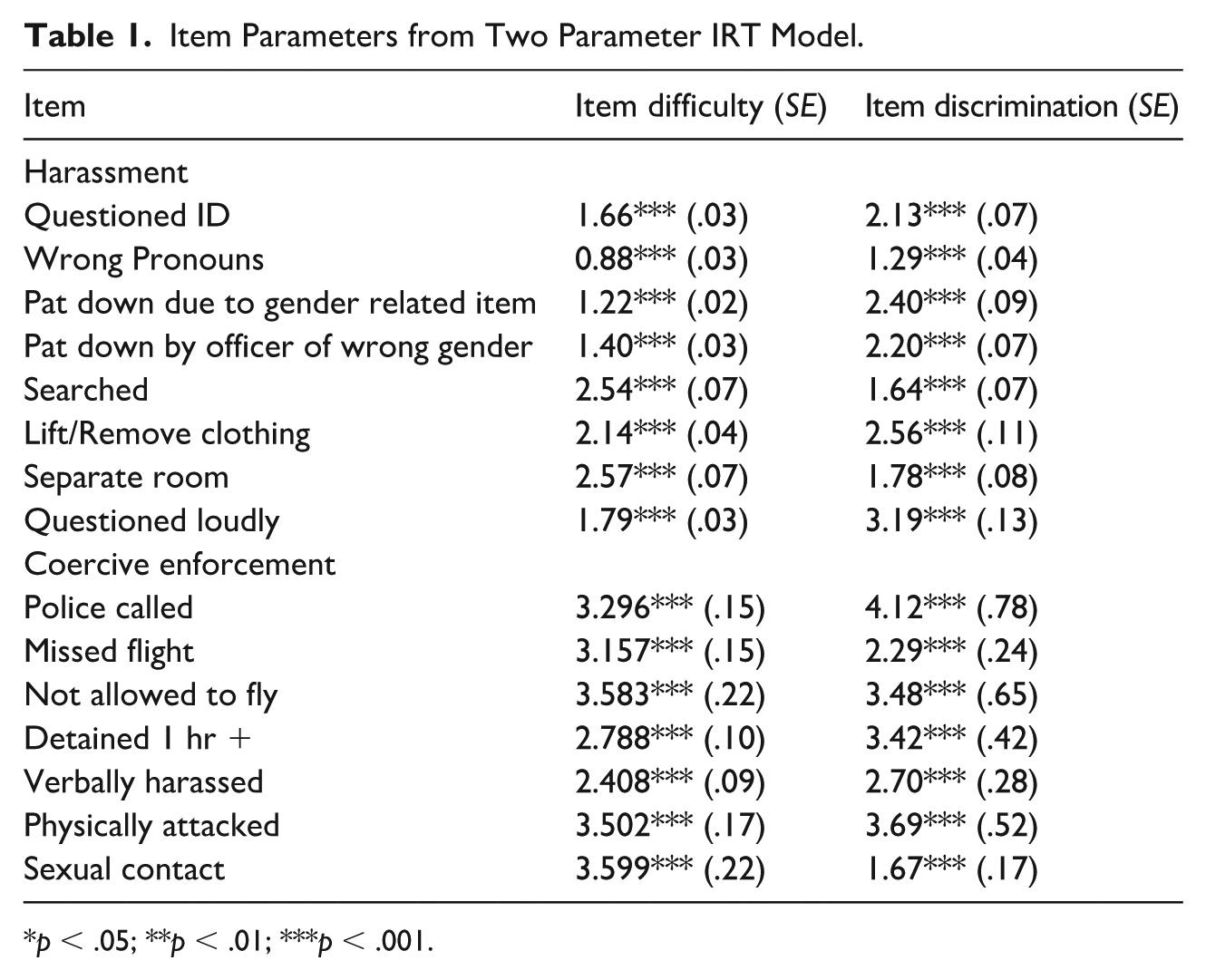
p < .05; **p < .01; ***p < .001.
Results
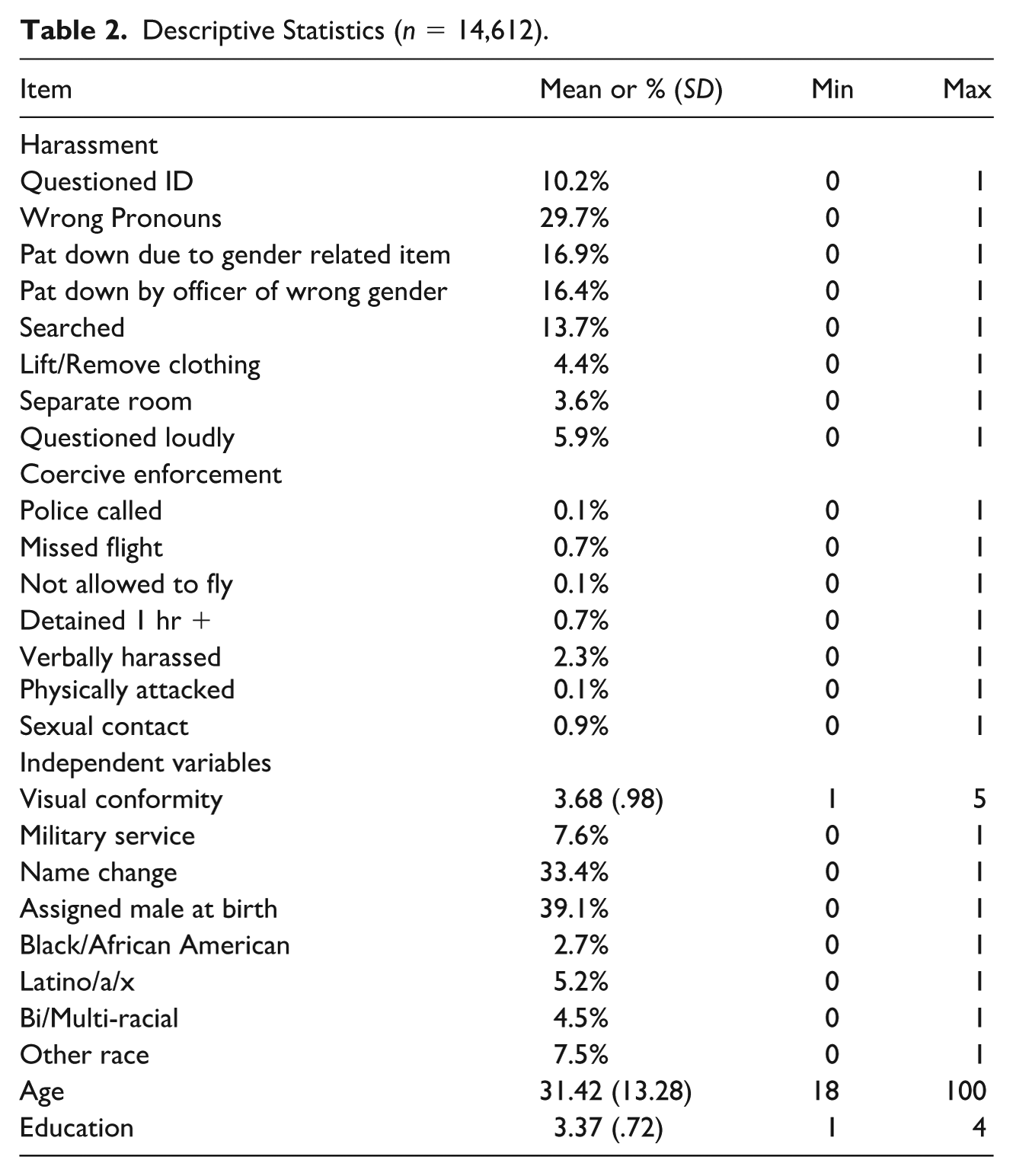
Descriptive information for the sample are provided in Table 2, respondents were more likely to endorse the harassment items than the coercive enforcement. More specifically, within the category of harassment, item endorsement ranged from a low of 3.6% for being taken to a separate room to a high of 29.7% for having an agent use incorrect pronouns. Among coercive enforcement, item endorsement ranged from a low of 0.1% for several items to a high of 2.3% for being verbally harassed. The average respondent reported that people sometimes or rarely identified that they were trans without being told, but there was considerable variation on this variable (the standard deviation is almost a full point). About one third of the respondents successfully changed their legal name through the courts. A majority of respondents were assigned female at birth (61%). Approximately 8% of the sample was on active duty in the military. The majority of respondents identified as White (80%). The average age of the respondents was 31, and had completed, on average, some college, with a modal response of Bachelor’s or higher.
Descriptive Statistics (n = 14,612).
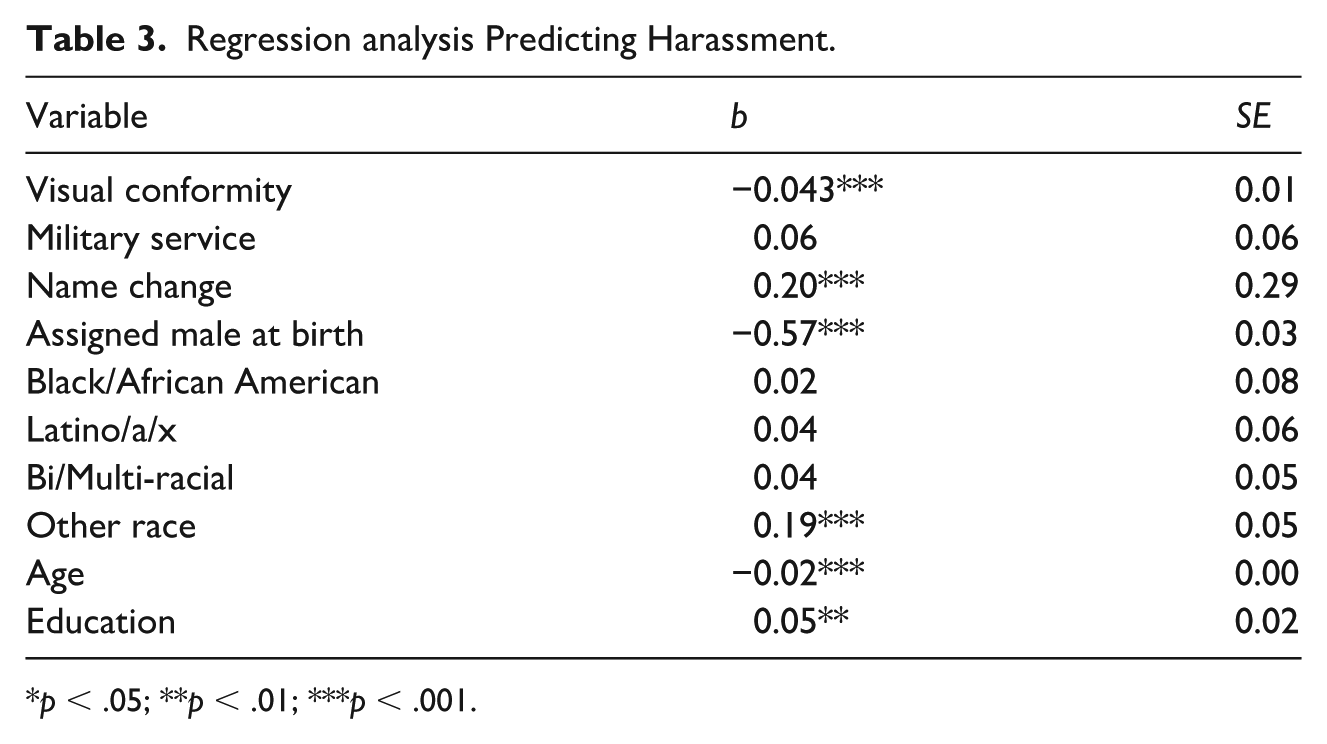
Results from the 2-parameter logistic IRT model predicting harassment are presented in Table 3. As shown in Table 3, those reporting greater visual conformity (“passing”) experienced significantly less harassment at TSA. This suggests that those with physical appearances consistent with a gender binary experience smoother interactions with TSA agents. This is likely because agents are identifying the person based on a correlation between their gender identity and their gendered presentation. In contrast, those whose appearance falls outside the gender binary have more problematic interactions with TSA agents (Clarkson, 2019), as expected.
Regression analysis Predicting Harassment.
p < .05; **p < .01; ***p < .001.
Having legally changed one’s name correlated with significantly more harassment from TSA agents. This is an interesting finding, because one would assume that having a legal name change would be protective against these bad experiences, but that is not the case. We speculate that this may be because a legal name change cannot alter how one’s visual appearance is interpreted and TSA agents doing the scans are not necessarily looking at an ID initially. Additionally, being assigned male at birth (AMAB) correlates with significantly less harassment from TSA agents; in other words, AMAB individuals (trans woman and/or genderqueer individuals) experience significantly less harassment than individuals assigned female at birth (AFAB). Perhaps this is due to an initial impression of femininity (therefore evoking additional politeness).
Those coded as other race (primarily Asian Americans) experienced significantly more harassment from TSA agents than White respondents. Racialized experiences with law enforcement have long documentation (Mallory et al., 2015; Stenersen et al., 2024; Stotzer, 2014), but it is surprising that it was the category of individuals identifying as either Asian, American Indian, or Alaskan and Hawaiian natives who had the most problems with TSA. Older respondents reported significantly more harassment from TSA agents than did younger respondents. This could be the result of resiliency against these lower forms of negative reactions, compared with a long lifetime of worse experiences. Finally, increased education correlated with significantly more harassment from TSA agents. This could be the result of education heightening sensitivity and awareness to more subtle forms of discrimination.
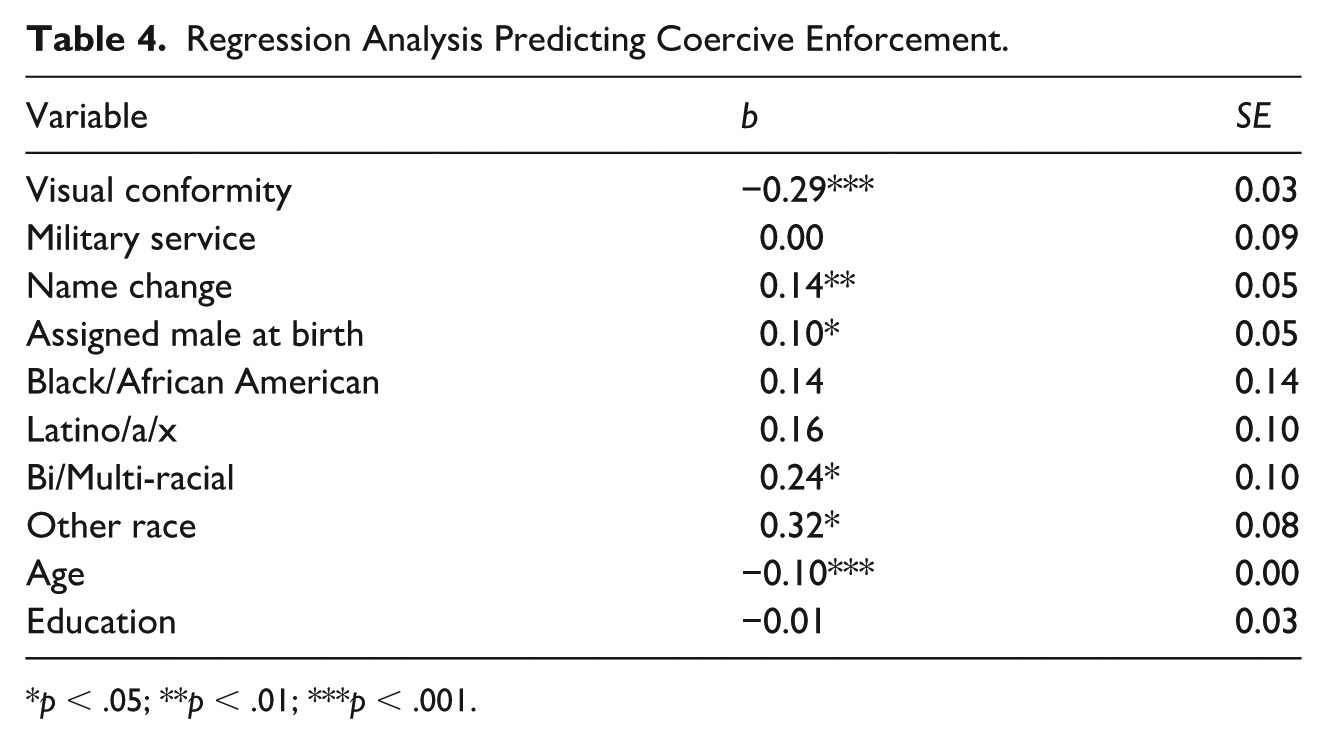
Results from the two-parameter logistic IRT models predicting coercive enforcement are presented in Table 4. Consistent with findings for harassment, visual conformity correlated with significantly fewer coercive enforcement actions. This finding reinforces the notion that when a person’s physical gender presentation is perceived as outside the binary, officers treat those individuals more negatively than those who pass. Likewise, paralleling our findings for harassment, having a legal name change significantly correlates with more coercive enforcement. Again, this may be because those doing the body scans rarely see the IDs and may be more “surprised” by the result of the body scan and respond poorly. Legal name changes may be protective against some disruptions to travel, but they appear to have the opposite effect in this data on interactions with TSA.
Regression Analysis Predicting Coercive Enforcement.
p < .05; **p < .01; ***p < .001.
In contrast to the findings for harassment, being assigned male at birth (AMAB) correlates with significantly more coercive enforcement by TSA. Specifically, AMAB trans individuals (trans women or non-binary individuals) are more likely to be assaulted by or miss their flights because of TSA agents. This may indicate a counterpoint to the reduced risk of harassment experienced by the same group. It is possible that AMAB individuals are perceived as more “dangerous” (given implicit assumptions associated with ‘biological maleness’) and therefore elicit a more extreme response from TSA agents than AFAB trans individuals.
With regards to coercive enforcement (assaults, missed flights), bi/multi-racial individuals and other race individuals are significantly more likely than White individuals to have these bad experiences with TSA. Finally, age correlates inversely with bad outcomes with TSA. That is, older trans respondents reported fewer assaults and flight disruptions than did younger trans respondents.
Finally, it is important to clarify the importance of approaching this issue as we have, in a way that allows for differentiation by severity. Although there is certainly some overlap between those who experienced harassment and those who endured coercive enforcement, the correlation harassment also had coercive enforcement (4.3%) and most of those who experienced coercive enforcement also reported harassment (87%). That said, the distinction is clearly important, as demonstrated by the disparate results for each type based on respondents’ sex assigned at birth.
Overall, these findings provide a concerning, if not surprising, account of the interactions of trans and non-binary individuals with TSA. Although certainly not universal, some form of negative reaction or behavior from TSA was not uncommon in this sample, and these experiences of negative reactions were particularly pronounced when the trans person’s gender presentation was perceived as outside the normative binary. TSA, then, is clearly an important site of state regulation and disciplining of gendered bodies.
Discussion
This research supports efforts to create more inclusive, respectful, and equitable environments by highlighting the pervasive nature of microaggressions and the serious implications of major disruptions for transgender travelers. In exploring the experience of “traveling while trans,” we shed light on previously understudied risks for discrimination and victimization faced by transgender individuals. Findings indicate that trans individuals are not uncommonly targets for serious victimization. Results also are consistent with national victimization data that finds trans individuals have three times the rate of victimization than their cisgender (those whose gender identity is consistent with the sex assigned at birth) counterparts (Truman et al., 2024). Finally, there is a high prevalence of microaggressions, suggesting a need for focused intervention and prevention efforts.
Our findings are particularly alarming in that TSA agents are employees of the federal government, specifically the Department of Homeland Security. Their actions are carried out under the authority granted by the federal government to enforce security protocols and regulations. If these policies and procedures allow, or fail to prevent discriminatory practices, they effectively sanction the victimization of individuals. Without adequate safeguards or training to prevent the profiling of transgender individuals or other minorities, the state is complicit in the subsequent victimization. When TSA agents and their systems allow discriminatory or offensive behavior, they do so under the mantle of federal authority, making it a form of state-sanctioned abuse.
Particularly considering the most recent executive orders regarding trans identities, the potential for strict (and possibly threatening) enforcement of a gender binary seems possible, if not likely. As one of the clear sites of gender surveillance, the possibility of genuine restrictions of freedom are a legitimate threat. Executive orders targeting one’s ability to have their preferred gender marker on their official IDs and requiring gender markers to be consistent with one’s birth certificate could shift the results found here. That is, any “benefit” trans individuals experience from being recognized (or passing) as the gender they identify with could be threatened by the inability to have one’s ID reflect that identity. Because an ID check precedes electronic security, such measures may serve to increase (and expedite) coercive enforcement. It is, as of yet, unclear if earlier detection (at the ID check) of a “distinctiveness threat” could impact trans travelers’ experiences.
This study provides a particularly clear example of Foucault’s (1990) principles of gender construction and how transactional realities impose the power of the state in reinforcing binary gender norms. In this case, reinforcement of binary notions of gender and related conceptions of gender concordance with bodies comes with the power and authority to detain and or limit innocent citizens’ ability to travel. Moreover, this research further reinforces findings from Schilt and Westbrook (2009) that indicated that reactions of cisgender men and women to trans men were different than those to trans women. Specifically, negative reactions by cisgender men to trans women are more likely to be hyper-masculine–aggressive or violent–in nature. This was partially understood as a threat response to the idea of “gender deception.”
Our goal was to shed some light on the complex relationships of gender identity, visual conformity, legal status, race, age, and education in shaping transgender individuals’ experiences with TSA agents. We found that being assigned male at birth was associated with less harassment. This could be due to societal perceptions and biases that afford trans men some level of invisibility or reduced scrutiny compared to trans women. That is, there is a much larger range of “acceptable” gender presentation for those perceived as women than for those perceived as men. Women can wear a more elaborate range of clothing, hairstyles, shoes, and cosmetics (or not) and still be perceived as being normative. The same is not true for men.
In contrast, being assigned male at birth was associated with more coercive enforcement actions, indicating that those assigned male at birth are more vulnerable to severe mistreatment, such as assaults or missed flights. This discrepancy could reflect deeper societal biases and fears around femininity and trans women, leading to more aggressive or punitive responses from TSA agents. One could argue that misogynistic practices and beliefs foster victimization among trans women as a reflection of society’s broader disdain for and devaluing of femininity (Hoskin, 2020). Alternately, more extreme responses to those assigned male at birth may be a manifestation of the public perception of danger in narratives about “disguised maleness” or “gender deception.” There is certainly evidence that issues of political climate and public opinion can impact police practice, even when those practices are less effective (De Vries et al., 2023). Regardless of the reason, these experiences illustrate only one of many factors that the trans population must navigate as part of the complex and ever-changing requirements put in place by federal and state agencies for verification of sex on identity documents (Clarkson, 2019) prior to even arriving to a TSA line.
Our findings also highlight the multi-faceted nature of discrimination, where racial and gender biases compound to exacerbate negative experiences. Compared to White/Caucasian, African American/Black, and Latino/a/x respondents, those who identified as other races, particularly Asian Americans and other minorities, experienced significantly more harassment. Bi/multi-racial and other race individuals faced higher risks of coercive enforcement compared to White respondents. This aligns with extensive documentation of racialized experiences with law enforcement and security personnel, where minorities often endure heightened scrutiny and harsher treatment (Kutateladze, 2022; Lim et al., 2023; Rushin & Edwards, 2019; Warren et al., 2006). Age and education also played significant roles, with older respondents reporting less harassment and coercive enforcement and those with higher education levels reporting more. The latter effect might reflect increased awareness and sensitivity to subtle forms of harassment among younger and more educated individuals who might be more active and visible in public spaces.
In addition, having a legally changed name was associated with experiencing more harassment. This result might stem from heightened scrutiny or discrepancies between legal documents and appearance, as suggested by Clarkson (2019), which increases the likelihood that additional questioning or skepticism from TSA agents is triggered. Further research is needed to explore the specific mechanisms behind this phenomenon. At the very least, the correlation between legal name changes and increased harassment points to gaps in policy implementation and the need for frontline training.
Importantly, we determined that visual conformity to the gender binary significantly reduces the occurrence of harassment and coercive enforcement, underscoring the value of “passing” and of binary classification in interactions with TSA agents. The results from the two-parameter logistic IRT models indicate that visual conformity reduces the likelihood of both harassment and coercive enforcement. Our study suggests that TSA agents rely heavily on visual cues to assess gender, leading to fewer issues for individuals whose appearance aligns with binary gender categories.
TSA agents and other security personnel often rely on visual cues to detect difference as a signal of threat (Clarkson, 2019). Security personnel are trained to identify and mitigate potential risks, and deviations from gender norms might be mistakenly interpreted as suspicious behavior. This leads to what some have called “securitizing gender” (Currah & Mulqueen, 2011; but see also Clarkson, 2019), where gender non-conformity, in and of itself, is cause for suspicion. People whose gender presentation aligns more closely with societal expectations of their gender identity are less likely to experience victimization. People who pass may be seen as less of a threat or anomaly, which can result in smoother interactions with TSA agents. When individuals conform to traditional gender presentation norms, they are less likely to be flagged as suspicious or subject to additional scrutiny. “Passing” reduces ambiguity in gender presentation and does not challenge a gender binary, which can minimize confusion or uncertainty for TSA agents. This clarity can prevent misunderstandings or misidentifications that might otherwise lead to invasive questioning or additional screening procedures.
Those who pass are also less likely to trigger biases against transgender people, as they are perceived to fit within conventional gender binaries. This too reduces the likelihood of encountering prejudicial attitudes or discriminatory behaviors from TSA agents. In this and other areas of social life, passing may impact the degree to which trans people successfully navigate and mitigate the negative impacts of being perceived as different in less-inclusive environments. People who visually conform to a gender binary may face less overt discrimination, allowing them to navigate public spaces more easily.
However, it is essential to recognize that high levels of visual conformity did not eliminate all forms of victimization. Further, there are many whose gender identity does not fall under any binary, for whom the notion of “passing” in terms of binary gender categories is not possible nor desired. In our sample, over 1/3 of respondents identified as genderqueer or non-binary. Thus, the wider trans/nonbinary population faces significant challenges that require systemic change and increased advocacy. It is crucial to address the underlying biases and improve TSA technology, procedures, and training for TSA agents to ensure fair and respectful treatment for all individuals, regardless of their visual conformity. TSA training programs addressing unconscious biases and promoting respectful interactions can foster a more respectful, safer environment for all individuals navigating airport security. Effective training, prevention strategies, and accountability among federal and state agencies can be vital for reducing risks and promoting the health, security, and dignity of transgender people (Carter et al., 2020).
It is important to note that this data, as all data, is limited. It is not a representative sample and was collected a decade ago. As such, it likely overrepresents trans individuals who seek out support groups and/or trans specific health care. However, its sheer size still allows us to capture rare events (e.g., missing a flight, victimization) that would not be as easily captured in a small sample. Although imperfect, it remains the largest current collective of information about trans experiences in the U.S. Further our use of RIT allowed us to account for important differences in severity and commonality of different experiences with TSA.
Finally, we assert that these findings are particularly salient in the current political climate. Gender-affirming care, such as hormone replacement therapy (HRT) and surgeries, helps many transgender individuals align their physical appearance with their gender identity. Without access to this care, individuals may have a harder time “passing” as their identified gender, ultimately making them more visible and vulnerable to discrimination and harassment in public spaces, including at TSA checkpoints. Policies that limit gender-affirming care also reinforce broader legal and institutional discrimination against transgender individuals, forcing trans individuals into public visibility when their physical appearance does not align with societal gender norms. This visibility can make them targets for hate crimes, bullying, and other forms of victimization. Future studies should explore the potential relationship between gender-affirming care restrictions and rates of victimization in various settings, including employment, housing, healthcare, and public services.
Footnotes

Funding
The authors received no financial support for the research, authorship, and/or publication of this article.
Declaration of Conflicting Interests
The authors declared no potential conflicts of interest with respect to the research, authorship, and/or publication of this article.