







Abstract
Housing is a critical reentry domain, with research demonstrating the challenges faced in securing stable housing and the impact housing has on recidivism. In Pennsylvania, the focal state of this research, approximately one-third of state prison releasees are placed in halfway houses, unable to procure a parole-approved homeplan. Halfway houses increase reincarceration risk in Pennsylvania, yet research has not adequately examined resident experiences. This research utilizes in-depth interviews of male reentrants with substance use disorders living in halfway houses post-release (n = 20). Findings demonstrate increased recidivism risk through exposure to illicit substances within the facility. Other themes include barriers to reintegration, bureaucratic frustrations, and heightened surveillance as a source of recidivism risk. Combined, respondent experiences highlight critical areas for reform.
Introduction
Initial housing placements post-prison release impact reentry success and recidivism outcomes. Housing insecurity increases recidivism risk (Clark, 2016; Lutze et al., 2014; Steiner et al., 2015) and reentrants have high rates of housing instability (Augustine & Kushel, 2022; Herbert et al., 2015). Prior research demonstrates that securing housing post-release is a monumental task (LeBel, 2017; Lutze et al., 2014; Pleggenkuhle et al., 2015; Western et al., 2015), with stigma and restrictive, discriminatory policies contributing to this difficulty (Harding et al., 2014; Keene et al., 2018). For the majority of reentrants, family members provide an initial housing placement (Clark, 2015; Western et al., 2015). The multi-state Returning Home study found that 80% to 88% of reentrants initially reside with a family member, most often mothers or sisters (Visher, 2007). More recent statistics from Pennsylvania, the focal state of this research, show that approximately two-thirds of parolees leaving state prison in 2016 were released to their own address, typically residing with family, with the remainder released to a halfway house (Bucklen et al., 2022).
Residing with family post-release is found to delay time to recidivism (Huebner & Pleggenkuhle, 2013), increase informal social control (Steiner et al., 2015), and enable reentrants to shift focus to making progress in other reentry domains, such as employment (LeBel, 2017; Walker et al., 2014). Post-release housing is deemed so critical, particularly for individuals with substance use disorders (SUDs), that there is a movement to focus on housing prior to focusing on treatment provision (Padgett et al., 2010). The housing first movement posits that “providing immediate, safe housing stabilizes the individual and facilitates the success of concomitant service provisions, particularly substance abuse treatment” (Pleggenkuhle et al., 2015, p. 381).
In Pennsylvania, most individuals leave prison under parole supervision, with only 16% of the nearly 20,000 releasees in 2016 “maxing out” their sentence without subsequent parole supervision. Those leaving prison on parole are required to submit a home plan for approval, with their intended address being assessed by parole for a number of factors (e.g., other residents with felony records in the home, home is “unsafe” or “unfit,” weapons in the home). If a reentrant does not have an approved home plan, they are released to a community corrections center, also known colloquially as a halfway house. In 2016, 35% of state prison releasees in Pennsylvania were placed in a halfway house, while 65% were released to a personal address (Bucklen et al., 2022). While placement in a halfway house is a better alternative than homelessness, post-release housing placements that increase supervision levels, such as halfway house and inpatient treatment facility placements, have been found to increase the risk of parole revocations (Clark, 2016; Hamilton & Campbell, 2013).
Rigorous evaluations of halfway houses, including their impact on recidivism, are scarce, with only nine such studies being identified in the last 30 years (Wong et al., 2025). Findings on the impact of halfway house residency on reentry success, primarily measured through a dichotomous recidivism variable, are mixed (Clark, 2015; Ndrecka, 2014; Willison et al., 2010; Wong et al., 2025). Given stark differences in how halfway houses operate across states, these mixed findings are unsurprising, as some halfway houses provided appropriate matching to services based on risk/need level and the provision of high-quality treatment, while others provide little more than a roof and a bed (Lowenkamp & Latessa, 2002, 2005). In general, transparency regarding halfway houses is low, with basic information such as the number of Americans housed annually in such residences being inaccessible. Policies and conditions of such facilities are similarly shrouded, with the exception of occasional news articles when there is a highly publicized incident at a halfway house (see Daniel & Sawyer, 2020).
Tens of thousands of Americans will reside in a halfway house for some period of time annually, with nearly 6,000 individuals being released to a halfway house from Pennsylvania state prisons in 2016 alone. Our understanding of the impact such placement has on reentrants is minimal, with a smattering of recidivism analyses providing the bulk of this understanding. In this research, 20 men with SUDs recently released from a Pennsylvania state prison were interviewed, with 14 of those men being placed in a halfway house immediately post-release and six spending time in an inpatient rehab facility and a halfway house as part of an intermediate sentencing program (SIP). These in-depth interviews provide critical understanding of how facility residency impacts reentry, facilitating or impeding desistance and recovery, and highlight imperative policy changes.
The Effects of Halfway House Placement
Halfway houses are intended to temporarily lift some responsibilities from a reentrant and reintroduce them more slowly back into society, providing a safety net of sorts by extending the post-prison transition timeline and reducing reentry stress. These facilities attempt to counteract the heightened risk of recidivism immediately post-release by providing some basic needs (e.g., housing and meals), while hypothetically assisting residents in planning for full community integration through assistance finding employment, affordable housing, and health care resources (Goetting, 1974). The term halfway house stems from this model and the fact that residents are “halfway back” to their communities, still under supervision and restrictions but no longer in the total institution of the prison or jail. Importantly, this model alleviates concerns of potential homelessness among reentrants, as homelessness and housing insecurity are significant predictors of increased recidivism risk (Herbert et al., 2015; Steiner et al., 2015), making halfway house placement a potential avenue for increasing success in reentry.
However, it is plausible that reentrants in halfway houses are delaying their reintegration through extended isolation from the reality of their daily activities and interactions once such residency ends. The model is not intended to function in this manner, but issues with program implementation or logistical matters may result in extended isolation. The purpose of the “halfway back” model is to house individuals close to their home communities so they are reintegrating into the neighborhood they will reside in long term (Goetting, 1974). If individuals are placed too far from their terminus communities, it will be challenging to find housing from a distance and, if employment was secured, they will not be able to keep that job once discharged. Additionally, geographic distance does not facilitate reactivation of prosocial ties, and research has demonstrated the protective effect social support and informal social control from such ties have on reentrants (Berg & Huebner, 2011; Fahmy, 2021). This distance varies greatly by facility and between reentrants, which adds to the complexity embedded in determining how halfway house placement affects outcomes. If halfway houses are not easing participants into their reentry communities as intended, such placement may only increase revocation due to heightened supervision (Hamilton & Campbell, 2013).
Some studies suggest that halfway house placement has positive effects, but most find null long-term findings in terms of recidivism rates (Ndrecka, 2014; Wong et al., 2025). Using propensity score matching, Costanza et al. (2015) found that individuals released to halfway houses were more likely to successfully complete parole compared to individuals released directly to personal addresses, but effects on long-term recidivism were negligible. Similar patterns of reduced revocation but non-significant rearrest and reconviction results were found using propensity score matching in New Jersey (Hamilton & Campbell, 2014). Other evaluations demonstrate the importance of placing only reentrants of appropriately matched risk levels into such centers. In their rigorous and broad-scale evaluation of Ohio halfway houses, Lowenkamp and Latessa (2002, 2005) found that such placement was deleterious to low- and medium-risk reentrants but protective for high-risk individuals, with the authors strongly cautioning against such placement without careful consideration of risk.
Lowenkamp and Latessa (2002, 2005) also recognize that Ohio halfway houses have a strong record of providing group programming, such as anger management and substance use treatment groups, which is not the case across states. Halfway house evaluation is plagued with the generalizability concern that permeates program evaluation – variability across programs, even programs with the same slated structure and curriculum, is vast due to implementation and the resulting spectrum of program fidelity. In their work on halfway houses in New Jersey, Hamilton and Campbell (2013, 2014) discuss the variation that exists between facilities within the same state, such as fidelity of programming and staff experience. Additionally, parole officers (POs) have differing levels of involvement across facilities, which alter rates of noncriminal revocations (Hamilton & Campbell, 2013). These supervision effects distort recidivism measures, with high rates of “failure” among halfway house residents due to noncriminal or minor revocations, including failed drug tests. Hamilton and Campbell (2013) discuss this complication as the “dark figure” of community corrections, recognizing the complicated interaction between risk/need levels, heightened supervision, and measures of recidivism. The effect of heightened supervision can be seen in Clark’s (2016) results, in which all inpatient facilities (transitional, work release, and treatment) had higher rates of revocation than release to personal addresses, but two of the three inpatient facilities lowered rearrest risk.
In a 2013 recidivism report by Pennsylvania Department of Corrections (PADOC; Bell et al., 2013), state prison releasees in 2008 to 2009 were assessed for 3 years post-release. Those released to halfway houses had lower 6-month, 1-year, and 3-year rearrest rates than those released to personal addresses (Bell et al., 2013). However, halfway house placements had higher reincarceration rates than their counterparts at the same time points, with the 6-month rates being particularly telling. At 6-months post-release, Pennsylvanians released to halfway houses had a 20.4% reincarceration rate, more than double the rate (9.3%) of those released to personal addresses. This quick reincarceration reflects returns to prison based on revocation of parole or some violation of facility rules (e.g., leaving the facility without an appropriate pass, curfew violations). This difference in reincarceration rate persists, with a 12.5% higher rate at 1-year and a 9.3% higher rate at 3-years. In an updated recidivism report from PADOC tracking all 2016 state prison releasees (Bucklen et al., 2022), the recidivism rate for halfway house placements was 69.8% compared to 57.9% for those released to personal addresses. The impacts of the heightened surveillance that is a natural byproduct of facility housing on reincarceration are apparent within the state of Pennsylvania, the focal state of research here.
Halfway House Placement and Substance Use Disorders
There is a dearth of research on the impact of halfway house placement on recidivism in general, with a recent meta-analysis finding only nine studies for inclusion since 1994 (Wong et al., 2025), and there is virtually no research examining this relationship with specific focus on reentrants with SUDs. Given that an estimated two-thirds of incarcerated individuals have a SUD (National Institute of Drug Abuse, 2020), an estimate aligned with the 65.8% of Pennsylvania state prison releasees in 2016 with a SUD (Bucklen et al., 2022), such research is certainly warranted. Considering that relapse is the modal experience during recovery, and given what is known about cravings and environmental triggers (Volkow et al., 2016), being placed in a facility alongside drug-using peers would likely increase reincarceration risk for a reentrant, especially when drug availability is combined with heightened supervision. Indeed, prior research has pinpointed the local availability of drugs as a relapse and recidivism risk (Binswanger et al., 2012; Wooditch et al., 2013). Determining if and how halfway house placement differentially affects reentrants with SUDs provides a clear avenue of policy intervention by diverting individuals who are being negatively impacted by such placement to other post-release housing options.
One study found high rates of technical violations among substance-involved halfway house residents, but there was no comparison group of substance-involved reentrants living in private residences to compare the risk associated with specific housing placements (Hamilton & Campbell, 2013). The only study in which the relationship between housing placement and post-release outcomes is evaluated specifically for reentrants with SUDs found that, for a sample of opioid-using men, halfway house residency in Washington D.C. reduced the number of drug-using days but had no impact on criminal behavior (Wooditch et al., 2018). Given incredible variation between facilities, more research on the effects of halfway house placement is warranted. This is particularly true during the opioid crisis, during which there has been an influx of news articles about overdose events at halfway houses (see Dolnick, 2012; Moraff, 2017). There is a notable lack of oversight when it comes to these facilities, which contributes to the lack of standardization, even among those within the same states and cities (Daniel & Sawyer, 2020). This is due in part to the contracting out of facilities, which is done in Pennsylvania, and the resulting privatization means that publicly available data is not required. GEO Group, a private company that runs 30% of halfway house facilities nationwide, does not report data on their population, standards, audits, or outcomes (Daniel & Sawyer, 2020; Sukin, 2015).
It is unclear from existing research how reentrants with SUDs are differentially impacted by halfway house placement, but given the pervasiveness of SUDs among this population, heightened attention to this issue in research and policymaking is crucial. This research examines how halfway house placement affects male reentrants with SUDs, and how the environments of these facilities impact their reentry and recovery outcomes. While research in this area is lacking in general (Wong et al., 2025), data that moves beyond administrative records is even scarcer, making first-hand accounts of halfway house residency and its impact on men with SUDs an important contribution to both research and policymaking.
Sample and Methods
The in-depth interviews utilized in this research were collected between 2017 and 2019 in Pennsylvania as part of a longitudinal analysis of the reentry experiences of men with SUDs. The research was approved by the associated University Institutional Review Board (IRB) and all respondents consented to participate in the research through an informed consent process. Incarcerated men participating in a prison-based SUD treatment program were asked to participate in a series of pre- and post-release in-depth interviews. PADOC does not allow research incentives for in-prison research participation, but those who completed post-release interviews were paid $25 per interview (up to two interviews were conducted post-release).
Interviews used in this analysis are from the wave two, or first post-release, interviews. Of 51 men interviewed at wave two in this project, 20 were placed in a halfway house either immediately post-release (n = 14) or after a required two- or three-month stint in an inpatient rehab facility as part of a state intermediate punishment (SIP) program (n = 6). These interviews focused on the individual’s reentry experiences thus far across important reentry domains such as housing, employment, reunification with family, health, finances, and substance use. The respondents’ current living situations were a dominant topic within the interview, providing depth of information on halfway house residency for this subset of the sample. All interviews were audio recorded, transcribed, and redacted of identifying information prior to analysis. Table 1 provides pseudonyms for this sample (n = 20) alongside their age, race/ethnicity, and their recidivism and relapse outcomes. Recidivism was measured as either reincarceration (provided by PADOC) or rearrest (obtained through the Administrative Office of Pennsylvania Courts). Time to their first post-release relapse to substance use is based on the respondents’ self-reported substance use behavior during the wave two interview.
Qualitative Sample Outcomes, Facility Placement Post-Release (n = 20).
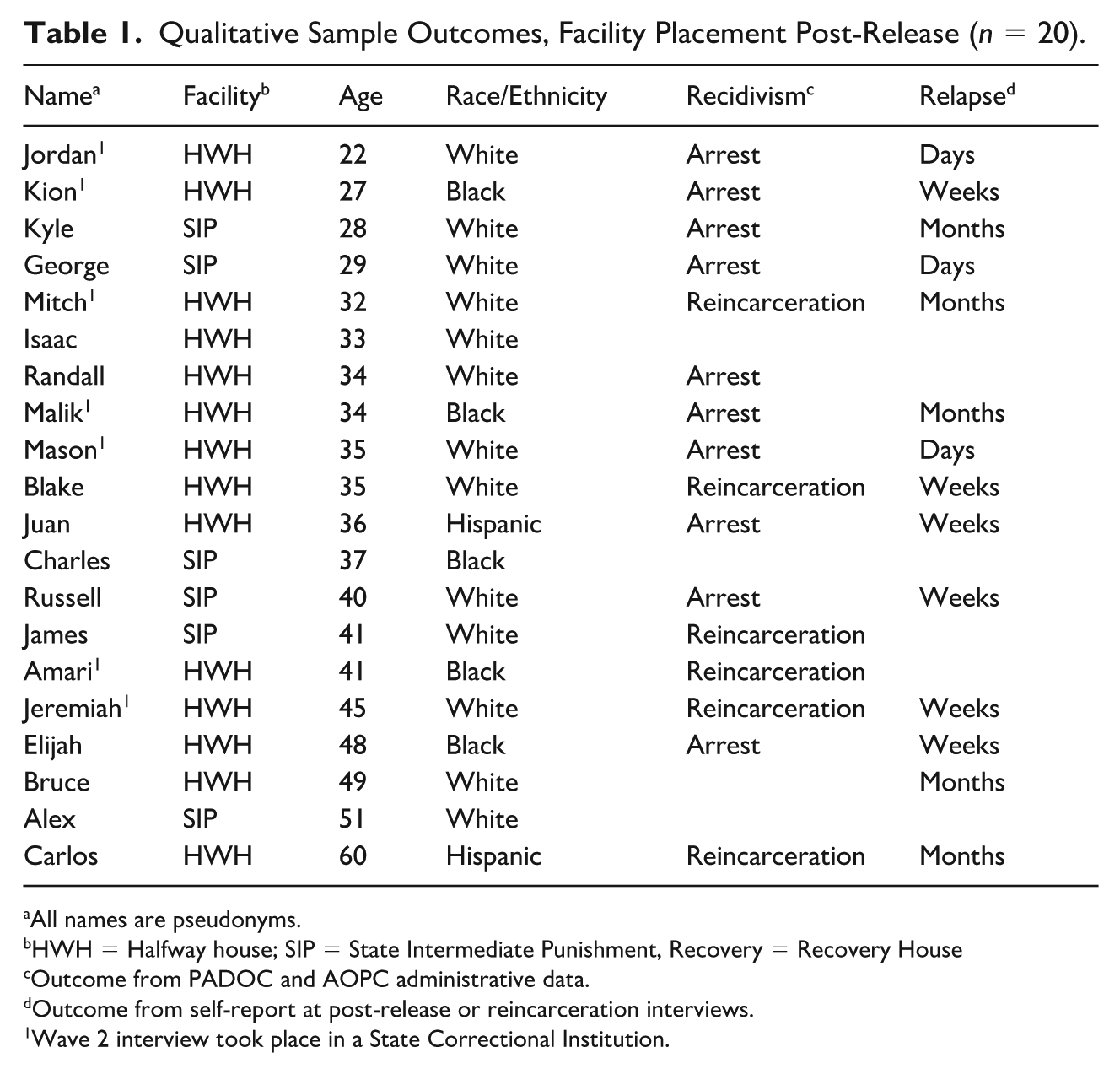
All names are pseudonyms.
HWH = Halfway house; SIP = State Intermediate Punishment, Recovery = Recovery House
Outcome from PADOC and AOPC administrative data.
Outcome from self-report at post-release or reincarceration interviews.
Wave 2 interview took place in a State Correctional Institution.
As part of an iterative process of open coding, three independent coders utilized the software program NVivo to code all second wave interviews using structural coding, identifying large sections of text related to broad thematic areas (MacQueen et al., 1998). A theme identified through this process was “halfway house or inpatient rehab experiences.” All portions of the second wave interviews identified within this broad theme were then iteratively coded by the author abductively, allowing existing knowledge of and research regarding halfway houses to guide identified themes, but noting unexpected or misaligned data points that strayed from or extended beyond existing knowledge or expectations. For example, the author was familiar with prior research on heightened supervision levels resulting in an increased risk of technical violations, but the bureaucratic frustrations and delays identified (and discussed below) were an unexpected source of tension and eventual sanctions for respondents. This iterative process resulted in themes regarding the various challenges or frustrations of facility residency post-incarceration, which have been aggregated to the broad thematic areas presented below.
Findings
In this sample, 80% of respondents placed in halfway houses were rearrested or reincarcerated within the recidivism data collection window, while 70% self-reported at least one relapse. As a comparison, among the 27 wave two respondents who resided with family post-release, 44.4% were rearrested or reincarcerated and 51.9% self-reported at least one relapse (the remaining four respondents were in recovery houses or were tenuously housed/unhoused). Among respondents who resided in halfway houses as their initial housing placement, or those moved there after inpatient rehab as part of their SIP program, the most prevalent theme across interviews was the availability of drugs and how profoundly this affected their ability to maintain abstinence. Every respondent who resided in a halfway house mentioned the presence of drugs in their facility, with some respondents who were not housed in one discussing this as well, with reference to a prior experience in a halfway house or known experiences from peers. Moving beyond the availability of drugs, other hindrances to reentry progress, such as distance from their home communities, home plan denials, financial burdens, and the iatrogenic effects of excessive surveillance, are examined. Several respondents absconded from their halfway houses or inpatient rehabs due to some combination of these issues, which resulted in the near inevitability of reincarceration. As a whole, the evidence surrounding halfway house and inpatient rehab residency demonstrates the various mechanisms through which such facilities heighten recidivism risk, particularly for reentrants with SUDs. Positive perceptions of facility residency were exceptionally rare and were tangential to residency, such as making a friend in the facility or finding a decent job nearby.
Drug Availability and Relapse Risk
The men in this sample were placed in many different halfway houses across the state and yet, their perceptions were cohesive. The presence of drugs in Pennsylvania halfway houses is so pervasive that respondents were often entirely unsurprised or unfazed by it. As Jeremiah bluntly stated about his facility, “It was basically like all halfway houses, lot of drugs, lot of bullshit going on, but it is what it is.” Jeremiah returned to substance use while in this halfway house, but he was not caught or sanctioned for his use while there. But he recognized the incongruence of his situation, positing, “It’s just kind of hard to take somebody that was a drug addict and put him in a drug, you know what I mean, environment. That’s gonna be – that’s hard.”
Many respondents perceived that drug use was so rampant in the halfway houses that staff stopped intervening. Russell described widespread use of synthetic marijuana, or K2, at his halfway house vividly:
There’ll be 10 guys in the bathroom, at all times, until 5:00 in the morning, passing around joints of that shit. The staff walk in to do count, there will be guys just sitting there and nodding out, damn near going into convulsions over it. They say, what’s your bed number? As long as you can tell him your bed number, you’re fine, and the staff walk right out. They don’t say anything.
In addition to the facility being “flooded with K2,” Russell described witnessing fellow residents using heroin and crack within the halfway house. While Russell did not use these substances while housed there, he was misusing a medication he was originally prescribed for nerve pain, taking 20 times the prescribed dosage. Considering his exposure to various drugs, including drugs he previously misused, his use of only this nerve medication could be commended. Russell explained his exposure to substances with great frustration:
The temptation and the access to bad things is overwhelming. It really is. Three of my roommates sell deuce, K2, one sells pills, one sells heroin. I live in a room with 12 guys and five of them sell drugs. That’s just in my room. . . it’s wild, it’s off the fucking chain.
Kyle highlighted the risk of overdose when explaining how fentanyl was “really flowing” around his halfway house, which is a clear danger given its potency and the diminished tolerance of reentrants. Bruce summarized his three months at the facility and the frequency of overdoses:
Three months, there has been eight people who died. . . The house is filled with drugs. I can see why the recidivism rate is so high there. That’s just the overdoses that I’m talking about. That’s not the times that the ambulance is there for people getting they call it stuck on K2. . .it seems like once a day, one of them are there, you know? It’s a very bad place. You know, and how they consider that better than my home is beyond me.
Intending to live with his sister and brother-in-law, Bruce was unprepared for this environment. His home plan was denied because his nephew got a felony for marijuana possession. Instead of living in that stable home, “they stuck me in a whole house full of felonies.” Woven throughout his interview was pent-up frustration at this situation, the trauma he was enduring, and the unnecessary nature behind it all. Bruce felt for the overworked staff at the halfway house, but could not forgive the experiences he was subjected to, having to “look out the window and you see somebody in a body bag zippered up all the way up to the neck.”
Elijah, who returned to opioid use soon after arriving at his halfway house, blamed himself for not adequately “utilizing the tools” from his treatment program. Yet he was exposed to this environment every waking moment: “My bed was right on the left and the bathroom is right here. You have to walk past me to get into the bathroom and it was a crack house. All types and hours, all day and night.” Randall witnessed five overdose deaths in three months at his halfway house. “There’s more drugs in there than there is in the street,” he proclaimed, a common quote from halfway house residents. The examples are plentiful and the solutions, according to the respondents, are essentially nonexistent.
Ultimately, respondents concluded that staff were powerless against rampant drug use and availability within the facilities. The sanctions typically enacted for a positive drug test were being locked down at the facility for 30 days, moved to an inpatient facility, or reincarcerated. Reasonably, staff seemed hesitant to reincarcerate for drug use, but other sanctions, according to respondents, did nothing other than cause an employed individual to lose their job and expose the individual to additional drug use in the environment while locked down. For example, Juan provided a positive drug test after alcohol use and was given a two-week “blackout,” in which he was not allowed out of the facility. This blackout meant, “I had to stay in from work for two weeks. I wasn’t allowed to go to work, I lost my job, I had to redo everything all over again.”
Randall credited his initial blackout period as nearly causing him to relapse: “When you first get there, they don’t let you out for a week, a blackout period and all that. Just being in there, bored, there’s nothing to do in there whatsoever.” For reentrants with SUDs, experiencing the cravings and triggers that accompany the disease, being locked down 24/7 in a facility with widespread drug use and nothing to occupy their time appears iatrogenic. The risk halfway house placement poses for reentrants with SUDs is apparent, and is worded most succinctly by Mitch as he reflected on his halfway house experience:
It was infested with drugs. . . I mean, I didn’t get high right away, but my first day there, you walk into the bathroom, people are shooting up, smoking K2. It was, I was like, where did they send me? I’m trying to be clean, and then they send me to a place like this. It’s hard to be clean when it’s everywhere you go in your surroundings, you know.
This interview with Mitch took place in a state prison, as he was reincarcerated after absconding from his halfway house, and was supremely bleak. Halfway house placement was detrimental to his recovery, mental health, and reintegration. Mitch was housed in a facility far away from his home community, the bus routes and job leads he was familiar with, and the few prosocial ties he had remaining. These compounding factors, combined with his return to substance use, resulted in him feeling anxious and depressed. When he discussed these struggles with staff at the facility, they did nothing to intervene: “I told them I was depressed, feeling suicidal, and they didn’t care and I was like, oh, since you guys don’t care, then I’m just going to leave.”
Not only was the facility infested with drugs, as Mitch described, but he felt unsupported and isolated in the halfway house, leading him to abscond. Apathy of staff was a common theme, with some recognizing their overburdened caseloads, but others directing harsh language toward their perceived indifference, hostility, or unprofessionalism. This is further expounded below alongside other challenges associated with facility residency. But Jordan, the youngest post-release respondent, summarized these issues plainly: “Everyone’s selling drugs or using drugs. The workers don’t wanna help you do nothing. It’s kind of – kind of sucks being there for real. Just like being in jail.” Knowing the nature of halfway houses, Mason did everything in his power to avoid being placed in one. He was fearful of relapsing in a halfway house in a large city and asked his prison counselor if he could be placed in a rehab instead. But, he reports, “it all came down to money, they said that the DOC won’t fund me to go to a rehab.” Mason returned to substance use in his halfway house within his first week post-release.
Reintegration Barriers
Placement in facility housing introduced frustrations beyond drug availability, including high stress transitions, distance from home communities, issues with home plan approval, and financial burdens. From the earliest moments of reentry, facility housing added stress through transportation complications, with respondents getting lost or spending exorbitant amounts on their way to the facility. Amari went to his children’s mother’s house after leaving prison to check in and then called his halfway house for directions. With staff unable to help him figure out public transportation or provide any help, he paid $128 for a ride share to the facility. Bruce had a similar experience trying to get to his halfway house without assistance, which was in a city he was entirely unfamiliar with: They didn’t even tell me where to go. They said walk out where you’ll find the bus station, the trains – I never rode no bus or train or any before in my life. I had a hard time, I got on so many different buses. The one guy that was with me, they gave him a ticket voucher. . . He went to use it, it was no good. For all I know, that guy is still standing in the streets of [City].
To experience such stress and frustration immediately upon release from prison is counter to the extremely positive emotions that are anticipated – sometimes for years of incarceration – in the early moments of freedom. For reentrants with SUDs, stress and negative affect can trigger substance use, adding to the environmental cues that may already accompany being out in society for the first time in years.
Additionally, as previously discussed, the halfway house method loses its fidelity when reintegration is thwarted by geographic distance, effectively delaying reintegration until the reentrant can move closer to their eventual community. This was in fact the case for a number of respondents, who lamented at the location of their halfway house, its dissimilarity to their home communities (i.e., urban vs. rural), and/or the distance from remaining social supports. Mitch, who felt isolated and depressed in a halfway house in an unfamiliar city, felt he would not have been reincarcerated if he had been sent to a facility in his home city: If they could have just sent me back to [City], that would have been the best thing for me. I guarantee I wouldn’t have ran, I wouldn’t have had to, I wouldn’t have chosen to get high. Yes, I would’ve been in the halfway house, but I wouldn’t have just been stuck in there. I would have been able to go do stuff, like going to my friends’ houses and stuff like that. And then with me just being out there, that’s really what got to me.
For some reentrants, being near friends could be a criminogenic risk, but for Mitch – and his depression – he needed some form, any form, of social support. And he did not find any among fellow residents or staff at the halfway house he was sent to in an unfamiliar city. The location of his halfway house was also an issue for Jordan, who was not only two hours away from his parents, but was also far from bus routes and job opportunities: The halfway house I was at, you gotta walk up the highway like half an hour just to get to the bus stop to get in the city. . . I don’t even know why they put the halfway house all the way out there. I don’t know, it was kind of frustrating not being in my area for real cuz my parents like it’s – aid. They help me out a little bit but they work two hours away. They couldn’t really do too much for me.
Jordan was reincarcerated after absconding from his halfway house and, reflecting on the entirety of his experiences, he pinpointed a number of issues at the facility that contributed, including drugs at the halfway house, distance from his support systems, and hostile staff behavior. Beyond the distance from his existing ties, Blake identified living in a halfway house as a barrier to meeting new people, as curfews and day passes made many prosocial activities – such as 12-step meetings after work – challenging or impossible.
Distance was such a barrier for Randall that he absconded from his halfway house to be closer to his daughter. In his interview, he introduced another common theme among halfway house residents – denial or delaying of home plans. Meeting for his interview in his home community while on the run from parole, he explained, “my daughter lives up here and it’s pointless for me to stay down there. I put in like three home plans and they were shooting them down for some reason, so I took off on them.” Many respondents reported issues with getting home plans approved, typically for reasons they did not understand or believed were unjustified. When asked why his home plans kept being denied, Randall replied: All kinds of stupid reasons. The first one, they said that since my girlfriend’s son was on juvenile probation, I couldn’t stay there. Then the second time, they said something like the landlord said I couldn’t stay there, which is bullshit, because I got a signed letter from the landlord and gave them, so I knew they were playing around.
Malik had a similar experience with his home plan after saving money dutifully for his own apartment. He provided “a copy of the lease and the rent received” to his PO and his counselor at the halfway house, yet this paperwork was inexplicably missing when it was time for him to move into his new apartment. Malik was not allowed to leave the halfway house, could not get his money back from the landlord, relapsed the day after this transpired, and was rearrested the same day for retail theft, a crime he does not remember committing because he was blacked out from alcohol use. Other home plan issues derived from lengthy approval periods, with Kyle explaining that men in his halfway house who submitted home plans two months ago had yet to hear if they were approved or denied. A change of PO derailed Elijah’s housing progress: She told me anywhere from two to four weeks, I should be gone. Then they switched the parole officers around and I had to submit another home plan and that was taking some time. Long story short, I submitted four home plans within a month – within six weeks.
George was dismayed that residents who managed to get a job were charged “money up front to take them to their work when how are they gonna give you anything? They’re in a center, they have no money.” This perceived nickel-and-diming of individuals directly out of prison, especially of those living in facilities and typically lacking strong social support, was met with disdain by respondents. During his reincarceration interview, Jordan recalled how halfway house residency impacted his earnings and delayed his ability to seek independent housing:
I’d make 9.50 an hour. I’d leave at like six in the morning, I wouldn’t get back until 8:00 at night and the halfway house takes so much of your – I forget what it is. They take so much of your check every month for rent and stuff so, by the time I got my check, it was nothing. It was like maybe 100 dollars. . . the halfway house takes so much of your check so it’s kind of hard to like save money for an apartment. It’d take forever.
In addition to taking money for rent, transportation, or food costs out of paychecks, facility housing placement can also inhibit the securing of employment in various ways. For example, Russell, who desperately wanted to be working full time to save money, was impeded in his employment search by his facility residency and parole conditions. A security job was denied because it was at an alcohol-serving establishment and numerous construction jobs conflicted with his required outpatient treatment sessions. At three months post-release, Russell had been offered three jobs that his halfway house counselor had denied for various reasons. Blake summarized the financial frustrations associated with facility residency, and tied these woes into the detrimental nature of heightened surveillance: I gotta keep saving money, and I don’t feel like giving these people my rent money because God knows they’ve been taking money from people so. The state thinks they did a great thing by opening up this halfway house, is doing good by people, but really it was another way for them to keep an eye extra on you. You know what I mean?
Surveillance as a Source of Stress and Risk
The heightened surveillance involved in halfway house residency was a pervasive theme, and it resulted in added stress, impediments, indignity, and distrust of the criminal justice system. Related narratives highlighted staff, excessively restrictive policies, and inefficient procedures as the most prominent frustrations. Kyle explained his issues with staff at his halfway house: Sometimes the staff in there can be aggressive. Like they think they are COs. . . Like, you’re not going to get a rise out of me. That’s what he was trying to do. Like he was trying to goad me to do something wrong, so he can justify him putting handcuffs on me or something.
A number of respondents described that staff were either hoping you would slip up or were doing their best to force a slip up. Amari was reincarcerated after a staff member at his halfway house claimed he spit on her while she was administering a breathalyzer. He was adamant that he did nothing wrong and pleaded for other staff members to check the cameras for evidence. Siding with the staff member, the issue was not investigated thoroughly and Amari was interviewed in a state prison as he awaited resentencing for this parole revocation. He had maintained abstinence, secured employment, and was proud of his success. But one moment derailed everything for him because a staff member was “in possession of taking my freedom.” Amari concludes, “I lost everything right then and there. It just dawned on me all the work that I put in for nothing.”
Beyond individual-level staff issues, there were broader administrative issues, such as understaffing and long turnarounds for paperwork like day passes and home plan approvals. Bruce described having to wait two and a half hours to see a counselor for a day pass to meet for his interview: “I have to sit in line, wait in a vestibule so when the counselor’s ready, there’s 200 other people waiting to see one of three counselors.” For Bruce, who was required to attend outpatient treatment and was working over 40 hr per week, wasting many hours waiting for counselors took time away from getting much-needed sleep and seeing his family members. In his halfway house, Elijah perceived the procedures for seeing counselors and getting day passes to be illogical, ineffective, and burdensome: It felt like an extension of jail. Yes. I got there, I was on blackout. They wouldn’t give me a counselor right away, and I was being bounced back and forth in counselor to counselor, my pass, they wasn’t them being put in a computer.
In addition to feeling a distinct lack of freedom and independence, Elijah was hindered by botched bureaucratic processes, such as putting in four home plans within six weeks because of staff turnover and paperwork issues. For respondents in facilities, these seemingly trivial burdens amassed to major complications, resulting in missed work time, reduced time with family, and a daunting number of vague and inconsistent rules they perceived only existed to trip them up.
Juan articulated this phenomenon, explaining how unexpectedly challenging it was to follow so many minor rules and meet so many expectations: It’s hard where people are being in a facility, and as soon as you – it is almost kind of like walking on eggshells. You can easily fall right through it over something so petty, for coming in late or leaving and not getting your pass signed, or missing a small group can cause you a write up. I mean, so many write-ups can cause you to get thrown out.
In his pre-release interview, Juan was excited for his placement in this facility, pinning his reentry and recovery success on the additional support. He felt that easing into his reintegration in this manner would help him immensely, but instead, he found that petty rules were hindering his progress and putting him on edge.
Beyond relapse and recidivism risks, the men placed in these facilities faced complicated and inconsistent regulations, financial burdens, and elevated surveillance. Many perceived the facilities to be setting them up to fail. Blake recognized that, without such facilities, many reentrants would face homelessness, but his experiences over years of cyclical incarceration left him deeply distrustful of staff. “They’re trying to help us in the wrong ways like the halfway house are great cuz it give people – they give places for people like us to go, but a lot of them are ran by corrupt people.” This perception of facility placement as setting you up to fail was shared by many, as George explained:
In [Prison], right, you finish your sentence, you don’t have an address, they don’t let you out. They force you to go to a halfway house, recovery house. You go in there, and it’s nothing but people getting high. You leave the recovery house because you’re going to get high and you know you’re going to go back to jail. Which you’re going to jail anyway because they consider it absconding. So how is me going back to the house I was in prior worse than me going to a house where I don’t know anybody, and everybody is getting high anyway? It’s not. It’s just another set up. Another way to get you back in so they can keep you in the system.
George was convinced that prison, parole, these facilities, all of it is designed to keep people entangled in the system. Talking about all “these programs” that are supposedly designed to help reentrants, George resolved, “They don’t care if you succeed. Matter of fact, they make more money by you being in jail.”
Alternatively, individuals leaving prison with more prosocial network ties and higher levels of social capital can avoid the drug-ridden environments, heightened surveillance, and inhibiting regulations of facility residency. Respondents recognized the advantage that accompanies supportive ties, identifying “burned bridges” or relationships severed through the behaviors accompanying SUDs, as the mechanism by which some reentrants leave prison without support. Bruce believed most other residents at his halfway house were in a different situation than him, not benefitting from any family support. “They either burned all their bridges or the families don’t want them or whatever it may be. Maybe they don’t even have families.”
Damon, a 48-year-old respondent who left prison without family-based housing or strong social support, provides an important counter to the outcomes experienced within this sample. Damon was released to New Jersey and was able to participate in a reentry assistance program that is an exemplar of how supports and graduated sanctions can be implemented. Upon release, this program placed Damon in a rented room with one roommate in a building with a dozen units. He felt safe in the building, could come and go as needed, was not subjected to dozens of facility rules, and was able to save all his earned money for an apartment. He was assigned a counselor who he could reach out to for any reason, and she was supportive and non-punitive. It was this counselor relationship that was most significant for Damon, for he had a reliable source of help and guidance – someone who did not pose a threat of reincarceration for minor slipups – that he could turn to for assistance. His counselor helped him find employment, and a second job when his first one was not going well. When Damon experienced a series of relapses, his counselor was a constant source of support; she got him into an outpatient program and connected to a 12-step group. Damon credited this non-punitive individualized support for the majority of his success post-release. One-year post-release, he was living independently in a rented apartment, which his counselor helped him find, working full time, and reconnecting with his children.
Discussion and Policy Implications
The early days and weeks of reentry are tumultuous as individuals face immediate and simultaneous challenges across reentry domains (Western et al., 2015). Arguably the most critical of these domains is housing, as being unhoused or tenuously housed results in cascading issues with employment, community supervision, physical safety, and reintegration. Those without stable housing have heightened recidivism risks (Clark, 2016; Herbert et al., 2015; Lutze et al., 2014; Steiner et al., 2015). For those leaving Pennsylvania state prisons on parole, halfway houses are the necessary solution for those without their own housing options. Provision of this option is indispensable, as evidenced by individuals who “max out” their sentence, leaving prison without parole supervision but also without DOC-provided housing. Russell maxed out a previous sentence during winter when all the shelters in Pittsburgh were full: “the day I got out, it was 10 degrees outside, there’s six inches of snow. . . they released me in my DOC clothes. I just had a long-sleeved button-down shirt and a thin pair of pants.” Clearly halfway house residency is a far superior alternative to this situation, and even a facility plagued with rampant drug use is a better circumstance than being unhoused in such conditions.
However, as these respondents demonstrate, placement in halfway houses can subject residents to risky environments given the availability of drugs and exposure to substance using behavior in the facility. Beyond drug availability and the resulting hazardous environments, the facilities respondents were placed in post-release did not facilitate community reintegration, as individuals were often housed too far from their intended long-term neighborhoods to foster the intended slower-paced reintroduction into their post-prison lives. Even those who were in proximity to their home communities faced significant barriers to reintegration given rules and restrictions that respondents perceived to be unnecessary, or worse, to be landmines intentionally planted to disrupt their success. Respondents explained how their progress with securing employment or housing was derailed by delayed paperwork, staff indifference, or restrictive regulations. These frustrations originated not from being subjected to rules and expectations, but from the insurmountable hurdles posed, and perceived disrespect stemming from their imposition. Respondents waited hours for a day pass – and missed a bus or invaluable time with loved ones as a result – or lost out on ideal housing options due to misfiled paperwork or unclear policies. They were barred from well-paying jobs due to blanket restrictions. Inconsistent imposition of regulations created tension and uncertainty, while perceived disrespect or indifference from staff amplified stress and frustration.
Prior research in community supervision has identified the negative effects of sanction uncertainty and of reentrants feeling infantilized by excessive, baseless, or counterproductive restrictions (Donnelly & Davidson, 2025). It is unsurprising that such findings extend to community supervision in the form of facility-based housing post-release, but the effects are more profound, as frustrations due to parole supervision do not equate to those felt at the facilities individuals are confined in for large portions of their early reentry days, weeks, or months. While individuals are able to leave their halfway house after their blackout period, freedom of movement is limited by day passes and curfews, which can result in missed opportunities, frustration and resentment, and sanctions and setbacks. While rules and restrictions are essential, clear expectations, consistency, and staff accountability are also critical.
A handful of respondents were placed in a halfway house despite having a housing option they perceived to be more conducive to reentry success due to home plan denials. Bruce could not fathom how his halfway house environment was perceived by PADOC to be a safer or more appropriate housing choice than his brother’s house, arguing that his nephew’s marijuana possession felony presented far less risk than residing in a “house full of felonies.” Denial of home plans can occur for many reasons, including having dogs in the home or based on input from neighbors, and the reason for denial does not have to be communicated to the individual. Parole faces a daunting task of balancing public safety with reentrant success, but when the alternative housing options following home plan denial are those described above, perhaps the bar for denial should be reevaluated, and further consideration given to individual circumstances.
The conditions and outcomes of halfway house facilities has been a focus in Pennsylvania over the last decade, with high profile instances of drug overdoses, by both residents and counselors (Moraff, 2017), and with PADOC finding higher recidivism rates among reentrants released to halfway houses (Bell et al., 2013; Bucklen et al., 2022). After PADOC’s 2013 recidivism report, PADOC enacted performance-based contracts with their contracted halfway houses (see PADOC (Pennsylvania Department of Corrections), 2015). This policy required contracted halfway houses to demonstrate a recidivism rate of 60% or less, with financial incentives available for facilities that reduced their recidivism rates by 10% or more (see Gilna, 2013). Yet in their 2022 recidivism report, PADOC releasees in 2016 placed in halfway houses had a recidivism rate of 69.8% (compared to 57.9% among those released to family-based housing; Bucklen et al., 2022). This report does not separate outcomes for those released to state-run versus contracted facilities, but seemingly the recidivism rates in these facilities were not impacted by the performance-based payment policy, which was enacted prior to the 2016 releases. Interestingly, PADOC’s secretary announced in 2015 that recidivism in contracted facilities was down 11.3% from July 2014 to June 2015 after enacting the performance-based payment policy (PADOC (Pennsylvania Department of Corrections), 2015), but these positive impacts were apparently short-lived. Currently, on PADOC’s Bureau of Community Correction’s website, seven state-run halfway houses are listed alongside 20 contracted facilities. This is a significant reduction from the 42 contracted centers listed in PADOC’s news release in 2015 (PADOC (Pennsylvania Department of Corrections), 2015), which reflects in part a reduction in PADOC’s overall population, as there was almost a 20% reduction in PADOC’s population from 2017 to 2024 (PADOC, 2024). It is possible that PADOC has made an effort to end contracts with facilities that are underperforming in terms of recidivism or quality of life, but most of the facilities these respondents were housed in remain operational as of 2026.
Many states have noted issues with their contracted community corrections facilities, with some cities and states opting to end such contracts given poor facility conditions and overall unsatisfactory performance (see Jacobovitz, 2019; Marks, 2019). Attention has been drawn to the privatization of these facilities, with profit incentives resulting in understaffing and cut corners (Daniel & Sawyer, 2020; Rubin, 2015). Resulting calls for reform have been for increased transparency, enhanced data collection of community correctional facilities and their outcomes, and greater oversight and regulation of these facilities (Daniel & Sawyer, 2020). While this research stems from a small sample of halfway house residents, their experiences align with the need for improved transparency and oversight within this state’s halfway house system.
Generalizability is a limitation of this research for, while experiences and perceptions were similar across respondents, they were housed in a handful of facilities in one state, and there is known variation in halfway houses across and within jurisdictions. These data were also collected from 2017 to 2019, and changes to the halfway house system have certainly transpired since that point. The COVID-19 pandemic impacted such facilities greatly, and, importantly, PADOC has reduced their number of contracted halfway houses significantly since these data were collected. Further, there was attrition across data collection waves, a concern common with longitudinal data collection. Finally, staff perceptions were not collected as part of this data collection effort, and their perceptions are central to our understanding of halfway house operations. Still, the challenges faced by these respondents highlight critical reintegration and recidivism considerations for community corrections agencies and community-based criminal justice facilities.
Policy recommendations stemming from these findings include, most directly, improvement of Pennsylvania’s halfway houses. Sending reentrants to facilities flooded with drugs that are a great distance from their eventual home community is a practice that should be reconsidered. Placing reentrants with SUDs in these facilities is even more concerning considering the disease model of addiction and how exposure to substances increases relapse risk (Volkow et al., 2016). As an alternative to large facilities – Russell lived in a halfway house that housed 400 reentrants – smaller facilities that are more geographically dispersed would be easier to manage and closer to reentrant home communities. Damon’s building had only a dozen units, reducing the resulting chaos and enabling better monitoring. With fewer residents, staff would be able to manage the property more effectively and provide more individualized attention and case management, akin to Damon’s experience with his counselor. Of course, fewer residents per facility could have iatrogenic effects, as lower staff-to-resident ratios would increase surveillance levels. To counteract this, facilities should have clear, consistent, and reasonable graduated sanctions for misconduct and positive drug screens. Reincarceration for non-criminal violations of rules or parole conditions should only occur in drastic cases, with attempts at intervention and support, like Damon received with his counselor, at many points prior to this final decision. Additionally, as previously stated, increased transparency, data collection, and oversight is needed across halfway house facilities to ensure resident safety and enhance reentry outcomes.
Reentry is an incredibly difficult time, and criminal justice actors, including halfway house staff, should recognize the vast challenges of reentry and how SUDs compound these challenges. Those who engage with reentrants would ideally understand the disease model of addiction and how changes in brain function and long-lasting impacts on reward systems and stress regulation affect behavior. Appropriately graduated sanctions for recovery setbacks and minor infractions are also necessary. Given high rates of SUDs among criminal justice-involved individuals, cognizant consideration of typical recovery trajectories would result in fewer iatrogenic facilities and policies. Importantly, the experiences of individuals in reentry can inform our policies and practices, enabling the identification of both iatrogenic procedures and sources of heterogeneous reentry outcomes (Davidson et al., 2023). This research, highlighting the experiences and perceptions of men with SUDs residing in halfway houses post-release, contributes to our understanding of the lived experiences of individuals moving through our criminal justice institutions.
Footnotes

Funding
The author disclosed receipt of the following financial support for the research, authorship, and/or publication of this article: This work was supported by the National Institutes of Health [1R21-AA023210-01A1; PI: Derek Kreager], the National Institute of Justice [2019-R2-CX-0010; PI: Kimberly Davidson], and a seed grant from the Pennsylvania State University Criminal Justice Research Center. The author would like to thank Derek Kreager for his comments on earlier drafts.
Declaration of Conflicting Interests
The author declared no potential conflicts of interest with respect to the research, authorship, and/or publication of this article.