







Abstract
Profound changes in family-related behavior have occurred over the past 40 years in the US. To evaluate the extent to which family sociology has kept pace with these changes the article first reviews four prominent sociology journals from 1993 to 2011, investigating the range of family types covered in published articles over nearly two decades and the kinds of approaches taken to study non-traditional families. The article then presents two case studies of research areas that have always been central to family studies – reproduction and household labor – to review how changes in family structure impact core family processes and alter the approaches for studying them. The advent of assisted reproductive technologies and the range of living arrangements in which the division of household labor now occurs challenge the parameters of the ‘traditional’ family. The findings indicate that family sociologists have been slow to rethink underlying categories of analysis, methodological approaches and scope of inquiry in the wake of significant changes in family experience. Assumptions about the kinds of family forms and household arrangements underlying family research have not yet expanded to meet new realities in American family life.
Introduction
Profound changes have transformed US families over the past 40 years. New work patterns, living arrangements, social expectations and cultural values have reshaped the social landscape at the beginning of the 21st century in ways that impact the life course of individuals and the shape of their society (Cherlin, 2009; Goldscheider and Waite, 1991; McLanahan and Casper, 1995). Among the most dramatic changes have been the expansion in women’s labor force participation and the related phenomenon of the decline of the ‘family wage’ with which a single breadwinner could support a group of dependants. Changing incentives to marry and the subsequent delay in the age at first marriage have spurred an increase in living alone and in cohabitation (Cherlin, 2009). The widespread practice and acceptance of premarital sex and the availability of contraceptives have led to dramatic changes in marital and non-marital fertility patterns. Marital instability has increased, and changes in household and family composition stemming from this instability have proliferated (Farrell, 1999). Traditionally defined gender roles have been called into question, along with the gendered division of household labor (Williams, 2000). Family and gender issues are now thoroughly embedded in contemporary political agendas and rhetoric.
Many of these changes are not exclusive to the US, although this is the focus of our analysis. We recognize the extent and variation of family change that is occurring globally; our research project is to investigate more specifically whether such change, as it has been experienced in the US, is reflected in the current family sociology scholarship. Explaining broad patterns of social change has been a defining project of the discipline of sociology since its founding, and, given the extent to which families and households have been core units of social organization and analysis, we would expect to find evidence of significant family change reflected broadly in the scholarly literature of the field. In particular, we would expect to find that the subfield of family sociology has expanded its scope of inquiry to incorporate the study and impact of non-traditional family patterns and household arrangements. Our research question, then, focuses on whether the coverage of more diverse family types and experiences within the field of family sociology has tracked closely the dramatic changes that have occurred in the US in recent decades.
The 20th-century ‘modern family’ and 21st-century family change
At its root, the modern US family that had developed by the early 20th century was defined by the relationship between a male breadwinner and female caretaker. It was predicated on the special status conferred by the legal marriage of a heterosexual couple. Marriage, by custom and legal contract, presumed a gendered division of labor inside and outside the domestic sphere, and it defined the accepted reproductive matrix for childbearing and childrearing (Parsons and Bales, 1956). For most of the past century, the family type represented in the research literature was defined by this dominant model: a married couple as its core, with the addition of biological children forming the ideal-typical nuclear family unit. Yet, in 2010, married couples for the first time made up fewer than half of all US households, down from over three-quarters of US households in 1950. The proportion of (nuclear family) households headed by married couples with children under the age of 18 (21 percent) was surpassed by the proportion of single-person households (28 percent) (US Census Bureau, 2010). New living arrangements – including non-traditional family types and non-family households – have been rapidly increasing, especially over the past decade.
If current patterns hold, the majority of Americans will still marry in the course of their lifetimes, yet at later ages and with a high probability of their unions dissolving during the course of their adult lives. Marriage appears to be an increasingly fragile institution, and remarriage even more so (Cherlin, 1992 [1981], 2009). There are also many alternatives to marriage, including remaining single as a life-long status or cohabiting outside of marriage. Although rates of cohabitation in the US have been increasing, such relationships still tend to be relatively short-term and temporary. Contemporary American marriage paradoxically remains culturally and personally important to many people (perhaps especially to those who are still barred from this legal status), even as it occupies a shorter part of the life course than ever before (Coontz, 2006; Farrell, 1999). Demographic, social and cultural currents have weakened and, in some cases, radically transformed the foundation on which marriage historically rested (Cott, 2000). This suggests some far-reaching implications for the field of family sociology overall if marriage, once the core social and cultural mechanism for forming family units, has been eroded. As new family forms and living arrangements proliferate, how should researchers rethink the study of US families?
In this article, we lay out the case for bringing family sociology research closer to the lived realities that many Americans now experience. We turn first to a review of four sociology journals that serve as indicators of the scholarly interest in examining the experience of non-traditional families. We then turn to two research areas that have always been central to the definition of the modern US family – reproduction and the division of household labor – to review the state of current study in each area and the extent to which family scholars have begun to address important new research questions and approaches. If reproduction and domestic labor now take place in very different family contexts that produce profoundly different experiences and family dynamics, have the sociological studies of US family life kept pace with actual family change?
Taking the measure of the field
There are several ways to measure the extent to which the field of family sociology has kept pace with changes in family experience. For example, one could look at syllabi from family sociology courses, the themes of family sociology conferences, or the topics of recently published books. In this article, we review articles on the family in several mainstream sociology journals, focusing on which family structures and themes are covered. We chose this measure because articles are a standard way of circulating ‘new’ knowledge in the field and because journals cover the widest range of topics in the subfield. After this journal review, we provide two case study analyses of scholarship about reproductive technologies and the family division of labor, in order to investigate the extent to which family sociology scholars are engaging with new family forms and experiences.
Family sociology in four journals
We analysed family articles in four sociology journals over a 17-year period, 1993–2011, and coded them based on the family types addressed or included in the sample. Our primary question was: to what extent does this sample of sociology journal articles examine the experiences of non-traditional families? This question is not meant to imply that the number of articles published on a subject should be proportional to the empirical quantity with which a social phenomenon occurs. However, we argue that a lack of scholarly coverage of non-traditional families in general could limit a full understanding of family change. Thus, our data provide one descriptive metric of how well new family structures are represented in the field of family sociology.
We analysed the family sociology content of the Journal of Marriage and Family (JMF), the American Journal of Sociology (AJS), American Sociological Review (ASR) and Qualitative Sociology (QS). The JMF is the leading scholarly journal in family sociology, as measured by impact factor, and it is the only journal that is SSCI ranked and categorized in both sociology and family studies. Thus, JMF should provide a broad gauge of the family types being researched in the field of family sociology and peer reviewed for publication. Furthermore, AJS and ASR are the leading empirically based sociology journals, according to impact factor, and thus they provide data on the extent to which non-traditional families are covered in the sociological literature more broadly. Finally, we reviewed QS to address the possibility that much of the family scholarship on non-traditional families might be qualitative and to ensure that qualitative scholarship was well represented in our data. Other sociological journals might provide more coverage of non-traditional families, as they may be more willing to push disciplinary boundaries or to embrace alternative methodologies or research questions. Such coverage is laudable and, indeed, crucial for the development of the discipline. However, we focus on what is being published in journals with high impact factors because these journals are widely read and influential.
In our analysis, we first coded each family article as either ‘traditional’ or ‘non-traditional’. We defined ‘traditional’ families as comprised of two married heterosexual parents residing with their biological child or children. ‘Traditional’ articles either focused on these kinds of families directly or did not explicitly include any non-traditional family structures in the analysis or sample. In other words, to be coded as ‘traditional’, an article need not have been about heterosexual married parents, but it must have addressed or included only ‘traditional’ families in its analysis. As such, articles coded as ‘traditional’ differed greatly in terms of the topics covered; what unites them is their lack of attention to any kind of non-traditional family form or structure.
We applied the code ‘non-traditional’ to articles that focused on or included families that did not fit our definition of ‘traditional’. Non-traditional families therefore included single parents; those divorced, separated, or widowed; intergenerational families within the same household; and non-married family households made up of cohabiting couples, unmarried parents and gay and lesbian families. We also included teenage parents and stepfamilies as representing another kind of variation on the normative two-parent ideal: in the first case, parents who are younger than the contemporary norm, and, in the second, a two-parent family in which one parent has a non-biological relationship to the children. We use the terms traditional and non-traditional for lack of better terminology, but we recognize that the ‘traditional family’, as we have defined it, is neither immutable nor the only recognized family form. Indeed, family diversity has existed throughout history and cross-culturally, and ‘tradition’ may evoke a range of family forms (Coontz, 1992). We define traditional and non-traditional families as we do above in order to examine the extent to which the diversity of family structures is currently being incorporated into the family sociological literature, especially as this diversity continues to comprise an ever-greater share of family experiences.
Coding decisions were based on the title and abstract of each article. When titles and abstracts did not provide enough information to code an article reliably as traditional or non-traditional we read entire articles. We coded all substantive articles, but excluded book reviews, editor’s responses and feedback to published articles. Most of the articles were coded by a team of two coders working together. To ensure coder reliability, 10 percent of all articles were analysed separately and the resultant codes were compared, with an inter-rater reliability rate of 91.9 percent.
As Table 1 shows, only a third of all articles published in JMF explicitly included non-traditional families, even though the period from 1993 to 2011 was one of great change in US family life. Articles on families represented only a very small proportion of the content of the three general sociological journals, ranging from 6.4 to 12.1 % and among those articles that did include family topics, non-traditional families comprised from 27.5 percent (AJS) to 46.9 percent (ASR) of their themes. The issue of changing family structures and relationships now being experienced in the lives of many Americans is significantly underrepresented in our sample of key sociological journals.
Counts and percentages of all family articles and non-traditional family articles, by journal
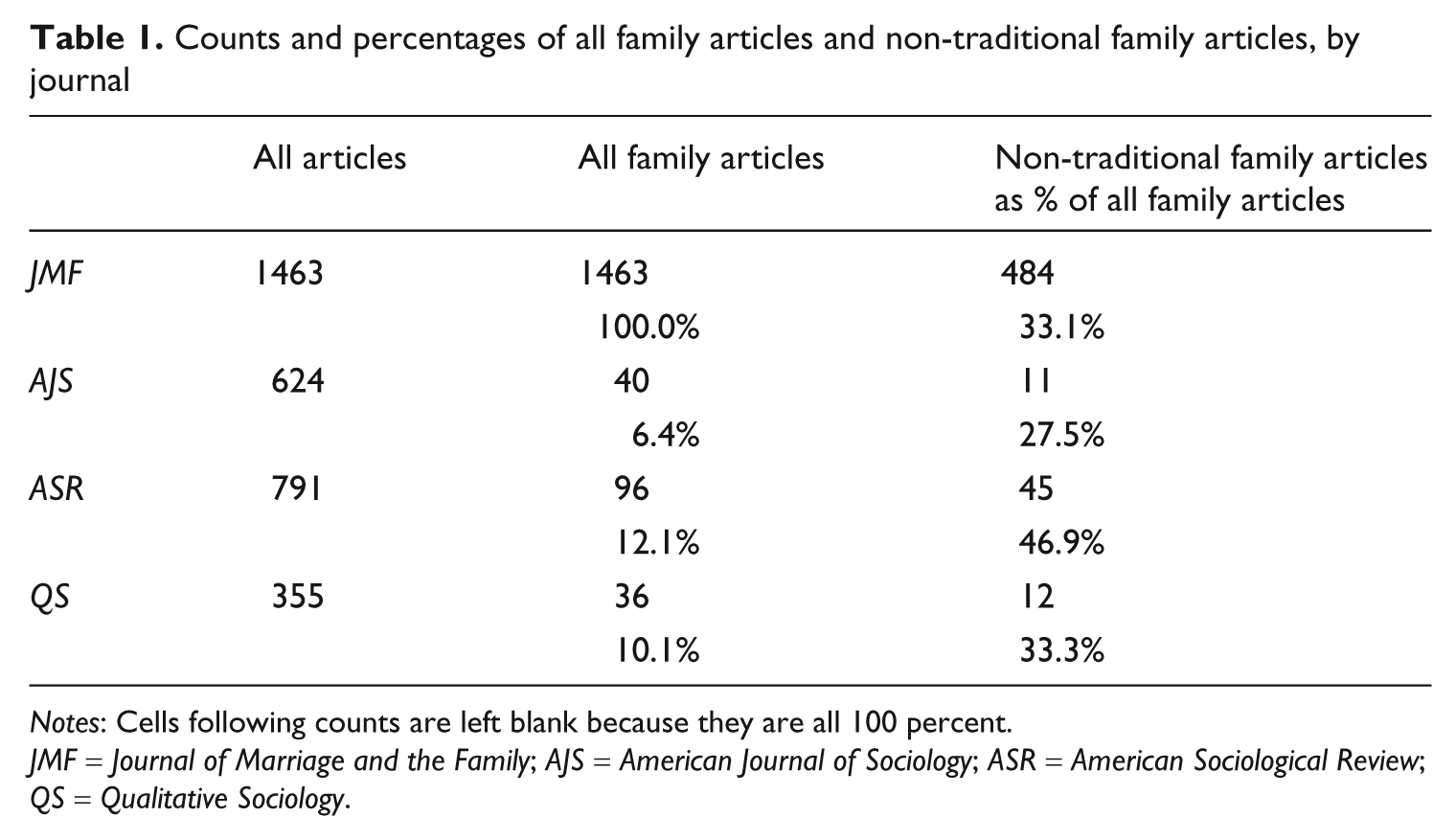
Notes: Cells following counts are left blank because they are all 100 percent.
JMF = Journal of Marriage and the Family; AJS = American Journal of Sociology; ASR = American Sociological Review; QS = Qualitative Sociology.
Even if the number of scholarly journal articles on non-traditional family forms is small, the range of subjects they cover could still be influential in shaping sociological discourse and research agendas. Thus, we also charted the specific family types covered by the articles on non-traditional families that appeared in these four journals during our review period. To do so, we first developed a set of 22 codes to represent the specific family structures covered by the non-traditional articles we found. Later, we merged these into seven broad non-traditional family codes: divorce, cohabitation, unmarried parenting, single parents, non-resident parents, teenage parents and gay/lesbian families. We also included a ‘comparative’ code for articles that compared two or more types of non-traditional families. Finally, a code labeled ‘other’ was created to include articles on types of non-traditional families that had very low counts, including articles on widows, stepfamilies, intergenerational households, separation, childlessness, adoption and foster care. Coding was conducted and reliability was checked as above, with an inter-rater reliability rate of 88 percent.
Figure 1 charts the results of our analysis, showing the percentage of articles covered by each of the seven coded family types in the four journals over the 17-year period of our study.
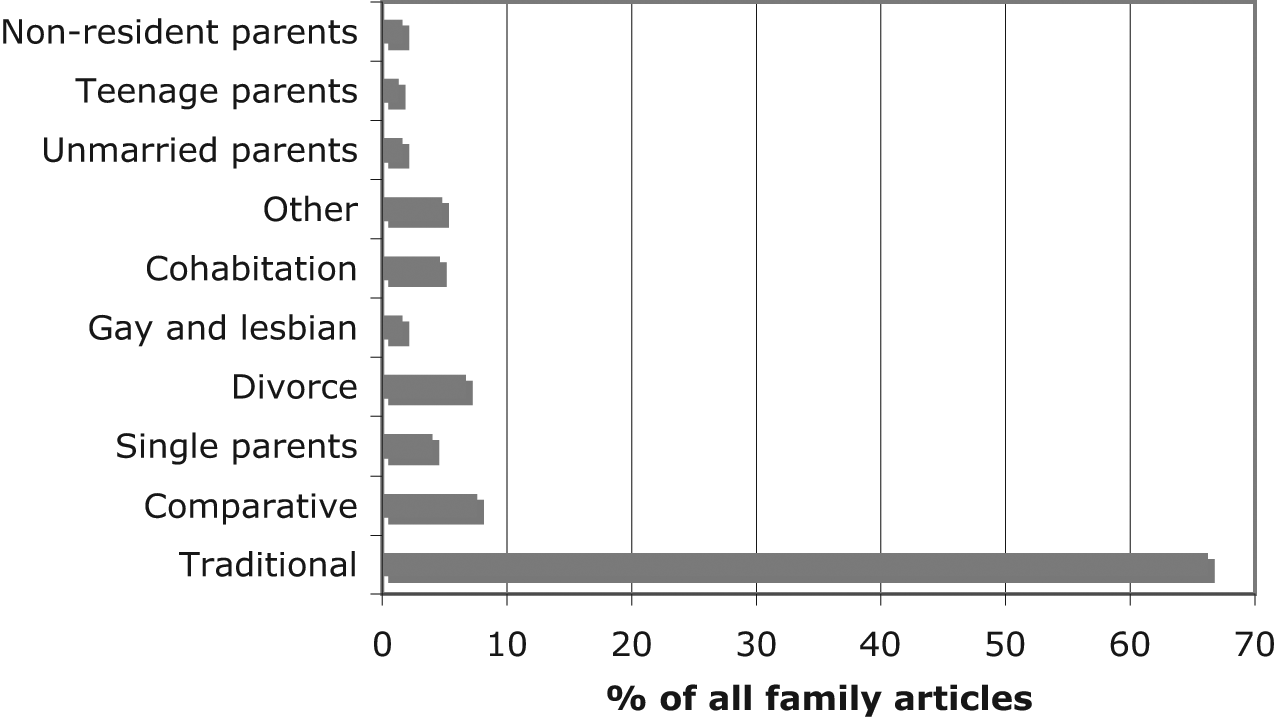
Themes of all articles on the family in four journals (in percentages)
As this graph so dramatically shows, not only do studies that focus on the traditional family vastly outnumber all studies of non-traditional family types, but the latter cover a relatively narrow range of themes, as well. Certain types of non-traditional families receive far more coverage in the extant literature than others. Articles on divorced and cohabiting families, for example, comprise 20.1 percent and 13.9 percent of all articles on non-traditional families, while comparative articles account for an additional 22.7 percent. Moreover, we discovered that even articles focused on non-traditional family arrangements, such as cohabitation, were often framed against the norm of the heterosexual married couple or nuclear family model, e.g. questioning whether or not cohabitation led to marriage, and, if it did, how long the resulting marriage lasted. Similarly, ‘comparative’ articles often compared non-traditional families to a marital norm and found them lacking in some way. Our concern with the limited number and themes in recent family sociology articles is not with their findings, but with the framing of the research questions and the assumptions behind them. Rather than examining the deficits of non-traditional families, these studies could produce a more nuanced understanding of how different family contexts and conditions shape different family relationships and processes.
This journal review of the family sociology literature also suggested to us the need for scholars to discuss definitions of family more openly. As we categorized articles for this study, we repeatedly found ourselves questioning what constitutes a family and what kinds of relationships are most often studied by family sociologists? Contemporary family life is clearly complex and multifaceted. Our review of sociological journals over the past 17 years is not presented here to suggest that family researchers must always include all types of family structures in their studies, or that scholars turn their attention away from heterosexual marriage and nuclear family relationships altogether. Rather, we wish to highlight the need for family sociologists to incorporate more of the complexity of contemporary family experience into their studies in order to produce relevant and useful data on US family life. More studies of the family need to include a broader range of couple partnerships, family relationships and household structures as a standard part of the research framework.
The family structures commonly covered in recent sociology journal articles represent just one way to examine how family sociology is responding to family change. In the next two sections, we explore how family sociology has or has not incorporated family change into its research paradigms by analysing two separate topics in family sociology in more depth. The first case study focuses on an area of changing family life that remains understudied by family sociologists, namely, the use of new reproductive technologies. The use of these technologies redefines the parameters of childbearing and questions common definitions of family based on biological connectedness. The second case study focuses on an area of family life that has been well researched by family sociologists: the household division of labor. Despite considerable scholarship on this topic, family sociologists have continued to focus on traditional families. This constrains our thinking about and understanding of the subject, particularly the gendered nature of the division of labor, and the ways in which family context influences domestic work and relationships.
Both case studies involved thorough literature searches and careful readings of the extant research. Several standard search engines were used to find relevant literature, which was then reviewed and summarized, with an eye toward the key questions raised by our study. In particular, we examined the extent to which family sociology has used non-traditional family experience as a lens through which to view reproduction and the division of domestic labor. The case studies, then, ask how the paradigm of the two-parent, heterosexual, nuclear family that has prevailed since the early 20th century constrains our current thinking about and understanding of contemporary family relationships and practices.
New directions for family sociology: Reproduction
Childbearing, once normatively contained within the reproductive matrix of the heterosexual family, has now entered new and relatively uncharted territory through the advent of assisted reproductive technologies (ARTs). Over 30 years have passed since the first ‘test tube baby’ was born in 1978. Since then, the popular press has met each new development in assisted reproduction, such as in vitro fertilization (IVF), legal battles over parenthood and dramatic multiple births, with extensive and often sensationalistic coverage. Yet, journalists have also identified challenges to the definitions of family and kinship and to the dynamics of generational relationships that assisted reproduction portends, drawing attention to a family transformation that is still in process with unpredictable consequences (Mundy, 2008). In the interdisciplinary scholarly literature, most attention to the implications of ARTs has come from feminist scholars, legal scholars and anthropologists. A brief overview of this literature offers a new critical lens through which we might begin to interrogate the prevailing assumptions and orientations of family sociology.
The gender politics of new reproductive technologies
Feminist theorists were among the first to focus their attention on new developments in assisted reproduction during the 1970s and 1980s. They often did so in this era through two opposing perspectives: one that identified how ARTs could help expand reproductive choice for women, and another that voiced concern about the increasing technological and medical infringement on reproduction, with particular attention to the class issues raised by the prohibitive cost of most treatments and the expanded regulatory power given to physicians who provided the access to ARTs (Arditti et al., 1984; Thompson, 2005). Feminist scholars have always provided an important gendered perspective on the social-cultural meanings and politics of reproduction, motherhood and fatherhood; but, as more feminists embraced poststructuralism and ‘a tone of moral ambivalence’ in the early 1990s, their responses to reproductive technologies began to allow for more nuanced considerations of the technologies and their impact (Thompson, 2005: 69). Several scholars began to focus more specifically on infertility as a historical, social and personal experience, often underscoring the varied contexts and complex motives involved in the decision to use or not use ARTs (Becker, 1994; Koch and Morgall, 1987; May, 1997).
A significant contribution of feminist scholars in this area has been to articulate the potentially transformative impact that ARTs can have on the image and practices of families as gendered institutions. Still, the critical perspectives offered by feminist analyses of ARTs have often been subsumed into a standard normative conception of family (Thompson, 2005), rather than used to explore new directions in family sociology. Mainstream family sociology has yet to engage fully the challenging themes and perspectives raised in this feminist scholarship.
The expansion of family law in the face of assisted reproductive technologies
Family legal scholars have also played an important role in examining the impact of ARTs on the definition and status of legally recognized and protected families. Recent analyses have focused on how ARTs influence the legal status of parent–child relationships. Among the important legal issues to emerge from non-biological parenting are the commodification of human relationships, the expansion of a contested domain for reproductive choices and the challenges of identity for children born in these new family settings (Sterett, 2002). Shanley (2001) identified many of the legal and ethical dimensions of families created by ARTs and called for more progressive family law. In subsequent work, she made the case against the commodification of human gametes and anonymity in the transfer of gametes, arguing that the new family forms allowed by ARTs require society to see family as grounded in ‘an ethic of interpersonal and intergenerational responsibility under conditions of unprecedented choice’, rather than as bonds that are either the result of ‘nature’ or ‘convention’ (Shanley, 2002: 280).
Skinner and Kohler (2002) reviewed case law to determine how the rights and responsibilities of parents were decided in cases where the nuclear family model does not apply. They found that judicial rulings varied widely in cases involving ARTs because of the vastly different state laws regarding these family relationships. They identified in these rulings ‘a reluctance to abandon traditional notions of family structure and the exclusivity doctrine [by which a child can have only two legally recognized parents]’ (Skinner and Kohler, 2002: 298) and, along with other legal scholars, they called for broadening the legal definition of what constitutes a family in order to provide a more stable legal context for non-traditional families (2002: 300).
Family sociologists have not felt the same imperative to address the questions that legal experts have confronted in case law, even though the realities of US family experience are challenging in practice the ways in which families have been defined in sociological theory. The push by legal scholars to redefine a new legal status for non-traditional families indicates that a similar re-examination of the definition of ‘family’ should occur among sociologists, with new questions raised about what constitutes relatedness and how family ties should be conceptualized.
Kinship revisited in anthropology
Anthropologists have also explored the impact that assisted reproduction has had on the concept of kinship, emphasizing the ways in which ARTs illuminate how kinship is grounded in a particular historical and cultural set of assumptions (Edwards et al., 1999; Franklin, 1997). Anthropological perspectives on kinship and on its related identities help frame the many complexities now embedded in new family forms. The ‘natural’ facts of reproduction have been rendered opaque with the advent of assisted reproduction, with kinship relations and identities open to negotiation and reinterpretation rather than fixed.
Where is the sociological research on assisted reproductive technologies?
Studies such as these should be generating new sociological questions about how the social roles of parenthood are destabilized or expanded by ARTs; how identities are shaped by living in non-traditional families; and how the institutions of medicine, law and family interact in response to technological developments and their resulting social transformations. Yet, to date, few sociological attempts to examine issues of family raised by ARTs have appeared in the sociological literature. A few studies of lesbian reproduction using ARTs have surveyed how new family forms may simultaneously destabilize, reinscribe and make visible traditional assumptions about what family means (Dempsey, 2010; Mamo, 2007). These studies examine the ways that technology-assisted reproduction among lesbians challenges taken-for-granted assumptions about families and allows for new understandings of relatedness and identity. However, studies of ART families have not been widely incorporated or interpreted as core themes in the field of family sociology.
Two decades ago, sociologist John Edwards called upon family researchers to recognize that ‘new technologies present the need in the short run to redefine “parenthood” and “family” relations’ (1991: 356). Yet, our broad investigation of family sociology literature, which included a wide range of journals and databases, found very few articles and books published on this topic. Almost no subsequent research has followed from Edwards’s appeal to rethink the traditional nuclear family as the core unit of sociological analysis, despite the challenge to a singular family model presented by ARTs. Why have families created through the use of ARTs been so understudied by family sociologists? One answer is that the number of families at issue is empirically small. Still, over 80,000 children in the US were born as the result of IVF or from donor sperm in 2004 alone (Mundy, 2008), and reproductive trends suggest that the use of ARTs will likely expand. Regardless of the absolute numbers of families affected, the broader cultural implications of this trend for the way childbearing and parenting are being experienced and understood are manifold.
Another barrier to studying families formed from ARTs stems from the reliance of sociological researchers on large, pre-existing survey datasets, most of which include no questions regarding methods of childbearing. The National Survey of Family Growth (NSFG) is an exception in that it includes several questions relevant to the study of childbearing and family formation decisions (such as pregnancy intentions and infertility problems), but the majority of surveys used by family sociologists do not include variables for studying the impact of ARTs on family life. Thus, sociologists interested in the experiences of families created with ARTs face the challenge of undertaking their own data collection efforts, an approach that limits sample size and therefore the ability to produce generalizable results.
The study of childbearing and family formation through ARTs focuses on a family experience that is a ‘statistical outlier’ but that nevertheless holds many lessons for family scholars seeking to understand the impact of new social and cultural trends in US family experience. In the next case study, we turn from a relatively rare experience in family life to one that is universally prevalent – the household division of labor. We ask what difference it makes to domestic work that more Americans now live outside the traditional boundaries of heterosexual marriage and the nuclear family structure. How do changes in living arrangements impact the processes of domestic labor and the meanings attached to domestic roles, responsibilities and expectations?
New directions for family sociology: Household division of labor
In the past few decades, there has been a growing volume of research on the household division of labor, resulting in an extensive body of research detailing domestic work. We know, for example, that there has been a gradual narrowing of the gender gap in the allocation of housework, as women have reduced and men have slightly increased the hours they spend on those tasks (Coltrane, 2000). We also know that women still do at least twice as much routine housework as men, and that the vast majority of men and most women rate these arrangements as fair. It appears that beliefs about who should perform unpaid family work have been particularly slow to change (Hochschild, 2001 [1989]). With the introduction of comprehensive datasets and new data analysis techniques, researchers have also been able to specify more precisely the social and demographic conditions that have had an impact on the household division of labor and on the ways in which the employment hours of men and women, their relative earnings and their beliefs about gender and the family influence the allocation of household labor.
Researchers in the 1990s also began to explore the transitional nature of household work across the life course, instead of simply capturing household labor at one point in time and conceptualizing this kind of work as static. There has been a proliferation of middle-level hypotheses about the impact of age, work experiences, marriage, remarriage, childbearing and other life course events on housework (Coltrane, 2000). For example, studies found that later ages at first marriage and parenthood contributed to a more equal division of labor between husbands and wives (Coltrane, 1990; Pittman and Blanchard, 1996). Remarriage and a more extensive work history also decreased women’s share of housework (Demo and Acock, 1993; Ishii-Kuntz and Coltrane, 1992; Sullivan, 1997). These studies implicitly acknowledged that men and women have been spending less time in marriage (at least in first marriages) and that the nature of family life varies over time. Now, more than a decade later, we need to be asking whether studies such as these go far enough in incorporating broad changes in family life into their research programs.
Are family sociologists looking for change in the wrong place?
Despite recognition of the transitory and dynamic character of family life, a preoccupation with studying married heterosexual couples persists, severely limiting a more complex understanding of household labor and gender inequality. Well over a decade ago, Shelton and John analysed the impact of marital status on the household division of labor and argued that ‘understanding the division of labor in married couple households no longer means that we understand how the division is accomplished in “the family” ’ (1993: 402). In his review of the 1990s literature, Coltrane also concluded that, ‘in particular we need to do a better job of assessing contributions to routine chores in a wider range of households’ (2000: 1227). Yet, research in this area continues to assume a married heterosexual couple. We know very little about how men in single-father and gay-male families experience household labor in a cultural climate in which caretaking and household work hold little status for men. And although it is often assumed that women in single-parent, cohabiting and lesbian families are freer to negotiate a more equal division of household labor, our knowledge of how allocations actually occur and the gendered meanings attached to domestic labor in these households is still limited. Family sociologists eagerly looking for signs of change in the allocation of household labor between husbands and wives may be missing important changes taking place in non-traditional families.
Moreover, advances in our understanding of gender have not been incorporated into mainstream sociological work on the household division of labor. Gender is too often undertheorized or inadequately conceptualized, especially in survey research. As a variable, gender is treated as a dichotomy and understood as the division between men and women (Stacey and Thorne, 1985). Many scholars now believe that the performance of household labor actually produces gender, in addition to other instrumental tasks (Berk, 1985; Fenstermaker et al., 2002). By conceptualizing gender as a variable rather than a process, researchers may well be missing significant changes in the way that different tasks are gendered and produce gender. In short, more complex accounts of gender and its relationship to household work are needed in the literature on the division of labor.
Does gender inequality in household labor persist across family types?
Although the bulk of studies have focused on household labor among heterosexual married couples, a small number of family sociologists have begun exploring whether the patterns documented in these families persist across a range of other household types. Gender theory suggests that widely held normative expectations about masculinity and femininity should influence the way men and women conduct household labor in all types of families. All men and women face pressures to conform to gendered norms and are held ‘gender accountable’, albeit in varying ways (West and Zimmerman, 1987). There is therefore reason to expect that gender continues to shape household labor in non-married households, but the actual processes by which this occurs may also differ by family context. In what follows we briefly review the relatively sparse research on household labor among single-parent, cohabiting and gay and lesbian families to examine what is known about household labor across a range of family types.
Single-parent families
Among the formerly married (divorced and widowed), single men appear to spend slightly more time on housework than do married men (Baxter et al., 2008), and single women spend less time on housework than their married female counterparts (South and Spitze, 1994). Some researchers have interpreted this finding – that single fathers and mothers are more similar to each other than they are to men and women living in two-parent families – as critical, because it suggests that fathers contribute more hours to domestic work, as well as do more ‘female-typed tasks’ (meal preparation, dishwashing, cleaning, laundry) when mothers are not around (Baxter et al., 2008; Hall et al., 1995: 691; South and Spitze, 1994).
Nevertheless, these findings should not be overstated. Researchers who compared mothers and fathers in married (first marriages and remarriages) and single households (never-married and divorced) found that, across family types, mothers spent between 40 and 44 hours per week on household labor, and fathers averaged 13 hours per week (Demo and Acock, 1993). Moreover, being single did not significantly change the ways in which men and women do housework, the level of responsibility they take for it and the meanings they attach to it. Single fathers tended to rely much more heavily on their offspring for help with domestic work than did single mothers. Fassinger (1993: 212) concluded that ‘single parenting may produce greater equality in men’s and women’s behavior (i.e., more housework for men, less for women) while preserving gendered differences in the interpretations of this behavior’. Based on the little that is known about single-parent families and household labor, then, gender inequality appears at first glance to function in similar ways as it does among heterosexual married couples.
Cohabiting families
Several sociodemographic characteristics of cohabiting couples – age, employment status, earnings and the presence and age of children – tend to differentiate this group from married couples. All these factors have been shown to affect how household labor is allocated. Cohabiting couples are also thought to embrace a more egalitarian gender ideology than married couples and thus share the household labor more equitably (VanEvery, 1993). Research findings show cohabiting men doing slightly more housework than their married counterparts, and cohabiting women less than married women (Davis et al., 2007; South and Spitze, 1994). Because the gender gap in the number of hours spent on household labor is smaller in cohabiting households than in married households, cohabiting couples appear more egalitarian.
Closer scrutiny of the research findings, however, suggests that the smaller gender gap in cohabiting households can be explained by the fact that cohabiting women contribute significantly fewer hours (6.3 per week) to household labor than do married women (Blumstein and Schwartz, 1983; South and Spitze, 1994). In contrast, the difference between cohabiting and married men is only about 1.3 hours per week (Shelton and John, 1993: 409). Perhaps outside of marriage women are less gender ‘accountable’, or perhaps the special nature of the relationship between cohabiting women and men impacts the way they perform housework. Why cohabiting women do significantly less housework than married women but the level of household labor by cohabiting men remains relatively close to that of married men needs further investigation.
Gay and lesbian families
Overall, studies comparing household labor across heterosexual family types tend to conclude that gender, not family type or statutory relationship, is the critical variable in explaining domestic labor. The sparse research on non-marital (cohabiting) and post-marital (divorced, separated, widowed, single-parent) families has not yet challenged the persistent finding that the division of domestic labor is largely determined by gender. Gay and lesbian couple families therefore provide an especially rich area of inquiry.
Early studies did find that gay and lesbian couples were freer to negotiate more equitable work patterns because of the lack of institutionalized gender roles associated with domestic labor (Blumstein and Schwartz, 1983; Lynch and Reilly, 1986). More recent longitudinal research confirmed that household labor among full-time employed lesbian and gay couples tended to be more equitably shared (Kurdek, 1993, 2007). Researchers also find that the division of labor among lesbian couples continues to be relatively equal even under pressure of childrearing responsibilities (Patterson, 1995; Reimann, 1997; Sullivan, 1996). Yet, this picture of relative equality has begun to be challenged. Carrington (1999) found that gay and lesbian couples are not as equal as they claim to be. Moreover, in lesbian stepfamilies, biological mothers may perform significantly more housework and childcare than non-biological stepmothers (Moore, 2008).
Clearly, even with the absence of gender differences, other contextual factors, such as biological connectedness to children, can influence unequal divisions of labor. Family context may hold considerable explanatory power for understanding the division of labor in gay and lesbian households. At the same time, research suggests gender continues to shape divisions of housework in lesbian and gay families in complex ways. Lesbian couples do less housework and/or divide household labor more equitably than gay male couples (Carrington, 1999; Kurdek, 2007). And both gay and lesbian couples continue to ‘do gender’ as they divide household labor and explain these divisions to others (Carrington, 1999).
The role of family context, rather than gender, in shaping the division of household labor
Heterosexual gender roles traditionally scripted the ways in which married couples understood and participated in domestic work. But, if gender is no longer understood as a role or a trait but as something humans produce during daily interactions, we should expect that the way gender is produced will vary in different interactional and familial contexts (West and Fenstermaker, 1993). We cannot assume that gender shapes household labor in the same way across all family types. The way that husbands and wives divide labor reflects the production of the particular gendered roles of ‘wife’ and ‘husband’, roles that are currently undergoing a shift in meaning as marriage is transformed as an institution. The statuses of cohabiting, being single, or living in a gay or lesbian family are also likely to create a different kind of context for ‘doing gender’ than heterosexual marriage (Carrington, 1999; Davis et al., 2007). Researchers also point to the ways that family contexts are subject to change as individuals move in and out of different households and relationship statuses. One study, for example, traced the different meanings that divorced women ascribed to housework (as less emotionally fraught, less frustrating and less pressured) when they became single (Fassinger, 1993). It is these kinds of varying family contexts for the allocation and performance of household labor that family sociologists have yet to explore and interrogate fully.
More research is clearly needed to inform our understanding of the way in which union context shapes the experiences of household labor. There are many questions we cannot begin to answer with the research currently available. For example, how does the meaning of household labor change when one’s relationship status shifts? How do cohabiting men and women ‘do gender’ through housework in ways different from husbands and wives? To what extent do gay male and lesbian couples have different understandings about the gendered nature of housework than heterosexual couples? By widening the scope of household labor studies to incorporate households other than those made up of married heterosexual couples, researchers will be better able to investigate the complex processes at work in shaping household labor practices.
Conclusion
Much of the sociological study of the family still views the two-adult, heterosexual, married couple, residing together with their biologically related offspring, as constituting ‘the family’. By 2010, this described fewer than half of households in the US. The US Census Bureau itself has been struggling to catch up with changes that are taking place in Americans’ living arrangements. The 2000 Census, for example, for the first time recorded ‘unmarried partners living in the same household’, recognizing that there were unmarried heterosexual couples, as well as gay and lesbian couples, both with and without children, who shared a residence. Single individuals living alone – both as young people and in old age – constitute over one-quarter of all households in the US, now the most common household type. And there are other variations of household living arrangements that defy the traditional norm. In the field of family sociology, however, the study of diverse kinds of family forms and household arrangements has not kept pace with these new realities. Even more significantly, as our case studies of new reproductive technologies and the variation in household labor by family type suggest, this lack of attention to non-traditional families has had serious consequences in limiting the scope of research and our subsequent understanding of the complexities that now characterize contemporary family life.
In this article, we have argued that family sociology needs to expand to reflect the new realities of many Americans’ lives. We have argued this from a review of sociological journal articles and the perspective of two illustrative case studies. In the first case, assisted reproduction has begun to challenge the boundaries of the nuclear family standard, raising questions about how genetic relatedness, legal relationships and popular understandings of family membership are evolving over time, and how these issues influence everyday family life, kinship relations and identity. In the second case, incorporating a broader range of non-traditional families into the scope of inquiry on household labor raises new questions about the kinds of gendered practices produced and reproduced through domestic work. It also suggests that family context itself, not just gender dynamics, might shape household labor. By calling into question the taken-for-granted nature of the family and by shifting the center of sociological inquiry to encompass a wider range of families and households in the US, new perspectives on family meanings, practices and contexts have begun to emerge that hold the potential to revitalize family sociology and its place in the discipline for a new era.
New questions, even those that are recognized as legitimate and important areas of study, are often structured and constrained by prevailing methodologies and existing databases. Some of the new areas of inquiry that we have pointed to here will require qualitative studies of contemporary family life, as well as new questions added to the existing national surveys that can take account of the diversity of family experiences. We are convinced that the field of family sociology has the potential to expand to meet the realities of 21st-century family experience. It must do so if the field is to make sense of the dramatic changes in Americans’ life experiences and to help set the research agenda for a new generation of family sociologists.
Footnotes
This research received no specific grant from any funding agency in the public, commercial, or not-for-profit sectors.