







Abstract
Emphasis has shifted in climate change politics from fear to dreams and opportunities. This article demonstrates that many social science analyses of anthropogenic climate change are characterized by utopian presumptions, including technological mastery of nature, and that key concepts such as post-carbon society, decarbonization, low-carbon transitions, ecological direction of travel, and ecological modernization have not been defined in terms of the absolute amount of emissions appropriate for anthropogenic global warming. It shows that time-cost discounting is erroneous. These misleading conceptions give false positives for improvement and sustain wishful thinking in societies that have locked themselves into carbon-based infrastructures where default options are fossil fuels leading to an emerging path-dependent hypercarbon world. The article explains how those concepts can be reconceptualized to increase validity and also suggests accurate concepts like time-cost exacerbation, low-carbon and decarbonization transition searches, and ecological modernization niches. By comparing longue durée emitting societies, it documents the superiority of (1) social democracy over neoliberalism in transitioning to low-carbon economies while enhancing democracy, equity, and prosperity, and (2) multitasking of international mitigation commitments with local mitigation, adaptation, and resilience. The article seeks to stimulate research into learning from better performing societies to innovate transitions of institutions and culture to robustly defined low-carbon economies.
After the failure of fearful predictions and of international negotiations to motivate reduction of greenhouse-gas emissions, emphasis shifted in the social science of climate change politics to dreams and opportunities (Prins et al., 2010). Giddens (2009: 12) used an analogy to illustrate that nightmarish conditions are best transformed by invoking dreams: ‘Martin Luther King didn’t stir people to action by proclaiming, “I have a nightmare!” ’ In his important study of inequality produced by market dynamics, Piketty (2014: 11) concludes that economists’ ‘overly developed taste for apocalyptic predictions gave way to a similarly excessive fondness for fairy tales, or at any rate happy endings’. Is this also true for sociologists’ analyses of anthropogenic climate change?
The theme of the 2012 annual meetings of the American Sociological Association (ASA, 2012) inspired by its president (Wright, 2010) was ‘real utopias’, an ASA admitted oxymoron, hence the focus was on tension between ‘real’ and ‘utopia’. The challenge is to empirically ground emancipatory plans in a world where conditions for social change are imperfect. Research on real utopias is supported by Burawoy (2011). Urry (2011: 139–140) argues that although social scientists have not valued utopian thinking, it can serve as a mirror to demonstrate the limitations of existing societies, to bring out connections between elements of future societies, and to inspire change to bring the utopia partly to fruition. The organizers of the ASA (2012) meetings contend what is needed are ‘empirical studies of innovative contemporary institutions and practices around the world that prefigure emancipatory alternatives to dominant social structures and institutions’.
These issues are important for emancipating societies from carbon dependence and the world from dangers of anthropogenic climate change: ‘sociology has a real contribution to make to the analysis of future “post-carbon” societies, drawing on its roots in critique and the elaboration of alternative, utopian, futures’ (Redclift, 2009: 369). The dystopian side of climate change is well known, namely predictions of catastrophes. The utopian presumptions behind proposals of full-speed ahead and of some alternatives are less evident. Envisaging what a future post-carbon society would look like and visualizing pathways toward it need to be complemented by empirical investigations of whether societies are headed in that direction and of institutions which facilitate the transition or instead reinforce fossil fuel path dependence. Predicting future climate stability or change involves anticipation, hence elements and degrees of both indicative evidence and uncertainty (Murphy, 2012, 2013). The challenge is one of social learning based on both visions of what could be and knowledge of what is.
There is a long history of utopian thinking, especially in Marxian theory (see Bloch, 1995 [1954]), which is beyond the scope of this article. ‘Real’ and ‘utopian’ are used here as ideal types. By ‘real’ the article is referring to phenomena for which there is much evidence, not only observable practices but also substantiation from the natural and/or social sciences. ‘Utopian’ refers to speculation for which there is (as yet) little evidence or there is counter-evidence; whether utopian proposals turn out to be ‘no place’ remains to be seen. Not all aspirational pathways are utopian: some are grounded on much evidence, others far less. The analysis here is meant to differentiate aspirational pathways for which there is substantial real-world evidence from those having (as yet) little evidential support, to demonstrate the depth of the climate change problem, and to provoke research and debate.
The objective of the article is to explore tensions between aspirations to emancipate society from adverse consequences of socio-technical development and the recalcitrant real social and material world. Since the concepts ‘post-carbon society’, ‘decarbonization’, ‘low-carbon transition’, ‘direction of travel’, and ecological modernization are often used in a taken-for-granted way in the social sciences, the article clarifies their meanings and suggest precise conceptions. It then examines the possibilities and risks of utopian thinking. It uses evidence from the real world to determine whether there are utopian elements in social-science approaches to climate change. 1 It assembles documentation to discern what is emerging: whether the transition is in the direction of a cornucopian technological utopia, or a hypercarbon dystopia, or a post-carbon utopia. It seeks out innovative societies dealing with anthropogenic climate change and, to determine whether success requires sacrificing other valued goals, it compares societies on prosperity and income inequality.
The emerging hypercarbon world
The International Panel on Climate Change (IPCC) recently released its fifth assessment report (IPCC, 2013: SPM-7) concluding that ‘the atmospheric concentrations of carbon dioxide (CO2), methane, and nitrous oxide have increased to levels unprecedented in at least the last 800,000 years. CO2 concentrations have increased by 40% since pre-industrial times, primarily from fossil fuel emissions and secondarily from net land use change emissions. The ocean has absorbed about 30% of the emitted anthropogenic carbon dioxide, causing ocean acidification.’ It found that even if emissions were halted immediately, the effects of their present accumulation will persist for many centuries. The 2012 Emissions Gap Report (UNEP, 2012: Executive Summary) found that despite the recent recession ‘current global emissions are already considerably higher than the emissions level consistent with the 2oC target [the maximum safe atmospheric temperature increase] in 2020 and are still growing’. Data about climate are incomplete, but Edwards (2010) showed how an ingenuous ‘machine’ has been constructed yielding reliable conclusions using data analysis, measurement, checking, smoothing, simulation models based on physical theory, reanalysis models from weather forecasting constrained by observations, and mathematical analysis of historical records of weather and climate. Predictions have been grounded in empirical findings about what is presently occurring. A critical appraisal of climate science by sociologists (Shackley et al., 1998; Van der Sluijs et al., 2010; Wynne, 2010) did not lead them to deny the reality of anthropogenic climate change. Van der Sluijs (2012: 192) recommended more openness concerning ignorance and dissent by the IPCC but warned against overexposure of uncertainty: ‘the high scientific standards that climate skeptics rightly demand from the IPCC apply to them too’. Predictions of anthropogenic climate change involve the distant future, hence they are necessarily anticipatory, as is its denial. Whitington (2013) shows that long wave, weak signal climate change can be attributed to anthropogenic global warming by its fingerprints (night-time lows), gives glimpses of the distant future through bellwethers, sentinels, and harbingers (melting Arctic ice, Maldives flooding), and can prompt thinking about climate futures through model events (Hurricane Sandy).
Anthropogenic global warming is disproportionately caused by affluent societies and groups (Murphy, forthcoming) but its effects will be disproportionately suffered by vulnerable poor societies and communities, hence tend to be imperceptible to those causing it (Whitington, 2013: 312). Bangladesh and Chad do not have the means to adapt and be resilient that the United States and Canada do, but the per capita emissions of the latter far exceed those of the former. Not only developing countries but also wealthy ones are powering their economic growth with fossil fuels. This article focuses on countries having high per capita emissions for a long time, thus is limited to investigating countries in Europe, North America, and Australia.
The IPCC has been criticized for minor errors in its massive reports, but its most significant error was underestimating the rapid melting of Arctic ice (Wynne, 2010). Archer et al. (2009) demonstrated that 20–35% of the CO2 remains in the atmosphere much longer than the usual assumption of a century, which has resulted in underestimating the longevity of global warming. The worse danger is that the environment could be irreversibly tipped into no longer providing high-quality services to humans (Schneider, 2009), as occurred with the draining of the Aral Sea and overfishing Newfoundland’s Grand Banks. Paradoxically, it is known that human activities are changing the climate from a relatively known state to an unknown one.
There are huge problems of scale in transitioning to a post-carbon economy, namely the amount of energy used and the tiny proportion based on renewable sources. The International Energy Agency (IEA, 2012) estimated in 2012 that renewable energy could be increased by 1,300 million tons of oil equivalent between 2010 and 2035 under a best-case scenario, but that it will be dwarfed by an 2,700-million-ton fossil fuel increase, including an 800-million-ton increase of highly polluting coal. The IEA (2012: 5) also documented what has happened: ‘Coal has met nearly half of the rise in global energy demand over the last decade, growing faster even than total renewables.’ Creating renewable energy displaces little fossil fuel energy (York, 2012) unless accompanied by measures to suppress fossil fuels. Renewable energy has been largely additive. Since the greenhouse effect results from the absolute amount of carbon in the atmosphere, it is worsening and the proportion of renewables is irrelevant. The emergence of some add-on renewable energy must not obscure the increasing use of carbon to power economic growth. Latin (2012) argues persuasively that backloaded incremental strategies involving gradual cuts to emissions, which defer significant reductions for decades, will exacerbate global warming and prove too little too late.
A conceptual critique
The concept ‘post-carbon society’ has been used ambiguously. The following referents indicate the range of meanings. ‘A real post-carbon society would have managed to reduce them [greenhouse-gas emissions] to zero’ (Reusswig, 2011: 190). Just as prosperous societies are no longer dependent on animal energy, post-carbon societies would be emancipated from fossil fuels, the latter replaced by non-polluting, renewable energy. This literal conception, the only precise one appropriate for dealing with climate change, implies a utopian project presently existing nowhere.
‘Post-carbon’ has also been defined weakly: ‘a postcarbon world, meaning a search for entirely new problem-solving strategies’ (Davidson and Gismondi, 2011: 205). 2 However ‘search’ does not imply solutions have been found, nor that they predominate over fossil fuels. ‘Post-carbon societies’ in this sense exist presently even as emissions increase: societies with the highest emissions (USA, Canada) could be classified ‘post-carbon’ because they search for alternatives. This feeble meaning of ‘post-carbon society’ is misleading because practices could stay carbon-dependent as the interminable search continues. Massive amounts of carbon will have been extracted from safe storage in the ground and transferred to the atmosphere with harmful effects before carbon-free practices become dominant. ‘Post-carbon search societies’ would be a more accurate conceptualization, whereas ‘post-carbon societies’ implies that the search has eliminated carbon fuels. A ‘post-carbon search’ is what exists currently in some societies and rhetorically in others, and is far from being post-carbon.
Many analyses have also used a misleading conception of ‘decarbonization’: ‘reductions in the energy intensity of gross domestic product (GDP) have been the primary factor responsible for the decarbonisation of the global economy’ (Prins et al., 2010: 23). Pielke (2010: 3) similarly argues that the world has been decarbonizing for a century through less energy used to produce units of GDP. But if it has been decarbonizing, why has atmospheric carbon increased because of economic activities? It is because decarbonizing is conceived of as ‘growing the economy at a rate faster than the rate of growth in carbon dioxide emissions’ (Pielke, 2010: 68). Emissions increase even as economies are supposedly decarbonizing according to this misleading conception. Atmospheric carbon increases because of not only high emissions per GDP but also high emissions due to high GDP. Understanding the depth of the problem requires that relativist, intensity-based conceptions of ‘decarbonization’ be replaced by a decrease in absolute amounts of emissions into the atmosphere. Use of absolute conceptions puts more onus on longue durée, high-emitting societies to reduce their emissions to make room for poor, developing countries to grow their economies out of poverty. It necessitates recognition that statements like ‘diversification beyond fossil fuels necessarily implies an accelerated pace of decarbonisation’ (Prins et al., 2010: 11) are false and that energy supply diversification has hitherto been achieved by adding renewables to an increasing amount of fossil fuels. The need to reduce absolute emissions is an important reference point for assessing climate performance, and reveals that reason is being overpowered by interests.
Similarly ‘transition’ implies the question: transition to what? If it is to low-carbon societies, then absolute amounts of emissions must decrease. Intensity-based conceptions superficially indicate a low-carbon transition even where emissions are increasing and a hypercarbon world is emerging. For example, in the exploitation of Alberta’s tar sands, there are less emissions per barrel of oil extracted now than previously but more overall emissions because many more barrels are being extracted and because extracting oil from tar sands produces more emissions than pumping it from a well. Rayner’s (2010: 617) conception of ‘direction of travel’ raises related issues. Relativist conceptions give the appearance of traveling toward low-carbon societies even while absolute increases of emissions push societies toward a hypercarbon world. Valid directional compasses must be based on conceptions appropriate for the environmental problem: for global warming, this consists of determining whether the absolute quantity of emissions is increasing or decreasing. Rather than begging the question by the expression ‘low-carbon transition’, it would be more accurate to speak of a ‘low-carbon transition search’ to distinguish between (1) attempts being made, and (2) emissions reductions needed at the scale and urgency to manage global warming.
The possibilities and risks of utopian thinking
Possibilities
Imagining alternatives to deficient institutions is important for social change. Martin Luther King had a dream of racial equality, Mahatma Ghandi had a vision of a decolonized independent India. To a certain extent reality can be bent to change the world. In 1987 Apple’s CEO Sculley proclaimed: ‘ “Apple would never be a consumer products company. . . . We couldn’t bend reality to all our dreams of changing the world” ’ (Isaacson, 2011: 295). Nevertheless Steve Jobs made this utopian dream real. Before something new is innovated, there are often plausible reasons for believing it impossible. The issue of utopias is nevertheless complex. Because it is based on values, a utopia for some groups is a dystopia for others. Amish communities are viewed as real utopias by adherents, but as dystopias by non-Amish because of their patriarchy, shunning of deviants, and restrictions on education and consumption. This suggests there are risks as well as benefits from utopian thinking.
Risks
Utopian projects have too frequently resulted in real dystopias. Religious utopias frequently fail to match their advance billing. The 1960s communal utopian values in America degenerated into wishful thinking and were followed in the 1980s by greed-based, trickle-down doctrines. Utopian thinking has ushered in oppressive dystopias: the communist theoretical utopia led to the Soviet gulag; the Chinese cultural revolution produced actions contrary to the envisioned perfect society. The lofty theory was beautiful, but the resulting practices were appalling. Despite their many failures (Scott, 1998), utopian theories have been defended with the facile excuse that they have not been tried and found wanting, rather they have not truly been tried.
Utopian visions have perverse consequences if they foster blindness to emerging dystopias. Analysis must be based on clear distinctions between wishful thinking and reality. Aspirational concepts must be differentiated from descriptive and analytical ones. Post-carbon societies and decarbonization are aspirations. Whether some societies are in transition traveling in that direction is an empirical issue. Grand visions can have paralyzing effects if they seem impossible. The perfect can indeed be the enemy of the good. The crucial issue is whether visions are translated into improved practices. Clumsy reforms may make more progress than utopian projects. Furthermore, the construction of a utopia concerning one issue can perversely result in dystopias regarding others. Will transition to post-carbon societies diminish democracy, equality, and prosperity?
Utopias
The utopian postulates of deep ecology are well known: ‘we must have no more than 100 million people if we are to have the variety of cultures that we had one hundred years ago’ and the prospering of other species (Arne Naess, quoted in Devall and Sessions, 1985: 75–76). The human population must be reduced to 1/70th of its present size. Since deep ecology has already been critically examined (Murphy, 1994), this article seeks to uncover less evident utopian premises in other sociological analyses of environmental problems, specifically climate change.
Dystopian analyses and utopian solutions
Treadmill-of-production theory (Schnaiberg, 1980) and ecological rift theory (Foster et al., 2010) contend that environmental degradation is inherent in the capitalist market. Structural human ecology (Dietz and Jorgenson, 2013; York et al., 2003) argues it is intrinsic to increased affluence and population growth. These perspectives imply that solutions to environmental problems require the replacement of the market with something else or/and decreased population and diminished consumption. This exemplifies the depth of dystopian analyses, and of utopian proposals necessitating the transformation of human behavior to solve global climate change. Davidson and Gismondi (2011: 212, 209) give a dystopian depiction of fossil fuel practices as amounting to ‘mass suicide’: ‘Trucks filled with Athabasca tar rumble on, poetically driving us all into the sunset of modern civilization.’ Their solution consists of wished-for pathways to a post-carbon society: although Alberta presently produces almost half of Canada’s emissions from big emitters (Environment Canada, 2010, 2011, 2013) despite having only 11% of Canada’s population and repeatedly elects a conservative political party espousing low flat taxes both corporate and personal, no consumption tax, and depends on fossil fuel revenues, Davidson and Gismondi (2011: 224) hope a legitimacy crisis will produce a moratorium on tar sands oil extraction and a post-oil future.
A technological utopia
There has been an ongoing refrain, especially from economists (Lomborg, 2001, 2007; Simon, 1981), that even if a resource becomes depleted and economic growth causes environmental problems, applied science steered by market incentives will find timely solutions. When a resource becomes scarce, its price rises, and technological innovation will develop supplies or substitutes: ‘within a century or two, all nations and most of humanity will be at or above today’s Western living standards’ (Simon, 1995: 642). Although planet Earth is finite, human reason is not, and its market and technological manifestations will make the cornucopia last forever. This utopian speculation seems confirmed by recent market-driven technological innovations to extract oil and natural gas from shale and bituminous sands and to drill in deepwater, which has apparently refuted predictions of peak oil. They seemingly corroborate the renewability or substitutability of even non-renewable resources and validate the utopian premise of eternal energy abundance: ‘the availability of cheap oil fosters myths of unlimited material abundance and growth’ (Redclift, 2009: 374). There is an almost magical faith in market-driven applied science to bend reality. Modern society is assumed resilient, adaptable, and will find timely solutions no matter what it does to its natural environment.
Utopian wishes dressed in pragmatic trousers 3
Some sociologists (Rayner, 2012; Verweij et al., 2006), working mainly from the cultural studies interpretive tradition, argue climate change is a wicked problem that can be managed but not solved. Elegant solutions like the Kyoto Protocol fail and harm other priorities. They postulate that ‘needs and wants cannot be usefully distinguished’ (Rayner and Malone, 1998: 12) and interpret restrictions on consumption, on economic growth, and on population as based on sinfulness whereas their reframing emphasizes human dignity. They suggest clumsy, modest, indirect actions that bring immediate local benefits. Building resilience to present dangers and adapting to changes in the near future are emphasized, with incremental mitigation of emissions going along for the ride. They assume ‘people living in the future will probably be wealthier than our contemporaries and will be better buffered from the shocks that weather and climate produce’ (Rayner and Malone, 1998: 106). Although some sociologists have been making this argument for years, it has become prominent since the Kyoto Protocol failed (Prins et al., 2010).
These sociologists recognize nevertheless that ‘decarbonisation of energy supply is the only long-term approach that can deliver a radical acceleration of decarbonisation of economic activity’ (Prins et al., 2010: 24). They presume that intentionally making fossil fuels expensive will be rejected: when populations have to choose between near-term economic benefits and mitigation of long-term environmental dangers, they always choose the former, which Pielke (2010) calls the iron law of climate policy. To become acceptable to consumers and taxpayers, the ‘goal must be to make clean energy cheaper at point of use to the consumer than dirty energy … without permanent subsidies’ (Prins et al., 2010: 24). Pielke (2010: 224) argues that a ‘political commitment to leaving fossil fuels in the ground will likely have to accompany innovation of alternative sources of energy. Such a commitment will be made far more likely with alternatives cheaper than fossil fuels available, and will be impossible without those alternatives.’ The linchpin of their supply-side analysis is wished-for technological innovations. ‘There will be little progress in accelerating the decarbonisation of the global economy until low-carbon energy supply becomes reliably cheaper and provides reliability of supply’ (Prins et al., 2010: 30). Governments need to push development of carbon-free technologies through public-works models, demonstration projects, changing to carbon-free technologies, and carbon taxes – dedicated to developing cheap, clean, abundant energy – that begin low (although as high as politically acceptable) then increase perhaps doubling in 10 years. They would be set upstream on extraction of fossil fuels (Pielke, 2010; Prins et al., 2010). Pielke (2010) advocates carbon capture and storage (CCS) and developing technologies of air capture to mop up carbon already emitted into the atmosphere. This interpretive, cultural studies perspective yields conclusions surprisingly similar to technological utopia hypotheses: technological fixes of energy supply will enable management of anthropogenic climate change.
Ecological modernization
This approach is unabashedly ‘environmental reform in theory and practice’ (Mol et al., 2009: subtitle), hence it seeks to be on the ‘real side’ of the real-utopian scale. It searches for convergence whereby environmental remedies can piggyback on economic goals. Ecological modernization scholars ‘brought many market and monetary instruments and approaches – such as eco-taxes, environmental auditing and reporting, corporate environmental management, green consumption/consumerism, valuation of environmental goods, environmental assurances, green niche markets, green branding and eco-labelling, etc. – together in a coherent broader framework’ (Mol et al., 2009: 505). They argue that pursuit of profit is insufficient to propel the market to become ecological. Giddens (2009: 71), who sees himself as an ecological modernization supporter, argues the state must intervene in the market to institutionalize polluter-pays principles through full cost pricing incorporating externalities, assurance bonds to insure costs that might arise later, a carbon tax, feed-in tariffs, etc. It has to facilitate and enable mitigation, and ‘ensure that definite outcomes are achieved – most notably a progressive reduction in carbon emissions’ (Giddens, 2009: 8). Ecological modernization, despite its reformist orientation, has been characterized by an ‘unflappable sense of technological optimism’ (Hannigan, 2006: 26). Hence it is important to examine whether its modernization is really ecological or just wishfully so.
Utopian proposals assessed
Technological innovation driven by market dynamics is producing carbon-laden energy, thereby aggravating emissions: fossil fuels are combusted to extract fossil fuels from bituminous sands, upgrade heavy oil, hydraulically fracture shale, drill in deepwater oceans and in the Arctic made accessible by global warming, and liquefy natural gas. There is declining energy return on energy invested to obtain energy (Davidson and Andrews, 2013; Hughes, 2009), hence extraction requires increasing amounts of fossil fuels. In the full cycle from extraction to combustion, fuel-efficiency regulations downstream are undermined by greater emissions upstream to extract and upgrade unconventional oil (e.g. from tar sands). Moreover carbon sequestration cannibalizes energy: ‘about 30 percent of the energy in a typical coal plant is required to capture and compress carbon dioxide’ (Hughes, 2009: 94). Far from being in transition to a low-carbon world, economic growth and energy security are pursued mainly through fossil fuels resulting in a hypercarbonizing world.
The utopian wish that low-emissions energy be cheap confronts opposing evidence. In 1954 the chairman of the US Atomic Energy Commission asserted nuclear energy would result in electricity ‘too cheap to meter’ (Strauss, 1954), but safety requirements made it expensive. Fusion in a flask was rapidly debunked. Forty years ago fuel cells to power vehicles were presumed only 30 years away, but are nowhere on the horizon today. The economist Jaccard (2009: 131) counsels a price placed on carbon, but concludes ‘all of the options for low- and zero-emission energy are more costly. If we make an effective effort over the next fifty years, then it is likely that the cost of energy services will be 25 to 50 percent higher than today.’ Cheap energy is typically not carbon-free (e.g. coal) and carbon-free energy (wind, solar, sequestration) is not cheap. If cheap energy is the priority, its carbon content will be discounted and worsen climate change. The interpretive cultural studies analysis necessitates an escalating carbon tax that augments costs without any assurance clean cheap energy will be developed. Most high-emissions societies reject carbon taxes: Australia, New Zealand, and France eliminated them, the Canadian population voted down a political party proposing them, and the American Obama administration doesn’t dare suggest them. Cap-and-trade systems are assumed more politically feasible than unpopular carbon taxes, but they too are resisted. British Columbia implemented a carbon tax offset by reduced income taxes. It taxes carbon pollution to fund healthcare and education, resulting in resistance to its elimination because other taxes would have to be increased to maintain services. The basis of its acceptance by the population – revenue neutrality – means it provides no funds for stimulating technological innovation. If managing anthropogenic climate change needs a carbon tax to fund innovation, it requires broader societal innovation for acceptance.
Interpretive sociologists are betting the atmosphere and societal security on technological fixes, putting all eggs in that basket, but cheap energy innovation is littered with failures and perverse consequences. They can be desired, but counting on such fixes to solve environmental problems borders on recklessness. Their argument breaks down if the population rejects carbon taxes or if clean cheap energy is not found and deployed. Technology often fails to provide timely solutions whereas social innovation can diminish harm. For example, technology failed to cure lung cancer: the search for ‘light cigarettes’ did not yield a ‘post-lung-cancer or post-nicotine society’. Anti-smoking measures, however, significantly decreased smoking and diminished lung cancer rates. When people had to choose between near-term pleasures of cigarettes or heeding scientific warnings of long-term danger, most chose the latter. Iron laws are not so iron-clad or lawful after all.
Rayner and Malone (1998: 92) assume that delaying emissions mitigation reduces costs because of ‘time-cost discounting (i.e., the further in the future a given economic burden lies, the smaller the resources that must be set aside today to undertake it)’. That would be true if the burden’s size is fixed and mitigation resources are accumulating. But in most societies mitigation resources are not being set aside, whereas atmospheric carbon is accumulating because of human activities, hence a more appropriate portrayal would be ‘time-cost exacerbation’. Moreover interpretive sociologists have taken the wrong ‘direction of travel’ (Rayner, 2010: 617) heading into a hypercarbon world instead of a low-carbon one by not using the absolute amount of emissions as their directional compass.
Neither treadmill theory nor ecological rift theory nor critical ecology provides empirical studies of innovative contemporary societies that have moved off the treadmill and healed the rift or made reduced affluence and population decline acceptable to the public. Concerning Davidson and Gismondi’s wishful post-oil Alberta, its economy is instead transitioning to greater dependence on tar sands oil. It is necessary to look elsewhere for viable environmental innovation.
Ecological modernization niches must never be misinterpreted as transitions to low-carbon economies: focusing on two steps forward to renewable energy is misleading if it obscures four steps back to fossil fuel dependency through fracking, deepwater oil extraction, tar sands oil, Arctic oil, etc. Success stories indicate a potential for managing environmental problems like climate change, with the potential realized only if scaled up to levels and timeliness needed by the problem. Intensity-based conceptions of fewer emissions per unit of GDP constitute false positives leading to erroneous conclusions of decoupling economic growth from emissions if their absolute quantity increases thereby worsening global warming. Similarly, policy proposals must never be mistaken for action. Canada proposed interesting climate change policies, which resulted in only ‘hot air’ and were not implemented (Simpson et al., 2007). Conceptions appropriate for environmental problems are necessary to determine whether modernization that is ecological is occurring, which for climate change involves decreasing the absolute amount of emissions. Otherwise ecological modernization discourse is more imaginary than real and descends into greenwashing.
Emancipation from a locked-in carbon future
The ASA (2012) preamble stated that ‘ “utopia” implies developing clear-headed visions of alternatives to existing institutions that embody our deepest aspirations for a world in which all people have access to the conditions to live flourishing lives; “real” means taking seriously the problem of the viability of the institutions that could move us in the direction of that world’. Redclift (2009: 382) is aware of the tension between (1) speculation imagining a future free from carbon dependency and (2) his wise counsel: ‘rather than speak loftily of the need to “transform” human behaviour, we could make a start by analyzing how current behaviour is tied into patterns and cycles of carbon dependence’. How can utopian ideals be grounded in real potentials rather than remain fantasies that float freely? In a carbonizing world, scientific warnings have led to societal variations in response: ‘how people respond is linked to distinct cultural understandings’ (Redclift, 2009: 381). Which political regimes are adopting front-loaded solutions by immediately lowering their carbon dependence, and which are fostering fossil-fueled economic growth? Are there societies that are reconciling tensions between prosperity and movement away from carbon dependence without diminishing democracy and equality? To investigate these questions, the environmental performance, prosperity, and equity of wealthy countries that have been emitting for a long time will be compared.
Wright (2010: 336, 338, 350) argues that (1) social emancipation requires that the state enhance empowerment and (2) developing class compromises is the main preoccupation of social democratic politics. He (Wright, 2010: 351) contends that working-class associational power has been strong in the production sphere in Germany, in the political and exchange spheres in Sweden, and has dwindled in all three in the United States. Dryzek et al. (2003) conclude the United States has no ecological modernization, the United Kingdom a belated form, Norway a weak version, Germany a strong type, and Nordic countries are leaders in ecological tax reforms. This is because Northern European institutions have a more cooperative emphasis compared to adversarial relationships in the United States, which is related to perceptions of complementarity between economy and ecology in the former and opposition in the latter. Esping-Andersen (1990), Korpi and Palme (1998), Kautto (2002), and Chung and Muntaner (2007) have documented significant differences between North America and Northern Europe in institutions, discourses, and collective actors. Urry (2011: 157) argues that ‘shifting to a low carbon path is more likely to be possible, the more equal and “deeply” democratic the society’. All this suggests where to find innovation in constructing low-carbon societies, namely, Northern European social democratic societies. Urry (2011: 157) adds however that low-carbon systems will ‘provide lower levels of measured income, economic wellbeing and population, at least for those in the rich North’. Is that the case?
Emissions-lowering societies
Table 1 compares carbon emissions of Northern European countries with North America and Australia. It shows that, to employ Freudenburg’s (2006) concept of disproportionality, whereas North America and Australia are disproportionately carbonizing the atmosphere, Northern Europe has disproportionately low-carbon emissions.
Societal carbonization of the atmosphere.
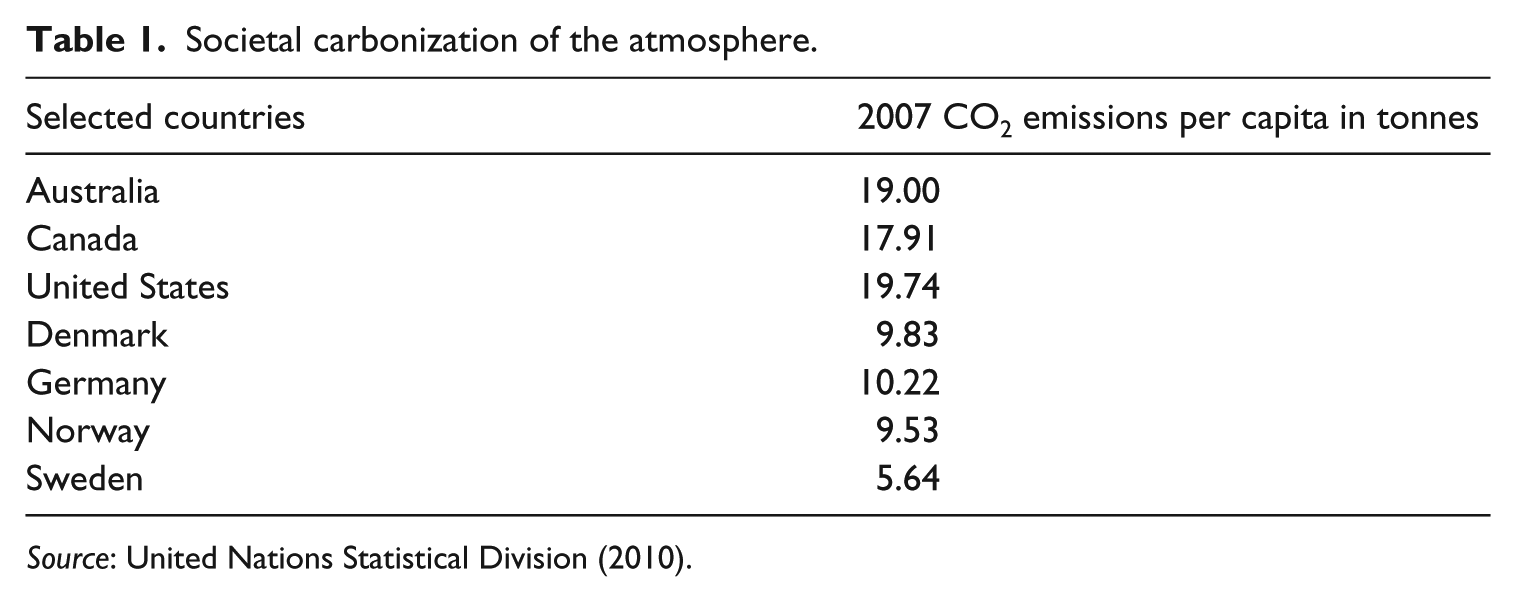
Sweden has less than half the per capita greenhouse-gas emissions of Canada and the United States (UNFCCC, 2010) and lived up to its Kyoto Protocol commitment of a reduction of 9% in its greenhouse-gas emissions since 1990. Sweden generates only 2.2 megatonnes of CO2 equivalent emissions to produce US$10,000 worth of GDP, which is between one-quarter and one-third of Canadian and American emissions respectively (UNFCCC, 2010; USEIA, 2010). Sweden developed centralized, low-emissions heating systems using bio-energy from waste (Swedish Energy Agency, 2010), Denmark and Germany installed higher proportions of wind energy than other countries, and all states of Northern Europe are world leaders in efficient energy use. They are also leaders in suppressing fossil fuels through carbon taxes, cap-and-trade measures, constructing rapid public transportation, controlling urban sprawl, constructing bicycle lanes for daily home-to-work commute, etc. Northern Europe has already decreased its emissions since the Kyoto reference year of 1990 (UNFCCC, 2010).
Table 2 presents the 2012 rankings of North American, Northern European, and several other countries on the Germanwatch (2012) Climate Change Performance Index. It documents that Northern European countries rank near the top, whereas North America and Australia compete with Russia, Poland, China, and Greece as bottom dwellers.
Climate Change Performance Index 2012.(50% emissions trend, 30% absolute emissions, 20% policy).
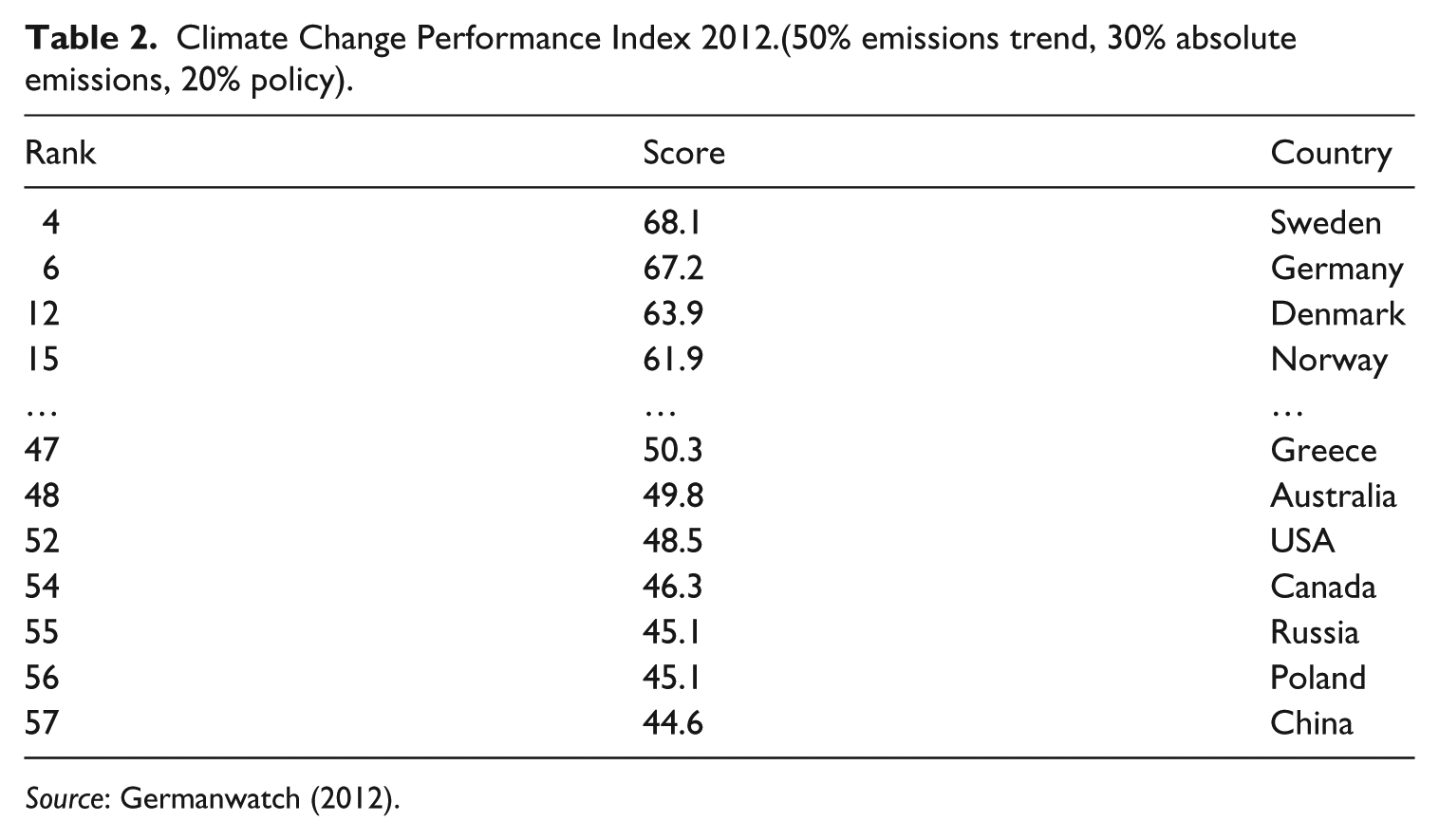
Source: Germanwatch (2012).
Yale University’s (2012) Environmental Performance Index (EPI), which includes climate change, yields a similar ranking of societies, as shown in Table 3. Some fluctuation over time is evident, notably Canada is performing worse in 2012 than in 2008. Nevertheless the finding that Northern Europe performs better at mitigating climate change and other environmental problems than North America and Australia is remarkably consistent from year to year.
Environmental Performance Index (Yale University).
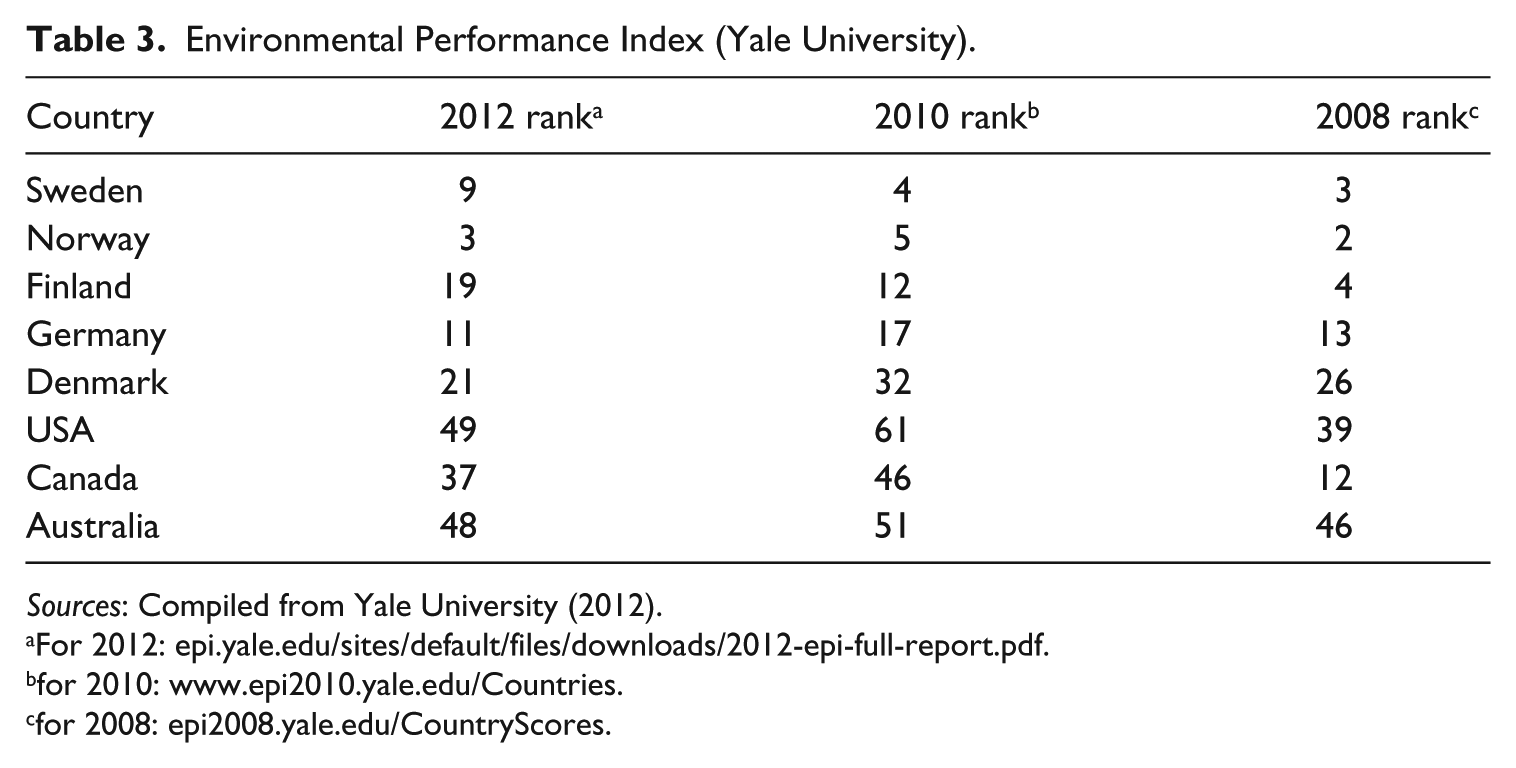
Sources: Compiled from Yale University (2012).
for 2010: www.epi2010.yale.edu/Countries.
for 2008: epi2008.yale.edu/CountryScores.
Northern European societies are among the rare wealthy, longue durée emitters that attempted to implement the Kyoto Protocol. They are pushing for binding international commitments to reduce emissions. Oil producing states are laggards in introducing carbon taxes, cap-and-trade measures, offsetting emissions, and are opposed to binding emission-restraining commitments in international agreements. There is but one exception: Norway. It deals with its emissions through a carbon tax and offsetting them by paying developing countries to reduce their emissions, which is not an ideal post-carbon solution but is superior in mitigating emissions and environmental justice than refusal to offset them. Alberta introduced a carbon tax for bitumen extraction, but it is so tiny it failed to decrease emissions or fund carbon capture and storage.
Has the success of Northern European societies in reducing or offsetting their emissions diminished democracy and equality? The Gini coefficient in Table 4 documenting inequality of family income shows that for wealthy countries, Northern European societies have least inequality, likely because of higher taxation of the wealthy to provide services for all: unemployment insurance, pensions, medical care, other transfer payments, etc. (Simpson, 2011: A15). Whereas small government, unchecked capital, and low taxes benefit primarily wealthy shareholders (Piketty, 2014) and the present generation, Northern Europe has long used government to attain democratically chosen goals for the well-being of all social classes. It is as if the best government is interpreted as not being the smallest government but rather the smartest government, and freedom is defined as all classes free to have the capacity to prosper. This is then extended to future generations through attempts to mitigate long-term environmental problems like anthropogenic climate change. Even when conservative parties form governments in Northern Europe, they tend to tweak the social democratic model and its institutions rather than eliminate them.
Global Gini Inequality Index (distribution of family income) ranking by country.
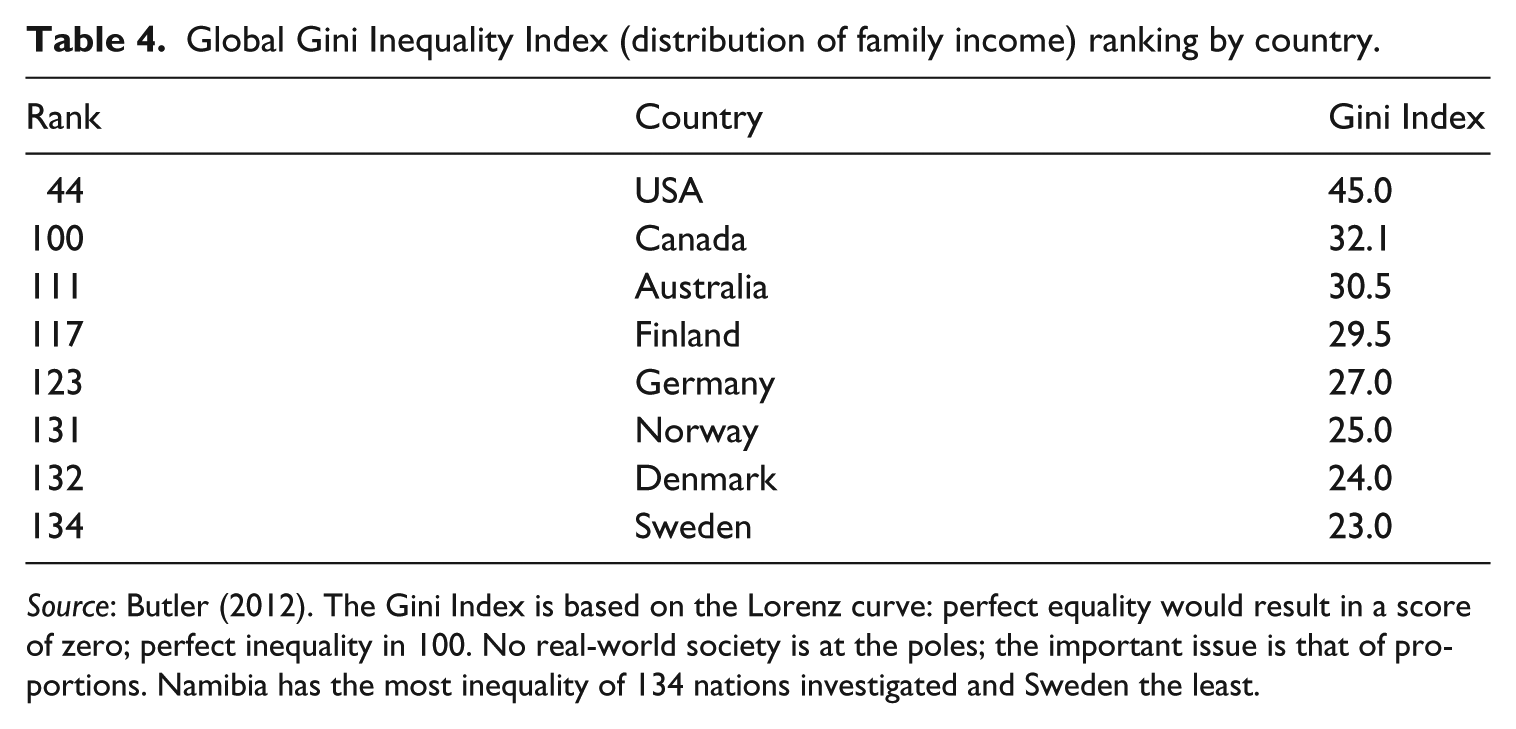
Source: Butler (2012). The Gini Index is based on the Lorenz curve: perfect equality would result in a score of zero; perfect inequality in 100. No real-world society is at the poles; the important issue is that of proportions. Namibia has the most inequality of 134 nations investigated and Sweden the least.
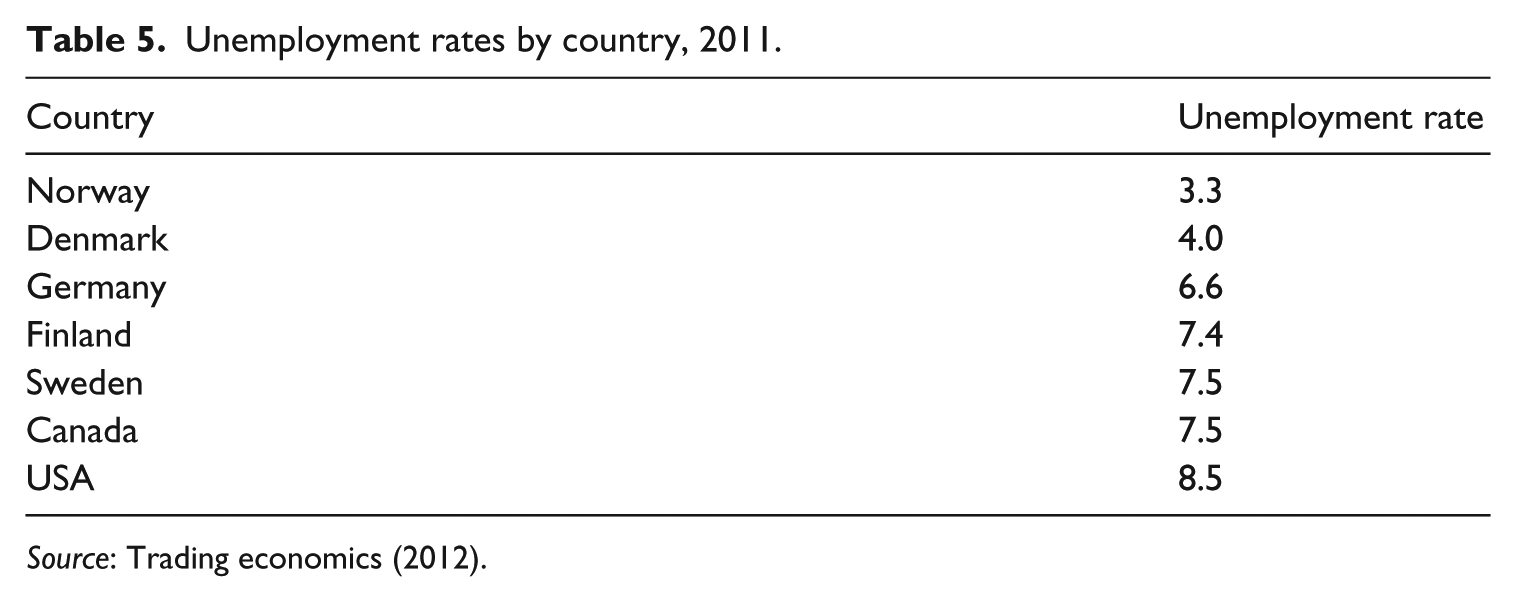
Although Northern European countries have higher proportions of government workers, publicly funded universities, and more inclusive healthcare than countries like the United States, they have not had a debt crisis nor the need to pay high interest because their governments reliably pay their debt on time through taxation, and hence have low risk of defaulting. They have not suffered serious unemployment increases since the 2008 recession endured by other countries. Table 5 shows they had lower unemployment than the USA in 2011.
Unemployment rates by country, 2011.
Source: Trading economics (2012).
Northern Europe’s superior environmental performance has not sacrificed prosperity. This is confirmed by the Legatum Prosperity Index (Legatum Institute, 2010). The three top countries on that index and four of the top six are Northern European countries with relatively high taxes and a strong role for government, which also facilitates measures to alleviate the recession and mitigate global warming. The United States, which emphasized deregulation, tax cuts, reduced government, and meager climate change mitigation, ranked behind the Northern European societies on that prosperity index, even for the purely economic dimension.
Alberta created a heritage fund in 1976 to save some of its oil revenues, but placed little money in it selecting instead low royalties and low corporate taxes to attract investment, and avoiding value-added and sales taxes for the present population (Clarke et al., 2013). After North Sea oil was discovered, Norway created a state-owned oil company, did hard bargaining with privately owned oil companies for high royalties, maintained value-added and sales taxes, introduced a carbon tax, borrowed Alberta’s idea of a sovereignty fund in 1990, and put huge amounts in it (Campbell, 2013). Norway has not only maintained prosperity but also built up a vast sovereignty fund (US$656.2 billion by 2012) managed by the state for present and future generations, whereas Alberta’s heritage fund in 2012 contained only 1/40th (US$15.9 billion) of Norway’s fund even though Alberta’s fund has existed almost twice as long (SWF, 2012).
Conclusion
It is well known that dire predictions concerning anthropogenic climate change characterize conclusions of climatologists and that deep ecology proposes utopian solutions to environmental problems. What is less recognized, but shown in this article, is that utopian presumptions typify many social science analyses (1) relying on technology, whether market-based or government-driven, to provide timely solutions and (2) those implying a complete change of social structure, affluence, or population is required. Dystopian/utopian theories remain ongoing features of conceptualizing environmental problems, and faith in technological mastery of nature still underpins many approaches.
Concepts like ‘post-carbon society’ have often been used in sociology in an unreflective, taken-for-granted way. This article showed that conceptual precision would be enhanced by distinguishing ‘post-carbon search society’ from the more challenging and precise literal conception of ‘post-carbon society’. This distinction exposes the depth of the anthropogenic climate change problem: the search is superimposed upon high emissions resulting in a dangerous hypercarbon world; it is known that emissions are leading to the unknown.
The article demonstrated that concepts like post-carbon society, decarbonization, low-carbon transition, ecological direction of travel, and ecological modernization are premature and should be understood as denoting aspirations rather than facts. It showed that time-cost discounting is spurious for problems like climate change and that intensity-based, relativist indicators of improvement consist of false positives. Such undemanding indicators of demanding concepts are misleading. Concepts must be grounded in what is appropriate for the problem. Since the absolute amount of carbon in the atmosphere causes greenhouse effects, valid social science analyses must be based on the absolute quantity of emissions by societies, industries and globally. That key reference index shows that the present direction of travel and transition for the world and many wealthy societies are toward hypercarbonization and that interests are overpowering scientific warnings. Inflection points for societies occur when their emissions change from increasing to decreasing. Only then could their direction of travel be validly interpreted as transitioning toward decarbonization. The same is true for the world. Since fossil fuels remain default options in path-dependent trajectories where societies are still locking themselves into carbon-based energy infrastructures and where carbon accumulates in the atmosphere, more precise concepts are required, such as time-cost exacerbation, absolute inflection points, ecological modernization niches, low-carbon and decarbonization transition searches.
Innovating clean technologies, adaptation, and resilience are important to reduce emissions and depletion of non-renewable energy and to mitigate disasters. Economic growth is needed in developing countries to decrease poverty. But to move toward real-world low-carbon societies, the absolute amount of emissions must be lowered. This is a challenging test of whether modernization, efficiency, etc., are ecological or merely economic, but it is the most appropriate test for the anthropogenic climate change problem. Intensity-based measures may have value for some purposes, but they must be used with care because they are saturated with greenwashing possibilities that camouflage atmospheric deterioration under the false guise of ecological improvement. Those legitimating possibilities explain why intensity-based indicators are favored by the fossil fuel industry, for example companies extracting oil from tar sands. If modernization reduces society’s absolute amount of emissions, then it could accurately be called ecological. If it increases that amount, then it would more appropriately be referred to as non-ecological economic modernization. A transition to successfully managing climate change should not be presupposed just because of some renewable energy coming online, somewhat greater efficiency, unrepresentative projects, and policy pronouncements.
Technological innovation has hitherto increased emissions and aggravated climate change by accessing new fossil fuel sources, and most societies refuse carbon taxes, cap-and-trade legislation, binding international commitments, etc. Fear of the emerging hypercarbon reality has not motivated improvements, so climate change politics have shifted to emphasizing dreams and opportunities. To avoid wishful thinking and utopian talk that leads nowhere, aspirations must be empirically grounded with real-world evidence needed to achieve goals. Documentation compiled here confirmed that Northern European societies are leaders in mitigating anthropogenic climate change. Far from promotion of international mitigation commitments hindering local mitigation, adaptation, and resilience, their experience demonstrates the two go together. Multitasking is possible. The documentation also confirmed that this superior environmental performance was accomplished without forgoing prosperity or generating unemployment, thereby contradicting assumptions that successfully managing anthropogenic climate change requires reducing median standards of living. It is the way prosperity is attained that is determinant. The economic sphere has been reconciled with the environmental sphere more in Northern Europe than in neoliberal societies like the United States and Canada, and has not perversely resulted in dystopias regarding other socio-political values. Societies and institutions that perform better in lowering carbon emissions are also better performers concerning environmental justice and equitably distributing society’s wealth both for the present and future generations, the latter exemplified by Norway’s sovereignty fund.
Northern Europe’s social democratic institutions, while not attaining the perfection of imaginary utopias and having room for improvement, are foremost examples of equity, democracy, and mitigating and adapting to climate change. They constitute better practices if not best practices and are the avant-garde institutions of the post-carbon search world, fostering symbiosis between the present generation and its global biophysical environment for the benefit of future generations and other societies. Whether this will suffice for dealing with anthropogenic climate change remains to be seen, but at least it has proven its worth. Other utopian schemes like replacing the market with something or/and purposefully reducing population and affluence would involve transformations of human behavior at much higher levels of utopian change, for which there are no real-world societies that prefigure success.
To mitigate anthropogenic climate change, not only technological innovation and carbon pricing are necessary but also transitioning to more ecological and equitable institutions and culture. Although social democratic cultural values have developed in specific Northern European historical settings, other societies could learn from the successes and limitations of these real-world institutions which prefigure emancipatory alternatives to the dominant social structures of the emerging hypercarbonization of the atmosphere. By drawing attention to national disparities, and to the social democratic-neoliberal institutional differences underlying them, as well as to findings that climate accomplishment does not require reduced prosperity, this article seeks to stimulate sociological research into how societies could learn from these real-world successes to construct their own transition to more robustly defined low-carbon societies. This embodies clear-headed visions and attention to the viability of institutions and provides a grounded direction for future research and action concerning intra- and intergenerational equity, justice, democracy, and mitigating environmental dangers.
Footnotes
Funding
I wish to express my gratitude to the Social Sciences and Humanities Research Council of Canada for a grant (# 410-2011-0260) that supported this research.