







Abstract
Internationalization pressures are omnipresent in the world of science. Scholars and administrators now often make use of international impact as a yardstick by which to assess the quality of national scholarship. However, little is hitherto known about the effects of the internationalization incentives at the level of specific national scientific communities. This article presents an analysis of the forms of internationalization in Chile over a period of four decades, from 1976 to 2015. Using Web of Science data, the article looks at the evolution for both publications and citations and examines the internationalization pressures on Chilean scholars and Chilean journals in relation to changes at the level of publication language and co-authorship. The article particularly focuses on the differences between the three cultures (humanities, natural sciences and social sciences). Building on the findings, the article concludes with some suggestions for research policy.
Introduction
Although internationalization is hardly a new issue in the ‘world of science’, it has taken on new forms in recent decades (e.g. Ollion and Abbott, 2016; Schofer, 1999). International networks do not just provide the broader context within which national communities operate. Scholars and administrators now increasingly make use of international visibility or impact as a yardstick with which to assess the quality of national scholarship. In a broad variety of national academic systems, international visibility is used to demonstrate the strengths and/or weaknesses of particular departments, to legitimate support for the work of particular research groups, to distribute available research funds to some researchers and not to others, and so on (e.g. Whitley and Gläser, 2007).
This transition has been enhanced by the rapid diffusion of tools such as Web of Science (WoS) and Scopus that were originally constructed to conduct bibliographic studies. These instruments pretend to cover and index the world’s leading scholarly journals, but they now increasingly serve to monitor and evaluate scholarly work. Administrators and policy-makers heavily rely on scientometric data to discuss the success, impact and visibility of research conducted in various settings. Many scholars, too, have incorporated the journal rankings and impact factors into their everyday decision-making routines (Espeland and Sauder, 2007; Paasi, 2015). For them, the publications and citations included in these databases have become differences that make a difference (e.g. Auranen and Nieminen, 2010; Bloch et al., 2014; Kaltenbrunner, 2018; Rushforth and de Rijcke, 2015). The world of science has not only become saturated by bibliometrics and scientometrics; these instruments also provide a powerful image of what ‘international’ has come to mean in the world of science.
No doubt, discussions about the coverage of these tools have generated a dynamics of its own. Growing concerns about underlying western and Anglo-Saxon biases have, among others, led to the development of repositories and indexes that centre on scholarly work produced and/or published in the periphery or semi-periphery of the web/world of science. For Latin American scholarly literature, for example, several alternative indexes have been developed, such as Latindex, RedALyC and SciELO. To legitimate their own global claims, however, the western instruments have also increased their coverage of ‘local’ journals, such as Latin American ones. While, for example, WoS only covered two Chilean journals in 1976, this number had increased to 12 in 2005 and 47 by the end of 2015 (see Collazo-Reyes, 2014; Garfield, 1984). More changes of this kind are likely to take place in the near future, for Latin America and other parts of the world. But the use of scientometric indexes themselves does not seem to be questioned. In a context of new public management, many countries build their research policies on these measurements of internationalization. The way these tools are used suggests that a broad consensus on scholarly impact is nowadays routinely achieved.
We might say that the international databases have ‘performative’ effects (Fourcade and Healey, 2007; Wang et al., 2017). Their selection and evaluation mechanisms change the world of science. These indexes now command an implicit, yet powerful, influence upon the scholarly environment. Many scholars now feel forced to align their efforts with the realities produced by the scientometric models (e.g. Bianco et al., 2016; Santos, 2012). But what kinds of changes have actually taken place or are likely to take place in the near future? And more particularly: what are the effects of the diffusion and institutionalization of these kinds of incentives at the level of specific national scientific communities (and not just at the level of individual scholars, research groups or departments)?
Hitherto there does not exist much analysis of the consequences of internationalization pressures at the national level. Various scientometric models of national performances have been put forward, but historically and sociologically sensitive analyses of the impact of these pressures on different national communities remain scarce (Rousseau, 2018). This article attempts to address this lacuna by analysing the internationalization of the scholarly cultures in Chile during a period of four decades, from 1976 to 2015. Although (or because!) Chile is often depicted as part of the (semi-)periphery, it has in recent years put much emphasis on academic internationalization. The National Commission for Scientific and Technological Research (CONICYT), for example, now provides funding for Master’s and PhD students who undertake their studies abroad. Almost 8500 scholarships were awarded between 2005 and 2014. 1 Funding for the formation and consolidation of international research partnerships has also significantly increased, and special funds to enhance the international indexation of national journals are now provided. Moreover, publications in international, especially WoS-indexed journals have gained central importance in the incentive structures for both individual scholars and research institutions (CONICYT, 2018). Whereas such publications are used to rank individuals who apply for jobs or research grants, several institutions also pay bonuses to its authors or include output criteria in employment contracts. Against this background, we look in this article at different aspects of the internationalization of Chilean research.
Internationalization pressures may take different forms in different scholarly ‘cultures’ (Lepenies, 1985). They may also affect different national communities and their journals in different ways (Vanderstraeten, 2010, 2011). To study their effects in Chile, we primarily make use of the same tool as most science administrators, viz. WoS, as it provides us with a large and rich database that allows for fine-grained analyses of publication output and citation networks. But we do not use publications and citations included in the WoS database as indicators of scientific quality. We look instead at the ways in which WoS-guided internationalization pressures have transformed the scientific community in Chile. We aim at understanding and contextualizing the structural changes that have taken place in its different scholarly cultures. We also intend to discuss how these structural changes have transformed the world of science for Chilean researchers and Chilean publication venues.
Hereafter we clarify how we composed our database of Chilean publications and Chilean citations. The main part of this article is then devoted to a presentation of the results of our analyses. After having presented an overview of evolutions over time and differences across disciplines, both for publications and citations, we look at changes in publication language and international collaboration or co-authorship. We furthermore specify these analyses at the level of disciplines and scholarly cultures (humanities, natural sciences, social sciences). On the basis of these findings, we finally discuss the changing relation between citation and publication rates at the disciplinary level. Although the visibility of Chilean research in the world of science (as represented by WoS) has changed, the changes do not point to a straightforward process of internationalization. For the social sciences and humanities, a Latin American ‘continentalization’ of research communities can be observed. Building on these findings, we conclude with some suggestions for research policy.
Data and methods
Starting from the WoS database, the following analyses address the internationalization of the scientific networks in Chile. We pay attention to, on the one hand, Chilean articles, i.e. articles authored or co-authored by scholars based in Chile, and, on the other, Chilean journals, defined as journals whose editorial address is located in Chile. Analyses at both levels – articles and journals – allow us to add nuance to the discussion. Moreover, we make use of both publication and citation data. Whereas publications are seen to stand for productivity, citations are often additionally used as a proxy for visibility or impact by scholars and administrators alike. Altogether, the WoS database permits us to study a period of four decades, from 1976 to 2015.
To analyse changes at the article level, we first retrieved all Chilean papers published between 1976 and 2015 from the core collection of WoS, which consists of the Science Citation Index Expanded (SCIE), the Social Sciences Citation Index (SSCI), the Arts & Humanities Citation Index (A&HCI) and the Conference Proceedings Citation Indexes. To avoid some well-known quality issues that plague this database, we hand-checked and cleaned the raw data with the help of publication lists made available by Chilean research institutions. We then divided the resulting set of 121,451 papers into 10-year periods and disciplines, using WoS’s list of scientific disciplines. Disciplines classified by WoS in more than one index (SCIE, SSCI or A&HCI) were dealt with as different ones, each including only the journals listed in the index in question. Given both the significant increase in the number of WoS-covered publications in recent decades and substantial variations in publication and citation cultures, we calculated the ratio of Chilean articles to the total sum of WoS-indexed papers per discipline and per decade. In addition, we retrieved the total number of articles citing at least one of the 121,451 Chilean papers and then calculated the ratio of these citing papers to the total sum of papers that cite other papers per discipline and per time period. 2
To address changes at the journal level, we retrieved all papers published in all the Chilean journals since their inclusion in WoS (whether or not these papers are co-authored by Chilean scholars). We also retrieved all the articles citing those journals per journal and decade. To understand these changes, we, moreover, analysed the editorials of these Chilean journals, looking for changes in their international ambitions, publication languages, peer review practices, and so on. Finally, we gathered similar information for the Chilean journals that are not included in WoS. Due to space limitations, however, we here primarily focus on those aspects of internationalization that can conveniently be addressed from a substantial body of quantitative data.
We should add a cautionary note. Due to the lack of a national database covering the entire Chilean publication output, we cannot discuss our dataset against the background of all Chilean publications or citations. However, in view of both the increasing numbers of Chilean articles and Chilean journals included in WoS and the increasing importance attached to this particular type of output, we believe that the following results not only provide a good overview of the changes currently taking place in different Chilean scientific networks, but also shed light on the challenges and problems which will ensue from these changes in the near future (see also Collazo-Reyes, 2014).
Results
We start our analysis with brief overviews of the evolution of the shares of Chilean articles and of citations to these articles in WoS. For clarification purposes, we divide, as already mentioned, the time period for which WoS data are available, i.e. 1976–2015, into four decades. To understand the evolutions during this entire period of time, we subsequently pay attention to changes in publication languages and collaboration or co-authorship structures at both the article and the journal level. We then deal in more detail with these underlying aspects of internationalization in the different scholarly cultures: the natural sciences, humanities and social sciences. Based on this distinction, we afterwards discuss in more detail the relation between international publications and international citations. Our findings finally lead us to some reflections on the consequences of the recent (largely unanticipated) changes in the coverage of the WoS databases.
Publications
Figure 1 presents an overview of the growing presence of Chilean papers in the WoS database. Averaged by discipline, 0.10% of the papers published in the period 1976–1985 were (co-)authored by Chilean scholars. This share increased to 0.13% in 1986–1995, 0.18% in 1996–2005, and 0.34% in 2006–2015. While the relative presence of Chilean authors grew by a factor of almost 3.5 in this 40-year period, the increase is particularly evident during the last decade. In this sense, we may say that the internationalization strategies pursued in Chile have been relatively successful.
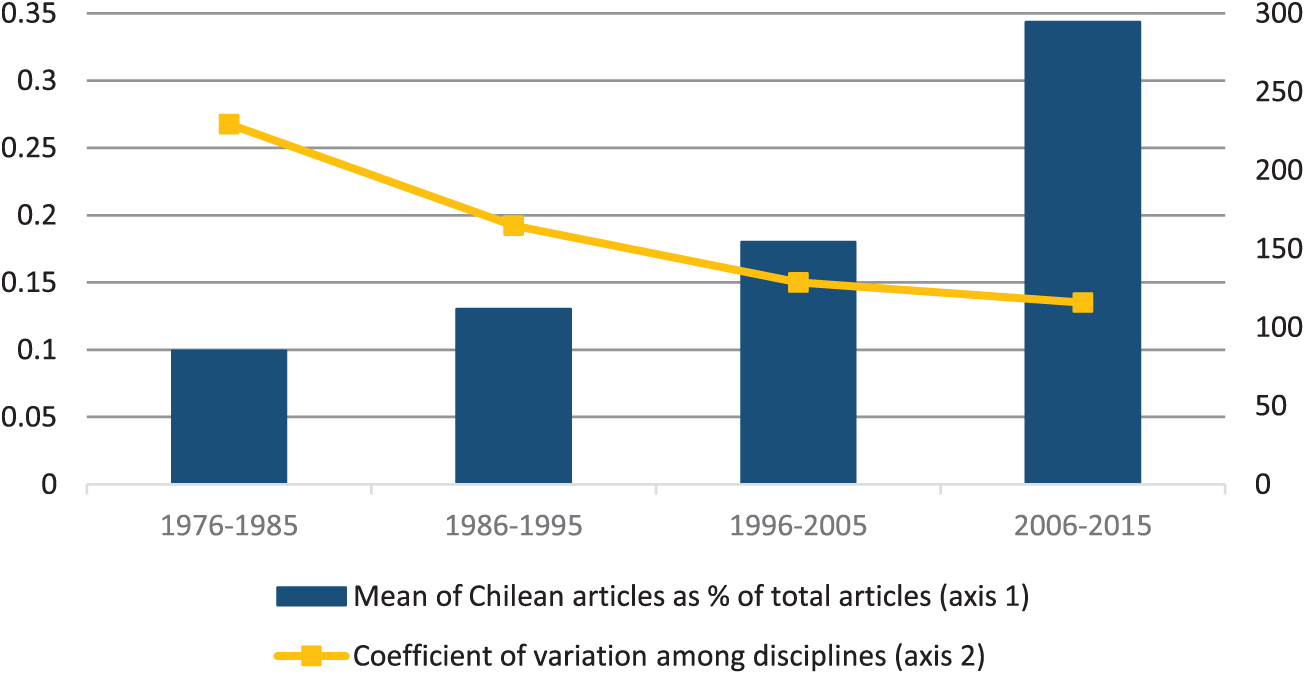
Evolution of Chilean publications, 1976–2015.
Figure 1 also shows the variation across disciplines. The share of disciplines (as defined by WoS) to which Chilean researchers contributed increased from 82% in the period 1976–1985 to 99% in the period 2006–2015. The coefficient of variation displays a continuous decrease from 227% in 1976–1985 to 115% in the last decade (2006–2015). 3 The increase of the mean values thus reflects the internationalization of publication output in a growing number of disciplines. As, however, the values of this coefficient remain quite high, it is difficult to speak of a gradual homogenization across disciplines.
A caveat is again in place. Although our findings show that international publications have gained in importance across all disciplines in Chile, the large number of journals published throughout this 40-year period in Chile (more than 820) suggests that national or local settings continue to play an important role within many scholarly disciplines. The orientation towards international peers has emerged next to a domestic ‘world.’ Our datasets do not allow us to provide a systematic analysis of all – national and international – publication output. In the following, however, we will return to the diversity which is characteristic of contemporary networks of scholarly communication.
Citations
Complementary to Figure 1, Figure 2 provides an overview of the recent evolution of references to Chilean articles. How did the global impact of the work of Chilean researchers and institutions change over time? Did the evolution of the share of citations of Chilean publications match the increase of the share of Chilean publications in the WoS databases?
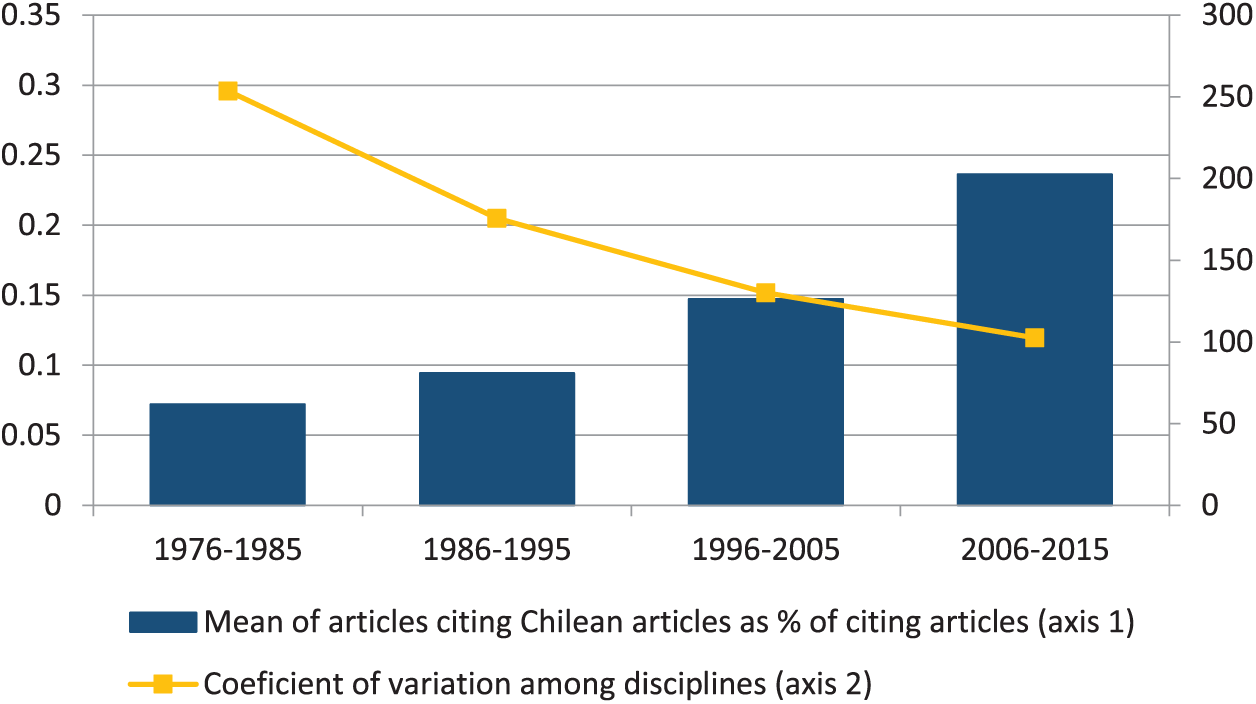
Evolution of Chilean citations, 1976–2015.
By and large, the evolutions displayed in Figure 1 and Figure 2 are very similar. 4 Figure 2 displays, on the one hand, the steady rise of the average share of papers citing Chilean papers during the 40-year period under study. This share grew from 0.07% in the period 1976–1985 to 0.09% in 1986–1995, 0.15% in 1996–2005, and 0.24% in 2006–2015. Figure 2 shows, on the other hand, a decrease of the variations across WoS disciplines. The coefficient of variation shrank from 253% to 102% during the same 40-year period. Despite this strong decrease, however, the variations across disciplines again remained substantial. Whereas more papers (co-)authored by Chilean scholars from more disciplines are currently cited in the WoS-indexed scholarly literature, the differences in the visibility of Chilean publications at the disciplinary level are still considerable.
Although both the publication and citation data point to the increasing visibility of Chilean research in international networks, it should be noted that the growth of the citation rates has been slower than that of the publication rates. In comparison with publication rates, citation rates are of course more difficult to manage. While national policy-makers and administrators can incentivize their scholars to publish in international, WoS-indexed journals, citations are dependent on importing settings, which are often hard to control by scholars and their administrators.
This discrepancy should not come as a surprise. Most of the available evidence shows a negative bias towards work from the (semi-)periphery. Not only has the long-standing bias of WoS towards Anglo-Saxon journals led the authority of Anglo-Saxon (and especially US American) scholars and journals to rise inexorably (Archambault and Larivière, 2009; Pontille and Torny, 2015), but papers authored by Latin American scholars also have fewer citations than those by US American ones in top-ranked journals in the sciences, despite the fact that all submissions passed through the same peer review process (Meneghini et al., 2008; see also González-Alcaide et al., 2017). The internationalization imperatives in Chile (and elsewhere) will have to come to terms with the divergences that ensue from such – now well-known – ‘reputation’ biases (Hirschauer, 2004). Before looking in more depth at the changes in the relation between publication and citation data in our period of four decades, we first explore in more detail the kinds of changes internationalization brings about.
Chilean papers: Languages and co-authorship
Internationalization is often associated with two kinds of changes: the shift towards English as the language of publication, on the one hand, and increasing international collaboration, on the other. Publications in English are thought to be accessible to a larger audience. Even for non-native English scholars, there is a clear tendency to publish primarily if not exclusively in English, assuming that this will give them more recognition and/or reward (Di Bitetti and Ferreras, 2017; López-Navarro et al., 2015). 5 This tendency is reinforced by the Anglo-Saxon bias of databases such as WoS. Moreover, international collaborations often result in co-authored English publications.
Figure 3 displays the transformations of Chilean research output in terms of language of publication and authorship. Above all, the stacked bars show the increase of internationally co-authored and English-language publications during this period of four consecutive decades. Between 1976 and 1985 14% of the publications were in English and internationally co-authored; between 2006 and 2015 this proportion had nearly quadrupled to 52%. Given the fact that the proportion of articles written in English but without international co-authorship remained relatively stable over time, it is clear that the growing internationalization of the Chilean publication output, as displayed in Figure 1, primarily builds on the internationalization of research collaboration.
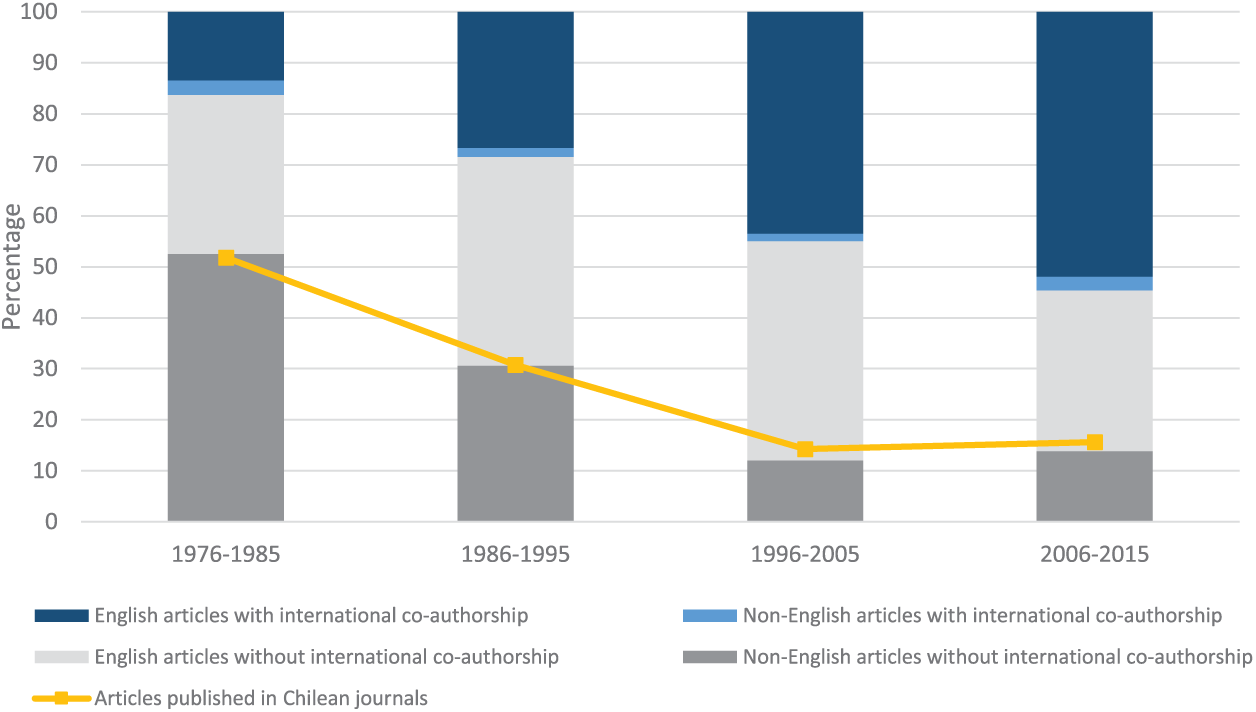
Evolution of authorship and language of publication of Chilean articles, 1976–2015.
As a corollary, the share of articles in a language other than English and published without international co-authors decreased markedly during our time frame, from roughly 53% in the period 1976–1985 to 31% in 1986–1995, 12% in 1996–2005 and 14% in 2006–2015. The slight increase of non-English (mainly Spanish) and nationally (co-)authored articles during the last time period is mainly a consequence of the aforementioned policy changes of WoS, which led to the incorporation of several national and continental (Latin American) scholarly periodicals.
In addition, Figure 3 displays the evolution of the share of Chilean articles published in the WoS-indexed Chilean journals. Initially, the share of those articles decreased considerably: from 52% in 1976–1985 to 14% in 1996–2005. An increase of Chilean articles thus was not an effect of the inclusion of more Chilean journals in WoS. However, WoS’s new editorial strategies, which led from the coverage of 12 Chilean journals in 2005 to 47 by the end of 2015, account for the relatively small increase during the last decade (2006–2015). Altogether, the internationalization of the Chilean publication output in recent decades thus largely ensues from the increase of internationally co-authored work that is presented in international, non-Chilean journals.
Chilean journals: Languages and co-authorship
In spite of this trend, it is useful to pay attention to the Chilean journals in relation to WoS and internationalization. Pressed by internationalization imperatives, many journals in Chile have in recent years tried to address an international audience. Several of them have not only started to allow for, but also to give preference to papers written in English instead of Spanish (Bordons and Gómez, 2004). In disciplines such as biology, ecology, or chemistry, there is a clear tendency for journals to turn into English-only as their language of publication. An analysis of the output in the Chilean journals may therefore provide for an additional perspective on the consequences of the internationalization pressures in Chilean research.
Figure 4 shows, on the one hand, that the proportion of the publications in English in the WoS-indexed Chilean journals increased substantially from almost 7% in 1976–1985 to roughly 39% in 2006–2015. While Spanish remains the dominant publication language in these journals, English has in the twenty-first century become omnipresent, too. Such a trend is not unique to Chile; it takes place in most non-English parts of the world of science (e.g. Choi, 2012; Engels et al., 2012).
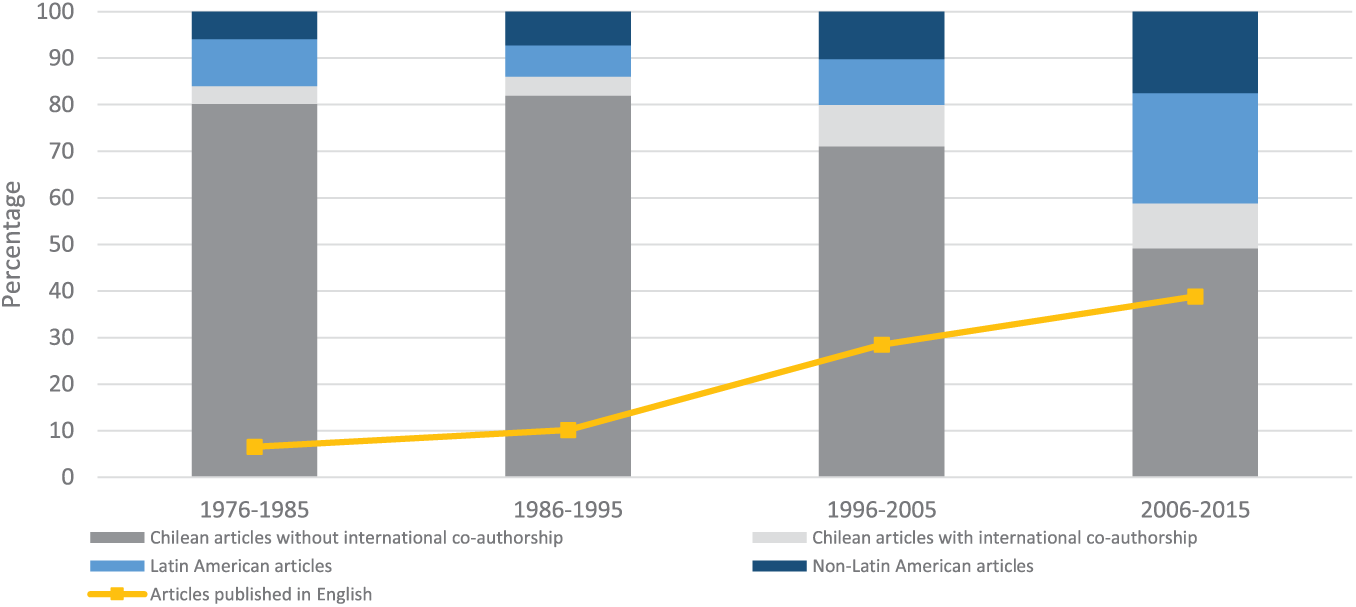
Evolution of authorship and language of publication of Chilean journals, 1976–2015.
Figure 4 displays, on the other hand, changes in authorship structures and publication languages in these Chilean journals. The proportion of Chilean papers in Chilean journals that did not involve international co-authors decreased from over 80% in 1976–1985 and 1986–1995 to around 70% in 1996–2005 and less than 50% in 2006–2015. However, the share of internationally co-authored Chilean papers only displayed a modest increase, from 4% in 1976–1985 to 10% in 2006–2015. For Chilean scholars, the Chilean journals are clearly not the venue to showcase internationally co-authored work. When they participate in international partnerships, the results of this work rather tend to appear in non-Chilean journals, as shown in Figure 3. The Chilean journals broadened their horizon in other ways. Figure 4 shows that the proportion of papers published by non-Chilean scholars increased (aggregate of top two stacks) from 16% in the period 1976–1985 to 41% in the period 2006–2015. The increasing presence of Latin American (co-)authors on the pages of the WoS-indexed Chilean journals is especially remarkable. 6 Figure 4 shows an evolution towards a Latin American ‘continentalization’ of the communication networks of the Chile-based journals.
It may be added that the citation culture in the Chilean journals has changed as well. Whereas the average share of self-citations at the journal level decreased from 53% in 1976–1985 to 10% in 2006–2015, the share of citations in papers written by non-Chilean and non-Latin American authors gradually increased. 7 This trend was not homogeneous across disciplines, however. In the period 2006–2015, more than half of the citations to Chilean journals in the natural sciences came from non-Latin American authors, but this share was only around 30% for journals in the humanities and the social sciences. These differences are connected with different editorial policies. In the natural sciences, the internationalization pressures not only led Chilean journals to opt for English as language of publication; some of them are now also published by large multinational groups (e.g. Springer). In the social sciences and humanities, however, several Chilean journals now opt to reinforce a ‘continental’ orientation: they privilege Spanish as language of publication, aim at a continental audience, address regionally relevant topics, and so on. It indicates that internationalization can indeed mean different things in different scholarly cultures and traditions.
Co-authorship cultures
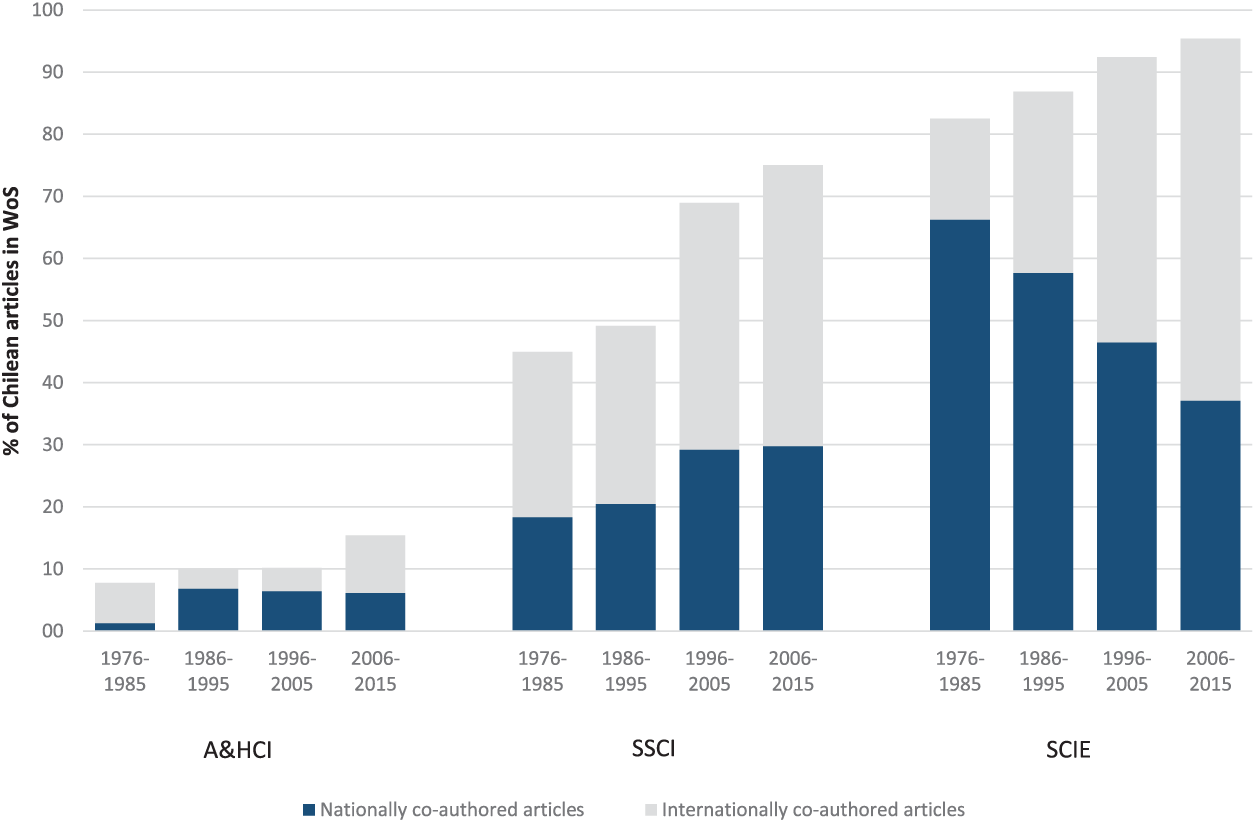
As the next step in our analysis, we look at differences in co-authorship between the scholarly cultures. Figure 5 presents co-authored Chilean articles as a percentage of the total number of Chilean articles published between 1976 and 2015, thereby distinguishing between nationally and internationally co-authored publications. Noteworthy, first, is that co-authored publications continue to constitute an exception in the humanities. Although the share of co-authored humanities papers is slowly increasing, 85% of this publication output in the period 2006–2015 is still single-authored. In this period, the share of internationally co-authored papers increased to 9%.
Evolution of co-authorship of Chilean articles in WoS index, 1976–2015.
The differences with the other scholarly cultures are considerable. The social sciences are situated in-between the natural sciences and humanities, but they have increasingly come to resemble the natural sciences. In fact, the increase of co-authored publications is most distinctive for the social sciences in the period under study. The shares of both nationally and internationally co-authored publications increase for the social sciences, but the increase is more noticeable for international cooperation. The latter share rose from 27% in 1976–1985 to 45% in 2006–2015. Following international trends, the average number of co-authors per paper grew at a steady pace from 2 in 1976–1985 to 2.2 in 1986–1995, 3.1 in 1996–2005 and 3.3 in 2006–2015 (see also Ossenblok et al., 2014).
Figure 5, finally, shows that co-authored publications are standard practice in the natural sciences. It is, moreover, remarkable that internationally co-authored publications are here gradually replacing nationally co-authored ones. The kinds of ‘big science’ practised in many of the natural sciences have increasingly come to rely on international cooperation and increasingly lead to multiple-authored and multinational publications (O’Brien, 2012). In the humanities and social sciences, by contrast, such large consortia (yet?) hardly exist. In these scholarly cultures in Chile, internationally co-authored publications are more often the outcome of occasional collaborations.
In fields of study such as astronomy, astrophysics or particle physics, around 15% of the Chilean output is now produced by large research consortia (which often attribute the authorship of papers to over 100 individuals). 8 In astronomy, for example, international missions already played an important role in nineteenth-century Chile, but the installation of large, internationally operated telescopes in Chile’s Atacama Desert at the beginning of the twenty-first century quickly led to an unprecedented expansion of international research. Not only are many foreign scholars now working in Chile, but several Chilean scientists have also become integrated in large research consortia and now contribute on a regular basis to their publication output (see Barandiaran, 2015). This case also illustrates the complex path dependency of particular internationalization trajectories.
Publication language cultures
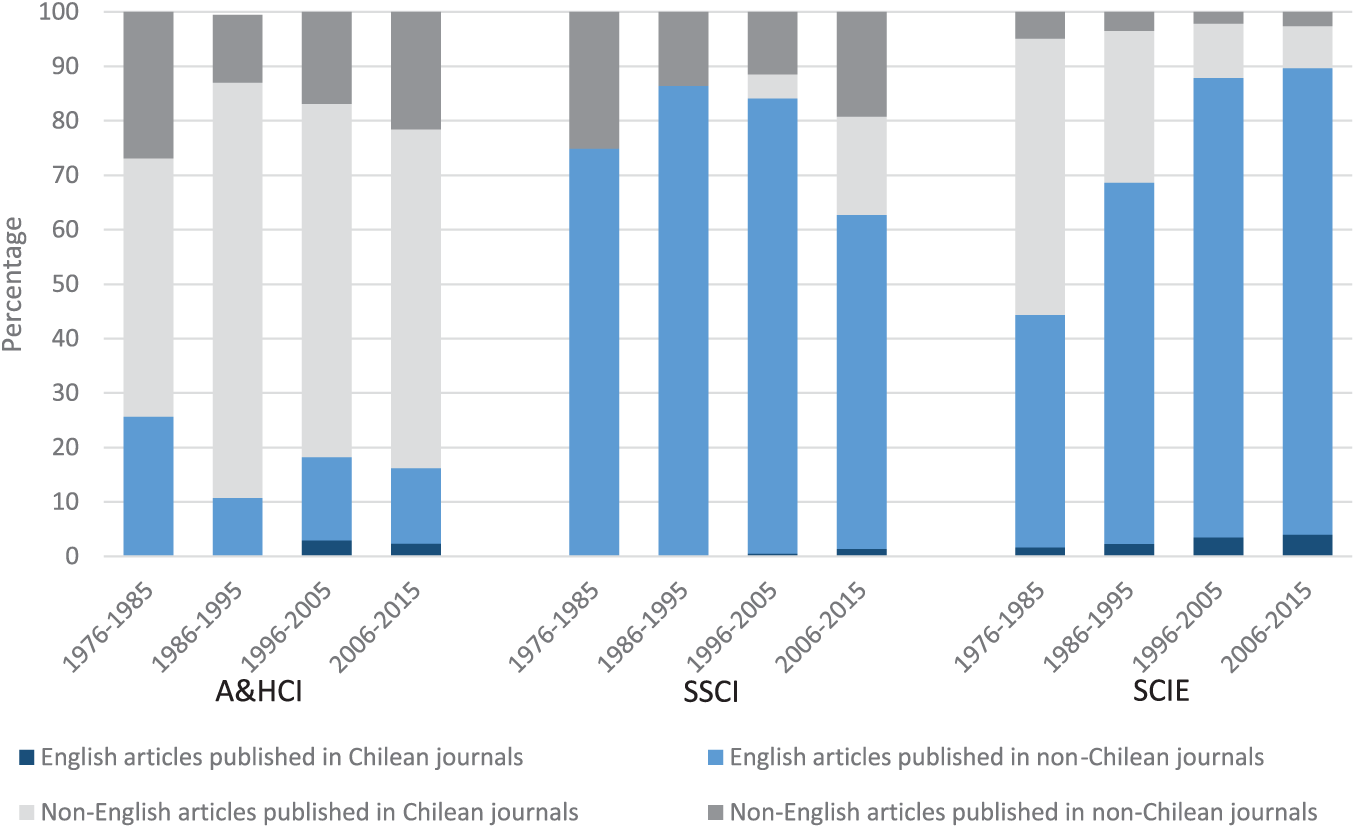
Figure 6 displays the evolution of the share of Chilean papers by language for each of the scholarly cultures. English-language articles dominate in the natural and social sciences. In the humanities, however, the share of English-language articles has remained low. In the last two time periods, about 16% of this scholarly output was in English, with some 2.4% of it published in Chilean journals. In other words, Spanish has remained the prevalent international language in the humanities in Chile. Some variation across fields of study is present, but 82% of the Chilean humanities papers published by Chilean scholars between 1976 and 2015 appeared in Spanish.
Evolution of language of Chilean articles in WoS index, 1976–2015.
For the social sciences, WoS did not include a single Chilean journal before 2000. Until that year, all WoS-indexed Chilean publications were thus published abroad. An important share was written in English: 75% in 1976–1985 and 86% in 1986–1995. The inclusion of several Chilean social-scientific journals in WoS – two journals were covered in the period 1996–2005 and 11 in the period 2006–2015 – later changed the picture. Whereas 5% of the Chilean articles appeared in Chilean journals in the period 1996–2005, this share increased to 19% in 2006–2015. About 90% of these articles were in Spanish. As WoS also extended the coverage of journals from other Latin American countries, the share of social-scientific articles written in English reduced quite substantially to 63% in 2006–2015.
For the sciences, 52% of the output during the first period (1976–1985) was published in national journals; almost all of these publications (97%) were written in Spanish. Of the papers published abroad, the majority were in English (90%). In the following decades, this pattern changed gradually. More articles were published internationally: 70% in 1986–1995 and around 88% in the last time periods. Almost all of these papers appeared in English (97%). 9
As language of publication, English has become more important in all scholarly cultures. In the natural sciences, this trend is evident in both the non-Chilean and Chilean journals. In the social sciences and humanities, however, the incorporation of national and continental (Latin American) journals in the WoS database during the last period (2006–2015) has led to an upgrading of Spanish as an international language of publication, providing support for the aforementioned continentalization of publication networks (see also Liu, 2017). Against this background, we now look again at the relation between international publications and international citations in/for Chile.
Three cultures – or one?
As we have seen, the scholarly cultures differ with regard to the international orientation of their publication output. But are there also different citation cultures? How has the internationalization of the Chilean publications affected the citation rates for each of these scholarly cultures? To shed light on changes in these relationships, we look hereafter at the evolution of the slopes of the regression lines of citations on publications for the disciplines included in each index.
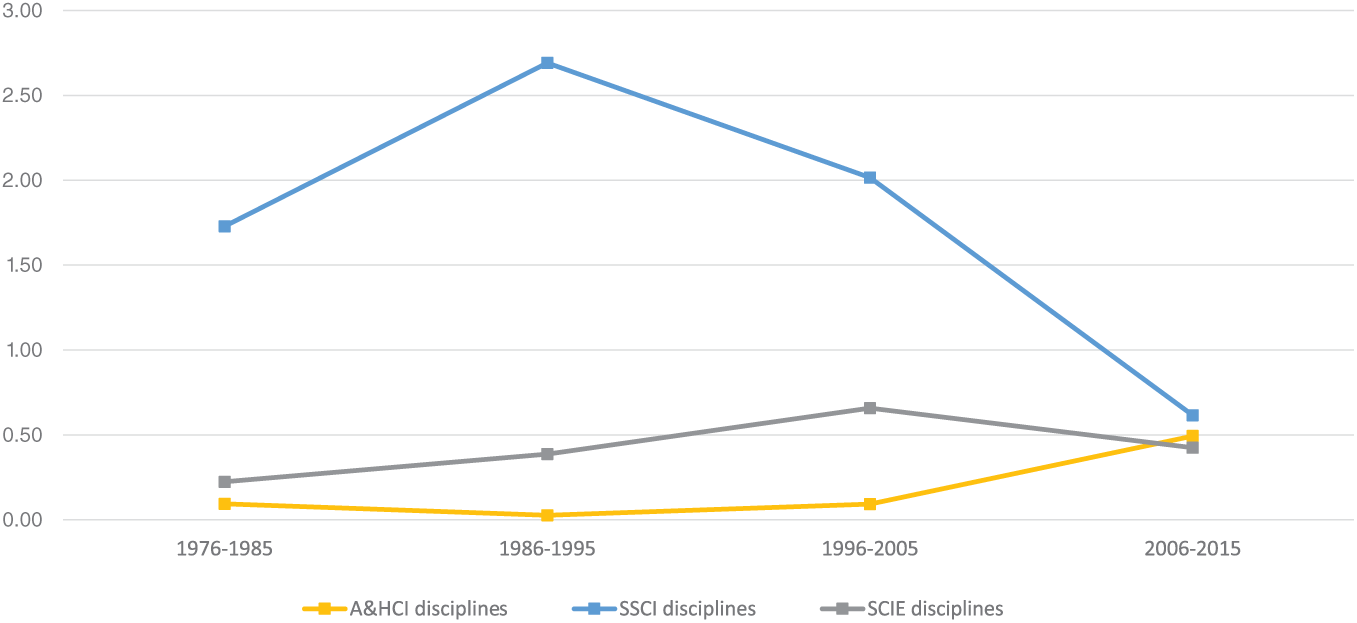
At first sight, the trends seem to differ markedly for the three cultures (see Figure 7). For the humanities, the slope has long been almost horizontal. Only in the most recent decade, has it become positive. The shift is a consequence of the relatively high number of citations to Chilean papers in the Chilean humanities journals that were included in WoS in the early twenty-first century. For the natural sciences, the evolution is quite different. The slope does increase until the period 1996–2005, but falls back in the period 2006–2015. Although WoS’s new policies also did have a significant effect on the publication output in the natural sciences, the ensuing increase in publication output was not followed by an increase in citations. For the social sciences, finally, the evolution is quite remarkable. The slope was ⩾ 1 until the period 1996–2005, which means that the change in the share of citations was higher than the change in the share of publications. Especially papers which commented on the Chilean dictatorship (1973–1989) gained much visibility. The impact of Chilean social-scientific publications diminished in more recent years, however. The increases in the Chilean publication output in the social sciences in the period 2006–2015 were not matched at the level of citations – quite to the contrary. The slope of the regression line fell well below the value of 1.
Evolution of the relation between citation and publication rates.
To understand this trend, it is useful to remember that the scientometric instruments provide a particular image of the ‘world of science’. In fact, the hierarchical rankings of journals have become a reality in their own right. The scientometric tools lead to the diffusion of their selection criteria; the ways in which journal rankings and impact factors are calculated reinforce the hegemony of the Anglo-Saxon part of the world. To build their argument, ‘international’ authors and institutions often prefer to rely on what is considered to be officially acknowledged, certified knowledge. In the recent past, academics and academic institutions in Chile (and elsewhere) have learned to define themselves in relation to western, especially Anglo-Saxon-dominated hierarchies. To give credibility to their work and to enhance their chances of success, they tend to accept and reproduce the rankings produced by the western instruments (Kurzman, 2017; López-Navarro et al., 2015). They have difficulty building upon a national orientation, while they now define themselves in relation to international, western-dominated models of science (see Heilbron, 2014; Mosbah-Natanson and Gingras, 2014).
But not just the different trajectories of the cultures attract attention. Figure 7 also shows that the slopes for the scholarly cultures converge in the period 2006–2015. For the three cultures, the slope of the regression lines is around 0.50 in this period, which means that the changes in Chilean citation shares are about half as large as the changes in the Chilean publication shares. Of course, it is difficult to foretell whether this convergence will last in the following years. But it is remarkable that different evolutions with regard to forms of international collaboration (Figure 5) and language of publication (Figure 6) do result in a point of convergence in which increases in publication output do not match those in citations. The efforts and incentives aimed at increasing the international visibility of Chilean scholarship clearly do not always bear the fruits they are supposed to bear. The structural features of the world of science, which we discussed, impose limits on Chilean scholarship.
Discussion and conclusion
The focus of this article is on the internationalization of the scientific community in Chile. Although it is wise to exercise caution in drawing more general conclusions from analyses of a single case, it is also reasonable to assume that other national scientific communities are being confronted with similar pressures and transformations. Internationalization imperatives are changing research and communication practices in a broad range of countries. Research evaluations now increasingly rely on data provided by internationally-oriented scientometric instruments. Against this background, some more general conclusions and suggestions for research policy may be presented.
First, the most used scientometric tools are characterized by particular biases. Several alternative repositories and databases have been developed to counter such biases. As mentioned before, we can now utilize several indexes that focus on work published in the semi-periphery of the world of science. But WoS itself has recently also extended its coverage of the scholarly literature in different parts of the world and different fields of study; the unprecedented large growth of the number of indexed journals from Latin America, for example, certainly also serves to counter the new, competing initiatives. It is difficult to predict to which editorial decisions the commercial interests of WoS might lead in the future. As we have seen, however, WoS’s decisions to include or not to include particular journals can have important consequences. Especially for the humanities and social sciences, the changes in the coverage of Latin American journals are also changing the ways in which international research is defined or appears on the monitors of science administrators and scholars. These changes not only make it difficult for scholars to know what does or does not count as international research, but they should also stimulate us to critically look into the selection and evaluation mechanisms at work. Of course the question also is why policy-makers aim at controlling and internationalizing their national research communities on the basis of such disputed indexes.
Second, we have seen that the editorial practices and policies of many journals have changed as a consequence of internationalization pressures. But the reactions to these pressures may diverge; the divergences between the three scholarly cultures are remarkable. While several Chilean periodicals have opted for a global orientation with English as their language of publication, other periodicals now display a regional or continental orientation. Especially in the humanities and social sciences, a continental orientation now gradually seems to be taking root (see also Heilbron et al., 2017). In Chile and other parts of Latin America, this development is connected with the rise and reinforcement of an international Spanish-speaking scientific community. As our analyses show, it gives way to more collaboration within a relatively large community of scholars, for whom Spanish is their native language. We believe that there are grounds to advocate for more regional diversity within the world of science. Especially in the humanities and social sciences, research might benefit from such diversity. Intimate knowledge of local circumstances often is important for this type of research, but the large diversity of relevant empirical configurations also makes findings from one context possibly irrelevant in another. In this light, we believe that different linguistic communities can still play an important role.
Against this background, a third comment can be made. Internationalization pressures, journal rankings and impact factors support a ‘citation consciousness’ that reproduces centre–periphery differences. The selection and evaluation mechanisms embedded in WoS (and related instruments) are both institutionalized and interiorized. 10 In this regard, many scholars and journals now ‘play it safe’. As a consequence, regional scholarship can become alienated from its own traditions (Ollion and Abbott, 2016). In several fields of study, however, countries of the (semi-)periphery have been able to establish relatively strong scholarship traditions. Important innovations or challenges to dominant paradigms or research programmes have emerged in several (semi- )peripheral countries. We do not oppose internationalization, but we advocate for the recognition and protection of different forms of national and continental diversity. Such diversity may indeed not only be beneficial for scholars in the (semi-)periphery, but also prove an asset to the world of science.
Scholarship has long been shaped by specific national contexts. Next to academic systems (with their universities, research institutions, departments and so on), scholarly associations and publication venues have in the nineteenth and twentieth century often been organized along national lines, too. The recent focus on internationalization has not just broadened the horizon of national scholarly communities, but also altered the everyday world of most scholars. Internationalization pressures have often been translated into output requirements; internationalization has become measured in terms of publications and citations in indexed journals, especially in WoS-indexed journals. As our analyses show, the new incentive structures reinforce WoS’s evaluation criteria. The scientometric indexes reduce the visibility of work from the (semi- )periphery and reinforce the hegemonic position of the Anglo-Saxon centre. At the same time, however, the changes we observed in a period of 40 years (1976–2015) do not point to a straightforward process of internationalization of the national scientific communities in Chile. For the social sciences and humanities, in particular, a Latin American ‘continentalization’ of publication networks can also be observed. In part, this ‘continentalization’ gains impetus from the inclusion of regionally-oriented journals in WoS. In the near future, this evolution might further the international visibility and impact of scientific work conducted in the (semi-)periphery. However, the recognition and protection of scientific diversity will require full support from policy-makers and administrators in the centre and the periphery.
Footnotes
Acknowledgements
We would like to thank Ricardo Ayala for his valuable comments on the manuscript.
Funding
This research received funding from CONICYT PFCHA/DOCTORADO BECAS CHILE/2015 – 72160036.
