







Abstract
A growing concern worldwide is whether or not urban sustainability policies promote social equity. In Western countries, sustainability policies are at the forefront of an emerging regime of urban governance. While some researchers have shown how such policies support, counter or ride along with predominant neoliberal trends, others suggest that they may form a beacon for progressive politics. However, these studies do not investigate whether the political economy of urban sustainability policies promotes equity on a national scale. The present article addresses this gap by investigating ‘sustainable city’ discourses in 11 Canadian municipalities. Contrary to recurring hopes, these policies do not fully embrace a return to social equity. Instead, they overwhelmingly privilege a form of ‘environmental neoliberalism’ by focusing on a creative, educated and professionalized urban community. The article examines how these policy discourses conceive social equity around the themes of economic growth, housing, income and democratic participation. Today’s urban compromise leaves little room for social equity.
Introduction
Whether urban climate governance enhances social equity is a growing concern worldwide. In Canada, as in many industrialized countries, cities have developed a governance network with a focus on a sustainability agenda. These developments raise growing concerns for the social equity of climate mitigation and adaptation policies (Satterthwaite, 2016). While urban sustainability policies officially aim to ensure an equitable distribution of environmental and social resources, they are often instrumental in deepening pre-existing injustices (Swyngedouw, 2010). Existing research frequently portrays policy adaptations as tacitly approving, supporting, or even countering neoliberal development in Western countries (Brenner et al., 2010). Despite leaving a range of class, gender and ethnic inequalities intact, these policies can be part of a movement against market deregulation and for a greater social redistribution of resources (Warner and Clifton, 2014). Yet, Nancy Fraser (2013) cautions against indulging in such hopes. She argues that a ‘triple movement’ consisting of ‘proponents of marketization, adherents of social protection, and partisans of emancipation’ (Fraser, 2013: 129) leads to uncertain outcomes. In the face of competing claims, do policy discourses actually favour social equity?
I argue that Canadian sustainable city policy discourses privilege a form of environmental neoliberalism aimed at protecting a professionalized social class while sidelining precarious and marginalized groups. In spite of embodying a ‘triple movement’ (Fraser, 2013), the political economic imperatives behind these sustainability policies tend to downplay or subordinate their equity dimensions (Jessop, 2010; Wachsmuth et al., 2016). In this article, I examine them within their national context and against the background of global political-economic processes. Sustainability policies typically fall within multilevel regimes of governance involving international, national, corporate, municipal and community actors (Bulkeley and Betsill, 2013). This larger analysis is undertaken while recognizing the importance of local agency (Jessop, 2010; Peck and Theodore, 2015). By investigating the Canadian setting, my aim is to contribute to the political economy and interdisciplinary research on the nationwide implications of such policies for social equity.
First, I examine the factors that affect social equity in policy implementation and outline their main outcomes. Here I discuss how urban policy emerges through multilevel governance both as an instrument of neoliberal environmentalism (Bulkeley and Betsill, 2013; Jessop, 2012) and as a nexus for emancipatory politics (Warner and Clifton, 2014). Second, I use a sample of 11 Canadian metropolitan areas’ policies with a focus on how they frame social equity. Nancy Fraser’s (2014) notion of a ‘triple movement’ provides a theoretical template to assess social equity provisions in discourses about economic growth, housing, income and civic participation. As it turns out, this equity regulation is not as progressive as many would hope it to be.
Environmental neoliberalism, urban governance and social equity
In this section I illustrate the positionality of municipal policy discourses within multilevel governance in Canada. I then depict the limitations that impact urban policy-making and the grounds for a return of social protections.
While urban sustainability often appears as a means to pursue neoliberal imperatives under an aura of green acceptability, using neoliberalism as an analytical vantage point can mask critical policy features (Centeno and Cohen, 2012; Dean, 2014). In Canada, neoliberalism began through the Conservative Government of Mulroney (1984–1993) with cutbacks in the public sector, attacks on labour unions and the internationalization and deregulation of the market (McKendry, 2018: 41). In the conventional rationale, neoliberalism is a historically specific state-sponsored extension of market rule in social life (Brenner et al., 2010: 329; Peck, 2012: 629). Many emphasize its dissemination as an unequal, partial and unfolding process, one that is hybrid as it adds to pre-existing regulatory mechanisms (Brenner et al., 2010: 330–332; Jessop, 2014: 352). Yet, the neoliberal is often as omnipresent as it is elusive (Venugopal, 2015). Additionally, what we tend to think through the lens of neoliberalization hosts a range of other decisive processes (Storper, 2016). In sum, although sustainability policies are generally a reaction to the failures of neoliberalization and often convey some neoliberal measures themselves, it is inaccurate to suggest that they have one converging effect on local contexts (North et al., 2017; Peck and Theodore, 2015: 237). Research should rather begin by investigating the variegated local use of policies (Peck and Theodore, 2015).
In this, what is clear is that cities convey a form of governance through the mobilization of a sustainability agenda (Guyadeen et al., 2019; Holden and Larsen, 2015). A now widespread policy umbrella, sustainability emerges with the 1987 World Commission on Environment and Development Brundtland Report and becomes a local policy agenda with the 1992 Rio Earth Summit. Governance implicates a multilevel ensemble of partly conflicting actors such as social justice and grassroots organizations, municipal, provincial and national governments, NGOs, corporations, and so forth (Bulkeley, 2013: 71–75). They perpetuate the act of ‘governing’ within and beyond the state apparatus, and across different scales (local, regional, national and international) (Doern et al., 2015; McKendry, 2016).
A municipal sustainability governance appears gradually in Canada. The 1990s are under the sign of municipal voluntarism, with initiatives such as the Winnipeg and Vancouver-based Urban Development Agreement designed to bridge the gap between governments, businesses and communities in a problem-solving perspective. A network for climate governance materializes with an International Council for Local Environmental Initiatives (ICLEI) pilot programme (1993) then leading to the Cities for Climate Protection campaign (CCP): a network of cities committed to reduce greenhouse gas emissions and respond to climate change (Duxbury and Jeannotte, 2012; Gordon, 2016). In 1998, the CCP and the Federation of Canadian Municipalities (FCM) create the Partners for Climate Protection (PCP). This new network reunites cities, the Federal Government and ICLEI Canada. The 2000s are under the sign of a coordinated municipal political stance for sustainability (Bulkeley and Betsill, 2013: 140). From 2006 onwards, many cities adopt the federal government’s four pillars model for urban sustainability: the Integrated Community Sustainability Plans (ICSP). These four pillars include economic health, social equity, cultural vitality and environmental responsibility (Duxbury and Jeannotte, 2012). The ensuing urban governance mobilizes city operations management, infrastructure, service systems as well as the monitoring of civic and corporate initiatives (Bulkeley, 2013: 92; McKendry, 2018: 4).
In spite of unprecedented implications for urban settlements, sustainability policies retain social equity as a marginal objective (Agyeman and Evans, 2014: 157; Reckien et al., 2017; Wachsmuth et al., 2016). Social equity refers to the distributive consequences (i.e. benefits, privileges, burdens and costs) of policy developments, the fairness of policies and institutions, and their interaction with pre-existing social contexts (Reckien et al., 2017: 160–161). This equity follows the definition proposed by the Brundtland Report: to respond to the needs of the population equitably while perpetuating a sustainable relation with the environment for generations to come (Dempsey et al., 2011: 292; Vojnovic, 2014: 33–35, 39). Concretely, however, sustainability appears to favour the greening of situated urban districts, to dispense with local community advocacy and to dismiss a globalized economy that is nothing but sustainable (Wachsmuth et al., 2016). The end result is often a gentrification equating sustainability with greater density, walkability and green technology (Leffers, 2015; Quastel, 2009). In an increasingly urbanized world, these trends invite scrutiny of the social equity of the now widespread urban sustainability agenda. Out of Canada’s 35 million residents, 60% live in metropolitan areas (agglomerations of at least 100,000 inhabitants).
In Canada, social equity falls under an uneven municipal regime of sustainability governance (Duxbury and Jeannotte, 2012). However, little research assesses this variegated nationwide regime of governance (Gordon, 2016). This may be in part due to the influence of the 1990s and early 2000s ‘new localist’ perspective that advocated a focus on sustainability in specific localities (Bulkeley and Betsill, 2013). Gordon (2016) shows how out of the PCP group that comprised 247 cities in April 2014, 80 member cities developed climate initiatives and only 16 consistently reported their activities. The PCP involves more than 350 municipalities today but maintains such disparities, notably in terms of social equity. To analyse sustainability endeavours in prevailing political economic forces may contribute to a comprehension of local cases within broader processes (Bulkeley and Betsill, 2013: 137).
Soaring living costs are also to blame for sustainability’s limited social equity. Canada witnesses rising income inequality and greater spatial economic segregation in urban areas throughout the 1980–2005 period (Chen et al., 2012). This trend endures after the 2008 financial crisis. Despite a historically low poverty rate nationwide, urban poverty persists coupled with precarious and part-time work (Zuberi and Taylor, 2018: 98–105). The housing crisis of the 1990s and 2000s and federal cuts in welfare programmes reinforce this trend (Hyde, 2018). Moreover, after the termination of the national housing programme in 1993, the responsibility of affordable housing was overwhelmingly discharged on municipalities. Unfortunately, they are particularly ill-suited for such responsibilities within the Canadian legal system (Mah and Hackworth, 2011). Not only do they possess limited financial means relying on property taxes but they also necessitate provincial approval to adopt policies (Levi and Valverde, 2006). In this conundrum, cities tend to favour zoning concessions to developers in exchange for affordable housing units or ‘inclusive housing’ mandates requiring a percentage of affordable units in new residential developments (Mah and Hackworth, 2011).
Ultimately, city sustainability embodies a Janus-faced compromise to secure economic growth and facilitate an inclusive urban setting. Urban development plans endorse a spectrum of positions from a neoliberal environmentalism that claims to protect the environment using market-based mechanisms to a progressive liberal environmentalism that supports economic growth and state intervention in market affairs (McKendry, 2018: 17–18, 88–89). In today’s post-political condition where the political is reduced to managerial and administrative tasks, where democratic decision-making is taken over by expert knowledge, municipal incentives for democratic participation can remain little more than a disguise for market-oriented consensus-making (Swyngedouw, 2010: 225). After all, sustainability policies are part of a largely rhetorical Green New Deal, a post-neoliberal solution to the 2008 economic crisis, its aftermath and climate change (Jessop, 2012). Highly flexible, transportable and adaptable to local contexts, they serve as ‘policies that work’ for today’s ‘fast policy’ regime of ongoing benchmarking and experimentation (Leffers, 2015: 331; Lombardi et al., 2011: 274; Peck and Theodore, 2015: 3–4). Simultaneously, urban climate politics also forms a regime of contestation, debate and struggle (Bulkeley, 2013: 72; Bulkeley and Betsill, 2013: 149). In certain cases, a governing coalition can even transform pre-existent municipal practices and the broader socioeconomic context of a city (Ravazzi and Belligni, 2016: 324).
In the face of the austerity-driven marketization of urban services, many question whether or not cities’ policy response could be part of a historical movement for greater social protections (Warner and Clifton, 2014). In the political and economic crisis of the 1930s, Polanyi (1944) deciphers a ‘double movement’ where a cross-class coalition for social protection would ultimately subdue soaring market deregulation and its socially destructive consequences. In the process, these advocates of social protection will re-embed free market tendencies into social regulations. Today’s crisis, however, does not follow the same fault line between the proponents of economic deregulation and those of social protection (Fraser, 2013). We rather witness a struggle between three sets of actors, namely those who promote marketization (commercial and financial actors promoting an expansion of commodification and market deregulation), social protection (mainly civic and national interests privileging access to education, healthcare, welfare, social services, fiscal regulations and other redistributive mechanisms) and emancipation (such as anti-imperialist, anti-racist, feminist and anti-war movements striving for recognition rather than redistribution) (Fraser, 2013). These actors privilege three distinct scenarios of market and, as I will emphasize here, equity regulation (Warner and Clifton, 2014: 46). ‘Hollowing out’ endorses marketization and privatization strategies to ensure that market institutions gain greater leverage on cities, ‘riding the wave’ involves cities fighting back to revitalize progressive measures and become actors of market regulation, and ‘push back’ implicates citizens’ movements against marketization.
Amidst the converging pressures of neoliberalization, urban governance and mounting housing and income inequality, cities’ policy compromise translates into forms of liberal environmentalism (McKendry, 2018). Against this background, I analyse how urban sustainability policy discourses envision social equity.
Methods
The social equity of sustainability policies generally refers to socioeconomic disparities, environmental vulnerabilities, the injustices of urban institutions and the risk-proneness of urban developments (Reckien et al., 2017: 163; Vojnovic, 2014). This created an opportunity to explore how policy discourses situate social equity within political-economic developments.
My methodology aimed to seize the broad trends of policy discourses following Warner and Clifton’s (2014) neo-Polanyian scenarios. For this, I drew and expanded on cultural political economy research highlighting the cultural bases of political-economic processes (Jessop, 2010). Indeed, each of the previous scenarios conveyed an economic imaginary: a ‘semiotic system that gives meaning and shape to the “economic” field’ (Jessop, 2010: 344). Elements of such economic imaginaries bear normative implications as they are instrumental in producing a city’s governance, plans, organizations, debates and future actions (Jessop and Sum, 2016). I selected a maximum variation sample of the most recent sustainability policies from 11 of Canada’s 33 metropolitan areas (one policy per metropolis) on the basis of their geographical representativeness, their demographic and their political importance 1 (List, 2004). With this strategy I endorsed the view that an emblematic array of cases can tell us more than a larger statistically significant sample.
The sample comprised policies that explicitly targeted sustainability. I chose cities from the provinces of Alberta (city of Calgary), British Columbia (Vancouver and Victoria), Manitoba (Winnipeg), New Brunswick (Moncton), Nova Scotia (Halifax), Ontario (Ottawa and Toronto), Quebec (Montreal and Sherbrooke) and Saskatchewan (Saskatoon). Half of them were capitals, either of their province (Calgary, Halifax, Toronto, Victoria, Winnipeg) or of the country (Ottawa). The other half comprised some of the most populous cities of each province (Montreal, Moncton, Saskatoon, Sherbrooke, Vancouver). I did not include metropolitan areas from the provinces of Newfoundland (Saint-John’s) and Prince-Edward Island (which has no metropolitan area), but retained Halifax and Moncton as representatives of the four Atlantic provinces. This strategy facilitated a nationwide perspective on urban policy discourses. Furthermore, it provided valuable insights into the sustainability discourses and contexts of an OECD country (McKendry, 2018).
This sampling and methodology had potential limitations. Not all cities displayed their sustainability projects through the same palette of policies. For some, one policy document integrated all key endeavours. For others, sustainability views were more dispersed. This was arguably the case for Saskatoon and Calgary where, to protect the consistency of the sample, I also consulted Saskatoon’s Performance Dashboard (Saskatoon, 2019) and Calgary’s Municipal Development Plan (2017). Additionally, since policies do not work in isolation from one another, some might object that I should have encompassed a broader range of policy types. While this points to a highly desirable avenue for future research, the present sample was appropriate to capture sustainability policy-making at the city level. Finally, others may rightly caution against inferring any general outcome from policy discourses alone. Indeed, not only do economic imaginaries coexist in multiple configurations throughout policy texts, but they also relate to varied outcomes. In some cases, hollowing out schemes have increased the standard of living, even if in many other cases they have mostly amplified inequalities (Fraser, 2013: 129). Thus, despite my efforts to trace, albeit in broad strokes, the path-dependency between social contexts and policy discourses (Jessop, 2010: 340), I tailored the contribution of this article to how policies envision social equity. On this front, additional research may enable us to understand the precise impact of municipal policies on social equity outcomes across different locations.
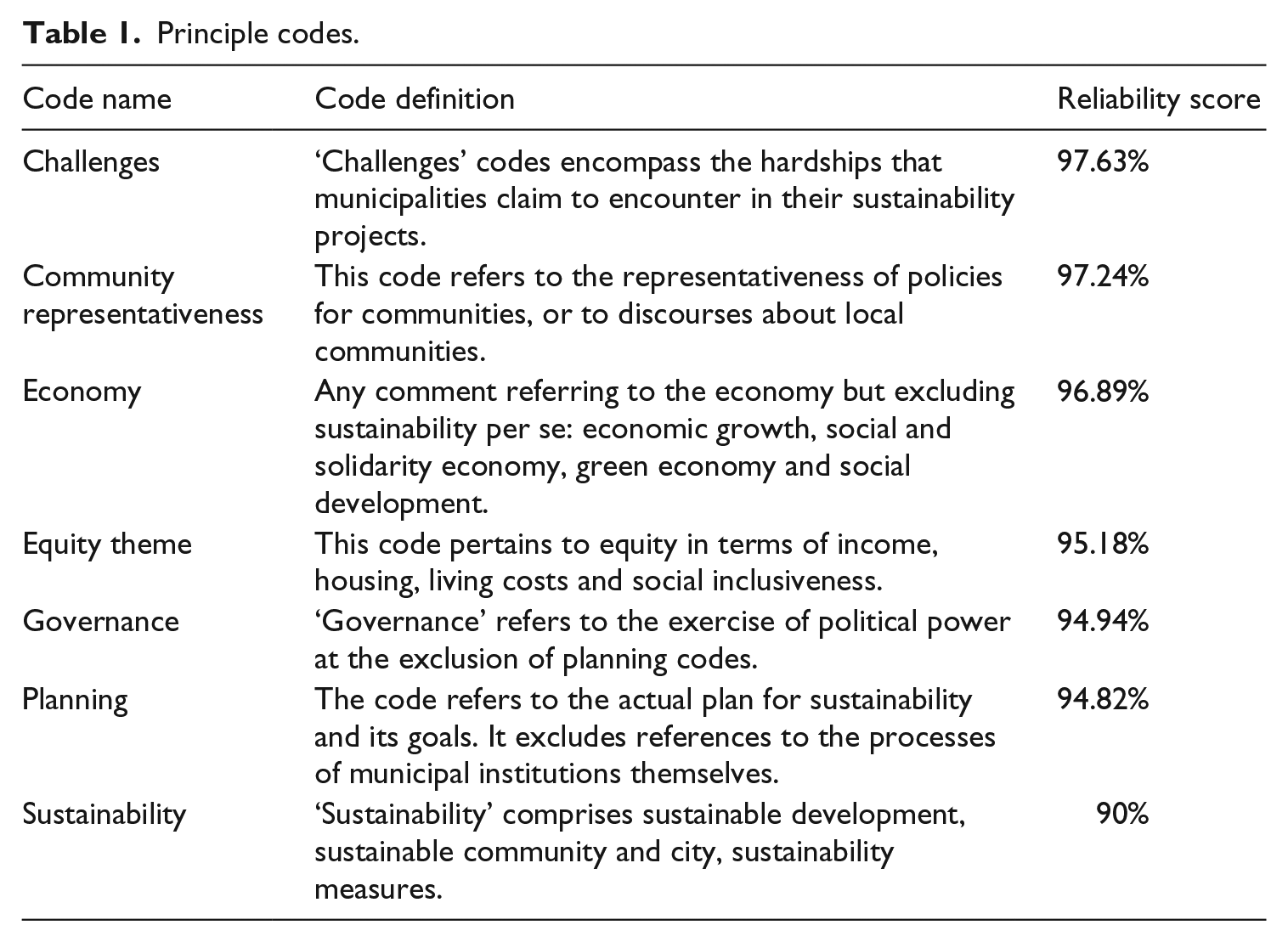
Firstly, my goal was to code an array of key policy themes. I adopted Ghaziani’s (2014) retroductive method to generate codes inductively and deductively. In the first round of coding, I began inductively by coding line by line these 11 policies through NVivo and identified 70 codes. I then divided these codes into seven recurring themes: challenges, community representativeness, economy, equity, governance, planning and sustainability (for elaboration see Table 1). In a second round of coding I used relevant deductive codes stemming from the urban political economy literature (sustainability, social equity, housing, income and economic growth). Though they are not as commonly mobilized in qualitative research as they are in quantitative research, reliability tests are essential to safeguard the accuracy of the coding procedure (Campbell et al., 2013). I therefore employed the proportional agreement test (percentage of agreement between the author and an independent coder) to evaluate inter-coder reliability. An independent coder used my codebook to code the standard recommended 10% of the selected documents (Hodson, 1999). Results indicated a high level of reliability with scores above the 90% threshold (see Table 1).
Principle codes.
Secondly, I regrouped these codes into broader themes. For (i) social equity, my sub-themes were environmental issues (access to water, clean air, sustainable energy, healthy food, etc.), affordability, inclusiveness, income and housing. In terms of (ii) sustainability, my sub-themes were the views about sustainable cities, development and community. Lastly, I documented discourses about (iii) the economy, with sub-themes such as economic growth, green economy and social economy. Furthermore, given the varying performativity of policy discourses, I distinguished between discourses about the sustainability plan (e.g. broad vision, dimensions of sustainability, challenges, stakeholders), about policy goals (e.g. improved access to clean water) and about monitored objectives (e.g. reaching 2000 additional green jobs in urban farms by 2021). This categorization allowed me to evaluate the breadth of policy commitments.
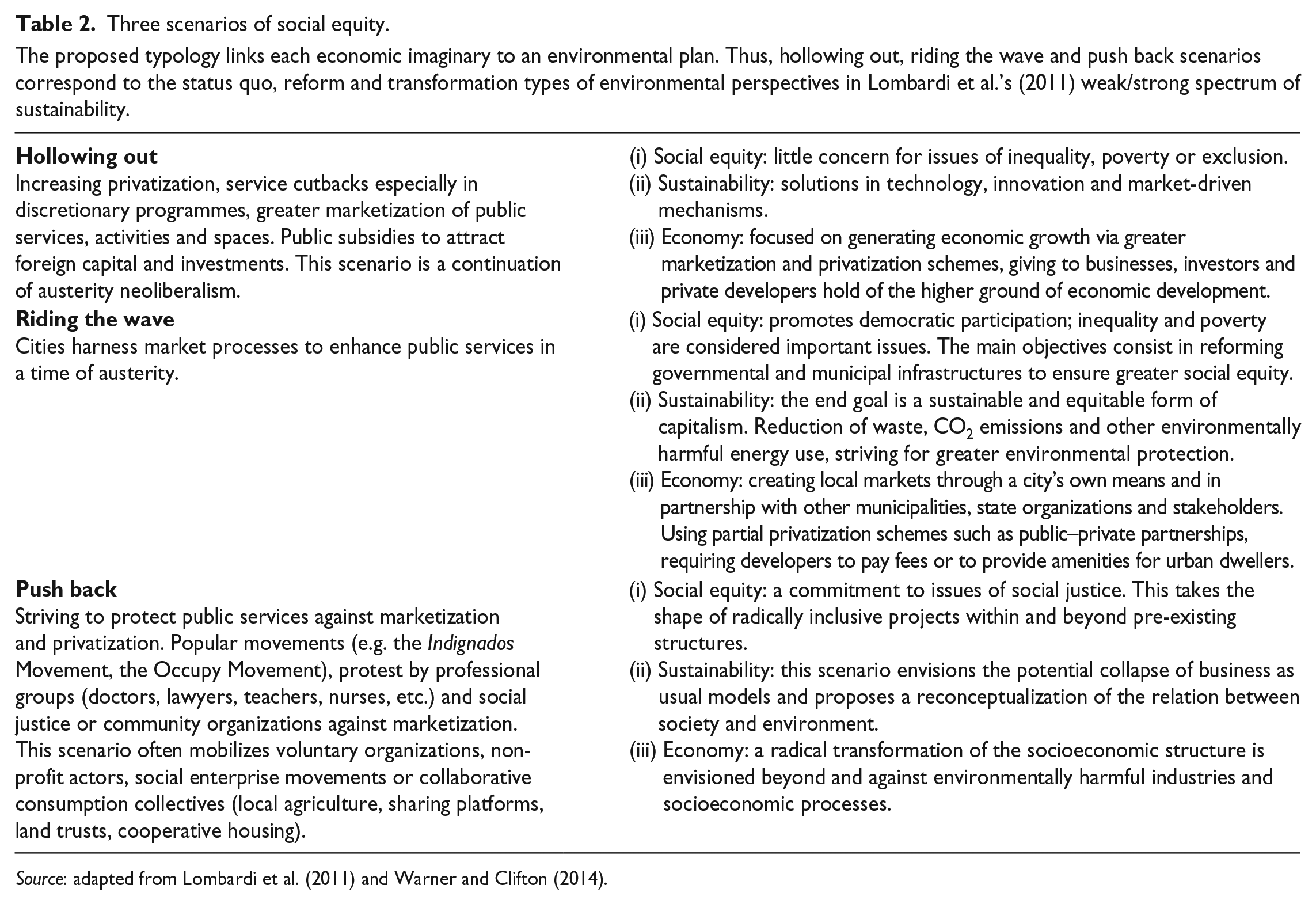
Thirdly, I adapted Warner and Clifton’s (2014) neo-Polanyian typology to policy material and analysed the previous codes and patterns. To ensure a relevant synthesis of political economic and urban planning elements, I controlled the validity of the revised typology against the background of Brenner et al.’s (2010: 340) types of counter-neoliberalization and of Lombardi et al.’s (2011: 277) weak/strong sustainability continuum. Hence, the hollowing out scenario referred to a city that increases ‘the marketization of citizenship’, privileging a conception of citizens as consumers (Warner and Clifton, 2014: 50). Riding the wave concerned city initiatives for a greater role in the management of urban markets to preserve public services (Warner and Clifton, 2014: 50). Finally, the push back scenario referred to counter-movements that challenge the marketization and privatization of public services. (See Table 2 for elaboration.)
Three scenarios of social equity.
The proposed typology links each economic imaginary to an environmental plan. Thus, hollowing out, riding the wave and push back scenarios correspond to the status quo, reform and transformation types of environmental perspectives in Lombardi et al.’s (2011) weak/strong spectrum of sustainability.
Source: adapted from Lombardi et al. (2011) and Warner and Clifton (2014).
Though I readily acknowledge that a range of policy aspects fell beyond the scope of this article, this methodology allowed me to assess the return of social protections in the multifaceted landscape of urban sustainability nationwide. To find answers I emphasized the dominant discourses about social equity across policies.
Sustainability for environmental neoliberalism?
Municipal efforts to instigate social protections mobilize a mixture of riding the wave and hollowing out scenarios (Warner and Clifton, 2014). My findings show that urban sustainability policies privilege economic growth for creative, educated and employable communities. Simultaneously, and in spite of uneven commitments across cities, Canadian municipally-based governance arguably challenges typical neoliberalization with public hearings, consultations and collaborations with community stakeholders, neighbourhood, social justice and grassroots organizations, enabling of community initiatives and lobbying at other government levels. Lastly, policy discourses suggest a governance based on green economic growth that is distinct from what we traditionally associate with neoliberalism (McKendry, 2018). Here, I debate dominant policy views across four key social equity themes: economic growth, housing equity, labour and civic participation. I scrutinize these topics because, as discussed earlier, they are central to how policies position their own conception of social equity within multilevel governance and the predominant inequalities of present-day neoliberalism.
Growth in complete communities
In their views on economic growth cities overwhelmingly follow the hollowing out and riding the wave scenarios. Along this line, policies convey a sustainable development through ‘complete communities’, a planning ideal where all residents would equally fulfil their basic needs via an integrated planning of land use, local transportation and community design. Cities and businesses are envisioned as leaders for a ‘green’ economy; one that reduces its environmental footprint and adapts to climate change. Cities tend to ‘green’ their operations, public facilities and services, and to incentivize residents and businesses along those lines. Attempts to push back occur mainly by facilitating initiatives for the local economy and with lobbying efforts towards the provincial or federal governments.
To fashion this uneven compromise, policies equate dissenting economic imaginaries: the neoliberal imaginary with the marketization of city spaces, institutions and practices, and the push back imaginary with its circular self-sustaining local economy. On closer inspection, however, the driving forces in this collage of economic visions are market-driven solutions and businesses. Montreal aims to ‘support the development of a social and solidarity economy, in particular by increasing the organization’s use of services and products from these types of businesses’ (Montréal, 2016: 22). Likewise, ‘a strong economy is an important component of a sustainable community’ (Moncton, 2011: 9) where access to employment and education supports ‘wealth creation, innovation, entrepreneurship and individual economic well-being’ (2011: 9), or again: ‘To be a competitive city, Winnipeg has been doing its part to foster inclusion and equity, support diversity and engage newcomers to our city’ (Winnipeg, 2011: 12). As it turns out, the goal of greater equity is subordinate to that of securing economic growth.
Policy discourses emphatically promote a ‘greening’ of the economy as a whole. Urban communities would thus become smart, knowledge-based and innovative, attract investments, promote a healthy quality of life and provide a range of green practices. Besides new municipal infrastructures and advocacy for walkability, cycling, waste and energy reduction or healthy food, this ‘greening’ occurs mainly through partnerships with businesses or sustainable entrepreneurship programmes. For instance, Vancouver yearns to become the Mecca of green enterprises. With its Green and Digital Demonstration Program (GDDP) the city aims to ‘accelerate the pace of innovation, commercialization and job growth in Vancouver’s clean technology and digital sector’ (Vancouver, 2015: 9). To do so, the city grants entrepreneurs access to municipal roads and buildings so they can test their innovations (Vancouver, 2015: 9). Others follow similar innovation-led strategies (Montréal, 2016: 24; Toronto, 2017: 99–100). In many cases, they stress how climate change adaptation provides unexpected commercial opportunities in industry, insurance, energy, transportation, building retrofits, emergency situations as well as tourism (Sherbrooke, 2013: 58, 86; Toronto, 2017: 94). The goal of an equitable circular economy – that limits waste and maximizes reuse and recycling (Stahel, 2016) – appears as an auxiliary objective (Halifax, 2014: 69; Moncton, 2011: 11).
Still, cities instigate numerous push back measures at the margin of predominant economic strategies. It is the case of Vancouver’s sharing economy that aims to diminish social isolation while simultaneously reducing waste and consumption: ‘social lending, peer-to-peer accommodation, and car sharing are just some examples of how technology has pushed the sharing economy to a new level’ (Vancouver, 2015: 34). Yet, social lending remains a ‘technological innovation’ well in line with the policy’s liberal perspective rather than with a degrowth worldview. Amidst limited mentions of equity issues, city policies support a greening of economic growth and of its coextensive inequalities.
Housing equity in the perfect storm
In terms of housing, cities develop social equity through affordable and social housing schemes, complete communities, accessible urban mobility and dense mixed neighbourhoods (comprising a diversity of dwelling types and income levels) (Calgary, 2005: 25–26; Moncton, 2011: 18, 27). Furthermore, they use provincial programmes when possible, inclusive housing projects and zoning concessions to developers (such as allowing for greater density) in exchange for affordable units or community benefits (Halifax, 2014: 8; Montréal, 2016: 28; Toronto, 2017: 37–38).
Overall, municipal measures convey a negligible impact on the very causes of housing unaffordability. This is particularly striking in major cities. 2 Predominant policy discourses evoke how housing and poverty issues fall beyond a city’s powers (Halifax, 2014: 57–58; Victoria, 2012: 99; Winnipeg, 2011: 3). That said, the landscape of housing affordability varies immensely across the country. Toronto and Vancouver are in an affordability crisis of their own, though Calgary, Ottawa and Victoria are also climbing the podium (CMHC, 2019; Walks, 2014). In the meantime, Montreal makes headlines on its rapidly mounting housing costs. Especially in major cities, the strategy to equate greater density with sustainability tends to produce housing affordability via condo developments which subsequently exclude the poor (Hyde, 2018; Quastel et al., 2012). Housing affordability is not as much an equity challenge in areas such as Halifax, Moncton, Saskatoon, Sherbrooke or Winnipeg (Kneebone and Wilkins, 2016).
In this differentiated context, policies devise livability for a diversity of inhabitants via affordability targets, land management, building by-laws and taxation schemes (Saskatoon, 2013: 27; Sherbrooke, 2013: 14; Winnipeg, 2011: 14). For instance, Moncton plans a 15% increase in its affordable housing units and a 15% reduction of its social housing wait list by 2015 (Moncton, 2011: 24). The needs are dire, however, with ‘999 affordable units in 2009’ but still ‘640 people on [the] Provincial wait list’ (Moncton, 2011: 54). Calgary plans to create 600–800 affordable housing units for 2020 (2005: 20), while Victoria (2012: 26) hopes to provide a diverse housing offer: ‘Accommodating and fostering a greater range of housing options throughout the Downtown Core Area, including non-market housing’ (Victoria, 2012: 47). Building by-laws, for their part, are essential for a transition to energy efficient buildings and may alleviate energy costs for the poorer households (Montréal, 2016: 20–21; Toronto, 2017: 102–103; Vancouver, 2015: 17–18). Finally, taxes aiming to regulate the marketization of housing include for instance Vancouver’s empty home tax (The Canadian Press, 2019) or Montreal’s regulation of Airbnb rentals using the same provincial tax umbrella as that of the hotel industry (Curtis, 2019).
The challenge of ensuring an equitable livelihood is certainly a recurrent theme. Ottawa wants to ‘improve the quality of life for all income groups, by committing to poverty reduction and to helping people achieve greater self-sufficiency’ (2012: 22) in complete communities, while Saskatoon wishes to secure ‘leisure and civic activities for all, a range of housing options, employment opportunities, art, culture and recreational facilities and other amenities’ (Saskatoon, 2013: 27). Many advocate an efficient mix of affordable, quality housing and acknowledge housing equity issues (Moncton, 2011: 24). In Ottawa, a quarter of all households pay 30% or more of their income on housing. Furthermore, energy costs will likely spike given the cumulative impacts of climate change (Ottawa, 2012: 22, 36). Others claim to ‘fight inequality and promote inclusiveness’ by targeting the population of seniors and vulnerable individuals (Montréal, 2016: 11, 23, 32). However, variations on this theme do not translate into robust measures to restrict the marketization of housing.
Despite numerous municipal efforts, policy discourses on housing exhibit a compromise geared to satisfy the more well-off. That said, their outcomes are considerably diverse, notably between major cities and provincial or regional centres.
Greening labour
To protect their job sector, cities aim to attract investors and plan a transition to a green economy. Beyond ‘greening’ a municipality’s workforce, policy discourses encourage community and business initiatives to adopt sustainable practices. Many expect that climate change adaptation and mitigation will expand the proportion of ‘green’ labour throughout the city as a whole. Some cities elaborate more precise goals: to increase the proportion of jobs in low carbon emission sectors (Toronto, 2017: 94), the percentage of workers in the environment, engineering and energy fields (Moncton, 2011: 28), to double the amount of ‘green’ jobs from 16,700 (in 2010) to 33,400 (in 2020) (Vancouver, 2015: 8), or to promote job reinsertion with 5,000 internship opportunities (Montréal, 2016: 32). The majority, however, do not elaborate on the precise modalities of job creation. The municipally-led job opportunities in the push back scenario remain marginal. They can involve incentives for community innovation and partnering with community or non-profit organizations: such as food banks, food networks and urban farms (Ottawa, 2012: 91, 101–106; Victoria, 2012: 113; Winnipeg, 2011: 16–18).
In terms of income equality, what is perhaps the core strategy throughout is to attract investments for the growth of average income (Calgary, 2005: 19; Moncton, 2011: 28). Otherwise, municipalities try to facilitate access to jobs via dense mixed neighbourhoods, improved mobility and broader commuting options (Calgary, 2005: 19, 26; Ottawa, 2012: 38; Victoria, 2012: 47, 55, 103–104). Certain sustainability measures in the push back spectrum – such as urban farming or local food banks – aim to alleviate poverty. Yet, with the exception of Vancouver (2015: 46), they remain relatively marginal in contrast to the dominant strategy of sustainability plans (Montréal, 2016: 23, 31–32; Ottawa, 2012: 98). After all, municipalities also tend to compromise with the composition of their pre-existing workforce in order to safeguard a coherent job growth strategy. For instance, in Ottawa (2012: 16) the federal government employs one in five workers.
Overall, the invitation to a healthy community goes hand in hand with a competitive environmental neoliberalism. This points to what could be the strongest terrain for the push back scenario: civic participation in city politics.
Civic participation under post-political conditions
Municipalities exhibit significant efforts to boost public participation in policy-making: with opinion polls, public hearings, consultations or community meetings. This invites us to problematize to which extent and in which contexts municipal sustainability is an instrument of depoliticization (Swyngedouw, 2010). No fewer than 18,000 citizens submitted their opinions and views for Calgary’s sustainability plan, to ‘increase the diversity of accessibility to engagement opportunities, presented in a variety of ways to enable citizens of all capabilities to respond (e.g. language, sight, ethnic, physical)’ (Calgary, 2005: 9), whereas in Saskatoon ‘more than 10,000 citizens participated in forums, interviews, online questionnaires, summits and visioning sessions . . . about the things they value, the opportunities and challenges they see, and the hopes they have for Saskatoon’ (Saskatoon, 2013: 19). Halifax (2014: 107), Moncton (2011: 5), Montreal (2016: 25–26, 31, 37), Ottawa (2012: 8), Toronto (2017: 17, 28), Victoria (2012: 23) and Winnipeg (2011: 8) adopt comparable methods. Montreal created five consultations to include individuals in situations of poverty around urban development projects. Victoria (2012: 23) proceeded with community surveys, workshops, forums, citizens’ committees and intergovernmental platforms. Its sustainability plan ‘engaged more than 6,000 citizens and a diverse range of stakeholders, including groups who work with people who are harder to reach such as people who are homeless, living on low income, youth and single parents’ (Victoria, 2012: 23).
Cities deploy efforts to enable citizens’ projects and mobilization for sustainability. Admittedly, however, they do not represent a clear break from post-political modes of consensus-making (Swyngedouw, 2010). Vancouver’s ‘Get involved!’ injunction mirrors a widespread demand for community participation. Vancouver claims to have ‘empowered’ 3 10,100 individuals from 2011 to 2014 in a ‘City-led or City-supported project to take personal action in support of a Greenest City goal and/or to reduce levels of consumption’ (Vancouver, 2015: 32). Montreal solicits a ‘commitment from at least 500 organizations in the Montreal community to implement partner actions and to participate in mobilizing teams and implementing sustainable development projects’ (Montréal, 2016: 25). The Faire Montréal programme stimulates ‘the creation of at least 50 collaborative projects’ and funds research and initiatives for sustainable development (Montréal, 2016: 25). For its part, Ottawa seeks to broaden ‘participation in community-based initiatives by involving a broader range of interests (e.g., business, cultural, education)’ (Ottawa, 2012: 83). These initiatives may uphold, at least in some capacity, the push back scenario, although further research is needed to assess their scope.
In certain cases policies present an outright disapproval of provincial or federal commitments. Such was the case of Vancouver’s opposition to the federal Conservatives’ promotion of the Trans Mountain pipeline. After consultation with residents, ‘the City put forward over 1,000 questions to Trans Mountain and formally challenged the hearing process, which excluded the upstream and downstream climate change impacts of building the pipeline from being considered’ (Vancouver, 2015: 14). Many cities actively lobby the federal and the provincial bodies for more responsiveness on urban issues (Ottawa, 2012: 105).
Overall, discourses on social equity exemplify the hollowing out and riding the wave scenarios. If sustainability policies undoubtedly harbour an emancipatory potential, their discourses predominantly support an environmental neoliberalism.
Conclusion
In spite of stated hopes for a return to social protections, sustainability policy discourses endorse an environmental neoliberalism geared to a creative, educated and professionalized urban class. In a context that provides cities with limited levers to address housing and labour inequality, municipal strategies to secure economic growth implicate modest commitments for the push back scenario. Each of the Canadian cities discussed here has reached a compromise through policies that attempt to counter neoliberal justifications of income and housing inequity while at the same time promoting social inclusiveness. They also aim to strengthen political participation and municipal accountability. To evaluate whether policies envision greater social protection, I examine the differentiation of policies across Canadian metropolises. I uncover how a ‘triple movement’ made up of proponents of marketization, adherents of social protection and partisans of emancipation shapes their discourses (Fraser, 2014). If urban sustainability policies arguably embody a different mode of governance than that of typical neoliberalization (Brenner et al., 2010), they are nevertheless instrumental in producing new injustices by feeding on many pre-existing inequalities.
In this study, I emphasize the importance of social equity issues for urban sustainability by focusing on policy discourse. First, consistent with urban governance scholarship (Bulkeley and Betsill, 2013), I show how cities remain knots within a multilevel governance conveying variegated effects on social equity. Advocates of finance-based neoliberalism promote ever greater downsizing of the public sector and the increased commodification of the environment: through non-renewable and extractive resources, green consumption, tourism and leisure, carbon markets, green finance, and so forth (Fraser, 2014; Jessop, 2012). Canada’s federal and provincial governments, for their part, perpetuate mostly market-based interventions for social equity. In contrast, grassroots movements and community initiatives embody some of the clearest push back efforts (Warner and Clifton, 2014). It is amidst these governance levels that cities develop sustainability goals of their own. Second, the relative role municipalities assign to hollowing out, riding the wave and push back strategies in policy discourses enables us to trace the path-dependency between policy and social injustices (Jessop, 2010). Third, a comprehensive view of the equity of urban sustainability countrywide should integrate the impact of housing and employment discrepancies. Major cities are arguably more inserted into global circuits of capital and prone to the more intensive forms of gentrification that smaller agglomerations tend to avoid – though housing affordability issues are widespread (CMHC, 2019; Hyde, 2018). With a median income that lags behind soaring living costs, the project of an inclusive sustainability faces significant limitations.
At a time when those who are able to avoid climate hazards overwhelmingly reside in the richer countries (Vojnovic, 2014), I argue that the Canadian case supports the claim that urban sustainability policies largely favour the rich in post-industrial cities (Wachsmuth et al., 2016). Despite evidence of transnational interest in a broad portrait of social equity in Canadian urban sustainability policies, this study’s contribution remains limited as it is essentially tailored to policy discourse. Studies of environmental, income and housing inequalities using discourse analysis and ethnographic fieldwork may unravel the day-to-day interpretation, implementation and outcomes of these policies (Lobao et al., 2014). Additionally, a more encompassing study should include the critical equity issues linked to gender and race. In terms of the hoped return of social protections, future research needs to assess how diverse community organizations, municipal actors and other political bodies can transform the governance of social equity. For now, at least, we can say that urban sustainability policies embody a neoliberal compromise that promotes social inequality rather than any outright return of social protections.
Footnotes
Acknowledgements
I am grateful to the anonymous reviewers of Current Sociology for generously sharing their valuable critiques and feedback. I extend additional thanks to Thomas Kemple, Adam Vanzella-Yang, Nathanael Lauster and Amin Ghaziani for thoughtful comments on previous drafts of this article. Lastly, versions of this article were presented at the MaxPo doctoral seminar, Paris, and at the UAS’s Spring Campus Conference at Freie Universität Berlin whose organizers and participants offered precious insights.
Funding
This research was supported by the Vanier Canada Graduate Scholarships (File Number: 397149).
