







Abstract
This article examines structured inequalities and authors’ positionalities in the academic publishing field. It uses Bourdieu’s insights in explaining the reproduction of publishing inequality and mobility through cultural capital and habitus modification. The article elaborates ‘positionality’ to constitute structure and agency through position and positioning, and situates academics in varying positionalities (insider, outsider, hybrid) in the global publishing field. Focusing on Filipino international migration scholarship, the article examines 392 journal articles from 1989 to 2018, and tracks the first authors’ ethnicity, institutional affiliation, and university where they received their PhD. The findings show that authors institutionally affiliated in the Global North (insiders) dominate the field (publication count and citations), while homeland-based Filipino scholars are in the periphery (outsiders). With their insider-leaning hybrid positionality, overseas Filipino scholars in the Global North accrue network-mediated benefits. They have respectable representation in publication count and are the most frequently cited authors. Positionality is examined as cultural capital accumulation and adoption of the dominant habitus that enable academics to shift positionality from outsider to insider and derive benefits in research and publishing. The article contributes to the literature on positionality-based inequalities in knowledge production and a periphery standpoint in the discourse on academic publishing inequality.
Introduction
Positionality is a persistent issue in knowledge production, encompassing social theory, research methods, and publishing. Classical sociology of knowledge holds that social position determines knowledge (Jensen, 1953; McCarthy, 2007; Merton, 1937). In standpoint theory and Foucault’s (1980) subjugated knowledges, positionality is a central element in which marginalized categories – scholars of color and women – attribute their identities as sources of their subjugated knowledge and use them to work for inclusion (Collins, 1989; Smith, 1990). In qualitative methods, the researcher’s insider–outsider positionality vis-a-vis the research subjects has been examined in the context of reflexive research processes (Carter et al., 2014; England, 1994; Ganga and Scott, 2006). Concerns include power relations in fieldwork and researcher’s biography-based bias in knowledge production, i.e. taking an insider/outsider status (Cousin, 2010; England, 1994). In academic publishing, the international hierarchy of knowledge production in leading journals is usually classified according to the authors’ social positions, such as institutional affiliations and their countries’ positions in the world system (Kong and Qian, 2019; Mearsheimer, 2016; Meriläinen et al., 2008; Svensson, 2005).
The inequality is enormous. For example, the top 20% of PhD-granting institutions represent 86% of the published articles in leading journals in the humanities published between 1975 and 2015; half of the papers are from authors in the top 10% of the universities, mostly located in the United States (Wellmon and Piper, 2017). In economics, graduates of top- and middle-ranked departments have more publications than graduates from lowest-ranked departments within 16 years, inclusive of pre- and post-tenure years; economists employed in departments with PhD programs led in the number of publications (Davis and Patterson, 2001). The institutions in the above examples of leading publications are mostly in the United States. Anglo-American hegemony in publications and citations characterizes this hierarchy in almost any discipline, including international studies (Mearsheimer, 2016), organizations (Meriläinen et al., 2008), urban studies (Kong and Qian, 2019), and sociology (Babović, 2018; Bhambra, 2014).
In this article, I examine academic positionality in publishing inequality, employing Pierre Bourdieu’s notions of field, habitus, and capital. I use Bourdieu’s insights in explaining the reproduction of inequality in the publishing field as well as the mobility of scholars through cultural capital accumulation and habitus modification. Following Bourdieu, I elaborate ‘positionality’ to constitute structure and agency through position and positioning, emphasizing the determinism of the structure and determination agents, and I situate academics in varying positionalities (insider, outsider, hybrid) in the dominant publishing culture (the field). As academics are positioned and positioning as insiders and outsiders in the dominant publishing culture, I utilize positionality in explaining the social reproduction of inequality in publishing as well as mobility through capital accumulation and habitus modification. As a case study, I examine the peripheral scholars working on an interdisciplinary field whose research subjects share their ethnicity. This field of study is global and has attracted contributions from scholars of various disciplines, nationalities, ethnicities, and institutional affiliations. In this field, I explore publishing inequality and insider–outsider positionality of scholars. I show how peripheral scholars with accumulated cultural capital acquire insider positionality and consequently succeed in better publication count and citations.
I use the Philippine international migration as a sub-field of research and Filipinos as the research subjects of migration scholars. The unit of analysis is publication (count and citations) based on the researcher’s insider–outsider positionality (ethnicity, institutional affiliation, and university where PhD was obtained) in the global publishing field. For several decades, Filipino transnational migration has captured the attention of scholars from numerous disciplines, institutions, and nationalities across the world. This academic interest may not only be due to the 10 million Filipinos diffused in more than 200 countries but also to Filipinos’ ‘caring presence’ in every country in the Global North. 1 ‘Filipino’ does not only refer to national identity but also a premium global brand of carers – occupying private spaces with close and sustained interactions with the citizens of these countries, in various roles as domestic workers, healthcare providers, cruise ship crew, entertainers, and even ‘brides.’
In this study, I shift the attention from the ‘known’ to the ‘knower’ in Philippine migration scholarship by determining the distribution of journal articles and their scholarly influence according to the authors’ ethnicity, institutional affiliation, and the university where their PhD was obtained. The purpose is to understand how positionality shapes scholarly outputs. Because it has been established that Filipinos are peripheral scholars in general, I focus on Filipino scholarship with global interest to examine the extent of their participation on a research topic that is more familiar to them, and at the same time, draws global competition.
In the big picture of early 21st-century sociological theorizing, this inquiry contributes towards a growing interest tied to postmodernism – on multicultural social theory which addresses multiple discourses of reality, particularly from ‘the periphery and its tendency to level the intellectual playing field’ (Ritzer, 2010: 228). As most studies on academic publishing concentrate on the top of the hierarchy, this is a contribution from the bottom. It contributes to studies on positionality in the sociology of knowledge, cultural capital, and migration knowledge production. Whereas most studies on positionality have focused on the knowledge production process, this research concentrates on the published products of knowledge, specifically on positionality-based inequalities in publication.
In the following, I employ Bourdieu’s concepts to characterize the publishing field and positionality which results from habitus and cultural capital. This is followed by a discussion of methods in examining positionality-based inequality in Philippine transmigration scholarship. Results and findings are presented and I examine how the intersection of ethnicity, institutional affiliation, and PhD training produces insider, outsider, and hybrid positionalities in the publishing field, and the role of cultural capital and habitus in these varying positionalities.
The publishing field and academic positionality
The publishing field
For Bourdieu, the field is a social-spatial arena that situates agents in relationally hierarchical positions which are outcomes of the intersection of social rules and agents’ habitus and capital. Relevant in this article are Bourdieu’s conceptions of intellectual and university fields. I describe the publishing field as an intellectual field: a ‘system of relations built up between the agents of the system of intellectual production’ (Bourdieu, 1969: 93). Like the university field, the publishing field is a ‘locus of struggle to determine the conditions and the criteria of legitimate membership and legitimate hierarchy’ (Bourdieu, 1988: 11). The publishing field focuses on the publication of the academic’s work which necessarily passes through ‘specific authorities of selection and consecration’ (Bourdieu, 1969: 90). Below, Bourdieu (1969: 104) elaborates on the social relationships involved in the accomplishment of publication: . . . [T]he subject of an aesthetic judgment is ‘one’ which may take itself for an ‘I’: the objectivization of the creative intention which one might call ‘publication’ (in the sense of ‘being made public’) is accomplished by way of an infinite number of particular social relationships, between publisher and author, between author and critic, between authors, etc. In each of these relationships, each of the agents employs not only the socially established idea he [sic] has of the other partner to the relationship . . . but also the idea of the idea that the other partner of the relationship has of him, that is of the social definition of his truth and his value as constituted in and through the whole network of relationships between all the members of the intellectual world.
The work of an academic is defined by their relationship with different sets of agents in the publishing field, including the editorial teams, blind reviewers, other contributing academics, and reading public. These agents constitute the external legitimizing authority whose judgment affects the academic’s work. The agents represent the ways ‘society intervenes at the very center’ of the academic’s project, through ‘its demands and refusals, its expectations and its indifference’ (Bourdieu, 1969: 95).
Academic journals are classified by the Web of Science and Scopus based on their rank and influence (Bakkalbasi et al., 2006). The higher the rank of the journal (measured as Impact Factor or Scimago Journal Rank), the more influential and restrictive it becomes.
The analytical unit in this study is the global publishing field where scholars are differentially positioned and positioning. On top of the hierarchy are the high-impact journals in English language, located in Western countries, especially in the US. As leading journals, they receive the greatest number of manuscripts and consequently they become highly restrictive in the number of accepted manuscripts and countries that are considered relevant. Many high-impact journals in the social sciences restrict their scope to the Global North.
Given the prestige attached to publishing in leading journals, scholars everywhere in the world aspire to publish in these journals. Journals in peripheral countries such as the Philippines are ranked much lower in the hierarchy and receive fewer manuscript submissions. For example, the Philippine Sociological Review, the official journal of the Philippine Sociological Society, is not indexed on Scopus. The Filipinos’ interest to publish in high-impact journals has an institutional basis, as universities provide monetary incentives. In one private university, for instance, publication in the top 1% journals is awarded about US$4000 per article and international conference travel support. The value of the incentive diminishes with the quartile rank of the journal.
Filipino scholars who seek wider readership submit to higher-impact journals outside the country. When their work is rejected, they move down in the hierarchy until they find a journal that accepts their manuscript. More practical scholars, on the other hand, immediately submit to lower-tiered journals.
The dominant culture (insider) of native English and core-based institutions in the global publishing field is favorably situated because it defines the standards of international publishing. The top publishing requirements in these journals reflect the academic habitus of the dominant group (insider) and perpetuate the Anglo-American hegemony through its restrictive normative practices (Canagarajah, 1996; Meriläinen et al., 2008). Manuscripts are gauged based on native English standards (Benfield and Howard, 2000; Huang, 2010), the use of Western literature, a research problem that draws interest from ‘core’ readers (Meriläinen et al., 2008), and presumption of abundant resources (Canagarajah, 1996).
These primary requirements alone already exclude most scholars. The academic habitus of core and white scholars allows them to produce manuscripts ‘easily.’ The secondary set of requirements is nondiscursive (Canagarajah, 1996) and involves access to academic materials, equipment, and technology which Bourdieu (1986) refers to as objectified cultural capital. It may also include an in-person experience of the Western worldview which Bourdieu refers to as embodied cultural capital. All these pose barriers to peripheral scholars from ‘quality’ publishing.
Doctoral training in the best universities offers excellent opportunities to publish in reputable journals. More importantly, these institutions provide superior working environments, time, resources, and inspiration for authors to publish, increasing the likelihood to generate and submit numerous and high-quality manuscripts (Bakanic et al., 1987 in Weiner, 1998). On the other hand, other factors contribute to the high publication rate of these top universities. Some studies have uncovered institutional practices in academic publishing that favor the hegemon and disqualify subjugated knowledges. For example, reviewers’ recommendations and editors’ decisions are influenced more by the writers’ characteristics (such as the institutions where they graduated from and are currently employed) than the merits of the manuscript under review (Bakanic et al., 1987 in Weiner, 1998). Similarly, US reviewers have a significant preference for US submissions than non-US submissions (Link, 1998). Such skewed judgment may be explained by ‘deference, by less careful appraisals involving exacting criteria, by self-doubts of one’s own sufficient competence to criticise a great [scholar] or by fear of affronting influential persons in the field’ (Zuckermann and Merton, 1971: 82 in Weiner, 1998).
Meriläinen et al. (2008: 630) posit that ‘institutions of academic publishing are constantly reproduced through hegemonic practices that . . . maintain and reinforce core–periphery relations’. Situating Finland as part of the periphery of academic knowledge production, Meriläinen and others narrated their experiences in the manuscript review process as authors, where they became the ‘other’ in the publishing process. They detailed subtle coercion to situate their studies within the interest of reviewers from the core. If some European scholars already locate themselves in the periphery, Third World scholars routinely find themselves excluded in academic publishing (e.g. Canagarajah, 1996).
Positionality, habitus, and cultural capital
In the field, Bourdieu (Bourdieu and Wacquant, 1992) described position to refer to the determining aspects of the structure whereas position-taking refers to agency or determination, the struggle to gain/protect a desirable position. Instead of using two terms (position and position-taking), I broaden the conception of positionality and use it to reflect a balance between position (determinism) and positioning (determination). Positionality captures both the determining effects of position on the academic as well as the academic’s determination to position themselves in more socially desirable spaces in the publishing field. As positionality needs a reference point, the literature frequently employs this term as ‘insider–outsider positionality.’ Positionality refers to the researchers’ social distance (homogeneity/heterogeneity) with the research subjects’ identities (gender, race, class) or experiences (marriage, war, migration) (Banks, 1998; Chavez, 2008; Merriam et al., 2001). It captures ascribed and achieved statuses as well as objective position and subjective positioning.
I employ outsider, insider, and hybrid positionalities as broad categories with several permutations within each category. Positionality constitutes social position (gender, race, class, nationality, age, and sexual identity) and positioning or cultural capital accumulation (PhD university, current institutional affiliation, involvement in professional associations, collaborations, etc.). Social positions are also converted to positioning when scholars use their identities (not previously recognized) in strategic ways to gain more pieces of the pie.
In the global publishing culture, the extreme side of insider positionality is represented by white, middle-class, and fully abled men in elite US universities who publish in leading, high-impact journals in their disciplines. Within the lower tier of insider positionality are international scholars, persons of color, and women who made it to these elite universities and compete for space in leading journals. Also within the lower tier of insider positionality are men and women scholars in core countries who compete for space in high-impact journals.
At the other end of the pole, outsider positionality is depicted by men and women academics in peripheral country universities who are restricted access to leading journals and therefore publish in no- or low-impact factor journals. Within the lower tier of outsider positionality are academics in the top universities of peripheral countries who may publish in low- to mid-impact journals, with the exceptionally talented publishing in leading journals. Scholars from top universities may have obtained their PhD in North America, Europe, Australia, or top universities in Asia, and returned to their home countries.
Positionalities may also be subjective: one may identify as outsider or insider based on self-chosen criteria. Those who are outside the extreme poles of outsider and insider positionalities may identify themselves in various ways. I call the space outside the extreme poles as hybrid. Hybrid positionality has insider and outsider statuses in varying degrees and dimensions. Scholars may call themselves ‘outsider within’ like Collins (1999), ‘outsider and insider’ such as Lamont (2009), or one with ‘insider moments’ such as May (2014). These characterizations represent the hybrid spectrum from one that is closer to the inside (outsider-within) to one closer to the outside (insider moments). It also indicates shifting positioning.
Scholars in the intersection of ethnicity, institutional affiliation, and PhD institution hold hybrid positionality (insider and outsider). They include scholars of color originally from peripheral countries who obtained their PhD in the Global North and/or acquired institutional affiliations in this region. While they are not fully insiders because of their racial/ethnic difference with the dominant white group, they may have insider positionality due to acquired habitus (Western disposition and habits, native language proficiency, and knowledge of the field) drawn from many years of cultural capital accumulation (material resources, migration, PhD from reputable institution, institutional affiliation, and publications). In their institutions in the core region, they continue to build up their cultural capital (access to more books and journals, mastery of English, less teaching load, and access to experts and networks). They may not always publish in leading journals, but they are more likely to occupy the next levels in the hierarchy of international journals.
Academics manifest the habitus of the group where they are positioned and positioning. While durable, Bourdieu indicated that habitus is not eternal, that it is ‘an open system of dispositions that is constantly subjected to experiences and therefore constantly affected by them in a way that either reinforces or modifies its structures’ (Bourdieu and Wacquant, 1992: 133). This indicates that habitus can be modified, the one ‘acquired at a later stage and in more specialized contexts’ is called ‘secondary habitus’ (Costa and Murphy, 2015: 7). Two examples that have modifying or transforming effects on habitus are international migration and social mobility (see Arnado, 2021; El-Mafaalani in von Rosenberg, 2016; Jo, 2013). In these examples, individuals grapple with their origin (old habitus in country of origin or class position) and the situation in their country of destination or social position that eventually results in habitus transformation. In a hybrid positionality of a former outsider, a part of their habitus that is modified allows them to become insiders while the part where the old habitus is retained keeps them as outsiders.
In this study, academics are objectified by their social position: ethnicity, institutional affiliation, and the university where they obtained their PhD. By their original social position, they have insider or outsider positionality with corresponding habitus in relation to the dominant publishing culture and are consequently privileged or disadvantaged. With their habitus structuring their cognitive processes, they unconsciously participate in the reproduction of their position, whether they are in the dominant (insider) or dominated (outsider) class. However, with cultural capital accumulating over time in some of the academics, the habitus and positionality of the outsiders may shift towards being insiders and therefore hold hybrid statuses. In this study, habitus represents the structuring aspect of positionality, whereas cultural capital accumulation constitutes agency.
Using Bourdieu’s (1986) notion of cultural capital, I explain how insider positionality enables the scholar to derive benefits in academic publishing. On the other hand, outsider positionality locates the researcher with social constraints that limit their capacity to publish in more reputable journals. Like art and lifestyle, academic knowledge embodies the taste of distinction of the dominant class of scholars (Bourdieu, 1984). Highly exclusionary, leading journals only accept the ‘best’ in the field, with criteria that can only be met by those with cultural capital. It results in the social reproduction of stratification in academic publishing. To sum it up, the academic’s insider–outsider positionality in the publishing field is both a structured and maneuvering exercise through years of practice involving capital accumulation and habitus modification aligned with the dominant class of scholars.
Methods
This is a case study on Philippine international migration scholarship, involving quantitative and qualitative approaches in the review of all journal articles in this field. The following selection criteria were followed. First, journal articles included come from Scopus-listed journals published from 1989 to 2018. Second, the articles focused on Filipino international migration. Articles about internal migration were excluded, as were articles that studied Filipinos alongside other nationalities of the same circumstance as migrants. Comparative and regional studies of different nationalities were likewise excluded. The exclusion ensures focused analysis on Filipinos or the Philippines. Third, only sole and first authors were included in the analysis. By focusing on the first author, I could identify individuals in leadership roles. Also, the exclusion of other authors was motivated by limitations in time and resources. Fourth, to be as comprehensive as possible, I included articles from various disciplines such as social sciences; arts and humanities; health-related disciplines; multidisciplinary fields; and business, management, and accounting.
To find these articles, I used the Scopus database and Google Scholar to complement each other as these databases are incomplete. Google Scholar search results that did not appear on Scopus-search (even though they come from Scopus-listed journals) were incorporated in the list. Details of the articles not found on Google Scholar were obtained from journal websites. More than 1000 abstracts were evaluated using the selection criteria. Three-hundred-ninety-two (392) articles were qualified for the review.
To explore the authors’ insider–outsider positionality, I included the following variables: ethnicity, institutional affiliation, and the university where they obtained their PhD. I categorized in binary terms or based on continents. Ethnicity was measured as either Filipino or non-Filipino. As the author’s ethnicity was not reported in the journal article, Google searches were conducted on authors’ names to check whether they are ethnic Filipino/non-Filipino. Being Filipino as a measure of ethnicity was based on a combination of several identifiers: self-identification as Filipino, knowledge of any Filipino language, having at least one Filipino parent, Filipino-sounding name, and Malay-looking image. Those who did not belong to any of the above characteristics were categorized as non-Filipinos.
In addition to authors’ profiles, images on Google were also viewed. Whether Filipino-looking authors were ethnic Filipinos posed a difficulty. Because the Philippines and Filipinos are their research subjects, all authors yielded results associated with these terms. The search entailed going beyond profile views and digging deeper using publicly available documents: for example, (1) dissertations’ acknowledgment section that provides personal details; (2) curricula vitae (CV) for earlier universities and schools attended and language proficiency; and (3) news articles that discuss their ethnic identities. In a couple of cases where I could not determine the author’s ethnicity, I excluded the articles. To find the universities where these scholars obtained their PhD, online biographies and CVs were checked.
PhD university and current institutional affiliation were measured as Philippine-based or overseas-based (‘abroad’), referring to all countries outside the Philippines. They were further specified according to continent. Even though it is not a continent, the Philippines was included as a category to distinguish Philippine-based authors from those in other continents.
This article is limited in the following ways. First, the social positions thoroughly investigated are authors’ ethnicities, institutional affiliation, and PhD university. Gender analysis is excluded in this article. Second, since I am interested in Filipinos in this article, I engage in inadvertent reverse ‘othering’ in which non-Filipino authors are generalized as ‘others’ – the most specific description given to them is the continent where their institutional affiliation is situated.
Data analysis consisted of quantitative and qualitative approaches. Descriptive statistics were used, including percentage distribution, mean, and maximum count. An auto-ethnographic method was also used, particularly my situated experiences in different periods as homeland-based and overseas Filipino migration scholar, to provide qualitative contexts and details of the quantitative data.
Results
In this section, I map the migration studies according to journals and authors’ social positions. I lay out the social position and positioning of authors in Filipino migration research in terms of their distribution in all journals, prestigious migration-related journals, and scholarly influence through citations.
Philippine international migration as a field of knowledge production
Based on the review, 392 articles were published in 224 Scopus-listed journals in the last three decades. These journal articles present an exhaustive picture of published studies on Filipino international migration: from micro to macro analysis – intra-body processes to the world system; country of origin, countries of destination, and origin-destination dynamics; temporary migration to second-generation dynamics; land-based to sea-based migration; labor, professional, entertainment, and marriage migration; contemporary to historical; and from numerous disciplines and methodologies. Publications on Philippine international migration increased per decade, as shown in Figure 1. From only 35 articles in the 1990s, the number tripled to 114 in the 2000s. From the 2000s, the publications doubled to 243 in the 2010s.
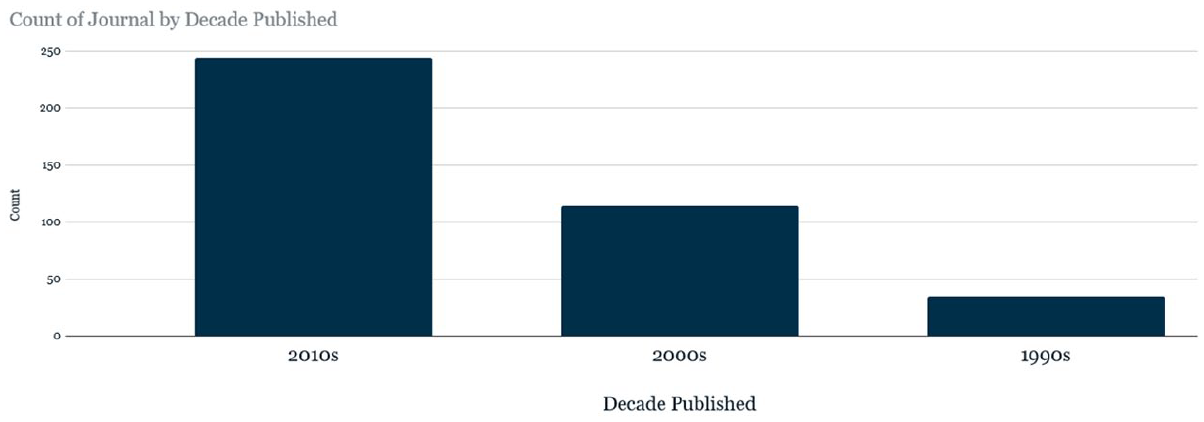
Number of journal articles by decade.
The social positions of authors in Philippine migration research
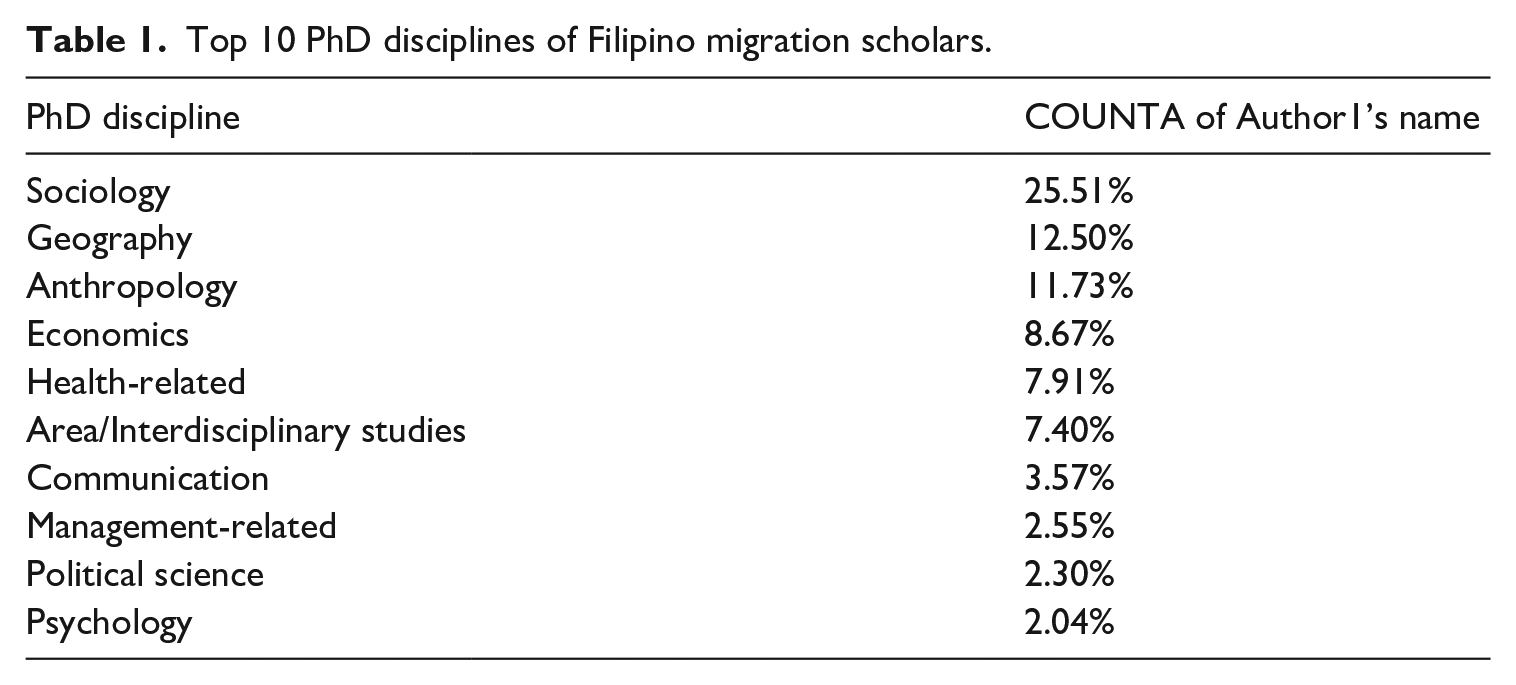
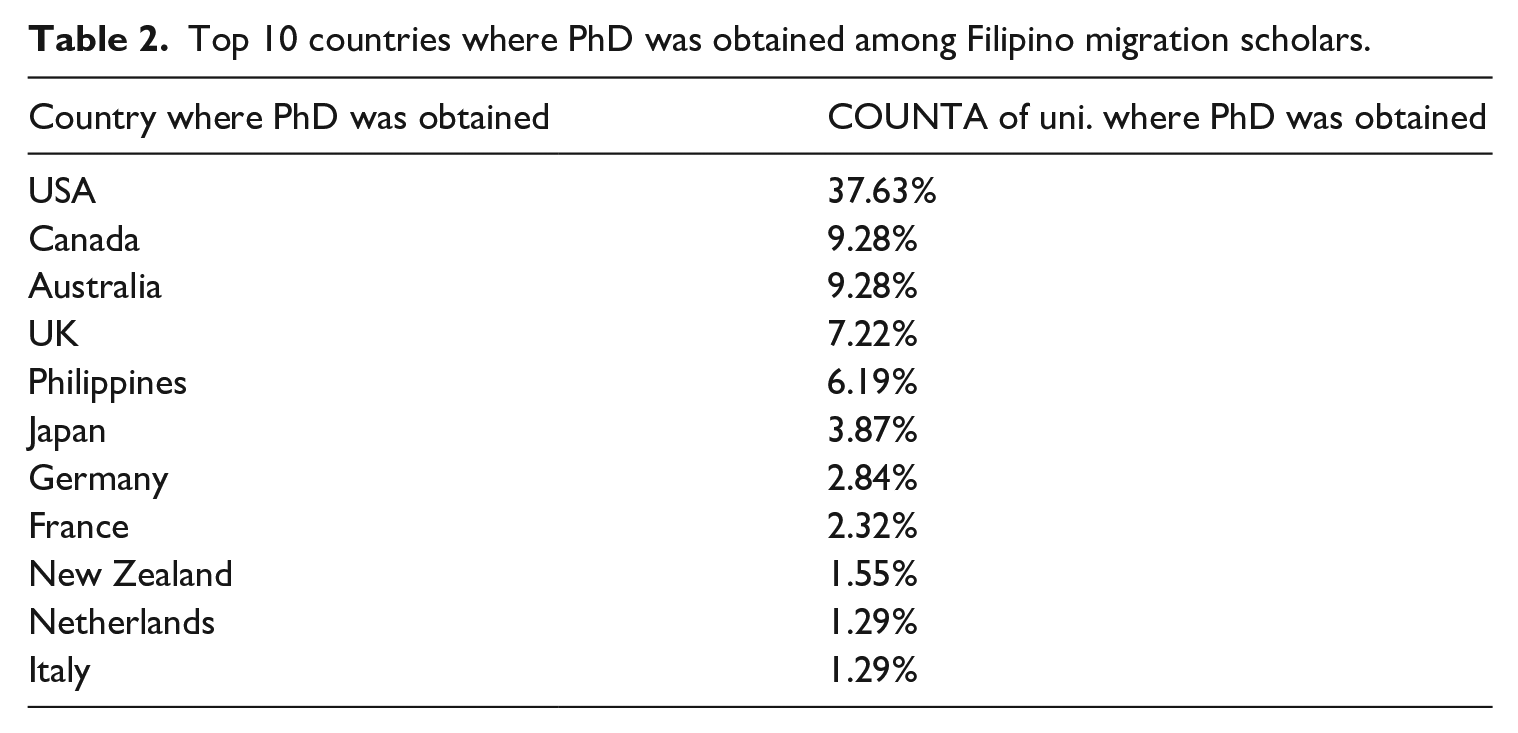
In terms of disciplinary background, a quarter of Filipino migration scholars have a PhD in sociology (see Table 1). Sociology is followed by geography (12%), anthropology (12%), economics (9%), health-related fields (8%), area or interdisciplinary studies (7%), communication (4%), management-related fields (3%), political science (2%), and psychology (2%). A plurality of authors obtained their PhD in the USA (37%) (see Table 2). Canada and Australia followed far behind (9% each), then the UK (7%), Philippines (6%), Japan (4%), Germany (3%), France (2%), New Zealand (2%), the Netherlands (1%), and Italy (1%).
Top 10 PhD disciplines of Filipino migration scholars.
Top 10 countries where PhD was obtained among Filipino migration scholars.
The data (see Table 3) show an enormous disparity in publications according to the authors’ social positions, with the country of affiliation and ethnicity as key factors in these variations. Authors from the Philippines represent a peripheral share of only 16% of these publications, while most (83.7%) are from authors with affiliations in universities and research institutions outside the country – 38% of which are in North America, 19% in Europe, 14% in Asia outside the Philippines, and 12% in Australia.
Social positions of sole/first authors according to ethnicity and continent of affiliation (top panel); and according to ethnicity and country of affiliation (bottom panel).
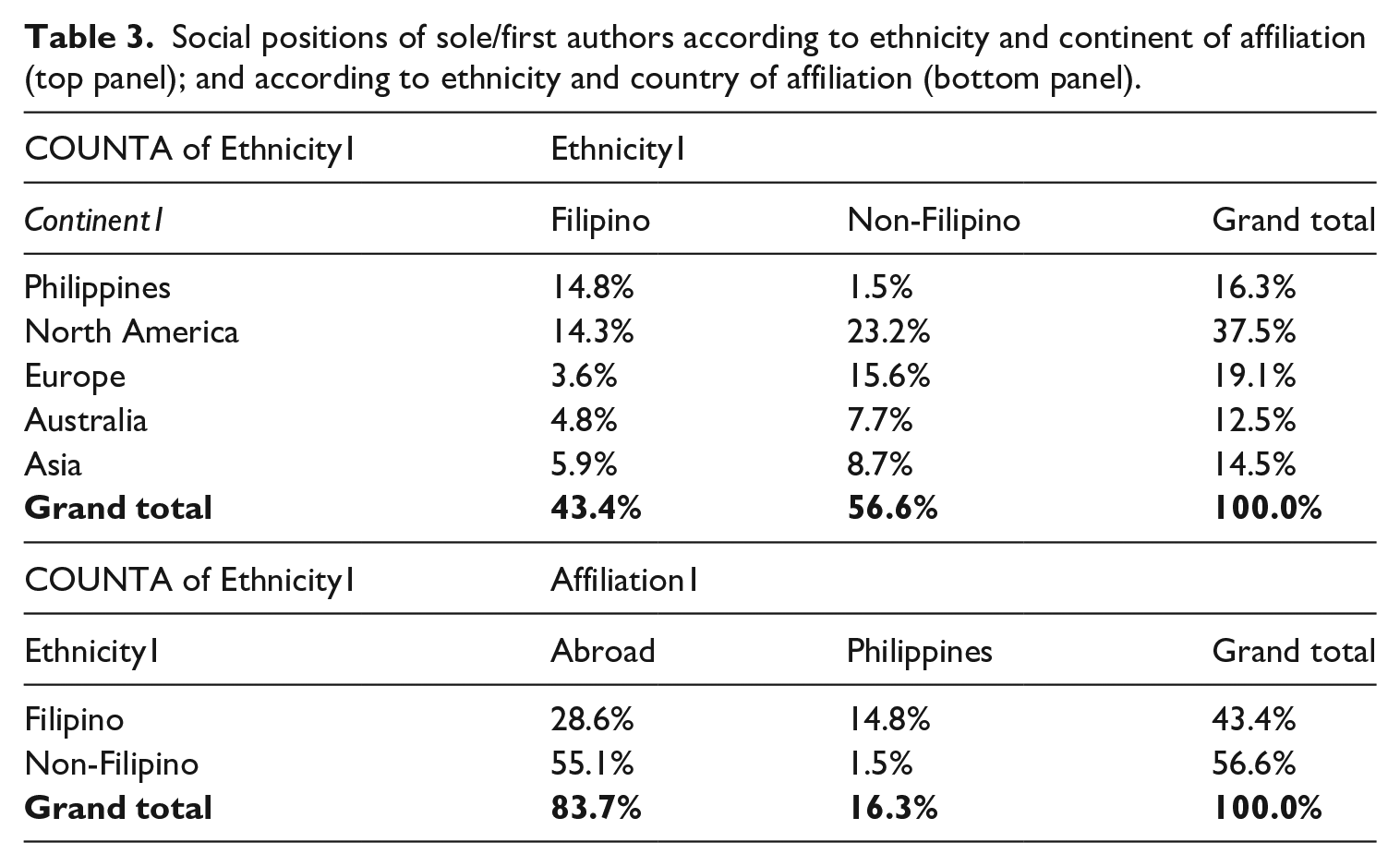
The authors’ ethnicities are uncovered in this project, as many of these authors based in the Global North are Filipinos. By unpacking ethnicity, the data show that the inequality in academic knowledge production on Filipino migration declines. The data present a good picture for Filipino scholars – that almost half (43%) of the published articles were authored by Filipino scholars. It lifts the Filipinos’ publication record, although it is not included in official reports. Overseas Filipinos published twice as much (28%) as those in the Philippines (14%).
Social positions in selected journals
In the analysis, I include the top 11 journals that most frequently publish articles on Filipino migration, as well as how authors’ ethnicities and affiliations are positioned in the distribution of publications in these journals. These 11 journals are listed in Table 4, which also presents the journals’ SJR or Scimago Journal Rank. SJR is a measure of ‘quality’ and impact factor of a journal from the Scopus database (Falagas et al., 2008).
Distribution of top 11 journals that most frequently published Filipino migration articles, and the journals’ Scimago Journal Rankings (SJR).
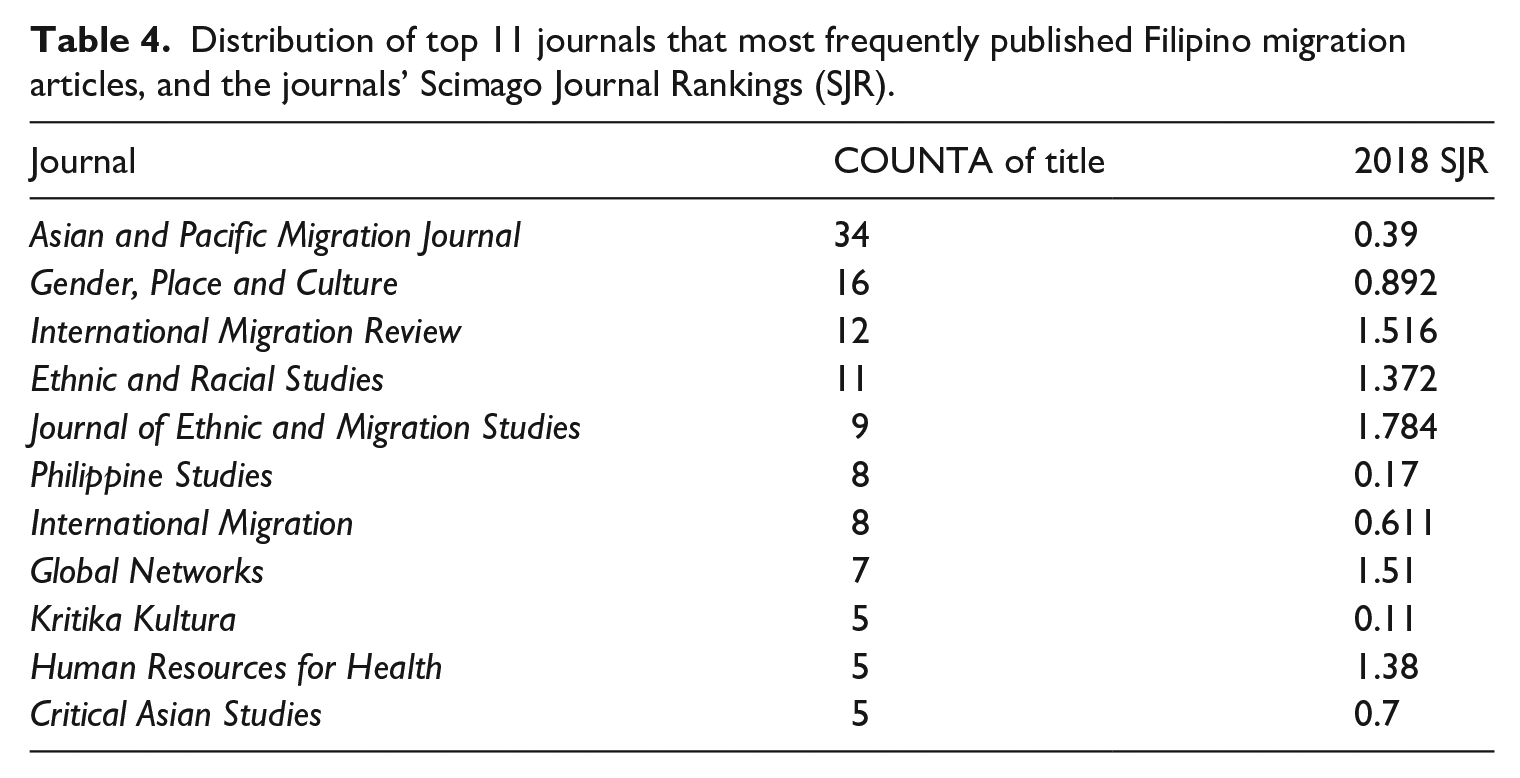
Almost a third (30%) of the 392 articles are published in these 11 journals, which include leading journals in migration, such as the Journal of Ethnic and Migration Studies (JEMS), International Migration Review (IMR), and International Migration (IM). Other leading journals in the Scimago Journal Rank for demography are on this list: Gender, Place and Culture (GPC) and Ethnic and Racial Studies (ERS). Global Networks (GN) is another prestigious journal under social sciences as are Human Resources for Health (HRH) and Critical Asian Studies (CAS) under geography planning and development and public health, environmental and occupational health, respectively. Publishing 9% of all articles in this review, the Asian and Pacific Migration Journal (APMJ) is the most frequently used journal by the authors to publish their works. This is because of its appropriate regional focus on Asia, and it is more accessible being a Philippine-based publication.
Concerning the authors’ positionality in these publications, Table 5 shows that homeland-based Filipino authors are absent in more prestigious journals identified earlier, except in IM and HRH with 33% and 25% representations, respectively. None of the homeland-based Filipino authors have published in more popular migration journals with a higher SJR, such as JEMS, IMR, GPC, ERS, and GN.
Distribution of sole/first author’s ethnicity and affiliation in each of the 11 journals that have the largest numbers of articles on Filipino migration.
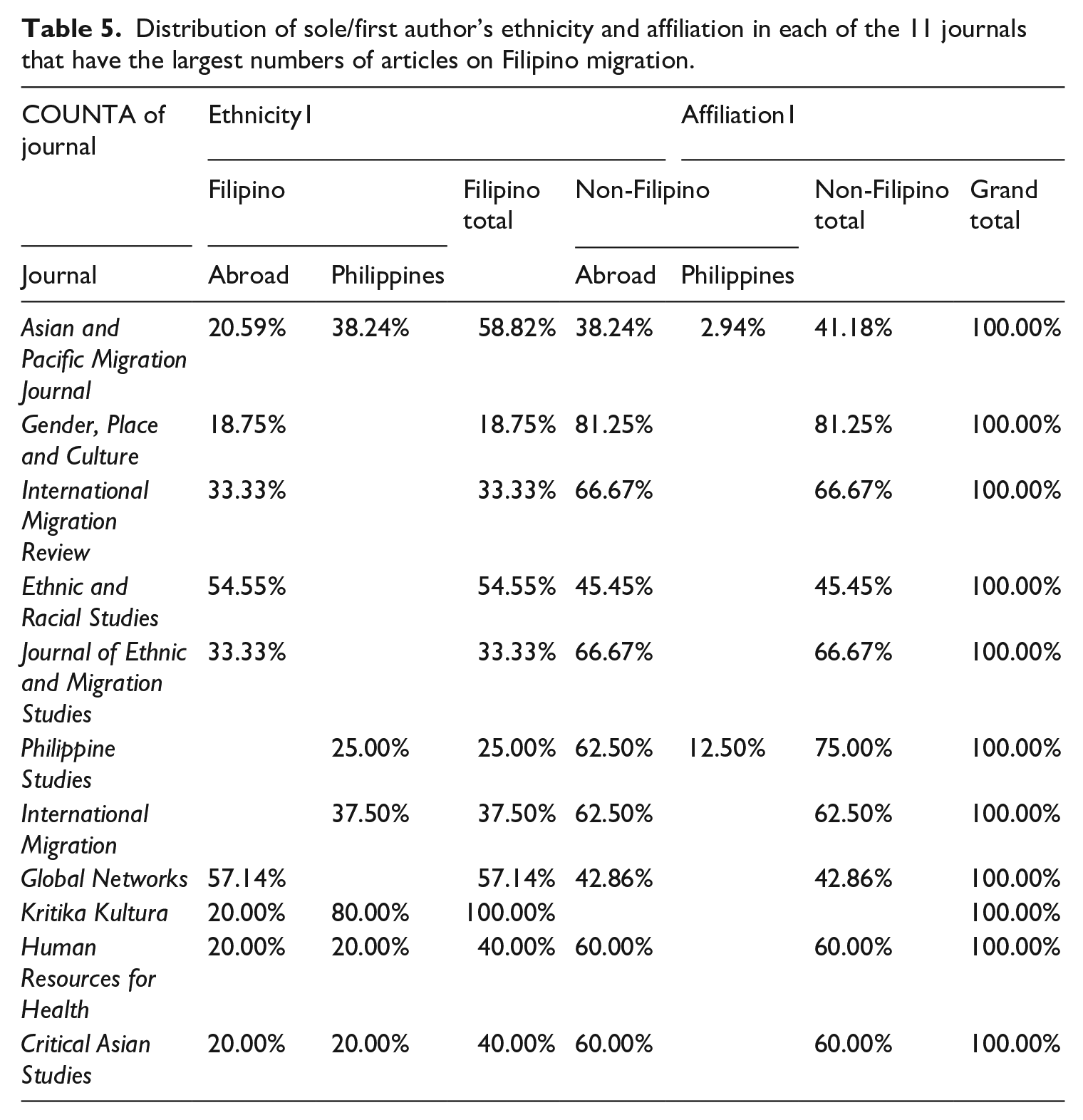
From the data, it appears that the higher the impact factor, the lower the homeland-based Filipino authors’ representation. In contrast, they have a higher representation in lower SJR-rated journals, specifically the respected Philippine-based journals, such as APMJ, Philippine Studies, and Kultura Kritika.
Overseas Filipino authors perform better in comparison to homeland-based Filipinos in terms of their publications in migration journals with higher SJR (0.89 and higher). However, overseas Filipinos have yet to perform as well as other nationalities combined. Compared to other nationalities, overseas Filipino authors represent about a quarter of related articles in GPC (18.8% versus 81.3%), a third in IMR (33.32% versus 66.7%), and a third in JEMS (33.3% versus 66.7%). On the other hand, overseas Filipinos have slightly higher representations than other nationalities in GN (57.1% versus 42.9%) and ERS (54.5% versus 45.5%).
Authors and their scholarly influence
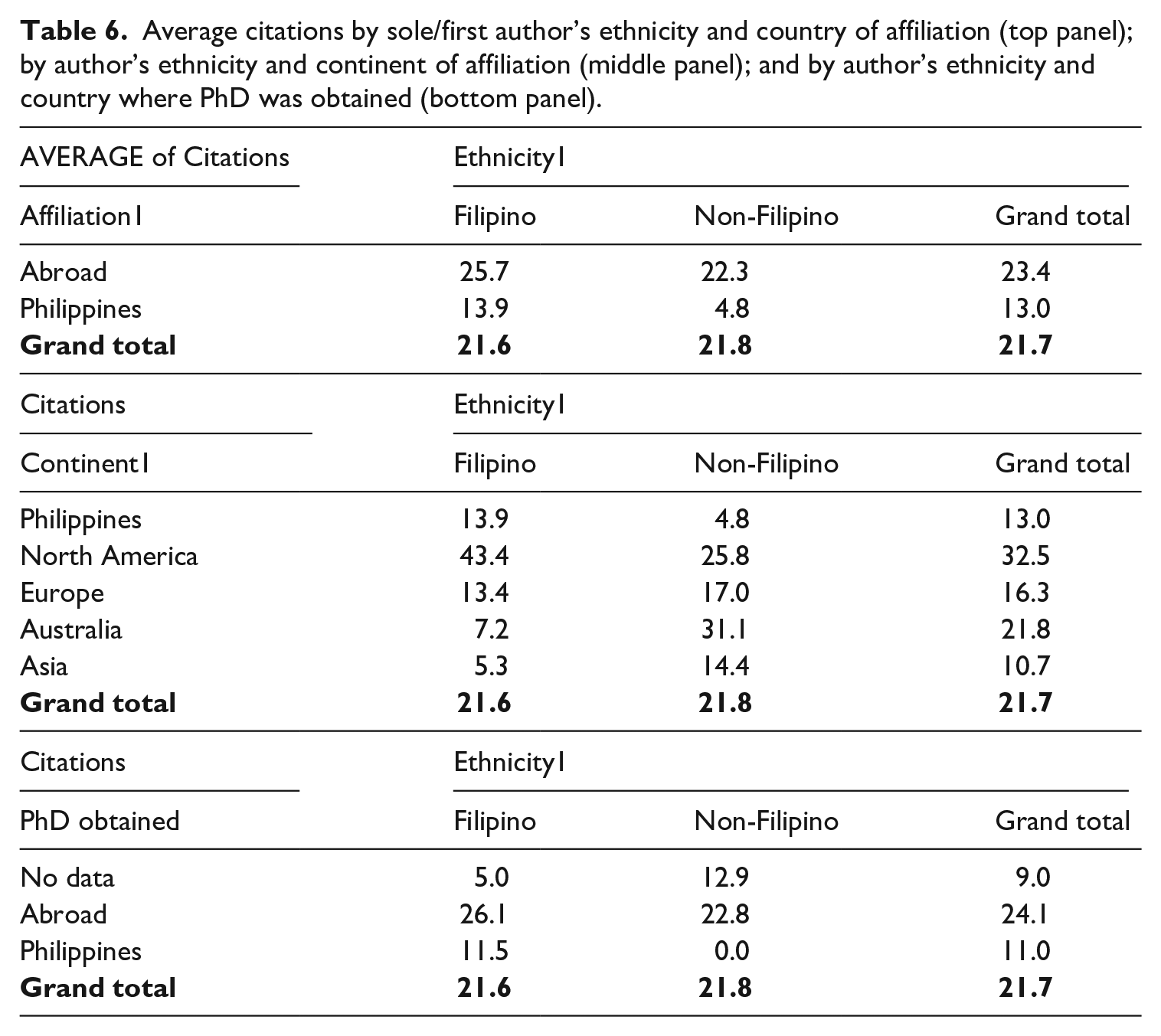
Citation measures ‘scholarly influence’ – a form of recognition, as well as a proxy for the author’s human capital for doing quality research (Ravallion and Wagstaff, 2011). Table 6 presents the average number of citations by ethnicity and institutional affiliations (country and continent). Overall, Filipinos and non-Filipinos have the same number of average citations at 22. Authors based outside the Philippines have almost twice the number of citations (23) than Philippine-based authors (14 citations). Filipinos abroad receive the highest citations (26) compared to any category. More concretely, Filipino authors in North America have the highest average citations: 43. Regarding the university where authors obtained their PhD, Filipino authors with a PhD from outside the country had the highest average citations (26), a similar pattern to institutional affiliation. They are followed by non-Filipino authors abroad (23), and Philippine-trained Filipino scholars (12).
Average citations by sole/first author’s ethnicity and country of affiliation (top panel); by author’s ethnicity and continent of affiliation (middle panel); and by author’s ethnicity and country where PhD was obtained (bottom panel).
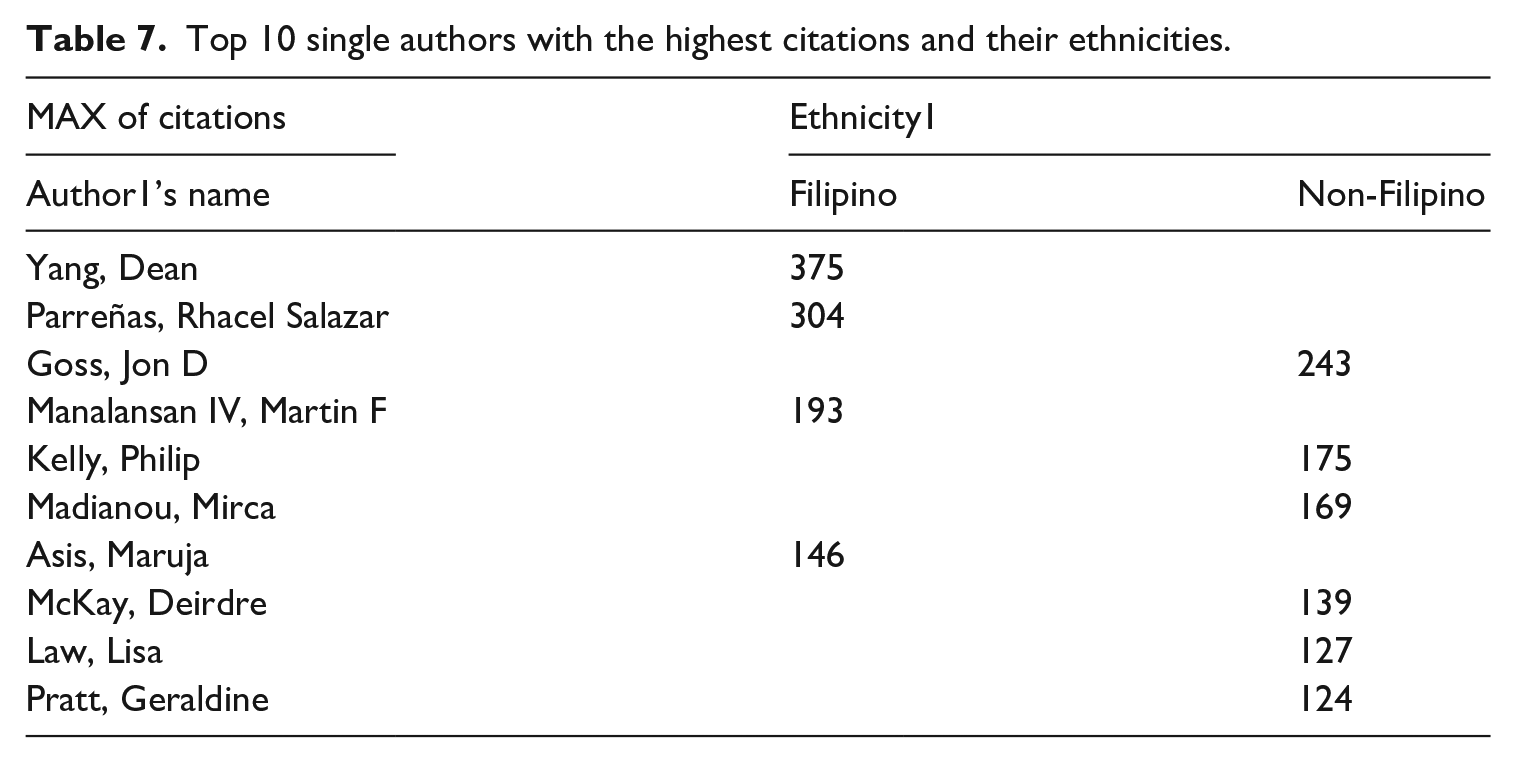
I also examined the top 10 single authors with the highest citations (Tables 7 and 8). Four of the 10 authors are Filipinos. First, second, and fourth places are taken by Filipinos who are affiliated to US universities: Dean Yang (375 citations), Rhacel Salazar Parreñas (304), and Martin F Manalansan IV (193). Seventh in the list is Maruja Asis (146 citations), a Filipino with a Philippine-based affiliation. The other six are classified as non-Filipinos. Third, fifth and tenth are affiliated in North America: Jon D Goss (243 citations), Philip Kelly (175), and Geraldine Pratt (124). Sixth is Mirca Madianou (169 citations) from Europe, and seventh and eighth are Australian-based authors Deirdre McKay (139) and Lisa Law (127), respectively.
Top 10 single authors with the highest citations and their ethnicities.
Top 10 single authors with the highest citations and the continents where their institutions are located.
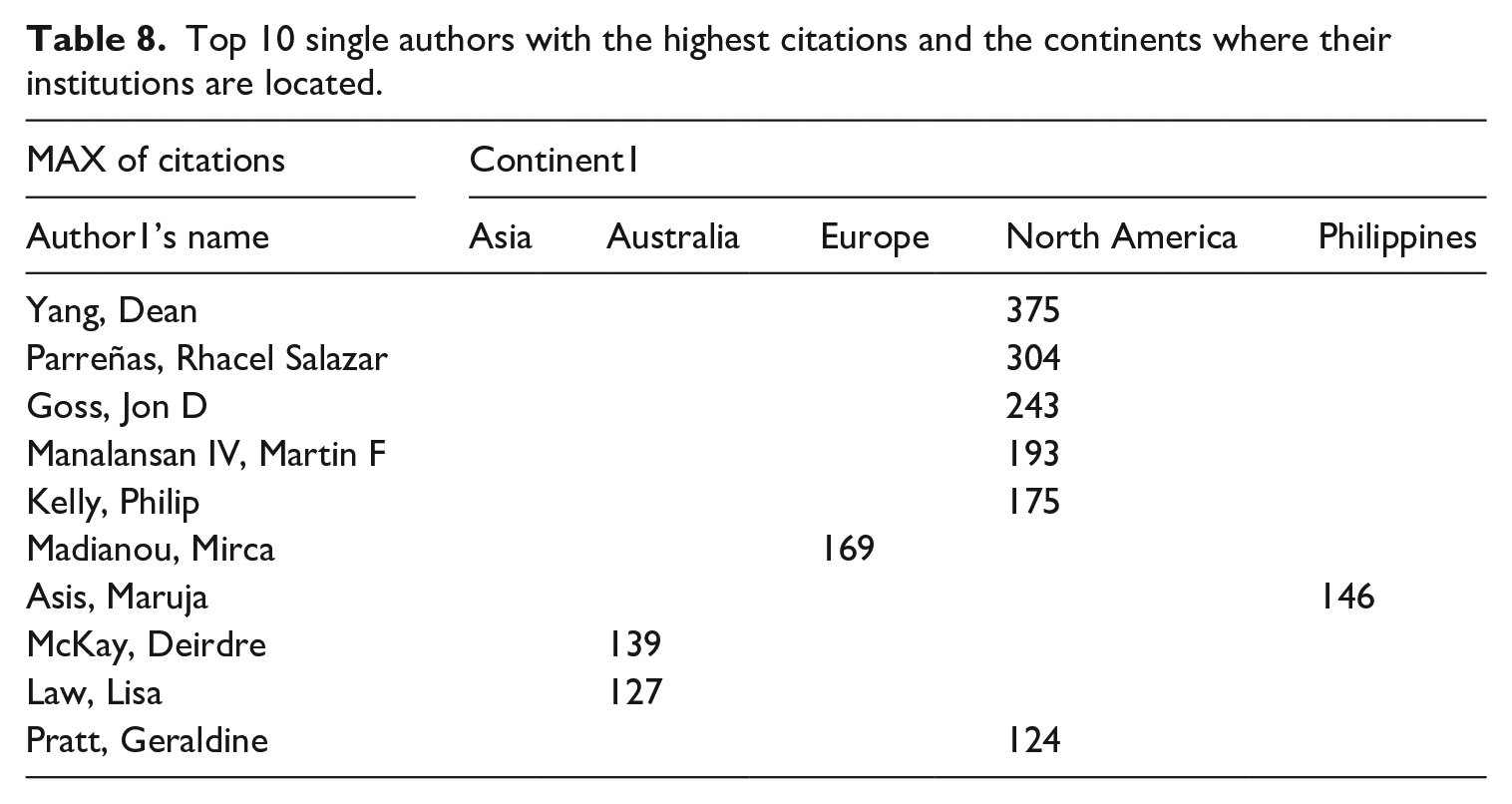
The top five highly cited authors are all affiliated to academic institutions in North America: Dean Yang, Rhacel Parreñas, Jon Goss, Martin Manalansan IV, and Philip Kelly. Four of them are based in the United States, while one – Philip Kelly – is based in Canada.
Discussion
Inequality in publishing
While most studies on international hierarchy in academic publishing are based on specific academic disciplines (i.e. Kong and Qian, 2019; Mearsheimer, 2016; Meriläinen et al., 2008), this is an interdisciplinary field of migration whose subjects are Filipinos or the Philippine state. In terms of the distribution of journal articles in this study, not one region or continent comprises a majority of publications, unlike in the literature that shows a pattern of Anglo-American dominance. The hegemony of the ‘foreign’ is apparent in my findings, in which authors based in more economically developed countries combined constitute most of the publications. However, American hegemony is displayed in scholarly influence, in which the five most cited authors are all affiliated to North American institutions.
The study finds enormous inequality in the distribution of published articles and their influence, based on the authors’ ethnicity and institutional affiliation. These inequalities are manifested in the (1) distribution of articles published in all journals, (2) prestigious migration-related journals, and (3) scholarly influence through citations. Authors affiliated in institutions outside the Philippines at the time of publication dominate the field of Filipino international migration scholarship. In contrast, homeland-based Filipinos are positioned in the periphery of knowledge production. While the author’s ethnic identity is frequently invisible in publications data, when uncovered, it presents a contradictory picture of solidarity and inequality between homeland-based and overseas Filipino authors. Overseas Filipino authors, whose institutional affiliations are in their host countries, performed remarkably, representing twice the publications count as their counterparts at ‘home’ – unofficially raising the overall Filipino contribution to 43% of all articles published. In more prestigious journals, Philippine-based authors are absent in all but one, while overseas Filipinos are better represented, although not as well as other nationalities. In terms of scholarly influence, however, Filipinos are on a par with other nationalities; in particular, overseas Filipinos receive higher citation numbers compared to all other nationalities combined, with US-affiliated Filipino scholars obtaining the highest citations compared to any other country of affiliation. In sharp contrast, Philippine-based authors have half the citations of authors outside the country.
These findings suggest that Filipino migration scholarship comprises of multiple and geographically foreign voices from various regions in the Global North, inadvertently inclusive of ethnic Filipinos affiliated in these regions, and with a plurality from North America. The ambivalent contribution of overseas Filipinos complicates Filipinos’ position vis-a-vis other nationalities in the international hierarchy of knowledge production. While overseas Filipinos raise the overall Filipino representation in the scholarship, theirs is a camouflaged contribution without an institutional basis, as their work is registered under the academic institutions in the Global North. Based on institutional publishing record, overseas Filipino author is not a category; official records only show the author’s institutional affiliation and country. Going by official count, overseas Filipinos’ publications record is counted based on their institutional affiliations in specific countries.
Insider–outsider positionality in academic publishing
Three relevant categories of scholars emerge in the analysis: homeland-based Filipinos, overseas Filipinos, and non-Filipinos based outside the Philippines. I situate the positionality of these three categories along three areas in the publishing field: (1) all journals, (2) leading migration-related journals, and (3) scholarly influence through citations (Table 9). While non-Filipino scholars constantly keep their position as insiders, Filipino scholars have shifting positionality along these areas. Overseas Filipino scholars have hybrid positionality in terms of publication count in all and leading journals, whereas they have insider positionality in scholarly influence having garnered the highest number of citations. Homeland-based Filipino scholars have hybrid positionality in publication count in all journals and citation number. This type of hybrid positionality leans towards the outside but with ‘insider moments’ (May, 2014) as many of these scholars were educated abroad, published, and had citations. However, they are outsiders from the highly restricted leading journals.
Situating the positionality of migration scholars in the publishing field.
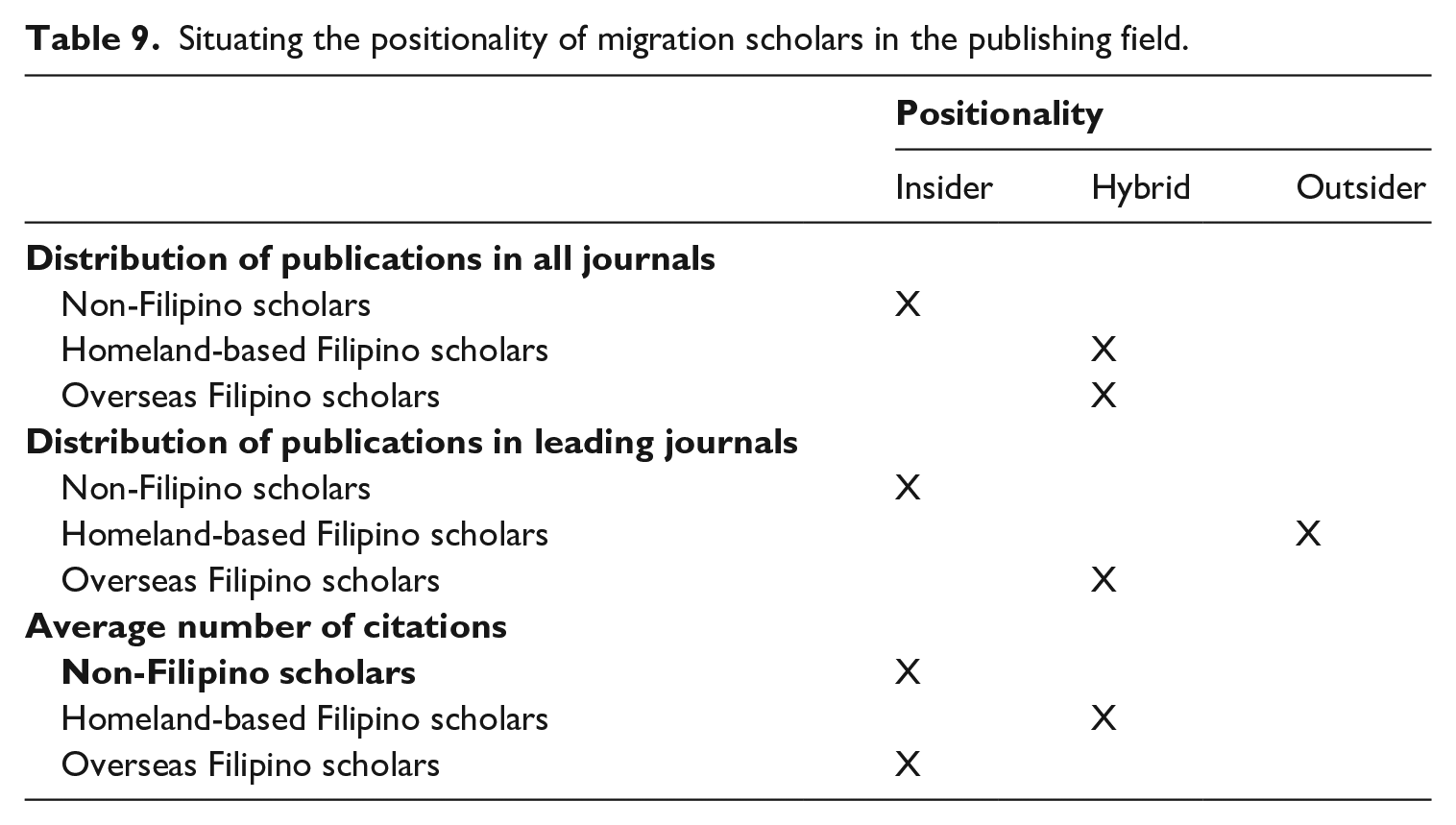
Homeland-based Filipinos represent the peripheral scholars who have outsider and hybrid positionalities in the dominant publishing culture. Peripheral scholars’ poor or absent representations in reputable international journals have been widely reported in the literature. In Bourdieu’s terms, the homeland-based Filipino migration scholars belong to the dominated class in knowledge production. They have poor representation in publication count. The social structure and cognitive structure constrain them from having their work accepted in leading migration journals, as Philippine-based works are frequently considered ‘subjugated knowledges’ (Foucault, 1980): low-ranking and disqualified from prestigious platforms. It also manifests the Philippines’ peripheral status in the world system, exporting humans as raw materials for knowledge production as it cannot fully develop human capital. At the cognitive structure, they do not have the insider’s habitus.
The ‘non-Filipino’ authors outside the Philippines have insider positionality. Based on the authors’ image-checks, they are mostly Caucasians and light-skinned Asians, affiliated to institutions in the Global North (if not in the core region), consistent with Filipino migrant presence in these countries. Most of them come from English-speaking countries, and they belong to universities with good publications performance.
The overseas Filipino scholars have hybrid positionality. In a sense, they are outsiders because of their ethnicity, but they are also insiders because of their institutional affiliations and PhD degrees from more developed countries. I emphasize hybrid positionality because it manifests how position and positioning work. It involves the shifting of positionality towards dominant agents using cultural capital. I deem that the overseas Filipino scholars’ success is due to their hybrid positionality which leans more towards the inside than outside. They inhabit Collins’s (1999) ‘outsider within’ and Lamont’s (2009) ‘insider and outsider’.
The overseas Filipino scholars share many of the differentiating capacities to publish with citizens of the Global North affiliated in research institutions. The cultural capital of overseas Filipino scholars consists of that which they have accumulated from the past, as well as present opportunities their institutions provide. Accumulated cultural capital is built up through the years and includes the ‘doings’ of their parents, who migrated to the developed world before their birth or during their childhood. Parental migration is an investment in ‘institutionalized cultural capital’ (Bourdieu, 1986), the profits of which are experienced by the second-generation Filipinos who subsequently acquire the habitus of the society where they are situated. These may include a native-level mastery of English, a PhD from a relatively prestigious university, and a globally northern cultural orientation or habitus that prepares them to have an insider’s view of the globally northern world, including their dominant ways of knowing, writing, and publishing. Even scholars on a temporary stay in these countries for their graduate studies and/or postdoctoral work may capture this secondary habitus. Regardless of their biographies, their acquisition of institutional affiliation in relatively prestigious universities is an outcome of cultural capital.
In addition, affiliation in research institutions in North America, Western Europe, Australia, and selected countries in Asia positions them in rigorous academic scholarship through various forms of institutional support. With significantly less teaching and administrative load compared to homeland-based Filipino scholars, overseas Filipino academics have more time for research work. They also have access to the literature, research assistance, and equipment. Their environment is conducive to idea generation and development through informal conversations, seminars, and workshops within and outside the university.
When overseas Filipino scholars submit manuscripts for publication in their chosen journal, these papers are already of high quality in form and substance, passing several rounds of consultation, discussion, and public presentation. In addition, their previous works on the topic inform their current project, so that the longer they are in academic work, the easier it becomes to publish. When institutionalized cultural capital is converted to social capital, it leads to favorable reviews of their submitted manuscripts, even with the double-blind review system in place. Repeated publication in a certain field makes the author’s identity visible to reviewers who are familiar with the field of study. A scholar with an established reputation in the academic community is difficult to reject.
In addition, a manuscript is likely to be accepted by anonymous reviewers if it complies not only with the published instructions to authors but also to the unwritten rules in publishing in high-impact journals. These rules include situating the context of the paper within the interest of northern, English-speaking readers (e.g. Meriläinen et al., 2008); framing the manuscript from American or European paradigms (e.g. Sharp, 2008); and organizing sentence structure and ideas in a manner acceptable to these select journals (e.g. Canagarajah, 1996). In Bourdieusian terms, these culturally exclusionary practices demonstrate intentionality to reproduce the dominant scholars’ interests in the Global North.
Conclusion
This article has broadened the conception of positionality and used it in a Bourdieusian analysis of inequality in the publishing field, where ‘insiders’ define the terms of the game that restrict outsider access. Insider–outsider positionality helps explain the unequal distribution of academic publications. It also showcases the ‘locus of struggle’ in the field depicted in agents’ outside-to-inside mobility through cultural capital, thereby gaining an insider’s disposition that facilitates success in publishing. The explication of insider–outsider positionality in the publishing field is my theoretical contribution to Bourdieu’s work on the social reproduction of inequality and the agents’ maneuvering for mobility.
The case study on Filipino international migration scholarship is an empirical contribution to this field. The experience of overseas Filipino scholars is an exemplar of outsider-to-insider positionality in publishing. My study implies that while the system of publishing inequality is always ruled by core countries represented by their most reputable research universities, peripheral scholars can enter this system through affiliation to these universities as PhD students and later as professors. This takes many years of preparation; sometimes, the outcome is seen in the next generation.
My data on homeland-based Filipino scholars are consistent with the literature showing peripheral scholars’ limited representation in publications. It may remain this way for a long time. There are, however, numerous institutional actions of Philippine universities to develop their faculty members’ cultural capital. Among these initiatives include developing (sending faculty overseas for their PhD) and retaining talents and inviting Filipino overseas scholars to return to the country. There have been developments in enticing Filipino scholars to work collaboratively, present in international conferences, and publish in high-impact journals through monetary incentives, promotion, and light teaching load. While the Philippines lags behind its Southeast Asian neighbors in publication outputs, institutionally supported investments in cultural capital are geared towards better performance on the horizon.
Footnotes
Acknowledgements
I would like to extend my gratitude to the blind reviewers for recommending the publication of this manuscript, and more particularly to the first reviewer whose suggestions contributed significantly to the improvement of the article. Special thanks as well to Bubbles Asor, Dennis Erasga, and Delfo Canceran for sharing their candid thoughts, and to Wilaine Dy, Samuel Heinrich, and Sophie Heinrich for their research assistance.
Funding
This study was made possible through the Review Article Grant of the University Research Coordination Office of De La Salle University.
